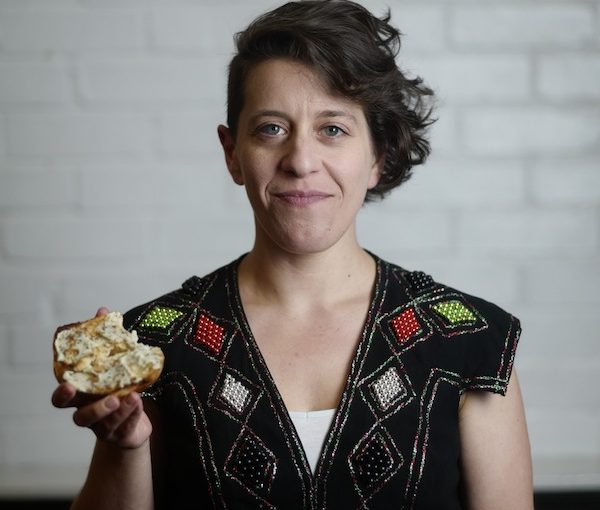
Tamara Micner performs her one-woman play Holocaust Brunch this weekend at Chutzpah! (photo by Sophie le Roux)
“In recent years,” playwright Tamara Micner told the Independent, “I feel there’s been increasing discussion about inherited trauma in indigenous communities and in other minority communities, such as Japanese- and Chinese-Canadian communities. For me, it’s been valuable to remember that, sadly, we as Jews are not alone in inheriting collective trauma. In fact, I also know white, Christian Canadians who have it, too. The tsures we carry is unique in some ways, but we’re definitely in good company.”
Micner, who now lives in London, England, will be returning home to Vancouver for a couple of weeks to perform her new one-woman show, Holocaust Brunch, at the Chutzpah! Festival. It is one of two theatre works that will see their Canadian première at this year’s festival; the other is The Diary of Anne Frank LatinX, directed by Stan Zimmerman, who is based in Los Angeles.
While The Diary of Anne Frank was mounted by Fighting Chance Productions last year (jewishindependent.ca/glimpse-of-life-in-the-annex), Zimmerman’s production features only Latinx actors. This is what makes this version of the play – written by Frances Goodrich and Albert Hackett Based and adapted by Wendy Kesselman – unique.
“I chose to use Latinx actors for the characters in the attic,” Zimmerman told the Independent, “after seeing a CNN report about a Jewish woman in L.A. who arranged to hide a Latina mom and her daughters after her husband was suddenly deported by ICE [U.S. Immigration and Customs Enforcement].
“Contrary to initial media reports – that went worldwide – we are not replacing the Nazis with ICE agents [in the play]. We are performing a word-for-word production of the script that Natalie Portman starred in on Broadway in 1997. I’m not saying the situation is exactly the same as the Second World War, but there are parallels – parallels that we can hopefully learn from. Only then can we live by Elie Wiesel’s famous phrase, ‘Never again.’”
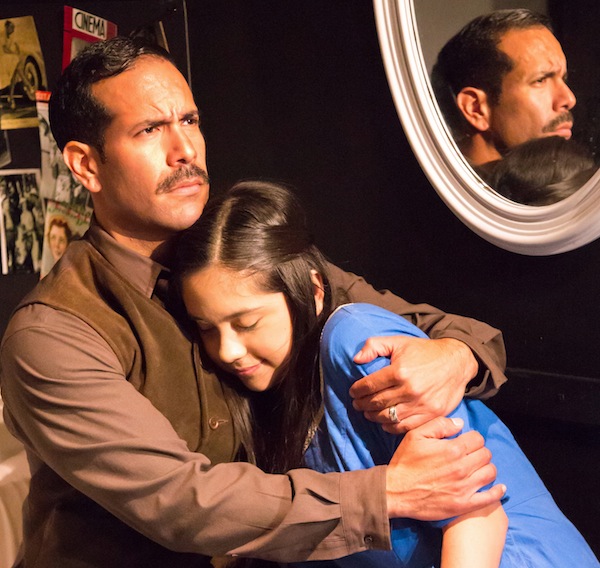
Emiliano Torres and Genesis Ochoa in The Diary of Anne Frank LatinX, which will be at Chutzpah! Nov. 6-9. (photo by Elvira Barjau)
Some Jewish community members were concerned about Zimmerman’s casting choice.
“Initially,” he said, “I had a few Jewish friends question my decision to cast Latinx actors in the play. For them, it was more about not wanting to tarnish the legacy of Anne Frank. But, when they saw that we were honouring her memory, they understood the power of this production. I took to heart the insightful words of a young Anne Frank from her diary – ‘Our lives are all different, and yet the same.’”
The concept of “different yet the same” is one of the reasons that Micner was interested in telling the stories of Bluma and Isaac Tischler, who have both passed away. Born in Poland, they “met in medical school in Tajikistan during the war, and went on to become renowned Vancouver doctors.”
“I have known the Tischler family since 1987, when their daughter Yael and I did What Do I Do When I’m Two? together at the JCC,” said Micner, referring to a program at the Jewish Community Centre of Greater Vancouver. “Our parents and grandparents have also known each other for many years.”
That said, Micner explored some of her gaps in understanding, through creating Holocaust Brunch.
“Growing up,” she said, “I felt there was a disconnect between ‘the Holocaust story’ I was taught, which focused on Western Europe and camps, and my own family’s story, which was about living in Eastern Europe (Poland) and surviving the war in the Soviet Union. The Tischlers’ story has those parallels as well, and it feels important to me to talk about a kind of Holocaust story that I haven’t seen told in wider culture, and that some non-Jews I know have never even heard.”
Micner is no stranger to writing plays based on people she knows.
“I have created shows in the past that are inspired by my own family,” she said. “Holocaust Brunch is partly about another family’s story, and started with the Tischlers offering me part of their family’s story to tell in a piece of theatre. I take that offer very seriously as an act of trust and a responsibility, as the creator and performer of the piece. We’ve had several conversations along the way about the central questions and themes of the piece as it has taken shape, and they have seen the show as it has evolved.”
One of the central aspects of the work is looking at trauma from a third-generation perspective.
“I am indeed part of the ‘third generation,’ and Holocaust Brunch explores what it’s like living as a descendant of Holocaust survivors, two generations removed from that history and trauma,” said Micner. “It’s certainly based on some of my experiences and, inevitably, incorporates aspects of other people’s experiences based on conversations I’ve been part of, books and articles I’ve read, and so on. There are many of us who are thinking and talking about these issues.”
In contrast, Zimmerman witnessed a lack of discussion and knowledge about the Holocaust and, specifically, The Diary of Anne Frank.
“I was quite shocked,” he said, “when the 15-year-old actor playing Anne told us that she did not know who Anne Frank was before auditioning for our production. As a Jew, I grew mad to learn that Anne’s diary is no longer required reading in the California school system. I decided then that it was vital to get as many student groups as possible to see this play, with this cast.”
And it hasn’t been only the cast and audiences who have learned something from the play.
“Although I was a good student at my temple’s Sunday school,” said Zimmerman, “being involved in this play opened my eyes to so many stories about the Holocaust that I never knew before. These important lessons were gained by visits to several museums and meeting many survivors and hearing their stories firsthand.”
He added, “As many of our survivors pass, it is important for us as artists to find creative ways to keep Anne’s story alive.”
One of the ways in which Micner creatively tells her story is with humour. Describing Holocaust Brunch as a “dark comedy,” Micner explained, “I think there’s a history of Ashkenazi Jews using comedy to look at hard things – the oppression we’ve suffered, displacement, antisemitism, poverty and so on. Holocaust Brunch is certainly engaging with that tradition,” she said. “I think there’s also a history of Ashkenazi humour being self-deprecating – as in, making fun of ourselves – and, one of the things I’ve been interested in, is looking at where that comes from and what it would mean for us not to be the butt of our own jokes. Holocaust Brunch is using comedy to look at communal trauma, and how we might be able to heal from that. The show also uses humour to explore stereotypes and assumptions that some non-Jews have about Jews. I think laughter helps us open up and look at hard places.”
For his part, Zimmerman would like audiences who come to see The Diary of Anne Frank LatinX “to feel like they literally stepped into the shoes of these characters – just like the actors have. Then we can all have this highly emotional and very visceral experience that can only be achieved communally with live theatre.”
Holocaust Brunch runs this weekend in the JCCGV’s Wosk Auditorium, Oct. 27, 1 p.m., and Oct. 28, 7 p.m. The Diary of Anne Frank LatinX, co-presented with Howard Blank of Point Blank Productions, is at the Rothstein Theatre Nov. 6, 8 p.m.; Nov. 7, 8 p.m.; Nov. 8, 1 p.m. and 8 p.m.; and Nov. 9, 2 p.m. For tickets to these and other Chutzpah! shows, visit chutzpahfestival.com.
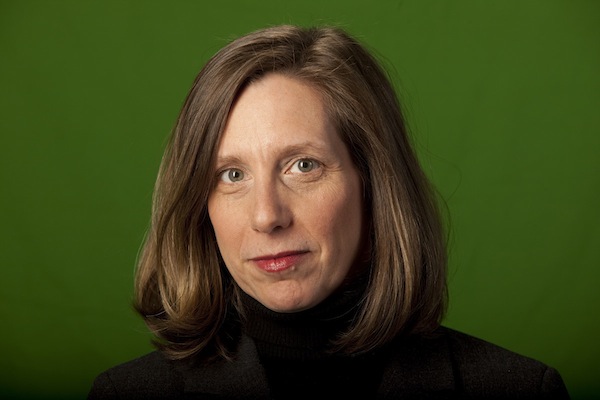
Marsha Lederman (photo by John Lehmann/Globe and Mail)
A few years ago, Marsha Lederman went with her mother, two sisters and a cousin on the adult portion of the March of the Living, which included a walk between the two main camps of the Auschwitz-Birkenau complex.
“The march from Auschwitz to Birkenau was somber and sorrowful, but it was also so empowering,” she recalled at the annual High Holidays Cemetery Service at Schara Tzedeck Cemetery in New Westminster Oct. 6. “We were marching with a statement to the world and a comforting message to the souls whose lives had ended so brutally on those grounds: ‘We are here, we are still living, we are multiplying, we remember you.’”
The family group proceeded to Radom, the town outside Warsaw where Lederman’s mother had grown up. The man who lived in the apartment where she had lived allowed them in and Lederman’s mother recounted her family’s years there.
“It was joyous,” Lederman said. “We were still on a high when we visited the memorial for the Radom Jews killed in the Holocaust. As I recall, it was in a fairly large square and seemed a little neglected. We were looking at this lonely memorial, the five of us women, when a group of, I would say, teenage boys began chanting something nearby. I don’t speak Polish, so I couldn’t understand what they were saying. But I did understand one thing: ‘Auschwitz-Birkenau.’ I don’t think they were offering their condolences.”
She reflected on the way she responded in that moment.
“We hurried away and said nothing. It was a safe thing to do, for sure. But, if that happened to me today, I would not walk away. I am done with walking away. Would I have put us in danger if I had turned around and confronted those boys? Maybe. But I know now that the real danger is in remaining silent.”
Lederman is the Vancouver-based Western arts correspondent for the Globe and Mail. Her father was born in Lodz, Poland, on erev Yom Kippur 1919. Her mother was born in Radom, Poland, in 1925. All four of their parents were killed in gas chambers at Auschwitz and Treblinka, as was Lederman’s father’s sister and little brother, and her mother’s little brother.
Lederman’s parents met in Germany after liberation and had one daughter there before moving to Canada, where they had two more daughters.
Lederman reflected on recent antisemitic incidents in North America and Europe, as well as her own encounters with antisemitism and racism, including a harrowing verbal attack on an Asian woman on the Skytrain at rush-hour, an incident in which Lederman was the only person to intervene.
“We have a duty to speak up,” she said. “We have a responsibility. This is our inheritance. I never had a bubbe or zadie to hug me or spoil me on my birthday or cook chicken soup for me. There’s nothing in my home that was theirs. I did not receive a single heirloom. But I did receive an inheritance – a duty to protect others from hate…. That is my inheritance and that is their legacy. Enough. Never again.”
She recalled being stunned during an interview with famed Vancouver photographer Fred Herzog, who died last month. Chatting after the main interview, Lederman asked the German-Canadian if he had experienced anti-German sentiment when he arrived here after the war. He launched into a discourse on the “so-called Holocaust” and said Jews died in the camps mostly because of lice and because Allied bombings prevented food from getting to them. Lederman agonized over whether to expose the admired photographer, eventually writing the story, for which she has been subjected to a range of criticism.
“Well, I have had enough,” she said. “And I’m going to fight to tell those stories and expose antisemitism and Holocaust denial and racism. I am not going to be quiet anymore. I think of all that was lost in the gas chambers; all the lives, of course, but also all the potential. With those millions of lives extinguished, what was lost with them? Poems were never written, beautiful artworks that were never painted, the cure for cancer, for Parkinson’s, the answer to the climate crisis?
“It was not just the people who were murdered that the world lost. It was all of their descendants and all of their descendants and all of that potential.… I talk about this because of what this leaves on our shoulders. I interviewed a Nisga’a poet, Jordan Abel, and he used a term to describe himself that I have adopted. He calls himself an intergenerational survivor of residential schools, which makes me an intergenerational survivor of Auschwitz. I do not take this lightly. With my parents’ survival came a hefty responsibility on me and on all of us who are descendants.”
At the service, Jack Micner, who led the ceremony and is also a member of the second generation, outlined a litany of antisemitic incidents and comments in Europe and North America in recent weeks.
“I suspect that those of our parents resting here in this cemetery would be furious to see what’s going on across the world,” he said. “We have to continue doing the type of work that VHEC [Vancouver Holocaust Education Centre] is doing in as many ways as we can think … it falls on us, because nobody’s going to do it for us.”
Rabbi Shlomo Estrin reflected on the loss of Chassidic communities during the Holocaust. Cantor Yaacov Orzech chanted El Maleh Rachamim.
Names were read of community members who have passed since the last High Holidays and a moment of silence was observed for the six million.
The Mourner’s Kaddish was recited by Jeremy Berger, a grandson of a Holocaust survivor. After the service ended, the Mourner’s Kaddish was also recited at the Holocaust Memorial in the cemetery.
The annual event is presented by the Vancouver Holocaust Education Centre with Congregation Schara Tzedeck and the Jewish War Veterans, and with support from the Jewish Community Foundation of Greater Vancouver.
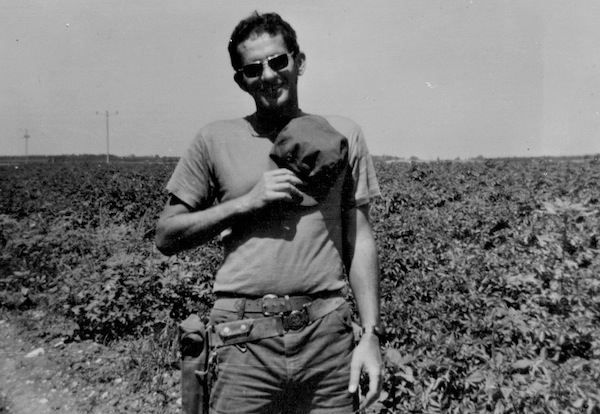
Patroling the kibbutz perimeter. (photo from Victor Neuman)
In this eight-part series, the author recounts his life in Israel around the time of the 1973 Yom Kippur War. The events and people described are real but, for reasons of privacy, the names are fictitious.
Part 5: Night Guard Duty on the Kibbutz
Lev, the banana boss, was in his early 30s and a miracle worker. He was back on the kibbutz and strolling toward me. He had talked the army into releasing him so he could save his banana fields. I was not surprised he had pulled it off. Lev was originally from the United States and a dedicated Zionist. He had long ago concluded that the only proper place for a Jew was in Israel and so he immigrated. Always determined in what he wanted, he bulldozed his way through kibbutz apprehensions to single-handedly create the banana crop as a major branch of our agricultural sector. And he was fearless to a fault.
“Fearless to a fault” may sound like a contradiction. It’s not. The right amount of fearlessness is courage. The wrong amount is stupidity. In my opinion, Lev was sometimes at the wrong end of that equation. Here’s an example.
Before the war, Lev was fed up with the theft from our banana fields and had no confidence that the village police from the nearby Arab town would take any action. The culprits were likely from the town and might even have been relatives of the cops. I had to agree with Lev – the only time I had seen any action from these police was when they drove up to the kibbutz to extort chickens for their next village wedding.
One day, Lev had six of us arm ourselves with clubs and do a stakeout in the banana fields. We had a German Shepherd named Ledie to help take down anyone we caught. Before long, two Arab teenagers appeared, checking for ripe bananas. They came toward where I was hiding. I jumped up but I had moved too early and they raced for their village. Only Lev, the dog and I were near enough to give chase. It was a farce. The teens were lean and fast. Lev smoked two packs a day. Our dog was never trained to be aggressive and was an older dog as well. So, it was the two teenagers way in front, me next, Lev a distant fourth and the dog in last place – tail wagging madly the whole time. I gave up and stopped, but Lev ran past me and yelled, “Come on!”
By the time we arrived at the village, the two thieves had vanished and our dog also had disappeared, likely returning to the kibbutz. I wanted to go back, too, but Lev wasn’t done and I couldn’t leave him on his own. Like a gunslinger minus the gun, he walked us right into the first building we came to. It was some kind of coffee house, full of locals sitting at tables sipping their drinks. All conversation and sipping ceased when we barged in. They all stared at us. I felt like I was in a bad Spaghetti Western. I was convinced Lev was going to get us killed.
Lev stomped around, demanding to know if anybody had seen the two boys. Heads were shaking. Not satisfied, he gave a description of what they looked like and the clothes they were wearing. Heads kept shaking. He then demanded that everybody keep an eye out for these banana thieves and report them to our kibbutz. To my astonishment, heads nodded. I think we had caught them by surprise and then Lev’s pure chutzpah had won the day. Walking out in one piece was a win for me, while Lev was angry at not catching anybody; surviving was not one of his concerns.
Now you know what I mean by “fearless to a fault.” And now, here was fearless-to-a-fault Lev walking up to me.
“Shalom, Victor. I’m back so I’ll be taking over the irrigation. I wanted to keep you on it, but Gidon says he needs you for guard duty. You better see him. And thanks for looking after the bananas. I expected half of them to be dead but they are all good. Nice job.”
High praise from Lev, who rarely expressed gratitude to anybody. The bananas were like children to him and I was the babysitter who, surprisingly, hadn’t murdered any.
Gidon told me I was to patrol the kibbutz from dusk to dawn for the next week at least. He gave me an ammunition belt, a flashlight and a first-aid kit with pressure bandages to patch up anybody I shot inappropriately. He also gave me Chauncy, the English guy. Chauncy was one of those hapless tourist volunteers who came to experience kibbutz life and was experiencing more than he bargained for. Though he wasn’t Jewish, he gamely agreed to be my assistant on patrol.
Our first patrol had a slow start. Chauncy begged me to let him hold the Uzi long enough to get his picture taken. I didn’t want to, but figured it would be better to get it out of his system. I removed the ammunition clip and handed him the Uzi. He gave me his camera and I took a half-dozen pictures of him, empty gun at the ready, looking steely-eyed and staring into the dark. I was thinking he was an idiot but then remembered the photos I had made Tamar take when I first got my weapon. She thought I was an idiot. Israelis would never think of getting this kind of snapshot, as Canadians wouldn’t think of getting their picture taken in their kitchen holding a spatula. Why record it? In this country, everybody has a spatula.
We walked the perimeter for about a week. Early evening was the best, as kibbutz members stopped to chat and the time went quickly. Adding to our duties was the requirement that we join others in checking cars that were coming up the driveway and searching them for bombs. I was particularly happy to intercept the village police who had come on another of their chicken runs. We made them get out of their car and stand around while we did a thorough, very slow check of their vehicle. The chicken-stealing cops were not nearly as annoyed as I had hoped. I was thinking we’d need to do a strip search next time.
As the night wore on, everybody went to sleep and it was just Chauncy and I walking the perimeter. As per Gidon’s instructions, we didn’t go to the dining hall to scrounge for food and thus take ourselves away from our rounds. We carried our lunches and ate under the security lights. I was always conscious of how dark it was beyond the reach of those lights and how impossible it would be to see anyone coming. On the other hand, Chauncy and I, walking directly under the lights, were highly visible from far away.
It became a nagging question in my mind as to how effective night guard duty was when Chauncy and I were always in plain view while the bad guys were always hidden. I confronted Gidon about it one day and his reply was, “When you are shot, it will alert the rest of the kibbutz.” I wished he had had a grin on his face, but he didn’t. I was just thankful he hadn’t ended with “Are we understanding?” We were not.
I never told Chauncy about that conversation but I think he detected my increased wariness. A certain morbidity came over me. In trying to come to terms with the possibility of death, I tried to control the fear by embracing the notion. I decided one night we would have our meal in the kibbutz cemetery. Chauncy was freaked but I put it to him that the dead were dead and gone. Also, I argued, the headstones made good back rests for eating in comfort. To pass the time, I read the Hebrew on some of the stones; the easiest part to grasp being the date of death and age of the departed. Many were in their 20s and had died in 1948, likely in the War of Independence. They were close to my age and Chauncy’s. It made me think of how endless the fighting was in this land. The dead of one war pondered by participants in another, with two other conflicts in between. We only had lunch in the cemetery that one time.
I never had to shoot anybody during my stint as night guard but I did come close once. Chauncy and I were in the area of the mechanical shop at around two in the morning when we heard noises coming from the shop and saw the lights were on. The kibbutz was generally very quiet at night. There was no shift work besides guard duty so everyone should have been in bed.
I told Chauncy to stay behind me as we entered the shop to investigate. For the first time in all my guard duty, I slid the thumb switch of my Uzi from safety to automatic.
Chauncy whispered, “Jesus!”
We got as close to the noise as we could and then I stepped around a corner with my Uzi leveled.
It was a kibbutz teenager named Uri. Apparently, Uri had a bout of insomnia and decided he might as well go to the shop and keep working on his project. He was trying to make a go-kart out of discarded tractor parts. Uri had almost gotten a permanent cure for his sleeplessness. I had almost shot a 15-year-old kid.
Victor Neumanwas born in the former Soviet Union, where his family sought refuge after fleeing Poland during the Second World War. The family immigrated to Canada in 1948 and Neuman grew up in the Greater Vancouver area. He attended the University of British Columbia and obtained a BA and MA with majors in English literature and creative writing. Between 1968 and 1974, he made two trips to Israel, one of which landed him on a kibbutz at the time of the 1973 Yom Kippur war. Upon his return to Canada, he studied Survey Technology at BCIT and went on to a career of designing highways for the Province of British Columbia and the firm of Binnie Civil Engineering Consultants. When he retired, he reconnected with his roots in creative writing and began writing scripts for Vancouver Jewish Folk Choir concerts and articles for the Jewish Independent. Neuman and his wife, Tammy, live in southeast Vancouver and enjoy the company of friends, their extensive extended family and their four sons.
During the Yom Kippur War, the author had to learn how to fire an Uzi and other weapons. (photo by Victor Neuman)
In this eight-part series, the author recounts his life in Israel around the time of the 1973 Yom Kippur War. The events and people described are real but, for reasons of privacy, the names are fictitious.
Part 4: Training Day
We were two or three days into the war and the news was chilling. Egypt had overrun the defences along the Suez Canal and was pouring into the Sinai. Syria had breached the outposts in the Golan and was within striking distance of Tiberias. We were in shock to think that, a scant six years after the pummeling of the Six Day War, these countries were able to go to war again.
I think the nation was in disbelief as well. Soldiers, in large numbers, had been sent home to observe Yom Kippur with their families. The government had effectively demobilized much of the Israel Defence Forces prior to the attack. The trust in Moshe Dayan and Golda Meir would never be the same.
At first, the response of the average Israeli was cocky. Tamar thought the attack was stupid. “We beat them in six days … now it will be five.” Then, as the news came in, the optimism vanished. Kibbutzniks came around to ask me if I was tuned in to the BBC. They didn’t trust the government to give them the truth of what was going on. It was wartime after all and, at such times, every involved government lies through its teeth. There was not much to listen to, though. Everything was so sudden that the international news services hadn’t caught up with what was going on.
Then Gidon came by. The next day, I was to receive weapons training along with three other volunteers who had just enough Hebrew to say “Halt! Who goes there? Who are you? Stop or I’ll shoot.” The basic wartime jabber.
I don’t recall ever being asked if I wanted to join the fight. As a candidate for kibbutz membership, it was a given that I would step up and do anything required to help. And so it was. This was now my home and these people were my family. Not doing everything I could was never a question in my mind. But, truth be told, to me the fighting seemed far away and unreal and I had no real sense of personal danger. More oblivious than brave might be the way to put it.
Next day, the four of us and Gidon met in a field behind the kibbutz. Gidon had set up a target that consisted of a plywood board on two metal rods that were banged into the ground. There was a rise behind the target to stop the bullets from straying. On a table to the side, he had weapons. There was an Uzi, a bipod sniper rifle and three Second World War relics. Gidon apologized for the older guns, saying they were there just to give us the hang of things and he expected we would have better weapons soon. But, first, he addressed us with a sombre face.
“As you know, our kibbutz is located on Wadi Ara. This valley connects the West Bank territories to the coast of Israel. The military tells me that, if Jordan enters the war and opens a third front, there is a good chance they will come right down Wadi Ara and we are the first Israeli settlement past the West Bank. If that happens, I am told, we have to hold out for six days without help from the army. They are fully occupied in the Golan and the Sinai and will not be able to help us until they have solved their problems over there. Are we understanding?”
“We are,” we all said, a little unenthusiastically. I was thinking, “Worst pep talk ever, Gidon!”
Then came the practice shooting and I learned stuff that no graduate in English literature needed to know.
When sniping with a rifle, lie flat with elbows well anchored. The right leg should be extended back in a line with your rifle and your body to absorb the shock of the recoil. Your left leg is splayed out to the left for stability. Don’t breathe, take aim and squeeze the trigger. Our accuracy was rough, then better. But my main recollection is the kick of those rifles. We were basically lying in fine dirt and, when the round went off, the force pushed our whole body two or three inches backwards. The movement after every shot caused a small cloud of dust to rise up around us and we had to wait a moment before we could see well enough to shoot again.
An Uzi has 32 rounds in its clip. The sliding switch by your thumb has three positions: safety, single shot and automatic. Gidon told us to forget about the first two positions. In battle, you had to be quick. You had to be in automatic mode and learn to shoot from the hip without aiming. The dumbest thing you could do was to hold the trigger down. Doing that would empty your clip in three seconds and the recoil would twist your arm and body up and to the right. Gidon taught us that we had to squeeze off short bursts of around three rounds, see where they hit and adjust accordingly.
Our shooting with the Uzi was fairly awful. Shooting from the hip is really tricky. There were puffs of dust halfway up the hill behind the target, in the dirt just metres in front of us, way off to the left and right of where we were trying to aim. I thought the safest place to be on that range was standing in front of the target.
I had a little better luck than the rest. High with the first burst. Low with the second. Then I adjusted again and hit the target with a burst that knocked the whole thing over.
That evening, Gidon marched us into one of the bomb shelters and gave us all our assigned Uzis. Then he showed us how to disassemble them. We had to disassemble and reassemble our Uzis over and over again until we could do it in a matter of seconds. We were feeling pretty good about ourselves until suddenly Gidon turned off the lights and we had to do the whole thing in pitch dark. A bomb shelter, of course, has no windows. So, when the lights are out, you might as well be spelunking in the world’s deepest cave. We eventually learned to do it using only our sense of touch.
Training ended and so did my date nights in the banana fields with Tamar. She was needed elsewhere and I was approved for carrying a weapon, so I was on my own for going out to the fields at night and dealing with the irrigation. A scary business. Alone in the dark, banana trees making the fields look like a jungle, shadows everywhere and the possibility of infiltrators from the West Bank. I felt like I never breathed until I was in the Willis, job done and heading back to the kibbutz. Back at the kibbutz, I signed in to prove I was still alive. Sometimes I even looked at my own signature to make sure.
When I returned to our flat at 2 a.m., Tamar would be fast asleep. In another world, my girlfriend would leap out of bed and throw her arms around me, overjoyed at my safe return. Tamar would half-waken and say, “Shalom, shalom sweetie,” then go back to sleep. And I understood. It wasn’t that she didn’t care about me. This was Israel. The Yom Kippur War was not their first rodeo.
Victor Neumanwas born in the former Soviet Union, where his family sought refuge after fleeing Poland during the Second World War. The family immigrated to Canada in 1948 and Neuman grew up in the Greater Vancouver area. He attended the University of British Columbia and obtained a BA and MA with majors in English literature and creative writing. Between 1968 and 1974, he made two trips to Israel, one of which landed him on a kibbutz at the time of the 1973 Yom Kippur war. Upon his return to Canada, he studied Survey Technology at BCIT and went on to a career of designing highways for the Province of British Columbia. When he retired, he reconnected with his roots in creative writing and began writing scripts for Vancouver Jewish Folk Choir concerts and articles for the Jewish Independent. Neuman and his wife, Tammy, live in southeast Vancouver and enjoy the company of friends, their extensive extended family and their four sons.
Tamar on a visit to Canada. (photo from Victor Neuman)
In this eight-part series, the author recounts his life in Israel around the time of the 1973 Yom Kippur War. The events and people described are real but, for reasons of privacy, the names are fictitious.
Part 3: Dating, Israeli Style
After our kibbutz commander, Gidon, had given everybody their marching orders, Tamar and I went back to her flat and started hanging black plastic on all the windows. It was late afternoon. Darkness was on its way and it was going to be our first night of wartime blackout. I didn’t bother hanging plastic in the shack I was originally assigned. Days before the war, Tamar and I had begun living together at her place. I got the girl of my dreams and a room upgrade all at the same time.
As a kibbutz volunteer from abroad, I was on the lowest rung of the accommodation ladder. All such volunteers were given a room of their own but it was in a sreef (shack), which was no more than an old wooden cabin left over from the first days of the kibbutz. These were the slap-dash shacks occupied by the kibbutz founders, intended for shelter only until the kibbutz was able to get on its feet. Once crops were sold and the money was flowing, housing was built out of concrete and tile. Who got into the new units was purely a matter of seniority. You could hold the highest position in the hierarchy (kibbutz secretary) but you’d still live in a shack until it was your turn to upgrade.
Our kibbutz had around 250 members and all the members had newer homes that were on the small side, but clean, solid and agreeable. None of them had a tub. Too much of a waste of water and space. Instead, there were narrow-stall kerosene showers for those who preferred not to use the communal hot showers down the path. Tamar had one of these. You would start a kerosene fire at the base of the water tank and go away for 20 minutes while your water heated. Then you’d come back, turn off the kerosene and enjoy your three minutes of hot water. If you wanted to push it, you could leave the kerosene burner on while you showered and squeeze a couple of more minutes out of the hot water supply. There was a down side to that, however. Though the burner was screened from the shower water, things could go wrong. During one of my showers, water got into my kerosene burner. It overflowed and I had the disconcerting experience of washing my upper end while flaming drops of kerosene landed around my feet.
The evening we were hanging the black plastic, Lev, the banana boss, came by to tell me he was being called up to the war and I would have to do everything I could to maintain irrigation on my own. The rains hadn’t come yet and the bananas wouldn’t recover if an irrigation cycle was skipped. He was going to try to get an exemption from the army on the grounds that the all-important banana crop stood in danger of being devastated in his absence, but he was not sure if it would come through. It wasn’t a cop-out. It was true. Lev was a banana guru and he was single-handedly responsible for the establishment of the kibbutz’s most important cash crop. Without him, there was nobody to be the banana whisperer and make the damn things thrive the way he did. I could do irrigation on my own but, for the rest, I always looked to Lev for direction.
Irrigation was done around the clock. With several fields to supply and only enough pressure for one field at a time, I would have to be changing taps, cleaning filters and dumping fertilizer at various times of day and night. I would have to catnap between sessions and try to be awake enough to stay on top of the schedule. I told Lev I could do it and he went away satisfied. Tamar looked at me as if I was crazy to agree but she was an Israeli, she understood. Then Lev came back and told me I could use the Willis and I was much happier. The jeep would get me to the fields a lot faster than the tractor. More time to rest. More time to sleep.
But not that night. The war was edging closer to our ordinary lives and, all night long, vehicles of all kinds were coming and going. There was the noise of a truck pulling up, the sound of boots pounding past our window, loud voices giving orders, the truck driving away, then silence. The same sequence repeated over and over again.
By morning, the kibbutz wasn’t the same place. All our trucks and buses were gone and so were all the young men and some of the young women. Why not all the young women? Because, while the Israeli army gave weapons training to both sexes, there were still some traditional attitudes toward women in war. The women all knew how to handle weapons but, somehow, when push came to shove, they never ended up on the front lines or in tanks or in planes. In war – at that point in time – their duties were confined to nursing, communications and secretarial work. Most of the young women reservists, like Tamar, remained on the kibbutz, along with the older folks. With them was a ragtag bunch of hapless tourist-volunteers wishing they had picked another time to experience life on a kibbutz. And then there was me: a volunteer worker who had become a candidate for kibbutz membership. And now we were running the show.
Gidon dropped by to talk to me.
“Are you going to the fields after dark?” he asked.
“Yes, I have to change the taps.”
“Two things then. First thing. You have to sign out when you leave and sign in when you come back. Second thing. You have no weapons training, so you have to take Tamar with you as your guard. Are we understanding?”
“We are.”
Conversations with Gidon were never anything but straight to the point and businesslike. He never had much of a sense of humour at the best of times and he now had the safety of 250 people in his hands. He felt the weight of it deeply and I wasn’t about to make his job any harder.
The next night, Tamar and I signed ourselves out and headed for the fields. I drove. She sat next to me with her Uzi resting on her lap. When I got to the irrigation pipes, I got out and, in the glare of the jeep’s headlights, I cleaned the filters, dumped sacks of fertilizer into the tanks, reset the flow timers and hopped back into the vehicle. All the while, Tamar kept her weapon at the ready and scanned the shadows of the banana trees for trouble.
There was a beautiful full moon out. A lover’s moon, just for the three of us. A guy, a gal and her Uzi. This was dating, Israeli style.
Victor Neuman was born in the former Soviet Union, where his family sought refuge after fleeing Poland during the Second World War. The family immigrated to Canada in 1948 and Neuman grew up in the Greater Vancouver area. He attended the University of British Columbia and obtained a BA and MA with majors in English literature and creative writing. Between 1968 and 1974, he made two trips to Israel, one of which landed him on a kibbutz at the time of the 1973 Yom Kippur war. Upon his return to Canada, he studied Survey Technology at BCIT and went on to a career of designing highways for the Province of British Columbia. When he retired, he reconnected with his roots in creative writing and began writing scripts for Vancouver Jewish Folk Choir concerts and articles for the Jewish Independent. Neuman and his wife, Tammy, live in southeast Vancouver and enjoy the company of friends, their extensive extended family and their four sons.
The author was in the banana fields, working on the irrigation system, when the war started. (photo from Victor Neuman)
In this eight-part series, the author recounts his life in Israel around the time of the 1973 Yom Kippur War. The events and people described are real but, for reasons of privacy, the names are fictitious.
Part 2: The War Begins
Sometimes, war begins with a whimper and not a bang. It was Oct. 6, 1973. I was back on the kibbutz that I had been on with Suzanne, except Suzanne had never returned from Paris.
I was in the banana fields, working alone on the irrigation system, when I began to feel a strangeness in the air. At first, I couldn’t put my finger on what was different. I was alone – just me and my tractor – but that was nothing new. The bananas were not ready for harvesting, so no one else was supposed to be around. The pruning of new shoots was over with and the stripping of dead leaves had been done a couple of weeks before.
Not being able to determine what was bothering me in that moment, I went back to pondering the meaning of my life. I had been to Israel on a previous trip, spent a year or so on three different kibbutzim, done archeology in the Negev at a site called Tel Beersheva, worked on construction of a chemical pipeline near Arad, gone back to Canada to get my master’s in English literature, and now I was back in Israel, at the age of 28. I still had no clue as to what I wanted to do. Go back to Canada? Teach English at the University of British Columbia? Stay in Israel? Become a member of the kibbutz?
Skewing my thought process was my relationship with a kibbutz Sabra named Tamar. By all I hold dear, Tamar was the most beautiful creature I had ever laid eyes on. When I met her, I was gob-smacked and smitten. When I found out she kept an Uzi in her flat, I was gob-smacked, smitten – and careful. She had become an officer during her two years of military service. On her bookcase, there was a photo of her looking rather sternly at her platoon. They were standing stiffly at attention while she inspected their weapons. Definitely not a gal to be trifled with.
Complicating things more was the fact that Tamar was 26 and the first child born on the kibbutz after it was founded in 1949. She was the darling of the kibbutz and, at the same time, a big concern to everybody. After all, she was already 26 and, by the standards of the day, she was on the cusp of becoming an elderly single. She had a problem common to many kibbutz youths. Who was there to get it on with? Our kibbutz, like many others, had what’s called a beit yeladim (children’s house). All babies that are weaned are taken and put in the children’s house; there, they are raised until they are of high school age. They visit with their parents frequently but, at the end of the day, they return to their communal home to sleep and live. The result is that they grow up feeling that their peers are like their brothers and sisters. Romantic feelings are hard to come by and their best chance of finding a partner is to match up with somebody from outside the kibbutz.
The kibbutzniks liked me. I worked hard. I had a university education. I always volunteered when extra work needed doing and I had applied for membership. Everybody was pulling for me and Tamar. I told my kibbutz friend Aaron that my dating Tamar was still a thing in its early stages. He was having none of it. To make his point more emphatic, he switched to English and called me by my kibbutz nickname, Kanadi. “No, no, no, Kanadi. You marry 26!” It was a romance in a goldfish bowl but I didn’t mind. She was gold to me.
When my mind returned to what was happening in the banana fields, it hit me. The constant hum of traffic on the Afula road was missing. This road was a major corridor just below our fields and it was constantly abuzz with trucks, tractors and cars. Israelis called it the “Ruler Road.” As they put it, “It is straight as any school ruler and it even has a hole in the end – Afula.” (There was never much respect for the town of Afula.) But now the road was silent. I drove the tractor to the top of a hill to get a better look and was surprised to see the road deserted. Something was going on.
Suddenly, there was a horrific racket from above. A helicopter gunship roared overhead, heading straight up the Afula road at just above treetop level. It was so close I could see the barrels of guns bristling from every port on its side. In another second, it was gone. Then, a second gunship barreled through. Same height and same direction. I started to worry.
I hopped on my tractor and booted it back to the kibbutz. Same story all along the way. No traffic on the roads. Nobody working any of the fields. Nobody walking around. Just me. As I drove into the parking lot, the roads and walkways were deserted. It was as if a mysterious virus had devastated the earth and I was the only one left. I was starting to feel like I was living in an episode of The Twilight Zone.
Then, I heard voices coming from the dining hall, so I walked in that direction. When I entered, everyone was there. The voices had dropped off and now there was only one voice dominating. It was Gidon, our designated commander.
Gidon was a recent immigrant and a South African Jew. It never surprised me that he would be in charge of our defence. Every South African immigrant I met in Israel was trained in the military. Not by Israel but by South Africa. The British won the Boer War but the Afrikaners were running the show and they were determined to never let the blacks get the upper hand. It seemed that most South Africans knew one end of a gun from the other, even the many who were disgusted with the brutality of apartheid and had left the country. So, while most Jews immigrating to Israel were novices when it came to the art of war and had to be extensively trained, the South African Jews I met had come prepared.
Gidon’s voice wasn’t the loudest I’d ever heard but, in the hush of that room, it was loud enough. Thankfully, his Hebrew was as far along as mine and I understood everything he said: “… and there will be no more swimming in the pool. The swimming pool is now our emergency drinking water supply. All tractors and vehicles are to be filled up with fuel and oil. All tractors and vehicles are to be scattered around the kibbutz and not parked in one place. The bomb shelters are no longer discothèques. The kids have to clear out all the records, strobe lights and disco stuff.
“Before the day is over, I want white lines painted on all the shelter pathways. We are blacking out the kibbutz and we have to be able to find our way to the shelters in the dark. No lights on after dark in the rooms unless there is black plastic taped to the windows. Patrols by the shomer leila [night guard] around the kibbutz perimeter are to be carried out seriously. I don’t want to hear of any guards hanging out in the kitchen having food and coffee. They can pack their lunches and eat them as they do their rounds. No, we can’t double the patrols. They’ll just end up shooting one another. That is all. We are at war. Are we understanding? Then go do your jobs.”
I looked across the room at Tamar. She looked back and her expression was serious. We were at war.
Victor Neumanwas born in the former Soviet Union, where his family sought refuge after fleeing Poland during the Second World War. The family immigrated to Canada in 1948 and Neuman grew up in the Greater Vancouver area. He attended the University of British Columbia and obtained a BA and MA with majors in English literature and creative writing. Between 1968 and 1974, he made two trips to Israel, one of which landed him on a kibbutz at the time of the 1973 Yom Kippur war. Upon his return to Canada, he studied Survey Technology at BCIT and went on to a career of designing highways for the Province of British Columbia. When he retired, he reconnected with his roots in creative writing and began writing scripts for Vancouver Jewish Folk Choir concerts and articles for the Jewish Independent. Neuman and his wife, Tammy, live in southeast Vancouver and enjoy the company of friends, their extensive extended family and their four sons.
The author took refuge from the perils of the streets by joining a kibbutz as a volunteer. (photo from Victor Neuman)
In this eight-part series, the author recounts his life in Israel around the time of the 1973 Yom Kippur War. The events and people described are real but, for reasons of privacy, the names are fictitious.
Before the War: Part 1
“The bomb shelters can no longer be used as discotheques.”
It was Oct. 6, 1973. Gidon, our kibbutz commander, was announcing that we were under attack and giving us our preparation instructions, including the immediate clearing out of bomb shelters for use in the event of air attack.
Syria had overrun the Golan defences and Egypt was pouring into the Sinai. I was in disbelief over the whole thing. Last year, I was writing my master’s thesis, analyzing Hawthorne’s The Scarlet Letter. Now I could be writing something more like Warfare: A Tourist’s Guide. How had my life gone so abruptly from pondering literature to pondering existence?
There’s an expression Israelis use: “I could sell you.” In other words, you are ripe for the plucking and I could easily take advantage.
When I arrived in Israel on my first trip, in 1968, I was totally pluckable. No knowledge of Hebrew. No knowledge of the country. No tour group guide to protect me. All I had was my curiosity about this country that had recently achieved a stunning victory in the Six Day War. I think that event had caught the attention of many like myself, and there was a huge influx of tourists and volunteers to visit this remarkable place.
I was bought and sold in the streets of Tel Aviv. Simply buying a prickly pear fruit was fraught with fraud.
“One-and-a-half lira please,” the street vendor told me. I paid him and started walking away. Then an Israeli stepped up to the stand.
“One-and-a-half lira please.”
This time, the buyer was having none of it. “Yes, one-and-a-half lira, but you’ll take 75 grush.” Leaving no opportunity for a response, he paid what he wanted and took the fruit. I had just paid double for the same thing.
At another time, I tried to be smarter. I needed to change my German marks into Israeli money. I was aware there was a black market for foreign currency and the street usually offered better rates than the bank. It didn’t take long to find a dealer. They can smell a tourist a mile away. One came up to me asking if I had foreign currency to change. I asked him what rate he was offering for German marks. He gave me a number that sounded pretty good and we agreed on a transaction. I handed over the Deutschmarks – he could have bolted but he was an older guy and I figured I could outrun him if I had to.
He took my money and began counting out Israeli currency. I thought there was something odd about the way he wrapped the money around one finger as he flipped the bills and counted them out to me. Later, when he was long gone, I recounted what he gave me and found I was several bills short. He had flipped the bills so that he had ended up counting the same ones twice and giving me less than we had agreed upon. In the end, I was “sold” again and had even less than I would have gotten at the bank.
You never really lose at these things because they always come with lessons. In most cases, you win some and you learn some. The only time you really lose is when misfortune befalls you and you’re sleeping through class.
I took refuge from the perils of the streets by joining a kibbutz near Haifa as a volunteer. Kibbutzim are basically communal societies where all wealth, housing and equipment are owned by the collective. Material perks like TVs or stereos are doled out on a seniority basis. No one – even those running the place – has any real power over others or more wealth than others. The top jobs are considered something to be avoided. You have all the responsibility and headaches of administering the mess without any particular rewards. In my experience, a kibbutznik generally takes the top job when it is their turn in the rotation and they simply can’t get out of it. Socialism in its purest form and no commissar overlords.
Kibbutz life was good. Nobody tried to rob me and, in return for picking grapefruit and oranges, I got accommodation, food, Hebrew lessons and free tours of the countryside. Sometimes, on my days off, I went further afield.
One of those forays was particularly memorable. My girlfriend, Suzanne, was a kibbutz volunteer from Paris and together we decided to attend Independence Day celebrations in Jerusalem. We booked a hotel room in the Arab quarter of Jerusalem’s Old City and thought about our plans for the evening. The debated options were hanging out in the room or going to the cinema to take in a movie that was a modern American take on Romeo and Juliet. Romance won the day and we left for the movie. The movie was mediocre. Things back at the hotel were less so.
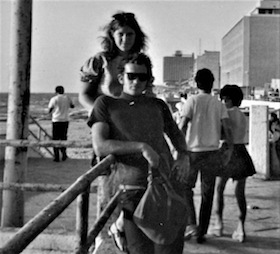
Victor Neuman and his then-girlfriend, Suzanne, in Tel Aviv. (photo from Victor Neuman)
When we got back, we were met by police and the hotel manager. The manager apologized for the inconvenience but we were being moved to another room and could we please collect our luggage from the original room. The sight of our old room was amazing. It was all sparkly. The windows were gone and every horizontal surface was covered with dust. Someone had set off a bomb in the alleyway outside our room.
You might think that a bomb blast would send great shards of glass flying across the room. A blast close by doesn’t. Instead, it pulverizes the glass into a fine dust and that’s what is blown across the room. Objectively speaking, the room looked beautiful – like a fantasy bed chamber decorated in fine diamonds. In reality, we were shaken, as we carefully swept the glass from our bags and began hauling them to our new room on the opposite side of the hotel. It was nice. It had windows.
And the movie? We upgraded its rating from mediocre to fantastic.
Suzanne and I had different travel plans and, after Jerusalem, she traveled to be with friends on a kibbutz north of Hadera. I was concerned that I didn’t have enough money to fly home if the need arose. I was also learning very little Hebrew from the kibbutz we had been on and it was getting annoying needing Suzanne to translate for me wherever we went. When we parted, I headed south to find work in Arad, hoping I could make some serious money and learn Hebrew by some kind of immersion method.
The immersion was profound. I was plunked down in an environment where nobody spoke English. The Arad employment office put me on a crew building a pipeline that would take Dead Sea chemicals to a refinery in Tishlovet. The crew consisted of central European Jews, Israeli Arabs, some local Bedouins and an assortment of thieves, bastards and criminals who were probably one step ahead of an Israeli SWAT team. One of them stole my camera (a beautiful Zeiss Ikon that my father had gifted me) and an assortment of items from all of the crew. We were put up in a motel and, the day the thief quit, he still had the key to the motel room. He made the most of it.
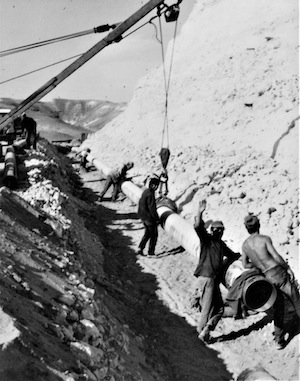
The crew on which the author worked, building a pipeline that would take Dead Sea chemicals to a refinery in Tishlovet. (photo from Victor Neuman)
On the job, I was low man in the pecking order. I had to fetch tools when yelled at and woe to me if I didn’t understand what was being asked for. With this bunch, everybody knew only enough English to swear, and little more. I was sworn at in English, Arabic, Romanian, Hungarian, Polish and Hebrew. It was somewhat typical of what I heard in other parts of the country. Israelis have a knack for adopting the choicest insults from all the languages they encounter. Understandable when you come down to it. Spoken Hebrew was basically invented by linguistic scholars around the time the state was created. They had the difficult task of updating ancient Hebrew to cover things like helicopters and toaster ovens. They didn’t spend a lot of time thinking up swear words. Israelis had to improvise and they did a fine job of it.
The upshot was that, in two months on the pipeline, I learned more Hebrew than in a year of kibbutz Hebrew school. I was getting pretty fluent and I had a good ear for the accent. I began to find that, when I spoke, I was often being mistaken for a Sabra. And, as a bonus, I could swear like a sailor.
* * *
Living in Arad, I now had a decent amount of money rolling in from my work. I decided to take an offer from a guy I’ll call Bad Lennie. Bad Lennie was a South African Jew who had immigrated to Israel with his brother, Good Lennie. Good Lennie lived in one part of Arad with his girlfriend; Bad Lennie had his own apartment. When the two of them were in the same room, I noticed Good Lennie seemed somewhat embarrassed around his brother and often cringed when his brother rambled on about his life in South Africa. In time, I found out that he had good reason to be embarrassed.
Bad Lennie was between jobs and needed money, so he offered me a chance to share his flat if I split the rent with him. I couldn’t pass up the chance to leave behind the den of thieves that were my pipeline crew, so I moved in with Bad Lennie.
Bad Lennie had some disturbing fantasies. He had undergone some military training in his home country. He had a lot of stories to tell me about his time in the military. According to him, he was a top-notch officer in command of hundreds of blacks. His favourite story was of the day one of his men questioned his authority in front of the others. Bad Lennie calmly walked up to the offending black soldier and put a bullet in his head. After that he never had trouble with the others. He told me many stories with pretty much the same theme. The den of thieves was starting to look better to me.
Bad Lennie had a revolver. I found out about it one day when he had this huge grin on his face and told me to feel under his arm. I wanted to pass but he grabbed my hand and stuck it in his armpit.
“What do you think? It’s a gun!” What did I really think? He was wearing a holstered gun under a turtleneck sweater! Not a bad James Bond look except that his turtleneck quick draw was going to need some work. I knew he was an idiot but now I was beginning to wonder how dangerous a one.
Bad Lennie pestered me to get him a job on the pipeline so I did. He lasted three days. On the third day, he came up to me and said, “Watch this.” Then he proceeded to go up to our Arab foreman and swear a blue streak at him in English. He turned back to me with that same stupid grin on his face. “It’s OK. The bugger hasn’t a clue what I’m saying.”
I had been on the pipeline long enough to know different. Everybody in this bunch was fluent in Swearese. Bad Lennie was fired. He still seemed confused about why but he was a goner nevertheless. And his problem became my problem. Bad Lennie was getting half the rent money from me but it was not enough and he started borrowing my money. I saw no chance of getting repaid because Bad Lennie now had no job. He spent most of his time hitting on his brother for money and going to the cinema in Beersheva to watch the latest Western. After coughing up a fair amount of cash, I cut him off. Then he offered to sell me some of his coffee table books on Israel. Truth be told, they were beautiful books but I was still living out of a backpack and couldn’t see myself schlepping all that weight.
I said, “No thanks.” He looked pissed but I didn’t care.
One day, I returned from work and walked through the door of our flat. There was Bad Lennie standing kitty-corner across the room with his gun pointed straight at my head. I just froze. I felt a powerful urge to say something but nothing came to mind. Then he pulled the trigger and there was this loud “snap.”
“It’s empty,” and he was grinning again. “I’m just kidding around. I wasn’t really going to shoot you.”
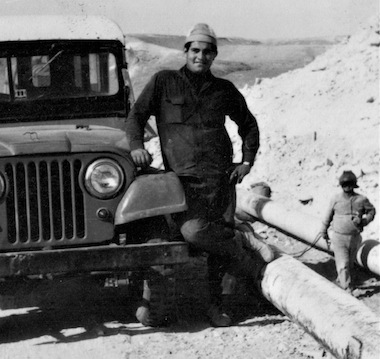
The Arab foreman of the pipeline who fired Bad Lennie after Bad Lennie swore at him. (photo from Victor Neuman)
I decided then and there that I had made enough money and my Hebrew would suffice. Bad Lennie’s gun was empty but I was sure he kept bullets somewhere. It was time to get out of Dodge. On the day I decided to leave, I left the job site early and headed for the apartment. I knew Lennie wasn’t around because they were playing a new Western at the cinema. I grabbed all my things and stuffed them in my bag. There was a little room left, so I grabbed Bad Lennie’s books and stuffed them in my bag as well.
Lastly, I wrote him a note: “Hi Lennie, I’m leaving town to go to a kibbutz in the north. Take care and best of luck. P.S. I’ve changed my mind about your books. I’ll buy them after all. Just deduct what they are worth from the money you owe me and we’ll call it even. Cheers.” Then I headed for the nearest road out of Arad and started hitchhiking north. It was a bit nerve-wracking. I wasn’t sure who would show up first – my ride or Bad Lennie. I was in luck. My ride came first and I was on my way to join Suzanne.
As I mentioned, Suzanne and I had met at our previous kibbutz, near Haifa. She was Jewish and, like me, had come to Israel to check it out and become a volunteer. She was a huge fan of Leonard Cohen and, as a consequence, had a real thing for dark, brooding, handsome Canadians. All I had going for me was the Canadian thing and, happily, she settled for that. For me, the trigger was her incredibly sexy French accent. It was like listening to music.
She also spoke her mind entirely with nothing held back. Tears or laughter came at the drop of a hat and you were never in doubt about what she thought or how she felt. It was a raw honesty of emotion that took some getting used to but, once you did, it was exciting in a scary kind of way. The ride was bumpy but never ever dull. And nothing frustrated her more than people suppressing their feelings. Once, when I was being particularly uncommunicative, she booted me in the rear to try to get me past it. I don’t recall if it worked but, after that, if I felt withdrawn, I made sure I was sitting down.
Suzanne worked in the children’s house and I had a steady job in the banana fields with a guy named Lev as my boss. Banana life was good but there came a time when I worried that I was spinning my wheels. I wasn’t sure I wanted kibbutz life forever and I thought I had the beginning of a career back in Canada. I had a BA in English literature, after all. It had to mean something. I felt I needed to return to Canada and see what I could make of my life there. I was in a dark, who-am-I kind of mood. When I told Suzanne I was going home, she was angry.
“I won’t be the one left behind,” she told me.
Before I knew it, she was on a plane bound for Paris and I was sitting in the middle of a very empty room. Worse than empty. The life had gone out of it. To my surprise, I actually wept. I never realized until then how much I would miss her. Typical of me. Why not save steps? Burn the bloody bridge while you’re still standing on it.
I couldn’t bear that empty room and so, in the time I had left before going home, I joined an archeological dig in the Negev near Beersheva. The work was hot, dirty and finicky. We had to move a lot of dirt to get down to the Iron Age town we were looking for and, at that point, the work had to be much more careful. Every find was scraped, brushed clean, surveyed for location, photographed and, finally, removed to our storage room at the base of the hill.
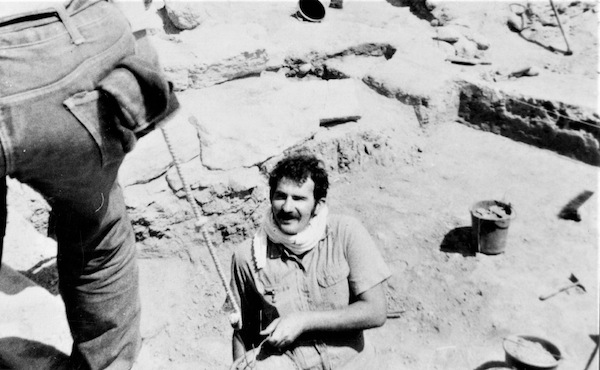
In the summer of 1969, the author worked on an archeological dig. Here, he passes up a bucket of dirt for disposal. In the background, partially covered with a rock slab, is a Bedouin grave dating to the Middle Ages. (photo from Victor Neuman)
I was particularly proud of finding an intact Iron Age kiln, circa 700-600 BCE – basically, a three-foot-wide, clay-walled cylinder standing on its end. I carefully brushed and excavated the kiln to its base, always careful to leave the dirt in the centre as support for the walls. After three days of clearing the outside of the kiln and the floor around it, I was told it was time to take it down and go deeper. It had been photographed, measured and catalogued and now it had to be removed. Strangely, my fellow volunteers had all dropped their tools to come and watch me take a pickaxe to the kiln. Not sure what was going on, I swung the pickaxe and buried it in the centre of the kiln. There was a horrible sound of glass breaking.
“Crap!” I thought. “I’ve just destroyed some 2,600-year-old glass artifact that was situated in the middle of my kiln.” Everybody who had gathered round gasped loudly in horror. Feeling disgraced, I dejectedly began pulling out bits of glass. But there was something peculiar. The glass had a colour that was unlike any ancient glass I had ever seen. In fact, it looked a lot like.… “Alright,” I said, “Who buried the frigging beer bottle in my kiln?”
Aside from the pranks, we did a lot of good work and, by the end of the season, I was standing on the streets of ancient Beersheva where Abraham once walked.
When the dig ended for the summer, it was time to go home. My first trip to Israel was over. I returned to Canada in 1970, got an MA in English literature by May 1972 and, damn me, I still didn’t want to teach. I was no further ahead in knowing what I wanted to do. Also, I missed the kibbutz. I decided to go back to Israel later that year. My thinking was that I’d spend some quiet time there deciding about my future. I didn’t realize that I’d have to do my contemplating in the middle of a war.
Victor Neumanwas born in the former Soviet Union, where his family sought refuge after fleeing Poland during the Second World War. The family immigrated to Canada in 1948 and Neuman grew up in the Greater Vancouver area. He attended the University of British Columbia and obtained a BA and MA with majors in English literature and creative writing. Between 1968 and 1974, he made two trips to Israel, one of which landed him on a kibbutz at the time of the 1973 Yom Kippur War. Upon his return to Canada, he studied survey technology at BCIT and went on to a career of designing highways for the Province of British Columbia. When he retired, he reconnected with his roots in creative writing and began writing scripts for Vancouver Jewish Folk Choir concerts and articles for the Jewish Independent. Neuman and his wife, Tammy, live in southeast Vancouver and enjoy the company of friends, their extensive extended family and their four sons.
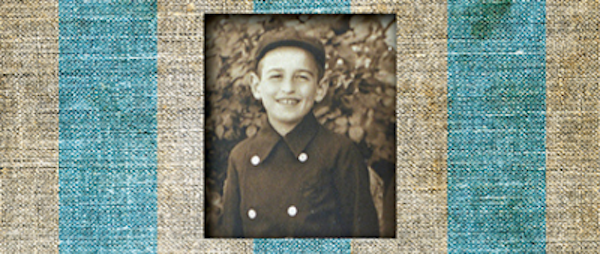
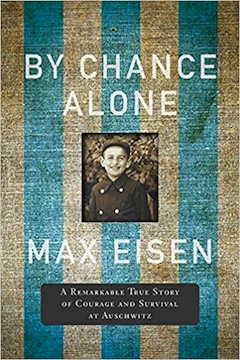
As public opinion surveys continue to tell us that vast numbers of people know little or nothing about the Holocaust, it was encouraging that Max Eisen’s memoir, By Chance Alone, became CBC Radio’s Canada Reads 2019 choice, bringing this wrenching narrative to many more eyes and ears.
Born in Czechoslovakia in 1929, Eisen enjoyed a childhood filled with shenanigans and idyllic summer excursions to his maternal family’s farm – until the Nazi invasion of his country, in 1938.
“At 9, I didn’t fully understand what was taking place, but I noticed the rising tensions in my hometown,” he writes.
Eisen’s father’s friends assembled at their home to listen to a major address by the Führer on a crystal radio. “All of us understood basic German,” he writes. Hitler’s words, “Wir werden die Juden ausradieren” – “We are going to eradicate all the Jews of Europe” – clarified for the young Eisen the import of the moment.
While traumas befell the family from then on, it was in the night after the first seder in 1944 that the worst of the family’s catastrophe began to unfold.
At 2 a.m., after the family had settled into bed after what Eisen calls their “last supper,” a neighbour arrived at their property urgently insisting that the family hide in the forest because he had overheard gendarmes saying that they would gather all the Jews in the vicinity the next day. Because it was Passover and the Sabbath, Eisen’s grandfather declared that the family would not travel. At 6 a.m., gendarmes forced their way into the home, gave the family five minutes to pack a bundle and be ready to depart their home.
The complicity of bystanders before, during and after the Holocaust permeates the book.
“On both sides of the road, the townspeople jeered and cursed at us as we passed. Many were looking out the windows of the Jewish homes they now occupied.… Many townsfolk who bought goods on credit from Jews like my grandfather were happy they wouldn’t have to pay the money back. Our deportation was an economic windfall for them.”
In the chaos of arrival at Auschwitz, Eisen had no idea of the seriousness of the separation of himself, his father and uncle from the rest of their family. The three would be the only ones to survive the first selection.
The everyday “indignities and deprivations” they had experienced before quickly turned to horrors. The forced labour he endured, long shifts of excruciatingly exhausting work on starvation rations, was fatal to those less strong.
His father and uncle were moved to another barracks and, after selection one day, Eisen could not find them.
“I ran to a fenced off holding area where the SS kept the selected prisoners until they were ready to transport them to Birkenau to be gassed.… My father reached out across the wire and blessed me with a classic Jewish prayer…. The same prayer my father once uttered to bless his children every Friday evening before the Sabbath meal. Then he said, ‘If you survive, you must tell the world what happened here. Now go.’”
At one point, when Eisen let down his guard and relaxed for a moment, an SS guard delivered a blow with the butt of his gun on the back of Eisen’s head. The nearly fatal attack put Eisen in the camp’s infirmary, which proved one of the chances that led to the book’s title. A surgeon, a Polish political prisoner, assigned Eisen the job of cleaning and running the operating theatre. Although the responsibilities he was forced to undertake and the things he witnessed were appalling, the comparative comfort of the job may have saved his life.
As the Nazi regime was on its last legs, “the SS ceased distributing rations and the water system was shut down,” Eisen writes. “I woke up to the smell of cooking meat.… Several inmates sat around a small stove and watched as a pot boiled. I could not imagine how they had acquired meat, but when I crawled to the latrine where the cadavers were stacked, I noticed that some of the bodies were missing pieces from their buttocks.”
On May 6, 1945, the camp was liberated, but the term lacks much meaning in the context. Everything and everyone Eisen knew was destroyed. When the Americans provided food, a stampede of starving people led to deaths by trampling. Those who got food suffered ruptured stomachs and many died on the spot.
After overcoming a nearly fatal bout of pleurisy, Eisen faced yet more incarceration. After the communist takeover of Czechoslovakia, his plan to find freedom abroad was dashed. Because he came from the eastern, Hungarian-speaking part of the country, he tried to obtain phony Hungarian ID and join a mass of Hungarian refugees passing through to the West. Discovered, he was imprisoned for a year.
When finally released, Eisen was given 24 hours to get out of his native country. Eventually, he made his way to Canada where, since the 1980s, he has educated school kids and others about the Holocaust.
“It is in this way,” he writes, “that I have fulfilled my final promise to my father: telling the story of our collective suffering so it will never be forgotten.”
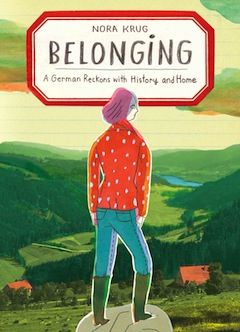
Nora Krug’s Belonging offers a thoughtful and artistic exploration of identity and history. (photo by Nina Subin)
Nora Krug’s Belonging: A German Reckons with History and Home (Scribner, 2018) opens with a page made to look like it’s written in pencil on yellow graph paper. The illustration of a bandage takes up half the page, which is ostensibly “From the notebook of a homesick émigré: Things German.” Entry No. 1 is about Hansaplast, a type of bandage created in 1922 that Krug associates with safety, her mother having used it, for example, to stop Krug’s knee from bleeding after a roller-skating accident at age 6. “It is the most tenacious bandage on the planet,” writes Krug, “and it hurts when you tear it off to look at your scar.”
Belonging is the written and illustrated account of what happens when Krug decides to rip off the Hansaplast and examine the scars left by the history of her family – which had only been related to her in vague terms – and her country of birth, Germany. It is a creative and engaging memoir about Krug’s efforts to define for herself and reclaim for herself the idea of Heimat, tarnished by the Nazis’ use of it in propaganda.
Heimat can refer to an actual or imagined location with which a person feels familiar or comfortable, or the place in which a person is born, the place that played a large part in shaping their character and perspective. Krug’s exploration of identity comprises archival research, interviews with family members and others, and visits to her mother’s and father’s hometowns – Karlsruhe (where Krug grew up) and Külsheim, respectively.
Alternating with the narrative of her discoveries are several notebook entries, on a range of items, from bread to binders to soap, which are both points of pride, as they are quality-made items, and metaphors. For example, Persil is “a time-tested German laundry detergent invented in 1907,” which Krug uses. However, she writes, “Some referred to the postwar testimonials written by neighbours, colleagues and friends in defence of suspected Nazi sympathizers as Persil Certificates. Persil guarantees your shirts to come out as white as snow.”
As well, Krug includes pages “From the scrapbook of a memory archivist,” which present odd and sometimes disturbing arrays of items found at flea markets on her research trips to Germany. These include Hitler Youth trading cards, a letter from the front containing a lock of hair and photographs of soldiers petting or holding various animals, mostly dogs.
But the main intrigue of the book comes from what Krug shares as she persists in her research, asking questions and scouring documents. She wants to find out all she can about her family’s involvement in the Holocaust, in particular that of her maternal grandfather, who died when Krug was 11, and her paternal uncle, who was drafted at 17 and shot and killed at age 18, before her father, a postwar baby, was born; her father was named after the brother he never knew. Despite her efforts, many of Krug’s questions remain unanswered.
At the end of Belonging, it’s not even clear if Krug – who readers find out early on married into a Jewish family – feels any less guilty or any more secure in her self and in her past. But she does manage to start the healing process on some family rifts. And she highlights a couple of steps towards healing that she witnesses in Germany. For example, of Külsheim – which had, in 1988, the 50th anniversary of Kristallnacht, abandoned a proposal for a memorial plaque where the synagogue once stood, before it was burned down the night of Nov. 10, 1938 – she writes: “Plans are made to restore Külsheim’s old mikvah, and a memorial stone is erected where the synagogue used to be, ‘as a manifestation of sadness and shame,’ Külsheim’s new mayor says on the day it is installed.”
The book ends as it began, with a notebook entry. No. 8 is Uhu, “invented by a German pharmacist as the first synthetic (bone-glue-free) resin adhesive in the world, in 1932.” Despite its world-record strength, which is why Krug imports it to repair everything from the soles of her shoes to broken dishware, Uhu “cannot cover up the crack.”
We humans spend most of our lives searching for a path forward. Our priorities tend toward avoiding pain and seeking pleasure. We don’t even think about it, it is the instinctive reaction of any living thing. In this, we are essentially the same as any other life form on our globe. Humanity is no different than an amoeba, for example, in its instinctive struggle to survive, seeking the positive environment and avoiding the negative.
It is reported that Socrates said that the unexamined life is not worth living. In his day, he was reportedly a gadfly, challenging everyone and everything with his relentless questioning. Difficult and sometimes uncomfortable though it may be, we ourselves often feel the need to honestly examine the what, the who and the why of our lives. And we have to look at both its micro and macro elements.
As for myself, on the macro side, I find I have a huge loyalty to my tribe, the Jewish tribe that I was born into. I am so proud of the contribution we have made, as a people and as individuals, and are continuing to make, in the advancement of the human condition in so many fields. I believe that much of this flows from the unique cultural package that adherents absorb with their mother’s milk.
But I am also aware that, along with the benefits of the moral code that our religiosity has contributed to improving the life on our planet, comes the distressing tendency for religion’s most orthodox adherents, whatever their stripe, to insist on a closing of minds to ideas that do not fit into an inflexible and unalterable worldview. I have needed to come to terms with the role my tribe (e.g. Baruch Spinoza) has played in that.
We have seen that, when religious and political dogma become state policy for believers and non-believers, and these are forced on the unwilling (e.g. the Inquisition, Communism), humanity stumbles on its way forward. We have seen the expression of the effort to avoid this in the adoption of the principle of separation of church and state, but this is imperfect and does not solve the problem of secular fanaticism. For me, humanity must always move to avoid extremism and the inevitable pain and destruction it causes to so many people.
Historically, we have seen how the advances that humanity made during the Greek flowering in the arts, philosophy and science were lost for a millennium. Some of this was salvaged under early Rome. They were then smothered for centuries by religious orthodoxy. We have seen how we have benefitted as humans from their liberation. These forces have shaped the world we live in, and the lives we are living, as we seek our pleasures and strive to avoid life’s pains.
On the micro side, I, like many of you must have, and must have been, studying the trajectory of our lives. Thinking back over my times, I wonder at the career decisions that I have made. I wonder at my actions during what proved to be watersheds in my life. Some of it was not much fun. I wonder at the impact on those whose lives, willy-nilly, were carried alongside of me in the tide of my life.
Then there is the question of nature or nurture. To what degree are our futures driven by the DNA package we inherited? Surely, to some extent, we are programmed in our reactions to fate by our inheritance. I wonder at the impact if our blood is programmed to run a certain way or another, or if our hormones, liver and kidneys function efficiently, the quickness of our minds, the quickness of our step, the state of our health. Doesn’t that make a huge difference in what we can accomplish? How much do we owe to our forbears for our results?
And then, what if we are raised on the “right side of the tracks,” our parents are educated, they pay attention to the development of their offspring, or none of these things? If we were born into abject poverty or in a country in turmoil, how greatly would our opportunities be constrained? Does not colour, economic circumstance and location make a huge difference in our range of opportunities? Doesn’t the political system, religion, sex and sexual orientation, the very epoch in which we were raised, make a difference even in these so-enlightened times?
Some of us can believe we deserve all the credit for our accomplishments, but how much do we owe to all the positive circumstances that affected our lives? Or, we may weep over our misfortunes, and surely we can truly finger the circumstances and the evidence that show that all of us do not start out on a level playing field.
We have little room for arrogance about our outcomes in the lottery. We can count on our lucky stars if we are winners, if we overcame our disadvantages enough and, summoning the best of the resources we salvaged, we can find some satisfaction in the outcomes. For those still on the trail, you may wish to proceed with caution with your assertions of personal mastery. As well, the knowledge that we face disadvantages will not absolve us from desperately trying our best in our lives. We have that obligation to ourselves.
We will know in our hearts at the end of the trail where we failed and where we succeeded. Special pleading will not help when we face our internal judge and jury, as we are the harshest of the judges we face when we examine our lives. My advice is to be kind to yourself and to one another.
Max Roytenbergis a Vancouver-based poet, writer and blogger. His book Hero in My Own Eyes: Tripping a Life Fantastic is available from Amazon and other online booksellers.