Skip to content
  • Home
  • Subscribe / donate
  • Events calendar
  • Business Directory
  • FAQ
  • News
    • Local
    • National
    • Israel
    • World
    • עניין בחדשות
      A roundup of news in Canada and further afield, in Hebrew.
  • Opinion
    • From the JI
    • Op-Ed
  • Arts & Culture
    • Performing Arts
    • Music
    • Books
    • Visual Arts
    • TV & Film
  • Life
    • Celebrating the Holidays
    • Travel
    • The Daily Snooze
      Cartoons by Jacob Samuel
    • Mystery Photo
      Help the JI and JMABC fill in the gaps in our archives.
  • Community Links
    • Organizations, Etc.
    • Other News Sources & Blogs
  • JI Chai Celebration
  • JI@88! video

Recent Posts

  • SFU honours Gloria Gutman
  • Lifting people’s spirits
  • Wedding a ray of light
  • Indigeneity and Zionism
  • Rule of law broken: councilor
  • Football and its roles
  • The burden of defence
  • Fish Café returns after fire
  • All right in what goes wrong
  • Nuns & mermaids at TUTS
  • Camp offers holiday retreat
  • Students and mentors inspire
  • Once-in-a-lifetime trip
  • 100 dancers, one heart
  • Money for the sciences
  • What “Jewish food” means
  • Have a cookie, schnitzel too
  • Federation now across BC
  • Israel fighting for its existence
  • Deal strengthens Iran
  • Patriotic belonging diminishes
  • A campaign to engage
  • Upstanders’ first live event
  • Responding to Carney
  • Having your own home
  • Music a family tradition
  • Musical to warm heart
  • Community milestones … June 2026
  • Sharing her passion for Israel
  • Or Shalom reopens its doors
  • JFS from past to future
  • Need holistic approach
  • Sharing stories, advice
  • Journalist shares fears
  • Skills to live together
  • Road to independence

Archives

Follow @JewishIndie
image - CJN box ad Rockowers 2026

Tag: lifestyle

Adding colour to our lives

Life is such an adventure, but its appeal for us depends so much on our attitude. One of the amazing things about this fact – that our attitude makes all the difference – is that this appears to be a law of nature. How we “reflect off” the events in our lives is crucial to our fate.

Most of us know a little bit about the nature of sight, the mechanics of seeing. We know less about the role played by light in our world. Light travels in units called photons. We know that these photons travel really fast, even when they have to bounce around in a world full of atoms to get where they are headed, which is everywhere. Photons travel so fast, we don’t notice that random atoms are impeding their progress a bit. In spite of that, they reflect off all the objects in our world and succeed in entering our eyes.

The lenses in our eyes focus this reflected light onto the light-sensitive rods and cones on the retina at the back of our eyeballs. (The rods work in dim or dark situations and the cones in bright light.) These create variable electrical charges sent along the optic nerve to the brain. Our brains interpret these stimuli as the visions that we see before our eyes. Did you know that the curvature of our eyes results in the images we receive being upside down? Our brains turn them right-side up for us.

What we are seeing is the reflected light. Any light absorbed by the objects we are looking at, we will not see. The same is true about colour. We only see the colours that the objects we are looking at reflect. All other colours are the ones that have been absorbed by these objects and we will not see them. Colour is all about light reflecting off the things in the world around us.

In the same way, it is our reactions to the realities we face in life that determine the kinds of lives we will lead. Different reactions, different lives. What does it mean to say that our reactions can be of overwhelming importance in determining our fates? It means that, to an important extent, our fates are in our own hands. (What does that do to the blame-games we have been nursing all our lives?)

I am getting to be what some people might term “an old guy.” Others, less kind, might say, “an old fool.” One would have to be foolish to live a whole life without understanding the principle I have enunciated above. And yet, it is only at this late date that this has become so clear to me.

Of course, I always knew I had to hustle my butt if I wanted to achieve the things I desired for my family and me. Yet, I never achieved the clarity of insight that I now have. I would venture to say that there are others of my fellow travelers who might have been, who might still be, wanting in this matter.

When all is said and done, there is no substitute for having a positive attitude. There are so many good things in our lives that we have to appreciate, that we have to be grateful for. There are so many people we pass every day who are less fortunate than we are. But that does not absolve us from the need to actively present our own best case to the world, to be up and at ’em every day, meeting the challenges we all face and will face. Without that, we are beat before we start.

Being open to the positive is a necessity if we hope to take advantage of any opportunities that might come our way if we reach out. Like the photons of light in our world, we move forward in our lives toward our goals in spite of impediments we might face; or we find paths to goals we hadn’t considered before.

I am not talking merely about amassing material possessions. I am talking about spending time working out how to ensure we are adding the colour we want to see in our lives. If all of this is dependent wholly on ourselves to determine what the elements of our lives are going to be – not our parents or our partners or our bosses or the economy – then what are we going to do about it? If, in spite of our positive attitude, we are not happy, if we are not satisfied, what are we going to do about it? I must confess, I never had this moment of clarity until I was 70 years of age. That’s a whole lot of living to have gone through without thinking about such things.

At the age of 71, unheralded, I flew across half a continent to try and reconnect with a woman I had known when we were teenagers more than 50 years before. I can report that we can look back now at almost 15 years of happily married life. We are keeping each other alive.

So, what I am writing about here is seeing the reflections off the objects (subjects?) that make up the elements of our lives. We have to be aware of the reflections streaming into our eyes, and consciously translate the images making their way into our brain. What colours are being reflected? Are we absorbing what those images are telling us? Or are we seeing them without really seeing them, same old, same old? And, if we do see them, and we don’t like what we see, what are we going to do about it? It is never too late to make an effort, I can tell you that!

Max Roytenberg is a Vancouver-based poet, writer and blogger. His book Hero in My Own Eyes: Tripping a Life Fantastic is available from Amazon and other online booksellers.

Posted on February 28, 2020February 26, 2020Author Max RoytenbergCategories Op-EdTags aging, lifestyle, philosophy, science
Camp helps lift spirits

Camp helps lift spirits

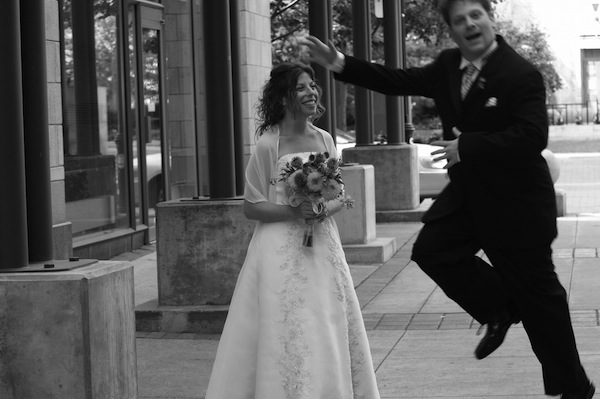
A moment of levity during the taking of Justine and Stewart Silver’s wedding photos. (photo from Justin Silver)

The late Stewart Silver was born and raised in Montreal. He had worked as a standup comedian, and moved to Toronto in hopes of furthering his career. Justine Silver grew up in a Houston suburb. In late 1990, she followed her sister, who had moved to Toronto, and, there, she joined Jewish online dating site Jdate. So had Stewart.

“There was a thing where you had to describe your perfect date,” recalled Justine. “Profile after profile included long romantic dinners and were all gushy and gross … but his said, ‘Yeah, after we grab a drink, we step out of the restaurant and trip over a big bag of money.’ I was like, ‘Oh my gosh … that’s the perfect date!”

The couple took their time getting to know each other and, after a year and a half, got married.

To all appearances, Stewart was a healthy 44-year-old. He had biked up hills in Christie Pits Park the day before he had a fatal heart attack while the couple was having a conversation on Nov. 16, 2011.

Left shocked and widowed, Justine embarked on a healing path, including taking a hiatus from her event-planning business.

“It’s been quite some time since then and there’s been grief bursts,” said Silver. “In the early days, there was a lot of therapy and some peer support groups. Then, I found Camp Widow and have been to a few of those. I was pleased it wasn’t at all associated with any religion and was welcoming…. There was one in Tampa, and so a couple of widow friends that I had met up with, here, in Toronto, in a peer support group for young people who’d lost their spouses under the age of 55 … decided to make a whole trip of it. We went to the beach, museum, and then to Camp Widow. It’s a very transformational experience when you feel that you’re surrounded by people who understand the topsy-turvy world that you’re starting to barely understand yourself.”

The first camp Silver went to, in Tampa, was in the spring of 2018. Then, in November 2018 and November 2019, she attended the camps in Toronto. She and her friends have already signed up for the next November 2020 camp in Toronto.

While it’s called a “camp,” the weekend is more like a conference, with people coming together for sessions on various topics.

“One of the neat things I like at Camp Widow is that the name tags, everyone has one, but there are a couple features to it,” said Silver. “One of them, there’s a ribbon at the bottom. For example, in my work as an event planner, if you’re a presenter, your ribbon will say ‘presenter,’ or, if you’re on the organizing committee, it will say ‘organizing committee’ or ‘volunteer.’

“But, these [also] have the number of years ago that your loss occurred. So, for me, that was six years. So, let’s say it’s a teal ribbon. All of a sudden, you notice the six-year people … and there’s a bond, because you’re in a different place than, say, the six-month people. Everyone is compassionate to everyone else, but it’s just a really interesting way to bond with people.”

As far as the camp schedule, there are some group meals, as well as meals on your own. There are various types of sessions offered.

“There are tracks, like for people who are five years out, one year, or one to five,” said Silver. “I can’t remember the exact breakdown, but you can decide to go to everything along a certain track, or you can decide in the moment what you’ll do, which sessions you’ll go to. Then, there are some networking evening events, different ways of getting to know people.”

One is designed like speed-dating, but not for that purpose. You get the chance to talk to someone for a certain amount of time, and then you move on to the next person and chat with them. “It’s really interesting to see where the commonalities fall,” said Silver.

On Saturday night, there is a banquet with a theme and people dress up – some participants may not have gone out since their loss. After dinner, each person says the name of their loved one out loud, while some 200 others quietly listen. Then, there is a dance, which gives the opportunity to destress and socialize. The DJ doesn’t play any music that could potentially trigger anyone’s grief, like slow songs.

At the camp, there are people from their mid-20s to people in their 70s and 80s; people from all religions, cultures and political leanings.

For Silver, Camp Widow “creates community and support amongst widows and widowers…. Sometimes, when you’ve lost someone, it can be very isolating, which can be in different and unexpected ways. I wouldn’t say never, but it doesn’t go away. The intensity definitely lessens and you find new ways to live with grief. And there are plenty of people who, we say, are ‘re-partnered.’ When you’ve been widowed and then you meet someone else and you have a boyfriend/girlfriend, wife/husband or partner, we say you’re ‘re-partnered,’ because we don’t think that means you’re not still widowed.”

The camp provides tools and connections that widows and widowers may not otherwise find on their own.

“I feel camaraderie in sharing my story and being heard, or hearing someone else’s story and being helpful to them,” said Silver. “At this past Camp Widow, I did an art thing. I can do crafty things OK, but I’m not really an artist. But, one of the workshops I went to was all about healing through art and it was just a whole different facet. We all had paint and they set it up so well…. We had a white piece of paper and I got white paint and I painted a white heart. Then, I put a line through it – a squiggly line, like it was broken – and you could barely see it … like you couldn’t see that my husband had a heart problem…. Then, everyone shared in the room what theirs was about. When you do that, it’s like opening up a wound, and then the scar heals better next time.”

Six months ago – eight years into her healing journey – Silver and her older sister, Eileen Jadd, who is a social worker, started the charity Good Grief Bereavement Healing Services.

“We have a roster of counselors in different parts of Toronto for bereaved people,” said Silver. “We’re also offering workshops on eye movement desensitization, which is a thing for trauma victims. It really helps you compartmentalize the trauma, so you can talk about it without being retraumatized. So, we’re doing a workshop on that.

“We’re starting a group on sibling loss and, eventually, will have a physical building. We want to have a centre, so people who’ve lost someone, it’s like a snap of the fingers and they’ll know where to go. When you know there’s an accident, you know to dial 911. We want it to be, ‘Wow, you’re in need, you’ve lost someone, and you know exactly where to go.

“I think widows and widowers need their person’s name to be said. People are so afraid of saying it, because they don’t want to bring it up in fear. But, they want their names to be said, so that’s a big part of it. I happen to talk about Stewart all the time, but a lot of people don’t have those opportunities in their own lives.”

In addition to talking about him when memories arise, Silver said, “Every year, I go to shul and I say his name and a prayer for him, and commemorate it that way. I remind people that we got married in that synagogue, and I remind people that he was a person that existed and stood in that space with me, and that his influence is still there. Just because he’s not standing next to me in that moment … he’s still there. In those ways, we talk about him.”

Camp Widow is put on by Soaring Spirits International. For more information, visit soaringspirits.org, campwidow.org, widowedresilience.org and goodgriefhealing.ca.

Rebeca Kuropatwa is a Winnipeg freelance writer.

Format ImagePosted on February 28, 2020February 26, 2020Author Rebeca KuropatwaCategories NationalTags Camp Widow, death, grieving, health care, Justin Silver, lifestyle, mental health, widows

When Joseph went missing

A friend recently went through a scary time and, as a result, I did, too. His niece in Minnesota, a young mother, simply disappeared. She went out on a date and didn’t come home. Her mother was with the woman’s children. When she didn’t know what to do, she contacted police, the story was in the media and the important, informal networks of the Missing and Murdered Indigenous Women and Girls (MMIWG) swung into action.

Like many friends, I tried to pass the word along about a woman who was missing. Her family needed her. My friend couldn’t sleep. He worried. I worried. The worst part seemed to be not knowing how to help, what to do and what happened. Things seemed very dangerous.

Some in the Jewish community may say, this isn’t about me. They would be wrong on several levels. First, and most apparent, your prejudice is showing. There are many Jewish community members who have ties to multiple other communities in Canada. Yes, there are indigenous Jews; as well, there are many other cross-cultural, interreligious and inter-ethnic family connections of which you may not be aware.

Second, anyone can be at risk. Missing people and human trafficking are as old as time. When Joseph’s brothers throw him into a pit and then sell him to the Ishmaelites (Genesis 37:28), they’re participating in human trafficking and slavery. They turn Joseph into a missing person. His parents go through the anguish of not knowing what happened to their child. If you’re a parent or, heck, if you’ve ever lost a pet, it’s not hard to imagine this anguish.

Rashi’s commentary says that Joseph was sold several times. According to Midrash Tanhuma, he’s sold from the Ishmaelites to the Midianites and, from there, into Egypt. This description is not unlike what happens now to women captured in wartime. News reports offer similar stories of women enslaved today – by Boko Haram or, to mention refugees closer to home, Yazidi women who were enslaved by ISIS, some of whom have found homes in Canada.

Some believe slavery is a thing of the past, tied to faraway, evil people – like the narratives I’ve heard from Canadians about the American South. People might be evil, but they aren’t far away. This is a modern issue. Once a person is being trafficked, it’s very hard to break free. She’s possibly been forcibly confined, addicted to drugs, beaten and sexually assaulted. She may be hidden, unable to get help, and brainwashed by those who kidnapped her.

There are charities that work against human trafficking, and many nongovernmental organizations do, as well. However, I was recently invited to participate in a raffle. The business offered a prize in exchange for donating to an anti-trafficking organization. I got as far as clicking through to the organization’s donation page before I saw that it did its work through a lens of Christian evangelizing. Here’s what I found: “Agape International Missions has an incredible team of staff members and volunteers who faithfully carry out our mission, day in and day out. At AIM, we believe that Christ through His Church will defeat the evil of sex trafficking, so we invite you, the Church, to join us in this fight!”

Further, if you wanted to work for them, and you’re not Christian? Too bad. Here’s what their job search info looked like: “You should consider pursuing a career with AIM if: You’re a Christian; You agree wholeheartedly with our Statement of Faith. As the foundation for all we do, our Christian faith is a uniting factor among volunteers and staff.”

Essentially, this Christian organization uses an “us” versus them narrative, in which this religiously motivated group is all good. They are out to conquer this evil that happens to faraway (non-Christian) others. Sadly, if you change the religious ideology, I’m not sure Jewish communities are much different in how we portray social action issues.

Kidnapping, human trafficking, using sex as a weapon – many people like to think these terrible things don’t happen to “us.” However, this naïve view harms victims, perpetuating the idea that these things only happen to people far away or long ago, or who somehow did something wrong to deserve it.

Joseph, according to Jewish tradition, was our relative, a part of our family. His brothers kidnapped and sold him. My friend’s niece went missing this winter. This isn’t some ancient or distant problem. Some argue that, if Joseph hadn’t been his father’s favourite, or if he’d behaved better, this wouldn’t have happened to him – this is blaming a victim.

In Joseph’s case, he lived. He was found, and he flourished over time, in Egypt. My friend’s niece came home to her mother and children after a week. It’s still unclear what happened to her. It sounds like something like human trafficking may have taken place. We (helpers outside the family) may never know.

Every time a missing person is found safe, it’s lucky – but it’s not a sure thing. Often, many hundreds of people’s efforts go into finding someone, and keeping others safe.

If you’re sent a missing person’s information, don’t judge whether or not the person is “worthy.” Send it onwards. Just imagine if your relative or friend went missing – wouldn’t you want everyone’s help, without judgment or religious prejudice?

Joanne Seiff has written regularly for CBC Manitoba and various Jewish publications. She is the author of three books, including From the Outside In: Jewish Post Columns 2015-2016, a collection of essays available for digital download or as a paperback from Amazon. Check her out on Instagram @yrnspinner or at joanneseiff.blogspot.com.

Posted on February 14, 2020February 12, 2020Author Joanne SeiffCategories Op-EdTags human trafficking, Judaism, lifestyle, slavery, tikkun olam, Torah, women

What is the worth of work?

Recently, I’ve had numerous encounters with middle-aged women. This isn’t strange. I’m talking to women who are a lot like me: dealing with school-aged kids, piano lessons, finding childcare, etc. What’s remarkable is that the same conversation pops up – about work.

One friend, an author and artist, said that she does the math every time she’s invited to do a workshop or a special event. Will the cost of travel, supplies and teaching preparation be worth the return? She’s often told, “Well, we can’t afford to pay you to teach” but, when she shows up for the single event she agreed to do for payment, what happens? People surround her, saying, “Well, if we’d only known you were coming, we would have paid for you to do a multi-day workshop!”

Another woman explained that she is only now, after years of staying at home, getting back to very part-time work in her field. Why? The cost of childcare would have canceled out anything she would have earned with part-time work.

Among women who juggle a full-time job with conventional hours, there’s an acknowledgement that it’s extremely hard to manage. In some cases, their partners step up to do the childrearing and run the household. In others, there are moms who are obligated to work full-time, be “on call” as the primary caretaker and either do, or hire someone to do, all the household chores. For many, this works because everyone’s healthy and they have support from extended family. In case of illness or lack of family support? Forget it. Of course, since these women do manage it, anyone who struggles is seen as “not as capable” as a woman who “has it all.”

This is a big topic, and it’s also (surprise!) a Jewish topic. We’ve been wrestling with it forever. In Exodus, the Israelites flee Egypt and slavery. Yet, in Exodus 14:12, the Israelites are afraid and they actually suggest to Moses that it would be better to return to Egypt and slavery (work without being paid) than to die in the wilderness. Lacking faith, they struggle with how they will be fed, and manna appears for them.

The first question is, what is the value of our work? For the Israelites, they were willing to live for nothing more than food and housing, as Egyptian slaves, rather than cope with being tossed out into the unknown. They didn’t value their work, and perhaps didn’t have the confidence that things could be different. Yet, when they take that risk, miraculously, their basic needs are met.

There are no guarantees. We can offer up our work for free – in whatever professional fields we’re qualified to do so – but there’s no surety that, at the end, we’ll have any offer of full-time, paying work. I see women doing this all around me. There’s an expectation that you’ll volunteer to offer your presentation, and you’ll also tack on free teaching, writing, editing, professional-level creative work or even childcare for others’ children. (Yes, I’ve been asked to do all these things for free.)

Here’s the second question. Is the Israelites’ manna in the desert the ancient equivalent of the “guaranteed minimum income” or “basic income” concept? At what point in modern society do we decide that everyone should get enough to eat? When is it acceptable to say, “Everyone should have a warm place to live, no matter what you earn or your special needs or other health challenges”?

In the Talmud, in Berachot 17a, the sages of Yavneh say that we are all G-d’s creatures, those who learn Torah in the city and those who labour in the fields. That both kinds of people rise early. Neither one is superior. Their work has equal merit as long as they “direct his heart towards Heaven.” This includes the idea that the labourer doesn’t presume to do the Torah scholar’s work and the scholar doesn’t presume to do the labourer’s. In this gendered ancient world, this leaves out women. Then Rav Hiyya acknowledges that women are offered “ease and confidence” because they do an enormous amount to sustain Jewish learning through raising their kids Jewishly and supporting their husbands who study Mishnah.

So, even in talmudic times, work was valuable and considered important, no matter what you did. Further, a woman who is doing “traditional” things like taking care of her children’s education or her husband is owed “ease and confidence” for her efforts.

Our work has meaning. It has important economic and social value. However, sometimes, when we compare our resumés, we feel lacking; certainly if we are being asked to do work for free. It turns out that we shouldn’t be expected to work for free, because our work, no matter what it is, is equivalent and necessary.

A more modern reminder: Martin Luther King, Jr., preached that all work is crucial and deserves fair pay. He supported the Memphis Sanitation Workers’ strike. To be healthy, we need trash collection. Garbage collectors matter.

There’s also no such thing as being out of the workforce. That dinner you cooked, the snow shoveled, the cleaning you did to keep someone healthy, the child you kept safe – according to the rabbis, if you do your work with the right intention, it’s all equally important.

I was recently invited by a favourite undergrad professor of mine to submit a short bio for the Cornell University Near Eastern studies department’s alumni page. I read some previous ones – doctors, rabbis, professors and others – and felt out of my league. Then I talked about it with my husband and thought about it. Being asked to share my work experience on that forum means, like the rabbis’ view of work, mine is valuable too – and so is yours.

Joanne Seiff has written regularly for CBC Manitoba and various Jewish publications. She is the author of three books, including From the Outside In: Jewish Post Columns 2015-2016, a collection of essays available for digital download or as a paperback from Amazon. Check her out on Instagram @yrnspinner or at joanneseiff.blogspot.com.

Posted on February 7, 2020February 6, 2020Author Joanne SeiffCategories Op-EdTags Judaism, lifestyle, Torah, women, work

The comfort in imperfection

We’re not perfect. Yes, and you’re saying, so, why is this in the newspaper? I’m writing this over winter break. Like many families, we chose a staycation. We’ve done some walks and games outside, and a lot of time just hibernating, resting and rejuvenating indoors. All the Chanukah treats were investments in this: new toys that our twins could play with for hours, books, warm socks – and a huge gift for all of us: my husband chose to repaint our main bathroom as part of his time off.

I know, you’re still thinking, why is this in the Jewish newspaper?

Well, first, if you’re a Jewish family who celebrates only Chanukah, winter break gets long. It’s a time when the radio and TV are full of someone else’s holiday celebrations. In a cone of silence, my family has always turned inwards, to hang out together. My parents used to joke it was the time of year for wallpapering. (My mom would choose the paper and my dad would hang it and curse about wallpaper!)

Aside from a much-improved colour and some very important anti-moisture paint, the bathroom fix-up also gives us a chance to seek comfort and self-improvement from within, by focusing solely on our household. I think my husband gets a great sense of satisfaction when he finishes a home repair project and feels it is a “job well done.” He dwells endlessly on the parts that aren’t perfect, and what might be better.

This is connected to the Torah portion Vayechi (Genesis 47:28-50:26) for a few reasons. This portion is very much about family, connections, our blessings and our imperfections. Joseph’s father, Jacob, is dying. Jacob’s dying blessings and wishes are both comforting to some and very uncomfortable for others. His need to include Ephraim and Menashe (his grandchildren) and to offer blessings out of birth order strike many as unfair. The rabbis discuss why Jacob crossed his arms and preferred the younger over the older grandchild. One wonders why he includes the children of his favourite child at all.

Yet, if you think back, Jacob has never been particularly even-handed with his kids. This is the dad that made Joseph the multicoloured coat. Joseph is the child of his old age. Jacob is unfair. He plays favourites, and this rubs us wrong as modern parents or family members. Dads shouldn’t play favourites, right?

When you read Jacob’s predictions (or blessings) for each of his children, some of them sound generous, and others are really harsh. It’s hard to imagine how this experience would feel from a modern perspective, it’s so out of whack with how we see modern family relationships. True, his sons have not been consistently upright people. However, at least Jacob mentions them. He doesn’t even acknowledge Dina – his daughter doesn’t exist here.

This story remains something I dwell upon because my twins’ Hebrew names, in part, are Ephraim and Menashe. Their dad’s Hebrew name is Yoseph (Joseph). Their grandfather’s name? Ya’akov (Jacob). You get the picture. Whenever we bless our kids on Friday nights, we say, in Hebrew, “May you be like Ephraim and Menashe.” Then we translate the prayer into English. We say, “May you be like …” and we use their English names. May they be like (true to) themselves.

When we reflect on it, we can see that, even among our patriarchs, like Jacob, we have imperfect role models. Jacob stole his twin brother’s birthright. He wrestled with the Divine. He played favourites with his children in harmful ways. He was by no means a perfect person. In a sense, this is comforting. No matter how crummy our mistakes or imperfect our efforts, we know that many biblical role models also weren’t perfect. Perfection may be overrated.

Our best hope is that we be true to ourselves – continually striving to seek peace and justice and pursue it, in a flawed world. We can commit to doing our best, within our own particular skill sets, to making things better.

As we start a new secular year, 2020, and decade, we have so many opportunities to reflect on what’s not right about the world. Yet, we can also gain comfort from the knowledge that imperfect people (and paint jobs!) can still make a positive difference for a long time to come.

Here’s to a better world in 2020 – imperfections, warts and all.

Joanne Seiff has written regularly for CBC Manitoba and various Jewish publications. She is the author of three books, including From the Outside In: Jewish Post Columns 2015-2016, a collection of essays available for digital download or as a paperback from Amazon. Check her out on Instagram @yrnspinner or at joanneseiff.blogspot.com.


Posted on January 31, 2020January 28, 2020Author Joanne SeiffCategories Op-EdTags Chanukah, ethics, home repair, Judaism, lifestyle, Torah

The supporting cast in our lives

Shabbat, Dec. 21
Vayeishev, Genesis 37:1-40:23

I am a rabbi because of a game of catch I played at camp with a rabbi more than three times my age. I found love and happiness and my partner in life because my best friend and my family helped me through a very difficult time. I survived the social pressure cooker of high school because my woodshop teacher took a personal interest in my well-being. I am alive today, I truly believe, because an anonymous man pulled me back from the curb as I was about to step into oncoming traffic in Manchester, England. (I was looking in the wrong direction for British traffic patterns.)

We have all sorts of names for these people in our lives. Some call them guardian angels, some call them heroes, and our tradition calls them shlichim, “messengers” or “emissaries” from God. I call them supporting actors. A rabbi, a friend, family, a teacher and an anonymous man in the movie that is my life: these are the people who have enabled me to play a starring role!

These are the people who, intentionally or not, gave the trajectory of my life a nudge at just the right moment and kept it on track, or steered it in a new and better direction. If awards were given to supporting actors in life as they are to movie actors, then they would each deserve an Oscar for the roles they played and for how their playing of their roles enabled me to play mine.

Who are the supporting actors in your life? Who are the people, past or present, who, at critical crossroads in your life’s journey, gave you directions, held your hand and walked a bit of the way with you? Who are the people who, upon reflection, were it not for them, everything would be different and so much would not have been possible?

Consider for a moment the story of Joseph and his coat of many colours in this week’s Torah portion, Vayeishev.

Here, we meet Joseph, son of Jacob, grandson of Isaac, great-grandson of Abraham, who, by all accounts, is a leading man in the story of the Jewish people. Joseph, in my estimation, is the second most pivotal person in Jewish history. The most pivotal one is a man whose name we don’t know and the Torah doesn’t record, but whose role as a supporting actor in one scene of Joseph’s life changes the arc of Jewish history.

In this week’s portion, Joseph goes out searching for his brothers, who are supposed to be in the field tending the flock. He searches in all the usual places but can’t find them. Along the way, he meets a man whose name we never know: the Torah refers to him simply as ha-ish, “the man” who saw Joseph wandering in the field (Genesis 37:15).

There is an allusion here to the nameless man or angel that Jacob, Joseph’s father, wrestled with in the previous parashah, Vayishlach. We note that, sometimes, when the Torah does not name a character, that character comes to play a pivotal role in the unfolding story. Such is the case in this instance. The man sees that Joseph appears to be lost and approaches him. He asks: “What are you looking for?” Joseph responds, “I’m looking for my brothers. Can you tell me please where they are tending the flock?” (See Genesis 37:15-16.)

The nameless man remembers seeing Joseph’s brothers, he overheard them talking about heading toward a place called Dothan. On the anonymous man’s advice, Joseph seeks his brothers there and finds them. Shockingly, they are not happy to see him. They conspire against him, abuse him, threaten to kill him and, eventually, sell him into slavery to a band of traveling nomads who are headed to Egypt. Through a series of events, Joseph, the boy who looked for his brothers in a field, becomes the chief advisor to Pharaoh and ascends to the second-most powerful position in all of Egypt.

Meanwhile, a famine occurs in the Land of Israel and these same brothers are sent by the leader of the Israelites, their father Jacob, to find food. They travel to Egypt and, this time, it is they who are surprised to find their brother – not only alive, but also in a position to help them. After a series of encounters, Joseph embraces them, asks after his father and makes all the arrangements for the entire nation of Israel to immigrate to Egypt. His position and power save the Jewish people and, for many years, they live well in Egypt and thrive.

Then, a new pharaoh comes to power and forces the Israelites into slavery. A prophet named Moses rises up from among them and, through plagues of frogs, lice, boils and so on; the splitting of the Red Sea; and, ultimately, the giving of the Torah, the people return to the Land of Israel. And that’s pretty much the story of our people.

But what about this nameless man? Who or what was he?

The commentators offer a variety of answers. The 11th-century scholar, Abraham ibn Ezra, reads the text of Genesis 37:15 with a p’shat, a “straightforward” interpretation and concludes this was a passerby. Rashi, on the other hand, delves further and concludes: “This [the man] was the angel Gabriel, as it says (Daniel 10:21), ‘and the man Gabriel.’” (Rashi on Genesis 37:15) Rashi draws inference from the definite article that is used to identify “the” man.

Ramban explains that he was an ordinary man (a passerby), yet he was unwittingly fulfiling God’s design. He was actually “sent” by God to guide Joseph, though he himself was not aware of the significance of his actions. In Hebrew, the word malach means both “angel” and “messenger,” because every malach, human or supernatural, is one of God’s messengers, activated to implement His will on earth. (See Ramban on Genesis 37:15.)

Menachem Mendel Morgensztern of Kotzk, known as the Kotzker Rebbe (1787-1859), goes in a completely different direction: “The angel taught Joseph that, whenever one is straying in the ways of life, when one is downtrodden or downcast, one should speak to oneself and clarify for oneself what one is really asking for, looking for, seeking, and what one really desires, so that one can return and first explain to oneself what one needs.”

The Kotzker Rebbe seems to disagree with Ramban, Rashi and Ibn Ezra, saying, it’s not a passerby, God or an angel that points the way. Rather, he says that the supporting actor in this unfolding mystery is Joseph’s inner voice and that, sometimes, our inner voice can be our own supporting actor.

Whatever or whoever he was, were it not for ha-ish, the man Joseph met along the way, the man who told Joseph where to find his brothers, how different it all could have been.

We never know in the present tense which people or events will be the most instrumental and transformative in our lives but, in hindsight, nothing is clearer. Upon reflection, the pieces of the puzzle and the paths of our lives are perfectly clear, even if they may be filled with uncomfortable observations.

This week’s parashah is a reminder to all of us to recognize the supporting actors who have guided us on our path and pointed us to our direction. It compels us to acknowledge, honour and thank them – even to give them awards – for the important roles that they’ve played, for doing so teaches us something greater still: in recognizing the transformative influence of supporting actors in our lives, we become keenly aware of how important we are in the lives of others. And we come to appreciate the capacity each of us has to help our friends, neighbours, even strangers achieve wholeness in life and find what they are seeking.

Rabbi Dan Moskovitz is senior rabbi at Temple Sholom and author of The Men’s Seder (MRJ Publishing). He is also chair of the Reform Rabbis of Canada. His writing and perspective on Judaism appear in major print and digital media internationally. This article originally appeared on reformjudaism.org.

Posted on December 20, 2019December 18, 2019Author Rabbi Dan MoskovitzCategories Op-EdTags Judaism, lifestyle, Reform movement, Torah

A not so diasporic dialogue

Awhile back, friends invited me to a writers group. Although I told them that I wasn’t quite the right fit for the group, they convinced me to go.

The meeting was nearby. I enjoyed walking on a cold, dark and starry night. Yet, the meeting’s “gatekeeper” told me that I wasn’t eligible for their future gatherings, as I didn’t (yet) write or edit in their genre. Instead, she invited me to another writers event in October. (I’m not on the social media lists for these types of things, as I tend to focus on writing deadlines and my household – and I’m introverted.)

The event, titled Diaspora Dialogues, took place on a Friday and Saturday. Although it might been possible for me to attend some parts of it, I saw only one gathering that interested me. Called Vulnerability and the Public Space, it boasted a live podcast, but it was held on Saturday afternoon. As someone who writes on religious issues in the public sphere, it seemed relevant. However, I saw no way that I could pull off attending – Saturday is a family day for us. After we go to services, I’m often feeding everyone a big lunch and playing with kids afterwards. (In an ideal world, we’d even take a nap!) To go, I’d have to have given up my day off and commit to attending on Shabbat.

This “diaspora” event, which seemed designed for Canadians of colour, was scheduled at a time when Muslims might be busy (Friday afternoon) and on Shabbat, when Jewish families might be busy with family or synagogue or both. It wasn’t inclusive of religious diversity. It excluded any person who might be both religiously observant and a Canadian minority.

Even the event’s title puzzled me, as the first dictionary definition for diaspora usually references the historical dispersal of the Jewish people outside of Israel. The “scattering of a people outside their original country to other places” is a secondary definition. So, OK, this was a secondary use of the definition, fine.

I resolved my personal conflict. I emailed one of the organizers to point out the discrepancy. Although I write about vulnerable religious issues, often in the public space, I wouldn’t be able to attend this “diaspora” event, as its timing excluded Canadian religious minorities. No matter, though, perhaps I could access the podcast online later? Where, I asked her, could I locate the podcast link?

I received no reply. The podcast never appeared online.

We celebrate our religious freedom on Chanukah. It’s the chance to rededicate our spaces to Jewish practice. However, the holiday’s origins are a tale of struggle between minorities and the majority: Jewish assimilationists, religious fundamentalists and the Seleucid empire’s religious majority (aka the Greeks, or the Assyrians). We remind ourselves of this in each generation – we can’t take religious freedom or Jewish practice for granted.

There has been a huge rise in antisemitic activity. Identifiable Jews or Israelis are now often targeted, assaulted and harassed throughout the world.

A far more subtle and insidious change has also happened in terms of Jewish identity. Now, U.S. President Donald Trump has decided, via presidential order, to define Jewish students as an ethnic or racialized “national”group that, theoretically, can’t be discriminated against. Yet, the definition alone is a worrying precedent.

Take a look around you at any Chanukah event. We’re not one race by any (purely artificial and historic) definitions. We aren’t one homogenous ethnic group, even if we might have been thousands of years ago. Just ask those who argue about doughnuts versus latkes or other holiday foods. What or who defines us? We’re now facing new identity definitions – as delineated from the outside.

We are a diaspora religious minority group that evolves and changes. We haven’t disappeared despite changing definitions.

Chanukah’s a minor holiday on our calendar. It celebrates clinging to our freedoms in a dark world. It relies on a subtle understanding that not all discrimination is based on racism. It implies that religious, ethnic or racial background alone doesn’t solely define someone’s minority status.

A true acknowledgement and respect for religious freedom is one that practises intersectionality instead.

What is intersectionality? Our identities – racial, sexual, class, gender, religion, nationality, etc. – are complex and changing. We are each the result of several roads, always under construction, that meet in one huge intersection.

As Jewish North Americans, living in the Diaspora, we’re more than one ethnicity, gender or race. Together, we celebrate our tradition and identity as a triumph over adversity. We just may have to celebrate with an understanding that we’re no longer included in some folks’ definition of diaspora and, hence, excluded from the narrative. Heck, I cannot even access the podcast about the narrative!

Wishing you a very happy, inclusive Chanukah from my family to yours. Have a great winter break, one where you feel included! May it be full of light, joy and peace.

Joanne Seiff has written regularly for CBC Manitoba and various Jewish publications. She is the author of three books, including From the Outside In: Jewish Post Columns 2015-2016, a collection of essays available for digital download or as a paperback from Amazon. Check her out on Instagram @yrnspinner or at joanneseiff.blogspot.com.

Posted on December 20, 2019December 18, 2019Author Joanne SeiffCategories Op-EdTags discrimination, interfaith, intersectionality, Judaism, lifestyle, writing

Renewal requires courage

Did you notice what a great day it was today? Rain or shine, there are lots of people out there who are so happy you are alive. Besides yourself, I mean. I bet you did some things today that added to that number.

I’m feeling pretty good myself, remembering stuff from my youth. In December, we light the candles marking Chanukah, the Festival of Lights, as it is called. I always liked this holiday as a kid, along with Rosh Hashanah, because there were good things to eat at the party we always had. And older people in the family gave you money, Chanukah gelt. I hope they still do that, although I haven’t heard much about it since the kids got big and left home to form their own households.

Many people – unless they have Jewish neighbours or notice the lights around Christmas time – don’t know about Chanukah because it is not in the Bible, and because the events surrounding it happened later. After the empire forged by Alexander the Great broke up, the piece in which Israel was included was under the rule of kings named Antiochus.

These kings liked to fancy themselves gods. One of them put a statue of himself in the Jewish Temple. This was just too much for the Israelites and they rose up under the leadership of the Maccabees – Mattathias and his five sons – and drove out their Greek rulers.

Chanukah is about renewal, because that’s what the holiday celebrates, the renewal of the Temple in Jerusalem after the land was freed. Current Israel is part of that same story, as the ingathered exiles renewed national life on their land. Our national renewal is an assertion that our past is merely prologue, with the full story yet to be written.

Jewish history of the recent two millennia may not illustrate it, but Jews can be fighters when roused. The self-rule reestablished back then was ultimately surrendered to Roman rule, when they lost their unity. But Jews kept on fighting to achieve independence until, finally, the Romans used their power to exile Jews from their land. We must remember that the Romans executed Jesus because they feared that he would lead such a revolt, but the Jews continued their opposition after his death.

It took 12 legions to pacify the Jews – Rome conquered the Britons with only two legions. The Romans exiled the survivors to secure their rule, but the power of the religious ideas spawned in Israel conquered Rome itself a hundred years later. Those ideas were borne into exile by Jews who proved to be among the first martyrs.

More recent Jewish military history, in Israel – leaving aside the resistance without weapons in the Warsaw Ghetto, holding off the Nazi soldiers for weeks – proves that Jews can be fierce fighters.

The whole idea of renewal excites the blood. Renewal can make you feel like you can cancel out all the ills of the past, as if they never really happened. One can turn a corner and start out fresh. It is an idea around which one can rally believers, as has been done in so many places at so many different times.

Many people have fought and died in defence of renewal. It is at the heart of every movement that seeks to channel people’s efforts for change. It can be local, regional, national or global. It can have a religious or patriotic motivation. Its beauty is that it can have its origin in the lives of each and every one of us.

Change is not easy. We may be very unhappy with important elements of our lives, but taking drastic action to materially transform our lives takes courage and, often, an acceptance of the risk of substantial loss. Some of us may have done this at some time in our lives and not even appreciated that we were risking all for renewal.

It may not have been on a battlefield, but I consciously sought to renew my life when I reached out at the age of 70. I reached out to seek a relationship with a person I had known only superficially more than 50 years earlier as a teenager. The object of my continued memory and attention, my future bride, mustered up the courage to take me on as an unknown quantity, and her courage has enriched both our lives.

Truth be told, the times that haunt us most in our lives are those when we did not “seize the bull by the horns” and do the thing we really wanted to do. But, in the end, failing to act for lack of courage, or for some other reason, we settled for less than we ached to reach for. We can count every one of those times in our mind’s eye. Don’t we agonize sometimes about those steps not taken? We can never know for sure what the ultimate outcome would have been.

Looking out through the windows of my eyes, seeing the young and not so young, I am filled with enthusiasm for the future. I see the possibilities we all face in our lives to reengineer what the future holds for us.

There is so much happening out there of which I may have no understanding. What I do know is, if we really put our minds to it and concentrate on this renewal business, we can be sure to make our tomorrows fantastic.

Happy renewal in whatever calendar you follow, wherever in the world you are!

Max Roytenberg is a Vancouver-based poet, writer and blogger. His book Hero in My Own Eyes: Tripping a Life Fantastic is available from Amazon and other online booksellers.

Posted on December 13, 2019December 12, 2019Author Max RoytenbergCategories Celebrating the HolidaysTags Chanukah, conflict, history, lifestyle
Holiday of light, community

Holiday of light, community

In recent years, sufganiyot have easily become the unsung heroines of new Chanukah traditions. (photo from piqsels.com)

Full disclosure, Chanukah has always been my favourite holiday. It has all the things a good holiday needs: dark wintery nights, deep-fried oily foods, magical lights, melancholy songs and cozy family time.

As a child, I looked forward to latkes and gatherings round the stove at my grandparents’ house, homemade sufganiyot – the jam-filled deep-fried doughnuts, consumed exclusively and excessively on this holiday – and the week-long vacation from school. Needless to say, my romantic view of Chanukah was somewhat tarnished as I reached adulthood only to realize that Chanukah is considered a vacation for schoolchildren; for university students and working normal folk, it’s business as usual, plus sufganiyot, plus kids. Living in Israel, a country that demands a lot of sobering up as you reach adulthood, I still count this as one of my top three.

The origin story of Chanukah frames it as a holiday of miraculous intervention. Chanukah songs and school teach us that this holiday is all about chasing away the darkness – most appropriate, given its wintery timing – and the Maccabees and their ferocious war of rebellion against the Greek-Hellenistic Seleucid Empire. We have the admirable protagonist of Judah Maccabee, waging his David vs. Goliath-like war against the archvillain of tyrant Antiochus IV Epiphanes, famous in Jewish lore for his relentless persecution of the Jews. And, of course, there’s the miracle of the oil: as the victorious Jews returned to purify the recaptured Temple, the tiny amount of oil they had miraculously lasted for the eight days it took to do so. This talmudic tale is the source of the modern eight-day celebration of Chanukah centred on the ritual of lighting the chanukiyah, adding a candle with each day.

These mythical tales reinforce the traditional Jewish narrative of a war of independence, and the few fighting and winning against the many, with the aid of a heavenly power. As a Jewish holiday, Chanukah joins the lore of religious and cultural oppression, a fierce tale of valour with a great hero in Judah Maccabee, and a grand finale celebrated in the Temple. Its roots also lent themselves perfectly to creating the holiday’s traditions; the oil from the lamp becoming a staple in both foods and in lighting the chanukiyot, when those were still oil-based, as well as holiday songs equating this religious war with chasing away the darkness.

With time and as with many holiday traditions, the modern celebrations of Chanukah grew to outshine these origin stories. This is partly helped by the holiday’s lack of family traction – no vacation time for grownups, no prescribed big family meals like on Rosh Hashanah or Passover – leaving more room for personal traditions to form and for purchasable items or foods to take centre stage. Our traditions become lighting the candles with our roommates or sharing fancy doughnuts with our work colleagues.

For me, the loose nature of Chanukah tradition also represents the growing pains of adulthood, as we’re freed to make, or burdened with constructing, our own traditions with our own families and friends. A lot of this comprises practical choices, like who to celebrate with and where, but, in the broader perspective, this is our way of connecting, or disengaging, from our community. A way of choosing our group of peers, perhaps redefining some set-in-concrete values we never considered were malleable along the way.

Chanukah provides us with an opportunity to redefine some of those traditions along with their meaning, reshaping them according to our personal beliefs and faith. Take the Chanukah narrative, for example. Do we continue to raise our children on tales of Jewish plight and persecution, of wars as heroic, of the Temple as an utmost goal worth sacrificing our lives for? Are stories of male combative heroism the most important lesson we want to teach the next generation? Is religious separatism still an essential value, or how do we tell this tale while encouraging pluralism and tolerance? And where are all the women in these stories? (There is the tale of Judith and her beheading of opposing military leader Holofernes, which is a rare account of female heroism in a terribly masculine world.) Essentially, how do we create a more challenging version of the holidays and still allow our children, and ourselves, to enjoy these traditions, not losing our sense of community as we go?

In a way, it’s fitting that the main paraphernalia of Chanukah – the chanukiyah, has also historically been a vessel for establishing Jewish identity in the Diaspora. As one of the few items used in Jewish ritual that doesn’t have a Christian parallel (like a censor or chalice, for example), the artists making these objects were free to use any type of decoration, as there was no risk the object would be mistaken for a non-Jewish item. Thus we find chanukiyot with the eagle of the local Austro-Hungarian emperor, architectural flourishes resembling renowned local structures – be they churches or mosques – or even the Chanukah tale of Judith beheading Holofernes. There are Moroccan chanukiyot made of reused sardine cans, as this was a predominantly Jewish industry, Italian chanukiyot featuring animal hybrids and putti (baby angels common in Italian

Renaissance and Baroque art) and Israeli chanukiyot with the Israeli flag. (The Israel Museum has an impressive collection of Chanukah lamps, museum.imj.org.il/stieglitz.)

As the questions of reestablishing our communal and individual identity remain, the grounding of Chanukah in our everyday world is often found in much more earthly places. In recent years, sufganiyot have easily become the unsung heroines of new Chanukah traditions. Bakeries and cafés are finding ways to make their doughnuts progressively outrageous with each passing year, adapting them to the millennial taste for opulence, decadence and quick satisfaction, since who knows what tomorrow might bring. It might not be a perfect solution, but it is undeniable that existential quandaries are best answered while consuming vast amounts of deep-fried, sugary foods while singing songs in the candlelight.

Avia Shemesh is an art history PhD student, studying medieval Spanish art, and living in central Israel. She is passionate about anything to do with art and culture, and loves to write about the ways we interact with the visual world around us and with one another. When not working or writing, she likes to travel, bake and go to yoga classes, like the borderline millennial she is.

Format ImagePosted on December 13, 2019December 12, 2019Author Avia ShemeshCategories Celebrating the HolidaysTags Chanukah, chanukiyah, Judaism, lifestyle, tradition

Generations struggle together

I’ve heard some unsettling real-life stories lately. These weren’t news, but family stories, in my social media inbox. One friend is wrestling with how to best cope with family members struggling with addiction. (This is, unfortunately, a common problem.) In another note, I heard of how an estate is being divided after a parent died; in this case, a sibling told his sister and her family (who stayed local to care for the parents) that she will be homeless within two months unless she can manage to get a mortgage to buy the family’s home. Another message concerns the arrival of a baby, and how scared the new mother is about being sent home early from the hospital. Finally, another friend and I shared our cultures’ rituals as we worked through a discussion about miscarriage, premature babies, infertility and pregnancy loss.

There is both love and struggling out there. These challenges are just part of dealing with our families and lives. No matter what your religion, you may encounter things like this in your life. But, while none of the stories I’ve mentioned is a “Jewish” one, neither are they not Jewish.

With these burdens in mind, I thought about the stories we hear in synagogue this time of year. This week’s parashah, Toldot (Genesis 25:19-28:9), offers vignettes about life. There’s Rebecca’s story about what it’s like to struggle with infertility and pregnancy difficulties. There’s sibling favouritism, as Isaac and Rebecca raise their twins, Jacob and Esau. There’s inheritance trickery when the twins struggle over their father’s blessing. Their dying father, Isaac, shows what some might call poor judgment, as he mixes up his children’s identity and offers them unequal blessings.

This section of Genesis contains a lot: wealth, poverty, lying, distrust, water rights, and discord between neighbours, intermarriage, family relationship troubles and even possibly some mental health issues. What happens to Rebecca, for instance, when Isaac dies? She needs to know that Jacob will marry someone with whom she can cope, as she mentions with the phrase, “I am disgusted with my life….” (Genesis 27:46)

When we wrestle with similar family and community relations issues in a 21st-century context, many feel isolated. Despite plentiful online information, we can feel overwhelmed and lost when life throws us big challenges.

Our tradition gives us support. When I hear the Torah read or read it on my own, I’m reminded that these stories come with centuries of commentary. When using a modern tool like sefaria.org, I can pull up the portion, but also see commentaries (in both English and Hebrew) that allow me to learn from that scholarship.

It’s true that, for some, nothing beats seeking out an elder or a rabbi who might offer in-person wisdom. For others, the struggles are deeply private. It can be good to have access to knowledge online when dealing with hard issues like addiction, infertility or other family issues. Sometimes, the backlash from older family members can be such that a young person might never again want to talk with them about it. For instance, the pressure to “start a Jewish family” or even “accept being childless” from an older family member can be anguishing.

This Torah portion is called Toldot, which translates to Generations. We’re often in a North American generational struggle, as the phrase “OK, Boomer” currently echoes around the internet. Millennials seek help, guidance and a place in society, while their elders respond with comments like the AARP’s senior vice-president Myrna Blyth, who said, “OK, Millennials, but we’re the people that actually have the money.” (Even as a Gen Xer, I’ve long known how the Millennials might feel. Yes, Boomers have the money. The rest of us, largely, don’t.)

Elders do often have the money, power and influence in society. They sometimes, like Isaac and Rebecca, make selfish or complicated decisions. So, the question is, how does Judaism and its leaders respond to younger generations who seek out help? Are we doing this on a local level to help those in need? These sound like institutional questions, and perhaps our institutions can help. Yet, the last step is a personal one. What can we do as individuals when we see someone in need of support? We can reflect on how our words, actions and contributions help others along life’s path.

I go back to what I heard about how that estate was managed after a parent died. What parent would want to turn out their child and her family from their home? What sibling declares that “it’s only fair” to insist his sister pay off the other siblings or be homeless within two months? (Especially considering this was after she did most of the daily caretaking of their parents for years.)

Of course, families are complicated and have their difficulties, but being an upstanding elder might mean thinking ahead. How does your child/executor behave? Is he or she without compassion? Good, fair estate planning should protect all your children. It should recognize and support those who took time off to care for you. That’s a sign that you’re helping all your generations along their way.

None of these are new problems, but they’re hard. Luckily, we have voices of experience, love and compassion in our tradition to help us do the right thing. It might be time to listen.

Joanne Seiff has written regularly for CBC Manitoba and various Jewish publications. She is the author of three books, including From the Outside In: Jewish Post Columns 2015-2016, a collection of essays available for digital download or as a paperback from Amazon. Check her out on Instagram @yrnspinner or at joanneseiff.blogspot.com.

Posted on November 29, 2019November 27, 2019Author Joanne SeiffCategories Op-EdTags Judaism, lifestyle, Torah

Posts pagination

Previous page Page 1 … Page 16 Page 17 Page 18 … Page 24 Next page
Proudly powered by WordPress