King David head retires soon

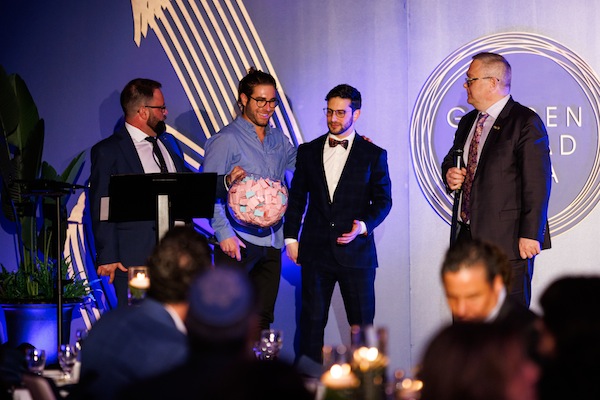
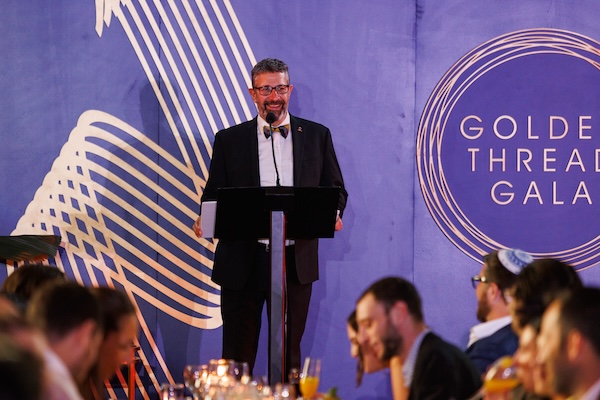
King David High School principal Russ Klein at the school’s 2023 Golden Thread Gala fundraiser. About to retire, this year’s event will celebrate his 16 years of service. (photo from  KDHS)

Russ Klein stepped into the role of head of school at King David High School for a two-year temporary stopgap when Perry Seidelman retired in 2008. This June, he retires after 16 years at the helm.

“This job has just been a gift,” Klein said, before clarifying: “It hasn’t been a job.”

Klein was a vice-principal at Prince of Wales Secondary, in the Vancouver public school system, and was on track to become a principal when the position at KDHS opened. One of the teachers at PW was on the search committee to hire the new King David head of school and asked Klein – hounded might be a more appropriate term – to consider the role.

“I told him a number of times, using choice language, what I thought of that idea,” Klein recounted recently in his corner office at the school.

Finally, Klein consented to meet the search committee’s director, who convinced him to tour the school. He was suddenly interested.

Klein’s superiors at the Vancouver School Board thought a two-year stint as principal at an independent school would be good experience before returning to the public system, and a deal was struck.

“I thought I was in and out,” he said. “I thought I was coming because they needed someone. They knew I had a two-year contract. That’s what I signed.”

The King David experience, though, changed his life.

“When the Vancouver School Board invited me back to be a principal at one of our local Vancouver schools, I had to think long and hard about it and I realized I didn’t want to leave,” said Klein. “I had joined a community that was so different than anything I had experienced before. 

“In this job, I found a community that I didn’t know I had,” he said. “That was beyond special. I really do think of this job, this position really, as a gift.”

Klein, who was divorced, found not only professional fulfilment at King David, but personal, too. At the school, he met Deborah Youngson, a King David parent, and they have been together for 13 years.

“Deborah is the gift that keeps on giving,” he said. “She is just simply unbelievable. She has managed to help me through the highs and the lows of this job because I could not have done it on my own. Believe it or not, it may be a small school and it may be a small Jewish community, but there’s a lot of pressure that one feels and trying to look like the pressure isn’t impacting you when it really is, is not always so easy. But having a person who understands and is supportive made the biggest difference in the world.”

There are many tangible and intangible measures of success in the education field. The year Klein started, the Grade 8 incoming class had 18 students. This year’s Grade 8 intake was 65. Total school population has risen to 270 from fewer than 140.

“That’s very pleasing for all of us because the whole goal is to provide a Jewish education for as many Jewish students as we can,” he said. “That’s the mission.”

As the only Jewish high school in town, King David has an obligation to reach the widest swath possible, he said.

“We need to be able to provide as much of an education as we can from secular to, let’s say, a more traditional family,” Klein said, noting they use the term pluralistic Jewish school. “We also describe ourselves as a community school. We are open to everyone. We want everyone to be here. We are not a religious school – I will just clarify that with people – but we are a faith-based school.”

Among the advances during Klein’s tenure has been the solidifying of the Judaics department and the requirement for all students to participate in that component. He cites as a point of pride the annual Grade 8 trip to Israel – though global events have hampered that tradition in recent years.

Taking Grade 8s to Israel is rare, he said, as most Jewish schools in North America wait until students are a bit older. Klein thinks getting kids to Israel as early as possible is invaluable.

Dorin Eilon-Heiber, the school’s Hebrew coordinator and Judaic studies teacher, organizes the Israel trip and she and Klein have now accompanied more than 500 students on the journey.

“That’s probably one of the biggest satisfactions I have,” he said, laughing that it’s hardly a vacation. “But it was a privilege.”

The school had previously taken students on Israel trips but when Klein arrived they began taking the Grade 8s.

“It was considered young and we even had pushback here in taking them [at that age],” Klein acknowledged. However, the impact on the students throughout their high school experience is profound, he said. “I would ask [students], why do you come to a Jewish day school? And the kids don’t know. To be honest, many of them know they’re Jewish, [but] they’ve never been to Israel, they don’t know anything about Israel. My goal was to take them in Grade 8, let them fall in love with Israel and – you know how teenagers are, puppy love, etc. You go to Israel in Grade 8 and it is one of the most special moments you have in your life. We take them to meet Israelis, to spend time in Israeli homes and, literally, they fall in love.

“And then they have four more years to understand why they are actually at a Jewish school or why they’re learning Hebrew or why the history that they are learning is meaningful,” he said. “I just think it changes the conversation for them.”

Then worldwide events intervened. COVID prevented the annual excursion in 2020, 2021 and 2022. By 2023, the only students who had been on the school trip to Israel were in Grade 12. “So, last year, we were able to organize with our Israeli sister school, Har Vagai, two trips,” said Klein. “We took one in October with our Grade 10 students and we took one in March with our Grade 11 students, trying to catch up.”

Doing two trips was too stressful on the school and stressful on the Israeli hosts. “So, we decided at that point that this year we would move the trip to Grade 10 because we couldn’t catch up to get back to Grade 8,” he said.

There were plans to take the students just after Pesach this year. “And then, of course, Oct. 7 happened and we’re not going to Israel in Grade 10 this year,” Klein said. The sister school, located just outside the Vancouver partnership community of Kiryat Shemona, in the Galilee Panhandle, is mostly evacuated due to attacks from Hezbollah in southern Lebanon.

“They are all in hotels and other places and it’s a terrible situation,” said Klein. “Dorin and myself and our spouses are heading to Israel in a few weeks and we’re going to visit our sister school, take them our love and presents, and we’re also going to take our alumni in Tel Aviv and Jerusalem out for dinner, offer them our love and support and just say, hey, we’re here with you.”

Klein credits the entire KDHS team for everything he has accomplished over 16 years, but especially for stepping up during COVID.

Managing education during the pandemic may have been easier for independent schools, being able to navigate separate from a massive bureaucracy, said Klein. Within two days of shutting down in March 2020, King David classes were completely online. Unlike public schools, students were back in classes, with extensive protocols, at the beginning of June. 

In addition to the immediate issues of a deadly pandemic, there have been conflicting ideas about vaccines, masks and the broader needs and solutions in dealing with it. Klein credits parents and staff with superb resilience and patience.

There was a loss, though, of some of the social factors. Relationships between school staff and parents were less robust than before the pandemic simply because face-to-face contact was reduced, he said.

COVID has not been the only difficult time. 

“The lows are tragic moments, when alumni passed, parents passed,” he said. “Of course, most recently, with the loss of Ben Mizrachi in Israel at the Nova Music Festival [on Oct. 7]. Those are really hard, especially to try and lead when you are feeling as heartbroken as everybody else. Those lows are pretty clear.”

Klein calls the past 16 years “the most meaningful in my life,” bringing him back into a community he had mostly left behind. 

“I went to Talmud Torah [elementary school], I was part of the Jewish community in Vancouver. I had my bar mitzvah at the Beth Israel and, then, like a lot of people of my generation, I did not participate,” he said. “I went to Israel in my 20s a couple of times, spent time on kibbutzim and had that experience and fell in love with Israel, but I wasn’t living any religious life or any traditional life whatsoever. When I came to the school, my whole life changed, and I had community and that was a gift.”

As for retirement, Klein has planned not to plan.

“Very intentionally, I am not making a plan,” he said. “I’ve got tension and stress that needs to ooze out of me and it’s going to take a period of time for me to get to know myself again in a different way, without being in a position, to be able to feel relaxed and to not worry every time my phone pings.”

When school reconvenes in September, he and Youngson will be on their way to London to board a cruise to Iceland. Beyond that, he has only one commitment.

Klein’s father, Emerich, who passed away last year, was a survivor of Auschwitz.

“I will totally offer my services to VHEC [the Vancouver Holocaust Education Centre] to see if I can do some storytelling for them so I can bring that message,” said Klein. “But that is actually the only thing that I have thought I will definitely want to offer my services for.”

Diane Friedman, co-chair of the King David board, lauds Klein’s 16 years of accomplishments.

“Russ has overseen the transformation of King David into a strong, lively and inclusive Jewish high school,” Friedman said.

She credited Klein, and the King David team during his tenure, with adding an accelerated math and science program, annual school retreats, and an outdoor education program. 

“Russ also built up the Judaics program, making it compulsory for all students with no exceptions – it is who we are – focusing on service and volunteerism,” she said. “Russ recognizes that, while our students’ academic achievements are noteworthy, student achievement is so much more than academic marks.”

Under Klein’s leadership, Friedman noted, King David also became a Canadian Accredited Independent Schools member school, which attests that the institution follows national standards and best practices.

“Russ has been a true guiding light for King David,” she said. “He exemplifies the principles and traditions of Judaism, with a sense of purpose, fairness and kindness. Russ has fostered unity and belonging to a point where the King David community is a family … everyone says so, starting with the students and including staff and families. Russ has an open-door policy and strives to create an environment where every student feels welcome and valued.”

Friedman acknowledged the support the school has received from the Diamond Foundation, which owns the land on which KDHS sits and helped fund renovations and the addition of custom modular units on the campus during Klein’s tenure. 

While Klein is set to retire before the dramatic development of JWest breaks ground – a project that will ultimately see the school move into the new community hub on the site of the Jewish Community Centre of Greater Vancouver – Friedman credits Klein for collaborating on that project to ensure the long-term stability of the school.

“While seeing Russ off to retirement is bittersweet, we are excited for the future of King David and we look forward to welcoming Dr. Seth Goldsweig as our new head of school this summer,” said Friedman.

Klein’s years of service will be the focus of celebration at the Golden Thread Gala May 22. Information and tickets are at goldenthreadgala.com. 

Rallies help keep hope alive

Jewish Federation of Greater Vancouver chief executive officer Ezra Shanken addresses those who gathered at the Vancouver Art Gallery Jan. 14. (photo by Pat Johnson)

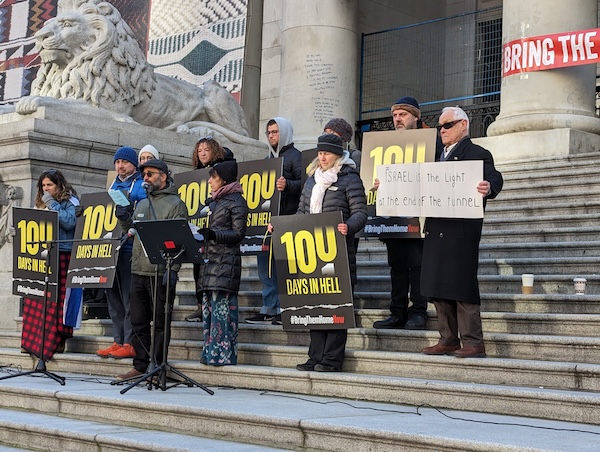
Vancouverites gathered Jan. 14 to mark the 100th day since the Oct. 7 terror attacks and to demand the release of hostages. The weekly vigils – which have taken place since the day after the attacks with the exception only of two weeks during the December holidays – continue to gather hundreds, with police escorts accompanying marchers through downtown streets after speeches outside the Vancouver Art Gallery.

“This is the moment for leaders of the world to take a stand against terrorism, to call on Hamas to release the hostages,” said event organizer Daphna Kedem. “Where are you, world leaders? You stay silent while girls are held in tunnels and Hamas are abusing women of all ages. Where are you? [There are] 136 hostages: 17 women, two children, 15 men and women over the age of 65, 94 men and youngsters, eight foreigners. We will not rest until they are all back.”

Kathryn Zemliya spoke of the commitment she made to Israel when she became a Jew by choice 17 years ago.

“Israel is the Jewish homeland,” she said. “Israel is also the birthplace and source of our Jewish faith. Our religious holidays reflect all the seasonal changes in the state of Israel and we celebrate those throughout the year.”

Her commitment to Israel, she said, is also a very personal one. 

“Israel is one of a very few handful of Middle Eastern countries where people are not punished as criminals simply because of their sexual orientation or gender identity,” said Zemliya. “For me, this is tremendously important. There are lots of places in the world where I could not travel with my family, where I could not travel with my wife, but I know that I would always be welcomed in Israel.”

She called for justice and defined what that justice would look like.

“Justice requires that we listen to and believe those who have given testimony of rape, brutality and torture that they have experienced or witnessed at the hands of terrorists,” she said. “Justice requires that we recognize and care for those who have been displaced from their homes due to conflict on all fronts in Israel because the war is not happening just in Gaza. Justice requires that we recognize and care for those who have lost family members, who have been traumatized and who, because of their life circumstances, are retraumatized daily by this terror. My hope is that we will see this justice soon and in our time, that is what we pray for.”

Rabbi Hannah Dresner, senior rabbi at Or Shalom Synagogue, and Rabbi Arik Labowitz, assistant rabbi, addressed the crowd.

“We are here to console one another through the power of gathering in such a difficult time,” said Dresner. She noted that the week’s Torah portion featured the demand by the Israelites to the tyrant of their time to let their people go. “We, likewise, are commanded by everything we know to be decent, to demand of the tyrant of our time, let our people go.”

Labowitz spoke of “waves of grief, fear and deep concern for the existential realities of our precious home in the land of Israel.”

“We are all heartbroken by the loss of life, the ever-deepening chasm and the generations of repair that will be required to heal from this moment in our shared history,” he said. “We know that the Jewish people have a heart that is bigger than any malicious attempts against us. The love and support that has come together to repair the fabric of Israeli society, of our local communities and of each of our hearts, is made up of the strength whose origin is in the plight of our ancestors to be free people in a land of our own, a land where our people were sovereign for centuries and a land that we returned to after 2,000 years of exile.”

photo - Rabbi Arik Labowitz, assistant rabbi of Or Shalom, standing next to his colleague, Rabbi Hannah Dresner, the congregation’s senior rabbi. The two spoke at the Jan. 14 rally marking 100 days since Oct. 7
Rabbi Arik Labowitz, assistant rabbi of Or Shalom, standing next to his colleague, Rabbi Hannah Dresner, the congregation’s senior rabbi. The two spoke at the Jan. 14 rally marking 100 days since Oct. 7. (photo by Pat Johnson)

Adi Keidar, who moved to Vancouver from Israel in 2000, shared the lesson she has learned since Oct. 7.

“Life, I used to think, matters to all,” she said. “But these past 100 days, I am sad to say, I’m wrong.”

Evil exists, she said, but must not be allowed to be the dominant voice. 

Ezra Shanken, chief executive officer of the Jewish Federation of Greater Vancouver, acknowledging the day’s below-freezing temperatures, said of the hostages: “The least we can do is stand here in the cold if they live in the cold depths of the tunnels.

“Let them know that, even in the coldest days of the year, we will stand out here and we will stand with them because we know that they need it,” he said, urging attendees to “keep showing up.”

Kedem, who has organized the events week after week, read aloud the names of the 136 hostages.

107 days

A week later, the King David High School community was front and centre at the Jan. 21 rally. Students of the Jewish school sang and spoke at the gathering, which ended in a downpour of rain as the group marched through city streets.

“You’re a link in a chain that has been growing stronger for thousands of years,” event organizer Daphna Kedem told the students.

Erica Forman, a 2022 alumna of King David, and brother Max Forman, a Grade 12 student, spoke of the strength they gathered during this time of unprecedented antisemitism from their respective communities at the University of British Columbia Hillel and at King David.

Rutie Mizrahi, parent of a Grade 12 student, spoke of her uncle and aunt, Oded and Yocheved Lifshitz, who were abducted from their home in Kibbutz Nir Oz Oct. 7. Yocheved, 85, was among the first hostages released, after 17 days in captivity, because her captors believed she was near death.

The captors underestimated her aunt, Mizrahi said, and she has survived, despite arriving back in Israel appearing to be about half the weight she was when kidnapped. Yocheved had been rolled in a carpet and driven away on a motorcycle, but not before she saw her 83-year-old husband being savagely beaten outside their home. She did not believe he could have survived, but another hostage, freed later, confirmed that Oded was alive in Gaza but, without his blood pressure medication, had repeatedly fainted and was then taken to a hospital. 

“The odds that we will see him back alive are close to zero,” Mizrahi said.

King David’s head of school Russ Klein said he is grateful his father, Emerich Klein, a Holocaust survivor who passed away earlier in 2023, is not witnessing the hatred in the world since Oct. 7.

“He instilled in us the need for Israel,” the principal said. “Only Jews, he said, would take care of Jews. I spent much of my time growing up not believing him. As I found with so many things as I got older, I learned my father was right.”

Klein called the school assembly on Oct. 10, when students and faculty gathered to mourn the Hamas murder of alumnus Ben Mizrachi, 22, and the other victims of the pogrom, the hardest moment of his career.

He urged people of all ages to inform themselves of facts to better engage in the discussion around events in Israel and Gaza, specifically directing attendees to resources released recently by the Jewish Federation of Greater Vancouver, an online toolkit called “The Power of One” and a messaging guide called “Real Peace Now.” Both are available at jewishvancouver.com. 

KDHS chai celebration

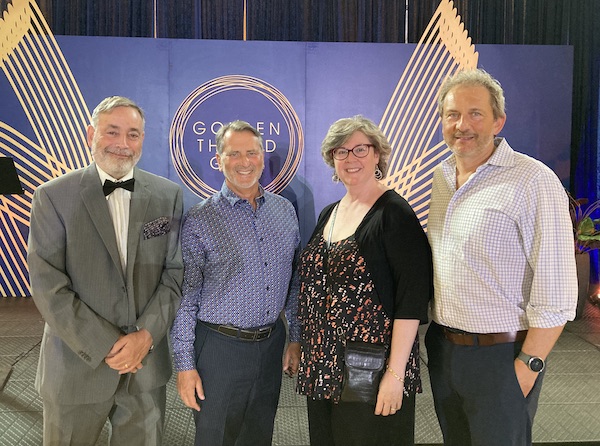
Left to right: Jeff Ross and Stephen Kaye, King David High School co-presidents in 2006, and Diane Friedman and Alain Guez, this year’s co-presidents. (photo from KDHS)

“At King David, Jewish memory and education intersect, creating a unique and powerful learning experience that prepares our students for a lifetime of meaning and purpose,” said King David High School board co-president Alain Guez in his closing remarks at the school’s Golden Thread Gala May 18.

The gala is KDHS’s primary fundraising event of the year, and more than 300 people filled the ballroom at Congregation Beth Israel, including some 50 King David alumni, to celebrate the school’s 18 years in its current building, at Willow Street and 41st Avenue. The school itself is double chai (36) years old, its origins being found in Maimonides Secondary School, which opened in September 1987.

“We would not be here today if Maimonides … had not started us on our path, our derech, to where we are now,” said head of school Russ Klein in his opening remarks.

“This evening is to celebrate what our community has built together,” he said. “The Diamond Foundation, who support so many of our community efforts, made King David possible with their generous support, belief in our importance, and their strong Jewish values.”

Rabbi Stephen Berger, head of Judaic studies at KDHS, noted that the event was taking place on erev Yom Yerushalayim. He compared Yerushalayim – “a holy place for all people, all people can worship G-d in this one place” – to KDHS, in that there are many different Jewish schools in Metro Vancouver but only one high school, and this one high school has to serve everybody across the religious and cultural spectrum. “We don’t always get it right, but it is a place where we can try, and respect and show love to everybody,” he said.

Event co-chairs Heidi Seidman and Sherri Wise said a few words about the school, as well. “It is important to note,” said Seidman, “that not one student is left behind and, when you look around the room tonight, you are all part of the village that makes that possible.”

As auctioneer, Fred Lee – who is a regular contributor to CBC, the Province, Boulevard and Vancouver Magazine – stressed this idea. He spoke about the Jewish community and the importance of the high school. He also helped raise funds that will go towards the school’s programs and students. There was a silent auction, a 50/50 draw and other opportunities to donate.

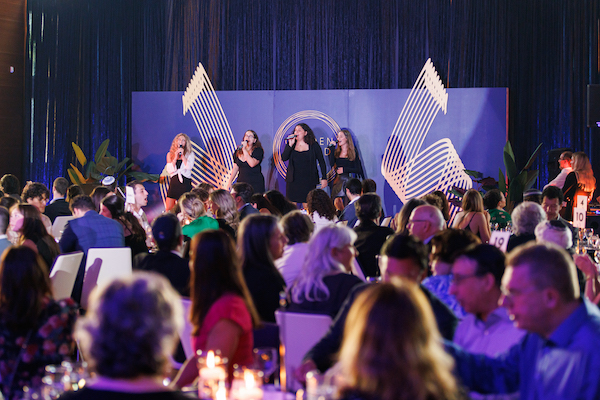
photo - Throughout the Golden Thread Gala, there were musical performances
Throughout the Golden Thread Gala, there were musical performances. (photo from KDHS)

The gala featured panelists Stephen Kaye, and Jeff Ross and Reisa Schwartzman, who were integral to the transition of the school from Maimonides to King David, and for taking the school from the portables it occupied on Baillie Street to having its own building on Willow. They were introduced in a video by their respective children, David Kaye and Zachary Ross, graduates of the inaugural KDHS Class of 2006.

Stephen Kaye came to Canada from South Africa, where there is a network of Jewish day schools called King David Schools. He described himself as “very passionate about Jewish education” and said, “The feedback we got from the community was that, if we could show enough commitment from parents to send their kids to a Jewish high school, there would be support from the community.” It was a hard sell, he said, but then the Diamonds bought the land at Willow and 41st.

Stephen and Sandy Kaye shlepped three kids from North Vancouver to King David in Vancouver, noted Klein, who emceed the panel discussion.

Ross spoke of studies showing that kids who have gone to a Jewish high school are more Jewishly knowledgeable and involved. And yet, he said that, in the beginning, there was almost a feeling that you were sacrificing your children to the experiment of a new high school, but that didn’t turn out to be the case. Ross gave Rabbi Mordechai Feuerstein, a co-founder of Maimonides, kudos for his efforts to keep the school going.

When the school was in “the shack” (portables) on Baillie Street, said Schwartzman, there were fewer than 60 kids and now there are more than 270. Back when she was helping bring KDHS into existence, she said she was confident this growth would happen, based on a survey that was conducted at Vancouver Talmud Torah, which would be the main feeder school into the high school. She was president of VTT at the time, and the survey of parents showed that about 50% of the kids from VTT would go to a Jewish high school if there were one.

Quality education was important to everyone, said Schwartzman, and one of the things the group behind KDHS did to ensure quality was to bring Perry Seidelman in as principal. Seidelman, who had some 30 years’ experience in teaching and administration at the time, had been contemplating retirement, but took on the principalship and held the position until 2008; he was succeeded by Klein.

In a video that featured Gordon and Leslie Diamond and their daughter Jill Diamond, as well as Class of 2023 students talking about how the school has positively impacted them, the Diamonds spoke of how proud they were of KDHS, its students, staff, and all the people who have given it its “personality” and contributed to its success. Calling the school “a labour of love for the Diamond Foundation,” Jill Diamond said, “And the most wonderful thing about King David is that it is teaching the Jewish values of tikkun olam, of chesed, of mitzvot and of tzedakah to the next generation of leaders of our community.”

Such has been the growth of the school that it added a modular unit last year, the building of which was funded by the Diamond Foundation. In her remarks with Guez, KDHS board co-president Diane Friedman spoke about how the addition is affectionately called the school’s “East Campus,” and thanked the foundation, as well as the donors who filled the modular with state-of-the art equipment, furniture and technology.

The evening came to a close with Klein and Seidelman. The former principal said he had worked at many schools before King David, and that he liked all of them – but he “loved King David.” He said he felt very proud as he looked around the room.

The gala also featured, under the direction of music teacher Johnny Seguin, the KDHS jazz band, who played at the cocktail reception – Luca Jeffery, Max Kimel, Jesse Millman and Nikki Wiseman – and performances throughout the night by singers Ella Ankenman, Kailey Bressler, Rachel Gerber, Mhairi Hemingson and Nikki Wiseman, with choreography credit given to Shai Rubin.

Gala committee members were Cyndi Ankenman, Dalia Bressler, Laura Feldman, Andrea Foxman, Nicole Ginsberg, Margaret Hemingson, Anna Herman, Ruth Jankelowitz, Joelly Simkin and Annie Simpson. Other volunteers were Lina Chernov, Kim Fisher, Jessica Forman, Simon Karsyente, Matilda Rosman Levsky, Melina Baum Singer, Gaenor Vaida, Jacqueline Wener and King David students Danielle Agulyansky, Eden Almog, Ali Fadida, Tamir Gini and Yuli Kabazo.

KDHS hits all the right notes

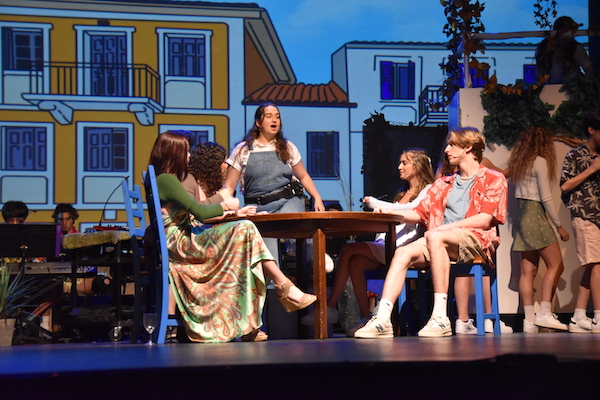
Rachel Gerber, playing Donna Sheridan, performing “Money, Money, Money” in King David High School’s production of Mamma Mia! (photo from KDHS)

High school theatre programs have the power to unite a student body. At King David High School, community values are inseparable from the student experience, and their recent production of Mamma Mia! May 3-4 was a captivating demonstration of exactly that.

Mamma Mia! follows a young bride’s search for her birth father, leading her to invite three of her mother’s former lovers to her wedding. It is a tale of love, friendship and family, told through the beloved hits of the iconic ABBA. I was lucky enough to see the King David High School production of the show on its sold-out closing night May 4. The audience was brought to its feet by the final song, “Waterloo.”

Staging a musical such as Mamma Mia! requires teamwork and camaraderie. The show largely relies on its ensemble and King David’s ensemble and principal actors seamlessly collaborated in their singing, dancing and acting. Several of the actors agreed that the most meaningful part of the process was the cast coming together over the course of rehearsals and the performances.

The cast featured students from grades 8 to 12. The on-stage band, led by Johnny Seguin, was professional and impressive, providing a soulful and steady backbone for the actors. With an electric musical score, a heart-warming plot and countless laughs, any theatre’s take on Mamma Mia! is sure to delight its audience, and this production was no exception.

The graduating seniors of King David claimed the stage in roles that showcased their respective talents. The curtains rose as Kailey Bressler, playing Sophie Sheridan, enchanted the audience with an angelic rendition of “I Have a Dream.” Bressler – who, full disclosure, is my sister – portrayed Sophie with a balance of sweetness and confidence, accompanied by her breathtaking voice. While I did not see Mhairi Hemingson’s portrayal of Sophie the day before, she earned herself rave reviews – I heard she gave a genuine and graceful performance.

The introduction of Sophie’s mother, Donna Sheridan, and the Dynamos sent laughter and excitement throughout the audience. Nikki Wiseman brought energy and humour to the character of Rosie, skilfully counterbalanced by Kiera Katz’s poised and classy portrayal of Tanya. Both Wiseman and Katz said that a memorable part of the rehearsal period was developing the dynamic between their characters, and their efforts paid off, eliciting roaring laughter with each interaction. Completing the trio was Rachel Gerber’s portrayal of the matriarch, Donna. Gerber’s performance emanated confidence, energy and depth, bringing some to tears with her rendition of “The Winner Takes It All.”

The leading male characters of the show – Sophie’s three possible dads – also delivered heartfelt and vibrant performances. Shai Rubin’s Sam was dignified and upbeat. Ori Haber, who played Harry, shared that his favourite part of rehearsals was crafting the intricate interactions among the dads, who happen to be his real-life best friends. The actors’ friendship translated on stage, especially with the masterful comedic timing of Yair Cohen, playing Bill. Another standout was Jesse Millman’s exuberant stage presence as Sophie’s fiancé, Sky.

As King David prepares to send off its graduating class, Mamma Mia! proved to be the ideal narrative for its seniors. The story captures the journey of navigating unique paths while having the comfort of community to fall back on. It is about growing up and self-acceptance in an ever-changing world. Gerber and Bressler’s rendition of “Slipping Through My Fingers” perfectly captured the emotional core of the story – it was an emotional moment for the families of the graduating class, as well.

With their talent and joy, this remarkable cast and crew made Mamma Mia! a pleasure to watch, and a beautiful testament to the strength of King David’s community.

Alisa Bressler is a fourth-year student at Queen’s University in Kingston, Ont. She is an avid reader and writer, and the online director of the arts and culture publication MUSE Magazine. Bressler is a member of the Vancouver Jewish community, and the inaugural Baila Lazarus Jewish Journalism Intern.

KDHS gala coming soon

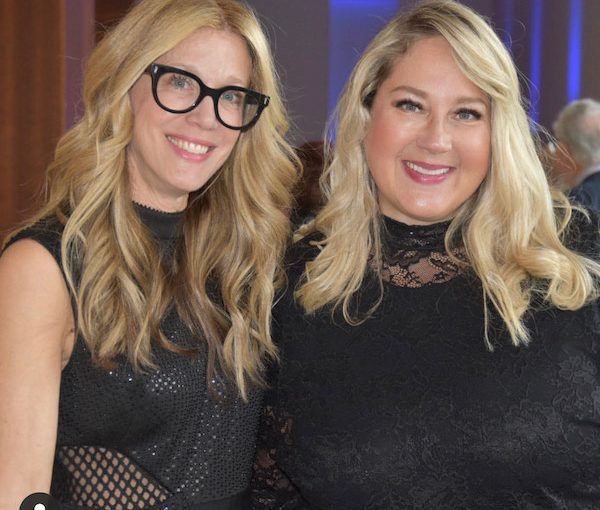
King David High School Golden Thread Gala co-chairs Heidi Seidman, left, and Sherri Wise. (photo from KDHS)

Heidi Seidman and Sherri Wise are excited to be back as co-chairs of the gala, which this year takes place May 18, 6:30 p.m., at Congregation Beth Israel. Having a combined three kids at the school, they recognize that Jewish high schools provide a unique environment for students to learn about their Jewish identity, while receiving an amazing education. An emphasis on values such as tikkun olam (repairing the world), social justice, community service, instilling a sense of responsibility and commitment to making a positive impact on the world, are just a few of the amazing things students learn.

This year, the annual Golden Thread Gala fundraiser celebrates 18 years of the school on Willow Street. For 18 years, the halls of KDHS have been filled with immersive Jewish and academic learning. This education is the golden thread that weaves the past and present together, shaping the next generation of students and alumni.

The gala evening includes dinner, entertainment, photo booth, silent auction, wine wall and raffle. For tickets, visit goldenthreadgala.com.

Courtesy King David High School

Survivor breaks his silence

Emerich Klein speaks to a student following his recent talk at King David High School. (photo from KDHS)

For decades, Emerich Klein kept his story of survival during the Holocaust to himself. While raising two children in Vancouver and making a life, he shared nothing of what had happened to him after he, together with his family, was deported to Auschwitz.

After years of cajoling, Klein shared his experiences with Russ Klein, his son, who is principal of King David High School. In 2019, he also sat with interviewer Hodie Kahn and recorded almost four hours of testimony for the Vancouver Holocaust Education Centre.

On Feb. 14, with his son the principal at his side, Emerich Klein spoke of his survival story for the first time to an audience, addressing students in a Holocaust studies class. The students had viewed the recorded testimony in advance of the visit.

Klein was born in Uzhorod, Czechoslovakia, in 1930, and lived with his sister Judith and their parents Isidor and Rose on the site of the electric power plant where Isidor worked. They had a large extended family and Emerich remembers Shabbat dinners at his grandparents’ home, with throngs of cousins. His grandparents, who were very traditional, were in charge of the mikveh and his grandfather was a melamed, a teacher.

Emerich’s early childhood was largely uneventful, except for being taunted and beaten up on his way to and from school by non-Jewish kids. At one point, on the advice of a teacher, he loaded his school bag with rocks and took revenge on his tormentors. When one of the bullies dragged the police to the Kleins’ door urging assault charges, Emerich’s father explained how his son frequently returned from school bloody. The cop apologized and left. The father of the bully beat his own son – not for bullying, it would seem, but for being bested by a Jew.

While older people may have sensed the shifting social climate, for kids like Emerich, things seemed pretty good for a time. By 1941, though, Jewish businesses could operate only with an Aryan partner and so an uncle had to close his small bakery.

When Isidor was conscripted – first into the army and then, when Jews could no longer serve in the military, in a work battalion – the family’s fortunes suffered. His boss at the power plant eventually convinced authorities that he was an irreplaceable employee.

One day, a stranger showed up in town, speaking a language Emerich did not understand. The boy took the man to a rabbi and, after the rabbi shooed Emerich away, the man explained that he had escaped Poland and told the rabbi what was happening to Jews there. The man’s stories of ghettoization, forced starvation and worse was unimaginable to the Jews of Uzhorod.

Under the 1938 Munich Agreement, which British prime minister Neville Chamberlain signed with Hitler to partition Czechoslovakia, Uzhorod was returned to Hungary, to which it had belonged until the First World War. (It is now in Ukraine.) In 1944, the Nazis occupied Hungary, and things got much worse for the Jews living there. When they heard the word “ghetto,” the words of the Polish stranger who had shown up in town returned to them.

Emerich’s grandfather was stopped on the street, beaten up and had his beard cut off. Jews were ordered to report to a cordoned-off area but, because this ghetto was so small, it served mostly as a deportation area. The Kleins remained there only for a couple of days.

They were packed into railway cars, with only room to stand. One big drum served as a potable water supply and another as a toilet. Children were crying, people were moaning.

After several days – Emerich doesn’t know how long – the train stopped. People were banging on the outside of the cars and the doors were flung open. People in striped clothes screamed at them to get out. They had arrived at Auschwitz.

Once they got down off the train, the women and children were separated from the men. The old and sick were yanked across the tracks and packed into big waiting trucks. Rose pushed Emerich to join the men. The boy didn’t want to let go of his mother but she screamed at him to leave. He ran and found his father.

While waiting for the next step in their processing, Emerich saw what he thought were piles of cordwood but he soon realized they were human bodies. The new arrivals were taken to a building for a cold shower, then they were shaved, doused in disinfectant and handed clothing in random sizes.

When an army officer called for metal workers, Isidor volunteered and a fellow prisoner advised Emerich to step forward or risk being separated from his father. Despite his lack of knowledge in the field, Emerich passed himself off as an apprentice. Together, the father and son were separated from the rest of the group and transported out of Auschwitz, on a train again for days, until they arrived in France.

Isidor and Emerich worked at a mine in tolerable conditions, with survival rations for a time, until they were moved again, to a salt mine in Germany. There, they were joined by 1,000 inmates from Poland and Emerich and the others learned the horrors of what was happening further east.

At the salt mine, their job was to break boulders to make gravel and then level out the ground, so concrete could be pored over it. After a time, Emerich was put on burial duty, which was less physically onerous work. A Russian prisoner assured Emerich that the war would soon be over and to keep up his strength. He would move on to factory work, cleaning the floor and cutting aluminum.

In April 1945, the workers were forced on a death march. Planes were flying so low that the prisoners could see the pilots. As the march continued, Isidor insisted he couldn’t go on, but Emerich and two of their friends stuck together and forced the father to keep moving. Eventually, they were loaded onto a train and provided food for the first time in nine days. Then, in the midst of a great commotion, the incarcerated passengers realized that the German army was in full retreat. The guards abandoned the prisoners.

Emerich and his group walked into the nearest town, which was already overrun with freed prisoners. They were put up in a German army base that had been repurposed as a repatriation centre. Tables had been set up for each country and people registered their names and hometowns.

Emerich and Isidor eventually made it back to Uzhorod, but Emerich’s mother Rose and sister Judith never returned. All the extended relatives but two cousins were gone. Emerich spent most of the time crying.

After a few weeks, Emerich left by himself for Prague and registered with the Joint Distribution Committee, after which he was transferred to a displaced persons camp in Germany. He intended to go to Palestine with members of his youth movement, but word came that the British were halting migration.

A friend told him of an opportunity to go to Canada, so they signed up. Six months later, Emerich docked in Halifax and made his way to Toronto, where he stayed for two years. The Jewish community there was highly supportive and Emerich became an apprentice jeweler. Isidor, who in the new world would be known as Robert, and his new wife arrived during this time.

Isidor/Robert had remarried a fellow survivor from Uzhorod, who had a sibling in Chilliwack, B.C., so the family headed to the West Coast. Emerich met his wife, the Vancouver-born Jenny, in a bowling alley during a B’nai B’rith event.

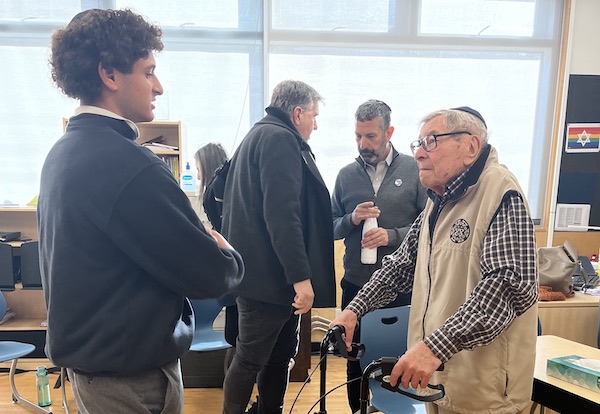
In the King David classroom last month, students asked thoughtful questions and Klein responded. His son told students they were lucky to see the elder Mr. Klein at his most talkative, as getting a sentence from the soft-spoken senior is considered by family members to be an accomplishment.

photo Russ Klein, principal of King David High School, and his father, Emerich Klein, who spoke to a KDHS class in February about his experiences during the Holocaust.
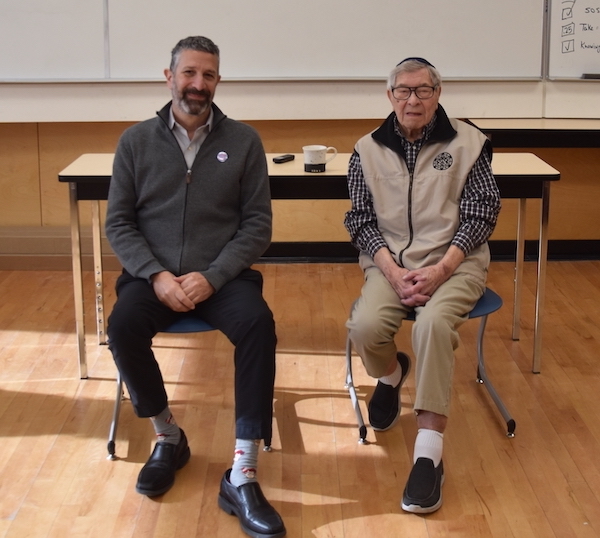
Russ Klein, principal of King David High School, and his father, Emerich Klein, who spoke to a KDHS class in February about his experiences during the Holocaust. (photo from KDHS)

A student asked if he ever lost faith that he would survive.

“Yes, definitely,” said Klein. “We lived not from week to week or day to day, but from hour to hour. Life didn’t mean a thing.”

About liberation, he said, “I felt wonderful. I felt that I’d been given a chance to live again, to be human again.”

Asked how his experiences under the Nazis and their collaborators had affected his attitudes toward religion, Klein was blunt.

“It sort of turned me against it,” he said. Nevertheless, he insisted that his two children attend Talmud Torah elementary school. Why?

“To learn about Judaism and to learn about the Holocaust,” he said, turning to his son. “I was not able to talk about it, but you had to know about it. That was the only way that I could get my children to learn about it. They couldn’t learn it through me.”

His decades-long refusal to discuss the past with his children was intended to prevent the next generation from anguish, he said.

“Why should they suffer my pain?” he asked. “That was a terrible thing to think about. Bad enough that I suffered, [why should] they suffer the same thing through me?”

Reflecting on his postwar return to Uzhorod, Klein was again straightforward.

“I went back to see who came back from the family. I spent a month, maybe six weeks there and then I left, never to return,” he said. “It was very difficult. I came up against reality there. Up until then, we did not know what happened to the rest of our family. We were separated and that’s all I knew. I had hopes that everybody was coming back. Nobody came back. So there was no point in me staying there.”

Coming to Canada was wonderful and difficult, he said.

“Wonderful just to get out of Europe – doesn’t matter where,” he said. “I just wanted to get out of that country that was soaked in Jewish blood.” But, he added: “It was difficult – difficult to get used to a new life, a new way of living, a new language, a new country. I was 17 years old. It was very difficult but you make do. You do the best you can. You adjust.”

Settling into life in Vancouver, Klein made family and stability his focus.

“A normal person would try to make a living and get themselves a better position, work your way up in life,” he said. “To me, that was not important. To me, the important thing was family. I concentrated on one thing only. Just to give you an example, all my friends went into business – I did not. They asked me, why don’t you go into business? I said … what happens if it doesn’t go right? These children cannot be hungry. I knew what hunger was. It was so important for me to stay just at a low level but make sure that my family will not go without. That was an effect of what happened to me.”

A student asked why, after all these years, Klein decided to speak.

“Because I was convinced after an awful long time that to be silent is being complicit in what happened,” he said. “You’ve got to talk about it, even if it hurts, you’ve got to talk about it.”

He is concerned by some of the political developments he sees in the world today.

“Most of humanity is very good,” he said. “There are parts of society that are not good. Let’s face it, people can be influenced very easily. If you get a charismatic person, [they] can convince people of almost anything they want.”

Burying sacred books

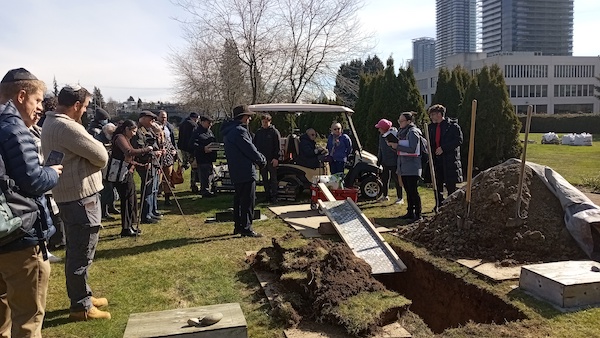
On March 9, community members gathered to bury sacred Jewish texts at Beth Israel Cemetery. (photo by Cynthia Ramsay)

According to Jewish law, no sacred texts and objects are allowed to be thrown out. This includes anything with God’s name printed on it. These texts and objects must be buried in a respectful way,” explained Rabbi Jonathan Infeld of Congregation Beth Israel in an email to the Jewish Independent about the March 9 Genizah Project ceremony at the synagogue’s cemetery. “Since a burial spot is not always convenient, people store their sacred material in a special place called a genizah until they can be buried.”

A few months ago, Infeld received a phone call from Eugene Barsky, a librarian at the University of British Columbia. Barsky was looking for a place to bury a considerable number of sacred books that were beyond repair. Infeld “immediately said yes.”

“But I wanted to do much more than just bury the materials,” the rabbi said. “I asked if he would be interested in a community-wide program, and Eugene also agreed. After that, we sought other interested parties including UBC Jewish studies, Hillel BC, King David High School, Peretz Centre and the Waldman Library.”

Representatives of these organizations were present on March 9, including students from KDHS and UBC. Infeld spoke about how sacred objects and texts not only give Jews a connection to our spiritual existence, but a social connection as well.

“And, no matter what differences we may have as a people, we are brought together within a rubric of study, of prayer, all connected to the written word,” he said. “For us, as a Jewish people, the book is sacred. For us, as a Jewish people, study is a sacred task, a sacred opportunity. And so, it only makes sense that, when we have studied, have brought a book to its conclusion, that’s literally falling apart, we don’t just throw it away, but the book, or the sacred object, has become our friend and become part of us. And so, according to Jewish tradition, we bury it.”

Barsky highlighted one of the many books being buried: a Pentateuch (the Five Books of Moses) published in Furth, Germany, in 1805. “I wish we could preserve these books, but some of them are molding,” he said. “We have a preservation lab at UBC but they reviewed them and some of them just could not be preserved.”

Barsky asked two members of the Vancouver Jewish Folk Choir – Stephen Aberle and Aurel Matte – to sing a couple of songs. The pair led “Hinei Ma Tov,” about how pleasant it is when sisters, brothers, all of us, gather together; and “Al Sh’loshah Devarim,” about the three things on which the world stands (Torah, divine service, acts of love) and by which the world endures (truth, justice, peace).

For UBC student Ellie Sherman, the burial ceremony was particularly meaningful, “as someone who spends every day reading more and more information, paying close attention to authors and narrators, and focusing on crafting assignments with correct references, to give credit where credit is due.”

She said, “The need for the genizah recognizes that the significance of words is beyond two-dimensional figures on a page, that the lessons we learn and the knowledge we gain from our books can be infinite, just as the meaning behind the words.”

Gregg Gardner, associate professor and Diamond Chair in Jewish Law and Ethics at UBC, shared how the name genizah came about. “The ancient rabbis of the first centuries tell a story about a king,” he said. “The king’s name is Munbaz. This king travels to Jerusalem, where there is drought and a famine. To provide relief, Munbaz gives away his fortune to the needy. Munbaz bizbez, Munbaz spends. His brothers confront him and demand an explanation as to why he’s giving away the family fortune…. Munbaz says that he does not bizbez the fortune … but rather he ganaz the fortune, he stores it, he saves it…. Munbaz explains that, by giving your money to charity here on earth, you do not waste your money … you save it in the world to come, in the afterlife.

“The word genizah literally means ‘storing’ and, in doing so, it can denote hiding from view,” he said. “Ancient Jewish traditions going back to the first centuries, the Second Temple period, talk about hiding many things, even the holy vessels from the Jerusalem Temple, and there are traditions in which the word ganaz is associated with storing valuables.”

Gardner said, “We are here at a cemetery, essentially taking these books out of use, laying them to rest, and yet, at the same time, going back thousands of years, the genizah has been a story not only about death, but about Jewish life.”

Richard Menkis, associate professor of medieval and modern Jewish history at UBC, picked up on this last aspect. During the planning for the burial, he said, there was a feeling towards solemnity, even mourning. But, he said, “there was a whole other sensibility that we could be bringing to it.”

He spoke of the Jews of Algeria, who would place items wherever they could around the synagogue and “several weeks later, they would carry them, the books, the other objects, in sacks. They’d escort them to the cemetery and bury them and, on that day, there would be a feast and special hymns for the occasion. There were similar customs in the community in Morocco of Meknes.

“The Sephardic Jews of Jerusalem had a custom of placing sacred objects and texts in the walls of the synagogue and, every three to seven years, would … joyously take them from the synagogues to a special section in one of the cemeteries in Jerusalem.”

The joy would come, said Menkis, from knowing that “the respect and honour that they were giving to these items would bring down upon them a variety of divine segulot, a variety of blessings. For some, it might be, we can call down rain. For others, it might be to prevent a plague.”

Menkis said, “I embrace the Genizah Project as the moral opposite of a horrible feature of modern life – the book burning. While the book burning denigrates ideas and discussion, the genizah shows reverence for ideals and aspirations.”

Those gathered were reminded of this reverence by Rabbi Kylynn Cohen, senior Jewish educator of Hillel at UBC, who led the service by the gravesite. As in the burial of a human body, she said, it is up to us to do the carrying when a person – or, in this case, the books – cannot go forth themselves.

Everyone helped transport the books from the chapel to the gravesite. Maiya Letourneau, head librarian of the Waldman Library, held up a book with gold embossing, another with lace embroidery. She said, “When we’re thinking about the memories that books create and the importance that they have in our lives, as a librarian, it can be really, really hard to take a book out of the collection, but it’s part of maintaining a healthy library, it’s part of making sure the library is useful for years to come, and it’s just an important part of what we do.”

After those gathered recited the Kaddish d’Rabbanan, the prayer that is said whenever a minyan of Jews finishes studying, Rabbi Stephen Berger, head of Judaic studies at KDHS, spoke about the class he brought to the ceremony, which has been studying Malachi, the Book of Kings. “It’s not just that we study to know,” he said. “The studying itself, opening the book and learning the book is a religious act in Judaism. And that’s why we treat it so carefully and so succinctly and sanctify it…. All these acts [serve to remind us] this is who we are, and we should live up to the title of the People of the Book.”

BI Rabbi Adam Stein concluded the ceremony with Eitz Chayim Hi, which most congregations sing when putting the Torah scrolls back in the ark at the end of a Torah service. It describes the Torah as a tree of life.

A better understanding

King David High School’s Holocaust and Genocide Studies 12 class with Liliane Pari Umuhoza. (photo from KDHS)

On Nov. 24, King David High School Holocaust and Genocide Studies 12 teacher Anna-Mae Wiesenthal invited a guest speaker. The class had the opportunity to hear from Liliane Pari Umuhoza, a child survivor of the Rwandan genocide, who is currently doing a master’s degree at the University of British Columbia.

Hearing Umuhoza’s personal story of healing from trauma, as well as her work with other survivors of the genocide, gave our class a better understanding about how genocide affects individuals and how to help them with their personal growth. Especially interesting was hearing about her involvement with the Survivors Fund, and her process of helping women share their stories from the Rwandan genocide. Having Umuhoza speak to our class was an experience we will never forget, and that we will continue to learn from.

Emma Silber is a Grade 12 student at King David High School.

Milestones … Chief Dr. Robert Joseph, KDHS students, Zac Abelson

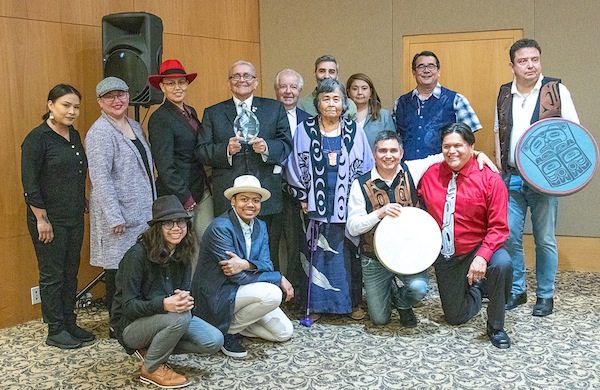
On May 25, the Centre for Israel and Jewish Affairs honoured Chief Dr. Robert Joseph (holding the sculpture) with the Victor Goldbloom Award for Outstanding Interfaith Leadership. (photo from CIJA)

On May 25, the Centre for Israel and Jewish Affairs honoured Chief Dr. Robert Joseph with the Victor Goldbloom Award for Outstanding Interfaith Leadership.

In memory of the late Dr. Victor Goldbloom, the Victor Goldbloom Award recognizes the contributions of leaders from various faith communities in advancing interfaith relations.

Joseph is a hereditary chief of the Gwawaenuk First Nation and the founder and current ambassador for Reconciliation Canada, an Indigenous organization dedicated to dialogue with multifaith and multicultural communities. He is also the former executive director of the Indian Residential School Survivors Society and a member of the National Assembly of First Nation Elders Council. As a result of his work, he has received numerous awards and recognition for bringing people of different faiths together.

Joseph is a dear friend to the Jewish community who has worked with Robbie Waisman, a Holocaust survivor, to make connections between survivors of the Holocaust and the residential schools.

On May 26, representatives from the Sikh, Roman Catholic, Evangelical, Ismaili, Muslim, Ahmadiyya, Ukrainian Catholic, Anglican, Baha’i and Black-Canadian communities, as well as Indigenous leaders, joined to celebrate Chief Joseph’s lifetime of work serving British Columbia, urging people of all faiths toward truth and reconciliation, and renewing relationships between Indigenous people and all Canadians.

***

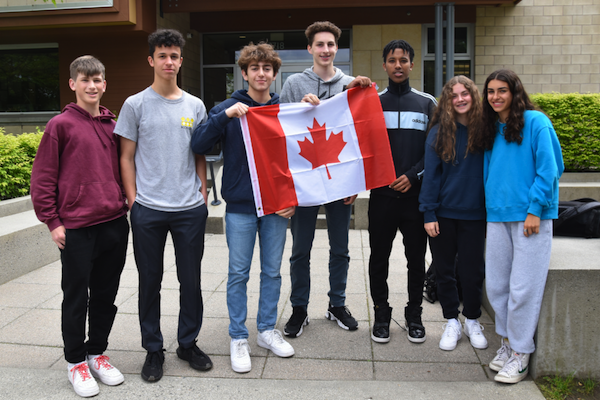
photo - Left to right: Emmett Simkin, Max Koenigbaur, Zachary Bordan, Joseph Gabay, Ezra Heayie, Sierra Brosgall and Ziv David
Left to right: Emmett Simkin, Max Koenigbaur, Zachary Bordan, Joseph Gabay, Ezra Heayie, Sierra Brosgall and Ziv David. (photo from KDHS)

The Maccabiah Games take place every four years in Israel, and the 21st Maccabiah will take place July 12-26, with some 10,000 athletes from 80 countries competing in more than 40 sports. Seven King David High School students were selected to play in a variety of sports and faculty member Matt Dichter is the coach for a basketball team. KDHS is so proud and wishes them all a successful time in Israel!

***

On May 31, Birthright Israel Excel selected 60 college students worldwide for its fellowship in business and technology, which began on June 7 and runs in Israel for 10 weeks. Forty participants are from the United States, while 20 come from Argentina, Brazil, Canada, Ecuador, France, Mexico, South Africa, Spain and the United Kingdom. Thirteen of them will be visiting Israel for the first time.

photo - Zac Abelson
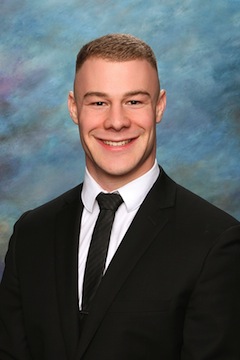
Zac Abelson (photo from Birthright Israel)

One of the participants is University of British Columbia Sauder School of Business student Zac Abelson, 21, who is majoring in commerce, with a double minor in operations and logistics, and entrepreneurship. He will be doing his internship with Deloitte.

Since 2011, the Birthright Israel Excel Fellowship has selected top students from hundreds of applicants for summer internships with leading business and tech companies in Tel Aviv. This year’s cohort features an equal number of women and men and the most first-time visitors to Israel. Their internships will be in such areas as environmental sustainability, software development, consulting, finance, venture capital, engineering, marketing, cybertech, biotech, business development and startup development. Students will intern each Israeli workweek, Sunday through Thursday, and attend an evening series of speakers from across Israeli society.

A core component is the one-on-one pairing between each Excel fellow and an Israeli, enabling the foreigners to acclimate quickly to the local culture and see the country through a more authentic lens than as typical tourists. Many peer-to-peer relationships grow into long-term friendships. Some have invested in each other’s business ventures.

Birthright Israel Excel fellows enjoy free time to explore Israel with their peers, and three weekend trips as a group bring them throughout the country: the north, typically including the Golan Heights, a winery tour and a rafting trip down the Jordan River; Jerusalem, including the Western Wall and the Machane Yehuda outdoor market; and the south, for a desert trek, a mud bath in the Dead Sea and a sunrise hike on Masada.

After their return home, the Excel fellows enter a network that provides resources for professional and personal development, Israel engagement and encouraging them as philanthropists.

Birthright Israel Excel fellows have gone on to positions at companies such as J.P. Morgan Chase, Bain & Company and Google. Others have developed strategic partnerships with Israeli companies and started their own companies, often hiring other fellows.

Gala celebrates alumni

Left to right, Alex Monchamp, Aaron Friedland, David Kaye and Howard Blank prepare to draw the 50/50 winner at King David High School’s Golden Thread Gala on May 12. (photo from KDHS)

“The reality is King David took a student who genuinely struggled, exposed me to meaningful ways to make a difference – they gave me passion and purpose, they provided me with academic rigour to realize my dreams, provided me with confidence, and then added a fundamental layer of Jewish and humanist values,” said Aaron Friedland, addressing a full house at King David High School’s Golden Thread Gala on May 12.

“And what is interesting is how unremarkable my story at King David is,” he continued. “There are simply too many grads who King David has helped to overcome the odds and flourish – and it’s the outcome of brilliant and caring educators investing in us.”

Friedland is founder and executive director of the Simbi Foundation, which helps underserved and refugee communities access education. He is a National Geographic Explorer and a PhD candidate in the field of econometrics, focusing on the interplay of economics and education. And these are only a few of the many accomplishments and projects on Friedland’s growing resumé.

He came to King David in Grade 8, he said, after having attended four different elementary schools. “I’m incredibly dyslexic,” he shared, “and there was a time when teachers told my parents I likely wouldn’t make it to university.”

But there is more to King David than preparing students for university, he added. “The world doesn’t just need more university grads. The world needs more global citizens who are passionate about creating positive impact and who have the skill set to realize their dreams.  Tonight is about celebrating a school that has developed a tried-and-true approach to developing global citizens who thrive while engaging in tikkun olam, or repairing the world. And I’m not sure if you’ve seen or have been reading the news, but the world could use a little repair.”

Mentioning COVID-19, Russia’s war on Ukraine, the challenge to Roe v Wade in the United States and generally declining literacy rates, he spoke about the need for hope. He then cited primatologist and anthropologist Jane Goodall, whom he had interviewed on Simbi Foundation’s Impact in the 21st Centurypodcast.

“Jane explained, ‘Hope isn’t just wishful thinking – it’s rolling up our sleeves and doing something about the problem.’ And she shared a few pieces of wisdom,” said Friedland.

“When we’re feeling a lack of hope, it’s important to remember just how much power we each possess.

“When we’re feeling stuck, we must think globally and act locally. She means that we must find causes we’re passionate about and start making a difference immediately,” he said. “No action is too small. Jane spoke about the addictive nature of helping. And, once we’re helping, we’re part of the solution and it feels great – so we do more of it.

“And, when I pushed Jane further, she explained that she stays hopeful for three reasons. One, our amazing human intellect. Two, the indomitable human spirit – meaning, we don’t give up. And three, the power of young people.

“Jane believes in the power of young people so strongly,” said Friedland, “that it is where she invests all of her time, specifically high schoolers, because she believes that those are the people who are going to change our planet and change the world. And, after speaking with Jane, it got me thinking about how King David is the exact breeding ground for the types of people who come out and positively impact the world and give us hope.”

A visit to KDHS by farmer J.J. Keki, a leader of Uganda’s Abayudaya Jewish community, was the spark for Friedland’s tikkun olam work and further study. The Simbi Foundation began its life as the Walking School Bus and the organization now builds solar-powered classrooms, known as BrightBoxes, in Ugandan and Indian refugee settlements, with each installation providing up to 6,000 students with access to education and electricity. The foundation’s chief operating officer and co-founder is Ran Sommer, another KDHS graduate.

The Golden Thread Gala celebrated the almost 750 students who have graduated from KDHS since it was established – and it raised $202,491 for the school.

The gala, which was held at Congregation Beth Israel, began with a piano and vocal performance by student Joseph Gabay, and also featured a song performed by students Kailey Bressler, Rachel Gerber, Mhairi Hemingson and Kiera Katz; group member Sara Bauman was unable to attend. Alex Monchamp, deputy head of school, stepped in to welcome the crowd because head of school Russ Klein couldn’t be there either, but Klein’s emcee duties were taken on by actor David Kaye, another KDHS alum. As part of his emceeing, Kaye interviewed on stage two other KDHS grads – Jordan Grubner and Ava Katz – about their time at the school and how it prepared them for the larger world.

Rabbi Stephen Berger, head of Judaic studies, did the blessing over the bread before the meal and gave a few remarks, as did gala committee co-chairs Heidi Seidman and Sherri Wise, and KDHS board members Alain Guez and Chana Charach. Howard Blank led the live auction.