From the JI archives … education

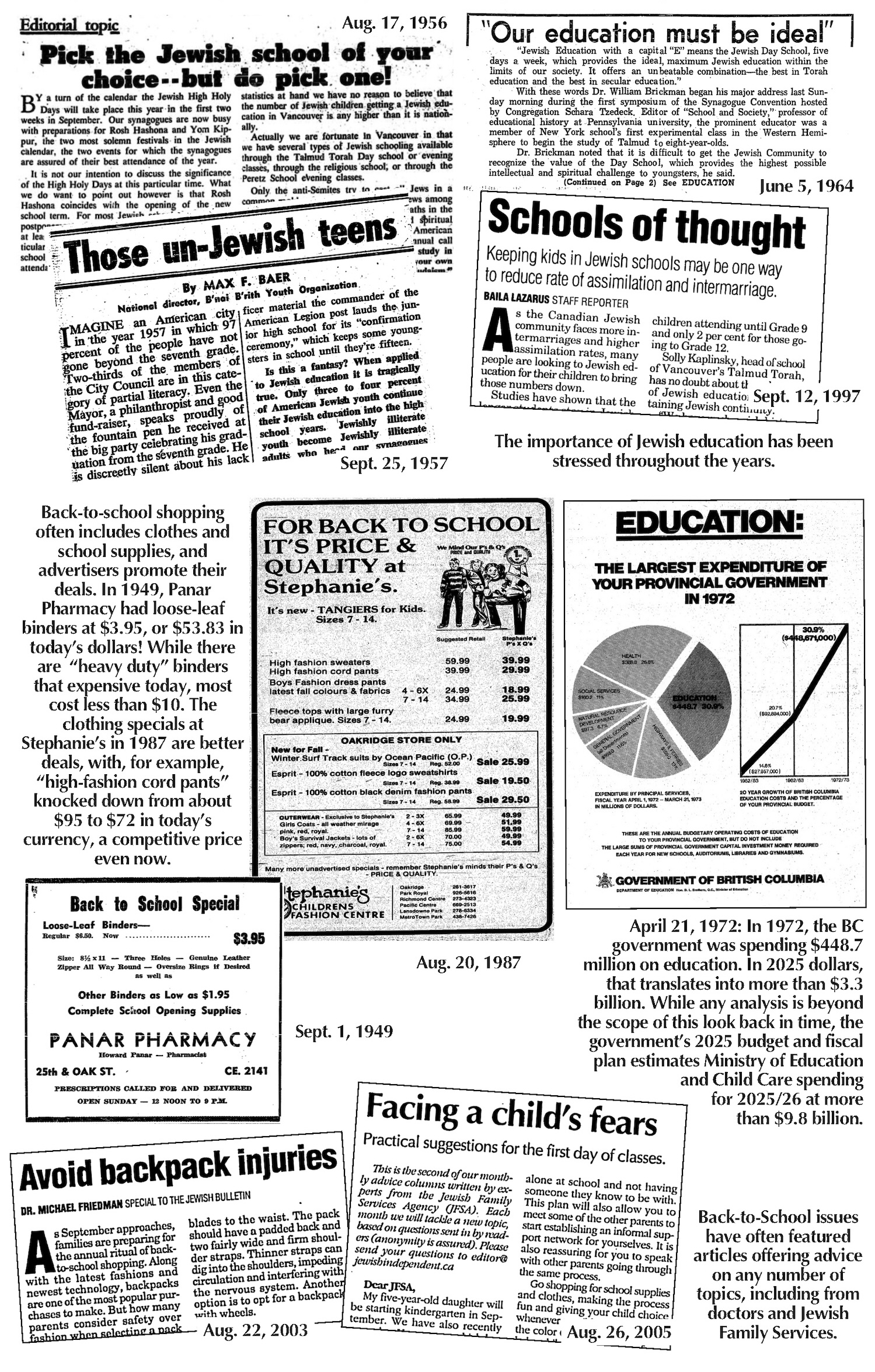
Not surprisingly – “People of the Book,” and all – education is an always-relevant topic that has been covered in the Jewish Independent / Jewish Western Bulletin. The paper seems to have steered clear of editorially supporting any particular Jewish school or type of Jewish schooling, but rather consistently stressed the need for Jewish education, especially for children, but also for youth and adults.

A 1956 editorial noted that “an estimated 50 percent of Jewish children in Canada do not get any Jewish education whatsoever.” While admitting that there were no data to suggest Vancouver fared better than other Canadian cities in this regard, it noted that there were several types of schooling available here, day school, evening classes, religious and secular options. “Only the anti-Semites try to cast all Jews in a common mold, a hateful mold,” it noted. “But the Jews among themselves have always followed diverse paths in the perpetuation of their history, ideals and spiritual heritage.” So, it concluded, “Register your child in the Jewish school of your choice. And, if your child is already enrolled, remind your friend or neighbor about enrolling his child.”

image - clippings from the JI at 95 years about education

New day school opens

Tamim Academy of Vancouver is accepting kindergarten through Grade 5 applications for the 2025-2026 school year. (photo from TAV)

Tamim Academy of Vancouver, a new Jewish day school, is accepting applications for the 2025-2026 school year.

Located at Granville and 62nd, in what was the premises of Vancouver Hebrew Academy, Tamim will offer an integrated Judaic and general studies curriculum, with small class sizes.

Vancouver Hebrew Academy had been struggling financially. Several VHA staff members will help as the transition to Tamim takes place. New staff will also be joining the team and “will undergo intensive summer training to prepare for Tamim’s unique, child-centred educational approach,” Rabbi Shmulik Yeshayahu, who sits on the board of the school, told the Independent.

Open to all Jewish families, no matter how observant, Tamim will start this fall with a kindergarten through Grade 5 program and expand to include Grade 6 in 2026 and Grade 7 in 2027. Additionally, Ner Atid, a full-day early-years program for children 5 years old and under, just launched, with the aim of providing a smooth transition into the elementary school. Spots for younger siblings in the Ner Atid daycare program, adjacent to the school, are available as well.

“Together, Tamim and Ner Atid offer a seamless educational journey rooted in tradition and ready for the future, beginning in infancy and extending through the foundational years of learning and growth,” said Yeshayahu, who is also the director the Ohel Ya’akov Community Kollel.

The school day will be from 9 a.m. to 4 p.m., with optional extracurricular activities – an hour before and/or an hour after those times – included at no extra cost. 

“Our objective is to create a school that offers a unified, child-centred and future-ready approach to Jewish education, where academic excellence and spiritual development go hand in hand,” Yeshayahu said.

“At Tamim, general and Judaic studies are integrated, not compartmentalized – reflecting the belief that students should be empowered to live as their whole selves in every environment. We educate the whole child,” he said, “nurturing intellectual growth, emotional well-being, social responsibility and Jewish identity in equal measure.”

Yeshayahu emphasized that each student at the school will have their own learning plan, developed to meet their unique strengths, interests and areas for growth. Tamim offers an educational model that is personal, and designed for the real world, he said.

According to Yeshayahu, the school will include Hebrew taught by native speakers; a values-based culture that stresses kindness, responsibility, resilience and leadership; a nutritious hot lunch; and a diverse community.

photo - Tamim Academy of Vancouver will offer an integrated Judaic and general studies curriculum, with small class sizes
Tamim Academy of Vancouver will offer an integrated Judaic and general studies curriculum, with small class sizes. (photo from TAV)

Among some of the additional program highlights will be gardening, nature exploration (hiking and wildlife observation) and art across several media. The school, with access to a large field and playground, will also feature outdoor play.  

“Tamim students don’t just learn, they flourish,” said Yeshayahu. “They leave school each day feeling capable, connected and proud of who they are.”

Yeshayahu made clear that, while the Tamim Academy is situated on the location of the former Vancouver Hebrew Academy, it is a completely new school with a distinct vision, leadership team and educational model. 

“Tamim Academy of Vancouver is part of a growing international network of schools that are reimagining Jewish education for today’s world,” he said.

“We honour the legacy of Jewish education in this city,” said Yeshayahu. “Tamim carries that commitment forward with renewed energy, a modern educational philosophy and a warm, inclusive community. We welcome Jewish families of all levels of observance and are proud to offer a space where every child is supported, celebrated and inspired to grow.”

Laen Hershler, the school’s director of education, is currently a teaching associate and mentor for pre-service teachers at the University of British Columbia. His work focuses on literacy education, creative pedagogy and inclusive teaching methods. He has previously served as a Judaic educator at King David High School, developed interactive and performance-based learning programs, and contributed to curriculum development across K-12 and post-secondary education.

Itay Reuven – a former army officer and commander, with a background in business studies – is the school’s operations and safety coordinator, and Preet Brar serves as director of student life, innovation and learning enrichment.

Khezia Gibbons is the manager of Ner Atid Early Childhood Centre. She brings more than a decade of experience in early childhood education and, most recently, worked with the Township of Langley, where she guided young learners.

Tamim Academy of Vancouver will be the third Tamim in Canada after those established in the York region north of Toronto and the Kineret Tamim Academy, which opened in Victoria last year. (See jewishindependent.ca/groundbreaking-may-26.) There are 20 such academies in North America, and others around the world. The name stems from Tomchei Temimim, the first formal yeshiva system of the Chabad-Lubavitch movement that was founded in 1897 by Rabbi Sholom DovBer Schneerson in Russia. Each student was referred to as tamim: pure, perfect or complete. The assumption is that each child is inherently holy and good, with the concept of “wholeness” being the foundation of the education model.

For more information, visit tamimvancouver.org. 

Sam Margolis has written for the Globe and Mail, the National Post, UPI and MSNBC.

Sharing a personal journey

Son of a Seeker follows Kai Balin’s search for where he fits within Judaism and Jewish community. (still from Son of a Seeker)

Kai Balin’s documentary Son of a Seeker, which screened to a sold-out Rothstein Theatre last month, is an official selection of the 2026 Vancouver Jewish Film Festival, which will take place next April.

The very personal work that follows Balin’s search for where he fits within Judaism and Jewish community will be thought-provoking for viewers, generating questions about what religion, family and belonging mean to them.

“I think my mother, sister and even my brother have a more innate sense of security in who they are and in who they are as Jews,” Balin told the Independent. “My dad and I, on the other hand, have a more complex identity. It makes it harder to fully fit in or feel completely rooted. However, I see it – and I know my dad does too – as a kind of blessing. It’s ultimately who we are. And, while it comes with plenty of challenges, being a seeker is also a beautiful way to live.”

Balin dedicates the documentary to his grandparents, who survived the Holocaust. “But survival is not the same as security,” he narrates in the film. “My father and I have spent our lives trying to understand what it means to continue.”

Having grown up in a Jewish but not religious home, where his deeper questions were not answered, Balin’s father, Jeffrey, began looking for answers elsewhere, notably, in Buddhism. And, while Balin’s mother, Jennifer Shecter, grew up in a traditional Jewish family and attended Jewish school, “bringing a strong sense of Judaism into the home wasn’t a priority, but I knew I was a Jew,” says Kai Balin in the film. “And I got to create a version of Judaism that I owned and I loved.”

The home video clips in the film highlight this love. As a child, Balin plays at being a rabbi, wants to be one when he grows up. But, over the years, he loses this connection, just as his father begins to return to Judaism. How the father and son negotiate their respective paths, while being respectful of the other’s journey, is a key aspect of the documentary.

“When I first started making Son of a Seeker, I had no idea what the title would be, or even what the story really was,” said Kai Balin. “I knew I wanted to explore Judaism and what it means to be Jewish, but I didn’t expect it to become so personal. Early on, I interviewed a few dozen Jewish people from across the spectrum on camera. But, in the end, I realized I wanted this film to be something much more intimate.

“My dad initially thought he’d just be one of many voices in the film. He didn’t expect to become such a central figure in the story. It pushed him far beyond his comfort zone, but he ultimately believed in the project and gave me his full blessing to be a part of my documentary.”

Balin’s sister, Justine, and brother, Jackson, are also in the film, his brother in the background, while his sister is featured more prominently.

“My sister was my right-hand woman throughout the entire process – I truly couldn’t have made this film without her,” said Balin. “She filmed what’s arguably the most important scene in the movie, when I’m walking through the town where our grandfather was born and raised until he was sent away to a forced labour camp and had everything taken from him and his family. My sister also spent countless hours in the editing room, helping make the tough calls about what to cut and what to keep. Without her input, the film would’ve easily been two hours long and a lot less focused.

“My whole family really stood behind me on this project,” he said. “They gave me the strength, courage and confidence to see it through.”

Balin came to filmmaking somewhat organically.

“I was studying kinesiology at Western University. After my second year, I worked on an indie film, Volition, as part of the swing crew, helping with lighting and grip. Later that summer, I was the program director at Camp Hatikvah (2017), where the videographer/photographer, Denis Lipman, brought some super cool gear…. Right before my third year, I bought a camera – and, from then on, I started dedicating less and less time to what I was actually studying, and more time learning how to shoot and edit. 

“I was running a nonprofit at school that threw club and bar events for local charities, and the first video I ever made was a recap of one of those nights,” said Balin. “I started getting more involved on campus and around the city (London, Ont.), looking for any chance to shoot videos.

“My first paid gig was filming a club event that featured a guy in a robot suit on stilts. I was also on the rugby team, so I made a few hype-up videos for them whenever I was injured (which was quite a bit). Over the last two years at my time in university, I got more invested in videography and less focused on kinesiology. I ended up shooting videos for all sorts of events and student clubs.”

After graduating, Balin pursued videography full time. Not wanting to make corporate videos, he started making a documentary about his dad’s work.

“He was a leadership development coach working mostly with heads of NGOs and social enterprises,” explained Balin. “I lined up a plan to travel to different countries, mostly in East Africa and India, to film these organizations and their leaders. I started shooting, but I didn’t have a clear direction. Eventually, I lost the passion for the project – and for filmmaking altogether. I just wanted to travel.”

It would be almost five years before Balin made another video.

“It took about three months to put My 5 Year Video Project together – I wasn’t working any other job at the time – and we held a small premiere in August 2024 with around 70 people,” he said about the film, which can be seen on YouTube.

“I didn’t expect people to be so moved by what I had created,” he said. “That experience gave me the confidence to pursue my next film project. At the time, it was just a rough idea, and I had no clue it would eventually become something so personal – and so deeply centred around my father’s story as well.”

But, for Balin, it’s the personal aspects of art, films and books that draw him in, “even if I can’t directly relate to what the creator is going through,” he said. “I remember hearing years ago, from a few directors I really respect, that you ultimately have to make the film for yourself – something you’d enjoy watching a hundred times over, and something that excites you to work on every day.

“For me, that excitement comes from sharing something personal. It’s my life, my questions, my struggles, and I find them interesting. So maybe others will too.”

As for what comes next, Balin said, “One side of me just wants to let the river flow, follow life as it comes without getting too attached to any future outcomes. But the other side of me dreams of being a famous, successful filmmaker making big-budget movies. There’s still something in me that maybe wants to be a rabbi one day as well.”

He added, “I know my relationship with Judaism will continue to evolve, but, for now, I’ve found a sense of peace. I feel like I have a steady relationship with it, and I’m much more secure in who I am as a Jew than I was when I started this film.

“These days,” Balin said, “I find myself seeking something else: my soulmate. That might even be the focus of my next documentary – exploring the journey to find ‘the one’ – if that concept even exists.” 

Two Yiddish-speaking Bluenosers

Writer Adina Horwich only met Yehuda Miklaf and his wife Maurene in Jerusalem, even though both Adina and Yehuda are from Nova Scotia. (photo by Adina Horwich)

So, this guy walks into my Yiddish group one fine Sunday in Jerusalem – this is not the beginning of a joke. In the group, we welcome anyone who is into Yiddish, with any background, and, on that day, Yehuda was introduced to us. We went around the room asking him questions. I asked where he hailed from. Little could I have anticipated his answer: Nova Scotia.

“I don’t believe it!” I said. “So do I!” Then, “From where, exactly?”

“Annapolis Valley.”

 “Oh,” I paused, thinking to myself, I’d be hard-pressed to find any Jews there. 

Later, Yehuda’s story was revealed when the teacher matched us up to work together.

Yehuda, an Esperanto speaker and aficionado, has only recently started to learn Yiddish, while I have been at it for 15 years. I started off with little but the smattering I heard as a child. Yehuda happened upon it by the by, via a friend in the hand-printing scene, where he is an active, prominent member. With the characteristic zeal that he tackles so many projects, and lots of gumption, he has taken to Yiddish very well. 

The sight and sound of us two old-time Bluenosers (nickname for Nova Scotians) hacking a chainik in Yiddish, is too precious. But, most of all, I like when Yehuda slips into the down-home accent I grew up with. That is when I really kvell.

Né Seamas Brian McClafferty, Yehuda was born in the mid-1940s to a father with Irish roots and a mother with origins in Quebec. The youngest of eight, he had an idyllic childhood, as a small-town Catholic youngster in Annapolis Royal, which today has a population of only 530.

In his last year of high school, Yehuda attended a Fransciscan seminary in upstate New York, his first foray away from home. With his fellow students, he passed a building with Hebrew letters, which intrigued him. A friend he asked about these unfamiliar markings promptly replied: “That’s just Hebrew.” Yehuda had never seen, much less met, any Jews. 

He completed his last year of high school and then spent a year of silence and meditation at the novitiate in the Adirondacks. The following year, he furthered his studies towards the priesthood, commencing a rigorous and intense program that sounds like a yeshiva govoha (Torah academy of higher learning).

Discipline and training, mostly in silence, hours of meditation and living under austere conditions, Yehuda carried on through to the second of four years. He heard a lecture about the Torah, which was demonstrated by a small model scroll, and delved deeply from then on, backed by the church’s ecumenical approach of spirituality and faith. He availed himself of the library to his heart’s content and took to reading the Hebrew Bible over and over again. He didn’t know it at the time, but his first steps towards life as an Orthodox Jew were taken, while he was encouraged to become a scholar of the “Old Testament.”

Over the four years of study, Yehuda began to have rather different ideas about how he wanted to live his life.

Returning to Canada in the mid-1960s, he spent time in Toronto and in Nova Scotia, taking road trips home to tend to his father who had taken ill. Things grew clearer.

Yehuda absorbed every mention of things Jewish. It was an emotional attachment. In 1966, after having left Christianity, he discussed his evolving beliefs with a Jewish friend, who said: “You sound more Jewish than me. I’m surprised that you haven’t converted.”

The conversion process was long but not arduous. Yehuda took a class in Toronto and eventually went to the mikvah. 

He and his wife Maurene – who he met through his roommate in Toronto – visited Israel, as tourists, for an extended vacation. They had not intended to make aliyah, but, smitten with Israel, as so many of us are, did so three years later.

After making aliyah, Yehuda had to “rinse and repeat,” so to speak, as often happens with conversion. Israeli rabbinic courts do not automatically accept even the most stringent diaspora Orthodox ones, and Yehuda had to go through it again, studying for a year and then going to the mikvah. The converting rabbi gave him the option of choosing a name and Yehuda suited him, since that’s where the word Jew comes from. Miklaf (literally, “from parchment”) was a good abbreviation of McClafferty, he thought, and could not have been more fitting for his chosen profession of printer and bookbinder.

Like most new immigrants at the time, they started out at an absorption centre and had a routine klita (absorption/integration), including Hebrew language studies at ulpan. Maurene got a job in high-tech and Yehuda opened a studio. He started out by binding the original of David Moss’s My Haggadah: The Book of Freedom, and branched out into printing.

The couple attends an Ashkenazi shul but try not to be pigeonholed as being from one background (Sephardi or Ashkenazi). Early on, Yehuda tasted some traditional Ashkenazi delicacies and learned how to make potato kugel, for which he’s now famous, along with kneidlach.

Yehuda still has two siblings in Nova Scotia and visits his longtime friends in Annapolis Royal.

Our paths from the Atlantic led us to meet in Jerusalem, where we raised our families. The Miklafs have two children and several grandkids. Their daughter was a high school friend of my daughter’s, and both women have been living in the same community, and they see each other now and again.

Ma’aseh avot siman l’banim – the deeds of the fathers are a sign for the children – or, in this case, Ma’aseh horim siman l’banot, the deeds of the parents are a sign for the daughters. 

Adina Horwich was born in Israel to Canadian parents. In 1960, the family returned to Canada, first living in Halifax, then in a Montreal suburb. In 1975, at age 17, Horwich made aliyah, and has lived mostly in the Jerusalem area. She won a Rockower Award for journalistic excellence in covering Zionism, aliyah and Israel for her article “Immigration challenges.”

Love learning, stay curious

My household’s really into learning. It doesn’t stop during the summer, when there’s no school. Even on vacations, we’re always trying to nurture our kids’ curiosity and feed our own. 

When our kids were in preschool, and just toilet-trained, we took a long trip to a friend’s northern Minnesota cottage. I say “long” because Google Maps told us it would just be a few hours across the US border. Eight hours later, we’d been slowed by the border crossing, construction and stops at every unnamed exit along a dirt road off the North Dakota highway so the kids could go to the bathroom. It was an excruciating trip. Three days later, it was just as long on the way home to Winnipeg.

Yet, we remember parts of the trip fondly. This historic family cottage contained a mostly functional pump organ, books filled with spidery copperplate handwriting and an empty fish tank. In between long play sessions in the sand by the lake, our friend created new wonders for us to explore. Using a net and years of experience, he gathered a selection of lake life into the fish tank. Once indoors, with the tank now full, the friend and my husband, two adult biology professors, casually called over the kids to investigate.

Neither adult studied lake aquatics professionally. Instead, four heads poured over fish and fauna guides from years past, discussing what they thought was in the tank. The kids made observations, and the adults’ heads bobbed as they looked and agreed. Once the science mysteries were solved, the tank got dumped back into the lake. The next day, it all happened again. 

We also visited the remains of an old gristmill, complete with a playground nearby. We then had a kite-flying break. Years later, my kids still wonder when we might ever get invited back to that magical cottage. The truth is, for the adults, it was a lot of effort: to open and clean the cottage, get and cook enough food for several days, and pack and travel there and home. This doesn’t include the many loads of laundry (toilet training!), or the lost items left in the dryer by mistake, which had to be mailed home internationally.

The “vacation” exhausted me. Still, when I put a photo background on my iPad, the obvious choice is an image of my small twins, in swim gear and floppy sun hats, playing on the rocks near the lake’s blue water. 

These summer experiences weren’t fancy or expensive. They laid the groundwork for other adventures over time. One weekend in July, we went raspberry picking at a farm about 45 minutes away from home. Now, my kids, 14, are at a day camp learning to fence, do archery and play racquetball. They came home tired but also stretched by exotic activities that they’d not considered before. To my surprise, one of them stopped multiple times to thank me for arranging these outings. Now that he’s older, he texts constantly with school friends. He sees that our experiential learning isn’t the same as others. (And I hear about this all, too, because I wouldn’t take him to the folk festival during a 10+ wildfire air quality warning, or to the shopping mall!)

We try hard to hold onto this love for learning and intellectual curiosity even if the education system can cause one to lose enthusiasm. As our family hits the milestone of high school entry, we’re in limbo. The closest public high school, where their cohorts and friends will attend, is out of catchment for our children. We’re hoping to get our sons into that nearby school, but so far have not gained access through the provincial “school of choice” legislation. Another private high school looks to be a challenging, interesting academic option, but it’s pricey. It also means giving up on the small dream of attending the closest public school with beloved classmates.

Of course, as the parent facing the school division board of trustees, I looked to Jewish text to find strength, solace and direction. In the Babylonian Talmud tractate of Avodah Zarah, Daf 19a, there’s an examination of learning Torah with many nuggets of wisdom. Rava, who lived in the 4th century CE, says, “in accordance with the statement of Rabbi Yehuda HaNasi: A person should always learn Torah from a place in the Torah that his heart desires, as it is stated: ‘But his delight is in the Torah of the Lord.’” This advice, to study what you love, feels timeless.

Rava encourages learners to gain a broad understanding of the text before returning to analyze it. Further, for those of us who study and fail to understand, Rava encourages review and repetition as helpful techniques to gain access to basic understanding.

The next tidbit is one that I hold dear. Rava quotes earlier rabbis, such as Rav Sehora and Rav Huna (3rd-century CE), who suggest learning a little bit each day, studying and reviewing, to retain more Torah and more knowledge. Rav Nahman bar Yitzhak, a contemporary of Rava’s, responds in the next paragraph (and possibly in person), saying: “I did this, as I studied little by little and regularly reviewed what I had learned, and my learning has in fact endured.”

Experience and learn it and then decipher it; work away at it, a little every day; review it to retain more knowledge. These are still basic study skills. This guidance is the same that educators use today. These are ancient and Jewish ideas – Ben Bag Bag (Pirkei Avot, Sayings of our Fathers, 5:22) says, when referring to Torah: “Turn it and turn it, for everything’s in it.”

The rabbis took an expansive view, feeling that we could gain information about just about anything in the world if we studied enough Jewish texts. This even includes the funny tale of Rav Kahana – the student who hid beneath Rav, his teacher’s bed, to “learn” from him and his wife about marital relations – which is in the talmudic tractate Berachot on page 62a. While we would see this as Peeping Tom behaviour, the student says, “Rabbi, this is Torah!” 

I’m not recommending my kids hide under anybody’s bed. I am, however, hoping they can maintain their wonder and enthusiasm about learning, wherever it takes them, a little bit each day, even when the going is difficult or there are obstacles in the way. 

Summer’s the time, no matter our ages, to explore new skills informally, from lake water studies at a cottage to fencing. Little by little, I hope we can all find joy in learning more – about the world, Judaism and one another. 

Joanne Seiff has written regularly for the Winnipeg Free Press and various Jewish publications. She is the author of three books, including From the Outside In: Jewish Post Columns 2015-2016, a collection of essays available for digital download or as a paperback from Amazon. Check her out on Instagram @yrnspinner or at joanneseiff.blogspot.com.

Omnitsky’s new place

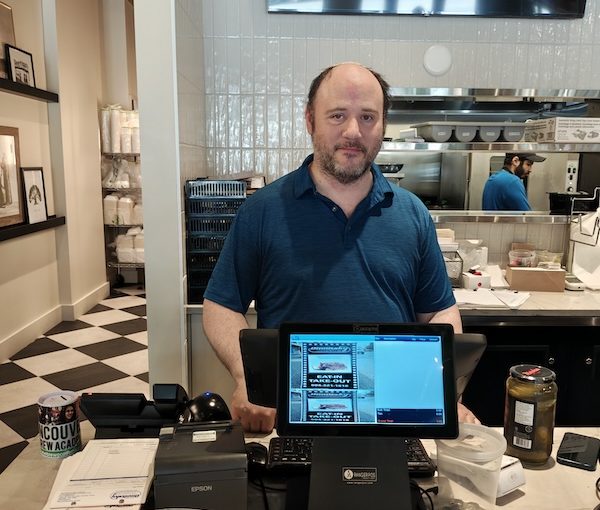
The move of Omnitsky Kosher to Fraser Street has been a positive one overall, says owner Richard Wood. (photo by  David J. Litvak)

Omnitsky Kosher recently reopened on Fraser Street in East Vancouver. Forced to move from its Oak and 41st location because of redevelopment, the deli’s owner, Richard Wood, took advantage of the situation to rebrand Vancouver’s longest operating kosher butcher and deli, which has its roots in Winnipeg’s North End.

Eppy Rappaport, who bought Omnitsky’s from William Omnitsky in 1983, brought the deli from Winnipeg to Vancouver almost 30 years ago. It’s a Canadian institution, having been established by William Omnitsky’s father, Louis, in 1910. Wood took over the business just over a year-and-a-half ago.

When the deli opened on Fraser Street two weeks before Passover, it was only selling Passover products. It’s now back in full operation, and bigger than ever.

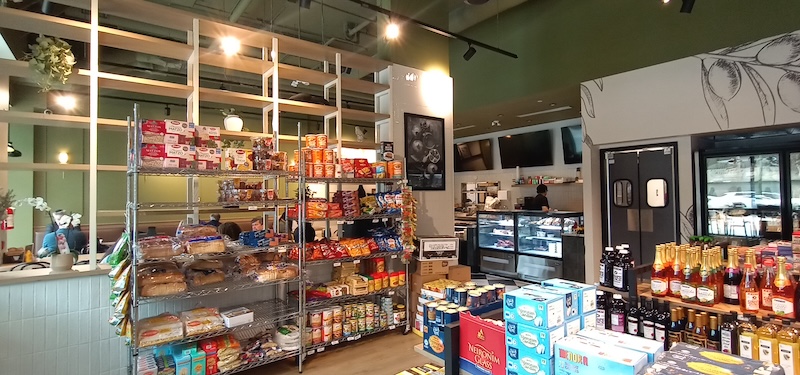
The new store is significantly larger than the old one. Divided into two sections, one half is basically a grocery store with an array of kosher products, ranging from meat, poultry and cheese, to grape juice, challahs, pickles, herring, crackers, cookies, and many more kosher items. The other half is a dining area that seats 40 to 50 people for breakfast, lunch, snacks and shmoozing.

“Everyone,” said Wood, “loves the spaciousness, the openness, the décor and the feel of the new dining area.”

He hopes that, eventually, the restaurant will be open for dinner as well, so that Jews who keep kosher “can enjoy a dinner out.”

Other than the larger dining room, Wood notes other differences between the Oak Street store and the one on Fraser: longer operating hours, additional kosher products and, in response to customer requests, more takeout meals.

Wood has started a WhatsApp group to let customers know about specials and to inform them about new products being offered, such as chicken wieners and salamis.

Omnitsky’s hosted its first event in April. The event itself was a first-ever in Vancouver: a third Passover seder, organized by Jewish Addiction Community Services Vancouver, which was led by Rabbi Joshua Corber, JACS’s director of addictions and mental health services. According to Wood, it was a rousing success that attracted more than 50 people.

Wood is open to hosting other after-hours events, like parties, book launches, poetry readings, musical performances, etc. He welcomes people’s suggestions, as he envisions keeping the restaurant open longer hours to accommodate the dinner crowd as well as bar and bat mitzvah parties.

photo - When Omnitsky’s first opened, it was only selling goods for Passover. Now, the store is offering a full selection of kosher products and the restaurant a full menu
When Omnitsky’s first opened, it was only selling goods for Passover. Now, the store is offering a full selection of kosher products and the restaurant a full menu. (photo by Cynthia Ramsay)

In addition to serving dinner on a daily basis, Wood said, “We want to offer some different menu items, like salmon or steak, to give our customers some affordable dining options, because going out for dinner is not cheap.”

Wood’s long-term plans for Omnitsky’s include employing a baker a few times a week to make bagels, pastries and other treats.

The deli is doing well in its new location, attracting new – and different – customers than it did on Oak Street.

“A majority of our clientele and regulars have returned, but we are seeing an increase in younger families coming in from the neighbourhood and younger Jewish families who are coming in for lunch on Sundays, which has been a popular day, and this is a major change from the old store,” said Wood. “In addition, we are having a broader increase in non-Jewish clientele coming in.”

This growth will require some innovative thinking to maintain.

“The challenge with the non-Jewish clientele is that the price of kosher food is substantially more expensive than non-kosher food and, therefore, some of our new non-Jewish customers in the neighbourhood find Omnitsky’s to be pricey,” said Wood.

While he is offering some value-added combos – for example, a hotdog, fries and a drink for $9.95 and a sandwich with fries and a drink for $24.95 – to make things more affordable for customers, he said, “the price of meat is something we have no control over.”   

Another challenge for Omnitsky’s is that some customers of the previous store, which was in the heart of the Jewish community, find it difficult getting to the new location. To address this issue, the deli offers free delivery on orders over $50.

Wood is open to suggestions from customers about how to improve the menu or any aspect of the store.

“I am always open to feedback either positive or negative,” he said.

While there have been some growing pains, including staffing and equipment issues, the move of Omnitsky’s to Fraser Street has been a positive one overall, said Wood, who would like his customers to see the deli, which also offers catering, as more than just a place to buy kosher food.

Jewish life “revolves around family, food and prayer,” said Wood, and he would like the Jewish community to view Omnitsky’s as a meeting place where they can shmooze, bump into their friends and be proud to be Jewish. A place where they can say “Am Yisrael chai,” have a kosher meal, do their Shabbat or holiday shopping or order takeout – even order shiva platters, which can be prepared on short notice.

“We want Omnitsky’s to be there for our customers through good times and bad times, for simchas and in times of mourning,” said Wood.

For more information on the deli, check out omnitskykosher.com or head to 3435 Fraser St. and grab a bite, something to eat in or take home. 

David J. Litvak is a prairie refugee from the North End of Winnipeg who is a freelance writer and publicist, and a mashgiach at Louis Brier Home and Hospital. His articles have been published in the Forward, Globe and Mail and Seattle Post-Intelligencer. His website is cascadiapublicity.com.

Arab Zionist recalls journey

On June 12, Rawan Osman spoke with Daniel Koren, founder and executive director of Allied Voices for Israel, which brought her to the West Coast. (photo by Pat Johnson)

Rawan Osman, among the most visible Arab advocates contesting antisemitism and anti-Israel ideology, recently brought to Vancouver a bleak overview of hate ideologies across the Middle East and North Africa – but her prognosis is hopeful.

Osman is a Syrian-born, Lebanon-raised, German-based – and soon to be Israeli – accidental activist who shared her experience going from what she said is a characteristically antisemitic Arab into an “Arab Zionist.” She spoke at Temple Sholom June 12, in conversation with Daniel Koren, founder and executive director of Allied Voices for Israel, which brought her to the West Coast.

Osman took Islamic and then Jewish studies at Heidelberg University. After Oct. 7, 2023, she founded a social media channel called Arabs Ask, to combat antisemitism in the Arab world. She is writing a book about her relationship with Judaism and Israel, and is the narrator and central figure in the documentary film Tragic Awakening, about antisemitism after Oct. 7.

“My case is unusual,” she acknowledged. “There aren’t many people born in the Arab world who support Israel.”

She recounted the story of her first encounter with a Jew. She had moved to Strasbourg, France, and found herself living in the Jewish Quarter. She had assumed that the neighbourhood’s name was like the Jewish Quarter in Beirut or Damascus – an historical designation. When she went into a grocery store on her first day there, she stumbled into a kosher grocery and saw real-life Jews for the first time.

She had a panic attack, left her purchases and belongings behind and fled to her apartment. After she recovered and returned to collect her things, she had a life-altering experience.

She made an excuse that she had forgotten her wallet but she is certain the shopkeeper knew what had happened. He asked where she was from and how long she had been in town. He helped her with her groceries and behaved like a human being, not the monster she had been told was the way of the Jew.

“He allowed me to save face and, that day, without knowing it, that gentleman converted me from an enemy to an ally,” she said. “I realized it was the first time in my life that I was sharing the same space with a Jew, the enemy, and it was the first time in my life when I asked, why is the Jew my enemy?”

Osman’s father was Sunni from Damascus and her mother was Shia from the Beqaa Valley, which is the stronghold of Hezbollah.

“I grew up in Lebanon, attending a French Catholic school,” she said. But, negotiating between her family’s dual Muslim identities and Christians in Lebanon, she chose a middle path of atheism.

“They were secular, progressive, relaxed, laid-back,” she said of her family and the broader environment in which she was raised – with one exception. “The only thing everybody hated was Israel and the Jews and the Zionists.”

She said she employs these three terms – Israeli, Jewish and Zionist – interchangeably because that is how they are used in the Arab world.

“They say, I am anti-Zionist, not antisemitic. That’s a farce,” she said. “I grew up in that part of the world and I too believed [they were different things].” 

Studying abroad and having access to uncensored information in Europe was a privilege with which she was unaccustomed. The more she explored the history of Judaism and met and interacted with Jews, the more she rejected the antisemitism with which she was raised. Eventually, she moved back to the Middle East and decided to challenge the prevailing narrative.

“After living in the Middle East for awhile, I decided, OK, it’s hopeless,” she said. “I’m going to leave. I’m going to move to Europe. And I did.”

She chose Europe because she identified with Western values, she said, and because, as one person, “what can I change?”

She opted to mind her own business in Germany. Even so, she was alarmed by what she was seeing.

She viewed the notorious gang rapes that took place in Cologne on New Year’s Eve and the early hours of 2016 as a symptom of Arab misogyny imported to Europe. What was more jarring to her was seeing herself in the place of others perpetrating hate crimes. She watched a video of a young Arab man encountering a Jew in Berlin.

“He took off his belt and he was hitting the young Jew with the metal buckle on his head,” she recounted. “This was me. I was the civilized version … I wouldn’t hit a Jew. But I had a panic attack the first time I saw a Jew.”

She did not plan to become an activist. After Oct. 7, it just happened.

“I started speaking on social media and became an accidental activist and influencer,” she said. “I thought influencers made nail designs, baking and makeup.”

She is part of a small but notable group of Arabs who are speaking out against antisemitism and other regressive realities.

“We refuse to continue to raise our children and grandchildren in a world that tolerates what happened on Oct. 7,” she said. 

It is something she could not have undertaken if her extended family did not also live abroad, she said. To be known as an activist for Jews and Israel would endanger family in the Arab world, which means even many who live in the West remain silent, she said. But those who have the freedom to do so need to join her, she contended.

Osman receives private messages from Arabs and Iranians lauding what she does. She admires the courage of those who write to her from the Middle East. For those writing from Sydney or Toronto, she has strong advice.

“Those people who are living in the comfort of Toronto or Sydney tell me, I’m proud of you, I wish I could do what you’re doing,” said Osman. “Don’t be proud of me, darling. Do it. Do it. You might lose a friend or two but you will make a thousand more.”

Osman has chosen to convert to Judaism and is making aliyah this summer.

“The thing I love most about Judaism, what’s phenomenal, is that Judaism encourages your imagination. It encourages debate. Two Jews, three opinions. This is the talmudic tradition. It encourages challenging ideas.

“Islamic ideology is exactly the opposite,” she said.

When she decided to convert to Judaism, she got pushback – from Jews.

“Jews will tell me, you have to be a Muslim Arab ally,” she said, noting that some have told her she has a more powerful voice as an outsider. “You’re missing the point. Converting to Judaism is a privilege, my privilege. It’s not my dirty secret. It is time to say, I stand for that.… Your ancestors accepted that mission not because you’re special – you are the chosen people because you accepted that mission.”

Israel is not an easy place, she acknowledged, but the dichotomy of life in the Jewish state amazes her. The Israeli who pushes in front of her in queue and steps on her toes would, conversely, take a bullet for her, she said. 

“As soon as there is an alarm, a siren, they have each other’s back,” she said. “It’s unbelievable.”

Osman ultimately is hopeful. The new Syrian president, Ahmed al-Shara, is a jihadi terrorist turned – apparently – a suit-and-tie-wearing diplomat. Some doubt his sincerity. Osman believes that young Arabs who are drawn to extremism can see his transformation and believe there is an alternative path for them as well.

A billion Muslims are not going anywhere, she said. The only resolution to what she sees as a civilizational conflict is internal reform within Islam. This is already visible in the Abraham Accords – which she is certain that Syria will join – and the small number of activists like her speaking out.

Gabriela Rosenblum, director of education with Allied Voices for Israel, welcomed the audience and thanked Dr. Neil and Michelle Pollock of Pollock Clinics for sponsoring the event. Rabbi Carey Brown, associate rabbi of Temple Sholom, welcomed guests to the synagogue and led a prayer for the redemption of those held captive and a prayer for the soldiers of the Israel Defence Forces. 

Bringing joy to people

Ira Pettle, middle, with actors Dave Francis and Cedar Lynn Dobbin. (photo from Ira Pettle)

Laugh Out LIVE! will be hitting the road in the fall. On the list of cities and towns it will be visiting are Pemberton, Squamish, North Vancouver and Bowen Island, with classes on the North Shore coming this winter.

Known as a children’s entertainer for the last 25 years, Ira Pettle began producing Laugh Out LIVE! in December 2021 in Whistler with funny woman and partner, Rebecca Mason.

“Comedy has always been on my radar. Laughter is the best medicine and it lights me up to bring joy to others. Being raised on SNL, In Living Color, and a countless number of comedy films, TV shows, actors and the like, I feel like I’ve always known this was one of the paths for me,” Pettle recently told the Jewish Independent.

Currently, Laugh Out LIVE! brings stand-up, improv and sketch comedy shows to packed houses at various venues in Whistler, including the Maury Young Arts Centre, Rainbow Theatre, Whistler Conference Centre, Dusty’s Bar & BBQ, and the Garibaldi Lift Co. Bar & Grill (GLC). Pettle performs in all three shows. 

The Marquee Variety Show is devoted to a mix of different comedic acts and can involve improv, sketch, musical comedy, film and parody. The Improv Battle pits teams against each other weekly “to claim unscripted victory,” and Stand-Up Standoff is a monthly competition where the best comics win $500 in prize money. There are also opportunities for writers, theatre technicians, stage managers and filmmakers on the show’s website. 

Pettle began his improv and sketch career at the Second City Conservatory program in Toronto but was drawn to comedy from an early age.

“As a kid, I was always drawn to and fascinated by comedy. Watching The Carol Burnett Show, and SCTV (Second City Television) with John Candy, Eugene Levy, Andrea Martin, Catherine O’Hara, Rick Moranis … those were the most influential comedy shows for me as a young, aspiring performer,” said Pettle, who lists Jerry Seinfeld, Mel Brooks, Gene Wilder, Adam Sandler and Bob Einstein as the Jewish comics he has been most influenced by.

Pettle has a master’s of education and has taught improv, acting and music to thousands of kids, teens and adults. In 2022, his debut children’s album, A Little Bit, co-written with Juno Award-winning singer/songwriter Norman Foote, was nominated for children’s artist of the year at the 2023 Western Canadian Music Awards. His next record is slated for release this winter.

Known as “DJ Ira” throughout the Sea-to-Sky Corridor, Pettle is a sought-after family entertainer. As a key player in the BC performing arts scene, he was named the 2019 Champion of Arts and Culture at the Whistler Excellence Awards, with another nomination at the 2023 awards.

“I discovered very early in my life that I was a performer,” he said. “An entertainer. I remember as a kid, the joy I felt bringing a smile to someone or soliciting a laugh. In those early days, it was my coming to the dinner table on all fours, pretending I was an ape, making my mom giggle, or going to the Blue Jays baseball game when I was 14 with my buddies and pretending to fall down the stadium stairs, getting 500 people sitting in the stands to simultaneously gasp.”

Today, when he’s not entertaining children or performing comedy, Pettle leads a number of improv, stand-up comedy, public speaking and presentation workshops. He uses improvisation as a tool to “release tension, awaken joy and return to the present moment.”

Many of the performers on his improv stage started out taking classes with him. 

Pettle grew up in Toronto and says that learning about Judaism was a huge turning point in his life. 

“Having been raised Reform, and being the grandchild of a Holocaust survivor, I was always told how important my Jewish roots were,” he shared. “But, because my family’s religious practices were very surface level, I was confused and became deeply confronted by what I was told versus what I was doing in my daily life as a ‘Jew’ and, through a series of divine interventions, became committed, for the first time, to seeking out a deeper understanding of my Jewish roots.”

Pettle eventually found out about the yeshivah Ohr Somayach and studied with them in Israel.

“I felt ready (and passionately interested) in making a clear choice on whether to declare myself Jewish definitively and pursue/develop a more conscious connection to Judaism, or allow my Jewish roots to remain as is, or simply fall by the wayside/disappear. I needed to dive deep into the learning at the source.”

Pettle’s connection to Judaism was affirmed and, with a renewed and more solid understanding of his cultural roots and heritage, he remains, he said, “very honoured to be Jewish.”

To contact Pettle regarding his work as a kids entertainer, go to irapettle.com. For Laugh Out LIVE! inquiries, contact him via laughoutlive.com. 

Cassandra (Cass) Freeman is a Vancouver improviser and journalist.

Parshat Shelach Lecha

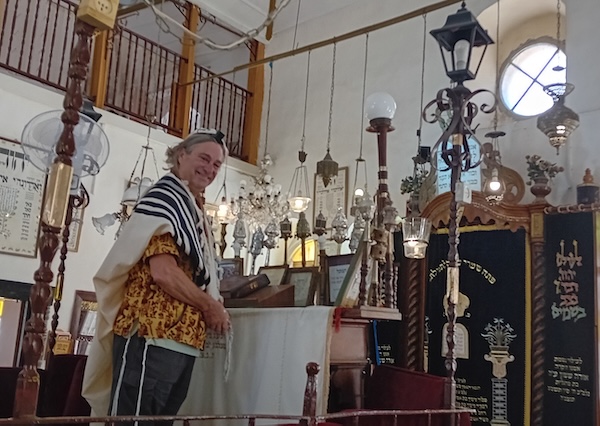
On June 21, at Ohel Yitzhak in Nahalat Shiva, Gil Zohar celebrated the 57th anniversary of his bar mitzvah. (photo Gil Zohar)

Man plans, God laughs, goes the Yiddish aphorism. For the last half year, I have been diligently learning the trope of Parshat Shelach Lecha (the Torah portion meaning Send for Yourself) to celebrate the 57th anniversary of my bar mitzvah, which I had when I was a boy in Toronto. My wife Randi and I had planned a kiddush at the historic Beit HaRav Kook synagogue near our home in downtown Jerusalem. We are members there, and enjoy the leadership of Rabbi Yitzhak Marmorstein, formerly of Vancouver’s Or Shalom. Alas, the war with Iran started. In accordance with the Home Front Command orders against large public assemblies, the shul closed. And so, we considered canceling the simchah.

While all but Jerusalem’s most essential businesses were locked down tight as a drum, the wartime defence regulations allowed synagogues near a bomb shelter to keep their doors open, with limited attendance. Hence, Ohel Yitzhak, the Sephardi synagogue in our courtyard in Nahalat Shiva, built in 1888, remained open. And so, we switched the venue from the former home and yeshivah of Abraham Isaac Kook (1865-1935) – the first Ashkenazi chief rabbi of British Mandatory Palestine – to the equally historic synagogue where Ben-Zion Meir Uziel (1880-1953) – Kook’s Sephardi counterpart, who served as nascent Israel’s chief Sephardi rabbi until his death – used to pray.

The illustrious Sephardi landmark, resembling a house of worship in a mellah in Morocco, is close to the Herbert Samuel Hotel, which opened its miklat (bomb shelter) to the public as well as hotel guests. So, on June 21, undeterred by the spectre of a ballistic missile salvo, I was called up to chant Maftir and read the Haftarah. 

What’s it like when the air-raid sirens sound nightly and warplanes roar through the starry sky? Lori Nusbaum of Toronto, who came with her son, Ryan De Simone, for my second bar mitzvah, has been posting on Facebook:

“The 3rd night in Jerusalem and the 3rd siren alert went off; it was 4:35 a.m. Sleep is hard. You don’t want to be in a deep sleep and miss the [cellphone] notifications so you try to have ‘one eye open.’ There’s something strangely intimate about being in a smallish space with a bunch of strangers, some in bathrobes, carrying pillows and blankets, wearing slippers, with sleep still in their eyes. You aren’t sure if you should make eye contact or not. It’s nighttime, so conversation is not really happening. I think we all want to keep sleep in our brains, hope we can go back upstairs quickly and close our eyes for a peaceful rest of the night.”

Like many guests at the synagogue, Lori found my wartime bar mitzvah intensely emotional. “My somewhat unaffiliated son had an aliyah at one of the oldest shuls in Jerusalem,” she posted on Facebook. “Our friend, whose bar mitzvah we came to witness, literally took the tallit off his back to wrap around my son so he could go to the bimah. With tears in my eyes, so many emotions washed over me. Too many to describe adequately. This is what Israel is all about. The people who in the middle of a war come together, pray, help each other and celebrate life together. And give you the proverbial shirt off their back.”

The grim situation in which we find ourselves today parallels the Torah reading of Shelach Lecha (Numbers 13:1-15:41) and its equally pertinent Haftarah (Joshua 2:1-24).

Returning after 40 days of reconnoitring the Promised Land, the spies sent by Moses reported: “We went into the land to which you sent us, and it does flow with milk and honey! Here is its fruit [showing a huge cluster of grapes hanging from a stave, today the symbol of the Ministry of Tourism, proudly worn by every licensed tour guide]. But the people who live there are powerful, and the cities are fortified and very large.”

Then, Calev ben Yefune shushed the crowd declaring, “We should go up and take possession of the land, for we can certainly do it.”

Ten of his fellow spies (all except Joshua) disagreed – “We can’t attack those people; they are stronger than we are” – and they spread a slanderous report about the land they had probed. Misunderstanding the many funerals they had witnessed because of the plague God had sent so that the spies would go unnoticed, they said, “The land we explored devours its inhabitants. All the people we saw there are of great size. We saw the Nephilim there [the descendants of the giant Anak]. We seemed like grasshoppers in our own eyes, and we looked the same to them.”

Grasshoppers? They might as well have called the Jewish people cockroaches.

In the words of Rabbi Lord Jonathan Sacks ztz”l, this dibbat ha’aretz (slanderous report about the Land of Israel) is the language of fear and demoralization. They are big, we are small. They are strong, we are weak. They do not fear us, but we fear them. We cannot prevail.

Was this, in fact, the case? As the Haftarah makes clear, the 10 scouts could not have been more mistaken. A generation later, Joshua bin Nun too sent two spies – the same Calev, and Pinchas ben Zimri. They slept on the roof of a house belonging to Rahav the prostitute, which formed part of the walls of Jericho. Hearing about the spies, the city’s king ordered his soldiers to arrest them, but Rahav hid them and misdirected the guards. What is more interesting is what she tells the spies of the feelings of Jericho’s residents when they heard that the Israelites were on their way:

“I know that the Lord has given this land to you and that a great fear of you has fallen on us, so that all who live in this country are melting in fear because of you. We have heard how the Lord dried up the water of the Red Sea for you when you came out of Egypt, and what you did to Sihon and Og, the two kings of the Amorites east of the Jordan, whom you completely destroyed. When we heard of it, our hearts melted and everyone’s courage failed because of you, for the Lord your God is in heaven above and on the earth below.”

Like contemporary Gazans and Iranians, the people of Jericho were anything but giants – they were terrified of us. The spies of Moses’s day should have known this. They had already said in the song they sang at the Red Sea: “Nations heard and trembled; terror gripped Philistia’s inhabitants / The chiefs of Edom were dismayed / Moab’s leaders were seized with trembling / The people of Canaan melted away.”

How did 10 of the spies so misinterpret the situation? They misunderstood Moses’s instructions: “Alu zeh b’Negev v’alitem et ha-har” – ascend (alu) through the south, and ascend (va’alitem) the mountain. The word “ascend” (aliyah in Hebrew) also means to overcome. (When Martin Luther King Jr. famously said, “We shall overcome,” he was citing this verse.) The spies lacked the faith that the land would be theirs, despite God’s promises, and 39 years of wandering in the desert followed.

The Jewish people, in Israel and the diaspora, experienced a crisis of confidence in 1313 BCE following the Exodus from Egypt, on the eve of entering the Promised Land. Not so today. We have no such hesitations as the Israel Defence Forces battle the regime of the latter-day Haman in Iran and its Hamas, Hezbollah and Houthi proxies. Our response is to follow Moses’s instructions: “Alu.” Ascend. Overcome. Make aliyah.

To that end, I invite you to celebrate Parshat Shelach Lecha with me at Beit Ha Rav Kook (9 Rabbi Kook St.) on June 13, 2026. Next year, in peaceful Jerusalem. 

Gil Zohar is a writer and tour guide in Jerusalem.

Seeing the divine in others

I recently participated in a conference panel on hope in a time of divisive politics. A friend in the Jewish community couldn’t do it, so she asked me to help instead. I won’t lie, I felt nervous.

I worried that I wouldn’t measure up to some of the speakers, who had big job titles, awards and experience. This was compounded by a few missteps that left me feeling embarrassed and humbled. First, my friend’s name was left on the conference program and mine wasn’t listed, even though organizers had ample time to update the panelists’ names. Second, social media amplified the panel on Facebook and Instagram, but listed my name with incorrect, made-up undergraduate degrees. I’d provided my graduate degrees in religious studies and education because I felt they were relevant. Somehow, five years of education went away due to clerical errors.

The weird part was that my brief talk, and my presence at the panel, was to elevate Jewish experience and Jewish hope in an approachable way. Two academics spoke, using big concepts and bigger words, while minimizing their personal approach to the issues. Then, an amazing African Canadian legal professional spoke of her family’s journey and deep roots in Canada – it was personal, compelling and important. I was up next.

I’d prepared my notes in advance. I spoke from them, but, first, I changed gears. The night before the panel, held at Winnipeg’s Canadian Museum for Human Rights, I encountered members of the Persian community, holding up their lion flags to represent the Iranian people and their opposition to the Islamic Republic. I stopped to tell a young woman holding the flag that our hearts were with her, and we were thinking of her, and hoping the people of Iran were safe. She seemed shocked. Surprised that I saw her, knew what she represented, and embraced this message against extremism and violence of the Islamic Republic of Iran. She asked where I was from, I smiled and only said, “Winnipeg.” 

The day of the panel, I struggled with a parking meter. Then I crossed a street, sharing a warm smile with an Indigenous man on a bicycle who passed by. My heart thumped hard. Though I’ve done plenty of public events and teaching, I felt on edge. Maybe it was because I was one of the only representatives of the Jewish community in that multi-faith gathering. Maybe it was because I’d been checking on where the Iranian missiles were landing in Israel right before I came. I worried about repercussions following me into the Canadian Museum for Human Rights.

Pretending to check if the microphone was on, I said, “Welcome. Thank you for coming …” and, looking at the crowd, I greeted everyone with a “Hello y’all!” After that informal start, I made sure to mention the Jewish concept of the world as a broken pot, in which the vessel’s shards, our souls, are in each of us. I talked about tikkun olam, repairing the world, and putting those shards back together, as an act of hope that we work towards, as an act of ongoing creation – a human and divine partnership. Throughout the morning, I took time to look at people, greet them and try to see G-d in each of them. I decided that the way to confront my feelings of embarrassment, and the erasure of my name and credentials, was to fully see others the way I would want to be treated.

At this conference, there were many references to reconciliation. An Anglican bishop who is also a residential school survivor spoke during our panel question period. When I recounted all this later to my family, we recognized an important theme.

As a professor, my husband often attends events with a land acknowledgement. Working with a group of Indigenous students last year, he asked them how they feel about the “workshopped” statement the university uses. They said it was often done by rote and perhaps lost its meaning as a result. They didn’t feel seen by it. 

Almost immediately, I recalled that our congregation had changed its Prayer for Canada. The new one feels genuine to me. It includes aspects of a land acknowledgement by mentioning by name the first inhabitants of the land. It also includes the current Canadian political infrastructure. It’s a prayer to maintain our diversity, so that never again will Canada say, “None is too many,” in reference to the antisemitic exclusion of Jewish refugees fleeing Europe during the Second World War.

My husband will meet again this summer with a new group of Indigenous students. He’s considering a different discussion. What does it mean when society suggests that some people’s innate connection to the land must be acknowledged, but others don’t deserve a similar acknowledgement of their homeland? This issue isn’t “just” about Israel, either. What about the Kurds? What about the Druze? The dispossessed list is a long one.

When we moved to Winnipeg 16 years ago, celebrations for Canada Day included enormous festivals and bombastic firework displays. Over time, due to the pandemic and to a change in how we perceive the day, this has changed. Many Indigenous Canadians don’t celebrate Canada Day. 

Having my name left out and hard-earned credentials jumbled was difficult, but it reminded me of how acknowledgement works. We can choose, as Canadians, to look up from our phones and really see one another. We all deserve to take up space and be here, recognized for our special contributions, in this land of plenty. We may not be able to control the huge geopolitical events around us, but we can see one another and pray for our loved ones and our neighbours, too, both here and elsewhere. Recognizing the divine, individual spark in each person is crucial.

I’m hoping for a family cookout at home this Canada Day. We might talk about how we connect to Canada, and how we fit in the Jewish diaspora and homeland. It’s a complicated equation, worth talking about during a war. We should also choose to see, greet and value all those we walk with on this land and in the world. Let’s recognize everyone’s names, identities – and souls – as meaningful, too. 

Joanne Seiff has written regularly for the Winnipeg Free Press and various Jewish publications. She is the author of three books, including From the Outside In: Jewish Post Columns 2015-2016, a collection of essays available for digital download or as a paperback from Amazon. Check her out on Instagram @yrnspinner or at joanneseiff.blogspot.com.