MAID vs Jewish values

I am a Canadian Jew with deep roots in Canada. My grandfathers, one from Winnipeg and the other from Toronto, helped build two of Vancouver’s prominent synagogues in the postwar era. I married a Canadian, also the descendent of Canadian Jewish leaders. Now that my wife and I are raising children south of the border, we frequently hear from my relatives in British Columbia about how much more enlightened Canadian society is. We often agree.

However, my perspective on Canada has been shifting as I’ve learned more about Canada’s ever-expanding Medical Assistance in Dying (MAID) program. Recent international media attention has focused on the fact that Canadians are choosing MAID at rates far beyond expectations, particularly as Canada has expanded eligibility to include non-terminal cases (“Track 2”). I am deeply concerned about this direction.

My message to Canadians, especially Canadian Jews, is this: please be more critical of your government. (Notice I said “please” – can’t shake those Canadian manners.) Just because MAID is legal does not mean it’s ethical. We Jews know all too painfully that the actions of Western, enlightened governments can be immoral.

Since I’m a rabbi, I’ll start with the ways I believe that MAID violates the most basic Jewish tenets. The Talmud teaches that three partners are involved in the creation of every human being: the two parents, and the Holy One. (Kiddushin 30b, Niddah 31a) This ancient teaching captures something profound about the limits of human authority over life and death – we are partners in creation, not owners of life itself.

Our tradition also teaches that “One who saves one life, it is as if he saved a whole world.” (Sanhedrin 37a) One of the most important theologians of our time, Rabbi Irving “Yitz” Greenberg, recently published Triumph of Life: A Narrative Theology of Judaism. In this book, a culmination of lifelong philosophical inquiry, Greenberg presents a theologically grounded vision of a world moving toward deeper recognition of the infinite value, equality and uniqueness of every person. I recommend reading it.

Judaism values protecting and supporting the vulnerable, not offering them death as a solution. Even Track 1 MAID presents complex questions within Jewish tradition. While Judaism prohibits hastening death, there is also a tradition against unnecessarily prolonging the dying process. Some Jewish authorities might find space within this framework for passive euthanasia for Track 1 cases; others maintain that any hastening of death crosses a fundamental line. But Track 2 MAID represents something categorically different and far more troubling from any Jewish perspective on the sanctity of life.

The Toronto Board of Rabbis wrote to Canadian senators in 2021 about MAID, expressing concern about “pressure, both subtle and overt” on vulnerable people to choose death. While this letter represented important rabbinic concern, it wasn’t enough. Canadian Jewish leaders from every denomination should articulate clearly that MAID’s existence and expansion fundamentally contradict Jewish values about infinite human worth.

Dr. Arielle Berger, a Toronto geriatrician studying for the rabbinate, writes about “fundamental ideas necessary for aging such as the centrality of gratitude to living a meaningful life, and the truth of interdependence, which allows us to both give and receive with generosity.” She notes the “transformative impact these counter-cultural ideas can have” on understanding worth beyond productivity. Berger uses a Jewish lens and Jewish texts to express that human worth isn’t contingent on productivity, independence or the absence of suffering. Dependence, weakness and need of others are universal features of being human.

I want to amplify voices like Berger’s and Greenberg’s, and urge more Canadian rabbis and other Jewish leaders in Canada to take a clear stance: MAID needs to be questioned on both societal and individual levels. Individual citizens should reject MAID. Rabbis and religious leaders should call on the Canadian government to repeal MAID, while also guiding congregants to choose life. Choosing to live, even when life is diminished or difficult, even when we might feel like “a burden,” remains sacred and valid.

Even non-religious people have good reasons for concern. When the government anticipates almost $150 million in annual savings from MAID, we’ve created a system where death becomes financially advantageous. The possibility of coercion is impossible to avoid.

It’s also deeply troubling for a government to play a role in killing citizens. Decriminalizing suicide is one thing; making death easily accessible through state systems is categorically different. And, if you wouldn’t end your own life directly, asking someone else to do it for you isn’t ethical either. It’s also unethical to be a doctor providing MAID; perhaps the people who do so need a new professional title – “euthanists” – since they’re no longer practising medicine in any traditional sense.

Additionally, MAID represents ageism and ableism dressed up in the language of autonomy and choice.

When my great-aunt Mona Winberg was born with cerebral palsy in Toronto in the 1930s, doctors told her mother to institutionalize her and forget her. The medical consensus was that her life would have no value. Her mother refused. Mona became a pioneering journalist and disability rights activist, receiving the Order of Canada, among other honours. But, even if Mona had never won awards or achieved public recognition, her life would have been important and worthwhile, just like my own.

If any of these more secular arguments speak to you, or if MAID just makes you uneasy, or if recent headlines feel like a dystopian novel, rest assured that you have support from Jewish wisdom that has guided our people for thousands of years.

The Canada my grandparents helped build was founded on the principle that society is judged by how it treats its most vulnerable members. Today’s Canada seems to have forgotten that value, bent on helping vulnerable members access easy death rather than better care. I’m not saying we in the United States have society all figured out; far from it. But Canadian Jews have an obligation to think and act critically, and to engage in this public conversation before MAID unravels in even more alarming ways. 

Seth Winberg is executive director of Hillel at Brandeis and senior chaplain of Brandeis University. This article was originally published by the CJN. For more national Jewish news, go to thecjn.ca.
Cheshvan a great month, too

The Hebrew month of Cheshvan, or “Mar Cheshvan,” is the second month on the calendar after Tishrei. It comes right after all the fall holidays end. The rabbis called it “mar,” or bitter, because it doesn’t have any holidays or special mitzvot (commandments). This mom has an entirely different take. I’m very tired … and relieved. 

This doesn’t take away from any of the meaning, pomp or special parts of the fall Jewish holidays, which are all fantastic. I’m still holding one moment as dear: sitting in my sukkah, I could see the clear sky, with a few clouds floating past, see and hear the migrating birds, smell and see the fall leaves, and embrace the chill in the air. It was a fabulous family meal moment, only topped by the solitary lunch I ate on the back porch, in the sukkah sunshine. I had the newspaper, along with a big plate of food. I was warm. There were no wasps. A true triumph, considering it often rains or snows in Winnipeg during this harvest holiday.

Yet, I’m also worn out, and not just from two years of worry about the war. If you live outside big Jewish population centres and you want celebratory holiday meals, the options are limited. In Winnipeg, if you want kosher food, there’s only catering from two or three places. If you’re OK with kosher-style food, there are more options, but, for instance, a beautiful big challah is not always easy to procure at the last moment. Even if you’re not strictly traditional, purchasing and putting together a holiday meal can be expensive and time consuming, even if you don’t cook it.

Challah is a good example. If you want a buy a single challah, it costs somewhere between $6 and $12 in Winnipeg. I like to cook and bake. From what we’ve observed, my recipe is richer and has a higher food cost than these commercially produced challahs. In the past, I used to make one batch (about three pounds) using my bread machine and produce three loaves. One would go into the freezer for a future Shabbat or holiday. Two would go out on the table and last the weekend. I now have twin teenage boys. All three challahs might last through Sunday lunch. Doubling the recipe and doing it all by hand results in more loaves to freeze for another day, but I receive grumbling from the peanut gallery because it doesn’t taste the same.

The person in charge of food prep in your household is well-aware of the grocery planning and food preparation time needed. They’ll even know the time it takes to set a holiday table and get everything out onto it before a holiday starts. Yes, it’s sometimes easier if others help, but sometimes it results in bellyaching and goes slower than if the most efficient person does it all by themselves.

In recent years, this effort has been given a few names: mental load is one. I’ve carefully tried not to gender this task. However, just as women’s pay rates in Canada still don’t equal men’s, it’s also true that women tend to shoulder much of this unpaid burden. Yes, there are exceptions, absolutely. There are women who’ve never left the workforce to have children, haven’t married or compromised in any way for a man’s career, and never been a caretaker. These women might make an equal wage for their work, and that’s great. It’s also true that there are men who shoulder most household tasks. Just like the example of Golda Meir as Israel’s prime minister, simply because an exceptional woman has achieved equity or high office doesn’t mean we’re “there” yet in terms of equality and equity for everybody.

I recently pitched a class for Limmud (an international program offering Jewish learning, where everyone pays to attend and shares the cost) about positive tips for raising Jewish kids. Many of the tips I thought of relate to this situation: special foods or cooking together, holiday celebrations, Jewish stories, activities or events, and Jewish learning and home life. Again, many of these tasks often fall to women, even though there’s no essentialist reason why they should. If a mom wants to do some quiet quitting and pull back to regain some time for herself, her work life or other pursuits, it doesn’t always follow that the other partner will jump into action to fill the void.

While mainstream Jewish organizations bemoan the cost of Jewish life, it’s rare that the supports exist to make this kind of unpaid labour easier. One exceptional example is when Jewish preschools provide parents with a way to order challah for Shabbat. Every Friday or holiday when school was in session, we were able to bring home challah affordably. It made a huge difference.

This isn’t, of course, a new phenomenon. I recently read about the requirements of the priests’ clothing in the Babylonian talmudic tractate Zevachim. Essentially, in the days of the Temple in Jerusalem, if the priests’ clothing wasn’t appropriate, it could make a person’s animal sacrifice invalid. To do a sacrifice, a person incurred a lot of costs: raising or purchasing an animal, getting to Jerusalem, and more. An invalid sacrifice could result in a horrible outcome for the person and their family, the priest and the community. Yet, no one discussed in this section how the priests got the clothing in the first place. Other information indicates that predominantly women spun all this yarn (on spindles, by hand) and wove the fabric and likely sewed it all together for the priestly garb. This effort was thousands of hours of unpaid work behind the scenes.

I’m looking forward to a hopefully peaceful and easier Cheshvan ahead. It’s a time that some may find bitter, but, like a bitter coffee served with dessert, sometimes a little less hoopla might be a nice, restful contrast. It also might give families time to reflect on who provides all that planning and labour to make your home celebrations special and your holidays a reality – there are many ways to alleviate that burden. Further, we should stop using examples of truly exceptional cases – that woman with nine kids who works full time and makes all the meals – to shame everyone else. A better outcome would be more equitable distribution of these Jewish tasks – to increase holiday or Shabbat joy in every household. 

Joanne Seiff has written regularly for the Winnipeg Free Press and various Jewish publications. She is the author of three books, including From the Outside In: Jewish Post Columns 2015-2016, a collection of essays available for digital download or as a paperback from Amazon. Check her out on Instagram @yrnspinner or at joanneseiff.blogspot.com.

Grammar insight on holidays

This year, I volunteered to help during High Holidays at my congregation. As a result, I became one of the “ticket ladies” on Rosh Hashanah. I used a cellphone that scanned bar codes on service tickets. When I first saw this being done on a holiday, I was surprised because of the technology use at a Conservative congregation on a day when some might not carry a phone. My family chose to print out our tickets, but times change. Even though everyone in my family had a printed ticket, we carried our cellphones anyway as we volunteered. It seemed safer to have our phones while walking to synagogue and while we were there. After all, that’s what the tickets are for, too. They indicate that the person belongs or has a spot and that the person is “safe.” 

The police and private security guards asked where they should position themselves. More than once, they indicated that being indoors in the lobby might be a good spot. Instead, they were asked to stand outside, in autumn’s sunny weather, guarding the doors and/or directing traffic. I heard only one incident of loud, angry shouts on the street, near the police officer there. That was enough for me. I was relieved police were there, and that there were master lists of everyone who might be in the building that day, just in case. 

While outsiders might think that this security is new, this is just the usual necessity at Jewish gatherings, though admittedly now more than ever. At odd moments between ticket scans, I thought of a dear family friend named Marge, who passed away in her 90s. Marge was a venerable and respected volunteer at the temple where I grew up. She was famous for her High Holiday ticket lady efforts. Marge was all business at the front door, a big smile for those she knew as they flashed their tickets. Yet, even if Marge knew you for 50 years, if you forgot your ticket, that grin vanished. A stern reprimand ensued. Marge kept us safe, and she wasn’t playing. She took that job seriously. 

The congregation where I grew up, Temple Rodef Shalom in Falls Church, Va., is right near Washington, DC. Rodef Shalom started out small in the 1960s, when my paternal grandparents were founding members. It grew rapidly, along with the Washington area. My mom started its preschool, ran the entire education program, and ended her career there as the administrator/executive director. As a Jewish professional’s kid, I knew where the emergency alarm buttons were and that synagogues near DC were frequent targets of hate. Congregation members who worked for the FBI or CIA formed part of the volunteer security patrol for the High Holidays, too. Everyone smiled as they said that “no-nonsense” Marge ran a tight ship. She was their best line of defence. 

Nobody knew this history in Winnipeg when I was given the ticket lady designation. I’d emailed with Marge right up until her passing. I tried to see her at every family visit. She loved to tell me about her Canadian grandfather, a fur trader whose family came from Sault Ste. Marie. The whole holiday, in between wishing everyone gut yontif, shana tova or sweet new year, I longed to tell Marge all about how I was a ticket lady now. I knew she’d love it. When I mentioned this to my mother, we both smiled over the phone. I’d never be as good at it as Marge was, but my mom also said, “Don’t worry, I’m sure Marge knows. She’s proud of you.” 

Being a ticket lady was an education. I’ve been in Winnipeg 16 years, so I recognized many names on the tickets, but definitely not all the faces. As people rolled in, I also recognized how diverse we are as a people. Some of us are early, others right on time – and then, there are the rest. 

This experience let me greet new people and hold on to lifelong connections. It made me think about a grammar term that’s fallen out of use. I wondered at how, as individuals, we are also dependent clauses. For years, we have seen news, books and other sources where the editing allows a sentence to start with “and” or “but” in a way that’s clearly dependent on the prior sentence. When I see this, I want to chastise, just as Marge might have. To me, that editorial choice still grates, but the volunteer experience made me see how the Jewish community works together. At the best of times, we are an enormous team, dependent on one another to function at our best.

Volunteering is an important part of Canadian identity. It was a required topic to study for my Canadian citizenship test, and I wondered why more congregants hadn’t volunteered. It was a vital part of my holiday this year. It reminded me how reliant we are on one another, as well as on our allies, our laws and law enforcement. Dependent clauses aren’t full sentences on their own. We, too, must remain connected to maintain meaning as Jews in Canada. 

In the Babylonian Talmud’s tractate of Zevachim, which I’m now studying, there’s a lot of time spent on what happens when a Temple (animal) sacrifice goes wrong. If the priests in the Temple had the wrong intention or person in mind when performing a sacrifice, it could mean the person’s sacrifice wasn’t valid. We don’t sacrifice at the Temple in Jerusalem anymore, but our intentions, towards ourselves, the community and the world, still matter. Volunteering wasn’t a sacrifice for me. It felt like I was fulfilling my role with the best intentions while I depended on others to keep me safe at that open door. Instead of any kind of sacrifice, it was a High Holy Day bonus. 

Joanne Seiff has written regularly for the Winnipeg Free Press and various Jewish publications. She is the author of three books, including From the Outside In: Jewish Post Columns 2015-2016, a collection of essays available for digital download or as a paperback from Amazon. Check her out on Instagram @yrnspinner or at joanneseiff.blogspot.com.

Be more solution-oriented

Leaders are simply people, of course. And all people have strengths and weaknesses. Just like the traditional approach to weaving Persian rugs with an intentional mistake, we must remember that only the Almighty is perfect. 

But some leaders become lionized and celebrated, their human failings swept under the rug (sorry). However, we’re in a political moment where some leaders’ mistakes are all too obvious. No need to name anybody. Many fit this description. It’s upsetting and confusing to realize that even those chosen as “the best” or “brightest” fail sometimes. It’s a useful learning experience, too.

Awhile back, I was discussing politics online with other Canadians. I came upon something that stopped me cold. A poster criticized a political leader. I asked what she saw as solutions. The questions I asked were how, if she were in charge, she’d do things differently.

Her response surprised me. She said the only thing she could do was vote and complain. That, essentially, it was her right to find fault, but not her obligation to offer solutions. Her opinion was that she wasn’t passive because, well, she voted consistently and complained vociferously.

From a Jewish perspective, we have plenty of examples of whiners. Remember the Israelites, wandering in the desert, who wanted to go back to Egypt because they didn’t have meat, fish, onions, garlic, leeks or cantaloupes? (Numbers 11:4-5) It’s a normal response to crave foods when you’re unable to get them. As a high schooler studying abroad, I craved M&Ms so much that my mother brought them when she visited. They were superfluous, but I wanted them.

The opportunity to complain is always available, but it’s unattractive, especially if there’s something you can do to fix the problem yourself. Since that high school moment, I’ve lived many places where I’ve craved food but couldn’t buy it locally. As a result, I’ve become a more creative cook. When traveling, it’s good to “load up” on cravings if they’re available. Not to hoard, but just as an extra pleasure.

Worldwide political upheaval made me study the Babylonian Talmudic tractate of Horayot with more interest. It’s a small part of the Talmud but it’s about how people in charge (kings, high priests, judges, teachers, etc.) can make amends or do the right sacrifices or actions to atone for their mistakes. This text assumes that there will always be errors in judgment. People in certain important positions have societal roles to play, and that means their atonements to seek forgiveness for errors must be bigger sometimes than if they were private citizens. 

This may sound irrelevant but consider the role of a teacher. Teachers make mistakes. The best resolution to this would be a public acknowledgement of the error and a demonstration of how to fix it. We might shrug and get on with things after a private math mistake. Yet, if a math teacher makes this error in front of the class, the best lesson is having a student find and correct the error. Then, the teacher can perform the act of learning from their error, thank the student, and acknowledge that no one is perfect.

In our lives, even if we are not teachers, parents, supervisors, or in any authority roles, it’s a great idea to try to practise this approach: to remember that no one is perfect and that it’s all our jobs to find solutions. As Rabbi Tarfon teaches, “that it’s not upon us to complete the work, but neither are we free to stop doing it.” (Pirkei Avot 2:16) 

This sounds simple. But, in the tractate of Horayot, there’s a very powerful ending about how our pride and ego can get in the way. It’s about three rabbis and their leadership roles: Rabban Shimon ben Gamliel (Rashbag) was the leader of the Jewish community in the Galilee during the late second century, after the Bar Kochba Revolt; the head of the court was Rabbi Natan; and a great scholar at the time was Rabbi Meir. 

Rashbag is upset with a lack of protocol in the Torah academy. He wants everyone to stand when he comes in until they’re told to be seated. Rashbag suggests that, for Rabbi Natan and Rabbi Meir, who he perceives as less important, those studying should rise when they enter, but students can sit down again right afterwards. Rabbis Meir and Natan try to put Rashbag to an intellectual test to prove that he isn’t above them, but Rashbag finds out in advance and bests them. 

Rabbis Meir and Natan are expelled from the Torah academy and forced to study outside. However, the academy couldn’t continue without their expertise, so there was the ancient equivalent of paper airplane communication happening. The expelled rabbis would throw questions into the academy, students would try to answer. If the students couldn’t, they’d ask for more help. 

Obviously, this was a bad way to learn. Rashbag was forced to readmit the scholars, but only with the proviso that their rulings couldn’t be under their own names. Essentially, the glory of Torah was more important than the glory of Torah scholars. This remained true for all except for Rashbag and his descendants, who insisted on maintaining their grudge and hereditary leadership and denying these two learned men their due.

Where does that lead us? Leaders are fallible. Each of us has the potential to uplift, lead and find solutions. When necessary, we need to stop being passive and lead more. Sometimes, that means trying to avoid big egos or coming up with creative responses to difficult problems. It can feel uncomfortable to raise our voices and act, if we’re used to letting others do the hard work. Also, we need allies to help make change. This means building connections with others, particularly outside the Jewish community.

The pressing example for the Canadian Jewish community is our political leaders’ refrain after antisemitic incidents: “This isn’t who we are as Canadians.” Well, in fact, it is who we are, as evidenced by the dramatic rise in hate crimes. We have leaders who aren’t acting to solve this problem. It’s getting worse. In response, we must step up and ask our allies to do so, too. Nobody’s perfect. People make mistakes. That said, we must hold leaders – and all those passive followers – to account if we expect to remain safe in Canada. It’s time to find solutions. Complaints alone don’t cut it. 

Joanne Seiff has written regularly for the Winnipeg Free Press and various Jewish publications. She is the author of three books, including From the Outside In: Jewish Post Columns 2015-2016, a collection of essays available for digital download or as a paperback from Amazon. Check her out on Instagram @yrnspinner or at joanneseiff.blogspot.com.

Hope for a good year

We begin the cycle of a new year in the coming days. We are all reflecting on our lives, our actions and our place in the world at this time of year. Perhaps, in the past two years, we are doing this more than ever before, even without the catalyst of the month of Elul or the impending holy days as motivation.

One of the things many of us are certainly pondering is how we move through life, and whether we approach the world with the balance tilted towards wonder and hope or towards cynicism and pessimism. These choices are challenging no matter where or under what conditions you live. For Jews in Israel and the diaspora right now, they are especially poignant.

A strength of Jewish life and practice is the capacity to hold sadness and joy in the same moments – life is rarely all one or the other. We mourn that there are still people being held hostage, the deaths in Israel and Gaza and in other conflicts, loved ones facing illness and confronting mortality, natural disasters, climate change, creeping 

authoritarianism in many countries, and all the big and small sadnesses of being human, but these are, above all, a part of being alive. In Judaism, it is a mitzvah to choose life through our actions and choices. This commandment appears in a Torah portion we read prior to Rosh Hashanah, reminding us that we can choose hope over despair, that we can choose a different reality.  

This duality will be on full display in the coming days as we move through the holy days, including navigating the joys and now sorrows of Simchat Torah, which will forever be equated in our memories with the atrocities of 10/7. 

Along with holding joy and sadness in the same moment is holding more than one truth, that being strong is being able to experience things that sadden or madden us and not permit their presence to destroy what happiness or equanimity we have.

Pirkei Avot asks and answers: “Who is mighty? One who conquers his impulse.” 

If our impulse is to be angry, vengeful, depressed or miserable, we might conclude that we have no control over these responses. We do. It’s not easy, but it is within our capability.

Without minimizing the challenges, neither should we dwell on them exclusively.

In the context of Jewish history, victory of a sort in our era comes from being physically safe, with the opportunity to live a contented, meaningful life.

As you hopefully gather as a community in prayer spaces and around holiday tables in the coming days, may you find a greater sense of ease in the balancing of the sweet and the sorrowful, and may you grant yourself and those you love the consent to live well, with hope for a truly good year. 

The bodycheck’s a wake-up call

Our family caught a big summer cold this August. We went to two crowded pavilions at Folklorama, Winnipeg’s international festival, earlier in August and I got sick. For all kinds of reasons, moms “can’t” get sick. I was cooking and doing carpool and canning pickles and chutney while feeling worse every day. Fatigued, with a stuffed nose and goopy cough to boot. It wasn’t COVID and I soldiered on. My husband helped when he could. 

Of course, after me, one twin got sick, then my husband and, finally, twin #2 began to get sick. This cold might last for weeks in our household. Families know how this story goes. We spent Labour Day weekend in the usual way: I lined up an appointment at a walk-in clinic for a twin who might now have an ear infection. Our only long weekend outings were to walk the dog around the neighbourhood. At least we’re not dealing with the “broken bone on three-day weekend” story yet. 

This situation has more in common with Rosh Hashanah than one might think. In the lead-up to Rosh Hashanah, during Elul, we’re supposed to reflect and repent for what’s happened over the last year. We need to be accountable for what we’ve done.

“The King is in the field” – this phrase is supposed to mean that G-d is nearby to help. Maybe we’re able to engage with this divine project more easily outdoors. For those of us who can get out into nature, even to an urban park or residential neighbourhood, we’re surrounded with gardens, produce, flowers and leaves in their last grand hurrah at this time of year. In Winnipeg, due to our dry smoky summer, we’re already beginning to see dead leaves. Time is short, we need to take advantage of this rich harvest season.

This accounting every year for Rosh Hashanah has us debating how we’ve wronged others, failed in our relationships to our families, our communities and with the Creator. However, if we circle back again to the story of the sniffling mom, we can ask ourselves something else. How have we wronged or failed ourselves? What can we do to improve our closest relationships, to ourselves and to our families?

During this summer season, I’ve had ample time to examine things because, in the end, my family didn’t travel anywhere. We weren’t even outside that much. I feel a little like we’ve been robbed. We had Winnipeg’s smokiest summer ever. I have asthma, so I had to be indoors more than I would have liked. My husband, a professor and associate department chair, had a heavy burden of administration, as well as research students in his lab, which resulted in him going into work while theoretically on vacation. Somehow, I signed kids up for a patchwork of camps. They enjoyed themselves but I spent a lot of time dropping off and picking up kids and didn’t get much of a break when they were home either. Of course, the ongoing war in Gaza, the Canadian response to it and the rise in antisemitism offers an underlying current of stress, too. Plus, we had some challenges about where the twins would end up for high school this fall.

Long story short, catching a cold? It’s a wonder we made it this far, to be honest.

All around me, I see others struggling in the 24/7 bad news feed. Meanwhile, I was grasping for positive conclusions, hopeful signs and a change for the better. My sign came suddenly – and in a way I didn’t expect.

My son and I were out on a dog walk in the neighbourhood. Our historic area has a kilometre loop that’s a frequent track for runners, bikers and families but, this year, it’s under construction so it’s less busy. (Oh yeah, did I mention the torn-up roads, dust, noise and diggers?)

We meandered on the narrow sidewalk, chatting, as the dog sniffed and read the “pee mail.” Out of the blue, we heard someone run up behind us and say an abrupt, “Excuse me!” My kid jumped into the grass. I pulled our large dog close and scooted to the right.

Nonetheless, a large male runner bodychecked me as he ran by. I stood, stunned. The man could have detoured on the grass. He could have chosen the empty street. Instead, he barreled into me, because we didn’t get out of his way fast enough. There are so many issues here: right of way, safety, courtesy, male power plays and respect for others. For me, though, maybe it took this incident to remind me that before I can repent for anything big, I need to focus on repairing my relationship with myself.

I shouldn’t have to get bodychecked on the sidewalk near my house. I deserve better than that. And, maybe, I – and my household – also need more vacation, breaks from stress and better self-care.

Examining how we got to where we are is the first step towards making better plans. I have learned a few things. When we leave the fun vacation trip planning to the last minute, the trip never happens. When the smoke or the stress is bad, I’m more prone to sickness. When it looks like something bad is barrelling towards us, I need to do a better job of getting myself out of the way.

Don’t get me wrong, I think the runner was wrong. He shouldn’t have done what he did. He should have apologized at the least. He should do his own repentance. But, as I jokingly remind my kids, “G-d helps those who help themselves.” Maybe if I’m hoping 5786 will be a better year, I need to make changes and apologize to myself, too.

Self-reflection and teshuvah (repentance) is hard work, but sometimes the outcome might be surprising. Perhaps the reflection will also mean taking better care of ourselves.

Wishing you a healthy, happy, meaningful new year, full of safe sidewalks, peace and good things! 

Joanne Seiff has written regularly for the Winnipeg Free Press and various Jewish publications. She is the author of three books, including From the Outside In: Jewish Post Columns 2015-2016, a collection of essays available for digital download or as a paperback from Amazon. Check her out on Instagram @yrnspinner or at joanneseiff.blogspot.com.

An exploration of the shofar

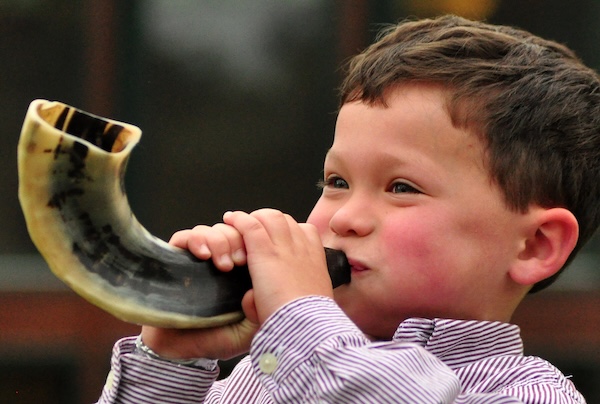
Most shofars are made from a ram’s horn, reminding us of Akeidat Yitzchak (the Binding of Isaac), which supposedly took place on Rosh Hashanah, since a ram was sacrificed in Yitzchak’s place. (photo by Len Radin / flickr)

Around the High Holidays, some young children receive colourful plastic shofars to blow. Are these shofars kosher? Could they be legitimately used during holiday prayers? 

While their colour might hold the attention of the children and worshippers, the answer to the above two questions is no. Shofars that can be used ritually come from animals, including rams, antelopes and goats. The long spiral shofar used by Yemenite Jews, for example, comes from the greater kudu, a striped antelope common to some parts of Africa. But most shofars are made from a ram’s horn. In fact, the shofar is sometimes referred to as a “ram’s horn.” This type of horn reminds us of Akeidat Yitzchak (the Binding of Isaac), which supposedly took place on Rosh Hashanah, since a ram was sacrificed in Yitzchak’s place.

A ram’s horn has a wide base surrounding a core bone, which connects to the animal’s head. Once the animal is dead, the horn is separated from the bone, resulting in a horn that is hollow in its wide part, but sealed at its narrow edge. Heat is applied to enable straightening part of the horn (though some rabbis think this should not be done), then it is polished on the outside and an air-passage hole is drilled in the narrow part, allowing it to produce a sound similar to a trumpet, a trombone or a didgeridoo.

According to Mahzor Lev Shalem, the shofar had a variety of uses in the Bible. It was used as a call to war (remember how it was used to miraculously tumble the walls of Jericho in Joshua, Chapter 6), as a call to assemble the community and, most significantly, to note G-d’s descent on Sinai. Later, it became associated with G-d’s call for Jews to repent.

From one specific shofar, a player can typically produce one sound, which depends on the horn’s length – the longer it is, the lower the sound produced by it, and players must use their lips to vibrate the air in the shofar exactly in the resonance frequency of the specific shofar. But Israeli trumpet player Amit Sofer takes the shofar beyond the tekiah, shevarim and teruah routines of the Jewish prayer book, and turns it into a musical instrument. Listen to Sofer’s trio presentation of Leonard Cohen’s “Hallelujah” (youtube.com/watch?v=lwaD92UcZME).

The shofar is well traveled. Its Greek cousin, the troumbeta or voukino, for instance, was once used all over Greece. Greek musicologist Fivos Anoyanakis, author of Greek Popular Musical Instruments, notes that this animal horn was used to announce field-wardens and postmen. It closely resembles the shofar. 

According to Yad Vashem, during the Shoah, Rabbi Yitzhak Finkler, the Radoszyce rabbi, was incarcerated at Skarzysko-Kamienna, a forced labour camp. Getting hold of a ram’s horn required him to bribe a Polish guard – but the guard brought him an ox horn. It took a second bribe to get the right kind of horn. Then, the rabbi asked camp inmate Moshe Winterter (later Hebraized to Ben Dov), who worked in the camp’s metal shop, to make a shofar. 

At first, Winterter refused. Preparing an item that was not an armament, or even carrying something considered contraband from the workshop to the barracks, carried with it a penalty of death. But he relented. So, in 1943, camp inmates heard the shofar blowing. The shofar traveled around wartorn Europe and the United States until Winterter made aliyah. In Israel, he donated the shofar to Yad Vashem.

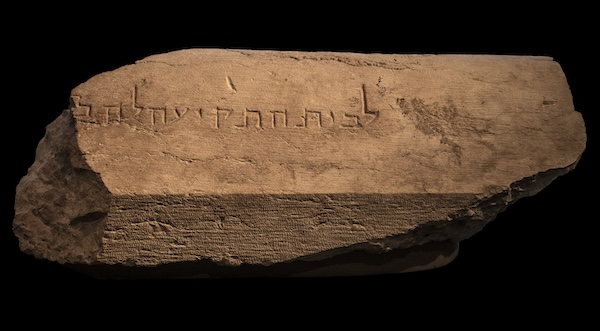
A year after the Six Day War ended, archeologist Benjamin Mazer discovered the Trumpeting Place inscription (which was written in Hebrew, of course). He discovered the 1st century CE stone in his early excavations of the southern wall of the Temple Mount. It shows just two complete words carved above a wide depression cut into its inner face. The first is translated as “to the place” and the second word “of trumpeting” or “of blasting” or “of blowing.” Today, the stone is on display at the Israel Museum in Jerusalem.

photo - The Trumpeting Place inscription
The Trumpeting Place inscription is a stone from the 1st century CE discovered in 1968 by Benjamin Mazar in his excavations of the southern wall of the Temple Mount. The first word translates as “to the place” and the second as “of trumpeting” or “of blasting” or “of blowing.” (Andrey Zeigarnik / wikipedia)

What exactly is the mitzvah of the shofar – the hearing of it being blown or the blowing of it? The written source (Numbers 29:1) of the mitzvah is relatively vague, so the issue was debated by scholars. The verse simply says, “a day of sounding shall be for you.” But, in his Shulchan Aruch, Rabbi Yosef Karo (1488-1575) rules that we make the blessing “to listen to the sound of the shofar” and not “on the blowing of the shofar,” so subsequent halachic (relating to Jewish law) authorities have followed this ruling. 

What does this mean for a person who has trouble hearing? In this age of hearing aids and cochlear implants, does one fulfil the mitzvah if one uses a hearing device? 

As with many other issues dealing with the interpretation of halachah in modern times, there is a difference of opinion regarding electronic hearing aids. Anyone who is not completely deaf is obligated to hear the shofar, according to all opinions. Rabbi Yehuda Finchas, a worldwide expert, lecturer and author of Medical Halacha, opines that anyone who wears electronic hearing aids should ideally stand near the person blowing shofar and remove the aids when the shofar is sounded. However, according to Hacham Ovadia, if one cannot hear the shofar without such a device, one should wear them and fulfil the mitzvah.

A common custom is to start blowing shofar daily at the time of the morning service in the Hebrew month of Elul, the month preceding Rosh Hashanah. On Rosh Hashanah, the shofar is blown at the time of the Torah reading service. Technically, this happens after the Torah and Haftorah have been read, but before the Torah is returned to the ark. On Yom Kippur, the shofar is blown after the final prayer service of Yom Kippur, Neilah.

Whether a person will hear the shofar being blown on Shabbat depends on the individual’s synagogue affiliation. In the Orthodox and Conservative movements, the shofar is not blown on Shabbat. It is blown, however, in Reform congregations. 

Originally, the sages worried that, if shofar blowing was permitted on Shabbat, people might be tempted to violate Shabbat law by carrying a shofar. Rather than risk such a situation, they prohibited any shofar blowing on Shabbat. But, even in Jerusalem, where the shofar would have been blown when the Temple stood, and which has an eruv (a symbolic enclosure within whose borders carrying is permitted) around it, the shofar is not blown in Orthodox and Conservative synagogues.

During the Rosh Hashanah musaf (additional) service, there are three additional sections read: Malchiyot (Kingship), Zichronot (Remembrance) and Shofarot. The Shofarot section provides readers with verses from Exodus and Numbers, Psalms and the Prophets, in which the shofar is mentioned. 

Have a meaningful holiday and a happy new year. 

Deborah Rubin Fields is an Israel-based features writer. She is also the author of Take a Peek Inside: A Child’s Guide to Radiology Exams, published in English, Hebrew and Arabic.

A new year, a new you?

If we want to improve our character traits, we need look no further than the latest issue we have in relationships. Do we get angry easily? Or impatient? (photo of universe.roboflow.com)

The Jewish New Year, 5786, is upon us. How can we be better? Life is always giving us opportunities to learn and to grow, and I believe one of the secrets to life-long learning about how to improve ourselves is to “be aware.”

Self-awareness or being mindful is a habit that is nurtured and practised every day. However, it isn’t about sitting quietly when we meditate, although certainly that is one of the ways we train our mind to observe and to be aware. Self-awareness is a process where we listen to our inner voice as well as listening to messages (whether we like them or not) from friends and family.

Paying attention to our reactions when we see someone who is less fortunate is a good place to start to look at our behaviours and character traits. Are you called to be generous or judgmental? Do you react with humility or arrogance when someone cuts in front of you when you are in line at the grocery store? Are you proud of how you respond, or do you think you could do better? Feelings of being unsettled when we leave a conversation may be a hint there is work to do on our inner self.

Awareness starts by watching our day-to-day actions and decisions, especially those where we find ourselves out of sync with friends, family and/or our “Higher Self.” Even those of us who may not have a direct or active connection to a Higher Self are connected to something – we all have a soul. According to the Torah (Genesis 1:27), we are made in the “image of G-d,” and thus we have the capacity to create relationships, show kindness and make the world a better place through being charitable.

If we want to improve our character traits, where do we look? Alan Morinis, author of Everyday Holiness: The Jewish Spiritual Path of Mussar and the forthcoming book The Shabbat Effect, says we need look no further than the latest issue we have in relationships. Do we get angry easily? Or impatient? How is your generosity muscle working? These are character traits that, when out of balance, may be on the spiritual curriculum we have to work on in our lives.

Mussar teaches us to balance our character traits, not eliminate them. If patience (savlanut) is on your spiritual curriculum, the challenge is to watch for opportunities where you can practise “bearing the burden.” Once you identify a trait you want to work on, lo and behold, there are opportunities everywhere to do so.

A new year is an opportunity to take stock of how we are in this world, and how we can be better. It is also a time to be grateful for all our blessings. Sometimes our blessings may not be wrapped in a silver bow, the silver lining yet to be found. There is the concept of win/win – similarly, if one person loses, so too does the other person. 

Use this time of year to make a list of where you might improve your everyday interactions, remind yourself of what you are grateful for. Take a moment to journal how you want to improve. Being a kind and generous friend only makes the world a better place. G-d knows we could all use more kindness. 

Shelley Karrel is a registered clinical counselor in British Columbia and can be reached at shelley@karrelcounselling.com.

Preparing for High Holidays

We have a new rabbi at Shaarey Zedek, our Winnipeg congregation. This is exciting as well as reassuring for many people. Why? Well, Rabbi Carnie Rose is the son of a rabbi and professor who lived in Winnipeg for many years, Dr. Neal Rose. His brother, Kliel, is a rabbi at Congregation Etz Chayim, another nearby congregation in Winnipeg. So, while Rabbi Carnie is new as a rabbi in Winnipeg, he is also a deeply familiar entity. He became a bar mitzvah at Shaarey Zedek. He went to kindergarten with the synagogue’s current executive director. 

This addition to our congregation is welcome, as Rabbi Anibal Mass and our chazzan, Leslie Emery, carry a heavy workload. They are still working hard, don’t get me wrong, but sometimes a new hire can offer support and everybody gets more breaks. I’m only observing this as a congregant and as the child of a Jewish professional. Sure, I serve on a committee, I show up to services, but I can tell there’s been a lot of work lately.

On a practical level, moving from the United States to Winnipeg is a big change. My family wanted to be supportive – after all, we too moved from the United States, in 2009 – so we’ve been helping Rabbi Carnie get his library in order. He’s got, as you might imagine, lots of books. These all got miserably jumbled in the move. While this has got to be stressful, he’s handling it all with good humour. We’ve taken pleasure at getting to look at and learn about all sorts of resources in Hebrew and English that we hadn’t seen before. Some books are like old friends, as I studied them as an undergraduate or in graduate school, but, to be honest, my books aren’t in nearly such good condition.

This experience mirrors many Jewish volunteer activities I did as a kid. As the child of a Jewish education director, who then went on to be the administrator (executive director) of my childhood congregation, Temple Rodef Shalom in Falls Church, Va., I spent many afterschool hours folding the weekly paper bulletin handed out on Shabbat, moving books or setting up chairs. While attending services or religious school were important activities, for me, the relationships I made with the rabbi and the staff and other congregants as we did these small jobs were the most meaningful ones. Along the way, I met many important guests, though it’s all a bit blurry now. For instance, I sat next to Elie Wiesel once after he spoke at our congregation. What I remember particularly is how formal and dressed up we were. Also, the dessert was good! I was allowed to stay up way past my bedtime.

Now, I’m proud that my kids are finding their way towards making their own community connections. One of my twins has gone to morning minyan many times this summer. He’s the only teen there and gets a lot of positive attention this way, including exchanging ideas with a retired provincial court judge. This judge also happens to be the father of my son’s elementary school principal, so we’re always on good behaviour with him!

My other twin isn’t getting to morning minyan much, but instead he volunteered for full weeks at a summer camp and daycare, helping little kids. He also helps on the synagogue tech team, doing accessible subtitles for prayers that are projected on screens as part of our service. This job is an important one, as it enables people to keep up with the service even if they are having a hard time hearing what’s going on or cannot read Hebrew. He’s been asked to help during the High Holidays. It’s a big honour and responsibility for a 14-year-old.

These commitments are important because they embody both the Canadian emphasis on volunteering and the Jewish one. When I was a teen, I lived for a year on a kibbutz. Volunteering was considered deeply valuable and important. Being the first to volunteer was a moral virtue. Yet, when I hear Winnipeg kids discuss accruing volunteer hours for school credits, it’s seen as an onerous requirement. Perhaps, for some, this requirement doesn’t have great value. On the contrary, in our household, we see these experiences as offering so many learning and growth opportunities.

While we moved books, searched for lost volumes and organized sets of Talmud and commentaries, we also saw the bustle behind the scenes as the congregation gets ready for Rosh Hashanah. There’s so much pageantry to the High Holidays. It’s a big deal. Some members jockey for important honours or specific seats and we listened with interest. We just wanted seats near the back, near where our kid would be in the tech booth. When I mentioned this to the new rabbi, I suggested that maybe different things matter to us. After all, I joked, I didn’t need to show off a new hat. (My mom always said this was an important part of High Holiday services when she was a kid in the 1950s!)

As for honours, we love a quiet summer Shabbat, when sometimes our kids get asked to read or are called up for an aliyah because no one reserved them in advance. These spur-of-the-moment experiences, where we might help out and take part in services, feel like the right spot for us. It may take months of practice to chant one part of the Torah portion, but we try to aim for a week when not much is happening.

A strong community is one where we can all contribute and help. Yes, big donors and fancy new hats are often part of the High Holidays. Big monetary donations keep the heat on, and status matters to many. However, a synagogue, and the Jewish community, must function throughout the year.

There’s a lot to think about when it comes to evaluating how we’ve behaved in the past year, and how we’ll make amends. To me, the most important reflections aren’t about where we are or how we behave specifically on Rosh Hashanah and Yom Kippur. In every regular weekday morning minyan, we also say “ashamu” – we are guilty. We work on ourselves all the time. Perhaps, while it’s important to have good intentions when it comes to the High Holidays, it’s also key to think about each day beforehand, and afterwards, too. Elul’s a whole month of reflection. Valuing one another and our community means making every day count. 

Joanne Seiff has written regularly for the Winnipeg Free Press and various Jewish publications. She is the author of three books, including From the Outside In: Jewish Post Columns 2015-2016, a collection of essays available for digital download or as a paperback from Amazon. Check her out on Instagram @yrnspinner or at joanneseiff.blogspot.com.

Hebrew Bible stories inspire

On Sept. 16, Stephen Schecter will retell three stories from the Hebrew Bible at the 40th anniversary celebration of L’Chaim Adult Day Centre. He promises the stories will bring laughter and tears. (photo from Stephen Schecter)

“I love the Hebrew Bible,” Stephen Schecter told the Independent. “It is, after all, the template of Western literature and the DNA of the Jewish people. Its stories are all told twice, inviting the reader to ask what is going on here. And the stories invariably end badly, teaching us the importance of getting a handle on our passions if we want to have a halfway decent life together.”

On Sept. 16, in celebration of L’Chaim Adult Day Centre’s 40th anniversary, Schecter will share a few of his favourite biblical tales. 

“Retelling these stories,” he said, “is my way of giving the Jews back their pride and their backbone, steeling them to be proud Zionists, once again going back to ‘In the beginning,’ which is the title of my show on Sept. 16. The stories – and I will be retelling three of them – when you examine them closely are rather funny, but this is no laughing matter. Some of them bring you even to tears.”

Schecter, who was a sociology professor at Université du Québec à Montréal, has always been interested in literature, but not necessarily the Hebrew Bible. 

“When my kids had their bat and bar mitzvahs, I started going to Shabbat services again, which meant I read the weekly Torah portion and, lo and behold, I was swept away,” he said. “When a friend put me on to a contemporary rewrite of some of the books of The Iliad, I thought I could do that too but within my tradition. The upshot turned out to be a 170-page poem called ‘David and Jonathan,’ published in 1996. 

“From there, I went on to lecturing about the Hebrew Bible to multiple audiences in Montreal and ended up doing a one-man show on the first half of the book of Genesis in 2003 at the Saidye Bronfman Centre theatre [now the Segal Centre for Performing Arts]. In 2005, I moved to Vancouver and gave a number of series of talks on the Hebrew Bible to seniors at the JCC.”

Schecter continued to write about sociology and, in 2012, published a book called Grasshoppers in Zion about Israel’s situation in the Middle East. In that book, he said, “I explained how a reading of the Hebrew Bible could help Jews immeasurably in dealing with the Palestinians. No one listened, but I continued to write and now do so on Substack at schecter.substack.com.”

He also noted how people don’t listen to – or even know about – the lessons of the Hebrew Bible. Hence, he quipped, “the constant rewrites. Steinbeck’s East of Eden retells Cain and Abel. Shakespeare’s Romeo and Juliet turns the Dinah story into a five-act play. The end of the Book of Judges replays Sodom and Gomorrah, which now finds its rehash on our TV screens in Gaza. Not for nothing is the Hebrew Bible laced with irony, engendering that particular form of Jewish humour Sholem Aleichem and S.Y. Agnon each captured.”

The English-speaking world once used the Hebrew Bible to learn to read, but people have stopped reading it altogether, said Schecter.

“Many Jewish day schools do not teach it, especially at the high school level, which is where Jewish youngsters could begin to immerse themselves in their tradition,” he said. “When I attend shul, I often hear more about food banks than the wild poetry of the parashah [weekly Torah portion]. The answer to antisemitism lies not in refuting the arguments of those who slander us; it is in asserting the timeless truths of this sacred text, which lay out the indissoluble link between the Hebrew Bible and the land of Israel and our identity as Jews.

“I am blown away every time I reread these stories,” he said. 

“So, I hope Jews come to see the show,” said Schecter. “I hope especially community leaders, activists, rabbis, principals and teachers come and hear these magnificent tales and see how they still speak to a modern audience. It is a show to celebrate the 40th anniversary of L’Chaim, the only adult Jewish day centre in the Lower Mainland, whose exceptional level of care would have well served even our founding patriarchs, all of whom could have used its services. Come and see why.”

“We are on our way to becoming the gold standard of adult day programs in Vancouver,” said L’Chaim executive director Leah Deslauriers of but one of the many reasons to celebrate the organization’s 40th year.

“L’Chaim is fortunate to have community support, from foundations to private donors, which allows us to offer an enriched program to our clients and their families. All of us at L’Chaim are forever grateful for this support,” she said, adding that “L’Chaim continues to grow, and shows no signs of slowing down.”

In the coming years, said Deslauriers, “L’Chaim will prepare to move into the new JWest building upon its completion. In the next 10 years, our hope is to increase our funded spaces from 16 to 22 each day. And, if demand increases, maybe even add an additional day and be open on Sundays.”

Tickets ($18) for In the Beginning, which takes place Sept. 16, 7 p.m., at the Rothstein Theatre, can be purchased at eventbrite.ca.