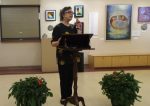
Rabbi Irwin Kula speaks in Vancouver on Sept. 16 at FEDtalks, the opening event of the Jewish Federation of Greater Vancouver annual campaign. (photo from JFGV)
The world is in a time of historic shifts and the way we interpret and respond to what is happening can make each individual a player in this civilizational drama.
This is the promise of Rabbi Irwin Kula, who will speak in Vancouver on Sept. 16 at FEDtalks, the opening event of the Jewish Federation of Greater Vancouver annual campaign. Kula is co-president of Clal, the National Jewish Centre for Learning and Leadership.
“We are living in one of the most dramatic, exciting times in human history,” Kula told the Independent in a telephone interview. “Whenever one lives in a dramatic transitional moment, the call to responsibility is also dramatic. The fear and the anxiety that we are feeling is all understandable. But managing the fear, managing the anxiety and, therefore, managing some of the loss that comes in these great moments of transition, is how we move on the journey.”
Kula promises audience members more than an interesting talk.
“Anyone who is going to be in that room, anyone who is willing to speak about it this way, really has an opportunity to be a part of not only the solution but one of the great adventures in the human drama right now,” he said.
At Clal, Kula is part of a team that is “reimagining Judaism for this era.”
“And not only Judaism, but religion in general,” Kula said. “What is religion and Judaism going to look like in an information age? In an age of globalization? In an age when the borders and boundaries of their identities are more permeable?”
Kula is an eighth-generation rabbi and holds a degree in philosophy. He has served congregations in Jerusalem and St. Louis, Mo., and, over the last 30 years, has been involved with Clal, which describes itself as a “do-tank” – “The thinking actually has to apply to people’s doing,” he explained.
Kula works “at the intersection of religion, innovation and human flourishing,” he said. “Those are the lenses I use.”
Kula analyzes how information, entertainment, media, retail and other components of society are affected by innovation. In his 2007 book Yearnings: Embracing the Sacred Messiness of Life, Kula considers the relationship between what we desire and how we live.
“Yearnings is a fancy word for desires,” he said. “The central insight in the book is that what animates us, what animates our lives, are our desires. They are sources of great wisdom for who we are as human beings. We know our most intense desires – our desire for love, our desire for the truth, our desire for meaning, our desire for happiness, our desire to be creative and have a purpose and to contribute.… The interesting thing about looking at our desires is, the more one can understand our desires, the wiser our lives are.”
Whatever the day’s headlines, Kula said, maintaining optimism is critical to making positive change in the world.
“Being an optimist doesn’t mean you have to be Pollyanna,” he said. “You can be an optimist and be 51-49 about it. The difference between being a 51-49 optimist and 51-49 the other way may be the biggest difference of all.”
And when the nightly news brings stories of authoritarian ascendancy or other alarming developments, the long view is an antidote.
“I use a long-term, macro-evolutionary take,” said Kula. “This is where Martin Luther King, I think, is right. The arc of history bends toward justice. But it doesn’t bend linearly. It’s not one plus one plus one plus one. It’s sometimes two steps forward and a step backward. We are in now a very, very significant moment of transition. There’s a lot of ways to talk about that transition – postmodern, information age, technological age – and all of the changes are hard to metabolize. So, it takes a very serious responsibility for elites and cultural creatives and people who experience themselves at the cutting edge of these changes to take very seriously the costs and pains and dislocation of these changes for different people. That is what I think we are all called to do.”
People may look at the state of the world and feel helpless or hopeless. But the better response, Kula said, is not only to acknowledge the ways in which we might affect improvements, but also to take individual responsibility for the situation.
“Maimonides, the great Jewish philosopher, said, in the face of trauma and in the face of political tragedies, the first thing to ask is how am I complicit in what is transpiring,” said Kula. “Not in a giant moral drama of blaming, because, if we are actually interdependent … then what’s happening with people with whom we deeply disagree is connected to us. It’s not some other, evil person over there.”
This is not to say there is not evil in the world, he cautions. But, asserting that those with whom we disagree are evil can potentially misallocate cause.
“In America, there aren’t 60 million evil people who voted for Trump that want America to be destroyed and become a homophobic, primitive, psychologically regressive place in the world,” Kula said. “It behooves us, says Maimonides, to address very seriously what have I missed and, therefore, perhaps been complicit in allowing this to emerge?”
Courage and a sense of adventure can help us navigate times like these.
“If we mitigate a little bit the fear and just stand at that burning bush and not be so scared, know there is tremendous possibility,” he said.
For tickets to FEDtalks, at the Vancouver Playhouse, visit jewishvancouver.com.
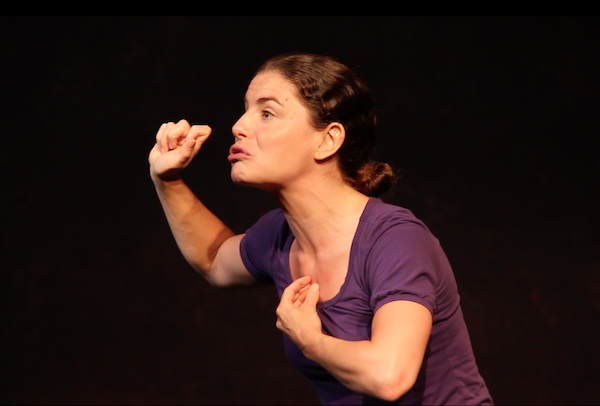
Naomi Vogt performs in Big Sister, written by her real-life sister, Deborah Vogt. (photo from Fringe)
The Vancouver Fringe Festival has started and there are (at least) a few shows that readers should try to fit in around the High Holidays. Jewish community members Deborah and Naomi Vogt, David Rodwin and Gemma Wilcox are presenting very personal works that examine issues with which we all deal, such as self-esteem, family relationships, finding and losing love, and the search for meaning. And they do it with humour and energy.
Local playwright Deborah Vogt and her sister, actor Naomi Vogt, “are still making tweaks” to Big Sister (Revue Stage), Deborah Vogt told the Independent. “However, I’m not sure if there will ever be a ‘final version,’ given that the script is a reflection of our ongoing conversation as sisters attempting to learn more about each other. Additionally, Naomi loves to ad lib and so the play will be slightly different every evening depending on who is in the audience. However, the dream would be to take it to other Fringe festivals, especially Edinburgh (the world’s largest Fringe Festival – and my personal dream). There is something very special, however, about premièring this show in the city that we grew up in and the community that we know and love.”
The idea for the show came up last summer at the Edinburgh Fringe. “Over there, I saw so many beautiful, personal solo shows that tread the line between monologue and standup. I thought, ‘I would love to do this, but I can’t act. Who do I know that could perform a solo show that I could write?’ The answer was obvious: my sister. We spent two weeks traveling together shortly after the Fringe, where we brainstormed ideas for shows in between hikes and wine bars. We abandoned most of those ideas when we realized the only story we could honestly tell was that of our relationship as sisters, and specifically how our relationship has changed over the last few years in the wake of Naomi’s 75-pound weight loss.”
Camp Miriam makes an appearance in Big Sister, said Vogt, “because my sister Naomi went there for a few summers as a preteen and our mother went there for many, many years when she was younger…. The show focuses on Naomi’s weight loss, and talks about what being a fat kid at camp was like. Naomi loved Camp Miriam, but we also acknowledge that no camp experience is easy if you don’t look like the other children.”
Naomi Vogt performs the whole play. “For the most part,” said her sister, “she is playing herself, but the version of herself that I have written through my perspective. And, on occasion, she plays me as well. I just have to sit in the audience every night and hear the ways she’s manipulating my words. Part of the joy of the show is the various power dynamics at play – as a playwright, I have shaped Naomi’s personal story but, as an actor, she is able to change my words at any moment.”
There were many challenges to writing Big Sister, said Vogt. “First of all, it was difficult trying to find the balance between Naomi as my real human sister and Naomi as a character. We wanted this show to be entirely truthful, while still presenting a piece of theatre. And this show touches on painful aspects of both of our lives (in a funny way, of course), so trying to write that without overstepping my place or lying to the audience about what actually happened (two sides to every story, right?) was difficult to manoeuvre.”
In a nutshell, the show is about weight loss. “It touches on how being heavy can affect all aspects of life, and particularly sibling dynamics,” said Vogt. “Both of us have lost weight … but Naomi’s journey was far more significant than mine. Through telling her story of weight loss, we’ve learned a lot about each other, our childhoods and the community we live in.”
* * *
David Rodwin shares his sometimes-heartbreaking dating experiences in F* Tinder. (photo by Julia Farr)
“F* Tinder is 100% autobiographical,” said David Rodwin. “Only the names have been changed. But I only have 75 minutes to talk about dating 120 different women over two years, so there’s a lot I have to leave out. But every story I tell, I do so as accurately as I can recall – with a theatrical flourish.”
F* Tinder: a love story (Performance Works) began as a book, when a friend who was writing his first book challenged Rodwin to do the same.
“I’d moved to San Francisco after my last serious relationship ended in L.A. and, over a year and a half on Tinder and other apps, I’d experienced some bizarre and noteworthy experiences in the lawless dating wilds of the Bay Area,” he said. “So, I had an unorganized collection of short stories I’d been developing…. Around that time, I met the one woman I truly fell in love with. That inspired me to write like crazy. But (spoiler alert), when she dumped me, I got writer’s block for the first time in my life.
“Though I wasn’t able to continue sitting alone at my desk typing out these tales, I couldn’t stop telling them to friends and in storytelling shows like The Moth, which I’ve done for years. Finally, it became clear that, rather than just a bunch of short anecdotes, this was a full evening of stories with its own narrative integrity…. And though I’d written half the book, I threw out everything and started over because I find that writing with my mouth creates a more natural, humorous and vibrant live performance than when I type something, memorize it and recite it.
“It’s a thrilling and terrifying process for me each night, not knowing quite how it’s going to go and I hope it creates a more visceral, authentic and deeply intimate experience. And it’s a technique I inherited from my mentor Spalding Gray. But it’s meant that the show has changed a lot over time. The first version was 60 minutes long, then it grew to 90 minutes. Now, it’s 75 minutes. But there have been multiple versions of each one…. I’m also able to adjust certain sections to fit specific audiences. I’ve even added a curling joke for my Canadian audiences, making fun of Americans’ inability to understand the sport.”
Rodwin continues to work on the book F* Tinder and, later this year, he said, “I’ll begin directing a web series of F* Tinder set in San Francisco, and also a feature film of my previous show set in Los Angeles, called Total Novice. That one has an even edgier narrative than F* Tinder, if you can believe. Let’s just say I was a ‘nice Jewish boy’ who went to Princeton and I was a very late bloomer who became fearless (and occasionally stupid) in my pursuit of things that I considered off limits when I was younger.”
F* Tinder includes Jewish elements, said Rodwin, “because they directly affected how I look at relationships.”
In the show, he shares how, on one Shabbat, while chanting prayers he’d said for 30 years, he stopped midway through the V’ahavta, “when I said, ‘And thou shalt teach them diligently unto thy children.’ It suddenly hit me that I didn’t have children, and I couldn’t fulfil this prayer in a literal way. I always thought eventually I would. But, at 45, when I read that, I fell silent, contemplating how I’d lived my romantic life in such a way that I was childless. And what it meant for me. And what I should be doing with the woman I was in love with. And it directed my next choice in how that relationship went.”
Rodwin shared another touching, and Jewish, element of his show.
“The woman I fell in love with told me she could tell I was falling for her and I shouldn’t do that because she’d already decided we weren’t going to work out in the long term, and she didn’t want to hurt me. So, she told me to build a wall around my heart, or she wouldn’t see me again…. I agreed to do so because I was afraid if I told her the truth, that I was already hopelessly in love, I’d never see her again. Now, I’m not a biblical scholar, but the next morning a piece of Torah came to my mind, out of the blue, while she lay sleeping next to me. Deuteronomy 30:6 – I’d studied it eight years earlier with Rabbi [Sharon] Brous and I didn’t understand it, so it stuck in my mind. The phrase, ‘You must circumcise your heart … so that you may live,’ baffled me. But, that morning, it suddenly made sense to me, and I decided I had to circumcise my heart and careen it against the wall around her heart until I either broke through or I broke. And people can come see the show, to discover the surprising ending.”
* * *
In Magical Mystery Detour, Gemma Wilcox explores the detours that happen in life and how we can find and trust our own centre. (photo from Fringe)
There are many twists and turns in Magical Mystery Detour (Studio 1398) by Gemma Wilcox. Set in the United Kingdom in 2012, the action is prompted “by a letter from her dead mother, [and] the protagonist, Sandra, and her dog, Solar, take an unexpected car journey from London to Land’s End, Cornwall, at a pivotal and sensitive time in her life.”
Created in the summer of 2012, Magical Mystery Detour premièred at the Boulder, Colo., Fringe Festival that year.
“It is a semi-autobiographical piece, heavily based on aspects of my life at that time,” Wilcox told the Independent. “I wrote this show very shortly after the death of my mother and the ending of a very significant love relationship with a man I thought I would marry and have children with. It was inspired by the tender and vulnerable process of dealing with and letting go of my mother’s death, the getting over and releasing this powerful love relationship, as well as some of my magical journeys through the sacred, beautiful landscape in the southwest of the U.K.
“The show reflects some of the themes I was fascinated by and exploring at that time in my life,” she continued, “such as learning how to trust and surrender to the detours that happen in life, when we think our life is going in a certain direction, but then it dramatically changes. I was also interested in exploring how we can find and trust our own centre when those we love are not there anymore, and when we feel lost or that life is too chaotic or not going the direction we want it to.”
Wilcox was born and raised in London, and moved to the United States in 2001. She has been based in Boulder since 2004. “I moved to the U.S. to explore yoga and embodiment practices, was in the Shakespeare Company in Austin, Tex., for a couple years, and found my theatrical/creative family in Boulder, as well as touring across the U.S. and Canadian Fringe festival circuit every summer for the past 11 years,” she said.
Magical Mystery Detour is one of a handful of shows that Wilcox and director Elizabeth Baron have worked on together. In creating it, said Wilcox, Baron was incredible, advising “me on how to stay both open and vulnerable as a performer, whilst also staying protected and safe and able to show the many shades and subtleties of a character.”
Wilcox writes comedy-dramas. “I find that it is highly important to balance the ‘light’ material with the ‘darker’ material, humour with seriousness – for me as a performer, and also for the audiences,” she said. “It is easier to receive and digest more poignant or shadowy material when juxtaposed in appropriate moments with humour and lightness. Humour is a huge aspect of my work – humour that comes from identifiable and sometimes embarrassing situations or honest admissions.”
For the full Fringe lineup, visit vancouverfringe.com. The festival runs to Sept. 16.
On Rosh Hashanah, the challah is round and sweet, symbolizing our collective wish for a good, sweet year. (photo by Przemyslaw Wierzbowski)
It was two years ago that I fell in love with challah. I attended a challah baking workshop at a Jewish retreat and, at that point, the extent of my challah knowledge was that it’s sold in delis, comes in a plastic bag with a twist tie and makes great French toast. I was a challah virgin. This was around the same time that I was test-driving a more observant Jewish life, and figured it behooved me to learn more about our people’s famous braided egg bread. Little did I know how profoundly the workshop would affect me.
There we were, 40 or so Jewish women, up to our elbows in yeast dough, patiently following the instructor’s directions. She explained what each ingredient symbolizes, and how making challah each week is an auspicious time for Jewish women to pray for what they want and need. I was hooked. When it came time to make the blessing over the challah, that’s when I lost it, and became emotional. Something about a sisterhood of Jewish women gathered around tables doing something their mothers and grandmothers had been doing for generations struck a chord deep within me.
As I said the blessing, with my eyes closed and my hands atop the soft dough – “Baruch atah Adonai, Eloheinu, melech ha’olam asher kidshanu b’mitzvotav v’tzivanu, l’hafrish challah” – tears poured down my cheeks like they would never stop. The woman sitting next to me (almost a complete stranger) heard my sniffling and put her arm around me. I’m sure she was puzzled by my tearful response and, truth to tell, I was embarrassed, but I was overcome and just couldn’t help myself. Somehow, the mitzvah of making challah, and all that it symbolizes in our collective identity as Jewish women, hit me.
It mattered, in a deep-seated way, that I was part of something much bigger than myself – something inextricably tied to my Jewish roots, something to which I had paid scant attention over the years. I knew this activity would become a meaningful part of my life from that moment on. Challah is far more than just a food to sustain my family and me physically. It fills us spiritually as well. And that’s the most beautiful taste in the world.
Long story short, I now bake challah on a regular basis, for others and myself. It reminds me of who I am at my core. It draws me closer to my community of Jewish friends and acquaintances, and places me smack in the middle of what is real and true – my Yiddishkeit. Who knew that combining a few essential ingredients could produce such an inexplicable gift in my life?
It’s no secret that every Jewish custom is significant on a spiritual level. With Rosh Hashanah approaching, I set out to learn how to make one of the many unique symbols of the Jewish New Year – the round challah. The rest of the year, we make braided challot and dip them in salt, but, on Rosh Hashanah, the challah is round and sweet, symbolizing our collective wish for a good, sweet year. Its circular shape, which represents the cycle of life, has no beginning and no end, thereby symbolizing the continuity of the Jewish people. You could also say it’s a metaphor for the endless blessings that God sends us. Another interpretation is that the round challah resembles a crown, symbolizing the supreme power and authority of God.
As Rosh Hashanah nears, it’s a time for personal introspection and the beginning of our individual and collective teshuvah (return or repentance). We get ready to reflect, repent and ask for forgiveness. It’s a time to elevate ourselves and direct our thoughts and deeds toward a higher, more purposeful end. At precisely this time, when our thoughts turn to repentance and resolutions for improvement, the round challah reminds us that the opportunity for teshuvah is never-ending. This Rosh Hashanah, may we all be successful in elevating ourselves from our current reality into a higher, more spiritual state of being, on both an individual and collective level.
For those of you who want to learn more about the significance of baking challah, there’s a fascinating book called The Mitzvah of Challah by Esther Rivka Toledano (ArtScroll Mesorah Publications, 2018). The author dives deep into what is undeniably a mitzvah granted especially to women. She shares the history, the halachic (Jewish legal) guidelines, several recipes and lots more. The book goes far beyond the basics for those who really want to understand and embrace the mitzvah of challah.
May we all have a sweet, happy, healthy and prosperous New Year. L’shana tova u’metuka!
Shelley Civkinis a happily retired librarian and communications officer. For 17 years, she wrote a weekly book review column for the Richmond Review, and currently writes a bi-weekly column about retirement for the Richmond News.
“King David Playing the Harp,” by Gerard van Honthorst, 1622. All of the biblical heroes are imperfect, as are we. (photo from artsandculture.google.com)
One of the beautiful ideas behind Rosh Hashanah and Yom Kippur is the notion that we need to reflect, review and rethink who we are and what we have achieved in our lives. We should never see who we are and what we have created as the ultimate expression of who we ought to be. There must always be a gap between who we are and who we ought to be, between reality and our aspirations. When our aspirations are fulfilled, there must be something wrong with our aspirations.
This is the fundamental idea behind teshuvah and its challenge to us – to embark on a process of self-criticism and reflection. To embrace teshuvah is the ultimate aspiration of our humanity, for the highest level that humans can achieve is not one of fulfilling all our values, but of constantly maintaining a tension in which goals serve as a foundation to evaluate the lives we have created and to challenge us to move forward and beyond.
An expression of this idea is found in the biblical depiction of heroes, all of whom are imperfect. We are never given a hero who embodies everything. Sometimes, it’s embarrassing. The biblical heroes seem too human, permeated by too much imperfection. The Bible is teaching us that being a hero doesn’t mean that one is devoid of imperfections; it means that one must do something about those imperfections.
By elevating these people to be our ideal, it challenges us to emulate them. You are going to fail like Moshe or Avraham. You are going to sin like David. There are going to be multiple dimensions of your life, whether it’s in your worship of God, with your spouse, with your children or with your friends, where you’re not going to be who you ought to be. Welcome to the human story. Our religion has no fantasies about human beings. It has aspirations from human beings.
For human beings to embody the aspiration of self-criticism and reflection, it is not only the individual who must be open to change but also the societies within which we live. People around us often want us to remain who we are. People don’t want us to change. They have gotten used to and comfortable with our imperfections, for it gives legitimacy to theirs.
Some rabbis in the Talmud were deeply worried about the social pressure to maintain mediocrity and lock everyone within the status quo of their failings. As a result, in Tractate Baba Kama 94b we find the following teaching:
It once happened with a certain man (thief) who desired to repent and make restitution (to those from whom he stole). His wife said to him: “Fool, if you are going to make restitution, even the clothing which is on your back would not remain yours.” He consequently refrained from repenting. It was at that time that it was declared: “If robbers or usurers are prepared to make restitution, it is not right to accept it from them, and he who accepts it does not obtain approval of the sages.”
A thief’s desire to complete his or her process of self-correction by making restitution is clearly understood and valued. The problem is that this standard may inhibit them from beginning the process. A lifetime of harm cannot be erased and, as a result, may lock us in our imperfections under the argument that one can never really begin again. “Fool, if you are going to make restitution, even the clothing which is on your back would not remain yours.”
In response, the rabbis teach that we have a responsibility towards each other to enable these new beginnings. A Jewish society is one where we make sure that reflection, self-criticism, self-evaluation and the ability to accept new horizons and new ideas are things society fosters and encourages, even at a high cost. We are individually responsible to not merely refrain from hindering each other’s growth, but that we must be willing to forgo what is rightfully ours in order to ensure that our fellow citizens will grow and change.
A Jewish society is not simply characterized by a high level of kashrut or Shabbat observance. A Jewish society is one where we allow others to do teshuvah, where we are not threatened by others’ desires to move in a new direction. A Jewish society is one that understands that to be fully human is not to accept our failings: to be fully human is to aspire to overcome them.
Shana tova to us all.
Rabbi Dr. Donniel Hartman is president of the Shalom Hartman Institute and author of the 2016 book Putting God Second: How to Save Religion from Itself. Articles by Hartman and other institute scholars can be found at shalomhartman.org.
A mosaic of the Akeida in Bet Alfa National Park in Israel. (photo from hartman.org.il)
For many of us, the approach of the Jewish New Year offers an opportunity to take a moment from our harried lives to reflect on life’s “big” questions. It is a time for many of us – across the religious spectrum – to think about our relationships with ourselves and our families, with our tradition and with God. For those of us who choose to spend Rosh Hashanah in synagogue, the holiday offers the opportunity to participate in a communal reading of some of our most sacred and paradigmatic collective narratives, which in turn have the potential to illuminate some of our most pressing personal dilemmas.
Two of the most important biblical stories we revisit every Rosh Hashanah are the binding of Isaac (known in the Hebrew parlance as the Akeida) and Abraham’s argument with God regarding the fate of the inhabitants of Sedom. These two accounts represent two different religious anthropologies: one of sacrificial self-surrender and one of assertive moral challenge. As I have previously written, the personal moral empowerment displayed by Abraham in the story of Sedom – his insistence on his own ethical intuition and God’s acceptance, in turn, of those claims – is, for me, the foundation of the covenantal relationship.
The account of the Akeida, on the other hand, presents a distinct moral dilemma: How do we begin to understand a God who would ask His most loyal follower to sacrifice his beloved son? There are many ways to approach the theological puzzle that is the Akeida. This Rosh Hashanah, as we pause to examine not only our relationship to the divine, but our personal family relationships as well, I propose rereading the story of the Akeida by looking at God’s character through an anthropomorphic lens.
Before I begin describing God in human terms, however, it is important to remember that we have a long and deep tradition of doing so. The Bible is replete with images of God experiencing “human” emotions. Throughout the biblical narrative, we are presented with a God who is alternately angry, jealous or ego-driven.
During the Jewish people’s sojourn in the desert, for example, Moses, like Abraham before him, finds himself in the position of having to plead with God not to destroy a people – in this case, the Jews of the desert generation. The Bible describes God in nakedly human terms, as Moses finds that he has to, in some way, appeal to God’s ego. The Midrash describes Moses grabbing hold of God and saying to Him, “I’m not going to let you do what you want to do to the Jews.” Moses even appeals to God’s public relations considerations: he reminds God that He not so recently delivered this desert people from bondage in Egypt; if He kills them now, the other nations will say that He took them out of slavery only to slaughter them in the wilderness. Moses tells God in no uncertain terms that he will not help facilitate a people’s destruction.
Moses has to convince God not to allow His “emotions” to overpower Him, not to let His anger consume Him. This is but one example of many throughout the Bible and the Midrash of profound anthropomorphism, of portraying God as a character full of human weaknesses, with the potential to be both vulnerable and volatile.
In examining the story of the Akeida, we are compelled to ask, How could the God of the covenant – the God who promised Abraham that a great and multitudinous nation would emerge from his son Isaac – command that Isaac be killed? How are we able to understand the covenant in light of this seemingly unfathomable dictum? In attempting to understand the God of the Akeida, and what the Akeida might mean for us today, I have found it helpful to look at God as a parent.
God made the covenant with Abraham. But, after He did so, He got nervous, He suddenly felt scared. He had given over enormous power to human beings and He felt His ego being threatened. Thus, when God commands Abraham to “Take your son,” Abraham senses intuitively that it is not a moment in which to approach God with his moral claims. When God says, “Take your son,” Abraham understands that the God who is speaking – the God of the Akeida – is a God who experiences His own authority as under siege.
Abraham knows that the moment of the Akeida is not a moment for encounter or dialogue, but a moment that requires silence. It is a moment when Abraham knows that his only choice is to be quiet and submit. Abraham, a lover of God, senses the divine mood. When Abraham stood in front of God at Sedom, it was, in part, because he felt that it was a time when he could approach God; he sensed that God was in a willing position, that there was a possibility that He would be receptive to Abraham making covenantal demands.
Abraham’s response to God is analogous to a child’s response to a parent who the child knows is feeling challenged or threatened. There are times in a family’s life when a child knows intuitively – as Abraham knew intuitively – that there’s an opportunity for discussion, a moment when he can be critical of his parents, and his parents will be receptive to what he has to say. But there are other moments when a child understands that his parent is feeling insecure; moments when the mother or father is terrified of losing his or her authority. A child knows that is not the moment to try to encounter the parent in critical relationship; it’s not the moment to remind the parent that, in the past, he or she has encouraged critical reflection. That is a reality of family life: parents can become terrified of losing their position of power; they can become frightened that their children misjudge their encouragement of critical reflection as a negation of their parental authority. So, in some way, I attribute to God the same weakness or the same dilemma. He feels threatened. He feels that He must assert His power and test His child.
Before the Akeida, Abraham is referred to as ohavai elokim, a lover of God. Subsequent to the Akeida, he is referred to as yerei elokim, a fearer of God. The question we are faced with is why must God demand Abraham’s submission and fear? Why was his love not enough? To understand the God of the Akeida, we have to understand that God has conflicting forces within Him. The Midrash on the Akeida paints a very strange portrait of a God who says to the Jewish people, “Please pray for me. Please pray that my attribute of compassion will overcome my attribute of justice.”
Who is this God that must pray to human beings for help in overcoming His impulses? Who is the God that needs to ask human beings to remind Him of compassion? The Midrash illuminates for us the reality of a God who is struggling to reconcile the opposing forces within Him. It is my view that the Akeida is a moment of God’s struggle within Himself. God tests Abraham because of God’s own internal difficulty balancing justice with compassion, fear with love.
How can we talk about God experiencing an internal struggle? The great contemporary biblical scholar Yohanan Muffs argues that it is only in human terms that we can most authentically grasp the nature of the divine. I share Muffs’ view that God’s humanity, so to speak, is essential to a true understanding of Him. Yet it is not only 20th-century thinkers such as Muffs, Abraham Joshua Heschel and I who have portrayed God in starkly mortal terms. Drawing on the tradition of the Bible and the Midrash, the rabbis of the rabbinic period routinely discussed God as having an interior emotional life. While this approach did not fit in with medieval philosophy, which maintains that God cannot take on any human form, that any change or emotion in God is a sign of imperfection, the great figures of the rabbinic period were not frightened to speak of God in the language of human psychology.
It is this tradition that empowers me to think of God in terms of psychodynamic maturation: to cite His shift from being a figure of complete and total authority to a figure who works in concert with human beings. It is the deep rabbinical tradition of ascribing human qualities to God that enables me to see a God who decides to become accountable to human beings.
And it is this precedent of anthropomorphism in the rabbinic canon that informs my view of the God of the Akeida as a parent struggling with his identity, grappling with the competing values within Him. He loves Abraham and He has planned great things for him, but God is beset by his own internal dilemmas, by his own conflicting emotions. This is the God of the Midrash, the God who says to Moses, “Hold me back, Moses, I’m losing myself.”
If this is a bold way of discussing the divine, it is no bolder than the way the Bible itself discusses God. Rather than diminish God in our eyes, looking at God in human terms enables us to understand Him on a deeper level. The God who experiences emotion, who experiences internal struggle, is a God who can enter into a relationship of mutual accountability with human beings. The God who experiences His own psychodynamic reality is the God of covenantal spirituality.
This Rosh Hashanah, as we examine our relationships with our parents and our children, with ourselves and with our tradition, we are all faced in some form or another with the challenge of balancing compassion with justice, authority with love. As the Jewish New Year draws closer, let us allow ourselves to draw on the wisdom of our shared narratives as we struggle to reconcile the competing values within us.
Rabbi Prof. David Hartman (1931-2013) was founder of the Shalom Hartman Institute. Articles by Hartman, z”l, and other institute scholars can be found at shalomhartman.org.
Repetition is good for us. (I may have said this before!) If you exercise, you’re in touch with “reps” or, if you walk your dog, you’ve been down this block with someone sniffing at the end of the leash before. If you’re rolling your eyes in boredom as you stand in a line, way too much of life seems to be about waiting patiently and repetition.
Jewish tradition has lots of “rinse and repeat” kinds of moments in it. If you read the Torah portion regularly, phrases like, “And Moses said,” pop out frequently. If you’re already preparing meals or family gatherings for upcoming holidays, you may reflect on how often you’ve done this before. It would be wrong to ignore the feeling of drudgery that sometimes accompanies all this. There are definitely times, as I try to figure out how to fit in all the prep, when I wonder if it’s so meaningful to do it again. And again.
Two recent experiences reminded me that we get something out of this repetition thing.
The first was one of those ubiquitous parenting articles that mention the value of self-care and meditation. Sometimes it’s easier to dismiss such suggestions. Yes, I’ve thought, but who will watch the kids, make dinner and earn the money while we’re doing all this trendy stuff?
However, I happened to hear a tidbit at services recently about Rosh Chodesh. Bill Weissman was leading a Sunday minyan at the start of the month of Elul. He reminded everyone about the association of women with the beginning of the month, mentioning that, aside from tending small babies, women were supposed to have a day off. In some Jewish communities, women don’t do certain kinds of work on the holiday, perhaps avoiding laundry or other tedious jobs. In fact, Jewish tradition teaches us that we need breaks. Scheduled activities, like a learning group, a meditation circle or even a standing coffee date, enable us to take better care of ourselves, whether it’s scheduled for Rosh Chodesh or every Tuesday.
The second experience that brought this all together occurred on the same weekend but the day before. One of my twins was feeling sick and was on antibiotics, so he stayed home with Daddy. I took the other twin on a Shabbat date. We went to family services together. Usually, while this kid dances and participates, he doesn’t read or engage with every prayer. My other twin sings along to everything, but makes up his own words. That’s fine. I figure they both enjoy themselves and get something out of being there. (For me, attending services is all part of that repetitive self-care thing, but it’s hard to get the most out of it with twins along for the ride.)
To my surprise, this Shabbat, a switch flipped in my kid’s 7-year-old brain. He sang and davened every prayer. He engaged completely. He wanted to be involved and responded to everything at the service – he even heard something interesting during the announcements. During the month of Elul, we blow the shofar during morning minyan.
Later, when I said how proud I was to hear him sing and say all the prayers, I asked what had happened. He explained that he likes to be quiet until he knows something perfectly. He decided he knew things well enough, so now he can say them all. It was as if buzzers were going off in my “educator” brain. Bing! This kid is an introvert. This is how introverts often process and learn new material. It’s about quiet introspection and repetition.
The next morning, I still had one sick twin and one healthy one. The healthy introvert announced that he wanted to attend that morning’s minyan. He cheerfully got through the hour-long service on Rosh Chodesh. He joked with many of the minyan regulars, participated, and he heard the shofar. It was a meaningful experience for him. I am still feeling celebratory about it many days later!
How did we get to this point? It wasn’t a one-time experience. I didn’t create a high-pressure event where I brought my children to one service, asked them to tell me if they enjoyed it and expected them to make a decision about their religious observance as a result. When we learn at school or while doing a sport, there are a lot of drills involved. It can be boring or reflective, but maybe it doesn’t matter.
We need to keep repeating things – Jewish content, CPR training, swimming lessons, whatever – until it sticks. You can’t give yourself a chance to make or eat a good holiday meal or have a meaningful religious experience if you haven’t practised. Recipes, prayers, exercise and meditation, among other things, don’t generally come out right the first time. Is it sometimes boring to do one’s exercise, cooking or other life tasks? Oh, you bet. However, nobody ever said that taking care of yourself, your household, relationships and work would be easy.
Some things aren’t fascinating. Even so, all that repetition can be good for us. Repetition teaches life skills. Learning the discipline needed to stick to something and practise it? That’s well worth taking time to learn. Repetition offers our bodies and minds a lot of healthy habits. Jewish communities and activities offer these skills. Just keep going. (It’s about showing up.)
Joanne Seiffwrites regularly for CBC Manitoba and various Jewish publications. She is the author of three books, including From the Outside In: Jewish Post Columns 2015-2016, a collection of essays available for digital download or as a paperback from Amazon. See more about her at joanneseiff.blogspot.com.
Families sometimes just have a bad run when it comes to health in the household. From December onwards, it seems like somebody has been sick at our house … but, in between, there were brief periods when most of us functioned OK. It’s been challenging.
Like many folks, I’m also signed up for an exercise class, but I have had to miss it a lot because of all these illnesses. I’m usually game for a long walk with the dog, but not a big fan of exercise – I do it because I should. We need regular exercise to strengthen and care for the body. However, when a kid is home sick, or I am, I have to skip that class, too. Exercising is, in the long run, good for me, but, in the short term, there are days when I just have to sit on the couch.
Figuring out how to care for our bodies is a balancing act. On the one hand, sometimes things hurt, but, on the other, there’s no one else inside each of our bodies, telling us what to do about it.
Some people have a high pain tolerance and, more, we’ve been taught to “walk it off,” “suck it up” or cope with what comes without complaining. Is this choice, to learn to cope with discomfort without complaint, a Jewish thing?
Some might say it is the opposite. If you read the Torah portions about the Exodus from Egypt, you get multiple examples of when the Israelites complained. They wanted meat. They wanted water. They wanted better food. In Numbers 20:5, it says, “Why did you make us leave Egypt to bring us to this wretched place, a place with no grain or figs or vines or pomegranates? There is not even water to drink!”
On more than one occasion, G-d does provide for the Israelites, but there’s also punishment. People get sick, or are bitten by serpents. Complaining isn’t rewarded. It might be natural for some to complain of their lot – even the most strong among us need to let out our frustrations after awhile. However, some of us were taught that complaining too much isn’t OK; that, unless you’re dying, you need to get on with things, and save the cries of pain and complaints for when something actually really matters.
Unfortunately, if you hold the pain in and don’t act like you’re dying, sometimes you don’t get taken care of promptly. In some cases, the squeaky wheel gets the grease. Also, if you’re not a big complainer, people may forget that there might be anything wrong, though being stoic, understated and self-controlled can make life less complicated, too.
I’d like to say that folks remembered that some in our family weren’t 100% healthy, but that wasn’t always the case. Sometimes I felt a lot of pressure for us to be joiners and attempt something that I knew just wouldn’t work out – as I recovered from pneumonia, for instance. I’d have to say things like, “Well, we’re really not up to that, but thanks for inviting us.” I feel like maybe we’ve missed out, but good health is really important. It has to come first.
Jewish tradition teaches us that the body is a temple. We have to take care of it. We wish people “refuah shlemah,” or “complete healing.” We say “la bruit” (“to your health”) when someone sneezes. Midrash teaches us that we wish health to someone when they sneeze because, in the past, some saw sneezing as dangerous and deadly – the soul could leave through the nostrils. It’s a mitzvah (commandment) to do bikur cholim (visiting the sick), and many congregations have committees in place to make food and visit those who are unwell.
We have contradictions here. In our oldest stories, there are complainers and punishments for complaining. In our ritual traditions, we wish people health, help them get well, and have an obligation to take care of others and visit them. We’re also not to abandon those who are sick – when Miriam got sick, the Israelites waited for her to get well before traveling on. Yet, we’re also part of a 24/7, on-the-go culture. It’s hard to reconcile the need for good, old-fashioned rest with our modern lives, but both are necessary. When it hurts, it’s OK to say so, within reason, and to expect others to care and wish you better health.
Here’s a funny story of “it hurts.” While I was in labour with my twins, another expectant mother came in. She came with two people (family members? friends?) and made a lot of noise. It turned out that, when the people with her had to leave the room, she stopped making noise. It felt like we were listening to a performance! This lady felt that part of delivering the baby required making noise about it – and we all heard it, on cue.
It’s traditional to be supportive of someone in their time of discomfort – to support and help – but perhaps Hashem would prefer it if we saved the hysterical screaming for when it really hurts rather than just for when someone can hear us. Complaining for its own sake, it would seem, warrants punishment but, when it really hurts, we’re commanded to visit, bring food and help.
Sickness happens to the best of us, and it sure isn’t fair. But, there’s no point in making it worse for everyone by screaming louder than anyone else.
Joanne Seiffwrites regularly for CBC Manitoba and various Jewish publications. She is the author of three books, including From the Outside In: Jewish Post Columns 2015-2016, a collection of essays available for digital download or as a paperback from Amazon. See more about her at joanneseiff.blogspot.com.
If you listen to lifestyle advice, finding one’s work-life balance has never been harder. Indeed, work obsesses many of us 24/7. We’re always struggling to find time for family, household and leisure activities. Like every generation, we think we’ve invented a new problem.
It only takes a little while studying Jewish texts to respond to this with a “Don’t be ridiculous!” Yes, our technology makes our work lives faster and more omnipresent, but, in Jewish tradition, we’ve been discussing and debating how to balance these issues for thousands of years.
When I started thinking about this, I remembered how many detailed tips are available to us by studying Midrash and Talmud. There are discussions about how much sleep we need. Depending on their profession, there are views about how many times a week men are obligated to be intimate with their wives. There is advice on how to raise your (Jewish) children and how to take care of your livestock.
By the way, in case you raise livestock (for work or fun) or have pets, you should always feed them first, before you eat. Is that irrelevant? Not in my household, where we conscientiously feed our dogs first every morning and evening, before breakfast and dinner. (It cuts down on begging at the table, too.)
A few weeks ago, a new start-up that works on networking and advice for people in university alumni communities asked me to participate in a career path interview. It was done entirely online. I was happy to do it, because it struck me as a useful exercise. New university graduates might be able to learn from older peers, and gain useful information and connections. I responded to the questions without hesitation.
Although I listed plenty of professional qualifications, I focused on how important it was to be flexible, evolving and intellectually curious as your life changes. In my experience, things like getting married, having health issues or kids, or moving affect your career path enormously. I figured this was not news to anyone, but that it was advice worth offering to 20-somethings or career changers.
To my surprise, someone at the start-up contacted me and asked if they could feature me in a “career journeys” email. At first, I thought, “Sure, why not?” I even wondered if it might bring in more writing or editing jobs. Then I read their draft.
Their draft email sandwiched my photo and quote in between two male professionals, a medical physician/specialist and a virtual reality DJ. The quote they chose for me highlighted that moving for my husband’s academic career forced me reinvent myself to find paying work and to stay competitive.
I was the only woman featured, and the only professional whose married status was mentioned first. I felt angry. Why were my peers’ work credentials front and centre but, for me, it was about marital status and career sacrifice for a partner?
I asked them to cut me from their interview or significantly revise what they posted. I pointed out why. They responded quickly, apologized, and let me revise the text so that it featured what I brought, as a professional, to the conversation rather than my gender or family status. In the end, my quote read: “You do not need to know ‘what you want to be when you grow up’ when you are 18 or 21. We need to be flexible, evolving and intellectually curious.”
So far, at least, I have heard nothing as a result of the e-newsletter’s publication but, at least, I’m not embarrassed by it.
Twenty years ago, this past June, our wedding program featured a quote from Bava Metsia 59a. It came from what Rav Papa said to Abaye: “If your wife is short, bend down and listen to your wife, and whisper in her ear.” If you’ve ever met me (and my partner) in person, you know that I am certainly short … and the key to keeping a healthy balance is in these discussions, too. If we want to maintain good work lives and, more importantly, healthy, happy overall lives, we need to listen to one another, and value what we each bring to the table.
Sometimes, it’s hard work to maintain a marriage, raise kids, or even feed the dogs promptly before we eat. The technology aspect of the work-life balance makes us think that it’s all new, but something was always the newest thing in every generation. Rather, look at it another way. We aren’t alone. Network backwards. We’re lucky to be bolstered by thousands of years of good Jewish advice. Just like our ancestors, we’re free to sift through it and take what works best for us.
Joanne Seiff writes regularly for CBC Manitoba and various Jewish publications. She is the author of three books, including From the Outside In: Jewish Post Columns 2015-2016, a collection of essays available for digital download or as a paperback from Amazon. See more about her at joanneseiff.blogspot.com.
Traditions can disappear within a blink of an eye. But keeping certain practices alive is what helps us remember where we came from and shapes how we live and be Jewish today.
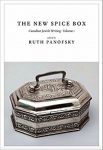
I was excited and curious to read volume 1 of The New Spice Box: Canadian Jewish Writing, edited by Ruth Panofsky, and published by New Jewish Press. I wanted to see how various writers used their family’s history in stories and poems to express their views.
The book is divided into three sections: voice, place and practice. Oppression and triumph are recurring themes throughout, and the stories exhibit strength and are endearing. Panofsky has brilliantly chosen selections that represent what it means to be Canadian in a Jewish context – overcoming difference while maintaining tradition.
The Spice Box: An Anthology of Jewish Canadian Writing was first published in 1981 by Lester and Orpen Dennys; it was edited by Gerri Sinclair and Morris Wolfe. The original book featured many authors, and brought Jewish stories to the forefront in Canada, including translations from original Yiddish texts.
For this new edition, Panofsky researched extensively writings from 1980 to the present. Material that did not make it into the original book was re-evaluated. Pieces relevant to the lives of Jews today were picked out and the contributors include authors from the first edition, such as Matt Cohen and Seymour Wayne. Current pieces were added, and they complement the other writings tremendously. This contemporary collection is intended to provoke new ideologies of culture and what Jewishness means in Canada. To do so, some of the stories refer back to a time before Jews arrived in Canada, while others relate modern-day situations. Readers can see how traditions and circumstances have changed over the years.
The collected pieces within The New Spice Box present how the writers see themselves today and how moving to Canada shaped who they are. In some stories, Canada is depicted as a haven, but also as an intimidating place for new arrivals. Moving to a new location during the war would have been difficult and somewhat terrifying, and these stories show just how much tenacity these immigrants had to begin again. Their families are what kept them going; making sure the next generations would play a role in telling their histories and keeping age-old traditions current.
One story, in particular, demonstrates how daunting moving to another country is. In “My Mother’s Luck” by Helen Weinzweig, a daughter is talking. Initially, it is written in the first person, but the narrative changes into the second person as the story continues. Esther begins, telling her story, but the mother’s perspective takes over. Lily is preparing her daughter, Esther, for her journey to Germany from the United States. Esther is very reluctant to go, even though she agreed beforehand to do so, in the pursuit of a higher education. Esther is scared about the impending changes and is nervous about fitting into a new country, as well as living with her estranged father.
Lily reassures her daughter that this is what she needs to accomplish, even though she herself is skeptical about the value of a higher education, believing that people who are more educated do not necessarily get decent paying jobs in their chosen profession. This attitude is most likely based on Lily’s terrible experiences with men. For example, Esther’s father abandoned them shortly after she was born, preferring to be around his university friends. But, even if mother and daughter fight throughout, Lily’s love for Esther shines through, and Lily assures her daughter that, if everything does not go smoothly, she has a ticket to come back home.
Meanwhile, “Pesach en Provence” by Gina Roitman highlights a duty to safeguard Jewish holiday customs. The narrator describes why making a Passover meal is particularly significant. While in Alpes-Maritimes, taking a break from her life in Montreal, she is planning a seder for a friend. Most of her family was killed in the Holocaust and, besides her brother, only distant relatives remain. In planning the seder, overwhelming memories of her mother at Passover return. Because of these recollections, the narrator adds dishes to the menu other than those she initially planned. By the end of the story, she comes to understand why the meal was so prominent in her family and why Passover is something powerful to celebrate. She realizes her mother’s importance in keeping the tradition alive, and comes to appreciate both her mother and her culture more.
Chloe Heuchertis a fifth-year history and political science student at Trinity Western University.
Barbara Pelman speaks at the opening of the exhibit Encounters, which is at Congregation Emanu-El in Victoria this summer. (photo by Frances Aknai)
On June 3, the exhibit Encounters opened at Congregation Emanu-El in Victoria. It is the culmination of the most recent Calling All Artists exchange, a project that has been going on for more than a decade.
“Bible has to be interpreted to be relevant,” said Barbara Pelman, coordinator of Calling All Artists since its inception. “All Renaissance art is Bible interpretation. That’s what we do with this project.”
In 2004, Pelman was the head of the adult education committee at the synagogue.
“Rabbi Harry [Brechner] came up with the idea to gather a bunch of artists and writers for a few study sessions to teach them a particular theme and its rabbinic interpretation,” she recalled. “I thought it was a wonderful idea. The sessions were conducted once a month for five months. Afterwards, the artists would offer their own interpretations of the theme, and the synagogue would have an exhibit of their works.”
While the congregation also produced colourful chapbooks – mini catalogues of the exhibitions – in previous years, they did not do so this year.
Over the course of the project, the artists have studied a variety of subjects. The first exchange was based on the topic of Paradise, and the exhibit was held in 2005. In subsequent years, themes have included dreams and prophecies; creation; the Book of Ruth; death and afterlife; and reinventing rituals.
“We missed a few years since the beginning,” said Pelman. “Once, we thought that maybe we are finished with the project and won’t do it anymore, but everyone involved said, ‘No! No! We should continue.’ Another year, holidays interfered.”
This year’s theme examines divine-human interactions.
“What happens in these encounters? What does one look like and how is it reported and remembered? What are some examples in biblical and rabbinical tales? How do we understand divinity and how does that understanding affect our worldview? These are some of the questions the artists of different genres have been exploring,” Pelman explained.
She said that not all participating artists are members of the congregation, or even Jewish. “The project is open to the community,” she said. “This year, 30 people signed up for the project; 17 artists remained to the end to exhibit their works. Five of them are not Jewish, but all of them are interested in learning.”
Studying with the rabbi is a mandatory part of Calling All Artists, Pelman said. “This entire project is about learning from those who know more than we do. The point is not to exhibit but to learn. That’s why the art is not vetted.”
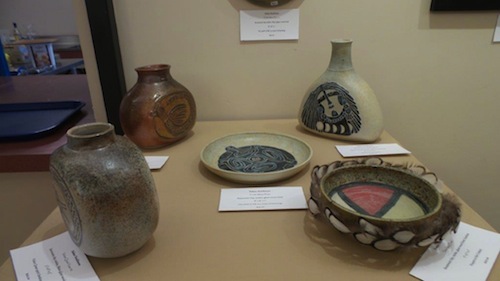
Encounters features a range of artistic genres, including pottery. (photo by Frances Aknai)
Participating artists represent a wide variety of media and genres, as well as skill levels. Some participants are professionals; others do art as a hobby. The exhibits feature photographs and paintings, fibre art and pottery, sculpture and poetry. Every piece is accompanied by an explanation of the work by the artist.
Pelman is a poet, so her involvement in every year’s project has been a poem. For her, divinity is not an all-knowing old guy somewhere above. “It’s the biggest and best part of you, of us all,” she said. “How do we find it? How does it inform our muse?” This is what she contemplates in her poem for this year’s explorative journey.
Pelman worked as an English teacher for many years. She taught high school, college and university classes, and she has been writing poetry for a long time. “I have three poetry books published,” she said. “The last two by Ronsdale Press, a Vancouver publisher.”
Another frequent participant in the project, artist and writer Isa Milman, said, “I participated in the first Calling All Artists, The Paradise Project, in 2005. It was a spectacular experience. The combination of Rabbi Harry Brechner’s teaching, the group of artists who gathered and learned from each other, wrestling with text that most of us were unfamiliar with, was truly energizing. The process involved five sessions spread over a few months, to learn from Harry’s teachings and engage with one another, as we entered a spiritual quest for meaning. Then we went off to put our learning into practice and create our responses.”
Milman has taken part in a number of Calling All Artists projects. “I’ve written poems as well as created paintings for these projects,” she said. “Learning with Rabbi Harry is an inspiration. He’s a gifted teacher and a wonderful spiritual guide. My Jewish education was extremely Orthodox and doctrinaire and I rebelled against it. Learning Torah with Rabbi Harry is so different. It’s an invitation to engage and converse, which I so welcome.”
Olga Livshinis a Vancouver freelance writer. She can be reached at olgagodim@gmail.com.