Skip to content
  • Home
  • Subscribe / donate
  • Events calendar
  • News
    • Local
    • National
    • Israel
    • World
    • עניין בחדשות
      A roundup of news in Canada and further afield, in Hebrew.
  • Opinion
    • From the JI
    • Op-Ed
  • Arts & Culture
    • Performing Arts
    • Music
    • Books
    • Visual Arts
    • TV & Film
  • Life
    • Celebrating the Holidays
    • Travel
    • The Daily Snooze
      Cartoons by Jacob Samuel
    • Mystery Photo
      Help the JI and JMABC fill in the gaps in our archives.
  • Community Links
    • Organizations, Etc.
    • Other News Sources & Blogs
    • Business Directory
  • FAQ
  • JI Chai Celebration
  • JI@88! video

Recent Posts

  • Eby touts government record
  • Keep lighting candles
  • Facing a complex situation
  • Unique interview show a hit
  • See Annie at Gateway
  • Explorations of light
  • Help with the legal aspects
  • Stories create impact
  • Different faiths gather
  • Advocating for girls’ rights
  • An oral song tradition
  • Genealogy tools and tips
  • Jew-hatred is centuries old
  • Aiding medical research
  • Connecting Jews to Judaism
  • Beacon of light in heart of city
  • Drag & Dreidel: A Queer Jewish Hanukkah Celebration
  • An emotional reunion
  • Post-tumble, lights still shine
  • Visit to cradle of Ashkenaz
  • Unique, memorable travels
  • Family memoir a work of art
  • A little holiday romance
  • The Maccabees, old and new
  • My Hanukkah miracle
  • After the rededication … a Hanukkah cartoon
  • Improving the holiday table
  • Vive la différence!
  • Fresh, healthy comfort foods
  • From the archives … Hanukkah
  • תגובתי לכתבה על ישראלים שרצו להגר לקנדה ולא קיבלו אותם עם שטיח אדום
  • Lessons in Mamdani’s win
  • West Van Story at the York
  • Words hold much power
  • Plenty of hopefulness
  • Lessons from past for today

Archives

Follow @JewishIndie
image - The CJN - Visit Us Banner - 300x600 - 101625

Tag: Jewish Seniors Alliance

Community birthdays, awards

Community birthdays, awards

Team BC Junior Olympic level 10 (16+) were bronze medalists in the 2017 Canadian Championships in Artistic Gymnastics that took place in Montreal May 25-28. Congratulations to the whole Gymnastics BC team, which included 18-year-old Rachel Rubin-Sarganis (third from the left). (photo from Gymnastics BC)

***

photo - Sylvia Hill
Sylvia Hill (photo from Jewish Seniors Alliance)

In the Pirkei Avot (Ethics of Our Fathers), we learn the saying, “Teach us to number our days so that the experiences of life should provide us with wisdom that only years can bring.” How fortunate we are that we have this exceptional woman, Sylvia Hill, admired by all who know her.

Sylvia has been part of the Jewish Seniors Alliance of Greater Vancouver since its inception and is an honourary life member. On June 6, Sylvia turned 103 years old. We honour her as she continues to inspire us with her staunch resolve to advocate for better lives for seniors – be it in the home where she was once president of the residents or within the community at large.

In the newsletter put out by the Snider Campus, Sylvia was called “the Face of Louis Brier” and was honoured during morning services on June 10, with a special kiddush following. On the day, we of JSA proudly wished you, dear Sylvia, a yom huledet sameach, a happy birthday, and we wish you continued good health for many years to come … beez (until) 120, and thriving, as has been the theme of JSA’s Empowerment Series this season. Continue being a beacon of light for us to follow!

With love and deep respect.

* * *

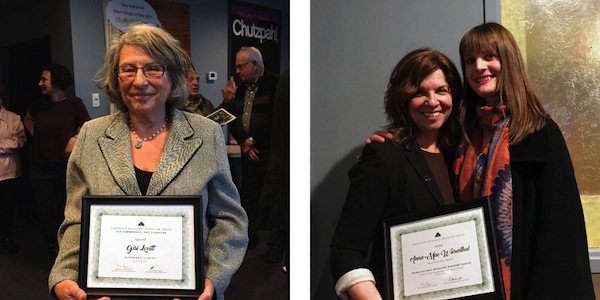
At the annual general meeting of the Vancouver Holocaust Centre Society for Education and Remembrance on June 14, Gisi Levitt received a Life Fellow Award for her 12 years of service as VHEC’s director of survivor services.

The Meyer and Gita Kron and Ruth Kron Sigal Award for Excellence in Holocaust Education was awarded to Anna-Mae Wiesenthal, who teaches Jewish history and English at King David High School. She recently worked together with VHEC on the Student Docent Training Initiative, a successful pilot project in which volunteer students from KDHS were trained to become docents. Two of the student docents, Milena Markovich and Jacqueline Belzberg, did an outstanding job of sharing with the audience their experiences of guiding their fellow students through the VHEC exhibition In Defiance: Jewish Resistance During the Holocaust.

photos - Gisi Levitt, and Anna-Mae Wiesenthal, left, and VHEC education director Ilona Shulman Spaar
Gisi Levitt, and Anna-Mae Wiesenthal, left, and VHEC education director Ilona Shulman Spaar. (photos from VHEC)

* * *

On June 20, Women in Film & Television Vancouver celebrated leaders for their outstanding work and contribution to advancing opportunities for women with their annual Spotlight Awards. This year’s recipients included Mark Leiren-Young, who received the Iris Award.

The Iris Award is given to a person who has demonstrated a commitment to the promotion of female creators and their screen-based works, either through curating or programming or through print and online media sources. Named after the Greek mythological figure Iris, associated with communication, messages and new endeavours.

Leiren-Young was also one of the finalists for the 2017 BC Book Prizes’ Hubert Evans Non-Fiction Prize for The Killer Whale Who Changed the World (Greystone Books).

Killer whales had always been seen as bloodthirsty sea monsters. That all changed when a young killer whale was captured off the west coast of North America and displayed to the public in 1964. Moby Doll – as the whale became known – was an instant celebrity, drawing 20,000 visitors on the one and only day he was exhibited. He died within a few months, but his famous gentleness sparked a worldwide crusade that transformed how people understood and appreciated orcas. Because of Moby Doll, we stopped fearing “killers” and grew to love and respect “orcas.”

Leiren-Young is a journalist, filmmaker and author. His Walrus article about Moby Doll was a finalist for the National Magazine Award and he won the Jack Webster Award for his CBC Ideas radio documentary Moby Doll: The Whale that Changed the World.

* * *

It was a banner year for the Leo Awards, which received a record 1,295 entries, from 301 unique programs in 14 different categories. Among the finalists was David Kaye – for best lead performance by a male in a motion picture for his work in Cadence and as part of the cast of Grocery Store Action Movie, which was nominated in the category of best music, comedy or variety program or series.

Format ImagePosted on June 30, 2017June 29, 2017Author Community members/organizationsCategories LocalTags Anna-Mae Wiesenthal, David Kaye, Gisi Levitt, gymnastics, Holocaust Centre, Jewish Seniors Alliance, KDHS, Leo Awards, Mark Leiren-Young, Rachel Rubin-Sarganis, Sylvia Hill, VHEC, women
An afternoon of song

An afternoon of song

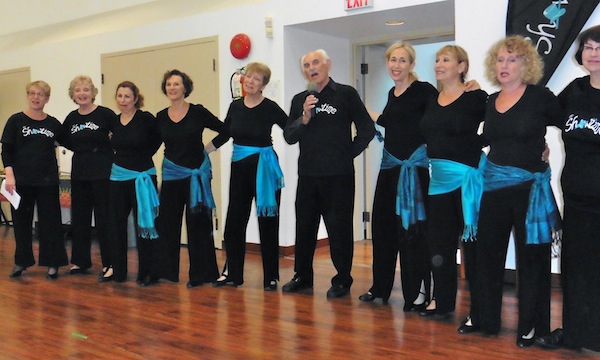
JCC Showtime performers in action, left to right: Nassa Selwyn, Jocelyne Hallé, Marshall Berger, Dawn Hurwitz, Daniella Givon, Debbie Cossover and Arnold Selwyn. (photo by Binny Goldman)

Sunshine and song greeted the 120 people who gathered to enjoy a BBQ lunch and watch the sensational JCC Showtime perform on June 27 at Congregation Beth Tikvah.

Toby Rubin, executive director of the Kehila Society of Richmond, welcomed everyone and explained the event’s agenda. She then highlighted two of the society’s outstanding volunteers, Stacey Kettleman, who at one time had been co-president with Rubin, and Sylvia Yasin, a 90-year-old dynamo who had directed the set up of the whole room.

Marilyn Berger, president of the Jewish Seniors Alliance, which partnered with Kehila to present the afternoon’s program, noted that it was the fourth and final session in this year’s Empowerment series. The lunch’s theme, “A smile on your face – a song in your heart,” was brought to fruition through the dedicated efforts of Gyda Chud and Shanie Levin. The food – salads, beef and vegetarian burgers, fruit and chocolate cake – was catered by Kettleman and her staff.

JCC Showtime’s Debbie Cossover explained that the troupe consisted of volunteer performers who have been together 13 years, with their next show making a total of 200 performances so far. The group was created by Beryl Israel, who immigrated from South Africa in 2002; he had been involved with a similar group there and was inspired to establish one here.

The afternoon’s program began with Marshall Berger singing “Showtime,” accompanied by the group’s pianist, Muriel Morris, and aided by sound technician Gary Zumer. The crowd was transported down memory lane with nostalgia-laced songs such as “Chattanooga Choo Choo,” complete with suitcase; Cossover’s foot-stomping rendition of “You Can’t Get a Man with a Gun”; heart-tugging duets by Arnold and Nassa Selwyn, which included “Together,” “Do You Love Me?” from Fiddler on the Roof and the particularly crowd-pleasing “I Remember It Well.”

The “Hello, Dolly!” number charmed the audience, as well, as it actually included a visit from “Dolly,” a life-size doll that danced in the arms of Berger and Selwyn, both men vying for her attention. Another fun number was a chorus of cowgirls sequence, which required precisely timed twists and turns. And “Tzena Tzena” and “Hava Nagilah” set everyone’s hands to clapping, as the audience joined in with Berger and Selwyn on the last stop on a world tour of songs.

Clever costumes, with outfit changes accomplished in mere minutes, and intricate choreography achieved the illusion of instant scene changes and delighted the audience, which showed its appreciation by loud, sustained applause.

Rubin remarked in thanking the performers that she doesn’t mind growing old now that she has seen what seniors can accomplish. She noted that audience members were from the Weinberg Residence, Louis Brier Home and Hospital, L’Chaim Adult Day Centre, Jewish Seniors Alliance and, of course, Kehila Society.

Attendees left wanting more – some smiling, some singing – all buoyed by the afternoon’s session. I’m still humming.

Binny Goldman is a member of the Jewish Seniors Alliance of Greater Vancouver board.

Format ImagePosted on July 22, 2016July 19, 2016Author Binny GoldmanCategories MusicTags JCC Showtime, Jewish Seniors Alliance, Kehila Society

Why should we volunteer?

Why do we volunteer? As a volunteer myself, I never gave this topic much thought until the editorial committee of Senior Line determined to feature volunteering in an upcoming edition.

A volunteer is someone who offers their service of their own free will or without being asked. Most people who volunteer do so because they are making a contribution to society or to a selected part of society. Some volunteer because of values that have been instilled in them or are part of their heritage, or because of the examples that others have set.

Volunteers are the backbone of every not-for-profit organization that exists. They run the gamut of everything that an organization does: sit on boards of directors, raise funds for the operation of the organization, plan and chart the future of the organization, visit seniors who are shut-ins or visit the sick and infirm. These are but some of the ways that volunteers make an enormous contribution.

My interest in volunteering likely came from observing my parents while growing up in what was considered rural Surrey in the late 1940s and 1950s. Both were involved in the Royal Canadian Legion and the Newton Athletic Club. I became involved in a number of organizations that included the B.C. Association of Social Workers, Habonim Dror Camp Miriam, the Performing Arts Lodge, Congregation Beth Israel and, more recently, Jewish Seniors Alliance. My motivation? To use my experience in supervision, management and organizational development. What could I do to make a difference? It was important for me to believe in the purpose and direction of the organization and how I could fit in. I have never wanted to be a spectator but an active contributor to the positive evolution of an organization and, of course, to the services they provide.

Norman Franks represents the quintessential volunteer. Franks is a native Vancouverite whose family has a long history in the city. During his student days at the University of British Columbia, he served as president of Hillel House. At the invitation of brothers Jeffrey and Peter Barnett, who helped pioneer the establishment of Variety Club in Vancouver, Franks became a member. He agreed with the purpose of Variety and, perhaps more important, identified with them because of being the parent of a severely challenged child.

Franks also has been involved with State of Israel Bonds, as executive director and as volunteer, he was involved with Project Isaiah, the Louis Brier Jewish Aged Foundation, Vancouver Talmud Torah and the Mountain View Cemetery Restoration Committee. He has served on the board of Beth Israel and, for the past nine years, has served as parnass, helping with the administration of the congregation. Franks works for the personal satisfaction he gets from the task at hand. In his own words, “I feel blessed and volunteering is my way of showing gratitude.”

Courtney Cohen, 27, sets the standard for younger people who demonstrate a passion for volunteering. In 2013, while brainstorming with Lynne Fader, co-executive director of the Kehila Society of Richmond, Rose’s Angels was born. Cohen’s inspiration comes from her late grandmother, Rose Lewin, who she describes as “the most compassionate and selfless person I have ever known.”

Rose’s Angels is a yearly event that provides a special package to assist people who live in poverty. Agencies that received packages this year included the Jewish Food Bank, Chimo Outreach, Richmond Family Place, Turning Point Recovery and many others. The decision of what to include in the packages was based on what the agencies’ clientele needed, such as non-perishable food, toiletry items and warm socks, toques, gloves and scarves. Donations came primarily from individuals and, on Feb. 14, more than 40 volunteers recruited by Cohen gathered at Richmond Jewish Day School to assemble and deliver a total of 400 care packages and 750 warmth bundles. Cohen said she measures success by “knowing others are benefiting from our care packages and the satisfaction felt by all volunteers and donors.”

Elayne Shapray, z’l, represented a special class of volunteers for her courage and for her convictions. She was a registered nurse by profession and graduated from the Jewish General Hospital in Montreal. In her own words, “Volunteering was always in my blood and I had the luxury of not having to work. I wanted to give back to the community. I got more from volunteering.” Shapray had an enviable record for the volunteering she undertook: Planned Parenthood, palliative care at Vancouver General Hospital, helped start L’Chaim Adult Day Centre, UBC Women’s Resources, served on the boards of Jewish Family Service Agency and Beth Israel – it was Shapray who initiated the annual coat drive at BI 22 years ago.

At age 39, she was diagnosed with multiple sclerosis, but she never disclosed her malady to the organizations she volunteered with so she would not receive any special treatment. Her days as an active volunteer ended about two years ago. Her most recent diagnosis was progressive secondary MS and, from 2011, she had been in the media about the “right to choose,” physician-assisted dying. She will be remembered for her caring, involvements and beliefs.

Larry Shapiro is a “wild and crazy guy.” He is energetic, entertaining and fun to hang out with. He and his wife, Dianne, moved to Vancouver from Montreal more than two years ago to be closer to family. In Montreal, he was involved with civil

defence, Zionist causes and his Masonic lodge. He became an advocate for his very independent late mother’s well-being, ensuring all her needs were being met.

As a new Vancouverite, it was important for him to meet new friends and to become involved. Initially, he joined Oakridge Seniors’ Centre, where he now sits on the board of directors. Shortly thereafter, he met Serge Haber, the founder of JSA, who invited him to volunteer as a peer counselor. After meeting the program’s trainer, Grace Hann, Shapiro entered the 55-hour training program. Today, he has five seniors with whom he is in regular face-to-face contact, and he is now on the executive committee of JSA.

Shapiro has some thoughtful insights about seniors who may feel isolated, lonely and possibly depressed, and believes that interaction with seniors in need requires more than mere physical care. He noted, “Listening is important and it is something not all of us do well. People have a story to tell and they want to relive their lives through storytelling even if it’s repetitive. I have seen the positive effects that peer counseling can make. It is often an instantaneous and spontaneous return to normalcy because it involves another person who listens and cares unconditionally.”

Do volunteers make a difference? Re-read this article and you will know the answer.

Ken Levitt is a vice-president of the Jewish Seniors Alliance of Greater Vancouver and a former chief executive officer of Louis Brier Home and Hospital. A longer version of this article will be printed in a forthcoming Senior Line.


Posted on May 13, 2016May 11, 2016Author Ken LevittCategories Op-EdTags Jewish Seniors Alliance, JSA, volunteering
World is at your fingertips

World is at your fingertips

At the latest Empowerment session, co-hosted by Jewish Seniors Alliance and JCC Seniors on Jan. 27, Philip Morris offers advice on avoiding fraud, scams and identity theft. (photo by Binny Goldman)

It was interesting to me – a person who still enjoys using one of the “original computers,” namely, the pencil – that I was about to attend a workshop entitled Technology: Give us the Tools to Finish the Job.

On Jan. 27, about 100 people gathered in the Jewish Community Centre of Greater Vancouver’s Wosk Auditorium to hear three experts in the field of technology at a workshop hosted by Jewish Seniors Alliance in partnership with the JCC seniors department. It was the second session of the current season’s JSA Snider Empowerment series.

JCC seniors program coordinator Leah Deslauriers welcomed the audience and outlined the afternoon’s activities, while Gyda Chud welcomed everyone on behalf of JSA. Chud explained how she was introduced to JSA via the Peretz Centre for Secular Jewish Culture four years ago and that JSA is always looking for new partners in its aim to make its workshops easily available and accessible to all who may be interested. Chud added that she hoped the Technology session would help build her own confidence when it came to computers and other aspects of the tech world.

Noting that living is learning, the first speaker, Stan Goldman, demonstrated the simplicity of mobile technology. Once one learns how to use the iPad, the knowledge can be applied to the iPhone, which uses the same system, and one may watch free movies, read free ebooks and newspapers, and get email by accessing the right app. To illustrate, Goldman and Deslauriers used voice commands to ask for directions, dictate an email and do advanced math. Goldman offered a seemingly endless list of things that can be done with this technology, including Skyping with family and friends in other countries, enjoying music, playing games, etc. – all by using apps, many of which are free. The world is, indeed, at your fingertips.

Philip Morris, an expert on fraud, scams and identity theft, spoke next. He said that, once we have let the world in, so to speak, we must be cautious when using our devices – protecting them with passwords, and keeping private our personal information (social insurance numbers, birth certificates, passports, etc.) and not easily accessible to hackers. Morris advised shredding all discarded documents and, when buying a new cellphone, making sure all of the personal information has been deleted from the old phone, as hackers can retrieve data from seemingly wiped phones. It is important to be alert in public places, to keep wallets and purses out of easy reach and to ensure that you have received your own credit card from the server in a restaurant. He also suggested taking a photograph of passports and credit cards in case of theft.

New words have been coined, such as “smishing,” the ability to obtain information from people’s texts. Morris recommended changing passwords annually and, when writing cheques in payment for credit cards, to reference only the last four numbers of the card. To report a theft or loss, Morris gave two numbers to call to check your credit profile: 1-800-465-7166 (Equifax) or 1-800-663-9980 (TransUnion Canada). For instances of fraud, he said to call the Canadian Anti-fraud Centre, 1-888-495-8501.

Mark White, “the gizmo guru,” gave advice on the latest fun gadgets, including some lesser-known ones, and where to get them. As far as finding directions, however, he warned people to keep paper maps on hand in case the technology fails to connect. White added that he reads the Vancouver Sun’s online version, and that the library offers many newspapers online to members. In order to keep Skype conversations private, he suggested using earphones if Skyping in a public place.

Isaac Waldman Jewish Public Library librarian Rossana Caritey explained that the Waldman has an extensive collection of ebooks, which can be read on any device – ebook readers, laptops, for example. If someone brings in their device, a librarian or volunteer can show them how to download books. Waldman librarian Helen Pinsky handed out further information to attendees.

Chud thanked the speakers, noting that each of them had exhibited in their talks the mission and ideals of JSA – that of advocating for, inspiring, educating others to be the best they can be.

The audience retired to enjoy light refreshments. Long lines formed at the workstations set up in the auditorium, clearly showing the keen interest in the session. The workshop may have eased many fears, allowing timid souls to venture through the now-open doors leading to new technological possibilities.

Binny Goldman is a member of the Jewish Seniors Alliance of Greater Vancouver board.


Format ImagePosted on February 19, 2016February 18, 2016Author Binny GoldmanCategories LocalTags ebooks, Empowerment, iPad, iPhone, Jewish Seniors Alliance, smishing, technology, Waldman Library
Showtimers wow audience

Showtimers wow audience

JCC Showtime’s cowgirl dance was an audience favorite. (photo by Binny Goldman)

The duet sung by Maurice Moses and Debbie Cossever, “Teach the World to Sing,” set the tone for the entire afternoon performance by JCC Showtime at the last of this year’s JSA Snider Foundation Empowerment Series, which had as its theme, “A Smile on Your Face, a Song in Your Heart.”

Toby Rubin, executive director of Kehila Society of Richmond, welcomed the crowd of 100 who gathered June 29 at Congregation Beth Tikvah for the Jewish Seniors Alliance of Greater Vancouver and Kehila event.

Rabbi Howard Siegel, who led the Hamotzi, joked with those assembled that the reason there was no clock on the wall was because it would not suffice to record the length of his sermon (which he said he was about to deliver), as his would require a calendar.

After the BBQ lunch catered by Stacey Kettleman – and just before a huge cake honoring all the volunteers was served – Rubin called up a number of those volunteers from her various committees and presented them with certificates.

Rubin said that, in the audience, there were people from the Louis Brier Home and Hospital, L’Chaim Adult Day Centre, JSA, Angels There for You, CARP and seniors from Beth Tikvah, as well as people who had heard about the event through publicity.

The program began with “Happy Opening“ and showcased the talents of the JCC Showtime performers, accompanied on piano by Muriel Morris and with Gary Zumar as sound technician.

photo - Arnold Selwyn leads other JCC Showtimers in a song
Arnold Selwyn leads other JCC Showtimers in a song. (photo by Binny Goldman)

Each number presented new and charming scenarios, which included quick and clever costume changes. Some crowd favorites were the duets “Together” and “Let’s Call the Whole Thing Off” by Arnold and Nassa Selwyn; the guest appearance of “Dolly,” Marshall Berger dressed as a woman; Cossever belting out “Can’t Get a Man with a Gun”; Moses engaging the crowd with “Beautiful Morning”; and the striking cowgirl dance, as well as “Chattanooga Choo Choo.” Two of the last songs, “Tzena Tzena” and “Hava Nagila,” led by Moses and Arnold Selwyn, took the crowd to Israel as they sang along.

Complex choreography and the blink-of-an-eye costume changes were all conceived and created by the founder of JCC Showtime, Beryl Israel, who immigrated in 2002 from South Africa, where she had been involved with a similar program.

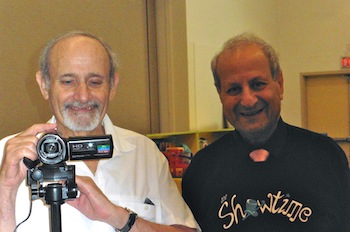
photo - Videographer Stan Shear, left, and performer Maurice Moses
Videographer Stan Shear, left, and performer Maurice Moses. (photo by Binny Goldman)

Rounding out the Showtime lineup were Sara Bernstein, Rona Black, Lisa Conn, Andria Engel, Tamar Glaser and Susan Goldstein.

Just as the performers were about to leave the stage, Berger was handed the microphone and asked to sing “Happy Birthday” to his wife, Marilyn Berger, president of JSA, who was celebrating her birthday that afternoon. He was joined by all the performers in the singing of a touching rendition of the song.

Marilyn Berger thanked the performers for a wonderfully joyful afternoon that traveled down memory lane and she also gave a short talk about JSA, highlighting its advocacy and its peer support program. She then handed out gifts for each of the cast, helped by Kenneth Levitt, one of JSA’s vice-presidents.

Stan Shear, with Karon Shear, JSA coordinator, by his side, made a video of the performance, which will be posted at jsalliance.org.

It was an afternoon that definitely put smiles on faces and songs in hearts.

Binny Goldman is a member of the Jewish Seniors Alliance of Greater Vancouver board.


Format ImagePosted on July 10, 2015July 8, 2015Author Binny GoldmanCategories LocalTags Beth Tikvah, JCC Showtime, Jewish Seniors Alliance, JSAGV, Kehila Society
Giving is a way to live well

Giving is a way to live well

Graduates of the Jewish Seniors Alliance peer support program, and teachers. (photo by Binny Goldman)

On June 11, I walked into a room filled with givers – of themselves. It was the special occasion of the graduation ceremony of the fifth class of peer counselors, which took place at the Peretz Centre for Secular Jewish Culture.

They were 13 men and women of various ages who had met as strangers and quickly become an extended family of friends. Through 11 weekly five-hour sessions in which interactive role-playing was used, they were taught how to listen, comprehend and use their newly acquired techniques.

Charles Leibovitch, coordinator of peer support services, warmly welcomed those gathered – family and friends of those receiving certificates and members of the board of the Jewish Seniors Alliance of Greater Vancouver. He introduced himself and Grace Hann, trainer and supervisor of the peer counseling program, then credited the founder of JSA, president emeritus Serge Haber, for being instrumental in initiating the program and working diligently to ensure that it thrived through continuous and crucial funding issues to meet the ongoing needs of our growing senior community.

Leah Deslauriers, coordinator of seniors at the Jewish Community Centre of Greater Vancouver, informed the audience of the many and varied activities open to all people (Jewish or not) at the centre for a nominal fee. She encouraged all to visit and partake in yoga, swimming, card playing and just general socializing. Expressing the wish for further partnering with the JSA, she extended a mazel tov to the graduates.

Barb Kirby of Community Resource Network said that, in both a personal and professional capacity, she had seen many gaps in the care of seniors over the years. “One of the greatest gaps we see is lack of support causing social isolation of seniors and that is why your job is so important. Your training and expertise provides a lifeline to those who truly are in greatest need,” she said.

“They say it takes a village to raise a child. I believe it take a village to care for the elderly and it takes a special kind of person to care for the elderly. You are that caring voice or the person sitting next to someone who truly needs a caring human connection or to go one step further to help get the further supports they might need.” One individual, organization or government cannot do it alone, said Kirby. “Speaking up, sharing knowledge and best practices will help make our communities a safer, more enjoyable place for those who need our support.”

She thanked Haber and JSA president Marilyn Berger “for providing all the invaluable services to bring awareness through education and support to our communities.”

Becky Herrmann of Angels There For You noted that people want to be needed, sought after and validated. She recommended the book Give to Live, and said there were no side effects to giving of oneself, urging everyone to try doing so. Larry Shapiro, one of the graduates, countered with, “There are side effects, but no negative ones.” Herrmann later presented each of the graduates with a gift.

Shapiro spoke next, sharing with the audience that, having completed the course, he felt prepared to go out and serve as a counselor. He proceeded to give a little history of peer support counseling in British Columbia, which has been present since the 1980s, addressing social isolation and other daily issues affecting seniors. Shapiro felt the course had taught him empathy, as well as the skills and techniques necessary to offer others methods of self-help.

Fellow graduate Neveen Hossameldin said that, as an immigrant, what one missed most were the friendships left behind, and that she didn’t have another 55 years to forge new ones. Yet, after 55 hours as part of this group, she had indeed made new, lasting friendships. Hossameldin appreciated that Haber had told the class that they were not working for JSA but were part of JSA. Echoing what others had said, she praised Hann for making the sessions pleasurable and warm.

Hann, laughing, said that since Shapiro had stolen a good chunk of her speech, she would just thank JSA and its founder, Haber, who deserved a special tribute for his vision, without which the program would not exist. She underscored that self-absorption kills empathy, that focusing on ourselves makes our world contract whereas giving to others broadens our world.

Leibovitch spoke of the ongoing need for peer support services and of the graduates who go out in the community to help combat the loneliness he sees daily. He said that phone calls to the office are often by those who have been guided by others to use the peer services, and that this essential, relevant help has become very valuable in the community. Karon Shear, coordinator of JSA, and Rita Propp were thanked for their constant commitment to excellence and giving of themselves.

Haber said, “Don’t do unto others what you don’t want others to do unto you,” a teaching found in other religions as well. Giving of yourself – so necessary both to the giver and the receiver – helps to alleviate loneliness, isolation and perhaps even remove the tarnish from the gold quite often present but hidden in the “golden years.” JSA is very proud of this program, he said, adding that he, too, had taken the course to familiarize himself with what was being offered and that he, too, had learned to really listen and hear what was being said. He concluded with the wish that all the graduates would go out and spread good will.

Certificates were handed out along with a rose to each graduate, as was a hug from both Hann and Leibovitch.

Ruby Boychuk, one of the graduates, presented Hann with a bouquet of yellow roses, explaining that yellow roses symbolized love and appreciation.

Family and friends proudly took photos of the celebration, while Stan Shear took a video that will be posted on the JSA website. Refreshments shared by all helped bring the evening to a close, leaving a sweet taste in our mouths and in our hearts. Mazel tov, graduates. Mazel tov, JSA.

Binny Goldman is a member of the Jewish Seniors Alliance of Greater Vancouver board.

Format ImagePosted on June 26, 2015June 25, 2015Author Binny GoldmanCategories LocalTags Jewish Seniors Alliance, JSA, peer counseling, peer support

We walk a little taller

Karon Shear, left, and Marilyn Berger. (photo by Binny Goldman)

Moshe Feldenkrais is quoted as saying, “When you know what you are doing, then you can do what you want!” How appropriate that some of us who spent the two nights of the Passover seders sitting at the table – or reclining, as directed – were now being taught to sit properly.

On April 13, about 50 people gathered at the Oakridge Seniors Centre (OSC) to attend an event co-hosted by Jewish Seniors Alliance of Greater Vancouver to learn the helpful movements of the Feldenkrais Method.

Alexandra Henriques, manager of OSC, graciously welcomed the audience and called upon JSA president Marilyn Berger, who said how impressed she was with the surroundings and the newsletter put out by OSC, and said she would come back to sample some of the lunches being offered at the centre. Berger then acquainted those gathered with the aims of JSA, mentioning its advocacy for the betterment of the quality of life for seniors and the peer-counseling courses being offered.

photo - Feldenkrais instructor Vita Kolodny
Feldenkrais instructor Vita Kolodny. (photo by Binny Goldman)

Berger then introduced Vita Kolodny, a nurse and a movement educator, who gently eased the audience through the mindful movements that can be used to ease back pain. By a quick questioning of the audience, we learned that almost all in attendance had suffered from back pain at one time or another.

We all sit so much during the day, doubling the stress placed on our back compared to when we stand, Kolodny explained. That is why we may prefer to stand when experiencing back pain.

Kolodny led those gathered through the correct way of positioning our bodies and ways of strengthening the skeletal muscles. It is important to reeducate our brains to the new ways of sitting by repeating the movements we learned, slowly and with awareness of how our whole body participates, with a rest in between the exercise.

A question was asked by Lou Segal: “Is it better to train one’s body to sit in the new and correct way, even while resting, so it becomes our natural way of sitting?” The answer was yes.

Dr. Norman Doidge’s book The Brain’s Way of Healing was recommended reading if attendees cared to learn more about neuroplasticity and the Feldenkrais Method.

Some constructive and supportive suggestions were made during the demonstration. For example, sit forward in a chair with feet flat on the floor. A pillow may be placed behind your back, remembering to maintain the arch in your back. As well, it helps to sit on an armless chair, stool or exercise ball while maintaining good balance.

Gyda Chud of JSA thanked Kolodny, using her penchant for alliteration, saying “Vita was vital, vivacious and vibrant in her presentation,” echoing the feelings of the audience, all of whom were visibly sitting upright, already making the changes suggested by Kolodny that afternoon.

Not only were our hearts smiling – as suggested in the theme – but our spines were, as well.

Discussions followed over dessert and hot drinks.

Berger, in thanking “the gregarious Gyda Chud and our ever incredible Karon Shear,” reminded everyone of the JSA Spring Forum on April 26, which will take place at the Jewish Community Centre of Greater Vancouver. The theme is YOLO: You Only Live Once.

So, let’s live it tall!

Binny Goldman is a member of the Jewish Seniors Alliance of Greater Vancouver board.

Format ImagePosted on April 24, 2015April 23, 2015Author Binny GoldmanCategories LocalTags Alexandra Henriques, Feldenkrais, Gyda Chud, Jewish Seniors Alliance, JSA, Karon Shear, Lou Segal, Marilyn Berger, Oakridge Seniors Centre, OSC, Vita Kolodny
Enjoy an afternoon movie

Enjoy an afternoon movie

Would you like to go to the movies? Yes? That is exactly what about 80 people did on Nov. 25 at the Peretz Centre for Secular Jewish Culture, thanks to the wonderful combined effort of Jewish Seniors Alliance and Vancouver Jewish Film Centre, which co-host a movie screening scheduled on the afternoon of the last Tuesday of every month.

Upon arriving, we were treated to a light buffet of bagels, sweets, fruit and beverages, then we headed to the large auditorium, where VJFC director Robert Albanese welcomed the audience and introduced the day’s film, The Outrageous Sophie Tucker.

After Gyda Chud, on behalf of JSA, made some announcements, including that the previously scheduled JSA Empowerment series talk Oy Vey, My Back! will be presented in March, Albanese spoke of the variety of films that the film centre will be presenting over the next few months. Then, Sophie Tucker “entered” our world.

Tucker was born Sonya Kalish to Ukrainian Jewish parents in 1886 as they fled from czarist Russia. She only became Sophie Tucker after she adopted her former husband’s name, Tuck, and added the “er.” That name became a password that could be used to gain entry to celebrities and even presidents.

In the film, authors and biographers Lloyd and Susan Ecker relate much of Tucker’s story.

When very young, she worked in her parents’ kosher restaurant, a job she did not enjoy. One day, her father asked her to distribute pamphlets at theatres as the actors left, since most of them were Jewish. He thought it would increase the number of diners.

While doing this task, Tucker heard the music from inside a theatre, she snuck in and what she saw changed her life forever, as well as the lives of her future audiences. She ran away to New York, leaving her family, but knowing where she belonged.

She tried vaudeville but, not being a classic beauty, she had difficulty being accepted “as is,” so she sang in “black face.” Eventually, her powerful voice began to be heard. When she forgot her makeup one day and sang as herself, the show was a success – she never performed in black face again.

Irving Berlin wrote music for her and she “stopped the show” when she sang. Tucker worked without a contract; her word or a handshake was sufficient.

Tucker was respected and she respected others, asking for their names, numbers and addresses upon meeting them and entering those contacts in a book, which eventually housed 10,000 names. She would write to these people if she were coming to their towns, asking them to come see her perform. She was the original Facebook – only it was the Tuckerbook.

Ted Shapiro, her accompanist for 46 years, had the unique talent of being able to interpret the mood that Tucker wished to portray.

In later years, mobsters took over the ownership of many nightclubs and Tucker befriended Al Capone. He enjoyed having her sing, as she brought people into his Chez Paris. He called her a “human cash register.”

In the years to come, Tucker decided to share what she knew and opened a school teaching young women how to be “Red Hot Mamas.”

She knew how to market herself: in the 1930s, she was the spokeswoman for soup; in the 1940s, she advertised blouses for the fuller mamas, saying she enjoyed being overweight – “Too much of a good thing is wonderful!” She prided herself on having creative and huge hairdos, calling herself the “Modern Marie Antoinette,” and always carried a large filmy handkerchief as she performed.

In 1929, the biggest entertainer was Al Jolson and he sang in the first talkie. That same year, Warner Bros. had Tucker debut in the movie Honky Tonk, where she sang “Some of These Days,” a song with which she is still identified. Judy Garland learned how to “sell a song” from Tucker.

During the war, Tucker was one of the performers to whom soldiers wrote and received answers. She was a pinup girl along with Betty Grable.

There was a young Jewish soldier who was obsessed with music and hauled around his records, vowing that he would play Tucker’s rendition of “My Yiddishe Mameh” in Berlin when he beat Hitler. Unfortunately, he died before he could accomplish this goal but his fellow soldiers fulfilled his vow, much to the anger of some German soldiers, as that song had been banned in Germany. The victors played it for eight hours through the streets of Berlin.

Tucker remained on top for 58 years, into the television era. Along the way, she befriended many, including Josephine Baker, who, because she was black, was having a hard time being allowed to perform – until Tucker invited her to sing with her.

Tucker’s talent and her voice were both immeasurable, but her true outstanding ability was in marketing herself when there wasn’t the media infrastructure there is now. She was indeed the last of the Red Hot Mamas, a glowing ember, memorable, still admired, still inspiring!

Expressing what we all felt, Chud thanked Albanese for enriching our lives with this movie, then we all went home with the echo of a song in our hearts, “Some of These Days.”

Binny Goldman is a member of the Jewish Seniors Alliance of Greater Vancouver board.

Format ImagePosted on December 12, 2014December 11, 2014Author Binny GoldmanCategories TV & FilmTags Jewish Seniors Alliance, Vancouver Jewish Film Centre, Vancouver Jewish Film Festival, VJFC, VJFF
JSA forum on mental health

JSA forum on mental health

At the recent Jewish Seniors Alliance of Greater Vancouver fall symposium, left to right: Peggy Casey, Lorilee Mallek, Nora Paul, Mark Godfrey and Grace Hann. (photo by Binny Goldman)

A capacity crowd of 175 gathered at the Peretz Centre for Secular Jewish Culture on Sunday, Oct. 26, to learn more about mental health and wellness, the topic of this year’s Jewish Seniors Alliance of Greater Vancouver fall symposium.

JSA president Marilyn Berger opened the session by asking the audience to rise in the name of mental health and to honor the soldiers who had lost their lives that week in Canada. This was followed by O Canada, led by Barbara Bronstein and Debbie Cossover, with Claire Cohen joining them in the singing of Hatikvah, and Marshall Berger accompanying on piano.

Gyda Chud introduced herself and co-convener Bev Cooper, and proceeded to inform those in attendance of the various projects that are JSA’s main concerns: advocacy, Senior Line Magazine, peer support counseling and the Empowerment Series. She went on to explain that the day’s topic had been chosen by attendees at past events, via the evaluation cards they had filled out citing this issue as a particular interest.

Cooper introduced the first speaker and the panel moderator, Dr. Penny MacCourt, past president of the B.C. Psychogeriatric Association, who admitted that she, too, will become a senior this summer.

MacCourt said that mental health is often equated with mental illness but that they are not the same thing. She emphasized the need to teach people ways in which to cope in the face of adversity; to help moderate the impact of stress, and facilitate social and emotional well-being. We as a society need to provide supportive living shelters, and continuous inclusiveness and access to such services, she said.

Help should be provided to those in need to maintain self-esteem and achieve effective coping strategies, she added, as these are the “protective factors” that can ease or ward off risks, including social isolation, limited income, loneliness, challenging life transitions, and lack of meaningful activity.

Dr. Martha Donnelly spoke next. At one time the director of the division of geriatric psychiatry at the University of British Columbia and a leader in the development of guidelines for geriatric mental health practice, she outlined some “red flag” symptoms of depression: appetite disturbance, loss of weight, early morning wakefulness, lower energy, and wishing life were over. The highest rate of suicide is in the senior years, she said.

One of Donnelly’s patients, Don Carroll, a very young 82, offered the audience a glimpse into his former work life, which included being an instrumental part of TV shows such as Mr. Dress Up and The Friendly Giant, and his subsequent descent into a depression from which he could not emerge on his own. With Donnelly’s continuing help, Carroll has returned to being an outgoing, fun, contributing person; a difficult journey for him, his supportive wife, Nancy, and family. It took resolute determination on all their parts to get Carroll to where he is now – off any medication and sharing with others his belief that one can heal with the correct diagnosis, therapy, doctor and support, to regain the ability to rely on oneself. The process was slow, including group therapy, daily exercise, medication and “thought catching,” tossing out negative thoughts before they take hold.

Grace Hann, who is currently working with JSA as a trainer and supervisor of peer support services, acknowledged JSA president emeritus Serge Haber for his vision to initiate the peer services as a vital project of JSA.

Hann is president of Senior Peer Counseling of British Columbia and on the YWCA board of the Community Action on Elder Abuse Project. She explained that it takes a peer to fully comprehend the feelings one is experiencing, such as loss of a loved one, age-related challenges, relocation, family discord – all situations that need empathy, which she described as “echoes of another person in ourselves.”

Hann called upon three graduates of JSA’s program to do role-playing, one of the methods used in the 55-hour course in peer counseling. They performed skits depicting examples of exchanges between clients and counselors at Week 1 and in Week 54. It showed the process through which the trainees had gone and from which they had grown from the initial expectations of their own abilities and finally gaining the knowledge and understanding of how to deal with the challenges clients face, such as loss of vision, a loved one and/or freedom and independence.

Trainees are taught to not use JAR: judgment, advice or rescue. Rather, counselors employ the three Es: empowerment, empathy and emotion. Both clients and counselors have benefited from the interactive sessions, said Hann, noting that there is a waiting list.

Hann then introduced a special guest, Tanja, 91, who, when Denmark was invaded by the Germans, secretly and at high risk to herself, helped Jewish adults and children escape to Sweden. Tanja shared that one of her most gratifying moments was witnessing the uniting of a mother with her child in a kindergarten when the war was over. She also shared that, many years later, here in Canada, when she was ill with cancer and reached out for help, she received empathy and understanding. Tanja was given a standing ovation by those attending, many of whom had been moved to tears listening to her.

The symposium came to a close with Berger thanking the speakers, presenting them with gift certificates. She made special mention of the co-conveners as well as JSA coordinator Karon Shear and the entire symposium committee for putting together such a successful event.

Refreshments and discussions followed. The audience left with much to contemplate but assured in the knowledge of where and to whom to turn should the need arise.

Binny Goldman is a member of the Jewish Seniors Alliance of Greater Vancouver board.


Format ImagePosted on November 7, 2014November 5, 2014Author Binny GoldmanCategories LocalTags Barbara Bronstein, Bev Cooper, Claire Cohen, Debbie Cossover, Grace Hann, Gyda Chud, Jewish Seniors Alliance, JSA, JSAGV, Marilyn Berger, Marshall Berger, Martha Donnelly, Penny MacCourt

Posts pagination

Previous page Page 1 … Page 5 Page 6
Proudly powered by WordPress