Skip to content
  • Home
  • Subscribe / donate
  • Events calendar
  • News
    • Local
    • National
    • Israel
    • World
    • עניין בחדשות
      A roundup of news in Canada and further afield, in Hebrew.
  • Opinion
    • From the JI
    • Op-Ed
  • Arts & Culture
    • Performing Arts
    • Music
    • Books
    • Visual Arts
    • TV & Film
  • Life
    • Celebrating the Holidays
    • Travel
    • The Daily Snooze
      Cartoons by Jacob Samuel
    • Mystery Photo
      Help the JI and JMABC fill in the gaps in our archives.
  • Community Links
    • Organizations, Etc.
    • Other News Sources & Blogs
    • Business Directory
  • FAQ
  • JI Chai Celebration
  • JI@88! video

Recent Posts

  • Sharing her testimony
  • Fall fight takes leap forward
  • The balancing of rights
  • Multiple Tony n’ Tina roles
  • Stories of trauma, resilience
  • Celebrate our culture
  • A responsibility to help
  • What wellness means at JCC
  • Together in mourning
  • Downhill after Trump?
  • Birth control even easier now
  • Eco-Sisters mentorship
  • Unexpected discoveries
  • Study’s results hopeful
  • Bad behaviour affects us all
  • Thankful for the police
  • UBC needs a wake-up call
  • Recalling a shining star
  • Sleep well …
  • BGU fosters startup culture
  • Photography and glass
  • Is it the end of an era?
  • Taking life a step at a time
  • Nakba exhibit biased
  • Film festival starts next week
  • Musical with heart and soul
  • Rabbi marks 13 years
  • Keeper of VTT’s history
  • Gala fêtes Infeld’s 20th
  • Building JWest together
  • Challah Mom comes to Vancouver
  • What to do about media bias
  • Education offers hope
  • Remembrance – a moral act
  • What makes us human
  • המלחמות של נתניהו וטראמפ

Archives

Follow @JewishIndie
image - The CJN - Visit Us Banner - 300x600 - 101625

Tag: children’s books

New publisher set to launch

New publisher set to launch

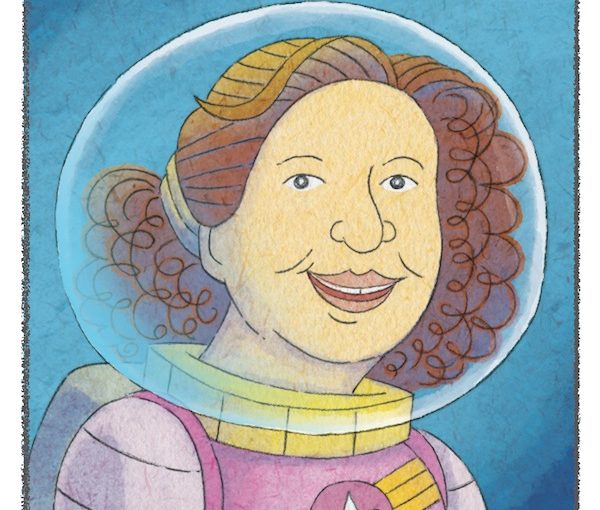
Intergalactic Afikoman publishing house is the brainchild of children’s author and educator Brianna Caplan Sayres. (image from Intergalactic Afikoman)

A new Jewish children’s publisher is set to launch in Seattle. The brainchild of children’s author and educator Brianna Caplan Sayres, Intergalactic Afikoman will officially release its first book on Feb. 11.

Sayres is a fourth-generation Seattleite. Her bestselling series Where Do Diggers Sleep at Night has sold hundreds of thousands of copies. Illustrated by Christian Slade and published by Random House, Sayres said the series was inspired by a question from her then-2-year-old (who just celebrated his bar mitzvah) about where dump trucks sleep at night.

Her latest children’s books explore territory far from earth. Night Night, Curiosity (Charlesbridge), illustrated by Ryan O’Rourke, is about a young girl who imagines herself on board the rover Curiosity as it explores the planet Mars. Asteroid Goldberg: Passover in Outer Space, illustrated by Merrill Rainey, is one of the books to be published by Intergalactic Afikoman. In this story, a young Jewish girl gets stuck in outer space for Passover, so she plans a celestial seder.

Sayres is a graduate of Brandeis University in Massachusetts and an award-winning Jewish educator – recipient of the 2016 Grinspoon Award for Excellence in Jewish Education.

“I realized that I had a vision for what I wanted to see in Jewish children’s books,” she said about why she decided to establish the new publishing house. “One day, I sat down at my computer and a mission statement just started pouring out of me.”

Her vision includes publishing genres that are not frequently seen in the Jewish book world, including fantasy. She also wants Intergalactic Afikoman to be known for publishing humorous books – “The word zany often comes to mind,” she said.

However, the primary goal of Intergalactic Afikoman is “readability,” she said. “We are aiming to publish books that children re-read again and again.”

Of the name Intergalactic Afikoman, Sayres said it “really says a lot about our company in that it is a fun and unique name and we are a fun and unique Jewish children’s publisher.”

She added that the word “intergalactic” also “signifies the out-of-this-world quality we are going for with every one of our books – from the text to the illustrations, it all has to be absolutely stellar,” she said.

Aside from Asteroid Goldberg, Intergalactic Afikoman will be releasing Such a Library! A Yiddish Folktale Re-Imagined, written by Jill Ross Nadler and illustrated by Esther van den Berg. “Both of these books exemplify the type of fun, humorous and unique books that Intergalactic Afikoman is aiming to publish and both of them feature illustrations that are absolutely out of this world,” said Sayres.

“Make sure to look closely at Such A Library! A Yiddish Folktale Re-Imagined,” she added. “There are so many wonderful and funny details hidden in Esther’s illustrations.”

In addition to publishing these two books, Sayres said, “Intergalactic Afikoman is planning to do our own small part to help fight hunger by donating 10% of the net profits from each book sold to Northwest Harvest, Washington state’s own statewide hunger relief agency whose vision is ending hunger in Washington.” She explained that this commitment embodies the principle of feeding the hungry that is a fundamental element of the Passover seder.

Sayres, who has deep roots in Seattle, said she is “thrilled that our publishing company is based in Seattle, which is a literary hub of the Pacific Northwest, with many wonderful independent bookstores, an incredible children’s writing community and a thriving literary community.”

She said she is also “very happy to let the world know that, yes, there are Jews in Seattle.”

Sayres intends to publish just a few books a year to start and will be looking for both picture books and middle-grade novels from writers and illustrators from around the world.

“Our goal is to publish the absolutely best quality of Jewish children’s literature, so we are eager to consider all submissions,” she said, pointing out that one of Intergalactic Afikoman’s upcoming books is I Am Hava: A Song’s Story of Love, Hope and Joy by Freda Lewkowicz, who is from Quebec

“Of course, we would be thrilled to publish children’s authors from the wonderful Vancouver writing community,” she said.

Sayres also is looking forward to teaching a session at this year’s Limmud Vancouver, which takes place Feb. 29-March 1 at Congregation Beth Israel. For more on the class and the full LimmudVan schedule, visit limmudvancouver.ca.

For more information on Intergalactic Afikoman, visit intergalacticafikoman.com.

David J. Litvak is a prairie refugee from the North End of Winnipeg who is a freelance writer, former Voice of Peace and Co-op Radio broadcaster and an “accidental publicist.” His articles have been published in the Forward, Globe and Mail and Seattle Post-Intelligencer. His website is cascadiapublicity.com.

Format ImagePosted on February 7, 2020February 6, 2020Author David J. LitvakCategories BooksTags Brianna Caplan Sayres, children's books, Intergalactic Afikoman, Limmud Vancouver, publishing, Seattle
Silver family wedding

Silver family wedding

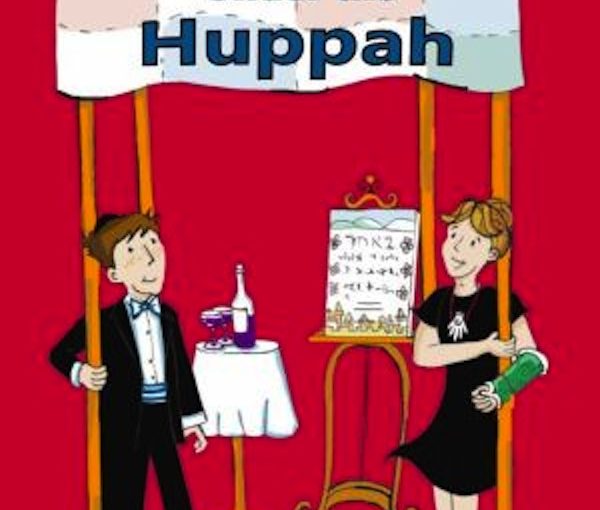
Hoopla Under the Huppah by Dori Weinstein (Five Flames Press, 2017) is the third instalment of the YaYa and YoYo series, which includes Sliding into the New Year, about Rosh Hashanah, and Shaking in the Shack, about Sukkot.

Targeted to 9-to-11-year-olds, Hoopla Under the Huppah features 11-year-old twins YaYa (Yael/Ellie) and YoYo (Yoel/Joel) Silver. Their Aunt Rachel is getting married to soon-to-be Uncle David, and they have been asked to participate. As the plans develop, YaYa and YoYo learn all of the rituals and traditions of a Jewish wedding. However, as the weeks pass, there are all kinds of good and bad adventures that the twins and their 13-year-old older brother, Jeremy, experience. As the ketubah, painted by the kids’ mother, the wedding ceremony and more evolve, YaYa worries about “the Evil Eye” and that she might be bringing bad luck to everything she touches.

Hoopla Under the Huppah offers opportunities for parents to discuss various Jewish traditions with their kids, while enjoying the humour of the Silver family. As an adult, I really enjoyed this book.

Weinstein grew up in New York, taught in public and Jewish schools and now lives in Minneapolis, Minn., with her husband and children, where she teaches preschool Hebrew.

Sybil Kaplan is a journalist, lecturer, book reviewer and food writer in Jerusalem. She created and leads the weekly English-language Shuk Walks in Machane Yehuda, she has compiled and edited nine kosher cookbooks, and is the author of Witness to History: Ten Years as a Woman Journalist in Israel.

Format ImagePosted on February 22, 2019February 21, 2019Author Sybil KaplanCategories BooksTags children's books, Dori Weinstein, Judaism, weddings
Honorary degree, book and article awards, new GM at Green Thumb … community milestones

Honorary degree, book and article awards, new GM at Green Thumb … community milestones

Dr. Carol Herbert (photo from Western University)

Vancouver’s Dr. Carol Herbert, professor emerita of family medicine and adjunct research professor of pathology at Western University, was awarded an honorary doctor of science, honoris causa (DSc), at the Oct. 24 afternoon session of Western University’s 312th convocation. Herbert served as dean of the Schulich School of Medicine and Dentistry from 1999 to 2010. A pioneer in developing services for sexually assaulted adults and children in British Columbia, she was co-founder and co-director of the Sexual Assault Service for Vancouver from 1982 to 1988.

She spoke to graduates at the convocation, asking them to keep in mind one acronym: PROP (privilege, responsibility, opportunity and passion).

“Acknowledge your privilege. While you have been diligent in your studies, the fact that you and I are here today is evidence of our privilege,” she said.

With privilege, there is a responsibility to give back, she added. Graduates must reflect on what they have been given and remember to pay it forward and embrace opportunities to help others. “Be as passionate about ensuring the success of others as you are about yourself. Start small, but start contributing to your community.”

Herbert reminded graduates of the difficulties women in science continue to face today. “I want to encourage women scientists to hang in there,” she said, to juggle a career and family, to look for workplaces that support them and their complex lives, and to seek mentors. She encouraged all to work towards a level playing field in which women have equal opportunities.

For the full address, visit news.westernu.ca/2018/10/herbert-offers-props-graduates.

***

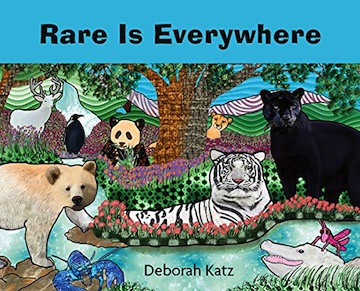
image - Of Rare is Everywhere book coverVancouverite Deborah Katz has won the 2018 Vine Award in the category of children’s literature. Of Rare is Everywhere (Miss Bird Books), which Katz wrote and illustrated, the award jury said, “Fun, exciting and such a different take on difference and diversity for our small children.”

The Vine Awards honour the best Canadian Jewish writers and Canadian authors who deal with Jewish subjects in four categories – fiction, non-fiction, history and children’s/young adult literature – each with a prize of $10,000. The 2018 jurors – Beverley Chalmers, Joseph Kertes and Lee Maracle – reviewed 59 entries this year.

The Koffler Centre of the Arts announced the 2018 winners at an awards lunch at the Windsor Arms Hotel in Toronto. The other winners were Laurie Gelman for Class Mom (Henry Holt and Co.) in the fiction category, Julija Šukys for Siberian Exile: Blood, War and a Granddaughter’s Reckoning (University of Nebraska Press) in the non-fiction category and Hugues Théorêt for The Blue Shirts: Adrien Arcand and Fascist Anti-Semitism in Canada (University of Ottawa Press) in the history category.

***

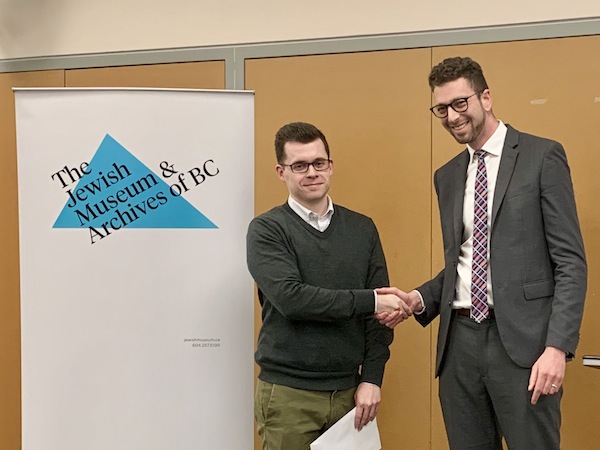
photo - Nathan Lucky, left, and the Jewish Museum’s Michael Schwartz
Nathan Lucky, left, and the Jewish Museum’s Michael Schwartz. (photo from JMABC)

The Jewish Museum and Archives of British Columbia awarded the inaugural B.C. Jewish History Research Prize to Nathan Lucky, for his article “British Columbia newspaper responses to Jewish persecution in Europe, 1938-1939: A call for refugees and a cause for civilization.”

This undergraduate essay explores relations between the Jewish community press and the mainstream press in British Columbia. It demonstrates the ways in which Jews in the province were alert to world affairs and worked to impact Canadian policies of immigration in response to unfolding tragedy abroad. Juxtaposing reporting and editorials published by the Jewish Western Bulletin (the predecessor of the Jewish Independent) with those of contemporary non-Jewish publications, the author documents the shifting waves of public discourse as new information arrived from Germany and Austria. The article makes substantial use of the B.C. Jewish Community Archives, particularly the Jewish Western Bulletin Collection, and it demonstrates how future scholars might also incorporate the collection, and the archives more broadly, into their research.

The prize was awarded on Nov. 21 at the annual general meeting of the Jewish Historical Society of British Columbia. Following the AGM, guests gathered to hear a lecture by Lucky, summarizing his research. This award and lecture will be an annual tradition of the JMABC in the coming years.

***

photo - Breanne Harmon
Breanne Harmon (photo by David Cooper)

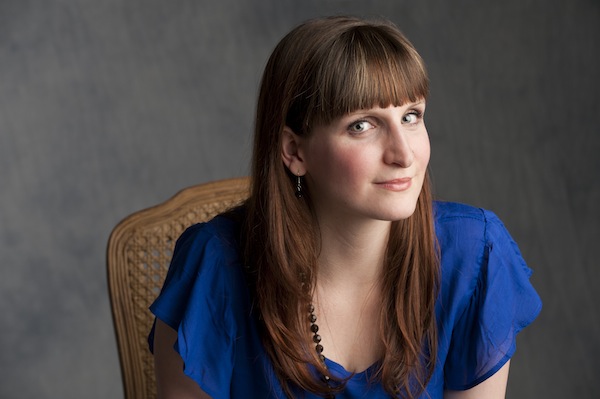
Breanne Harmon (née Jackson) has been appointed general manager of Green Thumb Theatre, which has been bringing live theatre to young audiences for 40 years. Before taking on the role of general manager at Green Thumb, Harmon worked as the tour and education manager for two years.

Born and raised in Richmond, Harmon has trained and worked in theatre for most of her life. She graduated with honours from the University of British Columbia with a bachelor of fine arts in theatre production/design, where she was the recipient of the Norman Young Scholarship for Theatre and the Dean of Arts Scholarship, while also completing the fine arts program in visual arts at Langara College. At UBC, she was a member of the Jewish Students Association at Vancouver Hillel and sat on the Hillel board as alumni representative after graduation.

Harmon has worked as a stage manager, production manager and arts administrator for various companies across Canada, including the Shaw Festival, Arts Club Theatre Company, National Arts Centre, and Chemainus Theatre Festival, among many others. She has sat on the Jessie Richardson Theatre Awards Society board, the GVPTA’s Theatre Engagement Project Steering Committee, the Jessie Richardson Theatre for Young Audiences and Large Theatre juries and was a stage management mentor with the Cultch’s Ignite program.

She is also the very proud mother to her 1-year-old son.

Format ImagePosted on November 30, 2018November 28, 2018Author Community members/organizationsCategories LocalTags Breanne Harmon, Carol Herbert, children's books, Deborah Katz, Green Thumb Theatre, Jewish museum, JMABC, Nathan Lucky, Vine Awards, Western University
A gift of holiday reads

A gift of holiday reads

Many authors of children’s Chanukah books still perpetuate two mistakes. One is that a chanukiyah is the same as a menorah, whereas the latter is actually the seven-branched Temple lamp looted by the Romans when the Temple was destroyed. The second is the rabbinic legend of the miracle of the oil, which is not actually part of the story of the Maccabean revolt and the Maccabees’ fight for the right to worship as Jews. The books reviewed here are sweet, but part of the time reading these books might be spent discussing these issues.

While Light the Menorah (Kar-Ben Publishing) by Jacqueline Jules, with illustrations by Kristina Swarner, calls the chanukiyah a menorah throughout and highlights the miracle of oil, this “manual for the contemporary Jewish family” contains sweet reflections for each night of the holiday, a form of history, games, songs, recipes, crafts and blessings geared for a family with 4-to-10-year-olds.

***

Dreidel Day (Kar-Ben Publishing), written and illustrated by Amalia Hoffman, is a cute board book for babies, infants and toddlers. It teaches readers numbers one through eight and some words related to Chanukah.

***

How It’s Made: Hanukkah Menorah (Apples and Honey Press) is by Allison Ofanansky and photographer Eliyahu Alpern. These two creative people have once again combined their talents to produce a new book in their “How It’s Made” series. Sadly, the authors only refer to the chanukiyah as a menorah. Nonetheless, this is an educational and fun book, which explains the materials needed to make a candelabra, shows examples of them and provides instructions on how to make one, as well as how to make candles and olive oil. The book ends with songs, a recipe for potato latkes, instructions for playing dreidel, a matching game and the blessings. The text is child-friendly and good for all ages, especially 4 to 8.

***

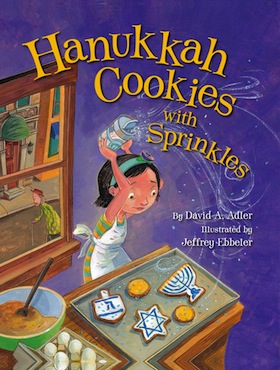
image - Hanukkah Cookies with Sprinkles book coverHanukkah Cookies with Sprinkles (Apples and Honey Press) by David A. Adler and illustrator Jeffrey Ebbeler was published a few years ago, but it was new to me, and I hope it’s new to others, as well.

Sara is a little girl who is very observant about things she sees from her apartment window. One day, she sees an old man pick up a piece of bruised fruit from a box next to the market. She then decides to leave things for him. Soon, she discovers he is the man who helps set up the chairs and collects books at the synagogue. She learns more about him as she practises the true meaning of tzedakah and spreads the idea to her family and classmates.

The book’s Note for Families provides context for the story and traditions of Chanukah, as well as the meaning of tzedakah, and challenges readers to think about ways they can give tzedakah, too.

***

Hanukkah Delight! (Kar-Ben Publishing) by Leslea Newman and illustrator Amy Husband is a board book. In it, all of the customs of Chanukah are rhymed with delight as a darling family of bunnies practises each one. The artwork is colourful and the details are really well done. The male bunnies and other male animals wear yarmulkes and the drawings of dreidels, children playing with the dreidels, latkes and presents are quite appealing. For any 1-to-4-year-old, this is a sweet way to introduce the holiday of Chanukah.

***

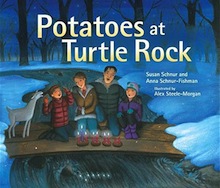
image - Potatoes at Turtle Rock book coverPotatoes at Turtle Rock (Kar-Ben Publishing) is written by Rabbi Susan Schnur and her daughter, Anna Schnur-Fishman, who are also the authors of Tashlich at Turtle Rock. It is illustrated by Alex Steele-Morgan, who also did the artwork for the Schnurs’ earlier companion book.

Potatoes at Turtle Rock is the story of a family – mom, dad, teenage son (Lincoln) and daughter (Annie) – who have, as pets, a chicken (Richie) and a goat (Ubi).

They also have their own Jewish holiday traditions. For Chanukah, the family goes to the woods, with Dad carrying a lantern, Mom carrying the chicken, Annie leading the goat and Richie pulling a sled. They make stops along the way, where Annie provides riddles.

Although a little off-beat, this book for ages 5 to 9 shows children that every family can be original and creative and create their own traditions for Jewish holidays.

***

A Hanukkah with Mazel (Kar-Ben Publishing) by Joel Stein and artist Elisa Vavouri is about Misha, a poor artist living outside Grodno, a city in western Belarus, in the late 19th or early 20th century. One cold winter night, he discovers a little cat. He takes her into the barn, where his cow lives, and then into his house. He names her Mazel, meaning luck.

Chanukah is about to arrive and he begins a painting of a chanukiyah, since he has no money to buy oil for his chanukiyah. The story evolves when a peddler stops and discovers Mazel is his Goldie.

With the themes of hope and luck, this is a very charming story for 3-to-8-year-olds.

Sybil Kaplan is a journalist, lecturer, book reviewer and food writer in Jerusalem. She created and leads the weekly English-language Shuk Walks in Machane Yehuda, she has compiled and edited nine kosher cookbooks, and is the author of Witness to History: Ten Years as a Woman Journalist in Israel.

Format ImagePosted on November 16, 2018November 15, 2018Author Sybil KaplanCategories Books, Celebrating the HolidaysTags art, Chanukah, children's books
Stories to bring smiles

Stories to bring smiles

Delightful. That’s the first word that comes to my mind for two new hardcover children’s books by members of the Jewish community that will soon find their way to my youngest nieces’ bookshelves: Pip & Pup by Eugene Yelchin (Godwin Books) and Counting on Katherine: How Katherine Johnson Saved Apollo 13 by writer Helaine Becker and illustrator Dow Phumiruk (Christy Ottaviano Books).

Yelchin’s wordless book begins with a chick hatching. On a farm somewhere, having just come out of her shell, Pip sees the world for the first time. She spies a puppy sleeping under cover of a tractor. Fearless, she goes right up to Pup’s nose to say hello. When Pup awakens and barks in greeting, Pip is thrown into a panic, not quite prepared for the full size of her relatively large new friend.

When the rain starts, Pip literally climbs back into her shell, but just to stay dry. She is no longer afraid. In fact, when she sees Pup’s distress at getting wet and at the sound of the thunder and the force of the rain, she offers what help she can. The two start to play even before the sun comes out again. A broken eggshell dampens spirits momentarily, but then it’s Pup’s time to fix things, which she does.

Pip & Pup is a simple story that is evocatively illustrated using warm colours, texture and layers, combining pastels, coloured pencils and digital painting. There is a depth to the art and the story. Children and their adult readers will have fun asking each other questions as they go along. Do you think Pip is brave to say hello to Pup? Do you like the rain? How is Pup feeling right now? How would you feel if something of yours broke?

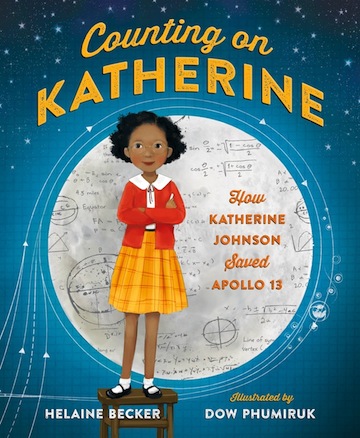
image - Counting on Katherine book coverMany questions will arise from reading Counting on Katherine, as well, though some of them will require a different kind of reflection, as the story touches upon racism, sexism and other such topics – in an age-appropriate way for readers 5 and up.

Becker interviewed Katherine Johnson, who turned 100 years old on Aug. 26, and Johnson’s family for this picture-book biography. Johnson was a mathematician at the National Aeronautics and Space Administration (NASA) and, among other things, her manual calculations were crucial in bringing the crew of Apollo 13 back to earth safely after it was damaged while in space.

In Counting on Katherine, we meet Johnson as a young girl: “Katherine loved to count. She counted the steps to the road. The steps up to church. The number of dishes and spoons she washed in the bright white sink. The only things she didn’t count were the stars in the sky. Only a fool, she thought, would try that!”

And Johnson was anything but a fool. She skipped three grades in elementary and was ready for high school at 10 years old. “But back then,” writes Becker, “America was legally segregated by race.” Johnson’s high school didn’t admit black students, so her father, by “working night and day, he earned enough money to move the family to a town with a black high school.”

Johnson’s next challenge was that, as a woman in that era, she was relegated to the teaching and nursing professions, so she became an elementary school teacher. However, in the late 1950s, the space race began, and NASA’s predecessor began hiring thousands of workers. “It even started hiring black women – as mathematicians.”

Johnson excelled at NASA and her work was integral to the United States’ space program, not just to the Apollo 13 mission, and Counting on Katherine has an epilogue that gives some additional information about Johnson. As well, Phumiruk’s imaginative digital artwork is also information-filled, clearly showing Katherine’s longing to learn, as she gazes from her bedroom window at the night sky; her joy with numbers, as she fills chalkboards with them; her anger at not being allowed to attend her town’s high school; her meticulousness, as she calculates a safe journey for Apollo 13. Counting on Katherine is a wonderful book.

Format ImagePosted on September 7, 2018September 6, 2018Author Cynthia RamsayCategories BooksTags art, children's books, Dow Phumiruk, Eugene Yelchin, Helaine Becker, Katherine Johnson, science, women
A once in 30-year occurrence

A once in 30-year occurrence

Take a seasoned children’s book author like New York-based Jane Breskin Zalben – who has created more than 50 children’s books and is an abstract painter – and pair her with Mehrdohkt Amini, an illustrator of children’s books who lives in the United Kingdom, and the result is a charming book about interfaith friendship for 3-to-7-year-olds – and older readers.

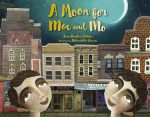
In A Moon for Moe and Mo (Charlesbridge Publishing, 2018), Moses Feldman and Mohammed Hassan meet in a Flatbush, Brooklyn, grocery store, where the storeowner mistakenly takes them for twins since they both have curly dark hair, brown eyes and olive skin. They are shopping with their mothers for their up-and-coming holidays, with Rosh Hashanah, the Jewish New Year, and Ramadan, the Muslim holy month of daylong fasts that marks the giving of the Qur’an to Muhammad, overlapping – something that happens only once every 30 years or so.

The two boys become friends, including going on a picnic, which brings their families together. That same evening in their homes, both boys see the first sliver of the new moon.

In an interview, Breskin Zalben said she was shopping with her granddaughter in a store in Brooklyn when she met an Arab mother with her child and the two children began to interact.

“After being invited to speak at many international schools, in counties where I visited mosques and old synagogues, doing this book was a natural outgrowth of those broadening journeys to other cultures,” she said.

Although Breskin Zalben was art director at Scriber Publishers and illustrated most of her other books, she knew that Amini was from Iran, saw her portfolio and wanted her to do the illustrations for this book. Amini has created beautiful acrylic, marker, ink and photo-collage artwork, which was then assembled digitally.

In the back of the book is information about Rosh Hashanah and Ramadan, notes from the author and illustrator and two recipes.

Said Breskin Zalben, “I am excited to share the diversity and the similarity of Moe and Mo…. I hope maybe this book, in any book’s small way, finds an audience. It was six years in the making and so much hard work and passion goes into every book.”

This is a very special book for children and their parents to read at Rosh Hashanah.

Sybil Kaplan is a journalist, lecturer, book reviewer and food writer in Jerusalem. She created and leads the weekly English-language Shuk Walks in Machane Yehuda, she has compiled and edited nine kosher cookbooks, and is the author of Witness to History: Ten Years as a Woman Journalist in Israel.

Format ImagePosted on August 31, 2018August 29, 2018Author Sybil KaplanCategories BooksTags children's books, friendship, interfaith, peace
Keeping children safe

Keeping children safe

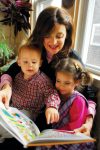
Bracha Goetz reads from one of her recent books to her two grandchildren. (photo from Bracha Goetz)

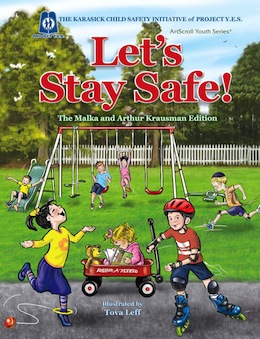
Many of us were raised to not talk to and be wary of strangers, but the sad fact is that kids are much more likely to be taken advantage of or abused by someone they know and think they can trust. This reality was the driving force behind Bracha Goetz’s book Let’s Stay Safe, which was published in English in 2011, and just came out in Yiddish this summer, as Zai Gezunt.

Born in Queens, N.Y., Goetz graduated from Harvard and started on the road to becoming a psychiatrist before heading to Israel for what was to be one summer. However, while in Israel, she become observant, and ended up staying. There, she did a further 11 years of study, got married and had a family.

Goetz and her family have since moved to Baltimore, where she coordinates a Jewish Big Brother Big Sister (JBBBS) program. As well, she writes children’s books and, to date, has published 36 of them. “They are all spiritual children’s books,” she said. “Originally, I was just writing Jewish children’s books, but now I’m also writing spiritual children’s books for anybody.

“I always wanted to write spiritual books for everyone, but I just recently found a publisher that was interested. It’s not easy. It took a long time, but I’m very happy to do that, because, although these are Jewish concepts, they are also actually universal concepts that I’d love to share with any child.

“I try to write books that I wished I could have read as a child, to answer the spiritual questions I had as a child that weren’t answered,” she continued. “They were answered for me when I was 22, but I try to write about the deepest spiritual concepts on a simple level so any child can understand them. I also try to do it in a joyful, delightful way, so that it can go right into their soul.”

In her role at JBBBS, Goetz witnesses firsthand how sexual abuse affected children. This made her think about how she was teaching her own children about such dangers.

“I realized that I didn’t raise my children with an awareness about it,” she said. “I taught my children about ‘stranger danger,’ but, when they were little, we weren’t as aware as we are today that, with most sexual abuse, the perpetrators are known to the children; that’s how they get access. It’s rare that it’s a stranger. It’s most commonly someone the child already knows. There was no book like this in the Orthodox community and some of the books (in the general community) are not culturally relevant for Orthodox people.”

photo - Let’s Stay Safe, which was published in English in 2011, and just came out in Yiddish this summer, as Zai Gezunt
Let’s Stay Safe, which was published in English in 2011, and just came out in Yiddish this summer, as Zai Gezunt.

Goetz wanted to write a book that would be accepted by the Orthodox Jewish community specifically, as the subject tends to be less discussed in these communities. So, she wrote Let’s Stay Safe, but could not find a publisher. That is, not until Rabbi Yakov Horowitz, dean and founder of Yeshiva Darchei Noam in Monsey, N.Y., agreed to help and got the book accepted by ArtScroll.

“He really worked at it, and it was a really groundbreaking book,” said Goetz. “There was nothing like it out there. We wanted readers to understand that these were additional normative safety rules that needed to be adhered to by children to be safe. Of course, the book is also for parents, because, when parents read it to their children, they also gain an awareness.

“It’s not a good idea to leave the safety responsibility of children up to the children. It’s the parents’ responsibility. But, the parents also need to teach the awareness to their children and remind them about it every so often. As they come upon new circumstances, they need to review the guidelines.”

To take the book a step further, especially in Chassidic communities, Horowitz spearheaded a Yiddish version. “In certain Chassidic communities,” explained Goetz, “their mother tongue is Yiddish. We wanted to reach as many people as possible, so that they would bring this book into their homes and share it with their children. Even the pictures were altered to be more Chassidic-looking. We don’t want anything to stop the Yiddish-speaking population from getting this information.”

One of the concepts Goetz wanted to stress in the book was that children speak with a parent even if somebody touched them inappropriately a long time ago. It is important for these experiences to be told, she said, so that survivors can heal, and also so that the perpetrators cannot continue abusing children.

Another concept she wanted to convey clearly is not to trust someone just because she or he is dressed in Orthodox clothing, as that does not automatically mean they are safe people.

“There’s one picture of an older teenaged boy at a camp,” Goetz said, by way of example. “Many times, it’s a familial problem, where it’s an older brother, an uncle, a step-brother who is the perpetrator. Just this week, I was in a community different than I was usually in, but the people knew I was the author of the book … and, this happens a lot, people come to me with questions. I was outside watching my grandchildren and a mother came by and said, ‘Does this seem right? There’s a teenaged boy and he’s playing with all these little children. He’s playing ball with them. He doesn’t live in this community. And why is he here? He’s Orthodox, as well, just as the children, but he didn’t know any of them. Why was he playing with them?’ I said that’s definitely a red flag.

“This kind of awareness was not typical before the Let’s Stay Safe book was published. The incident illustrates the impact that the book has had. Now, there is a general awareness in our community, because there has been consciousness-raising on the issue of child sexual abuse.”

Books written by Goetz are appropriate for kids ages 2 and up, but are better starting at the ages of 3 or 4.

“This book is often read to 4- to 8-year-olds but, the truth is, older children love reading this book, too,” said Goetz. “And what I find so interesting is that a lot of children tell me it’s their favourite book of mine, which I never expected because it’s all about rules and guidelines. But, they love it. It gives them a sense of safety and security, and children ask for it as their bedtime story.”

Other books written by Goetz touch upon topics like eating healthily (and enjoying it), teaching children sensitivity, and teaching people how to interact more naturally with children with special needs.

Rebeca Kuropatwa is a Winnipeg freelance writer.

Format ImagePosted on November 10, 2017November 9, 2017Author Rebeca KuropatwaCategories BooksTags abuse, children's books, health
Meet award-winning artists

Meet award-winning artists

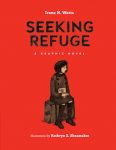
Seeking Refuge, written by Irene Watts and illustrated by Kathryn Shoemaker, has been shortlisted for the 2017 Vine Awards for Canadian Jewish Literature. Published by Tradewind Books, the graphic novel is one of the three finalists in the children’s/young adult category.

While this year’s Vine winners will be announced Oct. 3 at a luncheon in Toronto, Vancouverites can meet Watts and Shoemaker later this month at Word Vancouver, and again at the Vancouver Writers Festival in October. The multiple-award-winners, who are both founding members of the Children’s Writers and Illustrators of British Columbia Society, have worked together on several publications, including Good-bye Marianne, a graphic novel based on Watts’ play and subsequent novel of the same name, which also included Shoemaker illustrations.

In Good-bye Marianne, readers meet Marianne Kohn. Set in Berlin in 1938, a week after Kristallnacht, the 11-year-old struggles to understand and cope with the increasing restrictions placed on Jews in Nazi Germany, and the fierce antisemitism she and her family encounter, with a couple of exceptions. The story begins with Marianne not being allowed into her school – all of the Jewish students have been prohibited from attending. As well, her father has disappeared. The situation, as we know from history, worsens, and her mother makes the heartrending decision to send Marianne with “a group of 200 children who are leaving for homes in England,” one of the first groups to be rescued in the Kindertransport.

Seeking Refuge sees Marianne safely to London, arriving Dec. 2, 1938. While protected from physical harm in her new country, Marianne does not escape antisemitism and poor treatment.

In an interview with CBC, Watts commented on Shoemaker’s choice of medium for Seeking Refuge, noting how the grey of the pencil was so well-suited to the story.

“Seeking Refuge is a darker, sadder story, taking place in a time of blackouts, black-and-white films, coal-foggy London, especially the winter months, a gloomy time and place,” said Shoemaker in an interview with the Jewish Independent. “In Good-bye Marianne, Marianne is happier than in Seeking Refuge because she is with family, her home, her country, her language. So, yes, the backgrounds are light, often white. She is anxious about her being sent away but she is not yet sad about it. She is not yet a displaced refugee.”

The possibility of using Seeking Refuge as a way in which to teach younger readers about the current refugee crisis has not gone unnoticed by reviewers and interviewers.

“Stories, in whatever genre, help us to discover more about our place in the world and who we are,” Watts told the Independent. “Immersing ourselves in the lives of fictional characters and their stories, we gain insight of how others live.” While acknowledging that readers will “take whatever message they are ready to understand from the books they read,” she added, “Marianne’s story, though set in the past, is still a familiar one. There are many refugees in the world. Seeking Refuge concerns one child, and how she responds to losing home, friends, family, birthplace, language, culture. In reading about Marianne, a reader may wonder how he would cope in this situation; maybe respond with more kindness and understanding to anyone struggling to make a new life.”

Marianne’s story is similar to – but not the same as – that of Watts, who was educated in England and Wales after her escape from Berlin via the second rescue train in December 1938. Skipping ahead 30 years, she and her husband moved to Canada in 1968, she said, “to give our children a better future.” They immigrated to Alberta.

A playwright and director for Theatre in Education and a drama teacher and consultant in England, Watts taught drama in Hobbema (now Maskwacis), where they lived for a short time before moving to Edmonton. In Edmonton, she was director of Citadel on Wheels and Wings, a children’s touring company that traveled all over Alberta. “We even took our shows to schools in the Northwest Territories,” she said, noting that, among the company’s alumni are Jackson Davies and the late Susan Wright.

“After a few years,” said Watts, “my late husband accepted a position in Vancouver and our four children and I followed. This was in 1976. My base was in White Rock, B.C., and I moved to Vancouver in 2000.”

That Watts likes to write in different genres is clear from the way in which Seeking Refuge came into being.

“Good-bye Marianne began life as a play, which premièred at the Norman Rothstein Theatre in 1994,” Watts explained. “It was produced by Carousel Theatre, and toured widely. It has had many productions, both in Canada and the U.S.A., and will be touring with Theatre New Brunswick for three months in the spring of 2018. I had been a playwright long before I became a novelist. I decided to write the novel because there was still much to say beyond the confines of the play. Kathy Lowinger, then publisher of Tundra Books, rescued the manuscript from the slush pile, and published it in 1998.

“I received countless letters from children, wanting to know what happens next, and so completed both the novel and the play Remember Me, on which Seeking Refuge is based. The trilogy, which ends with Finding Sophie, was later published in an omnibus edition, to commemorate the 75th anniversary of the Kindertransport, as Escape from Berlin.”

For readers anticipating a possible third graphic novel, Watts told the Independent she has “no plans to write about Marianne and Sophie again.”

Shoemaker and Watts collaborated on Watts’ first book for Tradewind, A Telling Time, “which places the story of Queen Esther and the story of Purim in three time frames: modern-day Canada, Nazi-occupied Vienna and the biblical era of Persia. So,” said Watts, “when Kathie told me she had read my play Good-bye Marianne and suggested that it would make an interesting graphic novel, I needed no persuasion, and together we embarked on our next project – a new genre for me. Since then, we have done several other books together, for both Tundra and Tradewind Books.”

A Telling Time, which Shoemaker described as “a picture book for older children about the parallel stories of Queen Esther and how she saves her people and a 1939 secret Purim party,” was recognized by the International Youth Library in Munich, Germany, with a 2006 White Raven special mention.

“For that book,” said Shoemaker, who teaches children’s literature at the University of British Columbia, “I did a huge amount of research. As well, Irene shared many resources with me.

“While I was illustrating A Telling Time,” she said, “I was working on my MA in children’s literature at UBC. Instead of doing an academic thesis, I wrote a graphic novel. During the process of finishing it up, Irene asked me what it was like to write a graphic novel and I told her that, for her, it would be a snap, as it is very much like writing a play or screenplay, as you write primarily dialogue, and, similarly to writing a play scene by scene, a graphic novel is written panel by panel. In response to my answer, Irene told me that Good-bye Marianne had been a play before it was a novel.”

Shoemaker said she drew up several pages of Good-bye Marianne for Watts to send to Tundra as a proposal for a graphic novel. “It was about to have its 10th anniversary, so it was good timing,” said Shoemaker. “Tundra had never done a graphic novel before but they agreed to it.”

Graphic novels were still a relatively new phenomenon at that time. “Other than Chester Brown’s Louis Riel and books for adults, there were almost none,” said Shoemaker. “It was a bit of challenge working with an editor who did not understand the form and also who didn’t seem to understand how closely Irene and I work.

“You will often hear that editors like to keep writers and illustrators apart. I hate that. Irene and I work closely on everything that we do.”

Their creative process begins with Watts writing a rough draft. “She doesn’t number the panels but she describes all the key actions she wants to see occur along with the dialogue,” explained Shoemaker. “From that version, I go back into the manuscript to visualize the sequence of panels. When I do that, I create panel numbers and add in additional panels that may be close-ups, wordless images and additional panels to handle complex conversations. After I’ve done that, I begin a visual dummy, drawing out the entire book panel by panel. When that is complete, I sit down with Irene and go through it panel by panel. As we go through it, we decide what stays, what goes and what more we might need. The best thing about our working together is that we highly respect each other’s ideas and we both listen, consider and change things without any kind of ownership because we consider the work ours. It is our book, not mine, not hers, but ours.”

Watts and Shoemaker will be at Word Vancouver on Sept. 24, 12:45 p.m., at the main branch of Vancouver Public Library in the South Plaza (the Quay) and the Writers Fest on Oct. 18, 1 p.m., at Revue Stage on Granville Island. For more information on both of these festivals and for tickets to the latter ($17), visit wordvancouver.ca and writersfest.bc.ca, respectively.

Format ImagePosted on September 8, 2017September 5, 2017Author Cynthia RamsayCategories BooksTags children's books, Holocaust, Irene Watts, Kathryn Shoemaker, kindertransport, refugees
Gasoi is one class act

Gasoi is one class act

Singer/songwriter Jennifer Gasoi, seen here in a promotional shot for her new book, was back in her hometown last month. (photo by Philove)

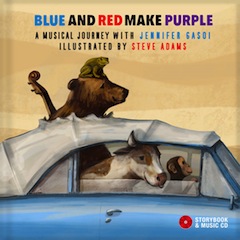
Jennifer Gasoi’s new book, Blue and Red Make Purple, is both a hardcover children’s book and a CD collection. It was released to immediate acclaim, winning the 2016 Parents’ Choice Gold Award and a National Parenting Product Award.

CD cover - Jennifer Gasoi’s new book, Blue and Red Make Purple, has already won awards.
Jennifer Gasoi’s new book, Blue and Red Make Purple, has already won awards.

Illustrated by Steve Adams, Gasoi’s songbook has a vintage feel with a touch of Chagall. It is vibrant and surreal, full of movement, as a group of animals get up to all sorts of musical capers. “I love the illustrations for this book,” Gasoi told the Independent. “I feel that Steve accurately depicted the joy, love and depth of my songs. He offers a brilliant visual representation of the music.”

Gasoi has local roots and, 15 years ago, she was performing at Rossini’s jazz bar in Kitsilano. She studied music at Capilano University’s jazz program and took part in community choir events around town before she decided it was time for a change and moved to Montreal. There, she taught music to young children and parents. Her debut album, Songs for You (2004), garnered awards and nominations, as did her second CD, Throw a Penny in the Wishing Well (2012).

Among the honors for her second recording was a 2014 Grammy Award for best children’s recording. An unusual compilation, the CD introduces children to a wide range of genres, including bluegrass, calypso and klezmer.

“Winning a Grammy was a life highlight,” said Gasoi. “It was something I had been dreaming of since I started my music career – and having Cyndi Lauper present the award was pure gold.”

Gasoi’s lyrics are deceptively simple. The song “Happy” from Wishing Well, for example, starts gently in a voice that sounds as natural as exhaling, were it not for the jaunty, syncopated piano accompaniment. This brief “ditty,” as she calls it, is written for children but models a spirit of resilience and self-acceptance that could be a mantra for any age. A chorus of “I feel happy” follows lines such as, “When I jump, when I fly, when I feel, when I cry.” Likewise, this song teaches generosity and compassion: “When I laugh, when I live the life I want to live, when I take a little less than I give. I feel happy….” And, “When I dance the way I want to dance. When I step out of the box and take a chance, I feel happy….”

Gasoi’s voice brims with a mix of confidence, mischief and kindness. Asked if she’s aware of this last quality, she laughed, “I do hear that. I hear that I’m soothing. Even when I was in jazz clubs and I’d be thinking, ‘I’m rocking this, I’m digging it!’ people would come up and say, ‘I’m so relaxed right now!’”

As an artist, Gasoi is working to a plan. Her goal is to reach children deeply, authentically, as both an educator and a musician. This drive has long been apparent, said singer Christie Grace, Gasoi’s contemporary at Capilano. “She was always extremely self-disciplined.”

“I have a soul connection with children,” said Gasoi. “I see their light and their beauty. I pray that, through my music, I can inspire them to tune into what they feel, what they love, what they are good at.”

With an eye to the greater good, the singer wants her music to motivate children to be active and empowered citizens working for “a world that is based on peace, compassion and love.”

Gasoi also recognizes that dialogue is part of any educational experience. The adults may be the ones who have laid out the agenda, but the lesson goes both ways. She speaks of the rich education she gained during the 15 years she honed her voice and performance style “teaching music in daycares and community centres, a lot of mom and baby groups.”

Asked about what keeps her motivated, Gasoi describes a visit to an inner city school in Montreal. “I performed my songs to the most enthusiastic audience I’d ever seen,” she said. “The kids were beaming with excitement. They knew all the songs.”

In a population that doesn’t usually have a chance to attend concerts, the experience was all the more poignant. The singer described the group as “jubilant and receptive.”

“One of the teachers told me that one of her students, a boy with autism, had never sat still for more than five minutes during any other concert,” said Gasoi. “During this show, he was engaged for the full hour. It’s moments like these that keep me going.”

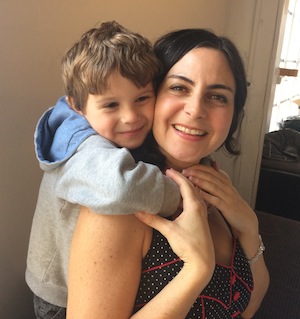
photo - Singer/songwriter Jennifer Gasoi with one of her fans, Joel Harrington, the writer’s youngest son
Singer/songwriter Jennifer Gasoi with one of her fans, Joel Harrington, the writer’s youngest son. (photo by Shula Klinger)

On stage at the Vancouver Writers Fest last month, Gasoi was utterly in her element. She addressed the audience of hundreds as if it were an intimate group of a few children, gathered around her knees. Her experience as an educator was apparent, as she asked questions and engaged the crowd in conversations, responding to the children as they called out answers and praising them for their unexpected gems. In the middle of “Little Blue Car Trip,” she asked the audience for another form of transportation. The first answer fired back, “Camel!” got a laugh from audience and band alike.

Gasoi’s band members – Jody Proznick (double bass), Joel Fountain (percussion/vocals), Chris Gestrin (piano/melodica) and Ralph Shaw (banjo) – are no less engaging. Shaw doubles as the Purple Man from the song of the same name, leaping across the stage to the strains of this energetic, multi-genred song, which culminates in a fiery rendition of “Hava Nagila.”

There’s nothing like a hometown reception for a returning artist and this show was no exception. “This week was absolute magic. Vancouver welcomed me with open arms!” said Gasoi, who continues to deliver songs packed with rhymes, wordplay and colorful imagery.

“I am constantly amazed by kids,” she said. “They are so pure, honest, innocent and in touch with their instincts. I see their potential and I am doing everything in my power to support them.”

Shula Klinger is an author, illustrator and journalist living in North Vancouver. Find out more at niftyscissors.com.

Format ImagePosted on November 4, 2016November 3, 2016Author Shula KlingerCategories Books, MusicTags children's books, children's music
From cardboard to folktales

From cardboard to folktales

Books can take you to the most captivating places. Not always happy places, but places worth exploring, places where the people, environment, challenges and culture are different. A place you can have adventures, learn from what has happened to others or just escape from your daily routine, all for the relatively low price of a book. Oh, and maybe a cardboard box.

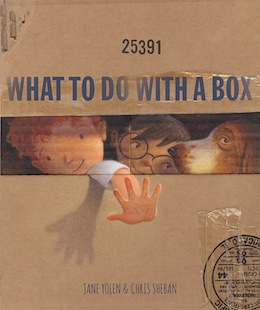
book cover - What to do with a BoxThe beautifully and creatively illustrated What to do with a Box (Creative Editions, 2016) features the rhythmic writing of Jane Yolen and the inspired art of Chris Sheban. The book is a tribute to the power of the imagination – a way to impart to the younger set that fun doesn’t necessarily need batteries. It’s also a reminder to parents that expensive toys aren’t at the root of what makes playtime enjoyable, and they may even be enticed to join their kids in a cardboard box adventure – if they’re invited to come along, that is.
The writing is simple, as it is for most picture books. That box, “can be a library, palace, or nook,” or a place you can “invite your dolls to come in for tea”; it can be a racecar, a ship, and so much more. And the art by Sheban looks as if he took Yolen’s advice: “You can paint a landscape with sun, sand and sky or crayon an egret that’s flying right by.” It is described as cardboardesque and, indeed, it looks as if he drew the illustrations on different types of boxes.

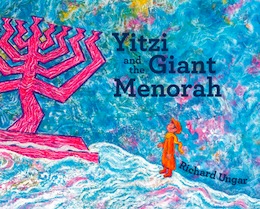
book cover - Yitzi and the Giant Menorah For slightly older readers (or listeners), Richard Unger has written and illustrated a more traditional story with Chagallesque art, Yitzi and the Giant Menorah (Penguin Random House, 2016). It is a picture book, but with a substantive amount of text on each page. It, too, is beautifully and creatively put together, with most of the text printed on a plain page that includes a black-and-white sketch that doesn’t overlap it in any way, making the reading easier. More importantly, it leaves most of the colorful, vibrant and expressive artwork on the opposite page free from writing. At the end of the book is the brief story of Chanukah.
While set on the eve of Chanukah in the shtetl of Chelm, this tale bears a similar message to What to do with a Box: money isn’t everything. It adds to that the lesson of gratitude.

In the story, the mayor of Lublin gives the people of the Chelm “the biggest menorah” Yitzi has ever seen and the villagers are so grateful, they want to thank the mayor in a way that matches the grandeur of his gift. This being Chelm, the solution doesn’t come easily but, after a few failed efforts, they succeed in a heartwarming way.

* * *

For young adult readers, the stories are much more serious in both subject matter and tone.

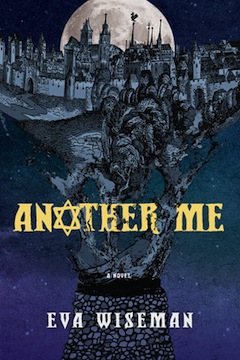
book cover - Another MeEva Wiseman’s Another Me (Tundra Books, 2016) is set in the mid-1300s in Strasbourg, France. It starts with the main character’s death at the hands of the men poisoning the town’s water – an act the Jews were accused of committing not only in Strasbourg, but other cities in Europe, as well. It was thought that poisoned water was causing the plague and, since fewer Jews were dying, the rumors began that they were causing the illness. In reality, Jews were also dying, but in fewer numbers because Jewish law required much more handwashing than was customary in medieval times.
Wiseman also elaborates upon less tangible Jewish beliefs in Another Me. When Natan, 17, dies, his story doesn’t end. He becomes an ibbur – his soul enters the body of another man; in this instance, that of Hans the draper.

Hans works for Wilhelm, with whose daughter, Elena, Natan has fallen in love. Natan has come to know all of these non-Jews from helping his father in the shmatte business. Wilhelm is one of the very few Strasbourgians who is not antisemitic. Hans is also a good person, though he is jealous of Elena’s affection for Natan. When Natan – to whom she’s attracted – becomes Hans – who she finds ugly – Elena struggles to see beyond the exterior.

While mostly told from Natan’s perspective, Wiseman also allows Elena to tell a substantial part of the story. It is sometimes hard as a reader to change gears, but the dual voices offer a deeper understanding of the situation of the Jews in the city (and beyond), and those who would help them. Being historical fiction, while Wiseman can play with magic, there is, sadly, no chance for a happy ending.

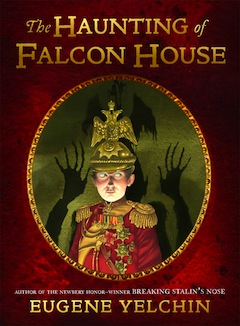
book cover - The Haunting of Falcon HouseMagic – or, at least, ghosts – also informs the storytelling in Eugene Yelchin’s The Haunting of Falcon House (Henry Holt and Co., 2016).

Ostensibly, this book is a translation Yelchin has made from a bundle of decaying pages bound with twine that he came across as a schoolboy in Russia. He brought them with him when he immigrated to the United States, but let them sit for years. Apparently written and illustrated by “a young Russian nobleman, Prince Lev Lvov,” who was born in 1879, there were many pages missing or unreadable.

“I managed to establish a chronological order of the events and then divided them into chapters, matched the drawings to the chapters, and discarded those I could not match,” writes Yelchin in the translator’s note that begins the book. So “inwardly connected to the young prince” did Yelchin become, he writes, “I can’t be certain, but as I typed Prince Lev’s inner thoughts, I felt cool fingers firmly guiding mine across the keys.”

In the story, 12-year-old Lev’s hands are similarly guided by a mysterious force when he is drawing. Arriving at Falcon House from St. Petersburg to take his place as heir to his family’s estate, Lev – who bears a striking resemblance to his grandfather – dreams of being a hero and nobleman like his grandfather and preceding ancestors. But, with some mystical guidance from Falcon House’s resident ghost, Lev begins to understand that being nobility doesn’t necessarily mean being noble, and his family’s secrets, which are slowly revealed, make him rethink his aspirations.

The ghost, a scary aunt and the disturbing illustrations combine to good effect in The Haunting of Falcon House, even though the story takes a little too long to unfold. The detailed notes at the book’s end provide valuable historical context and add greatly to the reading experience.

book cover - Briar Rose: A Novel of the Holocaust Jane Yolen’s Briar Rose: A Novel of the Holocaust (Tor Teen, 2016) is also a retelling – an adaptation of Sleeping Beauty. And, it is a reissue, having originally been published almost 15 years ago in a series created by Terri Windling, which comprised novels by various authors that reinterpreted classic fairy tales.

In Yolen’s reimagining, Briar Rose (aka Sleeping Beauty) is Gemma, Rebecca’s grandmother. Unlike her cynical and competitive older sisters, Rebecca never tires of listening to Gemma’s version of the tale, which doesn’t quite match up with the traditional folktale. When Gemma dies, leaving behind a box containing a few documents and photos that don’t quite match up with what she has told her family about her history, Becca sets off to find the truth.

Her search – done in the days before Google – starts slowly, with the help of her editor, Stan, on whom she has a crush. It takes them from their hometown of Holyoke, Mass., to Oswego, N.Y., where refugees were sheltered at Fort Oswego: “Roosevelt made it a camp and, in August 1944, some 1,000 people were brought over and interned [there]. From Naples, Italy. Mostly Jews and about 100 Christians,” explains the reporter at the Palladium Times to Becca.

What she learns at Oswego leads her on a journey to Poland and to Chelmno. Of the more than 152,000 killed by gas (or shooting) at the Nazi extermination camp that was there, only seven Jewish men are known to have escaped. This allows Yolen to imagine that one woman survived the killing centre, which was established on an old estate in a forest clearing that had a schloss (castle, or manor house).

In Gemma’s cryptic telling of her survival, she is saved from the castle by a “prince,” who we find out was himself saved by partisans after his escape from Sachsenhausen concentration camp and then joined the resistance; in her story, briars take the place of barbed wire, the wicked fairy the Nazis. As Becca discovers the reality of her grandmother’s past and finds her own voice and identity through the journey, we also witness Poles’ difficulties in dealing with what took place during the Holocaust and we meet others – including Gemma’s prince – who are still trying to heal from the destruction the Nazis’ wrought.

Interweaving the “real” story with Gemma’s fairy tale is very effective at building the anticipation and, once Becca arrives in Poland, Briar Rose is a page-turner. One almost doesn’t realize how much they’re learning while they’re reading. Almost.

Format ImagePosted on September 23, 2016September 21, 2016Author Cynthia RamsayCategories BooksTags Chanukah, children's books, fairy tales, fantasy, ghosts, Holocaust, picture books, plague, playtime, science fiction, Sleeping Beauty, young adults

Posts pagination

Previous page Page 1 Page 2 Page 3 Page 4 Next page
Proudly powered by WordPress