Skip to content
  • Home
  • Subscribe / donate
  • Events calendar
  • News
    • Local
    • National
    • Israel
    • World
    • עניין בחדשות
      A roundup of news in Canada and further afield, in Hebrew.
  • Opinion
    • From the JI
    • Op-Ed
  • Arts & Culture
    • Performing Arts
    • Music
    • Books
    • Visual Arts
    • TV & Film
  • Life
    • Celebrating the Holidays
    • Travel
    • The Daily Snooze
      Cartoons by Jacob Samuel
    • Mystery Photo
      Help the JI and JMABC fill in the gaps in our archives.
  • Community Links
    • Organizations, Etc.
    • Other News Sources & Blogs
    • Business Directory
  • FAQ
  • JI Chai Celebration
  • JI@88! video

Recent Posts

  • Zionism wins big in Vegas
  • Different but connected
  • Survival not passive
  • Musical celebration of Israel
  • Shoppe celebrates 25 years
  • Human “book” event
  • Reclaiming Jewish stories
  • Bema presents Perseverance
  • CSS honours Bellas z”l
  • Sheba Promise here May 7
  • Reflections from Be’eri
  • New law a desecration
  • Resilient joy in tough times
  • Rescue dog brings joy
  • Art chosen for new museum
  • Reminder of hope, resilience
  • The national food of Israel?
  • Story of Israel’s north
  • Sheltering in train stations
  • Teach critical thinking
  • Learning to bridge divides
  • Supporting Iranian community
  • Art dismantles systems
  • Beth Tikvah celebrates 50th
  • What is Jewish music?
  • Celebrate joy of music
  • Women share experiences 
  • Raising funds for Survivors
  • Call for digital literacy
  • The hidden hand of hate
  • Tarot as spiritual ritual
  • Students create fancy meal
  • Encouraging young voices
  • Rose’s Angels delivers
  • Living life to its fullest
  • Drawing on his roots

Archives

Follow @JewishIndie
image - The CJN - Visit Us Banner - 300x600 - 101625

Heart-felt and pain-filled memoir

Heart-felt and pain-filled memoir

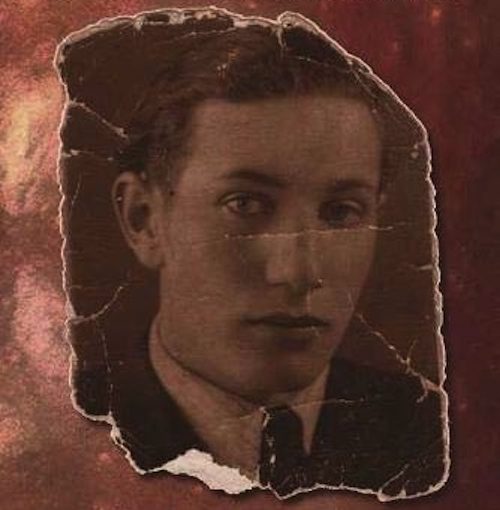
From the page before the opening of Moishe Rozenbaumas’s incisive, heart-felt memoir, we already feel the pain that will inhere in much of his story. Even before we begin reading this autobiography, we see a photocopy of the author’s dedication, handwritten in Yiddish, to the memory of his mother and three brothers, with the dates they were murdered by the Germans’ Lithuanian collaborators in August 1941, in Telz, where Rozenbaumas (1922-2016) was born.

Many people know Telz as the name of the famous yeshivah that was located there, but The Odyssey of an Apple Thief (Syracuse University Press, 2019) by Rozenbaumas – translated from the French by Jonathan Layton and edited by Isabelle Rozenbaumas – takes us into the city, depicting a vibrant Jewish culture, zeroing in on housing, way of life, learning and sports. The title comes from little Moishe’s sneaking into the bishop’s orchard next door and nabbing apples, and the author gives us an historian’s sweep of an area, with a memoirist’s penchant for detail.

For instance, his description of a middle-class household’s Sabbath meal. Although Jews lived “in poverty, hand to mouth,” middle-class Jews had munificent Sabbath meals. Typical to Eastern European towns, the housewife prepared the cholent pot at home, then brought it to the baker, whose oven was heated all Friday night long throughout the Sabbath. Then, around noon on Shabbat, the woman would go and pick up her cholent. Most Jews didn’t have the sort of meals that Rozenbaumas describes, which are at odds with the reigning poverty in Telz.

When the Germans occupy Lithuania, Rosenbaumas accents the avid cooperation between the Lithuanians and the Germans, who murdered 90% of Lithuania’s Jews. He writes that the situation of the Jews in Lithuania was no worse than in other countries; they weren’t loved but they were tolerated. However, in the very next sentence, we read that once, when the president of Lithuania addressed an antisemitic rally, he said that nobody should be stupid enough to slaughter a productive cow while it’s still giving milk.
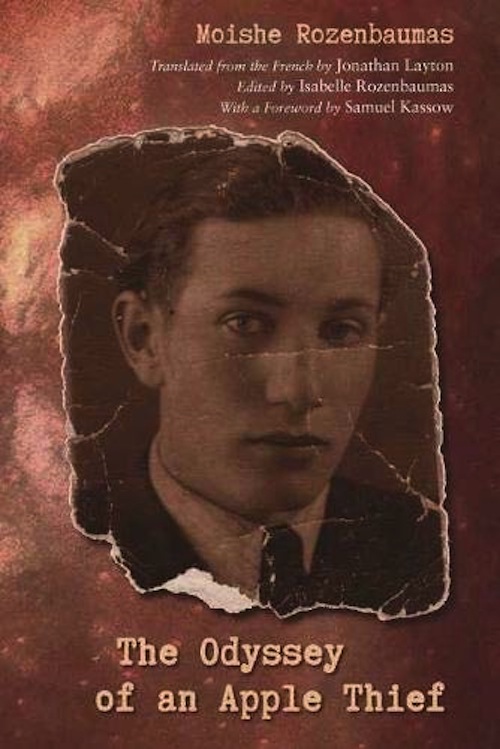
image - The Odyssey of an Apple Thief book coverRozenbaumas provides what he considers a needed reassessment of the yizkor bikher, the memorial books that survivors of various towns assembled after the Holocaust, which always accented the people’s “piety, purity and morality,” even though there were all kinds of individuals. What is often omitted from these yizkor bikher, Rosenbaumas states, is the miserable poverty of Jews who lived in lightless cellars, had only black bread dipped in powdered sugar for food, froze in winter, and dressed in rags.

During the financial crisis in the late 1920s, his father’s successful fabric shop began slipping. Rather than declaring bankruptcy, the father ran away to Paris, where he had sisters. Despite continuing promises, the father never sent any support to his wife and children, and was unaware of what happened to his family until after the war.

Without a father, the author’s mother and her four boys slowly sank into poverty and hunger. Rozenbaumas becomes an apprentice to a poor tailor with 10 children who live in squalid quarters. Soon, he is the sole breadwinner for his family. But, when the Germans invade, he flees eastward to the Soviet Union, just like his father had fled westward. But the author doesn’t notice the irony of the breadwinner again fleeing alone. True, Rozenbaumas asks his mother to come, but she refuses; he doesn’t ask any of his brothers to join him in his flight.

In the Soviet Union, life wasn’t easy. First, Rozenbaumas served four years on the front, undertaking dangerous reconnaissance missions; he was wounded and decorated several times. He regrets that Jewish former soldiers from other lands never mention the half million Jews who fought with the Red Army, including hundreds of Jewish generals and other high-ranking officers.

When Rozenbaumas’s unit liberates Lithuania, first thing he does is go to his house in Telz, where he finds Lithuanians occupying his now-emptied home. He learns where his family was massacred and longs for revenge, which soon comes. After volunteering as a translator for the Russians, he gets the satisfaction of hunting for the Lithuanian murderers, finding them, watching their trials and immediate executions. He even found the murderer of his youngest brother, Leybe, “who may have been,” Rozenbaumas adds, “his playmate.”

When Rozenbaumas finally decides to leave communist-controlled Lithuania, he describes the nightmare of leaving, taking the great risk of paying an exorbitant fee for forged papers that would guarantee his exit. He makes it, finally, across the border into Poland, with suspense and fright accompanying him like a second skin. It was not until he got to Vienna that he could breathe freely.

One day, Rozenbaumas met a man who knew about his father in Paris and thus was able to find him. But the father-son relationship was uneasy. The father never expressed a word of emotion regarding the murder of his wife and his three sons.

Coincidence also plays another crucial role. Rozenbaumas, by chance, bumps into his old girlfriend, Roza, and later marries her.

Rosenbaumas concludes his touching narrative with the hope that the stories of the European Jewish civilization that was brutally erased from the face of the earth will not be forgotten.

 Curt Leviant’s most recent novel is Katz or Cats; Or, How Jesus Became My Rival in Love.

Format ImagePosted on April 3, 2020April 2, 2020Author Curt LeviantCategories BooksTags history, Holocaust, memoir, Moishe Rozenbaumas, Yiddish
Shalev’s latest not her best

Shalev’s latest not her best

In an interview with the Jewish Independent in 2014, after her book The Remains of Love came out in English, Israeli writer Zeruya Shalev said that, until that novel, she had been avoiding writing directly about what she called “the Israeli reality.” She said at the time: “And yet, still I am wrestling with the dominance of this reality, and try not to let it take over my books – it’s enough that it controls my life.”

Shalev’s latest novel to be translated into English is all about the Israel reality, but not in the engaging and provocative way that The Remains of Love was (see jewishindependent.ca/zeruya-shalev-opens-jewish-book-fest). Concisely called Pain, Shalev’s story about a Jerusalem woman suffering post-traumatic stress syndrome, which flares up on the 10-year anniversary of when she was seriously injured in a terrorist attack, is anything but concise. Translated ably by Sondra Silverston, the book needed a better editor, as Shalev gets lost in the physical and emotional suffering of her protagonist Iris, who is not portrayed likeably.

image - Pain book coverDespite being the respected principal of a successful school, despite being married to a perhaps dull but well-meaning husband (who could well be distant because of his wife’s indifference to him) and despite raising two competent and kind but vulnerable children, one of whom desperately needs her help, Iris cannot let go of a lost love from her teenage years. When, by chance, at a clinic, she meets Eitan, the man who left her so abruptly so long ago – he is now a doctor who specializes in the treatment of pain – Iris goes headlong into the fantasy of what her life could have been with him, despite all indications that he’s a selfish and emotionally stunted ass. She considers leaving everything tangible and good that she has built for herself for a life that never was.

There are some astute observations in this novel – about trauma and how it affects not only the person injured but those who love them, about the harmful effects of living in the past, about forgiveness, about the fickle nature of life, and more – but it gets lost in Iris’s nearly interminable self-pity and self-delusion. Pain is not Shalev’s best work.

Format ImagePosted on April 3, 2020April 2, 2020Author Cynthia RamsayCategories BooksTags fiction, health, terrorism, Zeruya Shalev
‘הקהילה היהודית בוונקובר – חלק ד

‘הקהילה היהודית בוונקובר – חלק ד

(מוזיאון העם היהודי L.11730)

כמחצית מהיהודים שחיים בוונקובר ובאזור אינם שייכים לשום קהילה דתית. הקהילה של ונקובר גדלה במהירות רבה, החיים היהודיים התוססים מנוהלים על ידי הפדרציה היהודית של ונקובר רבתי. יש מערכת חינוך יהודית ענפה הכוללת עשרה גנים, שלושה בתי ספר ונקובר היברו אקדמי, תלמוד תורה יסודי ותלמוד תורה תיכון, וכמה בתי ספר ערב ובתי ספר של יום ראשון: בית ישראל, אור שלום, בית הספר של בית הכנסת שלום, בית מדרש תורת חיים במערב ונקובר, בית תקווה, ביתה ספר היהודי ריצ’מונד ועץ חיים. שלושת האחרונים בעיר ריצ’מונד הסמוכה לוונקובר. הכולל הקהילתי של ונקובר רבתי, שנמצא בבית הכנסת עץ חיים, מקיים הרצאות וסמינרים ביהדות בכל אזורי ונקובר. קורסים בעברית לומדים במיני אולפן קיץ. ארגוני נוער וסטודנטים כוללים בני ברית והילל, קרן עבור סטודנטים יהודיים באוניברסיטת קולומביה הבריטית ואוניברסיטת סיימון פרייזר, שתיהן בוונקובר, וכן מכללות אחרות באזור. יש עוד ארגוני נוער: הבונים דרור, תנועה ציונית, קדימה, מועצת הנוער היהודי, הועידה הלאומית לנוער תנועת הנוער של בית הכנסת שלום ותנועת הנוער של בני ברית.

בתי הכנסת בוונקובר משקפים מגוון רחב של תנועות וזרמים יהודיים: בית המדרש בני יעקב (אורתודוכסי), בית הכנסת הספרדי היחידי במערב קנדה, חנך מבנה חדש בחודש יוני אלפיים וארבע. בית ישראל (קונסרבטיבי), הראל (שוויוני-קונסרבטיבי) במערב ונקובר, ברוח התנועה הקונסרבטיבית. לובביץ’ של מחוז קולומביה הבריטית (חסידי). אור שלום (רקונסטרוציוניסטי), שייך לתנועה לתחייה יהודית; שוחרי צדק (אורתודוכסי), שייך לקהילה האורתודוכסית הגדולה בוונקובר, מקיים תפילות יומיות, ונוכחות רבה מאד בתפילות יום השבת; בית לואיס ברייר (אורתודוכסי); שלום (רפורמי), נחנך בשנת אלף תשמע מאות שבעים ושש, בית הכנסת הרפורמי הראשון במערב קנדה. וכן שערי תפילה (מסורתי).

בוונקובר פועלים ארגונים יהודיים רבים. נזכיר אחדים: הקונגרס היהודי הקנדי אזור האוקיינוס השקט, ועדה לענייני ישראל קולומביה הבריטית, המרכז לענייני ישראל והיהודים בקנדה. הקשרים בין הקהילה היהודית בוונקובר לבין ישראל נשמרים בין היתר הודות לסניפים מקומיים של אגודות הידידים הקנדים של אוניברסיטאות ישראליות ומוסדות מחקר והשכלה גבוהה וגם מוסדות רפואה, תרבות והומניטריים.

שירותי הקהילה כוללים סוכנות לשירותי משפחה, אגודת עזרה, ומרכז שלום של מחוז קולומביה הבריטית למידע, הפנייה ומתנדבים. הקהילה פיתחה תכנית סיוע לנזקקים, יד ביד מועצה לטיפול בעוני, אגודת דיור ללא מטרת רווח, ומפעילה תכניות לאזרחים קשישים: מועצה לקשישים ואנשים עם מוגבלויות, וגם ארגונים, מועדונים, ואגודות לחברי הקהילה הקשישים: מרכז יום לקשיש לחיים, קשישי בית הכנסת שלום, קשישי הר-אל מערב ונקובר, קשישי שלום עליכם של מוסד פרץ ונקובר ועוד. מועדון טיולי טבע, מועדון פנויים ופנויות וקהילה עבור הפנויים והפנויות. שירותי סיוע למהגרים יהודים ולימודי אנגלית למהגרים למען שילובם של מהגרים יהודים בקנדה. יש גם כמה ארגוני נשים: נעמ”ת קנדה, מועצת הדסה-ויצ”ו ונקובר, נשות אמונה קנדה, מועצה לאומית לנשים יהודיות, ארגון נשים לסיוע של בית לואיס ברייר, וג’ואיש וומן אינטרנשיונל.

על הפעילות התרבותית מופקדים כמה ארגונים, ביניהם מרכז פרץ לתרבות יהודית חילונית, החברה ההיסטורית היהודית של קולומביה הבריטית וארכיבי הקהילה, שמוציאים את כתב העת של החברה ההיסטורית היהודית של קולומביה הבריטית, המוסד הגניאלוגי היהודית ופסטיבל הסרטים היהודי ונקובר, שנוסד בשנת אלף תשע מאות שמונים ותשע. יש שני ארגונים המוקדשים לזכר קורבנות השואה: מרכז השואה לחינוך וזיכרון ובו ארכיון אור קולי של עדויות , מקיים פעילות חינוכית , והארגון המערבי של ניצולי השואה משפחות וידידים. קמפוס הקהילה היהודי ע”ש הארי וג’נט וייברג בו שוכן המרכז הקהילתי של ונקובר רבתי וגם הספרייה הציבורית ע”ש יצחק וולדמן. תקשורת יהודית: יחד, פדרציה יהודית למגזין של ונקובר רבתי, ג’ואיש ווסטרן בולטין הנקרא כיום הגו’איש אידיפנדט, ומדריך לחיים היהודיים בקולומביה הבריטית.

Format ImagePosted on April 1, 2020June 30, 2020Author Roni RachmaniCategories UncategorizedTags British Columbia, history, Jewish community, Jewish museum, JMABC, Vancouver, Victoria, וויקטוריה, וונקובר, מוזיאון העם היהודי, קהילה יהודית, קולומביה בריטית, תולדות
A virtual community

A virtual community

With COVID-19, we now must connect online.

As the world continues to grapple with the coronavirus (COVID-19) pandemic, Jewish organizations across Metro Vancouver are finding new ways to connect with the public.

Last week, schools and most businesses and places of worship closed their doors to support the provincial government’s directives for new social-distancing policies. For everyone, this change has required the adoption of different ways to address daily needs, like shopping, study and religious practice. It has put increased demand on organizations and businesses to think out of the box when it comes to staying in touch with and supporting their membership, clients and connections. Here’s some of what the community is doing.

New lesson plans

Schools have shifted their classes to online attendance and are creating lesson plans that allow students to study virtually and independently. Some schools, like Richmond Jewish Day School, have sent out private communications to parents, outlining class schedules and continued services. Others are using their websites or other online services to keep families apprised and facilitate the learning curve that students, parents and teachers will inevitably face using the technology.

Students at Vancouver Talmud Torah will have independent study periods and be able to use social media to connect with their teachers and peers. The school is using Google Classroom for study plans and assignments and its website notes that students who are experiencing problems, need to discuss study plans or want to connect with other class members will be able to do so during the teacher’s virtual office hour each day. For families that don’t have a computer available, the school says students will be able to sign out a laptop to use at home (one laptop per family, as inventory is limited).

King David High School’s new multimedia program launched a week ago, and it uses Zoom video services, Moodle and Google Classroom to connect with at-home students. According to KDHS’s website, the school is doing its best to keep schedules and study periods the same as they were prior to the shutdown. It is using classes prior to Passover break (April 3) to test and refine the online structure.

Shalhevet Girls High School is also working hard to keep schedules standardized and reflective of the lesson plans it offers, and students can still connect with one another during the “lunch and shmooze” hour.

Take-out and online

On March 21, the City of Vancouver ordered all in-house restaurant service to cease. Restaurants that provide take-out and delivery services have been permitted to remain open.

Many of Vancouver’s kosher restaurants already provide take-out or delivery services to the public. Omnitsky Kosher, Nava Creative Kosher Cuisine and Maple Grill have enhanced their takeaway and catering services. Some provide service through the DoorDash online app or Uber. Most are urging customers to order with sufficient advance notice.

A staff person at Maple Grill said that ordering ahead is necessary for very large orders, “but we always have take-out between 4 and 8 p.m. for smaller orders.” Patrons should keep in mind that seating – even while waiting for orders – will be closed in all restaurants during this time.

Nava, which has a take-out restaurant at the Jewish Community Centre of Greater, has requested 24-to-48-hour notice on all orders. According to Susie Siegel, although the JCCGV is currently closed, customers can pick up orders by calling or emailing their order ahead of time. Sabra Kosher Bakery also will be open for take-out and larger Passover orders.

Other restaurants that have relied largely on their in-house service have found it challenging to meet the requirements of the city’s precautionary ban. Café FortyOne has announced that it has “made the difficult decision to temporarily close to protect the health and safety of customers and staff.”

Restaurants – including non-kosher establishments like Market Meats – are also accepting orders for Passover and most have cut-off dates for orders. While many kosher restaurants are scheduled to close on April 8 for the week of Passover, customers may wish to call ahead to confirm deadlines for orders and take-out during the current shutdown.

Meanwhile, stores are also struggling. Buchan’s Kerrisdale Stationery on West 41st Avenue, which has a selection of Judaica, among many other items, is now offering delivery service. And Olive and Wild, on Main Street, which offers a variety of Judaica, Passover items, art and home décor items, is transitioning its services to better serve customers who aren’t able to shop in-person.

Simon Zaidel, who co-owns Olive and Wild with his wife Bella, admitted that the COVID-19 alert hasn’t been easy. The owners have added an online store to their website and Zaidel said patrons can either pick up their orders, have them delivered or, for those outside the Lower Mainland, request delivery by Canada Post. He added that the store is currently providing a discount to offset any delivery costs.

Safeguarding the vulnerable

Jewish Family Services, like many organizations, is shifting its services to meet increased at-home demands. Kassidy Taylor, JFS marketing and communications manager, said the organization realizes that the current health concerns are financially and logistically difficult for people of all ages. Its Emergency Care Campaign allows families and individuals to reach out for help with food, deliveries and other social support.

“It is for anyone who needs a meal or grocery delivery, counseling, emotional support or just a friendly phone visit,” Taylor said. “We are trying to support as many people as possible.”

Taylor added that, for many seniors and other individuals, having to stay at home has cut them off from food banks and various resources that don’t deliver. “We are just trying to fill in the gaps as we can,” she said of JFS’s focus.

Individuals needing assistance can contact JFS through its website or by calling the agency’s hotline, 604-558-5719. As well, the emergency care program is in need of volunteers, and those wishing to donate are welcome to contact JFS as well. “There is a lot of need right now,” Taylor said.

On another front, healthcare facilities have been taking successive steps to address the impacts of the COVID-19 outbreak. On March 17, Vancouver Coastal Health announced the closure of all adult day centres, such as the L’Chaim Adult Care Centre at the JCCGV, in an effort to protect seniors and healthcare workers from the virus. Care workers are monitoring participants by phone to ensure that medications, food and support are coordinated as necessary through VCH case managers. More information is available by logging onto the Lower Mainland Adult Care Centre Association’s website and clicking on the appropriate care centre’s link.

As of March 17, Vancouver Coastal Health also restricted visitors to Louis Brier Home and Hospital, Weinberg Residence and other care homes to “compassionate visits” that meet specific limited guidelines for continued care and end-of-life support. VCH stresses the rules are a precautionary measure to keep patients and staff protected.

Most of the community’s organizations have instituted changes to address social distancing and other limitations brought about by the outbreak. Links to each one and an overview of temporary changes are accessible through the Jewish Federation of Greater Vancouver’s website.

Virtual davening

Few Jewish organizations have been as impacted by the call for social distancing than Vancouver’s religious institutions, which have been faced with myriad challenges. Restrictions on attendance (at press time, it was limited to 50 people) and other issues have forced synagogues to rethink how best to both continue regular religious services and provide social and educational support to their members, many of whom are seniors and required to stay at home. It’s also forced organizations across Metro Vancouver to change programs and services for Passover. Most religious institutions have already canceled or transitioned upcoming holiday celebrations to Zoom online services.

On March 21, rabbis from Vancouver Lower Mainland institutions issued a joint statement to congregants outlining the synagogues’ new guidelines for attendance. Many of the congregations have transitioned to online religious services via Zoom video to ensure that their members can stay connected, supported and engaged in religious life.

Congregations Schara Tzedeck, Beth Israel, Temple Sholom and others are providing daily and/or weekly minyanim online, along with classes and “meetings” throughout the day.

Most congregations are also working to fill the gap when it comes to much-needed social interactions for teens and younger members. Synagogues have found ways to both address concerns about halachah and ensure that members struggling with the impact of isolation are supported.

Both Schara Tzedeck and Beth Israel issued new cemetery guidelines earlier this week, calling on members and guests to adhere to practices that help safeguard both the participants and others who may be at risk from exposure to the virus. Cemetery facilities are closed to the general public. Burials are, in most cases, limited to family members, with some allowances to ensure that there will be enough attendees for a minyan so mourners can say Kaddish, and unveilings have been canceled to April 30 at least. Congregants and those interested should contact the synagogues in charge for more information on the revised guidelines.

Helping those in need

Many Jewish organizations are also finding ways to help those most vulnerable get financial aid if needed. The Hebrew Free Loan Association has announced that it will lend up to $2,000 to individuals or families impacted by loss of a job or other economic problems stemming from the coronavirus outbreak. Organizations, like Or Shalom, for example, are accepting donations within its congregation to help those struggling from illness or loss of income.

***

For the most comprehensive list of community resources and organizations, visit jewishvancouver.com/covid-19-updates.

Jan Lee’s articles and blog posts have been published in B’nai B’rith Magazine, Voices of Conservative and Masorti Judaism, Times of Israel, as well as a number of business, environmental and travel publications. Her blog can be found at multiculturaljew.polestarpassages.com.

Format ImagePosted on March 27, 2020March 26, 2020Author Jan LeeCategories LocalTags coronavirus, COVID-19, education, Judaica, Judaism, restaurants, synagogues, technology
Gymnast excels at her sport

Gymnast excels at her sport

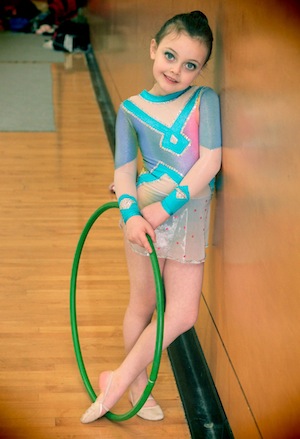
At the B.C. Winter Games in Fort St. John last month, Belle David received a silver medal for her ball routine and placed fourth all around. (photo from Danica David)

Local athlete Belle David started the year off with success after success after success in her chosen sport: rhythmic gymnastics.

The 10-year-old gymnast competes provincially at level 3B (ages 9-11). At the Queen of Hearts invitational competition in Vernon Jan. 24-26, she received an all around first place, a gold medal in the ball routine, a silver medal in the free routine and a bronze in rope. At the Olympia Cup in Burnaby Feb. 7-9, she received a bronze medal in rope, as well as a special award for Miss Dance Jr. And, at the B.C. Winter Games in Fort St. John Feb. 20-23, she received a silver medal for her ball routine and placed fourth all around.

“The most fun part of rhythmic gymnastics is the competitions,” Belle told the Independent in a recent interview. “The most difficult part of rhythmic gymnastics is the long practices.”

Admitting that she gets a little nervous when she competes, she said, “but I have a lot of practise with competitions and that practise helps my nerves.”

Belle trains three times a week for four hours each time at rhythmic gymnastics and she also trains in ballet twice a week. “Altogether, I train for rhythmic gymnastics over 14 hours a week (including mandatory ballet) and, combined with my other sports, I do 25 hours a week.”

The restrictions that have been implemented by various levels of government to try and manage the spread of COVID-19 have brought changes in that regimen, however.

“Belle’s coach has set an individual stretch and strengthen program for each athlete,” Belle’s mother, Danica David, told the Independent. “The coach has sent a video, 26 minutes long, of basic training exercises she expects the athletes to follow, along with detailed plans for each gymnast. Belle is expected to film herself training and send in the film to the coach to check in daily.

“Mentally, Belle is processing the end of the season coming early. When there are still three competitions left, it’s disappointing, after all her hard work, but she will keep practising at home. She said, ‘I feel like there’s nothing to do and nowhere to go.’”

In Grade 4 at David Oppenheimer Elementary School, Belle said her favourite subject is art. Interviewed before the pandemic forced closures, she said, “I socialize at school and at practice because I don’t have time for friends outside of practice. I mostly do my homework early in the morning before school.”

photo - Belle David at her first rhythmic gymnastics competition, at age 6
Belle David at her first rhythmic gymnastics competition, at age 6. (photo from Danica David)

Belle started dance classes at the Jewish Community Centre of Greater Vancouver when she was 4 years old and began taking rhythmic gymnastics classes when she was 5.

“I love sports,” she said. “I love baseball, dance, rikudei ’am [folk dances], swimming, skating and artistic gymnastics.”

She also makes time for community and cultural activities.

“I celebrate all the Jewish holidays and I keep Jewish traditions,” she said. “Our family hosts holiday parties and I enjoy PJ Library events and books.”

After three years performing in Goh Ballet’s The Nutcracker, Belle said, “I took a break this year to really enjoy Chanukah with my ima, abba, grandma, brother and friends. When I danced in The Nutcracker, sometimes I performed in two shows a day during the run and I missed the Chanukah fun. This year, we did Chanukah bowling, skating, the party bus and menorah parade and, as always, we lit candles and opened presents each night of Chanukah.”

Belle said she wears a red-string kabbalah bracelet on her left wrist, including in competitions, that her mom blesses.

Family is important to Belle and one of her ambitions centres around her grandparents in Israel.

“I have a short-term goal to learn the apparatus hoop,” she said. “I have a long-term goal of making it to the Grand Prix Holon.

“The Grand Prix Holon takes place in my home city (Holon) in Israel,” she explained. “I would like to compete for Canada or Israel. It’s an international competition and it’s across the street from my savta and saba’s apartment. All my family could come and see me compete. This is my dream.”

Belle’s family moved from Israel to Vancouver almost seven years ago, said her mother.

“I was born in Canada and her dad was born in Israel – we met in India,” David said. “Belle was born in Israel and she has a brother born in Canada, named Omri, he is 6 years old. Their father, Ofir, has never been able to move permanently to Canada because of the nature of his work but he visits often. We live in a multigenerational household in Vancouver with my mother, who was a former competitive athlete. She finds great joy in supporting her grandchildren to pursue athletics – it’s a family passion that skipped a generation. Belle and Omri have seven cousins in Israel and a large extended family that they miss very much.”

In Israel, David said they didn’t have access to activities like they have here. “In our town,” she said, “private country clubs dominated and we had no access without costly memberships. When we came to Canada, Belle was interested in trying everything, sports, arts, activities of all kinds, and, through the JCC and local community centres, it was affordable.

“Belle’s grandmother really encouraged rhythmic gymnastics, as she was involved in the sport herself as a teacher,” continued David. “Belle participated in a rhythmic gymnastics camp at age 5 and she was hooked. When I came to pick her up, her face was red and she looked exhausted. I expected her to want to quit but exactly the opposite – she loved the challenge. The coach had been a Russian-Israeli who spoke Hebrew and Belle felt right at home. She continued camp during the summer. In the fall, she was asked by a club to enter the competitive rhythmic gymnastic training stream.”

As the parent of athletes, David said her “biggest challenge has been being a witness to the highs and lows of the sport without holding any attachments to them. The same goes for their achievements. What Belle achieves is hers alone. It is her self-discipline and motivation to grow in sport that encourages us to support her in any way we can.

“The biggest joy for me,” said David, “is to see that Belle is a wonderful sister, modeling hard work and perseverance to her brother. Belle is self-determined: she chooses her goals and achieves them in her own time. She chose to sacrifice social time and other opportunities to train two years for the winter games. It wasn’t always easy on the family or her but she followed through. I admire her drive – when I was 10 years old, I couldn’t even keep my hamster alive.”

David described herself as “hopelessly non-competitive and uncoordinated” and, therefore, said it is hard for her “to truly invest in the competitive aspect of the sport. Judging and performance can alter from competition to competition and a place on the podium is never guaranteed.

“I find my niche in the esthetic aspect of the sport,” she said, “and support Belle by adding Swarovski crystals to her bodysuits and finding the most complimentary apparatus. These athletes place a lot of pressure on themselves and, after the long hours and hard work, people question why we subject our children to the intensity of the competitive sport. In my opinion, most of the kids at this level of sport are progressing from an inner motivation and they have cultivated a sense of belonging through sport.”

Format ImagePosted on March 27, 2020March 26, 2020Author Cynthia RamsayCategories LocalTags Belle David, coronavirus, COVID-19, gymnastics, sports, youth

We must continue to ask

Probably every action or event has unintended consequences. The more significant the initial act, the more dramatic the consequences, for better or worse.

Significant historical events illustrate a few of these. Income tax, for example, was an outcome of the First World War, which was, like all wars of course, cataclysmic to individuals and countries.

The Depression resulted, again among many other things, in public acceptance of vast government interventions into the economy through programs like the New Deal in the United States, and similar initiatives in Canada and elsewhere.

The Second World War, one of the worst human catastrophes ever known, was accompanied by a universe of social and economic changes, including the effective nationalization of critical industries to support the war effort. That period of social upheaval – during which personnel of all races served side by side and women entered the workforce in large numbers to fill the places of men at war – contained the seeds of social revolutions to follow, including the civil rights movement and the transformation of the role of women in society. The war was also a direct antecedent to formal decolonization in the developing world.

In other words, some terrible events can result in transformative consequences. This is not to play the ethics game and ask, if we could reverse history and prevent this act, would we do so, knowing that some positive byproducts would likewise be erased. It is merely to draw attention to the consequential moment in which we find ourselves.

The terror attacks of Sept. 11, 2001, are perhaps the freshest parallel for most of the current generation. On that day, we understood that everything had changed but we could only imagine in what ways. Wars would soon begin that continue to this day and, closer to home, social schisms between groups, including the rise of Islamophobia, emerged.

Political debates shifted dramatically to erstwhile largely dormant issues like government surveillance, balancing collective security with individual rights, the use of enhanced interrogation – torture, that is – and the thing that affects most of us most obviously: massive changes in airport security processes.

Since then, we have seen the rise of social and economic inequality and the attendant antisemitism and xenophobia it has engendered. Such shocks to the system produce reverberating impacts, often felt by more vulnerable and marginalized groups, Jews included, and we know that the consequences of any one shock can compound the waves of others in ways expected and unexpected.

We have plenty to worry about right now, with the immediacy of the pandemic. But we should also make time to consider potential unintended outcomes from this experience.

We have seen already, as we mentioned here a very long week ago, a vast outpouring of social unity. On social media, Vancouverites are coming together in mutual support. At 7 p.m. each night, for example, many are joining together to cheer frontline healthcare workers in a small but meaningful act of solidarity and hope. Most people, with notable exceptions that are being rightly called out, are responding appropriately to the advice of experts.

But consider the small, perhaps less obvious ways this experience could impact us. When it’s all over, will we be more reticent to shake hands, to hug? Will we be more attuned to the reality that we are each a part of an inseparable collective humanity, regardless of human-created boundaries?

More substantively, might we see the early reports of decreased air pollution due to this situation continue for the weeks or months this endures and realize that substantive progress on climate change is possible if we recognize the difference between essential and non-essential carbon-consuming activities? Could the once-unimaginable international coordination we are witnessing rekindle our collective hope in unified action for any number of good causes? If we can come together against a threat to us all, could world peace be less remote a dream than we might think?

Conversely, we should be cognizant, as well, that the vast power of the state – our state, every state – to effectively shut down entire societies and economies represents a unique global event. It is done in this case, of course, for the right reasons. But could a less-than-benevolent leader, tasting this level of control, envision ways to use it for their own purposes and against the common good? Might one use coronavirus as justification to delay or cancel elections?

There are a great number of question marks in this week’s editorial. The point here is not to play Nostradamus but to remind ourselves to question. At Passover, in whatever virtual or altered form we celebrate this year, we will ask questions for which we know the answers, and have been pondering for millennia. As this unprecedented time of humankind proceeds, we should remember to continue asking. How will this experience change us? What good might come of it? How can we ameliorate the terrible things that seem to be nearing their peak? Who might be trying to exploit this situation for ill and who is modeling the best of human kindness?

For more information and updates from the B.C. Centre for Disease Control and Canada’s public health authorities, visit covid-19.bccdc.ca and canada.ca/en/public-health/services/diseases/2019-novel-coronavirus-infection/prevention-risks.html, respectively.

Posted on March 27, 2020March 26, 2020Author The Editorial BoardCategories From the JITags coronavirus, COVID-19, liefstyle, Passover
Nature’s riot of colour

Nature’s riot of colour

“Desert Spring” by Jessica Ruth Freedman.

A harsh critique early in her career didn’t stop Victoria-based Jessica Ruth Freedman from doing what she loves – painting – and becoming a successful artist.

“I was born in Montreal, and then my brother and I were whisked away to Kibbutz Ein Dor in the Galilee,” Freedman told the Independent. “After a few years there, we returned to reside in Calgary. I attended what was then called the Calgary Hebrew School-Talmud Torah. I was filled with the love for Jewish lifecycle events, food, and being part of a community. Apart from a fabulous school experience, one episode of failing an art assignment in kindergarten stands out. We were told to pick a rock and paint it like a ladybug. Creatively, I painted it black on red, rather than red on black, so that the white dots would stand out better. I sadly was singled out as an art failure in front of the whole class!

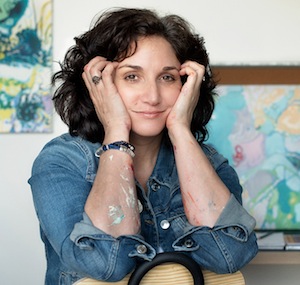
photo - Jessica Ruth Freedman was to participate next month in the Art Vancouver fair, which has been postponed
Jessica Ruth Freedman was to participate next month in the Art Vancouver fair, which has been postponed. (photo from Jessica Ruth Freedman)

“Fast forward a few years, a career as a contemporary dancer, yoga teacher and accountant, [then] I returned to my love of painting,” said Freedman, who has a bachelor of arts, with a major in dance and a minor in fine arts, from Simon Fraser University. “At this time, I had moved to Victoria to chase the warmer weather and, after a few holidays in nearby Hawaii, I was hooked on representing the juxtaposition of botanicals versus the urban in my artwork.”

Freedman is one of the artists participating in Art Vancouver, which has been postponed from its scheduled dates, April 16-19, because of COVID-19.

“These days, the traditional way of selling art through a gallery is changing,” she said. “Many galleries are shutting their doors due to increasing rents and a growing online marketplace. Art fairs give individual artists an opportunity to connect directly with new collectors. I also love the communal spirit of the artists working and showing together. There is a lot of sharing of process and information that goes on at these types of events. Since I live on the West Coast, Art Vancouver is the best art fair to participate in, and Vancouverites are a knowledgeable art bunch.”

She said she likes to create fresh work for each art fair. “I consider carefully the city, people, environment and sizes of artwork,” she said. “At this Art Vancouver, I will be debuting some non-traditional materials in my paintings, all while keeping the abstract botanical theme. My aim is to always create work that uplifts and inspires, and I attempt to do this through colour, theme and design.”

Freedman works in acrylic, ink and mixed media. She has exhibited internationally and her work is in private and public collections around the world. On her website, she notes, “My journey through life can only be described as an artistic DIY.” She says she “was always the child who wanted to be left alone to explore and discover” and yet that it is her “path in life to share my art to celebrate connection, serenity and humour and to share this journey together.”

“Many artists will agree that one needs to look inward to find the source of creation,” Freedman explained of her need for both solitude and community. “Even realist painters rely on an internal compass based on technique and free expression. As a Jewish person, I honour the spirit of creation within me, and I also pay tribute to the concept of tikkun olam, the repair of the world. I feel fortunate to explore the creative side of myself for a living, but I also feel it’s necessary to do good work in the world. This might mean volunteering for Jewish events, donating my paintings to charity auctions, or just being a positive person with a solution-focused outlook.”

For Jewish community members who come to see her work at Art Vancouver, the dates for which will be released in the near future, Freedman said, “Surprisingly, a fair amount of Hebrew – my first language – appears in my paintings. If readers come visit my booth, I’ll look forward to pointing it out!”

Though she paints the natural world, Freedman noted a certain irony – she is not very good at caring for actual plants. “I am lucky that I can send my husband out to purchase plants – I paint them and he cares for them,” she said. “I am mostly fascinated by the riot of colour, of chaos, that Hashem has let loose in the natural world. The process of growth and decay, while natural, is obviously hard on us humans but is a natural part of life. I am also very interested in urban design that incorporates the natural world in ways that increase sustainability, beauty, communication and wonder.”

For more information on Freedman, visit jessicaruthfreedman.com. For more on Art Vancouver, go to artvancouver.net.

Format ImagePosted on March 27, 2020March 26, 2020Author Cynthia RamsayCategories Visual ArtsTags Art! Vancouver, Jessica Ruth Freedman, nature, painting
NCJWC Vancouver plans, learns, noshes and welcomes newcomers

NCJWC Vancouver plans, learns, noshes and welcomes newcomers

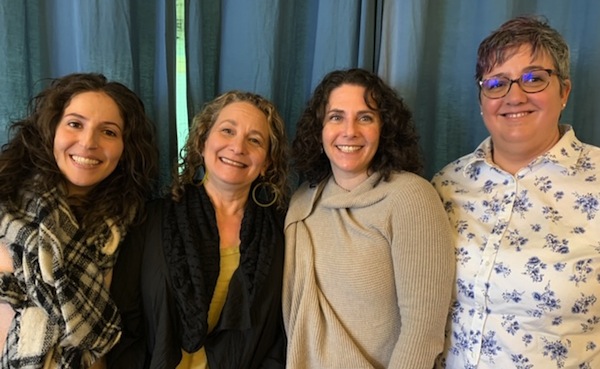
Books for Kids volunteers at NCJWC Vancouver’s 96th AGM, left to right: Jodi Seidelman, Rhea Lazar, Gail Gumprich and Tanya Hebron. (photo from NCJWC Vancouver)

On International Women’s Day, March 8, National Council of Jewish Women of Canada, Vancouver section, planned, learned, noshed and welcomed newcomers.

Sunshine was all around the room at NCJWC Vancouver’s 96th annual general meeting, which took place at the Jewish Community Centre of Greater Vancouver in the Snider Senior Lounge.

Members were welcomed by president Catherine (Cate) Stoller and the new board was installed by Shirley Hyman, Limmud Vancouver program chair and longtime volunteer for NCJWC.

The new executive board is Stoller (president), Fran Ritch (treasurer), Jackie Krystal (co-treasurer), Linda Arato (recording secretary), Anne Lerner (vice-president, social action), Ricki Mintz (vice-president, engagement), Marnie Weinstein (vice-president, marketing and administration) and Rochelle Garfinkel (member-at-large). Appointed board members are Rhea Lazar (chair, Books for Kids program) and Sandy Hazan, Sarah Morel Shaffer and Jane Stoller (co-chairs, Operation Dressup).

After the AGM, Anna-Mae Wiesenthal, a Jewish history teacher at King David High School and a PhD student in Holocaust studies, gave a presentation on the “othering” of indigenous peoples in Canada during the settler colonial period and of Jews in Germany during the Holocaust.

Stressing the strong connection between NCJWC’s social action in the Jewish and non-Jewish communities in British Columbia, council’s advocacy nationally against antisemitism, its support for family services in Israel and its international role supporting human rights, Cate Stoller cheered the passing of the baton between generations. For more information about the Vancouver section of NCJWC, visit ncjwvancouver.org.

Format ImagePosted on March 27, 2020March 26, 2020Author NCJWC VancouverCategories LocalTags AGM, National Council of Jewish Women, NCJW, tikkun olam
Writing for Israel at UN

Writing for Israel at UN

Aviva Klompas recently published the book Speaking for Israel: A Speechwriter Battles Anti-Israel Opinions at the United Nations. (photo from Aviva Klompas)

Aviva Klompas came close to writing a declaration of war. In early 2013, after an Israeli post was fired upon by Syria – one of a number of attacks – Klompas was tasked with penning a condemnation that would be submitted to the United Nations.

Still relatively new as director of speechwriting for Israel’s Permanent Mission to the UN in New York City, she recalled the criticism she received: “Be more direct. Be more assertive about things,” she was told. “I thought to myself, ‘channel outrage.’ I tried to do so. I wrote this very stern letter, and I took it to the ambassador to review.”

Klompas, who spoke with the Independent recently, said she then learned the art of diplomacy, and how words might set off an international firestorm.

“To be clear,” Ambassador Ron Prosor, then Israel’s permanent representative to the UN, told her, “you don’t have any authority to declare war.” And it was off to a rewrite.

Thankfully, there weren’t any other close calls, but there are many other fascinating stories – many of which Klompas has brought to light in Speaking for Israel: A Speechwriter Battles Anti-Israel Opinions at the United Nations (Skyhorse, 2019). The book is a candid examination of how the Israeli delegation – and Israel as a whole – is perceived and treated in the international body.

image - Speaking for Israel book coverDuring Klompas’s time at the UN, several major events occurred, including but not limited to the Iran deal, countless anti-Israel resolutions, Palestinians’ bid to join the International Criminal Court, the kidnapping and murder of three Israeli teenagers, and 50 days of war between Israel and Hamas in Gaza. She wrote the book, she said, to show the tireless work of those who advocate for the Jewish state and who rarely get their due.

“It always feels like it is an uphill battle by the nature of the bias at the UN,” she said. “There are people who show up every single day and never say, ‘Why are we doing this? We should leave the UN.’ I’ve never had a single colleague make that suggestion. They came to work and did the job. I think, it’s a little bit my story, but it’s really our story.”

Klompas was director of speechwriting from 2013 to 2015.

“It’s very few people that make the headlines – the ambassador, maybe the deputy ambassador, maybe the foreign minister – but what about everyone else that is doing it day in and day out?” she asked.

About her work, the Toronto native said it advanced Israel’s policies and informed public opinion. Being successful at it, she said, required overcoming some challenges. For one, there was a culture clash.

“Certainly, Israelis are much more direct in their feedback, which is for better or for worse. At first, it is startling, but then you get to understand that it’s not personal,” she said.

Learning how to write in someone else’s voice was difficult, too. Prosor has “a very distinct style,” she said, describing him as “extremely articulate, funny, charming and intelligent. To be able to write for somebody like that takes time.”

In addition, Prosor took a different approach to diplomacy, when “so many speeches can be dry and not entirely lively,” said Klompas. “He’d be all too happy to break out into song in the middle of a speech, whether it be a song about African nations, which got him a standing ovation from some of the African nations in the General Assembly, [or] he would sing John Lennon’s ‘Imagine.’ In a speech about women, he sang Aretha Franklin’s ‘Respect.’”

Klompas gave him the nickname “the Singing Diplomat.”

“Ambassador Prosor felt it was very important to be heard and, to be heard, you have to be different,” she explained. “He knew he had to capture attention to get people to listen.”

In the beginning, she would have to write up to 20 drafts of a speech before she got a sense of the ambassador’s voice and style. Sometimes, there wasn’t much time to tweak.

“It’s pretty stressful,” she said. “You can get a phone call any time of day or night, weekend, and be told the Security Council is convening a special session, come down to the office, we have to get writing. You could have a couple of days’ notice or a couple of hours’ notice. And emergency sessions tend to get a lot of publicity.”

Klompas, who is now associate vice-president of Israel and global Jewish citizenship at Combined Jewish Philanthropies in Boston, said there were poignant takeaways from her job as a speechwriter.

“You can’t be easily deterred by situations that seem unfair or unreasonable. You need a courage of conviction to deflect the constant attacks and brush aside the fact that systems and processes aren’t as simple as one might hope,” she said. “I’d say that my experience gave me a greater sense of what happens behind the scenes in international diplomacy, and the ways in which Israel is working to find equality in the family of nations.”

Dave Gordon is a Toronto-based freelance writer whose work has appeared in more than 100 publications around the world.

Format ImagePosted on March 27, 2020March 26, 2020Author Dave GordonCategories BooksTags Aviva Klompas, diplomacy, Israel, politics, Ron Prosor, UN, United Nations
Baking under quarantine

Baking under quarantine

These “quarantini” cookies were baked by Lynne Altow and her aunt, Alexandra Altow. When Queen’s University closed earlier this month, Lynne stayed at her uncle David and aunt Alexandra’s house in Toronto on her way home to Vancouver, where her parents, Lisa and Andrew Altow, and grandparents, Bill and Debby Altow, live. Debby shared this photo with the Independent.

Format ImagePosted on March 27, 2020March 26, 2020Author Debby AltowCategories NationalTags Altow, baking, coronavirus, COVID-19, family life

Posts pagination

Previous page Page 1 … Page 269 Page 270 Page 271 … Page 664 Next page
Proudly powered by WordPress