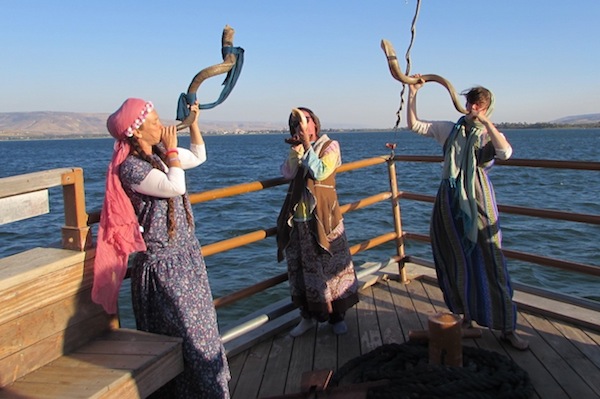
Left to right: Devorah Abramson, Yehudit Dribben and Sheva Chaya blow the shofar at Miriam’s Well on Lake Kinneret. (photo by Aviva Spiegel)
In the annals of the current COVID-19 pandemic, artist Maureen Kushner has a rare happy story – and likely the only one dating back some 3,500 years.
For the last 12 years on the anniversary of the death of Miriam the Prophetess on Nissan 10 in the Hebrew calendar, New York-born Kushner has been chartering a vessel from Tiberias-based Holyland Sailing Ltd. to bring a boat full of women to the spot on Lake Kinneret where, according to Midrash (Bamidbar Rabbah 1:1), the mystical spring known as Miriam’s Well now rests.
Typically, 126 women and children (corresponding to Miriam’s age when she died) equipped with rams horns, violins, harps, drums, flutes, guitars and tambourines have made the maritime pilgrimage. They sail on the Sea of Galilee, also called Lake of Gennesaret, to what Jewish tradition considers the exact spot where the miraculous spring that supplied the Children of Israel with drinking water during their 40 years of wandering in the Sinai Desert ended its own journey.
This year, the yahrzeit (death anniversary) of Miriam fell on Friday, April 3, immediately before Passover. Kushner – who is named in Hebrew after the miracle-working older sister of Moses and Aaron – booked the sailing for Thursday, April 2, in order to allow Sabbath-observant women from Jerusalem and other distant cities to join in the fête. All was set for this year’s celebration when Israel’s Health Ministry locked the country down in an attempt to halt the spread of the coronavirus.
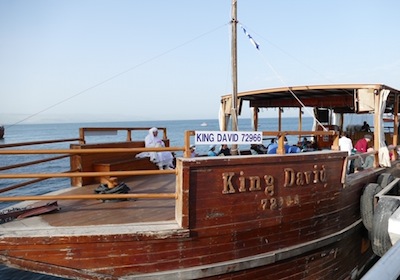
Many passengers short, because of COVID-19 restrictions, 40 women were still able to sail on the King David across the Kinneret to Miriam’s Well. (photo by Aviva Spiegel)
Thanks to those regulations, which at their most severe restricted Israelis to remaining within 100 metres of their home and still prevent almost all non-citizens from landing at Ben-Gurion Airport, the pandemic has somewhat abated. Recently, the Health Ministry began lifting its pandemic regulations.
Without any tourists arriving, the pilgrim boats remained moored in Tiberias and at Kibbutz Ginosar for three months. But, on Wednesday, June 3, the ministry allowed Kushner and her social distancing-reduced group of 40 women and children – each bringing facemasks, water, hats, sunscreen and kosher snacks – to make their 135-minute voyage on the lyre-shaped lake. When the vessel King David raised its anchor, it was Holyland Sailing’s first boat trip since quarantine regulations went into effect.
“What a hallelujah for our beloved Kinneret!” said Kushner, who was the artist-in-residence at the Jewish Community Centre of Greater Vancouver in 2005. “What a hallelujah in honour of our great, great, great Hakodesh Baruch Hu [the Holy One Blessed Be He], who is filled with goodness and compassion and love and blesses Am Yisrael [the Jewish people] with rain and dew and sustenance and a good life here in Eretz Israel, the good land.”
Kushner was especially excited that this past winter has seen heavy rains that filled Israel’s main freshwater reservoir to the brim, at 209 metres below sea level after five years of drought.
“The Kinneret is full! In great and abundant thanks to Hashem [God] in the zechut [merit] of Miriam Hanivia [Miriam the Prophetess], we celebrated with shofarim, drums, flutes and the harp,” she said.
Miriam the Prophetess today has become a popular figure for many Jewish women.
The Torah relates she was married to Caleb ben Yefunah. Though she died in the wilderness of Zin, her widower miraculously carried the spring named in his wife’s honour across the Jordan River on Nissan 10, the anniversary of her death, explained Kushner.
Miriam’s death is described in Numbers 20:1 and, in the next verse, the Israelites are described as complaining of the lack of water at Kadesh. The text reads, “Miriam died there, and was buried there. And there was no water for the congregation.”
In Jewish texts, this abrupt transition between her death and the lack of water was explained by postulating that a “Well of Miriam” appeared after she died. Further elaboration identified the rock that Moses struck to bring forth water in Exodus 17:5-6 with this well.
So powerful was the tradition of Miriam’s Well in Judaism that, even after the spring disappeared into Lake Kinneret some three-and-a-half millennia ago, it has occasionally miraculously appeared in the Diaspora.
According to Chassidic lore, once, just before Yom Kippur’s Kol Nidre prayer began, Yitzchak Isaac Taub (1751-1821), who was the sage of Nagykálló (Kalov in Yiddish) in eastern Hungary, called on his assistant Rabbi Yaacov Fish to harness his horse and wagon. The two set out to Fish’s fields, where they found a small pool. Immediately, the holy man disrobed and immersed himself, while Fish stood by transfixed. After the Day of Atonement, Fish returned to his fields, but the pond had disappeared. Fish asked his master, “Rabbi, as you know, despite our long friendship, I never mix into your affairs. But I beg you to enlighten me about the pool of water that appeared and disappeared so mysteriously in my fields.”
The holy man, who founded the Kaliver Chassidic dynasty, smiled: “If Rabbi Yaacov had had the sense, he would have dipped himself the same as I did, for, at that moment, Miriam’s Well passed by.”
Gil Zoharis a writer and tour guide in Jerusalem.
(Note: This article has been updated from the print version to note that Maureen Kushner was the artist-in-residence at the Jewish Community Centre of Greater Vancouver in 2005.)
A human jawbone found in the Misliya Cave on Mount Carmel near Haifa. (photo by Israel Hershkowitz, Tel Aviv University via Ashernet)
A human jawbone and other fossils found in the Misliya Cave on Mount Carmel near Haifa indicate that human migration from Africa occurred during the Ice Age, approximately 200,000 years ago, which is contrary to the popular theory that the freezing conditions and dryness of the Ice Age periods deterred human migration between continents.
These recent findings were published in the Journal of Human Evolution by Dr. Lior Weissbrod of the Israel Antiquities Authority and Prof. Mina Weinstein-Evron of the Zinman Institute of Archeology at the University of Haifa, and they build on work previously published by Weinstein-Evron and Prof. Israel Hershkowitz of Tel Aviv University in Science.
In addition to the jawbone, Weissbrod said, “The fossils now being investigated were identified as belonging to 13 different species of rodents and small insect eaters, some of which now live in high and cold regions, in the Zagros Mountains of northwestern Iran and in the Caucasus Mountains.”
This means that, “in Israel, cold conditions prevailed that allowed such animals to survive. Finding the human jawbone in the same layer where the rodent lived, suggests that these early humans survived under these conditions,” changing existing perceptions on human evolution.
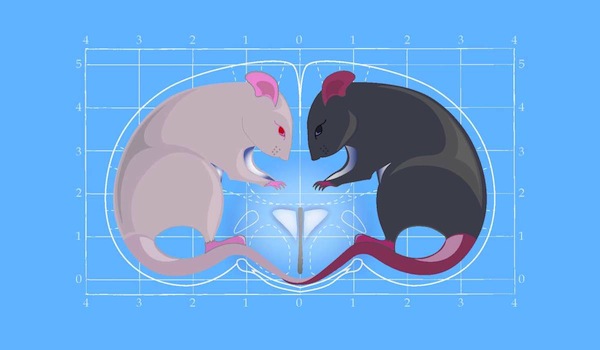
Oxytocin, a peptide produced in the brain, may bring hearts together – or it can help induce aggression. (image from Weizmann Institute)
During the pandemic lockdown, as couples have been forced to spend days and weeks in each other’s company, some have found their love renewed while others are on their way to divorce court. Oxytocin, a peptide produced in the brain, is complicated in that way: a neuromodulator, it may bring hearts together or it can help induce aggression. This conclusion arises from research led by Weizmann Institute of Science researchers in which mice living in semi-natural conditions had their oxytocin-producing brain cells manipulated in a precise manner. The findings, which were published in Neuron, could shed new light on efforts to use oxytocin to treat a variety of psychiatric conditions, from social anxiety and autism to schizophrenia.
Much of what we know about the actions of neuromodulators like oxytocin comes from behavioural studies of lab animals in standard lab conditions. These conditions are strictly controlled and artificial, in part so that researchers can limit the number of variables affecting behaviour. But a number of recent studies suggest that the actions of a mouse in a semi-natural environment can teach us much more about natural behaviour, especially when we mean to apply those findings to humans.
Prof. Alon Chen’s lab group in the institute’s neurobiology department have created an experimental setup that enables them to observe mice in something approaching their natural living conditions – an environment enriched with stimuli they can explore – and their activity is monitored day and night with cameras and analyzed computationally. The present study, which has been ongoing for the past eight years, was led by research students Sergey Anpilov and Noa Eren, and staff scientist Dr. Yair Shemesh in Chen’s lab group.
The innovation in this experiment was to incorporate optogenetics – a method that enables researchers to turn specific neurons in the brain on or off using light. To create an optogenetic setup that would enable the team to study mice that were behaving naturally, the group developed a compact, lightweight, wireless device with which the scientists could activate nerve cells by remote control. With the help of optogenetics expert Prof. Ofer Yizhar of the same department, the group introduced a protein previously developed by Yizhar into the oxytocin-producing brain cells in the mice. When light from the wireless device touched those neurons, they became more sensitized to input from the other brain cells in their network.
“Our first goal,” said Anpilov, “was to reach that ‘sweet spot’ of experimental setups in which we track behaviour in a natural environment, without relinquishing the ability to ask pointed scientific questions about brain functions.”
Shemesh added that “the classical experimental setup is not only lacking in stimuli, the measurements tend to span mere minutes, while we had the capacity to track social dynamics in a group over the course of days.”
Delving into the role of oxytocin was sort of a test drive for the experimental system. It had been believed that this hormone mediates pro-social behaviour. But findings have been conflicting, and some have proposed another hypothesis, termed “social salience,” stating that oxytocin might be involved in amplifying the perception of diverse social cues, which could then result in pro-social or antagonistic behaviours, depending on such factors as individual character and the environment.
To test the social salience hypothesis, the team used mice in which they could gently activate the oxytocin-producing cells in the hypothalamus, placing them first in the enriched, semi-natural lab environments. To compare, they repeated the experiment with mice placed in the standard, sterile lab setups.
In the semi-natural environment, the mice at first displayed heightened interest in one another, but this was soon accompanied by a rise in aggressive behaviour. In contrast, increasing oxytocin production in the mice in classical lab conditions resulted in reduced aggression.
“In an all-male, natural social setting, we would expect to see belligerent behaviour as they compete for territory or food,” said Anpilov. “That is, the social conditions are conducive to competition and aggression. In the standard lab setup, a different social situation leads to a different effect for the oxytocin.”
If the “love hormone” is more likely a “social hormone,” what does that mean for its pharmaceutical applications?
“Oxytocin is involved, as previous experiments have shown, in such social behaviours as making eye contact or feelings of closeness,” said Eren, “but our work shows it does not improve sociability across the board. Its effects depend on both context and personality.”
This implies that, if oxytocin is to be used therapeutically, a much more nuanced view is needed in research: “If we want to understand the complexities of behaviour, we need to study behaviour in a complex environment. Only then can we begin to translate our findings to human behaviour,” she said.
Participating in this research were scientists at the Max Planck Institute for Psychiatry in Munich, including research students Asaf Benjamin and Stoyo Karamihalev, staff scientist Dr. Julien Dine and postdoctoral fellow Dr. Oren Forkosh of the Chen lab; Prof. Shlomo Wagner and postdoctoral fellow Dr. Hala Harony-Nicolas of Haifa University; Prof. Inga Neumann and research student Vinicius Oliveira of Regensburg University, Germany; and electrical engineer Avi Dagan.
בשבועות האחרונים מפגינים רבים יוצאים לרחובות בערים שונות ברחבי קנדה כדי למחות נגד הגעזנות והאפלייה בארה”ב, קנדה ובעולם כולו. (רוני רחמני)
קנדה התמודדה בשבוע שעבר עם פרשה הקשורה להפעלת כוח מופרז על-ידי שוטרים נגד בני מיעוטים. ראש הממשלה הקנדי, ג’סטין טרודו, הביע זעזוע עמוק מסרטון וידאו שפורסם ברבים ובו נראים שוטרים עוצרים תוך שימוש באלימות, את הצ’יף של הקהילה האינדיאנית האנדבוריג’ינית במחוז אלבטרה.
בסרטון, שאורכו שתיים עשרה דקות, נראים השוטרים בין השאר מכים את האיש, אלן אדם, בראשו. טרודו ציין לאחר שצפה בסרט כי יש לו שאלות רציניות בנוגע למה שקרה. הוא הוסיף שהחקירה העצמאית חייבת להיות שקופה ולהיעשות כך שנקבל תשובות. בה בעת שכולם יודעים שזה לא מקרה בודד. לדברי טרודו יותר מדי קנדים שחורים וילידים אינם מרגישים בטוחים בסביבת שוטרים. זה בלתי מתקבל על הדעת והממשלה חייבת לשנות את המצב הזה.
המחלקה האחראית על חקירת שוטרים במשטרת אלברטה בודקת כעת את האירוע. המשטרה הגישה נגד אדם כתב אישום בגין התנגדות למעצר ותקיפת שוטר. לדברי עורך דינו של הצ’יף, העימות כולו החל בגלל שפג התוקף של לוחית רישוי של רכבו.
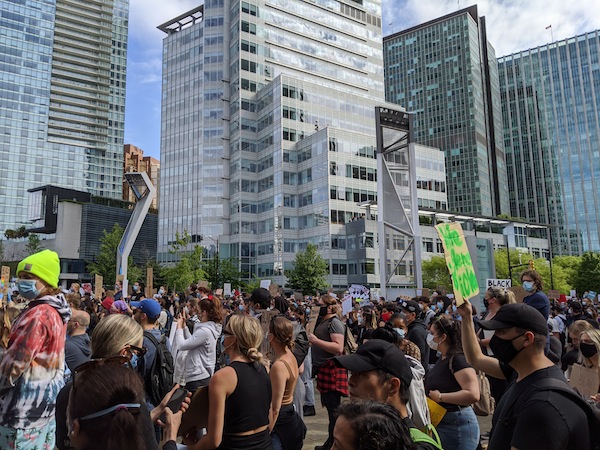
בשבועות האחרונים מפגינים רבים יוצאים לרחובות בערים שונות ברחבי קנדה כדי למחות נגד הגעזנות והאפלייה בארה”ב, קנדה ובעולם כולו.
קנדה מתנגדת לתוכנית הסיפוח של ממשלת ישראל
סוכנות הידיעות הפלסטינית הרשמית (וופא) דיווחה לאחרונה כי קנדה הבהירה לרשות הפלסטינית, כי מתנגדת לתוכנית הסיפוח הישראלית של השטחים הכבושים. זאת כיוון שהסיפוח עומד בסתירה לחוק הבינלאומי.
על פי הדיווח של סוכנות הידיעות הפלסטינית, עמדת קנדה נגד הסיפוח נמסרה בשיחה בין שר החוץ של קנדה, פיליפ שמפיין, לבין שר החוץ הפלסטיני, ריאד אל-מאליכי.
שר החוץ הקנדי ציין כי אם קנדה תיבחר לחברה זמנית במועצת הביטחון של האו”ם, היא לא תחריש אלא תשמיע את קולה כדי לשמור על השלום והיציבות במזרח התיכון. וכן תפעל מול ישראל והפלסטינים כדי להשכין שלום בין הצדדים. בהקשר זה, קרא שר החוץ הפלסטיני לקנדה להמשיך בלחץ על ישראל כדי לסכל את תוכנית סיפוח השטחים, כולל באמצעות איום בסנקציות נגדה.
ראש ממשלת קנדה, ג’סטין טרודו, אמר לא מכבר כי העביר מסר ברור להנהגה בישראל בנוגע לתוכנית סיפוח השטחים הכבושים בציינו, כי קנדה סבורה שמהלך זה עלול לעכב את האפשרות להגיע לשלום בר קיימא במזרח התיכון ועל כן היא מודאגת מאוד מכך.
קנדה האריכה את איסור כניסת אוניות נוסעים לשטחה עד לסוף חודש אוקטובר
ממשלת קנדה האריכה את האיסור על פעילות אניות תענוגות בשטחה עד השלושים ואחד באוקטובר שנה זו. זאת עקב מגיפת הקורונה העולמית. שר התחבורה, מארק גארנו, הודיע על הצעדים המעודכנים בנוגע לאוניות התענוגות וספינות הנוסעים, וציין כי הממשלה מחויבת להגן על אזרחי קנדה, במיוחד בתקופה מאתגרת זאת. מסיבה זו הוא הכריז על צעדים עדכניים עבור אוניות תענוגות ואניות נוסעים אחרות בקנדה, שכוללים איסור פעילות של אוניות תענוגות גדולות במים קנדיים עד סוף חודש אוקטובר שנה זו.
על פי התקנות, אוניות נוסעים המובילות מעל למאה איש על סיפונן עם מקומות לינה לא יורשו להיכנס למים הקנדיים כאמור עד סוף אוקטובר. בנוסף אוניות נוסעים עם יותר משניים עשר איש לא יורשו גם להיכנס למימי החופים בקנדה (הארקטי, נונאציאווט, נונאוויק ולברדור) גם כן עד סוף חודש אוקטובר.
מעבורות, מוניות מים ואוניות נוסעים חיוניות אחרות צריכות ליישם התקנות חדשות, שלפיהן הן יפעלו עם מספר מופחת של נוסעים. ובנוסף עליהן לנקוט באמצעים שונים להתגוננות מפני המגיפה.
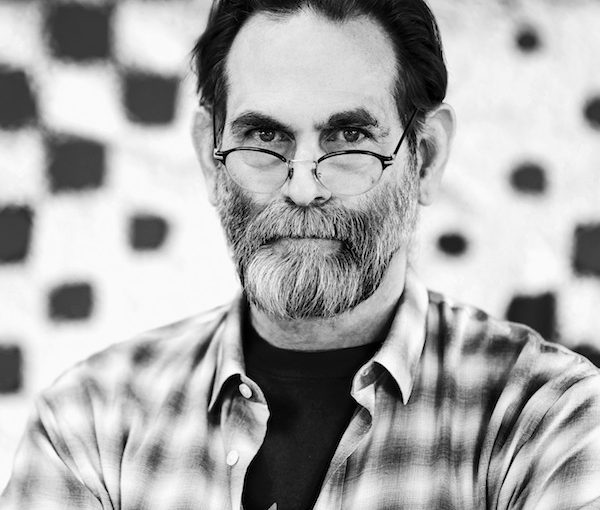
Avram Finkelstein will be participating in the Queer Arts Festival, which takes place July 16-26. (photo by Alina Oswald)
A lot of it feels familiar, said New York-based artist and activist Avram Finkelstein about the current situation in the United States. The same American institutions that failed during the HIV-AIDS crisis are failing to effectively deal with the pandemic. And, when he was a teenager in the 1960s, cities were also being burned in America.
“It’s sad to think that we will be having the same struggles,” he told the Jewish Independent in a phone interview last week. “But, also, as you get older, you realize that progress is not a pendulum swing from left to right, it’s actually a spiral going forward and things do move to the right and they move to the left, but [there is] incremental change. So, part of me feels like we’re seeing the dying gasp of a world that I hope we’re leaving behind, and I see a world in the future that I want to live in. So that’s kind of helping me through this.”
Finkelstein was scheduled to come to Vancouver next month to participate in the Queer Arts Festival.
A founding member of the Silence=Death and Gran Fury collectives, as well as the political group ACT UP, he is the author of After Silence: A History of AIDS Through its Images (University of California Press, 2017). His artwork is part of the permanent collections of MoMA, the Smithsonian, and the Victoria and Albert Museum, to name but a few places, and his work has been shown around the world. He was set to unveil one of his new works in Vancouver. As it is, with the restrictions required to minimize the spread of COVID-19, he will be helping open the festival remotely, as part of a panel discussion chaired by curator Jonny Sopotiuk, which will also provide viewers with a tour of the festival’s art exhibition.
“I have a large mural that was going to be in the exhibition and now it’s going to be in a virtual space,” said Finkelstein. “I’m very excited about this piece and the fact that Jonny chose it – it’s the first time I’ve shown it…. I had a commission to do a work for the Shed, which is a new art space in New York, and, while I was waiting for the weaving tests of the final pieces – it’s a very large jacquard weaving – I decided to start drawing from the same source material as the cartoon for the weaving. I hadn’t drawn since recovering from a stroke; I had a stroke about two years ago…. I then realized that my hand isn’t my own, my body is no longer my own.”
The source material, he explained, “is a portrait of a gender-non-conforming friend who later transitioned. The work was all about corporeality as an abstraction and the ways in which we’re allowed to look at certain things, and what is public and what is private about gender and sexuality. And then, all of sudden, I realized, I’m actually talking about my own body in these drawings because my own body is not my own body anymore. I realized that I had made this sharp pivot from an abstract, theoretical idea of corporeality to this kind of war or dance, or I don’t know how to describe the physical process of having to use your entire body to hold a pencil.”
Despite the health, political and other challenges Finkelstein has faced, he remains hopeful.
“We’re trained to think that, if we don’t have hope, then the only thing that’s left is despair, but the truth is, hope isn’t so much the point – it’s the horizon that hope is sitting on and, so long as you can see a horizon, I think that, to me, is the same thing,” he said.
“I’m Jewish, as you know, and I think that Jews have a very different relationship to memory and to witnessing. If your people have been chased all over the globe for centuries, you take a long view. You sleep with one eye open, but you take a long view, and I think, therein, I’m eternally hopeful.”
In an interview in 2018, Finkelstein predicted that the situation in the United States would worsen before it improved.
“Which is another thing about being Jewish – you learn that there is no such thing as paranoia because it’s all real,” he said. “So, one could have seen, as plain as the nose on one’s face, where America was heading. And, in actual fact, what happened with Trump’s election was, we’ve joined the international march of global totalitarianism…. And, it’s not about to get really bad, it’s really, really bad. It’s really bad and I think that, here again, you can’t be Jewish and not think – not think your entire life, actually – in some way being prepared for, OK, what are the risks I’m willing to take if this happens? How far would I be willing to fight for other people if that happens. The shadow of Nazi Germany never escaped your consciousness.”
So how does Finkelstein conquer the fear?
“I guess I’ve replaced it with anxiety,” he said, laughing. But, he added, “I don’t know why I’m not fearful. I think that I was just raised – a day doesn’t go by that I’m not reminded of another lesson or another incident or another part of Jewish-American social history in the 20th century that my family was directly there for. I almost feel like I’m the Zelig of the left. All the stories you would tell my mother or my father, they’d be like, ‘Oh, yeah, we were there. We were there at the Robeson riots. Oh, yeah, we were there when they closed The Cradle Will Rock and everyone walked down the street’ – exactly the way it was in the last scene in Tim Robbins’ movie. When I saw it, it seemed too preposterous, I called my mother, said, ‘Could that have happened?’ And she started singing the song that Emily Watson sings in the film.
“So, I think I have such a sense of self that one could interpret it as fearlessness, but I think that it would be more accurate to say I was not given an alternative role model. I was raised to feel the suffering of others and, if other people are suffering, there’s no night’s sleep for me. So, there’s really no option – you’re either closing your eyes to something terrible or you’re doing everything you can to try and make it less terrible. And I think that that’s the Jewish condition.”
He described Jews as being like queer people. “We are everywhere,” he said. “We’re in every culture, we’re in every race, we’re in every gender, we’re in every country. We have every type of ethnic community that we surround ourselves with. An Ethiopian Jew is different from an Ashkenazi Jew, but we’re still all Jews.”
Though raised by atheists, he said, “I don’t think you’ll find anyone more Jewish than I am or than my family, but Jews are prismatic. We are many things. Consequently, I feel like I can’t speak on behalf of other Jews, I can only speak on behalf of myself.
“Likewise, I’ve always had people of colour in my family; I just always have. And, I learned very early on back in the ’60s, when the civil rights movement was fragmented between King and Stokely Carmichael and the Panthers, and everyone was choosing sides, I think that’s another example of what I’m talking about – there are many ways in which to be black. And so, I don’t feel like what I have to say about this current moment is anywhere near as important, essential, vital, critical … [as] a person of colour – what a person of colour has to say about this moment is much more important.”
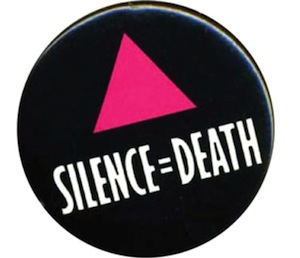
The original Silence=Death poster has been adapted over the years by many people, including for use as a pin.
Finkelstein was one of the minds behind the now-iconic Silence=Death poster, which has been adapted over the years by many people. A variation of it could be seen in at least one of the recent protests. The original iteration encourages viewers to use their power and, for example, vote. In general, working towards solutions is an important part of Finkelstein’s activism.
“I think critiques are easier,” he said. “I think also we mistake public spaces, we mistake the commons, as a declarative space. I tend to think of it as an interrogative space. I think that, even in late-stage capitalism, when someone is trying to get you to put your money in a bank or go buy a soft drink, there’s something Socratic about the gesture of trying to get you to do something … you’re responding to it, you’re engaged in it, and that’s the interrogative part that I think is easy to overlook. And I think that’s where the answers are.
“I think that the way that the Silence=Death poster is structured is it’s really like a bear trap. We worked on it for nine months – the colour has certain codes and signifiers, and the triangle has another set of codes and we changed the colour of the triangle from the [concentration] camps and inverted it to obfuscate some of the questions about victimhood. And the subtext has two lines of text, one that’s declarative and one that’s interrogative, and the point size forces you into a performative interaction.”
This poster and other work with which Finkelstein has been involved include aspects that “people are very afraid to experience,” he said, “which is fallibility, mess-making and tension. And I find all of those things as generative, as kindness, support, community. They’re differently generative and … hearing so many people who are trying to figure out how to find their way in, as white people, into the conversations that are happening in America right now, is the same struggle as a young queer person trying to find their way into the AIDS crisis. I mentor a lot of young queer artists and activists and the first thing they say, their immediate impulse is, I have no right to this story, I wasn’t here, I didn’t live through it. To which my response is, immediately, you have every right to the story – it’s your story, it’s the story of the world…. Race is a white person’s problem. People of colour are paying the price for it, but the problem, the genesis of the problem, is whiteness. And we have to figure out how to talk about it…. But I think now is the time for listening.”
He said, “We have to know what our responsibilities are and this goes back to Judaism – our responsibilities as witnesses. You can’t let your discomfort change the importance of this moment or overshadow the importance of this moment.”
One of the things Finkelstein does is teach social engagement via flash collectives. “I think we’re never put into a position where people mentor our personhood,” he said. “We have people mentor us as computer programmers or healthcare providers or tax accountants or artists or writers, but … there’s something primeval which is missing in the way we’re acculturated, and the flash collective is almost shamanistic in that regard; it taps into this primal thing that is quite astonishing when you let it out.”
Understanding that he will not live forever, he said “the Silence=Death poster casts a very mighty shadow and it makes it very difficult for people to figure out how to make new work, if that’s what they think it has to be…. It became obvious to me that I could be talking about Silence=Death until the day I drop, but, one day, I am going to drop and I want other people to start making those new works and I thought this would be a way to get people to make new work.”
He described the collectives, which teach political agency, as being “like a stew of the top 10 hits of grassroots organizing in a condensed workshop that’s tailored to the individuals in the room.”
He said, “I believe that I don’t necessarily have to change the world because I know that there could be a teenager in 2050 who sees something that someone I worked with did that made them think of something else that I never would have thought of. That is the point of the work, not the how do I fix it before I’m gone, which is the dilemma of Larry Kramer [who passed away last month]. He really thought, and I think it’s really male, but it’s very men of a certain generation also – he really thought that he could fix the AIDS crisis, and it didn’t happen.”
Unfortunately, space doesn’t allow for most of what Finkelstein shared with the Independent about Kramer, who he described as “a complicated person.”
Kramer was a rhetorician, said Finkelstein. “And I’m a propagandist. We’re both rhetoricians in a way, but what was the dividing line that made Larry incapable of understanding the work that I did?… I felt like I understood his process better than he understood mine. And I started to think, well, here’s the difference between a person who articulates their rage with words and a person who articulates their rage with every tool in the toolbox…. Not to make myself sound superior, but I realized that I think of rage as sculptural; he thought of rage as rhetorical. I think of rhetoric as sculptural, I think of it as casting a shadow and activating social spaces. And I think that he was a Jewish gay man of a different generation and a lot of his rage was tied into his personal struggles. And I did not have those. I had other personal struggles, but I did not have them.”
As part of the Queer Arts Festival, Finkelstein will lead a flash collective on the question, “What does queer public space mean in a 21st-century pandemic?” He hopes the resulting work will be shown in a public space.
For more information about the festival, visit queerartsfestival.com. The next issue of the JI will feature an interview with QAF artistic director and Jewish community member SD Holman.
On June 4, New Brunswick resident Chantel Moore, originally from the Tla-o-qui-aht First Nation near Tofino, B.C., was shot to death by a police officer sent to her home to check on her well-being. On May 27, Regis Korchinski-Paquet, an indigenous-black woman, fell 24 floors from her apartment during a police incident in Toronto.
In the United States, George Floyd died on May 25, after being pinned to the ground with a knee pressed into his neck for more than eight minutes by a police officer in Minneapolis. Breonna Taylor was killed March 13 in her bed in Louisville, Ky., in what amounts to a home invasion by police. Ahmaud Arbery was chased by three armed white neighbours and murdered on Feb. 23, while he was jogging in Georgia.
The challenge in compiling a list of names of black Americans and indigenous and racialized Canadians killed by police or lynched by vigilantes is choosing which from a horrifically long list of victims’ names to include. And the structural conditions that have led to this particular moment of upheaval are not new. Similar demonstrations have occurred after particularly egregious incidents, like the killing of Michael Brown by police in Ferguson, Mo., in 2014; Trayvon Martin, who was murdered in 2012 by a cop-wannabe; and the beating of Rodney King by police in Los Angeles in 1991. Again, the list of just the most familiar incidents could fill pages. And they are not limited to the United States.
Could this time be different? One thing that some Black Lives Matter proponents are noting is the apparently unprecedented engagement of non-black allies in this moment. Is this because we all have more time on our hands right now? Or have we reached a tipping point, when the lofty language of equality has finally penetrated deep into the mainstream of North American society?
There are parallel streams happening, from the issue of police violence to the broader matter of societal behaviour toward racialized people. These are exacerbated by the unpardonable conduct of the U.S. president. When Trayvon Martin was killed, then-president Barack Obama noted that, if he had a son, he would look like Trayvon. The current president tweets threats of violence and has police forcibly clear peaceful demonstrators so he can have a photo taken in front of a church he has never entered. In a country aflame, the president’s comportment is incendiary and perilous.
This is a time for our community, the Jewish community, to consider our complacency and complicity in upholding racist systems. It is, as American historian and author Ibram X. Kendi implores, not enough to be not racist. We must be actively anti-racist. We must stand in solidarity with those who are suffering and recognize that the pain of racism is also the pain of antisemitism.
The solidarity and support we crave when we are threatened is the solidarity and support we must give other communities when they are in need. Give your time to an anti-racism organization. Donate your money to support black-owned businesses and organizations working to support the black community. Pray for the healing that is so badly needed in our society. March for equality and justice (in a safe manner). Stand up when you see injustice or hear a “casually” racist remark. Sign your name to a petition asking decision-makers to step up and rein in the militarization of policing and the funding that gets diverted from community into the over-policing of racialized communities.
Interrogate Canada’s colonial history and the lived realities of indigenous communities. Ask our educators to explore with their students global histories and the untold stories of millions, including richer views of Jewish history and the experiences and contributions of Jews who are not of European descent. Read a work of fiction by a black or indigenous author. Learn about how black culture forms the bedrock of North American culture and from where those art forms come. Explore the history of the black community here in Vancouver and how the early Jewish community, along with other minorities, together have called Strathcona home.
Absorb the teachings of Abraham Joshua Heschel, who referenced the calls of the Hebrew prophets in the struggle for civil rights in the 1960s and who marched alongside Dr. Martin Luther King, Jr., for justice. If you’re already doing all of these things, share your knowledge and example with your family, your synagogue and the organizations and schools you support.
Some Jewish observers have expressed reservations about the Black Lives Matter movement, at least partly because the umbrella organization endorses the boycott, divestment and sanctions movement against Israel. This is an unfortunate and misguided move on their part, especially since BDS harms Palestinians in addition to Israelis. But the issue of black people – and people of colour in Canada and elsewhere – being murdered by police or lynched by racists must take precedence now. We can argue over Israel and Palestine later.
If one feels the need to prioritize Jewish or Israeli concerns at this moment, then let’s prioritize the safety of black Jews and Jews of colour. The vast majority of Jews are morally affected by what is happening in our society and black Jews are immediately and personally impacted both by what is happening in the world and by what is happening in our community around this issue.
Let us not pretend that this is not a “Jewish issue.” Rather, let us live by what is referred to as one of the “eternal religious obligations” of Judaism: “Justice, justice you shall pursue.”
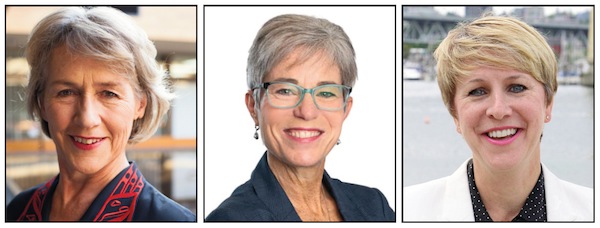
Left to right: MP Joyce Murray, MLA Selina Robinson and Vancouver Councilor Sarah Kirby-Yung spoke at a June 3 webinar hosted by the Canadian Jewish Political Affairs Committee. (photos from the internet)
“Intense” was the word used by speakers from all levels of government to describe their experiences during the pandemic emergency.
In a June 3 webinar on Zoom, federal and provincial cabinet ministers and a Vancouver city councilor addressed COVID-19: What’s the New Normal? The event was hosted by the Canadian Jewish Political Affairs Committee.
Joyce Murray, member of Parliament for Vancouver-Quadra, is Canada’s minister of digital government, a role that took on sudden significance when even Parliament began operating virtually and almost all federal civil servants are being asked to work from home.
“It’s been an incredibly intense time,” she said. “I never thought I would work harder than I do as a minister in Ottawa, but I would say these last few months have been much more intense than I expected.”
A million Canadians were able to apply for the Canada Emergency Response Benefit (CERB) on the first day, which Murray said illustrates the scope and speed of the government’s electronic mobilization.
Responding to a question from an audience member, she acknowledged that there may be some inequities in the program – some people are earning more not working than a neighbour might earn on the job – but the decision was made to ramp up immediately, knowing that anomalies were likely.
The federal government has not decided when to reopen the U.S. border, Murray said. The current, extended closure ends June 21.
“Our primary focus is the safety of Canadians,” she said. “We’ll be taking the advice of public health officials and thinking about all of the different ramifications and make a decision when the time comes.”
The discussion was moderated by James Moore, a former Conservative MP, who pressed Murray on the unanticipated federal expenditures resulting from the pandemic.
“Fortunately, Canada entered this in a very strong fiscal position compared with most of its G-20 partners,” she responded. “So we were ready and able to respond and there is now approximately $150 billion in direct support to Canadians that has been put on the table. That makes it one of the most ambitious response plans in the world. But our view is that we had fiscal firepower, it was right to use it and it will help our economy emerge more quickly and more strongly when the pandemic allows us to do that safely. Our focus right now is on helping Canadians and getting that right.… We will return to a strong fiscal position when it’s time.”
Selina Robinson, British Columbia’s minister of municipal affairs and housing, noted that the provincial government stepped up with $5 billion in emergency funding.
“It would be very, very hard coming out of this if we had people who were evicted from their homes and couldn’t put food on the table,” said Robinson, who is MLA for Coquitlam-Maillardville. “I think everybody agrees that we needed to invest in people, so that they can continue to feed their families.”
Provincial Health Officer Dr. Bonnie Henry has warned that no pandemic in history has not had a second wave. Robinson said British Columbia and other jurisdictions are ready for that potential.
“I think we’re far better prepared for any future waves, given the experience we’ve had over the last few months,” she said.
Murray lamented the sharp rise in anti-Asian hate crimes, while Moore warned that U.S. President Donald Trump “is going to run for reelection against China, and not against Joe Biden” – he fears the repercussions for Asian communities in North America as a result.
Robinson said the Jewish community is uniquely placed to be allies to those affected by this phenomenon, as well as to racialized individuals during the parallel upheavals around race, police violence and Black Lives Matter.
“I’m really proud to be part of the Jewish community and knowing that our history as a Jewish community has historically stood up for these values, to make sure that there is space for everyone and for standing up when we see injustice,” she said. “We will continue to do that and I urge everybody who is participating to make sure that you use your voice however and wherever you can.”
Sarah Kirby-Yung, a Vancouver city councilor, also spoke from a personal perspective, noting that her immediate family is of Asian descent.
“I’m incredibly distressed when I hear from members of the Asian community, seniors and vulnerable people particularly, who are afraid to leave their home or go for groceries or are changing their pattern because of who they are,” she said.
Vancouver’s budget has taken a swift kick during the pandemic, but Kirby-Yung rejected the rumour that the city is approaching bankruptcy.
“We are looking at about a $150 to $200 million projected revenue gap for Vancouver through the end of 2020,” she said. “Vancouver is not going bankrupt. We are in reasonable shape, but it doesn’t mean that we don’t have to be very thoughtful about our spending in our decisions.”
Joel Chasnoff spoke at a Zoom event presented by Jewish National Fund of Canada on June 1 and he’ll speak at a CHW Montreal Zoom event on June 21. (photo from APB Speakers)
Michael Levin grew up in Philadelphia, joined the Israel Defence Forces as a lone soldier and died in a battle with Hezbollah in southern Lebanon in 2006. At that time, most Israelis weren’t familiar with the concept of a lone soldier – a legal term for a volunteer, usually (but not always) from outside Israel, who enlists to defend the Jewish state.
Levin’s death at 22 came just days after he returned hastily from his leave back home in the United States when he learned of the start of the Second Lebanon War. He flew back to Israel, hitched a ride to his platoon in Lebanon and took up the fight against the Iranian-backed terrorists. He was killed in an intense firefight in the Hezbollah-controlled village of Aita al-Shaab.
His grieving mother, Harriet Levin, was concerned that her son’s funeral would not have a minyan to say Kaddish and so, on arriving in Israel, she asked a few people to come to the military cemetery to ensure a proper Jewish burial. On her way to Mount Herzl, traffic was so congested she feared she would be late for her son’s funeral but, when she did get there, she discovered that the few people she had asked to spread the appeal for a minyan had shared the news widely. Media picked it up and more than 10,000 Israelis showed up to pay their respects.
It was a turning point in the Israeli consciousness, according to Joel Chasnoff.
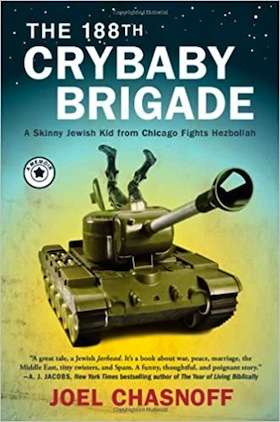
Chasnoff is a stand-up comedian and writer who shared his own story of leaving his Chicago-area home two decades ago to become a lone soldier. In a Zoom event presented by Jewish National Fund of Canada June 1, Chasnoff, who now lives in Israel, spoke of the changing understanding of lone soldiers – and his reflections on now being the father of soldiers. A decade ago, he chronicled his experiences as an IDF volunteer in the book The 188th Crybaby Brigade: A Skinny Jewish Kid from Chicago Fights Hezbollah.
Today, lone soldiers are a better understood phenomenon in Israel and supports are in place that were not when Chasnoff volunteered in 1997. There is now a network of Lone Soldiers Centres – commonly called Michael Levin Centres – around Israel, to help overseas volunteers adapt and smooth their way to a successful integration, coordinate holiday and Shabbat homestays and deal with the myriad complications that arise for a newcomer to Israel.
Chasnoff shared comedic experiences, including the challenge of proving he was indeed a lone soldier without Israeli parents, when government officials insisted that Levin’s father had never left Israel after his first visit in 1976. The stakes were basic – a lone soldier’s salary at the time was $160 a month instead of $80, plus a few privileges. But it required a sheath of documents from the States to prove that his father was indeed an Illinoisan, not an Israeli.
“Never mind that he had raised me in the U.S. and I have a very strong and good relationship with my dad. The Israelis believed that my dad was actually living in Israel the whole time and I was just trying to pretend that I was a lone soldier to get the extra $80 a month,” Chasnoff said.
His decision to join the IDF was sparked by a visit to Israel as a teenager.
“I got off the plane,” he said, “and, you know, you’re 17, your hormones are raging. What’s the first thing you notice being a teenager coming to Israel? How beautiful the Israelis are. The women were all tan and fit, the men were these hunks with muscles and crew cuts. It’s so odd because they have the same roots as we do, right? Except they look like supermodels and we look like Jews. How does that happen? That’s not fair.”
The soldiers he met were just a year older than he was.
“They were 18, and they had machine guns and berets and Ray-Ban sunglasses and forearms like bricks,” said Chasnoff. “And then there was me, slathered in sunscreen, wearing a fanny pack … stuffed with lactose pills.”
One of the eye-opening things Chasnoff discovered about the Israeli army, he said, is how democratic it was.
“I would even say insanely democratic,” he said, noting that soldiers argued about orders and fought with their superiors. “People ask me what’s it like in the Israeli army. I think the best way to describe it is, imagine a bunch of Israelis running an army. That is the Israeli army.”
This is why one of his platoon-mates was a darling among commanders: he didn’t speak Hebrew. The young man was raised in an evangelical Christian home in Oklahoma, but, at a certain age, learned that his mother had converted from Judaism. One thing led to another and he volunteered for the IDF.
“So, they made him a tank gunner,” Chasnoff said, “because, to be a tank gunner, you basically need to know six words – stop, go, left, right, forward, back. Tim was one of the best soldiers in our platoon because he didn’t have the Hebrew to argue back. When the commander would give orders, the guys would argue. Tim, by not having Hebrew, just did what he was told. And was an excellent soldier for that reason and one of our commander’s favourites.”
Unfortunately, a lack of Hebrew can be deadly in moments of military conflict. Chasnoff said some casualties in conflicts in Gaza may have resulted from linguistic challenges and he believes the military is doing a better job ensuring fluency in such situations.
While lone soldiers is a term associated with overseas volunteers, Chasnoff said that about half of the 6,000 lone soldiers are Israelis, mostly Charedim whose volunteer service or other factors estrange them from their families.
While lone soldiers were not so much in the Israeli consciousness a few decades ago, they are now a welcome oddity.
“I think, when you get a lone soldier in your platoon, people are very excited about it,” Chasnoff said. “Everyone wants to bring him or her home to show the family the sort of strange character who came all the way from New York City or Sydney, Australia, or whatever. People are really interested in what motivates them to serve, so they are invited. It’s very, very different than the old days.”
Addressing the broader differences between Israelis and Diaspora Jews, Chasnoff riffed like the comic he is.
“We grow up with this myth that Israelis are, you know, just like us. They are Jews and we are Jews and we’re one big happy family. And then you get to Israel and you realize the Israelis are nothing like the American Jew. They speak their minds. They shout. They argue,” he said. “You’ll never be with an Israeli and wonder to yourself, ‘I wonder what she really thinks about me right now.’ I’m married to an Israeli for 21 years and I can honestly say that once in those 21 years has my Israeli wife apologized to me because, in the Middle East, apologies make you look weak and nobody wants to look weak. We had one huge fight where she actually apologized and it wasn’t even a real apology, it was an Israeli apology: she came up to me a few days later and said, ‘Yoeli, motek, I am sorry you’re such an idiot.’”
He also has plenty of material about growing up Jewish in America.
“My mom was actually one of these Jewish mothers who – let’s be honest – they have a special ability to worry about every situation,” he said. “You give them any scenario, they will figure out the potential thing that could hurt you in that scenario.”
For their annual family visit to Texas to see his paternal grandparents, Chasnoff’s mother would book the family on two separate flights so that, if a plane went down, the entire family wouldn’t be lost.
“That’s a typical Jewish upbringing,” he said.
When his zaidie gave him a jersey with the number of his favourite player and his own name, Joel, on the back, Chasnoff’s mother refused to let him wear it outside the house because a stranger would know his name.
“And, because he knew my name, I would think he knew me, so I would go with him,” he said. “You know why? Because I’m an idiot. That’s why there are no Jewish athletes. Not that we’re bad at sports, our mothers won’t let us wear the jersey.”
Readers will have another chance to hear Chasnoff speak this month. CHW Montreal is hosting a Zoom BBQ with the comedian on Father’s Day, June 21, at noon, Pacific time. Visit facebook.com/chwmontreal and click on Events for details. Funds raised benefit hospital workers at the Shamir Medical Centre and Hadassah Hospital in Israel.
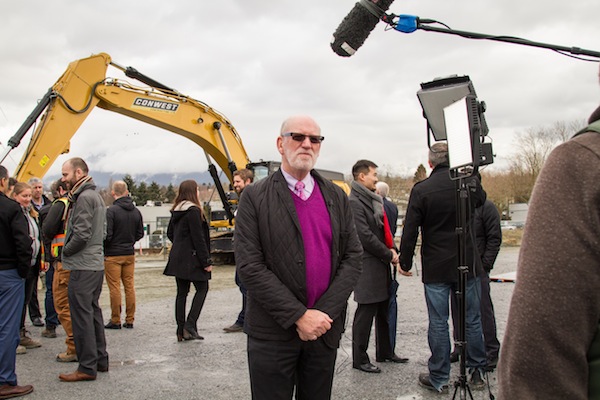
Michael Geller at the groundbreaking of ConWest’s IRONWORKS development in 2017. (photo from Michael Geller)
The COVID pandemic and the months of social isolation it created will have impacts on real estate prices, urban design and human behaviours, says a local expert. But the changes are not likely to be revolutionary so much as accelerate trends already underway.
Michael Geller, an architect, planner, real estate consultant and property developer, spoke to the Temple Sholom Men’s Club in a virtual event via the meeting platform Zoom May 25. (For more on the club, click here.) Geller is also adjunct professor in Simon Fraser University’s Centre for Sustainable Community Development and a longtime leader in Jewish communal organizations. His topic was Real Estate in the Era of COVID.
“Housing sales are down significantly and are as low as they have been in recent memory,” he said. Wages have been dramatically impacted for an enormous number of individuals and household debt is increasing significantly. Many renters are unable to meet their payments.
Housing sales are affected by the obvious issues of economics, but also because buyers and sellers are reticent about the physical interaction required in the process of viewing potential homes. Sales have not entirely collapsed, though, he noted.
“There are still some bidding wars for more affordable condos, priced under $700,000,” said Geller, adding: “Can you imagine 30 years ago being told that affordable condos would be under 700,000? It just shows you what has happened to our market in recent years.”
While sales are down, there has not been a significant increase in the supply of either listings or new homes coming to market, he said. “So, at the moment, we aren’t seeing the dramatic drop in prices that many assumed, myself included, would occur.”
What may occur is a stalling of new construction because lenders are cautious. “They don’t want to lend money for anyone to buy land at the moment,” he said. “This is a significant factor.”
While there were many years when there was almost no purpose-built rental housing created, this has shifted, with about 4,000 new units this year in the city proper and 9,300 in Metro Vancouver. This supply, combined with the economic challenges brought about by the pandemic, have had impacts on rental rates. “For the first time in a long time, we are starting to see a softening of rent,” he said.
Foreign investment has been credited with playing an outsized role in property values in recent decades and some commentators speculate that buyers may be “circling like vultures” in the event of comparative real estate bargains in British Columbia, he said.
Geller noted the opposite could occur, however, as the market softens. “Some of the people who came, especially from mainland China but also Hong Kong and Europe, might actually divest themselves of their investments and pull out of the Vancouver market,” he said.
International events will also likely play a role. Uncertainty and upheaval around changes in China’s governance of Hong Kong could make Canada very appealing, especially to the 300,000 residents of Hong Kong who have Canadian citizenship.
“We have a high level of personal safety and, when you think about it, that is one of the most important considerations,” he said. “You can have all the money in the world but if you don’t feel safe in your home at night, you may not necessarily stay in that home.”
British Columbia’s recognized success in dealing with the pandemic has enhanced its international image. “As we start to focus more and more on health issues, that cannot be ignored,” he said.
Foreign investment in Vancouver has dropped significantly since the implementation of the foreign buyers’ tax.
“Will those foreign buyers come back, even if they have to pay 20% premium?” Geller asked. “If they don’t come back, and if that means local developers decide not to build, whether it be rental or condominiums, and we start to see significant unemployment of all those construction workers … then it may well be that the government says, you know, this is a difficult situation, these are unprecedented times and maybe they’ll just decide that, for the next two years, the foreign buyers tax will be reduced to five percent rather than 20% in order to stimulate the economy.”
On the commercial real estate front, the experience of working from home may change our relationship to the office. If people continue working remotely, that could reduce demand for office space. On the flip side, new ideas of personal space and social distancing could mean that people come to expect fewer workers in more space, thereby increasing demand.
If more people do opt for remote work options, some may choose to move to more affordable and remote locations. Home design might adapt to include formal workspaces so that people aren’t using kitchen counters as desks. Condo towers and apartment buildings might opt for hotel-style shared business centres rather than spas. They may move toward more “touchless tech” – a familiar example being the Shabbat elevator.
As stores reopen, retailers may see a decline in shoppers, but Geller suspects that warehouse space is headed for a bull market. “As more and more people are buying online, there is a need for more and more warehouse space to store all this product before it’s delivered,” he said. “This applies not just to clothing and giftware, it applies to food and other goods that are stored in cold warehouses.”
Looking at social changes that have resulted from pandemics in previous centuries, Geller said, “One of the things that came out of [earlier pandemics] was an appreciation of the need for more parks and green space throughout the cities. Central Park in New York, that was created by the New York City Board of Health because of the belief that this would lead to improved human environmental health for everybody in the city. In most European cities and many other American cities, large parks and green networks were created to help people lead healthier lives.”
Improved sanitation, water supply and sewage treatment systems were also at least partly a result of these catastrophes. Home design changed, including the advent of sleeping porches, based on the understanding that fresh air was preferable to stuffy interiors. The modern bathroom, including the proliferation of white tiles that both made it easier to clean and added to the perception of sterility, emerged. Wooden toilet seats, which were the norm, were replaced by plastic ones.
“The powder room became a creation in a larger house because the man who came to deliver the coal or to deliver the ice, you didn’t want them going through your house using your bathroom, so powder rooms became popular,” he said.
Though he had plenty of ideas, Geller was emphatic that he didn’t really know what the future holds. But he has some confidence about a general forecast.
“Often,” he said, “pandemics and similar sorts of events accelerate changes that were already happening.”