
Best years ahead: Shanken
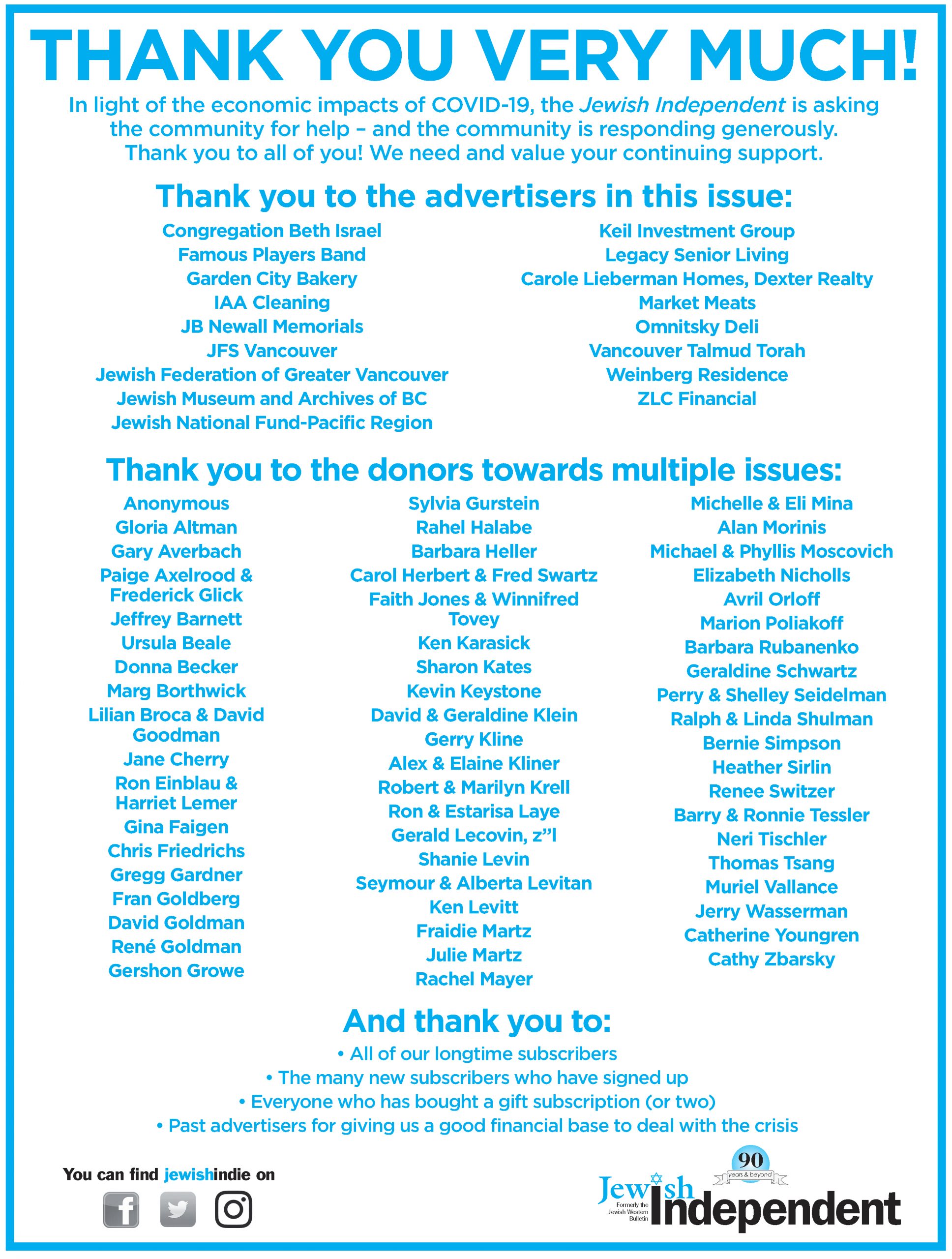
Jewish Federation of Greater Vancouver chief executive officer Ezra Shanken holding a T-shirt featuring Dr. Patricia Daly, vice-president of public health and chief medical health officer for Vancouver Coastal Health. The Facebook post thanks Daly for always being there, throughout COVID-19, “behind the scenes providing valuable support.” (photo from facebook.com/jewishvancouver)
The largest capital project in the history of British Columbia’s Jewish community – the redevelopment of the Jewish Community Centre of Greater Vancouver site – is going ahead as planned, despite the pandemic. This and many other projects are continuing as planned, says Jewish Federation of Greater Vancouver chief executive officer Ezra Shanken, in part because the agency has been preparing for a crisis for more than a decade.
As the Jewish Federation is set to launch the 2020-21 annual campaign, the Independent spoke with Shanken about the achievements and challenges of a year that started out relatively normally and veered suddenly into the utterly extraordinary.
While the COVID-19 crisis wreaked havoc on communities worldwide, and upended 2020 in unpredictable ways, Shanken said that Federation has been prepared for a crisis and that means the community remains in a position of economic and social health. After the 2008 economic recession, the organization launched a multi-year planning and allocations process intended to smooth economic ripples and equip partner agencies with reliable income expectations.
Federation raised $10.3 million this year – $8.9 million through the 2019 annual campaign and $1.4 million in special targeted funds from donors toward specific high-priority community needs such as supplemental education, to expand Jewish Family Services’ food hubs and to increase outreach to suburban and remote Jewish communities. Dr. Jonathon Leipsic was campaign chair. Alex Cristall, Federation board chair, and Shanken, provided a comprehensive overview of the year’s achievements in the 2019-20 annual report, available online at jewishvancouver.com.
When the pandemic struck, Federation launched an emergency campaign to help agencies meet the challenge of providing services to their constituencies while confronting the health crisis and its associated economic implications. The amount raised so far is not being announced, but $505,000 in funding has been released, for services like food and housing supports through JFS; to the JCCGV to help with service delivery; to supplemental and day schools to assist with tuition subsidies and transitions to online learning; for emotional support for seniors through the Jewish Seniors Alliance; and more.
A crisis like COVID, said Shanken, can have unintended consequences in helping communities overcome divisions and work together to reduce duplications of effort.
“Crisis often opens the door for opportunities for collaboration that never would have existed before for myriad political reasons,” he said. “People have far greater clarity around what the big picture looks like when they are in crisis. They are willing to forgo those smaller, often political complications that don’t allow for the advancement of big-ticket projects.”
Programs and projects that were underway before COVID include a Jewish Day School Council, chaired by Hodie Kahn, which began a year ago to undertake a benchmark study on the costs of education for each of the five schools in Metro Vancouver’s Jewish community. The findings of the report are expected to point the direction toward new funding models for Jewish education.
Community security also remains top of mind. This year saw the largest number of community organizations receive federal funding for security upgrades to facilities – Federation’s community security advisory committee, chaired by Bernard Pinsky, helped secure more than $225,000 from the federal Security Infrastructure Program. Security training sessions were provided to 160 community members.
A significant portion of campaign funds support programs abroad, including in Israel, especially in Vancouver’s partnership region, the Upper Galilee Panhandle. A connection with Jews in far-eastern Russia is also enjoying support from Vancouver’s campaign.
The challenges presented by the pandemic brought out the best in the community, Shanken said.
“It’s unprecedented in its negativity and it’s unprecedented in its positivity,” he said. “It’s unprecedented in the way that we are seeing need but it’s also unprecedented in the way that we are seeing cooperation to address that need. It’s really been a beautiful thing to see the community come together, agencies across the spectrum working together to ensure that we really have a great community as we come out of this.”
He recalls a phone call he received at the height of the lockdown.
“Somebody called me up one time when we were knee-deep in this thing and said to me, you know, Ezra, if you want to go through a crisis, go through it with the Jewish community, because we do it better than anybody,” he said. “I actually think that there is some truth to that. We really are very, very good at coming together at these critical moments. You see that materializing in the way that our agencies are working together, the way our donors are working together, the way our volunteers are coming now to serve, people are delivering food packages, over 1,300 people are being fed a week, that’s being done on the backs of volunteers and amazing professionals, multiple agencies working in conjunction with each other to make that happen. And that’s only possible because people’s best selves are emerging during this moment.… What strikes me is we really, really do, as a Jewish community, show our best selves in times of crisis.”
Shanken credits Eldad Goldfarb, executive director of the Jewish Community Centre of Greater Vancouver, for forging ahead with plans for the redevelopment of the site.
“I think people are still very passionate about seeing this project move forward,” said Shanken. “We are committed to continue to walk down the road. I can’t tell you when we will get a shovel in the ground, but I will tell you we have not put this on hold.”
Though this has been a most unusual year, so far, Shanken is bullish on the Metro Vancouver Jewish community.
“I believe it in my soul that the best years for our community have yet to happen,” he said. “We have had an amazing run over the past decade or more. Our community is incredibly strong, well positioned to emerge from COVID better than it’s ever been. But, for us to emerge in that way, it requires a commitment from our community to seize on the moment and bring us to that place that I know we can get to. The call that I would have for people is to join up, because we have an unprecedented opportunity to do truly great things for this community and to make us even stronger than we’ve ever been.”
Working to advance equality
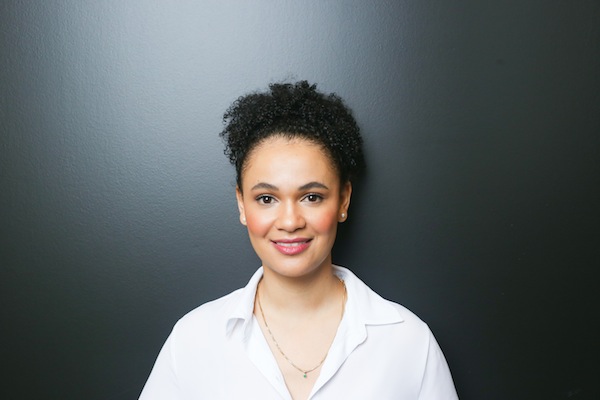
Akilah Allen-Silverstein, a co-founder, with Sara Yacobi-Harris and Daisy Moriyama, of No Silence on Race. (photo from NSR)
Amid a global reckoning around race, a group of Canadian Jews of colour is calling on the community to advance inclusivity and racial equity in Jewish spaces. And rather than generalized good wishes for more equality, No Silence on Race has created nine pillars to guide community organizations through a comprehensive process.
The group emerged at the end of June, when founder Sara Yacobi-Harris and co-founders Akilah Allen-Silverstein and Daisy Moriyama released a letter to the community introducing their work and their nine pillars.
“We are Black Jews and non-Black Jews of colour,” the letter said. “We are Jewish community board members, educators and leaders. We write from a place of love for our Jewish identities and community, while also grappling with the cultural erasure, exclusion and structural racism that we experience in Jewish spaces. Nevertheless, we are compelled to be in Jewish community because it is who we are.”
They began by sending the letter to agency leaders and posting it on Jewish social media and discussion platforms. Organizations circulated it further and began to request meetings.
“We are working to make a change in the culture, recognizing that the Jewish community is multifaceted in identity and making sure there is an awareness and an education around the diversity of the Jewish community,” Allen-Silverstein told the Independent in a recent interview.
In addition to asking individuals and organizations to sign their open letter, the group is asking community agencies to issue statements of their own and commit to the nine pillars.
The nine pillars guide agencies through developing allyship and educational approaches around race, as well as relationship-building. They move from more general approaches to applied processes such as hiring an equity consultant and developing inclusive employment and recruitment policies; creating leadership strategies for Jews of colour in the organization and amplifying their voices. The process is anticipated to evolve over three- to five-year periods. The entire text is easily accessible online at nosilenceonrace.ca.
“We are asking every organization to make a public statement, but, within this public statement, it’s not just about solidarity or signaling that you’re with us or you feel the same,” said Allen-Silverstein. “Our pillars are intentional in that the first three are ‘free’ and we’re very cognizant that it’s COVID right now and a lot of these organizations are just working to keep the lights on. But the first three pillars –allyship and education and relationship-building – these are things that will mostly be individual work. The organization can help facilitate by sending out reading lists, book lists, articles to give people the context, because, if you just run ahead and skip to steps four, five, six, you’re trying to create proposals or rules and guidelines without the context of the education to understand where the issues are, what people of colour have faced for years and their experiences within the Jewish community, and we are not going to be putting together any policies that actually make sense or help.”
No Silence on Race is cautious to express that, in employment and recruitment, the group wants to avoid tokenizing. “Tangible efforts could include mentorship programs for Jews of colour to be groomed for leadership positions,” she said. “We realize that takes time but that should just be done intentionally.”
Working to amplify the voices of Jews of colour, Allen-Silverstein added, means not just expecting Jews of colour to come and share what “for some of us can be very painful and exhausting, to do this for free constantly.”
Allen-Silverstein, a financial planner, is the daughter of an Ashkenazi father from London, Ont., and a mother from St. Kitts in the Caribbean. Jews of colour, she said, can come from intermarriage, but the broad category also includes Sephardim, Mizrahim, Ethiopians “and others who have always been Jews of colour,” she said.
Acknowledging and condemning antisemitic remarks and actions that have come from some prominent African-American athletes, artists and religious figures, as well as some incidents within the Black Lives Matter movement, Allen-Silverstein said the incidents speak to a communication problem.
“It just shows the breakdown between both communities,” she said. “I think, if you look historically, the similarities and the oppression that both communities have faced, we should be allies more than any other two groups. It’s sad. All we can do is honestly be that person who tries to explain it to both sides and that generally happens.”
Amid the hundreds of chapters of the Black Lives Matters movement, she acknowledged, there are some who have expressed extreme ideas. Allen-Silverstein sees two approaches in response.
“Sometimes, it’s noise and we really have to ignore that. One person speaking out and saying something stupid doesn’t mean that everybody else feels that way, and I think we need to be careful not to do that,” she said. The other step is to get to the root of the matter – “Let’s figure out where they’re getting this terrible message,” she said.
There has been forward movement in the fight for racial equality, as well as some backsliding, over many decades. Like others working for racial justice, Allen-Silverstein looks at the current moment with cautious optimism.
“It is inspiring that people are really listening and seem really genuinely interested to move forward, to acknowledge past things that have been done, whether it’s unconscious or consciously as well,” she said, adding that there appear to be more people engaging in the issue. “We are seeing, too, many things that make it very obvious that there was an element of people within the community who just considered these issues not theirs and not something they needed to participate in. That, for us, wasn’t acceptable as people who obviously walk both lines, being both members of that community and the Jewish community.”
The world needs us to change
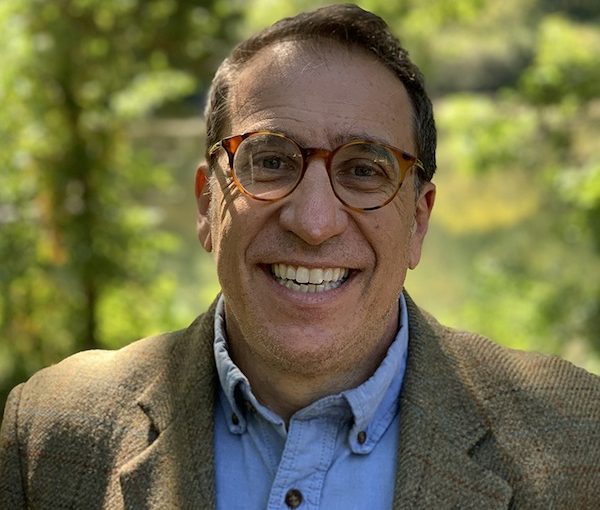
Nigel Savage, president and chief executive officer of Hazon, is one of the keynote speakers for Jewish Federation of Greater Vancouver’s annual campaign opening on Sept. 8. (photo from JFGV)
Nigel Savage, president and chief executive officer of Hazon, is looking forward to addressing the Vancouver Jewish community Sept. 8 as one of the keynote speakers for Jewish Federation of Greater Vancouver’s annual campaign opening. “The pandemic is a reminder of why we have and why we need central institutions like federations for the Jewish community,” he said.
“Hazon is working to turn the Jewish community outwards, address environmental sustainability and to use that process to strengthen Jewish life,” explained Savage in an interview with the Independent. “I think of the Vancouver Jewish community as one made of people who choose to live in the Pacific Northwest and have a sensibility of caring for the world and its natural resources, so I want to sketch out what may be possible for all of us in the long term.”
Savage was a professional fund manager in London, England, where he worked for NM Rothschild and was co-head of UK equities at Govett. After nine years in the financial world, he opted to take a sabbatical year and study at Pardes in Jerusalem. “I had an amazing time and stayed on in Israel as I tried to figure out what I wanted to do with my life,” he recalled.
A friend invited him to join a hike from the Mediterranean Sea to the Sea of Galilee, and Savage, who described himself as “a chubby, nerdy, intellectual English kid who grew up in Manchester and never really set foot outdoors,” agreed. He loved the hike and, as he began doing more physical activities outdoors, recognized it as a great way to bring Jewish tradition to life and connect with others. “We didn’t enter Jewish history in a synagogue or JCC. We entered it in relationship to the land of Israel, with a relationship to food, land, climate, language. That’s what the Torah is a record of,” he said.
Savage’s time in Israel was the impetus for the creation of what is today one of the largest faith-based environmental organizations in the United States. Hazon’s goal is to strengthen Jewish life and contribute to a more environmentally sustainable world. It calls itself the “Jewish lab for sustainability” and strives to effect change through immersive experiences and by inspiring individuals and communities to commit to change – particularly with respect to food systems.
Hazon is focused on Jewish outdoor, food, farming and environmental education (JOFFE) and, since its inception in 2000, has been dedicated to helping establish and inspire change. “In the Bay Area, there’s Urban Adama and Wilderness Torah, and, in north San Diego, there’s Coastal Roots Farm. In Boulder, there’s the Milk and Honey Farm and, in Toronto, we have Shoresh,” he said.
“In each place, people are doing slightly different programs with similar goals,” Savage explained. “Those goals are to reconnect the Jewish community to land and food, to reconnect people to Jewish tradition, to reconnect people to each other and to use that process to strengthen Jewish life and create the kind of world we believe in.”
Savage’s list of accolades suggests that he is achieving his goal at Hazon. In 2015, he was awarded an honourary doctorate by the Jewish Theological Seminary and he’s been named a member of the Forward 50, the annual list of the 50 most influential Jewish people in the United States, on two occasions.
He noted that September 2022 is the start of a new seven-year cycle in Jewish life. “Imagine if the Vancouver Jewish community began to envision Jewish life in Vancouver over the next seven years. If we wanted the Vancouver Jewish community to be on the cutting edge of Jewish communities around the world around issues of sustainability by 2029, what would that look like?”
Savage suggested that every Jewish institution in the city could begin a process to establish a coherent food plan over the next seven years. It might include policies regarding use of plastic bottles, whether to serve meat and soda, carbon neutrality goals for community buildings, and other actions in relation to food and land use.
“At Hazon, we want to treat these questions as real questions and involve people in the Jewish community, from teenagers to rabbis. We want to start a real conversation which draws on Jewish tradition, the best of what’s happening in Vancouver and Canada, and use that process so that, by 2029, the Vancouver Jewish community has integrated food polices in all its institutions that reflect our values.”
Hazon’s goal is to invite communities to unpack questions like these and to act as a resource on matters of sustainability and Jewish efforts to promote it.
“If we think about the nature of obesity, diabetes and heart disease, these are chronic illnesses,” Savage noted. “The world needs us to slowly and steadily change how we’re living so that all these people can live sustainably on this planet. Right now, we have a 10- or 15-year window to change the trajectory of Jewish civilization. We can’t complete this task by ourselves, but neither are we free to desist from it.”
Savage will be joined at the Federation campaign launch by fellow keynote speaker Sarah Hurwitz, author of Here All Along: Finding Meaning, Spirituality and a Deeper Connection to Life – in Judaism (After Finally Choosing to Look There) and former speech writer for the Obamas. To register for the event, which starts at 5 p.m., go to jewishvancouver.com/faco2020.
Lauren Kramer, an award-winning writer and editor, lives in Richmond. To read her work online, visit laurenkramer.net.
Historic Israel-UAE accord?
Hosannas of historical significance followed the announcement that Israel and the United Arab Emirates have normalized relations with each other. The truth is, we don’t really know what this means for the long-term. History is best judged in hindsight.
In some ways, the mutual recognition is not a massive surprise. Israel has long had semi-secret good relations with some of the Gulf states. But, in the name of solidarity with Palestinians, the Arab states kept official relations off the table. It is a sign now that fear of Iran, rather than solidarity with Palestinians, is increasingly the priority guiding diplomatic decision-making in the region.
New York Times columnist Thomas Friedman made it sound like the accord is the greatest thing to hit the Middle East since hummus. Calling it a “geopolitical earthquake,” Friedman suggested this was the third most important event for the region after President Anwar Sadat visiting Jerusalem and Yasser Arafat shaking Yitzhak Rabin’s hand on the White House lawn. But Friedman’s choice of those two examples may exactly undermine his case that this is quite so tectonic.
Perhaps more than anywhere else in the world, history in the Middle East does not have a consistently forward-moving trajectory. Relations between Israel and its neighbours have often been one step forward and two steps back. The anti-Zionist culture that permeates much of the Middle East and North Africa is not necessarily something that can be overcome simply by a recognition by top government officials on either side. Egypt’s peacemaking with Israel in the late 1970s can be seen as the most direct cause of the assassination of Sadat in 1981. When some extremists saw Jordan’s King Abdullah I as too soft on the Zionists, he was assassinated at the entrance of the Al-Aqsa Mosque in Jerusalem by a Palestinian, in 1951. Extremism is not limited to the Arab side – Rabin was killed 25 years ago by an Israeli extremist opposed to concessions with the Palestinians.
Extremism could derail this progress, as well. Some voices in the Arab world are already warning of dire consequences for Arab figures working with Israelis. Even if, as we desperately hope, there is not retaliatory violence, and even if rumours that other Arab countries are ready to follow the UAE’s lead are true, it may be premature to see this one step as a guarantee of rainbows and doves.
When Israel and Egypt signed the Camp David Accords and adopted a position of mutual recognition, it was perceived to be a future-changing moment. It certainly appeared that way at the time. However, relations with Egypt – then the unchallenged political, military and cultural superpower of the Arab world and the birthplace of pan-Arabism – never became chummy. What Israel has received in practical terms in the subsequent 40-plus years is mostly a cold peace. Similarly, after Israel’s parallel agreement with Jordan. There are mutual benefits and a state of comparatively benign adjacency but these relationships are hardly the stuff of great friendship.
Still, the Gulf states are different. They have not been involved in any conflagration with Israel. Their emergence as high-tech and financial powers in recent decades puts them on footing with Israel among the Middle East’s forward-looking economies.
Meanwhile, as part of the deal, Israeli Prime Minister Binyamin Netanyahu has called off his annexation plan in part of the West Bank, though it was hard to see a way forward for the ill-advised initiative. It’s possible that Netanyahu’s annexation scheme was like U.S. President Donald Trump’s Mexican border wall – red meat to their respective far-right constituents but a promise that was never going to be kept. It may not have been a jagged pill for Israelis to swallow.
And, speaking of Trump, as he often does, the U.S. president is crowing that he (via his advisor/son-in-law Jared Kushner) is responsible for this great unfolding. It seems undeniable that the U.S. administration played a role. Just 70-some-odd days out from one of the most important elections of our lifetimes, the agreement seems timed to bolster the image of the president as a statesman and appeal to Jewish and evangelical voters. However, the relationships between these actors are not entirely transparent and there are likely many moving pieces – and many lucrative business deals – to which we are not privy. Much of the excited coverage of the agreement fails to recognize the larger geopolitics in the region and how this agreement may best serve those currently in power.
Palestinian leaders are outraged by a deal that reduces their leverage in the region, and Israel and its supporters should be wary of unilateralism if there is any hope of keeping a two-state solution alive. That said, whatever the future holds for Israel’s relationships with the UAE and other Arab states, this is a time for cautious hope. While the Palestinian leadership and some of their ostensible allies, like Turkey and Hezbollah, are upset by the accord, it’s possible that they are among those who should be most enthusiastic.
Denormalization, the once-nearly-unanimous assertion by Arab states that Israel shouldn’t exist – and, in their official diplomatic worldview, doesn’t exist – was intended to harm Israel. But Israel’s economy continues humming along, even as the pandemic makes the outlook more uncertain. The biggest losers of denormalization have been neighbouring Arab people and states – most especially the Palestinian people – who are effectively quarantined from the economic engine of the region. The Israeli-UAE agreement could be a good thing for all people in the area, whether they recognize it right now or not. However, we shouldn’t let our excitement for a détente get in the way of other critical interests: a two-state solution and electing governments in the United States and Israel that are oriented to coexistence and fair play.
Israel and UAE accord
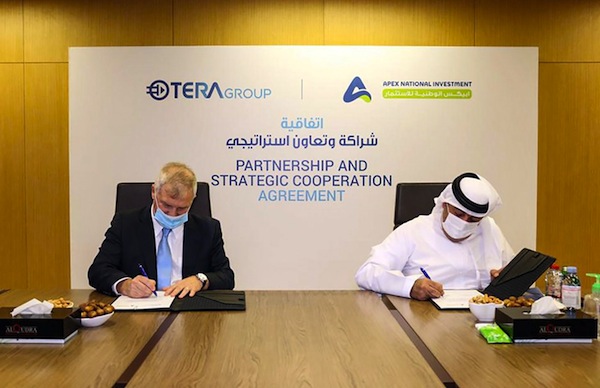
TeraGroup chair and chief executive officer Oren Sadiv, left, signs a research deal with Khalifa Yousef Khouri, chair of APEX National Investment, in Abu Dhabi. (photo from WAM Emirates News Agency via Israel21c)
Overcoming the COVID-19 pandemic could be just one of many positive results of Israel and the United Arab Emirates establishing full diplomatic relations on Aug. 13, 2020. The historic pact is expected to trigger numerous joint projects in health, economics, agriculture, water technology, telecommunications, security, culture, tourism and other fields.
“Today, we usher in a new era of peace between Israel and the Arab world,” said Israeli Prime Minister Binyamin Netanyahu in announcing the U.S.-brokered Abraham Accord with Abu Dhabi Crown Prince Mohammed bin Zayed al-Nahyan (“MBZ”).
Even before the accord, on July 3, Rafael Advanced Defence Systems and Israel Aerospace Industries of Israel signed agreements with Abu Dhabi’s Group 42 concerning research and development collaborations for solutions to SARS-CoV-2, the virus that causes COVID-19. On Aug. 15, UAE company APEX National Investment signed a strategic commercial agreement with Israel’s TeraGroup to develop SARS-CoV-2 research. And, on Aug. 16, in the culture arena, Israeli singer Omer Adam announced that the UAE royal family invited him to perform a private concert.
Netanyahu said the two technologically advanced countries will open mutual embassies and direct flights, among other bilateral agreements.
“This is the greatest advancement toward peace between Israel and the Arab world in the last 26 years, marking the third formal peace between Israel and an Arab nation, after Egypt (1979) and Jordan (1994),” he said.
One big difference is that Israel and the UAE – a federation of seven states including Dubai and Abu Dhabi – do not share a border and have never warred with one another. Under-the-radar business and security ties have been building over the past 20 years, and diplomatic ties more recently.
In 2015, Ministry of Foreign Affairs Director General Dore Gold opened a diplomatic mission in Abu Dhabi connected to the International Renewable Energy Agency. In 2018, Israel’s communications minister attended a telecommunications conference in Dubai; in 2019, Israel’s foreign minister spoke at a United Nations environmental conference in Abu Dhabi.
Israel’s culture and sports minister came to the Abu Dhabi Grand Slam judo competition in October 2018, where, for the first time, the UAE permitted Israeli competitors to wear their national flag on their uniforms, and played the Israeli national anthem on the winners’ podium.
The new agreement puts an official stamp of approval on this ongoing relationship and allows it to expand in full daylight.
* * *
The development of coronavirus vaccines, therapeutics and testing will “absolutely” figure prominently in Israeli-UAE deals following the Abraham Accord, said Jon Medved, chief executive officer of Jerusalem-based OurCrowd.
Medved has been traveling to the UAE for years, building contacts between Israeli and Gulf entrepreneurs, investors and experts.
“They’ve got world-class hospitals and there is huge interest in working with Israel on healthcare technology, telemedicine and digital health,” he told Israel21c.
Medved spoke in Abu Dhabi last December at the SkyBridge Alternatives (SALT) investment conference. He was the first Israeli investor to appear on a public stage in the UAE.
“I wasn’t sure they would let me speak openly about Israel, but, on the contrary, they wanted me to talk about Israel’s ecosystem,” said Medved. “You could tell we are in historic times. I was amazed how open they are to us and how aware they are of what is going on in our country.”
Medved reiterated that the UAE has long done business quietly with Israel but now will become a bigger trade partner and a bridge to other Gulf-region markets for Israel.
“For most of us, the Arab world has been more or less an afterthought and that’s about to change,” he said. “We will sell them enormous amounts of health gear and ag-tech, education-tech and cybersecurity,” he predicted. “For the startup community, the agreement will open up a source of tremendous new investment from the best investors in the world. [The Emiratis] are not only deep-pocketed but incredibly skilled, experienced and sharp.”
However, he added, “The real challenge for us is how we can really make this a win-win by trying to understand what they want. My sense is they don’t want to be passive investors. They want to build joint ventures, engage in technology transfer, build startups, do business and create jobs and long-term value and partnership.”
* * *
The Abraham Accord is “a huge diplomatic achievement for Netanyahu” and a “brave leadership act of Bin Zayed,” said Yoel Guzansky, senior research fellow at the Institute for National Security Studies and co-author of Fraternal Enemies: Israel and the Gulf Monarchies (Oxford University Press, 2020).
Guzansky, who coordinated Israeli policy on Iran and the Gulf states under four national security advisers and three prime ministers, said in a press call on Aug. 13 that “the announcement was historic and dramatic, but not 100% surprising for those who have been talking behind the scenes with Emiratis.”
“Relations between Israel and some of the Gulf States, especially the UAE, [are] the worst-kept secret in the Middle East,” Guzansky said. “It was almost ordinary for Israelis to visit the Gulf representing industries from diamonds to agriculture to desalination to security. Relations evolved, especially in the past five years, in several dimensions – security intelligence, economic/commercial, cultural and religious dialogue – pushed and led by Bin Zayed.”
Guzansky believes the deal could catalyze other Arab countries in the Gulf and North Africa. Indeed, Netanyahu said he expects to “soon see more Arab countries join our region’s expanding circle of peace.”
Bahrain released a statement lauding the landmark Abraham Accord, while an anonymous Saudi Arabian source told Israel’s Globes business newspaper that “the Arab world has a great deal to gain from Israel.”
The Israeli Ministry of Foreign Affairs has confirmed the start of phone service with the UAE and stated that the peace treaty “will benefit the entire region, helping secure a brighter and more prosperous future for all.”
Israel21c is a nonprofit educational foundation with a mission to focus media and public attention on the 21st-century Israel that exists beyond the conflict. For more, or to donate, visit israel21c.org.
New MK has Canadian roots
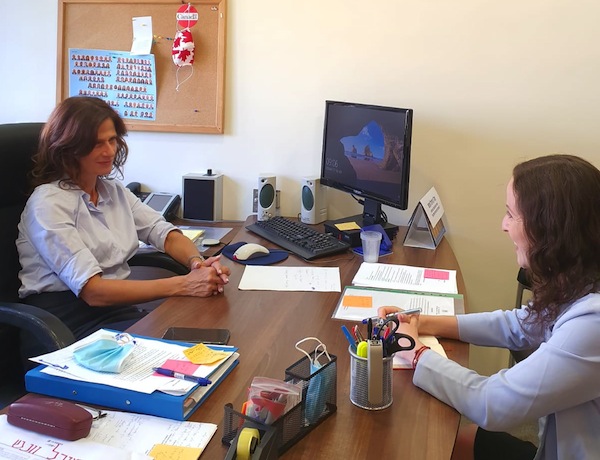
Both MK Michal Cotler-Wunsh, left, and her political aide, Becca Wertman, have Canadian roots. (photo from Becca Wertman)
A new, dynamic force has hit the Knesset, with a political aide just as passionate, and both are rooted in Canada.
Michal Cotler-Wunsh, who once held Canadian citizenship, became a Member of the Knesset for the Blue and White Party this past June. She is among those who have endorsed a proposed bill that, if passed, would change the requirement that Knesset members who hold citizenship in another country must give up that citizenship.
Recently sworn in, Cotler-Wunsh heads a staff of four – a political aide, a parliamentary aide, a spokesperson and an aide who works with her on her portfolio as chair of the Drug and Alcohol Use Committee. In a recent interview, she told the Independent that the issues that concern her are “unity, mamlachliut (often translated statesmanship) and responsibility…. You can’t politicize or personalize issues,” she stressed. Two other issues about which she is passionate are “the ability to combat antisemitism and a commitment to olim [immigrants] and prospective olim.”
Cotler-Wunsh also emphasized her commitment to Israel as a Jewish and democratic state. As a lawyer and international law expert, she added that the international community and Israel must always uphold international law and not allow terror groups to exist in a culture of impunity. She specifically highlighted the importance of this in the context of Hamas not returning the four Israelis currently being held captive in Gaza, in a six-year standing violation of international law.
Jerusalem-born, Cotler-Wunsh spent her first seven years in Israel. When her mother, Ariela (née Ze’evi), married Canadian Irwin Cotler, the family moved to Montreal, where her three siblings were born. Most JI readers will be familiar with Cotler-Wunsh’s father, a former minister of justice of Canada, an international human rights lawyer, emeritus professor of law at McGill University, and founder and chair of the Raoul Wallenberg Centre for Human Rights, among other things.
Cotler-Wunsh returned to Israel for a one-year program after high school and stayed to serve in the Israel Defence Forces as a lone soldier. She then received her law degree from the Hebrew University and did her internship.
In 2000, she and her husband returned to Canada with their son but returned to Israel 10 years later, by which time they had three more children. In 2010, she became associated with the Interdisciplinary Centre in Herzliya and was a research fellow at the International Institute for Counter-Terrorism.
Cotler-Wunsh’s political aide is Vancouver-born and -raised Becca Wertman. The two met at a conference of nongovernmental organizations. “I read Becca, I heard her voice in what she writes,” said Cotler-Wunsh.
Wertman, who is the daughter of Charles and Carla Wertman of Vancouver, has a bachelor degree from the University of Southern California in international relations and a master’s from Columbia University in political science. She was managing editor and responsible for the Canada portfolio at the Jerusalem-based research institute NGO Monitor, authoring articles for a wide variety of publications.
“My messages are very nuanced; it was important to find somebody that can make my nuanced messages accessible to the public and be able to represent me,” explained Cotler-Wunsh. “Having read some of what Becca published, I saw that the values that drive me also drive Becca as well, particularly in the areas of human rights, international law, Zionism and democracy.”
Wertman manages Cotler-Wunsh’s schedule, handles all things that come in English, including media and social media, and reaches out to NGOs that fight antisemitism or are concerned with olim; she also assists Cotler-Wunsh in her foreign endeavours. Like her boss, she is passionate about issues concerning olim chadashim (new immigrants) and working with Diaspora communities.
Wertman made aliyah in 2016 and went to an ulpan to learn Hebrew; she is engaged to an oleh from Chicago. She sees her role as a perfect fit because of the values she shares with Cotler-Wunsh and their shared Canadian backgrounds. In addition, she admires Cotler-Wunsh’s father.
“As a Canadian who is interested in human rights, Prof. Irwin Cotler has been someone I looked up to for many years,” said Wertman.
In June, when Cotler-Wunsh received word that she would be a member of the Knesset, she reached out to Wertman and offered her the position.
“I’m 100% dedicated to MK Michal Cutler-Wunsh, to help her accomplish what she wants to accomplish,” said Wertman. “I fully believe in her goals. Her issues are those I care about. I feel so lucky to work for a member of the Knesset who is furthering issues that I so deeply believe in.” She added, “her background in human rights and international law, these are unique and important skills, experiences and values that can and will add to the Knesset.”
Sybil Kaplan is a journalist, lecturer, book reviewer and food writer in Jerusalem. She created and leads the weekly English-language Shuk Walks in Machane Yehuda, she has compiled and edited nine kosher cookbooks, and is the author of Witness to History: Ten Years as a Woman Journalist in Israel.
Making yoga more accessible
For Miriam Leo-Gindin, founder of the Yoga Buggy, COVID-19 has meant more opportunities to bring her passion for yoga to Vancouver youth – free of charge.
Leo-Gindin, 41, a former school teacher who has taught yoga in various capacities, including at Vancouver Talmud Torah, founded her Vancouver-based nonprofit organization in 2017. Until recently, she was offering free Zoom yoga classes to kids, but, thanks to sponsorship from the Canadian Red Cross, she’s been able to offer physically distanced classes at McSpadden and Woodland parks to local children and their families.
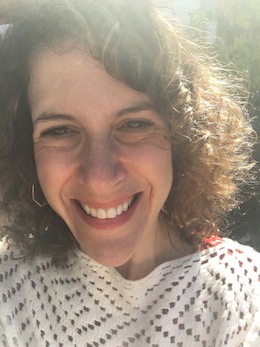
“I’ve been doing yoga since I was 19 and it helped me get through some of my own health issues,” she told the Independent. “I founded Yoga Buggy to bring yoga to all kids and families, including those who are underserved, have financial difficulties or don’t have access for other reasons.”
The “buggy” part of Yoga Buggy refers to its mobile nature. Leo-Gindin’s classes are portable, so she is able to bring them to before- and after-school programs and to parks, so that families don’t have to travel far to participate. In addition to the Red Cross, her organization also has received funding from the B.C. Recreation and Parks Association.
Pre-pandemic, Leo-Gindin was doing around 25 classes per week all over the city, in Vancouver schools, YMCAs and neighbourhood homes, while also planning expansion into Burnaby, Richmond and Coquitlam. When COVID-19 began, she launched Community Zoom Yoga, offering two sessions a week for 12 weeks. The classes had a variety of themes, from community kindness to staying healthy, and were geared at children ages 5 through 12. There were also classes for preschoolers and teens.
“Yoga is really fun and kids enjoy it,” she reflected. “It brings out their creativity, helps build their attention span, makes them feel more confident, and can play a supportive role in dealing with anxiety, depression and behavioural issues.”
The website notes, “Yoga Buggy’s trauma-aware practitioners strive to offer as welcoming a space as possible. Choice in how to participate is always at the forefront of our classes and events. If there are any sensory, learning or additional supports that could be of benefit to any of the participants, please let us know so that we can offer as hospitable a space as possible. This information is kept private and confidential.”
Yoga Buggy has 15 active teachers and will continue its work through the fall. Leo-Gindin hopes to develop a yoga teacher training program and to start a YouTube channel to increase her reach even further with kids yoga classes. For more information, visit yogabuggy.com.
Lauren Kramer, an award-winning writer and editor, lives in Richmond. To read her work online, visit laurenkramer.net.
***
Note: This article has been updated to make clear that, while Miriam Leo-Gindin taught yoga at Vancouver Talmud Torah, she was not on staff at the school.
Discussion, wine, food
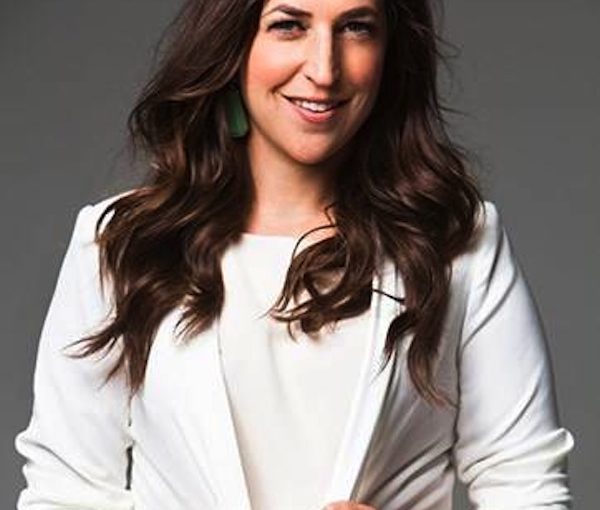
Mayim Bialik headlines a Sept. 9 event to raise funds for the SOS: Support Our Students Assistance Fund at Ben-Gurion University. (photo from CABGU)
Across five time zones, two scientists and a Canadian senator will virtually get together to talk science, Judaism, veganism, Israel and the empowerment of young women. Join the Canadian Associates of Ben-Gurion University of the Negev on Wednesday, Sept. 9, at 4:30 p.m. (Pacific) for their first national virtual event, inspired by the appeal to address the dire needs of BGU’s students as a result of the coronavirus. The event will feature actress, neuroscientist and author Mayim Bialik, PhD, star of the TV series The Big Bang Theory and the sitcom Blossom; BGU president Prof. Danny Chamovitz; and special guest moderator, Senator Linda Frum. They will offer three perspectives on some of the most pressing issues facing the Jewish community, Israel and the world.
The economic crisis caused by the pandemic has forced thousands of BGU students to question their ability to continue their studies this fall. The event will benefit the recently launched SOS: Support Our Students Assistance Fund at Ben-Gurion University – a fund designed to save the class of COVID -19.
“Our event brings together three highly intelligent and socially engaged speakers that will captivate the 500 people we expect from across Canada,” said Mark Mendelson, chief executive officer of CABGU, speaking from Montreal.
“Mayim’s story has relevance and appeal for the next generation, especially during these turbulent times when many are wrestling with how to realize their social responsibility,” said David Berson, CABGU’s executive director for Western Canada. Regional chairperson for the event, Adam Korbin, added: “Equally important is the fact that she knows how to make people laugh, something we all could use right now.”
In addition to the discussion, guests will be treated to a bottle of award-winning red wine from the Yatir Winery in Israel’s Negev region and sweet and savoury kosher treats prepared by Café 41. Tickets are $180 per household, which includes a partial tax receipt; sponsorships are also available.
To purchase tickets or for further information, go to bengurion.ca or contact Berson at [email protected] or 604-266-2680. Tickets are limited and this event will likely sell out.
Supporting HU scholarships
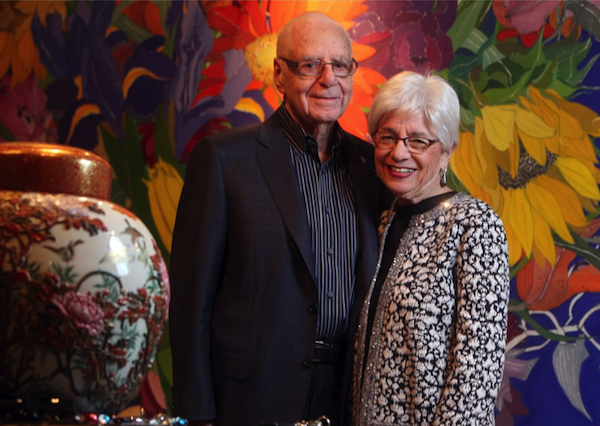
Lenny and Faigel Shapiro (photo from CFHU)
Calgary resident and philanthropist Lenny Shapiro recently announced that he and his wife Faigel are expanding their scholarship program at Hebrew University in Jerusalem. As part of a new five-year commitment, the couple is increasing the number and value of scholarships they will be awarding to students pursuing their university studies after completing their mandatory service in the Israel Defence Forces (IDF).
A strong believer in the concept of tzedakah, Lenny Shapiro has donated to many nonprofit organizations in both Canada and Israel. He has long supported students at HU, having provided scholarships to hundreds of students over the years and, in July, he decided to make a substantial donation to be used over the next five years for scholarships for students who have served in the IDF. To add to the impact, Canadian Friends of Hebrew University (CFHU) and Hebrew University will be matching a portion of his contribution.
At the heart of this action is Shapiro’s longstanding respect and appreciation for those who risk their lives in defence of Israel.
“I’m in love with the soldiers,” he said. “They put their lives on the line. Many have lost friends in battle. For those that then go on to study at Hebrew University who I can help, I feel they’re like my family. I see myself as being like a grandfather for them. Their needs are my needs, and I’m so pleased to do what I can to help them get their degree as they make their way through life.”
Shapiro has shared his passion for Hebrew University with the next generation in his family. One of his daughters, Robin Murphy, is a member of CFHU’s national board.
Born in Montreal, Lenny Shapiro grew up in modest conditions. After graduating from Sir George Williams University (now Concordia University) with a bachelor of commerce, he went on to head Allied Resources Management, part of the petroleum industry in Alberta.
Shapiro has always operated according to the principle that there’s no better exercise for your heart than reaching down and helping to lift someone up. His impact is reflected in the many letters he’s received over the years from HU students for whom his scholarships have allowed them to complete their studies.
“With the financial support I received from you, it’s easier for me to concentrate on my studies,” Julia Arziantzev wrote to Shapiro during the second year of her master’s degree in cultural studies at HU. “Without your scholarship, I doubt I would be able to keep up my average or even keep studying. Thank you for your generous assistance. It makes me optimistic to know there are people like you who are willing to help in such a tremendous way.”