Skip to content
  • Home
  • Subscribe / donate
  • Events calendar
  • News
    • Local
    • National
    • Israel
    • World
    • עניין בחדשות
      A roundup of news in Canada and further afield, in Hebrew.
  • Opinion
    • From the JI
    • Op-Ed
  • Arts & Culture
    • Performing Arts
    • Music
    • Books
    • Visual Arts
    • TV & Film
  • Life
    • Celebrating the Holidays
    • Travel
    • The Daily Snooze
      Cartoons by Jacob Samuel
    • Mystery Photo
      Help the JI and JMABC fill in the gaps in our archives.
  • Community Links
    • Organizations, Etc.
    • Other News Sources & Blogs
    • Business Directory
  • FAQ
  • JI Chai Celebration
  • JI@88! video

Recent Posts

  • Zionism wins big in Vegas
  • Different but connected
  • Survival not passive
  • Musical celebration of Israel
  • Shoppe celebrates 25 years
  • Human “book” event
  • Reclaiming Jewish stories
  • Bema presents Perseverance
  • CSS honours Bellas z”l
  • Sheba Promise here May 7
  • Reflections from Be’eri
  • New law a desecration
  • Resilient joy in tough times
  • Rescue dog brings joy
  • Art chosen for new museum
  • Reminder of hope, resilience
  • The national food of Israel?
  • Story of Israel’s north
  • Sheltering in train stations
  • Teach critical thinking
  • Learning to bridge divides
  • Supporting Iranian community
  • Art dismantles systems
  • Beth Tikvah celebrates 50th
  • What is Jewish music?
  • Celebrate joy of music
  • Women share experiences 
  • Raising funds for Survivors
  • Call for digital literacy
  • The hidden hand of hate
  • Tarot as spiritual ritual
  • Students create fancy meal
  • Encouraging young voices
  • Rose’s Angels delivers
  • Living life to its fullest
  • Drawing on his roots

Archives

Follow @JewishIndie
image - The CJN - Visit Us Banner - 300x600 - 101625

Depression insidious

Depression insidious

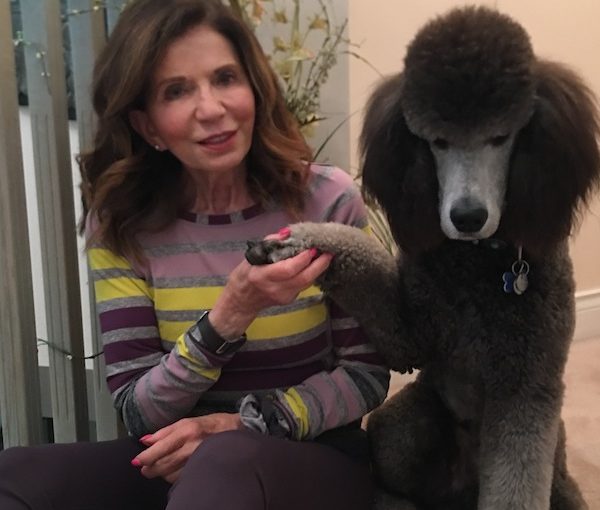
The author with her dog, Kesem. (photo from Dolores Luber)

It was mid-March. All I had been hearing and seeing on the news were the words and images related to contagion, epidemic, China’s wet markets, people enjoying the delicacy of cooked bats, pandemic and COVID-19. It was getting louder and closer, somehow it traveled from China across the Pacific to Vancouver. We were now dealing with the pandemic in Vancouver, we were in lockdown, even if the government never called it that.

In a flash, my household emptied out. My housemate, a University of British Columbia student, went back home; all her courses were now online. My boarder, a psychiatric nurse, scared of catching the virus and infecting me and her immune-compromised partner, took a six-month leave of absence from her work and joined him on a sailboat off the coast of Vancouver Island. I cleaned and organized and then it hit me – I was alone in the house with my Standard Poodle puppy Kesem. His name means “magic” in Hebrew and he truly is a wonderful companion, but….

Lockdown, what was that? We all had to create our own version. I maintained my Hebrew classes by means of Zoom, I continued working out with two personal trainers in my home gym. We did not touch each other. I went to the off-leash dog park every afternoon. We practised social distancing.

Then, a classmate of mine became hospitalized with the virus – I had not seen her for 10 days. I isolated myself for an additional week, not one of our group became ill. She is the only one I know who has contracted the virus. I was feeling proud of myself, I was managing well. As the editor-in-chief, I had produced the July edition of Senior Line magazine for Jewish Seniors Alliance on schedule. It was a labour of love, responding to the pandemic and the issues of the times. Everything was under control.

July 22 is my birthday. At the beginning of July, I began to feel very lonely. I had not seen any of my four sons, daughters-in-law or nine grandchildren for a long time. The planned family reunion in Oakville, Ont., was an event I had been looking forward to. My children had grown up in Beaconsfield, Que., and my youngest son had organized a fabulous get-together of all his friends who lived in the neighbourhood during his childhood. Photographs were collected, videos created, all plans had been made before the lockdown.

We gradually began to understand that the situation was not going to end soon; we were in it for the long haul. The reunion was canceled. I always see my children on my birthday, but, this time, I received FaceTime calls, beautiful cards, splendid flowers, but no hugs, no kisses, no warmth, no human touches. My thoughts were becoming very negative and gloomy; worst-case scenarios played in my head. I thought of moving back to Ontario to be with my youngest son; I researched buying a house in Oakville. I was experiencing symptoms of depression.

As a retired psychotherapist, I recognized the symptoms – among them, exaggerated feelings of sadness and loneliness. I made an effort to study more and read more Hebrew. I pushed harder in my workouts with my trainers. I developed and implemented a plan for the fall Senior Line magazine. By the end of July, I was thinking in a more balanced fashion. I had gotten through the rough spot and was well again.

Depression can be insidious, it can creep up on you. It is important to do a reality check with friends or family members from time to time. Isolation warps the processes of the brain. The chemicals in our brains can become unbalanced. Usually increased physical activity and enhanced social interaction can counteract the symptoms of mild depression. Beware!

Dolores Luber, a retired psychotherapist and psychology teacher, is editor of Jewish Seniors Alliance’s Senior Line magazine and website (jsalliance.org). She blogs for yossilinks.com and writes movie reviews for the Isaac Waldman Jewish Public Library website.

Format ImagePosted on September 11, 2020September 10, 2020Author Dolores LuberCategories Op-EdTags coronavirus, COVID-19, depression, mental health
A testament to free speech

A testament to free speech

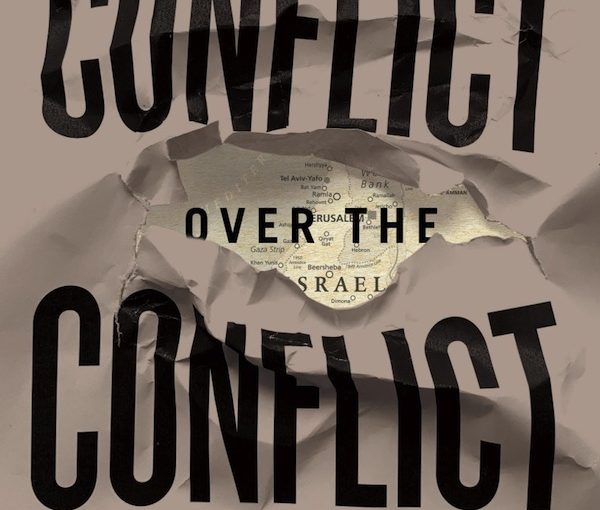
A new book on an incendiary topic turns out to be not quite as expected. The Conflict over the Conflict: The Israel/Palestine Campus Debate, by Kenneth S. Stern, may be the most comprehensive assessment of the (at least) 20-year battle on North American campuses between pro-Israel and anti-Israel forces.

Jewish and pro-Israel readers picking up the work might anticipate a litany of horrors, anti-Zionist if not antisemitic incidents, brawls, screaming matches, vandalism, boycotts and the like. There is that. But Stern argues that the perception that campuses are aflame in anti-Zionist rage is simply not true. More, he offers proof that the pro-Israel side is far from innocent of engaging in disgraceful tactics, too. There is ill will and there are bad actors on both sides. Most unexpectedly, as much as the book is about the conflict, it is more than anything an exercise in applied ethics on the topic of free expression.

Stern is the director of the Bard Centre for the Study of Hate, an attorney and an author. For 25 years, he was the American Jewish Committee’s expert on antisemitism and he was a lead drafter of the Working Definition of Antisemitism. He is also, it appears, something close to a free speech purist. As such, he rails against efforts by Israel advocates who have organized campaigns to censure (and censor) anti-Israel voices. He doesn’t let the other side off easily, either, calling out acts of harassment like drowning out pro-Israel speakers with the “heckler’s veto.”

The book, from New Jewish Press, an imprint of University of Toronto Press, begins with an empirical assessment. In institutions of higher learning in the United States, Israel is an issue in very few, he writes.

When speaking with Jewish audiences, Stern asks for a show of hands to gauge perceptions on anti-Israel attitudes. He asks for guesses on how many American colleges have divested from Israel.

“Many seem surprised when I say ‘zero,’” he writes. “There are relatively few campuses where Israel is a burning issue, and every year the number of pro-Israel programs … is usually at least double the anti-Israel ones. There are over 4,000 campuses in the U.S. – in the 2017-18 academic year, 149 had anti-Israel activity.… So the campuses aren’t burning.”

He does not dismiss the extreme tensions on a few campuses, however.

“[O]n some campuses where anti-Israel activity is prominent, pro-Israel Jewish students may feel marginalized, dismissed or vilified, sometimes with antisemitic tropes.” Identity politics and the conflation of Jewish people with “whiteness” creates racial conflict. “[T]he labeling of Jews as white becomes a problem when shared victimhood becomes a sacred symbol, a badge of honour, a precondition to enter a club of the oppressed. Antisemitic discrimination is rendered invisible.”

Though bigotry may play a role in the discussion, Stern does not see constructive resolutions in neologisms like trigger warnings, safe spaces and microaggressions.

“Faculty should have the right to give trigger warnings if they want, but I never do, and I think the idea is a horrid one,” he writes. “I teach Mein Kampf. It’s disturbing – get over it. College should prepare one to be an adult, and there are no trigger warnings after graduation day. Why are we encouraging students to be ostriches? Shouldn’t they, rather, be learning how to navigate things that will likely unsettle them over the rest of their lives?”

He quotes CNN commentator Van Jones, a strong civil rights proponent, who opposes “safe spaces” on campus: “I don’t want you to be safe ideologically. I don’t want you to be safe emotionally. I want you to be strong. That’s different. I’m not going to pave the jungle for you. Put on some boots and learn how to deal with adversity. I’m not going to take the weights out of the gym. That’s the whole point of the gym.”

Stern contends a fundamental error has been made in defining terms.

“We want campuses that are open to expression – including, perhaps even especially, difficult and disturbing ideas – but which protect students from real harassment and intimidation. Hate speech codes were efforts to say that ideas themselves can harass and intimidate. Ideas can and should make one uncomfortable (a comfortable college education is a wasted college education). But harassment is something different.”

Strategically, he argues, trying to censor hateful ideas is self-defeating and advances hate agents by martyring them.

“By trying to censor, rather than expose and combat, speech the students perceived as hateful, they were actually helping the alt-right and white supremacists,” writes Stern. “It’s no coincidence that the white nationalists in recent years have wrapped their racist and antisemitic messages around the concept of free speech. Why would progressives allow these haters to steal the bedrock democratic principle of free speech, disingenuously saying that this is what their fight is about? By trying to deny alleged racists platforms, progressives are helping white supremacists recast their vile message as noble protection of a right.”

Another strategic failure, he argues, is buying into the Palestinian narrative’s good/evil dichotomy.

“Israel’s case is best understood as inherently complex and difficult; playing into the ‘all bad’ and ‘all good’ binary of the other side renders those complexities invisible,” he writes.

The conflict on campus spills over, of course. Israel has created a list of 20 organizations, those that urge boycotts of the country, for instance, and bars their members from entering the country. Stern sees this as counterproductive: “You don’t make the case that blacklists (especially of academics) are proper if your goal is to oppose blacklists. You are conceding the argument.”

He gives an example of an anti-Israel campus activist who defends his group’s refusal to meet with Zionists “over cookies and cake” because “you Jews, in all due respect, you wouldn’t sit down with Nazis for tea and cake.”

He also reflects on the “Standards of Partnership” adopted by Hillel International, the Jewish campus organization, which proscribe engaging with groups or individuals that deny Israel’s right to exist, or who delegitimize, demonize or apply a double standard Israel, who support BDS or who exhibit “a pattern of disruptive behaviour towards campus events or guest speakers or foster an atmosphere of incivility.”

Writes Stern: “For those who are not yet ideological soldiers, but want to learn more, and want to do it around their campus Hillel, what sense does it make that adults are telling them they can only bring in certain types of speakers? Yes, the adults defined BDS as hateful. But does it make sense to tell students they have to go elsewhere than the Jewish address on campus to hear about it firsthand from those who support it?”

The litany of bad behaviours on all sides of the ideological divide is likely to make readers of Stern’s book uneasy, whether the reader is Zionist or anti-Zionist. But it is a rare and uncompromising testament to free expression that should give genuine free speech advocates an uplift, particularly in an era when ideologically driven regulation of expression and ideas, especially on campuses, has left many advocates of core liberal, academic values feeling beleaguered.

Format ImagePosted on September 11, 2020September 10, 2020Author Pat JohnsonCategories BooksTags academia, anti-Israel, anti-Zionist, antisemitism, BDS, boycott, censorship, conflict, free speech, Hillel, Israel, Kenneth S. Stern, Palestine, university campuses, Zionist

Two compelling reads from Simon & Schuster

Last year, I requested two books from Simon & Schuster Canada. Both contained strong female protagonists and stories that sounded compelling. While it took the pandemic slowdown before I had time to read them, I enjoyed both and would recommend them, albeit one with a caveat.

image - Woman on the Edge book coverLet’s start with the debut novel, the one I breezed through even though I found the premise tenuous. I wanted to know how Samantha M. Bailey’s thriller Woman on the Edge ended, even as I cursed aloud at the two main characters – Nicole Markham, founder and head of a widely successful athletic wear company, and Morgan Kincaid, a woman who has rebuilt her life after her husband was caught swindling people and then killed himself.

For reasons not revealed initially, Nicole hands her baby to Morgan at a subway stop, then jumps to her death, though video of the incident makes it seem like Morgan may have taken the baby then pushed Nicole onto the tracks. Alternating between Morgan’s attempt to clear her name and how Nicole came to give her baby to Morgan, the read is thrilling, even as it is too obviously contrived. At any point in time, a question or revelation from Nicole or Morgan could have shed light on their respective situations and cleared up critical matters. Yet, both women – unrealistically – keep their suspicions to themselves. The silences are necessary for the plot to work, so I chose to go where I was being led and relish the craziness of it all.

While there is no overt Jewish content in Woman on the Edge, Toronto-based writer and editor Bailey is Jewish. In her first novel, she shows a talent for creating dramatic tension, if not overall story structure. Despite its weaknesses, I found this novel a good escape read.

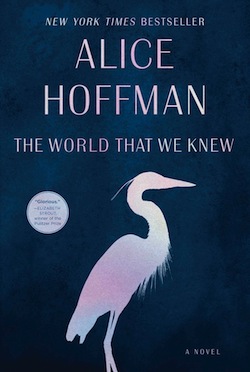
An absolute pleasure to read, and just as page-turning, is veteran author Alice Hoffman’s latest novel, The World That We Knew, set during the Holocaust. In it, there is magic. It is tangible – the golem Ava, created by Ettie, the precocious daughter of a respected rabbi, to protect Lea – and more abstract, in the loyalty of Ava to Lea and the beautiful friendship that develops between Ava and a blue heron along their journey.

image - The World That We Knew book coverAfter her husband is murdered and her daughter Lea is almost raped, Hanni knows she must get Lea to Paris, but she herself cannot leave Berlin. So, she turns to the rabbi for help, but making a golem is risky business and he won’t do it. Ettie, though, plans to escape with her younger sister, and Hanni’s payment will help her do that. Ettie has observed her father at work, and is able to bring Ava into being. As Ava becomes more seemingly human, however, and forms a bond with the blue heron, the main tension of the novel arises – will her appreciation for her own life and its possibilities outweigh her responsibility to Lea?

Many other tensions and relationships mingle with history, which is sometimes pedantically told but always interesting. The World That We Knew is a well-woven and moving story that offers an understanding not only of the past but of the emotions that motivate us and the connections we make with one another.

Posted on September 11, 2020September 10, 2020Author Cynthia RamsayCategories BooksTags Alice Hoffman, historical fiction, Holocaust, magical realism, Samantha M. Bailey, The World That We Knew, thrillers, Woman on the Edge
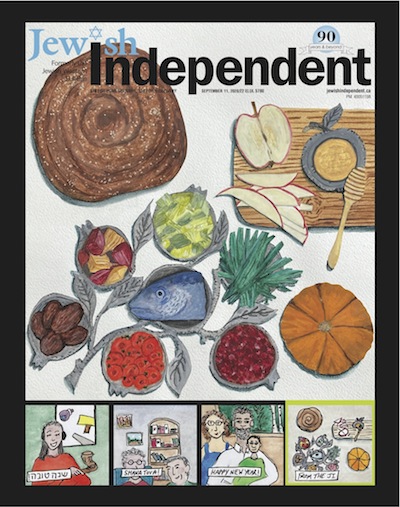
About the Rosh Hashanah cover art

About the Rosh Hashanah cover art

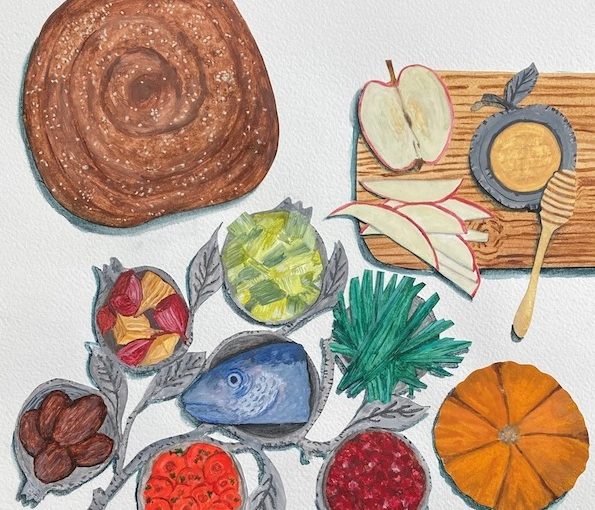
I was introduced to the Sephardi and Mizrahi tradition of a Rosh Hashanah seder by a dear friend, at whose home I celebrate most of the Jewish holidays. This New Year’s, given the pandemic and that we are not in each other’s immediate bubble, I will join their seder on the first night of Rosh Hashanah either outdoors, weather permit, I was looking, perhaps, to prepare myself mentally for this year’s socially distanced gathering, and a Zoom with my family in Ontario, when I thought of the idea for the cover, which is created using watercolour and ink (and surprisingly little Photoshop).

image - Jewish Independent Rosh Hashanah issue coverIn a Sephardi or Mizrahi seder, special dishes are served of specific foods whose Hebrew or Aramaic names are linked in a blessing to another word that has the same root letters. Puns flourish. So, for example, the Hebrew word for carrot and that for decree have different vowels but the same root letters – gimel, zayin and resh – and the blessing over the carrots translates as, “May it be your will, Lord our God, that that our bad decrees be torn up and our merits and blessings be proclaimed.” The word for leeks, chives or scallions – karti – is akin to yikartu, cut off, so the blessing over these vegetables is, “May it be Your will, God, that our enemies be cut off.”

Spinach or beet leaves also symbolize the hope that God will make our enemies retreat and we can “beat” a way to freedom. Dates carry the hope that hatred will end; the many seeds of a pomegranate that our mitzvot will be many; an apple that we will have a sweet year; string beans that our merits will increase; a pumpkin or gourd that God will “tear” away all evil edicts against us, while our merits are proclaimed. You get the idea.

For information on the New Year’s seder, I visited, among other sites, theicenter.org/resource/hebrew-and-rosh-hashanah-seder and myjewishlearning.com/article/a-sephardic-rosh-hashanah-seder. Not being adept at puns myself, I will leave you simply with a wish for a happy, meaningful and healthy 5781.

Format ImagePosted on September 11, 2020September 10, 2020Author Cynthia RamsayCategories Visual ArtsTags art, coronavirus, COVID-19, High Holidays, Judaism, Mizrahi, Rosh Hashanah, seder, Sephardi, tradition, Zoom
Evolution of the Jewish calendar

Evolution of the Jewish calendar

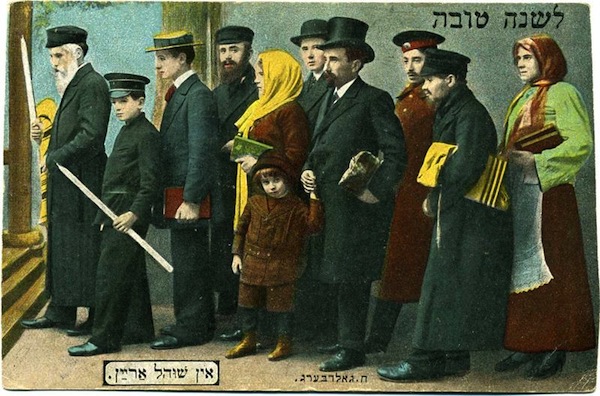
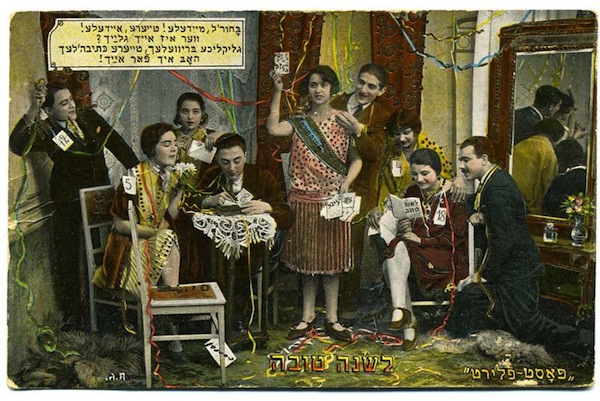
Rosh Hashanah greeting cards (above and below) from the author’s family’s collection. The cards are almost 100 years old. The translation of the one in which people are walking is “Into the synagogue.” It is signed by Chaim Goldberg, a well-known artist who also illustrated many children’s books. The party postcard, also done by Goldberg, is a printed rhyme, which translates as, “Boy, girl! Dear, refined! Who is like you? Happy letters, dear writings, I have for you!”

The Jewish calendar is an amazing conceptualization of time that has evolved (what else?) over time.

In his blog on the Museum of the Jewish People at Beit Hatfutsot website, Ushi Derman relates that, originally, the Jewish calendar was a solar calendar. But it was not just a solar calendar, it was a holy solar calendar, delivered by angels to Enoch. (See the Book of Enoch, the section dealing with astronomy, called “The Book of Heavenly Luminaries.”) Temple priests had to follow a rigorous schedule – time itself was judged to be sacred. Thus, the Temple in Jerusalem was regarded as both the house of G-d and the dwelling of time.

With the destruction of Jerusalem’s Second Temple, the priests lost their power. They were no longer the mediators between G-d and the people. Authority switched to the scholars (our sages) of the Mishnah (edited record of the Oral Torah), Talmud and Tosefta (similar to the Mishnah, but providing more details about the reasons for or application of the laws).

In a bold move, the scholars declared that G-d had handed religious authority to humans. “Each month, envoys were sent to watch the new moon and to determine the beginning of the month. Thus, the ownership of time was expropriated from G-d and delivered to man – and that is why the Hebrew calendar has survived for so many centuries,” writes Derman in the 2018 blog “Rosh Hashanah: The Politics and Theology Behind Jewish Time.”

Here is a lovely story from The Book of Legends, edited by Hayim Nahman Bialik and Yehoshua Hana Ravnitzky, illustrating the above change. A king had a clock. “When his son reached puberty, he said to him: My son, until now, the clock has been in my keeping. From now on, I turn it over to you. So, too, the Holy One used to hallow new moons and intercalate years. But, when Israel rose, He said to them, until now, the reckoning of new moons and of New Year’s Day has been in My keeping. From now on, they are turned over to you.”

Perhaps oddly, the Mishnah mentions more than one new year. In fact, it points out four such dates on the Jewish calendar:

  • The first of Nissan is the new year for kings and for festivals;
  • The first of Elul is the new year for tithing of animals (some say the first of Tishrei);
  • The first of Tishrei is the new year for years, sabbaticals and Jubilee, for planting and vegetables;
  • The first of Shevat is the new year for trees, according to the House of Shammai, while the House of Hillel (which we adhere to today) says the 15th of Shevat, or Tu b’Shevat.

With its thrice daily prayers, the synagogue came to replace the Temple. Excluding Yom Kippur, synagogue attendance is higher on Rosh Hashanah than any other time of year. Rosh Hashanah prayers are compiled in a special prayer book, or Machzor.

image - Rosh Hashanah greeting cards from the author’s family’s collection. The cards are almost 100 years old. The party postcard, also done by Chaim Goldberg, is a printed rhyme, which translates as, “Boy, girl! Dear, refined! Who is like you? Happy letters, dear writings, I have for you!”Amid COVID-19, the following words about Rosh Hashanah have heightened meaning: “The celebration of the New Year involves a mixture of emotions. On the one hand, there is a sense of gratitude at having lived to this time. On the other hand, the beginning of a new year raises anxiety. What will my fate be this year? Will I live out the year? Will I be healthy? Will I spend my time wisely, or will it be filled in a way that does not truly bring happiness?” (See the Rabbinical Assembly’s Machzor Lev Shalem for Rosh Hashanah and Yom Kippur, published almost a decade ago.)

Sounding the shofar is one of the special additions to Rosh Hashanah services. According to Norman Bloom – in a 1978 article on Rosh Hashanah prayers in Tradition: A Journal of Orthodox Jewish Thought – the timing of the shofar blowing weighed in the physical safety and comfort of the congregation. Hard as it may be to comprehend today, scholars considered potential attacks from both local enemies of the Jews and from Satan himself. They also considered the comfort of the infirm, who might not be able to stay through a long service.

Rosh Hashanah has other curious customs. For example, there is a tradition of having either a fish head or, among some Sephardim, a lamb’s head as part of the Rosh Hashanah meal. This is meant to symbolize that, in the year to come, we should be at the rosh or head (on top), rather than at the tail (at the bottom). Vegetarians and vegans substitute a head of lettuce.

Both Sephardi and Ashkenazi Jews have Rosh Hashanah seder traditions. The symbolic foods include beets, leeks, pomegranates, pumpkins and beans. As Rahel Musleah has pointed out, each food suggests a good wish for the coming year. Thus, before eating each one, people recite a special blessing. Humour is at play, too, as some of the blessings are puns on the food’s Hebrew or Aramaic name. (Read Musleah’s article “A Sephardic Rosh Hashanah Seder” at myjewishlearning.com/article/a-sephardic-rosh-hashanah-seder.) Of course, we cannot neglect to mention that the festive table also includes apples dipped in honey, for a sweet new year, and a round challah, symbolizing both the cycle of life and G-d’s kingship.

Another Rosh Hashanah custom is Tashlich. This ceremony involves going to a body of water to symbolically cast off one’s sins. Breadcrumbs are often used, as are leaves, but, seeing that COVID-19 will be a part of this year’s holiday, here is another suggestion. Originally, this activity was used with youth groups of the Reform movement – participants wrote out their sins and then the papers on which they were written were put through a paper shredder. A dramatic gesture, suited to our current need for social distancing.

My city, Jerusalem, is a land-bound city without a sea or lake in its immediate vicinity. So, what do residents of the capital do? Those who wish to practise Tashlich go to one of the following four sites. Two of the four places are near the Supreme Court: the Jerusalem Rose Garden and the Jerusalem Bird Observatory. Also in the same general area is the Botanic Garden in the Nayot neighbourhood and, in the Old City, one can go to the Shiloah Springs in City of David.

Wishing all readers a year of blessings and not of curses.

Deborah Rubin Fields is an Israel-based features writer. She is also the author of Take a Peek Inside: A Child’s Guide to Radiology Exams, published in English, Hebrew and Arabic.

  * * *

Additional observations

• Hebrew has a number of expressions using the word rosh. Here are just a handful of examples: rosh hamemshala (prime minister); rosh kroov, literally cabbage head, or a negative reference to someone who is not very bright; rosh katan, someone who is small-minded; l’kabel barosh, to be defeated; and rosh tov, or good vibes.

• Anyone interested in learning more about the solar calendar should read Prof. Rachel Elior’s article, “Enoch Son of Jared and the Solar Calendar of the Priesthood in Qumran,” which can be found in a Google search.

Format ImagePosted on September 11, 2020September 10, 2020Author Deborah Rubin FieldsCategories Celebrating the HolidaysTags history, Jewish calendar, Judaism, Mizrahi, New Years, Rosh Hashanah, seder, Sephardi, time, tradition
Celebrating world’s birthday

Celebrating world’s birthday

(photo from pikist.com/free-photo-vqamg)

One of the many names of Rosh Hashanah, the Jewish New Year, is Yom Harat Olam, the birthday of the world. It is the day on which our tradition says the world was created.

Before we can begin to celebrate this “birthday,” however, something is required of us. During the month prior to Rosh Hashanah, we prepare ourselves spiritually for forgiveness and, in the 10 days between Rosh Hashanah and Yom Kippur, the Day of Atonement, we are meant to ask forgiveness of anyone we may have hurt during the year, even unintentionally. We are required to atone for wrongs between people, in contrast to the sins that arise between us and G-d. We cannot make a spiritual “return,” if we remain shackled with unresolved guilt and resentments.

More Jews attend synagogue on these two holidays than at any other time. Many of the prayers praise the mighty and wondrous works of the Creator, in keeping with the theme of “the birthday of the world.” We are to recognize that life itself is a Divine gift and has a sacred purpose.

According to our tradition, everything we do is recorded in the Book of Life. No deed, word, thought, good or evil, goes unrecorded. The record is supposedly kept in heaven. One belief accords this job to Elijah the prophet, keeper of the records of humanity’s deeds. On Rosh Hashanah, the Book of Life is examined, our acts in the preceding year weighed and judged. On this basis, it is decided “who shall live and who shall die … who shall be brought low and who shall be exalted.” For this reason, we wish for one another, “May you be inscribed for a good year.” We are taught that the only way to avert a severe decree is by “penitence, prayer and charity.”

According to Rabbi Kruspedai, in the name of Rabbi Yohanan, three books are opened on Rosh Hashanah – one for the wholly righteous, one for the wholly wicked and one for most of us, those in between. The wholly righteous are inscribed and sealed in the Book of Life, the wicked in the Book of Death and the rest of us are held suspended until Yom Kippur, when we are judged worthy or unworthy. The zodiacal symbol for the Hebrew month of Tishrei is, fittingly, a balance – the scales of justice.

Many people accompany all meals at this time with apples and honey. In addition to its other symbolism, the apple represents the Shechinah (Divine Presence), which kabbalists refer to as an apple orchard.

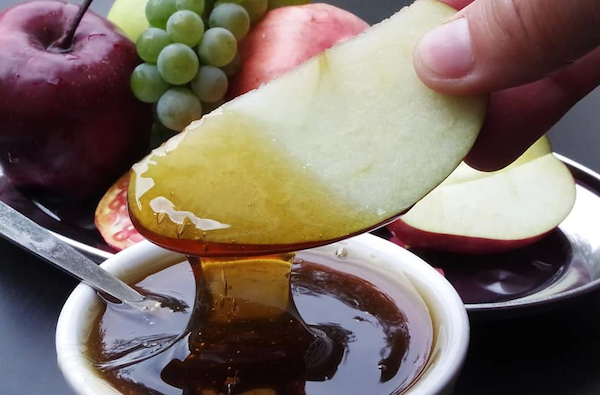
With the emphasis on creation at this time, it is customary to eat an apple dipped in honey on the first night of Rosh Hashanah, after the blessing on the wine and bread, and say: “Blessed art Thou, O Lord our G-d, King of the Universe, who created the fruit of the tree.” This is followed by: “May it be Your will, our G-d and G-d of our fathers, to renew unto us a good and sweet year.”

On the second day of Rosh Hashanah, we eat a new fruit – one we have not yet tasted this season – and we recite a blessing over it.

How do we know on what day of the year the world was created? We know that the first word of the Torah is Bereishit, in the beginning. When the letters are changed around, they read: aleph b’Tishri, the first of Tishrei, when G-d began to create the heaven and the earth.

May we all be inscribed for a good year.

Dvora Waysman is a Jerusalem-based author. She has written 14 books, including The Pomegranate Pendant, which was made into a movie, and her latest novella, Searching for Sarah. She can be contacted at [email protected] or through her blog dvorawaysman.com.

Format ImagePosted on September 11, 2020September 10, 2020Author Dvora WaysmanCategories Celebrating the HolidaysTags Book of Life, High Holidays, Judaism, new year, Rosh Hashanah, tradition

Reboot helps take stock

Reboot’s annual 10Q annual reflection project, which sends participants a question a day for 10 days will return for the 13th year this month. But, with the challenges, grief and fear of COVID-19 weighing heavily on the world, this year’s 10Q will include additional questions to offer a space for exploring and preserving feelings and experiences of this unique time in a digital time capsule.

Each year, for 10 days, the 10Q project from the nonprofit Reboot captures daily insights, experiences and beliefs from tens of thousands of people, many of whom have been participating since 10Q’s founding in 2008 and have amassed a personal archive.

“It has been found again and again that, when difficult circumstances hit, the simple experience of taking a pen and paper and allowing our inner voice to speak through our pens is in itself a healing and regenerative act,” said Nicola Behrman, 10Q co-founder (in partnership with writer Ben Greenman and educator Amelia Klein). “We know from 13 years of answers just how meaningful the 10Q experience is for so many, but, this year, when the foundation of everyday life has shifted so seismically and we are desperately attempting to find meaning in the madness, this simple act of reflection is both anchoring and essential.”

For 10 days, starting Sept. 18, and coinciding with the traditional period of reflection during the High Holidays, participants of all backgrounds will get the 10Q questions by email, leading them to their private digital portal, where the answers will be stored. The annual 10Q questions are not intrinsically religious and are focused on life, personal goals, plans for the future, relationships, our place in the world and more.

The answers are returned to participants the next year before the project starts again. The 10Q vault serves as a digital time capsule, and answers to the new questions will serve as a chronicle of experiences through COVID-19 that can also be shared by participants with future generations. For some people, this is a one-time experience; for others, 10Q has created an annual tradition of building a personal archive for future years and mapping personal growth.

Although the project is rooted in the Jewish idea of ethical wills and runs during the 10 days between Rosh Hashanah and Yom Kippur, in the last decade, more than 70,000 people of all backgrounds and ages have turned to 10Q for a meaningful and modern spin on the centuries-old tradition of introspection, atonement and self-change during the High Holidays. The questions have scrolled on the jumbo screens at Times Square in New York City and on the Las Vegas Strip.

“It has never felt so important to pause and reflect on ourselves and the world around us,” said Reboot chief executive officer David Katznelson. “We are living in such a unique moment of human history, a moment that is worth turning to the individual to ask big questions about what we can learn to take us into the future.”

To find out more about 10Q and to register, go to doyou10q.com. Find out more about Reboot at rebooters.net.

Posted on September 11, 2020September 10, 2020Author RebootCategories Celebrating the HolidaysTags High Holidays, introspection, Judaism, new year, Reboot, Rosh Hashanah, self-reflection, time capsule

The danger in certainty

Like many of you, I approach the New Year and Yom Kippur with a heavy heart. Ashamnu. We have sinned. Much is not well, not as it should or can be. Our communities are filled with anger, fear, hatred, pain, and acrimony.

Our tradition placed a heavy burden on us. Atonement is only attainable when accompanied by a commitment to change one’s behaviour. The burden is doubly heavy, for we are not merely responsible for our individual failings, but for our societal ones. Ashamnu. We have sinned. Yom Kippur is not merely a day of prayer in search of Divine forgiveness, but a day of taking responsibility for the world that we have created.

There are so many places to start this process and, for those who don’t know where, the Jewish prayer book provides guidance. Ashamnu. Bagadnu. Gazalnu. Dibarnu dofi. We have sinned. We have betrayed. We have taken that which is not ours. We have spoken evil.

This year, I will begin with the sin of certainty. The certainty that I have the truth and others do not. The certainty that I am right and others wrong. The certainty that I am good and others bad. The certainty that I love my country and others do not.

“Our God and God of our ancestors, we are neither so insolent nor so obstinate as to claim in your presence that we are righteous, without sin; for we, like our ancestors who came before us, have sinned.” (Yom Kippur Machzor)

Inherent to every social structure is the reality of difference. Members, adherents, citizens, who join or are joined together by blood, race, gender, ideology, religion, culture or nationality, inevitably find themselves disagreeing over issues both minor and major. Differences are a permanent and inevitable reality of life. By themselves, they do not undermine social cohesion. What threatens unity is how we respond to the reality.

The three conceptual tools for reflecting on difference are pluralism, tolerance and deviance. When those who are different are classified as deviant, the possibility of a shared society with them comes to an end. It is here that the sin of certainty spreads its destructive poison. The hubris of certainty allows one to shun and shame those who do not share in the truth as you know it, and to move them to the margins of society, if not outside it. Armed with certainty, acts of blatant aggression are clothed with the garments of self-preservation and sanctioned as acts of group loyalty.

A certainty of a different form is played out in the category of pluralism. We are pluralistic toward those differences that we assume to be of equal value to our own positions – “These and these are the words of the living God.” With pluralism, we accommodate difference that we believe is equally authentic and that we can associate as being on par with our truth, our knowledge and our beliefs. These and these are the words of the living God, but not those and those. And the one who decides is us.

Why tolerate that which I believe to be wrong?

The danger that lies with the sin of certainty is that it attempts to create social life around the categories of pluralism and deviance alone. Difference to which I ascribe value is accommodated and welcomed as my friend. Difference that I do not, is rejected and ostracized as my enemy. I and my certainty are the ultimate arbiters of who is in and who is out, who is valued and who is not, who is to be cared for and who is not, who is to be respected and who vilified.

It is tolerance, the often-derided category, that is most absent in much of contemporary social discourse. One does not tolerate that which one values, but rather that which one thinks is wrong. Tolerance can only take root in those places where we are able to relinquish our claim to certainty. Why tolerate that which I believe to be wrong? Because I know it is possible that my belief may also be wrong. Because I believe that truth, knowledge and enlightenment will only grow when I expose my certainty to the critique of others; when I am open to learn from others’ truths, knowledge and experience.

Why tolerate that which I believe to be wrong? Because I and those like me do not have a monopoly over the “true” identity of our society. It is theirs just as much as it is ours. We are destined to live with those who believe and do that which we hold to be intolerable. In some cases, judgment of deviance is both called for and necessary and, without boundaries, our societies will dissolve and lose any purpose, meaning and identity.

Which difference do we tolerate, and which do we not, is the question. The sin of certainty both blinds us to this question and renders us incapable of such discernment. The price? The price is the dysfunctional harmful social discourse and behaviour dominating our lives today.

“Our God and God of our ancestors, we are neither so insolent nor so obstinate as to claim in Your presence we are certain.”

Rabbi Dr. Donniel Hartman is president of the Shalom Hartman Institute and author of the 2016 book Putting God Second: How to Save Religion from Itself. Articles by Hartman and other institute scholars can be found at shalomhartman.org.


Posted on September 11, 2020September 10, 2020Author Rabbi Dr. Donniel Hartman SHICategories Celebrating the HolidaysTags certainty, High Holidays, introspection, Judaism, lifestyle, Rosh Hashanah, self-reflection, Shalom Hartman Institute
A history of sweetness

A history of sweetness

(photo from pixabay.com)

Although beekeeping as an occupation is not mentioned in the Bible, bees are mentioned four times, honeycombs are referred to eight times and honey is referred to 26 times. Archeologists actually have discovered proof that there was beekeeping and honey 3,000 years ago in a site in northern Israel.

Among Ashkenazim, sweet desserts for Rosh Hashanah are customary, particularly lekach, or honey cake, and teiglach, a hard, doughy, honey and nut cookie. Some say the origin of the sweets comes from a passage in the book of Hosea mentioning “love cakes of raisins.” There is also a passage in II Samuel, which talks about the multitude of Israel, “to everyone a cake of bread and a cake made in a pan and a sweet cake.”

It was Ezra, the fifth-century BCE religious leader who was commissioned by the Persian king to direct Jewish affairs in Judea, and Nehemiah, a political leader and cup bearer of the king in the fifth century BCE, who told the returning exiles to eat and drink sweet things.

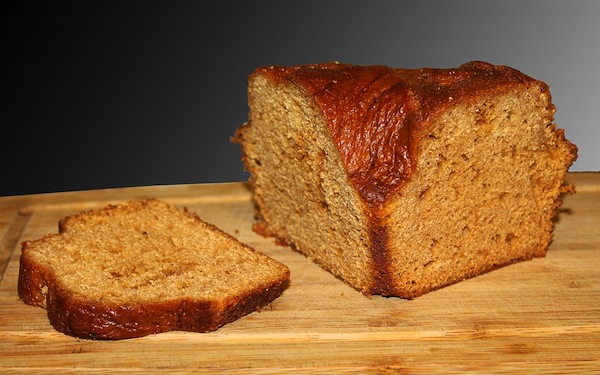
Honey cakes traditionally include honey, spices, coffee and brown sugar as major ingredients, but some contain cognac, brandy, orange or lemon peel and nuts. In Curaçao, for example, cinnamon, ginger, nutmeg, raisins, nuts or currants, lemon or orange peel is added. In Zimbabwe, Jews include allspice, cinnamon, cloves, raisins, chopped nuts, brandy and chopped candied fruit in their honey cake.

In That Hungarian’s in My Kitchen, Linda Radke includes a Hungarian recipe from her family, which includes the basic ingredients and orange juice. A cookbook of Russian recipes includes a Ukrainian honey cake, medivik, with the basic ingredients as well as cardamom, orange peel, raisins, walnuts and apricots.

In The Jewish Book of Food, Claudia Roden writes that honey cake was a favourite in Germany as far back as the Middle Ages, and that lebkuchen, honey gingerbread, was also mentioned as early as the 12th century.

According to John Cooper in Eat and Be Satisfied: A Social History of Jewish Food, references to honey cake were made in the 12th century by a French sage, Simcha of Vitry, author of the Machzor Vitry, and by German rabbi Eleazar Judah ben Kalonymos. Cooper writes that, on the new moon in the month of Nissan, boys at Jewish school were given honig lekach, honey cake: “Originally, the names of angels were inscribed on the honey cake and amulets were attached to them, but later this practice was discarded.” According to Cooper, the words lebkuchen and lekach probably came to be related to the German word for lick, lecke.

By the 16th century, lekach was known as a Rosh Hashanah sweet. It also became popular for other lifecycle celebrations, such as betrothals and weddings. Malvina W. Liebman writes in Jewish Cooking from Boston to Baghdad that Crypto-Jews in 16th-century Latin America ate honey cake at weddings, in memory of the honeycomb that an angel gave to Asenath when she married Joseph.

In The Complete International Jewish Cookbook, Evelyn Rose (z”l), a maven of Jewish cooking from England, wrote that the first cakes made with artificial raising agents were honey cake, and honey was the chosen sweetener because sugar was not widely available until the end of the 19th century. As an aside, she also recommends keeping a honey cake in a closed container for a week before serving it, so it will “mature.”

Among the Chassidim, it was customary for the rebbe to distribute lekach to his followers, and others would request a piece of honey cake from one another on Erev Yom Kippur. This transaction symbolized a substitute for any charity the person might choose to receive.

Gil Marks (z”l), in The World of Jewish Desserts, says fluuden, a layered yeast cake, was traditional for Rosh Hashanah among Franco-German Jews. Made with a cheese filling, it could be eaten after a meat meal, since they only waited one hour between meat and dairy. Strudel, from the German word for whirlpool, was also common for Rosh Hashanah among European Jews.

The most traditional cookie for Rosh Hashanah is teiglach, the dough pieces dropped into a hot honey syrup and simmered until brown then left to cool. It has been suggested that this Eastern European sweet was probably invented by some housewife who had dough left over and dropped the pieces into a boiling honey syrup.

Many Jews of Sephardi background make tishpishti for Rosh Hashanah. This cake with walnuts, almonds, hazelnuts or pecans, has a hot syrup poured over it. The syrup can be made with sugar, water and liqueur, according to Rabbi Robert Sternberg in The Sephardic Kitchen. Sternberg also points to rodanchas as a popular Sephardi Rosh Hashanah sweet. These spiral-shaped pastries of phyllo dough contain a pumpkin or squash filling because these vegetables and their shape symbolize the cycle of life and the ascent of the soul into heaven.

Here are some honey cakes to try this year.

TISHPISHTI
Jews who lived in Turkey after being expelled from Spain in 1492 adopted this dish, whose name means “quick and done.” Some say it was always served on Rosh Hashanah, but it was also popular for Passover because it has no flour.

2 cups ground almonds, hazelnuts, pistachios or walnuts
1 cup cake meal
1 tsp ground cinnamon
1/2 tsp ground cloves or allspice
6 separated eggs
1 cup sugar
2 tbsp orange juice
1/2 cup vegetable oil
1 tbsp grated lemon or orange peel
* * *
3/4 cup honey
1/2 cup sugar
2/3 cup water
1/4 cup lemon juice

  1. Preheat oven to 350°F. Grease a rectangular baking pan.
  2. In a mixing bowl, combine nuts, cake meal, cinnamon and cloves or allspice.
  3. In another bowl, beat egg yolks with sugar. Add to nut mixture along with orange juice, oil and lemon or orange peel.
  4. Beat egg whites in another bowl until stiff. Fold into batter. Pour into cake pan and bake 45 minutes.
  5. Place honey, sugar, water and lemon juice in a saucepan. Stir until sugar dissolves. Increase heat, bring to a boil and cook for one minute. Let cool.
  6. Cut cake into squares or diamonds. Drizzle syrup over cake. Serve warm or at room temperature.

MOM’S HONEY LOAF CAKE
I don’t recall my mom baking this, but it was in my collection of recipes as being hers.

3 1/2 cups flour
1/4 tsp salt
1 1/2 tsp baking powder
1 tsp baking soda
1/2 tsp ground cinnamon
1/8 tsp ground cloves
1/2 tsp ground ginger
1/4 tsp ground nutmeg
4 eggs
3/4 cup sugar
1/4 cup vegetable oil
* * *
2 cups honey
1/2 cup strong coffee
1/2 cup raisins
1/2 cup chopped nuts

  1. Preheat oven to 325°F. Grease two loaf pans or a rectangular baking pan.
  2. Combine in a bowl flour, salt, baking powder, baking soda, cinnamon, cloves, ginger and nutmeg.
  3. Beat eggs and sugar in another bowl until fluffy. Add oil, honey and coffee.
  4. Stir in flour mixture. Add raisins and nuts. Pour into pans. Bake for 1.5 hours.

Sybil Kaplan is a journalist, lecturer, book reviewer and food writer in Jerusalem. She created and leads the weekly English-language Shuk Walks in Machane Yehuda, she has compiled and edited nine kosher cookbooks, and is the author of Witness to History: Ten Years as a Woman Journalist in Israel.

Format GalleryPosted on September 11, 2020September 10, 2020Author Sybil KaplanCategories Celebrating the HolidaysTags food, history, honey cake, recipes, Rosh Hashanah, tradition

Foods that babas made

I’m here to boldly encourage you to try something entirely different at your Rosh Hashanah table this year. No, not a pony. A new food. Serve it, to non-vegetarians. And, if anybody asks what they’re eating, confidently tell them it’s a family secret. Don’t forget to mention that, if you tell them, you’ll have to kill them. That generally stops people in their nosy tracks. Let me be perfectly transparent: the food I’m about to suggest is on the meat spectrum. Alright, meat adjacent.

Isn’t it enough that everyone’s oohing and ahhing over the unparalleled tenderness of the dish? The specifics are strictly on a need-to-know basis. And no one needs to know. Except your butcher. OK, enough. It’s beef tongue. You heard correctly. I’m aware it’s not politically correct – after all, some farmer is clearly stifling free speech. Even if it only belongs to a cow. (And, technically, they can’t speak anyway. So moot point.)

Just so we’re clear, beef tongue is definitely not vegan. Or vegetarian-friendly. Not by a New York mile. I’m simply providing you with an alternative to screaming chicken, Coca-Cola brisket and mayo-slathered, onion soup-mix salmon.

I know that beef tongue screams old school (and Council cookbook). But so do I. And, if we’re going to be honest about it, people are still enthusiastically scarfing down ketchup-glazed meatloaf and baked salami filled with French’s mustard. They’re just not yelling it from the rooftops. So, loosen up and try thinking of beef tongue as a distant relative. Second cousin twice removed. Only maybe a little farther. But, still, meat mishpachah.

Before you pooh-pooh it, give it a shot. At least Google it and see what other Jews have to say about it. Most delis sell it pickled. But, believe me, pickled tongue has nothing on the sweet and sour version. Personally, I prefer to just boil it, cool it and eat it in a sandwich. With yellow mustard. On white bread. I can see the lynch mob in the distance.

The cooking part is where it gets tricky. If you’re a man, chances are you can’t relate to what I’m about to describe. You ladies, on the other hand, will understand perfectly. The cooking per se is easy (see recipe below). The next part is where it gets awkward. Once it’s cooked, you need to peel off the rubbery outside skin: think of taking off a pair of too-thick, too-tight pantyhose. That are wet. And it’s a hot, humid day. Not a particularly appealing visual, but it’s fairly accurate hyperbole.

Trust me when I tell you that your family/guests will be drooling all over themselves, demanding the recipe – if they can get past the sordid cooking details. Without further ado, here goes. And don’t be fooled by the simplicity of the recipe. You’re welcome.

SWEET AND SOUR BEEF TONGUE

1 beef tongue
2 onions, peeled and quartered
3 cloves garlic, peeled and halved
2 bay leaves
***
15 oz can of tomato sauce
15 oz water
3/4 cup brown sugar
juice of 1 lemon
1/2 cup sultana or dark raisins
dash of Worcestershire sauce (optional)
salt and pepper

Put the tongue and the rest of the ingredients into a deep pot with enough water to cover it well. Bring to a boil and simmer partly covered for about three-and-a-half hours, until tender when pierced with a fork. As it’s cooking, skim off the shmootz that forms on top. When tender, remove from the water. While it’s still warm, remove the skin (see detailed, gross description above), bones and stem. Slice and serve as is, or slice and serve with the sweet and sour sauce.

At the end of the day, a well-cooked beef tongue is all you need and nothing you don’t. But, I get that some of you are disgusted at the thought of eating tongue. So, for you finicky folks, I offer up another old school recipe – short ribs. This one is decades old and was handed down from my father’s cousin, Bertha Bloom. Nobody said it was diet food, so, if you’re not fussy about calories, go for it. Short ribs are notorious for being fatty, but therein lies most of their charm. Alright, all of their charm. You’ll diet tomorrow. And, hopefully, not die of clogged arteries tonight. But, have your cardiologist on speed dial, just in case.

BERT BLOOM’S BARBEQUE SHORT RIBS

Season two pounds of short ribs with salt, pepper and garlic salt then broil them until brown and half cooked. Transfer them to a covered Dutch oven (or similar deep roasting pan). For the sauce:

1 cup chili sauce
1/4 cup ketchup
4 tsp dry mustard
1/2 cup brown sugar
1 clove garlic, crushed
1 tbsp soy sauce
small tin of crushed pineapple

Mix the ingredients together – including the juice from the pineapple tin, but not the pineapple – put in a pot and bring to a boil. Pour the sauce over the ribs and cook covered at 300°F to 325°F for one-and-a-half to two hours, basting occasionally. Add the crushed pineapple 20 minutes before it’s finished cooking and leave uncovered. Prepare to be awed by the yumminess factor.

For your guests who prefer healthy food, you may want to direct them elsewhere for Rosh Hashanah dinner. Or, if you’re a really nice and accommodating host, make them a marinated tofu mock-roast. Or a Tofurkey. But, for those of you indulging in the short ribs, now might be a good time to loosen your belt or unzip your skirt, and prepare to stuff your belly. It’s Rosh Hashanah. Celebrate with some new arterial stents! Tell Dr. Saul I sent you.

Shelley Civkin, aka the Accidental Balabusta, is a happily retired librarian and communications officer. For 17 years, she wrote a weekly book review column for the Richmond Review. She’s currently a freelance writer and volunteer.

Posted on September 11, 2020September 10, 2020Author Shelley CivkinCategories Celebrating the HolidaysTags beef tongue, cooking, Rosh Hashanah

Posts pagination

Previous page Page 1 … Page 251 Page 252 Page 253 … Page 664 Next page
Proudly powered by WordPress