Skip to content
  • Home
  • Subscribe / donate
  • Events calendar
  • News
    • Local
    • National
    • Israel
    • World
    • עניין בחדשות
      A roundup of news in Canada and further afield, in Hebrew.
  • Opinion
    • From the JI
    • Op-Ed
  • Arts & Culture
    • Performing Arts
    • Music
    • Books
    • Visual Arts
    • TV & Film
  • Life
    • Celebrating the Holidays
    • Travel
    • The Daily Snooze
      Cartoons by Jacob Samuel
    • Mystery Photo
      Help the JI and JMABC fill in the gaps in our archives.
  • Community Links
    • Organizations, Etc.
    • Other News Sources & Blogs
    • Business Directory
  • FAQ
  • JI Chai Celebration
  • JI@88! video

Recent Posts

  • Zionism wins big in Vegas
  • Different but connected
  • Survival not passive
  • Musical celebration of Israel
  • Shoppe celebrates 25 years
  • Human “book” event
  • Reclaiming Jewish stories
  • Bema presents Perseverance
  • CSS honours Bellas z”l
  • Sheba Promise here May 7
  • Reflections from Be’eri
  • New law a desecration
  • Resilient joy in tough times
  • Rescue dog brings joy
  • Art chosen for new museum
  • Reminder of hope, resilience
  • The national food of Israel?
  • Story of Israel’s north
  • Sheltering in train stations
  • Teach critical thinking
  • Learning to bridge divides
  • Supporting Iranian community
  • Art dismantles systems
  • Beth Tikvah celebrates 50th
  • What is Jewish music?
  • Celebrate joy of music
  • Women share experiences 
  • Raising funds for Survivors
  • Call for digital literacy
  • The hidden hand of hate
  • Tarot as spiritual ritual
  • Students create fancy meal
  • Encouraging young voices
  • Rose’s Angels delivers
  • Living life to its fullest
  • Drawing on his roots

Archives

Follow @JewishIndie
image - The CJN - Visit Us Banner - 300x600 - 101625

Masa Canada visits the coast

Masa Canada visits the coast

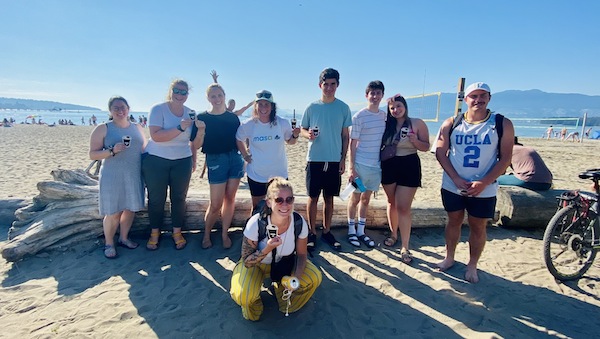
Mahla Finkleman, Canadian national manager of partnership and outreach for Masa Israel Journey (standing, fourth from the left), at Kits Beach in July with participants of the Shalom U’Lhitraot event. (photo from Masa Canada)

While the skies were closed for the first waves of the pandemic, with many organizations canceling their Israel trips, Masa Israel Journey saw an increase of almost 40% of North American students and young professionals traveling to Israel to partake in immersive four-to-10-month programs.

Since its establishment in 2004 by the Jewish Agency and the government of Israel, Masa has served more than 180,000 Jewish students and young professionals ages 16 to 35, from more than 60 countries. Offering experiences in gap, academic and career segments, Masa provides an unmediated and challenging journey into Israeli society, culture, politics and history, as well as access for global Jewry to Israeli businesses, social enterprises and academic institutions. Masa strengthens the Jewish leadership pipeline through the Impact and Leadership Centre, based in Jerusalem. When fellows return from Israel, they are ready to engage as active members in their community and many take on leadership roles.

Masa has regained a strong presence in Canada, with a new Canadian national manager of partnership and outreach, Mahla Finkleman, who sits within the Federation of Greater Toronto, and visits communities across the country. Since Finkleman started just over one year ago, Masa has sent more Canadians than ever before to Israel on programs.

This past summer, working from Vancouver, Finkleman partnered with the Community Kollel for a Shabbat dinner for Tu b’Av. Some 60 to 70 young professionals, including many Birthright alumni, gathered to learn about Masa opportunities and ways to get back to Israel for a meaningful experience, living like a local.

Earlier in the summer, in July, the first of three Shalom U’Lhitraot events took place, welcoming back Masa alumni from Israel and sending off others to Tel Aviv University, Masa Israel Teaching Fellows (MITF) and other programs.

A new condensed version of MITF is available now. MITF is an option for 21-to-35-year olds who have a bachelor’s or associate degree and whose mother tongue is English. Applications are due Nov. 1, with three city options to choose from: Rishon LeZion, Bat Yam and Ramle. The program, which costs $720 US, runs in 2023 from Jan. 5 to July 2, and is an exclusive partnership with Israel Experience.

Each city offers its own unique charm. In Bat Yam, you can take surf lessons and deep dive into the Israeli-Russian community. Rishon is Israel’s fourth largest city, with malls, parks, beaches and a zoo. And, in Ramle, an ancient city with mixed cultures and a rich history, the Pool of Arches is a top attraction, as is the Ramle market – additional perks are the spacious homes and a pool pass.

For more information, visit masaisrael.org/canada or the North American site, masaisrael.org. Anyone who has questions can also email Finkleman directly at [email protected].

This Rosh Hashanah, look out for Masa alumni postcards on the seats of your local Vancouver shul.

Format ImagePosted on September 16, 2022September 14, 2022Author Masa CanadaCategories Israel, NationalTags Canada, education, Israel, leadership, Mahla Finkleman, Masa Canada
Multicultural experience – new music releases offer unique rhythms and stories

Multicultural experience – new music releases offer unique rhythms and stories

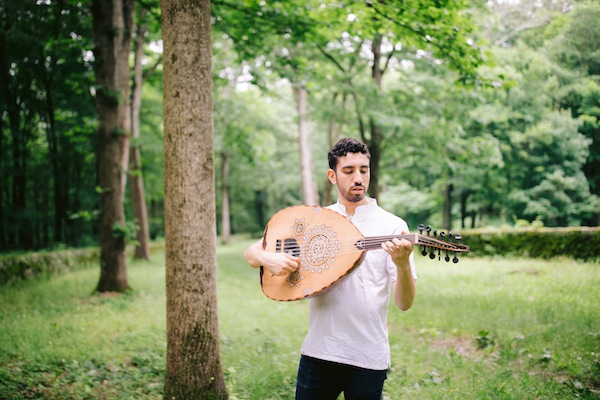
Yoni Avi Battat (photo by Richard Ijeh)

On Sept. 2, multi-instrumentalist, singer and composer Yoni Avi Battat released his debut album, Fragments, a collection of original and traditional music surrounding his Iraqi-Jewish identity. With lyrics in Arabic, Hebrew, English and Yiddish, the music uses Arabic modes and rhythms with an ensemble of traditional Arabic instruments to make sense of the artist’s fragmented identity.

“Growing up in an American Jewish community dominated by European culture, I had very little access to the music, language and traditions of my Iraqi-Jewish ancestors,” said Battat. “As an adult, I’ve had to make a concerted effort to learn Arabic music and language in order to represent my Arab-Jewish ancestry as a musician. Studying these musical traditions has connected me deeply with my roots, but there are still so many parts of my family’s experience about which I will never know. I can no longer ask my grandparents about their life in Baghdad or their departure from Iraq. I can’t visit the land where my ancestors lived for thousands of years.”

Battat dove into scholarship of Jewish Arabic poetry, researching translations and tracking down rare editions of Arabic books. In doing so, he was able to source the Arabic texts that helped him begin to answer his questions. By pairing these words with existing and original lyrics in other languages, and setting them to Arabic musical modes, Battat envisioned his own method to make sense of fragmented identity.

“As you experience these original and traditional pieces, I invite you to approach memory in a new way – not through exact facts, dates and photos but through your senses and your imagination,” he said. “Allow these smells, textures, tastes and sounds to transport you to a place and time you have never been. When we cannot access the specific details of our families’ stories, our imagination can still bring us a real and intimate connection with where we come from.”

Battat’s great-uncle, Razi, is his only remaining direct connection to the generation that was born in Iraq. Battat has been lucky to hear him sing at the tiny synagogue in Jerusalem where he’s been praying for decades. On the track “El Eliyahu,” a traditional Iraqi melody, the timbre of Razi’s voice offers a lens into a different time and place.

Another song, “Will Her Love Remember?” brings to life a Hebrew poem from the 10th century, one of the only remaining examples of poetry from this era thought to be written by a woman. The wistful melody and carefully metred lines show us how physical objects can be imbued with memory and allow us to hold our loved ones close, even when they are so far away.

Yet another relatable piece, “What Would You Say?” recounts the artist’s attempts to recreate his grandmother’s cooking and his struggle to get it just right. The chorus comforts any home cook with imagined advice and affirmation from Battat’s grandmother, Violet: “Take it slow. Take it easy. Trust your hands.”

For more on Iand Battat, visit yonibattat.com.

* * *

photo - Tamar Eisenman
Tamar Eisenman (photo from eisenwoman.com)

At the start of this year, Tamar Eisenman released Rain & Dirt, which includes 11 new tracks recorded in New York City, Shanghai and Tel Aviv, bringing together a multicultural musical experience from a guitarist’s perspective. Songs on this album observe the nexus between the life you’ve planned and the life you’re living. The main prism revisits the story and feeling of someone traveling between countries, trying to build a home and start a family.

A trio session with longtime friends, musicians Rea Mochiach and Yonatan Levy, produced an alternative wrap of musical textures, combining blues, rock, jazz and muddy funk. The trio were joined on some tracks by Yoed Nir on cello, pianist Chano Dominguez and saxophonist Amit Friedman.

The musical approach emphasizes the feeling and concept of living in a constant gap between languages, homes and cultures. This led to a real-time recording of events in the studio. Long jams created the rebirth of songs and paved the arrangements, as a reflection to all those plans you made that changed along the way and created new realizations.

“It’s a bit strange releasing an album that was ready and completed almost two years ago,” said Eisenman. “But, we all know what happened in the past two years, that obviously reflected this process. On normal days, I would have used all that ‘quiet time’ and lockdown state of mind to create and record. As New York City was shutting down, by the end of March, I had a baby – my first. I did not expect this would be my maternal experience; I couldn’t imagine this in my wildest dreams.”

For more information, visit the website  eisenwoman.com.

Format ImagePosted on September 16, 2022September 14, 2022Author WorldiscCategories MusicTags Tamar Eisenman, Yoni Battat
History of “left coast”

History of “left coast”

David Spaner’s new book, Solidarity: Canada’s Unknown Revolution of 1983, forms an archival testament of one of this province’s most dramatic epochs.

One of the funny things about watching the 1976 movie All the President’s Men, about how Washington Postreporters Bob Woodward and Carl Bernstein broke Watergate and brought down Richard Nixon, is that, after 138 minutes of sitting on the edge of your seat, you realize that you’ve watched nothing more than two men making phone calls and knocking on doors asking questions. In other words, stuff doesn’t need to blow up in order to make an excellent movie. This thought occurs when reading Vancouver author David Spaner’s new book, Solidarity: Canada’s Unknown Revolution of 1983. On the surface, the book is a litany of bureaucratic meetings and activists’ backstories. Together, they form an archival testament of one of this province’s most dramatic epochs.

Spaner, an activist and journalist who has been immersed in the left-wing ferment for most of his life, chooses a different Hollywood reference. At the end of the book, he alludes to the 1983 film The Big Chill, in which disenchanted middle-agers convene for a friend’s funeral and lament their glory days. For anyone who has been part of British Columbia’s left-wing movements – recently, in 1983, or decades earlier – this book will provide many Big Chill moments. An initial criticism might be the title, which alleges this history is forgotten. Any person who was living in British Columbia in 1983 and even moderately politically aware will not forget that riotous time, though Spaner revives it effectively for new audiences.

Spaner’s thesis is that British Columbia’s well-known legacy of progressive activism that began in the 19th century converged in 1983. All the economic, social, racial, gender and other movements cohered in response to unparalleled government excess – and then refracted again into the myriad organizations and causes that drive B.C. politics today.

The province’s long history of progressive activism weaves its way through the book. More volunteers from Vancouver signed up to fight Franco’s fascists in the Spanish Civil War than from any other North American city save New York, Spaner says. And, in a more trivial note, he claims that the Industrial Workers of the World got their nickname “Wobblies” right here. Greenpeace was founded in Kitsilano in 1971. Movements against the Vietnam War and nuclear warships found fertile ground here. A squatters’ park stopped development at the entrance to Stanley Park. A “smoke-in” in Gastown protested police brutality and called for loosened marijuana laws. The Simon Fraser University Women’s Caucus, formed in 1968, was, according to the book, not only the first such group in Western Canada, but the first in North America. The first rumblings of gay rights activists were heard in these parts around the same time.

With all this as a foundation, the events of 1983 exploded out of the results of the provincial election on May 5. Dave Barrett’s New Democrats, who had governed the province for a short but tumultuous two-and-a-half years beginning in 1972, had been widely anticipated to defeat Bill Bennett’s right-wing Social Credit government. Instead, Bennett pulled out a surprise victory – and then launched a “restraint movement” that was unprecedented in Canada and is often compared with Thatcherism in Britain and Reaganism in the United States. On July 7, Bennett and his cabinet “unleashed a far-right legislative avalanche that tossed asunder virtually every advance achieved by B.C.’s social activists and trade unionists,” Spaner writes. “In an instant, and from every corner of the province, there was a rising of resistance.”

Almost exactly two months after the election, Bennett’s Socreds dropped 27 radical bills, affecting every area of government operations. For starters, 1,400 members of the B.C. Government and Services Employees Union (BCGEU) were summarily fired the day after the bills were tabled. The government eliminated special education programs, reduced student loans, fired family support workers, took away autonomy from local school boards and mandated fewer teachers and larger class sizes. Environmental protections were removed, welfare rates frozen, healthcare facilities closed and programs, including the Human Rights Commission, were cut. Funding for programs in services like the Vancouver Women’s Health Collective were eliminated. They closed the Tranquille mental health facility in Kamloops and fired its 600 employees. Labour relations laws were amended to take away rights such as seniority, working hours and overtime in collective agreements. Tenants could be evicted without cause and the Rentalsman’s office was eliminated, meaning any disputes would have to go to expensive court proceedings. The Agricultural Land Act, intended by the Barrett government to protect farmland, was gutted. User fees for hospital care increased exponentially.

Organized labour mobilized as soon as they could shake off the disbelief about what they were confronted with. They formed Operation Solidarity, an umbrella covering 400,000 unionized workers in the province, under the not-so-gentle guiding hand of the B.C. Federation of Labour. A parallel group, the Solidarity Coalition, was a motley amalgam of community groups and activists, less hierarchical and disciplined than the trade union groups. (The names were lifted from the nascent Polish anti-communist movement emerging at the time, but the ruptures in the B.C. movement make the moniker somewhat ironic.)

The first big rally took place in Victoria’s Memorial Arena, attracting 6,000 protesters. This was where the initial idea of an all-out general strike gained currency – and the seeds of the movement’s destruction were planted. A massive rally followed in front of the old CN station at Thornton Park on Main Street in Vancouver, on July 23. Organizers had hoped for 2,000 attendees but 25,000 showed up.

As is common in activist circles, Jewish individuals played an outsized role. The author, who is Jewish, comes by his credentials naturally – his grand-uncle was a good pal of Dave Barrett’s dad, Sam, in East Vancouver. One of the most visible faces of the movement was Renata Shearer, a Jewish refugee from Nazi Germany who was fired as the province’s human rights commissioner. Feminist and union leader Marion Pollock and Carol Pastinsky, who grew up in a left-wing household that hosted meetings of the United Jewish People’s Order, are featured in the book. And, of course, Barrett, who, despite his recent defeat, led the charge in the legislature against the onslaught, was the province’s first, and so far only, Jewish premier.

Another Jewish person, Stan Persky, launched and edited the movement’s publication, Solidarity Times. The newspaper, funded by organized labour, provides one of many examples in the book about bitter feuds within and between the disparate factions in the Solidarity mishpachah (family). A bunch of young, idealistic journalists who were working under Persky got a taste of censorship that they might have expected in a career with the bourgeois press but perhaps had not anticipated from their comrades in the movement. “Remember who writes your checks,” a union apparatchik warned them after spiking a story that didn’t toe the union line.

One of the most visible schisms in the mass movement occurred at a huge rally where most of the rank-and-file attendees were apparently champing at the bit for a general strike, but the more cautious leader of the movement, Art Kube, instead urged everybody to get a copy of a petition, have their neighbours sign it and send it in to the government in Victoria.

Said one activist reflecting his response that day: “We want militant action. We want to shut down this province. Instead, were being told, ‘Go get a petition signed.’”

But, while Kube was the one who disappointed that day, many in the movement believe it was his illness – a physical or mental breakdown – that led to what many or most view as the ultimate betrayal of the entire project. The BCGEU and the teachers’ union went on strike, shutting down huge swaths of the province. As pressure built, an unexpected – and largely unwanted – resolution was hatched by one segment of the union movement.

Within the Solidarity movement, there were schisms between the far-left and the comparatively more right-leaning unions, between radicals who wanted transformative change and reformers more narrowly opposed to specific legislation. There were, of course, also a lot of very strong personalities, all packed together and stressed by the pressures of the time.

With Kube sidelined by illness, the B.C. Federation of Labour sent Jack Munro, one of British Columbia’s feistiest, foul-mouthed and most divisive union figures, to meet with Premier Bennett at his home in Kelowna. When other partners in the Solidarity movement found out that the meeting was taking place, they knew they were done for.

“Munro and Bennett reached the quick agreement, settling the BCGEU contract but offering little else to most Solidarity members,” writes Spaner. “Then they stepped out on the premier’s patio to announce their Kelowna Accord.”

“We were all in tears,” recalls one activist. “It was a horrible betrayal.”

Once a big swath of the union movement had pocketed what they wanted from the government, the larger movement effectively fizzled out.

“Some longtime union activists simply don’t have a bigger dream, so it was impossible for them to see the Solidarity drama as a failure. To them, it was just another contract negotiation,” Spaner writes.

But while the movement itself may be gone, the legacy lives on, Spaner argues. Those trenches formed a generation of B.C. activists, not least of whom is John Horgan, who was inspired by the lofty outrage of Barrett and marched down the road to join the NDP for the first time.

Spaner is no impartial observer. His stripes are on full display, but he delivers an insider’s view of the times – times that affect us still.

Format ImagePosted on September 16, 2022September 14, 2022Author Pat JohnsonCategories BooksTags British Columbia, David Spaner, history, politics, solidarity
Solving a family cold case

Solving a family cold case

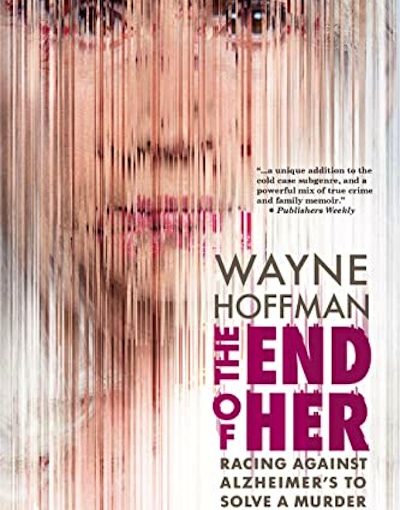
Wayne Hoffman’s latest book is about his efforts to solve the 1913 murder of his great-grandmother before his mother’s dementia takes full hold of her mind.

Well into his book The End of Her: Racing Against Alzheimer’s to Solve a Murder, Wayne Hoffman notes that it wasn’t until his mother was admitted into a nursing home that he began to read books and watch films about the disease, finding comfort in other people’s stories.

Hoffman’s nonfiction account of his mother’s decline – and his search for his maternal great-grandmother’s killer – was released this past February by Heliotrope Books. Perhaps coincidentally, I only cracked its proverbial spine (I have an electronic copy) a couple of weekends ago, the same weekend my father moved into a retirement home.

I was drawn to The End of Her both as the daughter of a parent with dementia and as a former Winnipegger. It was indeed comforting to read about how Hoffman’s family dealt with his mother’s dementia, how her dementia presented itself and how difficult the medical system was to navigate. There were many commonalities with my family’s experience, despite this part of Hoffman’s story taking place in the United States. Originally from Maryland and now living in New York, Hoffman is executive editor of the Jewish online magazine Tablet. He is a journalist, who also has published three novels, which almost guaranteed the The End of Her would be a compelling read.

Admittedly, I did not follow all the connections between Hoffman’s relatives across generations, nor find that part so interesting. But I did understand how Hoffman discovered more family during his research than he knew he had, and that this was a silver lining, though it could never compensate for the lost relationship with his mother.

Hoffman’s mother loved to tell stories and one of the more intriguing ones was of how her maternal grandmother, who had lived in Winnipeg, had been shot by a sniper while sitting on her porch nursing her new baby. Never believing the story, Hoffman kept his thoughts to himself until a video he made at Passover in 2010 revealed that his mother’s memory was failing. He thought about how the Passover story is handed down through generations, and how his family’s stories also become a part of history. He decided to challenge his mother’s – and his aunt’s – narrative about the 1913 murder of their grandmother, Sarah Fainstein. And his mother returned the challenge – asking him to tell her, then, what had happened.

Over the next 10 years or so, Hoffman searched, in fits and starts, for the true story of his great-grandmother’s death, finally finding information when he searches for Feinstein instead of Fainstein. The death certificate notes that it was, indeed, homicide. The amount of information Hoffman is able to piece together from a wide variety of sources, including conflicting newspaper reports and official documents, is impressive. He figures out the mystery to his satisfaction, but its veracity is unlikely to ever be known.

Unfortunately, by the time he reaches his conclusion, his mother’s dementia is to the point where she cannot absorb it. The photos and stories that his mother shared with him throughout his life are now his responsibility. A responsibility he takes seriously.

Format ImagePosted on September 16, 2022September 14, 2022Author Cynthia RamsayCategories BooksTags Alzheimer's, dementia, history, murder, Wayne Hoffman

Recollections of youth – Hatzaad Harishon

Sybil Kaplan, whose food articles often appear in the Jewish Independent, has a broader life experience than those articles would suggest, of course. In a recently self-published memoir, she shares a little of that experience: her time as a youth leader/advisor with the Black youth group Hatzaad Harishon, which translates as First Step.

Hatzaad Harishon: A “First Step” Love Story is as much a labour of love as was author Sybil Kaplan’s time spent in the group, which started in 1965 and ended in 1969. The group itself lasted only from 1964 to 1972.

Hatzaad Harishon is based on notes  and articles Kaplan wrote at the time, newspaper articles from which she cites extensively and other research. Many of the group’s key first members and leaders have passed away, so the contemporary voice of the book is Kaplan, with her perspective on the internal politics and ultimate impact of the group. All the names and the various comings and goings of members will mean little to most readers but it’s good to have them on record.

The publication would be mainly of interest to people who were in or encountered the group in their youth. It also would be valuable for researchers of American Jewish community history. There is published research about the group, but not an abundance of it.

Kaplan became involved in Hatzaad Harishon when she was asked to be a dance leader. The group participated in dance and other cultural events in an effort to increase interaction between white and Black Jews. There were other white Jewish leaders in the organization, including its founding director, Yaakov (or Yaacov) Gladstone, who was a Canadian Hebrew teacher. Internal and external politics contributed to the group’s dissolution, including race issues but also disagreements about how much the youth should be able to direct their own affairs, as opposed to taking direction from the adults involved.

One of the more intriguing – and sobering – aspects of Hatzaad Harishon and the period in history that it covers is how much has changed, and how much has not. Black Jews, and Jews of colour in general, still face discrimination and are still questioned about their Jewishness. New groups have formed in recent years in Canada and, no doubt, elsewhere to try and make the Jewish community more inclusive.

Hatzaad Harishon is available for purchase from Kaplan, at [email protected].

Posted on September 16, 2022September 14, 2022Author Cynthia RamsayCategories BooksTags Hatzaad Harishon, history, memoir, Sybil Kaplan
The elements of a hit song

The elements of a hit song

I freely admit it, I was one of those angsty teens who wrote bad poetry to express all my big feelings. I also wore a lot of black, but that’s not relevant here. What kind of surprises me about myself is that, despite having taken piano for years, learned various other instruments and sung in choirs since I was in single digits age-wise, it wasn’t until last year that I put some not-bad (not-great) poetry to music and wrote a song. It was inspired by my wife and it must have been beginner’s luck, because I’ve not been able to replicate that success.

This is a long preamble to why I was excited when award-winning songwriter and music consultant Molly Leikin emailed that she had a new book out: Insider Secrets to Hit Songwriting in the Digital Age (Permuted Press). While it’s too soon to say whether it will help me write another song, I did find it informative, easy to read – Leikin has a great sense of humour – and full of practical advice. I’ve just been too busy to do many of the myriad exercises and put in the time necessary to hone any skills.

There is a whole chapter on making the time to write, as well as how to quiet the inner critic, who often stops creative-aspiring people dead in their tracks. Other chapters focus on writing lyrics, composing a melody, picking a strong song title, working with a writing partner, overcoming writer’s block and other aspects of the process. There are also chapters on what needs to be done to get a song published, what royalties are, and what types of jobs you might be able to do to sustain yourself until your music can. Interspersed between the how and what chapters are interviews Leikin has conducted with some of her peers, other songwriters, producers and industry professionals.

Insider Secrets is targeted at writers who want to get into the business. And whether one succeeds at that is as much hard work as it is talent, probably more. One great aspect of Leikin’s approach is that she believes in being kind to oneself, so offers several ideas for how to reward yourself when you do put in the hard work.

“Whatever you do,” she writes, “make a point of acknowledging that you’re doing it as a reward for what you’ve just created. It is a victory in itself, just because you did it, not because your song was downloaded 10 million times. The victory starts with you.”

Ultimately, Leikin says, it comes down to persistence. It is also crucial to understand that a creative life is not a straight path, but an up-and-down one, and you have to learn how to navigate the challenges.

“A writer’s job is to write,” states Leikin. “If you do that, keep raising the level of your craft and write your fingerprint, and hustle your hustle, someday, the world will know your work. But until then, I want you to feel in your bones that you have the magic to go the distance. No Grammy can give that to you. Honestly, you have to give it to yourself, every day, all day, for the rest of your life.”

To purchase the book and for more information on Leikin, visit songmd.com.

Format ImagePosted on September 16, 2022September 14, 2022Author Cynthia RamsayCategories BooksTags Molly Leikin, music, music industry, songwriting, writing
Making the best of a mess

Making the best of a mess

Two picture books recently released by Kalaniot Books exemplify the publisher’s mission “to help young children and their families explore the diverse mosaic of Jewish culture and history.”

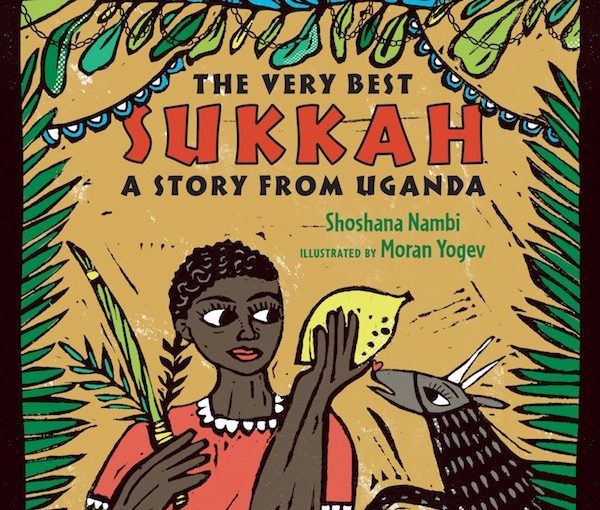
On the face of it, The Very Best Sukkah: A Story From Uganda by Shoshana Nambi and illustrator Moran Yogev may not seem to have much in common with Mendel’s Hanukkah Mess Up by Chana and Larry Stiefel and illustrator Daphna Awadish. But both charming publications explore the themes of inclusion via the experiences of their youthful protagonists.

The Very Best Sukkah centres around Shoshi, who likes to win any challenge, even when there’s none put forward. For example, despite her brother Avram’s plea for her to wait up, she makes sure to beat the other children to school – again. Shoshi shares, “My grandmother is always reminding me that life is not a competition. ‘Jajja,’ I tell her, ‘it’s not like I always have to win the race. I just like being at the front. The view is better there!’”

Shoshi and her brothers live with their “grandparents in a little house surrounded by coffee trees in the Abayudaya Jewish community of Uganda.” Shoshi races home on Friday nights to help her jajja make the holiday meal, in particular the kalo bread – it’s her job to mix the cassava and millet flour for the dough. The family then walks to synagogue, where the rabbi reminds the kids that their favourite holiday is coming up: Sukkot. The siblings start planning how they will make the best sukkah in the village.

Every family’s sukkah is different, “and each one reflects its builder’s special skills and talents.” For the most part, the differences are respected, but there is jealousy that Daudi, who sells samosas in the village, has enough money saved to buy “fancy battery-operated lights and elegant crochet trim in the big town of Mbale to decorate his sukkah.”

Life has a way of making playing fields level, however, and unfortunate weather one night causes mayhem, even for Daudi and his daughter, especially for Daudi, whose sukkah is destroyed. But the villagers rally around him and, in the end, the most beautiful sukkah is the one to which everyone contributes. A wonderful message, well delivered and boldly and colourfully drawn.

The Very Best Sukkah has a page about the Abayudaya, a glossary of terms and the lyrics of “Hinei Ma Tov” in Hebrew, Luganda and English: “See how good and pleasant it is for brothers and sisters to sit down together.”

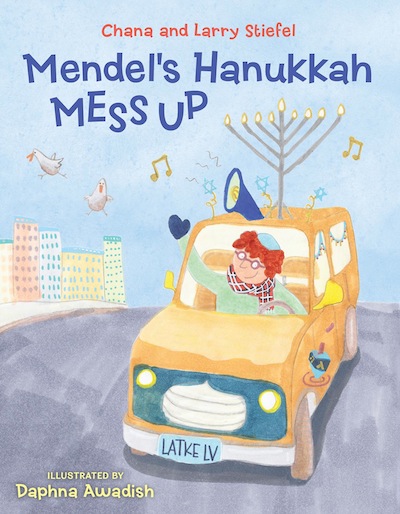
image - Mendel’s Hanukkah Mess Up book coverMendel’s Hanukkah Mess Up also features something getting wrecked. In this story, it’s a crashed-up Mitzvah Mobile rather than windblown sukkot. And, whereas it’s nature that destroys Daudi’s sukkah, it’s Mendel who doesn’t notice the bridge that’s so low as to crumple the large chanukiyah on the Mitzvah Mobile’s roof.

Anyone who knew Mendel could have predicted such an outcome when the rabbi asked him to drive the vehicle, as Mendel has a long history of mishaps, including having accidentally left a tray of jelly doughnuts on the rabbi’s chair. “Splat! ‘Oy, Mendel.’”

The unique nature of the vehicle and the accident draw a TV news team to the scene.

“‘What’s the story here?’ asked Rachel, the reporter.

“‘Um, well…’ Mendel’s words mushed like applesauce. ‘I blew it again,’ he sighed.

“Then Mendel thought of the lessons Rabbi Klein taught him. He stood up taller, like the shamash – the special Hanukkah candle that lights all of the others.

“As Mendel faced the camera, his words began to flow like silky sour cream.

“‘Hanukkah shows us the power of every person to make a difference. To rise up like the Jewish soldier Judah Maccabee fighting the mighty Greeks,’” he told Rachel. ‘If a tiny flask of oil can light up a menorah for eight days, we each have a spark to light up the world.’”

Mendel manages to turn his mistake into a win – spreading the story and joy of Hanukkah. It’s a fun story, with illustrations that are imaginative, engaging and detailed.

Mendel’s Hanukkah Mess Up ends with the story of Hanukkah and a glossary, instructions on how to play dreidel, the words to “Oh, Hanukkah” and a recipe for potato latkes, meant to be used by the young readers and their chosen adult.

For more information on these and other books, visit kalaniotbooks.com.

Format ImagePosted on September 16, 2022September 14, 2022Author Cynthia RamsayCategories BooksTags Abayudaya, Chana and Larry Stiefel, Chanukah, children's books, Daphna Awadish, Hanukkah, Jewish holidays, Kalaniot Books, Moran Yogev, Shoshana Nambi, Sukkot
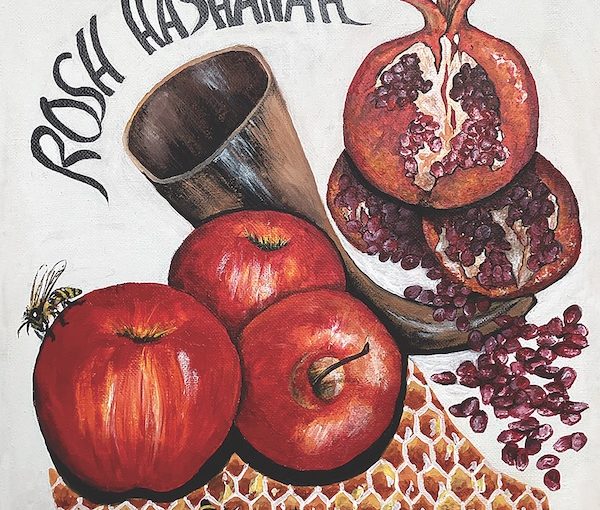
About the art on the cover of the JI’s Rosh Hashanah issue

About the art on the cover of the JI’s Rosh Hashanah issue

Merle Linde, working out of Malka’s Studio in Steveston Village, chose four symbols of Rosh Hashanah for her painting.

The shofar: the mournful cry, sounded 100 times during the traditional Rosh Hashanah service, evokes the freedom we gained when we returned to the Holy Land.

image - The cover of the JI's Rosh Hashanah issue by Merle LindeThe pomegranate: a symbol of righteousness, knowledge and wisdom because it is said to have 613 seeds (arils), each representing one of the 613 mitzvot (commandments) of the Torah.

The apples: slices dipped into honey are eaten to symbolize the desire for a sweet new year.

The honey: given to us by the bees, who can inflict pain with their sting and yet produce delicious honey. Linde would suggest that we eat only “sustainable” honey (the food of the bees) so that the bees can survive and continue to pollinate the pomegranate and apple trees.

L’shanah tovah u’metukah! Wishes for a good and sweet new year.

Format ImagePosted on September 16, 2022September 15, 2022Author Merle Linde – Malka’s StudioCategories Celebrating the HolidaysTags art, Malka’s Studio, New Years, painting, Rosh Hashanah
Importance of food in celebration

Importance of food in celebration

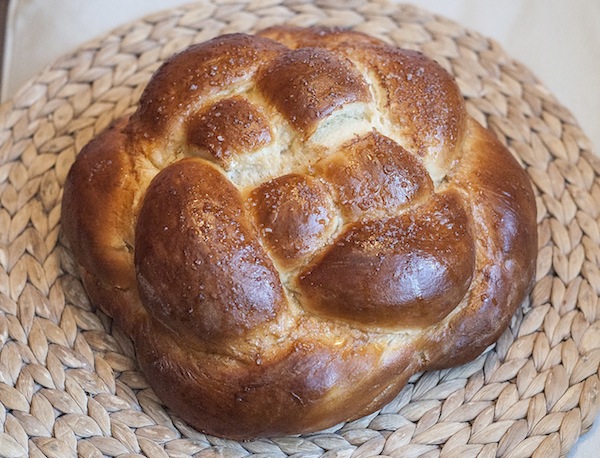
A round challah symbolizes a long life, or the unbroken circle of the full new year to come. (photo by Przemyslaw Wierzbowski)

On Rosh Hashanah, we are supposed to feast. Why? This is said to come from the passage in the book of Nehemiah (8:10): “Go your way, eat the fat and drink the sweet, and send portions unto him for whom nothing is prepared; for this day is holy unto our lord.”

Round, sweet challah

The most common Rosh Hashanah custom for Ashkenazi Jews is the making of sweet challah, primarily round in shape, to symbolize a long life or the unbroken circle of the full new year to come. Some people place a ladder made of dough on top of the loaf, so our prayers may ascend to heaven, or because it is decided on Rosh Hashanah “who shall be exalted and who shall be brought low.” Some place a bird made of dough on top, derived from the phrase in Isaiah: “as birds hovering so will the Lord of Hosts protect Jerusalem.”

According to John Cooper, in Eat and Be Satisfied: A Social History of Jewish Food, the tradition in disparate Jewish communities of baking fresh loaves of bread on a Friday morning has its roots in the talmudic era. The custom was ignored by medieval rabbinic commentators, he writes, but was revived by the Leket Yosher, a report compiled by Joseph ben Moses in the 1400s on the teachings and practices of his teacher, Austrian Rabbi Israel Isserlin; and by Rabbi Moses Isserles, the 16th-century Polish scholar of halachah, at the end of the Middle Ages.

According to Jewish tradition, the three Sabbath meals (Friday night, Saturday lunch and Saturday late afternoon) and two holiday meals (one at night and lunch the following day) each begin with two complete loaves of bread. This “double loaf” (lechem mishneh) commemorates the manna that fell from the heavens when the Israelites wandered in the desert after the Exodus. The manna did not fall on Sabbath or holidays; instead, a double portion would fall the day before the holiday or Sabbath.

Pomegranate blessings

photo - The pomegranate is eaten to remind us that G-d should multiply our credit of good deeds, like the seeds of the fruit
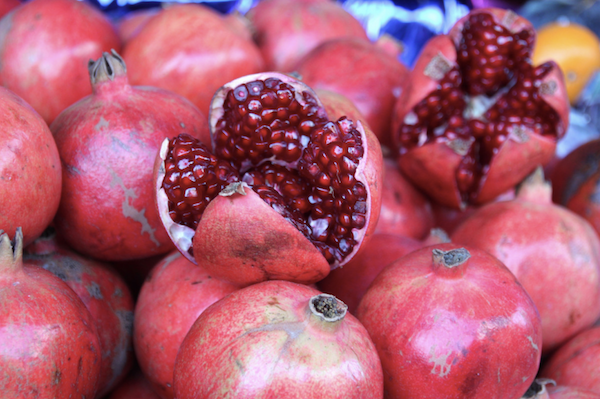
The pomegranate is eaten to remind us that G-d should multiply our credit of good deeds, like the seeds of the fruit. (photo from pxhere.com)

On the second evening of Rosh Hashanah, it is customary to eat a new fruit not yet eaten in the season and recite the Shehechiyanu, a prayer of thanksgiving for the first time something happens. It is said that, in Europe, this fruit was often grapes; in Israel today and around the diaspora, it is often the pomegranate.

The pomegranate is eaten to remind us that G-d should multiply our credit of good deeds, like the seeds of the fruit. For many Jews, pomegranates are traditional for Rosh Hashanah. Some believe the dull and leathery skinned crimson fruit may have really been the tapuach, apple, of the Garden of Eden. The word pomegranate means “grained apple.” In Hebrew, it is called rimon – also the word for a hand grenade!

Some say each pomegranate has 613 seeds for the 613 mitzvot, or good deeds, we should observe.

Symbolism of fish

The first course of the Rosh Hashanah holiday meal is often fish. Fish is symbolic of fruitfulness: “may we be fruitful and multiply like fish.” Fish is also a symbol of immortality, a good theme for the New Year, as are the ideas that we should aim to be a leader (the head) and that we hope for the best (to be at the top). Another reason for serving fish might be that the numerical value of the letters of the Hebrew word for fish, dag, is seven and Rosh Hashanah begins on the seventh month of the year.

Importance of tzimmes

Tzimmes is a stew made with or without meat and usually with prunes and carrots. It is common among Ashkenazi Jews, particularly those from Eastern Europe and Poland, and its origins date back to Medieval times. It became associated with Rosh Hashanah because the Yiddish word for carrot is mehren, which is similar to mehrn, which means to increase. The idea was to increase one’s merits at this time of year. Another explanation for eating tzimmes with carrots for Rosh Hashanah is that the German word for carrot was a pun on the Hebrew word, which meant to increase.

Tzimmes also has come into the vernacular as meaning to make a fuss or big deal. As in, they’re making such a tzimmes out of everything.

Lekach & other sweets

Among Ashkenazim, sweet desserts for Rosh Hashanah are customary, particularly lekach, or honey cake, and teiglach, the hard, doughy, honey and nut cookie. Some say the origin of the sweets comes from the passage in the book of Hosea (3:1): “love cakes of raisins.” There is also a passage in Samuel II (6:10) that talks about the multitudes of Israel, men and women, “to every one a cake of bread and a cake made in a pan and a sweet cake.”

Ezra was the fifth-century BCE religious leader who was commissioned by the Persian king to direct Jewish affairs in Judea and Nehemiah was a political leader and cup bearer of the king in the fifth century BCE. They are credited with telling the returned exiles to eat and drink sweet things.

According to Cooper’s Eat and Be Satisfied, references to honey cake were made in the 12th century by a French sage, Simcha of Vitry, author of the Machzor Vitry, and by the 12th-century German rabbi, Eleazar Judah ben Kalonymos. By the 16th century, lekach was known as a Rosh Hashanah sweet.

Among the Lubavitch Chassidim, it was customary for the rebbe to distribute lekach to his followers; others would request a piece of honey cake from one another on Erev Yom Kippur. This transaction symbolized a substitute for any charity the person might choose to receive, like the traditional kapparot ceremony, where, before Yom Kippur, one transfers their sins to a chicken.

Some Sephardi customs

Food customs differ among Jews whose ancestors came from Spain and Portugal, the Mediterranean area and primarily Muslim Arab countries. For example, whereas Ashkenazim dip apple in honey, some Sephardim traditionally serve mansanada, an apple compote, as an appetizer and dessert, according to Gil Marks (z”l) in The World of Jewish Desserts.

Just as gefilte fish became a classic dish for the Ashkenazi Jews, baked sheep’s head became a symbol – dating back to the Middle Ages – for many Sephardi Jews for Rosh Hashanah. Some groups merely serve sheep brains or tongue, or a whole fish (with head), probably for the same reason – fruitfulness and prosperity and new wishes for the New Year for knowledge or leadership.

The Talmud mentions the foods to be eaten on Rosh Hashanah as fenugreek, leeks, beets, dates and gourds, although Jewish communities interpret these differently. According to Rabbi Robert Sternberg in The Sephardic Kitchen, Sephardi Jews have a special ceremony around these and sometimes other foods, wherein each one is blessed with a prayer beginning “Yehi ratzon” (Hebrew for “May it be thy will”). The Yehi Ratzones custom involves preparing in advance and then blessing the Talmud-mentioned foods, or dishes made with the foods, as well as over the apples and honey, the fish or sheep head (some substitute a head of lettuce or of garlic) and pomegranate. In doing this, people recognize G-d’s sovereignty and hope He will hear their pleas for a good and prosperous year.

Sybil Kaplan is a Jerusalem-based journalist and author. She has edited/compiled nine kosher cookbooks and is a food writer for North American Jewish publications.

Format ImagePosted on September 16, 2022September 14, 2022Author Sybil KaplanCategories Celebrating the HolidaysTags Ashkenazi, food, New Years, Rosh Hashanah, Sephardi, symbolism, tradition
Bafflement part of life

Bafflement part of life

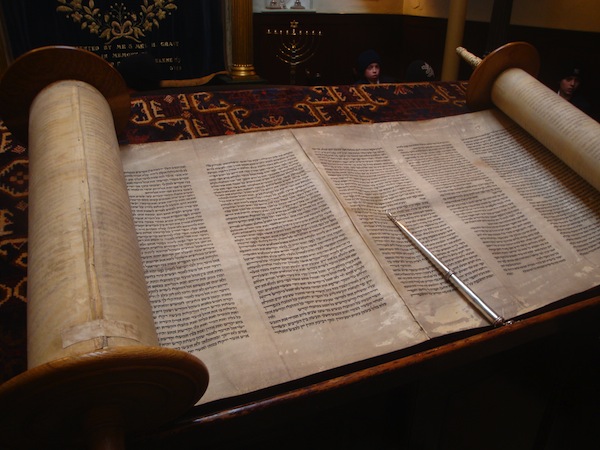
Just as in life outside shul we don’t understand everything we encounter, we don’t all necessarily understand the Torah reading and other parts of the High Holiday service. The High Holidays serve as a metaphor for life itself. (photo from flickr / Lawrie Cate)

Throughout the High Holidays, we repeat in the liturgy pronouncement after pronouncement about our lack of control: we are born against our will, we die against our will, we are but clay in the hands of God, we turn our eyes heavenward as children before a parent, and as slaves before a master. It would be dissonant in such an environment to try to assert our autonomy, to try to shape the experience around our own emotional needs.

And, while we want the High Holidays to be relatable for people, the season by necessity must not be customized to the individual. This is because their meaning lies precisely in the challenge of giving up our individual sense of entitlement in favour of something more important: meaning.

The High Holidays serve as a metaphor for life itself. During this season, we enter into an experience that has been curated for us, that existed before we ever did and which has elements that we are comfortable with and elements that challenge us. I may find myself standing in a synagogue next to people I don’t know, reciting words that I don’t know or would never have written, on a date that means very little to me personally except as a construct of the Jewish calendar.

This is true to life in general: I participate in a world that I don’t completely shape, with others who think differently than I do, within a system that I did not create. We do not choose to be born, nor to which families, nor under what circumstances or accompanied by what baggage. We likewise do not choose what natural successes or tragedies befall us. And, while we do our best to shape our lives, so much of the table is set for us and is beyond our control.

The High Holidays then bid us instead to think about meaning, about the control we do have. If life is not about what we choose, it is about how we choose to engage with what we encounter. We choose how we are going to interpret and how we are going to make meaning of it. How will we choose to see life, and how will our attitudes guide our actions? We may choose to read what we experience charitably or stingily, optimistically, realistically or nihilistically, or more often a messy combination of all of the above. But make no mistake: it is our own choices that will give rise to what we make of those lives that are given to us, to those circumstances that challenge us.

Eschewing a sense of entitlement and control in favour of a sense of meaning and potential is the work of the High Holiday season. It allows us to reflect on how and why we get in our own way, how our sense of entitlement, whether consciously or subconsciously, overrides our good judgment. This helps us to understand the idea of repentance, which is at the core of the High Holidays.

The talmudic sage Rava declared: those who are willing to forgive others easily will likewise be forgiven by God. The language attributed to him is literally, “One who overlooks his/her measurements, [God will overlook all of their sins].” Forgiveness, too, is about letting go of what we may still feel we are owed in favour of building relationships with others. Rather than standing on ceremony over what could have been, I am willing to loosen the reins, to be open to what might emerge. Oftentimes what needlessly keeps us from forgiveness is a focus on what we deserve, what we are entitled to. And, when this happens, we find ourselves once again getting in our own way and holding on to a vision of complete control over what happens or does not happen to us.

Letting go of trying to control the experience is hard. But it can also be liberating. For the High Holiday season, it relieves us of the expectation that we need to relate to everything. More importantly though, for life itself, it relieves us of the expectation of perfection – from ourselves, from others, from life itself.

At the same time, it reminds us of the depth of the human heart and the power of our own will in deciding how we will chart our path forward: that we can come to synagogue not only to be forgiven, but also to forgive; not only to be moved, but to choose to move ourselves.

Wishing all a meaningful New Year.

Dr. Elana Stein Hain is the director of faculty and a senior fellow at the Shalom Hartman Institute of North America, where she serves as lead faculty, directs the activities of the Kogod Research Centre for Contemporary Jewish Thought and consults on the content of lay and professional leadership programs. Articles by Stein Hain and other institute scholars can be found at hartman.org.il. This article was first posted on Times of Israel.

Format ImagePosted on September 16, 2022September 14, 2022Author Dr. Elana Stein HainCategories Celebrating the HolidaysTags High Holidays, Judaism, Rosh Hashanah, Shalom Hartman Institute

Posts pagination

Previous page Page 1 … Page 160 Page 161 Page 162 … Page 664 Next page
Proudly powered by WordPress