Skip to content
  • Home
  • Subscribe / donate
  • Events calendar
  • News
    • Local
    • National
    • Israel
    • World
    • עניין בחדשות
      A roundup of news in Canada and further afield, in Hebrew.
  • Opinion
    • From the JI
    • Op-Ed
  • Arts & Culture
    • Performing Arts
    • Music
    • Books
    • Visual Arts
    • TV & Film
  • Life
    • Celebrating the Holidays
    • Travel
    • The Daily Snooze
      Cartoons by Jacob Samuel
    • Mystery Photo
      Help the JI and JMABC fill in the gaps in our archives.
  • Community Links
    • Organizations, Etc.
    • Other News Sources & Blogs
    • Business Directory
  • FAQ
  • JI Chai Celebration
  • JI@88! video

Recent Posts

  • Story of Israel’s north
  • Sheltering in train stations
  • Teach critical thinking
  • Learning to bridge divides
  • Supporting Iranian community
  • Art dismantles systems
  • Beth Tikvah celebrates 50th
  • What is Jewish music?
  • Celebrate joy of music
  • Women share experiences 
  • Raising funds for Survivors
  • Call for digital literacy
  • The hidden hand of hate
  • Tarot as spiritual ritual
  • Students create fancy meal
  • Encouraging young voices
  • Rose’s Angels delivers
  • Living life to its fullest
  • Drawing on his roots
  • Panama City welcoming
  • Pesach cleaning
  • On the wings of griffon vultures
  • Vast recipe & story collection
  • A word, please …
  • מארק קרני לא ממתין לטראמפ
  • On war and antisemitism
  • Jews shine in Canucks colours
  • Moment of opportunity
  • Shooting response
  • BC budget fails seniors
  • Ritual is what makes life holy
  • Dogs help war veterans live again
  • Remain vital and outspoken
  • An urgent play to see
  • Pop-up exhibit popular
  • An invite to join JWest

Archives

Follow @JewishIndie
image - The CJN - Visit Us Banner - 300x600 - 101625

When boundaries have shifted

The beginning of January has not been easy in Winnipeg. We’ve dealt with hate crime graffiti, including swastikas, on Shaarey Zedek Synagogue, Kelvin High School, the Abu Bakr Al-Siddique Mosque, as well as a hookah café, residential properties and street signs. For my household, it was personal. It hit our congregation and my kids’ school. It marred street signs near where we live. It defaced a mosque where I know one of the members. This is a lot to deal with. The police triumphantly made an arrest, but, from what I’ve heard, it seems unlikely that this individual did all these crimes. The story is familiar to Canadians at this point. Here it is.

Hate crimes happen. “Oh!” our leaders say. “Hate crimes are horrible. This isn’t Canadian. We will seek justice!” Then, an intermittent flow of outrage and misinformation follows. Suddenly, there’s an arrest. Everything’s solved. Canadians live happily ever after. 

That is, until a new crime pops up. When that’s reported, the response sometimes is, “Well, this isn’t fitting into our narrative. We don’t know how this happened.” It even extends to, “Oh, we (police or officials) don’t clean up graffiti, so you can go ahead and do this yourself.” Essentially, another episode is swept under the rug as inconvenient.

I learned about the Overton Window in a social science class years ago. However, when it came up in reference to societal change and antisemitism, I had to review its meaning. The term is neither positive nor negative. It defines something that we have all experienced. Imagine you have a spectrum of beliefs: about school choice, disabilities, tolerance and diversity, human rights, whatever. The term was originally designed to describe how a politician might use a “window” to define policies on this spectrum. Occasionally, it’s used to say where someone’s beliefs fall on the political spectrum. We can shift the Overton Window; for instance, towards increased accessibility for those with disabilities. Some shifts are good, some are not. This term helps describe what’s happening with respect to antisemitism. 

As the police described their arrest of the suspect in this recent series of hate graffiti, they said something like they “would have to examine the motive behind the crimes.” I was flummoxed. How could a swastika on a minority’s place of worship or a public school be anything other than an act of hate? Discussion followed about the suspect’s mental health situation, as he is unwell. Soon after he was released from custody, he was arrested again, for breaking into a home and violating the conditions of his release.

Many people have mental health issues, but going out in the dark at 4 a.m. to paint swastikas isn’t a normal, common expression of those challenges. People who perform hateful acts should face consequences. The Overton Window of what is considered “acceptable” antisemitism seems to have shifted.

I’m guessing there are multiple people committing this hate in our city. Yet the narrative here indicates that “Hurray! We’ve got the culprit” and no more effort is being made to resolve the bigger issues.

Meanwhile, I concluded my Daf Yomi (daily page of Talmud study) of Tractate Zevachim, on how sacrifices worked in the days of the Temple in Jerusalem. I’m lucky I didn’t start my learning with this – it felt like a slog. However, I continued studying the tractate, even while I found it somewhat dry and lacking in fun aggadah (stories). 

Zevachim examines questions like when is a religious ritual sacrifice acceptable? What is the right physical and mental space for doing these holy rituals? When is it considered transgressive because it’s done wrong? When is it accepted even if it is not done in quite the right time or place? What rituals are exempt from repercussions, even if they are not done exactly right or considered acceptable practices?

These questions are intellectual exercises. We have no Temple in Jerusalem. The rabbis quoted in this approximately 1,500-year-old text didn’t have a Temple anymore. We Jews in modernity don’t do ritual sacrifice. Still, questions about what feels acceptable or forbidden, exempt or meaningful, have real-life repercussions. When the rabbis discussed different parts of ritual, they considered shifting their Overton Window about what they could see as correct, acceptable, exempt from punishment, or such a violation that one was cut off from the Jewish people.

Historically, the Overton Window about what’s considered appropriate discourse or hate speech has also shifted – multiple times. Slurs and crimes against Jews are commonplace throughout millennia. We’ve also had some golden eras, when things felt safe.

This January was another shift in Winnipeg. It’s been horrible, but we knew it was coming. It’s part of a worldwide shift of what’s considered “acceptable” antisemitism. I’ve been asked what can be done. I suggested giving this hate a broad, inclusive definition. Re-read the International Holocaust Remembrance Alliance definition. Nothing good is intended when someone spray paints a swastika on a synagogue door. It’s even more of a threat when it’s on a classroom whiteboard or hidden in a Jewish kid’s locker, as was the recent case.

We must educate people about history, including how to avoid antisemitic hate. Make that education required. With definitions and education, our window of what’s acceptable or a crime firms up.

These experiences have felt like a terrible personal violation. It feels threatening and unsafe. Yet, our congregation responded with courage and love. We welcomed many non-Jewish supporters at our Shabbat services afterwards. We responded with pride and inclusivity. 

The kid was so brave. He took a photo of the graffiti on his locker, asked a parent for help, went to the school office. Now, there’s a police report, all his classmates know what happened.

The kid also faced extended questioning from administrators about “if he’d told the whole story.” He was told that “everyone makes mistakes.” One lesson the kid learned is that maybe reporting the hate crime itself was a mistake, because, instead of supporting him, the approach involved the suggestion that the victim did the graffiti to begin with. This is bad news, and a familiar type of antisemitism, where Jewish victims are blamed for having “brought it on themselves.” We shouldn’t say this to any victim. It’s not OK. If this is treated as being OK, it means that victims may trust institutions less, and report less often.

Sunshine is the best disinfectant. Actions like education and transparency can clean up and eradicate hate. We don’t know who did this, but we know who we are. We’re Jewish. We’ve been here before. We’re made of stern, proud stuff. The Overton Window has shifted. It’s time to ask our allies to all lean in to help shove it back again. 

Joanne Seiff has written regularly for the Winnipeg Free Press and various Jewish publications. She is the author of three books, including From the Outside In: Jewish Post Columns 2015-2016, a collection of essays available for digital download or as a paperback from Amazon. Check her out on Instagram @yrnspinner or at joanneseiff.blogspot.com.
Posted on January 23, 2026January 21, 2026Author Joanne SeiffCategories Op-EdTags antisemitism, education, hate crimes, Overton Window, Talmud, Winnipeg
Guitar virtuosos play

Guitar virtuosos play

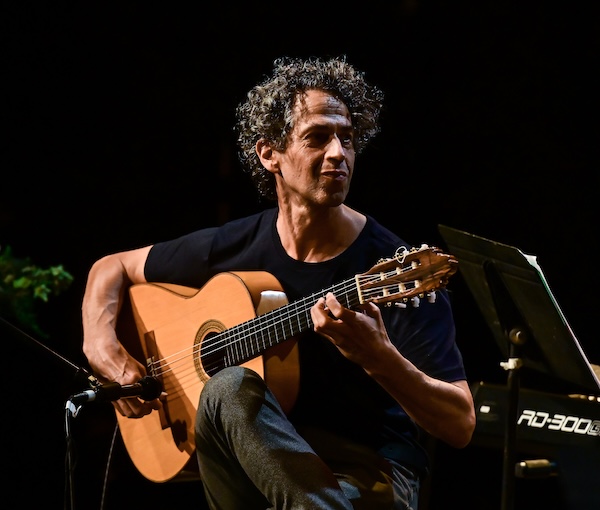
Itamar Erez performs with three other leading musicians on Feb. 1, 7:30 p.m., at Massey Theatre, as part of International Guitar Night. (photo from itamarerez.com)

International Guitar Night takes place on Feb. 1 at Massey Theatre. Once again, Jewish community member Itamar Erez, whose styles range from Middle Eastern, to jazz improv, to world music, is taking part.

“This unique project started with Brian Gore many years ago, when he had the vision to create these unique guitar tours. It’s been going on for over 20 years, with some of the best guitarists in the world,” Erez told the Independent.

“The idea is to put four guitarists on stage with a totally different style and sound,” he explained. “Each plays a solo set and introduces the next player – and, eventually, all four guitarists are playing together in duets and quartets. The audience loves the variety in the music and personalities and, often, there are interesting and funny stories that go with the music.”

Erez will be joined by Jocelyn Gould, a traditional jazz player and singer, Caroline Plante, who comes from the flamenco tradition, and Jamie Dupuis, who brings his harp guitar and Roma jazz influences.

“I’m playing my own mixture of Middle Eastern/Brazilian sounds,” said Erez, whose recent albums include Mi Alegria (2019), May Song (2022; for a review, go to jewishindependent.ca/erezs-new-cd-shows-mastery) and Migrant Voices (2024, with Hamin Honari).

“Migrant Voices was a unique album for me,” Erez said. “I had worked with Hamin for a few years already and we became really good friends. We worked on developing new material for the duet and, towards the recording date, we realized that this album will be mostly based on free improvisation. It just felt like the best approach and most authentic for us. Apart from the album title (Migrant Voices), that was composed by myself, all the tunes were basically improvised right there at the studio.

“In 2024,” he continued, “I also went to the studio with my piano trio (Jeff Gammon on bass and Kevin Romain, drums, and myself on piano) and we recorded in one afternoon a bunch of instrumental covers to tunes – this is something I never had done before, as I always was creating new original material. Among these tracks were Marina Maximilian’s beautiful song ‘Amok Batal,’ three Hanukkah tunes (‘Maoz Tzur,’ ‘Banu Hoshech,’ ‘Kad Katan’) and several other tunes, such as ‘Blue Bossa’ … all done with a very personal approach.

“Over the past year, I have released these tunes slowly as singles – and was overwhelmed with the warm response of audiences for these tracks.”

International Guitar Night is a touring festival, which has three iterations: Canadian, American and European.

“I did one full tour many years ago, in 2009/10, with many concerts in the US, Canada and Scotland,” said Erez. “I did the European version of the tour (Gitarren Nacht) a few years ago, with shows in Germany, Austria and France, and one more time in BC quite recently (2023), where I played for the first time with Jocelyn Gould…. My favourite part of these tours is making friendships with these musicians, some of them are friends for life. And making music with players that come from a totally different background is always fun and exciting.”

This year’s Canadian tour centred on British Columbia, with stops in Oliver, Campbell River, Duncan, Nanaimo and Victoria. The Feb. 1 performance at the 1,260-seat Massey Theatre in New Westminster caps it off.  For tickets, go to masseytheatre.com/event/ign-2026. 

Format ImagePosted on January 23, 2026January 21, 2026Author Cynthia RamsayCategories MusicTags British Columbia, concerts, International Guitar Night, Itamar Erez, Massey Theatre

Different concepts of home

The current show at the Zack Gallery – Finding Home – unites three very different artists: Jeannette Bittman, Andrea Dillingham-Lacoursiere and Eri Ishii. Sarah Dobbs, the gallery curator, told the Independent how the show came together.   

“All three artists submitted independent proposals for solo exhibitions,” said Dobbs, adding that, in their own unique way, all three artists “engaged the ideas of place, displacement, immigration and the evolving notion of home.… Their works differ significantly in style and approach, but their practices intersect conceptually. Andrea’s work is rooted in a specific geographic place. Eri’s practice explores internal and emotional landscapes. Jeannette’s work centres on the table as a focal point of Jewish life and tradition, and as a site that reflects the dynamics, rituals and emotional complexities of gathering. Together, their works expand and complicate the idea of home, from the physical to the psychological and to the communal.”

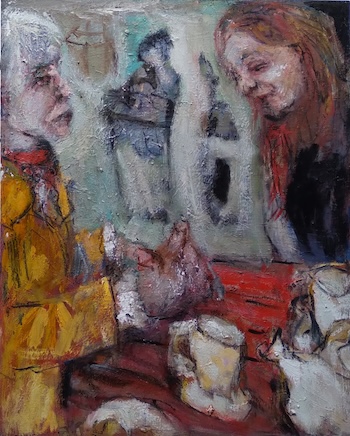
photo - “At Work” by Jeannette Bittman
“At Work” by Jeannette Bittman. (photo by Olga Livshin)

Bittman’s images are all domestic scenes. People, young and old, gather around a table, eating and chatting. The colours are muted, the faces indistinct, less important. The table and the food are the points of connection, the common joy and purpose.

“A table is of great significance in everyone’s life,” Bittman told the JI. “It is the place where we eat, but, maybe more importantly, where we meet others and ourselves. The table and gathering around it are critical to Jewish life and culture. Family meals are crucial for family and child growth. Gathering with friends often occurs around a table. Self-reflection, recollection and reminiscence, as well as dreams, occur around a table.” For her, a table is the essence of home. 

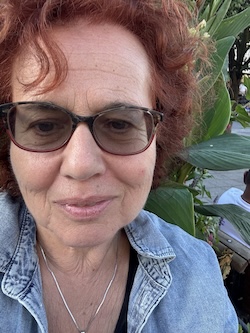
photo - Jeannette Bittman
Jeannette Bittman (photo courtesy)

“As an artist, I’m intrigued by human emotions and want to represent them through my art,” she said. “Initially, I focus on the realistic expressions of the models. Then, I explore, using colour, shade and form to go deeper. I try to capture the feeling rather than reality … I search for the mood. I rarely have a finished product in mind and become fascinated with the multitude of possibilities. It’s often challenging for me to stop at one.”

Ishii, meanwhile, ponders the outdoors in her paintings. A girl is running along a forest trail in “Runner.” Three girls are gazing across a river in “Three.” A young woman contemplates a peaceful pond in “Bridge,” while dappled sunlight plays all around her, and water ripples beneath the pilings of a little bridge. 

All of Ishii’s images are quiet and introspective, uplifting in their tranquil greenery. One could almost hear the breeze whispering in the boughs and the wavelets muttering at the shore. “I am essentially a figurative painter,” said the artist. “My main interest is the inner world of my figures. I want to create works that have emotional resonance.”           

For Ishii, home is a complex concept, an inner rapport rather than a particular geographic region. “To me, home means belonging, community and a sense of identity. As an immigrant, I have experienced that these things are fluid and shifting. I have two homes: the place where I spent my formative years – Japan – and the place where I chose to build my life – Canada.”

photo - “Runner” by Eri Ishii
“Runner” by Eri Ishii. (photo by Olga Livshin)

About her pieces in the Zack show, she said, “I made them at different points of my life. ‘Bridge’ and ‘Three’ are parts of a series that explores storytelling in paintings. They were inspired by film stills from a British mystery. ‘Runner’ and ‘Picnic’ are made more recently. ‘Runner’ revisits the running series from 20 years ago. The series investigated the transient nature of life and posed questions concerning where we are running to, as well as what we are running from. ‘Picnic’ is the most recent of my works. It explores family relationships. It was inspired by a photo I saw in a recipe book that showed a family enjoying a feast.”

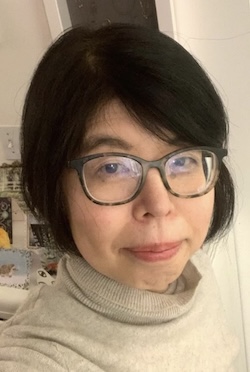
photo - Eri Ishii
Eri Ishii (photo courtesy)

Like many artists, Ishii is fond of mentoring others. “Teaching is rewarding in more external ways, as opposed to painting,” she said. “I love being part of people’s journeys, as they tackle challenges of making paintings. It is my way of giving back what I learnt, whereas painting is more internal, as I try to explore what is going on inside of me.”

Ishii’s creative explorations could happen anywhere in the world. “I deliberately made them non-specific,” she said. “I wanted to keep them open to viewers’ imagination.”

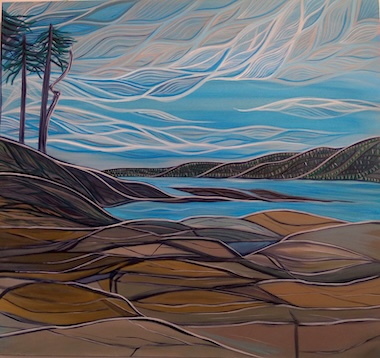
Dillingham-Lacoursiere, on the other hand, dedicates her landscapes to one very specific location: Lasqueti Island in the Strait of Georgia, an off-grid, ecologically conscious community, and her home. Her panoramic vistas are bright and intense. The sharp colours of land, ocean and sky echo the lines of nature and emphasize the artist’s fierce emotional link to the place. While Ishii’s paintings are murmurs of lyrical fulfilment and Bittman’s delve into the kernel of her Jewishness, Dillingham-Lacoursiere’s paintings are screams of defiance, a rebellious statement of the artist’s soul.

“I used to equate home with a soft place to land, with treasured collections and memories that serve as reminders of our lives, our ancestors,” she said. “When I moved from Alberta, I left a five-bedroom house, my family, most of my friends, a community that had taken me a lifetime to build, but it wasn’t easy [there]. Reconciling the beauty of the prairies with a mindset and values that never fit meant it was an uphill battle. I was tired of trying to make myself fit into the place I called home but had never felt like it.”

photo - “Home” by Andrea Dillingham-Lacoursiere
“Home” by Andrea Dillingham-Lacoursiere. (photo by Olga Livshin)

Here, in British Columbia, she said, “Now, home for me exists in small ways. It’s my favourite tree. It’s reading poetry on a Sunday morning, with coffee in my favourite mug…. I’ve worked with First Nations communities for over a decade, and it was in those circles, around those fires and in those sweat lodges, that I learned women are the keepers of the home. In that sense, I am my home, and I can offer refuge, perhaps especially to myself.”

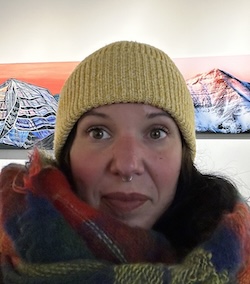
photo - Andrea Dillingham-Lacoursiere
Andrea Dillingham-Lacoursiere (photo courtesy)

Dillingham-Lacoursiere has been painting landscapes for about 10 years. “I had avoided painting landscapes my whole life, until 2016. At the time, I was in the throes of a crisis of conscience, at the confluence of my job and my community,” she shared. “I had spent a year at the helm of a project that was deeply honouring the unfinished lives of the missing and murdered Indigenous women and girls of this country. The next project I was asked to lead at the museum and art gallery where I worked was the Canada 125 celebrations. The cognitive dissonance I felt pulled me in ways I could not have expected.”

Her response was artistic.

“It led me to an exhibit focused on landscapes of our national parks system. It is a system constructed to outwardly give a sense of national pride, but, at the same time, to commodify some of the most beautiful natural spaces … as escapes for those that could afford it,” she said. “That exhibit was called Reflections on My Reconciliation. People really connected with my art and my message. And it began the unravelling of what I thought it meant to be Canadian for me.”

Finding Home opened Jan. 7 and runs until Feb. 2. Every visitor will be confronted with the question, “What does home mean to you?” 

Olga Livshin is a Vancouver freelance writer. She can be reached at [email protected].

Format ImagePosted on January 23, 2026January 21, 2026Author Olga LivshinCategories Visual ArtsTags Andrea Dillingham-Lacoursiere, art, Eri Ishii, exhibits, Finding Home, immigration, Jeannette Bittman, painting, place, Sarah Dobbs, Zack Gallery
Broadway’s Jewish storylines

Broadway’s Jewish storylines

David Benkof, the Broadway Maven, spoke on Jan. 11 as part of Kolot Mayim Reform Temple’s 2025-26 Voices of Jewish Music series. (photo from David Benkof)

David Benkof, the Broadway Maven, visited Victoria recently, to give a talk titled Spotlight on Jewish Broadway, on Jan. 11. He began with a clip from the musical Spamalot, which, in a tongue-in-cheek manner, asserts that a potential show may have the finest sets, the loveliest costumes and the best shoes, yet it “won’t succeed on Broadway if you don’t have any Jews.”

“The joke is that Jews wrote Broadway, Jews perform Broadway, Jews produce Broadway – and that’s true. It’s historically true, it’s statistically true, and it’s been said so many times that it barely counts as an insight anymore,” Benkof said.

Although seemingly innumerable Jews – Irving Berlin, Jerome Kern, Barbra Streisand, to name a mere few – may be associated with Broadway, Benkof encouraged the audience to consider the meaning of “Jewish Broadway” as something beyond the names of those who created and performed in well-known shows. Rather, he asked those attending in person and on Zoom to think in terms of Jewish-related themes: assimilation, reinvention, insecurity, exile, visibility and ambivalence.

“I want to go a step further,” he said, “and argue that Broadway isn’t primarily Jewish because of the people involved, but because of the very sensibility of the art form. Broadway is Jewish because its plots, themes and character arcs reflect the Jewish experience in North America.”

With clips from Hairspray, Hello, Dolly, A Chorus Line and Chicago, Benkof demonstrated that, while characters and plots were not overtly Jewish, or Jewish at all, there are invariably elements – such as restlessness, striving and defensiveness – that make them feel deeply Jewish.

“It grows out of histories of conditional welcome, where excellence becomes a survival strategy and visibility is both opportunity and danger,” said Benkof. “Broadway characters don’t assume that the room loves them. They hustle to make the room need them. That’s why Broadway feels Jewish even when Jews are nowhere in sight.”

Hairspray, for example, makes no claim that the characters are Jewish. It is method, not identity, according to Benkof, that makes it Jewish. The lead character does not want to tear down the system; she seeks to join it, he pointed out.

“The belief that assimilation is both a strategy and an ethical good is deeply Jewish in a North American context,” Benkof said. 

“The combination of idealism, anxiety, and faith that the system can be nudged towards justice if you appeal to its conscience is not universal,” he argued. “It’s a Jewish sensibility operating inside a story that never needs to say the word Jewish out loud, which makes Hairspray slightly subversive, like quite a bit of postwar Jewish art.”

By the end of his Victoria lecture, audience members were able to find Jewish themes in musicals that, on the surface, seem far removed from the Jewish experience: The Lion King, The Phantom of the Opera, The Sound of Music, even The Book of Mormon (think reinvention).

In the example of The Sound of Music, audience members found that its themes of escape, persecution and fear were elements that could be perceived as related to the Jewish experience. 

Congratulating the audience, Benkof said, “We could have said, Richard Rodgers was Jewish and, therefore, The Sound of Music is Jewish. That is true and boring. What we have been able to do here today is think about how you won’t succeed on Broadway if you don’t have any Jewishness, as opposed to just Jews.”

Benkof also discussed a Canadian connection to Jewish Broadway, Come from Away, a musical about the care of thousands of travelers, who, after Sept. 11, 2001, had their flights diverted to Gander, Nfld.

In 2024, Benkof made a trip to Gander to see a performance of the show, written by Canadians David Hein and Irene Sankoff.

“I got to go and meet some of the people who had done it,” he said. “They welcomed people into their home and their community, and that, I think, is a very Jewish theme.”

Benkof’s website, broadwaymaven.com, offers five to 15 classes every month. In January, for example, the online educational community had classes on the musicals of Howard Ashman and Alan Menken, on Pal Joey, and a 50th anniversary roundtable on Pacific Overtures by Stephen Sondheim and John Weidman. Upcoming events include classes on Sweeney Todd, Evita, Kiss Me, Kate and Cats, among others. Benkof also posts weekly about Broadway on Substack: substack.com/@thebroadwaymaven.

Benkof’s talk was the third lecture in Kolot Mayim Reform Temple’s 2025-26 Voices of Jewish Music series, part of the Vancouver Island shul’s annual Building Bridges program. The next in the series will be from Naomi Cohn Zentner, an ethno-musicologist at Israel’s Bar-Ilan University, on Feb. 8. Her talk – Music and War: An Optimistic View – will examine how Israeli musicians have responded to recent historic events and explore music’s role in processing grief, inspiring resilience and connecting community in times of crisis. Visit kolotmayimreformtemple.com. 

Sam Margolis has written for the Globe and Mail, the National Post, UPI and MSNBC.

Posted on January 23, 2026January 21, 2026Author Sam MargolisCategories Performing ArtsTags Broadway Maven, Building Bridges, David Benkof, education, history, Kolot Mayim, musical theatre, speakers
Sesame’s breadth and depth

Sesame’s breadth and depth

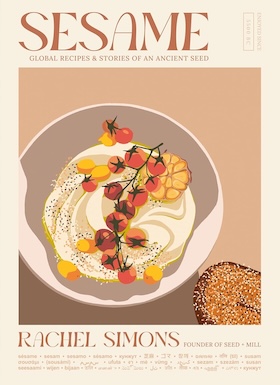
I made my wife a rockstar carrot cake for her birthday last week. Thanks to the JCC Jewish Book Festival, I received a review copy of Sesame: Global Recipes & Stories of an Ancient Seed by Rachel Simons, which features a unique take on one of my wife’s favourite desserts. The Tahini Cream Cheese Frosting with Carrot Cake & Seed Brittle was a hit – as was every other recipe I tried from the book. Everything I made looked beautiful and tasted great. 

New York-based Simons, founder of Seed + Mill, the first store in the United States to focus solely on sesame products, will be in Vancouver for a JBF pre-festival event Feb. 8, 7 p.m. Tickets are $20. (Go to jccgv.com/jewish-book-festival.)

image - Sesame book coverSimons seems delightful, with a passion for gardening, family, travel and being an entrepreneur. In Sesame, she shares some of her background, what led her to become an expert in all things sesame – the seed, oil and paste (tahini). We also learn a bit about the history of sesame and tahini. There are 80-plus recipes, ranging in complexity, most accompanied by a brief introduction. The whole presentation is appealing: the book’s layout, the feel of its pages, the photography by Alan Benson and illustrations by Evelina Edens; credit is given to Maren Ellingboe King for some of the text.

Just before the recipe section, Simons notes how hard it was for her to write many of the recipes, as she tends not to follow recipes herself, and cooks more “by instinct and with lots of practice.” This is an important note because newbie cooks might have to Google pieces of information like how long it takes to bake a cake at 350˚F, because Simons doesn’t give any baseline, just writes “bake until a skewer … comes out clean.” Even with Google and Simons’ advice, I slightly undercooked my cakes. Yes, cakes. Somehow, though I’m positive I followed the recipe to a tee and the cake we ate tasted amazing, I had twice as much batter as I was supposed to have. (I froze the second cake.)

There were other, smaller surprises with each recipe. And every recipe took me longer to make than indicated. I often find that with cookbooks though – if I were to rinse and de-leaf my cilantro, parsley, etc., chop all the nuts, etc., in advance, then maybe I could make something within the allotted time, but instead I plan for it to take two to three times as long as suggested.

On the day I made the carrot cake, I wanted to leave as much guilt-free room as possible, so made the Thai-Inspired Tahini, Lime & Broccoli Salad. It was full of flavour, seasoned with tahini and lime, as per its name, as well as soy sauce, hot honey for a bit of bite, garlic, lots of cilantro and mint for freshness, peanuts and sesame seeds for protein and texture.

The next day, we had friends over and served Pistachio and Whipped Feta, with veggies and pita bread, as an appy. A couple of tablespoons of tahini, a bunch of cilantro, plus lemon juice and, especially, lemon zest made this dip disappear quickly.

Birthday day started with An Indulgent Middle Eastern Breakfast Toast, which was all its name promised. I couldn’t find labneh, so substituted in pressed yogurt. While the recipe said the sprinkle of Sweet Dukkah was optional, I’d argue it’s essential. All together, this rich, tangy, toasted, sweet treat demanded a second serving.

In all this cooking, I’ve stained several pages of Sesame and will, no doubt, stain others, as this book becomes one of my staples. I’ve already made a few other things that are not included here for space reasons, not taste reasons. It’s all yum.

AN INDULGENT MIDDLE EASTERN BREAKFAST TOAST
(serves one)

1 thick slice sourdough bread
1 tbsp labneh
1 to 2 tbsp tahini
1 tbsp honey or date syrup
1/8 tsp flaky salt
Shake of Sweet Dukkah (recipe below)

Toast the bread or leave it fresh, depending on your preference. Spread the labneh on the bread, then drizzle with the tahini and honey and finish with the flaky salt and Sweet Dukkah (if using). Serve immediately.

SWEET DUKKAH
(makes about 2.5 cups)

1 cup sesame seeds
1/2 cup pistachios, coarsely chopped
1/2 cup almonds, coarsely chopped
1/2 tsp ground cinnamon
1/2 tsp ground cardamom
1/2 tsp flaky salt
1/2 cup unsweetened coconut flakes
2 tbsp edible dried rose petals (optional)

1. Preheat the oven to 375˚F. Line a rimmed baking sheet with parchment paper.

2. Spread the sesame seeds, pistachios and almonds on the baking sheet. Sprinkle with the cinnamon, cardamom and salt and toss to evenly combine.

3. Bake for 6 minutes, then give the baking sheet a vigorous shake to move the nuts and seeds around. Add the coconut and shake the sheet again. Return the mixture to the oven and bake until the coconut has turned golden brown, 4 to 6 minutes. Check regularly to make sure the dukkah isn’t burning.

4. Cool the dukkah completely on the pan before adding the rose petals (if using). Store in an airtight container in the pantry for up to two months. 

Format ImagePosted on January 23, 2026January 21, 2026Author Cynthia RamsayCategories BooksTags baking, cookbooks, cooking, JCC Jewish Book Festival, Rachel Simons, sesame seeds
Dylan Akira Adler part of JFL festival

Dylan Akira Adler part of JFL festival

Jewpanese comedian Dylan Akira Adler performs Feb. 18-19 at Revue Stage. (photo from Jewpanese Project)

“Soy vey” and “mazel tofu” are just two of the word mashups created by Jewpanese comedian Dylan Akira Adler, who is coming to Vancouver’s Just for Laughs with his show Haus of Dy-Lan, Feb. 18-19 at Revue Stage. He will likely open for Atsuko Okatsuka’s Feb. 21 performances at Queen Elizabeth Theatre as well, also part of JFL, which runs Feb. 12-22.

Born in 1996, Dylan grew up in a predominantly white San Francisco neighbourhood, where both he and his identical twin brother thought they were Asian Buddhists, until his mom explained they were also Jewish, like their dad. 

Adler’s obaachan (Japanese grandmother) didn’t experience incarceration during the Second World War, but her uncle’s family was sent to Heart Mountain in Wyoming. At 14, Adler’s ojiichan (Japanese grandfather) had signed up to be a kamikaze pilot, but the war ended a month before he was old enough to enlist.

Adler’s mom was born in Tokyo, but, because of the air pollution, the family moved to California, where they grew carnations. Meanwhile, his dad was born in Los Angeles into a Polish and Ukrainian Jewish family that fled the 1800s pogroms. His parents met at University of California, Berkeley, “where Jews and Asians procreate to make kids who put on one-man shows about being biracial,” as Adler jokes.

Adler was interviewed for the Jewpanese Project in October 2022. At the time, he was a writer on James Corden’s show, where he also had his late-night stand-up debut. Since then, he has been touring as the opening act for Okatsuka, as well as with his own show. The Canadian tour of Haus of Dy-Lan includes stops in Toronto, Ottawa and Montreal. I caught up with Adler this month, in anticipation of his Vancouver visit.

CT: On Dec. 1, 2025, I dropped a 68-page report on the Jewpanese American experience, one finding of which was: “The two most common ways for Jewpanese couples to meet were through either academic settings or chance encounters, often with the help of mutual friends.” How does it feel to now have one of your most popular jokes backed by research?

DAA: It makes me feel very good and scholarly…. I just know a lot of other Asian and Jewish couples who met at UC Berkeley because my parents are friends with them. They’re like my secondary aunts and uncles and their half-Asian and -Jewish kids are like our cousins.

CT: How does your Jewpanese identity inform your comedy? And how has it evolved over time?

DAA: My Jewpanese identity definitely informs my comedy. I love talking about the difference between spending time with my mom’s family and my dad’s family. But I also love to subvert expectations. My mom and her family don’t behave like a typical “Japanese” family because they are very loud and crazy. 

CT: In your 2022 interview with me, you mentioned that you had yet to go to your ancestral homelands (Japan, Poland and Ukraine) and that you hadn’t been out of the United States at that point. Where are you now on that journey?

DAA: I’d never been out of the country until 2025 and, that year, I went to 20 different countries. It completely changed my life. I’ve officially caught the travel bug. This year, in April, I’m going to go to Japan with my family and meet relatives I’ve never met before. I’m truly so excited. We’re going to Kyoto, Osaka and Tokyo. I don’t have plans to go to Eastern Europe yet, but would absolutely love to.

CT: Tell me more about Haus of Dy-Lan. Who is this show for? What should we expect?

DAA: I will be performing parts of my solo show Haus of Dy-lan along with some newer material during this tour. There will absolutely be material about being half-Japanese and -Jewish. I love talking about my racial identity because some people are already trying to figure it out when I walk onstage, so it addresses that curiosity. In the audience, you can expect there will be Asians, mixed-race baddies, queers and some straight women who forced their boyfriend to come to the show.

CT: Atsuko Okatsuka, who is an incredibly hilarious Japanese-Taiwanese-American comedian, is a major mentor in your comedic career right now. What Jewish influence do you also have guiding you in your journey?

DAA: Atsuko is the absolute best. She is so brilliant and kind and I truly am so grateful to have her as a friend and mentor and even surrogate mother. When it comes to Jewish influences, I’ve always admired Joan Rivers, Chelsea Perretti and Rachel Bloom, to name a few. 

CT: Do you remember when you shared with me that you made contact with your Jewish ancestors, while on a healing psychedelic trip on bufo (toad venom)? Have you been in contact with them since? How is that work coming along? 

DAA: I was actually just thinking about that this morning. It’s true, in 2022, I did a toad venom psychedelic trip, and I woke up in a village in Eastern Europe and felt my ancestors’ inherited trauma but also their light and resilience. I haven’t done it since, and I am still on a healing journey for myself. But I’ve always been very interested in ancestors and how we are profoundly affected by people who we may have never met in our lifetime. I want to continue that work and figure out a way to incorporate it into a creative project in some way. 

For tickets to one of Adler’s JFL shows and/or for Okatsuka’s performances and those of other Jewish community members, go to jflvancouver.com. 

Carmel Tanaka is the creator of the Jewpanese Project, an international community initiative at the intersection of being Jewish and Japanese. Check out the archives of oral history interviews and a research report on the Jewpanese American experience at carmeltanaka.ca/jewpanese-project-archives. She is still collecting interviews from Jewpanese Canadians.

Format ImagePosted on January 23, 2026January 21, 2026Author Carmel TanakaCategories Performing ArtsTags comedy, Dylan Akira Adler, Haus of Dy-Lan, Jewpanese Project, Just for Laughs, stand-up

Mortality learning series

Or Shalom Synagogue is launching Awakening to Mortality, a new learning and community series that invites open, thoughtful Jewish conversations about death, aging and what it means to live fully.

The series is offered in celebration of OSACK – the Or Shalom Auxiliary Chevra Kadisha – which was established in 2025 to serve community members who are not eligible for burial preparation through the community Chevra Kadisha administered by the Schara Tzedeck Cemetery Board, including Jews of patrilineal descent, transgender members, and others. OSACK volunteers are trained to work in partnership with a funeral services provider to offer tahara (ritual preparation of the body) and other sacred end-of-life practices grounded in Jewish tradition.

Drawing on Jewish text, ritual, reflection and creativity, Awakening to Mortality approaches death not with fear, but with curiosity, compassion and spiritual awakening. The series includes two four-week Virtual Zusia programs and a monthly in-person gathering called MortaliTea, all open to the wider community.

Highlights include an exploration of teshuvah (return and repentance) with Rabbi Daniel Siegel; teachings on aging, elderhood and wisdom with Ralph Benmergui; learning about Chevra Kadisha practices and the sacred care of the body after death; Jewish ways of supporting mourners, including shiva (seven-day period of mourning), shloshim (30-day mourning period) and the mitzvah of nichum aveilim (comforting mourners); and writing as spiritual preparation, including crafting a Heart Will® with Willow End of Year Education.

A Heart Will® is a guided reflective process and written document that allows a person to articulate what matters most to them – their values, love, wisdom, memories and hopes for those they leave behind. Unlike a legal will, which focuses on assets and logistics, a Heart Will® centres meaning, relationships and spiritual legacy.

Siegel reflected on why this learning matters: “We find God not in the trauma, but in the ways we care for each other.”

Through these educational offerings, Or Shalom hopes to help participants live more intentionally, love more generously and meet each day as a gift.

Programs run from January through April, with more offerings to follow. Registration details are available through Or Shalom’s website, orshalom.ca, or by emailing [email protected]. 

– Courtesy Or Shalom

Posted on January 23, 2026January 21, 2026Author Or ShalomCategories LocalTags Chevra Kadisha, education, Heart Will®, Judaism, mortality
A new strategy to brighten up BC

A new strategy to brighten up BC

Communities across British Columbia gathered for Hanukkah, including in Vancouver, shown here, and in Delta, Maple Ridge and Whistler. (photo by Caryl Dolinko)

At moments of heightened threat, the instinct to pull inward is natural. Jewish history gives us many reasons to do so. Too often, the dominant public stories about Jewish life are stories of persecution, expulsion and death. Our museums, memorials and education efforts rightly preserve these memories. They matter. But they are not the whole story of who we are. 

When those narratives stand alone, they can unintentionally cast Jews primarily as victims rather than as a living people defined by courage, creativity, resilience and contribution. At a time when antisemitism is rising, that framing matters – not only for how others see us, but for how we show up ourselves. 

photo - Hanukkah in Delta
Hanukkah in Delta. (photo from Jewish Federation)

This question – how to respond without retreating – was at the heart of months of work by an antisemitism task force convened by the Jewish Federation of Greater Vancouver. Confronting antisemitism cannot rely solely on crisis response. We must, of course, put out fires when they arise. But we must also plant trees – investing in long-term efforts that cultivate allyship while celebrating Jewish life itself, strengthening joy, pride and confidence.

Bringing this approach into being at Hanukkah was not just timely, but strategic. Hanukkah tells a story that stands in contrast to narratives of Jewish victimhood. It is a story of bravery and resistance, of strength and victory against overwhelming odds, of miracles made possible through human action. It is about light that is meant to be seen – placed in windows, carried into public space.

Strong brands matter. They shape perception. They create familiarity and emotional safety. They allow people to connect through shared values and comfort. That is why the Jewish Federation chose not simply to celebrate Hanukkah this year, but to brand it. Brighten BC is a province-wide initiative designed to combat antisemitism through confident visibility and deeper integration into shared civic life. 

photo - Hanukkah in Maple Ridge
Hanukkah in Maple Ridge. (photo from Jewish Federation)

Over eight nights, nearly 70 public Hanukkah events took place across close to 30 communities throughout British Columbia, a community of about 40,000 Jews. Menorahs were lit in town squares, at local fire halls and other civic sites. Neighbours, first responders, municipal leaders and community partners gathered alongside Jewish families. The City of Vancouver proclaimed the week Brighten BC Week. Destination Vancouver listed Brighten BC celebrations on its “Attractions and Things to Do in Vancouver” webpage. Online, the campaign reached about 19,000 people through #BrightenBC. Initiatives like the Best Hanukkah Donut Contest – engaging nearly 400 participants – reinforced the campaign’s tone: joyful, human and easy to join. 

photo - Hanukkah in Whistler
Hanukkah in Whistler. (photo from Jewish Federation)

On the first day of Hanukkah, the Jewish world was shaken by the violent attack at Bondi Beach in Australia. But the tragedy did not redefine Brighten BC – it tested it. That morning, event registrations surged across the province as community members and allies chose presence over retreat. Security protocols were immediately elevated, with police and fire departments becoming operational partners to ensure gatherings could proceed safely and openly.

On the first night of Hanukkah, communities gathered across British Columbia, including at the Silber Family Agam Menorah, on the grounds of the Vancouver Art Gallery, the same site where extremists had burned the Canadian flag on the first anniversary of Oct. 7. Gathering there was not an act of provocation. It was an act of belonging. 

The Lubavitcher Rebbe taught, “A little light dispels a lot of darkness.” This Hanukkah, we didn’t just celebrate. We invited, we aligned, we showed up. We chose light – and invited others to stand in it with us. 

The next phase of this work is about identifying other widely recognized, positively associated cultural moments that can serve as platforms for shared celebration and connection – moments with strong emotional resonance, public expression and low barriers to participation. 

– Courtesy Jewish Federation of Greater Vancouver

Format ImagePosted on January 23, 2026January 22, 2026Author Jewish Federation of Greater VancouverCategories Celebrating the Holidays, LocalTags allyship, antisemitism, branding, Brighten BC, Hanukkah
Sharing latkes and light

Sharing latkes and light

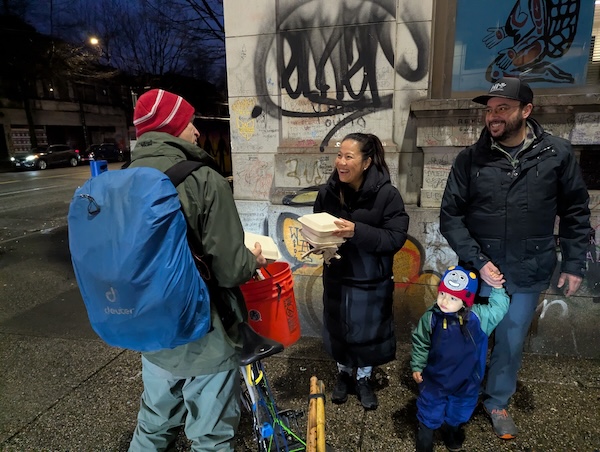
On the fifth night of Hanukkah, Jewish community members delivered latkes and sufganiyot in the Downtown Eastside. (photo by Pat Johnson)

On the fifth night of Hanukkah, a group of Jewish Vancouverites delivered latkes and sufganiyot to frontline workers and people living in the Downtown Eastside.

Mordehai Wosk came up with the idea while speaking to a doctor about antisemitism. The doctor commented that the dark days of winter were a good time to bring light into the world by demonstrating the values of Jewish ethics. 

“I thought it was a great idea,” said Wosk. “I loved it.”

Wosk called Ezra Shanken, chief executive officer of the Jewish Federation of Greater Vancouver. Within a few hours, the whole thing was organized and arranged under the Federation’s program of Brighten BC.

The event turned into a family affair. Wosk enlisted wife Hana, their son Ariel, daughter-in-law Ayami and grandson Rey J Wosk.

Rabbi Philip Bregman, meanwhile, mobilized the Chickpea food truck, which is owned by Bregman’s daughter and son-in-law Jordana and Itamar Shani.

“The message is that we’re on this planet together,” the rabbi said. “We need to help to dispel darkness, not just for our own community, but for the world.

The food truck set up outside Firehall No. 2, in the Downtown Eastside. Volunteers fed firefighters and police before spreading out across the neighbourhood distributing food.

“People are very grateful,” said Hana Wosk, as she handed out food along Hastings Street. “We often say ‘happy Hanukkah’ and get a bit of a blank stare back, but we also say ‘happy holidays’ and this is just a gift to light up your winter.”

Terry Yung, member of the BC Legislature for Vancouver-Yaletown and minister of state for community safety and integrated services, was also on hand. He is a retired 30-year veteran of the Vancouver Police.

“Firehall No. 2 is actually the busiest fire hall in the country,” Yung said. “Day in and day out, they see people in crisis, in chaos. I think it’s really important for them to know that the public is supportive, is on their side.” 

Format ImagePosted on January 23, 2026January 22, 2026Author Pat JohnsonCategories Celebrating the Holidays, LocalTags Brighten BC, Chickpea, Downtown Eastside, DTES, Hana Wosk, Hanukkah, Jewish Federation, Mordehai Wosk, Philip Bregman, Terry Yung

Johnson awarded for human rights work

Pat Johnson has been selected by the government of Romania for the 2025 Ambassador Mihnea Constantinescu National Award for outstanding merits in combating antisemitism, xenophobia, radicalization and hate speech. He was nominated for the honour by the Jewish Federation of Greater Vancouver.

photo - Pat Johnson
Pat Johnson (photo courtesy)

The jury’s decision to award the 2025 prize to Johnson took into account the innovative nature of his activities and their long-term impact, his substantial civic commitment and contributions to public education, Romania’s Ministry of Foreign Affairs said in the announcement. 

Johnson, who readers will know, is on the editorial board of the Jewish Independent and has been part of the newspaper for almost 30 years. He is a writer and public figure with more than 30 years of experience promoting human rights and equal opportunities, combating antisemitism, discrimination and prejudice. He is the founder of Upstanders Canada, a grassroots movement to encourage Canadians (especially non-Jewish Canadians) to stand against antisemitism and anti-Zionism. Readers can follow him at pat604johnson.substack.com.

“The work this prize represents  – standing against antisemitism, hate and distortion of history – is collective, ongoing, and carried by so many people. I see this prize as encouragement for all people to keep going, to speak clearly, and to just show up,” said Johnson.

Ambassador Mihnea Constantinescu was a senior Romanian diplomat. Among many other things, he served as Romania’s chair of the International Holocaust Remembrance Alliance, and chaired the meeting that adopted the working definition of antisemitism. 

Posted on January 23, 2026January 22, 2026Author JI staffCategories LocalTags allyship, antisemitism, human rights, Pat Johnson, Romania

Posts pagination

Previous page Page 1 … Page 9 Page 10 Page 11 … Page 662 Next page
Proudly powered by WordPress