Skip to content
  • Home
  • Subscribe / donate
  • Events calendar
  • News
    • Local
    • National
    • Israel
    • World
    • עניין בחדשות
      A roundup of news in Canada and further afield, in Hebrew.
  • Opinion
    • From the JI
    • Op-Ed
  • Arts & Culture
    • Performing Arts
    • Music
    • Books
    • Visual Arts
    • TV & Film
  • Life
    • Celebrating the Holidays
    • Travel
    • The Daily Snooze
      Cartoons by Jacob Samuel
    • Mystery Photo
      Help the JI and JMABC fill in the gaps in our archives.
  • Community Links
    • Organizations, Etc.
    • Other News Sources & Blogs
    • Business Directory
  • FAQ
  • JI Chai Celebration
  • JI@88! video

Recent Posts

  • Last hostage home
  • New bill targets hate crimes
  • Concerning actions
  • Recipes not always required
  • Survivor urges vigilance
  • Seniors profoundly affected
  • Farm transforms lives
  • Musical legacy re-found
  • A range of Jewish literature
  • A concert of premieres
  • Variety telethon on Feb. 22
  • Victoria club’s many benefits
  • Avodah dedicated to helping
  • Artists explore, soar, create
  • Life’s full range of emotions
  • Community needs survey closes March 29
  • Jerusalem marathon soon
  • Historic contribution
  • Chronicle of a community
  • Late-in-life cartoonist
  • Cashflow vs growth portfolio
  • My new best friend is Red
  • ישראלים רבים ממשיכים לתמוך בטראמפ ועדיין אינם מבינים במי מדובר
  • עשרים ואחת שנים בוונקובר
  • Supporting the Iranian people
  • The power of photography
  • A good place to start
  • When boundaries have shifted
  • Guitar virtuosos play
  • Different concepts of home
  • Broadway’s Jewish storylines
  • Sesame’s breadth and depth
  • Dylan Akira Adler part of JFL festival
  • Mortality learning series
  • A new strategy to brighten up BC
  • Sharing latkes and light

Archives

Follow @JewishIndie
image - The CJN - Visit Us Banner - 300x600 - 101625

Tag: Finding Home

Different concepts of home

The current show at the Zack Gallery – Finding Home – unites three very different artists: Jeannette Bittman, Andrea Dillingham-Lacoursiere and Eri Ishii. Sarah Dobbs, the gallery curator, told the Independent how the show came together.   

“All three artists submitted independent proposals for solo exhibitions,” said Dobbs, adding that, in their own unique way, all three artists “engaged the ideas of place, displacement, immigration and the evolving notion of home.… Their works differ significantly in style and approach, but their practices intersect conceptually. Andrea’s work is rooted in a specific geographic place. Eri’s practice explores internal and emotional landscapes. Jeannette’s work centres on the table as a focal point of Jewish life and tradition, and as a site that reflects the dynamics, rituals and emotional complexities of gathering. Together, their works expand and complicate the idea of home, from the physical to the psychological and to the communal.”
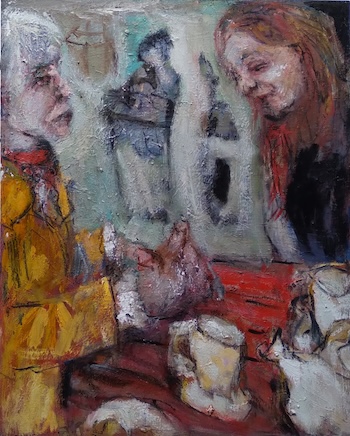
photo - “At Work” by Jeannette Bittman
“At Work” by Jeannette Bittman. (photo by Olga Livshin)

Bittman’s images are all domestic scenes. People, young and old, gather around a table, eating and chatting. The colours are muted, the faces indistinct, less important. The table and the food are the points of connection, the common joy and purpose.

“A table is of great significance in everyone’s life,” Bittman told the JI. “It is the place where we eat, but, maybe more importantly, where we meet others and ourselves. The table and gathering around it are critical to Jewish life and culture. Family meals are crucial for family and child growth. Gathering with friends often occurs around a table. Self-reflection, recollection and reminiscence, as well as dreams, occur around a table.” For her, a table is the essence of home. 
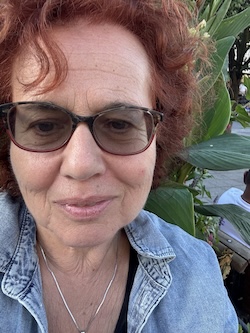
photo - Jeannette Bittman
Jeannette Bittman (photo courtesy)

“As an artist, I’m intrigued by human emotions and want to represent them through my art,” she said. “Initially, I focus on the realistic expressions of the models. Then, I explore, using colour, shade and form to go deeper. I try to capture the feeling rather than reality … I search for the mood. I rarely have a finished product in mind and become fascinated with the multitude of possibilities. It’s often challenging for me to stop at one.”

Ishii, meanwhile, ponders the outdoors in her paintings. A girl is running along a forest trail in “Runner.” Three girls are gazing across a river in “Three.” A young woman contemplates a peaceful pond in “Bridge,” while dappled sunlight plays all around her, and water ripples beneath the pilings of a little bridge. 

All of Ishii’s images are quiet and introspective, uplifting in their tranquil greenery. One could almost hear the breeze whispering in the boughs and the wavelets muttering at the shore. “I am essentially a figurative painter,” said the artist. “My main interest is the inner world of my figures. I want to create works that have emotional resonance.”           

For Ishii, home is a complex concept, an inner rapport rather than a particular geographic region. “To me, home means belonging, community and a sense of identity. As an immigrant, I have experienced that these things are fluid and shifting. I have two homes: the place where I spent my formative years – Japan – and the place where I chose to build my life – Canada.”

photo - “Runner” by Eri Ishii
“Runner” by Eri Ishii. (photo by Olga Livshin)

About her pieces in the Zack show, she said, “I made them at different points of my life. ‘Bridge’ and ‘Three’ are parts of a series that explores storytelling in paintings. They were inspired by film stills from a British mystery. ‘Runner’ and ‘Picnic’ are made more recently. ‘Runner’ revisits the running series from 20 years ago. The series investigated the transient nature of life and posed questions concerning where we are running to, as well as what we are running from. ‘Picnic’ is the most recent of my works. It explores family relationships. It was inspired by a photo I saw in a recipe book that showed a family enjoying a feast.”
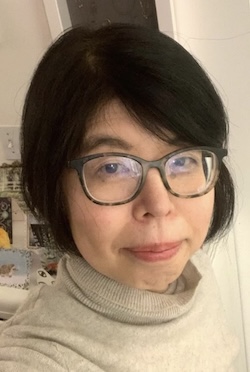
photo - Eri Ishii
Eri Ishii (photo courtesy)

Like many artists, Ishii is fond of mentoring others. “Teaching is rewarding in more external ways, as opposed to painting,” she said. “I love being part of people’s journeys, as they tackle challenges of making paintings. It is my way of giving back what I learnt, whereas painting is more internal, as I try to explore what is going on inside of me.”

Ishii’s creative explorations could happen anywhere in the world. “I deliberately made them non-specific,” she said. “I wanted to keep them open to viewers’ imagination.”

Dillingham-Lacoursiere, on the other hand, dedicates her landscapes to one very specific location: Lasqueti Island in the Strait of Georgia, an off-grid, ecologically conscious community, and her home. Her panoramic vistas are bright and intense. The sharp colours of land, ocean and sky echo the lines of nature and emphasize the artist’s fierce emotional link to the place. While Ishii’s paintings are murmurs of lyrical fulfilment and Bittman’s delve into the kernel of her Jewishness, Dillingham-Lacoursiere’s paintings are screams of defiance, a rebellious statement of the artist’s soul.

“I used to equate home with a soft place to land, with treasured collections and memories that serve as reminders of our lives, our ancestors,” she said. “When I moved from Alberta, I left a five-bedroom house, my family, most of my friends, a community that had taken me a lifetime to build, but it wasn’t easy [there]. Reconciling the beauty of the prairies with a mindset and values that never fit meant it was an uphill battle. I was tired of trying to make myself fit into the place I called home but had never felt like it.”
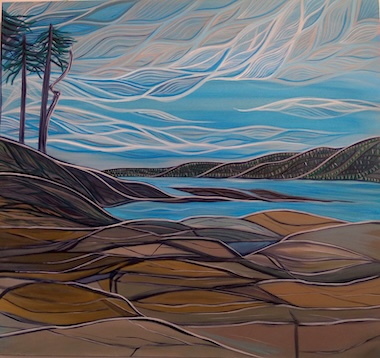
photo - “Home” by Andrea Dillingham-Lacoursiere
“Home” by Andrea Dillingham-Lacoursiere. (photo by Olga Livshin)

Here, in British Columbia, she said, “Now, home for me exists in small ways. It’s my favourite tree. It’s reading poetry on a Sunday morning, with coffee in my favourite mug…. I’ve worked with First Nations communities for over a decade, and it was in those circles, around those fires and in those sweat lodges, that I learned women are the keepers of the home. In that sense, I am my home, and I can offer refuge, perhaps especially to myself.”
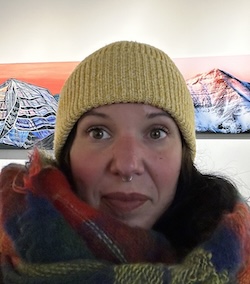
photo - Andrea Dillingham-Lacoursiere
Andrea Dillingham-Lacoursiere (photo courtesy)

Dillingham-Lacoursiere has been painting landscapes for about 10 years. “I had avoided painting landscapes my whole life, until 2016. At the time, I was in the throes of a crisis of conscience, at the confluence of my job and my community,” she shared. “I had spent a year at the helm of a project that was deeply honouring the unfinished lives of the missing and murdered Indigenous women and girls of this country. The next project I was asked to lead at the museum and art gallery where I worked was the Canada 125 celebrations. The cognitive dissonance I felt pulled me in ways I could not have expected.”

Her response was artistic.

“It led me to an exhibit focused on landscapes of our national parks system. It is a system constructed to outwardly give a sense of national pride, but, at the same time, to commodify some of the most beautiful natural spaces … as escapes for those that could afford it,” she said. “That exhibit was called Reflections on My Reconciliation. People really connected with my art and my message. And it began the unravelling of what I thought it meant to be Canadian for me.”

Finding Home opened Jan. 7 and runs until Feb. 2. Every visitor will be confronted with the question, “What does home mean to you?” 

Olga Livshin is a Vancouver freelance writer. She can be reached at [email protected].

Format ImagePosted on January 23, 2026January 21, 2026Author Olga LivshinCategories Visual ArtsTags Andrea Dillingham-Lacoursiere, art, Eri Ishii, exhibits, Finding Home, immigration, Jeannette Bittman, painting, place, Sarah Dobbs, Zack Gallery

Bonds of family, community

Following your dreams takes guts, hard work and perseverance. You have to admire someone who goes for it, whether or not they succeed. And if they succeed, it’s all the more impressive – and inspiring.

Two books came across my desk this summer via local connections. Emiliano’s Discovery is a first novel by Toronto-based Paula Hurwitz, whose uncle lives in Vancouver. Finding Home is a collection of non-fiction essays by Danita Dubinsky Aziza, whose mother lived here until recently moving to be closer to the family in Winnipeg. Both books were self-published with FriesenPress: Hurwitz’s in 2014, Aziza’s this year.

It might be an exaggeration to say that writing a novel was a dream of Hurwitz’s but she went to lengths to make it happen, a fact that can be seen from her acknowledgements. A lawyer by profession, she thanks a University of Toronto introduction to the novel course for giving her “the foundation to write this book,” as well as the Humber School for Writers, and several individuals. The end result is something of which to be proud.

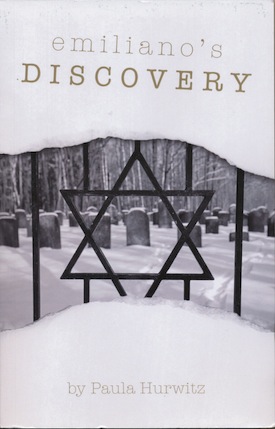
image - Emiliano's Discovery book coverEmiliano’s Discovery begins in Russia in 1903. The prologue in which Duvid, Malka and their family in Kishinev encounter the violent pogroms of the time sets the stage for Emiliano’s eventual search for family. It also reminds readers of the precarious world in which Jews seem to continually live. Chapter 1 takes us to Buenos Aires in 1994 and the terrorist bombing of the Asociacion Mutual Israelita Argentina (AMIA).

Emiliano – about to graduate university and in need of employment – heads to the AMIA with his girlfriend, Lia. With the lineup barely moving, he suggests they go and grab a coffee, but she chooses to stay behind. “Just as Emiliano steps out [of the elevator] an enormous blast knocks him from his feet. He hears people yelling and feels debris falling around him. Then he loses consciousness.”

While Emiliano is directly affected by the attack, both physically and mentally, more than 10,000 kilometres away, in Winnipeg, Naomi’s “lazy summer day” – she doesn’t start Grade 12 for six weeks – is interrupted by a newscast about the tragedy. Long after she turns off the television, “she can’t shut out the horrific images replaying in her mind. If only she could figure out how to help. Doing something might calm her down.”

The novel alternates between Emiliano and Naomi, until their paths combine. They do so in Winnipeg, and that is one of the most interesting aspects of this story because the Winnipeg Jewish community actually did encourage Argentine Jews to immigrate to their city, and it’s kind of like getting a peek behind the scenes. Another compelling aspect of the story is the concept of how two families – one in Buenos Aires, the other in Winnipeg – could have ancestors from the same village who ended up in such completely different places. While the novel may wrap up its narratives a little too neatly for some readers, it doesn’t detract from their value.

Not quite so neat – in fact, quite chaotic at times, perhaps because it is an account of her real-life experiences – is the story told through essays by Aziza of her family’s decision to make aliya, their years in Israel and their ultimate return to Canada.

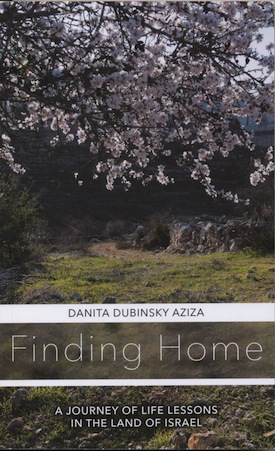
image - Finding Home book coverAziza has done a commendable job in compiling the almost 40 essays that were initially written as stand-alone articles or blog-type pieces. Rhonda Spivak, editor of the Winnipeg Jewish Review, asked Aziza to write about her experiences for the online publication, and she did. The Jewish Federation of Winnipeg also asked her to share some of her stories on its website.

Written over four years (2008-2012), each article – and now, each chapter – conveys a lesson Aziza learned, and not always the hard way. From “start slowly” (“leh-at, leh-at” in Hebrew) as a way of coping with all the changes one faces as an immigrant, to “your children are not your children” and, therefore, you need to let them make their own choices, even if it’s to enlist, to the title lesson, “finding home,” which may not be where you think it should be, Aziza takes readers on her journey. She writes with humor and with honesty, and without embellishment, a style I like very much.

The impetus to make aliya – Aziza, her husband, Michel, their three kids and their dog – came 23 years prior to when the family arrived at Ben-Gurion Airport in 2008. Aziza, living in Toronto in 1985, reluctantly headed to the gym. There, she met “the cute guy with curly black hair” and, after a couple of weeks, “with gym bags flung casually over our shoulders, Michel and I collided at the end of the cement walkway that led to the overcrowded parking lot of the JCC.” Regular meetings followed and, in one of those early encounters, Michel asked her, “Danita, would you ever consider living in Israel?” To which she replied, “Oh, for sure, I would love to live in Israel! I have visited three times and it is such an amazing place!”

As she would find out, visiting and living somewhere are two very different things. Learning a new language, negotiating a foreign culture, being far from your aging parent, seeing your son enter the army and facing the prospect of your daughters following suit, building a new home (in their case, literally constructing a house) and many other factors are challenging aspects of any immigration experience. There are also many new discoveries and joys. But sometimes leaving a place – in this instance, Winnipeg – makes you realize that you might have been home all along.

And, as Aziza writes about her response to a friend who was curious whether she “had failed at living in Israel. With an air of confidence I acquired only after living in Israel, I told her, ‘I didn’t fail. I think that our family did more in four years there than most. I believe the failure would have been for us not to have gone to Israel in the first place.’”

It’s a thought that rings true.

Posted on September 11, 2015September 9, 2015Author Cynthia RamsayCategories BooksTags Danita Dubinsky Aziza, Emiliano’s Discovery, Finding Home, FriesenPress, Paula Hurwitz
Proudly powered by WordPress