
The current show at the Zack Gallery – Finding Home – unites three very different artists: Jeannette Bittman, Andrea Dillingham-Lacoursiere and Eri Ishii. Sarah Dobbs, the gallery curator, told the Independent how the show came together.
“All three artists submitted independent proposals for solo exhibitions,” said Dobbs, adding that, in their own unique way, all three artists “engaged the ideas of place, displacement, immigration and the evolving notion of home.… Their works differ significantly in style and approach, but their practices intersect conceptually. Andrea’s work is rooted in a specific geographic place. Eri’s practice explores internal and emotional landscapes. Jeannette’s work centres on the table as a focal point of Jewish life and tradition, and as a site that reflects the dynamics, rituals and emotional complexities of gathering. Together, their works expand and complicate the idea of home, from the physical to the psychological and to the communal.”
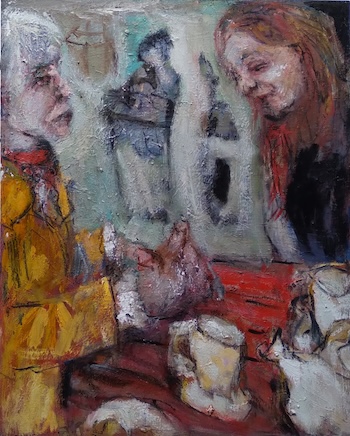
Bittman’s images are all domestic scenes. People, young and old, gather around a table, eating and chatting. The colours are muted, the faces indistinct, less important. The table and the food are the points of connection, the common joy and purpose.
“A table is of great significance in everyone’s life,” Bittman told the JI. “It is the place where we eat, but, maybe more importantly, where we meet others and ourselves. The table and gathering around it are critical to Jewish life and culture. Family meals are crucial for family and child growth. Gathering with friends often occurs around a table. Self-reflection, recollection and reminiscence, as well as dreams, occur around a table.” For her, a table is the essence of home.
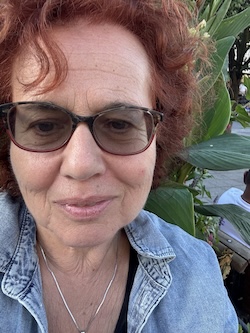
“As an artist, I’m intrigued by human emotions and want to represent them through my art,” she said. “Initially, I focus on the realistic expressions of the models. Then, I explore, using colour, shade and form to go deeper. I try to capture the feeling rather than reality … I search for the mood. I rarely have a finished product in mind and become fascinated with the multitude of possibilities. It’s often challenging for me to stop at one.”
Ishii, meanwhile, ponders the outdoors in her paintings. A girl is running along a forest trail in “Runner.” Three girls are gazing across a river in “Three.” A young woman contemplates a peaceful pond in “Bridge,” while dappled sunlight plays all around her, and water ripples beneath the pilings of a little bridge.
All of Ishii’s images are quiet and introspective, uplifting in their tranquil greenery. One could almost hear the breeze whispering in the boughs and the wavelets muttering at the shore. “I am essentially a figurative painter,” said the artist. “My main interest is the inner world of my figures. I want to create works that have emotional resonance.”
For Ishii, home is a complex concept, an inner rapport rather than a particular geographic region. “To me, home means belonging, community and a sense of identity. As an immigrant, I have experienced that these things are fluid and shifting. I have two homes: the place where I spent my formative years – Japan – and the place where I chose to build my life – Canada.”

About her pieces in the Zack show, she said, “I made them at different points of my life. ‘Bridge’ and ‘Three’ are parts of a series that explores storytelling in paintings. They were inspired by film stills from a British mystery. ‘Runner’ and ‘Picnic’ are made more recently. ‘Runner’ revisits the running series from 20 years ago. The series investigated the transient nature of life and posed questions concerning where we are running to, as well as what we are running from. ‘Picnic’ is the most recent of my works. It explores family relationships. It was inspired by a photo I saw in a recipe book that showed a family enjoying a feast.”
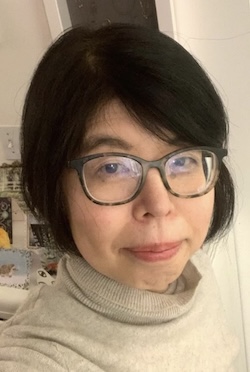
Like many artists, Ishii is fond of mentoring others. “Teaching is rewarding in more external ways, as opposed to painting,” she said. “I love being part of people’s journeys, as they tackle challenges of making paintings. It is my way of giving back what I learnt, whereas painting is more internal, as I try to explore what is going on inside of me.”
Ishii’s creative explorations could happen anywhere in the world. “I deliberately made them non-specific,” she said. “I wanted to keep them open to viewers’ imagination.”
Dillingham-Lacoursiere, on the other hand, dedicates her landscapes to one very specific location: Lasqueti Island in the Strait of Georgia, an off-grid, ecologically conscious community, and her home. Her panoramic vistas are bright and intense. The sharp colours of land, ocean and sky echo the lines of nature and emphasize the artist’s fierce emotional link to the place. While Ishii’s paintings are murmurs of lyrical fulfilment and Bittman’s delve into the kernel of her Jewishness, Dillingham-Lacoursiere’s paintings are screams of defiance, a rebellious statement of the artist’s soul.
“I used to equate home with a soft place to land, with treasured collections and memories that serve as reminders of our lives, our ancestors,” she said. “When I moved from Alberta, I left a five-bedroom house, my family, most of my friends, a community that had taken me a lifetime to build, but it wasn’t easy [there]. Reconciling the beauty of the prairies with a mindset and values that never fit meant it was an uphill battle. I was tired of trying to make myself fit into the place I called home but had never felt like it.”
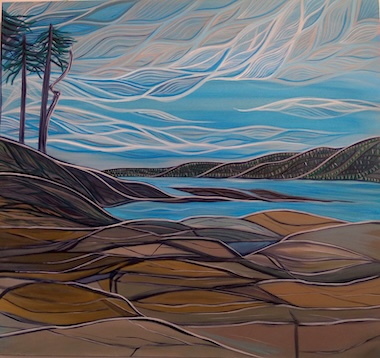
Here, in British Columbia, she said, “Now, home for me exists in small ways. It’s my favourite tree. It’s reading poetry on a Sunday morning, with coffee in my favourite mug…. I’ve worked with First Nations communities for over a decade, and it was in those circles, around those fires and in those sweat lodges, that I learned women are the keepers of the home. In that sense, I am my home, and I can offer refuge, perhaps especially to myself.”
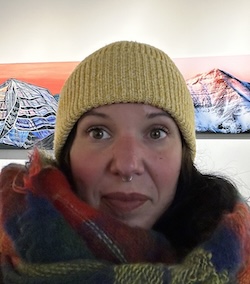
Dillingham-Lacoursiere has been painting landscapes for about 10 years. “I had avoided painting landscapes my whole life, until 2016. At the time, I was in the throes of a crisis of conscience, at the confluence of my job and my community,” she shared. “I had spent a year at the helm of a project that was deeply honouring the unfinished lives of the missing and murdered Indigenous women and girls of this country. The next project I was asked to lead at the museum and art gallery where I worked was the Canada 125 celebrations. The cognitive dissonance I felt pulled me in ways I could not have expected.”
Her response was artistic.
“It led me to an exhibit focused on landscapes of our national parks system. It is a system constructed to outwardly give a sense of national pride, but, at the same time, to commodify some of the most beautiful natural spaces … as escapes for those that could afford it,” she said. “That exhibit was called Reflections on My Reconciliation. People really connected with my art and my message. And it began the unravelling of what I thought it meant to be Canadian for me.”
Finding Home opened Jan. 7 and runs until Feb. 2. Every visitor will be confronted with the question, “What does home mean to you?”
Olga Livshin is a Vancouver freelance writer. She can be reached at olgagodim@gmail.com.