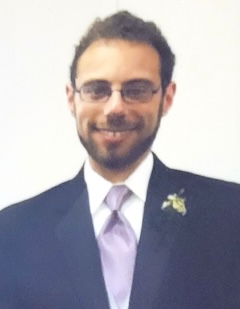
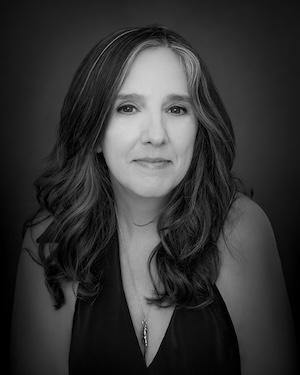
Left to right: Kara Mintzberg, Maurice Moses, Cyndi Mintzberg, Sheila Gordon (a friend of Haber’s), Gyda Chud, Grace Hann and Tammi Belfer, with Marilyn Berger in front. (photo from JSA)
On Nov. 19, Jewish Seniors Alliance held their Fall Symposium at the Peretz Centre for Secular Jewish Culture. The event honoured Serge Haber, JSA’s founder.
Haber passed away in October of this year at the age of 95. Throughout his life, he never lost his vision of there being in the community an organization that would see seniors helping seniors. He worked tirelessly to achieve this goal. Many of the speakers that Sunday afternoon mentioned that Haber would never take no for an answer. He managed by the force of his personality to involve people in the alliance and to find donors and foundations to support its work.
Gyda Chud, a former co-president of JSA, was the symposium’s emcee. She introduced Tammi Belfer, the current president, who welcomed the 50 people in the audience and the 22 watching online. Former JSA presidents Ken Levitt and Marilyn Berger spoke about what they had gained from working with the organization and what they had learned from Haber. Cyndi Mintzberg and her daughter Kara Mintzberg, cousins of Haber, representing the family, spoke of how much they enjoyed spending time with Haber. They particularly mentioned Shabbat dinners. Haber’s children, in Toronto and Washington, were watching on Zoom.
Two videos of Haber were shown. The first had been prepared for his 90th birthday, and featured a collage of photos from different periods and events in his life. Some showed him in Romania before the war; others in Montreal, where he married; and some from Vancouver, where he lived for many years. The second video was of a speech that Haber gave to the Fraser Health Authority in which he explained the importance of dealing with the loneliness that afflicts many seniors, and how the Peer Support Program of JSA can help with these issues by providing emotional support.
Rabbi Adam Stein of Congregation Beth Israel, who is a JSA board member, offered remarks on behalf of the synagogue, where Haber was an active member for many years. Stein described visiting him in hospice. Instead of talking about himself, Haber wanted to know how the rabbi and his family were doing.
Marie Doduck, another member of the JSA board, brought greetings from the Vancouver Holocaust Education Centre, where Haber was active with the survivors group.
Grace Hann, the trainer for the Peer Support Program, described her first interactions with Haber, saying she was frightened of him until he took the training and easily fit into the group. She felt the force of his dedication and said she learned a lot from him.
Maurice Moses, a long-time friend, sang a moving rendition of “Eli, Eli.” He also led the group in the singing of the Partisans’ Hymn, which Marilyn Berger had suggested as a reminder of the Holocaust and the Oct. 7 attacks in Israel.
Belfer shared some of the JSA’s plans, including the possible hiring of an executive director and the organization’s 20th anniversary gala, to be held in February at Temple Sholom. She spoke again of Haber’s vision and of the three pillars of JSA – education, advocacy and peer support – and noted that there were donor cards on the tables, which people could use to donate to the Serge Haber Fund at the Jewish Community Foundation of Greater Vancouver. The formal part of the event closed with the singing of Hatikvah.
Shanie Levinis a Jewish Seniors Alliance Life Governor. She is also on the editorial committee of Senior Line magazine.
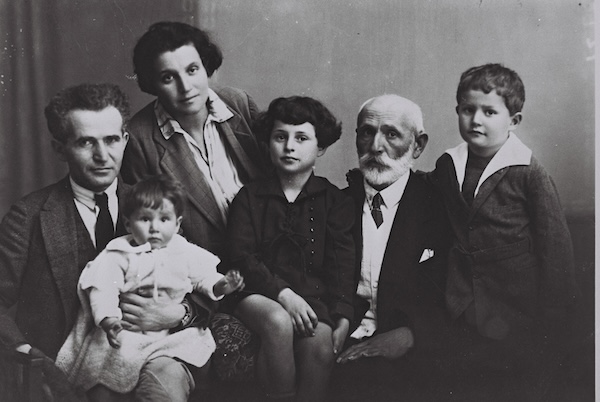
The Ben-Gurion family in their Tel Aviv home, 1929. From left: David and Paula with youngest daughter Renana on Ben-Gurion’s lap, daughter Geula, father Avigdor Grün and son Amos. (photo from National Photo Collection of Israel / Government Press Office)
David Ben-Gurion, who died 50 years ago, insisted Israelis needed Hebrew names. The process was controversial – but the outcome is clear.
The 50th anniversary of the death of David Ben-Gurion will be marked Dec. 1. The first prime minister of Israel is generally remembered in noble terms, though we live in an era when heroes are being toppled from their plinths. His actions in times of war and peace have been parsed by historians – fairly and unfairly, as seems inevitable – but Ben-Gurion’s legacy among Zionists appears generally secure. Those with ideological axes to grind will grind, but the esteem in which most Israelis and overseas Jews view “the Old Man” remains largely favourable. However, an aspect of his policy that affected people in a very personal way has come in for a reconsideration in the past couple of decades, though it is hardly the stuff that will make or break a reputation. It is the Hebraization of names.
Ben-Gurion was a fierce advocate of Israelis (or, before 1948, Palestinian Jews) adopting names that reflect their new reality and that, by extension, turn their backs on the past and the diaspora. Ben-Gurion himself was born David Grün (or Gruen), changing his name to the Hebrew Ben-Gurion (son a lion cub) in 1910. By 1920, at the latest, he had become an evangelist for Hebraizing names and, when he was in power, he insisted that leading military and political figures adopt Hebrew names.
Ben-Gurion did not start this trend – though he is perhaps most closely associated with it because he was in a position to make it the force of law and custom. He instituted an administrative order that senior military figures and diplomatic officials representing Israel abroad must have Hebrew names. Others, like Golda Meir, he browbeat into the change.
Of course, Jews – and others – have been changing their names since the dawn of migration. People have frequently altered their names when moving to a new society, in order to fit in. Iberian Jews migrating en masse to the Low Countries after the expulsions of the 1490s are an early, well-documented example. Jews arriving on North American shores routinely changed their names, but so did non-Jewish migrants. It was not necessarily (or only) antisemitism that name-changers sought to outrun, but differentness in general. There are stories of French newcomers changing from Boisvert to Greenwood.
Dara Horn, in her book People Love Dead Jews, emphatically debunks the long-held belief passed down by generations that their family names had been changed at Ellis Island (or whatever entry point was appropriate to the story). No, she argues, that didn’t happen. The changing of names by Jewish new Canadians and Americans was, she contends, done by the migrants themselves and represents a sad realization that the Goldene Medina might not be the refuge from antisemitism they had hoped.
But changing one’s name to fit into a society already in progress, like America’s, was different than the situation of arriving in the pre-state Yishuv. This was not a matter of looking around for a local-sounding name and changing Moses to Murray or Lipschitz to Lipson. This required inventing a whole new lexicon of names. It was not the act of taking a common name in the new place, but of inventing entirely fresh first and last names.
The process was a legacy, ultimately, of Eliezer Ben-Yehuda (né Perlman), who was the driving force behind the revival of Hebrew as a vernacular language. After making aliyah in 1881, he came to believe that the redemption of both the people and the land of Israel required a new language to replace Yiddish. This represented a rejection of the diaspora reality and mentality, and served to create a medium through which an eventual (hoped-for) ingathering of exiles from around the world, including places where Yiddish was not the Jewish lingua franca, could communicate. The revival of an ancient land would coincide with the revival of an ancient language, both modernized to meet the needs of a new type of Jew. Ben-Yehuda raised his son and daughter exclusively in Hebrew, which must have made for a somewhat lonely childhood, being effectively the only two people in the world to speak the language as a mother tongue.
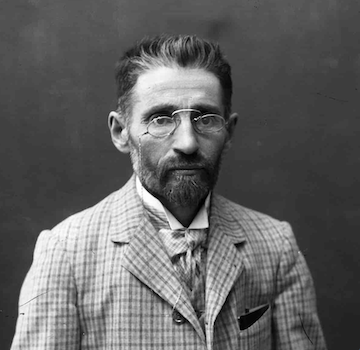
Eliezer Ben-Yehuda (né Perlman) was the driving force behind the revival of Hebrew as a vernacular language. (photo by Av Yaacov Ben Dov / Widener Library, Cambridge)
As the language spread – in large part thanks to Ben-Yehuda’s continued perseverance in promoting it and inventing modern words where the ancient language lacked them – the application of the new tongue to family and given names likewise grew.
The repudiation of the diaspora took on an entirely new relevance after the Holocaust. Some who made aliyah resisted changing their names, being attached, as is understandable, to one’s family name. Even so, no Jewish surnames were particularly long-established in the first place, since the practice of Jews adopting inheritable family names was only a century old, or a little more, at that time. The Austro-Hungarian Empire required Jews to take surnames in 1789 and in the Russian Empire and the German principalities not until the following century. At that time, choosing a name followed predictable patterns for Jews and non-Jews: a variation on “son of,” (Aronoff, son of Aron; Mendelsohn, son of Mendel), a reference to a profession (Becker for a baker; Melamed for a teacher), or a connection to the town or region (Frankel, from Franconia; Warshavski, from Warsaw; Wiener, from Vienna).
The adoption of Hebraized names in Palestine and Israel took four primary approaches.
The first was the traditional use of patronyms or matronyms, which is probably the oldest form of naming. Yiddish names, but also names that were German, Polish, Russian, English or French patronyms could be Hebraized: Davidson to Ben-David, Mendelson to Ben-Menachem, Simmons to Shimoni.
A second approach was to choose a Hebrew name that sounded like the original name. In some cases, the new name had a (sometimes remote) connotation with the original, as in the case of Lempel (little lamp) becoming Lapid (torch). Levi Shkolnik would become Israel’s third prime minister as Levi Eshkol. This was more than simply a near-homophone. It reflected another trend in the process, which was to adopt a name that spoke to the commitment of the chalutzim, the pioneers, whose Zionism was deeply informed by a back-to-the-land ethos. Eshkol means “cluster of fruit,” so it did double duty, sounding something like the original and also having a kinship with the blooming desert.
A third strategy was basic translation. Goldberg might become Har-Zahav (mountain of gold); Silver or Silverman might become Kaspi; Herbst, which in German and Yiddish means autumn, could be changed to a Hebrew equivalent, Stav or Stavi.
The fourth approach took the pioneer spirit and connection with the land to greater depths (with or without the homophonic advantage of Shkolnik/Eshkol). Flora, fauna and geography of the new homeland were attractive new names that situated the migrants linguistically and geographically. The writer Carrie-Anne Brownian cites such examples as Rotem (desert broom), Nitzan (flower bud), Yarden (Jordan), Alon (oak tree) and Tomer (palm tree). Simply adopting a place name gives us Hermoni, Eilat, Golani, Kineret and many others.
Those whose names already had a nature theme were at an advantage. The Haganah commander Moshe Klaynboym changed his family name, which meant “little tree” in Yiddish, to Sneh, Hebrew for “bush.”
Not necessarily related to nature, but to the idealization of the Zionist spirit, some took names like Amichai (my people live), Maor (light), Eyal (strength), Cherut (freedom) and Bat Or (daughter of light).
Golda Meyerson, after prodding from Ben-Gurion, became Golda Meir. Interestingly, her rather emphatically Yiddish given name she kept, presumably making Ben-Gurion half-satisfied.
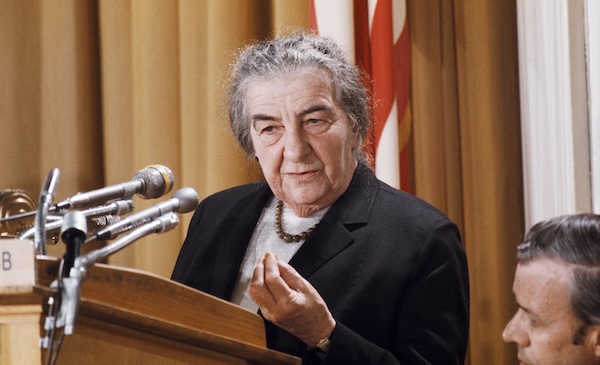
Golda Meyerson, with prodding from David Ben-Gurion, became Golda Meir. (photo from mosaicmagazine.com)
As refugees from the Middle East and North Africa began pouring into Israel in the 1950s and ’60s, the Hebraization of names came to be seen as Ashkenormative, the taking of one’s ancestral name being another indignity (alongside inadequate housing and social stigmatization, among other things) that different-looking newcomers faced in their presumed Promised Land.
It seems, for example, that teachers encountering “strange” Mizrachi and Sephardi given names took it upon themselves, in some cases, to assign kids new names based not on any Zionist ideological imperative but for the same reason Canadian teachers in the early to mid-20th century dubbed kids with “foreign” names new ones the teachers could more easily pronounce. In retrospect, some have complained that this phenomenon was an insidious part of a larger (conscious, unconscious or some of both) effort to force Mizrahim and Sephardim to comport to Ashkenazi expectations even in things as intimate as a given name.
Sami Shalom Chetrit, a professor at Queens College in New York, who is of Moroccan-Israeli origin, recalled in a Forward article by Naomi Zeveloff, feeling outraged when an Israeli elementary school teacher nonchalantly renamed him, along with other non-Hebrew-named kids.
“Alif, your name from now on will be Aliza,” Chetrit recalled the teacher declaring. “Jackie, your name is Jacob, and Michele, your name is Michal. She kept going alphabetically. Then she said, ‘Sami, your name will be Shmuel Shalom.’
“I went to my father, crying.… I really felt like something was stolen from me, something precious. I said: ‘They changed my name! They changed it!’”
Chetrit’s father taught the teacher something the next day, according to the story. In Arabic, “Sami” comes from the root “samar,” the father said, meaning “heavenly superior,” and that, the father declared, is “international.”
The tendency eventually faded out. When a million migrants from the former Soviet Union arrived in Israel, after 1991, almost none chose to, or were pressured to, change their names.
There are contemporary exceptions even to this, though. Anatoly Shcharansky, one of the most famous of the Soviet “refuseniks,” became Natan Sharansky on arrival in Israel in 1986. The American historian Michael Bornstein became the Israeli politician-cum-diplomat Michael Oren, having changed his name when he made aliyah in 1979.
Newcomers to Israel today are free to change their names – and free to keep their “galut” (“exile”) names. Israel, today, is an overwhelmingly Hebrew society, though. New arrivals do not present a risk of swamping the place with Yiddish, Arabic, German, Polish or English, as might have seemed a danger 75 years ago, creating a Babel where cultural unity was desperately needed.
In addition to the psychological impacts of adopting Hebrew names (and language) as a refutation of the diaspora that had so recently been the locus of calamity, there was the practical reality of finding commonality among wildly diverse new citizens. That has been achieved. Even sorbing a million Russian-speaking new Israelis after 1990 did not dilute the ascendency of the Hebrew language. For whatever criticisms the forced (or vigorously encouraged) adoption of Hebrew names might invite, there is no doubt the intended outcome has been realized. Ben-Gurion’s dream not only of a Jewish state, but a Hebrew one, is firmly in place.
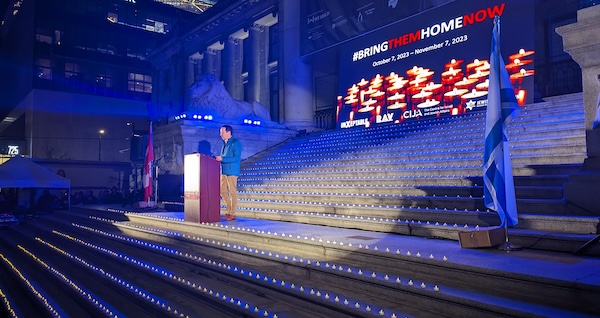
The steps of the Vancouver Art Gallery were illuminated by lights representing those murdered by Hamas on Oct. 7, as the community gathered Nov. 7 to mark shloshim, 30 days of mourning. Here, Ohad Arazi addresses the crowd. (photo by Pat Johnson)
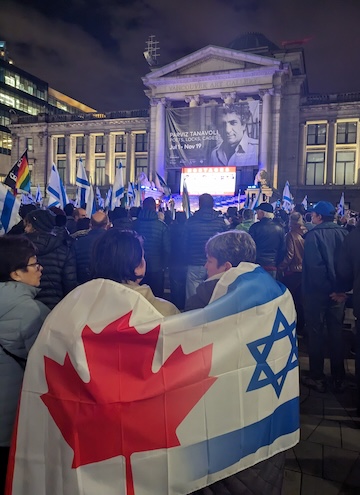
The steps of the Vancouver Art Gallery were illuminated by hundreds of lights representing lost lives, as the community gathered Nov. 7 to mark shloshim, 30 days of mourning, after the unprecedented terror attacks in Israel.
Among the lives lost on that single day was Ben Mizrahi, a 22-year-old Vancouverite, for whom Rabbi Shlomo Gabay of Congregation Beth Hamidrash recited El Moleh Rachamim.
“The past 30 days have been some of the most difficult of our lives,” said Ohad Arazi, who spoke at the gathering. “They have been difficult for some of us as Jews, for others as Israelis. They have been difficult for all of us as humans.
“There are not two sides here. It is not about politics, history, land, religion or anything in between,” Arazi continued. “This is about one thing and one thing only. This is about humanity. Nothing, absolutely nothing, justifies the horrific crimes that were committed 30 days ago. I do not know what comes next from the region as Israel and its allies must now fight to end Hamas’s regime…. But one thing I do know is that we here in Vancouver, here in Canada and elsewhere, we have a voice. We have a voice to stand up for humanity and to cry out against the senseless massacres that were carried out a month ago.
“For now, we need you, all of you, to stand up for Israel. Speak up. Your voice matters. Call them terrorists, not militants, for crying out loud. Do not give up hope that we will bring home all 242 hostages. These are dark days for Israel, but it’s an even darker time for the world, as many choose to side with evil or to not take a stand unequivocally in support of humanity.”
Another speaker, Moti Kotik, is an Israeli who has lived in Vancouver for 20 years. His friend’s daughter, Agam Berger, was kidnapped to Gaza on Oct. 7.
“Tonight, I don’t want to talk about the barbaric atrocities committed by Hamas,” Kotik said. “Nor do I want to speak about those crimes against humanity that so many failed to condemn. Instead, I’d like to share some personal thoughts and realizations that I’ve had in the last 30 days about what it means to be an Israeli Jew in the diaspora.”
For Israelis abroad, he said, it’s challenging to witness events from afar. He cited the Yom Kippur War, which began 50 years to the day before the October pogrom, calling it “a war that changed the lives of our parents.”
“This is our Yom Kippur and it’s already changing us,” he said. “For the first time, I was able to look from the outside and imagine what life for Jews would have been if there was not the state of Israel.”
Kotik said there has traditionally been a division between Israelis and other Jews in the community.
“Many times, we don’t mix with the local community,” he said. “For me, that is done. There is no more duality. I realize that I cannot escape from what I am, from what we are, which is one people, Jewish people, one community that supports each other, that makes us stronger.”
Kotik said the soldiers defending Israel on the frontlines today carry a burden of history.
“They are not there for their families and friends or neighbours, they are not even there just for the people of Israel or even for all of us,” he said. “They are there right now, risking their lives, in the name of every Jew that ever lived. Every Jew throughout history who did not have someone to protect him, who did not have someone to defend him, for every Jew throughout history, they are risking their life and putting it on the line. But they feel us and they feel our warmth and our support and our unconditional trust and they know, while they are on the front, we have their back and it helps them carrying that weight.”
The community gathered Nov. 7 to mark 30 days of mourning since Hamas’s terror attacks. (photo by Pat Johnson)
Ezra Shanken, chief executive officer of the Jewish Federation of Greater Vancouver, welcomed elected representatives and said he does not take for granted the presence and support of government officials and police.
Michael Lee, member of the Legislature for Vancouver-Langara, said he has been hearing from parents whose children in public schools and at universities are experiencing antisemitic taunts and bullying. He commended the City of Vancouver and the Government of Canada for adopting the International Holocaust Remembrance Alliance Working Definition of Antisemitism and said he has been advocating for years that the province of British Columbia likewise adopt it, so that Crown counsel and law enforcement have that tool to aid in prosecuting hate crimes.
John Rustad, leader of the B.C. Conservative party, said he was disgusted that Canada has allowed pro-Hamas rallies to take place.
“It should never, never happen in this country,” he said. “I will do everything I can to stand with you, to stand for peace and to make sure that people understand history.”
Lenny Zhou, a Vancouver councilor, brought greetings from city hall.
“This is not about Israel and Palestine,” Zhou said. “It is not about Jewish or Muslim. It is about Israel and Hamas. It is about civilization and terrorists.”
Rabbi Susan Tendler of Beth Tikvah Congregation read a prayer written for the shloshim and spoke of the anxieties felt by Jews worldwide.
Rev. Doug Longstaffe, a United Church minister and a founding member of the Multi-Faith Summit Council of BC, but speaking on his own behalf, said he believes it is a mistake that more non-Jews are not stepping up in solidarity.
“No group has had power used against them for so long, systemically and lethally, in such a variety of ways and places and it is staggering,” he said. “While I am not arguing that it is harder to be a Jew than to be Black or Brown or Asian – how would I know? I’m white – but it is different. I see that. And it is different mostly because of the history of antisemitism, which I have been privileged to learn about and horrified by.
“There are more hate crimes today against Jews in Canada each year than [against] any other group,” Longstaffe said. “I think our first responsibility as gentiles to Jews is to understand that, considering their unique history, the right of every group to protection under the law needs to be applied most rigorously to Jews.
“Second, considering this unique history of the Jewish people, we need to lose our naivety, so that we do not unconsciously jeopardize Jewish safety by thinking they should simply assume goodwill,” he said. “Third, we need to be especially understanding, as gentiles, of Israel’s need and right to self-defence when surrounded by terrorist groups who wish to destroy all Jewish citizens.”
Regular weekly rallies to free the hostages continued Sunday. That vigil, which emphasized the approximately 40 children held hostage – including an infant born in captivity last week – recognized United Nations World Children’s Day Nov. 20. Four Vancouverites whose cousin, 17-year-old Ofir Engel, is a hostage in Gaza, attended, with one giving a moving sketch of the youth, who was visiting his girlfriend at Kibbutz Be’eri when the attacks occurred. Attendees then marched down Robson Street to Denman, where they amassed outside the restaurant Ofra’s Kitchen, whose proprietor, Ofra Sixto, has been subjected to hateful anti-Israel harassment.
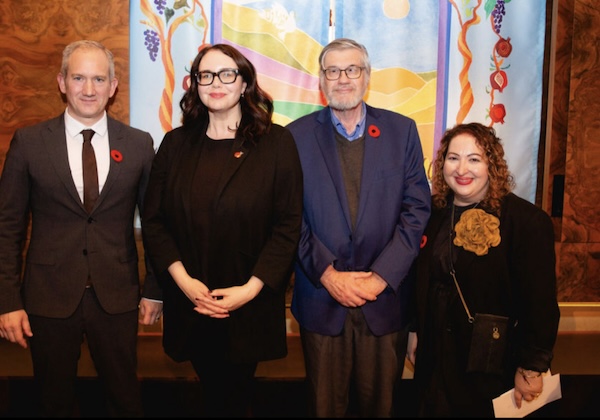
At the Nov. 9 Kristallnacht commemorative event, left to right: Dr. Janus Møller Jensen, Nina Krieger, Prof. Chris Friedrichs and Abby Wener Herlin. (photo by Rhonda Dent)
The rescue of Danish Jews during the Holocaust – an operation that mobilized almost the entire strata of Denmark’s population – is one of the bright lights in the history of that dark era. That extraordinary event, which took place 80 years ago last month, is one of the reasons Denmark had one of the highest survival rates of any country during the Shoah. Even this uplifting story, though, has its “shadows,” according to an expert who spoke in Vancouver Nov. 9.
Dr. Janus Møller Jensen, an historian and director of the Danish Jewish Museum, was the keynote speaker at the annual community-wide Kristallnacht Commemoration, presented by the Vancouver Holocaust Education Centre and held at Beth Israel Synagogue.
Denmark has an unusual history in the context of Nazi occupation. After the Nazis invaded the country with minimal opposition, in April 1940, politicians and the king, Christian X, surrendered, but managed to negotiate terms that allowed the Danish democratic system of government to continue in a so-called “peace occupation.” Importantly, one of the Danish demands was that no Dane be singled out according to their race or faith, said Møller Jensen.
This status quo fell apart in 1943, after a series of strikes and uprisings around the country. Amid the Nazi crackdown came rumours at the end of September that an action against Danish Jews was imminent. At the same time, word spread that Sweden was prepared to accept Danish Jews as refugees. A mobilization of fishing boats began – as did the Nazi mobilization – in early October. Up and down the coast of Denmark, small and larger boats carried their cargo of Jewish Danes across the straight to neutral Sweden. In all, an estimated 7,220 Jews and 686 non-Jewish spouses were transported. Of all Danish Jews, 472 were captured by the Nazis and transported to Theresienstadt, in present-day Chechia, a waystation to the extermination camps. Of these, all but 53 survived the war, in part because the Danish government persuaded the Nazis to allow food and medicine packages to be delivered to the Danish inmates.
Another stunning reality was that, when the Danish Jews who survived – estimates of survival range from 95% to 99% – returned to Denmark, almost all found their homes and possessions intact – a stark difference from what Jews elsewhere in Europe discovered if they returned to their places or origin.
Not all of Danish history is so bright for Jews, said Møller Jensen. A long history of Catholic and Lutheran theological antisemitism permeates Denmark, and immigration policies before the Second World War prevented many Jews from elsewhere from reaching refuge.
“We have letters of refusal in our collection, of people who we know later died in the camps,” said Møller Jensen.
In addition, Danish companies and agricultural producers provided materials to the German war effort, although this was required of all occupied countries, he noted.
Not all rescuers acted on altruistic motives, either, Møller Jensen added. Some fishers took money to transport Danish Jews, but he also noted that, while hindsight suggests the Nazi occupiers turned something of a blind eye to the rescue operation, those involved at the time did not know this and would likely have assumed they were risking their lives.
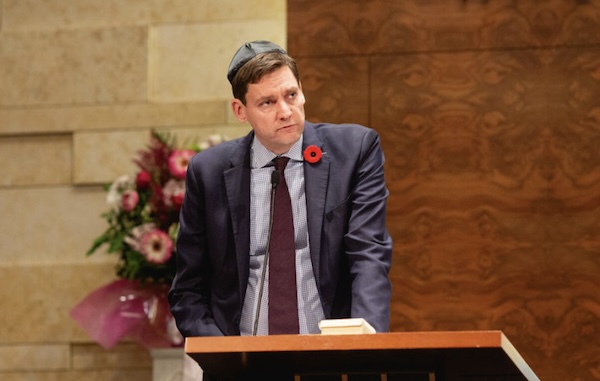
BC Premier David Eby spoke at the Kristallnacht event. (photo by Rhonda Dent)
In addition to the hands-on rescue, Danish society rose up against the Nazis’ action. “Organizations from the entire strata of society – doctors, professors, students, lawyers, industries, working unions – protested,” he said. “The Danish church promulgated a so-called ‘Shepherd’s Letter’ to be read aloud in all of the churches in Denmark the following Sunday, stating that this was an unchristian act, that all people were the same in the eyes of God and that this was wrong and the congregation should assist and protect their fellow human beings…. One of the priests remembered, having read the letter aloud, that the entire congregation spontaneously rose to its feet and shouted ‘Yes!’”
Beth Israel’s Rabbi Jonathan Infeld thanked Møller Jensen and reflected on his words.
“The Danish people,” he said, “did exactly the opposite of what happened in Poland. When the Jews came back to Poland, they were murdered and their property was stolen, and when the Jews came back to Denmark, dinner was waiting for them on their tables. That is righteousness.”
BC Premier David Eby spoke at the Kristallnacht event, saying he wanted to provide assurances that all parties in the Legislature are committed to ensuring that the Jewish community in British Columbia is protected from antisemitism and feels safe. He acknowledged the proximate anniversaries of Kristallnacht and Remembrance Day, and noted that his government had just announced that Holocaust education will become mandatory in the BC school system.
“The thing about remembering is you can’t remember something you’ve never learned, you can’t remember something you were never taught,” Eby told the audience. “I’m proud to stand with you, to support your community, to stand against antisemitism, to stand against Islamophobia, to stand against all forms of hate, for British Columbia to be a beacon of hope in the world of what is possible at a time when those who want to promote division and hate seem to be on the rise just about everywhere. We have lots to be proud of in this province and part of what I’m incredibly proud of is the strength of our Jewish community here and I’m very honoured to be with you here this evening.”
Before the keynote address, Prof. Chris Friedrichs, emeritus professor of history at the University of British Columbia, contextualized Kristallnacht and called the Danish rescue “the most spectacular episode of rescue in the entire history of the Shoah.”
The Kristallnacht gathering was presented in conjunction with Congregation Beth Israel and funded by the Jewish Federation of Greater Vancouver, with support from the Robert and Marilyn Krell Endowment Fund of the VHEC. Møller Jensen’s visit was facilitated by Norman Gladstone and Birgit Westergaard.
Corinne Zimmerman, president of the board of the VHEC, introduced a procession of Holocaust survivors, who carried memorial candles. Nina Krieger, executive director of the VHEC, opened the event and read greetings from Prime Minister Justin Trudeau. Cantor Yaacov Orzech recited El Moleh Rachamim. Councilor Sarah Kirby-Yung read a proclamation from the City of Vancouver. Taleeb Noormohamad, member of Parliament for Vancouver Granville, sent video-recorded greetings from Ottawa. BC cabinet ministers Selina Robinson and George Heyman were in attendance, as was Michael Lee, member of the Legislative Assembly for Vancouver-Langara.
The event drew a record crowd, according to organizers, of 420 in-person attendees and an additional 120 watching via livestream, including groups at the Louis Brier Home and Hospital and the Weinberg Residence.
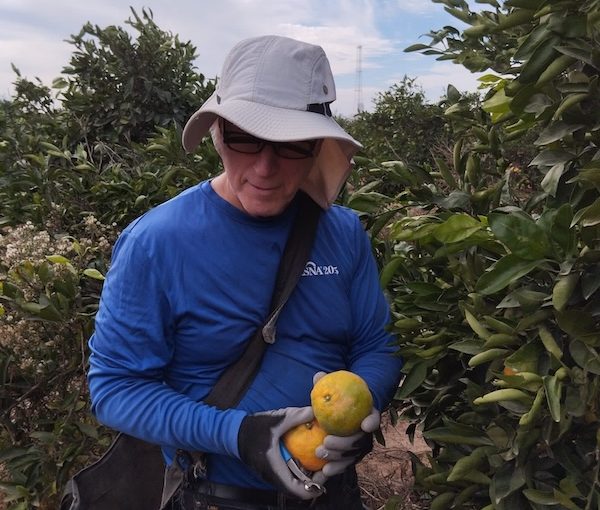
The author’s husband, Dr. Scott Fields, picking tangerines in southern Israel, on Kibbutz Nitzanim. (photo by Deborah Rubin Fields)
I have just returned from laundry brigade duty. Of course, your first question is, what is the laundry brigade? As you may or may not know, in my city of Jerusalem, as well as in other parts of Israel, the hotels are currently filled with people who, for safety’s sake, have left their homes in southern and northern Israel. These moves have created an unprecedented event in Israel’s history. As one friend from Adamit, a far northern kibbutz pointed out, “We are refugees in our own country.”
In my neighbourhood, as well as in other Jerusalem neighbourhoods, residents are volunteering to clean the clothes of those evacuated to hotels. This help is very organized, with a pool of volunteers listed on an Excel file. So, I just returned the laundered clothes of a young family from the northern town of Shlomi.
And, speaking of clothes, there have been clothing drives to help those who left their homes quickly. Books and games have also been donated so that displaced families have some positive way to occupy their time.
But there are so many other noteworthy acts of goodness. One of our sons and other staff from Kfar Saba’s Meir Hospital recently drove south to the Netivot area to help a farmer pick and box watermelon. The farmer’s usual Thai or Palestinian workers are gone. In their place, hundreds, if not thousands of ordinary citizens are in the fields picking – and this is happening all over the country.
One of our daughters spent a week at Jerusalem’s Bezalel Art School sewing uniforms and add-ons for protective ceramic vests, equipment the soldiers currently need. Sewing machines were even delivered to some kibbutzim so kibbutz members could also help with this task.
While there is enough food for soldiers, some people are still providing extra food. One Jerusalem restaurant owner prepared a meal for 70 soldiers (including his son) serving up north. The food was driven to the soldiers by someone else whose partner is serving with this platoon. In my area, one of my older religious neighbours gave his Pesach dishes to observant soldiers who are staying in a university dorm (camping “in” rather than “out” as it were).
There has been a big emphasis on checking people who live alone or who have mobility issues. Volunteers are helping with shopping, picking up medication, or just visiting these solitary individuals.
During this war period, Jerusalem’s branch of Magen David Adom has held more than one blood drive. Each turnout has been unbelievable, as potential donors stood in line for hours waiting their turn. Moreover, in addition to the sandwiches the MDA staff and volunteers regularly eat on their extended 12-hour shifts, volunteers have been cooking and delivering meals (including vegetarian portions) to the staff.
On the kibbutz where one of our sons lives with his family, each family is responsible for the needs of the 100 evacuees who are currently living on the kibbutz. Yad Sarah, the Israeli nonprofit that loans medical equipment, has offered to loan equipment that the evacuees were unable to take with them. In addition, volunteers have given their time to fix up these temporary living spaces while other locals have organized hazit habayit, drop-off sites where furniture and electronics are collected for those who have had to relocate. Another nonprofit, Tenufa Bakehila, is right now fixing up neglected bomb shelters and repairing homes damaged by rockets.
Other nonprofits have opened their doors to evacuees. The Society for the Protection of Nature in Israel has people lodging in its Eilat Field School. For the past month, it has likewise been providing meals.
All over the country, evacuated children have been enrolled in local schools. Even the National Library of Israel has become involved. It just moved into a beautiful new building, but its old building on Hebrew University’s Givat Ram campus has become a temporary school for children from Shlomi.
There is the story of a small family consisting of two sons and the father. When one son, Sgt. Maj. (Res) Gil Phishitz, was killed on Friday, Nov. 3, the word went out on social media. Thousands of people dropped what they were doing to attend the funeral in Hadera. Out of respect and to show support for the tremendous sacrifice of these fallen soldiers, people who don’t personally know the families have also been visiting during the shiva period.
Israeli farmers employ many Thai citizens. On Oct. 7, some of the Thai farm workers witnessed their co-workers being kidnapped. Some even saw their friends brutally murdered by Hamas. Our younger son, along with other volunteers, has been helping Thai workers find necessary food, lodging and medical care. Volunteers organized counselors and translators to help these people deal with what could easily turn into post-traumatic stress disorder, or PTSD. Volunteers advocated for these Thai workers with the Ministry of Agriculture and with local councils. At this point, many (estimates are 8,000 out of 30,000) Thai farm workers have left Israel.
In some places, acupuncturists and massage therapists are offering free sessions to people who have been evacuated. Several social workers and psychologists continue to give voluntary assistance to those put up in Dead Sea hotels.
Volunteerism is not just with people, it is also with animals. Volunteers have gone to the south to rescue pets and farm animals that were left behind. Veterinarians have provided medical care for injured animals. The rescued animals are now in shelters, awaiting foster homes.
Last, but certainly not least. In the big cities such as Tel Aviv and Jerusalem, many have been showing up at memorial services and vigils for the fallen and the kidnapped.
Why are people doing all these things? I think the best answer comes from Hillel in the Ethics of the Fathers (Pirkei Avot), 1:14: “If I am only for myself, who am I? If not now, when?”
Deborah Rubin Fields is an Israel-based features writer. She is also the author of Take a Peek Inside: A Child’s Guide to Radiology Exams, published in English, Hebrew and Arabic.
Jewish Federation of Greater Vancouver has raised $16.3 million to address the crisis in Israel and is currently distributing $2.8 million to support the needs of survivors and evacuees. This distribution is in addition to the $2.1 million already hard at work on the ground in Israel.
As Israel transitions from “emergency mode” to “emergency routine,” citizens nationwide are bracing for what is likely to be a long and challenging period. More than 300,000 Israelis have been displaced from their homes and communities, their lives turned upside down, physically and emotionally. Their needs range from mental health support to temporary burial service (in unbearable numbers) to educational activities to daily necessities and more.
This second release of funds has gone to the following organizations in Israel.
Bring Them Back Home: psychological support for the families of those missing and held hostage.
Beit Issie Shapiro: treatment and respite for evacuees and survivors with disabilities.
Ramat Negev Regional Council: kitchen centres for evacuated communities and mobile shelters for Bedouin schools.
Shaar Hanegev Regional Council: respite and treatment for young adults and terror attack survivors.
Tel-Hai College: supporting students and alumni through stress and trauma teams and art centres.
Mashabim Community Stress Prevention Centre: mental health care for the northern communities.
Galila: medical kits for communities of the Eastern Galilee Cluster.
Federation thanks everyone who has contributed to the Israel Emergency Campaign for making these vital and urgent supports possible. If you have not yet had an opportunity to donate, visit jewishvancouver.com/israel-fund.
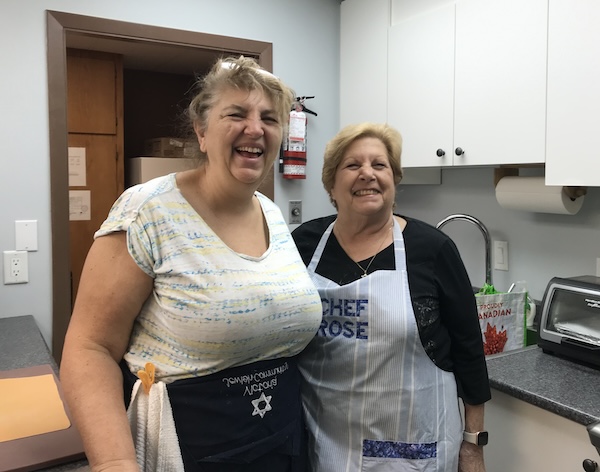
Lox Stock and Bagel’s new chef Lina Fainblum, left, and recently retired chef of 33 years Rose Carr, who will still be involved with the deli’s operations. (photo by Sam Margolis)
In June, Lox, Stock and Bagel deli at the Jewish Community Centre of Victoria was in something of a … well … pickle. A replacement needed to be found for Rose Carr, who had been overseeing the kitchen for 33 years, nearly the entirety of the deli’s existence, and about whom there are not enough superlatives to express her significance to both the local community and the customers the eatery serves.
Confronted with having to search for another chef, the JCCV advertised the vacancy. Many people applied but there was not a good fit, that is, a person who could fully appreciate the haimish (homelike) atmosphere of the deli and commit to staying in the position long term. The deli was forced to close.
Fortunately, the despair loyal patrons had to endure was short-lived, as Lina Fainblum, a member of the community and someone who loves cooking, came along.
“Everyone was thrilled,” said Larry Gontovnick, president of the JCCV. Lox, Stock and Bagel reopened in October, with a Wednesday to Friday schedule. Within three weeks, the deli resumed its original Tuesday to Friday hours.
“From looking pretty bad, it is going to what we wanted,” said Carr, who remains a beloved fixture at Lox, Stock and Bagel. “Lina is a mini miracle. Our prayers were answered.”
Although she has cut down her work in the kitchen, Carr is still on the board of the JCCV and runs the deli. The social aspect of the deli is very important, Gontovnick noted and, in this regard, Carr, who is also known as “Grandma Rose,” is in a class of her own.
“I’m in my third generation at the deli,” she said. “When I started here, people were bringing their little ones. Grandma Rose goes crazy when infants come in. And these kids grow up and come back and then bring in their little ones.
“We also have a lot of seniors who come in and they are treated with respect because we are all seniors,” she added.
When Carr arrived from Los Angeles in 1990, the JCCV at 3636 Shelbourne St. in Victoria’s Cedar Hill neighbourhood was in its fledgling stages, having just opened in June 1988. She introduced herself and has continued in her efforts to bring New York and Los Angeles deli food to Vancouver Islanders ever since.
At that time, the deli was located in a space at the centre that could only accommodate 15 people. Since then, it has expanded to seating 60 and, as Carr says, “many a day, we are full.”
Word of the wonderful dishes – such as knishes and kugel – spread shortly after the deli originally opened more than three decades ago. On one occasion, a group of firefighters came to test the exits of the JCCV. They wound up staying for lunch and told their friends and family, who were also eager to have a delicious and nearby nosh.
“It was recognized fairly early on that the customer base was non-Jews who lived in the area, enjoyed Jewish food and saw this as an affordable offering,” said Gontovnick. “It continues to this day. Most of our clients are non-Jewish. They love the place, the volunteers, the affordability and the quality of the food. It’s second to none. We have had a steady clientele. People come three or four times a week to eat.”
“People love us. They feel at home, they start clearing tables and they have been very generous with donations. They have been incredible accepting us as being Jewish.” added Carr. “After the Hamas attack, people whom we didn’t know would come into the JCC. They didn’t know anyone Jewish but would come to say they were praying for us. We are very well known and well liked in the community.”
As did many other establishments, Lox, Stock and Bagel faced challenges when COVID-19 struck in March 2020. The JCCV, at the time, decided to switch to takeout via the side door of the building. When the weather was balmy, they would set up tables outside.
One lasting result of the pandemic at the deli was the removal of a partition at the JCCV to open up more space and allow people to dine at tables further apart from one another.
Lox, Stock and Bagel, which received its name following a contest in the mid-1990s, serves all the standards one might expect at delis in much larger metropolitan areas: blintzes, matzah ball soup, pastrami on rye, jumbo hot dogs, pickled herring and gefilte fish. For dessert, there is the “Better Than Sex Chocolate Cake,” a favourite at the deli and at local fairs and, according to numerous sources, an item that lives up to its billing.
Lox, Stock and Bagel is open Tuesday to Friday from 11:30 a.m. to 1:30 p.m. From Dec. 5 to 15, it will be the site of Latke Mania. Hundreds of latkes will be prepared on several fryers for all those in the community to have a chance to mark Hanukkah with the traditional savoury treat.
“Our motto is: everyone’s welcome,” said Gontovnick. “This is nice place to come and just have a Jewish experience.”
Sam Margolishas written for the Globe and Mail, the National Post, UPI and MSNBC.
Book designer Barbi Braude and filmmaker Cory Bretz, both experienced in family history preservation, have launched FamilyMovieStoryBooks.com, to help “do-it-yourself family historians in crafting and publishing compelling family storybooks and producing cherished family movies.” (photo from Barbi Braude)
Irene Jacobson put the months of isolation during the COVID-19 pandemic to good use, researching and publishing the history of her Jewish family’s long settlement in South Africa.
With that ambitious project completed, the retired schoolteacher thought it was time she put together her own story, which began in South Africa and carried on in the United States, where she raised three children and continued her career, after immigrating in 1977.
But, like many people, Jacobson did not feel she could write an autobiography on her own – all that ordering of memories, distinguishing between fact and anecdote, and selecting from photos and documents amassed over the years seemed overwhelming. The technological tools now available to make that task easier and the finished product more professional-looking are not widely known or may seem intimidating to the amateur.
So, Jacobson, who lives in the Chicago area, turned to a new online platform created for people like her by book designer Barbi Braude and filmmaker Cory Bretz of Vancouver, both experienced in family history preservation.
The website FamilyMovieStoryBooks.com, which they launched after a year’s development, is intended to enable anyone to craft an heirloom that they can feel proud to hand down to future generations, say Braude and Bretz.
They believe that telling stories in an appealing and lasting format, whether book, film or both, provides a sense of fulfillment to the author and can inspire their descendants.
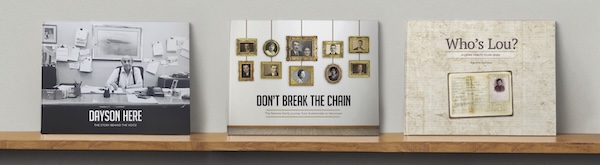
A few examples of books about Vancouverites – Ben Dayson, the Nemetz family and Lou Segal – with which FamilyMovieStoryBooks has helped. (photo from Barbi Braude)
The platform can serve as a step-by-step guide for those who want to work independently, or Braude and Bretz can arrange to have clients accompanied as much or as little as they want throughout the process.
If someone already has written a draft or taken home videos, they can be polished into a finished product, or the pair will take on the project from the very beginning, doing interviews online and going through possible imagery, shaping the material for the client.
“This innovative website aids do-it-yourself family historians in crafting and publishing compelling family storybooks and producing cherished family movies,” said Bretz. “The platform offers an array of valuable resources, including unwavering support, educational courses, interactive workshops led by experts, and professional design services.” Prospective users can take a free trial, and initial consultation is available without charge.
Jacobson had worked with Braude on her first book. “It’s fabulous. It is about my great-grandparents who went to South Africa with their four adult children, of whom one was my grandmother. We could not go further back than the great-grandparents, so we went forward and did a history book of the four siblings, their lives and descendants.”
The book about the Mierowsky family on her mother’s side, who were from Lithuania, is more than 400 pages long, with numerous photos. A copy was deposited with the Jewish Museum and Archives of British Columbia.
“The book I’m doing now through FamilyMovieStoryBooks is much less complicated and much smaller,” said Jacobson. “It is basically my biography, which I had written over a few years. As I’m older I felt I needed to get it done soon and in a simpler fashion. It’s my memories in chronological order.”
Jacobson (née Albert) was born in Port Elizabeth, a fifth-generation South African on her paternal side. She was a high school teacher there.
She and her husband came to the United States in 1977, where her children were born. Jacobson taught middle-school math and science at Jewish day schools.
“As my mother’s family is in my first book, I am going to have a small chapter, as an addendum, on my father’s family in my biography,” Jacobson said. After her autobiography is finished, she hopes to do a more comprehensive story of her Albert ancestors.
“I’m doing this book for me and my children and grandchildren. I will give copies to two friends I grew up with, as their children might find it interesting,” Jacobson said. “My first book is about how my parents’ generation grew up in South Africa. Mine is about how I grew up in South Africa and then my life in the US. I think everyone should do something for their family, especially if they have an interesting story to tell. Stories should be told, not lost.”
Jacobson chose FamilyMovieStoryBooks because it’s easy and affordable. “Barbi brainstormed a theme, so that helped me organize my thoughts. She also told me how to organize my photos to help me make choosing them easier,” said Jacobson.
“I am not particularly computer literate, but getting everything online has been easy to do. I could not find another place that did the same quality work. I wanted photos and more design. My brother-in-law worked on his memoirs with a ghost writer and it’s very dull with no design or photos. I’m looking forward to seeing the finished product, which is still a few months away, as I do what I can between traveling.
Braude said all communications with Jacobson are done remotely using Zoom for conversations and Google Drive for sharing chapters and images.
“At first I had to tutor Irene on how to use Google Drive. We are always happy to meet clients where their skill sets are computer-wise. We have the patience to empower our clients to use the internet.”
Working on the design remotely is fairly straightforward, said Braude, who employs the user-friendly Adobe Cloud for proofing feedback. FamilyMovieStoryBooks aims to serve people worldwide.
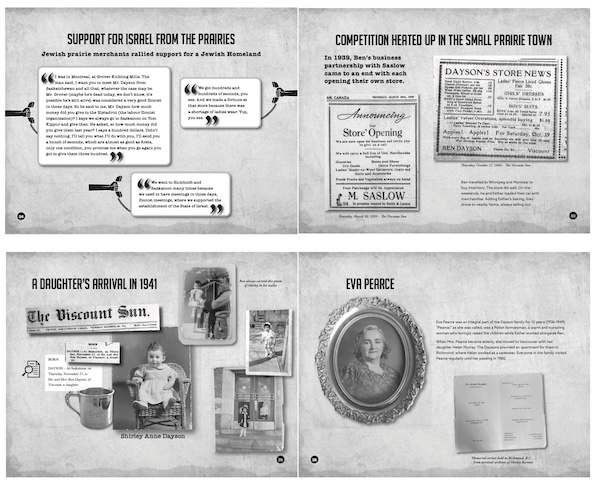
A peek inside the book about Ben Dayson shows what FamilyMovieStoryBooks can do. (photo from Barbi Braude)
Clients receive a high-quality hardcover book with glossy pages that reproduce photos and documents like birth certificates, immigration papers and letters in the best definition.
The movies directed by Bretz have the advantage of preserving the living presence and voice of the storyteller, he said. “It’s surprising how little people at shivas know about their deceased relative.”
Distance has not precluded close collaboration, both Jacobson and Braude attest. “A wonderful relationship does form between FamilyMovieStoryBooks and our clients,” said Braude, who is also currently designing a book for a Vancouver family. “The story is a collaboration between a 90-year-old Holocaust survivor and her daughter. The daughter said to me the other day, ‘What am I going to do when we complete this project? I have so enjoyed working with you as much as seeing my mom’s story come to life.’”
Asked if the platform can be especially valuable to Jewish families in general, Braude replied, “Absolutely! I’m reminded of a quote by Sue Monk Kidd from her book The Secret Life of Bees. It goes like this: ‘Stories have to be told or they die, and when they die, we can’t remember who we are or why we’re here.’
“Jews have lived in challenging times. We are the sum of our family legacy and life’s experiences. What better gift to give to future generations than the stories that made their families who they are,” said Braude.
Bretz commented that such a meaningful experience is “a testament to the power of bridging generations through the art of storytelling.” The FamilyMovieStoryBooks platform shares publishing and cinematic know-how with the general public that can transform what might be soon-forgotten family lore into a cherished artifact, he said. Along the way, family members wherever they are can bond and share a laugh or tear while exploring their common heritage, made possible through an innovative digital environment.
Janice Arnoldis a freelance writer living in Summerland, BC.
On Nov. 5, Dr. Joshua Grayson, a genealogist specializing in Jewish families from Central and Eastern Europe, was the lead-off speaker for the 2023-24 L’dor V’dor (Generation to Generation) lecture series on Zoom, organized by Victoria’s Kolot Mayim Reform Temple.
Grayson is the founder of Lost Roots Family History, a website, virtual museum and research service devoted to helping Jewish families reconnect with their roots, discover their past, engage with the present and preserve their heritage for the future.
Titled In Search of Lost Roots, Grayson’s talk elaborated on how he was able to trace his family history across three-and-a-half centuries, or 10 generations, to approximately 1650. Proficient in many historical scripts, he has conducted genealogical research in German, Russian, Polish, Hebrew, Yiddish, French and Spanish.
“There’s truly an astonishing amount of information out there,” Grayson said. “With a combination of computer research, language skills, a lot of perseverance and just the right amount of luck, the depth of information you can find about your family history can be simply astounding.”
Dr. Joshua Grayson, founder of Lost Roots Family History, launched this season’s L’dor V’dor lecture series, organized by Victoria’s Kolot Mayim Reform Temple. (photo from Kolot Mayim)
Grayson’s interest in family history started at a young age, when visiting his grandparents’ home and being captivated by a photo at the bottom of their staircase. Taken in 1904, it depicted his grandfather’s grandparents and the first five of their 10 children, including his great-grandmother at the age of 11.
“To my childish imagination, I was sure I could almost feel their presence looking over me and their other descendants. At times like these, I would muse at how my close connection with my grandfather was similar to his connection with the people in this photograph. And so on down the unbroken chain of time,” he said.
As a child, Grayson remembers, he was fascinated by the notion of all the people to whom a person could be related.
He recounted later honing his research skills at the University of Southern California, where he earned a PhD in historical musicology – skills, he said, that are particularly well suited to genealogy. They include gathering historical evidence, evaluating sources and communicating ideas.
When he typed in the name of one of section of his ancestry, Penzias, into a database on the Gesher Galicia website, Grayson said, “I quickly discovered records from as early as 1805 because our family name happens to be unique. I felt fairly sure that these were long forgotten family members.”
He said, “These databases allowed me to accomplish in just a few minutes what would otherwise have taken months or years of digging through archives, scanning old record books or microfilms one record at a time.”
As a side note, Grayson stressed that creativity with spelling can be helpful, as names were not written in a standardized way until much later into the 19th century and even into the early 20th century. Although most databases use technology to automatically include names that are spelled in similar ways, the technology is not perfect.
The Zoom lecture brought to light the remarkable and inventive methods of deduction Grayson employed to ascertain his own ancestry – from an egg merchant to a Cubist painter – and the sorts of investigations he performs to uncover the family histories of those who request his services, all while conveying an infectious enthusiasm for Jewish genealogy.
As an example of his research, Grayson spoke about a client who knew nothing of her family history other than her father was from Lublin and lost his entire family in the Holocaust. Grayson was able to trace the client’s father’s family back to 1750 and followed her family members as they moved around rural Poland and to Lublin in the 1880s. He discovered relatives who fought against the Nazis with the underground resistance and, ultimately, connected her with previously unknown family members on five continents.
Grayson is currently in the final stages of constructing a text database of the names of people buried in the Old Jewish Cemetery in Prague. The database is based on two 19th-century efforts to preserve names on the tombstones, one of which was published in a book in 1880 and the other of which appears on the website of the Jewish Museum in Prague.
Commissioned by E. Randol Schoenberg, the former president of Holocaust Museum LA, formerly the Los Angeles Museum of the Holocaust, Grayson’s database will cover the names, death dates and, in some cases, biographical details of approximately 15,000 Jews who died in Prague between 1437 and 1787.
“In my experience,” said Grayson, “I’ve found that finding out about family history can be a great way to get people more involved in Judaism. Understanding where we came from and the historical forces that shaped our own families can be a powerful motivator to exploring our Jewish identity.”
Kolot Mayim’s next Zoom speaker will be Dr. Jennifer Caplan, associate professor and chair of Judaic studies at the University of Cincinnati and author of Funny, You Don’t Look Funny. Her talk – titled Jewish Humour from the Silent Generation to Millennials – will take place on Dec. 3, at 11 a.m. To register, and for the full lineup of speakers, visit kolotmayimreformtemple.com.
Sam Margolishas written for the Globe and Mail, the National Post, UPI and MSNBC.
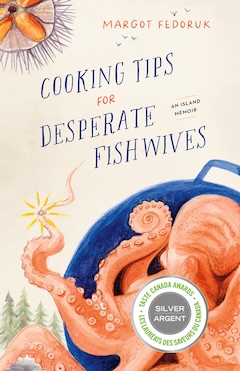
Cooking Tips for Desperate Fishwives: An Island Memoir by Margot Fedoruk (Heritage House Publishing) won a silver in the Culinary Narrative category at the 2023 Taste Canada Awards.
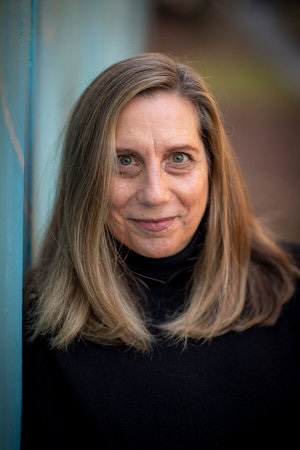
Margot Fedoruk won a silver in the Culinary Narrative category at the 2023 Taste Canada Awards for Cooking Tips for Desperate Fishwives: An Island Memoir. (photo by Vital Image Photography)
On Oct. 30, Taste Canada announced the winners of the 26th annual prizes during a soirée at the Fairmont Royal York in Toronto, hosted by Ali Hassan. The shortlists were announced in June, listing finalists in five categories in both French and English. Taste Canada is Canada’s only national, bilingual food writing awards.
Cooking Tips for Desperate Fishwives has been featured in the Jewish Independent(jewishindependent.ca/reading-expands-experience), Stir Vancouver, Winnipeg Free Press, BC BookWorldand other outlets. Fedoruk participated in the Cherie Smith JCC Jewish Book Festival in February 2023.
Part love story, part survival story, part meditation on family dysfunction, Fedoruk’s offbeat memoir chronicles the unpredictable life of a young wife and mother on a tiny BC island.
True to its title, the memoir is infused with recipes, from the hearty Eastern European fare of Margot’s childhood to more adventurous coastal BC cuisine. The narrative follows 23-year-old Margot when she left Winnipeg and her volatile Slavic-Jewish family for the wilds of British Columbia and fell in love with a sea urchin diver. Determined not to repeat the same mistakes as she had witnessed during her parents’ marriage, Margot paints a portrait of a modern-day fishwife left behind to keep the home fires burning.
Fedoruk is a writer, book reviewer and entrepreneur, whose work has been published in the Globe and Mail, Quill & Quire, BC BookWorld, Ormbsy Review and Portal. She holds a BA from the University of Winnipeg and a BA from Vancouver Island University, where she majored in creative writing. She was awarded the Barry Broadfoot Award for creative nonfiction and journalism and a Meadowlarks Award for fiction, both from Vancouver Island University.
Visit heritagehouse.ca for more information about Cooking Tips for Desperate Fishwives, Fedoruk or Heritage House. For more details about the Taste Canada Awards, visit tastecanada.org.
* * *
Journalist Marsha Lederman won a 2023 Webster Award for “Arts in the Crosshairs.” (photo by Ben Nelms / Penguin Random House)
Western arts correspondent for the Globe and MailMarsha Lederman received the Excellence in Arts and Culture Reporting Award for the article “U.S.-style book bans could happen in Canada too, if we’re not careful,” or “Arts in the Crosshairs,” at the 2023 Webster Awards.
The winners in the 14 categories of the 2023 Webster Awards were announced Nov. 15 during a live in-person event hosted by CHEK TV’s Paul Haysom and Gloria Macarenko from CBC Radio, who also conducted a fireside chat with the featured guest, veteran anchor/journalist Lisa LaFlamme. To see who the finalists and winners were of the 2023 Webster Awards, and to view the finalists’ work, visit jackwebster.com.