Skip to content
  • Home
  • Subscribe / donate
  • Events calendar
  • News
    • Local
    • National
    • Israel
    • World
    • עניין בחדשות
      A roundup of news in Canada and further afield, in Hebrew.
  • Opinion
    • From the JI
    • Op-Ed
  • Arts & Culture
    • Performing Arts
    • Music
    • Books
    • Visual Arts
    • TV & Film
  • Life
    • Celebrating the Holidays
    • Travel
    • The Daily Snooze
      Cartoons by Jacob Samuel
    • Mystery Photo
      Help the JI and JMABC fill in the gaps in our archives.
  • Community Links
    • Organizations, Etc.
    • Other News Sources & Blogs
    • Business Directory
  • FAQ
  • JI Chai Celebration
  • JI@88! video

Recent Posts

  • Eby touts government record
  • Keep lighting candles
  • Facing a complex situation
  • Unique interview show a hit
  • See Annie at Gateway
  • Explorations of light
  • Help with the legal aspects
  • Stories create impact
  • Different faiths gather
  • Advocating for girls’ rights
  • An oral song tradition
  • Genealogy tools and tips
  • Jew-hatred is centuries old
  • Aiding medical research
  • Connecting Jews to Judaism
  • Beacon of light in heart of city
  • Drag & Dreidel: A Queer Jewish Hanukkah Celebration
  • An emotional reunion
  • Post-tumble, lights still shine
  • Visit to cradle of Ashkenaz
  • Unique, memorable travels
  • Family memoir a work of art
  • A little holiday romance
  • The Maccabees, old and new
  • My Hanukkah miracle
  • After the rededication … a Hanukkah cartoon
  • Improving the holiday table
  • Vive la différence!
  • Fresh, healthy comfort foods
  • From the archives … Hanukkah
  • תגובתי לכתבה על ישראלים שרצו להגר לקנדה ולא קיבלו אותם עם שטיח אדום
  • Lessons in Mamdani’s win
  • West Van Story at the York
  • Words hold much power
  • Plenty of hopefulness
  • Lessons from past for today

Archives

Follow @JewishIndie
image - The CJN - Visit Us Banner - 300x600 - 101625

Category: News

Stories of resilience shared

A family fleeing war, aided by acquaintances from a lifetime of hospitality. A person’s choice to be the light in a dark world after a loved one was murdered. The creation of a vital medical resource as a tribute to a father who died too young. These three stories were shared at the event A Night of Hope, which was held at the Jewish Community Centre of Greater Vancouver Nov. 30. The three stories of resilience were intended to give hope in response to the trauma Jews worldwide have experienced since Oct. 7.

Rabbi Susan Tendler, spiritual leader of Beth Tikvah Congregation in Richmond, shared “the unlikely story” of how she became a rabbi, in part because of the trauma of having experienced the murder of a loved one.

In the year 2000, she recalled, “I was living my best life.” She thought she knew who she would marry, she had a dream job as a teacher in Israel and was planning on making aliyah.
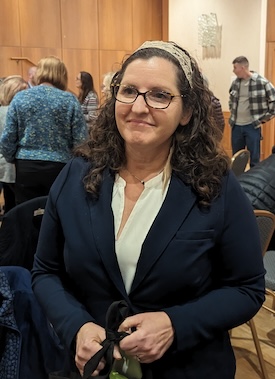
photo - Rabbi Susan Tendler
Rabbi Susan Tendler (photo by Pat Johnson)

“I returned to the United States to get my affairs in order before making the big move as the Second Intifada broke out,” she said. Global conflict was compounded in the personal realm when her engagement was broken off. With foreign students avoiding Israel, her job was suddenly eliminated. Things began looking up, though, when she met Mike, “who showed me what partnership might look like.”

“And then, one night, he was brutally murdered,” she said. Five young men, joyriding, had crashed a car and needed another vehicle.

“They came upon Mike and murdered him, not even for his wallet. Just for fun,” Tendler said. “Just to take his car a few miles down the road before they ditched it.”

The murder plummeted her into depths of darkness.

“I couldn’t understand how such palpable evil could exist in the world,” she recalled. “How could a human being, created in the image of the divine, not understand life as sacred? What were the lives of those individuals that they didn’t hold this basic value as truth? And, by doing so, those five young men took the sanctity out of this world for me, for Mike’s family and his friends. I really didn’t care to live in a world with such sheer evil. It wasn’t that I was suicidal – I knew the difference and I wasn’t – I just really didn’t care to live or to die.”

She cited the Israeli poet Yehuda Amichai, who wrote that the Jewish people are “infected with hope.”

“We are taught to love others, to embrace others and to share our burdens with others,” Tendler said. “We need not struggle alone…. So, as I held on, people rallied, surrounded me and guided me through the darkness.”

Overcoming this and other personal and geopolitical traumas led her to an important insight.

“I came to realize that, if I didn’t like living in a world full of darkness and evil, then I needed to be the light,” she said. “I needed to choose life. I needed to choose hope and spread kindness, goodness and godliness to others.

“The world needs us right now,” she continued. “We all have hope coursing through our veins. Certainly, it has been weakened and doubted [since Oct. 7], but that is exactly what they want. We won’t let them win. Let the light created by our hope and optimism join forces, knowing indeed that we are not alone and that this positive energy be magnified as it draws others in. May our light be a beacon for the world.”

Tanja Demajo, chief executive officer of Jewish Family Services, shared her family’s history of survival in the Holocaust and the personal story of her family’s escape from the post-Yugoslavia war in Bosnia, where she was born. She had not shared any of this publicly before.

As a child in Mostar, young Tanja would often come home from school to find strangers at the table. Anyone passing through or needing hospitality was received in their house and welcomed with food.
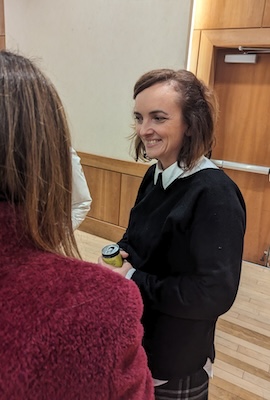
photo - Tanja Demajo
Tanja Demajo (photo by Pat Johnson)

“My family always kept the door open,” she said. This openness, she believes, helped save her family when war exploded.

In 1992, when she was 11-and-a-half, everything changed, seemingly in a day.

“There were explosions everywhere, there was shooting everywhere, the army was everywhere,” she said. “The city emptied.”

Getting away from the fighting was not easy. Roadblocks were set up by different militias and Demajo could see the fear in her father’s expression as they confronted each successive barrier. 

“We had to stop at three different points and at three different points we came across some people that my parents knew through their life,” she recalled. Keeping an open door meant there were people who knew the family and remembered their hospitality. “In each of these three situations, these friends came forward and put their lives on the line so they could let my family pass through.”

After the war ended, the family reconnected with her grandfather, who they had not seen in years.

“That was the first time actually that my grandfather shared with us his own story,” she said. From a community of 300, the grandfather and an uncle were the only survivors of the Holocaust. 

She asked him why he was so cheerful, despite all he had gone through.

“He had this beautiful way of just hugging people and he would hug me and say, what are the things you remember as a child?” She recalled spending weekends with her grandfather, the meals and stories they shared. “And he said, well that’s how you survive. Because those are the things that matter. The people you have in your life, the friendships that you share with them and the food you share with them.”

The connections she saw her parents forge at the table – which proved potentially lifesaving as the family fled war – are a lesson she has always carried. It is something that Jews worldwide can remember now, she said.

“We need allies and we need to have these conversations to bring people together,” she said.

Jaime Stein shared the story of how the death his father, Howard Stein, in 2006, from acute leukemia, inspired him to help create Canada’s first public
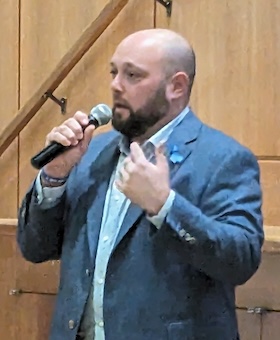
photo - Jaime Stein
Jaime Stein (photo by Pat Johnson)

Early in the last decade, when Stein helped launch the $12.5 million campaign to create the facility, Canada was one of only two G-20 nations that did not have such a service. Umbilical cord blood contains blood-forming stem cells, which can renew themselves and differentiate into other types of cells.

Working with Canadian Blood Services, Stein and the fundraising team for the project decided on a big focal point for the campaign – climbing Tanzania’s Mount Kilimanjaro, the highest peak in Africa.

“We got 25 people to sign up [to climb] and everybody had to raise a minimum of $10,000,” Stein explained.

Stein, in his 30s at the time, when $10,000 was a daunting sum, organized weekly 9 a.m. hikes with friends and strangers, at which he would offer career advice, listen to his hiking mates or otherwise engage, then write a blog post. 

“People started donating and people started telling their friends as well,” he said. 

In the end, he raised $27,000, second only to the chief executive officer of Canadian Blood Services among the 25 climbers. Of course, the money turned out to be the easy part. They still had to ascend the mountain. 

Like many others who climb tall mountains, Stein experienced altitude sickness – so severely he almost had to turn back.

“I could barely make it to camp,” Stein recalls of the onset of the crisis. “I just remember thinking about my dad, thinking of my family, thinking of the training, thinking of everything I did as I tried to get to camp.”

Slowly, his oxygen levels climbed and he was able to complete the trek.

The trip itself raised $350,000 and, eventually, the team raised all the funds necessary. Canada now has a fully functioning umbilical cord blood bank, with four collection sites, including one in Vancouver.

Alan Stamp, Jewish Family Services clinical director, and Ezra Shanken, chief executive officer of the Jewish Federation of Greater Vancouver, contextualized the stories as lessons in resilience community members can use to confront trauma. 
Format ImagePosted on December 15, 2023December 14, 2023Author Pat JohnsonCategories LocalTags blood bank, death, Jaime Stein, Jewish Family Services, Jewish Federation, leukemia, Rabbi Susan Tendler, resilience, Tanja Demajo, war

Jewish comedy history

“Jews have always turned and continue to turn to humour as a cultural touchstone and a way to make meaning,” said Dr. Jennifer Caplan, author of Funny, You Don’t Look Funny: Judaism and Humor from the Silent Generation to Millennials, which was published earlier this year.

photo - Dr. Jennifer Caplan spoke Dec. 3, as part of the L’dor V’dor lecture series organized by Victoria’s Kolot Mayim Reform Temple
Dr. Jennifer Caplan spoke Dec. 3, as part of the L’dor V’dor lecture series organized by Victoria’s Kolot Mayim Reform Temple. (photo from Kolot Mayim)

Caplan, who is an associate professor and the Jewish Foundation Chair in Judaic Studies at the University of Cincinnati, was the second presenter of the 2023-24 L’dor V’dor (Generation to Generation) Zoom lecture series organized by Victoria’s Kolot Mayim Reform Temple. On Dec. 3, she spoke about the past several decades of Jewish humour. Similar to the approach she took for her book, her presentation explored the changing relationship to Judaism of four generations of Jewish funny people.

According to a 2013 report by the Pew Foundation, called A Portrait of American Jews, 42% of American Jews thought that having a sense of humour was integral to their Jewish identity, said Caplan. In the survey, in terms of what American Jews deemed important to their identity, a sense of humour came out far behind Holocaust remembrance and intellectual curiosity, just under support of Israel, and well ahead of belonging to a Jewish community or eating traditional Jewish food.

“The report set off little bells in my brain which pushed me to say that there’s something here and that there’s something I want to think about,” she said.

There were Jewish commentators who pointed to the Pew survey as an alarm bell for the dangers of the rise of cultural Judaism. To Caplan, the TV show Seinfeld, which premièred in 1989, encapsulated what worried some about the culturally Jewish experience.

“It was this group of people who seemed Jewish, even though Jerry (the title character) is the only character on the show who is actually Jewish,” she said. “They all sort of felt Jewish, but they never did anything Jewish and nobody ever went to synagogue and they didn’t even have a menorah like Rachel and Monica did in their apartment on Friends.”

In Caplan’s view, this fear of cultural Judaism aligned with the way that Jews were being portrayed in popular comedy and media, as Seinfeld led to a boom in Jewish sitcom characters – in shows like Mad About You and Anything but Love, for example. She thought there was something important in the way Jewish comedians were using Judaism in their humour to think about themselves and their Jewish identity, and what it means for them to be Jewish.

Moving forward to the present and, according to Caplan, one finds that the younger generation, the millennials, are even more culturally tied to their American generational cohort and less so to being the grandchild or great-grandchild of Jewish immigrants.

“It’s a story about comedy and it’s a story about the way that Jewish comedians have related to Judaism in their comedy, but it’s also a story about Americanization. It is a story about the way that Jews in the United States became more and more embedded within their broader cultural milieu,” Caplan said, explaining the thought process that led her to write her book.

Caplan pointed out that counterculture, in Jewish comedy, was represented in the 1950s – a time generally associated in the popular sense with Leave It To Beaver and The Adventures of Ozzie and Harriet – by books like those by Philip Roth. His works, well before the broader 1960s counterculture movement, were critical of institutions but defensive of the Jewish community – viewing organized religion as something that was hurting Jews, but seeing the need for Jews to be protected.

What intrigued Caplan was that the pendulum had swung in the other direction for Generation X. “What I found was a fascinating reincorporation of Jewish ritual into the writing and the movies and the comedy of Generation X comedians. Jews themselves are being made fun of, but their engagement with Judaism is actually the thing that humanizes them,” she said.

In the 2001 film Kissing Jessica Stein, for example, the characters can be perceived as stilted, neurotic, self-absorbed Jewish caricatures, yet scenes at a Shabbat dinner and a wedding ground the characters and are not the subject of ridicule.

“It’s not that Generation X suddenly believes in God more than the previous generations did. It’s that they believe more in the power of ritual and tradition because it binds you. You’re not doing it necessarily because you have some sort of theological belief,” Caplan said.

As for millennials, among whom the oldest in the cohort is presently 42 years old, their story is still being written, she said. 

“It seems as though they are willing to ridicule both Jewish identity and Jewish religious interaction at various times, depending on what suits the comedy,” she said. “They neither have a sense of oppression about their Judaism, nor do they have a sense of embarrassment about their Judaism.”

Caplan is currently researching and writing her next book, Unmasked: Jewish Identity in Comic Books.

The next speaker in the L’dor V’dor series is psychotherapist and author, and member of the second generation, Rabbi Dr. Tirzah Firestone on Jan. 14. Firestone will talk on the topic Healing Intergenerational Jewish Trauma. For more information, visit kolotmayimreformtemple.com. 

Sam Margolis has written for the Globe and Mail, the National Post, UPI and MSNBC.

Posted on December 15, 2023December 14, 2023Author Sam MargolisCategories LocalTags comedy, culture, history, Jennifer Caplan, Judaism, Kolot Mayim

Local camper grants

The Jewish Independent briefly spoke with the Jewish Federation of Greater Vancouver about what support local campers could receive, if they needed it.

JI: Does Federation work with the Foundation for Jewish Camp at all?

JF: One Happy Camper is a grant program run through the FJC and federations to provide a $1,000 grant to first-time campers. In communities such as ours, where Federation does not sponsor OHC, PJ Library families are able to apply and receive this grant through PJ Library.

JI: To what camps does Federation give grants and why?

JF: Camp Miriam, Camp Hatikvah, JCC Camp Shalom and Camp Gan Israel. Through our Connect Me In program, we have provided grants to run camps in the regional communities or to pay for transportation for children to attend the day camps in Vancouver.

The Jewish Community Foundation has designated funds established by fundholders to support Jewish summer camps and camperships, and fundholders with donor advised [funds] also make distributions to camps.

Camps can apply for funding through the [Jewish Community] Foundation’s Unrestricted Grant Program for qualifying projects. Recently, the foundation supported Camp Miriam’s Water Security Project through this grant program.

JI: Do they support any individual campers, or how do families with lower incomes access camp for their kids?

JF: Approximately one-third of families receive camperships to send their children to Jewish summer camp. Odds are that if your family did not receive a campership, your child made friends at camp with someone who did. Families can apply for camperships funded by Jewish Federation directly through the summer camp of their choice. The camps then review the applications and make the decisions.

Sam Margolis has written for the Globe and Mail, the National Post, UPI and MSNBC.

Posted on December 15, 2023December 14, 2023Author Sam MargolisCategories LocalTags camper grants, financial assistance, Jewish Federation, PJ Library, summer camp
More important than ever

More important than ever

“This summer, the grounds of Camp Hatikvah will echo with laughter, song, and the spirited expressions of Jewish and Israel pride”: Liza Rozen-Delman, camp executive director. (photo from Camp Hatikvah)

For decades, Camp Hatikvah has been a cornerstone of the Jewish community, serving as a summer haven where traditions are cherished, friendships blossom and identities are proudly embraced. It has always been more than just a recreational retreat; it has been a powerful catalyst in shaping the future leaders of the Jewish community.

Developed in the aftermath of the Holocaust, Hatikvah was created to produce proud, happy Jewish youth who were committed to the rebuilding of the Jewish people and a homeland in Israel. As a 1949 article in the Jewish Western Bulletin (the predecessor of the Jewish Independent) stated, Camp Hatikvah provided early participants with a “place where they could live and express themselves as Jews, unhampered with fear of others and free from the out-of-place feeling that is so often a part of North American Jewishness.”

Today, as we witness a disheartening resurgence of antisemitism, the original mission of Camp Hatikvah seems to be as important as it was at the time of the camp’s creation.

“The need for a space where children can feel safe, embrace their heritage and express their identity without reservation is, once again, vital” said Liza Rozen-Delman, the camp’s executive director. “I am devastated by the current state of the world, but we are dedicated to rising above it and playing a critical role in combating hate.”

The camp’s leadership recognizes the need to renew its dedication to its original mandate, emphasizing that, in the face of external threats, the camp becomes not only a refuge but a dynamic force in cultivating resilience and unity.

“In response to the current crisis, this summer promises to be a rallying point for Jewish pride, a resolute stand against the hate we have seen, and a celebration of every aspect of who we are as a people,” said Joanna Wasel, board president.

As they begin preparing for summer, Rozen-Delman explained that the camp staff are gearing up to create an immersive experience that fosters a sense of pride, belonging, and love for all things Jewish. Through carefully curated activities and the camaraderie that comes from being part of a supportive community, campers will leave with not just memories of a fun-filled summer but also a strengthened sense of identity.

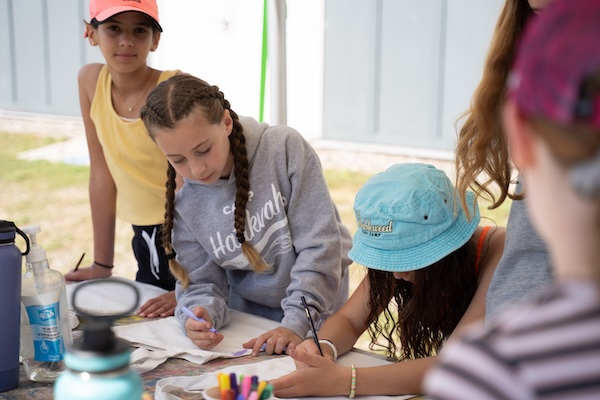
photo - Kids working on a project at summer camp
Kids working on a project at summer camp. (photo from Camp Hatikvah)

Camp Hatikvah also plans to intensify its Israel programming this summer in an effort to empower its campers with a more profound understanding of the Jewish state’s history and culture but, most importantly, its necessity. In a world where misinformation and delegitimization about Israel is rampant, Camp Hatikvah is determined to ensure that its campers and staff are equipped to advocate for the right of the Jewish people to live in peace and security in a homeland of their own.

“This summer, the grounds of Camp Hatikvah will echo with laughter, song, and the spirited expressions of Jewish and Israel pride,” said Rozen-Delman. “From the youngest to the oldest, everyone will be encouraged to stand tall, speak loud, and embrace every aspect of who they are.”

The importance of Camp Hatikvah extends beyond the traditional camp experience; it is a cornerstone for fostering resilience, unity, and an unapologetic celebration of one’s identity. Camp Hatikvah continues to play a pivotal role in creating a space where yet another generation of Jewish youth feel not only safe but truly at home. 

– Courtesy Camp Hatikvah

Format ImagePosted on December 15, 2023December 14, 2023Author Camp HatikvahCategories LocalTags Camp Hatikvah, education, identity, Israel, Liza Rozen-Delman, summer camp, youth
Encouraged to be oneself

Encouraged to be oneself

Lifelong friends can be made at summer camp. (photo from Camp Kalsman)

Fun is in all that we do,” Rabbi Ilana Mills, director of URJ Camp Kalsman, told the Independent. “Our staff creates dynamic programming that lets campers laugh and play in a way that doesn’t happen anywhere else. Where else can you spend a day with your friends and your evening doing messy night with a slip-n-slide, water balloons, shaving cream, and more?”

Summer camp is a unique experience for children and young people, for campers and counselors. While fun is at the forefront of programming, so is learning. In the case of Jewish camps, there is the added element of Shabbat observance and other elements of Judaic practise and values.

Looking at the example of Camp Kalsman, which is located north of Seattle, one can see the breadth of activities summer camp can offer. A typical day at Kalsman includes singing, pool time, prayers, and activities that range from canoeing and kayaking on the lake, to climbing the camp’s tower and/or high ropes, to farming or gardening, to painting or having a cook-out.

The camp has chugim (electives), which usually run three to four days, and campers do a project during them, said Mills. “Campers will get to rank their choice from a list of options and we do our best to give campers their choices,” she said. Chugim includes such things as pottery, embroidery, hiking, water aerobics, yoga or soccer.

And older campers have “Sababa Time,” said Mill. “Sababa Time is an hour each day where older campers get to choose their own activities from a number of creative options that changes each day. Those might include volleyball, board games, outdoor cooking, or spa days.”

The camp schedule also carves out free time for campers.

“Life is so busy and camp is as well. Free time enables campers to choose what they need on any given day,” said Mills. “Whenever we have free time, we have options for campers to choose which option best fits their needs.  Some campers need to get energy out, so they play basketball or go to the pool. Others may need down time, so they may read a book in the trees. Campers use free time to relax, recharge and have fun in a manner that best suits them. Recreation can be a time to re-create, to rejuvenate.”

photo - Kids at Camp Kalsman get ready to take a canoe out onto the lake
Kids at Camp Kalsman get ready to take a canoe out onto the lake. (photo from Camp Kalsman)

In addition to obvious practices, such as the celebration of Shabbat and group tefillah (prayer), Kalsman tries to impart Jewish values and culture throughout activities.

“We design our programs to foster a holy community through connection between campers, between campers and staff and between campers and the larger community,” said Mills. “We believe connection is important on every level, so our cabins do cabin time every night to form connections and, every week, we have all-camp programs, where campers of different ages can get to know one another. When we eat, pray and sing together, we connect to the larger community.”

Camp Kalsman ends each night in siyum, “a special closing prayer where we pray Hashkiveinu and Shema using a special tune written just for Camp Kalsman,” said Mills.

When asked what summer camps in general – and Jewish camps specifically – can give kids that schools can’t, Mills shared a quote from a 10-year-old camper, who said, “Kalsman lets me take off all the masks I have to wear at school and really be me.”

“At Kalsman, our campers know that they are valued, honoured and supported for who they are,” said Mills. “Camp enables kids to be kids, to be free, and to have fun in a way that they don’t get anywhere else. It frees them of the burdens of school and competition and allows them an outlet to be part of a great community. Kalsman campers disconnect from their devices and connect to a larger, holy community. Campers learn independence and problem solving, they learn they can make mistakes and how to manage mistakes in a safe environment. Camp is the place where kids can explore who they want to be in the world.” 

Format ImagePosted on December 15, 2023December 14, 2023Author Cynthia RamsayCategories LocalTags Camp Kalsman, education, identity, Israel, summer camp, youth
Getting more kids into camp

Getting more kids into camp

The Foundation for Jewish Camp serves more than 155 Jewish summer camps, close to 80,000 campers and 11,000 counselors across North America every summer. Among its initiatives is the One Happy Camper program, which is run in partnership with Jewish federations – including in Montreal, Toronto and Calgary – foundations, PJ Library, and camps across North America. The program provides incentive grants of up to $1,000 to children attending nonprofit, Jewish overnight camp for the first time, with the intention of introducing more children to the magic of Jewish camp.

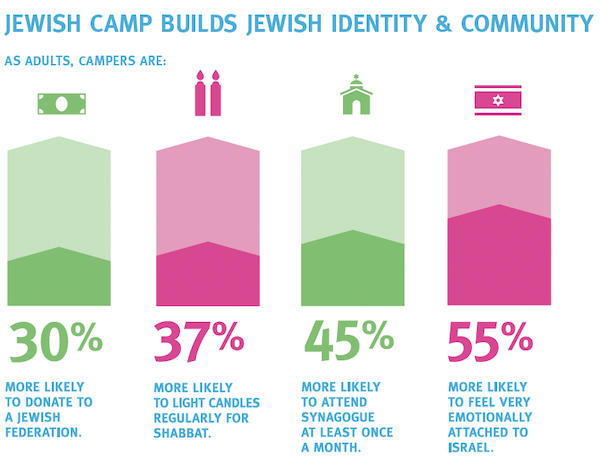
Based on the 2010 study by the FJC, Camp Works: The Long Term Impact of Jewish Overnight Camp, there is evidence that overnight Jewish camp is a proven means of building Jewish identity, community and leadership. As adults, campers are 30% more likely to donate to a Jewish federation, 37% more likely to light candles regularly on Shabbat, 45% more likely to attend synagogue at least once a month, and 55% more likely to feel emotionally attached to Israel. As well, one of three Jewish professionals (rabbis, cantors, teachers) started out as counselors at Jewish camp; one of five Jewish educators cited Jewish camp as a key experience that caused them to enter the field; and seven of 10 young Jewish leaders in their 20s and 30s attended Jewish summer camp.

North American Jewish overnight summer camps reach 77,000+ camp-aged children every summer, but this represents only 10% of eligible camp-age kids. In the FJC’s efforts to grow enrolment and increase awareness, FJC created the One Happy Camper program, thanks to the generosity of an anonymous donor. The program’s singular mission is to increase the number of children benefiting from the transformative experience of Jewish summer camp. Aimed at attracting new campers who do not have daily, immersive exposure to Judaism, the program provides financial incentives to encourage parents to choose nonprofit overnight Jewish summer camp over other summer options.

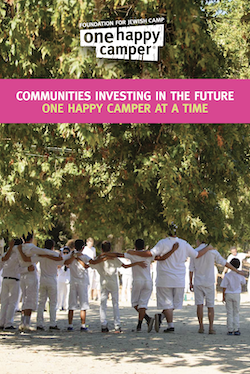
image - Communities Investing in the Future One Happy Camper at a Time report coverSince the success of the 2006 pilot, the One Happy Camper program has expanded across North America. To date, 64,000 campers have experienced Jewish overnight camp as a result of FJC’s partnership with 40 community-based organizations (federations/foundations), four national camp movements, 30 individual camps, the Harold Grinspoon Foundation’s PJ Goes to Camp program and the Jim Joseph Foundation-funded JWest program.

Of One Happy Camper grant recipients, six out of 10 would have stayed home or attended  a non-Jewish summer experience, and one out of three OHC recipients’ parents had not attended Jewish camp – FJC knows that parents who attended Jewish camp are more likely to send their own kids, so the grants are instilling a new legacy of Jewish camping for families.

Surveys show that OHC recipients enjoy their summers at camp as much as their peers, in that they say they found the experience of value and would likely recommend it. As well, they are as likely to return to camp. In fact, 82% of OHC recipients return to camp for a second summer. And their experience is infused with Jewish education, identity and connections: 97% feel that camps create an atmosphere where children are proud to be Jewish and 36% of recipients increased their participation in Jewish activities after their first summer at camp.

The majority of OHC families (63%) are not members or donors of their sponsoring organization but, as a result of the OHC grant, 78% of OHC parents feel more positive about their family’s connection to the Jewish community and 72% of OHC parents feel that they are more likely to support their sponsoring organization.

These are just some of the results found in the Foundation for Jewish Camp publication Communities Investing in the Future One Happy Camper at a Time. To read more, go to jewishcamp.org/community-partners and click on “Download ‘Communities Investing in the Future’ (PDF).” 

– Courtesy Foundation for Jewish Camp

Posted on December 15, 2023December 14, 2023Author Foundation for Jewish CampCategories WorldTags benefits of camp, FJC, Foundation for Jewish Camp, Jewish summer camp, OHC, One Happy Camper
Kelowna vigil for Israel

Kelowna vigil for Israel

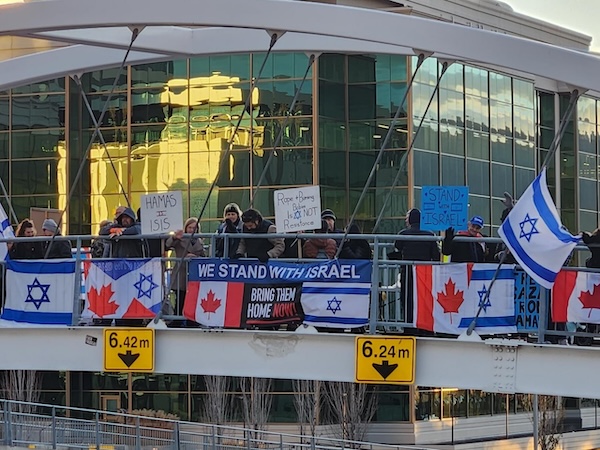
A vigil in solidarity with Israel took place on the Dayton Street pedestrian overpass in Kelowna on Nov. 19. (photo from vigil organizers)

About 100 people held a vigil in solidarity with Israel in Kelowna on Nov. 19, which proceeded without incident.

The two-hour gathering on the Dayton Street pedestrian overpass, which straddles Highway 97, was organized by members of the Jewish community, following a series of peaceful pro-Palestinian demonstrations since Hamas’s Oct. 7 attack on Israel. 

The organizer (who asked that their name be withheld because of security concerns) said that, in addition to community members, the participants included representatives of at least two churches, as well as Kelowna city councilor Ron Cannan, a former Conservative member of Parliament for Kelowna-Lake Country.

The vigil was encouraged by Rabbi Shmuly Hecht, director of the Okanagan Chabad Centre, who led men present in the putting on of tefillin in a display of Jewish confidence. 

The organizer said the pro-Israel public demonstration was the first of its kind in the area. The main purpose was twofold: to give the area’s small Jewish population an opportunity to unite and have its voice heard and to show other citizens that there is “another side” to the Israel-Hamas conflict not reflected by the public activities of Palestinian supporters.

One week earlier, around 300 people held a pro-Palestinian demonstration that started on the steps of the courthouse and concluded with a march. That event, which received local media coverage, was organized by the Okanagan chapter of Canadians for Peace and Justice in the Middle East, a Montreal-based anti-Israel lobby group.

The organizer said they and the other organizers decided not to alert the media to their event in order to avoid attracting any conflict with the other camp. There were no tensions, and the only show of disagreement came from a motorist driving under the overpass displaying a Palestinian flag and honking, they said.

There were a few honks of apparent approval and passersby did engage with those in the crowd, asking questions, they added.

The demonstrators carried Israeli and Canadian flags, and placards mostly reading “We stand with Israel” and “Bring them home now,” referring to the hostages taken by Hamas,  but also “Hamas (equals) ISIS” and “Rape is not resistance.”

The organizer said those supporting the Palestinians and condemning Israel are getting attention in the Okanagan because of the frequency of their protests and the media coverage. The result is people “only hear one side of the story.”

The Palestinian demonstration outside the Kelowna courthouse Nov. 12 was especially visual: an individual identifying themselves only as Haneen, a Palestinian studying locally, unfurled down the steps a computer printout listing what was said to be the names of every Palestinian civilian casualty between Oct. 7 and 26.

Kelowna is home to about 1,000 Jews, and an equal number are scattered throughout the Okanagan. At the time this article was written, the organizer said they did not feel any antisemitism in Kelowna or hostility as a result of the war and, in fact, finds a fair degree of sympathy for Israel’s position. “We haven’t removed the mezuzah from our door or things like that, like in other places. We feel quite comfortable.”

They said of the Chabad Centre, with which they are also involved: “There has been nothing there so far, but we need to be vigilant. It’s an easy place to find.”

Unlike elsewhere in British Columbia, Okanagan elected officials have generally remained neutral or understanding of Israel’s position. The area’s MPs, Tracy Gray for Kelowna-Lake Country and Dan Albas for Central Okanagan-Similkameen-Nicola are Conservatives, and have not strayed from that party’s stance supporting Israel’s right to defend itself. Right after the Hamas attack, Albas issued a clear statement “I stand with Israel” and condemned those in Canada who “celebrated these terrorist actions.”

In contrast, some 60 British Columbia politicians, at three levels of government, have signed a parliamentary e-petition sponsored by Quebec New Democrat Alexandre Boulerice calling on Prime Minister Justin Trudeau to demand an immediate ceasefire (before one happened), as well as an end to Israel’s blockade of the Gaza Strip. Over 286,000 signatures appeared on the petition by the Nov. 23 deadline. The only Okanagan official among the signatories is Penticton city councilor Isaac Gilbert.

At home, Rabbi Hecht is appreciative of the “care and assistance” the Kelowna RCMP detachment has shown to the Jewish community from the start, increasing its presence around the Chabad Centre and the Okanagan Jewish Community Centre, which houses Beth Shalom Synagogue.

Overall, he said, the Jewish community has “displayed incredible resilience and pride” as the conflict goes on.

Hecht has been urging greater public expressions of Jewishness during this time, such as putting up mezuzot and wearing kippot on the street.

“We have to shine our Jewish light right now; retreating is not an option,” he said. “We all need to be more outwardly Jewish, not less.”

The OJC did not play any role in the vigil but, in its latest newsletter, states “many members of our community” took part, that it was peaceful and received “a great response from drivers and passersby.” There is an accompanying photo.

“Everyone is praying for a swift conclusion to the war, an end to the violence in the region, and for the safe return of the hostages,” the newsletter states, continuing with the proviso: “Please note that the OJC is a social and religious community. We stand for Judaism and peace. Political events and activities of individual members are at their own discretion and are not organized by the OJC.”

OJC past president Steven Finkleman, who currently chairs several synagogue committees, told the the Jewish Independent, “We are all Jews here, and we do not want to be divisive amongst ourselves.” He emphasized that he was speaking personally and his comments do not necessarily reflect OJC policy.

“I am not on the board, so I can’t answer officially from the board’s point-of-view but only as an individual member of OJC,” Finkleman said via email. “I do know that there were several members of OJC at the event, but I’m not certain how they were made aware of the event, perhaps they are on Chabad’s emailing list.

“There is a fairly strong and active pro-Palestinian group whom I monitor, far outnumbering the group of Jews that were at the vigil. I personally think that flag-waving and asking members of the community to participate only contributes to possible division in the greater Kelowna community.

“We have had a lot of supportive emails (about 50), mainly from Christians, and have received zero negative communications. I think we have to be cautious about lowering ourselves to the level of flag waving and demonstrations that the opposition has done on a few occasions here in Kelowna.”

Finkleman, a retired pediatrician originally from Winnipeg who has lived in Kelowna 40 years, said he has had “some very gratifying contacts with Muslim students” and engaged confidentially with Palestinian supporters at the University of British Columbia campus in Kelowna and in the community,” private dialogue that he believes is more productive than public demonstrations. 

Janice Arnold is a freelance writer living in Summerland, BC.

Editor’s Note: This article was edited after publication in print and online, in response to a request for anonymity because of security concerns.

Format ImagePosted on December 1, 2023October 1, 2024Author Janice ArnoldCategories LocalTags Chabad Centre, Israel, Israel-Hamas war, Kelowna, OJC, Okanagan Jewish Community, Shmuly Hecht, Steven Finkleman
Canadian Jews’ first years

Canadian Jews’ first years

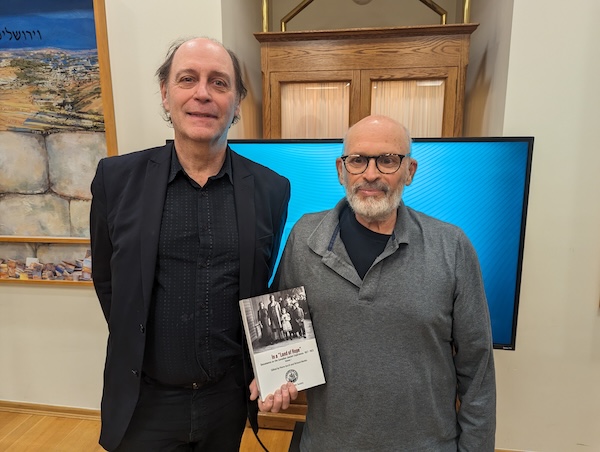
Pierre Anctil, left, and Richard Menkis with a copy of their new book, In a “Land of Hope”: Documents on the Canadian Jewish Experience, 1627-1923. (photo by Pat Johnson)

The first Jew known to have set foot in what is now Canada was Esther Brandeau, who arrived in Quebec City in 1738. Jews were forbidden from migrating to New France, but the young woman’s religion was not the only thing she was concealing. She was also dressed as a boy. 

Interrogated by authorities on arrival, Brandeau was the subject of high-level consultations before she was sent back to France the following year.

Although they are certain there were Jews in the land that would become Canada before 1738, professors Richard Menkis and Pierre Anctil say Brandeau’s case is the first documented proof of a Jewish presence here.

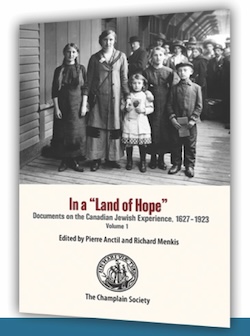
The historians shared Brandeau’s story at a book launch in Vancouver Nov. 21, following the annual general meeting of the Jewish Museum and Archives of British Columbia. Menkis, an associate professor in the departments of history, and classical, Near Eastern and religious studies at the University of British Columbia, and Anctil, a University of Ottawa history professor, co-edited In a “Land of Hope”: Documents on the Canadian Jewish Experience, 1627-1923.

The book spans three centuries through the lens of more than 150 documents, many of them never before published.

Menkis emphasized the efforts made to provide geographical diversity in the volume.

“If we want to appreciate the Canadian Jewish experience, we’ve got to move beyond – believe it or not – the borders of Quebec and Ontario,” he told the audience at Temple Sholom. “We have offered texts that represent the experiences from west to east. We offer an excerpt from the minute book of Congregation Emanu-El, in Victoria, recording a debate on whether to include the Freemasons in a cornerstone-naming ceremony. We have documents from the other ocean, from a controversy in Halifax, where the local SPCA argued that kosher slaughtering was cruel and that the local shochet (kosher slaughterer) was accordingly charged.”

Anctil, who is francophone, emphasized the uniqueness of the Jewish experience in Quebec and noted that shared interest between Catholics and Jews led to one of the first legislative acts of Jewish emancipation in pre-Confederation Canada. In 1832, the legislature of Lower Canada (later Quebec) passed a statute making British subjects who are Jewish equal under the law to all other British subjects in the jurisdiction.

“It’s a foundational document,” said Anctil. “It’s the first time that Canada and most British colonies allowed Jews to have political and civil rights.”

The motivation may have had less to do with Jewish rights – there were only about 150 Jews in colonial Canada at the time – than self-interest among French Catholics.

“They were Catholics living in a Protestant world and they knew that, if the Jews had more rights, the Catholics also had more rights,” Anctil said.

The Quebec education law of 1903 had lasting impacts on the province, especially for Jews and their place in the “distinct society.” 

“The Quebec government decided that Jews would be considered Protestants for the purpose of education,” said Anctil, “and [Jews] were all sent to the Protestant school board of Montreal and did not receive a Catholic or French education, which proved problematic in the decades ahead.”

Brandeau, the young Jewish woman who tried to masquerade as a non-Jewish boy, was only the first documented case of Jews coming up hard against Canada’s explicitly or implicitly racist immigration laws. The theme runs through the 400-page book.

Canadian immigration policies reflected the agricultural dominance of the Canadian economy into the 20th century and, since most European Jewish migrants were not farmers, this was an inherent, if not unwelcome from the perspective of immigration officials, bar to many Jews.

image - Land of Hope book coverThe editors address Jewish farmers in the book – those who had experience in the Old Country as well as those who, successfully or less so, took to the land after migration – but prioritize the economic experiences of Jews in peddling, retail and the garment industry.

The preference for immigrants with farming backgrounds was an implicitly, possibly even unintentionally, anti-Jewish component of Canada’s immigration approach. Other examples were less subtle. It was not so much that legislation said Jews were not permitted to migrate, but that unwritten rules, “administrative refinements” or policies that were open to interpretation could be used to block Jews from entering the country.

There had been rumours of a deliberate anti-Jewish immigration policy, and Menkis said their research found evidence that instructions had been sent to immigration officials in Europe that Jews were to be considered undesirable applicants.

In 1923, an order-in-council was passed by the federal cabinet, which said that only farmers, farmworkers and domestic women servants would be allowed to immigrate to Canada, effectively closing the door to Jews and many other communities from the Balkans and Eastern Europe.

Anctil and Menkis pointed out that Jews were far from the only group excluded under Canada’s immigration policies.

“Asians and Africans – out completely,” said Anctil. “Almost nobody got in. In 1923, we have the Chinese Immigration Act, which made it extremely difficult for financial reasons for Chinese people to migrate to Canada. So, we had a really racist immigration policy until the ’60s, ’70s. Not just Jews.”

Many of the documents included in the book were translated into English by the editors, from the original French, Yiddish or Hebrew.

“It’s very important to work in four languages,” Anctil said. “English, French, Yiddish and Hebrew – there is no way of doing Canadian Jewish history if you leave one out. All these four languages are represented in the book and serve an essential purpose of allowing the full flavour of this story to be told.”

The pair’s decade of research for In a “Land of Hope” uncovered some unexpected treasures. 

“Usually, we hear of social welfare from the minute books of established members of the community and their organizations,” said Menkis. “I was reading one of these minute books on one occasion in Toronto when a piece of paper dropped out.”

It was a desperate appeal from a woman seeking help from a Jewish women’s aid organization, specifically asking for chickens for the Passover seder.

“Please let me know if you’re going to send me the Paisez [Pesach] order and if you’re going to send me what you promised me,” read the handwritten letter. “I hope that you’re going to be kindly for my sick husband and my six little children because I just leave it to you and you should help because there is nobody to help accept [sic] you. I hope you won’t forget us and send us an answer right away. Because I could not tell you very much & That is the first time in my life that I should ask for help. But everything can happen in a lifetime. Yours […] Mrs. Green.”

The book closes in 1923 because that was a turning point in Canadian Jewish history and in the larger story of Canadian immigration. As a result of an economic depression following the First World War, nativist sentiments led to what was an effective end to large-scale immigration into Canada, itself a response to a parallel development south of the border. 

“One of the reasons it happened in Canada was that they knew the Americans were closing down [open immigration] and they didn’t want to get all those Jews that the Americans weren’t accepting,” said Menkis.

A second volume of the work, picking up from 1924, is due to be released in 2026. Anctil said the unique experiences of Jews in Quebec will be even more pronounced in that book.

“The Jews living in Quebec faced a different situation than Jews living elsewhere,” he said. “The majority of [Canadian] Jews were in Quebec until the ’60s and it’s not only the French and Catholic issue, it’s the issue that the school system was separated between Catholics and Protestants and Jews could not find a place easily in the public school system.”

Bias against Jews also has a different strain in each of Canada’s official linguistic communities, Anctil added.

“Antisemitism among the French is not the same as among the British,” he said. “The logic’s not the same and the results are not the same. Often, when you read histories of Canadian Jewry, you have the impression antisemitism is all the same, whoever is antisemitic. It’s not true. [There are a] number of subtleties and complexities in that.”

In a “Land of Hope” was released by the Champlain Society, a publisher of scholarly Canadian books. This is the first book the society has published about a community that is not French or English in its 115-year history.

“I hope at least I’ve convinced you of the value of the book, without being crassly commercial,” Menkis said at the end of the presentation, adding: “Although, I do want to say that In a ‘Land of Hope’ would make a great Hanukkah gift.” 

Format ImagePosted on December 1, 2023November 30, 2023Author Pat JohnsonCategories Books, LocalTags history, Land of Hope, Pierre Anctil, Richard Menkis
Contemplating the war

Contemplating the war

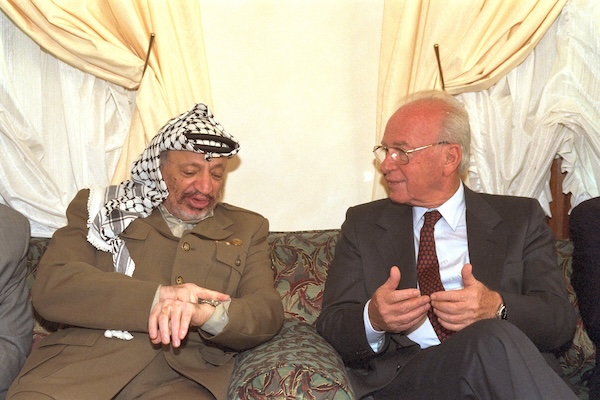
Prime Minister Yitzhak Rabin meets in Casablanca with PLO Chairman Yasser Arafat, 1994. (photo from flickr.com/photos/government_press_office/6324960139)

With all the darkness surrounding us since Oct 7, since the shattering of that tranquil Shabbat, have the people of Israel witnessed a miracle?

When Israel’s guard was fully down, when the south was under a vicious blitzkrieg by the monstrous Hamas, why did Hezbollah – with their 150,000 missiles pointed towards Israel – not exploit this excellent opportunity to open a second front? When Israel was existentially exposed, Hezbollah chose not to respond, at least not in any real-time, meaningful way. Complex geopolitical and military and conspiracy theories abound, attempting to explain why and why not. Pundits speculate and postulate and surmise. But maybe, just maybe, at some very esoteric level, the simplest and most logical answer, according to my close friend, a rabbi: it was a modern-day miracle. Pftt, pftt, pftt, as my great-grandmother would add.

***

The lights! Growing up, I was conditioned to shut the lights when leaving a room. I attempted to teach the same to my kids – and to my wife, although sometimes it seems she opens the lights when leaving a room. And then the missile sirens go off. Whoa! Slow it down. We have 90 seconds. Certainly time enough to shut the lights when racing to our shelter. My shouts muted by the screeching of the red alert, “Lights! Lights! Shut the lights!” I yell. To no avail, of course.

***

The day after … too soon to start thinking about it? That is where discussions about the war ultimately end up, each of us with our own theory, our own concerns, our own hopes. Once Israel achieves victory, in whatever form that takes, Gaza must then be rebuilt. But first it must be deradicalized – no more Hamas. Demilitarized – no more bombs hidden in schools, mosques and hospitals. And democratized – according to Winston Churchill, it’s the worst form of government … except for all others.

For this to succeed, Gaza should be divided into three cantons, similar to Germany, post-Second World War, each managed by a strong, Western or westward-looking country with enlightened self-interest for a stable and less radical Middle East. Maybe the United States. Maybe Britain. Maybe Germany. Maybe Egypt or Jordan. Escorted by a massive 21st-century Marshall-like plan. Maybe the Blinken Plan. Channeling the equivalent of $15 billion in 1948 purchasing power, that’s $191,569,917,012.48. OK, not that much, as the Gaza Strip is tiny compared to Germany, but enough funds to restore its economic infrastructure, to rebuild the Strip and rehabilitate its citizens, and make Gaza the Singapore of the Middle East – shipping, tourism, industry, maybe even offshore natural gas – like it could have become in 2005, when Israel fully withdrew. But then, what do I know.

***

Well before the day after, we need to take care of the Israeli hostages, including babies, children and octogenarians, both those still held in unknown condition by Hamas and other terrorists in Gaza, and those who have been returned. Interesting, but not necessarily surprising, is that neither the United Nations General Assembly nor UNICEF nor even the Red Cross demanded their unconditional release. Let alone a humanitarian visit.

As related by Liat Collins of the Jerusalem Post, Guelah Cohen – a 1980s right-wing parliamentarian, 2003 Israel Prize winner and mother of current senior Lukid lawmaker Tzachi Hanegbi – summarized this tragic situation best. Back during the First Lebanon War, when Tzachi was a combat solder, Cohen was asked what she would do if he were taken prisoner. She thoughtfully responded that, as a mother, she would be outside leading the protests to bring her son home, shouting with a megaphone outside the Prime Minister’s Office for the government to do anything and everything in its power to achieve his release. But, as a member of the government, she would be sitting quietly in the Prime Minister’s Office, advising him not to listen to the public. 

Prime Minister Yitzhak Rabin, during the controversial days of the 1993 Oslo Peace Accords process and accompanying Palestinian terror, said, “We must fight terrorism as if there’s no peace process and work for peace as if there’s no terror.” How utterly profound.

So, with the tragic circumstances of the hostages, the government must listen to the cries of the hostages’ families. But they also must lead and not be swayed by public opinion. The government must fight the war on Hamas as if there were no hostages and must, at the same time, bring all the hostages home. Alive.

***

As for economic recovery, I share a very micro, personal anecdote. About 18 months ago, we redid our condo, buying much of our furniture from BaKatzer, a wonderful and unique boutique furniture store located in a moshav (agricultural community) just outside the Gaza periphery, not too far from Ashkelon, which receives the brunt of the rockets from Gaza. While not the easiest of customers – I can be very demanding on price and service – I recently sent the owner a WhatsApp message. “Hey!” I wrote. “Hope all is well during these difficult times and hope to be back soon for more shopping.” Given my unforgiving consumerism, maybe she saw that as another threat. Alas, I can also be a very loyal consumer.

***

And there we were, my wife and I sitting around our Shabbat table with my daughter and her best friends, one with a brother who is a paratrooper and fighting in Gaza, the other an intelligence officer whose service was just extended, and still another, who was on a weekend leave from his Golani unit stationed up north. The conversation quickly moving from the trivial and benign to questioning and 

responding to issues and concerns that should be far away from them, that should not trouble the young minds of these 20-somethings, who should not deal with the complexities of miracles and hostages and day-after theories. Alas, there we were, talking of war and survival, looking hopefully to tomorrow. Am Israel chai. 

Bruce Brown is a Canadian and an Israeli. He made aliyah … a long time ago. He works in Israel’s high-tech sector by day and, in spurts, is a somewhat inspired writer by night. Brown is the winner of the 2019 AJPA Rockower Award for excellence in writing, and wrote the 1998 satire An Israeli is…. Brown reflects on life in Israel – political, social, economic and personal.

Format ImagePosted on December 1, 2023November 30, 2023Author Bruce BrownCategories IsraelTags history, Israel-Hamas war, lifestyle, peace, politics, terrorism
Sip for Solidarity campaign

Sip for Solidarity campaign

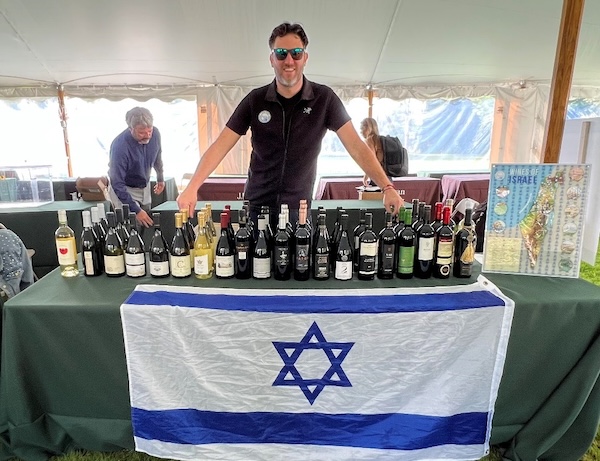
Joshua Greenstein, vice-president of the Israeli Wine Producers Association, showcases the array of wines produced in Israel. (photo from IWPA)

The world of wine in Israel, perhaps the oldest wine-producing region in the world, has become collateral damage of the atrocities that occurred on Oct. 7. To raise awareness, and in support of Israel and Israeli wineries, the Israeli Wine Producers Association (IWPA) is asking consumers to “Sip for Solidarity.”

The massacre has had an immediate, concrete impact, particularly on picking, sorting and winemaking teams. Harvest had begun shortly before the attacks, which meant that the sorting, crushing and fermentation processes were, in many cases, done under the constant threat of attack and bombardment. For many wineries, production teams have been hollowed out, as the young men and women who normally would be shepherding the crucial winemaking process have been called up to help defend the nation.

“Winemaking has its own schedule, unlike other industries, where you can pause production or run with limited staff. Grapes grow and ripen when they do. The winemaking process is very hands-on. Without staff, many wineries face an impending crisis,” said Joshua Greenstein, vice-president of the IWPA, a trade organization promoting 30-plus Israeli wineries through wine education and events.

“Additionally, wine is usually something enjoyed when you go out to eat or to a party, and people in Israel aren’t feeling particularly celebratory these days,” Greenstein added. “It’s catastrophic not just for this year’s sales, but for the vintages harvesting now that won’t be ready for sale for years to come.”

To help the situation, Greenstein suggested, “Buy a bottle of Israeli wine. Not only will the purchase help the wineries, but we’re donating 10% of every case shipped from Nov. 1, 2023, to Dec. 31, 2023, to Israeli relief efforts. With the wine-consuming public’s support, these challenges are surmountable, and wineries will still craft wines that accurately and deliciously reflect the character of the vintage and of Israel, just as they always have.” 

– Courtesy Israeli Wine Producers Association

Format ImagePosted on December 1, 2023November 30, 2023Author Israeli Wine Producers AssociationCategories IsraelTags farming, Israel-Hamas war, Sip for Solidarity, terrorism, wine, wineries

Posts pagination

Previous page Page 1 … Page 47 Page 48 Page 49 … Page 314 Next page
Proudly powered by WordPress