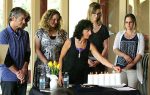
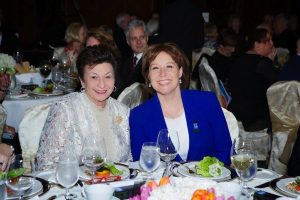
הפרמייר של מחוז אונטריו, קתלין ווין, ביקרה בין היתר ביד ושם. (צילום: הקונסוליה הישראלית)
הפריימר של אונטריו תומכת בחוק נגד אנטישמיות, אסלאמופוביה וגזענות
הפרמייר של מחוז אונטריו, קתלין ווין, הודיעה כי תתמוך בחוק חדש שנועד לגנות אנטישמיות, אסלאמופוביה וגזענות. דבריה של ווין נאמרו מסגרת דיון בפרלמנט של אונטריו בשבוע שעבר. ווין הציעה לפעול ביחד עם נציגי האופוזיציה לקדם את הצעת החוק החשובה.
הפרמייר של מחוז אונטריו, קתלין ווין, אפילו יצאה לריצת בוקר מוקדמת ומתוקשרת בטיילת של תל אביב. (צילום: הקונסוליה הישראלית)
ווין ערכה ביקור בישראל במהלך מאי עם משלחת גדולה בת מאה שלושים ואחד איש, בהם שרים, אנשי עסקים ונציגים של המוסדות האקדמיים. לווין נקבעו למעלה משמונים פגישות במהלך שבוע צפוף עם אירועים וטקסים. היא ניפגשה בין היתר עם ראש הממשלה, בנימין נתניהו, הנשיא לשעבר, שמעון פרס, נציגים בכירים של המוסדות הקדמיים, אנשי עסקים, בני נוער ונציגים של המגזר הערבי. ווין ביקרה בין היתר ביד ושם, בכותל המערבי ואפילו יצאה לריצת בוקר מוקדמת ומתוקשרת בטיילת של תל אביב. נציגי ממשלת אונטריו וחברי המשלחת חתמו על ארבעים וארבעה הסכמים לשיתוף פעולה, עם נציגי המגזר העסקי בישראל, בשווי שמונים ושבעה מיליון דולר. הסכמים אלה יביאו ליצירת מאתיים ושישה עשר מקומות עבודה חדשים במחוז אונטריו. במהלך הביקור אמרה ווין על ישראל: “ישראל היא היא יפה, מסובכת ומקום השראתי”.
אימה נפלה על אזור ונקובר. עורבים תוקפים באגרסביות הולכי רגל בפינות שונות של העיר וסביבותיה, שנמלטים בבהלה ומחפשים מיסתור במפני הציפור הרעה. התופעה כאילו לקוחה מאחת הסצנות של סרט האימה מהידועים ביותר בתולדות הקולנוע ‘הציפורים’, של המאי אלפרד היצ’קוק (שהופק בשנת 1963). תופעת העורבים התוקפים מאוזכרת דחופות באמצעי חדשות השונים כאן וברשת אף הועלתה מפה בה מצויינים מוקדי הפורענות של הציפורים הגדולות. וכל זאת כדי להרתיע הולכים ושבים שינמעו מלצעוד ברחובות ובאזורים מסויימים.
כידוע העורבים שומרים על הביצים בקינים שלהם לקראת סוף חודש אפריל, והם הופכים לתקופניים מאוד בעיקר בסוף עונת האביב, עת הגוזלים הקטנים מתחילים לעוף, וכהורים טובים הם מנסים להגן עליהם בפני כל רע. מבחינת העורבים כל מי שעובר בסמוך לקן שנמצא באחד העצים הגבוהים מעל המדרכה, נחשב לסכנה ויש להרחיקו בכל מחיר. מבחינת תושבי אזור ונקובר מדובר בסיוט שלא נגמר ורבים רבים מרגישים חסרי אונים.
כמה מאות הולכי רגל הספיקו לדווח כבר על מקרי תקיפה מצד העורבים בשבועות האחרונים, לאתר (שמופעל על ידי הסטודנטים של הקולג’ לאנגרה) שמעדכן כל העת את המתרחש. כך שמצטיירת לה מפה עירונית שהולכת וגדלה מדי יום, בה מצויינים בהדגשה מוקדי הפורענות העיקריים מצד העורבים. ונקובר לא נמצאת לבד: גם בערים הסמוכות לה ובאזורים נוספים ברחבי מחוז בריטיש קולומביה הולכים ומתרבים מקרי תקיפות מצד הציפורים השחורות והגדולות, המקרקרות ללא הרף. אף אחד באמת לא אוהב את העורבים.
מומחים שמכירים היטב את התנהגות העורבים שנחשבים לציפורים “אינטלגנטיות” לא מתפלאים מהמהומה הרבה סביבם. הם מציעים להולכי הרגל שהותקפו כבר לחפש דרכים חילופיות, ולא לצעוד באותם אזורים שוב ושוב. עוד מוצע לצעוד עם מטריות שיש להן יכולות טובות להגן בפני העורבים הרעים. יש אזרחים שמציעים לתת דווקא אוכל לעורבים האויבים שלאחר מכן יזכרו לך חסד. מכל מקום מומלץ ביותר שלא לגעת בשום פנים ואופן בעורבים או בגוזלים, וודאי שלא להתקיף אותם. כי אז הם יזכרו זאת לנצח ומעשה הנקמה עוד בטוח יגיע . מחקרים מראים שלעורבים יש זיכרון מצויין והם משתפים את חבריהם במידע על מי שתוקף אותם. לא לשכוח.
The current Sisterhood of Temple Sholom board at its installation in June 2015. (photo from the Sisterhood)
The Sisterhood of Temple Sholom obtained its charter from the National Federation of Temple Sisterhoods, now Women of Reform Judaism (WRJ), in 1966. Since its inception, the Sisterhood has provided vital funding and services not only to its congregation and the broader Jewish community, but well beyond. It has had much to celebrate in its 50th year.
The group has held several events, some marking the anniversary specifically, others part of the normal course of business. It began last October with Her Story, A Celebration of Women and Culture. Among the many events since then was Sisterhood’s annual Autumn Fling fundraiser in November and its Sisterhood Service in December. There was the Women’s Passover Seder in April and the recent Golden Anniversary Tea on June 5. The closing event takes place June 21 and the entire community is invited to the catered dinner, installation of the board and special guest Sarah Charney, WRJ vice-president of programming and education; Temple Sholom Rabbi Dan Moskovitz will also attend.
And these only touch upon what Sisterhood has done this year. The 200-plus-member group also held a Shabbaton weekend, co-sponsored scholar-in-residence Anat Hoffman of the Israel Religious Action Centre, and extensively researched Sisterhood’s history. Seven articles on the latter can be found via templesholom.ca/programs/sisterhood.
Donna Ornstein, a past Sisterhood president and current co-vice-president of marketing and communications, with Annette Kozicki, highlighted one major undertaking.
“To celebrate our 50th anniversary, our Sisterhood has just created a new fund called Sisterhood Open Door Accessibility Project, which is to be used to improve accessibility to the Temple building for the benefit of the Temple and the congregation,” she told the Independent in an email interview. “We have set aside $10,000 from our 2015-2016 budget and the intention is to add more funds each financial year as determined by our board to continue this project.
“This initial $10,000 is directed towards upgrading the Temple’s handicap washroom, and other washrooms as funds permit. Future projects will be determined by the Sisterhood board in consultation with the Temple. In 2014, Sisterhood completed paying the Temple $20,000 towards the cost of the construction of the accessibility ramp to the bimah.”
The Sisterhood’s mission statement is: “We, the Sisterhood of Temple Sholom, are an organization rooted in Reform Judaism. Journeying together, we aspire to engage in the pursuit of gemilut hasadim (acts of kindness), tikkun olam (healing the world, and tzedakah (righteousness).” In every measure, and then some, the group has met this aspiration.
“We have been fortunate in having many of the Sisterhood leaders over the decades reach out to the women in the Temple, encourage their participation and mentor their leadership training, not only in-house, but by encouraging new women to attend the WRJ Pacific District conventions,” explained Ornstein about the keys to the group’s success. “There was only a period of three years in the 50 years where we could not find a member to step up as president and, in that case, there was a group who rotated.
“Strong friendships have been created among our Sisterhood members, which have lasted for decades,” she continued. “We offer many different types of activities, and the women participate in what interests them: for example, book club, WRJ Lilith discussion group, women’s knitting group, Rosh Chodesh study group, Sisterhood Choir, walking group, mah jongg, games days.
“We form committees for larger projects and portfolios, bringing new women onto the committees and encouraging them to move up onto the board, such as fundraising, membership and social action.
“Sisterhood,” she added, “has enjoyed and appreciated the support of the Temple clergy and the office staff for our many events and projects over the 50 years.”
There have been almost 30 presidents of the Sisterhood, with the late Jan Pollack having been the founder and Reesa Devlin the current president.
“In the early years of Temple Sholom, Sisterhood’s social action adhered to charity begins at home, as it raised funds for items a new shul needs, such as libraries, kitchens, furnishings and office equipment,” write Sisterhood members Marie Henry and Joyce Cherry in their joint 50th-anniversary article. “As it became more established, Sisterhood helped those in the community around them and the world at large. In the late 1980s, Sisterhood contributed to the Armenian Earthquake Appeal and sponsored a Jewish camp for a youth group member. They participated in various community projects, such as the Jewish Food Bank and the Committee for Soviet Jewry.
“In the 1990s, Sisterhood sponsored a Russian family to come to Canada. A very special program saw a workshop on Understanding the Impact of AIDS in the Jewish Community that … led to the beginning of the Temple Sholom HIV AIDS committee. Funding also went to Emily Murphy Transition House, a vital resource for women fleeing violence in relationships. This involvement led to co-sponsoring Peace in the Home – Shalom Bayit – along with Jewish Women International, to address problem of domestic violence in the Jewish community.”
Sisterhood has sponsored teams in the annual Run for the Cure for Breast Cancer, has held sweater drives to collect winter clothing for those in need and has collected prescription glasses for developing countries.
“Another very important presentation program in 2009 brought addressing human trafficking in B.C. to everyone’s attention with the persistence of its originator, Marnie Besser,” note Henry and Cherry. “This program led to the spearheading of a successful lobby to the Canadian Senate for the passing of Bill C-268 regarding the minimum sentencing for the trafficking of minors.”
In the next decade, Sisterhood created “Bedtime Kits for Kids, filling backpacks with donated pyjamas, toiletries, underwear and some comfort items for children who arrive at a shelter with nothing but what they are wearing.” Sisterhood sponsors Tikun Olam Gogos, it collects clothing and toiletries for WISH (Women’s Information Safe Haven), a nonprofit operated by women to help women in Vancouver’s street-based sex trade, and also donates women’s business clothing and accessories to Dress for Success.
As well, it contributes to the World Union for Progressive Judaism and the ongoing WRJ initiative YES (Youth, Education and Special Projects) Fund, which, as one of the unbylined 50th-anniversary articles notes, “represents the collective financial efforts of individual donors and WRJ-affiliated Sisterhoods to strengthen the Reform Movement and ensure the future of Reform Judaism. YES Fund grants provide Reform Jewish institutions and individuals worldwide with the tools necessary for religious, social and educational growth, and enhance Jewish life by supporting clergy, cultivating women’s leadership, advocating for social justice, providing programming and offering support.”
In her 50th anniversary article, Bonnie Gertsman focuses on the history of the Sisterhood and food. “Preparing food has traditionally been the responsibility of women, to both nourish and nurture those they care about. And so it was at the beginning of Sisterhood 50 years ago,” she writes. “Although the group was small [at the beginning], the enthusiasm was keen. Refreshments for Oneg Shabbats were looked after by Sisterhood members, as was food for all special events.
“Over the years, the women’s skills increased and, when Bunny Rubens (rebbetzin of Rabbi Harold Rubens) became involved, Sisterhood took up catering. Regarded as a way to provide a service to members and at the same time raise money for the Temple, catering bar/bat mitzvahs and other events became a key component of Sisterhood life.”
Sisterhood started Temple Sholom’s first Second Seder, as well as the break fast following Yom Kippur. Rubens started the latter on her own, notes Gertsman, “and it morphed into a Sisterhood project, with members supplying the food. Sara Ciacci took it on many years ago, and continues to oversee it.”
In 1987, Sisterhood published Favorites from our Kitchen. “As the years passed,” writes Gertsman, “Sisterhood’s involvement with cooking for Temple has changed as the Temple grew and paid staff and caterers were hired for the kitchen and catering. Now, Sisterhood has Soup in the Kitchen and Soup Schvesters. These ‘soup sisters’ prepare soup to have on hand in the freezer, ready to be delivered to people in need of a helping hand.”
On the spiritual side, Sarah Richman writes in her 50th-anniversary essay on religious and educational programming that, as a member of WRJ, Temple Sholom Sisterhood “is committed to egalitarian participation, leadership and education.”
She notes, “The annual Sisterhood Service was one of the first and most enduring examples of this commitment. The first Sisterhood Service was conducted in the 1970s and was a Friday evening, erev Shabbat service that recognized the contributions of women to the congregation. The Sisterhood Service evolved over the years, affirming the right of women to participate and lead worship services. Over time, the service began including the Torah service … and also having a sisterhood member deliver the drash (sermon), demonstrating that women not only have the right to full participation in religious services, but also the knowledge and ability to do so.”
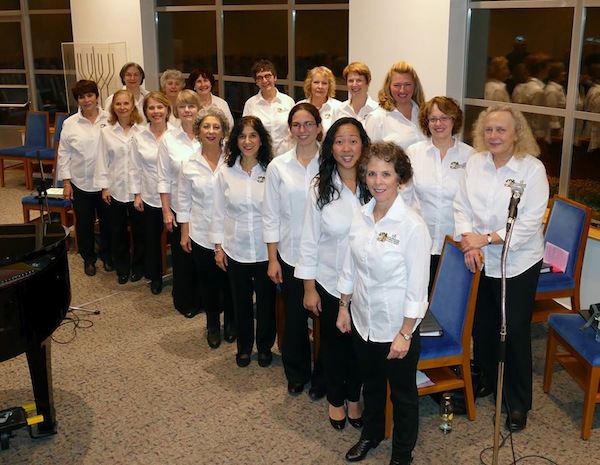
Sisterhood of Temple Sholom Choir (photo from the Sisterhood)
Richman highlights the Sisterhood Choir, the Rosh Chodesh Renewal program that “encourages women to explore and study our ancient texts together” and the purchase by Sisterhood of 126 copies of The Torah, A Women’s Commentary for the congregation. She also discusses Sisterhood-hosted Shabbat education seminars, which began in 2007, “motivated by the Shabbat initiative of Rabbi [Eric] Yoffie,” then president of the Union for Reform Judaism, and Sisterhood’s contribution to Temple Sholom’s scholars-in-residence program.
“The Blessings Wall Project,” she adds, “is an example of a program that blended each individual woman’s Shabbat candlelighting process (the spent matches), together with fabric, paper, photos and/or artwork that represent her personality or character. Each woman’s matches, paper/fabric and photos/artwork became an individual panel on the wall.”
WRJ is the organizational umbrella for hundreds of sisterhoods, and the North American (“national”) affiliates are divided into eight districts, with WRJ Pacific District representing 57 sisterhoods in the western United States and Canada. The Blessings Wall Project, Camp Kalsman Campership Fund/Fashion Show Project and A Community Conversation about Death and Dying are but a few of the Sisterhood programs and initiatives that have received recognition at both the district and national levels. Temple Sholom Sisterhood members have served on the district board, and member Alexis Rothschild has also served on the WRJ board.
Ornstein told the Independent that, in November, “we will send as many of our Sisterhood members as possible (hopefully about 10) to the Women of Reform Judaism Pacific District convention in Las Vegas where we will meet women from over 50 sisterhoods and participate in workshops on leadership training, spirituality, programming. We come home from these biennial conventions energized with lots of new ideas.”
Left to right are Anne Andrew, Marie Henry, Stephen Lewis, Joyce Cherry, Darcy Billinkoff and Dawn Alfieri at the African Grandmothers Tribunal, which was held in 2013 at the Chan Centre. (photo from Stephen Lewis Foundation)
The Grandmothers to Grandmothers Campaign, in conjunction with the Stephen Lewis Foundation, is supporting grandmothers of sub-Saharan countries in their efforts to raise their orphaned grandchildren, whose parents died of the AIDS epidemic in Africa. Tikun Olam Gogos, one of the local groups participating in the campaign, is hosting the Voices for Africa fundraiser on June 15 at Temple Sholom that will feature the City Soul Choir and a marketplace.
Marie Henry, volunteer administrator of Tikun Olam Gogos, talked to the Jewish Independent about the Stephen Lewis Foundation, the Grandmothers Campaign and Tikun Olam Gogos’ place in it.
“Stephen Lewis Foundation was created 10 years ago,” she explained. “Before that, Mr. Lewis was an NDP politician. After he retired from the Canadian political scene, the United Nations appointed him to look at the AIDS epidemic in Africa. What he saw there was shocking: 18 million children had been orphaned in Africa because of AIDS. Their grandmothers had to step in to raise the children. After he returned to Canada, he was determined to help them. That’s how the foundation started in 2006, and Lewis applied to Canadian grandmothers to support it. He knew they could do it. They had resources, experience, determination and time.”
According to Henry, there are now more than 240 groups across Canada associated with the Grandmothers to Grandmothers Campaign. They all include in their name the word gogos, which is Zulu for grandmothers. “The movement’s already spread to the U.S., England and Australia,” she said.
The funds the campaign gathers go to the Stephen Lewis Foundation, which in turn supports the grassroot initiatives of the grandmothers of AIDS orphans in sub-Saharan countries.
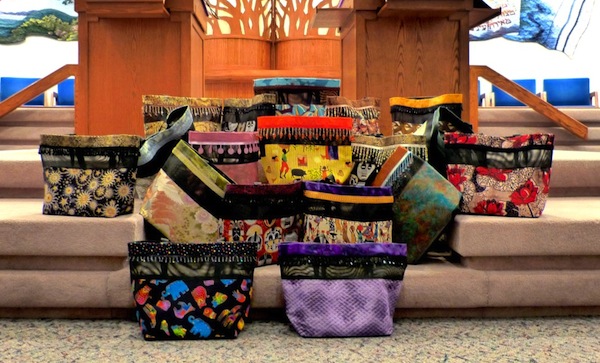
Totes made by Tikun Olam Gogos, and other Gogos, will be on sale at the Voices for Africa fundraiser on June 15. (photo from Tikun Olam Gogos)
Henry explained how it works. “The foundation can’t give enough money or food or shelter; the need is just too great,” she said. “Instead, the grandmothers have to come up with an initiative of their own that would improve their condition. It could be a small business that needs a startup loan. It could be a community garden to grow food for a number of families, and they need seeds. Or it could be an educational opportunity, to teach the children and their grandmothers how to prevent AIDS or how to access and administer medicines in case they are already infected. Many children are [infected]; they have been infected before they were born. Many grandmothers also need legal help and education to keep the roof over the children’s heads.”
The latter problem stems from the inheritance traditions in some countries where, after a husband dies, his widow doesn’t inherit property, the husband’s family does, explained Henry. Even if the law says otherwise, the husband’s family’s actions are not always lawful. Many of the grandmothers and their orphaned grandchildren live in small villages without access to legal or medical help, and could be kicked out of their homes by the deceased husband’s relatives. So, the grandmothers themselves have to come up with the programs, depending on what they need in their particular country, area or village. They then apply to the Stephen Lewis Foundation for funding.
“There are several regional directors in those countries, all local women,” Henry said. “They read the proposals, visit the people, assess the projects and decide if the money should go to this particular program. A year later, they would check if the program works, if it should be re-funded, or maybe not. The grassroot programs receive all the money – no government of any of the countries involved receives one dollar, no bureaucracy benefits. The foundation keeps its administrative cost to 10%, which is one of the lowest of all charities. The rest all goes to the people who need it.”
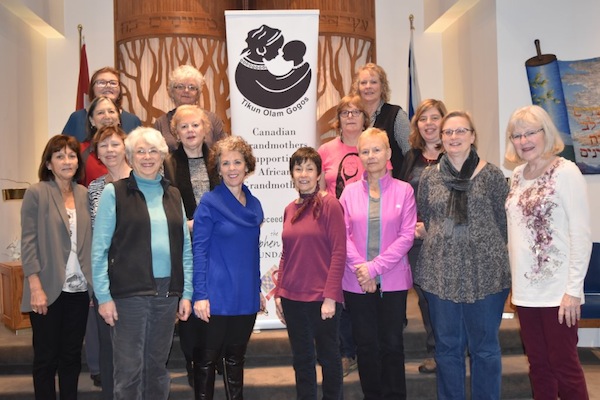
The Tikun Olam Gogos in January 2016. (photo by Susan Hyde)
Henry herself got involved with the campaign almost by accident. “I was visiting my family in Kelowna,” she recalled. “We went to a farmers market and I saw those beautiful totes. The woman who sold them was a member of one of the Gogos groups. They made and sold tote bags to raise money for the foundation. I loved the idea. I found a group in Vancouver and joined it, but there was a problem. I was the only Jew in the group and, often, their meetings fell on the Jewish holidays, when I couldn’t attend. I decided to create my own Jewish group and, of course, I started with my synagogue, Temple Sholom. Everyone was very supportive. Our group, Tikun Olam Gogos, first met five years ago, in May 2011.”
Currently, the group has 29 members, mostly retired women, some grandmothers themselves, others not. They meet once a month, discuss group business and create the kits for their totes. Several group members are experienced seamstresses who sew the totes of various sizes. Others apply their creativity to the trimmings and beads. Still others are good at sales. Everyone finds something to do that agrees with their personality and skill level.
The group’s tote bags are sold at craft fairs. To date, they have raised more than $120,000 for the Stephen Lewis Foundation. Many of their fundraisers include an entertainment program as well as a marketplace. The June 15 fundraiser is no different: it will feature the choir, under the direction of Brian Tate, and a marketplace of crafts by Tikun Olam Gogos, South Van Gogos, Welisa Gogos and Van Gogos, as well as a silent auction, wine bar and dessert. Tickets are available at eventbrite.ca.
Olga Livshinis a Vancouver freelance writer. She can be reached at [email protected].
It is hard to make new friends after you reach a certain age. Most people’s friendships date from childhood or college days, a work friend here and there. It is particularly difficult if tragedy strikes a family, but even when children leave home to start their adult lives, as they all must do, many women are left alone, unable to find a new niche. Circle of Friends, a relatively new program at the Jewish Community Centre of Greater Vancouver, addresses this problem.
Cori Friedman was instrumental in getting the program off the ground.
“In 2014, I was serving as the chairman of the [JCC] seniors committee. Being a widow myself, I recognized the need of single older women to combat loneliness,” she told the Independent. “There was a men’s group already established at the JCC with a much different format. With the cooperation of the committee, we were able to fulfil the need.”
According to Friedman, 14 women came to the first meeting, but attendance has grown significantly since then.
“The group started in September 2014,” recalled group facilitator Rebecca Porte. “The idea of forming such a group came from the knowledge that the transition following the loss of a spouse, whether by divorce or death, can be challenging. Often old friendships don’t fit as well, social engagements don’t carry the same meaning, and many aspects of life don’t have the same richness and fulfilment they once held. For women 55 and older, the question of where and how to foster their new meaningful social connections was a challenge.”
Circle of Friends became the answer to that challenge. “By now, I have about 75 people on our email list, those who have attended at least one of our meetings,” said Porte. “Since it is a drop-in program, the numbers that participate on any given week fluctuate, but generally it is between 15 and 30 at each meeting.”
She said there is a well-established Circle of Friends group in the Jewish community of Montreal. “They allowed us to use the same name,” said Porte, “and we have modeled much of what we do on their group.”
The JCC Circle of Friends meets every two weeks between September and June on Tuesdays, with the exception of Jewish holidays. The meetings start at 1 p.m. and last for about 90 minutes. “We usually have the first 15 minutes as social time: welcoming new members, introductions, announcements,” said Porte. “After that, there is about an hour of the main program – speakers, discussions, concerts by local artists, seminars, etc. Then another social time for 15 minutes before the meetings break up.”
The group is open to single women over 55, although some exceptions are made. “Most of us are not single by choice,” said Fran Goldberg, a member of Circle of Friends. “And a woman with a terminally ill husband could be very lonely sometimes. She often needs a place to relax, a time for herself.”
Every member of the group has a chance to suggest program themes and formats but, mostly, the programming is decided upon by the volunteer committee. “Six of our members serve on the committee,” said Porte. “They meet semi-regularly and put in some extra time and energy. They come up with ideas and we work together to create a balanced and interesting program. We want it to be relevant and have some level of opportunity for interaction.”
Circle member Cynthia Cherry said the programs include TED-type talks, movies and discussions, seminars on personal finances and nutrition, musical presentations, and more. “I joined the group at its start,” she said. “I had retired recently at the time and wanted to connect socially. I saw the ad at the JCC, dropped in, and liked it. I didn’t know anyone in the group then, but now some of us meet outside the Circle, [have] built new friendships.”
Another member, Lane Stein, said she came to the group after becoming a widow. “I enjoy the ladies and the programs. It’s something to do in the afternoon,” she said, mentioning that, since the beginning, several subgroups have branched out from the main one. There is a separate brunch group now, a travel group, and others in the works.
Porte has worked with the main group since its inception. “My role as facilitator is to help create the framework for each meeting and to facilitate the meetings to ensure that they are interactive, welcoming and run smoothly. In theory, the group could continue without a facilitator, but when I asked if they wanted me to stay, the group was quite adamant. They wanted me to keep doing it.”
The next meeting of the Circle of Friends will be held on June 14, 1 p.m. “We are going to visit the Queen Elizabeth [Park’s] Bloedel Conservatory,” said Porte. “We thought that an outing would be a great way to end our season. If the weather cooperates, we could make it a picnic. Then, we’ll pick up again in September.”
Are you Jewish and living outside of Vancouver? The Jewish Federation of Greater Vancouver wants to hear from you. Its Regional Communities Task Force has begun their work with a new survey to determine how best to engage Jews living beyond the borders of Vancouver, and they are asking you to respond.
From Whistler to Chilliwack, Federation wants to hear about the innovative and welcoming Jewish programs and services you – your friends and/or family – need close to your home.
The community is changing, with 46% of the Jewish community living beyond the borders of Vancouver, including many young families. They lack access to many Jewish community programs, services and institutions.
The fastest growing Jewish communities are Surrey/White Rock up 60%, Tri-Cities up 45%, Maple Ridge/Pitt Meadows/Langley up 23%.
Almost 25% of Jewish children live outside of Vancouver, and very few attend Jewish schools or camps.
A growing number of young families are intermarried and have limited or no connection to Jewish life.
Our strength as an entire community depends on our ability to embrace our diversity and to be flexible and innovative as we engage Jews in new and increasingly relevant ways. Take a moment to respond and to reach out to your friends, family and acquaintances for them to also take the survey at jewishvancouver.com/survey.
JustGreet allows customers to pick a greeting card online that will be mailed with a handwritten message of their composition. (photo by Sophia Hsin)
Vancouver-based JustGreet describes itself as “the cutest greeting card service on the internet.” The company’s model is unique in that it combines the convenience of online services with the meaningfulness of a handwritten and mailed greeting card. Founded just last year, the JustGreet team has already been nominated for a Small Business B.C. Award, being recognized in the best emerging entrepreneur category.
Creative director and Southern California native Lauren Berkman joined the startup after sensing its potential to fill a gap in the $30 billion greeting card industry.
“I really got my initial interest in startup life when I lived in Tel Aviv, Israel, an amazing hub of entrepreneurial ventures,” Berkman told the Independent. “While there, I worked for two tech startups, though after some time returned to the U.S. to work at an advertising agency, and then to Vancouver to complete my MBA at UBC. While at UBC, I completed an internship in market research, the main project of which was focused on JustGreet. While working on this research project, my interest was sparked by the simplicity of the service and the sentimental value greeting cards have held throughout my life.”
While people have come to rely on the ease that technology allows, Berkman said that JustGreet recognized that potential customers wanted something different from what existing online greeting card services were offering.
“The mainstream sentiment nowadays is that online communication is becoming increasingly noisy and impersonal – information fatigue is a mainstream sentiment,” she explained. “We realized that there was a big unaddressed opportunity to provide people and brands with a way to communicate that’s authentic and meaningful.”
Customers simply select a card from an online assortment and type a personalized message, then the JustGreet team takes care of the rest and the lucky recipient receives a handwritten card in their mailbox.
“That is the great thing about JustGreet. We are able to provide the best of both worlds – the convenience of technology in the ability to order a greeting card online but, ultimately, the same product ending up in the hands of the consumer had you gone to the store, picked the card out yourself, handwritten it, bought the stamps and put it in the mailbox,” said Berkman.
What sets JustGreet even further apart from many other companies is its commitment to ensuring its services are ethically and environmentally responsible. Each greeting card is printed on 100% recycled paper. Additionally, Berkman maintains that JustGreet would not exist without the community of independent artists who design the cards.
“Each artist is compensated directly with the sale of each card that features one of his or her designs. It is with this model that we have been able to attract such talented artists. We want to provide a platform in which we can help support our artists’ creative endeavors, and provide a mechanism to share their work with a larger audience. We are always welcoming new artists to the family, and love hearing from new ones who have interacted with our brand and want to get involved.”
As the company grows, JustGreet is working to allow its community of artists to grow as well. “We launched with 10 artists from the Vancouver area but just recently we had three join from the U.S. and one from South America,” said Berkman.
The addition of some artists from outside Vancouver is reflective of the company’s desire to reach customers beyond the city while maintaining a feeling of community.
“Greeting card tastes ultimately transcend borders and cities, so rather than view ourselves as a small local business, we would like to be seen as a community that supports its artists and consistently delights its customers, no matter how big it gets. As JustGreet expands, so does our community, and the variety of designs and inspiration we can offer to that community,” said Berkman.
Therefore, despite its potential for global growth, Berkman promises that JustGreet’s mission will always be “to help families, friends and loved ones stay connected in a way that gives people the personalization and sincerity they deserve.”
JustGreet’s initial local success was reflected in its 2015 Small Business B.C. Awards nomination. “We had only just launched when we were nominated for this award, so the fact that we were on anyone’s radar alone was very exciting,” said Berkman. “It’s a tremendous honor to be recognized amongst some of B.C.’s most promising new companies.”
She added, “In one year, we’d like to be able to say that we’re a fast-growing greeting card and stationery lifestyle brand with global online and wholesale operations. Our goals are pretty simple – create as many happy moments as we can and support the artists in our community. We think it’s a noble pursuit and our team is excited about it.”
Brittni Jacobsonis a freelance writer living in Toronto.
Left to right: Evan Orloff, Melina Moore, Barb Pullan lighting the candles, Rebecca Morlang and Hilla Shlomi. (photo by Roger Tepper)
The Okanagan Jewish Community has been busy over the last couple of months. They are also gearing up for their annual golf tournament, which takes place in July.
On April 22, the OJC hosted a Passover seder at Summerhill Winery. Led by Allan Holender, approximately 150 people attended, including 30 kids under 12. Dr. Jessica Strasberg organized the children’s crafts and activities, Ronit Little made the charoset for all the tables and Steven Finkleman helped with many of the food preparations and putting together the 18 seder plates; David Spevakow and Barb Druxerman volunteered a great deal of their time on preparations and planning. Steven Cipes and his family, of Summerhill Winery, hosted the event.
Writer and consultant Allan Holender leads the Passover seder with some young help. (photo from Okanagan Jewish Community)
Also in April, Cantor Russell Jayne from Beth Tzedec in Calgary came to the Okanagan to lead services. On May 7, with special guests from the International Christian Embassy Jerusalem (ICEJ) in attendance, OJC member Evan Orloff led the services, after which there was a dairy potluck. A new rabbi has been contracted for the High Holidays this year and the OJC is looking forward to having Rabbi Lawrence Seidman and his wife Linda – who is also a rabbi – join them.
On May 15, Orloff and fellow OJC members Ed Aizen, Max and Peggy Mandelbaum, Barb Pullan, Hilla Shlomi and Seymour Zidle attended a Holocaust remembrance service held at the Lakers Clubhouse in Vernon hosted by the ICEJ. The event was put on because members of the ICEJ were greatly disturbed by the rising amount of antisemitism in the world. The ceremony included speeches, candlelighting and the presentation of a copy of the names on Schindler’s list encased in a replica suitcase which was accepted by Orloff on behalf of the OJC. Orloff is a retired teacher in Kelowna; he dedicated much of his career to educating students about the Holocaust and why it is imperative to remember. Melina Moore performed the theme song from Schindler’s List and sang Hatikvah. The service honored the lives of those who died in the Holocaust and the resilience and courage of survivors, as well as saying “never again” and “no” to antisemitism and prejudice in all its forms. The OJC is very grateful to the ICEJ, led by members Gail Mobbs and Daniel Morlang, for putting on such a touching ceremony.
During this past month, the OJC has had seven groups of students, ranging from 30 to 50 students per group from four middle and secondary schools in the area, participate in its Talks & Tours, hosted by OJC members Finkleman and Orloff. The students heard a presentation on Judaism and then enjoyed challah and grape juice with an explanation of the significance. Some of the schools attend the seminars annually, finding the presentations educational and interesting.
Last but not least, the 19th annual OJC Golf Tournament is being held on July 21. The money generated from the tournament each year enables the OJC to continue bringing in guest rabbis and cantors and to provide programming for the community; this year, part of the proceeds will also help Canadian Blood Services, a charity chosen in honor of the late Sid Segal. There is still room available for more golfers (and hole sponsors) so, if you are interested in participating in this day of golf, food, drinks and social interaction, visit ojcc.ca or contact Anne Zazuliak at the OJC office, 250-862-2305 or [email protected].
Left to right: Gary Segal, 2014 Jewish National Fund Negev Dinner honoree, 2016 honoree Shirley Barnett and Ilan Pilo, Jerusalem emissary and executive director of JNF Pacific Region. (photo by Robert Albanese)
The tally is in. On April 10, the Jewish National Fund, Pacific Region’s soldout Negev Dinner raised a record-breaking $1 million to rebuild a shelter in Rishon LeZion. To be called the Vancouver Shelter, it will be a safe haven for families of all religions and backgrounds while providing them with the time and space to forge new independent lives. It will be run and operated by the Israeli nonprofit No to Violence Against Women, which works with women and children fleeing domestic abuse. The shelter project was selected by dinner honoree Shirley Barnett.
Josh Cooper, chief executive officer of JNF of Canada, praised Barnett for her community leadership and Frank Sirlin, JNF-PR president, lauded her dedication to the Jewish value of tikkun olam, repairing the world. Addressing the dinner guests, Sirlin said about Barnett’s philanthropic work, “Shirley knows what she wants and she makes it happen.” He also thanked the JNF-PR’s board and donors for making the event a great success.
Ilan Pilo, JNF Jerusalem emissary and Pacific Region executive director, spoke about the importance of the shelter and the funds raised from the dinner for it. He thanked the community at large, as well as the volunteers, lay leaders, dinner chairs and committee and all JNF supporters for supporting the project and for making it a record-breaking year.
Jewish National Fund Negev Dinner honoree Shirley Barnett, left, and B.C. Premier Christy Clark. (photo by Robert Albanese)
Attending the dinner, which was held at the Four Seasons Hotel, were several dignitaries, including Consul-General of Israel to Toronto and Western Canada D.J. Schneeweiss, Premier Christy Clark, Speaker of the Legislative Assembly Linda Reid, Minister of Justice and Attorney General Suzanne Anton, Minister of Advanced Education Andrew Wilkinson, B.C. NDP House Leader and Official Opposition Solicitor General Critic Mike Farnworth, former member of Parliament Stockwell Day, former member of the Legislative Assembly Grace McCarthy, and founder of No to Violence Against Women, Ruth Rasnic.
Entertainment for the evening was provided by Arik Davidov, an Israeli trumpet player, who also impressed the audience with his shofar playing. Arnold and Anita Silber were this year’s honorary chairs for the Negev Dinner and television and radio broadcaster Shane Foxman was master of ceremonies. Lorne and Melita Segal hosted a reception at their home the night before the dinner.
Since its inception in 1901, JNF has been the sole agency responsible for the development and infrastructure of land in Israel. Its many programs include land reclamation, reforestation and road-building.
Donations go directly to fulfilling the needs of one of the many development areas such as water, forestry and environment, education, community development, security, tourism and recreation, and research and development. For more information, contact Pilo at [email protected] or 604-257-5155, ext. 821.
Left to right: Esther Mogyoros, King David High School director of development; Shannon Gorski, PAC co-chair; speaker Josh Shipp; and Teaching for Tomorrow co-chairs Gaby Lutrin and Elaine Grobman. (photo from KDHS)
“What’s the difference between a watermelon and a cloud?” Josh Shipp asked the crowd. “Three percent. A watermelon is 94% water and a cloud is 97% water. All that separates them is three percent, but that little difference makes all the difference in the world. That little difference can be all that separates you from being average and being extraordinary.”
Shipp, a “teen expert” and motivational speaker, who graduated from Stanford and has lectured at Harvard and MIT, was speaking at Teaching for Tomorrow, an annual celebration of King David High School (KDHS), on May 17.
KDHS, which has 220 students and expects continued growth, is British Columbia’s only Jewish high school and one of six outside of Toronto. It is also one of the most successful Jewish high schools in Canada from the perspective of having growing enrolment each year.
The auditorium at the Chan Centre was packed, flanked on both sides by galleries full of KDHS students. After an introduction by emcee Liam Sasky, a Grade 12 student, the audience heard a concise, warm and humorous speech from school head Russ Klein. A musical interlude followed, with a duet about friends struggling with the romance that’s broken out between them. Following that came a video about KDHS and its values, focusing on the experience of current students and alumni – the students interviewed emphasized the sense of community at KDHS, and the feeling that they were known and valued personally at the school.
After that came the main event. Shipp was notable for his ability to get raucous laughter from the teens, who he seemed to hold in the palm of his hand throughout his talk. He peppered his speech with memorable images and questions, tech and pop culture references, and self-deprecating humor. Shipp, who was abandoned as a child and grew up a troubled delinquent in a series of foster homes, spoke candidly of his own horrific experiences of abuse and trauma. At the centre of his speech was the role that one caring adult can play; in his life, this was his foster father Rodney, who refused to reject Shipp, saving his life and turning it around. “All of you can be a Rodney to someone,” said Shipp. “Every child, every teenager, every human being is one caring adult away from success.”
Shipp challenged students to reach out to a “Rodney” in their own lives within 24 hours and say “thank you,” something Shipp said took him nine years to do after the day his Rodney turned his life around. Shipp also had a warning for students: face your ghosts.
“You guys are pretty serious here,” Shipp said. “I know it. I watched the propaganda video. You need to be unafraid to seek help for the things that are holding you back. This can be a problem in high-achieving communities like this. Don’t be afraid to seem weak, because talking about these things is not weak – it’s courageous.”
Matthew Gindinis a Vancouver freelance writer and journalist. He blogs on spirituality and social justice at seeking her voice (hashkata.com) and has been published in the Forward, Tikkun, Elephant Journal and elsewhere.
Canadian Museum for Human Rights researcher and curator Dr. Jeremy Maron discussed some of the issues the museum faced in deciding what to exhibit. (photo by Rebeca Kuropatwa)
The Canadian Museum for Human Rights (CMHR) in Winnipeg is one of the newest museums on the block. Dr. Jeremy Maron, a CMHR researcher and curator, discussed some of the issues the museum faced in deciding what to exhibit. The March 4 brown-bag lunch meeting at the University of Manitoba was open to students and the general community.
Maron’s main work at the museum is on the fourth floor, an area dedicated to the Holocaust. Displays on three perimeter walls take a case study approach, emphasizing themes closely related to the Holocaust as well as universal human rights.
“The first theme we look at is the abuse of state power,” he said. “This wall explores how Nazis used and deployed instruments of state power, such as the police, judiciary, laws and regulations, and even education to undermine human rights … and acquiring total dictatorial control of German society, promoting their racist and antisemitic ideology, targeting Jews and other specific groups for social exclusion and persecution, ultimately culminating in genocide.”
Dr. Jeremy Maron makes a point at a March 4 meeting in Winnipeg. (photo by Rebeca Kuropatwa)
Maron said the modern nation state, in its ideal sense, is supposed to be the guarantor of human rights. But, in reality, the centralized power of the modern state very often sets the stage for it to be the worst violator of human rights.
“The case of Nazi Germany is a good example of the centralized power and the capacity for it to be mobilized toward the violation of human rights, rather than protection,” he said. “There are many other stories in the museum in which state power is also being utilized in such a manner.
“The second thematic wall in this gallery … moves on to look at persecution and targeting of specific groups in Nazi Germany. This wall explores the increasing intensity of systematic oppression under the Nazis.”
According to Maron, the Allies did not fight the Second World War specifically because they were trying to save the Jews in Europe. However, their winning of the war ended the Nazi massacre of Jews, which continued nearly up until the day of the Germans’ surrender.
“Another exhibit, from which we try to draw human rights connections, is a large digital study table in our Breaking the Silence gallery, also on level four,” said Maron. “This gallery looks at breaking the silence specifically as a human rights act.”
Human rights violations are always accompanied by silence, distortion, justification, minimization and denial, he said. Perpetrators want to hide their crimes; victims who survive may feel scared for themselves or their families, or feel ashamed; witnesses and bystanders often look the other way, so the cycle continues.
The goal of the CMHR is to encourage people to speak out about these violations, to drag the violations out into the light of day and pursue justice, recovery and reconciliation, he said.
“This particular exhibit, Breaking the Silence … looks at a wide scale of human rights violations, putting an emphasis on how people have responded to them in order to break silence,” said Maron. “We tried to place the emphasis of the human rights response in this particular case. It’s a question of focus that tries to adopt a forward-looking perspective, rather than one that is trying to wholly examine the past in and of itself.”
While some visitors feel that the message and exhibit is too watered down, Maron said this was necessary to a certain degree, as the museum’s main focus is to educate and not to horrify or shock.
“It’s not just a sense of sensitivity we think about, it’s also a question of a fact,” said Maron. “Sometimes, when confronted with material that is explicitly horrific, even for someone like myself who has worked on this material extensively, it almost can shock you into silence as it overwhelms you. I think back to when I was doing my master’s in 2005. I went on a Holocaust commemoration tour [and] we toured Auschwitz. After you go through the gas chambers and you see the walls and the showerheads, you get back on that bus and you are just beaten down. You are sitting there and the guides are trying to debrief and talk, but no one wants to talk because they are beaten down.”
While the CMHR does not back away from the truth or gloss over troubling aspects, they choose to visualize these histories differently, he said. One of the concepts the museum is designed to highlight is that everyone’s actions are the result of choices, and that the consequences of these choices are not inevitable.
“That’s not to say that there are not constraints on choices,” said Maron. “If you’re in the midst of a particular human rights catastrophe and you do something like hide a potential victim in your attic, it’s very possible that you might be targeted as well. So, there are constraints on choices in certain historical circumstances. But, it’s still important to consider that these are choices and actions, and what happens isn’t inevitable. Some objects in the museum speak to some of the less obviously consequential choices that individuals might have made that allowed the Holocaust to be perpetrated on that scale.”
While Maron understands that it’s impossible to know for sure what a single individual could have done, with his display, he hopes to create a deep and meaningful reflection for CMHR visitors and, especially, students.
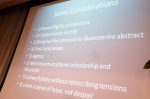
How to convey a history of conflicts accurately without reigniting tensions is another challenge the museum has taken into consideration, by using careful word choices and avoiding blanket statements. But, maybe the most important aspect and aspiration for the CMHR is ensuring that visitors leave with a sense of hope.
“This hope is not a naive hope that everything is going to be OK, but that … hope is possible as long as we promote the human rights of everyone, and the idea that hope is possible if people are willing to make hard choices and take action,” said Maron. “So, again, we hope our visitors leave with the idea that change is possible if people are willing to do something, while silence and acquiescence is the ally of rights violations.
“Until atrocities are recognized and acknowledged, until people believe action is possible, cycles of violations will continue. Such cycles, we hope, our museum, in some small part, can help improve by inspiring a lot of hard work and devotion by our visitors, who may become dedicated human rights advocates and defenders.”



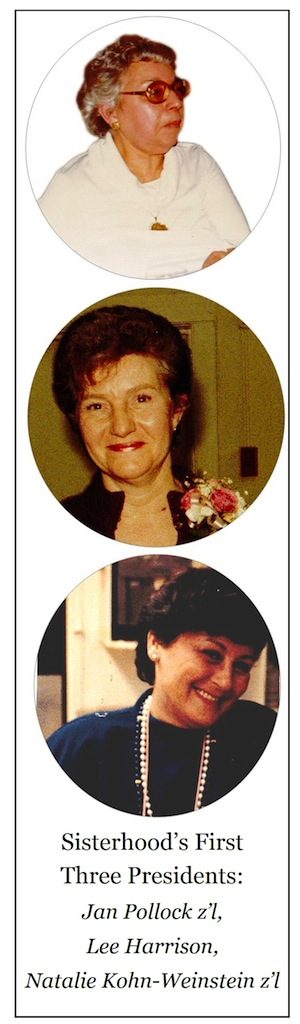 There have been almost 30 presidents of the Sisterhood, with the late Jan Pollack having been the founder and Reesa Devlin the current president.