A sold-out crowd attended CJPAC’s Women in Politics Pecha Kucha event on Oct. 24, which featured four speakers, including CJPAC’s Sherry Barad Firestone (standing on the left). (photo from CJPAC)
On Oct. 24, CJPAC (the Canadian Jewish Political Affairs Committee) hosted its first Women in Politics Pecha Kucha event in Vancouver. It was a sold-out crowd with women and men of all ages and political backgrounds in attendance. Hodie Kahn hosted the event at her home.
The Pecha Kucha style of 20 slides at 20 seconds per slide created a dynamic evening that allowed CJPAC to showcase four guest speakers, all Jewish, each highlighting different facets of political engagement, as well as its importance and its accessibility during and between elections.
CJPAC advisory board chair Sherry Barad Firestone, originally from Vancouver but now living in Toronto, was one of the presenters. “It was such a thrill to participate,” said Firestone. “It was nice to be able to share my experience as someone who does not come from a political background. We often think politics should be left to the experts but there’s a role for all of us, regardless of experience, in our democracy.”
Other presenters included Temple Sholom Rabbi Carey Brown, an American transfer to Canada, who is passionate about adult and youth education, social justice and teen engagement; Dr. Moira Stilwell, who served as the member of the Legislative Assembly for Vancouver-Langara from 2009 until 2017, and was a minister of several portfolios; and, Rakeea Gordis, a high school student who has attended political rallies, volunteered on campaigns and recently became an EF Canadian Youth Ambassador.
Perhaps one of the best and inspiring quotes of the night came from Gordis, who stated, “I’m too young to vote. The only way I can use my womanly voice is to volunteer on campaigns.”
Kara Mintzberg, B.C. regional director for CJPAC, noted that CJPAC hopes to have more events focused on women’s experience in politics. “We know that it’s not always easy to be a woman in politics but we think events such as these, in particular hearing from their peers, will encourage more women to get involved and, ultimately, it will become easier for those who follow.”
CJPAC is hosting another event soon – the Ultimate Kiddush Club, featuring “Scotch master” Barry Dunner, on Nov. 23, 7:30 p.m. For more information about the evening or any other CJPAC events and opportunities, contact Mintzberg at [email protected] or 604-343-4126.
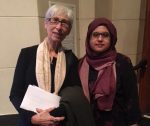
Martha Roth, left, and Itrath Syed. (photo by Matthew Gindin)
“I don’t get why people cannot look straight at what’s happening in the occupied territories and see it for what it is,” Roger Waters said to a full house at St. Andrew’s-Wesley Church on Oct. 26. “There’s a word for what is happening there: ethnic cleansing.”
The event took place a few days before the end of Waters’ cross-Canada Us and Them Tour, the final leg of a North American tour that kicked off almost a year ago. The primary songwriter behind Pink Floyd albums like The Wall and Dark Side of the Moon was invited to speak by Independent Jewish Voices (IJV). Among talk sponsors were IJV, CanPalNet, Seriously Free Speech, Not in Our Name, and Solidarity for Palestinian Human Rights. Waters was interviewed by Martha Roth, co-chair of IJV Canada, and Itrath Syed, a professor at Langara College.
Many in the Jewish community were opposed to his speaking, accusing Waters of antisemitism and anti-Israel bias. B’nai Brith Canada made a documentary called Wish You Weren’t Here and followed him around Canada showing it in conjunction with his concerts. A week before the talk, the Centre for Israel and Jewish Affairs sent out a mailing identifying Waters as “the rock musician obsessed with boycotting Israelis” who has become “the face of the hateful BDS movement.” An online petition called for the talk to be canceled.
At the church, Waters said his genesis as a BDS (boycott, divest from and sanction Israel) activist happened after a 2006 trip to Israel. “I was going to do a gig in Tel Aviv,” he said, “and I started to get emails from Palestinians and others who said that might not be such a good idea due to this very new movement started by Palestinian civil society called BDS, and they tried to prevail on me to cancel the gig. As an act of compromise, I moved the show to Neve Shalom, where they grow chickpeas and there are Jewish people living there, Arabs living there and Christians living there. All of their children go to school together, so it’s a lovely experiment in what can happen when people don’t fixate on all the things that we disapprove of in each other.”
A small group of protesters met across the street from the church, draped in Israeli flags and carrying signs. (photo by Matthew Gindin)
Waters returned the next year for a tour of the territories with UNRWA and became a convert to BDS. “Since then, I’ve tried to open my big mouth as often as I can,” he said. “It’s been a long, quite trying, difficult road, not nearly as hard and trying, obviously, as living under occupation. The blackening of my name is just one more way of obscuring the truth. They want to stop the public discourse where people tell the truth about what happened in ’47-’48, what happened in ’67, in ’73, what’s happening now.”
Waters praised young Jews opposing the occupation. He said, “If you look at polls now, you find that younger Jewish people are no longer looking at the situation and not seeing anything. They’re saying, ‘This is not what Judaism is about, this does not represent the way I feel, it goes against everything I believe in with my heart. I am a human being, I am humane, and I do not want my people or anyone who pretends to represent me to behave like this. It’s happening, and it lightens my heart every time I hear someone speak out. It’s great.”
Waters also discussed his communist mother’s tutelage of him as a social justice activist, his opposition to the Trump administration, capitalism and militarism, and the inspiration behind songs on his recent album Is This the Life We Really Want?
A small group of protesters met across the street from the church, draped in Israeli flags. One entered the talk and unfurled a banner reading, “Boycotts Don’t Scare Us – Am Yisrael Chai,” before being peacefully removed. A college-age Israeli protester held a sign saying, “Israeli Lives Matter” and told the Independent that what was going on inside was “just like Nazi Germany.”
IJV sent someone out to invite the protesters in afterward for dialogue. While they declined, one Jewish protester exchanged phone numbers with a Palestinian from Gaza who had approached the group, agreeing to meet later and talk.
Matthew Gindinis a freelance journalist, writer and lecturer. He writes regularly for the Forward and All That Is Interesting, and has been published in Religion Dispatches, Situate Magazine, Tikkun and elsewhere. He can be found on Medium and Twitter.
Photos from the Vancouver Shabbos Project event Oct. 26. (photo by Lior Noyman)
Participants collect their supplies. (photo by Lior Noyman)
On the night of Oct. 26, hundreds of Jewish community members came together at Vancouver Talmud Torah to bake challah and socialize in a welcoming atmosphere. The event was part of the Shabbos Project, a worldwide movement where Jews across the globe celebrates a Shabbat together.
Why challah for Shabbat?
Most challot are braided with either three or six strands of dough. In kabbalah, when we talk about the mundane and physical world with its limitations, we consider the (three) aspects of time, space and matter, and the six days of creation and the six directions in our three-dimensional world (north, south, west, east, up and down).
Throughout the week, we work to master our environment. We struggle with time – when is there ever enough? We are limited by space, and we attempt to control matter. We are preoccupied with succeeding in and dominating our physical world.
The challah braid represents the unity of everything. (photo by Lior Noyman)
Shabbat arrives and it supersedes and gives meaning to all we do during the week. It brings us back to focus. Shabbat represents the soul and our inner self. It represents the G-dly, the infinite and the spiritual energy beyond the physical dimensions.
The challah braid represents the unity of everything. It ties all the physical properties of our lives to the divine.
Similarly, Shabbat uplifts time, space and matter and all the dimensions of the physical world. It brings everything and everyone together, reminding us of unity, peace and the purpose of creation.
Rabbi Shmulik Yeshayahuis director of the Ohel Ya’akov Community Kollel.
Global TV was at Richmond Jewish Day School last week to recognize the efforts of Grade 6 and 7 students who are selling flowers to fundraise for the Variety Club, Richmond Animal Protection Society and the Jewish Food Bank. To date, the students have raised $2,000 for these charities. Pictured, left to right, are Rachel Marliss, Shai Rubin and Nathan Brown. (photo by Lauren Kramer)
צריך לדעת מתי לעזוב: גבר העלים מבת בת זוגתו לשעבר כי הם זכו בשישה מיליון דולר בלוטו. (צילום: olg.ca)
אם מחליטים להיפרד מבן או מבת הזוג צריך לדעת מתי לעשות זאת. לא מומלץ לעשות זאת לאחר שרוכשים כרטיס להגרלת הלוטו וזוכים בה. מוריס טיבו (46) מהעיר צ’טהאם שמחוז אונטריו החליט להיפרד פתאם מבת זוגתו הקבועה דניס רוברטסון (גם כן בת 46). הזוג גר למעלה משנתיים בביתה של רוברטסון (עם ילדתה מנישואים קודמים). אך טיבו העלים מרוברטסון את העובדה כי כרטיס הלוטו שלהם להגרלת 6/49 (מתאריך ה-20.9) זכה בלא פחות משישה מיליון דולר. עתה בית המשפט של מחוז אונטריו הוא זה יכריע בסוגיה מי יקבל את הכסף וכיצד הוא יתחלק בין השניים.
טיבו סיפר לזוגתו כי הכרטיס שלהם לא זכה בשום פרס אך התברר לה שהוא שיקר. זאת כיוון שאחד מחבריהם המשותפים סיפר לה כי לאחר שעזב את הבית טיבו מיהר גם התפטר מעבודתו הקבועה. בת זוגתו לשעבר כעסה מאוד ופנתה מייד לקבל עצה מעורך דין. אותו יועץ משפטי פנה בדחיפות לבית המשפט שהוציא צו זמני האוסר על העברת הזכייה לטיבו. ולפיכך אונטריו לוטורי גיימינג קורפורשיין (או.אל.ג’י) הקפיא את הכסף של הכרטיס הזוכה עד שהסוגיה תברר סופית בבית המשפט.
יועץ משפטי המתמחה בתחום, עו”ד בוריס ביטנסקי, אומר כי למרות שהזוג לא היה נשוי לאישה קרוב לוודאי יש זכויות על כספי הפרס. ידוע שבני הזוג גרו יחדיו למעלה משנתיים, והם נהגו לרכוש במשותף מדי שבוע כרטיסים להגרלות הלוטו. חבר של טיבו מכחיש שהיה הסדר בין שני בני הזוג בנושא הלוטו. לדבריו טיבו רכש את הכרטיס שזכה בדביט קארד שקשור לחשבון הבנק האישי שלו. הוא הוסיף כי כבר לפני חודשים טיבו התכוון להיפרד מרוברסטון ורק לאחר שזכה בלוטו יכל לבצע זאת בפועל. עו”ד ביטנסקי מדגיש כי על רוברטסון להוכיח בבית המשפט כי השניים אכן נהגו לרכוש בקביעות כרטיסים להגרלת הלוטו, ולחלק את כספי הזכייה אם היו. היא תוכל לחזק את טענותיה כנגד בן זוגה לשעבר, אם תוכל להציג אימיילים והודעות טקסט טלפוניות, על המידע שהחליפו בקביעות בנוגע לרכישת כרטיסי לוטו (כמו האם רכשת כבר את הכרטיס להגרלה הקרובה? האם לא שכחת לרכוש את הכרטיס עם המספרים שלנו?). לדעת ע”וד ביטנסקי אם רוברטסון לא תוכל להביא הוכחות יאלץ בית המשפט להכריע על סמך מה שהיא תמסור בעדותה, לעומת מה שטיבו ימסור בעדותו. אז השופט יכריע לאחר שיחליט למי הוא מאמין יותר משני הצדדים. הוא מציין עוד כי בדרך כלל סוגיות כאלה נפתרות מחוץ לכותלי בית המשפט. זאת, למרות שדרך כלל מריבות של בני זוג לשעבר הן הרבה יותר מסובכות בעיות אחרות הקשורות בחלוקת כספים של זכייה בכרטיסי לוטו. האו.אל.ג’י יחזיק את כספי הזכייה במשמרת עד להחלטת השופט, כי בעבר קרו כבר מקרים שכספים חולקו ורק לאחר מכן נפתחו מאבקים משפטיים ביו טוענים שונים לזכיה בהגרלות. לדברי היועץ המשפטי זכור לו מקרה שזכה לפרסום בתקשורת לפני כעשר שנים, כאשר גבר שנה לאחר שזכה בלוטו פנה לקבל את הכסף. בינתיים לאור כל אותו זמן הוא לא סיפר לאשתו כי הם זכו בפרס בלוטו, ובמהלך השנה בני הזוג התגרשו. הסוגיה לבסוף הוסדרה בבית המשפט והכסף התחלק בין השניים. עו”ד ביטנסקי מתקשה לתת עצה לבני זוג שחיים ביחד כיצד יגנו על עצמם בפני מצבים מסובכים שכאלה.
Or Shalom Rabbi Hannah Dresner, reciting psalms, leads the congregation around the Or Shalom cemetery perimeter. (photo by Robert Albanese)
Or Shalom Synagogue celebrated a major milestone on Oct. 15 with the dedication of its new cemetery.
In March, after four years of discussions with the City of Vancouver, the synagogue signed an agreement for a small area within Mountain View Cemetery (MVC). The area runs along the west side of Fraser Street extending south from 33rd Avenue.
Rabbi Hannah Dresner noted that the dedication helped “connect our bayit (our home in life) to our beit kavurot (our home in death).”
The ceremony, attended by more than 50 people (and a few dogs), began with a service at the synagogue, followed by a walk along Fraser to MVC. After reciting psalms while circling around the Or Shalom cemetery perimeter seven times to consecrate the area, participants proceeded to a reception at the MVC Celebration Hall.
Or Shalom is affiliated with Aleph, the Jewish Renewal movement, whose core values support efforts to explore and redefine Jewish traditions in ways that are egalitarian and inclusive. Accordingly, the cemetery offers a choice of all-Jewish and interfaith sections, a green section and double burials.
The area contains 64 lots (burial sites). However, Jewish custom allows multiple burials in one grave in locations where land is scarce, such as Jerusalem and Vancouver. Many older Jewish cemeteries in eastern Europe followed this practice. The Or Shalom section permits two people, related or not, to share a lot. Due to the small size of the cemetery, purchases are limited to individuals who have been Or Shalom members for at least five years.
Lots are purchased directly from MVC, which is owned and managed by the City of Vancouver. MVC manager Glen Hodges supported the project from the beginning and Or Shalom member Catherine Berris, a landscape architect with Urban Systems, helped with design.
Referring to Abraham’s purchase of a cave at Machpelah to bury his wife Sarah (Bereishit/Genesis 23) as the “first Jewish cemetery,” Dresner said, “It is beautiful to be buried in community, and this is what we will now be able to provide for one another at Mountain View: community in death.”
Dodie Katzensteinis a member of Or Shalom and a founding member of the cemetery planning committee.
Left to right, MP David Sweet, MP Michael Levitt, CIJA chief executive officer Shimon Koffler Fogel, MP Scott Reid and MP David Anderson pose for a photo during the House of Commons Standing Committee on Canadian Heritage hearings on M-103 on Oct. 18. (photo from CIJA)
Jewish groups were in Ottawa on Oct. 18 to testify in front of the House of Commons Standing Committee on Canadian Heritage, which will make policy recommendations on M-103, a motion that condemns “Islamophobia and all forms of systemic racism and religious discrimination.”
Leaders of the Centre for Israel and Jewish Affairs (CIJA) and B’nai Brith Canada drew on the Jewish community’s experience with fighting antisemitism in their recommendations on how to maximize the motion’s efficacy.
In his testimony, CIJA chief executive officer Shimon Koffler Fogel pointed to statistics that showed Jews are the most targeted religious minority in the country.
“Nationally, there were 54 hate crimes targeting Jews per 100,000 individuals in 2015. While this number is relatively consistent with previous years, there was an increase in hate incidents targeting other minority communities, including the Muslim community. In fact, Muslims were the next most targeted group, with 15 incidents per 100,000 individuals,” Fogel said. “I mention these numbers not to showcase Jewish victimhood, but rather to demonstrate the very real experience our community has in grappling with the issues this committee is studying.”
B’nai Brith Canada chief executive officer Michael Mostyn recommended that the motion be constructed so that it will be “embraced broadly by all Canadians” and by “communities that are the targets of racism and discrimination, including Canadian Jews, who continue to be the target of antisemitism.”
Mostyn said the bill must not diminish “the threat to Canadians of all faith communities who face racism and religious discrimination and it must not suggest that one form of racism or religious discrimination is more threatening, or of greater priority, than another.”
Among Fogel’s recommendations was that the committee work to improve on the collection and publication of hate crime data, as it currently varies widely by police department.
He said statistics from the Greater Toronto Area – including Peel Region, Toronto and York Region – are readily available, “but even with these three neighbouring jurisdictions, each report provides different information, making direct comparisons sometimes difficult.”
He added that there are cities, such as Montreal, that don’t release data about which identifiable groups are being targeted, leaving policymakers with incomplete information.
Fogel said it’s important to properly define hate, as we “can’t effectively fight bigotry and hatred without precisely defining it. The term ‘Islamophobia’ has been defined in multiple ways, some effective and some problematic. Unfortunately, it has become a lightning rod for controversy, distracting from other important issues at hand.”
Fogel used the Islamic Heritage Month Guidebook, which was issued by the Toronto District School Board earlier this month and contains a definition of Islamophobia that includes “dislike toward Islamic politics or culture,” as an example.
“Muslims can be protected from hate without restricting critique of Islamist political ideologies,” Fogel said.
Mostyn agreed that the committee should “exercise great care in any definition of Islamophobia” because, if the definition is vague or imprecise, it can be “hijacked and only inflame tensions between and among faith communities in Canada.”
Mostyn said an imbalance can create “the impression that Canadian Muslims are the only victims of hate crimes. We are just as concerned with the source of hate crimes targeting Canadian Jews from within radical elements of the Muslim community.”
Fogel also recommended that greater and more consistent enforcement of existing laws is needed. “Recently, the attorney general of Quebec decided not to lay charges in a case of an imam in Montreal who had called for the murder of Jews. Quebec’s attorney general also declined to pursue a second charge of genocide promotion. This decision sent a message that someone can call for the death of an entire group of people without consequence,” he said, adding that the federal government should train police and prosecutors to better enforce the existing Criminal Code hate speech provisions and provide resources for the development of more local hate crime units.
In his testimony, David Matas, B’nai Brith Canada’s senior legal counsel, argued that some fear of radical Islam is rational.
“Adherents to some components of Islam preach hatred and terrorism, incite to hatred and terrorism and engage in hate-motivated acts and terrorist crimes,” Matas said. “What the committee, we suggest, can usefully do is propose criteria, with illustrative examples, which can guide those directly involved in the combat against the threat and acts of hatred and terror coming from Islamic radicals.”
Matas called on the committee to “focus both on those victimized by Islamophobia and on the incitement and acts of hatred and terrorism, which come from within elements of the Islamic community.”
In his remarks, Fogel also referred to the passing of Bill C-305 – a private member’s bill that would expand penalties for hate crimes against schools and community centres associated with identifiable groups – which had its third reading on Oct. 18.
“CIJA has long advocated for the changes contained in Bill C-305,” Fogel said. “C-305 is a clear example of how elected officials can work together, in a non-partisan spirit, to make a practical difference in protecting vulnerable minorities.”
CIJA chair David Cape said, “CIJA remains grateful for the tireless efforts of MP Chandra Arya, who has committed his time and energy to strengthening hate crime protections. As we celebrate Canada’s 150th anniversary, we’re reminded that the safety of at-risk communities is essential for a healthy, vibrant country. Criminals who target Jews or other minorities don’t distinguish between houses of worship, community centres and schools – neither should the law.”
The Centre for Judaism of the Lower Fraser Valley is looking for nominations for its annual Lamplighter Award, which honours a young person who has performed an outstanding act of community service.
Candidates must be between the ages of 6 and 18 and submission of potential recipients must include two references describing the child’s community service. The chosen lamplighter will receive the award during Chanukah at an evening ceremony at Semiahmoo Shopping Centre.
“Chanukah celebrates the victory of light over darkness and goodness over evil,” said Simie Schtroks. “This is a most appropriate opportunity to motivate and inspire young people to make this world a brighter and better place. By filling the world with goodness and kindness, that light can dispel all sorts of darkness.”
To nominate a candidate for the award, contact Schtroks as soon as possible at [email protected].
* * *
This summer, David Granirer received a Meritorious Service Medal from the Governor General of Canada. The award recognizes a deed or activity that has been performed in a highly professional manner, or according to a very high standard: often innovative, this deed or activity sets an example for others to follow, improves the quality of life of a community and brings benefit or honour to Canada.
Granirer is a counselor, stand-up comic and mental health keynote speaker. Granirer, who himself has depression, has taught stand-up comedy to recovering addicts and cancer patients, and founded Stand Up for Mental Health, a program teaching comedy to people with mental health issues, in 2004. He has trained Stand Up for Mental Health groups in partnership with various mental health organizations in more than 50 cities in Canada, the United States and Australia. His work on mental health is featured by media worldwide and has garnered several awards.
Granirer also teaches Stand-Up Comedy Clinic at Langara College, and many of his students have gone on to become professional comics.
* * *
This year’s Mayor’s Arts Award for Community Engaged Arts went to Earle Peach. A singer, songwriter, composer, conductor, arranger, teacher and performer, Peach leads four choirs in the city and hosts a monthly community coffee house in Mount Pleasant. He teaches privately, and records musicians for demos and albums. He performs with Barbara Jackson as a duo called Songtree and also has a band called Illiteratty.
The emerging artist honour went to Ariel Martz-Oberlander, a theatre artist, writer and teacher. As a Jewish settler on Coast Salish territories with diasporic and refugee ancestry, her practice is rooted in a commitment to place-based accountability through decolonizing and solidarity work. She divides her time between theatre and community organizing, and specializing in creative protest tactics on land and water.
Martz-Oberlander is a facilitator with the True Voice Theatre Project, producing new shows by residents of the Downtown Eastside and vulnerably housed youth, in collaboration with the Gathering Place and Covenant House. Her most recent work, created with support from the LEAP program, won a research and development prize from the Arts Club. Martz-Oberlander is also the associate producer for Vines Festival, presenting accessible, free eco-art in Vancouver parks. Good art is accountable to the community, raises up voices rarely heard and is vital to repairing our world.
* * *
On Oct. 3, the Koffler Centre of the Arts announced the four winners of the 2017 Vine Awards for Canadian Jewish Literature, all of whom were on hand at the award luncheon at the Park Hyatt Hotel in Toronto.
Winners in two of the categories are based in Vancouver. Miriam Libicki won the non-fiction award for Toward a Hot Jew (Fantagraphics Books Inc.), which the jury described as, “An admirably complicated response to being a woman and a Jew in our time, a thrilling combination of memoir, journalism and art.” And Irene N. Watts and Kathryn E. Shoemaker took the prize in the children’s/young adult category for Seeking Refuge (Tradewind Books), which the jury described as, “A superb graphic novel dramatizing the Kindertransport, a powerful story enhanced by firsthand experience and beautiful black-and-white illustrations.”
The other winners were Peter Behrens’ Carry Me (House of Anansi Press) for fiction and Matti Friedman’s Pumpkinflowers (McClelland & Stewart) for history.
The history shortlist included Max Eisen’s By Chance Alone (Harper Collins Publishers) and Ester Reiter’s A Future Without Hate or Need: The Promise of the Jewish Left in Canada (Between the Lines). Runners-up in the fiction category were Eric Beck Rubin’s School of Velocity (Doubleday Canada) and Danila Botha’s For All the Men (and Some of the Women) I’ve Known (Tightrope Books). In non-fiction, Sarah Barmak’s Closer: Notes from the Orgasmic Frontier of Female Sexuality (Coach House Books), Judy Batalion’s White Walls (Berkley/Penguin Random House) and David Leach’s Chasing Utopia (ECW Press) were runners-up, while Deborah Kerbel’s Feathered (Kids Can Press) and Tilar Mazzeo and Mary Farrell’s Irena’s Children (Margaret K. McElderry Books) were on the children’s/young adult short list.
* * *
In September 2017, local community member Dr. Arthur Wolak was elected for a three-year term to the board of governors of Gratz College, a private liberal arts college in suburban Philadelphia. Founded in 1895, Gratz is the oldest independent and pluralistic college for Jewish studies in North America. Accredited by the Middle States Commission on Higher Education, Gratz is also recognized by Israel’s Ministry of Education and Culture. Through its undergraduate and graduate programs, Gratz educates students to become effective educators, administrators and community leaders.
Albi Serfaty with the Lucky Lamp. (photo from Aqua Creations)
When Renee Switzer launched the SwitzerCultCreative showroom in 2016, she was adamant that they include pieces by Israeli furniture and lighting designers, giving them a Canadian stage exclusive to Vancouver.
“I visited the New York showroom of Aqua Creations in 2015, and their designs completely blew me away,” said Switzer of the Israeli brand. “The same with Hagit’s [Pincovici] furniture, that reflect beautiful craftsmanship made in Italy and have never been seen here before.”
Together with her son, Adam Bellas, and daughter, Jennifer Wosk, the third generation of a legacy begun by their grandfather in the 1960s, Switzer is delving into modern, high-end furniture collections for Vancouver interiors.
It’s impossible to look at Aqua Creations’ lamps, lighting installations and furniture without feeling a sense of wonderment. The urge to curl up in the enveloping Gladis Lounge Chair in the SwitzerCultCreative showroom is overpowering. When co-founder Albi Serfaty heard my confession, he laughed in agreement. “This is what art is all about,” he said, Skyping from his home in Tel Aviv. “There must be this emotional connection, both for me as a designer, because I’m passionate about my work, and hopefully from our pieces as interior décor in a home, a restaurant or hotel.”
What began in 1994 as a small atelier in Tel Aviv is now a global brand with an Aqua Creations showroom in New York and their lighting installations worldwide, including 1 Hotel, Brooklyn; Savoy Hotel, Seychelles; and Hotel Okura Fukuoka, Japan.
As a photographer and designer, Serfaty re-interprets organic forms and abstract sea life into lighting and furniture. Morning Glory Floor Lamps, in silk over metal, when illuminated, seem to take on an otherworldly beauty all their own. Collections since 1994 show a definite evolutionary progression, with current geometric shapes like the Simon Says Yes Pendant, part of Aqua Creations’ Mino Collection. Whether as a singular hanging pendant or grouped together as colourful wall mounts, as shown in the SwitzerCultCreative showroom, they add a sculptural yet functional addition to interiors.
If you can imagine thousands of magnified neurons under a microscope, you will see the genesis of the Mimosa Collection. Composed of laser-cut galvanized metal, sprayed with clear polymer, the hand-sculpted shades transmit a dreamy, calming light.
The Lucky Lamp wall fixtures are Serfaty’s newest iteration, using groundbreaking technology in which each sustainable and dimmable light is controlled by a micro-computer that alters colour, motion and intensity.
“I’d love to collaborate in the future with a fashion designer like Missoni,” confided Serfaty, “and, at some point, build a place that combines home, work and studio in one location.” He added, “I’m like a sheep dog in that way – I like everything together.”
* * *
When Hagit Pincovici was a little girl in her grandparents’ atelier in Tel Aviv, she remembers the exhilaration of playing with and running between colourful sheets of Plexiglass that would eventually be moulded into trays, frames and furniture by her artisan grandparents.
Flamingo Storage Side Table, by Hagit Pincovici. (photo by Fabrizio Checchi)
“When my grandfather left Romania for Israel, he brought the recipe for making Plexiglass and I remember it was a kind of paradise looking through all the colourful pieces,” said Pincovici, now third-generation maker, in a Skype interview while she was visiting Tel Aviv.
It’s not entirely coincidental, then, that her multi-hued Art Deco-inspired furniture evokes a modern twist on a bygone era. Pincovici’s From Above Coffee Table from the Eclipse Collection is a geometric Carrara marble “moon” integrated into an abstract path of black shadow and coral sun in lacquered wood on a brushed brass base. Flamingo Storage Side Table, also from the Eclipse Collection, is a stunning sculptural platform perched atop stilt-like legs inspired by its namesake; a secret compartment rotates out to store jewelry, if placed in a bedroom, or becomes a handy bar for drinks, sure to spark conversation in the living room. The Metaphysics Sideboard is Pincovici’s take on elegance. The blue and black lacquered geometric wood console designed at multiple heights is mounted on brushed brass and immediately recalls the glamour of the 1920s and ’30s. “I love the thin minimalist lines just bordering on the decorative,” she explained.
After working her way up as head of product development for Aqua Creations in Israel and organizing their exhibition at the annual Salone del Mobile, in Milan, Pincovici decided to relocate to Italy, “where I fell in love with the Italian spirit of creativity,” not to mention her husband, Fabrizio Checchi.
She opened her own design studio in the furniture district of Brianza in 2014, where she sketches her designs by hand. The furniture is made with traditional craftsmanship and sold internationally. When not working on her first collection of lighting, Pincovici is also an instructor at NABA (Nuova Accademia di Belle Arti) in Milan.
“You know, we [Israeli] designers are like chameleons,” said Pincovici. “I don’t think we share a common style but we do share that drive to create and, in Italy, they really appreciate that approach.”
* * *
London-born Eli Chissick of Chissick Design is waxing poetic about wood. Skyping from his home-studio near Tel Aviv, the award-winning designer is concerned about the environment, recycling and products that will increase the mobility of people with disabilities.
Gradient Cocktail Table by Eli Chissick. (photo from Chissick Design)
Unlike the vast forests found in Canada, trees are not harvested for the lumber industry in Israel and wood is usually imported. That forces the industrial and product designer to be ingenious about scavenging off-cuts and repurposed wood from carpentry floors. “It’s a magical transformation when I sort what is usually thrown out, then press it into large sheets from which I create my furniture,” said Chissick.
The results are as sculptural as they are utilitarian. Mosaica, from Chissick’s Wood-Con-Fusion series, is a coffee table (or bench) composed of more than 2,000 intricate puzzle pieces of multi-coloured wood. The Marmelade coffee table is a mouth-watering compote of wood with inlaid lime-, raspberry- and white-striped Formica laminate. It’s built on wheels for easy manoeuvring in any space.
“I’m really excited about working with Renee at SwitzerCultCreative because I’m now able to send my furniture designs created on the computer to her and then have many pieces handmade in British Columbia with the same quality as in Israel,” said Chissick.
Those pieces include the Gradient Cocktail Table, handcrafted from eight types of veneer juxtaposed from light to dark in wenge, imbuia, American walnut, teak, African walnut, anigre, white oak and maple. Mirror 2012, from Chissick’s Wood-Con-Fusion series, is set in a painted and lacquered salvaged wood frame and can be customized in various colours. (It was a 2015 platinum winner at the U.S. ADEX Awards for Product and Project Design.)
He’s also a proponent of TOMS (Tikkun Olam Makers), a global movement of makers who donate their specialties to create solutions for people struggling with a debilitating problem. Over three days, 100 designers, engineers and techies meet with potential users personally then brainstorm in small groups and set to work making prototypes. Chissick has participated in these “Makeathons” in both Tel Aviv and San Francisco, resulting in a walker that allows a person to navigate stairs, a door opener for someone who has quadriplegia, and a digital hand and a high-tech go-cart for a child with disabilities, to name only a few.
Switzer, who has visited Israel several times, is planning a scouting trip there in 2018. “It gives me tremendous personal gratification to showcase such talented makers,” she said.
Laura Goldstein(lauragoldsteinwriter.com) was an arts publicist and writer in Toronto for 22 years before moving to Vancouver. She’s a frequent contributor to the Globe and Mail’s design section, Westcoast Homes & Design, Canadian House & Home and Destination BC, among many others. A highlight of her career was covering the Royal Tour in Vancouver last year.
Burgers made with insect protein, and no meat. (photo from Eran Gronich)
While the thought of eating insects or worms may sound outlandish or disgusting to many of us, there is growing support for doing just that.
In less than 25 years, the world will have nine billion people living on it. As things stand, there is not enough space or resources to support conventional protein production – beef, chicken, fish, etc. – for that many people. One solution that has been brought to the fore is that we can start eating insect protein. And now, the Israeli company Flying Spark is raising capital to make this a reality.
Leading the charge is Eran Gronich, a serial entrepreneur, and his partner, entomologist Dr. Yoram Yerushalmi.
“When I was looking for my next project, looking into all kinds of ideas, start-ups, etc., I came across a TED Talk in which this university professor was talking about the world having nine billion people by 2040,” said Gronich. “He was talking about all the damages of livestock farming – causing global warming, [using] 70% of growing seed, oceans over-fished…. He was saying the best solution is switching to insect consumption … and, I don’t know why, but I was fascinated. I started to learn about it…. When I realized I don’t know anything about insects, I found my partner, Dr. Yerushalmi, and together we started Flying Spark.”
They chose the larva of fruit flies to work with because it has a number of benefits, such as high values of protein, iron, calcium and magnesium. Its fat is unsaturated and, unlike some other insects, a fruit fly has no cholesterol.
The fruit fly uses less than one percent of water and land resources, has hardly any waste and 100% of the larva can be used. The lifespan of the larva is only six days and it multiplies 15 times in that time.
As it’s a vegetation-eating fly, it is a safe insect to use. No antibiotics, hormones or additives are used in the growing process, and the insect does not share any diseases with human beings.
Flying Spark’s Eran Gronich. (photo from Eran Gronich)
Gronich and Yerushalmi’s project was chosen as the winner of a mass accelerator challenge in Boston. “We spent four months in Boston working on accelerating the growth of the company,” said Gronich. “We raised some money there from investors and sent it to Israel. We developed the farming and ecosystem technology around farming the larva, reducing the cost.
“In the food lab, we developed the process that’s basically taking the larva and turning it into high-quality, 70% protein powder and high-quality oil. Also, we worked on all kinds of applications and the functionality of the protein powder. We made all kinds of products just to prove the point that you can make almost anything out of our materials – bread, pasta, cereal, cakes, whatever. And, also, achieve meat replacement, even milk, with more protein than cows.”
As it turns out, the larvae will be fed by fruit surpluses, which, according to Gronich, exist everywhere. “They are in every country and also throughout the supply chain – surplus that the farmer or grocery chain has,” he said. “It’s good food, but doesn’t look so good anymore. So, we developed this formula – based on feeding software – to calculate the right percentage … to get the nutritional diet needed.”
Gronich is working with several major food manufacturers, trying out various applications, with varying degrees of success.
According to Gronich, the product is not kosher and his market is not yet in Israel, though he does have some Israeli and Jewish backers. One of his backers is the Strauss Group, which invested money and provides support with offices, labs and a lot of technical support for marketing and networking with institutions worldwide.
“For Strauss, it’s a financial investment,” said Gronich. “Strauss believes insects will be a part of the human diet in the near future and decided to invest in the best company.”
Another important collaboration in which Flying Spark is involved is with IKEA. “IKEA, eight months ago, [invited] all kinds of start-ups to apply for special programs focused on making the world a better place, especially sustainability aspects. Thirteen hundred companies applied from about 80 countries around the world; they chose 10. We were lucky enough to be one of those 10 companies. So, we started a three-month program. My partner is in Sweden right now, in the IKEA centre, and the goal of the program in the end is to have a product made from our material in the IKEA restaurant.”
Gronich is currently working on designing Flying Spark’s first production facility in Israel, with operations scheduled for the end of 2018. “Now, we are raising three and a half million dollars to build the facility, which will be in Ashdod,” said Gronich.
While selling the product to the Western world is a bit tricky, in the Eastern world or in South America, insects are eaten regularly. So, heading east with their product is an obvious choice.
As for the West, Gronich said, “Now, people from Western countries … when I’m explaining to them about the larva – about how it cleans itself and its nutritional value – people understand it. They get that it is one of the best sources of protein. If you’re comparing it to shrimp or other kinds of seafood, it looks much better. It definitely looks much better than a dead chicken. And millennials are very much aware of what they put into their bodies, and aspects of food and farming, so it’s easier.”
Flying Spark was very happy with their positive reception in Boston. There, more than 85% of millennials told them they had no problem tasting it. And, when they gave people samples, the reaction was positive.
“Now, we’re working with companies that have heard about us through PR,” said Gronich. “Multinational companies approached us and the conversations with them have all been focused on nutritional value – source of the protein, they don’t care about it…. We call it the industrial approach. We’re not serving the insect in its original form. We’re turning it into a white powder and are selling it to regular, traditional food manufacturers – and there is a need for this product.”