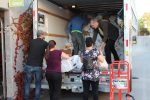
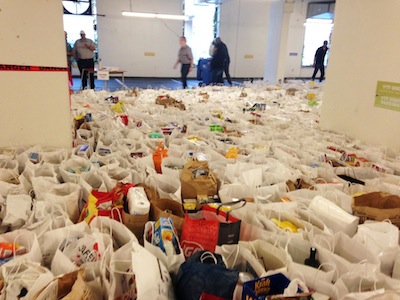
More than 80 volunteers came together to help Jewish Family Services sort the food on Sept. 26, organizing nearly 1,300 bags of food and toiletries. (photos from facebook.com/JFSVancouver)
During this year’s Project Isaiah food drive, the Metro Vancouver community donated four months’ worth of provisions for the Jewish Food Bank, which will feed and support the 300 households who turn to the Jewish Food Bank each month.
More than 80 volunteers came together to help Jewish Family Services sort the food on Sept. 26, helping unload, box and organize nearly 1,300 bags of food and toiletries. The collection is a huge effort and JFS could not have done it without all of its partners across the Jewish community, as well as the countless individuals who donated and volunteered, and Vancouver Talmud Torah and Congregation Beth Israel who offered the use of their facilities.
The number of those who rely on the Jewish Food Bank continues to rise. JFS’s services also include home delivery to seniors and people with disabilities, and the recently launched Jewish Food Link program extends the agency’s reach to serve people in the Tri-Cities and Richmond areas.
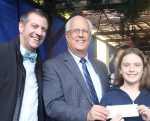
Left to right: The Bayit president Michael Sachs, Richmond Mayor Malcolm Brodie and Marc’s Mensches winner Taya Benson. (photo from the Bayit)
Marc’s Mensches winner Taya Benson fundraised more than $7,500 for the Richmond SPCA, where she also volunteers every week. She was awarded the cash prize on Sept. 26 at the Pizza in the Hut event for Sukkot, which was co-sponsored by the Jewish Federation of Greater Vancouver and Marc’s Mensches. The event brought out a diverse crowd of more than 200 people, including many local officials and civic election candidates.
While the Marc’s Mensches initiative continues, the program is in the process of switching objectives: instead of being a contest, it will be focused on working as a group to do acts of chesed (loving kindness) around the city and community. “People can still nominate [youth] for the monthly gift card draw,” Bayit president Michael Sachs told the Independent, “but the main focus in Year 2 is harnessing the power of these mensches and doing good all over.”
Millie Krause, who runs Elman’s, with receptionist Bonita Bouchard. (photo from Elman’s)
They started making horseradish 80 years ago and haven’t stopped. Elman’s Food Products is still making horseradish in small batches and, over the years, they have added new pickled products to the mix.
Today, Elman’s is run by Millie Krause, widow of the founder’s son, Manny Finkleman, who passed away in 2004. The company is gradually increasing its reach west from Winnipeg, led by Millie Krause’s daughter, Payton.
Six years ago, Payton Krause moved to Vancouver to be closer to friends and expand the family business, in which she first started working in the late 1980s. By then, the family had moved the company out of the garage and into its current-day location on Jarvis Avenue in Winnipeg’s North End.
“At that time, Payton, my daughter, was working here,” Millie Krause told the Independent. “And that was good, because she could keep an eye on things while I was running back and forth to hospitals, and taking Manny back and forth to this and that.”
In 2004, Manny Krause passed away. Since then, the brunt of the management has been in his wife’s hands.
“It was a really big learning curve for me, because my background was in sales. It took awhile,” she said. “Everybody wanted the same deals that Manny used to give and they didn’t really know who I was … but we survived.
“I always say that, if you don’t know something, find out. Just ask. If we look a little stupid or something down the road, who cares? Just get it done. That’s really the attitude we took it with. Now, what Manny said to me before he passed away … was that I should run it [Elman’s] for a couple of years, with Payton’s and everyone’s help … and then, sell it. So, 15 years later, I’m still here. The thing is, back then, when Manny was running the business, he ran it, if I might say, by the seat of his pants. He dealt with every problem that came up at the time, but he didn’t really remember what he did the next time, so it was like constant chaos.”
She and her daughter have tried “to reformulate the company and brand it – brand it into something that maybe wasn’t there at the time,” she said.
They position their products in the specialty food section, staying away from big retailers like Walmart and Giant Tiger. They sell the product by promoting the story behind it – making sure people know they’re a small, local family business with a long history in the city.
“I think we’ve succeeded in doing that,” said Krause, saying the process has “been a little slow.”
“Before Manny passed away,” she explained, “we were shipping from Winnipeg to Thunder Bay, and then west, but in very small ways. Then, Payton wanted to move out there, as apparently she needs mountains and water around her, and she wanted to open it up further. Actually, she’s done that.”
Expansion means winning over new clients, and that is exactly what her daughter is achieving in Vancouver.
“In fact, Payton had to pass a taste test,” said Krause. “Some of the wannabe customers she went to call on cut up 10 slices of pickles and said, ‘OK, now, which one is yours?’ And, I think she thought, ‘Sheesh! What if I get this wrong?’ But, she got it right.”
One breakthrough is that Elman’s pickles are included in all B.C. Ferries’ burgers. “They put the pickle on the top of the bun,” said Krause.
As another example, she said Elman’s are also used by Fairmont Hotels in Vancouver.
“The goal is to obviously get more business,” she said. “Up until this point, we didn’t have a lot of boots on the ground. We don’t have salespeople. The only ‘salespeople’ we have is Payton in the Vancouver area, but she has managed to do quite well. That is her goal – to get as much business as we can. It will hopefully get to a point that we can get enough business to be busy continually.”
Krause is hoping to get in with another large food service restaurant, which would allow Elman’s not only to be busier but to have the working capital to keep operations going. According to its website, the company currently has about 10 regular staff and casual employees.
Elman’s products carry a kosher certification from OU Kosher. For more information, visit elmans.ca.
ישראלים קונים, מוכרים ומוסרים בוונקובר והסביבה: מדובר בקבוצה סגורה בנושאי מכירה, קנייה ומסירה.
הישראלים שגרים בקנדה הקימו קבוצות באתר פייסבוק בערים שונות, בנוסף על קבוצות הישראלים בטורונטו ובוונקובר. בעיר השנייה בגדולה בקנדה – מונטריאול, פועלות מספר קבוצות של ישראלים. בהן: ישראלים במונטריאול – מדובר בקבוצה סגורה שמתמקדת בעסקים, שירותים, מודעות דרושים ואירועים המיועדים לקהילה בעיר. הקבוצה כוללת כשבע מאות חברים והיא נוסדה לפני כשנתיים. קרובים רחוקים במונטריאול – מדובר בקבוצה סגורה שמתמקדת במפגשים חברתיים לקדם את התרבות הישראלית והשפה העברית בקרב הישראלים, וכן לאפשר חיבור בין הישראלים שכבר חיים במונטריאול לישראלים שעוברים לגור בה. הקבוצה כוללת כחמש מאות וארבעים חברים והיא נוסדה לפני כארבע שנים. מועדון קוראות מונטריאול – מדובר בקבוצה סגורה שכוללת מפגשים פעם בחודש בנושא ספרים בכלל ומה שקורה בחיים בפרט. הקבוצה כוללת כשבעים חברים והיא נוסדה לפני כארבע שנים. אירועים בעברית במונטריאול – מדובר בקבוצה פתוחה שפועלת לרכז את כל האירועים בשפה העברית. הקבוצה כוללת כשישים חברים והיא נוסדה לפני כשלוש שנים. קבוצות קטנות נוספות במונטריאול: מונטריאול, לשאול, לטייל ולשתף ואין טראנזיט-קבוצת פרוייקט מונטריאול.
גם לישראלים באוטווה יש קבוצה: מדובר בקבוצה סגורה שכוללת כחמש מאות ושמונים חברים והיא נוסדה לפני כשש וחצי שנים. יש אף קבוצה קטנה לישראלים בוויניפג: מועדון אוהבי הספרים-ויניפג מניטובה. מדובר בקבוצה סגורה שכולל כשלושים חברים בלבד והיא נוסדה לפני כשלוש שנים.
במחוז אלבטרה יש שתי בקבוצות. ישראלים באדמונטון: מדובר בקבוצה פתוחה שמתמקדת בעסקים, שירותים, מודעות דרושים ואירועים המיועדים לקהילה בעיר. הקבוצה כוללת מאה ארבעים ושמונה חברים והיא נוסדה לפני קרוב לארבע שנים. ישראלים בקלגרי והסביבה: מדובר בקבוצה סגורה שנוסדה כדי להכיר אחד את השני, לעזור אחד לשני ולקרב לבבות. הקבוצה כוללת כארבע מאות וארבעים חברים והיא נוסדה לפני כחמש שנים.
להלן עוד מספר קבוצות קטנות בוונקובר: ישראלים קונים, מוכרים ומוסרים בוונקובר והסביבה: מדובר בקבוצה סגורה בנושאי מכירה, קנייה ומסירה. הקבוצה כוללת כשלוש מאות ושמונים חברים והיא נוסדה לפני כשנה. ישראלים שטוב להם בוונקובר: מדובר בקבוצה סגורה לניהול דיונים בנושאים שונים. הקבוצה כוללת כארבע מאות ועשרים חברים והיא נוסדה לפני כשלוש שנים. ישראלים מבשלים בוונקובר: מדובר בקבוצה סגורה שחברים בה כמאתיים ושישים חברים והיא נוסדה לפני כשנתיים וחצי.
להלן מספר קבוצות נוספות של ישראלים בקנדה. סטודנטים ישראלים בקנדה: מדובר בקבוצה סגורה שמיועדת לסטודנטים הלומדים בקנדה, או כאלה שרוצים ללמוד בה, וכל כל מי שמעוניין לקבל כל סוג של מידע על לימודים בקנדה. הקבוצה כוללת כשש מאות וארבעים חברים והיא נוסדה לפני כשנתיים. קנדה למטיילים: מדובר בקבוצה סגורה כדי לחלוק ולשתף מידע על ההכנות הדרושות לטייל בקנדה, טיפים והמלצות ממי שכבר טייל כאן וייעוץ למטייל. הקבוצה כוללת כאלף שמונה מאות וחמישים חברים והיא נוסדה לפני כשלוש שנים. ישראלים צעירים בקנדה: מדובר בקבוצה סגורה שמיועדת לצעירים שחיים או מבקרים בקנדה ומעוניינים להיות חלק מהקהילה כאן. הקבוצה כוללת כאלפיים חברים והיא נוסדה לפני קרוב לשנתיים. ישראלים בקנדה-ארה”ב: קבוצה סגורה למי שמחפשים עבודה, עובדים, עסקים נדל”ן, מידע על אירועים חברתיים, אטרקציות, בתי ספר וגנים, מלונות, מתכוני אוכל, בייביסטרים, בתי כנסת ועוד. הקבוצה כוללת כשלושת אלפים חברים והיא נוסדה בראשית השנה הנוכחית. קבוצות קטנות של ישראלים בקנדה: ישראלים גולשים בקנדה, חילופי בתים בין ישראלים בקנדה וארה”ב, ישראלים בקנדה מעבירים הלאה וישראלים בקנדה זה הכי טוב שיש.
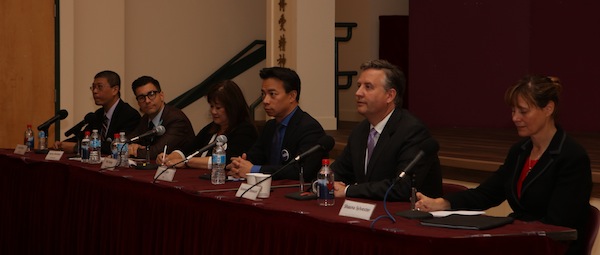
A full house came out to the CIJA-SUCCESS townhall Sept. 23, which featured six Vancouver mayoral candidates. (photo from CIJA)
The refracted nature of Vancouver’s civic politics was on full display at a candidates meeting featuring six of the perceived front-running candidates for mayor. The near-implosion of the governing Vision Vancouver party, combined with divisions among erstwhile Non-Partisan Association members, has led to a race with both the left and right sides of the political spectrum divided and struggling to gain traction in a campaign with 21 contenders.
The afternoon event Sept. 23 was co-sponsored by the Centre for Israel and Jewish Affairs and the multicultural organization SUCCESS, which is rooted in the Chinese-Canadian community. Veteran Vancouver broadcaster Jody Vance handily moderated the occasionally raucous meeting.
Housing affordability topped the list of issues, with Kennedy Stewart, a former NDP member of Parliament for Burnaby-South who resigned that seat to run for Vancouver mayor as an independent, said his plan to attack unaffordability calls for building 85,000 new homes over the next 10 years, including affordable and market rentals.
Ken Sim, an entrepreneur who founded Nurse Next Door and Rosemary Rocksalt Bagels and who is the candidate for the centre-right Non-Partisan Association (NPA), responded by claiming that the construction industry does not have the capacity to meet Stewart’s construction schedule.
Wai Young, a former Conservative member of Parliament for Vancouver South, is running with a new party, called Coalition Vancouver, which was originated by a group of former NPA members who felt betrayed by what they call a lack of democracy in that party.
“Vancouver does not have a supply issue,” Young said about the housing situation. “There are no millionaires wandering around Vancouver that are unable to buy a house or a luxury condo. The issue is that we are not able to keep our young people, our young families, here because they can’t afford to buy a house. We have an affordability issue in Vancouver.”
“If I am mayor, we will have a three percent vacancy rate,” said Shawna Sylvester, who is running as an independent but has roots in Vision Vancouver. The rate today is about zero. She supports more co-ops, cohousing and what she called “gentle densification,” as well as addressing how the housing situation has particular impacts for women, who experience poverty in greater proportions than men.
Left to right are David Chen, Hector Bremner, Wai Young, Ken Sim, Kennedy Stewart and Shauna Sylvester. (photo from CIJA)
Partly related to the affordability issue is the topic of Vancouver’s reputation as a place that is welcoming of people from diverse backgrounds.
David Chen, who is running with another new party, ProVancouver, noted that racism is alive and well in the city.
“My parents were first-generation Taiwanese [Canadian],” said Chen. “I was born in St. Paul’s [Hospital] because, at that time, it was the only hospital they were allowed to go to. During this campaign, I heard somebody say to me, ‘Go home.’ Well, I am home.” He added: “We haven’t progressed as much as we should or could.”
The NPA’s Sim echoed the experience and extrapolated it to the Jewish community.
“I’m 47 right now,” said Sim, “and I still remember the hurtful comments that I faced when I was 5 years old. It was tough. I think of what’s going on to our Jewish community right now. We still have a lot of issues. I’m acutely aware of what our Jewish community goes through because, when something happens halfway around the world, our friends in the Jewish community have to worry about their physical safety. That’s terrible. We will have zero tolerance for that, as mayor of Vancouver. We’re going to work with community groups, work with the Jewish community, work with all communities identifying threats to our communities and working on solutions to protect us, to protect our communities, and we will monitor our results.”
Hector Bremner, another former NPA member now leading another new party, YES Vancouver, is the only candidate for mayor currently sitting on Vancouver city council.
“Racism is a symptom, it’s not the disease,” Bremner said. “When do racial tensions flare up, when do they happen? They happen in a time when the people feel that resources are scarce and they feel pressure economically. It’s really a function of tribalism and nativism that occurs when people feel that it’s hard for them to make it. We look for scapegoats.”
Sylvester, who among many other roles is director of the Morris J. Wosk Centre for Dialogue at Simon Fraser University, said people need to stand up to extremist voices and actions.
“There are forces in our communities, whether we want to acknowledge them or not, that are trying to divide us,” she said. “What we need to do [is] not be tolerant of any kind of hate crime, not be tolerant of antisemitism.”
Stewart said those who don’t subscribe to Canadian ideas of tolerance should be helped to change their minds.
“Immigration is really one of the best things about being Canadian,” he said. “We travel around the world and we brag about it. Multiculturalism is a Canadian word and it’s something we’ve exported. It’s something we should embrace, and most of us do. Those that don’t, we have to help them understand, change their opinions.”
Accusations of intolerance and implications of racism emerged in the debate.
Young, who had originally sought the NPA mayoral nomination, implied that her supporters, many of whom were from the Chinese community, weren’t welcome in the NPA. This brought a sharp rebuke from Sim.
“Guess what, I’m Chinese,” he said. “Here’s the real issue. When you [say] inflammatory statements like that to win a political agenda, you create divisions in our communities. People don’t like that. You put a wedge. That is a problem and you’ve got to knock it off.”
Sim went on to accuse politicians of stoking already existing embers of intolerance around foreign purchasers of Vancouver real estate.
“For political expediency, what politicians are doing is pointing at groups and blaming groups for problems,” he said. “We have a lot of issues with affordability and there are a lot of things that affect affordability and housing. I’m not saying foreign purchases do not affect housing. But, when we point to it and we blame a group, that starts a slippery slope. That’s what’s dividing our city, our province and our country. I call on everyone here to knock it off, because there are a lot of things that affect affordability – permitting delays, interest rates, the economy – but to point to something for political expediency because it wins votes is dividing people and it’s hurtful.”
The meeting took place in a SUCCESS building in Chinatown, close to the Downtown Eastside. Candidates agreed that more needs to be done to confront the seemingly intractable challenges facing that area of the city.
Young said she had visited a seniors home in Chinatown earlier in the day and was told residents are afraid to go outside.
“They can no longer walk outside of their building,” she said. “That should not happen in our beautiful city. There was a time I remember coming down here to Chinatown when it was vibrant, when it was safe, when you didn’t feel like you couldn’t be on the wrong side of the street here.… This city has gotten dirtier and grittier…. There are needles everywhere, there is defecation everywhere. We are one of the top 10 cities in the world and yet, currently, it’s embarrassing to have your friends come visit.”
She promised to be “John Horgan’s worst enemy,” referring to the B.C. premier, in demanding provincial help to address the issues in the area.
Stewart touted his connections with former NDP member of Parliament Libby Davies, who previously represented the area in Ottawa.
“Last week, I was very proud to stand with Libby Davies in the Downtown Eastside and announce that, as mayor, I would immediately strike an emergency task force to deal with the opioid epidemic and homelessness,” Stewart said. “We cannot have the number of deaths that are happening and the number of overdoses. We can’t have the impacts on the people that are suffering through illness and addiction problems.”
Another perennial issue candidates addressed was transportation and congestion.
“Vancouverites spend 88 hours of your life every year sitting in congestion,” said Young. “That’s like a two-week holiday.”
Sim promised an independent review of congestion in the city.
“The number of cars has not increased in the city in the last 20 years but congestion has,” he said. He blamed a range of factors, including bike lanes, left-hand turns, people running yellow lights and getting stopped by police, pedestrians crossing after the indicator says “don’t walk,” and roads that are closed for construction longer than necessary.
Chen said getting people to switch from cars to transit requires improving the system.
“If you use negative reinforcement, you’re not going to get people to switch,” he said. “It’s not reliable, it’s not convenient, it’s not cheaper, it’s not faster. You [improve] those four items and suddenly people may just switch.”
The would-be mayors mooted the availability of culturally appropriate services, such as seniors care, community security for institutions like synagogues and the Jewish Community Centre of Greater Vancouver, and unisex washrooms.
During the debate, Stewart repeatedly emphasized that he, Bremner and Young were the only ones with elective experience, a tack that may be motivated by the few polls on the race, which have indicated that Stewart’s toughest opponent is Sim.
Election day for municipal governments across British Columbia is Saturday, Oct. 20. In Vancouver, advance voting opportunities are available until Oct. 17, from 8 a.m. to 8 p.m. (photo by Cynthia Ramsay)
Members of British Columbia’s Jewish community have been involved in many pursuits over the decades. With some notable exceptions, few have pursued elective office. And this election continues the tradition. Of the hundreds of people running for city councils, school boards, regional district boards and the Vancouver park board, the Independent has identified only four members of the community running in the Oct. 20 elections, though there may be others. Here is a glance at their platforms and motivations.
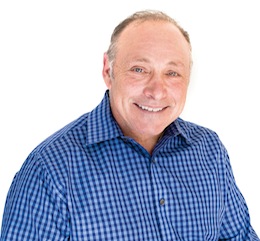
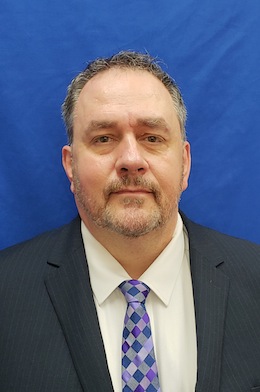
Herschel Miedzygorski Independent candidate for Vancouver city council voteherschel.ca
Herschel Miedzygorski
Herschel Miedzygorski’s priorities include clean and safe streets, increased night transit and more funding for the arts. He wants to deter real estate speculation and speed up permitting processes for middle-class homes.
Miedzygorski has had a career as a restaurateur in Vancouver and Whistler, running Southside Deli in the resort municipality for 25 years and being involved in food ventures in the city. He has sold his food interests and now represents Giant Head Estate Winery, based in Summerland, B.C., to restaurant clients.
“I was born and raised in Vancouver,” he said. “My father had a secondhand store on Main Street for 60 years, it was called Abe’s Second Hand. That was my mom and dad.… We all grew up on Main Street.”
Miedzygorski has coached football and soccer and spends time at the Jewish Community Centre of Greater Vancouver. He was asked to run with a couple of the city’s political parties, he said, but “I just want to be an independent voice.”
Ken Charko Coalition Vancouver candidate for Vancouver city council coalitionvancouver.ca
Ken Charko
Ken Charko owns Dunbar Theatre. He is president of the Hillcrest Community Centre and a director of the Motion Picture Association. He considers himself a “champion of the arts.”
“I’m very supportive of the arts,” he said. Charko wants to make arts and culture more accessible to all.
He also seeks a line-by-line review of the city’s budget and wants fair bylaws for hardworking people and small businesses.
“I’ve got good business credentials,” Charko said. “I understand small business. I’ve been there. But I’m really going to try to focus on the arts and things that matter to the arts community.”
He is running with Coalition Vancouver after breaking with the NPA because they appointed, rather than electing, their nominees.
“There is no party that completely represents all my views,” he said. But Coalition Vancouver aligns with his approach to fiscal accountability and socially progressive outlook, he said.
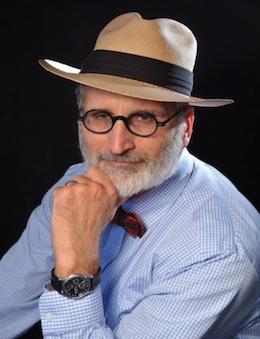
Steven Nemetz Independent candidate for Vancouver park board stevennemetz.com
Steven Nemetz
Steven Nemetz is running for Vancouver park board because the time is right.
“It speaks to me at this stage of my life – father, grandfather – and I grew up in the city,” he said. “I grew up intimately familiar – because my father was a great outdoorsman – with these parks.”
Nemetz is a lawyer and holds a master’s in business administration and a rabbinic ordination. He created the “pop-up shul” Shtiebl on the Drive for the High Holy Days this year.
Having lived in various cities, notably New York, Nemetz wants to bring to Vancouver some ideas that have worked in other places. Inspired by the High Line, a park created from an old elevated railway in Manhattan, Nemetz suggests saving the Georgia and Dunsmuir viaducts (which are slated for demolition) and creating an elevated park in the space between them and extending that park east and west. A second High Line-style recreation space could work along the Broadway corridor, he said, incorporating transit hubs, Vancouver General Hospital and other existing assets.
He advocates a “privileges card” for city residents that would mean they pay no parking fees at any parks.
“There are 650,000 residents of the city of Vancouver,” he said. “There are over 10 million visitors a year.” A slight price increase for non-residents could offset the loss of revenue from locals, he said. “The residents of the city of Vancouver pay taxes. They support their infrastructure. They shouldn’t have to pay more for the use of facilities that they primarily support by way of small nickel-and-diming, like parking at Kitsilano Beach and Jericho.”
Nemetz looks at Mountain View Cemetery, 106 acres at the heart of the city, and sees potential for repurposing it to respectfully accommodate more living residents.
“We are not talking amusement park,” he said. “It could be something very unique, world-class in a way, that’s different.”
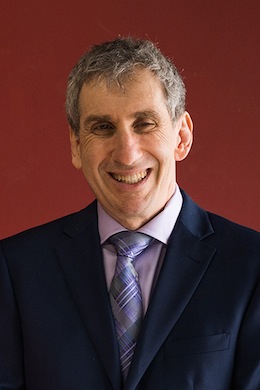
Norman Goldstein Richmond First candidate for Richmond school board richmondfirst.ca
Norman Goldstein
Norman Goldstein is a former Richmond school trustee seeking to return to the board.
“The best thing for all people, including the Jewish people, is an open, accountable government that adheres to the rule of law,” he told the Independent. “The laws need to be crafted by caring, competent people, who understand that the strength of a society rests on how fairly and inclusively all citizens are treated. This is what I believe and this shapes who I associate with and trust politically.”
His priorities for education include moving forward with the Sexual Orientation and Gender Identity (SOGI) policy passed by the Richmond school board.
“This has been, unfortunately, a very polarizing issue in Richmond,” he said. “To my understanding, the opposition to SOGI is based either on misunderstanding what the policy says – please, read the policy – or on deep-seated prejudice that is not self-recognized as such.”
Goldstein holds a doctorate in mathematics and taught and researched at the university level. He later completed a master’s of computer science and spent 21 years at MacDonald Dettwiler and Associates in Richmond, retiring in 2013.
“The Richmond School District has had a long, proud history of inclusion,” he said. “A major tool in this endeavour has been to integrate all learning levels into the same classroom. This socializes students to understand and appreciate each other.”
Election day for municipal governments across British Columbia is Saturday, Oct. 20. In Vancouver, advance voting opportunities are available until Oct. 17, from 8 a.m. to 8 p.m. Advance voting dates and times differ by jurisdiction. More details are at vancouver.ca/vote or on the website for your municipality.
Jeffrey Cohan of Jewish Veg speaks at a few local venues next week. (photo from Or Shalom)
There is no disputing the notion that God intended for us to eat a vegetarian diet, though eating meat out of necessity is permitted, according to Jeffrey Cohan, executive director of Jewish Veg, who will be in Vancouver next week for three presentations on animals and ethics.
Cohan’s father passed away at the age of 52 from a heart attack, when Cohan was 12 years old. “That’s always been in the back of my mind – what I can do to avoid the same fate,” Cohan told the Independent. “But, for the first 40 years of my life, I was a passionate meat eater and, although I was in good shape, I knew I needed a dietary change, as my cholesterol was up to 100 and I was approaching the age where my dad experienced heart disease.”
Cohan recalled a Simchat Torah when he was in his early 40s. The Torah reader came to a verse wherein God says to eat only plants and, for the first time, the possibility of being a vegetarian resonated with Cohan, and he and his wife immediately changed their diet. That was about 11 years ago.
“Then, I started researching intensively what the rest of the Torah and other Jewish texts said about this issue,” said Cohan. “I found out about an organization called Jewish Vegetarians of North America (JVNA). I was very excited. It was getting word out that this is what the Torah and our tradition actually says. At the time, I was working at the Jewish Federation of Greater Pittsburgh.”
Looking further into JVNA, Cohan learned, to his dismay, that it was run by only two volunteers, had an outdated website and no real relationships with the institutional Jewish community. This spurred him to go to New York to meet with these volunteers and a few others who were involved. He gave a presentation about what they could do to build up the organization. They asked him to become JVNA’s executive director – and Cohan said yes.
Since then, JVNA, which is now called Jewish Veg, has gone on to form relationships with some of the biggest Jewish organizations, said Cohan, including “those that deal with the demographic group most receptive to our message – young adults – partnering with Hillel.
“We created the first-ever vegan Birthright trips,” he added. “It’s been very gratifying. We are heading to Vancouver next, which is pretty exciting, being the first time we’ll give presentations in Canada…. Judaism, even when we were living in ghettos in Europe, does not exist in isolation. It is affected by external society to a great extent. Especially in America and especially in the 20th and 21st centuries in America and Canada, it’s been a two-way relationship.
“If you look at every social justice movement that has achieved success in the U.S. in the last 120 years – women’s rights, organized labour, the civil right movement, the LBGTQ movement – every one of these movements has had Jews involved in the leadership,” he said. “And this movement cannot be the exception. It goes back to the very raison d’être (reason for being) in Judaism, which is that we weren’t just given the Seven Laws [of Noah]. We were given a much higher bar to live up to. And, therefore, it is incumbent on the Jewish community, on this movement, to be at the forefront as we have been in other social justice movements. That’s exactly why Jewish Veg’s work is so important, because we’re mobilizing the Jewish community.”
According to Cohan, the work Jewish Veg is doing is inspiring the Christian community to follow suit. As an example, he said he was told by a longtime member of the Unity Church that they are creating a movement within their faith called Unity Veg.
Israel has become one of the most the most vegan-friendly countries in the world, said Cohan. “We actually … point towards Israel as an example for Canadian and American Jews to follow,” he said. “Jews speak on college campuses here [in the United States] about what’s going on in Israel and why they should be following its lead.”
While Cohan’s trip to Vancouver is the first for Jewish Veg in Canada, he is planning to soon speak in Toronto, Montreal, Winnipeg, Calgary and Edmonton.
Cohan hopes all people will become vegetarian one day, but his current aim is to meet people where they are. “We have something called our Veg Pledge program, which you can see on our website, which helps people transition to plant-based diets,” he said. “We don’t just come in, love them and leave them. We give them an opportunity to use our free resources to transition to plant-based diets at the pace that works for them.
“The way it’s structured,” he explained, “is that you start with a pledge, which can either be sticking your toe in the water or diving in head first, based on your comfort level. We really believe that helping people with the how is just as important as the why.”
During his visit here, Cohan will make three presentations: one hosted by the Vancouver Humane Society on Oct. 16, 7 p.m., in the Alma Vandusen and Peter Kaye rooms at Library Square Conference Centre; one at Or Shalom Synagogue on Oct. 18, 7:30 p.m.; and one at the University of British Columbia on Oct. 19, 1:30 p.m., hosted by Hillel BC at a Schmooze & Schmear gathering.
“I think a question you’ll hear many Jewish people ask is, ‘How does the Torah apply to our modern lives?’” said Shelley Stein-Wotten, program coordinator at Or Shalom. “We found it fascinating that Jeffrey’s own path to going vegan stemmed from his study of Torah and we wanted to provide an opportunity for him to share his story and create a space to have an open dialogue around if, as individuals and as a community, we can establish a Jewish framework to address climate change and make healthful food choices, which have inherent connections.”
Left to right are Ann Montague, Dr. Blye Frank, Marta Santos Pais, Jerry Nussbaum, Lillian Boraks-Nemetz and Marny Point. (photo by Tiffany Cooper)
On Sept. 13, at the Dean’s Distinguished Lecture held by the University of British Columbia faculty of education in partnership with the Janusz Korczak Association of Canada (JKAC), the audience listened to the words of a saint.
It is an apt description of Marta Santos Pais, whose middle name does indeed mean saint, in Portuguese. Santos Pais is the United Nations special representative of the secretary-general on violence against children. She has worked for decades with remarkable optimism, resilience, focus and patience to try and create a world where no child will suffer violence. At the least, it’s a saintly endeavour.
Santos Pais, who has a law degree from the University of Lisbon, was appointed to her current position in 2009, after a distinguished career working in several capacities in Europe for the rights of children, including being involved in the drafting of many high-level resolutions and policies. As a global independent advocate, Santos Pais would like to see the elimination of all forms of violence against children: in the justice setting, in the home, in institutional care, in schools, in the workplace and in the community.
The co-sponsor of the lecture, JKAC, was established in 2002 and is dedicated to the remembrance of Janusz Korczak and the dissemination of his ideas about the protection and education of children. Korczak was a Polish Jew who was killed by the Nazis along with the orphaned children under his care in the Warsaw Ghetto. Despite being given the opportunity to escape, Korzcak instead chose to stay with the children and accompany them to Treblinka, where they were all murdered.
Marny Point, a coordinator and instructor in NITEP, the Indigenous Teacher Education Program at UBC, and a representative of the Hul’q’umi’num Salish peoples, spoke in her language as well as in English to open the event. Holocaust survivor, author and JKAC board member Lillian Boraks-Nemetz then spoke briefly, reading from Korczak’s ghetto diary and highlighting the need for those who care for children to first attain self-knowledge.
“How can we aspire to become the kind of teacher and human being Korczak was?” asked Boraks-Nemetz, underlining his claim that it was through knowing ourselves that we may begin. Evoking Korczak’s warning that children are too often overlooked amid the storms that blow through the adult world, Boraks-Nemetz quoted him to that effect: “It is the children who always have to carry the burden of history’s atrocities.”
Dr. Anton Grunfeld presented a graduate scholarship to Ann Montague, a researcher in child education. She was awarded the scholarship on the basis of an ethnographic study of children’s education she conducted in Bali with an eye towards “mobilizing children as agents of care for the environment.”
While Dr. Blye Frank, dean of the faculty of education, introduced Santos Pais, Dr. Mary Ellen Turpel-Lafond, an Allard School of Law professor who works at the Indian Residential School History and Dialogue Centre – and who served as British Columbia’s first representative for children and youth from 2006 to 2016 – spoke a bit about Santos Pais first. She highlighted Santos Pais’s influence on the Truth and Reconciliation Commission of Canada’s 94 calls to action for the federal government, especially the sixth, which advises the abolition of Section 43 of Canada’s Criminal Code allowing the corporal punishment of children. Several of the evening’s speakers noted the importance of convincing the Canadian government to repeal Section 43 and join other countries that have outlawed all physical violence against children. Turpel-Lafond noted with particular gratitude the work of JKAC president Jerry Nussbaum in this regard.
Santos Pais began by acknowledging Korczak’s legacy, citing its role in inspiring the provisions of the UN Convention on the Rights of the Child (CRC). She drew a connection between the achievement of sustainable development and putting children first – starting with investing in the early years and creating a safe, loving environment for all children.
Progress has been made in the areas of “data, legislation, policy and program developments,” but the daily reality of millions of children, particularly the most vulnerable and marginalized, cries out to be addressed with more effectiveness, she said.
Santos Pais spoke of the goal to “leave no children behind anywhere and at no time – but, of course, the world is not yet there.” She noted that 2019 marks the 30th anniversary of the CRC, giving us an occasion to recommit to addressing the one billion children still affected by violence each year.
Santos Pais spoke of the UN’s efforts both to listen to children around the world about their experience of violence, and to comprehensively study the wider social and economic costs of violence towards them. According to Santos Pais, presenting such evidence can be an important piece in motivating governments to see preventing violence towards children not as an expense but as a benefit to their country as a whole. Still, she said, many governments have told her that the goal of completely eliminating violence towards children in the near future is too idealistic, that it is “a joke.” To the contrary, she stressed, “We tend to believe that this goal can be accomplished and that there are many practical steps that we can take towards it.”
After Santos Pais’s speech, Nussbaum and Frank presented her with a Janusz Korczak statuette in honour of her service to children. “Thank you so much,” she said. “I’m going to cry now in my seat.”
Matthew Gindin is a freelance journalist, writer and lecturer. He is Pacific correspondent for the CJN, writes regularly for the Forward, Tricycle and the Wisdom Daily, and has been published in Sojourners, Religion Dispatches and elsewhere. He can be found on Medium and Twitter.
סוף למשבר העמוק ביחסי ארצות הברית וקנדה בעידן טראמפ: שתי המדינות הגיעו סוף סוף להסכם סחר חדש. בפועל קנדה תצטרף להסכם הסחר שהושג כבר בין ארה”ב למקסיקו בסוף חדש אוגוסט. הסכם הסחר המשולש בין המדינות של צפון אמריקה שיחליף את הסכם נפט”א (נחתם באלף תשע מאות תשעים וארבע), יקרא יו.אס.אם.סי.איי (ארה”ב, מקסיקו וקנדה). הוא אמור להיחתם בין הצדדים בסוף נובמבר בטקס חגיגי, לאחר שיקבל את אישורי בתי המחוקקים של שלוש המדינת.
קנדה יש לזכור היא שותפת הסחר השניה בגודלה של ארה”ב לאחר סין. ועל כן להסכם החדש יש משמעות כלכלית גדולה מאוד לשתי המדינות השכנות, וכמובן גם למקסיקו. ההסכם החדש דן בתחומים רבים. ובהם: יבוא מכוניות, יבוא מוצרי חקלאות, יבוא חלב, יבוא תרופות, סוגיות של קניין רוחני, סוגיות של סחר דיגיטלי והמנגנון לפתרון סכסוכים בין המדינות. תוקפו של ההסכם שש עשרה שנים, ושלוש השותפות יבדקו אם יש מקום להכנסת שינויים בו רק בתום שש השנים הראשונות.
מיד עם היכנסו לבית הלבן לפני קרוב לשנתיים הודיע הנשיא האמריקני, דונלד טראמפ, כי הסכם נפט”א הוא הסכם גרוע מאוד לארה”ב ויש להחליפו. טראמפ החל במסע איומים קשים נגד קנדה ומקסיקו. זאת כדי לאלצן לחתום על הסכם סחר חדש. טראמפ הפנה את זעמו בעיקר לכיוון קנדה ומסע ההשמצות וההשפלות כנגדה הגיע לשיאו, עת הנשיא האמריקני סירב ללחוץ את ידו של רה”מ קנדה, ג’סטין טרודו, באו”ם בסוף חודש ספטמבר. טראמפ הגדיל לעשות והצהיר כי “אנחנו לא ממש אוהבים את הנציגים שלהם”. הנשיא האמריקאי התכוון בוודאי לשרת החוץ הקנדית, כריסטיה פרילנד, שעשתה רבות להשגת ההסכם המדובר. לטראמפ יתכן והפריע שפרילנד הוכיחה שהיא עומדת על שלה ופועלת בנחרצות לטובת האינטרסים הקנדיים – ועוד מדובר באישה! בשל התנהגותו הבוטה של טראמפ מערכת היחסים בין שתי המדינות שנחשבו לקרובות בעולם, הידרדרה לרמה שלא זכורה מעולם.
נציגי ארה”ב, קנדה ומקסיקו פתחו במגעים מואצים וארוכים להגיע להסכם החדש. לאחר שלושה עשר חודשים תמימים של משא ומתן הושג ההסכם הראשון בין ארה”ב ומקסיקו, בסוף החודש באוגוסט. ואילו ביום ראשון לפני כעשרה ימים (ה-1 באוקטובר), הושג ההסכם השני בין ארה”ב וקנדה. כל הצדדים נאלצו לוותר על חלק מהדרישות והתנאים המוקדמים להשגת הסכם סחר חדש של מדינות צפון אמריקה. נושא טעון אחד נשאר מחוץ להסכם ועל קנדה וארה”ב מוטל להמשיך ולדון בסוגיה, עד להשגת פתרון מוסכם. מדובר במכסי המגן שהאמריקנים מטילים על ייצוא של פלדה ואלומיניום מקנדה. מכל מקום מחלוקת זו לא תמנע את החתימה המשולשת על ההסכם החדש.
האופוזיצה בקנדה מיהרה לתקוף את ממשלת טרודו על כביכול הוויתורים הגדולים שעשתה לאמריקנים, כדי להגיע להסכם. לעומת זאת בנק אוף אמריקה מציין כי קנדה עשתה וויתורים סמליים בלבד. לפי אנליסטים של הבנק חלק מסעיפי ההסכם הם סמליים בעיקרם. ההסכם כולל הפחתה קטנה בפרוטקציוניזם לרפתנים מקנדה. עתה ליצרני החלב האמריקאים תהיה גישה ל-3.59 אחוזים משוק החלב הקנדי לעומת 3.25 אחוזים שהיו נהוגים עד כה. השינוי הנ”ל יגדיל את ייצוא החלב האמריקני לקנדה בכ-70 מיליון דולר בלבד.
עם השגת ההסכם אמר טראמפ על טרודו: “הבעייה היחידה של ג’סטין היא שהוא אוהב את העם שלו, הוא נלחם קשה למען עמו. תמיד היו לנו יחסים טובים והם קצת הידרדרו בחודשיים האחרונים”.
Members of the Tikun Olam Gogos show off some of the paddles being auctioned, until Oct. 10. (photo by Paula Simson)
Last fall, Sue Hyde, dragon boat master and member of Tikun Olam Gogos (which loosely translates as Grandmothers Repairing the World), walked into a board meeting with a hand-painted paddle she had decorated herself. Her idea was to sell paddles like it to raise money for the Stephen Lewis Foundation’s Grandmothers to Grandmothers Campaign, which supports grandmothers in Africa who are raising children orphaned by AIDS.
Tikun Olam Gogos is a Jewish charitable organization, sponsored by the Sisterhood of Temple Sholom, and it is dedicated to fundraising for Grandmothers to Grandmothers. The board was in favour of Hyde’s idea – and one of the board members bought the paddle on the spot. Paddles for African Grandmothers was born.
Hyde had access to more than 30 vintage paddles and the Tikun Olam Gogos asked various artists to paint them. The resulting paddles are being auctioned off until Oct. 10 at tikunolamgogos.org/on-line-auction.
“The paddles were done by a selection of different artists, including one stand-up paddle done by a Syrian refugee,” Tikun Olam Gogos member Sunny Rothschild told the Independent. “The rest are meant to hang on the wall. The paddles are amazing, intricately carved as well as painted. Some are two-sided and some aren’t.”
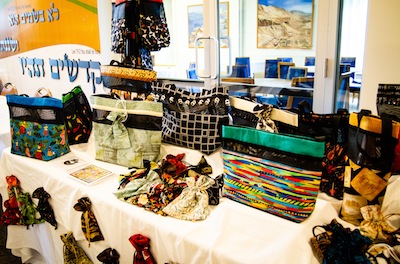
Tikun Olam Gogos makes bags and other items to raise funds, which will be for sale at the group’s Many Rivers to Cross event Oct. 13. (photo by Paula Simson)
The fundraiser will culminate with an evening concert on Saturday, Oct. 13, featuring the City Soul Choir and a meet-and-greet with the artists. Winning bidders can pick up their paddles then.
Marie Henry, the founder of Tikun Olam Gogos, also spoke with the Independent. The Tikun Olam Gogos are part of the Greater Vancouver Gogos, which includes more than 25 groups.
“I was visiting in-laws in Kelowna, and I went to a public market and saw a stall where women were selling beautiful tote bags. I found out they were supporting the Stephen Lewis Foundation,” she explained. “I came back and joined the group in Vancouver, but the only problem was I was the only Jew in the group and events kept conflicting with the Jewish calendar. ‘This is crazy,’ I thought, ‘I’m going to form my own group.’”
Henry did just that, in 2011. Today, the group, which is named after the Jewish concept of repairing the world (tikkun olam) and the Zulu word for grandmother (gogo) has Jewish and non-Jewish members. Henry said that only some of the members are actual grandmothers, with the rest being “grand others.”
There are a few hundred Grandmothers to Grandmothers groups across Canada, as well as organizations in the United Kingdom, Australia and the United States. Tikun Olam Gogos has sold more than 2,000 tote bags, with all profits going to the Stephen Lewis Foundation. That’s some $200,000 in donations from tote bags, said Rothschild.
“The admin costs are 11% of all the monies raised, one of the lowest rates of all charities in Canada,” Henry added.
While Henry takes care of notes and minutes and other administrative details for the group, she said, “We have a lot of really talented women in the group, like Sunny, who takes responsibility for part of the group and helps run it.”
Rothschild joined Tikun Olam Gogos almost four years ago, when she was slowing down her career as a lawyer and had more time for volunteer work. She is active in sewing the group’s signature tote bags, as well as taking turns selling them at local craft fairs, where the Gogos get a chance to tell people about their work and the Stephen Lewis Foundation. “That’s the best part,” she said.
“I have a Post-it up in my house – ‘May my life be for a blessing,’” said Rothschild. “This is one of the things that I do because I want my life to be meaningful and to have mattered.”
“The reason that I started this group when I found out what they are doing,” said Henry, “is to help these grandmothers raise up to 15 grandchildren. My grandchildren live a life of privilege and I feel so horribly guilty that these women in their senior years have to suffer so horribly badly. Doing this, I feel useful. In the final analysis, we are performing tikkun olam.”
“I don’t think that the governments in Sub-Saharan Africa understand the revolution that is going to take place because of these women becoming empowered,” said Rothschild. “There are amazing stories of what women are doing, standing up for their rights. It’s really quite amazing what’s happening.”
“The support that we give them helps them to do that,” added Henry. “I see this as the same to the way that suffragettes in North America stood up for their rights, and here it’s happening in a similar way nearly a hundred years later.”
For now, Henry and Rothschild are hoping the community will come out to support Paddles for African Grandmothers at the Many Rivers to Cross concert.
“We’ll be selling tote bags,” said Rothschild. “People can buy a glass of wine, there will be food too – it will be a lovely event.”
Tickets for the Oct. 13, 7 p.m., show at Temple Sholom can be purchased via tikunolamgogos.org/events.
Matthew Gindin is a freelance journalist, writer and lecturer. He is Pacific correspondent for the CJN, writes regularly for the Forward, Tricycle and the Wisdom Daily, and has been published in Sojourners, Religion Dispatches and elsewhere. He can be found on Medium and Twitter.

 More than 80 volunteers came together to help Jewish Family Services sort the food on Sept. 26, helping unload, box and organize nearly 1,300 bags of food and toiletries. The collection is a huge effort and JFS could not have done it without all of its partners across the Jewish community, as well as the countless individuals who donated and volunteered, and Vancouver Talmud Torah and Congregation Beth Israel who offered the use of their facilities.