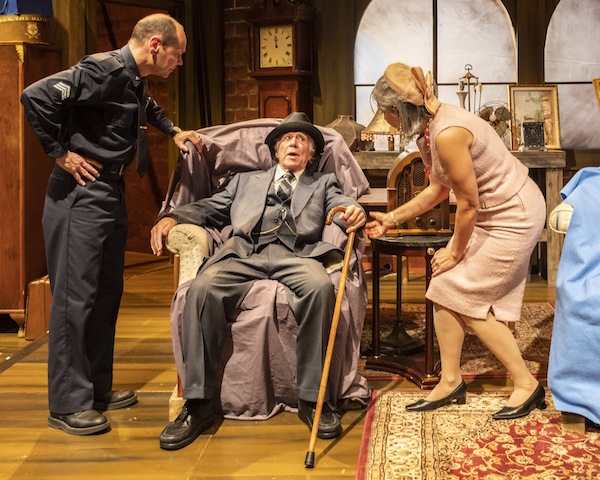
Stills from the NFB’s Highway to Heaven: A Mosaic in One Mile. Richmond Jewish Day School is one of the institutions featured in the short film, which screens at this year’s Vancouver International Film Festival.
The National Film Board short Highway to Heaven: A Mosaic in One Mile, written and directed by Sandra Ignagni, is visually striking. For the most part, it lets the images do the talking, communicating more about cultural diversity than words could.
Part of this year’s Vancouver International Film Festival, Highway to Heaven introduces viewers to the multiple faith groups and institutions along a mile-long section of No. 5 Road in Richmond, which includes Richmond Jewish Day School. In the 17-minute documentary, this strip of road – which has been called “Highway to Heaven” – appears both full of colour and action, as well as remote and removed, not just geographically but with chain link fencing and other security measures.
“We share a world grappling with ethnic and racial tensions, religious xenophobia and violence,” writes Ignagni in her director’s notes. “Such realities are not limited to the world’s conflict zones – they are a part of everyday life, even in the most advanced democracies such as Canada. It was in this context that I was drawn to the peculiar landscape of No. 5 Road … where multiple cultural and religious groups share a short stretch of suburban road. I was curious about how groups pitted against each other in so many corners of the world appeared to be living relatively peacefully with one another, and in very close proximity, in an ordinary Canadian suburb.”
In showing the beauty of the area – both in landscape and in cultural acceptance – Ignagni also captures some of the tensions that exist. The camera jumps from a lush orchard to a mansion mid-construction to a for-sale sign in front of what seems to be part of a forest. In one scene, which looks like it was filmed at RJDS, police in full gear – bulletproof vest and holstered weapons – address RJDS and Az-Zahraa Islamic Academy students, introducing themselves so that the kids should feel comfortable going to the police if they have a problem. The police then referee the kids in a game of ball hockey – boys against the boys, girls against the girls – throwing in questions about boundaries and other issues for the kids to consider.
Referring to the police presence on the road, Ignagni writes that it could “be variously interpreted as bridge-building, protection or surveillance. I learned that, for more than one decade, the Richmond Jewish Day School did not have an exterior sign for fear of antisemitic attacks against its schoolchildren. And, in recent years, the secular residential community that surrounds No. 5 Road launched a major campaign opposing the proposed expansion of a Pure Land Buddhist temple, using the pejorative moniker ‘Buddha Disneyland’ to describe the proposed building in local media and public debates. The mere fact that zoning by-laws have ordered these communities – the majority of which play a critical role in new immigrant and refugee resettlement – to the fringe of suburban land is also ripe for reflection.”
The minimal use of narration or interviews in the film was a deliberate choice. To do otherwise, Ignagni notes, “would be an exercise in public relations, reducing complex issues to soundbites and polemics. Instead, I wanted to make a film that would at once capture the remarkable – because it is truly remarkable – diversity on No. 5 Road, as it actually exists, while gesturing to some of the unresolved issues that underlie Canadian multiculturalism. The film is, therefore, constructed as a ‘mosaic’ – defined by writer and activist Terry Williams as ‘a conversation between what is broken.’”
While she doesn’t rely on words to tell this story, sound plays an integral role in the film: calls to prayer, monks chanting, different languages being spoken (and not translated), kids playing, school bells ringing.
“My film invites audiences to sit with what is unknown, different, raw or only partially visible,” says Ignagni. “To me, a mosaic captures perfectly the subtle tensions one finds on No. 5 Road, where custom and ritual, language and cultural diversity are practised under surveillance cameras and behind locked doors and gates. In making this film, I am asking audiences to look with open eyes and hearts – with a spirit of curiosity – at themselves and their neighbours, and simply reflect on multiculturalism as an unfinished project in need of attention in Canada and around the world.”
In addition to RJDS and Az-Zahraa, the list of participating neighbours includes the Evangelical Formosan Church of Greater Vancouver, India Cultural Centre of Canada/Gurdwara Nanak Niwas, Kingswood Pub, Lingyen Mountain Temple, Mylora Executive Golf Course, Royal Canadian Mounted Police (Richmond detachment), Thrangu Tibetan Buddhist Monastery, Trinity Pacific Church, and Vedic Centre.
At VIFF, Ignagni will participate in one of a series of panel discussions presented by Storyhive on Totally Indie Day, Sept. 28, at Vancity Theatre. She will be on the hour-long panel called Not Short on Talent: The Rise of the Short Form Documentary, which starts at 3:45 p.m. For the full film festival lineup, including, eventually, the not-yet-listed screening time of Highway to Heaven – which was an Official Selection at this year’s Toronto International Film Festival – visit viff.org.
One of the most important issues we should be grappling with nowadays is the preservation of our habitat. At the forefront of the nature preservation movement are photographers and one of them is Liron Gertsman, a young, award-winning local nature photographer whose solo show, Essence of Earth, is at the Zack Gallery until Sept. 22.
The show is sponsored by Esther Chetner.
“Eldad Goldfarb, executive director of the Jewish Community Centre of Greater Vancouver, approached me about this upcoming sponsorship opportunity, aware of my own concern about climate change and my passion for photography,” Chetner told the Independent. “Though I’ve traipsed parts of the globe enjoying the wonders that photo details can deliver, I’m not at all technically trained nor technologically nimble…. I recognize the remarkable quality of Liron’s images, and see value in making his work accessible to others.”
Calling Gertsman a “rising star,” Chetner said, “Encouraging this type of exquisite work is another way to help people appreciate our natural world more deeply and then, hopefully, to work toward preserving such essential global health and diversity. The more we see and appreciate about our natural environment, the more we will all be inclined to proactively protect it.
“Jewish values are quite aligned with environmental stewardship, and so having Liron’s work displayed at the JCC seems like an appropriate fit.”
Part of the proceeds of the exhibit will benefit the gallery, and another part will go to the Nature Trust of British Columbia.
“There are several charities concerned with nature preservation in B.C.,” Gertsman said, “but I like the Nature Trust because they purchase land specifically to build and maintain a treasury of wild areas.”
Liron Gertsman has loved nature and photography all his life. (photo by Ian Harland)
“I’ve loved nature and taking photographs all my life,” he told the Independent. “Recently, I started moving toward doing it professionally, like giving photography workshops or guiding people on their bird-watching expeditions.”
His photographs are like a guided tour. “I want people to witness nature,” he said. “I want to share with them what I see, even if they can’t travel themselves.”
To cover some of his costs, he has, at times, formed partnerships with companies and organizations.
“I choose companies focused on nature conservation,” he explained. “They would subsidize some aspects of my trip, or sometimes an entire trip, in exchange for photo use and social media marketing, usually through my Instagram account, which has close to 50,000 followers.”
For instance, in May and August of this year, Gertsman partnered with Ocean Outfitters, an ecotourism company based in Tofino.
“They are Tofino’s first carbon-neutral ecotourism company, and they have committed to donating $200,000 a year for multiple years towards restoration of the Tranquil Watershed,” he said.
Gertsman’s photos at the Zack Gallery are full of life and colour. His birds seem to soar through the gallery space. His landscapes are like windows, looking out into the British Columbia wilderness. Stars twinkle in the night sky. Pink crags reflect in the still surface of the lake. Waterfall gurgles across the boulders. Owls hide in the grass, and gulls skim over the rippling wavelets. But the beauty and serenity of his images filled me with apprehension. Could we lose all of this gorgeousness? The night after I visited his show, I had a dream, and Gertsman’s imagery figured heavily in my dreamscape.
* * *
“What is it, Grandpa?” a girl asked.
“A picture archive,” the old man replied.
“But it’s not a memory crystal.”
“No, it’s from the 21st century, an antique. Two hundred years old,” he said, inserting an outmoded device into a slot of his com-link and opening the files. Hundreds of pictures appeared on his screen. Nature, when it flourished.
“Oh,” his granddaughter said with interest. “What are those?”
“Birds,” he whispered reverently. In the image, hundreds of small dark bodies hurtle across the peachy sky, their wings pumping so rapidly, the image blurred.
“Like a hologram in a museum?”
“Yes. Only they were alive. Flying.”
“But why is the wall pink? Why would they paint it pink?”
“Sandpiper Sunset,” photo by Liron Gertsman.
The old man glanced at the wall of the cave that housed the archives. Nobody lived on the surface of the earth anymore. Nobody could survive the toxic environment. People inhabited underground caverns such as this one and, mostly, they didn’t bother painting the walls. There were few resources anymore.
“It’s not a wall, it’s the sky,” he said. He had been very young when the last of humanity had moved underground, but he still remembered the sky. Scientists said that, in a few more generations, they could live outside again, but he wasn’t sure his granddaughter would last that long. He certainly wouldn’t.
“Our teacher said the sky should be blue,” the girl insisted.
“The sky could be any colour. This is probably sunset.”
“What is sunset?” She had never seen the sun.
He sighed, but, before he could explain, her gaze had skipped to another image.
“It looks like a fountain,” she marveled, “but what are these green blobs?”
The old man winced. “Trees. Bushes. It’s not a fountain. It’s a waterfall.”
Her finger zeroed in on another image. “I know,” she said triumphantly. “These are dogs. Strange dogs, though.”
“These are not dogs. These are bears. The mother bear is….” He contemplated the animals on the screen, trying to remember his own textbooks. He had never seen a living bear either. “I think she is as big as I am,” he said at last. “Maybe bigger. And the little bears are probably your size.”
“So huge?” She eyed him with doubt. “They lived outside, too?”
He nodded.
“I don’t think I’d like it outside,” she said. “Everything is different. I like it better here.” She climbed off her chair and started to leave. “We have everything here.” She went out into the corridor. “I think it’s all fairy tales anyway,” she called back.
The old man remained still, staring at the closed door with sadness.
* * *
Essence of Earth opened at the Zack Gallery. To see more of Gertsman’s work, visit lirongertsman.com or instagram.com/liron_gertsman_photography.
Olga Livshin is a Vancouver freelance writer. She can be reached at [email protected].
Sandra Bernhard performs at the Chutzpah! Festival Oct. 31. (photo by J. Graham)
The Chutzpah! Festival returns during a new late-fall time period – from Oct. 24 to Nov. 24 – with performances at the Rothstein Theatre, Vogue Theatre, Rickshaw Theatre and the WISE Hall. Here are some of this year’s offerings.
Opening night, Oct. 24: Multi-award-winning, London-based songwriter, broadcaster and musical storyteller Daniel Cainer performs the Canadian première of his internationally acclaimed Gefilte Fish and Chips. Based on personal stories of what it’s like to be Jewish – and British – then and now, it includes travelers’ tales, feuding tailors, a naughty rabbi, family fables, and foibles. All of the human condition is here, lovingly and intelligently depicted in a remarkable collection of stories in song.
Sandra Bernhard (photo by J. Graham)
Quick Sand, Oct. 31: Sandra Bernhard is always three steps ahead of the crowd. She has to be. She’s “quick sand.” In these fast-paced times, a lady can’t stop moving. You never know what you might encounter next in this fun house world we’re living in. So, performing with a three-piece band, Bernhard takes control, bringing a mélange of musings, music and whimsy – “never boring, j’adoring” is her motto, covering the waterfront of the outrageous, quotidian and glamorous.
The Trombonik Returns to New Chelm, Nov. 1: Taking inspiration from the traditional comic tales of Jewish folklore about Chelm, songwriter Geoff Berner and writer, performer and satirist T.J. Dawe, along with friends Toby Berner, Tallulah Winkelman and Jack Garten, present a klezmer musical set in Depression-era Saskatchewan.
A wandering con artist posing as a rabbi becomes entangled in the Prohibition-era whiskey trade. This production combines the social critique of Berner’s decades of activist songcraft with the comedic zaniness of Mel Brooks. Following this performance is a celebratory full-on drinking, dancing Klezmer Punk performance with Berner and his co-conspirators, along with special guest and renowned clarinetist Michael Winograd, to mark the release of Berner’s new CD, Grand Hotel Cosmopolis.
The Diary of Anne Frank LatinX, Nov. 6-9: Everyone knows the story of Anne Frank, the Jewish teenager hidden away while Nazis hunted down Jews during the Holocaust. One American-Jewish director, Stan Zimmerman, adds a modern-day twist to the production, which will see its Canadian première at Chutzpah! Zimmerman said, “When I learned there are over a dozen Safe Houses in the L.A. area hiding Latinx families from ICE [Immigration and Customs Enforcement], it got me wondering – How do these families survive with so little money and needing to remain in the shadows? How do they not lose hope? What are their lives like on a day-to-day basis? Do they see the parallels to Anne’s story?”
DAI (enough), Nov. 12-13: Iris Bahr is an award-winning writer, actor, director, producer and host of the hit podcast X-RAE and she is bringing her critically acclaimed, award-winning solo show DAI (enough) to Vancouver.
AvevA, Nov. 14: Chutzpah! presents the West Coast première of Ethiopian-Israeli singer and songwriter Aveva Dese. A rising star in the Israeli music scene, AvevA’s music fuses traditional Ethiopian sounds and groove with her soul-pop songs; she sings powerfully in both English and Amharic about society, freedom and love. Opening for AvevA is B.C.-based Leila Neverland with Mountain Sound.
Closing night, Nov. 24: Celebrates a week-long inclusion project of sharing, exploring and creating through art. Internationally renowned disability and mental health advocate and stand-up comedian Pamela Schuller and Brooklyn-based professional dancers and choreographers Troy Ogilvie and Rebecca Margolick will perform stand-up and solo dance work, respectively, in a shared evening of dance and comedy. The show will also present Ogilvie and Margolick’s new movement dance work created, directed and performed with members and guests of the inclusion community of the Jewish Community Centre of Greater Vancouver.
In addition to these and many other shows, the Chutzpah! Festival will pay tribute to the JCCGV and celebrate the 25th anniversary of its long-standing and renowned musical theatre summer camp created by Perry Ehrlich – Gotta Sing! Gotta Dance!; present a Shticks & Giggles comedy night with local comedians Ivan Decker, John Cullen, Lisa Person, Yisrael Shurack and others; and host multiple workshops as well as creation residencies for artists in dance and theatre in urban and rural B.C. settings.
Festival tickets range from $24 to $60 and are available at chutzpahfestival.com or 604-257-5145.
Artists of Ballet BC in a previous production of Bill. (photo by Cindi Wicklund)
Ballet BC’s 2019/20 season marks its 34th anniversary year, as the company continues to celebrate life as movement. The new season features a North American première, a Ballet BC première and the return of five renowned choreographers.
Reveling in the beauty of our humanity, the season opens with Program 1, Oct. 31-Nov. 2. It features the première of BUSK by Canadian choreographer Aszure Barton and B.R.I.S.A. by Johan Inger. Inspired by the world of busking and set to an atmospheric score, Barton’s BUSK showcases her versatile and poignant choreography. Inger’s B.R.I.S.A., a probing and liberating piece exploring themes of awakening and change, returns to the stage by popular demand.
In Program 2, March 4-7, the company revisits the pleasure, pain and politics of young love with Romeo + Juliet by Medhi Walerski. In response to unprecedented demand and soldout performances for 2018’s world première of Romeo + Juliet in Vancouver, Ballet BC returns to this iconic story set to Sergei Prokofiev’s score. Crafted by Walerski, an original voice in international dance, it is an innovative and contemporary retelling of the full-length classic.
The season closes May 7-9 with the return of two of the most influential artists in international dance today, both of whom are from Israel. Ballet BC will be the first North American company to perform Hora by Ohad Naharin, following the success of the audience favourite Minus 16 in previous seaons. Program 3’s dynamic lineup features the much-anticipated return of Bill by Sharon Eyal and Gai Behar.
For the holidays in December, Ballet BC presents Alberta Ballet’s retelling of holiday classic The Nutcracker. With choreography by Edmund Stripe, sets and costumes designed by Emmy Award-winning designer Zack Brown, and Tchaikovsky’s musical score played live by the Vancouver Symphony Orchestra, this extravagant production is set in turn-of-the-century Imperial Russia. Reflecting an era noted for its opulent grandeur, this show, which runs Dec. 28-30, displays more than a million dollars in sets and costumes.
“In 2019/20, we are excited to continue a dialogue about dance and its power to transform and connect us in ways that echo across time, place and culture. Today, more than ever, we need channels of expression that examine society and our place in it,” said Ballet BC artistic director Emily Molnar. “Dance can move people to feel and interpret life in new and meaningful ways. This season we are eager to delve deeper into a dance with each of you.”
All performances are at the Queen Elizabeth Theatre. Tickets and more information can be found at balletbc.com.
Israeli mandolinist Avi Avital joins Vancouver Symphony Orchestra for a concert in the spring. (photo from vancouversymphony.ca)
The Vancouver Symphony Orchestra’s 101st season opens Sept. 20-21 at the Orpheum Theatre with Canadian diva Adrianne Pieczonka singing Franz Schubert’s orchestrated lieder, including Der Erlkönig (The Elf King), paired with Gustav Mahler’s Symphony No. 1 (Titan) and the world première of a new work commissioned from Juno-nominated Bekah Simms.
The VSO’s upcoming season also features several performers from the Jewish community, including cellist Gary Hoffman, originally from Vancouver, who provides a definitive interpretation of Edward Elgar’s Cello Concerto. Part of the 2019-2020 Masterworks Gold series, the Nov. 29-30 concert includes Modest Mussorgsky’s Night on Bald Mountain and Jean Sibelius’s Symphony No. 5.
Also as part of this season’s Masterworks Gold series, Gidon Kremer joins the VSO Jan. 31 and Feb. 1 in a performance of Robert Schumann’s Cello Concerto, in a transcription for violin. Anton Bruckner’s fourth and most popular Romantic symphony is part of the program, as is Orpheus by Canadian composer/conductor Samy Moussa.
This season’s Musically Speaking series includes Israeli mandolinist Avi Avital in a May 9 concert of works inspired by Italy, playing Ludwig von Beethoven’s Symphony No. 8, perhaps Beethoven’s most experimental symphony. Likewise, Giovanni Sollima’s new Mandolin Concerto, written for Avital, mashes up musical styles from baroque to rock ’n’ roll. Antonio Vivaldi’s Mandolin Concerto and Igor Stravinsky’s Pulcinella Suite round out the program, which will also be performed in North Vancouver on May 7 and in Surrey on May 8.
On May 22-23, Barenaked Ladies co-founder Steven Page brings an arsenal of songs from his 30-year catalogue for a sweeping set backed by the VSO. Together with trio mates Craig Northey and Kevin Fox, Page will guide audiences through an evening featuring songs from his solo career as well as Barenaked Ladies classics. This concert is part of the London Drugs VSO Pops series.
Brentano String Quartet launches Music in the Morning’s new season at Vancouver Academy of Music Sept. 11-12 and at Christ Church Cathedral Sept. 13. The quartet – Mark Steinberg (violin), Serena Canin (violin), Misha Amory (viola) and Nina Lee (cello) – will perform Ludwig von Beethoven’s String Quartet No.12, Opus 127, one of the pillars of the modern string quartet.
Music in the Morning’s Main Series also features Russell Braun, baritone, with Carolyn Maule, piano (Oct. 9-11); Anagnoson & Kinton, piano duo (Nov. 13-15); the Calmus Ensemble (Dec. 18-20); Stewart Goodyear, piano (Jan. 15-17); Colin Carr, cello, with Thomas Sauer, piano (Feb. 12-14); and Afiara String Quartet (March 18-20).
While the dates of Music in the Morning’s Summer Music Vancouver have not been announced, Noon with June: Lunch with the Artists, now in its second season, starts with an interview by host June Goldsmith of Brentano String Quartet on Sept. 11. The series of four conversations with mainstage artists continues with interviews of James Anagnoson and Leslie Kinton Nov. 13, Calmus Ensemble Dec. 18 and Afiara String Quartet March 18.
Bangarra Dance Theatre (photo by Edward Mulvihill)
DanceHouse’s new season, October 2019 through May 2020, showcases the work of four new companies to DanceHouse audiences and two returning favourites. This season’s offerings highlight a diverse range of artists who are transforming traditional dance styles with fusions of genres and cultures.
“Dance is a vibrant art form that is constantly evolving. We are delighted to share a curated lineup of world-class dance companies at the vanguard of their respective fields in our 2019/20 season,” said Jim Smith, artistic and executive director of DanceHouse. “We strive to present works with a unique and compelling perspective that simultaneously entertain and challenge our preconceptions. Vancouver audiences will be inspired by the artists’ athleticism, artistry, diversity of styles and dedication to inclusiveness.”
This season, new additions to the DanceHouse family include Bangarra Dance Theatre, one of Australia’s leading aboriginal and Torres Strait Islander dance companies performing Spirit, a collection of dance stories selected from their 30-year repertoire (Oct. 25-26); Montreal-based arts collective The 7 Fingers in collaboration with Artcirq of Igloolik and Taqqut Productions of Iqaluit with Unikkaaqtuat, a work that melds ancestral Inuit practices with circus arts (Jan. 22-25); Montreal’s RUBBERBANDance Group showcasing their dynamic blend of breakdancing, ballet and dance theatre in Ever So Slightly (March 20-21); and Spain’s Compañía Rocío Molina’s reinvention of flamenco dance in Fallen from Heaven (Caída del Cielo) (April 1-4).
DanceHouse welcomes back audience favourite and internationally acclaimed Brazilian company Grupo Corpo Feb. 28-29 in a mixed program featuring Gira, an homage to dance as a conduit to the divine. Finally, following their crowd-pleasing appearance in Vancouver in 2018, the New York-based tap dance company Dorrance Dance will return May 15-16 with ETM: Double Down, a celebration of the percussive potential of the human body.
All performances take place at the Vancouver Playhouse, except for Fallen from Heaven, which will be at SFU Goldcorp Centre for the Arts. DanceHouse subscribers get up to 30% off tickets to all six performances and single tickets will be on sale as of Sept. 9. For tickets and more information, visit dancehouse.ca or call 604-801-6225.
Janoah Bailin in SpinS. (photo from Janoah Bailin)
In anticipation of this year’s Vancouver Fringe Festival, which runs Sept. 5-15 at various locations throughout the city, the Jewish Independent interviewed some of the Jewish community members participating in the festival – Janoah Bailin, Erika Babins, Jed Weiss, Zach Wolfman, Melanie Gall, Susan Freedman and Shane Adamczak. They hail from as far away as Australia and their shows are vastly different, but they all have the same goal: to draw you into their world, perhaps allowing you new insights into yours.
* * *
SpinsS, at the Nest:“A wildly dizzying whirl of juggling, giggling, magic and movement, puppetry, PJs, circus and socks, totally tangled together! A unicyclist careens on stage, unpacking a quirky world of clothespin towers, erratic toothbrushes and gargantuan grins. Objects swirl into chaotic creation as Janoah constructs a performing-partner puppet from piles of props!”
Clothespins are “a recurring object in the performance,” Janoah Bailin told the JI. And so are, from the looks of it, some dangerous manoeuvres. But looks are intentionally deceiving, in order to entertain.
“I’ve actually never been seriously injured doing my work!” said Bailin. “Some stubbed toes and scraped elbows, sore wrists from catching myself, but nothing major. The worst is taking a pedal to your shin. When you learn unicycle, you learn falling. It just happens, you develop an innate sense of what you can and can’t comfortably do. I know how to fall and it happens all the time and I get up, shake it off, try again.
“This show plays with limits and bringing the skills to their limits – I expand or contract juggling patterns until I physically can’t hold them anymore and there’s a spin I do on the unicycle that spirals in on itself until I fall. So, falling is inherent in the show and I need to know how to do it well.
“I think I forget that audiences don’t know this,” he said about his being safe during his act. “So they are a lot more scared for me than I am, which is part of the magic of circus: faking instability, making something seem more chaotic than it is. The most dangerous stuff is long-term: keeping your body healthy through the strain of performing every day, the bipolar energy of performance – being totally on for an hour, all your energy focused on that one thing. The solutions to this are getting really good at physical self-care: know how and when to rest and stretch. The hardest work is taking care of my body in the long run.”
Bailin understands the use of the word “escapism” to describe his show, but said his goal is to bring audiences into his world for an hour, and “that seems like incredible presence, not escaping.”
Playful is another common description of SpinS.
“One of the aspects of my show that I’m incredibly proud of is that even fellow performers find the show playful,” said Bailin. “A lot of circus can start to look similar in the tricks and how they’re presented and, in certain ways, I aim to break those forms and I think I’m successful.
“Play is so important, and I mean play in the sense of creating space, pushing boundaries, trying things out. In my opinion, getting locked in routines is quite dangerous and play is a solution to this. Circus can seem quite playful, but it’s incredibly repetitive, the tricks are so hard they take an incredible amount of practice, so, by learning them, we make ourselves routine. I try to counterbalance this by choreographing at the edge of my ability – I can’t comfortably do all the things I do on stage, so they remain alive because I need to concentrate and there’s a very real danger that they won’t work and then I need to find a different solution – and also by choreographing through games, playing games on stage – how can I unpack a suitcase without getting off the unicycle?”
Bailin started juggling when he was 10, so he’s been at this for some 20 years now.
“I’m at the point in juggling and unicycling where I’ve mastered the basics and get to develop my own style,” he said. “So, I’m watching and feeling myself do the skills and how I can integrate my personality into them…. Also, I am continually excited about the challenge of piecing together shows, taking all the bits and fitting them together into something cohesive through all the disciplines I work with: circus, dance, puppetry, storytelling, magic.”
* * *
Lift, at Firehall Arts Centre:“Lift is a contemporary musical set in London’s Covent Garden Tube Station. The elevator ride takes one minute, but the journey inside takes us through eight lifetimes, allowing the characters to see and say things that might not otherwise … come up.”
“As a company, Awkward Stage is always looking to tell stories that haven’t been heard yet and, like many of our productions, Lift will have its Canadian première with us at the Fringe,” choreographer and Awkward Stage Productions artistic associate Erika Babins told the JI.
Erika Babins (photo from Awkward Stage)
“I think what drew us all into this story was the way that it was told. It intrigued us, the way the play bends reality and imagination. Our setting never changes but changes constantly, the characters are all rich relationships yet are strangers. We are constantly playing with those dichotomies in rehearsal.
“The script leaves a lot of room for interpretation and we’re so lucky to be working with a cast of brave and intelligent actors who are making discoveries with us as we build this show. Plus, the music is beautiful; it’s been stuck in my head for months.”
Choreography is integral to the show. It helps delineate the imagined settings to which the elevator riders take us. “The jostling of a train, warming up at a ballet studio, being at a strip club. It also helps to blend the lines between reality and the imaginings in the Busker’s mind,” said Babins. “The choreography in this show is quite integrated into the storytelling – there aren’t any ‘dance sequences’ per se, the movement weaves itself into the text and music.”
Jed Weiss plays the Busker, who he describes as “the quintessential introspective artist.”
Jed Weiss (photo from Awkward Stage)
“This leaves him both capable of deep insight as well as myopic self-centredness,” explained Weiss. “His arc is largely around learning and accepting that he has to be more considerate of the needs and lives of the people around him, leading him to a profound personal growth that his self-centred introspection could not achieve. This connects with the theme of the piece as a whole, highlighting the need to be brave in the face of vulnerable social interaction, to make meaningful connections with those that are important to you.”
The character, he added, “shines light on the shortcomings of the artistic male archetype we so often see in rom-coms and other media. Instead of following the stereotypical path of a tortured artist pining after a muse until she falls for him, it shows that real growth comes instead from practising sympathy towards the needs of others, not a commitment to romantic obsession.”
“I am playing Tall Dark and Handsome (TDH), a psychiatrist, and an American tourist,” said Zach Wolfman. “TDH is the dating avatar for Bright Young Thing (BYT) and represents BYT’s online persona. The American tourist is lost and looking for directions in London, hoping to bump into the Queen and visit Buckingham Palace.”
Zach Wolfman (photo from Awkward Stage)
For Wolfman, the character he plays allows him “to explore the dissonance between the face we show online versus how we act in real life. Getting to embody that daily interaction we all engage in online is fun for me.
“The play as a whole is very dynamic,” he said, “and I really enjoy the fast pace and shifts we make between different settings. One minute, we’re in a lift; the next, we’re in a club or a chat room. Lift definitely highlights the different masks we wear at work, online and in our relationships. How vulnerable are we and how willing are we to open ourselves up to those who are close to us, or simply strangers in a lift?”
“I hope the audience leaves the theatre with a little wonder,” said Babins. “I hope they wonder about what happens to the characters after the moments we meet them in, but I also hope they wonder about themselves, and the connections and disconnections they have every day.”
* * *
Melanie Gall brings Ingenue: Deanna Durbin, Judy Garland and the Golden Age of Hollywood to Vancouver. (photo from Melanie Gall)
Ingenue: Deanna Durbin, Judy Garland and the Golden Age of Hollywood, at Firehall Arts Centre: “Judy is an icon – loved as Dorothy in The Wizard of Oz. But, in the 1930s, Deanna Durbin was a far bigger star. A favourite of Roosevelt, Churchill, even Mussolini, her first kiss was front-page news. At 27, she disappeared to a life of obscurity in France. The true tale of the lifelong friendship and rivalry of two great stars of Old Hollywood.”
“I’ve always loved Deanna’s music and her movies. We have similar voices and look vaguely the same. Also, Deanna is a Canadian movie star who has almost completely been forgotten,” said Melanie Gall. “Her legacy is one well worth saving, and I hope that my show will help preserve her memory for old fans, and will introduce her and her music to a new generation.”
Always fascinated with history and with historic music, Gall has written and performed shows about Vera Lynn, Edith Piaf, Jacques Brel, George Gershwin, and First and Second World War knitting songs. In creating a new work, she said, “First off, I think about the music. What are the songs I’d like to sing, and which songs will stay interesting and relevant to me after over a year of touring?
“I then look at marketability and if a topic I’m considering will have commercial appeal. I then ensure that it has not been done before, or that it has not been done in a similar way to how I plan to present the topic.
“I also try to find a topic I feel passionate about and that I’d like to share through a theatrical piece.
“Finally, I try to judge if I’m the best person to present the topic. Do I sing in the correct style? Can I do the topic justice?”
For Ingenue, said Gall, “I was performing another show of mine, Opera Mouse, Off-Broadway in New York. After performing each day, I went to the New York Performing Arts Library and dug through historic clippings, notes and scrapbooks. I spent days combing through crumbling articles and building a comprehensive biography of Deanna Durbin. Researching Deanna’s mannerisms and speech involved tracking down and watching all of her movies, most of which are actually very hard to find.
“Researching the music involved listening to and playing through dozens of songs to choose the tunes for the show. Then, with the help of pianist and recording engineer Bennett Paster, I arranged and recorded the backtracks, maintaining historic integrity, while creating original arrangements. Much of the script is taken directly from interviews and articles about her life, and several sentences are accurate historic quotes. So, it’s a lot of work, but it’s work I love doing.”
Preserving history is a passion. “So much wonderful music and stories are in danger of being lost or forgotten, and I have devoted my life to preserving them. Although Deanna Durbin wasn’t Jewish, the producer and director who made her a star, Joe Pasternak and Henry Koster, were Jewish – they arrived in Hollywood after years of working in the Berlin Universal studio, fleeing in 1933 when Hitler came to power. Also, the composers of most of Deanna Durbin’s songs were Jewish. So, there is a strong connection.”
* * *
Old-ish, at the Havana Theatre:“It’s about aging and death only WAY funnier! Susan’s fifth one-woman comedy travels the hilarious, rocky road from denial to grudging acceptance of getting older.”
“I guess I’ve been ‘collecting data’ for this show for a long time,” said Susan Freedman, 77. “For about the last five years, whenever I hear news about my contemporaries, it is mostly not happy! The realization finally dawned that people do get really sick at my age and, yup, they die at my age too. I always write about issues and events that are important in my life and I always hope that my stories will resonate with audiences who may be experiencing similar events and feelings.”
Old-ish is Susan Freedman’s fifth one-woman comedy. (photo by Alan Silverman)
The show is structured around events in Freedman’s life that lead into one another thematically and more or less chronologically.
“I have had so much fun working with my son (Alan Silverman) on this show,” she said. “This is the first time he has directed me, though he is an experienced film director. He is smart, he’s a great writer and he has a terrific sense of humour. Do I sound like I’m his mother?
“I have worked with my husband (Bill Galloway) on all five of my shows. He is stage manager – calling the lights and music – on this show and he has been stage manager or slide projectionist on the others. He’s a huge help and support for me and, as I travel across the country with my shows, I get to have him as a roommate on the road! We have a great time traveling together.”
This Fringe marks Freedman’s 20th year of writing, producing and performing solo Fringe shows. When she did her first show, in 1999, she said, “my mother was still alive and I was sure she would live forever, so I certainly didn’t think of myself as old. I am frankly shocked that I’m the age I am. Like most of my friends, I have no idea how the years could have raced by so fast! There are lots of changes as we age, but there are still so many things we can do and enjoy and so much that makes life worthwhile. I am enjoying the good luck of being healthy, although I’m aware that can change on a dime.”
Admitting that she was nervous “about doing a show on aging and death,” she said, “but we are all aging and, if we’re lucky, we will get old. Critics are saying the show is uplifting. So, even though getting old can certainly present us with plenty of problems, it’s always good to laugh – right?”
* * *
Zack Adams: Love Songs for Future Girl, at Revue Stage:“… love, loss, heartbreak, growing bad ginger beards and everything in between. Think of it as a cross between a rock concert and group therapy.”
Shane Adamczak shares his heartbreak in Zack Adams. (photo from Shane Adamczak)
Shane Adamczak actually has two shows in this year’s Fringe. “Zack Adams got through because I won the lottery and The Ballad of Frank Allen is a one-off performance that the Fringe asked us to do as part of their Pick Plus season, where they bring back popular shows from previous years,” he explained.
The Ballad of Frank Allen, which is on one night only, at Performance Works, is “about a janitor named Frank who is accidentally shrunk in a science lab and ends up living in another man’s beard,” said Adamczak. “Yes, that is really what it’s about. It’s an exploration of masculinity in these modern times and what it means to be a ‘good man.’”
Adamczak uses music to tell his stories.
“I find it is such an accessible medium for people,” he said of that choice. “You’re so hard-pressed to find someone who doesn’t love some music at least. It’s also a way for me to live a rock star wannabe fantasy out on stage but using music as a theatrical device to tell stories.”
Both of these shows, he said, “are labours of love and very close to my heart for different reasons. If you love music, good storytelling and to laugh your ass off, please do come along.”
Howard Stern Comes Again highlights 37 interviews from Howard Stern’s show, and much more. (photo by Adam Bogoch)
Conversation is almost a dead art. Technology, ludicrously divisive politics and sheer laziness have almost entirely killed it. How often do you see true connection happen through dialogue anymore? Most people talk at each other, not to each other. Heck, most of the time they’re more interested in their phone. And I can’t say I’m guiltless in this department. Nor would radio talk-show legend Howard Stern, at least for the first 30 years of his epic career. This is a theme that’s intentionally threaded throughout his masterful new book, Howard Stern Comes Again (Simon & Schuster, 2019).
Not a fan of Howard Stern? Many people see him as a crude entertainer willing to insult and demean others in order to win a laugh. Well, as a die-hard fan of his, I can say that’s an accurate observation – at least partially. Ever since he moved his extraordinarily successful radio show to satellite in 2006, he’s become so much more than that. His level of insight and tolerance has grown exponentially. He’s learned to see beyond himself. And he attributes this shift to his new platform, meditation and, most importantly, extensive psychotherapy. Because of these changes, he’s regarded as “the greatest celebrity interviewer of all time.”
Don’t believe it? If you’re not willing to purchase a full SiriusXM subscription, a copy of Howard Stern Comes Again will suffice as proof. Don’t worry, this book isn’t meant for those who know what “Baba-Booey” means. It’s for anyone and everyone who loves actual communication.
The New York Times bestseller highlights 37 edited transcripts of interviews from Stern’s show. Each features a guest, such as Sir Paul McCartney, Chris Rock, Joan Rivers, Bill Murray, Jerry Seinfeld, Steve Martin, Lady Gaga, Larry David – and Stern’s mom. They contain fascinating revelations from these individuals, as well as from Stern, who has written an eloquent foreword to each chapter.
Every topic under the sun is covered. Nothing stays in a “safe space,” unless it’s honest to the individual he’s interviewing. The conversations are revealing, genuine, hilarious, and even pretty upsetting at times. It’s astounding how Stern is able to extract such information from celebrities who often try to maintain a level of secrecy to protect themselves, their families, and sometimes their art. They clearly feel comfortable with him. Maybe because there’s no question he asks that he’s unwilling to answer himself. He injects his own personal experiences, opinions and shtick into his interviews, making them real dialogues. The conversations are intimate and almost seem to be taking place privately – the opposite of interviews on shows like Late Night,60 Minutes or Oprah.
Stern’s approach has influenced countless podcasters and radio hosts. In a May 8 interview with the Hollywood Reporter this year, Stern described his style as “the dinner party approach.” This is an apt description. And, thanks to his new book, it is not only his listeners who get to be flies on the wall.
Howard Stern Comes Again is 130 mini-biographies in less than 600 pages. It’s not just the 37 that are included. The beautifully bound and well-formatted book also features short exchanges between Stern and a variety of other comedians, actors, news anchors, mobsters, filmmakers and musicians. These snippets are compiled in special chapters where the likes of Dave Chappelle, James Taylor, Tina Fey and Vancouver’s own Seth Rogen speak on topics like sex, religion and death.
Which brings me to Trump.
Unfortunately, I can’t get away without mentioning the current president of the United States. He features heavily in the book thanks to several chapter breaks entitled, “And Now a Word from Our President.” They present fragments of Stern’s now-famous interviews with “the Donald” before he became leader of the Free World. Although Stern has revealed he isn’t a supporter of Trump – a fact that put Stern in Trump’s bad graces – not every interaction with him is negative. Stern shows that he’s capable of doing something Trump clearly is not able to do – having a conversation, even a light-hearted one, with someone of a different opinion. Having said that, there are certainly some cringe-worthy moments here that maybe even Stern regrets. But, honestly, it wouldn’t be a Howard Stern book without them.
Because of Stern’s approach to conversation, as well as his outrageous comedy, he’s been described as “divisive.” I actually thought he was a monster before I was turned onto him by another member of the Jewish community who encouraged me to listen. And, guess what? I laughed. I learned to take things less seriously – especially the darkest aspects of society. Confronting them the way he does makes them more manageable.
I also became aware of Stern’s enlightened stance on equal rights, the environment, freedom of speech, Israel, and animal rights. Even when I disagree with him, I love him. Because he comes from an authentic place. A place of experience. Of flaws. A place with passion and desire. And never has this been more obvious than in a book focusing on – gasp – actual human interaction.
It’s apparent that Howard Stern Comes Again is meant to be considered as Stern’s legacy. Whether you’re an active listener or completely unfamiliar with him, it is something to appreciate and, maybe, just maybe, from which to learn.
Adam Bogoch is a Vancouver-based screenwriter and content writer.
Brazil’s Mauro Perelmann takes part in the upcoming Festival Judío. (photo from mauroperelmann.com.br)
For eight days, Aug. 2-9, the Peretz Centre for Secular Jewish Culture will be transformed into a hub of Latin American culture as it hosts Festival Judío, a multifaceted celebration showcasing Jewish artistic work from Argentina to Mexico. The festival, revived after its original 2004-2006 run, is expected to be the largest of its kind in terms of scope anywhere in the world.
“There is so much material to choose from that there could easily be separate festivals for Latin American Jewish visual art, books, films and music,” said organizer David Skulski, who also spearheaded the previous festivals.
Jewish Connections
Among the highlights of this year’s event is a show featuring Mauro Perelmann, who fuses various Brazilian styles with Israeli and klezmer music.
“My aim is to stir emotions through my music. I want to be evocative and create an atmosphere. It is more important for me to get a reaction from people than to play what is written,” he told the Jewish Independent from his home in Rio de Janeiro.
The samba was invented in the same Rio neighbourhood that later became a Jewish enclave, and there have always been links between Jews and Brazilian music in the city, he said. “With some modification of the scales,” he added, “I am able to turn familiar Brazilian tunes into sounds that resemble klezmer.”
A known composer and choir conductor in Brazil, Perelmann is no stranger to Vancouver audiences, having performed here in 2015 and 2016. His Festival Judío appearance on Aug. 8, as part of a nine-piece musical ensemble, will be preceded by a samba dance lesson.
Buenos Aires-based bandoneonist Amijai Shalev will present the lecture Tango: The Jewish Connection. “Jewish musicians and songwriters were very involved in the creative process of tango,” he explained. “The style of the violín tanguero is that of a Jewish violin arriving in Rio de la Plata (Argentina and Uruguay).” His Aug. 5 discussion of the parallels between tango and klezmer will examine the habanera rhythm (heard in George Bizet’s opera Carmen) that is present in both tango and klezmer. He will also trace the Eastern European origins of the bandoneon, a concertina that is a fixture in tango music.
Vancouver’s Andrea Fabiana Katz will perform several works by Jewish composers. (photo from andreafabiana.ca)
On Aug. 3, Argentine-Canadian mezzo-soprano Andrea Fabiana Katz’s performance will cover several works by Jewish composers. “People associate tango with earthiness, passion and emotion…. The texts are very, very rich and full of metaphor and deep emotions, mostly about love, especially old familiar love. The poetry is always wonderful,” said Katz, who lives in Metro Vancouver.
The evening will be a milonga, which can be taken to mean both a musical genre and a tango party. Prior to the concert will be a tango dance lesson, and Jewish foods from Latin America will be available.
Film screenings
Among the festival’s offerings are five films. An Unknown Country employs firsthand accounts in following the lives of Jews who escaped from Nazi Germany to Ecuador, and shows their contributions to the economic, artistic, scientific and social life of their adopted country. Director Eva Zelig will be on hand after the film, on Aug. 7, for a question-and-answer period.
Other films at the festival include Los Gauchos Judíos, based on an Alberto Gerchunoff novel portraying the thousands of Russian Jews who came as farmers to Argentina in the late 1880s and 1890s; and The Fire Within, a documentary chronicling the integration of Moroccan Jewish settlers with the indigenous women of rural Peru in the late 19th century.
Two dramas, the bittersweet comedy Nora’s Will (Mexico) and the slow-burning thriller The German Doctor (Argentina), complete the cinematic line-up.
Lectures and artists
The Song of Lilith, an Aug. 6 talk by visual artist, filmmaker and Jungian therapist Liliana Kleiner, explores the ancient myth of Lilith found in the Talmud and in kabbalah, its incarnations through the ages, and how this legend relates to the present day.
Additional events include a writers workshop led by young-adult author Silvana Goldemberg and a presentation about the reality of the situation in Venezuela, led by Jack Goihman, who was an agriculture engineer when he left his home country of Venezuela because of its political instability. Arriving in Vancouver in 2014, Goihman completed a master’s in business administration and now works as a project manager.
A visual art show and sale will exhibit works by local and internationally shown and collected artists, including Miriam Aroeste and Kleiner, as well as a mural by the late Arnold Belkin.
A book sale, primarily of selections from the University of New Mexico Press, includes Oy, Caramba! An Anthology of Jewish Stories from Latin America, edited by Ilan Stavans, and Yiddish South of the Border: An Anthology of Latin American Yiddish Writing, compiled by Alan Astro, with a introduction by Stavens.
“Festival Judío is a double celebration of Jewish culture and Latin American culture,” observed Shalev. “Both are expressions of the richness and diversity of humanity.”