Skip to content
  • Home
  • Subscribe / donate
  • Events calendar
  • News
    • Local
    • National
    • Israel
    • World
    • עניין בחדשות
      A roundup of news in Canada and further afield, in Hebrew.
  • Opinion
    • From the JI
    • Op-Ed
  • Arts & Culture
    • Performing Arts
    • Music
    • Books
    • Visual Arts
    • TV & Film
  • Life
    • Celebrating the Holidays
    • Travel
    • The Daily Snooze
      Cartoons by Jacob Samuel
    • Mystery Photo
      Help the JI and JMABC fill in the gaps in our archives.
  • Community Links
    • Organizations, Etc.
    • Other News Sources & Blogs
    • Business Directory
  • FAQ
  • JI Chai Celebration
  • JI@88! video

Recent Posts

  • Sharing her testimony
  • Fall fight takes leap forward
  • The balancing of rights
  • Multiple Tony n’ Tina roles
  • Stories of trauma, resilience
  • Celebrate our culture
  • A responsibility to help
  • What wellness means at JCC
  • Together in mourning
  • Downhill after Trump?
  • Birth control even easier now
  • Eco-Sisters mentorship
  • Unexpected discoveries
  • Study’s results hopeful
  • Bad behaviour affects us all
  • Thankful for the police
  • UBC needs a wake-up call
  • Recalling a shining star
  • Sleep well …
  • BGU fosters startup culture
  • Photography and glass
  • Is it the end of an era?
  • Taking life a step at a time
  • Nakba exhibit biased
  • Film festival starts next week
  • Musical with heart and soul
  • Rabbi marks 13 years
  • Keeper of VTT’s history
  • Gala fêtes Infeld’s 20th
  • Building JWest together
  • Challah Mom comes to Vancouver
  • What to do about media bias
  • Education offers hope
  • Remembrance – a moral act
  • What makes us human
  • המלחמות של נתניהו וטראמפ

Archives

Follow @JewishIndie
image - The CJN - Visit Us Banner - 300x600 - 101625

Byline: The Editorial Board

The tough choices

The value of ahavat ha’beriot, the love of God’s creations, is open to broad interpretation. The animal world, the environment, as well as other people, can all fall under this crucial tenet of Judaism.

Like positive values and most good things, of course, this is easier in theory than in practice. We all want a clean environment and a better world, but we also want the convenience of automobiles, abundant and varied food, and the panorama of disposable consumer goods that we associate with the “good life.”

Awareness is, on the one hand, the most important factor in social change. On the other hand, it can overwhelm us to learn the full scope of our impacts on the world. Leave aside the huge looming catastrophe of climate change and consider for a moment the impact of a single, almost universal item of clothing: the cotton T-shirt.

Some bumper sticker wisdom urges us to “live simply, that others may simply live.” We do not always think of our wardrobe when considering our carbon footprint. Yet, after housing, food and transportation, for many people, clothing is one of the largest expenditures. Since voting with our wallets is one important way of making change, it is worth considering the impacts of our wardrobe choices. And what we wear on our backs says more about us than merely our fashion sense. It speaks (whether we know it or not) about our views on the environment and matters like child labour and fair wages.

To this end, one might think that a basic T-shirt would be a good choice. Yet it can take up to 2,700 litres of water to produce the cotton required for this simple garment, according to the World Wildlife Federation. Caring for the T-shirt over its lifespan takes further resources: each load of laundry takes more than 150 litres of water. Throwing it in the dryer (with a full load) consumes even more energy resources than the washing machine – about five times as much. Hanging it instead on a clothesline would reduce the shirt’s carbon footprint by one-third, but who remembers those? (Walk down a back lane in Vancouver a generation ago, and clotheslines snaked across almost every yard.) That few of us would be prepared to make this comparatively small shift indicates the glacial – to use an ironic term in the context – pace of human change in a time of rapid change in the environment.

Our food choices are even heavier with impacts. Researchers at institutions including the Weizmann Institute of Science calculated the use of land area, water and nitrogen fertilizer in animal food production. Potatoes, wheat and rice require half to one-sixth of the resources needed to produce pork, chicken, dairy and eggs in a calorie-for-calorie comparison. (Beef takes as much as five times the resources as chicken.)

Livestock for food are estimated to create about 20% of greenhouse gas emissions while using vast amounts of agricultural and water resources. Reducing or giving up meat consumption results in a huge reduction in resources. Producing a kilogram of protein from beef requires about 18 times more land, 10 times more water, nine times more fuel, 12 times more fertilizer and 10 times more pesticide than producing a kilogram of protein from kidney beans. But, again, many people love a steak or roast chicken and giving up these pleasures is not on the agenda.

This is not to instil hopelessness that even our simplest choices are leading to environmental disaster. Rather, it is to be aware of the power of small changes to have significant results.

We can extrapolate the outsized impacts of larger choices. When faced with the realities of carbon fuels on our environment (and health), most of us will not choose to sell our cars. But we might use them more judiciously. Or buy a more fuel-efficient vehicle. And, when it comes to making big political decisions that impact our environment and health, we might consider that, on balance, we should be moving toward investing in alternatives to fossil fuels, not pouring public or private billions into perpetuating deleterious and nonrenewable resources. We may not go cold turkey on gasoline and oil overnight, but our discrete choices should be leading incrementally in the right direction, not the wrong one.


Posted on April 27, 2018April 25, 2018Author The Editorial BoardCategories From the JITags climate change, environment, Judaism

Antisemitism exposed

It recently came to light that Jeremy Corbyn, the leader of the Labour Party in the United Kingdom, was a member of at least one closed Facebook group where antisemitic rhetoric and hatred, including the most ridiculous assertions based on the Protocols of the Learned Elders of Zion and other such bunkum, was liberally purveyed.

David Collier, an independent British researcher, released an in-depth analysis of the kind of content that appeared in the group to which Corbyn and other leading Labour activists belonged. Members of the group routinely threw around phrases like “Jewnazi” and “Zionazi.” Members posted articles about the “Rothschild Empire,” the “Zionist agenda and New World Order” and “Jewish organ trafficking,” the latter, as the title implies, being a modern incarnation of blood libel.

About Mein Kampf, one poster urged: “Everybody should be forced to read it, especially Jews who have their own agenda as to why they were not liked.” Members have claimed that Hitler “supported Zionism” and that the Holocaust is being exploited so that Jews can oppress others – all the while shielding themselves with the assertion that “criticizing Israel isn’t the same as antisemitism.”

When caught, Corbyn, who has called Hamas and Hezbollah “friends,” defended his online association with antisemitism by saying, “Had I seen [evidence of antisemitism], of course, I would have challenged it straight away, but I actually don’t spend all my time reading social media.” In fact, even the most cursory glance at the page would indicate this is a site with which no legitimate public figure should be associated.

An older incident was made public about the same time, in which Corbyn defended the artist in a case where a local government opted to paint over an overtly antisemitic mural on a public wall. Later, Corbyn would claim he hadn’t really looked at the mural, which clearly depicts stereotypically Jewish looking men divvying up money on the backs of the oppressed, while the symbol of the Illuminati, a figment of the antisemitic movement’s imagination, hovers above them.

The fact that overt antisemitism, which has existed in the Labour Party for some time, has finally had a bright light shone on it, has brought some surprising reactions. Some MPs and other Labour activists have called for MPs who attended a rally against antisemitism to be blackballed from the party. You read that right.

Those whose dogged campaigning has brought the unseemly underbelly of antisemitism on the British left to light seem to now face the daunting task of ensuring that the blame for the problem – and the task of fixing it – falls to the perpetrators, not the victims.

Posted on April 20, 2018April 18, 2018Author The Editorial BoardCategories From the JITags anti-Israel, antisemitism, England, Jeremy Corbyn, Labour Party

Challenges in Mideast

The Russia- and Iran-backed Assad regime in Syria employed chemical weapons against its own citizens again last week. It’s hard to imagine that the atrocities in Syria could be any worse. Indeed, it is chilling to imagine what Syrian forces would be doing right now had Israel not neutralized that country’s nuclear capabilities in 2007.

Despite the horrific images coming out of Syria, much of the world’s attention, including that of the United Nations, was focused on Israel’s response to rallies on the Gaza border. It was striking to hear the outrage about Israel’s reaction to the Gaza events while a few hundred kilometres away the most atrocious acts were being perpetrated on a people by their own government. That said, the loss of life in Gaza is startling and we hope that the Israel Defence Forces can find non-lethal ways to defend against the protesters.

At the same time, it has been difficult not to be frustrated about the placement of blame. Portrayed by apologists as a peaceful rally – the so-called March for Return – the Friday events, for the second consecutive week, were a violent assault on the Israeli border. The planned action featured Gazans burning hundreds of tires in order to obscure the visibility of IDF soldiers. While tallying up the number of dead – 26 have been killed, according to the Associated Press Monday – it’s clear that the associations of some of the dead have been lost on most audiences, as at least 10 have been reported to be known combatants in the al-Aqsa Martyrs’ Brigade, Islamic Jihad and Hamas’ terrorist wings.

On Friday, the leader of Hamas in the Gaza Strip, Yehya Al-Sinwar, was employing what outside observers will likely dismiss as flowery rhetoric for domestic audiences when he exclaimed on Al-Jazeera that “We will take down the border [with Israel] and tear out their hearts from their bodies.”

Whether the actions of the IDF are deemed justified, the Diaspora community must continue to press for a non-military solution where possible and demand that the IDF remain restrained when demonstrators are unarmed. With a video surfacing that allegedly shows an IDF sniper shooting an unarmed Palestinian man while other soldiers cheer, there are calls for an investigation within Israel from across the political spectrum. As one Israeli politician said in the Times of Israel, “The battle isn’t just between us and Hamas; it is also for ourselves, for our values and for the identity of Israel society.”

It was, however, a leading figure in the Fatah government of Mahmoud Abbas, which runs the West Bank, who pointed out what should be obvious to the world. Dr. Mahmoud Habbash, a supreme judge in the Palestinian Authority Islamic court and Abbas’s adviser on religious and Islamic affairs, accused Hamas of “trading in suffering and blood, trading in victims” to get sympathetic headlines worldwide.

It seems to be working. “Solidarity” marches around the world included chants of “From the river to the sea, Palestine will soon be free.”

Against this backdrop, it may seem odd to raise the issue of Israel’s treatment of African refugees. As a Jewish newspaper, we feel it is our obligation to defend Israel from unjust accusations and attacks, and it is our duty also to condemn actions by Israeli governments or others that betray what we believe to be the just course.

Last week’s flip-flop by Prime Minister Binyamin Netanyahu was a disgrace and an insult to the values on which Israel prides itself.

A week ago Monday, Netanyahu announced an agreement with a United Nations refugee agency to alleviate a conflict about what to do with 38,000 African asylum-seekers currently in legal limbo in Israel by relocating about half of them to Western countries, including Canada. The next day, after getting pushback from right-wing members of his coalition and some aggressive residents of south Tel Aviv (where most of the migrants live) who want few or no migrants to remain in Israel, the prime minister reneged on the deal, seeking again to eject all 38,000.

As we have said in this space previously, it is ludicrous to suggest that 38,000 Africans – or half that – threaten the Jewish nature of the state. Neither, contrary to Netanyahu’s allegations, would the acceptance of these refugees – who fled violence and war – create a precedent.

If Israel wants to create a situation where it can avoid unwanted refugees while ensuring that it meets the obligations of a democratic state, it must develop the systems to appropriately adjudicate refugee claims. At present, situations like this – affecting the lives of 38,000 individuals – are being addressed arbitrarily and inappropriately. Israel, like Canada, Germany and other democracies, needs to have a standard by which the world’s homeless, who happen to find temporary refuge within its borders, are assessed and treated fairly within clearly defined legal parameters that recognize both the rights of individual non-citizens and the necessities of Israel, from the perspective of both the security of its citizens and the Jewish nature of the state. These are not incompatible objectives.

There is no shortage of challenges facing the Middle East. The situations in Gaza and Syria seem intractable. The fate of 38,000 migrants should not be so difficult to resolve.

Posted on April 13, 2018April 11, 2018Author The Editorial BoardCategories From the JITags asylum seekers, conflict, democracy, Israel, Middle East, Netanyahu, Palestinians, refugees, Syria

Marching in right direction

Estimates of the number of people – most of them teens and young adults – who rallied in Washington, D.C., last Saturday range from 500,000 to 800,000. They called for sensible gun control legislation and mourned lives lost to gun violence, mobilized particularly by the memory of the mass murder of 17 in a Parkland, Fla., school Feb. 14. Many more rallied across the country and even in Canada. A small group gathered in solidarity at Vancouver’s Jack Poole Plaza.

Despite the horrors that inspired the marchers, the day was uplifting and inspiring. Survivors of the Marjorie Stoneman Douglas school shooting – who have become the faces and voices of the movement – proved youthfulness was not a barrier to eloquence or to courage. In fact, they may have proved it was a prerequisite.

After nothing changed when 20 children, 6 and 7 years old, plus six adults, were killed at Sandy Hook elementary in Connecticut, in 2012, many of us concluded that nothing would ever be done to confront gun violence and the monetary and grassroots power of lobbying groups like the National Rifle Association. What the Stoneman Douglas students determined was that, if the adults of the world were not going to protect them, they would take matters into their own hands. The movement they have launched – and the dialogue they are fomenting – is being compared with the anti-Vietnam War movement that mobilized their grandparents’ generation.

It will take time to see if the power they seem to have unleashed develops into something long-lasting. Voters aged 18 to 29 consistently have the poorest turnout record among American (and Canadian) voters.

While it is encouraging to see the political waves being made by the movement, it is a cause of additional naches to witness the role of Jewish young people. Synagogues and JCCs became makeshift hostels for Jewish students piling into D.C. last weekend.

Zoe Terner, a Florida leader in the Reform movement’s North American Federation of Temple Youth, spoke at a Shabbat event the night before the march. “This is how we grieve,” she told JTA. “Tomorrow I will pray with my feet and, with every step, I will think of those few hours a month ago when I didn’t know if my friends were alive or dead.”

Students from Minnesota, who traveled 21 hours to the capital, wore T-shirts reading “Dayenu,” repurposing the Passover refrain to echo the anti-gun movement’s chant “Enough!”

We can’t help noting with a bit of disappointment the appropriation of the term #NeverAgain, which the movement adopted in good faith. Perhaps they were unaware that it has been the rallying cry for Holocaust remembrance and education for decades. It is one oversight in what has largely been a seamlessly orchestrated affair. Of course, groups cannot claim monopoly on sentiments like “Never Again,” but we wonder if it loses some resonance when used for other purposes. Perhaps parents and teachers have not sufficiently educated successive generations on the lessons of the Shoah. Or, just as likely, it may be that a familiar refrain expressed the urgency of the moment: the Jewish population of Stoneman Douglas high school is estimated at about 40%. (Several of the murder victims were and a number of the vocal activists are Jewish.)

The movement for sensible gun legislation in the United States faces hurdles. While last weekend’s rallies were an important start, and this fall’s midterm elections a crucial testing ground, it is difficult to foresee the trajectory of the cause.

A commentator on CNN over the weekend noted that the issue of marriage equality reached a tipping point, from where opposition to same-sex marriage reversed to majority support in a remarkably short time. By contrast, the debate over reproductive freedom has seen two sides dig in their heels for decades, with little middle ground.

Moreover, gun control is a more complex matter than the comparative yes-or-no approach one can take to gay marriage or abortion. There are dozens if not hundreds of permutations that gun regulation and control legislation could take.

But, for whatever challenges the youth movement for sensible gun policies faces in future, last weekend was the sound of millions of feet marching in the right direction.

Posted on March 30, 2018March 29, 2018Author The Editorial BoardCategories From the JITags gun control, youth

Holiday of freedom

As Rabbi Dr. Donniel Hartman writes (in this week’s issue), the Exodus story is not one in which humankind is the protagonist. It is the hand of God that creates the circumstances that permit the Hebrew people to escape bondage and, after a time, find freedom.

Still, this did not abrogate the need for human action. The people needed to recognize the successive messages being sent to them and, then, take the opportunity to escape – take that first step into the roiling Red Sea, for example, even before God parted it. A jailer may leave the key within reach of the unjustly imprisoned, but the inmate still needs to reach out and unlock the cell door.

Central to Judaism is the concept that God left the world unfinished and imperfect. It is the work of humankind to complete the work. Bringing about that ideal is the purpose of our existence.

Often, lately, it seems that the global trajectory is moving in the wrong direction. The reelection of Vladimir Putin – by an entirely anticipated landslide, assisted by his control of media and the murder of his opponents – moves Russia further away from the nascent democracy that emerged in the late 20th century. Across the former Eastern Bloc, tyrants and hyper-nationalists are rising. Even in Slovakia, one of the finest examples of democracy emerging from the communist past, people are rising up – this is an encouraging reality – as their government appears to be moving away from its promise.

The fate of the Rohingya people (addressed by Independent writer Matthew Gindin in this issue) is a flashpoint of inhumanity and yet we continue to argue over nomenclature. Is it genocide? Words matter. But, for heaven’s sake, let us take action.

Sadly, almost anywhere one looks in the world, including, of course, in Canada and in Israel, there are injustices, inhumanities and tragedies. The uncertainty facing African refugees in Israel, and still-unaddressed issues of the most basic human rights for First Nations communities – like the right to clean water, education and opportunity – remain scars on Canada’s conscience. To our south, angry rhetoric and divisive leadership sow discontent, distrust and falsehoods in pursuit of political and social advantage. There are literal or figurative slaves needing redemption on every continent.

Jewish tradition emphatically calls us to pursue justice, but perhaps never so ardently as at Pesach. Through our enjoyment of the holiday and the reminders of our bitter history and the components of the seder, the order of our remembrance, may our resolve be strengthened to pursue justice in this year and in the decades to come.

May we strive to not be disheartened by the magnitude and breadth of the work to be done, but inspired by the inestimable number of examples we have before us, locally and elsewhere.

So many in our own community are pursuing justice in their unique ways, from the day school kids who assembled and delivered hundreds of mishloach manot recently to those in need, or Rose’s Angels, who made Valentine’s Day special for hundreds more, or for the hundreds of individuals in our community whose every day is devoted to making the world better for seniors, students, people with special needs or those who just need a comforting companion.

We can be overwhelmed by the ferocity with which news comes at us, and it can seem that whatever we do could provide only a tiny drop in the required ocean of goodness to make this world a better place. But what is an ocean but billions and billions of tiny drops?

This is our mission. We do not repair the world by despairing. We redeem it by our actions. It is, perhaps, up to Canadians who are, by any measure, among the most fortunate people in the world, to rededicate ourselves during this season of remembering and reliving our time in bondage, release and redemption, to finding ways to play our small but irreplaceable part in the enormous work to be done.

Chag Pesach sameach!

Posted on March 23, 2018March 23, 2018Author The Editorial BoardCategories From the JITags genocide, human rights, Passover, Putin, Rohingya, tikkun olam
When will it be enough?

When will it be enough?

For a people who make up a fraction of one percent of the world’s population, Jews sure do gather a lot of attention and get credit for an extraordinary amount of bad doings on the planet.

Last week, Russian President Vladimir Putin, who evidence suggests directly meddled in American politics and is partly (if not entirely) responsible for Donald Trump’s election, said maybe it was “Jews” who meddled in the election.

Why wouldn’t he? It’s a strategy that has worked in Europe for centuries. In trouble? Look around. Find a Jew. Blame them.

About the same time, Trump was giving a farewell address to Gary Cohn, his erstwhile chief economic adviser, who resigned last week because of disagreements over tariff policy.

In his toast to Cohn, Trump said: “He may be a globalist but I still like him.” An untrained ear could hear the president’s remarks and assume Cohn is a free trade proponent in an administration filled with economic protectionists. But anyone familiar with alt-right radio broadcasts and white supremacist dialectics knows exactly what it means: Jew.

Jonathan Greenblatt, national director of the Anti-Defamation League, says the term was adopted in extremist and white supremacist circles as a euphemism for a stereotype of someone engaged in a global conspiracy. And the president of the United States feels confident he can use it with impunity.

Also at the same time – because fighting antisemitism these days is rather like the carnival game Whack-a-Mole – the leader of the United Kingdom’s Labour Party, Jeremy Corbyn, was found to have been an active participant on a hidden Facebook page called Palestine Live, where overt antisemitism, Holocaust denial and white supremacism were rampant. He even hosted an event at Westminster for the leaders of the secret group. Now, confronted with his past association with it, Corbyn’s response is, essentially, “What? I didn’t see any antisemitism. I don’t spend all day reading social media.” This comes as Corbyn’s supporters are being investigated for and purged from his party by the head office over seemingly incessant expressions of Jew-hatred and repetition of classical antisemitism. A glance at the evidence being presented online by anti-hate wings of the Labour party include every imaginable accusation against Jews – and plenty more that are beyond the imaginings of a healthy mind.

Then there is Louis Farrakhan. The head of the American-based Nation of Islam held his annual Saviour’s Day event in late February. There, Farrakhan declared Jews his enemy, “the mother and father of apartheid,” claimed that Jews have chemically induced homosexuality in black men through marijuana and are “responsible for all of this filth and degenerate behaviour that Hollywood is putting out, turning men into women and women into men.” He added: “When you want something in this world, the Jew holds the door.” Most chilling, and self-aggrandizingly, he declared: “Farrakhan … has pulled the cover off the eyes of that Satanic Jew, and I’m here to say your time is up, your world is through.”

Oddly, rather than holding Farrakhan to account for his words, perhaps because that is deemed a futile endeavour, most of the fallout has been around the association leaders of the Women’s March have with Farrakhan. Individuals like Linda Sarsour and Tamika Mallory have attended Saviour’s Day events and refused to condemn Farrakhan’s latest broadside on Jews. The march organization issued a statement, saying that his words were “not aligned with the Women’s March Unity Principles.” (By contrast, organizers of the Women’s March in Canada issued an unequivocal repudiation of Farrakhan and his remarks.)

Yet another notable incident happened recently. Residents of the Montreal borough of Outremont attended a public meeting to complain about a network of buses used by their Chassidic neighbours. Some of their complaints seemed justified. It appears the buses cause congestion on neighbourhood streets. But some of the residents appeared at the meeting wearing strips of yellow tape on their clothing. The allusion was obvious to anyone. This was meant to invoke the Nazi “Jude” star.

Some residents defended their choice, saying, effectively, “What? No! The yellow tape represents the buses that are disturbing our neighbourhood.” But one forgot to follow the script. “[The Jews] always bring up their painful past,” Ginette Chartre said. “They do it to muzzle us.”

In this month’s issue of The Atlantic, Armando Iannucci, an acute political observer who created the satirical TV program Veep and the recent film The Death of Stalin, noted: “Things are being said now that you wouldn’t have tolerated 10 year ago.”

As we approach Passover, we reflect on our history and celebrate our freedom. It is simplistic and insufficient to say that history and freedom have seen their ups and downs. But this time of year does invite us to put today’s events in a broader context. As much as the situation has worsened for us, we are not the only targeted minority, and oppressors to rival Pharaoh still abound. When we toast to next year in Jerusalem, we might also add wishes for the strength and wisdom to help bring about a tipping point at which people of goodwill say “Enough!” – and work even harder to ensure that our better natures win out.

Format ImagePosted on March 16, 2018March 15, 2018Author The Editorial BoardCategories From the JITags antisemitism, Farrakhan, Outremont, Putin, Trump, Women's March

What is anti-Zionism?

Last year, the Students’ Society of McGill University, in Montreal, barred the reelection of three Jewish members of the board of directors. The issue, according to a report undertaken on behalf of the university, was not the students’ Jewishness, but their Zionism. It was, the report concluded, a political issue, not one of discrimination against Jews. There is a great deal to unpack in this story.

B’nai Brith Canada has launched a petition calling for a comprehensive investigation into antisemitism on the campus, noting that the SSMU incident was far from the only concerning episode in recent years.

Sometimes, antisemitism is unequivocal. Swastika graffiti and statements that overtly target Jews for condemnation or murder are uncontestable. But, in many cases, unwitting perpetrators are so unaware of the history of antisemitism and its associated symbols and tropes that they employ antisemitic concepts without consciously knowing it. For example, many images and much of the language of the anti-Zionist movement dovetails with traditional images of scheming Jews merely recast as scheming Zionists or Israelis. Note the term “Israel lobby,” which does not imply a legitimate political position but rather suspect coercion.

With the McGill situation, part of the problem is that “anti-Zionism is not antisemitism” is often stated as a self-evident truth. A more accurate statement would be “anti-Zionism is not necessarily antisemitism.” Because, sometimes it is. For example, the most casual perusal of online discussions about Israel turns up volumes of images evoking blood libels of the Middle Ages. And the equation of Zionism with Nazism, which can plausibly be denied as explicitly antisemitic, intentionally rubs salt in the most painful of Jewish historical memories. Label such comments as one will, they have the very deliberate effect of inflicting pain on Jews.

And this is the important point here. People can defend their positions by saying that their criticisms are of Israel, not of Jews; that their positions are political, not based on ethnicity or religion. But, as we have said in this space before, outcome matters as well as intent. Israel may be the intended target but Jews feel the effects.

It doesn’t matter that not all Jews are Zionists. It would not matter even if most Jews opposed Zionism. The fact is that opposition to the existence of a Jewish state – which is the definition of “anti-Zionism” – is arguably de facto antisemitic. There are all sorts of defences, of course. Some people claim to oppose all forms of nationalism, yet the practical application of their ideology is to start by boycotting the Jewish state rather than, say, the Mexican, Malaysian or Dutch nations. As well, opposing Zionism, while knowing the historical impacts of Jewish statelessness, including history that took place in the memory of living generations, could be viewed as such disregard for Jewish individual and collective security as to be antisemitic.

Others claim they support Israel’s right to exist, but then take positions that defy these words, such as denying Israel’s right to defend itself, which in effect is a denial of, if not statehood outright, the right of Israeli citizens to live free from terrorist murder and missiles. What name should we give that?

When Jews say they feel singled out because of their Jewish identity or because of their support for a Jewish state, they are met with responses ranging from outright denial of the legitimacy of their experiences to accusations that they are fabricating their concerns as a political weapon. The idea that anti-Zionism is not rife with antisemitism would be more believable if its purveyors acknowledged that such a thing does exist, and condemned it.

Posted on March 9, 2018March 7, 2018Author The Editorial BoardCategories From the JITags anti-Zionism, antisemitism, Canada, Israel, McGill

Partisan decision

Andrew Scheer was two days old when Joe Clark was elected prime minister of Canada in 1979. In that election campaign, then-Progressive Conservative leader Clark promised to move the Canadian embassy in Israel to Jerusalem from Tel Aviv.

Cabinet documents recently released help explain why that promise was never fulfilled. There were diplomatic and, yes, commercial considerations though, at the time, the government claimed potential backlash from Arab states and businesses was not a factor.

Andrew Scheer is now leader of the Conservative party, facing a different Prime Minister Trudeau, and this week he promised to, well, you guessed it.

“Canada’s Conservatives led by Andrew Scheer will recognize Jerusalem as Israel’s capital when we form government in 2019,” declares a pledge on the party’s website. It describes the party as “a strong voice for Israel and the Canadian Jewish community.”

The Conservative government under Stephen Harper was indeed a strong voice for Israel – at times the only government in the world to be so – and for the Jewish community in Canada. There is no reason to believe that a Conservative government under Scheer would be any different, but the politics around this pledge are disappointing.

The statement came in the form of a petition-type pledge on the party’s website. That is, for those unschooled in the modern art of email harvesting, a strategy – legitimate and legal, certainly – of inviting people who agree with a topic to sign their name (and share their email address). The party can then target that voter, knowing they have a particular interest in the topic.

Again, there is nothing untoward about this, in general. But if a party that wants to form government chooses to issue a significant platform plank or promise dealing with one of the most contentious diplomatic issues in the world, perhaps a speech in Parliament or other suitable venue would be a more appropriate medium than a partisan webpage unabashedly accumulating names of voters for future political solicitations.

It is also so blatantly an imitation of the U.S. president’s shameless move on the issue. As we wrote here at the time, Donald Trump’s actions were not motivated by principle, but by sheer political calculation. Or, inasmuch as that president is not given to overthinking matters, more intended as a slap in the face to his political enemies.

We will leave aside here whether the embassy move is a good idea, a fair one, timely or otherwise merited or unmerited on substance. The point here is that the Conservatives are exploiting this issue for political purposes – and that is not good for Israel or for Jewish Canadians.

When Justin Trudeau became prime minister and effectively adopted the same policy approach vis-à-vis Israel as his predecessor, it was clear that a Canadian consensus was essentially in place. The New Democratic Party, in convention a few days ago, managed to put a lid on most of whatever dissent there was on this topic. Elizabeth May, the leader of the Green Party, put her leadership on the line in the summer of 2016 to let her members know she would not lead a party with an extremist agenda toward Israel.

This consensus is not a result of stifling free expression or of Zionist power or of anything other than a fair Canadian reading of important world events. In other words, for whatever else we disagree on, Canadians, by and large, accept Israel’s right to exist free from terrorist attacks.

Scheer’s move this week is cynical. It turns the legitimate consideration of the embassy’s location into a partisan one, when it should be entertained within the broader consensus we have developed. That is not the kind of voice Israel or Jewish Canadians want from our elected representatives.

Posted on March 2, 2018March 1, 2018Author The Editorial BoardCategories From the JITags Andrew Scheer, Canada, Conservatives, embassy, Israel, Jerusalem, politics
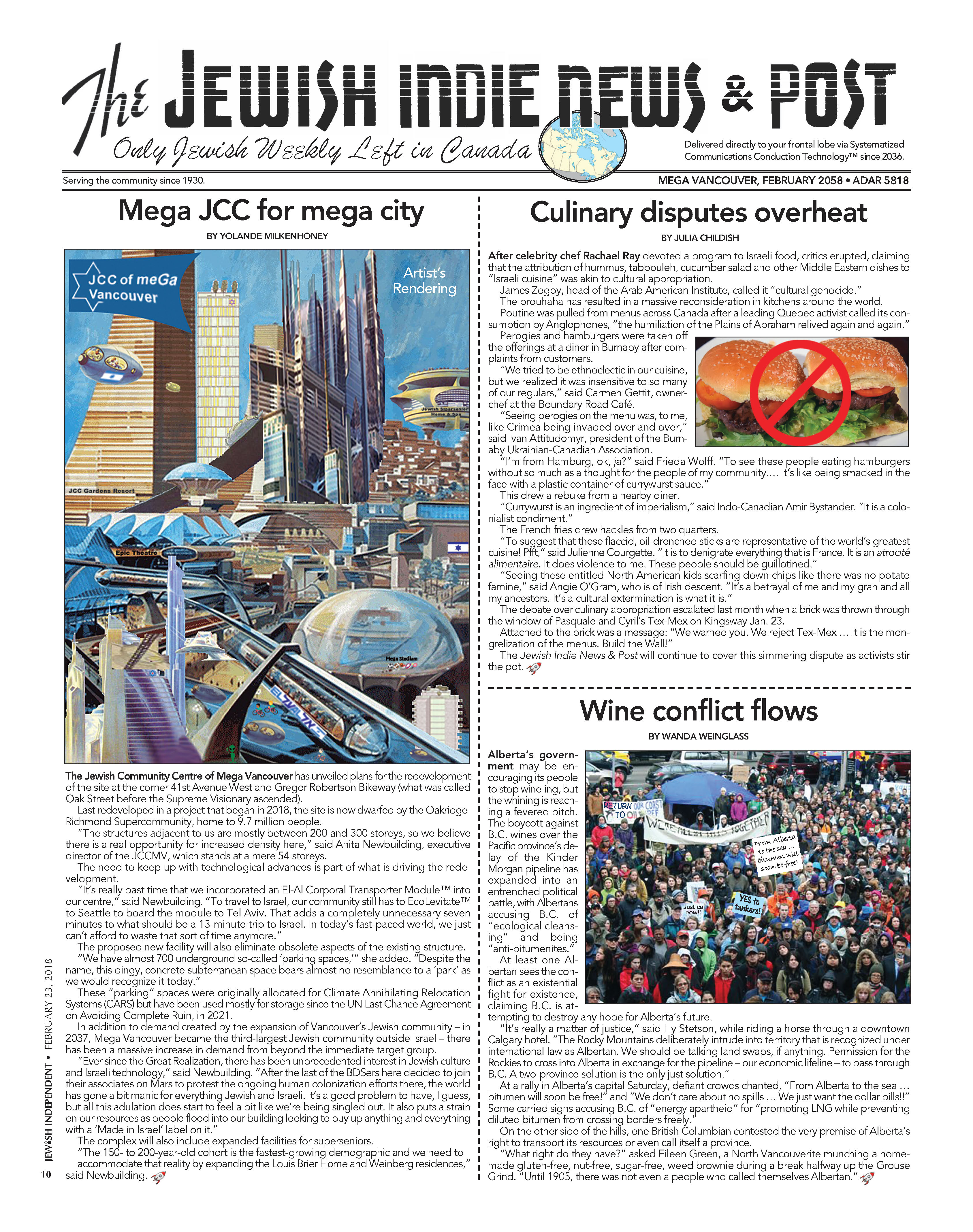
Happy Purim 2018!

Happy Purim 2018!

Purim spoof newspaper - Jewish Indie News & Post

Format ImagePosted on February 23, 2018February 27, 2018Author The Editorial BoardCategories Celebrating the HolidaysTags Alberta, British Columbia, cultural commentary, development, JCC, Kinder Morgan, Oakridge, Purim, spoof, Vancouver, wine

This year at Purim

Purim is a time when we play with identities, dress in disguises and revel in deceptions. There is an aspect of great fun to this holiday, and there are lessons that are deeply serious.

One of the timeless aspects of the Jewish calendar is that, while the dates and texts may remain the same – Purim again will start the night of 13 Adar and the Megillah will not have changed – we, the readers, are different than we were last year and the circumstances of the world we live in have changed since our last reading.

As with many Jewish holidays, Purim includes a lesson about the importance of continuity and survival against existential enemies. This is, sadly, an enduring reality.

Just this week, at the annual conference on international security policy, in Munich, Germany, Israel’s Prime Minister Binyamin Netanyahu reiterated the danger posed by Iran’s nuclear program and warned that regime not to underestimate Israel’s resolve in confronting it.

There are other threats, as well, in the form of growing antisemitism among far-right parties in Europe and in the British Labour Party, online and in the number of antisemitic incidents reported in North America and elsewhere.

We are still trying to uncover whether antisemitism played a role in the mass murder of 17 students and teachers at a Parkland, Fla., school last week. The tragedy led a white supremacist group to claim the perpetrator was one of theirs, but, despite being widely reported, this claim has been debunked.

Five of the 17 victims were Jewish – the high school is in an area with a significant Jewish population – and the murderer’s online rantings were teeming with hatred of African-Americans and Jews. In one online chat, he claimed that his birth mother was Jewish and that he was glad he never met her. Per usual, we are engaged in debating what motivated the perpetrator – easy access to guns, mental illness, pure evil or various combinations of these. As usual, we will engage in a nearly identical cycle of shock, grief, argument and ultimate apathy the next time this occurs, and the next time.

Threats of another kind are also top news right now, with charges recently laid against a number of Russian individuals and groups who are alleged to have interfered with the 2016 U.S. presidential election. The deception appears to have involved creating and stealing social media identities, as well as starting fake political pages intended to divide Americans. A rally against Islam, in Houston, Tex., in May 2016, was met with a counter-rally against Islamophobia. Both rallies, it now appears, were incited by Russian troublemakers.

More seriously still, the allegation is that deceptive and outright false statements were made in online posts and advertisements, which had the apparent impact of suppressing support for Hillary Clinton in key swing states, thus electing Donald Trump president. As each new allegation and example of proof has arisen, Trump has misrepresented reality, deflecting charges that his campaign (including members of his family) was engaged in collusion with the Russians, and claiming vindication at every turn.

A better president would pledge to get to the bottom of whatever is (or isn’t) real in the matter. Instead, this president plays partisan games and, unlike King Ahasuerus, does not take wise counsel willingly.

So, identity, disguises and deception are not only central to our Purimspiels, but woven through our news cycles and sensibilities every day, demonstrating again the eternal relevance of our narratives. Each year, on this holiday as on other days, we recognize and gird ourselves against the threats to our identity and existence. But we also celebrate our survival and rejoice in our not insignificant good fortune.

Posted on February 23, 2018February 23, 2018Author The Editorial BoardCategories From the JITags Iran, Israel, Netanyahu, politics, Purim, Russia, security, Trump, United States

Posts pagination

Previous page Page 1 … Page 27 Page 28 Page 29 … Page 49 Next page
Proudly powered by WordPress