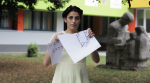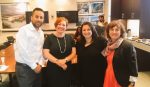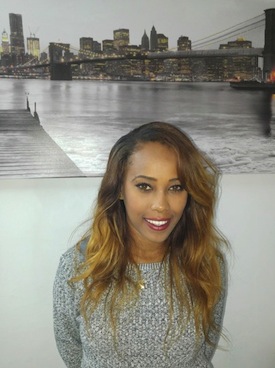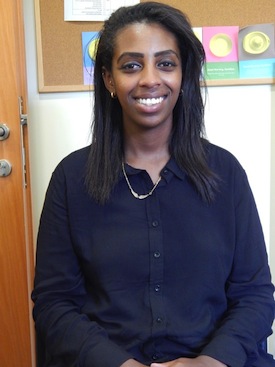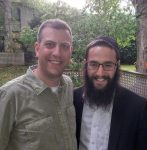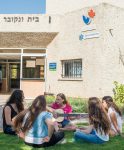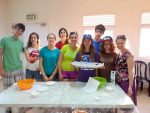
Teens from Temple Sholom’s sister congregation, Tzur Hadassah, in Israel. Rabbi Stacey Blank is on the far right. (photo from Rabbi Dan Moskovitz)
Derech L’Torah is a b’nai mitzvah orientation program currently offered by Temple Sholom, which pairs a group of Vancouver b’nai mitzvah with their Israeli counterparts. The Israeli families come from Tzur Hadassah, Temple Sholom’s sister community just outside of Jerusalem in the pre-1967 territory of the Judean hills. The ongoing dialogue has illuminated both similarities and differences between Israelis and Canadians preparing for the rite of passage.
“In Israel, boys are more often motivated to have bar mitzvahs by social pressure, whereas girls often desire to make a statement,” said Rabbi Dan Moskovitz of Temple Sholom. “They may be motivated by egalitarian, feminist ideals in a culture where the religious sphere is still more dominated by patriarchy.”
Canadian b’nai mitzvah may assume that Israelis will have a substantial leg up on bar or bat mitzvah preparation, but that is not necessarily the case. Canadians may actually have more synagogue experience than their Israeli compatriots, and Israelis find liturgical Hebrew something like Canadians find Shakespearean English.
“Whether Israeli or Canadian, both are going through the gateway of this liminal moment,” said the rabbi, “and both are being immersed in Jewish time and Jewish ritual.”
Among the parents, there are more similarities than differences, said Moskovitz.
In Israel, a bar mitzvah is not “required” for Jewish identity, whereas, in Canada, those who don’t have a bar mitzvah rarely cultivate a strong Jewish identity as they grow up.
“Both sets of parents want their children to be successful, without them feeling too pressured, and, for both, some of them are guiding their children through something they themselves may have walked away from.”
One of the main benefits of the program, said Moskovitz, is the way that it joins together parents of b’nai mitzvah into a cohort to connect with and support each other.
The program starts in the spring of Grade 6 and goes to the fall of Grade 7. Among the Temple Sholom contingent, the students tend to be about one-third from Vancouver Talmud Torah and Richmond Jewish Day School, and most of the rest have a supplementary school background.
The partnership between Temple Sholom and Tzur Hadassah aims to create a vibrant connection between Reform Jews in Canada and Israel and goes beyond the Derech L’Torah program. Visitors to Israel from Temple Sholom have attended Shabbat dinners and synagogue services at Tzur Hadassah, and Temple Sholom supported a community garden project there. Rabbi Stacey Blank of Tzur Hadassah has taught an adult education at Temple Sholom via Skype, and Moskovitz and Blank have published articles in each other’s temple bulletins.
Matthew Gindin is a freelance journalist, writer and lecturer. He writes regularly for the Forward and All That Is Interesting, and has been published in Religion Dispatches, Situate Magazine, Tikkun and elsewhere. He can be found on Medium and Twitter.
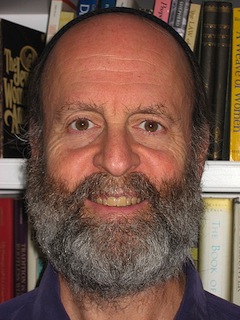
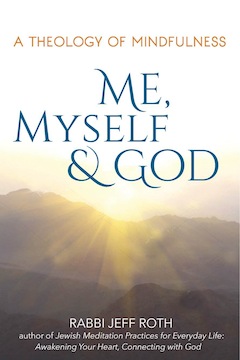 Roth’s latest iteration of that “working out” can be seen in his recent book, Me, Myself and God: A Jewish Theology of Mindfulness (Jewish Lights, 2016), from which he will be presenting practices and Torah teachings at the Dec. 4 session.
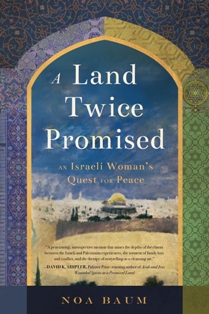 As recounted in her 2016 debut work A Land Twice Promised: An Israeli Woman’s Quest for Peace, Baum grew up with both a deep love of Israel and a keen sense of Jewish vulnerability and the wounds of the Holocaust. The narrative she grew up with about Israel centred on the heroism of its citizen army (“our boys,” she repeatedly calls them) standing up to the bewildering, relentless hatred of the Arab countries. She was deeply shaped by the experience of living through the 1967 Six Day War and the 1973 Yom Kippur War as a child.