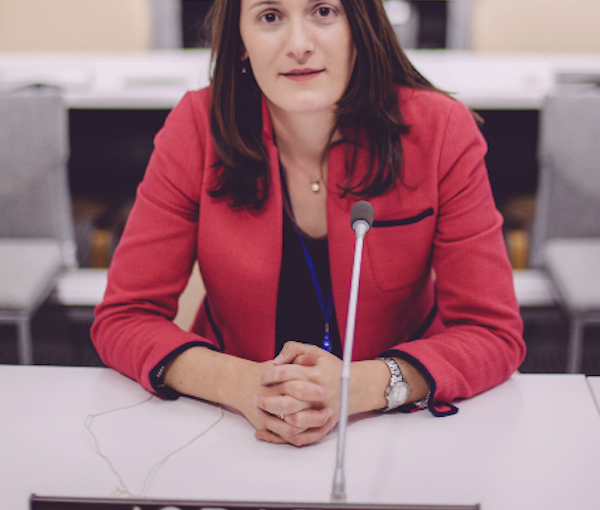
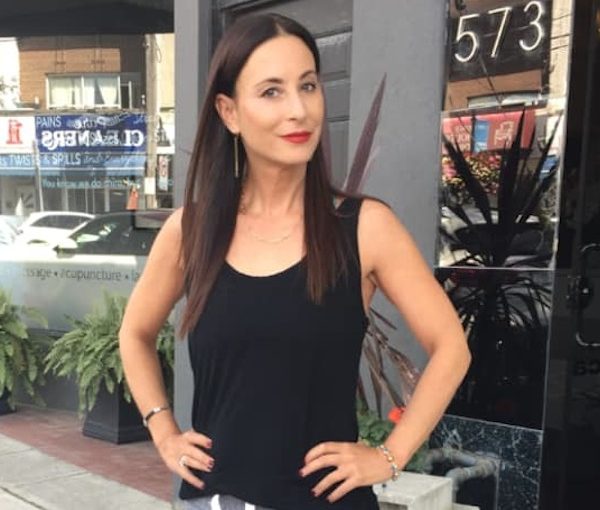
Adele Raemer lives in Kibbutz Nirim, near the border with Gaza, which means the community has had to build safe rooms for protection from rocket attacks. (photo from Adele Raemer)
Tens of thousands of rockets have been fired regularly and indiscriminately at Israel from Gaza since 2001, and they continue. Adele Raemer is a community member of Kibbutz Nirim, just two kilometres from the Gaza border – so close that, she says, “there is zero to 10 seconds’ warning” of a rocket attack on her neighbourhood.
As spokesperson for the community, Raemer moderates a Facebook group called Life on the Border, about the kibbutz. She teaches English as a foreign language, and is a counselor for the Israeli Ministry of Education. In addition, she is a trained medical clown in the pediatric ward of the hospital in Ashkelon. She was invited in November 2018 to be on an independent investigative committee for the United Nations, to discuss living at the border, and, in December 2019, she addressed the UN Security Council. She has filed stories for CNN, particularly during the Pillar of Defence conflict in 2012.
While attending the Jewish Media Summit in Jerusalem this past December, the Jewish Independent spoke with Raemer.
JI: What compelled you to move to Nirim, and when was it?
AR: I came to Nirim [from the United States] in the framework of my army service in 1975. I fell in love with the community and decided to stay.
JI: At the summit, you mentioned a joint bike marathon with Gazans. Can you talk about that?
AR: I have been in touch with Rami Aman, a Palestinian from Gaza, for a number of years. He is one of the founders of the Gaza Youth Committee, a group of people who work with youth in Gaza in order to improve their quality of life and education, and to teach them that those who live on the other side of the border [Israelis] are not their enemies. One of the activities I participated in with them was a [joint] marathon. I am not able to discuss activities happening now, for the safety of my contacts. Unfortunately, doing activities such as these, on the other side of the border, can cost one one’s freedom, even one’s life.
JI: How did you get invited to speak at the UN Security Council in 2018?
AR: In light of the map of [Gazan-initiated] fires that I put together at the time, the interviews I gave to the media, my blogging and the Facebook group Life on the Border with Gaza, people in Israel who work with the American embassy turned to me. At the time, the U.S. were the hosts of the UN Security Council, and President Trump was interested in putting the situation in Israel in the spotlight.
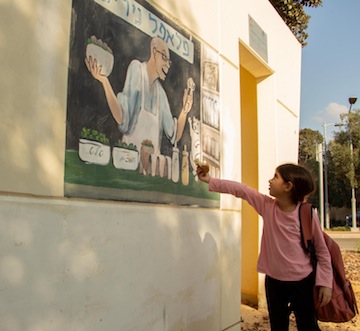
Adele Raemer’s granddaughter stands outside a safe room. (photo from Adele Raemer)
JI: Nirim began building concrete safe rooms to protect against rocket fire. What is the ratio of safe rooms to homes, and how many people typically fit in one? What is the cost of a room?
AR: Each home typically has one safe room, about the size of a small bedroom, about nine square metres, and costs about $44,000. Safe rooms in people’s houses usually have beds in them, so, depending on how much furniture is in the room, it varies how many people fit in. Certainly the entire family will fit.
JI: How many casualties have there been in your community from rocket fire?
AR: Two members were killed in 2014 and, if I am not mistaken … fewer than 10 were wounded, mostly lightly. That, of course, does not take into account the many who have suffered psychological damage.
JI: Who is your member of Knesset, and how are they involved in ensuring the safety of the community?
AR: It doesn’t work that way – we do not have regional representatives, like you do. All of the MKs should be working towards the good of our communities. The current ministry for the development of the periphery of the Negev and the Galilee is Yitzhak Wasserlauf, but he has just taken office so I cannot say what he will be doing yet. The office itself has done the following in recent years: reinforced all schools within the Gaza envelope, developed Ale Negev [a rehabilitation hospital in the Negev] and programs for developing psychological support and resilience centres.
JI: You’ve said the kibbutz was “95% heaven.” Why do you feel that way?
AR: The region is a desert that has been made to bloom, a modern miracle of development, while protecting and preserving the nature and wildlife, despite multiple challenges including, but not only, security challenges. The community in which I live is not only beautiful but it is crime-free, and [it is] safe for children to play on the lawns, without worry of being run over or kidnapped. But, above all else, it is the sense of community – our kibbutz, as well as the other communities in the region, which support each other … make it a friendly, warm environment in which to raise families.
JI: What is the main industry of the kibbutz?
AR: Our kibbutz is mainly agricultural, so we have farmers and workers in the different branches that support the agriculture, but our people also work as professionals in all different professions, just like anywhere else in the world. We have doctors, nurses, lawyers, mechanics, teachers, social workers, chief cooks and bottle washers.
Dave Gordonis a Toronto-based freelance writer whose work has appeared in more than 100 publications around the world. His website is davegordonwrites.com.
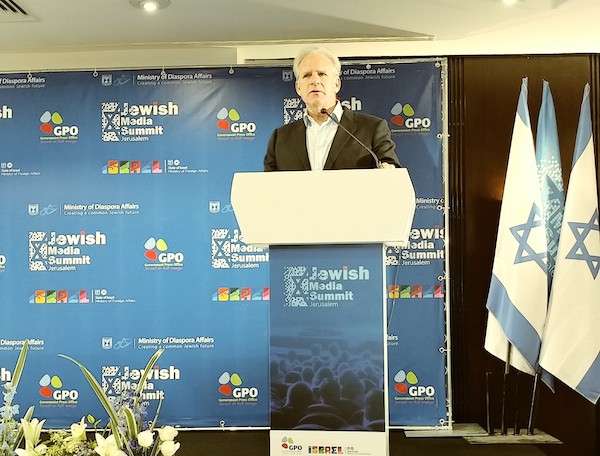
Author and former politician Michael Oren addresses the Jewish Media Summit, which took place in Jerusalem Dec. 19-22. (photo by Dave Gordon)
The Iranian threat, the new Israeli government, BDS, terrorism, and the challenges of aliyah, were just some of the discussion topics last December, at the fifth annual Jewish Media Summit, which took place in Jerusalem Dec. 19-22.
The nearly 100 attendees hailed from Israel and across Europe, as well as from South Africa, South America and North America, and included the Jewish Independent. Most panels and keynote addresses consisted of official spokespeople, politicians (incoming and outgoing) and organizational heads. The conference was organized by the Ministry of Diaspora Affairs, Ministry of Foreign Affairs, and the Government Press Office.
Former U.S. ambassador to Israel Michael Oren spoke about one of his pet projects. Oren is a former member of the Knesset and the author of several books, including Ally: My Journey Across the Israel-American Divide.
Several years ago, when Oren was a deputy minister in the Prime Minister’s Office, he proposed to Prime Minister Binyamin Netanyahu that Israel have a blueprint leading into the state’s 100th birthday – Oren’s book Israel 2048 will be published in April.
To write the publication, Oren investigated different areas of Israel’s future: social, education, health and foreign policies; Israel-Diaspora relations; Palestinians, Arabs. “We found experts in every field. It was a tremendous undertaking,” he said. “I would not shy away from any issue, controversial, even explosive.”
About Israel, he noted “we don’t have sovereignty over large areas of our territory,” referring to the 60% of the country that is the Negev Desert. As an example of what this means in terms of governance, he said there’s no application of Israeli law regarding housing there and so there are some 400,000 illegal Bedouin structures in the Negev.
“But if I built a two-millimetre addition to my balcony in Tel Aviv, I have a police car there, within seconds, giving me a big ticket,” he said. Additionally, he said there’s “an inability to enforce [other] Israeli laws” there, so there’s no control over guns, drug or human trafficking, and polygamy is rampant, despite it being illegal.
Of concern, he said, is that more Bedouin are being influenced by Islamic extremism and the Palestinian narrative.
“It’s critical that the 2048 initiative is not the initiative of religious people, of secular people, of right-wing, left-wing, Ashkenazim, Mizrahim. It’s everybody together,” he said. “If you want Israel to have a second great century … we have to work on it. And we have to work at it by talking to one another, about real solutions.”
Oren spoke with the Jewish Independent about how he thinks Israel will ease challenges to aliyah.
“What shocked me is that large segments of the population are no longer interested in large-scale aliyah,” he said. “I couldn’t get people in Israel and [in the] Israeli government to be very interested in encouraging aliyah from France.”
The predominant reason for this lack of interest in welcoming new immigrants from France or any other country in the Diaspora, he said, is that Israelis are becoming increasingly angry at how the many costs of new olim (immigrants) are offset by the state.
“This is going to play out now with Russia and Ukraine as well,” he noted. “So, while everyone’s focused on the grandfather clause [of the Right of Return], I asked a deeper question: to what degree is aliyah still a central tenet of our raison d’être of the Jewish people? Because, from my perspective, if we are not encouraging large-scale aliyah, we’ve lost a big sense of why we are here. And I see this as a danger.”
The largest section of Oren’s new book, however, deals with the Palestinians. Oren said he was involved in one way or another with “every peace initiative since 1993.”
On another topic, Oren noted that Benny Gantz, then-minister of defence, proposed a solution to the Iranian threat: “force our international partners” into offering “military intelligence and diplomatic cooperation.”
“Our actions must be preventative, before it is too late,” said Oren.
On a tour of the Tz’elim IDF base, a 10-minute drive from Gaza, Gen. Bentzi Gruber spoke about the ethics of combat, stressing that the army makes enormous effort to minimize innocent casualties. In contrast, he said, only two Hamas rockets hit the base, while thousands hit civilian areas.
Gruber added that he fights a psychological battle, too.
“I fight all my previous wars every night in my sleep. My wife wakes me up when I’m yelling,” said the deputy commander of the IDF armoured division. “Every soldier that fought in a war carries the scars with them. If you killed a terrorist or a civilian, that never leaves you.”
The tour included a mini-Gaza mockup city, a training area for the Israel Defence Forces.
Kibbutz Nirim, a few hundred metres from Gaza, has been hit by rocket fire from Gaza in recent years. The kibbutz’s spokesperson, Adele Raemer, who addressed the United Nations Security Council in 2018, said the village had to build safe rooms, as residents have just a few seconds to get out of harm’s way. One terror tunnel discovered nearby was 75 feet deep, 1.1 miles long, and made of 500 tons of cement.
Still, she said, she “has nothing against ordinary Gazans,” and locals participate in Project Road to Recovery, where Jews shuttle Arab patients to local hospitals “because we care about our neighbours.”
President Isaac Herzog encouraged Jews around the world to fight the BDS (boycott, divestment and sanction) movement, whether espoused by foreign governments or the media, on college campuses or elsewhere. He commented on those who disagree with Israel’s new government.
“Israeli democracy is vibrant and strong,” he said. “The many voices that compose us do not point to the weakness of our democracy, but our strength. The rule of law, freedom of speech, human and civil rights, these have been and always will be the wall of our democratic state.”
In a non-political talk, Neta Riskin, who plays Giti Weiss in Shtisel, spoke about the surprise hit, which has run three seasons. At first, the show’s publicist told them “there’s nothing to work with” and it wouldn’t last, but word of mouth and good reviews bolstered the show, she said.
For her, Shtisel “has nothing to do with religion. It has to do with people – longing, hope and people’s desires. The cultural restraints of the show made it more interesting. No dead bodies. No sex.” She said she was pleased that women’s stories were also being told in the show.
Shtisel is popular in the Haredi community, with people watching it on their phones, according to Riskin. “The show managed to bridge an un-crossable bridge,” she added, noting how popular it was among all stripes of Jews and non-Jews alike.
Dave Gordon is a Toronto-based freelance writer whose work has appeared in more than 100 publications around the world. His website is davegordonwrites.com.
Leah Goldstein is the first woman, and the first Israeli, to win Race Across America. (photo by Vic Armijo / RAAM)
Leah Goldstein became the first woman to win Race Across America in its 38-year history. The Vernon, B.C., resident also became the first Israeli to win the cycling tournament.
The 5,000-kilometre race – from Oceanside, Calif., to Annapolis, Md. – must be completed in under 12 days, and Goldstein completed it in 11 days, three hours and three minutes, rolling past the finish line at 9:41 p.m. on June 26.
“Race Across America (RAAM) is like no other race,” Goldstein told the Independent. “I’ve done the equivalent of the Tour de France for females. I’ve done major races and other ultra endurance races of 500, 800 miles, and nothing compares – because it’s not a matter of if, but when you’re going to experience all sorts of discomforts, back, neck, knee, constipation, diarrhea, swelling, some major saddle sores.”
This was the latest in a lifetime as a top athlete. Goldstein won the 1989 World Bantamweight Kickboxing Championship and was Israel’s duathlon champion. As a youth, she was a kickboxing champion and a Taekwondo champion. Later in life, she competed in a string of professional cycling events. That toughness carried forward to her becoming an officer in the Israeli commando and elite police unit.
This year’s race was particularly extreme, during a heat wave that punished riders with temperatures of more than 40°C; not just through the desert, but for the first eight days.
“That can break people down, where they almost feel defeated before they start, but that’s the thing with RAAM, those things are going to happen whether you like it or not, and you have to prepare for them,” said Goldstein. “It’s really something that pushes you far beyond your limits. You’re going to have more bad days than good days, and that’s just the challenge.”
During certain parts, she said she had hallucinations and her “brain felt like a potato.”
“I didn’t know what I was doing on my bike. I didn’t know where I was. And then you kind of snap out of it,” she explained. “It’s that element of the mental challenge of really pushing forward, knowing that whatever you’re doing, you just can’t get off the bike, no matter what the situation, the temperature, no matter what kind of pain you are in.”
It helped that this was her third RAAM, she said, and the crew was able to analyze past performance to build on it.
“We wrote down every single mistake that we made in 2019, with weather conditions, navigational problems, bike positioning, training, with sleep patterns, and we tried to perfect it as much as possible. And because of COVID last year, I had an extra year to prepare for this. I trained as if RAAM was still going to happen.”
Her onboard crew included a medic, a kinesiologist, massage therapists and nutritionists. “I think they know how I roll, and know how to read me on the bike, when I’m starting to fade or things are going sideways, or I’m low on nutrition,” she said. “We won as a team.”
Leah Goldstein during the Race Across America. (photo by Vic Armijo / RAAM)
Whereas riders fought the heat this year, they fought “uncontrollable rain and hail” two years ago. The crew prepared her with specialized clothing and pre-tested water-resistant equipment, just in case those conditions would prevail again.
“Prepare for the worst that possibly can happen, no matter how fully prepared you think you are,” she said. “It’s a matter of how badly do you want it, and how much are you willing to sacrifice.”
And Goldstein has experienced severe challenges. In 2005, during the Cascade Classic, she was involved in what she calls “the mother of all crashes” – she landed on her face at 80 kilometres an hour, “breaking practically every bone in my body, ripping my face right off.” Doctors were astonished she survived. In 2008, she was hit by a car, ejected 25 feet in the air and, in an attempt to cushion the fall, put her arms out, breaking both of them.
Neither accident kept her down. She returned to the racing circuit in 2011, winning the women’s solo category of Race Across America, breaking the previous record by 12 hours.
In 2016 she published a memoir, No Limits, outlining the triumphs and tragedies of her athletic life.
While the naysayers – who called her “insane and crazy” – said she was “past her prime,” the 52-year-old proved them wrong.
“Don’t use your age as an excuse or your past experiences as an excuse,” she said. “We don’t get second chances. What we got is what we got and, if you have a desire to do it, goddamn do it. What are you waiting for?”
Because of the high temperatures, the latest race took her a couple of days longer than expected, but she said the next one she plans on doing in under 10 days – and she’ll keep competing until she can’t anymore.
“If I’m alive at age 90 and I can still pedal my bike, I’m doing that race,” she said. “That’s my biggest goal.”
Dave Gordon is a Toronto-based freelance writer whose work has appeared in more than 100 publications around the world. His website is davegordonwrites.com.
Aviva Klompas recently published the book Speaking for Israel: A Speechwriter Battles Anti-Israel Opinions at the United Nations. (photo from Aviva Klompas)
Aviva Klompas came close to writing a declaration of war. In early 2013, after an Israeli post was fired upon by Syria – one of a number of attacks – Klompas was tasked with penning a condemnation that would be submitted to the United Nations.
Still relatively new as director of speechwriting for Israel’s Permanent Mission to the UN in New York City, she recalled the criticism she received: “Be more direct. Be more assertive about things,” she was told. “I thought to myself, ‘channel outrage.’ I tried to do so. I wrote this very stern letter, and I took it to the ambassador to review.”
Klompas, who spoke with the Independent recently, said she then learned the art of diplomacy, and how words might set off an international firestorm.
“To be clear,” Ambassador Ron Prosor, then Israel’s permanent representative to the UN, told her, “you don’t have any authority to declare war.” And it was off to a rewrite.
Thankfully, there weren’t any other close calls, but there are many other fascinating stories – many of which Klompas has brought to light in Speaking for Israel: A Speechwriter Battles Anti-Israel Opinions at the United Nations (Skyhorse, 2019). The book is a candid examination of how the Israeli delegation – and Israel as a whole – is perceived and treated in the international body.
During Klompas’s time at the UN, several major events occurred, including but not limited to the Iran deal, countless anti-Israel resolutions, Palestinians’ bid to join the International Criminal Court, the kidnapping and murder of three Israeli teenagers, and 50 days of war between Israel and Hamas in Gaza. She wrote the book, she said, to show the tireless work of those who advocate for the Jewish state and who rarely get their due.
“It always feels like it is an uphill battle by the nature of the bias at the UN,” she said. “There are people who show up every single day and never say, ‘Why are we doing this? We should leave the UN.’ I’ve never had a single colleague make that suggestion. They came to work and did the job. I think, it’s a little bit my story, but it’s really our story.”
Klompas was director of speechwriting from 2013 to 2015.
“It’s very few people that make the headlines – the ambassador, maybe the deputy ambassador, maybe the foreign minister – but what about everyone else that is doing it day in and day out?” she asked.
About her work, the Toronto native said it advanced Israel’s policies and informed public opinion. Being successful at it, she said, required overcoming some challenges. For one, there was a culture clash.
“Certainly, Israelis are much more direct in their feedback, which is for better or for worse. At first, it is startling, but then you get to understand that it’s not personal,” she said.
Learning how to write in someone else’s voice was difficult, too. Prosor has “a very distinct style,” she said, describing him as “extremely articulate, funny, charming and intelligent. To be able to write for somebody like that takes time.”
In addition, Prosor took a different approach to diplomacy, when “so many speeches can be dry and not entirely lively,” said Klompas. “He’d be all too happy to break out into song in the middle of a speech, whether it be a song about African nations, which got him a standing ovation from some of the African nations in the General Assembly, [or] he would sing John Lennon’s ‘Imagine.’ In a speech about women, he sang Aretha Franklin’s ‘Respect.’”
Klompas gave him the nickname “the Singing Diplomat.”
“Ambassador Prosor felt it was very important to be heard and, to be heard, you have to be different,” she explained. “He knew he had to capture attention to get people to listen.”
In the beginning, she would have to write up to 20 drafts of a speech before she got a sense of the ambassador’s voice and style. Sometimes, there wasn’t much time to tweak.
“It’s pretty stressful,” she said. “You can get a phone call any time of day or night, weekend, and be told the Security Council is convening a special session, come down to the office, we have to get writing. You could have a couple of days’ notice or a couple of hours’ notice. And emergency sessions tend to get a lot of publicity.”
Klompas, who is now associate vice-president of Israel and global Jewish citizenship at Combined Jewish Philanthropies in Boston, said there were poignant takeaways from her job as a speechwriter.
“You can’t be easily deterred by situations that seem unfair or unreasonable. You need a courage of conviction to deflect the constant attacks and brush aside the fact that systems and processes aren’t as simple as one might hope,” she said. “I’d say that my experience gave me a greater sense of what happens behind the scenes in international diplomacy, and the ways in which Israel is working to find equality in the family of nations.”
Dave Gordonis a Toronto-based freelance writer whose work has appeared in more than 100 publications around the world.
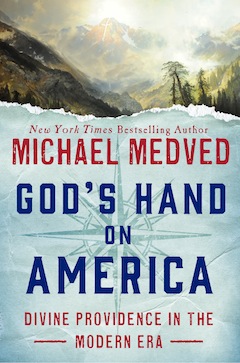
Michael Medved’s latest book is God’s Hand on America: Divine Providence in the Modern Era. (photo from Michael Medved)
Most of us would call them close calls or dumb luck – the many things in American history that could have gone terribly wrong, but didn’t. But Michael Medved firmly believes they weren’t merely happy accidents; rather, they were a direct result of God’s guidance.
Medved’s God’s Hand on America: Divine Providence in the Modern Era (Crown Forum) is a chronological sequel to 2016’s American Miracle (Crown Forum), a book that began with the pilgrims in 1620 and ends with Lincoln’s assassination, on April 14, 1865. They share a common theme, he said: “Divine intervention is extraordinarily obvious and important in tracing the course of American history.”
Story after story, Medved builds the case that there are solid “arguments for divine providence in the rise to power, and continued power and prosperity, of the United States.” President Theodore Roosevelt, for example, was shot in the chest but a folded speech in his jacket pocket took the bullet.
In another of many examples, a seemingly lucky moment came during the Battle of Midway, in June 1942. U.S. planes had gotten lost over the Pacific Ocean but, just in time, they suddenly found their way back, to dive bomb Japan’s fleet. History, said Medved, regarded this as a huge blow to the Japanese – at a time when the Americans and British had, up until that point, faced setback after setback, loss after loss, and were struggling to make advances in the Pacific.
“Fate, destiny, providence and the United States is a complicated process. It doesn’t mean America only wins, but it does mean that it’s safe to say that Lincoln, Washington, the Roosevelts, were right; Kennedy and Eisenhower were right; that America has been used as an instrument, or vehicle, for grand purposes by a Higher Power,” noted the Jewish syndicated radio host, whose daily program reaches more than five million listeners, across 300 stations. Medved is also author of 12 other books, including bestsellers The 10 Big Lies About America and Hollywood vs. America.
His thesis isn’t out of the blue, either – since the first landings, ordinary Americans and their leaders have believed that God helped in their nation’s successes, said Medved. For people of faith, it was the most reasonable explanation for the seemingly inexplicable. Their Bible-centred view carried over to an appreciation of Jews, he added, at a time when there were few Jews in the United State, i.e. until the 19th century.
They recognized, he said, “the special place the Jewish people had in America,” especially conscious of the verse in Genesis, which says that anyone who blessed the Jews would be blessed, and anyone who cursed the Jews would be cursed. These beliefs were exhibited in many ways, such as the Hebrew words on the seal at Yale, Urim and Thummim, elements of the ancient high priest’s breastplate, used for obtaining oracles; and the seal of Dartmouth College, which has El Shaddai (God) in Hebrew.
Early colonizers even identified themselves as being “like the Israelites who have crossed a perilous ocean to come to the land that was promised,” said Medved. “That identification of Puritans [goes] all the way back to the founding of New England in the 1630s.… They described themselves as ‘New Testament Hebrews.’ The identification with the Jewish people was very profound.”
While at Princeton, then-future president James Madison’s concentration of study was Hebrew, said Medved. Later in history, Harry Truman formally recognized Israel, minutes after it was declared a country. And then there was Richard Nixon’s military aid to Israel during the 1973 Yom Kippur War – quite unexpected, said Medved, given the recordings that surfaced of Nixon using insulting epithets against Jews. According to Medved, Nixon’s gesture of goodwill, though not mentioned in the book, saved the Jewish state from annihilation.
Dave Gordonis a Toronto-based freelance writer whose work has appeared in more than 100 publications around the world.
Rebecca Eckler’s latest book is one of her most candid. (photo from Rebecca Eckler)
Rebecca Eckler knows firsthand the challenges of forming a mixed, blended or bonus family. Based on her experiences, the author, blogger and former National Post columnist has written Blissfully Blended Bullshit: The Uncomfortable Truth of Blending Families.
“Everyone was private messaging me saying, ‘I’m going through this with my blended family. I know you are in one. How do you handle this?’ I’m thinking, ‘People need help,’” Eckler told the Independent.
When the American television show The Brady Bunch first aired 50 years ago, its premise relied on what was then a rarity – two parents on their second marriage, each bringing three children into the same home.
“The difference with The Brady Bunch is you never saw exes. You never saw the grandparents or cousins. It was just about the family. But blended family is so many other people,” said Eckler. “There is a lot of suffering, and people in blended families don’t want to admit how hard it is,” including when parents take sides with their biological children in a tiff between siblings.
“I had no idea all the BS that pops up, and all the variations of people who have to get along,” she said.
Eckler described this, her 10th book, as “my favourite book because it’s so candid.” During the writing process, she and her then-partner “unblended” and she discusses many of the unexpected issues that arose from the breakup. For example, the biological siblings, half-siblings and bonus children now weren’t – quite suddenly – in one another’s lives regularly. The more familiar struggles of breaking up with someone included the division of possessions; in Eckler’s case, agonizing back-and-forths over mundane items like the microwave and bed.
While she and her ex now have new partners, other difficult situations lay ahead.
“You know what was the hardest thing for me?” she said. “Telling [her daughter] Rowan’s dad that another man was moving into the house with two children. I felt like he would feel that another man is taking over the role of ‘dad’ in my daughter’s life. I could hear him choking up when I was telling him.”
Then there was the time that one of her (new) stepdaughters asked Eckler to go prom-dress shopping. While in the dressing room, the daughter took selfies and sent them to her biological mother. “So,” said Eckler, “while I was invited to come with her, it was her mother who had the final say. These are things that you don’t think about until they happen to you.”
One lesson learned through all of this was that partners need to keep open the lines of communication.
“I think one of the biggest mistakes at the very beginning is, we discussed nothing, which was ridiculous, but I had ‘love goggles’ on. He moved into my house and his kids were in my house 50% of the time. So, for them, I think it never felt like their home. To me, it always felt a little like, ‘this is my home’ that you guys have moved into. The [new] kids didn’t even get to pick their room.”
Horns locked over Jewish issues, too. When her partner wanted to bring ham into the home, discussions ensued – over the ‘December dilemma’ of a Christmas tree (she refused), Jewish versus mainstream summer camps, and to which grandparents they’d go to for the Passover seder.
“It’s almost like a cautionary tale, and it’s very juicy. It’s also a book for grandparents to read,” said Eckler. “I think I’d probably make a shitload of money if I came out with a line of greeting cards for blended families. ‘Happy bonus granddaughter’s day!’”
Dave Gordonis a Toronto-based freelance writer whose work has appeared in more than 100 publications around the world.
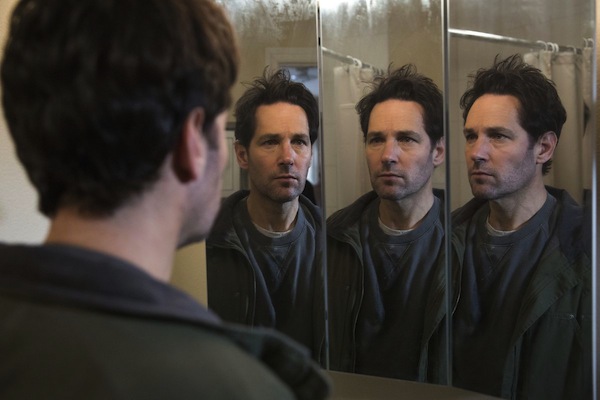
A still from the Netflix show Living With Yourself, co-starring Paul Rudd.
As the secular New Year approaches, many people make resolutions, in an effort to become a better person. What if there were a shortcut? What if, for a tidy sum, you could be transformed, virtually overnight, into the person you’ve dreamed of being?
This the conundrum posed by the Netflix show Living With Yourself, an eight-part series released in late October, starring Paul Rudd and Aisling Bea, who play spouses Miles and Kate Elliot. Rudd is also one of the executive producers.
The premise is this: Miles, a shlub discontent with and disconnected from his wife, and suffering career ennui, discovers a “spa” that offers a treatment to improve his charm and confidence. For a small fortune, they promise, a “new you.” And so, a shlemiel enters and a gentleman exits. Just one problem: [spoiler] it’s actually a cloning lab and, unbeknownst to Miles and Clone Miles, the two men exist and, later, each must contend with the other in his life.
Rudd’s 25 years of movie experience includes Ant Man, Anchorman, Knocked Up, 40-Year-Old Virgin and Clueless. On television, he played Mike Hannigan in Friends and appeared in Reno 911, among other things.
The New Jersey-born actor hasn’t been shy in publicly discussing his Jewish identity. He kibitzed a bit about his Jewishness in an interview segment of Between Two Ferns. In an episode of Finding Your Roots, he found out that his grandfather, Davis Rudnitsky, fought the Nazis, only to return home to England to face antisemitism. In 2017, Rudd played his first (overtly) Jewish character, Moe Berg, in the biopic The Catcher Was a Spy, about a baseball player who joins the Second World War effort as an undercover agent.
In Living With Yourself, there is one explicit Jewish moment, when a Holocaust survivor tells Miles an off-colour anecdote about the Shoah, involving pork. But there are also hidden Jewish themes. For example, envious of a colleague’s extraordinary success in the office, Miles is spurred by the prospect that his technological makeover could help him outperform this coworker. Though Judaism has no problem with someone being motivated to accomplish because of another’s success, the Torah warns against jealousy. The ninth commandment is one obvious caution against such sentiment: “Thou shalt not covet.” Another is Joseph’s brothers (Genesis 36), who, enraged with jealousy, sell Joseph into slavery. In a sense, Miles and Clone Miles are like brothers, and they develop petty and spiteful jealousies, wanting the best of both worlds, but not able to have it.
If only Miles initially had derived fulfilment and was grateful for what he had, he wouldn’t be in this much trouble. Ethics of Our Fathers (Pirkei Avot) (4:1) advises just that: “Who has wealth? The one who is pleased with his lot.” The meaning isn’t limited to “wealth” of materials, of course, but the wealth of blessings that are bestowed upon us, including, for most of us, our loved ones, our safety, our employment and access to the necessities of life.
Notably, though, Miles versus Clone Miles is illustrative of the yetzer hara (good inclination) and the yetzer hatov (bad inclination) at battle with each other. Interestingly, neither character is completely good nor bad, but a combination, reflecting the real, complicated, human condition, where we have both inclinations competing inside us.
Often, we are able to convince ourselves of the nobility of our decisions – that is, find a good reason for our perhaps less-than-good action; explain away the importance of a choice’s potential harm. Paradoxically, the yetzer hatov has a sneaky side. To explain this, author and radio host Dennis Prager often cites the late Rabbi Wolfe Kelman, former head of the Conservative rabbinate. He once told Prager that he had his yetzer hara under control, but his yetzer hatov “always got him into trouble.”
Rarely do ordinary people wake up each morning and strive to make another human miserable. Still, we must wrestle with our “other” selves, overcome our justifications and egos, to make principled choices. Every day is a lesson in living with ourselves.
Dave Gordonis a Toronto-based freelance writer whose work has appeared in more than 100 publications around the world.
The Museum of Jewish History in Sosua is located right next to the city’s synagogue. (photo by Dave Gordon)
Famous for its rum, cigars, resorts, beaches and rich history, the all-season holiday destination of the Dominican Republic attracts 800,000 Canadians each year. Moreover, the country has a relatively unknown past – few people realize, or know, that the country opened its doors wide to Jewish refugees fleeing Nazi persecution.
This era is chronicled at the Museum of Jewish History, in Sosua, which is in the northern section of the country. Located right next to the city’s synagogue, the museum preserves the memory of those Jewish refugees who sought a safe haven on Dominican soil, and left their mark on the region. It houses photographs of early-to-mid-20th-century Jewish immigrants, along with diary entries, ritual items and copies of letters from Jewish agencies during the war.
Before the Second World War, in 1938, U.S. President Franklin D. Roosevelt summoned the Allies to Evian, France, for a conference about how to handle the massive exodus of Jews who desperately sought to flee Nazi persecution. Though most of the participants at the conference expressed their sympathy, no resolution was formulated. Paraphrasing Chaim Weizmann (who would later become the first president of Israel), Central and Eastern European Jews perceived the world as consisting of just two camps: one that hounded and hunted them, and another that closed its gates.
There was, however, one notable exception.
Of the 32 countries that sent delegations to the conference, only the Dominican Republic, led by President Rafael Trujillo, agreed to receive 100,000 refugees, offering land resettlement under generous conditions. A group of experts on refugee affairs, under the leadership of James Rosenberg, was mobilized by the American Jewish Joint Distribution Committee to capitalize on the offer. This was the birth of the Dominican Republican Settlement Association (DORSA).
Inside Sosua’s synagogue. (photo by Dave Gordon)
Between 1940 and 1945, the Dominican Republic government issued 5,000 visas for displaced Jewish refugees. Tragically, however, the actual number of immigrant arrivals never reached anywhere near this figure, due to the escalation of the war, and also to what some believe to be mishandling by the Jewish Agency, which resulted in delays. Of the nearly 1,000 Jews who settled in the Dominican Republic, most were from Austria and Germany, although some came from as far away as China, and some from as close as the Caribbean islands.
Little by little, the jungle-like territory was divided into residential lots and communal barracks for arriving refugees. Each refugee was furnished with, as a repayable loan, 80 acres of land, 10 cows, one mule, one horse, and a living wage for a month. They were assisted with training in agriculture and farming techniques, of which most had little previous knowledge.
Jews took to food manufacturing, becoming successful in the production and sale of sausage, milk, cheese, tomato sauce, mashed carrots, stuffed peppers and mashed spinach. Many of these industries continue to this day. The refugees’ earnings enabled them to pay their debts and establish other small industries.
By the 1990s, however, just 36 Jewish families remained in Sosua, as most of the population either died, intermarried or moved to larger Jewish communities.
Interestingly enough, well before the arrival of these refugees, in 1916, the Dominican Republic briefly had a Jewish head of state, President Francisco Henríquez y Carvajal.
Visiting the country
Virtually every major supermarket has plenty of items with kosher certification, including imported canned goods, breads, fish and spreads. A Puerto Plata resort named Lifestyle has an on-site kosher restaurant, though only for guests staying there. Alternately, in Punta Cana, the local Chabad offers à la carte food orders upon request.
If this trip is a do-it-yourself getaway, as opposed to an all-inclusive, here are two suggestions for luxury stays that will offer the feel of home:
Villas Agua Dulce is a jaw-droppingly elegant and spacious facility. Each villa has a fully furnished living room, dining room and a washer/dryer. Three-bedroom villas are available to accommodate a family of seven. Toss in for good measure an outdoor patio, outdoor private pool, a spa centre, tennis and basketball courts, and Bauhaus interior design.
With the beach just a few hundred feet away, Cabarete Palm Beach Condos is centrally located in the Cabarete area. Each condo has a fully equipped kitchen, living room (with big TV), dining area and outdoor patio.
As for suggested adventures in the Puerto Plata area, I have several.
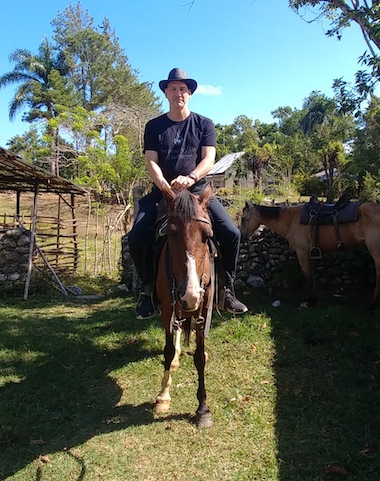
Horsebacking riding is one of the many outdoor adventures one can take in the Puerto Plata area.
Monkey Jungle: After enjoying the 4,500-foot, seven-station zip lines overlooking the trees, visit the adjacent capuchin monkey reserve. Scores of these adorable creatures bounce around from tree to tree, hopping on your shoulders and nibbling straight from the fruit plate in your hand.
Ocean World: This is where you can swim with sharks and dolphins and kiss the sea lions.
Tip Top Catamaran: Take a ride on the 75-feet-long and 33-feet-wide catamaran. Tourists are offered the chance to experience the vibrant underwater world through snorkeling Sosua Bay (equipment is provided). Immerse yourself in schools of fish, peer at the coral, get face-time with a puffer fish and play with the sea urchins.
Twenty-seven waterfalls of Rio Damajagua are tucked away in the hills of the Northern Corridor mountain range, behind tall stalks of sugar cane. In addition to the mélange of outdoor activities – such as cliff jumping into natural waters and climbing through caves – you are surrounded by forest. And, depending on the season, fruit will be growing from coconut, avocado, coffee bean and mango trees.
Kiteboarding: Think of yourself hovering over the ocean on a surfboard, propelled by a giant inflatable kite, and you have kiteboarding. Dare2Fly provides kiteboarding packages, lessons and rentals.
Rancho Luisa y Tommy: Try a morning horseback ride. Run by 30-year-old Tommy Bernard, a Quebec expat, he’s an affable fellow who’ll treat you to engaging conversation on topics including animals, his adopted country, and most anything in life.
Dave Gordonis a Toronto-based freelance writer whose work has appeared in more than 100 publications around the world.
From kimchi to cast iron, more than 300 new products were on display at this year’s Kosher Fest. (photo by Dave Gordon)
At Kosherfest this year, there were such traditional Jewish staples as gefilte fish, matzot, bagels and cured meats. But cauliflower pizza crusts, organic tequila, vegan cheeses, kimchi and date-seed coffee were among 300 new products on display.
The two-day event in New Jersey was the 31st annual convention. It showed that kosher food does not necessarily hail from countries with large Jewish populations. In the hopes of grabbing a slice of the market, exhibitors came from around the world, including from South Korea, Australia, Italy, Brazil, Mexico and the Netherlands.
From Pakistan, Adnan Pirzada, the general manager of Dewan Sugar Mills, was exhibiting kosher-certified ethanol for companies to use in beverages and mouthwashes. Currently, they export to 30 countries and are seeking U.S. consumers. The certification is new to the 15-year old company, which produces 125,000 litres of ethanol a day.
“We wanted to tell people that there’s nothing not kosher that ever comes in contact with what we make,” he said, noting that “sometimes, non-kosher ingredients can be in foods and people not know it.”
An example of that came from Dakshin Thilina, the director of Nexpo Conversion, makers of kosher dried coconut milk powder and coconut oil in Sri Lanka. Nexpo supplies an Australian ice cream manufacturer and an organic chocolate manufacturer, and hopes to find U.S. distribution.
“There are three big players in Sri Lanka [in the coconut industry] and they all use sodium caseinate, an animal-based product, and that makes it non-kosher,” he said. “So, now, with vegan, organic and other aspects that make these popular, we needed to enter the market in a different way. We cut out the sodium caseinate and went with a pure organic powder. Without that component, it’s essentially lactose-free – the allergies people suffer from due to milk-based products is out and, because it’s non-dairy, kosher Jews can use it anytime, alongside meat.”
In Dubai, kosher catering is a one-woman show, and she was at Kosherfest.
Elli Kriel, a South African expat of seven years who lives in Dubai, began her company recently. “I was producing kosher food for our family and people started reaching out to me,” she said. “Travelers in particular, moving through the city, needed kosher food. I used to invite them to eat in our home, but I realized, as more and more people began reaching out, I was in a good position to offer kosher catering.”
She said Elli’s Kosher Kitchen’s launch was bolstered by the United Arab Emirates’ Year of Tolerance, announced in February, “a government initiative promoting the idea of diversity within the UAE and the tolerance for all religions and races.” It was then, she added, that the Jewish community was formally recognized and, “at that moment, I thought it was perfect to step forward.” There are about 150 people in the Jewish community, with tourists receiving food each day, she said.
Not everything exhibited at Kosherfest was a food product. (photo by Dave Gordon)
Kosherfest attracted about 6,000 attendees this fall, some 800 more than last year. With 360 exhibitors, roughly 300 products on the floor had been introduced within the last 12 months, said organizers.
A recent Quartz article elaborated that it is “fairly astounding that more than 40% of the country’s [United States’] new packaged food and beverage products in 2014 are labeled as being kosher, while it was on only 27% of packaged foods in 2009.”
Explanations for this include the public’s desire for assurance that a product does not include certain allergens, or traces of allergens, such as shellfish. Or an assurance that a product is vegetarian or vegan, as in the example of Oreo cookies, that once contained lard, prior to the producers’ switch to kosher.
Another example of food that contains ingredients that may surprise some consumers is cheese. Most cheeses contain enzymes and rennet (animal-derived), but the Sheese line uses coconut oil, palm oil and other vegan replacements. Hailing from Scotland’s Isle of Bute, the “cheese” is lactose-free, vegan, kosher, cholesterol-free and gluten-free, appealing to various dietary needs.
In light of bug infestations in dozens of supermarket vegetables and the challenge of washing them thoroughly so as not to ingest these non-kosher critters, Boston-based Fresh Box Farms came to Kosherfest with a solution. They’re growing and selling leafy greens that are hydroponically grown in a triple-sealed environment, using no pesticides, herbicides or fungicides. “It’s free of any pests. And we don’t wash our product, and the consumer doesn’t need to either,” said Jacqueline Hynes, senior marketing officer.
An online essay by Star-K, a kosher certification agency in Maryland, noted that some “35 million non-Jewish consumers of kosher products” buy them because of health and food safety concerns, “as a trustworthy means of ensuring that these criteria are being addressed.” Food production companies, it says, are increasing their lines of certified products, due to “more general cultural anxiety about industrialization of the food supply.”
Menachem Lubinsky, chief executive officer of Lubicom, the organizer of the event, said kosher foods today appeal to a “more health-conscious consumer. Now, it’s become almost fashionable to have vegan or gluten-free, so why not kosher? They don’t want any customer to be left out.”
By 2025, the kosher industry will reach some $25 billion US in sales a year, according to the Jerusalem Post.
Not everything exhibited at Kosherfest was a food product. One company sold kosher cast-iron cookware. Isaac Salem, president of New York-based IKO Imports, said their cookware differentiates itself from other such products, as its non-stick “seasoning” is created with a proprietary plant-derived oil base, rather than the typical animal fat, “which obviously can come from non-kosher sources.” He said their cookware holds up against competitors, and appeals to vegans, as well.
Consumers who keep kosher will also be able to enjoy something they’ve never had before. Promised Land Beverage Company’s Exodus Hopped Cider does not contain any leavened products or grains; rather, it has fermented apples and hops, add could double as a kind of beer.
“Now you can have beer at the seder,” said Yoni Schwartz, company president, “something unimaginable in the past.”
Dave Gordon is a Toronto-based freelance writer whose work has appeared in more than 100 publications around the world.
This colour image was obtained by NASA’s Galileo spacecraft early Dec. 12, 1990, when the spacecraft was about 1.6 million miles from the earth. (photo from NASA/JPL)
It’s been 50 years since Neil Armstrong became the first human to walk on the moon, on July 20, 1969. But there was another “first” six months earlier – in January 1969, the first Jew journeyed into space, Soviet cosmonaut Boris Volynov.
Since then, there have been 14 Jewish space-bound astronauts, including arguably the most famous, Israeli Ilan Ramon, who died in the explosion of the Columbia Space Shuttle, with six colleagues, in February 2003.
Like many before him, and many since, Ramon’s mission was infused with his Jewish heritage. For the voyage, he packed a pocket-sized Torah smuggled in (and out) of Bergen-Belsen, the Nazi death camp, and brought “Moon Landscape,” drawn by Petr Ginz, a 14-year-old inmate of Auschwitz. He also requested kosher food on the shuttle and NASA contacted Illinois-based My Own Meals, which makes kosher “thermo-stabilized” sealed pouches for campers. Reports say that Ramon also asked Rabbi Zvi Konikov of Satellite Beach, Fla., about keeping Shabbat in space – depending on the shuttle’s position, sunrise can happen 16 times a day.
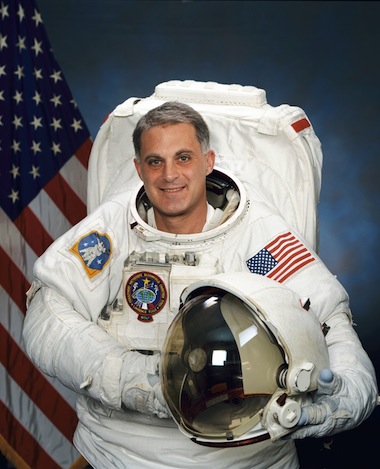
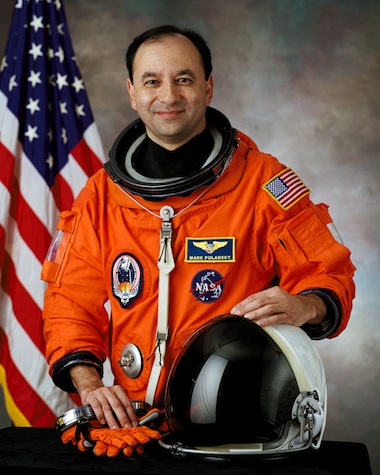
To mark the 50-year milestone of the moon landing, the Jewish Independent interviewed three Jewish astronauts: Jeffrey Hoffman (the first Jewish male astronaut in space), David Wolf and Mark Polansky.
* * *
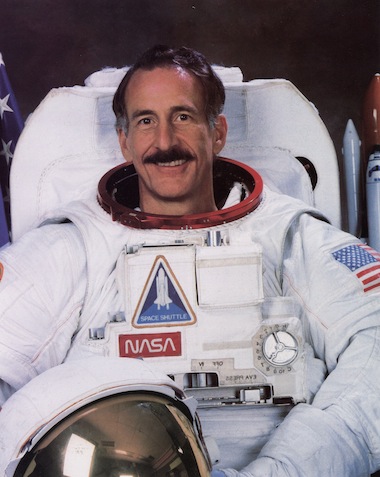
Hoffman was sent on five missions, the first in 1985; the last in 1996. In 1993, he repaired the Hubble Space Telescope. He logged more than 1,000 hours (the first to do so) and 21.5 million miles in space.
JI: Did you always want to be an astronaut?
Jeffrey Hoffman (photo from NASA)
JH: Well, if you asked in 1962 … any red-blooded young American boy, or probably Russian boys, for that matter, what they wanted to be when they grew up, 90% would say astronauts. I recognized that all of the early astronauts were military test pilots, and it was not a career I was interested in. I never considered it a realistic career prospect, but it was something I was always fascinated by.
In the late ’70s, NASA was developing what was then the brand new Space Shuttle, which had a crew of up to seven and they only needed two pilots. So, when they put out the first call for shuttle astronauts, all of sudden there were two types of astronauts now they were looking for. They were looking for the pilots, who were the traditional test pilot astronauts just like it had always been in the program, but they were also looking for scientists, engineers, medical doctors…. I all put in an application, and I was lucky enough to get selected.
JI: What was a highlight in space?
JH: The first highlight was riding a rocket into space, which fulfilled a childhood dream. But, the most memorable was, for every shuttle flight, two crew members were trained to use the space suits, just in case something happened. We weren’t planning on doing one on our flight, but one of our satellites malfunctioned and they sent me and my partner out to do what was, for NASA, the very first ever unplanned spacewalk. That was just an extraordinary experience.
JI: How did you get the idea to spin a dreidel in space?
JH: Before my first flight, my rabbi (Shaul Osadchey) asked me if I was interested in taking Jewish artifacts up. There were several dreidels I took up, one from the synagogue. I also took a mezuzah (donated to the Jewish Museum in New York), a Torah, both tallits from my two sons from their bar mitzvah, and a menorah, which is still at the front door of the science museum in Jerusalem. While I was in Jerusalem, I met a couple of Jewish artists who had read about me, a Jewish astronaut who took Jewish things into space. I had planned on being in space during Chanukah and one thing led to another and they presented me with a dreidel and a traveling menorah. It is a beautiful dreidel. It simply would not stop spinning!
JI: What did you do with the other Jewish stuff?
JH: There are only bunks for half the crew, with little places where you would sleep at night, and so we would share those with someone on the other crew. Well, I had a mezuzah with me. Of course, you can’t nail a mezuzah to the door when you are in a spacecraft; you have to use Velcro. So, I put it on the inside of my little sleep compartment and I would remove it every morning, because I figured this was for me and I didn’t want to impose on someone else who might not know what it is about. Fourth day of the mission, the guy who had been using my bunk at night said, “Hey, Jeff, that’s a nice idea putting the mezuzah in there!” I slapped my forehead…. It was Scott Horowitz, another Jewish astronaut. So, after that, we just left the mezuzah Velcroed to the wall for the both of us.
JI: Did you know Ilan Ramon?
JH: I knew Ilan, and had numerous contacts with his wife, Rona, since Ilan’s death. Although he was a payload specialist astronaut – a non-professional astronaut, on a crew for a special reason, for only one flight – he was totally accepted into the astronaut office culture. A large part of this is because his heroism as an Israeli Air Force pilot impressed the pilot astronauts, and another large part was because he was a genuinely likable person.
* * *
Wolf had four missions from 1993 to 2009, with more than 4,000 hours in space, 168 days in orbit on the space station Mir and seven spacewalks. He was the chief engineer for the orbital medical facility and chief scientist for the International Space Station (ISS) National Laboratory bioreactor (tissue-engineering) program. He conducted a number of experiments and studies, including advanced microgravity tissue-engineering techniques.
JI: How did you become an astronaut?
David Wolf (photo from NASA)
DW: I’d been flying in the F4 Phantom in the international guard for many years and had that air force background; I had this mix of medicine, engineering and flying. I wound up in a very unique situation as an astronaut because I had been at NASA for nine years already, building instruments for the shuttle and the space station. Interestingly enough, I went to NASA as a bioengineer and a flight surgeon initially. I was the chief engineer for what became the health medical facility on the space station.
JI: What was terrifying about being in space?
DW: I was trapped outside the airlock on a spacewalk in a Russian space suit in a Russian spacecraft. The airlock was never recovered. It wouldn’t repressurize, so we had to ditch into another module. [It] took like 14 hours; we were [brought in] at the last second. I have had three total power failures of a spacecraft.
JI: Now tell me about the Jewish aspects.
DW: We Jewish astronauts do consider ourselves as representing the Jewish community. We take it seriously. I carried a mezuzah and it’s on my door now. I also carried a yad, a Torah pointer, and gave it to my synagogue in Indianapolis. I had a small menorah up there. I have the world-record dreidel spin.
JI: You might want to ask Hoffman about that.
DW: Hoffman and I are having a running battle, a running argument, on who has the longest dreidel spin. But I know mine went for like an hour and a half until it got sucked into an air intake. It was just floating there spinning.
JI: Did you know Ilan Ramon?
DW: We were good friends, and his office was right down the hall, a few doors down. He was one of the very finest that we ever saw come through. And Israel should be totally proud of providing that kind of quality to the astronaut office.
* * *
Polansky was sent on three missions – in 2001, 2006 and 2009 – all of which contributed to assembly of the ISS. He has logged nearly a thousand hours in space, and served as director of operations at the Gagarin Cosmonaut Training Centre in Star City, Russia. His initial flight was notable for several firsts: the first shuttle to dock with the ISS, the first time that a total of 13 crew members lived and worked onboard the ISS at the same time, and the first time that an astronaut/cosmonaut from every ISS partner agency was in orbit together.
JI: When did you decide to become an astronaut?
Mark Polansky (photo from NASA)
MP: I was 13 when we landed on the moon and I got inspired and thought about becoming an astronaut. I’m old enough to remember that everything came to a screeching halt. The teacher would roll in a rickety old black-and-white TV on a stand and plug it in, and pull out rabbit ears….
I was a freshman in college in ’74 and I was living in a dormitory at Purdue University with, of all people, David Wolf, and Gene Cernan came to campus to give a talk. Imagine yourself as a freshman in college being about five feet away from a man who walked on the moon – I still have goosebumps about that. And that led me down a road which went to the air force and beyond to eventually get where I got.
JI: What was a highlight of being in space?
MP: You go over places, especially when you orbit around the Middle East, and you know what goes on, on the ground, and the horrible things humans can do to each other, and the suffering. You see none of that from there. You get this feeling of, it’s almost both hope and sadness. It gives you hope that we as a species can get past this.
JI: Given past disasters, were you afraid?
MP: Flying high-performance aircraft, being a fighter pilot, a test pilot, unfortunately, there are times when there are going to be aviation mishaps, and it’s usually very unforgiving. You realize that, as much as you would like to make things so safe, there is no such thing as absolute safety, where you never get hurt. You don’t want to get hurt in an aviation accident? Well, don’t fly airplanes. I always knew there was a lot of risk to it.
I got to meet a lot of the people who were working on the hardware. This was a calling for them. They could have made a lot more money working in another industry, but they were there because they just lived and breathed working on Space Shuttles, doing everything they could to make sure those Space Shuttles were as safe as they possibly could be.
JI: Did you know Ilan Ramon?
MP: I knew Ilan Ramon and, when he came over, he was flying with a couple of classmates of mine. After that tragedy, I spoke on behalf of the agency at a reception they had in Los Angeles, about Ilan. He was just a normal, great guy, and a man of peace.
** *
Other Jewish astronauts:
Jerome Apt: Four missions, 1991 to 1996. Author of Orbit: NASA Astronauts Photograph the Earth (National Geographic Society). Received the NASA Distinguished Service Medal in 1997. In 2012, the International Astronomical Union approved the name “Jeromeapt” for the main-belt asteroid 116903.
Martin Fettman: 1993 mission. Has published more than 100 articles in refereed scientific journals.
Scott J. Horowitz: three missions, 1996-2001. Four Space Shuttle flights. A retired U.S. air force colonel.
Garrett Reisman: 2008 and 2010 missions. Joined SpaceX in 2011 as a senior engineer working on astronaut safety.
Gregory Chamitoff: 2008 and 2011 missions. The Lawrence Hargrave Professor of Aeronautical Engineering at the University of Sydney, Australia; professor of engineering practice in aerospace engineering at Texas A&M University.
Ellen Louise Shulman Baker: three missions, 1989-1995, the last of which was the first Space Shuttle mission to dock with the Russian space station Mir, and involved an exchange of crews. Logged almost 700 hours in space.
Marsha Ivins: five missions, 1990-2001. Spent 55 days in orbit, on missions devoted to such diverse tasks as deploying satellites, conducting scientific research, and docking with Mir and the ISS.
John M. Grunsfeld: five missions, 1995-2002. In January 2012, returned to NASA and served as associate administrator of NASA’s Science Mission Directorate.
Judith Resnik: first Jewish American and the first Jewish woman in space. Died on Challenger, January 1986.
Dave Gordonis a Toronto-based freelance writer whose work has appeared in more than 100 publications around the world.