Skip to content
  • Home
  • Subscribe / donate
  • Events calendar
  • News
    • Local
    • National
    • Israel
    • World
    • עניין בחדשות
      A roundup of news in Canada and further afield, in Hebrew.
  • Opinion
    • From the JI
    • Op-Ed
  • Arts & Culture
    • Performing Arts
    • Music
    • Books
    • Visual Arts
    • TV & Film
  • Life
    • Celebrating the Holidays
    • Travel
    • The Daily Snooze
      Cartoons by Jacob Samuel
    • Mystery Photo
      Help the JI and JMABC fill in the gaps in our archives.
  • Community Links
    • Organizations, Etc.
    • Other News Sources & Blogs
    • Business Directory
  • FAQ
  • JI Chai Celebration
  • JI@88! video

Recent Posts

  • Story of Israel’s north
  • Sheltering in train stations
  • Teach critical thinking
  • Learning to bridge divides
  • Supporting Iranian community
  • Art dismantles systems
  • Beth Tikvah celebrates 50th
  • What is Jewish music?
  • Celebrate joy of music
  • Women share experiences 
  • Raising funds for Survivors
  • Call for digital literacy
  • The hidden hand of hate
  • Tarot as spiritual ritual
  • Students create fancy meal
  • Encouraging young voices
  • Rose’s Angels delivers
  • Living life to its fullest
  • Drawing on his roots
  • Panama City welcoming
  • Pesach cleaning
  • On the wings of griffon vultures
  • Vast recipe & story collection
  • A word, please …
  • מארק קרני לא ממתין לטראמפ
  • On war and antisemitism
  • Jews shine in Canucks colours
  • Moment of opportunity
  • Shooting response
  • BC budget fails seniors
  • Ritual is what makes life holy
  • Dogs help war veterans live again
  • Remain vital and outspoken
  • An urgent play to see
  • Pop-up exhibit popular
  • An invite to join JWest

Archives

Follow @JewishIndie
image - The CJN - Visit Us Banner - 300x600 - 101625

Byline: Dave Gordon

Politicians speak at AIPAC

Politicians speak at AIPAC

Clockwise, from top left: U.S. Vice-President Mike Pence, Joe Lieberman, Senator Marco Rubio and Senator Cory Booker address attendees of last month’s AIPAC Policy Conference. (photos by Dave Gordon)

U.S. Vice-President Mike Pence, in addition to other ranking American politicians, spoke of their unwavering support for the Jewish state to 18,000 people at the American Israel Public Affairs Committee (AIPAC) Policy Conference, in Washington, D.C., March 24-26.

Speech themes revolved around recent rocket attacks against Israeli civilians, the Golan Heights being recognized as Israeli sovereign territory by the United States, and sanctions against Iran. Every official who mentioned BDS, the boycott, divestment and sanctions movement against Israel, condemned it.

Much was said about the Democratic congresswoman from Minnesota, Ilhan Abdullahi Omar. Her statements – including “Israel has hypnotized the world” and that AIPAC has influenced U.S. policy through money – have been interpreted as antisemitic by some Jewish leaders.

Pence said, “History has already proven [Donald Trump] to be the greatest friend of the Jewish people and the state of Israel ever to sit in the Oval Office of the White House.”

Among the pro-Israel bona fides of Trump, Pence said the United States shut down the Washington branch of the Palestinian Authority as a consequence for funding terror; ended tax dollar funding for United Nations-funded Palestinian schools; moved the U.S. embassy to Jerusalem; and recognized the Golan Heights as Israeli territory.

“We stand with Israel because her cause is our cause, her values are our values,” he said.

In addition, Pence talked about the end of the “disastrous nuclear deal with Iran” that has been replaced with “a maximum-pressure campaign” of sanctions, thereby causing Iran’s economy to dip.

“There’ll be no more pallets of cash to the mullahs in Iran,” he said.

In a swipe across the political aisle, Pence said, “It’s astonishing to think that the party of Harry Truman, which did so much to help create the state of Israel, has been co-opted by people who promote rank antisemitic rhetoric and work to undermine the broad American consensus of support for Israel.”

Without mentioning her name, he referred to Omar as “a freshman Democrat in Congress” who “trafficked in repeated antisemitic tropes.”

Former U.S. ambassador to the UN Nikki Haley’s first comments were about what she believes is the UN’s hypocrisy.

“You know, what’s interesting is, at the UN, I can guarantee you this morning it is radio silent,” she said, in reference to the rocket attacks from Gaza into Israel. “They are not saying anything about Hamas, they’re not saying anything about the lives lost, they’re not saying anything. But, if it was any [other] countr[y], they’d be calling an emergency Security Council meeting.”

David Friedman, U.S. ambassador to Israel, claimed that Trump is “Israel’s greatest ally ever to reside in the White House” and, to those who think otherwise, “please, take a deep breath and think about it some more.”

How America is now sanctioning Iran was one example of an Israel-friendly policy. Friedman criticized the previous administration for paying the Islamic Republic $100 billion in the hopes that country would “self-correct.”

“What did Iran do with all its newly found treasure?” he asked. “Did it build up its civilian institutions? Did it improve the quality of life of its citizens?” Instead, he said, it “doubled down on terrorist activity in Yemen, in Iraq and in Lebanon. It increased its stock of ballistic missiles and it invested in military bases in Syria, on Israel’s northern border.”

photo - Protesters at this year’s AIPAC Policy Conference, in Washington, D.C., last month
Protesters at this year’s AIPAC Policy Conference, in Washington, D.C., last month. (photo by Dave Gordon)

Israeli Prime Minister Binyamin Netanyahu delivered an address via satellite, initially planning to take the podium in person, but returning to Israel to deal with the rocket attacks.

“The Golan Heights is indispensable for our defence,” he said of the recognition by the United States of the northern land seized by Israel in the Six Day War, in 1967. “It’s part of our history. When you put a shovel in the ground there, what you discover are the ruins of ancient synagogues. Jews lived there for thousands of years and the people of Israel have come back to the Golan.”

Netanyahu said he thought comments like Omar’s are antisemitic.

“Again, the Jews are cast as a force for evil,” he said. “Again, the Jews are charged with disloyalty. Again, the Jews are said to have too much influence, too much power, too much money. Take it from this Benjamin, it’s not about the Benjamins.”

In the session Canada’s Relationship with Israel, the panel included Liberal member of Parliament Anthony Housefather, Conservative MP Erin O’Toole and former Conservative foreign minister John Baird.

Housefather said he believes Israelis do not think there’s a negotiating partner for peace, but they share some blame in the conflict: “The more they create settlements, the less likely there will be peace … they should think carefully before expanding settlements.”

A questioner asked him when the Canadian prime minister would do something “real” for Israel and Housefather noted that, in recent weeks, Prime Minister Justin Trudeau forcefully condemned the BDS movement in a town hall meeting.

Another audience member asked why the Trudeau government continues to fund the United Nations Relief and Works Agency. While acknowledging that UNRWA has “curricula problems” that involve “anti-Jewish, anti-Israel comments, misogynistic comments and anti-gay comments,” he said that the $50 million in funding was just.

Housefather said he had spoken with the head of UNRWA and voiced his “concerns at the slow pace they are making changes in the curricula,” but added that their schools make children “a lot less likely to become terrorists against Israel.”

“Yes to helping them with UN aid programs; no to funding their schools,” said O’Toole. And Baird agreed.

On the topic of a peace plan, O’Toole said he “kept hearing from Palestinians their want for a ‘one-state solution,’” while their government “exerts violence, and does not take care of the needs of their people.”

“I think you’ll see from Israeli leaders that they’re prepared to experience real pain [in concessions],” Baird said, but “Palestinians have to stop the incitement” and the “hate-mongering.”

While several candidates for the Democratic party’s 2020 presidential nomination skipped the conference, leading Democratic figures were prominent at AIPAC, including House Speaker Nancy Pelosi, who insisted no one will be permitted to make Israel a partisan wedge issue.

Dave Gordon is a Toronto-based freelance writer whose work has appeared in more than 100 publications around the world.


Format ImagePosted on April 12, 2019April 10, 2019Author Dave GordonCategories WorldTags AIPAC, Anthony Housefather, antisemitism, BDS, Binyamin Netanyahu, David Friedman, Diaspora, Erin O’Toole, Israel, John Baird, Mike Pence, politics
A tour full of misinformation

A tour full of misinformation

The market in Jenin. (photo by Dave Gordon)

Everything is political in Israel; there’s no escaping it. Pick a corner, a street sign, a building, there’s potential for argument. So, you can imagine what it’s like to take a tour of an area as contentious as the West Bank, which, thankfully, was quiet with respect to violence when we visited. Not surprisingly, our guide almost took on the role of spokesperson for the Palestinian Authority.

Abraham Hostel, in the heart of Jerusalem, offers a three-day West Bank tour. The tours include Nablus (biblical Schechem), Jenin and the refugee camp that borders it, Jericho, Ramallah and Bethlehem.

It was eye-opening for me. For one, the media frequently portrays Palestinians in the West Bank as living in squalor, often involved in conflicts with the Israel Defence Forces. We saw bustling markets, shopping centres, corporate plazas, sports cars, and plenty of American restaurant franchises, such as KFC and Pizza Hut.

Our tour guide was a wannabe biblical scholar and archeologist. “Personally,” he told us, “there could never have been a Jewish Temple.” It’s impossible, apparently, to build on top of solid rock, he explained.

He gave a brief history of the term Palestine, correctly stating that Roman invaders, Vespasian and Titus, in the first century, renamed the region from Israel/Judah. But why, particularly, call it Palestine? “Hmm,” he said, taking a moment to think. “Because they liked the name.” Not, as many scholars believe, because the Romans sought to call the area after the Jews’ sworn enemy, Philistines, to rub salt in the wounds.

While at Bethlehem’s Church of the Nativity, our guide gave his take on the Gospels, contending that it wasn’t the case that Jesus’s mother, Mary, couldn’t find a room at an inn – rather, the Jews forbade Mary to have a room because she was ritually unclean after childbirth. And that, he said, was the unwritten explanation of the manger/barn scenario.

He then proffered his views on Jews. “Since anyone can become a Jew,” he said, “they’re not really tied to the land.” Meaning that anyone who has converted, or was born to converts, has no connection to Israel.

And, he added, since the parcel of land called Judah, from which the name “Jew” was derived, was only a fraction of modern Israel, today’s Jews should only have rights to those ancient borders.

Quoting the Torah – “if you bless Israel, you are blessed; if you curse Israel, you will be cursed” (Genesis 12) – our guide insisted that the “Israel” referred to in this verse has never meant “the nation of Israel” (which it does), but only refers to the patriarch Jacob, who was later named Israel. The underlying message was that there was no concern about being cursed if you curse Jews.

For good measure, he asked, pointing toward the refugee camp, “Doesn’t it say ‘love your fellow’ in the Torah? That’s one of the top commandments.”

Almost no tour anywhere is complete without the commercial aspect – wandering through the souvenir shops and markets.

At the ice cream shop, our guide claimed, “Palestinian ice cream is made with real cream, not like the Israeli version!” At the spice store, he spoke about how Israelis use cheap ingredients in their Zaatar, but not Palestinians. And, he said, “Even Israelis agree that Palestinian beer is better than the sewer water in a can they make.”

photo - Yasser Arafat mausoleum in Ramallah
Yasser Arafat mausoleum in Ramallah. (photo by Dave Gordon)

The hero worship of Yasser Arafat was astounding. Virtually every street corner in Ramallah had a wall-sized poster of him. My trip was in November, so these displays were likely timed for the anniversary of his death. Schoolchildren took a field trip to his tomb in Ramallah for a commemoration and photo opportunities.

Our guide made every effort to politicize the tour, down to the free lunch. He said there wasn’t such thing as “Israeli couscous,” only co-opted “Arab-Palestinian couscous.” Scholars and culinary experts differ, saying that Israeli couscous was created in the 1950s in response to food rationing. Alas, more was still to come from our guide.

While he had our attention, he showed us illustrations of how Palestine in 1947 comprised modern Israel and the West Bank, while today, the Palestinians only have small, scattered autonomous dots in the Palestinian Authority. As for the Palestinian part in this development, he said, “just a couple of bus bombs” derailed the peace process, but only temporarily.

Dave Gordon is a Toronto-based freelance writer whose work has appeared in more than 100 publications around the world.

Format ImagePosted on April 12, 2019April 10, 2019Author Dave GordonCategories Israel, TravelTags Judea-Samaria, West Bank
Helsinki’s many places to see

Helsinki’s many places to see

Helsinki Synagogue, in the heart of the city, was built in 1906. (photo by Dave Gordon)

Helsinki’s a city where you can experience high adventure, or simply chill, by taking in the sites on an easygoing walking tour. Elements of bustling metropolis meld with the laxity of a rural town, depending on which turn you take.

Home to some 1,400 Jews of Finland’s approximately 1,800-strong Jewish community, it is not a particularly large city, enabling a tourist to take in much of the core in a very short period of time. And it’s a treat for the eyes – modernity meets medieval, where whole city blocks are infused with colonial Swedish or Russian architecture, rich with history and stunning detail.

photo - Preserves and juices in the market in Helsinki
Preserves and juices in the market in Helsinki. (photo by Dave Gordon)

So, take it slowly. Walk along Norra Esplanade from the waterfront for a couple of kilometres and enjoy a wide array of boutique shops, dining options, cafés and the general feel of the city.

Stroll along Market Square, next to city hall, to get snapshot of local crafts and fare. It’s brimming with booths and kiosks – merchants peddling their wares. Drink fresh squeezed cloudberry or sea buckthorn juice (high in protein, vitamins C and E, and organic acids). Bring home an array of tchotchkes, like handmade knitted slippers, hats and sweaters. Nosh on reindeer jerky. Check out the bookmarks made with reindeer hide, and keychains made with reindeer antlers.

For investors and business, Helsinki is the latest start-up hub.

The city leapt from 43rd place in 2017 to 28th in 2018 in high-tech start-up successes among European and Scandinavian nations. The mega-conference for tech start-ups, Slush, takes place here, gathering 20,000 people. And, one of Europe’s biggest start-up campuses is about to be built, at 70,000 square metres.

Among the disruptors attracting global attention are Leadfeeder (analytics), ContractZen (one-click-cloud contracts), Smarp (shareable content hub), Utopia Analytics (artificial-intelligence monitoring of online discussion) and Hoxhunt (corporate security).

***

Finland is home to three Jewish institutions. Helsinki Synagogue, in the heart of the city, was built in 1906, and now serves about 1,200 congregants. Turku Synagogue was built in Turku in 1912, and has a few hundred members between the city and its surrounding areas. Both shuls are Ashkenazi Orthodox.

Helsinki Synagogue, with its bronze-coloured Byzantine-style dome, also houses a mikvah, a Talmud Torah and a playground. The congregation uses, not surprisingly, bilingual prayer books, in Hebrew and Finnish.

Meanwhile, Chabad Lubavitch of Finland is building a centre next to the city’s Presidential Palace, where they will offer classes, a daycare, a summer day camp and other services. Kosher meals are available through a handful of stores and organizations. Fazer, a local company that makes chocolate and cheeses, doesn’t have a hechsher (kosher certification), but is accepted by the community’s rabbinical authorities as kosher to consume.

The first Jew to officially plant roots in the country is recorded as Jacob Weikman, in 1782, despite the government ban on Jewish residence at that time. By the 1830s, there were enough Jewish soldiers to fill a makeshift chapel at the military base Suomenlinna Fortress, reports Hadassah magazine.

Many of today’s Finnish Jews are believed to be descendents of Russian infantrymen stationed there about 150 years ago.

During the Second World War, it was a complicated relationship for the Jews, many of whom fought with the Finnish army against the Soviets and, later, against the Nazis.

Finland openly defied the Nazi order to deport its 2,300 Jews, according to Yad Vashem. There was, however, a small exception: officials in 1942 allowed the Nazis to apprehend eight Jewish refugees. In 2000, a stone monument to memorialize the seven who died was erected by the government, at the park on Tähtitorninmäki (Observatory Hill).

But new evidence suggests that at least six soldiers of Finland’s army partook in the Final Solution. In January 2018, it was reported by JTA that an investigation had been launched by the Finnish government after the Finnish Society of Church History apparently found written testimony from one of the soldiers of his complicity. More than a year later, it seems that no results from the probe have been announced.

***

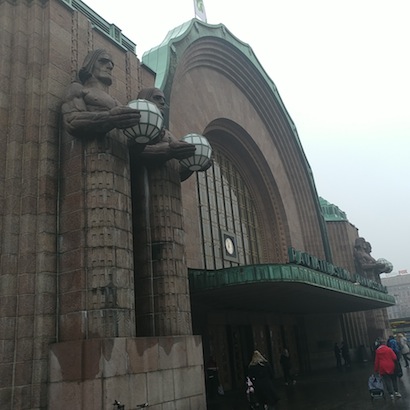
photo - Helsinki’s train station
Helsinki’s train station. (photo by Dave Gordon)

More history and culture can be found at the National Museum of Finland. Until Sept. 1, the temporary exhibition Inherit the Dust – Photographs by Nick Brandt is on display, offering an idea of the damage human beings are doing to the environment. Permanent exhibitions at the museum include Prehistory, a multisensory experience that allows visitors to “[t]ouch a genuine reindeer axe, bring a cave painting to life and see a mammoth move. The digital exhibits bring history to the present day.”

The museum of contemporary art, Kiasma, at just 20 years old, has some 8,000 works in its collection, and about 100 are added annually. Here, you can get a great feel for Finnish architecture from the building itself and, with renovations starting this year, the fence blocking off the area under repair has been covered with poster art.

***

There are many other places to visit, of course.

Allas Sea Pool, next to Market Square, is where locals go after work to exercise or relax. The Olympic-size outdoor pool is heated, having a calming effect on the body, while visually, the mist hovers at eye level as it collides with the cool air. Meanwhile, the “sea water pool” – filtered and treated with UV rays – is water straight from the ocean, chilly and punchy. Think of it like the famed “polar dive.”

Want to tap the inner child in you? The grown-up playground (the name of which is too difficult to spell, let alone pronounce) is a “sports acrobatics” centre with trampolines, bouncy airtrack, foam pits, sprung floor and more.

Arkadia International bookshop is a cultural icon in the city, featuring nightly concerts of every kind of music, as well as a venue simply to enjoy a cuppa joe, play a board game or shmooze with friends.

Takeoff Simulation is where you can “fly” a commercial airliner in a flight simulator the size of a real Airbus A320. It includes high-definition visual screens, real sounds and a highly detailed cockpit.

Dave Gordon is a Toronto-based freelance writer whose work has appeared in more than 100 publications around the world.

Format ImagePosted on March 8, 2019March 6, 2019Author Dave GordonCategories TravelTags culture, Helsinki, Judaism
A Nazi who saved Jews

A Nazi who saved Jews

One of the apartment buildings at the HKP complex. (photo from Richard Freund)

Nearly three-quarters of a century after the Shoah ended, we are still learning about aspects of what happened. For example, the documentary The Good Nazi tells the little-known story of a Nazi from Vilna who tried to rescue more than 1,200 Jews. It airs on VisionTV Jan. 21, and again April 29.

In 2005, Dr. Michael Good sought out Prof. Richard Freund of the University of Hartford to tell him about Maj. Karl Plagge, a Nazi who oversaw a military vehicle repair complex that was used as cover for 1,257 Jews in Vilnius (Vilna). Good described how his father, mother and grandfather were saved within this complex, and later wrote about it at length in his 2006 book The Search for Major Plagge: The Nazi Who Saved Jews (Fordham University Press).

While interesting to Freund, who works within a department known for its Holocaust studies, nothing further came of that meeting. That is, until 2015.

By then, Freund had directed six archeological projects in Israel and three in Europe on behalf of the university, including research at the extermination camp at Sobibor, Poland. In 2015, he was in Lithuania doing research on a Holocaust-era escape tunnel, adjacent to the Great Synagogue of Vilna. He and his team had brought with them specialized equipment that enabled non-invasive examination of the ground and walls, and they offered it to anyone wanting to do such research. The Vilna Gaon State Jewish Museum came calling, and brought Freund to a site on the outskirts of Vilna, where he was told about Plagge.

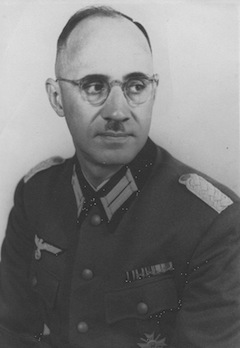
photo - Nazi Maj. Karl Plagge oversaw a military vehicle repair complex that he used to try and save 1,257 Jews in Vilnius
Nazi Maj. Karl Plagge oversaw a military vehicle repair complex that he used to try and save 1,257 Jews in Vilnius. (photo from Richard Freund)

Of that moment, Freund told the Independent, “I’m sitting there and I say, ‘Karl Plagge? I know that name!’”

Freund connected with survivor Sidney Handler, who was 10 years old when he hid from the Nazis in the work camp. After the Nazis left in July 1944, Handler was forced to move dead bodies, and could point out decades later where 400 Jews were buried.

“We could have gone through the entire 20 acres and not located exactly where that was,” said Freund.

Using scanners, thermal cameras, radar and other methods, Freund’s team discovered and recorded the various hiding places, also called malinas. Under Plagge’s plan, Jews had built malinas in building crevices, behind the walls, to keep out of sight when Nazis came to “liquidate” the complex.

The garage (repair shop) was dubbed HKP. It was on Subocz Street and is likely the only Holocaust-related labour camp left completely intact. Until recently, people had been living in the two six-floor buildings, which comprised 216 apartments.

Freund reached out to filmmaker Simcha Jacobovici, telling him how important it was to document the site, the story, and reveal it to the world. Things were made all the more pressing when Freund and Jacobovici discovered that developers were going to demolish the site. Fortunately, before this happened, Jacobovici took a film and photographic crew to HKP, in January 2018.

The Turning of Plagge

In 1941, Karl Plagge was placed in command of the HKP 562, a unit responsible for repairs of military vehicles damaged on the eastern front. Plagge experienced something of a pang of conscience – he hadn’t signed on to genocide. He made the decision to leverage his position and use Jews as “slave labour” for HKP, pleading the case to his superiors that, if Jews didn’t work there, there would be no one to fix the vehicles.

Virtually none of the 1,200 Jews was knowledgeable in fixing cars; they were accountants, lawyers, hairdressers, academics, cooks and others. They all learned various HKP tasks on the job, and Plagge somehow convinced the Nazi SS that every single one of them was necessary for HKP.

Even though the entire charade was met with a barely tolerated wink and nod by Nazi brass, Plagge had a deep (and correct) hunch that their patience would eventually wear thin.

Heinrich Himmler, the head of the SS, announced, in the summer of 1943, that he wanted every Jew in Eastern Europe eliminated, irrespective of whether they were contributing to the war effort in a work camp. So, with Plagge’s approval, his workers carved out malinas in the walls of the buildings and in attic rafters.

As the Soviet Red Army approached the outer edge of Vilnius in June 1944, it was a sign that the Allies were nearing victory. In this context, on July 1, 1944, Plagge made an impromptu announcement in front of an SS commander and the Jewish workers, who gathered to listen. He explained that his unit was being transferred westbound and, though he requested his labourers be allowed to join, his superiors wouldn’t permit it. All of this was code for the Jewish prisoners to take cover. Roughly half of the workers – some 500 of them – hid away in malinas or ran from the camp, while others decided to stay.

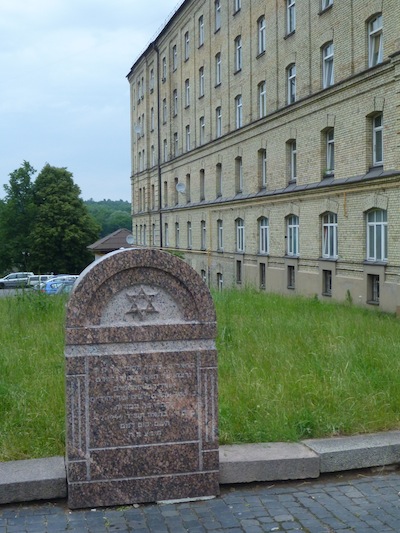
photo - A monument placed recently at the complex to honour Karl Plagge and memorialize the Jews who were killed at HKP
A monument placed recently at the complex to honour Karl Plagge and memorialize the Jews who were killed at HKP. (photo from Richard Freund)

When Nazi troops took over the camp two days later, 500 Jewish workers appeared for roll call, and were killed. It took the Nazis three more days to comb the camp and the surrounding area for any survivors, eventually finding roughly 200 Jews, all of whom were shot.

When the Soviets finally took over Vilnius later that week, approximately 250 of HKP’s Jews in hiding emerged.

When the war was over, Plagge returned home to Darmstadt, Germany, where, for the next two years he lived quietly, until he was brought to court as a former Nazi. Somehow, word traveled to a displaced persons camp in Stuttgart, a three-hour drive away, where many survivors of HKP had ended up. In Plagge’s defence, the survivors sent a representative to testify to the court in the hopes the charges would be overturned.

The testimony resulted in a favourable judgment, and Plagge received the status of an exonerated person. In 2005, after evidence and survivor testimony, Yad Vashem: The World Holocaust Remembrance Centre posthumously bestowed the title Righteous Among the Nations on Plagge.

The Good Nazi was produced in Canada for VisionTV by Toronto-based Associated Producers. Jacobovici was writer and executive producer, Moses Znaimer executive producer, Bienstock producer and co-director, Yaron Niski co-director and Felix Golubev line producer/executive producer.

Dave Gordon is a Toronto-based freelance writer whose work has appeared in more than 100 publications around the world.
Format ImagePosted on January 11, 2019January 17, 2019Author Dave GordonCategories TV & FilmTags documentary, Holocaust, Karl Plagge, Nazis, Righteous Among the Nations, VisionTV, Yad Vashem
Whisky’s ready to be poured

Whisky’s ready to be poured

Milk and Honey Distillery was established in 2012. (photo by Dave Gordon)

The Milk and Honey Distillery’s first three-year-old batch of whisky is about to be officially tapped, to appear in 150 locations across Israel, as well as the Netherlands, Belgium and Luxembourg. And plans are in the works to bring the product to North America. Current output is estimated at about a million bottles.

Milk and Honey’s founders sought to piggyback on what appears to be a trend of people wanting to try certain drinks from places that are not typically known for making them.

“Whisky consumption is seeing a big shift happening all over the world now,” Milk and Honey chief executive officer Eitan Attir told the Independent.

For decades, four countries have ruled the whisky industry – Ireland, Scotland, United States and Canada. But many customers are seeking uniqueness.

“It’s what we call a ‘new world’ whisky,” said Attir. “So, now you can find more and more countries, that never had a history of whisky, doing it.”

Proof of Israel’s new world whisky popularity was evident even before the first ounce of Milk and Honey’s product was officially available. In 2017, the distillery filled 391 bottles with its initial three-year-old whisky single malt. Head distiller Tomer Goren created the batch in his workshop, and it was aged in the distillery.

Bottles numbered 1 through 100 were sold on the Whisky Auctioneer website and more than 30,000 people bid on the bottles. The “number one” bottle was bought for $3,000 US and number two, about $2,500 US. The rest were sold for about $750 US each. Stock sold out in three months.

“That was a huge surprise, not only business-wise, but also the attention it got,” Attir said. Several media took notice: the New York Times, Boston Herald, CNBC and NBC, among others.

Fast forward a year to 2018, and the company’s “triple cask” – a combination of previously red wine, bourbon and Islay barreled whisky – won best in show and second place at Whisky Life Tel Aviv. Its competitors were 15-, 18- and 20-year-old beverages from many different popular brands.

How Milk and Honey got there was as much a blend of perfect ingredients as a premier blended whisky.

In 2012, the company was started by Gal Kalkshtein, Milk and Honey’s owner, and five friends, all previously in the Israeli tech and startup industry. With their million-dollar investment, the friends turned a former bakery into a distillery in 2014. (For more on the distillery, see jewishindependent.ca/israels-first-whisky-distillery.)

“We were the first ones here, so there really was no one to ask about how to build a distillery. So, they traveled all around Scotland and studied a lot,” said Gal Levin, manager of the visitor centre, who oversees business development.

Then came the parts: a tailor-made whisky pot still and a vintage still, each constructed in accordance with Scottish coppersmith tradition. The wash drum was found online, on a German website – it was sitting in a barn in Romania (Transylvania, to be exact).

“The guys traveled all the way there to see it and buy it,” said Levin. “They weren’t sure it was going to work. They bought it, brought it here, and fixed it. We still don’t know who made it and for what. It’s mysterious. It’s working, and that’s the most important thing.”

During renovations, they began tinkering with what recipes to use. In 2013, they hired two professionals. One was Scottish master distiller Dr. James Swan, who guided the company on research and development. His experience included advising distilleries and brands all over the world, from Jim Beam to Chivas. As well, he had expertise in aging and distilling in other hot climates, like Taiwan and India.

The second person hired was Goren, who was studying for his master’s distiller degree in Scotland. (He is also a judge at international whisky competitions.)

“We chose to adopt very strict regulations of the Scottish method, that allows us to connect with the Scottish tradition, and also so our whisky will be considered ‘whisky’ in many places around the world,” said Levin.

photo - Milk and Honey Distillery makes whisky, gin and a liqueur
Milk and Honey Distillery makes whisky, gin and a liqueur. (photo by Dave Gordon)

Whisky, by definition, is made with four ingredients: malted barley, yeast, water and the barrel. Milk and Honey maintains the tradition, with no added ingredients. Barrel selection included casks previously used for bourbon, a collection of new oak barrels, and former wine barrels (all kosher).

“We are aging for a minimum of three years before we call the product ‘whisky.’ That’s an important rule. Of course, in Scotland, the whisky is called ‘scotch.’ We don’t do that,” said Levin.

As an added plus, Israel’s climate allows for relatively quicker fermentation, up to two and a half times faster than that of Scotland, according to Milk and Honey. That means an Israeli three-year bottle might taste like a six-year bottle from the Highlands.

And Milk and Honey doesn’t only make whisky – they also produce gin and a liqueur.

The gin is spiced with and inspired by Israeli ingredients. The Levantine gin, for example, contains za’atar, orange slices, lemon peels, black pepper, cinnamon, chamomile and lemon verbena. The Roots liqueur has typical Holy Land flavourings: almond, savory, coriander, jasmine, tarragon, thyme and cardamom.

With all of this deliciousness, that’s something to say “l’chaim” to!

Dave Gordon is a Toronto-based freelance writer whose work has appeared in more than 100 publications around the world.

Format ImagePosted on January 11, 2019January 9, 2019Author Dave GordonCategories IsraelTags gin, whisky
Politicon’s Jewish voices

Politicon’s Jewish voices

Ben Stein and Ann Coulter at Politicon in Los Angeles on Oct. 20. (photo by Rich Polk-Getty Images for Politicon)

From pundits to Hollywood types, there were many Jewish names on the speaker roster at this year’s Politicon, the fourth annual two-day convention in Los Angeles that ropes in high-wattage names from the left, right and centre. This year’s gathering took place Oct. 20-21.

In the panel called The Deep State, discussion revolved around the allegations of U.S. President Donald Trump’s collusion with Russia. Speakers included Dr. Vince Houghton (curator at the International Spy Museum), Dan Bongino (former U.S. secret service for George W. Bush and Barack Obama), Dr. Jason Johnson (professor at Morgan State University in Baltimore), former Trump aide David Urban and former George W. Bush speechwriter David Frum, a member of the Jewish community.

While Frum outlined some of the evidence on meetings and correspondences between Trump aides and various Russians, he also conceded that “there are things in collusion that are utterly reprehensible, which are not illegal.”

He said, “To what extent there was cooperation back and forth, remains unclear,” but he is convinced that the facts are quite damning.

photo - David Frum at Politicon in Los Angeles on Oct. 21
David Frum at Politicon in Los Angeles on Oct. 21. (photo by Phillip Faraone-Getty Images for Politicon)

As a counterpoint, Johnson said: “I don’t think the president has such discipline or organization to pull off this kind of thing. Hillary [Clinton] lost because she ran a bad campaign, not because of a meeting with the Russians.”

Two right-wing pundits – Ann Coulter and Ben Stein – took the stage in a session called Ask Ann Anything.

Stein, the Jewish actor whose politics date back to serving as a Richard Nixon aide, said that, if he could change any numbers about America, it would be to increase the number of better-educated individuals, as well as the number of fathers marrying the women they’ve had children with.

Coulter, often appearing on media to represent the far-right, is the bestselling author of Slander: Liberal Lies About the American Right, Treason: Liberal Treachery from the Cold War to the War on Terrorism and Godless: The Church of Liberalism, among others. Her key complaint was that Trump had yet to build the wall between the United States and Mexico, as he had promised, and she holds the left responsible for the immigration crisis.

Three generations ago, she said, “immigrants would come and 30 or 40% of them wouldn’t make it, and [would] go back home. Now, they all go on welfare. The Democrats pushed the bill that promised to [enshrine this],” she said.

The biggest surprise, she said, was that “despite all the race-baiting, Trump, as I thought he would, got more of the black and Hispanic votes than either [Mitt] Romney or [George W.] Bush … considering all of the racial incitement of the campaign.”

Three different questioners harshly criticized Coulter for avoiding debate with liberals, but Coulter dismissed them outright – “they couldn’t find a New York Times bestselling author to debate me?”

Yarmulke-wearing Ben Shapiro – who was in Vancouver for talks on Oct. 30 and 31 – covered the topics of free speech, constitutional rights and racism in America in his keynote address at Politicon.

“If my speech is violence,” said Shapiro, “and the government can shut down violence, then the government can shut down speech. This is ugly stuff.”

On the #MeToo movement and abortion, he paraphrased his opponents: “Men, sit down, shut up, you don’t know anything.” But, he said, “We can’t have a conversation if you’re simply going to assume I can’t understand you because of dint of birth … identity politics throws up a roadblock in the way of it. It prevents you from having these conversations.”

He said, “If you’re going to make a pro-choice argument, then make a pro-choice argument. An argument cannot be based on a woman knows better what constitutes life than a man.”

A questioner asked why, on YouTube, Shapiro appears to fume at ideological challengers.

“There are many more examples of me talking to the left in a respectful manner than there are tapes of me ‘destroying’ anybody,” noted Shapiro. “Those are the ones we like to watch because they’re more fun, but it’s not happening on a day-to-day basis.”

In a session called The Russian Menace, Jewish actor, director and author Henry Winkler interviewed author, terrorism expert and naval expert in cryptology Malcolm Nance. This year, Nance published The Plot to Destroy Democracy: How Putin and His Spies Are Undermining America and Dismantling the West.

After Obama was elected, said Nance, Trump and a representative of Russian intelligence exchanged private Twitter messages, with the latter expressing interest in helping the U.S. change governments. “Trump responded with a picture of double thumbs up,” noted Nance.

Winkler retorted, “Not mine!” – a reference to his Happy Days character the Fonz’s signature symbol.

According to Nance, a week after this Twitter exchange, Trump registered the trademark “Make America Great Again.” Subsequently, Trump met with Russian oligarchs in Moscow for two hours, something that should raise suspicions, Nance insisted.

At one time, he said, Russians wanted the “money and luxury” that the West had, but now they employ “an old KGB strategy” of propaganda to tear down the United States.

“You don’t go at the people by invading it,” but rather, through “fake news stories,” said Nance. “You co-opt their mind; you create a new reality for them. In the old days, they used to call that brainwashing. Today, they call it Facebook.”

Evan Sayet, who has written two speeches for Trump and is the author of Kindergarden of Eden: How the Modern Liberal Thinks, told the Jewish Independent that the panel he was on, 13 Reasons Why Not to be a Liberal, could be summed up thusly:

“Everybody in America – every ethnic group in America – blacks, Asians, Hispanics, they should all be conservative. They’re family-centric, church-goers, entrepreneurs. The left has done such a great job via the entertainment industry, schools and media, of villainizing the right. Those who vote for Democrats, don’t vote Democrats. They vote against Republicans. They are so in fear of what’s been portrayed as the right.”

Other Jews to appear as speakers or panelists at Politicon included Joel Pollak (Breitbart), Jennifer Rubin (Washington Post), author Eric Golub, NBC’s Ari Melber, comedian Ben Gleib, Bill Kristol (journalist and former chief-of-staff to vice-president Dan Quayle), TV host David Pakman, TV’s Drew Pinsky, commentator Sally Kohn, mayor of Knox County in Tennessee and former wrestler Glenn Jacobs, comedian Sam Seder, actor Richard Schiff, comedian Elayne Boosler, NBC’s Jacob Saboroff, writer Jamie Kilstein, actor Josh Malina, NBC’s Gadi Schwartz and entrepreneur Fred Guttenberg.

Dave Gordon is a Toronto-based freelance writer whose work has appeared in more than 100 publications around the world.
Format ImagePosted on November 9, 2018November 7, 2018Author Dave GordonCategories WorldTags Politicon, politics, United States
China’s increasing Israeli ties

China’s increasing Israeli ties

Israel’s IVC Research Centre concludes that, with each passing year, some 16% more companies have at least one Chinese investor. (photo by Dave Gordon)

With headlines proclaiming the largest trade war in history, the United States and China began dueling tariffs July 6, and the ongoing row threatens hundreds of billions of dollars of product distribution. But, while China has locked horns with our neighbours to the south, it is partnering more and more with Israel.

According to Thomson Reuters data, Chinese investment in Israeli corporations tripled in the past few years to $16 billion, with about $600 million directed specifically to startups. Israel’s IVC Research Centre concludes that, with each passing year, some 16% more companies have at least one Chinese investor. The Jerusalem Post has stated that it will be no time before China surpasses the United States as Israel’s main foreign investor.

The Chinese “are leveraging Israeli tech to fuel their economy. Israel is held in high esteem as a hub of innovation,” said Hagai Tal, chief executive officer at Tel Aviv-based Taptica, an Israeli mobile advertisement company. “Many Israeli companies also see important opportunities in the East, and the meeting point of these two approaches is what produces such successful business partnerships.”

Israeli Shimi Azar, who runs mobile advertising Spotad’s Asia-Pacific operations, said he has seen “China becoming an innovation power in only a few years.”

China has 232 of the world’s 2,000 largest companies, up from 43 in 2003, according to Forbes magazine. Of the top 20 technology giants, China has nine, including Alibaba, Tencent, Ant Financial, Baidu and Didi. (The United States has 11.) C-Trip International is larger than Expedia, and China produces more online sales than anywhere else, says Market Watch.

“Big cities like Shanghai or Shenzhen already feel quite Western in almost every respect so, culturally, we are becoming closer every year,” said Azar. “The younger generation is eager to learn English and travel the world, so I’m convinced that any significant cultural differences to speak of will soon be a thing of the past.”

Ronen Mense is vice-president of Asia for AppFlyer, a mobile marketing analytics and attribution platform, which went to market with an Asia-first model. “In today’s digital and mobile-first world,” he said, “the Chinese mobile market is like no other. The numbers are staggering: about 800 million mobile users, nearly 500 million users making payments with their phones, nearly $2 billion quarterly revenue in the Chinese iOS App Store – more than any other country in the world.”

Lee Branstetter, professor of economics and public policy at Carnegie Mellon University’s Heinz College, said Israel is “doing truly world-class research” in microchips, security and machinery. Adding to the reasons why China and Israel are collaborating more is the political clampdown sweeping through the United States; notably, concerns over security, trade, foreign debt and foreign corporate control.

The bilateral cooperation was echoed at the political level when Chinese President Xi Jinping and Israeli Prime Minister Binyamin Netanyahu signed a memorandum in 2015, agreeing to partner in the technology sector.

For the past four years, the China-Israel Innovation Summit has taken place with the support of their respective countries’ governments. In the past two years, two Israeli companies entered the Chinese stock exchange for the first time: Alma Lasers (bought out by XIO Group in 2013) and Sisram Medical, in part owned by China’s Fosun Pharmaceutical. Major acquisitions are now legion.

In 2016, a Chinese consortium, led by Giant Network Group, paid $4.4 billion to acquire Playtika, an Israeli video game company. A year prior, China’s XIO Group ponied up $510 million for medical device firm Lumenis.

Last year, Kuang-Chi Group – whose stated aim is to “invest in and collaborate with innovative technology projects worldwide” – announced it was looking to base its headquarters in Tel Aviv. Its chairman, Dr. Ruopeng Liu, told Forbes that it all had to do with Israel’s “global reputation for innovation,” coupled with China’s strength in the global market.

Forbes also has reported that Ogawa, a healthcare leader in China, is earmarking $10 million for wellness technology investments in Israel.

Peggy Mizrahi, a Chinese citizen who now lives in Israel, sees two nations who have a similar view of the world. Mizrahi is vice-president of Indigo Global, an Israeli boutique investment advisory firm, with activities and operations in Africa, Asia and the Middle East. She said the “Chinese are [known for] long-term planning, conservative and hierarchical, unlike the commonly recognized Israeli mindset as fast, innovative, impatient, flexible and [with a] lack of respect for authority. However, paradoxically, both countries share something deeper than that: the refugee mindset – a people suffered for decades in wars, exiles, and Holocaust, massacres; struggled for independence and peace; respect of culture, history and the power of knowledge; and, most importantly, both Israelis and Chinese believe that economic progress and technological advancement will ultimately bring peace and prosperity to the world.”

David Maman, chief executive officer and co-founder of Binah.ai, recently sold one of his companies, HexaTier, to Chinese conglomerate Huawei. According to Maman, it’s not unusual for scores of delegations each month to visit Israel from the biggest corporations in China – including Fosun, Huawei, Alibaba, Tencent and Baidu – to explore investments and other ventures with Israeli startups.

Just as sure as tech can be used for the good, one expert had concerns about increasing collaboration.

Branstetter, who served as the senior economist for international trade and investment for the U.S. President’s Council of Economic Advisers, added there must be care ensuring technology isn’t misused.

“If an American pilot were ever shot down by a Chinese missile powered by Israeli technology, it would be a real problem for the Israeli government.”

Dave Gordon is a Toronto-based freelance writer whose work has appeared in more than 100 publications around the world.
Format ImagePosted on October 5, 2018October 3, 2018Author Dave GordonCategories WorldTags business, China, high-tech, Israel, trade, United States
Champions of Jewish values

Champions of Jewish values

Left to right, Dr. Mehmet Oz, Rabbi Shmuley Boteach, Sean Spicer and Ron DeSantis, at the Champions of Jewish Values International Awards Gala in New York on March 8. (photo by Dave Gordon)

What do an American soldier, a former athlete and a former U.S. press secretary have in common? According to the World Values Network (WVN), they are all – in their own way – defenders of the Jewish people and Israel.

The Champions of Jewish Values International Awards Gala took place on March 8 in New York City at the Plaza Hotel. The event was led by well-known rabbi and author of 32 books Shmuley Boteach, director of WVN.

Several awards were given out, honouring individuals who, according to the network, have shown exemplary actions to further the causes of human rights and the defence of Israel in the public forum.

Former Olympian and reality star Caitlyn Jenner was given the Champion of Israel and Human Rights Award.

“I’ve been thinking about the Jewish community, and how it has affected me several times in my life,” she said. Her father, William Jenner, was part of the unit that liberated Buchenwald concentration camp. Later in life, he showed Caitlyn the pictures that still haunt her to this day.

Jenner broke the decathlon Olympic record in Montreal in 1976. In the 1972 Olympics in Munich, a then-22-year-old Jenner witnessed the terror activity from an adjacent dormitory.

About Israel, she said the Jewish state’s example “should be followed, as a nation that has succeeded in dissolving many of the prejudices against the trans and gay communities. It is now celebrated as having the best city in the world for gays – Tel Aviv.”

She added that Israel is one of only 19 countries where members of the trans community can serve in the army.

In an overall message of inspiration, she said, “Our communities have no borders and our love is without borders. Every person in the world deserves to receive dignity.”

The Elie Wiesel Award was posthumously given to Yonatan Netanyahu and Taylor Force. Netanyahu was killed in the line of duty in the 1976 Entebbe rescue, and Force was a U.S. soldier killed by a Palestinian terrorist in Tel Aviv on March 8, 2016, exactly two years prior to the gala event.

During his life, Wiesel, among other things, wrote the book Night, in which he narrates his own experience as a young boy in Auschwitz death camp, as well as more than 35 other publications dedicated to the subject of the Holocaust.

In introducing the award, American television show host Dr. Mehmet Oz noted, “Elie Wiesel saw a spark of dignity in everyone that he met.”

In presenting the award, Elisha Wiesel (Elie’s son), spoke about how the Force family is advocating for the cessation of American aid to the Palestinian Authority until the PA stops financially rewarding terrorist acts. It is through the Forces’ efforts that the Taylor Force Law has been passed by Congress and now only needs a signature by President Donald Trump to become law.

Accepting the awards were Yonatan’s brother, Israeli Prime Minister Binyamin Netanyahu, via a previously recorded video, and Taylor’s father, Stuart, mother, Robbi, and sister, Kristen.

“Elie Wiesel showed such devotion to our people and showed that we control our destiny,” said Netanyahu in his remarks. “Elie spoke to the soul of our consciences. He was a great warrior on the battlefield of conscience, and can inspire many of us on our own quests for justice.”

As for other honours that were given out, Florida congressman Ron DeSantis was given the Falic Family Defender of Israel Award. In his acceptance, DeSantis said he led a trip to Israel last March to look for appropriate sites for the new U.S. embassy in Jerusalem. The embassy is slated to open May 14, coinciding with the 70th birthday of Israel. DeSantis ended his speech by saying, “At least in terms of the embassy we can say, ‘this year in Jerusalem.”’

Sean Spicer, former White House press secretary, was given the Friend of Israel Award. Of Trump, he said, in regard to how the president would treat Israel, “We knew he was going to be a real friend who was going to get results.”

Dave Gordon is a Toronto-based freelance writer whose work has appeared in more than 100 publications around the world.

Format ImagePosted on March 23, 2018March 23, 2018Author Dave GordonCategories WorldTags Caitlyn Jenner, Israel, Judaism, Mehmet Oz, Ron DeSantis, Sean Spicer, Shmuley Boteach, Taylor Force, Yonatan Netanyahu
China-Israel trade ties

China-Israel trade ties

Rebecca Fannin, founder of Silicon Dragon, at the event in Tel Aviv on Jan. 29. (photo from silicondragonventures.com)

Perhaps unlikely partners – 6,000 kilometres away from each other – Israel and China are cooperating and collaborating on business and investment deals worth billions of dollars. But it’s a not-so-hidden secret that China has been falling in love with Israeli start-ups, entrepreneurs and high-tech in general. And the feeling’s mutual.

The phenomenon was discussed Jan. 29 at an event called Silicon Dragon Israel, held at WeWork Sarona in Tel Aviv. Silicon Dragon events have occurred around the world since 2010.

Forbes contributor and author Rebecca Fannin is founder of Silicon Dragon, which boasts a 30,000-strong network of executives, entrepreneurs, venture capitalists and angel investors. She recently noted in Forbes that “several mega-funded Chinese tech startups are poised to go public this year or next,” with a potential combined worth of a quarter-trillion dollars.

There are likely to be Israeli fingerprints in some of those, and other recent, deals, given how Royi Benyossef, developer relations manager of Samsung Next, explained, “They’re mesmerized by Israel and their technology-exporting capabilities…. The idea that it’s a ‘start-up nation’ leads the Chinese to believe this is a place they want to invest in.”

Benyossef was on the panel discussing how key Asian corporations are leveraging Israel tech knowhow. He was joined by the director of investments of Singtel Innov8, Gil Prashker.

In another panel, moderator Simon Weintraub of Yigal Arnon and Co. explained the best way to cooperate with investors, especially when dealing with cultural barriers. As Yahal Zilka, managing partner and co-founder of Magma Venture Partners, explained, “In one word, building trust…. That doesn’t happen in one day.”

By way of example, Zilka said the GPS mapping app Waze “failed twice, miserably” in China. “And it all had to do with trust, nothing else. It clearly is a different interaction, pace and activity.”

Avishai Silvershatz, managing partner, Infinity Group, added, “The short answer is, be careful. Nothing in your experience will give you the experience to enable you to understand it. You have to have local partners, and be careful with them as well – it takes … years to understand. You have to be smart. There’s a lot of money to be made, because there’s as much money to be made as lost.”

One jolt for which most investors were unprepared was a recent government intervention. Weintraub said that, in 2016, business interaction from China was at an all-time high, until the authorities there “cracked down on the outflow of currency.” He said, “It caused tremendous uncertainty for 2017 … but now they’ve eased some of those restrictions.”

Zilka noted that the bureaucracy in China is comprised of “very complex structures.”

“In the same way that [Donald] Trump says ‘America first,’ the Chinese are saying ‘China first,’” explained Silvershatz. “They want investments to go towards their own strategic interests and goals. This is the ‘party line.’ It’s government, then corporate … so long as the government has their way.”

This panel also included Ehud Levy of Canaan Partners Israel, Aaron Mankovski of Pitango Venture Capital and Nathan Low of Sunrise Israel Tech Capital.

Independent of the event, some academics weighed in on why the Israel-China business relationship works so well.

“It’s different in organizational culture,” Daniel Galily, a former lecturer at Beijing-Geely University, told the Jewish Independent. “The educational system in China places great emphasis on discipline and obedience to superiors, while the Israeli educational system and the Israeli army encourage students and soldiers to think about new ideas and to solve problems in situations of uncertainty. The Chinese understand that, and so they strive to integrate the Israeli creativity to their economy, and also strive to learn how to combine creativity in to their economy.”

Dave Gordon is a Toronto-based freelance writer whose work has appeared in more than 100 publications around the world.

Format ImagePosted on February 23, 2018February 21, 2018Author Dave GordonCategories WorldTags business, China, high-tech, Israel, Rebecca Fannin, Silicon Dragon

Digital marketing expertise

Mitch Joel is an expert in digital marketing, a sought-after speaker and an author.

Twenty years ago, the president of Mirum – a marketing agency operating in more than 45 offices around the globe, with more than 2,500 employees – was the editor of In Montreal, a newspaper geared to the university-aged set of Federation CJA. Among other endeavours along his media path, he was editor of two boutique music magazines and he co-launched Distort Entertainment.

Last week, Joel was one of the keynote speakers at the Call to Action Conference in Vancouver. His professional mission, he told the Independent, is to help companies “figure out how to transform their business in this digital world,” while “taking large, complex, usually highly regulated organizations and brands, and helping them make a big shift.”

In 2002, Joel joined digital marketing company Twist Image, whose clients included Home Depot, Microsoft, Fujifilm and other corporations and financial institutions. Three years ago, Twist was acquired by WPP, the largest marketing communications network in the world – worth $30 billion US – and it became Mirum.

To keep his proverbial finger on the pulse of industry trends, Joel uses a skill set honed early in his career.

photo - Mitch Joel, president of Mirum marketing agency
Mitch Joel, president of Mirum marketing agency. (photo from Mitch Joel)

“My first real job was in journalism,” he said. “A ‘nose for news’ doesn’t just apply to journalists, it applies to life. It’s a curiosity. It’s not really satiable, so I can’t imagine not having an entrepreneurial spirit, even if I was an entry-level employee.”

In addition to having one’s antennae always up, Joel encourages businesspeople to not fly solo, if they can help it. “Choosing that partner – making sure it’s the right fit – is really critical,” he said, noting that Mirum’s corporate leaders complement each other in their abilities. “We each hate what the other one is doing,” he said, with a chuckle.

Knowing one’s strengths and weaknesses is important, and so is knowing to whom your product or service is directed, he said. Joel is less interested in making broad generalizations of any generation – be it boomer, Gen X or millennial – than on the type of consumer.

“Selling to moms is very different than if we are selling to healthcare professionals. Selling to healthcare professionals is very different than selling to a group you are trying to get to open a checking account,” he explained. “I know a lot of people are making a lot of money on, ‘How do you speak to millennials?’ I think it is really hard to look at millennials and say they are a segment. You are talking about people of different gender, people of different interest levels, people of different education, people of different geography.”

In addition to his speaking engagements and corporate marketing advising, Joel has imparted some of his advice via two bestselling books. His first, Six Pixels of Separation, was named after his popular blog and podcast, and his second, CTRL ALT Delete, was named one of the best business books of 2013 by Amazon.

In CTRL ALT Delete, Joel discusses “flow,” a figurative time-management, three-legged stool, consisting of the personal, communal and professional. It’s a balancing act with which the husband and father of three still struggles.

“I just try to make sure that there is a balance of that stool because, if one leg is shorter than the other, it’s going to tip over,” he said.

But that doesn’t mean that work and family can’t overlap.

“I don’t consider it stressful to look at my inbox or think about a project when I’m not in the office. And vice versa, when I’m in the office, I might take off because there’s something with my kids, or there’s another thing I can do, and I can pick up on the work a little bit later,” he explained. “I’m not 100% successful all the time at hitting that balance, and there are moments when that stool looks like it’s tipping over dramatically. But, I’m aware of it and I think about it, and I focus on that – and I don’t beat myself up over it.”

Dave Gordon is a Toronto-based freelance writer whose work has appeared in more than 100 publications around the world.

Posted on June 30, 2017June 29, 2017Author Dave GordonCategories NationalTags Mirum, Mitch Joel, technology

Posts pagination

Previous page Page 1 Page 2 Page 3 Page 4 … Page 6 Next page
Proudly powered by WordPress