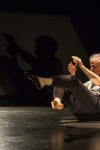
Vanessa Goodman is part of MascallDance’s OW, which premières at Dancing on the Edge. (photo from DOTE)
Audiences saw a glimpse of MascallDance’s OW last year at Dancing on the Edge. This year, the full work premiéres at the dance festival, with six performances July 6-14 at MascallDance’s home, in St. Paul’s Anglican Church downtown.
OW “analyzes timing, accents and rhythms of the sounds that erupt from the body as expressions, building a libretto of repeatable human emotions. Exploration is physically challenging and unpredictable; what has emerged to date is fast, rhythmic, often wildly funny and noisy,” explains MascallDance’s website.
Jewish community member Vanessa Goodman, artistic director and choreographer of dance company Action at a Distance, is one of the dancers in OW.
“One of the interests in the work that we keep coming back to is finding out how sound moves the body and how the body moves sound,” Goodman told the Independent. “As we dive deeper into the process, we are often faced with more questions about accessing the authentic experience of voice and movement. We started by exploring what sounds come from the body with specific physicalities and then also tried to see what happened physically when we made specific sounds.”
Goodman has been involved in the project since 2012, when MascallDance Society founder and artistic director Jennifer Mascall started doing research with her “to explore some of the thematic content that is present in OW,” said Goodman. “Then I was brought back into the process in January 2017 to continue with Walter [Kubanek], Eloi [Homier] and Anne [Cooper].”
The website notes that 17 dancers perform in the production. Also performing will be composer and violist Stefan Smulovitz and specialist in experimental voice D.B. Boyko.
“One of the inspirations for this work,” said Goodman, “was musicals – we watched a lot of clips from older films and observed the complexity of their compositions. They use tons of counter and polyrhythms, and our material was set so that we could achieve a similar result. What you are going to see is definitely not a typical musical formula, but, inside OW, some elements have been inspired by their compositions.”
Goodman has worked with Mascall before.
“My first experience with Jennifer was in 2005, when I was a student at SFU [Simon Fraser University] and she created a piece in my rep class exploring the voice of Glenn Gould. One of my favourite memories from that experience was that she watched the piece from the corner one day in rehearsal. It was one of our final runs before the show and, after watching, she declared that was how the work was meant to be seen, so we adjusted our ‘front’ to this new diagonal perspective. I loved this, as it allowed us to have a brand new experience inside the work and showed me that the creative process is always in a state of evolution.”
Working with Mascall “is fantastic,” said Goodman. “She has a deep practice of finding movement for the body from physiological systems. This is a vibrant place to work from, and I am also interested in anatomical processes and how they relate to movement.”
One of the most rewarding aspects of OW for Goodman has been working with all of the production’s collaborators. “Each artist involved on the team offers unique and critical information,” she said. “Performatively, this process has expanded my practice and has allowed me to discover new interests and curiosities.”
Dancing on the Edge runs July 5-14. For the schedule and tickets, visit dancingontheedge.org.
Martin Gotfrit co-created Real Time Composition Study, which is part of this year’s Dancing on the Edge. (photo by Paula Viitanen)
To celebrate its 30th year, this July’s Dancing on the Edge festival will feature more than 30 performances, including Real Time Composition Study by Rob Kitsos, Yves Candau and Jewish community member Martin Gotfrit.
“We are three artists with varying interests in dance, sound-making and music, etc., who are exploring creating abstract work spontaneously within the confines of a set space and time,” Gotfrit told the Independent in an email interview. “The work is entirely improvised but, since we’ve been rehearsing (i.e. meeting and exploring movement, sound and light) for 10 months, we have been building an awareness of each other in the space and of our collective efforts. We also work with large conceptual ideas, as well as simple structures, to make it all a little more coherent. The work is not intentionally narrative but words and themes can occasionally emerge.”
Gotfrit not only performs in Real Time, but is its composer. He has numerous recordings to his credit, and has received much recognition, via awards and grants, for his work. Among his affiliations, he is associate composer, Canadian Music Centre; founding member, Canadian Electronic Community; and member, Guild of Canadian Film Composers. He has served two terms as director of the School for the Contemporary Arts at Simon Fraser University and been associate dean and dean of SFU’s faculty of communication, art and technology.
“I’ve just retired after 37 years at SFU as a professor in music and administrator,” he said. “I’ve been performing for a very long time in a variety of ensembles and in many different contexts. As a composer, I’ve created music for film, as well as for new media, theatre and dance performances. I’ve also had the opportunity to move on stage occasionally in those contexts as well. If I had to summarize what I do, I’d say I’m an improviser who has worked in many different forms.”
Gotfrit is part of the Vancouver band Sulam (which means ladder in Hebrew), where he contributes his guitar, mandolin and vocal talents.
“I’m quite active in my synagogue (Or Shalom) and, for more than a decade, I’ve been a part of the band of the monthly Hebrew chanting event Chanting and Chocolate,” he said about his other community involvements. “I returned to be more actively involved in Jewish life as my kids approached bar mitzvah age. I found many like-minded souls at Or Shalom.”
Gotfrit met Kitsos when he started working at SFU, and Candau when he joined the school as a graduate student. About how and when Real Time Composition Study came into being, Gotifrit said, “Rob and I had worked together in the past and we share a love of improvisation and a similar esthetic. We both find Yves’ work very interesting and compatible with our interests. We three started meeting weekly in September of 2017. The work has evolved in many surprising ways since then. For example, when we began, I was sitting off stage playing the music live. As time went on, I began to move more into the centre of the movement space as Yves and Rob (a professional drummer himself) began to take on other roles as well.”
As to what he plans on doing now that he is retired, Gotfrit said, “In addition to playing a wide variety of music with a number of groups (and practising of course), I’m studying to be a pilates instructor. I’ve been a practitioner for almost 40 years. I’m currently interning at the Vancouver Pilates Centre.”
Real Time Composition Study is part of EDGE Seven, July 13, 7 p.m., and July 14, 9 p.m., at Firehall Arts Centre, as is Pathways, by Jewish community member Noam Gagnon (Vision Impure). Other community members involved in Dancing on the Edge this year include Amber Funk Barton (the response.), Gail Lotenberg (LINK Dance Foundation) and Vanessa Goodman (in MascallDance’s OW!). The festival runs July 5-14. For tickets and the full schedule, visit dancingontheedge.org.
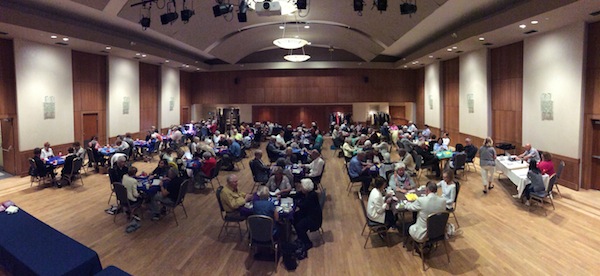
There were 28 tables of four playing on June 7 at the annual bridge event honouring Marjorie Groberman. (photos by Cynthia Ramsay)
More than 100 people gathered to play bridge at the Jewish Community Centre of Greater Vancouver on June 7 at a special annual event in honour of Marjorie Groberman, who passed away in 2011.
Leah Deslauriers is the former coordinator of JCC Seniors, which is now called Adults 55+ and headed by Lisa Quay.
“Marjorie Groberman was a driving force behind the JCC Seniors department for many years,” Deslauriers told the Independent. “She, along with some other ladies, started a duplicate bridge club at the JCC in 1995. When Marjorie passed away, [her daughter] Hildy Barnett and I created this event in her memory. We named the bridge club after Marjorie, as well.”
Barnett sponsors the meal and door prizes for the annual lunchtime event, and covers extras the club might need, said Deslauriers. For the lunch, “many players baked or brought dessert items for everyone.”
“There were 28 tables of four, so there were 112 people in attendance,” she said. “The club generally has up to 20 tables during regular play, so this was a very large event.”
The bridge club at the centre started in 1995 with four tables, explained Deslauriers. “Some of the original ladies, who still play today, subsidized the club so it would continue. The original club director was Connie Delisle, who taught many people how to play the game. Then Cathy Miller became director in 2006, when Connie had to retire. Cathy retired at the end of last year and the current director is Bryan Maksymetz, who is a Canadian bridge champion.”
Anyone who knows how to play duplicate bridge may attend. “It is very special,” said Deslauriers, “as many of its regular players are over 80, and many are over 90. I believe Ethel Bellows is the oldest player at the moment. Many of the players come 30 minutes before game time, to socialize over coffee and cookies, and it’s a very warm and friendly game, as far as bridge goes.”
The Marjorie Groberman Open Duplicate Bridge Club currently has more than 350 members, Quay told the Independent. Play takes place on Tuesdays and Thursdays. “The JCC also offers an array of bridge lessons for beginners on up, as well as practise opportunities for skill-building,” she said.
For more information, contact Quay at 604-257-5111, ext. 208.
Ryan Sidhoo’s new docuseries, True North, looks at the youth basketball scene in Toronto. (photo by Yasin Osman)
“Wherever I travel, I go play pickup basketball and I always make friends, and maybe end up at someone’s house for dinner … you go ask to play basketball on someone’s court, there’s always that moment of, ‘Who is this guy?’ but, once you get out there and you start playing, it’s an inviting, universal sport that you don’t need a lot to participate in,” filmmaker Ryan Sidhoo told the Independent in a phone interview from Toronto.
Sidhoo is the creator and director of True North, a nine-part online docuseries produced by the National Film Board of Canada (NFB) and Red Bull Media House about the youth basketball scene in Toronto.
“More and more young Canadians are playing basketball – over 350,000 according to the 2014 Canada Youth Sports Report – and the trend is particularly pronounced in and around Toronto, where a wave of second- and third-generation Canadians are shaping Canada’s new game,” notes an NFB blog about the series. It also notes that, “Canada now has over a dozen players in the NBA [National Basketball Association], more than any other outside country.”
In episodes ranging from 15 to 23 minutes, True North examines “the rise of the Toronto hoop dream through the stories of five young athletes.”
The series – which was three years in the making – “has a multigenerational appeal,” said Sidhoo, who spoke with players, coaches and families. Given the subject matter and format, he said younger viewers enjoy it but that, also, people closer to the age of the parents of the kids featured get something out of it from a parenting point of view.
In the series format, he said, we can tell in-depth stories, “but then that 15-minute episode has to be focused on one kid and their journey. I think that’s an appeal of the series, because they’re highly personal episodes and they’re not trying to do too much at once.”
Sidhoo has worked on various projects, including for Pulse Films, MTV and NBCUniversal, and he has produced and directed content across various VICE platforms; he was the creator and executive producer of Welcome to Fairfax, a 10-part docuseries for Participant Media about a group of young entrepreneurs in Los Angeles.
Born and raised in Vancouver, he’s since lived in California and New York. It was in New York that he earned his master’s in media studies, with a focus on documentary filmmaking, from the New School, in 2013.
“The seeds of the project were really planted at that time,” he said, referring to True North. At the New School, he wanted to do a project “on this old streetball legend named Fly Williams, who I’d read about in a book my dad had given me as a kid called Heaven is a Playground.”
In his search for Williams, Sidhoo ended up at a few different basketball tournaments. At the time, YouTube was just taking off, he said. “What I was seeing at these gyms in New York were these parents marketing their children as the next best basketball phenom. You started to see this cottage industry around youth basketball.”
Fascinated by this, Sidhoo said he kept his finger on the pulse of that world. He noticed that Canadians were having a lot of success getting into the NBA and the question of how basketball became significant in Canada led him to Toronto, “the epicentre of it all.”
“For me,” said Sidhoo of his love of basketball, “growing up in Vancouver, and, especially, having immigrant roots on both sides – my mom is Ashkenazi, they came from Poland and Winnipeg and eventually Vancouver, [while] my dad’s side of the family is from India – I just think that the popular sport in Canada is, obviously, hockey, and winter sports in general have more of a built-in tradition … [but] basketball lends itself to newcomers to a country, so my dad gravitated towards basketball as a kid. For me, growing up, basketball was always in the house, it was always on TV, it was something that I was around and I, naturally, through my dad, was introduced to the sport…. Of course, I like hockey and Wayne Gretzky and all that, but basketball was the thing that was a part of my identity … I always felt comfortable in the niche community of basketball in Vancouver because it was really diverse and it was very multicultural. As someone who had these mixed backgrounds, I felt at home in that world.”
Sidhoo played in various leagues in Vancouver, as well as participating in more than one JCC Maccabi Games. He described as “pivotal,” the Kitsilano Youth Basketball, run by Mel Davis, a former Harlem Globetrotter. Davis’s son, Hubert Davis, directed Hardwood, a documentary (also produced by the NFB) about his relationship with his father and basketball. When Sidhoo saw that film, he said he had two thoughts: “one, that’s amazing, because I know Mel and remember Hubert refereeing the games but then, secondly, it’s projects like that that plant the seed that, hey, maybe I could be a documentary filmmaker, too.”
As a kid, Sidhoo and his brother were encouraged to do what they wanted creatively. “I’d go out back and make videos of myself playing basketball,” he said. “My dad was always showing us films that maybe he shouldn’t have been showing us at that young an age, but explaining why he was showing them. So, basketball was always there and these offbeat films, or films that were aged above my viewing in terms of age appropriateness, that was always a constant, too.”
Growing up, he was also exposed to books, art shows and other culture. Sidhoo recalled his father taking him to one of the first Slam City Jams, a skateboard competition, in the early 1990s, when Sidhoo was 5 or 6 years old. “Back then, skateboarding wasn’t as corporate as it is now, it was still pretty punk,” he said. And, while it was a bit different to be at such an event, “at the same time, it’s normal because I’ve been consuming this kind of content and going to different, what you could call counter-culture, events, with my dad. So, the fascination with subculture was always there, along with basketball.”
True North is Sidhoo’s first project with the NFB. He called the film board with his idea while in Vancouver, and spoke with Shirley Vercruysse, executive producer of NFB BC & Yukon Studio. “She was open-minded,” said Sidhoo and connected him to the paperwork he’d have to submit for the NFB to consider producing the documentary.
“What I think attracted the National Film Board,” he said, “was that basketball is shaping Canadian identity, because we’re exporting so many amazing basketball players to the south that the perception of Canada is not just hockey anymore … basketball is part of the shifting Canadian identity. On a global, macro picture, that resonated with the film board. And then, also tapping into the human, story-driven documentary approach that I wanted to take is what the film board has been doing for a really long time. It spoke to a story that was big, but then also was told through the intimate, personal narratives of these kids. It was a nice combination for them, I think.”
In Euripides’ play, the Phoenecian women represent the innocent who are displaced and otherwise impacted by conflict. (photo from Arts Umbrella)
Some families are, quite literally, cursed. In Euripides’ The Phoenician Women, it is brothers Eteocles and Polyneices who are condemned to fight each other to their tragic end, but they are not the only ones harmed by the curse. During their conflict, the chorus, aka the Phoenician women, are trapped in Thebes.
The brothers’ father, Oedipus, had been sent away from his parents when he was a baby, in an effort to avoid the fulfilment of the dreadful prophecy that he would kill his father and marry his mother. However, fate cannot be so easily avoided, and Oedipus unwittingly does end up marrying his mother after unknowingly killing his father. Four children later, Oedipus discovers the truth, gouges his eyes out and leaves his kingdom (Thebes) to his sons – but he also curses them for their treatment of him, pledging they would have to “draw the sword before they share this house between them.” As did their father before them, the sons try to escape their fate, but, well, that never seems to work out.
“In The Phoenician Women, I play the role of Eteocles, one of the sons (and, technically, half-brother) of Oedipus, who exiles his other brother in order to hold onto the throne,” actor Naomi Levy told the Independent. Levy is in the Arts Umbrella Senior Theatre Troupe, which is presenting The Phoenician Women as part of the Expressions Theatre Festival at the Waterfront Theatre. Two performances remain: May 19, 9 p.m., and May 24, 7 p.m.
“What I love about my character,” said Levy, “is, at first, it seems Eteocles has exiled his brother to satisfy his own lust for power; however, upon further inspection, it seems Eteocles has done this in order to protect the city of Thebes, which he rules. He knows Polyneices, his brother, is not fit to be a king.
“The Phoenician Women is such a relevant commentary on displaced people, as well as a timeless tale of greed, protection, loss and grief. It’s an incredibly beautiful story, and I am so grateful to be a part of telling it.”
Naomi Levy plays one of the warring brothers in The Phoenecian Women, which has two remaining shows at Waterfront Theatre, May 19 and 24. (photo from Arts Umbrella)
To pay homage to the play’s roots in ancient Greece, Levy said, “we are performing in mask, which is such an unique experience. The masks allow me to explore parts of myself and my character I may not have been able to without it – while the mask hides my face, it also forces me to articulate my character through my entire body and explore his unique movements.”
Levy was born in Vancouver, and has lived here all her life except for one year, when she lived in the United Kingdom. She is currently in Grade 12 at West Point Grey Academy.
“I was raised a secular Jew,” she said. “It was important to my parents that I be raised Jewish, which is one of the reasons I was given my mom’s last name, Levy. I went to Peretz community centre from a young age, and [was part of] a b’nai mitzvah there, where I did a project on Jewish stereotypes.”
She said, “Though I am not personally religious, I find that both the cultural and religious parts of Judaism are important in my life. It’s always so incredible to meet a fellow Jew, as there is this automatic connection that is derived from shared culture and experience.”
Ever since she was a young kid, Levy has loved performing. “It was my brother who initially introduced me to acting, when he participated in a Bard on the Beach summer camp, and him again who introduced me to the Arts Umbrella theatre troupe of which I am now a part. I was so jealous that he was able to perform and I wanted to be like him. I was instantly transfixed by theatre and performing.
“I have also been heavily involved in choir and musical theatre since I was young,” she said. “I have attended several years of Bard on the Beach summer camps, performed with Encore Musical Theatre, acted in my school’s plays, sung in my school’s choir and, most recently, participated in the Senior Theatre Troupe at Arts Umbrella. This troupe specifically shows me the beautiful intricacies of acting and pushes me as a performer, which I love.”
Arts Umbrella’s Senior Theatre Troupe is a yearlong program for students between 15 and 19 years old, who are selected by audition. According to Arts Umbrella’s website, successful candidates rehearse twice a week every week from September to June, exploring “professionally developed theatrical works, from the classic to contemporary.” Among other things, the troupe tours the works to secondary schools and performs at the Expressions festival.
“Music and theatre in my mind are similar, and they are the two passions of mine, which make me so incredibly happy,” said Levy. “For a long time, I had told myself that, even though acting makes me happier than anything else has in my life, I was going to explore my other academic interests. I am passionate about gender and sexuality studies and its activism, as well as the humanities, and would love to be a social worker. I had originally thought that would be the path I would follow. It still may be, as I can’t say what the future will hold, but, for the time being, I am following what I love to do most, which is acting, music and performing, and hope to make a career out of it.”
In an effort to make that happen, Levy will soon head to Montreal.
“I am very excited to be going to Concordia University next year in the theatre program with a specialization in acting,” she said, adding that she also will explore her other academic passions, as well. At the least, she is aiming for a master’s degree.
Expressions Theatre Festival runs until May 26. For tickets and information on all five productions being presented by different Arts Umbrella troupes, visit artsumbrella.com/events/expressionstheatre.
Eden Lyons as Emory (seated) and Nathan Cottell as Linda in Awkward Stage Production’s MilkMilkLemonade, which runs May 23-26 at CBC Studio 700. (photo by Javier Sotres)
True to form, Awkward Stage Production’s upcoming show, MilkMilkLemonade by Joshua Conkel, will challenge and entertain audiences.
“Eleven-year-old Emory dreams of two things – leaving his farm for Mall Town, U.S.A., and going on Star Search. His grandmother wants him to be a normal boy and be friends with Elliott, the tough boy from down the road. Meanwhile, Linda, his depressed best friend, dreams of surviving to the next dawn,” reads the synopsis, noting that Linda is a giant chicken who does stand-up comedy and that the show includes the music of Brittany Spears, Spice Girls and Nina Simone.
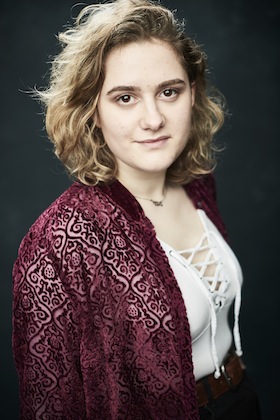
Jewish community member Eden Lyons plays Emory. With Arts Umbrella Pre-Professional Troupe, she played Mrs. Tottendale in The Drowsy Chaperone in 2016 and Hope Cladwell in Urinetown last year. Her resumé includes stilt walking as a special skill.
“I’ve been interested in acting and musical theatre for as long as I can remember, I was a very attention-hungry child,” Lyons told the Independent. Nevertheless, it wasn’t until her role in Urinetown that she knew she wanted to make a career of performing.
Born in Hamilton, Bermuda, Lyons has lived in Vancouver since she was 3 years old. She attended Vancouver Talmud Torah from preschool to Grade 7 and graduated from Point Grey Secondary School last June. When she left VTT, she said, “I felt somewhat disconnected to the idea of the Jewish community. Maybe because I didn’t feel I belonged from a gay perspective, because I always saw Judaism as more of a conservative traditional thing, as opposed to the ever-changing and loving thing I see it as now. In lots of ways, I feel my safest in the Jewish community.”
A sense of safety is particularly relevant to MilkMilkLemonade, which contains sensitive and explicit material. Producer and choreographer Erika Babins – also a member of the Jewish community – said the play “walks a fine line of comedy and heavy subject matter. Emory is subject to bullying at school because of his effeminate nature. Elliot attempts, and often fails, to reconcile his friendship and attraction to Emory with the internalized homophobia and misogyny that he was raised with. There are both scenes of intimacy and violence in the piece.
“We began rehearsing this play,” she said, “in the wake of controversy in the Canadian theatre community regarding directors and companies crossing professional boundaries in their rehearsal halls in the name of creating art. It brought to light a lot of practices that many theatre artists take for granted as part of the industry and certainly needn’t be. At the beginning of our rehearsal process, we outlined specifically what was deemed appropriate behaviour in rehearsal and what would not be tolerated, in order to create a safe environment for everyone. Actors have to be extremely vulnerable to create situations with physical intimacy and it is the job of the theatre company and the creative team to create and enforce that environment.”
Co-starring with Lyons are Demi Pedersen (Elliot), Stefanie Michaud (Lady in a Leotard), Sachi Nisbet (Nana) and Nathan Cottell (Linda). The producer is Sarah Harrison and the rest of the team is stage manager Laura Reynolds, light/sound designer Andie Lloyd, costume/prop/set designer Alaia Hamer, graphic designer Julia Lank and promotional photographer Javier Sotres.
“The age range of the cast is between 18-27,” said Babins. “All the cast members and creative team on this project are emerging artists.”
Winning the role of Emory came as a surprise to Lyons.
“When I went in for the MilkMilkLemonade auditions, I didn’t even think I would get cast at all, as I hadn’t yet been in a professional show and all I had gotten until then was a string of rejection emails,” she said. “When I got my email for MML, I was at work and I cried in the bathroom and called my parents saying, ‘Maybe I’m not a terrible actress after all!’ This is my first show with Awkward Stage, and I am really thankful that they are the first company I’m working with in my professional career.”
When asked what were the most challenging and fun aspects of playing Emory, Lyons said, “It was a challenge for me to get past my fear of being the youngest in a cast, especially since all of them have already graduated theatre school and worked professionally for years. It was also difficult to find the physicality for acting like a kid, and the balance between me being a woman, who’s playing a little boy, who is actually a little girl. Lots to unpack there. Emory is a really fun role because I get to play around and throw little tantrums and scream, and basically just be a kid. It offers me a lot of freedom to try new things.”
And Lyons is working on many new things in addition to this production.
“I’m currently assistant directing Oklahoma! with the Arts Umbrella Pre-Professional Musical Theatre troupe, which is playing at the Waterfront Theatre from May 18th to 26th, and I am assistant directing and associate producing Jasper in Deadland with Awkward Stage for the Vancouver Fringe Festival in September,” she said. “In the fall, I am moving to Toronto to attend Randolph Academy for Musical Theatre.”
While there is no specific target audience for MilkMilkLemonade – “There are pieces for all ages and walks of life in it,” said Babins – due to the subject matter, she said, “we do advise parental discretion for children under the age of 12.”
Leonard Brody talks about The Great Rewrite at the Jewish Family Services Innovators Lunch April 24. (Rhonda Dent Photography)
Sitting in the JFS client base are this community’s greatest and most hopeful assets,” said Jewish Family Services Innovators Lunch keynote speaker Leonard Brody. Donating to JFS is not charity, he said, but rather an investment with high returns.
The 600-plus attendees at the JFS’s main annual fundraising event obviously agreed. At press time, more than $350,000 had been raised for the agency’s work, and donations were still coming in, making this year’s lunch the most successful Innovators yet.
Event co-chairs Shannon Ezekiel and Candice Stein Thal welcomed those gathered at the Hyatt Regency Vancouver on April 24, and gave a brief overview of the JFS and of the organization’s new logo and look, which, they said, “inspired the theme for this year’s lunch: ‘Uplifting Lives.’”
Rabbi Jonathan Infeld of Congregation Beth Israel, who is the Rabbinical Association of Vancouver representative on the JFS board, did the blessing over the bread. “This week’s biblical portion is Acharei Mot-Kedoshim,” he said. “Kedoshim is really the essence of why we are here – ‘You shalt be holy,’ the portion begins, and then it gives us a litany of laws in which we are able to bring holiness into this world. A number of those laws do not ask, but demand, that we take care of those who are in need. And one of those laws in particular demands that we feed those who are hungry. Many of us here are hoping to make a difference in this world. We are here, maybe with the idea in mind of a business connection, but, really, the essence of what the JFS is all about is bringing holiness into this world by helping those who are in need.”
After a video, which told the stories of three individuals who were helped by JFS in some way, JFS board chair Bill Kaplan said a few words, stressing that, “most importantly, our volunteers and staff treat our clients with a respect and warmth that uplifts them, makes them feel part of the community and, if you ever visited, you’ll see, it becomes a social highlight for their week.”
All of the lunch guests were given a bag full of items – including some packaged food, toiletries, a poncho and gloves – and asked to give it to someone on their way to work or to a JFS client. The bags were packed by more than 80 kids and their families at Beth Israel a few weeks earlier.
Among those who Ezekiel and Stein Thal thanked were the event’s corporate sponsorship committee, chaired by Audrey Chan; the more than 40 sponsors at the lunch, who had “helped contribute over $183,500 … a record in sponsorship for this event”; the 28 table families; day-of-event chair Dr. Sherry Wise; and JFS’s Maya Dimapilis and her team. The lunch was co-presented by the Diamond Foundation, Austeville Properties Ltd. and Shay Keil; Neil and Michelle Pollock matched every new or increased portion of a donation raised through the lunch, up to $25,000, which was dedicated for the Jewish Food Bank.
Jewish Family Services executive director Richard Fruchter, left, and entrepreneur, venture capitalist and author Leonard Brody. (Rhonda Dent Photography)
JFS executive director Richard Fruchter spoke about JFS, its history and the expanding services it provides. It is because of this growth in the demand for JFS’s services, he said, that “it became important for us to be more visible in the community and tell our story to a much wider audience …. we’ve updated our logo and our name to reflect that. Our logo is a simple, elegant symbol – it conveys the warmth and heart of what we do here at Jewish Family Services.”
“For me, this is not just an amazing lunch with a marquee speaker,” said Keil before he introduced Brody. “It’s an opportunity for me to stand before you and proudly announce my support of the Jewish Family Services, and to thank the army of staff and volunteers … [for their] work in the community.”
Brody’s talk was on The Great Rewrite, a book he is creating with Forbes Magazine, based on a documentary series they produced. “Really what we’re doing this morning,” said the entrepreneur, venture capitalist and author when he took to the stage, “is talking about an evolution, an evolution in us, in our human story.”
Based on about a decade’s worth of research, he said, The Great Rewrite began with the question, “How is this moment in time different? We’ve been through a lot of innovation cycles, from the web and mobile, and now entering into AI and robotics… Is this vast amount of change that we’re all experiencing … substantively different from anything we’ve been through before? Is this a fourth industrial revolution?”
Humanity is “literally rewriting this planet from the ground up,” he said, arguing that we are currently undergoing “pretty much the largest institutional shift in the history of our species.”
The co-founder of four companies, Brody said, “The concept of this rewrite has nothing to do, for me, with just theory – it started as a theory but it’s really what we do and what I do every day for a living at CAA [Creative Artists Agency].”
Before looking at what we can expect in the next 730 days – the next two years – Brody explained how we, the humans of today, are nothing like the people of 100 years ago. For example, he said, the average person now lives 2.7 times longer and is three to four inches taller; the rate of poverty has been reduced from 90% in 1900 to 10% now, literacy increased from 12% to 85% and access to basic education risen from 17% to 86%. We are also “living in the lowest point of human death [caused by any factor] since we could record it, since 1400,” he said, and “the average human being living on this planet works about half the number of hours than someone living in 1900.”
We are fundamentally different people now, said Brody, and herein lies the challenge. “The houses we built don’t fit the people who live here any more,” he said. “We built institutions – I’m talking about all the institutions that govern your life, education, government, religion, work, the family unit – they are all going through massive pressure points today because they are structures based on assumptions, often technological, some patriarchal, that are just no longer true.”
So, he said, “The whole essence of this rewrite is you are living in the disconnect between the people we have become, the technological tools available to us today and the failure of our institutions to keep pace with that.”
One of the reasons for this, he explained, is “inversion.” Most of our institutions are organized as pyramids, with, for example, a head of state or religious figure at the top; however, the internet has flipped this power structure. Up to the mid-1990s, all the methods of communication, from radio to the telephone, had limited reach and were regulated by government, he said, but, with the internet, it “was the first time where millions of people could speak with millions of other people with virtually no hit on their disposable income” and where it was “impossible for governments to regulate.”
With respect to the internet, said Brody, “the average North American spends two-thirds of their working day in their virtual identity and not their physical one. The average Canadian, by the way, spends 63% of their time with close friends and family in their virtual identity and not their physical one, meaning not face-to-face. So, the virtual form of yourself is now the predominant human form, not the physical.”
And our behaviours are different online than in person. “You do things in your virtual identity that you would never dream of in your physical and vice versa,” he said. For example, the average internet user is four times more trusting than they are in person. He illustrated this using a question he asked his 83-year-old uncle: “When your children were babies, would you post their baby pictures on the lamp posts in your neighbourhood?” The response was an emphatic no. “So, then, why do you post hundreds of photographs of your granddaughter on Facebook and Flickr, which is a globally open, searchable and highly manipulated light post, and his face just went totally blank.”
As for how the internet has changed our institutions, Brody gave the example of marriage. As of the end of 2017, he said, “two-thirds of all new marriages in the Western world originated online” – and, for those who met their spouse online, the likelihood of divorce is 15 to 20% less. “The algorithms on these dating sites work from a data perspective,” he said. And, connected to the institution of marriage, he noted that, in the 2016 census, about 40% of Canadian adults reported themselves as living alone, while, in 1955, that statistic was four percent.
Brody went on to explain what CAA was doing in the field of entertainment with virtual reality and how, “in the next decade, roughly 30% of all ‘live’ entertainment will come from performers who are no longer living. You will take your children to go watch the Beatles and Michael Jackson and Elvis Presley – in fact, the Elvis tour has just begun; the estate just signed off on it.”
Currently, there are up to three-and-a-half billion people on the internet, he said, and, over the next two years, another billion people will join. This new billion will be “one of the most significant economic events in human history, if not the most significant,” he said, noting the amount of money to be made from e-commerce.
This coming two-year period, he added, “is the very beginning of a long journey in the rewrite of currency.” He said that traditional wealth generators, such as home ownership and the stock market, will not be profitable in the future, so currency “will become the new stock.”
Brody spoke about the fact that we’re about a decade away from creating machines able to think for themselves, and how computers can now create, for example, a Rembrandt painting that can fool the computers that detect fraud at top auction houses. “The reason I share that with you,” he said, “is because the very thing that makes us human is art. And, once machines begin to make art, you get a very clear indication of how different this world is going to be, and very clearly that we are on a path where humans may no longer be the predominant species on this planet. So, we have very important decisions to make in the next decade about how we regulate the ethics of artificial intelligence.”
He concluded, “Why are we talking about The Great Rewrite and the rewrite of this planet at a JFS Innovators Lunch? There are two specific reasons. The first is this massive shift in institutional power that’s coming…. And the second has to do with math, pure math; in particular, the number 70. Why 70? According to StatsCan, 70% of all charitable donations in this country come from primary donors – 70% come from a small group that make up the vast majority of the donations. So, I started to do a little bit of digging and I brought in my friends and partners at Forbes to help me out on it. It turns out, if you look through the Forbes millionaire and billionaire list, which many Canadians sit on, it turns out that … 70% of that [primary donors] group came from nothing” and could have been clients of an organization like JFS at one point in their lives.
“Benevolence and charity were the wrong lens” with which to look at giving, Brody said. “The right lens was investment. If it’s true, which it is, that the vast majority of donations to charitable causes in this country … and the vast majority of those individuals [who are giving] were, at some point in their lives, disadvantaged and downtrodden, then the math and the investment is very simple. An investment made in JFS today has the greatest statistical likelihood of identifying the next pillars in this community and the next great funders.”
Ted Littlemore, in Orfeo ed Euridice, the research for which will be presented by Idan Cohen and Ne. Sans on May 13 at the Dance Centre. (photo by Ted Littlemore)
A relatively recent arrival in Vancouver, Israeli choreographer and opera director Idan Cohen is already making his mark. On May 13 – with the support of the Dance Centre, Arts Umbrella and Vancouver Academy of Music – Cohen and Ne. Sans will present Orfeo ed Euridice, a glimpse into Cohen’s reenvisioning of Christoph Willibald Gluck’s opera.
The myth of Orpheus is a story of love. Poet and musician Orfeo mourns the death of his wife, Euridice, and he determines to get her back from Hades. With the intervention of Amor (Cupid), the god of love, Orfeo heads into the Underworld, gaining entry by winning over the Furies with his music, and he is reunited with his wife. However, Amor has set a condition – Orfeo must not look at Euridice, or explain why he is not doing so, until the two are back on earth. It’s a condition Orfeo breaks when Euridice begins to doubt his love and begs for a glance to assure her. When he gives in, Euridice dies again and Orfeo, grief-stricken, resolves to kill himself so that he can be with her. In the face of such love, Amor intervenes once more, to save both Euridice and Orfeo, and return them to earth.
“This opera was created in 1762 and, for me, a significant part of directing a classic opera is the studying of the values that originally inspired the music and the performance,” Cohen told the Independent. “Looking at concepts of novelty and tradition and respecting those as the DNA of this creation was quite valuable in my creative process. At the same time, those are values that are violent, discriminative and often quite outdated. One clear example that I personally find fascinating is the fact that Orfeo ed Euridice was originally written to be performed by a male castrato. Nowadays, it is often performed by a female mezzo-soprano or a male singer singing in a falsetto technique, but, for me, the history of the castrato and the violence that history entails against the human body is an example of difficult questions and issues that are a part of the time this opera was created in.
“It is even more fascinating and relevant,” Cohen added, “since the mythological story of Orpheus presents to us a musician and a poet who had the ability to enchant all living creatures through his musical gift. Orpheus’s strength was art and, hence, he is the ultimate representation of art and the artist. So, in Orfeo, these values can be represented in the most honest, vulnerable way, exposing their inner human truth and the limits through which we define and accept artistic beauty.”
Cohen grew up in Kibbutz Mizra in the north of Israel, but lived in Tel Aviv for 10 years before coming to Vancouver with his partner about a year ago. “When we got here, I completely fell in love with the city, the nature, the people,” said Cohen.
“Besides the personal reasons that brought me here,” he said, “I’m finding Vancouver’s arts scene most inspiring, and the city was very welcoming to me. I’ve received this wonderful DanceLab residency at the Dance Centre, I have been creating for Arts Umbrella’s pre-professional program, led by Lesley Telford, and with Modus Operandi, directed by David Raymond and Tiffany Tregarthen. These great artists invited me to teach and create when I just got here, and I immediately felt at home.
“Also, for the past years, I have been interested in directing opera through dance and movement … [and] there is so much going on in the city both in opera and in dance – I feel I have something to contribute to this city’s rich arts scene by fusing the two. Historically, they do belong together.”
As well, said Cohen, “living in Vancouver makes traveling so much easier and, when you travel often, this can be very convenient and helpful. This June, I will present at the Seattle International Dance Festival with Ne. Sans, my new Vancouver-based society, and, on the following day, will catch a flight to go to Sydney to present work in Sydney and Newcastle.”
According to Cohen’s website, Ne. Sans “is a home for the research and creation of work that seeks to deepen and reconnect opera and dance.” And this melding “opens a whole new world of collaborative opportunities: a space that involves working with singers, dancers, musicians, visual artists and designers.”
“Directing an opera like Orfeo ed Euridice through dance is a huge task that requires a tremendous amount of preparation,” said Cohen. “This opera was created 256 years ago, but has kept its immortality through its beautiful music and a story so rich, layered and full of depth.”
As he enjoys exploring operas with dancers in the studio – “It’s a great way to get intimate with the music, through the body” – Cohen said, “I’ve started this process by creating a 20-minute duet that was inspired by Orfeo ed Euridice, using parts of Gluck’s music and the main ideas behind the story, and translating those to pure dance. The dramaturgy of that dance piece was inspired by the opera and its libretto [by Ranieri De’ Calzabigi]…. But, looking at it closely and breaking it apart in the studio presented an opportunity to create a more abstract version of the story, in dance form. Fortunately, it was very well-received and won an award from the Be’er Sheva Fringe Festival, in Israel’s Negev.”
The presentation at the Dance Centre “will be performed by 18 singers from VAM [Vancouver Academy of Music] Schola Cantorum chorus, conducted by Kathleen Allan; six dancers from Arts Umbrella’s pre-professional program; two amazing dancers/musicians, Ted Littlemore and Jeremy O’Neil; and mezzo Debi Wong [director of re:Naissance opera company]. It’s a rather big cast for what I’m hoping will be an honest, pretty direct sharing of the research and ideas that will then be transformed into the ‘real deal,’ the full opera production.”
The Orfeo ed Euridice presentation is open to the public and is free of charge. It takes place in the Dance Centre’s Faris Family Studio May 13, 3 p.m. RSVP to [email protected] to reserve a seat.
Western Canada Jewish Book Award 2018 winners, left to right: Roger Frie, Deborah Willis, Kathryn Shoemaker and Irene Watts. Missing: Tilar Mazzeo.(photo by Cynthia Ramsay)
Deborah Willis became a writer, in part, because it is a way “to learn about the things that you’re curious about.” Irene N. Watts and Kathryn E. Shoemaker were motivated to reimagine a decade’s-old story in light of its relevance to pressing issues of today. And, in his latest work, Roger Frie found a way to discuss a past for which, previously, “the words were missing for how to speak about it.”
The Western Canada Jewish Book Awards, presented by the Cherie Smith JCC Jewish Book Festival, took place on April 26. Self-proclaimed book lover Daniella Givon, who is part of the JBF committee and was chair of the awards committee, introduced the evening.
“As I looked for ways to enhance the Jewish Book Festival,” she said, “I had a vision that book awards would marry the goals of the festival with the celebration of, and support the achievements of, local Jewish writers from Western Canada and showcase the winning authors. Since then, we’ve already gone through the process of bringing the ideas to fruition with the help of a subcommittee and the first round of awards … a beautiful ceremony was held here two years ago, recognizing five best-deserving authors.”
This year, four awards were presented, as chosen by the selection committee of former librarian Linda Bonder (Victoria); author and librarian Elisabeth Kushner (Vancouver); author and poet Dave Margoshes (near Saskatoon); writer, teacher and critic Norman Ravvin (Montreal); and Judith Saltman, professor emerita at the University of British Columbia School of Library, Archival and Information Studies. The winners were Calgary-based Willis for The Dark and Other Love Stories (Diamond Foundation Prize for fiction); Tilar J. Mazzeo, who divides her time between Maine, New York and Vancouver Island, for Irena’s Children (Pinsky Givon Family Prize for non-fiction); Vancouver’s Watts and Shoemaker for Seeking Refuge (Jonathan and Heather Berkowitz Prize for children and youth literature); and Frie, professor of education at Simon Fraser University and affiliate professor of psychiatry at UBC, for Not in My Family: German Memory and Responsibility after the Holocaust (Kahn Family Foundation Prize for writing on the Holocaust).
At the awards ceremony, each of the donors, or their representative, announced the winner of their sponsored award, which included a cash component. The winners – except for Mazzeo, who could not attend – read excerpts from their books and were interviewed briefly by Marsha Lederman, Western arts correspondent for the Globe and Mail.
Frie, who seven years ago discovered his maternal grandfather’s involvement with the Nazis, told Lederman, “This was a past no one had spoken about and, as I soon learned to understand, I think the words were missing for how to speak about it.” About the war in general, he said, his parents – who immigrated in the 1950s to Canada (Frie was born here) – talked about Germany’s responsibility for the Holocaust, however they did not speak about what his grandparents believed or what their involvement was in the war. He has found, in his research, that this “is a common dynamic amongst Germans in the postwar period.” He said that, while Germany has faced its past, “the emphasis on collective memory and collective understanding and collective responsibility has, in some way, allowed individual families to avoid confronting the past, and this book [Not in My Family] is very much a representation of that.”
Lederman described Mazzeo’s book as “astonishing.”
“I knew nothing about Irena Sendler before I picked up this book, so this has been a gift,” she said. “Irena Sendler was a Polish woman who saved … thousands of Jewish children during the Holocaust with amazing feats of courage, often in the Warsaw Ghetto. Her story is incredible, this book is incredible, and I can only hope that Steven Spielberg gets his hands on a copy.”
Shoemaker gave a brief presentation on the creative process she and Watts went through to create the graphic novel Seeking Refuge, which is based on Watts’ book Remember Me (first published in 2000). And Watts spoke of the challenge of cutting 27 chapters down to nine. “What I had to keep in mind,” said Watts, “is you can get so carried away by cutting and changing the language to make it more dynamic that you lose the story a little bit, and I had to watch that I didn’t diminish the characters.”
About the cover of the graphic novel, which features a girl sitting on a suitcase looking forlorn, Watts said Shoemaker “told the story in that one image.” Later, in response to a question from Lederman, Watts said the current refugee crisis was “the major reason to bring this book back in a different format.”
As for Willis, she spoke with Lederman about her winning collection of short fiction. “I was writing the stories for about five years, and I actually started noticing that the word ‘love’ was coming up over and over again. I was at first a little dismayed by that because I was thinking, oh, love stories, that’s been done. But then I embraced it and I wanted to try and explore that theme in a way that was true to my esthetic, or my goals as a story writer. I set it almost as a challenge.”
After an open Q&A with the authors, JCC Jewish Book Festival director Dana Camil Hewitt wound up the event with thanks to the sponsors, judges, awards committee and audience.
Ballet BC artists perform Bill, by Israeli choreographers Sharon Eyal and Gai Behar, with musician Ori Lichtik. The company premièred the work in Vancouver 2016 and is bringing it back as part of Program 3 May 10-12 at Queen Elizabeth Theatre. (photo by Chris Randle)
What’s coming out of Israel is some of the “most exciting” dance, Ballet BC artistic director Emily Molnar told the Independent in a phone interview last week about the company’s upcoming program May 10-12, which includes the return of Bill, by Israeli choreographers Sharon Eyal and Gai Behar, with musician Ori Lichtik.
“It’s moved around the world in different generations, where the leading focus is coming from in dance,” said Molnar, “and I think that Israel is, right now, very much one of the major centres…. There is something about the way that the body is being spoken through the dance that’s coming out of Israel that is very relevant right now … it’s exploring more the sophistication and the rawness and the curiosity and the aliveness of using the body in dance.”
Ballet BC performed the Canadian première of Bill in 2016 and have since toured nationally and internationally with it, as part of an evening of female choreographers, along with Crystal Pite’s Solo Echo and Molnar’s 16 + a room. Given the response to Bill after its première here, Molnar said, “It was just one of those things that, to me, was obvious – this needed to come back to Vancouver audiences.”
And it will be a somewhat different performance than it was two years ago. “It’s more in the skin of the performers,” said Molnar. She explained that, having toured with it, the piece is “more familiar” to the dancers, “so they can take different forms of risk than they did before, when they first learnt it. And, each year, we’ve been bringing someone who is familiar with the work and close to Sharon’s work to come and work with us on it, so we keep tuning it each time we do it.”
Ballet BC has only recently returned from six weeks in Europe. The company toured the United Kingdom with the Dance Consortium, which works with their network of presenters to put together a touring circuit for international companies. “They only do two a year, and we were one of them,” said Molnar. “Then we attached that to two weeks in Germany.” In Germany, Ballet BC was the first Canadian company to be invited to perform in Wolfsburg, for the Movimentos Festival, she said.
“There are really a few festivals in Europe that really are landmarks or venues,” she explained, saying that Sadler’s Wells in London, England, where Ballet BC also performed, and Wolfsburg were two of them. “And, next year, we’re going to Luxembourg, so that’s another big one. And then we’re going to Madrid, and also to Tel Aviv, hopefully. More and more touring is coming up for the company, which is really great for us. We love being here at home, for sure, but to be able to have more shows and to diversify audiences, we get more information about what works … we learn more about what we’re trying to do.”
Touring is a relatively new phenomenon, said Molnar. When she danced with the company, they may have toured a week and, when she started as artistic director almost 10 years ago, they weren’t touring at all, she said. “Then we started touring maybe two weeks of the year, and now, this year, we’re out about six or seven, and next year could be even more. There will be a limit, because we have to build a certain amount of work in order to do each season, so we’re not going to be a company that’s constantly on tour because we have a subscription series and we love being three times a year here in Vancouver.”
In many Ballet BC programs, audiences can expect to see a piece choreographed by Molnar.
“I work very closely with the dancers, with the company,” she said of her creative process. “I will often start with proposing ideas or text or ‘what if you tried this’ … and then we start to build some vocabulary. From that vocabulary, I start to compound it and build a dictionary and, from that, I start to place it into some form of a world…. I’m not someone who goes in and shows every step; I definitely cultivate a conversation or way of thinking about a theme or a topic … and then we start to see what comes out of it. I work a lot with improvisation before I get to things that are often scored. But, when I do score something – in other words, when I set it choreographically – I do often still try to keep some things that might be improvisational, but that’s not always the case.”
She said, “It’s more about finding unusual timings, unusual possibilities in the movement. I think that, although I’m very attracted to the expression of the body … there is usually always a concept for me of what I’m working with in the way that I grid, the way that I compose.”
Where the music comes in depends on the work. Sometimes it comes first, and that is the case with the work she has created for this season’s Program 3 with Graeme Langager, conductor of the Phoenix Chamber Choir.
Molnar said that she and Langager had been looking for awhile at how they could bring Ballet BC and the choir together in a performance. “We have a lot of shared philosophy,” said Molnar, so it was a case of “when can we make this happen, and this program seemed like the right one.”
Langager proposed a few compositions, and Molnar was drawn to one by Peteris Vasks called Plainscapes. But it’s a short piece, so that has been part of the challenge of choreographing it – “it’s only 15 minutes,” she said, “and I’m working with the full company, as opposed to a duet or something like that.”
As well, she said, there are 30 voices in the choir, a cello and a violin. “It’s this very beautiful, very intimate, but driving piece of music that has a mysterious urgency to it and I took it as a reflection of a landscape of memory, this desire to want to hold on to remembering something…. The more we lose memory of something, the more we want it to exist.” In her choreography, she tries to communicate that feeling – the desire to hold on to life, on to our memories.
When putting together a triple bill, Molnar said she looks first for diversity “that will take the audience, as a full evening, on a certain type of journey, as opposed to the same tone.
“It is always a risk when we’re doing new work,” she said, “but we don’t always have new work on the program. So, for instance, in this program, I knew mine would be new, so that’s an unknown, but I knew what Bill was and I knew what Beginning After was, which is the first work of the evening, which is a piece by our resident choreographer Cayetano Soto … to the music of [George Frideric] Handel, a beautiful aria. So, all of the pieces have a certain vocal aspect to them…. That wasn’t what drew me to say, oh, this evening is about the voice, but there is a certain type of humanity because the voice is involved in the musical aspect of the show. But there are things that are very different within each of the pieces, and then there is this real attention to the individual but also to the collective throughout each of the pieces.”
Next year will be Molnar’s 10th as artistic director of Ballet BC. Even before she got the job, she said, she had hoped that “its presence as a contemporary dance company, which was very clear before I ever joined as a dancer or as artistic director, would get, not just recognition but that it would have life outside of its own city and be an ambassador for all the new work” it was creating.
“It was not as known within the community as I thought it could be,” she said, noting that, for it to become known, some barriers had to be broken down about “what it meant to walk into a theatre under the banner of a ballet company.
“There are so many ways that can be,” she said, “and I’ve been really trying to work on that, that it’s really about having a conversation and it’s about sharing and it’s about understanding what dance can be, and it’s not about ballet, it’s about dance, it’s about art, it’s about community – and these are not meant to be catchphrases. Seriously, when you bring people together in a live performance and you have a conversation that’s been meaningful for a group of artists and you try to meaningfully extend that over to an audience and they care about it, then there are a lot of really exciting things that can happen.”
And one such exciting thing will be announced at Program 3. Ballet BC will be one of the first companies to commission the work of an emerging female Israeli choreographer so that, next season, Ballet BC will be performing three Israeli works. “We have Ohad [Naharin] coming back,” said Molnar. “We have another work of Sharon’s, a new work for us, and then….” (The JI is not one to ruin a surprise.)
Program 3 runs May 10-12, 8 p.m., at Queen Elizabeth Theatre. Tickets run from $35 to $100 and can be purchased from ticketmaster.ca or 1-855-985-2787.