Vigil marks nine months

The weekly rally at Vancouver Art Gallery marked nine months since the pogrom of Oct. 7. (photo by Anna-Mae Wiesenthal)

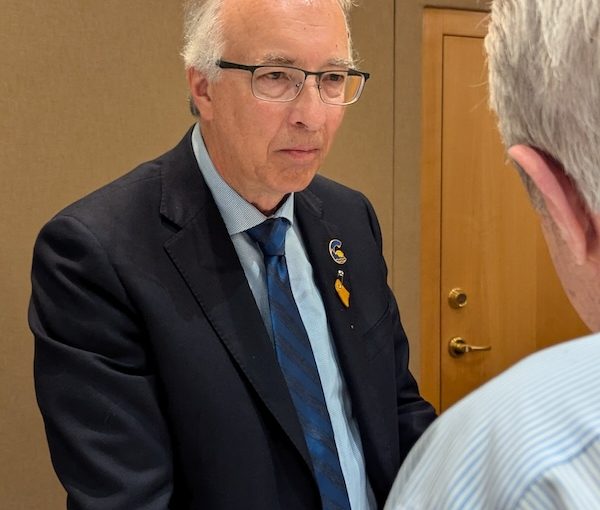
Selina Robinson, the former BC cabinet minister whose planned speech at Vancouver’s weekly rally for the hostages was canceled over security concerns earlier this year, was the surprise speaker Sunday at the vigil marking nine months since the pogrom of Oct. 7.

“I was out here nine months ago, representing government and the Jewish community … as we mourned together the slaughter of young people, the rape of women, the death of so many innocent people perpetrated by Hamas,” Robinson said. “I took it upon myself to make sure that we did right by the Jewish community and I took that honour with great reverence and commitment. I did so at the request of [then-premier] John Horgan and then I did it at the request of [current premier] David Eby and I did it diligently, as best I could. And we watched as a government what happens when hate goes unchecked. I never thought in my life, really, that I would see this level of hatred directed toward Jews.”
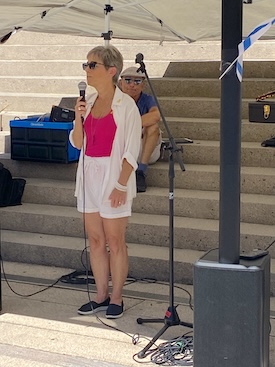
photo - Selina Robinson speaks at the July 7 vigil
Selina Robinson speaks at the July 7 vigil. (photo by Anna-Mae Wiesenthal)

She lauded fellow elected officials who stand with the Jewish community and said there should be unanimity.

“On this issue, we should not be divided,” said Robinson, a former minister of finance who was minister of postsecondary education when Eby, the premier, demanded her resignation after comments she made on a webinar calling pre-state Israel a “crappy piece of land.”

She credited Jewish organizations and allies for the work they are doing, but warned of a steep road ahead.

“We have a lot of work to do, my friends,” she said. “The antisemitism that has been unleashed is going to be hard to put back in the bottle.”

Congregation Beth Israel’s Rabbi Jonathan Infeld had harsh words for Robinson’s treatment at the hands of colleagues.

“Let’s tell the truth of why Selina was kicked out of cabinet,” Infeld said. “The reason is because Selina was the one representative of the Jewish people in cabinet. Selina was the one person in cabinet, in our government, willing to stand up not for some people’s human rights but for all of our human rights. Selina was kicked out of cabinet because she was a strong woman who stood for all that our province is supposed to stand for and she was kicked out of cabinet because she is a Jewish hero.”

BC Conservative Party leader John Rustad spoke, and was joined at the rally by fellow Conservative MLA Elenore Sturko and a number of Conservative candidates standing in October’s provincial election.

“I am proud to say that I stand here with you,” said Rustad. “I stand against terrorism. I stand against Hamas and what they have done.”

The government in British Columbia needs to do more to counter antisemitism, he said. 

“People who come to this province, to live here, come here with the expectation that they will live in peace,” Rustad said. “They come with the expectation to be able to raise a family, to be able to build the future, and what we are seeing today, with the antisemitism that is happening throughout our communities, I just find completely wrong.”

Ezra Shanken, chief executive officer of the Jewish Federation of Greater Vancouver, expressed pride in the community he serves. He urged elected officials to stand with the community. 

“We remember who was there on day one and we see who’s there now and that’s something that we have to stand up for here in our province and in our country,” he said. “We need them side-by-side by us and you need to be the ones to continue to tell them at all levels of government that we need them now more than ever.”
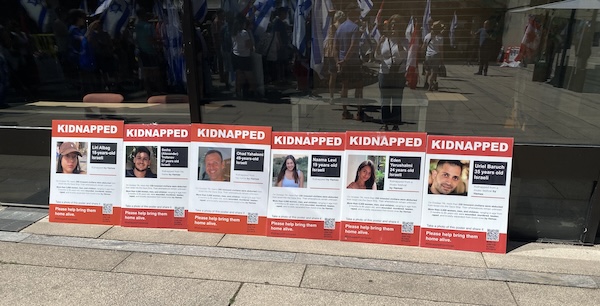
photo - Approximately 120 hostages are still being held in Gaza, more than nine months after the Hamas attacks on Oct. 7
Approximately 120 hostages are still being held in Gaza, more than nine months after the Hamas attacks on Oct. 7. (photo by Anna-Mae Wiesenthal)

Lior Noyman, an Israeli-Canadian educator and filmmaker, expressed sorrow for victims of violence in Israel and Gaza. He warned the audience to be vigilant against expanding antisemitism.

“Leaders, teachers, parents, Canadians, I am calling to you all,” he said. “Don’t let them walk us back in time.”

Dov (David) Rosengarten, a Vancouverite who is chief of staff for donor communications at United Hatzalah, Israel’s network of 7,000 volunteer first responders, brought greetings and gratitude from Israel. 

“Your display of unwavering solidarity every weekend here continues to give us strength through this difficult period,” he said. 

Noting the nine-month period since Oct. 7, Rosengarten drew parallels with the human pregnancy term, except that these past 40 weeks have been a time of unprecedented trauma. He sees hope in news of a ceasefire plan and hopes that “these painful birth pangs will end and the citizens of Israel and the Jewish people at large, including here in Vancouver, will be reborn again. After these many painful months, these cries of sorrow will be transformed to jubilation and we will finally hold our beloved hostages and loved ones again and celebrate the victory of unity and, like with a newborn child, we will shape for ourselves a bright future full of new dreams and possibilities.” 
Photos depict Oct. 7 trauma

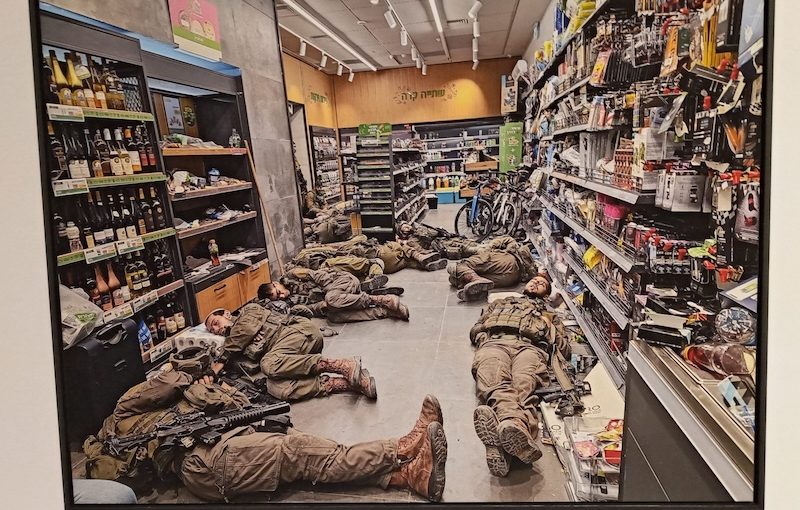
Batia Holini’s photo of Israeli soldiers sleeping on the floor of a grocery store near Kfar Aza on Oct. 8 is one of the works in the exhibit Album Darom. (photo by Gil Zohar)

Album Darom: Israeli Photographers in Tribute to the People of the Western Negev, which opened recently for a six-month temporary installation at the Petach Tikva Museum of Art, is the first group artistic endeavour in Israel to confront the tragedy of Hamas’s Oct. 7, 2023, massacre and the subsequent Gaza War, now in its 10th month. The ambitious tripartite installation Album Darom (Hebrew for Southern Album) incorporates a Facebook diary; a printed book of photographs accompanied by essays (published by Yedioth Ahronoth); and the museum exhibit.

Initiated by Prof. Dana Arieli, dean of the faculty of design at the Holon Institute of Technology, together with chief curator Irena Gordon, the project showcases 150 photographs, art installations and texts documenting the story of the western Negev region before and after Oct. 7. The exhibit includes the perspectives of 107 photographers and artists. Some of the participants in the album are world-renowned, others are amateurs. Lavi Lipshitz, the youngest featured photographer, lost his life fighting in Gaza. His mother penned the text accompanying his images.

The works in the album represent different photographic practices: artistic, personal and some staged, the intense images are upsetting. As well they should be in confronting mass murder.

Before walking around a corner to see Lali Fruhelig’s gruesome 3-D installation suggesting a corpse sprawled on the floor of a living room, a sign cautions: “The exhibition contains some potentially disturbing contents. Viewer discretion is advised.”

Arieli, a history professor and a photographer who explores remembrance culture and cultural manifestations of trauma, began the Album Darom project shortly after the Gaza war broke out.

“When something’s traumatic, you have to work or do something,” she said. 

Shocked by the murder of her friend Gideon Pauker from Kibbutz Nir Oz – who was killed just before his 80th birthday – she posted 100 daily historic and contemporary images of the Western Negev.

Initially, Arieli intended Album Darom to be exhibited at Kibbutz Yad Mordechai Museum just north of the Gaza Strip frontier. After the museum was damaged by rocket fire, this wasn’t feasible. Instead, she selected Petach Tikvah as the venue. She explained that the site – the first Yad Labanim memorial to fallen Israel Defence Forces soldiers from the War of Independence – is meant to be relevant to all Israelis. The museum offers free admission on Saturday, so observant Jews may visit on Shabbat.

Speaking to a group of journalists, Arieli compared Oct. 7 to the Nov. 4, 1995, assassination of then-prime minister Yitzhak Rabin. “Everyone is frozen in their memory of where they were,” she said.

Arieli and Gordon emphasized the intended cathartic nature of the exhibit. The two said the museum is a “safe space” and a “place for healing.” After experiencing the horrors of Oct. 7, Gordon found solace in this project, she added. “This is part of how we are coping with it all,” she said.

Miki Kratsman is one of the photographers whose depiction of his Oct. 7 nightmare is in the exhibit. Terrorists took his aunt Ophelia hostage from her home in Kibbutz Nir Oz. She was later released from Gaza in the November hostage exchange deal. 

Kratsman’s photograph, “In Aunt Ophelia’s Neighbourhood,” captures a modest kibbutz home collapsing as it is immolated in a fireball. 

“These are the kinds of things that need to be in a museum,” Arieli said of the photograph. “You’re looking at the destruction of Nir Oz.”

While vividly showing the devastation of the kibbutz, the burning home photograph is an enigma, and creates dialogue, she added.

But it is the human toll rather than the destroyed real estate that is most painful. Paradoxically, perhaps, Batia Holini’s peaceful photo of exhausted IDF soldiers sleeping on the floor of a grocery store near Kfar Aza on Oct. 8 hints at the savage warfare in which they have been engaged.

photo - “Funeral of Five Members of the Kutz Family who were Murdered in Kfar Aza,” a photo by Avishag Shaar-Yashuv
“Funeral of Five Members of the Kutz Family who were Murdered in Kfar Aza,” a photo by Avishag Shaar-Yashuv. (photo by Gil Zohar)

Avishag Shaar-Yashuv’s photograph, “Funeral of Five Members of the Kutz Family who were Murdered in Kfar Aza,” captures the searing emotion of the funeral of a family annihilated in the Hamas attack.

“I tried to focus and also wipe the tears at the same time,” Shaar-Yashuv said.

For this reviewer, the most symbolic part of the exhibit was a taxidermy display of a doe entitled “Bambi.” The exhibit references Felix Salten’s 1923 novel Bambi: A Life in the Woods and the 1942 animated movie produced by Walt Disney. Metaphorically, the hapless baby deer represents both the Six Million victims of the Holocaust and the 1,200 people murdered on Oct. 7.

Viewing Album Darom, one could conclude that the myth of the state of Israel protecting its citizens has been shattered. Arguably, Israelis today are no more secure than their ancestors were facing the Kishinev Pogrom of 1903, the Hebron Massacre of 1929 or the Farhud in Baghdad in 1941. 

Gil Zohar is a writer and tour guide in Jerusalem.

Tory leader woos Jews

BC Conservative leader John Rustad speaks with an audience member at a June 20 event at Schara Tzedeck Synagogue. (photo by Pat Johnson)

It has been 96 years since the Conservative party won a provincial election in British Columbia. The last time a Conservative was elected to the BC Legislature was a 1978 by-election. So, the rapturous reception BC Conservative leader John Rustad and several of his local candidates received from a mostly Jewish crowd at Schara Tzedeck Synagogue recently may have been a phenomenon unseen in generations.

Public opinion polls over the last year have consistently put the BC Conservatives in second place, ahead of the BC United party, which was known as the BC Liberals before a rebranding last year. The four sitting Conservative MLAs, including Rustad, were all initially elected as BC Liberals and later crossed the floor. 

The June 20 event was convened by Saul Kahn, a Jewish community leader who acknowledged he has not been politically active before. The synagogue, he noted, was a venue and the Conservatives’ presence there did not represent an endorsement.

Rabbi Andrew Rosenblatt, Schara Tzedeck’s senior rabbi, said he would welcome any politicians who want to meet and answer questions from the community. He noted that the event took place three weeks to the day after an arson attack on the synagogue and said the Jewish community is deeply concerned about developments in education in the province at all levels – primary, secondary and post-secondary. 

Rustad, the MLA for Nechako Lakes, an enormous riding sprawling across central British Columbia, lamented the situation.

“We shouldn’t need to have security,” he said, noting that churches and other institutions rarely even have to consider the issue. “We’ve allowed antisemitism to take root. We are not standing up and saying it’s wrong. It starts in our schools.”

Anybody who is promoting hate in the province should be criminally charged, he said, and, if they are not Canadian citizens, the federal government should consider deporting them.

Schools should be “teaching kids how to think not what to think,” said Rustad, and he promised to rescind the provincial government’s policy on sexual orientation and gender identity, commonly called SOGI. While promising to remove SOGI, Rustad pledged to support all students and pursue anti-bullying policies.

The leader, who has been in the legislature since 2005 and served in cabinet under premier Christy Clark, promised to go through all material in the education system “with a very critical eye” toward issues of ideology, gender and the environment. He said he assumes the BC Teachers’ Federation will fight back on issues like SOGI, which he calls the “sexualization of our children,” but said some of the things being taught in school could not be put on television or said in the legislature.

The party leader condemned anti-Israel protesters on BC university campuses.

“How is it that this is OK?” he asked. “People do not have the right to incite hate.”

He floated the possibility of holding back funding or otherwise putting pressure on universities to respond to this sort of activism.

Rustad condemned the province’s approach to addiction, saying that safe supply is “creating the next generation of addicts.” He called for long-term care and supports that help people get off drugs. 

“I don’t think it’s OK as a society to say it’s OK for them to live on the street,” said Rustad. 

Addressing the physical addiction is one thing, he added, but providing supports so that people coming off substances do not fall back into old habits and relationships must be part of the recovery process.

Rustad would like the province to gain the sort of autonomy over immigration that Quebec has been granted, “not from the perspective of saying people can’t come, but identifying those with the skill sets we need,” he said.

Housing construction needs to be ramped up and immigrants who can work in those sectors need to be encouraged, he said. Likewise, the province should be working with post-secondary institutions overseas to address issues of credentials before new Canadians move so that people can integrate smoothly into the economy when they arrive.

The foreign buyers’ property tax allows British Columbians to, he said, point at others and say “they are the problem” for high housing costs.

The province’s new densification policies overrule municipalities’ official community plans, he said. These “sound great” in terms of housing, said Rustad, but do not consider sewers and other infrastructures.

Dallas Brodie, the Conservative candidate taking on BC United leader Kevin Falcon in Vancouver-Quilchena, shared her “Israel coming-of-age story.” She had practised law for 10 years and served as a legal aid criminal defender for young offenders before getting into broadcasting. She intended to do legal analysis but broadened her scope to become a producer for CBC in Toronto and Ottawa and later for CKNW talk radio in Vancouver. She noted a media double standard in which, for example, if a pro-Israel speaker were booked, management would demand equal time for an anti-Israel voice. The process became so onerous, she said, “you just stop covering the topic of Israel altogether.”

Eventually, Brodie became host of a weekly program on the University of British Columbia campus station CITR, which she refers to as a “viper’s nest of Marxist thought.” There, she said, she was told not to say the word “Israel” on the air because it is upsetting to people. This UBC connection put Brodie in touch with staff at the campus Jewish organization Hillel, who included Brodie on trip to Israel that she says presented a balanced introduction to the region.

“Even the Palestinian perspective was presented to us,” she said.

The next year, she participated in March of the Living, where participants visit the Nazi death camps.

Running for the provincial legislature, Brodie said some people suggested that including her strong support for Israel in her political biography might hurt her chances, but she insisted on including it.

“My party more than supports my position and stands firmly and strongly behind me,” she said. “I will never go wobbly.”

Vancouver-Langara Conservative candidate Bryan Breguet, an economist who teaches at Langara College, noted that his institution became “internationally famous” last fall after a colleague (later fired) celebrated the atrocities of Oct. 7.

Breguet reflected on a recent incident in which a Burnaby public school teacher engaged in a “thought experiment,” asking students whether Israel had a right to exist. He questioned what the public reaction would have been to a thought experiment asking whether slavery should or should not have been abolished.

Breguet said he traveled to Israel in 2007 and was shocked to see the separation barrier in the process of construction. What shocked him, he said, was that the wall “hadn’t been built decades earlier.”

John Coupar, the party’s candidate in the newly created riding of Vancouver-Little Mountain, cited his 12 years of experience as an elected Vancouver park commissioner and his efforts to save the Bloedel Conservatory. 

He condemned the provincial government’s “failed experiment to legalize drugs” and called for “treatment, recovery and safe streets.”

He addressed antisemitism and condemned the governing New Democrats for their choice of candidate to run in the riding he is contesting.

“Your community is suffering deeply,” he said, before criticizing the governing NDP who he says “doubled down” by nominating Vancouver city councilor Christine Boyle as the NDP candidate in Little Mountain, “the only councilor to vote against IHRA [the adoption of a working definition of antisemitism] not once but twice.”

“This is absolutely appalling to me,” Coupar said.

A question from the audience addressed concerns that a failure to unite Conservative and BC United voters could result in a reelected NDP government. Rustad said discussions to fuse the parties, or to form some sort of electoral alliance, were unsuccessful, a failure Rustad placed on the other party.

He claims his party’s polling and analysis suggest that, if the two parties merged under the Conservative banner, the election would result in a six-seat majority for the Conservatives while, if they coalesced under the BC United banner, the NDP would win by 20 seats.

The election is on Oct. 19. 

Non-Jews must speak out now

As a student at the University of British Columbia, I want the Jewish community to know that the encampments at universities across Canada do not reflect all students’ values. In my view – and I have spoken with many other students who feel the same way – these encampments are not places of peaceful protests but instead places that allow for the exclusion of students who hold different views and the spreading of antisemitism. Advocating for Jewish students on campus has become controversial, and I want to change that. 

The student protesters at these encampments have resolutely turned their back on any form of dialogue. The recently disbanded encampment at UBC, for example, was set up on April 29 and, as early as May 9, a statement from the encampment’s Instagram – Peoples University for Gaza UBC – read “F*** a discussion, we want divestment” in response to their perception of UBC president Dr. Benoit-Antoine Bacon’s handling of their demands.

At UBC, openness to discussion with Jewish students of differing views has never been demonstrated, and only self-proclaimed anti-Zionist Jews were allowed into the encampment. The anti-Zionist group Independent Jewish Voices was allowed in, with the group having taken part in protests against Hillel BC on campus. From what I saw, if a Jewish student identified as a Zionist and tried to engage in dialogue or enter the encampment, they were intimidated off the premises. 

On May 31, I created an Instagram post from my personal account (@zaranybo) titled “A Canadian non-Jewish ally’s response to the university encampments.” That post has received more than 1,200 likes and hundreds of shares. I prepared myself for an onslaught of hate comments, but, instead, I have received only support. 

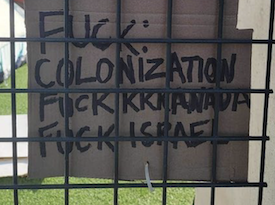
In the statement, I share two photos that were taken at the UBC encampment: a sign saying “Zionists F*** Off” and “F*** Colonization, another saying F*** KKKanada, F*** Israel.” These signs were prominently displayed on the outer fence for all passersby to see. The encampment was demonizing Israel and trying to convince my peers to believe Hamas propaganda and antisemitic rhetoric. 

photo - One of the signs that were posted on the fence of the encampment at the University of British Columbia
One of the signs that were posted on the fence of the encampment at the University of British Columbia. (photo by Zara Nybo)

I see such encampments as tiny, hypocritical echo chambers for my peers to radicalize in. It is my understanding that it is illegal to protest with a face mask or face covering under the Canadian Criminal Code and yet they do so. The encampment at UBC took university equipment and furniture to use as barricades. UBC is on unceded Musqueam land, thus the encampment was “colonizing” Maclnnes Field, against the law and on unceded land. The protesters were doing exactly what they contend Israel is doing to Palestinians.

From the response to my Instagram post, I realized that students across Canada are hungry for a community of students who are against the hypocrisy of the encampments and willing to speak out. I received a direct message from a student at the University of Toronto who felt they’d gone crazy, watching their peers spew pro-Hamas rhetoric. I also received an outpouring of support from many Canadian Jews, thanking me for standing against antisemitism.

After the first statement was so well received, I posted another one – “The time is now. Non-Jewish allies need to stand up.” We, as Canadian university students, have been silent for too long. I hold us collectively accountable for our silence. I know that it feels difficult for my peers to speak out. Understandably, they fear ostracization from their social circles and other repercussions. However, I challenge that, it should not be controversial to speak out against hate. 

What if social media had been around during the 1930s and 1940s? If we in Canada had seen the Jewish buildings being targeted then, saw that Jews were no longer allowed to attend school, and saw “no Jew” zones created, would we have said something? Would we have done something? 

Across Canada today, synagogues are being targeted, Jewish schools are being targeted, and the elders and children attending both are the target. If we believe we would have spoken up in the 1930s and 1940s, then we need to speak up now. We cannot let history repeat itself on our watch. 

It is vital that other non-Jewish students speak out, whether that is on social media or in their friend groups. Even though it feels nerve-racking to have a “controversial” or differing opinion from our friends, we must speak up nonetheless. Social media is a tool we can each use on an individual level to create a collective paradigm shift. 

To post or reshare support for Israel or call for the release of the hostages can create a rift in our friends’ online echo chambers. Social media algorithms work by showing users posts similar to what they have previously liked, reinforcing a certain worldview for users. This is what we call confirmation bias. If one person can alter that echo chamber, even with one post, it can begin to change what  individuals see on their feeds. With the amount of disinformation and terrorist propaganda circulating, this small action can make a difference. 

In the BC high school curriculum, we learned of the Nazis, antisemitism and the death camps. I always believed I would have risked my life to hide a Jewish family, but now I see it’s easier for most of us to be quiet in the face of antisemitism. 

After seeing my peers’ reactions and lack of courage to stand with the Jewish community after Oct. 7, I no longer believe that if social media had been around during the Second World War it would have made a difference. Many people knew then what was happening in Europe, even though media was less immediate and visually powerful, and people certainly know now what is happening. Yet, most of us are silent still. 

We’ve reached a point where standing up for Jewish people and against antisemitism seemingly require an in-depth understanding of the Middle East’s complex political history. This is a harmful conflation and double standard for fighting antisemitism – any other form of racism does not require this level of knowledge.

In my speech at the launch of Be An Upstander for Upstanders Canada on June 23, I said, “I’d like to tell you that the extreme anti-Israel rhetoric we are seeing on campus is not going to change the reality in the Middle East – but it is making life for Jewish students in Canada difficult and, in many cases, dangerous.” This is the truth. These protests aren’t going to change the outcome of this war, but they are creating a nearly unbearable campus culture for Jewish students. 

But I am hopeful. After the outpouring of support for my statements on Instagram from Canadian university students, I believe that, if more of us speak out against antisemitism, others will follow. There is still time to change the deafening silence of the non-Jewish community since Oct. 7.

Now is the time. Canadian non-Jewish allies need to speak up. How much more do our Jewish peers have to go through before we believe it’s gotten bad enough to sacrifice our comfort for our integrity? 

Zara Nybo is a third-year student at the University of British Columbia. Connect with Zara via Instagram: @zaranybo.

Criticism is hard but vital

A year ago, for an important birthday, we bought a mature lemon tree. This perhaps sounds absurd because we live in Winnipeg, which has extremely cold winter temperatures. However, our home has a heated sunroom and the lemon tree, in its pot, blossomed and bore fruit. When warm weather came, we moved it outside to enjoy the summer. The outdoor location, against a wall, sheltered the tree and two lemons ripened.

My kibbutz year came back as I picked that first lemon. The lemon blossoms perfumed the indoor air as they came and went. Off-the-tree citrus, just like any other fresh produce, tastes so much better than anything bought at a grocery store. While lemons offer a sharp, puckery sour taste, their zest and juice absolutely make food sparkle. 

I posted about our “crop” of two lemons on social media. Immediately, I had a friend from Israel commenting on how lemons were her favourite fruit. Two other North Americans asked how we managed to grow them. I sensed their excitement through their onscreen responses.

This experience recalled another scenario, which plays out regularly in Jewish life – that of feedback, or constructive criticism. I was a blunt kid, accused of being not just assertive but aggressive at times. Instead of cloaking things in demure, “ladylike” manners, I said what I thought. I took to heart the idea that everyone can improve and that we should have high expectations. Yes, criticism can be difficult, and it’s sometimes unwarranted, but, without it, we sometimes can’t grow and improve as individuals or communities.

I recently took part in a Jewish business fair for newcomers at our Jewish community centre. Sponsored by Jewish Child and Family Services, it uplifted many who had moved from elsewhere. I loved the opportunity. I smiled and chatted with everyone who came to my writing and editing booth. One community member recognized me and took the time to let me know she was sorry nothing was good enough for me here. Her view of my work, written over many years for both Jewish and non-Jewish publications, was overwhelmingly negative. I responded cheerfully, suggesting that there were many good things about Winnipeg’s Jewish community, but that it was also a good thing to learn about other possibilities from elsewhere, reflect and improve. She sniffed disapprovingly and walked away.

This interaction reflected other times when I’ve been asked for suggestions or advice. The responses often included some version of “That’s not how we do things here” with a sneer, grumble or angry tone. Even when the feedback includes a lot of praise and support, including data or anecdotal evidence from other communities, some people are defensive and aren’t ready to hear it.

In some cases, I’ve heard “since I didn’t land that gig/volunteer position/award, I was just offering sour grapes.” Sour grapes are that metaphor for saucy words we offer when we’ve been rejected and react with impulsive hurt, though sour grapes make good wine. That pucker-up taste, just like with lemons, can do wonders, with time, to improve food and drink.

A wise friend, a Holocaust survivor in her mid-80s, asked for feedback after our family’s lifecycle event at our congregation. Akin to an exit interview, it’s important to have congregants’ thoughts on how the synagogue is doing, what went well and what could be done better. I took the time to respond. I sent the information to the people in responsible positions who should see it. I also wrote a separate gushing, positive note about the livestreaming feed, which is so inclusive for us when we cannot be in the building. I got a response from someone about the livestreaming feed email. I’ve received nothing so far about the constructive criticism.

It’s normal to feel defensive about criticism, especially if it hits hard or close to the bone. Yet, a professional should be able to respond. Feedback helps us grow, whether as a customer service-oriented synagogue or a business. I have struggled with this. Rejection and negative feedback are part of being a writer.

I used to joke that a swift, rude rejection didn’t reflect on my work. Instead, I imagined a grouchy editor who ate a burrito for lunch. He had bad indigestion and took it out on me. Then the rejection wasn’t such a big deal. The guy’s stomach trouble and bad manners became funny, rather than a reflection of my efforts.

In time, I’ve embraced the notion that a rejection, including a frankly critical one, offers positive opportunities. An editor’s simple “No, thank you” can result in a quick sale when I resubmit the piece elsewhere. Helpful feedback means I can improve my skills. Complete silence doesn’t mean anything – it doesn’t indicate that my work is awful or it’s still being considered.

Jewish tradition grows from a long rabbinic tradition of debate, discussion, criticism and reproof. It’s part of who we are. It’s sharp and puckery like that fresh lemon bite or the tannic pucker of sour grapes. It’s not easy to hear. Yet, when offered in good faith, thoughtful analysis only shows how much the respondent cares. Hearing nothing from a congregant, colleague or friend doesn’t mean everything is good. It may mean that they don’t care enough to respond. Or perhaps they say nothing because they can’t stand the rude response, defensiveness or silence that might follow.

It’s important, as part of a community, to offer effusive praise and support for one another whenever we can. It’s also key to our future to reflect, reevaluate and offer ways to improve. We often make a good salad spectacular with a squeeze of tangy lemon. Sometimes, we need to pucker up to improve things, so we may experience the huge flavour that can follow. 

Joanne Seiff has written regularly for the Winnipeg Free Press and various Jewish publications. She is the author of three books, including From the Outside In: Jewish Post Columns 2015-2016, a collection of essays available for digital download or as a paperback from Amazon. Check her out on Instagram @yrnspinner or at joanneseiff.blogspot.com.

Support Victory Square 100

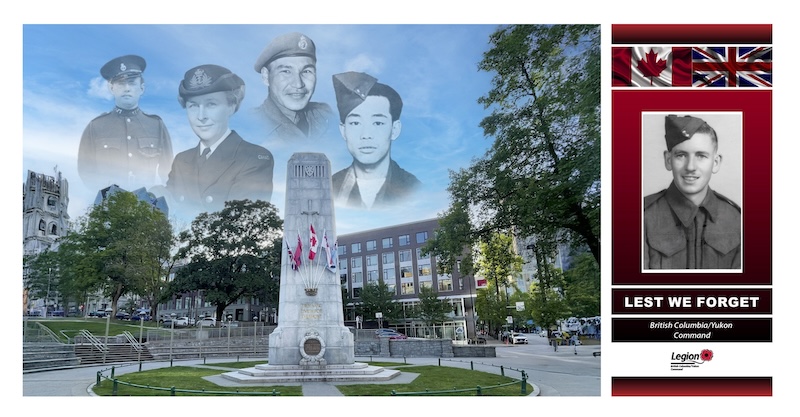
Victory Square 100 will create banners featuring photographs of veterans, which will be flown about Vancouver around the time of this year’s Remembrance Day commemorations, when the Victory Square Cenotaph in Vancouver turns 100. (images from RCL BC/Yukon Command)

Every year, from the last Friday of October to Nov. 11, tens of millions of Canadians wear a poppy as a visual pledge to honour Canada’s veterans. This year, the Victory Square Cenotaph in Vancouver will turn 100 years old and so the Royal Canadian Legion BC/Yukon Command has created the Victory Square 100 program.

Victory Square 100 invites all interested individuals and organizations to participate in creating banners adorned with pictures of veterans, which will be flown around the city of Vancouver.

If you are a veteran or if you have a loved one who served in the military, submit a high-quality picture of yourself, or the veteran, in uniform. Pictures need to be submitted digitally.

These photographs will be transformed into banners that showcase the faces of Canada’s veterans. Each banner will be crafted to ensure the dignity and respect befitting heroes.

There is a cost to creating and displaying the banners. The legion encourages the community, businesses and organizations to join them in the Victory Square 100 initiative and to sponsor a banner. If veterans or their loved ones who submit a photo choose to do so, they can also donate to the program.

There are a couple of options: a general donation to support the banner program (any amount), and $229 to support the banner program and have a veteran featured on the banner.

Victory Square 100 is more than just a gesture of appreciation – it’s a tangible expression of gratitude and respect for Canada’s veterans. By participating, you are helping ensure their legacy lives on and their service is never forgotten.

For additional information, visit legionbcyukon.ca or call Danny Redden, president of the Royal Canadian Legion’s Shalom Branch #178, at 604-739-1571. 

– Courtesy Shalom Branch 178

Fundraising for vital services

Larry Vinegar, left, and Marcy Schwartzman with Daniel Steiner, who presented them with the Lighting the Way Award at JFS Innovators 2024 on May 28. (photo by Kliri Photography)

JFS Innovators 2024: 18 Years of Lighting the Way raised more than $420,000. “With donations raised by Innovators 2024, we can provide holistic, wrap-around care – the kind that recognizes individual needs, situations and life stages,” Tanja Demajo, chief executive officer of Jewish Family Services, told the Independent. “Picture this: a single mom dealing with a debt after divorce, trying to care for her child with autism on a limited income, as her caretaker role and employment conflict each other. With these funds, we are not just filling their fridges, we are nourishing their well-being and giving them the fuel to keep going when it’s hard.”

The annual fundraising event, which was presented this year by Pollock Clinics, took place the evening of May 28 at Parq Vancouver. Originally a luncheon affair, the new approach was well-received, said Innovators 2024 committee co-chairs Candice and Todd Thal. In an email, they shared some of the feedback they had received: “Great event. Positive responses to the change in format. Open bar and food elevated the evening. Video was informative and touching.”

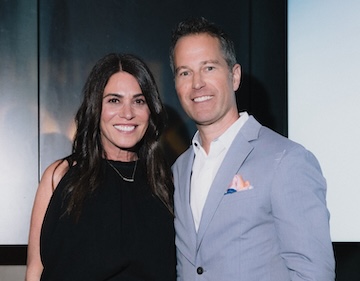
photo - Innovators 2024 co-chairs Candice and Todd Thal
Innovators 2024 co-chairs Candice and Todd Thal. (photo by Kliri Photography)

The Thals have been involved with JFS as donors and volunteers for many years, because they value that JFS “supports our local community, regardless of age, race or religion.” As co-chairs of Innovators, they were responsible for, among other things, marketing and communication, corporate sponsorship and overall event planning, which included sourcing a venue, integrating new fundraising strategies, and developing a menu.

The event started with a welcome and land acknowledgement by actor Christina Chang, who was the night’s emcee. Demajo spoke, offering an overview of JFS and Innovators, and Daniel Steiner presented the Lighting the Way Award to Larry Vinegar and Marcy Schwartzman. After a video featuring former JFS clients Sammy and Tadelu, auctioneer Fred Lee got people bidding. The proceedings wrapped up with remarks from the Thals, who told the Independent that their favourite part of the night was “watching over 350 happy and engaged people come to support the new Innovators format.”

“Having so many people come together to support JFS on this special anniversary of the Innovators event was very inspiring and such a lovely way to spend the evening,” agreed Demajo.

The presentation of the Lighting the Way Award was a highlight. The honour was established to recognize and celebrate “exceptional leadership and commitment within the community,” Demajo said. “This award serves as a tribute to individuals or companies who embody the core values and mission of JFS, particularly in their dedication to uplifting lives and contributing to a world repaired.

“By recognizing individuals or companies JFS not only celebrates their achievements but also encourages others to follow their lead in making the world a brighter place. The Lighting the Way Award serves as a beacon of hope and inspiration, reminding us of the collective responsibility we share in creating a more compassionate and inclusive society.”

photo - Members of the Innovators 2024 committee, left to right: Jessica Hanick, Candice Thal, Tamar Bakonyi and Cydney Shapiro
Members of the Innovators 2024 committee, left to right: Jessica Hanick, Candice Thal, Tamar Bakonyi and Cydney Shapiro. (photo by Josh Bowie Photography)

Vinegar and Schwartzman were given the award in recognition of their contributions to JFS and the community at large.

“They truly embody JFS’s values and demonstrate innovation in their commitment to social good, reminding us that finding a way through darkness can lead to a more resilient, compassionate and inclusive society,” said Demajo.

“Larry and his son Moishe had volunteered with the food bank since Moishe was a kid, demonstrating great passion and commitment to food security. In early 2021, Moishe left this world far too early. Larry and Marcy turned their grief into an amazing opportunity to engage young adults in food and environmental justice through the Moishe’s Farm Retreat,” she explained.

“Wanting to do more, they also planted an acre of land with squash in the Okanagan valley with the intention to donate the produce to the JFS Kitchen. Two years ago, Larry came across a piece of land in Richmond, which he, Marcy and their friends transformed into a thriving farm. Their vision attracted numerous supporters who have helped Larry and Marcy grow and donate fresh food to JFS and other organizations. Each week, Larry and Marcy deliver fresh produce to the JFS Kitchen. Since starting the farm, they have donated over 20,500 pounds of food. Their produce enriches lives by not only ensuring food security but also advancing food justice.”

photo - Former JFS clients Tadelu and Sammy
Former JFS clients Tadelu and Sammy.  (Photo by Kliri Photography)

Steiner, who presented the award to Vinegar and Schwartzman, has a special connection to JFS and Innovators. His wife, Naomi Gropper Steiner, z”l, and her friends Hildy Barnett, z”l, and Kristina Berman started Innovators in 2006. Steiner has been involved since the beginning, and continues to do what he can to continue her legacy.

And there is always more to be done.

“Due to an increase in poverty, hunger, homelessness and mental health issues, JFS faces an unprecedented number of requests for help and support in the community each and every day,” said Demajo. “For every person who receives care and services, there are five more waiting for support. Our mission is to ensure that every single person who crosses our path receives the care they deserve, precisely when they need it most.” 

A love affair that lasts

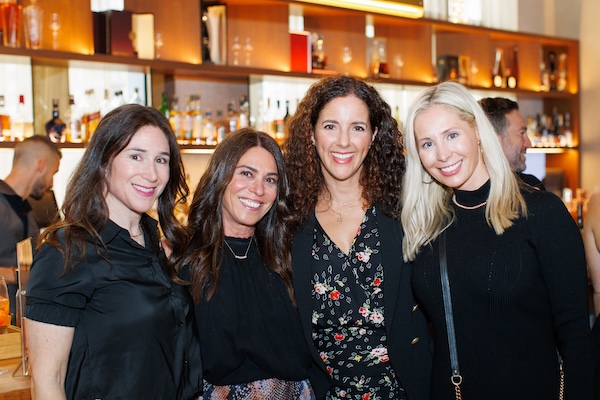
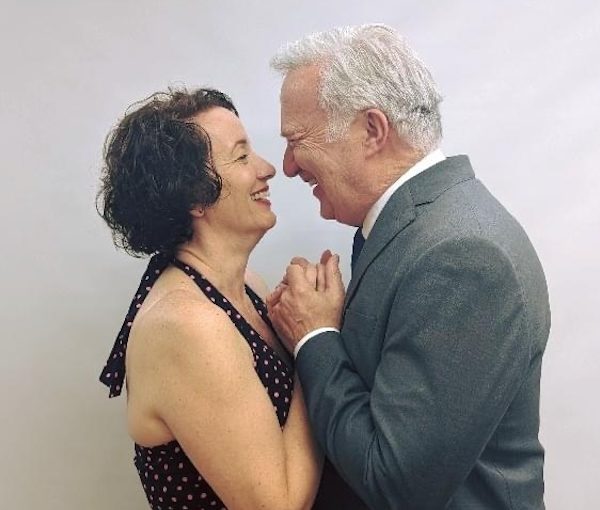
Sarah Heyman and Jerry Callaghan co-star in Bema Productions’ Same Time, Another Year, which opens July 17 at Congregation Emanu-El’s Black Box Theatre. (photo from Bema Productions)

From July 17 to 28, Bema Productions will be staging Same Time, Another Year, the sequel to Bernard Slade’s Broadway hit Same Time, Next Year, at Congregation Emanu-El’s Black Box Theatre.

The sequel catches up with Doris and George, who, in the first instalment, have carried on a long-standing love affair – meeting each other for a weekend once a year despite being married to others. Same Time, Another Year starts on their 25th anniversary, in 1976, and continues through their subsequent February rendezvous over the next 17 years.

The pair are now in their late sixties, faced with the responsibilities and consequences of life, all the while reexamining love beyond their annual assignation and the romance contained within it. Told in six scenes, and against the backdrop of the late 20th century, their affair and their perspectives on their relationship evolve and change. Along the way, there are illnesses, career successes and setbacks, second marriages, second families, and grandchildren.

“I knew that many of our patrons would remember Same Time, Next Year and, like me, wonder what happened to George and Doris 25 years later. I have had quite a few [people] tell me this since the advertising went out,” said Zelda Dean, founder and managing artistic director of Bema. “Maybe because I am ‘that age,’ the play spoke to me, as it addresses what we all have to face as we age – the fears that everyone has about their health and about losing the ones we love.”

Doris and George form a special bond beyond the bedroom, one with its own sincerity. Further, they provide a kind of gauge for what happens in the other’s life.

Dean told the Independent that what she likes most about the play is the unique relationship that develops over the many years, although the characters only meet once a year. She feels that audiences will enjoy the continuation of their journey.

Dean added that it has been a delight to work with the two leads, Sarah Heyman and Jerry Callaghan, whom she described as two very gifted actors. Both have been in the business for several years and are also close friends, which, Dean explained, made it easier for them to portray the relationship between the couple. 

“A ‘two-hander’ is always a challenge for the actors. Of course, many lines have to be learned and there is never time for a break on stage,” Dean said. “This particular play has six scenes, mostly four years apart. This means the actors have to change their costumes in two minutes or less. Much harder than one would think, especially standing in the wings.”

A Canadian playwright and actor, Slade created two popular television series in the late 1960s and early 1970s, The Flying Nun and The Partridge Family. He also wrote for Bewitched and The Courtship of Eddie’s Father, among others. He began his career as an actor, performing in more than 200 plays on stage, radio and television, in regional theatres around Toronto and on camera for the CBC.  By the mid-1970s, Slade turned his comedic focus to the stage and wrote more than a dozen plays.

One of the most produced and successful two-person plays, Same Time, Next Year opened on Broadway in March 1975, originally starring Ellen Burstyn and Charles Grodin, and ran for more than 1,400 shows during the course of nearly four years. It toured across the United States, played in London and was translated into several languages. It was adapted into a film in 1978 that featured Burstyn and Alan Alda. 

It has been said that Slade’s strength as a writer derives from his ability to fill the characters’ lives with events of great richness and depth, and still maintain the easy lightness so important to a romantic comedy – with strong dialogue and a consistent, realistic and emotional tone. The theme of Same Time, Another Year, as well as the original, is that few (if any) relationships fit into neat boxes, and each has its own rhythm and place in people’s lives.

For more information, showtimes and tickets, visit Bema’s website, bemaproductions.com. 

Sam Margolis has written for the Globe and Mail, the National Post, UPI and MSNBC.

Tempest musical exploration

Shayna Goldberg (photo from Music on Main)

The Tempest Project is a roving musical adventure that will see audiences taken on a journey, both literally and figuratively,” Shayna Goldberg told the Independent.

“Audiences will be led through the entire Vancouver Playhouse by guides, moving between spaces, through the theatre, hallways and stairwells, through the usual lobbies to the very unexpected,” she said. “While The Tempest Project is not a re-telling of the famous work, it is filled with storms and magic and wonder, and we believe it will leave audiences breathless.”

Goldberg is artistic planning and operations manager of Music on Main, which presents The Tempest Project July 17-22 at the Playhouse. She co-leads the production with artistic director David Pay.

“Audiences can expect a unique opportunity to listen together,” said Goldberg. “While traveling through the Playhouse, our hope is that audiences will experience what David Pay says music does best: convey emotions and feelings that cannot easily be put into words.”

On the route through the theatre, there will be live performances, recordings, projections, audio-and-optical illusions, and more. 

Pay began thinking about The Tempest Project in 2017, but development began in 2020, when the pandemic started and in-person gatherings weren’t permitted, said Goldberg. The first production was As dreams are made, “a beautifully intimate experience for one audience member with one musician (very pandemic friendly) and a sensational soundscape with a recording of a speech from Shakespeare’s play,” said Goldberg.

“Following the success of that first experiment into this project, we began working with local artists to explore the themes from The Tempest and how they could fit into a full-scale production,” she explained. “We did a lot of ensemble work with The Tempest Project Company, exploring how their insights, musical backgrounds and lived experiences could all contribute to devising creative ideas. Working with these amazing musicians over the past five years has certainly been a highlight to this entire process.

“As we enter the final phase, we are taking all of the things we learned as a team to create the world première! We knew that we wanted The Tempest Project to be something memorable and I think that, with the expert team we have assembled and by being in the Vancouver Playhouse, we’ll definitely achieve that.”

The musicians are Julia Ulehla, vocals; Paolo Bortolussi, flute; Aram Bajakian, guitar; Saina Khaledi, santour; Dailin Hsieh, zheng; Julia Chien, percussion; Jonathan Lo, cello; and Rachel Kiyo Iwaasa, piano. Dramaturg Melanie Yeats and production manager Alexis Douglas are part of the creative team.

Pieces have been commissioned from Khaledi; musician and storyteller Gabriel Kahane; Nancy Tam, who specializes in sound creations; and Alfredo Santa Ana, whose compositions range from the classical to electronic. There also will be improvised arrangements based on Solange’s “Things I Imagined,” and other works.

“David chose musicians who connect with audiences, have widely different but complementary music-making practices, and who reflect different aspects of the city we live in,” explained Goldberg. “The instrumentation of the ensemble is super varied…. It’s definitely not a typical ensemble! But the friendships and working relationships we’ve all forged as artists was one of the outcomes we were hoping for back in 2020 when we first invited everyone together.”

Goldberg has been working with Music on Main and Pay since 2018, when she joined the organization. 

“I’ve been lucky over the past 10 years to work with multiple companies, including almost five years at Pi Theatre. When I saw the posting for Music on Main, it felt like just the right challenge to me and, fortunately, they thought so, too,” said Goldberg, who has known from a young age that she wanted a career in the arts.

“I’ve always been a bit of a performer, maybe a tad dramatic, and I found that arts management was the right place for me and where I could help bring productions to life!” she said.

“While working with the Classical Theatre Project in Toronto, I felt a need to do more than be a group sales and company manager, and that led me back to school,” she said. “I never imagined that I’d complete an MBA, but the MBA with an arts and media management diploma from the Schulich School of Business was exactly what I was looking for. It provided me with the education to take my career to the next level, and the guts to move out to Vancouver, something I had always wanted to do.”

Since becoming a Vancouverite, Goldberg said she has “invested time in finding a strong and supportive community, and that has been primarily in the Jewish community. Shortly after moving here,” she said, “I was welcomed as a resident into the Moishe House and built some incredibly strong connections and friendships from that time. Also, through work with Na’amat Canada and the Axis Young Professionals program through Jewish Federation, I’ve really found my place here.”

And that includes, of course, her place at Music on Main.

“When I interviewed with David,” shared Goldberg, “I asked him what his next big project was and he said a large musical adventure exploring The Tempest. Now, coming from the theatre world and with a sincere love of Shakespeare, I was immediately excited. It took us awhile, but, when we were finally able to start the process, it was very much a labour of love on both our parts.”

For tickets to The Tempest Project, visit musiconmain.ca. 

Not-so-accessible city

Lenard Stanga as Hugh and Cadence Rush Quibell as Shiloh in Realwheels Theatre’s Disability Tour Bus podcast, which will be released July 17. (photo by Rashi Sethi)

On July 17, Realwheels Theatre releases its new production, Disability Tour Bus, as a radio play podcast available for streaming at realwheels.ca.

Written for podcast platforms by Amy Amantea and Jewish community member Rena Cohen, Disability Tour Bus follows Shiloh, a young wheelchair-user, as they navigate their first day as a guide for Funcouver Bus Tours. Working alongside longtime employee and relentless dad-joker Hugh, Shiloh struggles to stick to the Funcouver script when so much of “Canada’s most wheelchair-accessible city” is still so inaccessible. People and politics collide until a new passenger, Tess, comes aboard and offers common ground. The tour must go on! Because there’s someone special waiting for Tess at the end. At least she hopes there is.

The role of Hugh is played by Lenard Stanga, Jewish community member Cadence Rush Quibell plays Shiloh, and co-writer Amantea is Tess. The cast is rounded out by Mack Gordon, Caitlyn Bairstow, Ian Hanlin and Lauren Jackson playing multiple parts.

“As a wheelchair-user, I’ve heard that whole ‘most accessible city’ line a lot,” said Realwheels co-artistic director Adam Grant Warren. “It’s a big part of the reason I moved to Vancouver from the other side of the country. I’ve been here for 16 years now. After hundreds of busted elevators, torn-up sidewalks and too-full buses, I know Vancouver has a lot of work to do. Access-wise it means well, but it’s a mess sometimes. For me, that’s one of the most interesting tensions in this project: the attempt to create access when no one thought to ask what those of us who are looking for it actually need.” 

– Courtesy Realwheels Theatre