Skip to content
  • Home
  • Subscribe / donate
  • Events calendar
  • News
    • Local
    • National
    • Israel
    • World
    • עניין בחדשות
      A roundup of news in Canada and further afield, in Hebrew.
  • Opinion
    • From the JI
    • Op-Ed
  • Arts & Culture
    • Performing Arts
    • Music
    • Books
    • Visual Arts
    • TV & Film
  • Life
    • Celebrating the Holidays
    • Travel
    • The Daily Snooze
      Cartoons by Jacob Samuel
    • Mystery Photo
      Help the JI and JMABC fill in the gaps in our archives.
  • Community Links
    • Organizations, Etc.
    • Other News Sources & Blogs
    • Business Directory
  • FAQ
  • JI Chai Celebration
  • JI@88! video

Recent Posts

  • Story of Israel’s north
  • Sheltering in train stations
  • Teach critical thinking
  • Learning to bridge divides
  • Supporting Iranian community
  • Art dismantles systems
  • Beth Tikvah celebrates 50th
  • What is Jewish music?
  • Celebrate joy of music
  • Women share experiences 
  • Raising funds for Survivors
  • Call for digital literacy
  • The hidden hand of hate
  • Tarot as spiritual ritual
  • Students create fancy meal
  • Encouraging young voices
  • Rose’s Angels delivers
  • Living life to its fullest
  • Drawing on his roots
  • Panama City welcoming
  • Pesach cleaning
  • On the wings of griffon vultures
  • Vast recipe & story collection
  • A word, please …
  • מארק קרני לא ממתין לטראמפ
  • On war and antisemitism
  • Jews shine in Canucks colours
  • Moment of opportunity
  • Shooting response
  • BC budget fails seniors
  • Ritual is what makes life holy
  • Dogs help war veterans live again
  • Remain vital and outspoken
  • An urgent play to see
  • Pop-up exhibit popular
  • An invite to join JWest

Archives

Follow @JewishIndie
image - The CJN - Visit Us Banner - 300x600 - 101625

Month: September 2020

Want to be a therapist?

Want to be a therapist?

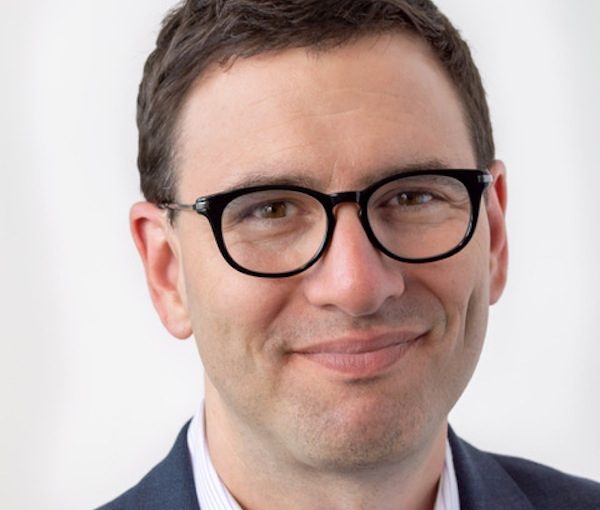
Avrum Nadigel’s latest book, which he co-authored with the late Dr. David Freeman, is aimed at people contemplating a career in family therapy. (photo from Avrum Nadigel)

Therapist Avrum Nadigel’s latest book hit the shelves this month. Co-authored with the late Dr. David Freeman, Where Would You Like to Start: A Master Therapist on Beginning Psychotherapy with Families is structured as a conversation or interview between veteran therapist Freeman and then-newish therapist Nadigel.

Nadigel is a family marriage therapist based in Toronto. Originally from Montreal, where he had worked for the Jewish community for years, he moved to Vancouver for a spell. It was here that he met Freeman (who passed away in 2010).

Freeman had brought in various therapists to speak on marriage, love and respect at different events. Attending these lectures, Nadigel found what the therapists had to say “redundant and I didn’t find it very helpful for me. I had a pretty severe case of fear of commitment, and they all rambled on about the same thing. But, when David spoke, it blew my mind.”

About a year after hearing Freeman speak, Nadigel met, online, the woman who would become his wife, Dr. Aliza Israel. “She is from Vancouver, but was staying in Toronto at the time,” said Nadigel. “Now, we’re married and have three kids. And that all started because of David’s talk in Vancouver. David’s talk introduced me to a type of therapy called family systems theory.’”

Nadigel read many books on the topic, including Freeman’s, which made Nadigel rethink his previously held suppositions about relationships and marriage. “I changed the way I practise with my own clients,” he said.

Nadigel moved to Toronto when he was accepted into a residency there. He started up a private practice and began to look for someone to mentor him. At his wife’s suggestion, he reached out to Freeman in Vancouver, who, although semi-retired, was happy to supervise Nadigel via Skype.

Nadigel recalled some of the game-changing ways in which Freeman changed his way of thinking.

“When I was single, if I felt anxious or not good in a relationship, I was taught that this meant there was something wrong,” said Nadigel by way of example. A relationship “should be lovely, giving and with good communication, but, as soon as I get anxious, I bolt. Then, David comes around and goes … ‘Perhaps your own internal states of anxiety have nothing to do with the people you’re dating, but with your own internal struggle itself.’ It really changed how I saw discomforting feelings in intimate relationships. It helped me sit with them longer.”

Thinking about his eventual marriage to Israel, Nadigel said, “I often think back to that time and think, ‘How did all this work?’ Maybe, it was one part luck, one part theory and one part having a good therapist in my corner.”

In addition to Freeman’s counsel, Nadigel has done much study on family systems, notably he did post-graduate training with the Western Pennsylvania Family Centre, which teaches Bowen family systems theory, as formulated by the late Dr. Murray Bowen, a psychiatrist and founder of the theory.

Recalling his conversations with Freeman, Nadigel said, “David was very worried about two things. Number one, that people were focusing too much on hacks and behavioural changes, and that the system was much more powerful than that … and that the system would often, not always, but often, thwart any attempts the individual would try to make the change. So, he was very concerned that there were so few therapists offering a larger perspective about human suffering.

“The second thing he was very worried about – I think this is because he was a grandfather at the time of his death, he had two grandkids – was about the disconnect from wise elders in society. I think that’s really coming home to roost right now, the fact that we have the hashtag on Twitter, where it says, ‘BoomerRemover.’

“Some people are thinking that, well, it’s good about this coronavirus – it’s going to kill off all the old people and there’ll be more condos. I don’t know what the hell they are thinking but we really do see the elderly as an inconvenience in a lot of cases, and David thought this creates an impoverished culture – that, when you think of traditional society, it’s the elders who share life lessons that can only be acquired over time, through adversity and history. You can read a book, but it’s very different if an elder tells you what it was like to survive the Blitz in Britain. And David thought that young people in their marriages were impoverished, because of their lack of connection.

“So, with those two things,” said Nadigel, “I thought, maybe, if I can somehow convince David to write another book, I could be the young green therapist and he could be the senior guy. He could speak to me and motivate the next generation of therapists.

“I thought to myself that it should be snappy and quick.… I threw him the idea and I think the same day he got back to me and said he thought the format’s viable – except that, in this case, it would be Skype calls between a young therapist and a senior therapist…. We quickly started working on this once a week.

“Then, David had the manuscript and was going on vacation,” said Nadigel. “We had a few more chapters to write; he really liked where the book was going. Then, I got an email from him, a very brief email, which was odd, because he was much more verbose. It just asked if I could call him.

“I thought, that doesn’t sound good, that maybe he was going to say the book sucks. I called, and it was his now-widow [Judith Anastasia], who answered, and she said, ‘Avrum, I’m sorry to tell you, but David died of a heart attack while we were cycling in Croatia.’ I couldn’t believe it. It was a crazy summer. My dad died, my son was born and David died.”
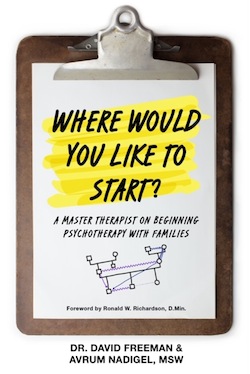
image - Where Would You Like to Start book coverSeveral years later, with Anastasia’s blessing and to honour Freeman’s memory and work, Nadigel started to complete their book.

“The book gives you a taste of a master therapist, to experience the wisdom and thinking he brought to thousands of families and couples he’s worked with over 40 years,” explained Nadigel. “And, once you finish the book, you might feel it’s your responsibility now to go and further your training in this area.

“David’s life work was helping people understand that, if you want to do well with your own personal goals and struggles and gridlock, you have to understand what you’re up against,” said Nadigel. “And you don’t do that by just talking about your neurotransmitters and serotonin and dopamine, or meditation…. It’s about certain ways of the here and now, that you either distance or connect through relationships that are happening right now – that are happening with your mother, your father, your sister, your aunt, your cousin. The work is staring you right in the face right now.”

Family system coaching, consultation or therapy, said Nadigel, is based on “the theory and the road map of going back and reworking through some of the gridlock in your family. And those people who are successful at doing something and thinking differently [about] their problems with their relationships – siblings, spouse, kids, whatever – [are] bringing those successes to every relationship. And that does not happen in the clinician’s office.

“Also, this type of therapy understands that human beings don’t get into problems because of their thinking – they get into problems because they are flooded with feelings…. It tries to promote good thinking to balance out strong feelings, toward being a little more strategic in how you conduct yourself in your relationships.”

And Nadigel himself is an example of how the approach can work.

“I’ve often thought that, if I was reading about this book, the interesting angle I always found … is that I was a punk rock alternative musician in Montreal. I was commitment-phobic and really saw marriage and family, marriage considerably, as the death knell of all that’s good in life – [that it’s] boring and sucks the nectar out of a good life. Then, David comes along in Vancouver and he just creates a profound paradigm shift in me, and I have come to a wildly different understanding. I’ve become a marriage therapist myself, a father, all this kind of stuff, so a pretty fundamental transition.

“I was one of these people that, once upon a time, really had a strong distaste for the very thing I’ve embraced,” said Nadigel. “It really is all credit to this one little talk in Vancouver in the JCC. There’s hope there. It doesn’t take years and years. It could be a 50-minute talk.”

Nadigel has created a blog and podcast to support the new book. To access it, visit nadigel.com/start. Electronic and hard copy versions of Where Would You Like to Start are available at amazon.ca.

Rebeca Kuropatwa is a Winnipeg freelance writer.
Format ImagePosted on September 11, 2020September 10, 2020Author Rebeca KuropatwaCategories BooksTags Avrum Nadigel, David Freeman, mental health, psychology, relationships, therapy

Community stronger

Rosh Hashanah is a time of new beginnings, a time to reflect on a year gone by and on the new year ahead. As is often the case with new beginnings, it is also a time of uncertainty. Last Rosh Hashanah, we wished one another a sweet year, unsure of the future but hopeful of things to come.

As we herald the arrival of this new year, we do so understanding that we control far less than we had thought. Normally, the uncertainty that comes with a new start is imbued with hope for the possibilities ahead. This year, however, it is uncertainty itself that dominates. As 5780 draws to a close, we have learned that we must seek what we can rely on: the strength of our community and our resolve to face these unprecedented challenges together.

In 5780, the challenges were many, and our community met them with an empowering, inspiring and united response.

When urgent help was needed, social service agencies and not-for-profits mobilized, delivering food, providing services remotely and offering support to those who needed it most. Jewish federations shifted their focus to emergency fundraising campaigns to meet the immediate needs of agencies on the frontlines, ensuring that the changing needs of our most vulnerable were met.

When COVID-19 hit, Jewish Federation of Greater Vancouver immediately released $505,000 in emergency funds to meet these urgent needs and continues working with donors to generate additional funds for community recovery. CIJA advocated for the inclusion of not-for-profits in government support programs, such as the Canada Emergency Wage Subsidy, and helped ensure that Jewish schools were eligible. Volunteers mobilized by the thousands, responding to calls for assistance, helping the many seriously impacted by COVID-19.

Our community was tested in other ways, as antisemitism, the crafty shapeshifter that is always on the move, found new outlets during the pandemic. With Statistics Canada reporting a rise in antisemitic incidents through 5780, our community from coast to coast continued to unite, offering support where it was needed most. Indeed, this was the year we learned the many ways we could help and, for far too many, how to reach out to ask for help ourselves.

As we renew our talk of new beginnings at the conclusion of a year defined by uncertainty, many wonder: how can we plan for the year ahead?

For 5781, we must change our approach and, instead of planning according to dates on a calendar, look at our character for the coming year. As Rabbi Adin Steinsaltz z”l, wrote, “This does not mean, however, that, on Rosh Hashanah, one should make plans for the whole year. That would be impossible…. What one should do on this day is form a general picture of what ought to be the character and direction of this year.”

For 5781, we can accept the uncertainty of what is to come and focus on the knowledge that we can rely on the tested strength of our community. And that continued strength is up to us. We can commit to volunteering our time and, if we can, donating our money. We can commit to finding creative ways to give back and offering support to those experiencing hardship. Instead of planning large events or travel, we can plan to lean on our community when in need and support it every way we can. We can plan to check in on those who are vulnerable, to be more understanding of ourselves and others, and to be more present when given the gift of company among our loved ones.

As we reframe what planning looks like for 5781, it can be difficult to determine how best to dedicate our efforts. There are many good causes that need our help. Instead of being overwhelmed, be reassured that, for whatever assistance you can offer, there is a worthy cause, organization or initiative looking for someone just like you. Federations are great starting places. Check out your local campaign and learn what their various service agencies and not-for-profits are doing.

Though much of the past year has been uncertain, Rosh Hashanah presents us with a chance to start anew. We can still hope for and work toward a better tomorrow. The coming year will be defined not by our individual wishes and schedules but by our collective character and commitment to our community. Planning for uncertainty may seem counter-intuitive, but history has shown that we have the capacity to come together and overcome even the darkest of times. As we look ahead to 5781, amid all the unknowns, one thing remains certain: our community will continue from strength to strength.

Judy Zelikovitz is vice-president, university and local partner services, at the Centre for Israel and Jewish Affairs.

Posted on September 11, 2020September 10, 2020Author Judy ZelikovitzCategories Op-EdTags Centre for Israel and Jewish Affairs, CIJA, coronavirus, COVID-19, Rosh Hashanah

More positives than expected

We often use the High Holidays for self-reflection. Consider, we’re urged, the year that has passed and the future. For me, the pandemic and its uncertainty has made me less focused on the year to come. Instead, I’ve been taking a positive accounting of things I’ve experienced this year – and it’s actually quite a lot.

First, there’s been more time for our family to do Jewish learning and “attend” synagogue at home. It’s been easy to turn on Saturday morning services or a special lecture or a concert and expose the family to more Jewish content. The internet has made us feel welcome everywhere. This a huge leap ahead of what we often got out of “business as usual,” pre-pandemic.

Learning in general has changed. As someone who used to teach, I was wary of homeschooling. To be fair, I’ve met some very bright kids who’ve been homeschooled. I’ve also met some odd folks, so focused on their (often evangelical) religious views that it got in the way of making other connections. As but one example, once, I drove with my husband to visit a local farm that advertised sheep fleeces for sale. I’m a hand spinner, and we thought the drive would be fun. I met a large family living in a series of rundown buildings and trailers, wearing an interesting assortment of “traditional” clothing. These isolated, homeschooled evangelical kids led me into a trailer full of both wool and wasps, all eagerly telling me about their visions of the end-times. I left with some wool, but only because my husband and I couldn’t find any other way to politely extricate ourselves.

I’d been scared that, if I ever homeschooled my kids, it would become claustrophobic, bad for the kids and hard for me to catch a break. This was the case when remote schooling started in March. Getting the kids onto the online school meetings and keeping things afloat with a poor internet connection and somewhat spotty assignments from teachers was awful.

When school ended, we were relieved. I kept doing some learning with them each morning, though. Reading, math, cursive, Duolingo (online language learning for Hebrew), art, architecture and design, music and science/STEM learning have kept us busy, along with long walks, playing outside, swimming and more. Sure, I don’t have much alone time. Time for work (or even work to do!) has been limited, but that’s OK, in the circumstances.

Our kids are supposed to go back to school in person this fall, and we’ll see how long that lasts. I don’t dread homeschooling as much now. Setting our own agenda resulted in kids who may be more socially isolated, but they’ve learned a lot. They read better now in two languages, and their math has improved.

Disconnecting from the school-extracurricular activities-synagogue cycle hasn’t been bad either. Those demands came with a lot of pressure. The need to keep up, fit in, afford it and get there on time is stressful. It is easier to practise piano, play soccer in the yard or turn on the services via Zoom than to get to everything in person. Further, there’s no weird social interaction with other families about what we’re wearing, or just how hip we are. (We’re so not hip.)

Making things ourselves has been a mostly good, too – lots of cooking and other activities. Last fall, I started using my sewing machine, after years off. I took sewing lessons as a kid but never gained confidence. Pre-pandemic, I’d sewn myself a few things and remembered how to do this. Returning to it has been a great gift. I’ve figured out making masks, fixing and making clothing. Better still, because of the pandemic, I’ve been able to shop for supplies online and support small businesses selling sustainable or deadstock fabrics. I didn’t have time to go shopping for this stuff in person before the pandemic. Now, most everything is online. I can make plans for kid pajama pants, and dresses and pants for myself, in the future.

We’ve enjoyed some amazing concerts, held outdoors on our block. A talented musician/producer neighbour with a big front porch invites guests to come set up chairs and blankets, social distance and enjoy. Musicians perform for donations, and we all benefit. We’ve heard baroque, classical, flamenco, jazz, old-time and folk. If we sometimes can’t get outside as a family to hear it, the music floats up into our second-storey windows when the wind blows the right way.

Art has blossomed, not only in our family’s projects, but at the “little free art box,” which is run by an artist in the area. Much like a Little Free Library, one can open the box, take art or put art inside for others. We’ve shared kid watercolours and my handspun yarn, and received gorgeous charcoal sketches, pen and ink, and other delights. We’ve traded and celebrated the skills of others nearby. Our diverse community is rich with talent.

None of these small positive things can compensate for the many deaths and illnesses of COVID-19, nor the economic devastation to so many businesses and workers. The downsides this year have been huge. However, last night, I watched as my kids created a caravan on the blanket spread on the grass. We were listening to live music, as my mind leapt to the text I’d been learning from Daf Yomi (a page of Talmud a day). The rabbis are trying to explain how to make a temporary boundary around a caravan as one traveled and camped on Shabbat. They mentioned using saddles and camels, and debated how much space each person might need.

The blanket caravan consisted of several toy trains and hard plastic rhinos and elephants, lined up nose to tail in a circle. The tractate Eruvin is about boundaries – what boundaries make it safe to carry on Shabbat? In the time of coronavirus, I was transported to a different kind of caravan and boundary. Our families have “circled the wagons.” We’ve been forced to stay put and look inwards – but also to be outdoors. What value can be found in these new enforced boundaries? What positive things can come from those necessary restrictions? In our house, we can say that art, music, handmade creations and learning can be celebrated as we finish 5780 and begin 5781. It’s been a valuable time, even as illness, hardship, fear and sadness danced at the edges of every day’s newscast.

From my (socially distanced) house to yours – may we all have a happy and sweet new year, full of creation, positivity and, most importantly, good health.

Joanne Seiff has written regularly for CBC Manitoba and various Jewish publications. She is the author of three books, including From the Outside In: Jewish Post Columns 2015-2016, a collection of essays available for digital download or as a paperback from Amazon. Check her out on Instagram @yrnspinner or at joanneseiff.blogspot.com.


Posted on September 11, 2020September 10, 2020Author Joanne SeiffCategories Op-EdTags coronavirus, COVID-19, gratitude, High Holidays, Judaism, lifestyle, Rosh Hashanah
Depression insidious

Depression insidious

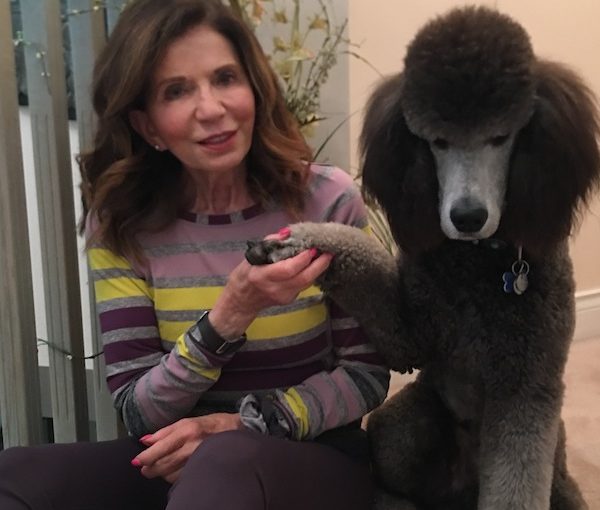
The author with her dog, Kesem. (photo from Dolores Luber)

It was mid-March. All I had been hearing and seeing on the news were the words and images related to contagion, epidemic, China’s wet markets, people enjoying the delicacy of cooked bats, pandemic and COVID-19. It was getting louder and closer, somehow it traveled from China across the Pacific to Vancouver. We were now dealing with the pandemic in Vancouver, we were in lockdown, even if the government never called it that.

In a flash, my household emptied out. My housemate, a University of British Columbia student, went back home; all her courses were now online. My boarder, a psychiatric nurse, scared of catching the virus and infecting me and her immune-compromised partner, took a six-month leave of absence from her work and joined him on a sailboat off the coast of Vancouver Island. I cleaned and organized and then it hit me – I was alone in the house with my Standard Poodle puppy Kesem. His name means “magic” in Hebrew and he truly is a wonderful companion, but….

Lockdown, what was that? We all had to create our own version. I maintained my Hebrew classes by means of Zoom, I continued working out with two personal trainers in my home gym. We did not touch each other. I went to the off-leash dog park every afternoon. We practised social distancing.

Then, a classmate of mine became hospitalized with the virus – I had not seen her for 10 days. I isolated myself for an additional week, not one of our group became ill. She is the only one I know who has contracted the virus. I was feeling proud of myself, I was managing well. As the editor-in-chief, I had produced the July edition of Senior Line magazine for Jewish Seniors Alliance on schedule. It was a labour of love, responding to the pandemic and the issues of the times. Everything was under control.

July 22 is my birthday. At the beginning of July, I began to feel very lonely. I had not seen any of my four sons, daughters-in-law or nine grandchildren for a long time. The planned family reunion in Oakville, Ont., was an event I had been looking forward to. My children had grown up in Beaconsfield, Que., and my youngest son had organized a fabulous get-together of all his friends who lived in the neighbourhood during his childhood. Photographs were collected, videos created, all plans had been made before the lockdown.

We gradually began to understand that the situation was not going to end soon; we were in it for the long haul. The reunion was canceled. I always see my children on my birthday, but, this time, I received FaceTime calls, beautiful cards, splendid flowers, but no hugs, no kisses, no warmth, no human touches. My thoughts were becoming very negative and gloomy; worst-case scenarios played in my head. I thought of moving back to Ontario to be with my youngest son; I researched buying a house in Oakville. I was experiencing symptoms of depression.

As a retired psychotherapist, I recognized the symptoms – among them, exaggerated feelings of sadness and loneliness. I made an effort to study more and read more Hebrew. I pushed harder in my workouts with my trainers. I developed and implemented a plan for the fall Senior Line magazine. By the end of July, I was thinking in a more balanced fashion. I had gotten through the rough spot and was well again.

Depression can be insidious, it can creep up on you. It is important to do a reality check with friends or family members from time to time. Isolation warps the processes of the brain. The chemicals in our brains can become unbalanced. Usually increased physical activity and enhanced social interaction can counteract the symptoms of mild depression. Beware!

Dolores Luber, a retired psychotherapist and psychology teacher, is editor of Jewish Seniors Alliance’s Senior Line magazine and website (jsalliance.org). She blogs for yossilinks.com and writes movie reviews for the Isaac Waldman Jewish Public Library website.

Format ImagePosted on September 11, 2020September 10, 2020Author Dolores LuberCategories Op-EdTags coronavirus, COVID-19, depression, mental health
A testament to free speech

A testament to free speech

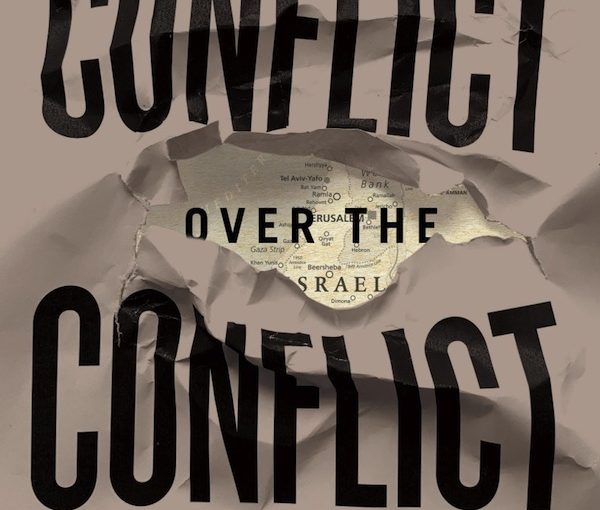
A new book on an incendiary topic turns out to be not quite as expected. The Conflict over the Conflict: The Israel/Palestine Campus Debate, by Kenneth S. Stern, may be the most comprehensive assessment of the (at least) 20-year battle on North American campuses between pro-Israel and anti-Israel forces.

Jewish and pro-Israel readers picking up the work might anticipate a litany of horrors, anti-Zionist if not antisemitic incidents, brawls, screaming matches, vandalism, boycotts and the like. There is that. But Stern argues that the perception that campuses are aflame in anti-Zionist rage is simply not true. More, he offers proof that the pro-Israel side is far from innocent of engaging in disgraceful tactics, too. There is ill will and there are bad actors on both sides. Most unexpectedly, as much as the book is about the conflict, it is more than anything an exercise in applied ethics on the topic of free expression.

Stern is the director of the Bard Centre for the Study of Hate, an attorney and an author. For 25 years, he was the American Jewish Committee’s expert on antisemitism and he was a lead drafter of the Working Definition of Antisemitism. He is also, it appears, something close to a free speech purist. As such, he rails against efforts by Israel advocates who have organized campaigns to censure (and censor) anti-Israel voices. He doesn’t let the other side off easily, either, calling out acts of harassment like drowning out pro-Israel speakers with the “heckler’s veto.”

The book, from New Jewish Press, an imprint of University of Toronto Press, begins with an empirical assessment. In institutions of higher learning in the United States, Israel is an issue in very few, he writes.

When speaking with Jewish audiences, Stern asks for a show of hands to gauge perceptions on anti-Israel attitudes. He asks for guesses on how many American colleges have divested from Israel.

“Many seem surprised when I say ‘zero,’” he writes. “There are relatively few campuses where Israel is a burning issue, and every year the number of pro-Israel programs … is usually at least double the anti-Israel ones. There are over 4,000 campuses in the U.S. – in the 2017-18 academic year, 149 had anti-Israel activity.… So the campuses aren’t burning.”

He does not dismiss the extreme tensions on a few campuses, however.

“[O]n some campuses where anti-Israel activity is prominent, pro-Israel Jewish students may feel marginalized, dismissed or vilified, sometimes with antisemitic tropes.” Identity politics and the conflation of Jewish people with “whiteness” creates racial conflict. “[T]he labeling of Jews as white becomes a problem when shared victimhood becomes a sacred symbol, a badge of honour, a precondition to enter a club of the oppressed. Antisemitic discrimination is rendered invisible.”

Though bigotry may play a role in the discussion, Stern does not see constructive resolutions in neologisms like trigger warnings, safe spaces and microaggressions.

“Faculty should have the right to give trigger warnings if they want, but I never do, and I think the idea is a horrid one,” he writes. “I teach Mein Kampf. It’s disturbing – get over it. College should prepare one to be an adult, and there are no trigger warnings after graduation day. Why are we encouraging students to be ostriches? Shouldn’t they, rather, be learning how to navigate things that will likely unsettle them over the rest of their lives?”

He quotes CNN commentator Van Jones, a strong civil rights proponent, who opposes “safe spaces” on campus: “I don’t want you to be safe ideologically. I don’t want you to be safe emotionally. I want you to be strong. That’s different. I’m not going to pave the jungle for you. Put on some boots and learn how to deal with adversity. I’m not going to take the weights out of the gym. That’s the whole point of the gym.”

Stern contends a fundamental error has been made in defining terms.

“We want campuses that are open to expression – including, perhaps even especially, difficult and disturbing ideas – but which protect students from real harassment and intimidation. Hate speech codes were efforts to say that ideas themselves can harass and intimidate. Ideas can and should make one uncomfortable (a comfortable college education is a wasted college education). But harassment is something different.”

Strategically, he argues, trying to censor hateful ideas is self-defeating and advances hate agents by martyring them.

“By trying to censor, rather than expose and combat, speech the students perceived as hateful, they were actually helping the alt-right and white supremacists,” writes Stern. “It’s no coincidence that the white nationalists in recent years have wrapped their racist and antisemitic messages around the concept of free speech. Why would progressives allow these haters to steal the bedrock democratic principle of free speech, disingenuously saying that this is what their fight is about? By trying to deny alleged racists platforms, progressives are helping white supremacists recast their vile message as noble protection of a right.”

Another strategic failure, he argues, is buying into the Palestinian narrative’s good/evil dichotomy.

“Israel’s case is best understood as inherently complex and difficult; playing into the ‘all bad’ and ‘all good’ binary of the other side renders those complexities invisible,” he writes.

The conflict on campus spills over, of course. Israel has created a list of 20 organizations, those that urge boycotts of the country, for instance, and bars their members from entering the country. Stern sees this as counterproductive: “You don’t make the case that blacklists (especially of academics) are proper if your goal is to oppose blacklists. You are conceding the argument.”

He gives an example of an anti-Israel campus activist who defends his group’s refusal to meet with Zionists “over cookies and cake” because “you Jews, in all due respect, you wouldn’t sit down with Nazis for tea and cake.”

He also reflects on the “Standards of Partnership” adopted by Hillel International, the Jewish campus organization, which proscribe engaging with groups or individuals that deny Israel’s right to exist, or who delegitimize, demonize or apply a double standard Israel, who support BDS or who exhibit “a pattern of disruptive behaviour towards campus events or guest speakers or foster an atmosphere of incivility.”

Writes Stern: “For those who are not yet ideological soldiers, but want to learn more, and want to do it around their campus Hillel, what sense does it make that adults are telling them they can only bring in certain types of speakers? Yes, the adults defined BDS as hateful. But does it make sense to tell students they have to go elsewhere than the Jewish address on campus to hear about it firsthand from those who support it?”

The litany of bad behaviours on all sides of the ideological divide is likely to make readers of Stern’s book uneasy, whether the reader is Zionist or anti-Zionist. But it is a rare and uncompromising testament to free expression that should give genuine free speech advocates an uplift, particularly in an era when ideologically driven regulation of expression and ideas, especially on campuses, has left many advocates of core liberal, academic values feeling beleaguered.

Format ImagePosted on September 11, 2020September 10, 2020Author Pat JohnsonCategories BooksTags academia, anti-Israel, anti-Zionist, antisemitism, BDS, boycott, censorship, conflict, free speech, Hillel, Israel, Kenneth S. Stern, Palestine, university campuses, Zionist

Two compelling reads from Simon & Schuster

Last year, I requested two books from Simon & Schuster Canada. Both contained strong female protagonists and stories that sounded compelling. While it took the pandemic slowdown before I had time to read them, I enjoyed both and would recommend them, albeit one with a caveat.

image - Woman on the Edge book coverLet’s start with the debut novel, the one I breezed through even though I found the premise tenuous. I wanted to know how Samantha M. Bailey’s thriller Woman on the Edge ended, even as I cursed aloud at the two main characters – Nicole Markham, founder and head of a widely successful athletic wear company, and Morgan Kincaid, a woman who has rebuilt her life after her husband was caught swindling people and then killed himself.

For reasons not revealed initially, Nicole hands her baby to Morgan at a subway stop, then jumps to her death, though video of the incident makes it seem like Morgan may have taken the baby then pushed Nicole onto the tracks. Alternating between Morgan’s attempt to clear her name and how Nicole came to give her baby to Morgan, the read is thrilling, even as it is too obviously contrived. At any point in time, a question or revelation from Nicole or Morgan could have shed light on their respective situations and cleared up critical matters. Yet, both women – unrealistically – keep their suspicions to themselves. The silences are necessary for the plot to work, so I chose to go where I was being led and relish the craziness of it all.

While there is no overt Jewish content in Woman on the Edge, Toronto-based writer and editor Bailey is Jewish. In her first novel, she shows a talent for creating dramatic tension, if not overall story structure. Despite its weaknesses, I found this novel a good escape read.

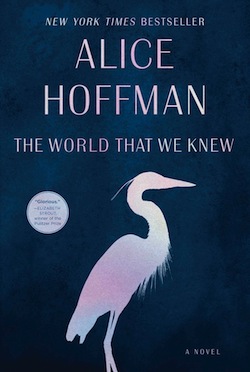
An absolute pleasure to read, and just as page-turning, is veteran author Alice Hoffman’s latest novel, The World That We Knew, set during the Holocaust. In it, there is magic. It is tangible – the golem Ava, created by Ettie, the precocious daughter of a respected rabbi, to protect Lea – and more abstract, in the loyalty of Ava to Lea and the beautiful friendship that develops between Ava and a blue heron along their journey.

image - The World That We Knew book coverAfter her husband is murdered and her daughter Lea is almost raped, Hanni knows she must get Lea to Paris, but she herself cannot leave Berlin. So, she turns to the rabbi for help, but making a golem is risky business and he won’t do it. Ettie, though, plans to escape with her younger sister, and Hanni’s payment will help her do that. Ettie has observed her father at work, and is able to bring Ava into being. As Ava becomes more seemingly human, however, and forms a bond with the blue heron, the main tension of the novel arises – will her appreciation for her own life and its possibilities outweigh her responsibility to Lea?

Many other tensions and relationships mingle with history, which is sometimes pedantically told but always interesting. The World That We Knew is a well-woven and moving story that offers an understanding not only of the past but of the emotions that motivate us and the connections we make with one another.

Posted on September 11, 2020September 10, 2020Author Cynthia RamsayCategories BooksTags Alice Hoffman, historical fiction, Holocaust, magical realism, Samantha M. Bailey, The World That We Knew, thrillers, Woman on the Edge
About the Rosh Hashanah cover art

About the Rosh Hashanah cover art

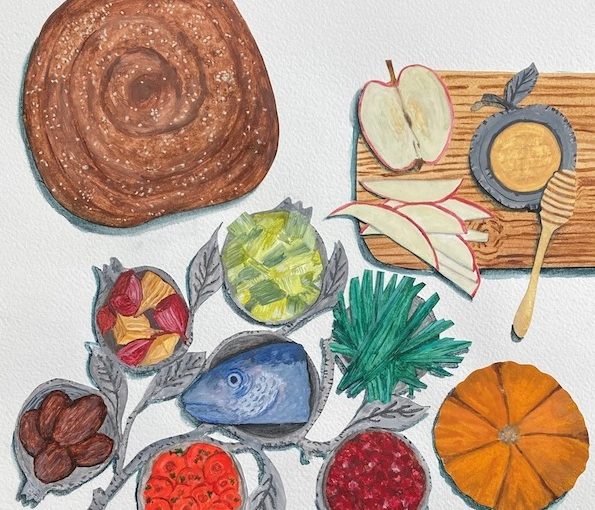
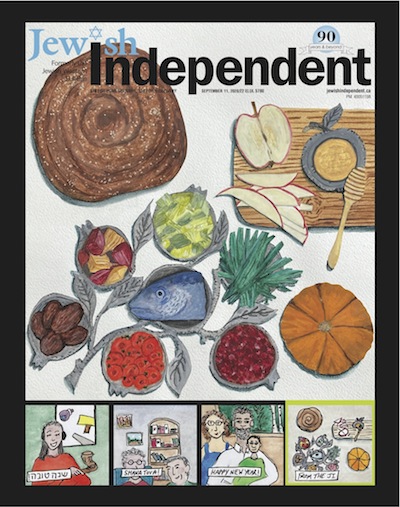
I was introduced to the Sephardi and Mizrahi tradition of a Rosh Hashanah seder by a dear friend, at whose home I celebrate most of the Jewish holidays. This New Year’s, given the pandemic and that we are not in each other’s immediate bubble, I will join their seder on the first night of Rosh Hashanah either outdoors, weather permit, I was looking, perhaps, to prepare myself mentally for this year’s socially distanced gathering, and a Zoom with my family in Ontario, when I thought of the idea for the cover, which is created using watercolour and ink (and surprisingly little Photoshop).

image - Jewish Independent Rosh Hashanah issue coverIn a Sephardi or Mizrahi seder, special dishes are served of specific foods whose Hebrew or Aramaic names are linked in a blessing to another word that has the same root letters. Puns flourish. So, for example, the Hebrew word for carrot and that for decree have different vowels but the same root letters – gimel, zayin and resh – and the blessing over the carrots translates as, “May it be your will, Lord our God, that that our bad decrees be torn up and our merits and blessings be proclaimed.” The word for leeks, chives or scallions – karti – is akin to yikartu, cut off, so the blessing over these vegetables is, “May it be Your will, God, that our enemies be cut off.”

Spinach or beet leaves also symbolize the hope that God will make our enemies retreat and we can “beat” a way to freedom. Dates carry the hope that hatred will end; the many seeds of a pomegranate that our mitzvot will be many; an apple that we will have a sweet year; string beans that our merits will increase; a pumpkin or gourd that God will “tear” away all evil edicts against us, while our merits are proclaimed. You get the idea.

For information on the New Year’s seder, I visited, among other sites, theicenter.org/resource/hebrew-and-rosh-hashanah-seder and myjewishlearning.com/article/a-sephardic-rosh-hashanah-seder. Not being adept at puns myself, I will leave you simply with a wish for a happy, meaningful and healthy 5781.

Format ImagePosted on September 11, 2020September 10, 2020Author Cynthia RamsayCategories Visual ArtsTags art, coronavirus, COVID-19, High Holidays, Judaism, Mizrahi, Rosh Hashanah, seder, Sephardi, tradition, Zoom
Evolution of the Jewish calendar

Evolution of the Jewish calendar

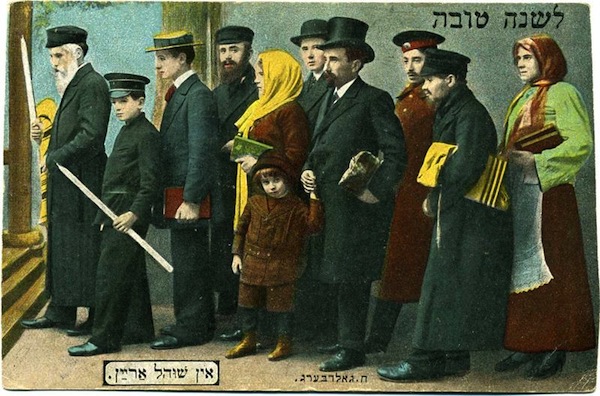
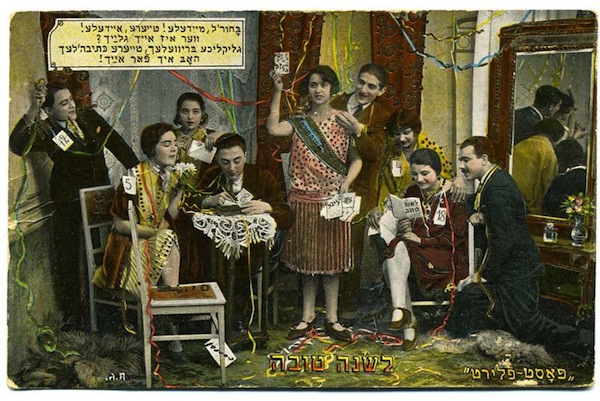
Rosh Hashanah greeting cards (above and below) from the author’s family’s collection. The cards are almost 100 years old. The translation of the one in which people are walking is “Into the synagogue.” It is signed by Chaim Goldberg, a well-known artist who also illustrated many children’s books. The party postcard, also done by Goldberg, is a printed rhyme, which translates as, “Boy, girl! Dear, refined! Who is like you? Happy letters, dear writings, I have for you!”

The Jewish calendar is an amazing conceptualization of time that has evolved (what else?) over time.

In his blog on the Museum of the Jewish People at Beit Hatfutsot website, Ushi Derman relates that, originally, the Jewish calendar was a solar calendar. But it was not just a solar calendar, it was a holy solar calendar, delivered by angels to Enoch. (See the Book of Enoch, the section dealing with astronomy, called “The Book of Heavenly Luminaries.”) Temple priests had to follow a rigorous schedule – time itself was judged to be sacred. Thus, the Temple in Jerusalem was regarded as both the house of G-d and the dwelling of time.

With the destruction of Jerusalem’s Second Temple, the priests lost their power. They were no longer the mediators between G-d and the people. Authority switched to the scholars (our sages) of the Mishnah (edited record of the Oral Torah), Talmud and Tosefta (similar to the Mishnah, but providing more details about the reasons for or application of the laws).

In a bold move, the scholars declared that G-d had handed religious authority to humans. “Each month, envoys were sent to watch the new moon and to determine the beginning of the month. Thus, the ownership of time was expropriated from G-d and delivered to man – and that is why the Hebrew calendar has survived for so many centuries,” writes Derman in the 2018 blog “Rosh Hashanah: The Politics and Theology Behind Jewish Time.”

Here is a lovely story from The Book of Legends, edited by Hayim Nahman Bialik and Yehoshua Hana Ravnitzky, illustrating the above change. A king had a clock. “When his son reached puberty, he said to him: My son, until now, the clock has been in my keeping. From now on, I turn it over to you. So, too, the Holy One used to hallow new moons and intercalate years. But, when Israel rose, He said to them, until now, the reckoning of new moons and of New Year’s Day has been in My keeping. From now on, they are turned over to you.”

Perhaps oddly, the Mishnah mentions more than one new year. In fact, it points out four such dates on the Jewish calendar:

  • The first of Nissan is the new year for kings and for festivals;
  • The first of Elul is the new year for tithing of animals (some say the first of Tishrei);
  • The first of Tishrei is the new year for years, sabbaticals and Jubilee, for planting and vegetables;
  • The first of Shevat is the new year for trees, according to the House of Shammai, while the House of Hillel (which we adhere to today) says the 15th of Shevat, or Tu b’Shevat.

With its thrice daily prayers, the synagogue came to replace the Temple. Excluding Yom Kippur, synagogue attendance is higher on Rosh Hashanah than any other time of year. Rosh Hashanah prayers are compiled in a special prayer book, or Machzor.

image - Rosh Hashanah greeting cards from the author’s family’s collection. The cards are almost 100 years old. The party postcard, also done by Chaim Goldberg, is a printed rhyme, which translates as, “Boy, girl! Dear, refined! Who is like you? Happy letters, dear writings, I have for you!”Amid COVID-19, the following words about Rosh Hashanah have heightened meaning: “The celebration of the New Year involves a mixture of emotions. On the one hand, there is a sense of gratitude at having lived to this time. On the other hand, the beginning of a new year raises anxiety. What will my fate be this year? Will I live out the year? Will I be healthy? Will I spend my time wisely, or will it be filled in a way that does not truly bring happiness?” (See the Rabbinical Assembly’s Machzor Lev Shalem for Rosh Hashanah and Yom Kippur, published almost a decade ago.)

Sounding the shofar is one of the special additions to Rosh Hashanah services. According to Norman Bloom – in a 1978 article on Rosh Hashanah prayers in Tradition: A Journal of Orthodox Jewish Thought – the timing of the shofar blowing weighed in the physical safety and comfort of the congregation. Hard as it may be to comprehend today, scholars considered potential attacks from both local enemies of the Jews and from Satan himself. They also considered the comfort of the infirm, who might not be able to stay through a long service.

Rosh Hashanah has other curious customs. For example, there is a tradition of having either a fish head or, among some Sephardim, a lamb’s head as part of the Rosh Hashanah meal. This is meant to symbolize that, in the year to come, we should be at the rosh or head (on top), rather than at the tail (at the bottom). Vegetarians and vegans substitute a head of lettuce.

Both Sephardi and Ashkenazi Jews have Rosh Hashanah seder traditions. The symbolic foods include beets, leeks, pomegranates, pumpkins and beans. As Rahel Musleah has pointed out, each food suggests a good wish for the coming year. Thus, before eating each one, people recite a special blessing. Humour is at play, too, as some of the blessings are puns on the food’s Hebrew or Aramaic name. (Read Musleah’s article “A Sephardic Rosh Hashanah Seder” at myjewishlearning.com/article/a-sephardic-rosh-hashanah-seder.) Of course, we cannot neglect to mention that the festive table also includes apples dipped in honey, for a sweet new year, and a round challah, symbolizing both the cycle of life and G-d’s kingship.

Another Rosh Hashanah custom is Tashlich. This ceremony involves going to a body of water to symbolically cast off one’s sins. Breadcrumbs are often used, as are leaves, but, seeing that COVID-19 will be a part of this year’s holiday, here is another suggestion. Originally, this activity was used with youth groups of the Reform movement – participants wrote out their sins and then the papers on which they were written were put through a paper shredder. A dramatic gesture, suited to our current need for social distancing.

My city, Jerusalem, is a land-bound city without a sea or lake in its immediate vicinity. So, what do residents of the capital do? Those who wish to practise Tashlich go to one of the following four sites. Two of the four places are near the Supreme Court: the Jerusalem Rose Garden and the Jerusalem Bird Observatory. Also in the same general area is the Botanic Garden in the Nayot neighbourhood and, in the Old City, one can go to the Shiloah Springs in City of David.

Wishing all readers a year of blessings and not of curses.

Deborah Rubin Fields is an Israel-based features writer. She is also the author of Take a Peek Inside: A Child’s Guide to Radiology Exams, published in English, Hebrew and Arabic.

  * * *

Additional observations

• Hebrew has a number of expressions using the word rosh. Here are just a handful of examples: rosh hamemshala (prime minister); rosh kroov, literally cabbage head, or a negative reference to someone who is not very bright; rosh katan, someone who is small-minded; l’kabel barosh, to be defeated; and rosh tov, or good vibes.

• Anyone interested in learning more about the solar calendar should read Prof. Rachel Elior’s article, “Enoch Son of Jared and the Solar Calendar of the Priesthood in Qumran,” which can be found in a Google search.

Format ImagePosted on September 11, 2020September 10, 2020Author Deborah Rubin FieldsCategories Celebrating the HolidaysTags history, Jewish calendar, Judaism, Mizrahi, New Years, Rosh Hashanah, seder, Sephardi, time, tradition
Celebrating world’s birthday

Celebrating world’s birthday

(photo from pikist.com/free-photo-vqamg)

One of the many names of Rosh Hashanah, the Jewish New Year, is Yom Harat Olam, the birthday of the world. It is the day on which our tradition says the world was created.

Before we can begin to celebrate this “birthday,” however, something is required of us. During the month prior to Rosh Hashanah, we prepare ourselves spiritually for forgiveness and, in the 10 days between Rosh Hashanah and Yom Kippur, the Day of Atonement, we are meant to ask forgiveness of anyone we may have hurt during the year, even unintentionally. We are required to atone for wrongs between people, in contrast to the sins that arise between us and G-d. We cannot make a spiritual “return,” if we remain shackled with unresolved guilt and resentments.

More Jews attend synagogue on these two holidays than at any other time. Many of the prayers praise the mighty and wondrous works of the Creator, in keeping with the theme of “the birthday of the world.” We are to recognize that life itself is a Divine gift and has a sacred purpose.

According to our tradition, everything we do is recorded in the Book of Life. No deed, word, thought, good or evil, goes unrecorded. The record is supposedly kept in heaven. One belief accords this job to Elijah the prophet, keeper of the records of humanity’s deeds. On Rosh Hashanah, the Book of Life is examined, our acts in the preceding year weighed and judged. On this basis, it is decided “who shall live and who shall die … who shall be brought low and who shall be exalted.” For this reason, we wish for one another, “May you be inscribed for a good year.” We are taught that the only way to avert a severe decree is by “penitence, prayer and charity.”

According to Rabbi Kruspedai, in the name of Rabbi Yohanan, three books are opened on Rosh Hashanah – one for the wholly righteous, one for the wholly wicked and one for most of us, those in between. The wholly righteous are inscribed and sealed in the Book of Life, the wicked in the Book of Death and the rest of us are held suspended until Yom Kippur, when we are judged worthy or unworthy. The zodiacal symbol for the Hebrew month of Tishrei is, fittingly, a balance – the scales of justice.

Many people accompany all meals at this time with apples and honey. In addition to its other symbolism, the apple represents the Shechinah (Divine Presence), which kabbalists refer to as an apple orchard.

With the emphasis on creation at this time, it is customary to eat an apple dipped in honey on the first night of Rosh Hashanah, after the blessing on the wine and bread, and say: “Blessed art Thou, O Lord our G-d, King of the Universe, who created the fruit of the tree.” This is followed by: “May it be Your will, our G-d and G-d of our fathers, to renew unto us a good and sweet year.”

On the second day of Rosh Hashanah, we eat a new fruit – one we have not yet tasted this season – and we recite a blessing over it.

How do we know on what day of the year the world was created? We know that the first word of the Torah is Bereishit, in the beginning. When the letters are changed around, they read: aleph b’Tishri, the first of Tishrei, when G-d began to create the heaven and the earth.

May we all be inscribed for a good year.

Dvora Waysman is a Jerusalem-based author. She has written 14 books, including The Pomegranate Pendant, which was made into a movie, and her latest novella, Searching for Sarah. She can be contacted at [email protected] or through her blog dvorawaysman.com.

Format ImagePosted on September 11, 2020September 10, 2020Author Dvora WaysmanCategories Celebrating the HolidaysTags Book of Life, High Holidays, Judaism, new year, Rosh Hashanah, tradition

Reboot helps take stock

Reboot’s annual 10Q annual reflection project, which sends participants a question a day for 10 days will return for the 13th year this month. But, with the challenges, grief and fear of COVID-19 weighing heavily on the world, this year’s 10Q will include additional questions to offer a space for exploring and preserving feelings and experiences of this unique time in a digital time capsule.

Each year, for 10 days, the 10Q project from the nonprofit Reboot captures daily insights, experiences and beliefs from tens of thousands of people, many of whom have been participating since 10Q’s founding in 2008 and have amassed a personal archive.

“It has been found again and again that, when difficult circumstances hit, the simple experience of taking a pen and paper and allowing our inner voice to speak through our pens is in itself a healing and regenerative act,” said Nicola Behrman, 10Q co-founder (in partnership with writer Ben Greenman and educator Amelia Klein). “We know from 13 years of answers just how meaningful the 10Q experience is for so many, but, this year, when the foundation of everyday life has shifted so seismically and we are desperately attempting to find meaning in the madness, this simple act of reflection is both anchoring and essential.”

For 10 days, starting Sept. 18, and coinciding with the traditional period of reflection during the High Holidays, participants of all backgrounds will get the 10Q questions by email, leading them to their private digital portal, where the answers will be stored. The annual 10Q questions are not intrinsically religious and are focused on life, personal goals, plans for the future, relationships, our place in the world and more.

The answers are returned to participants the next year before the project starts again. The 10Q vault serves as a digital time capsule, and answers to the new questions will serve as a chronicle of experiences through COVID-19 that can also be shared by participants with future generations. For some people, this is a one-time experience; for others, 10Q has created an annual tradition of building a personal archive for future years and mapping personal growth.

Although the project is rooted in the Jewish idea of ethical wills and runs during the 10 days between Rosh Hashanah and Yom Kippur, in the last decade, more than 70,000 people of all backgrounds and ages have turned to 10Q for a meaningful and modern spin on the centuries-old tradition of introspection, atonement and self-change during the High Holidays. The questions have scrolled on the jumbo screens at Times Square in New York City and on the Las Vegas Strip.

“It has never felt so important to pause and reflect on ourselves and the world around us,” said Reboot chief executive officer David Katznelson. “We are living in such a unique moment of human history, a moment that is worth turning to the individual to ask big questions about what we can learn to take us into the future.”

To find out more about 10Q and to register, go to doyou10q.com. Find out more about Reboot at rebooters.net.

Posted on September 11, 2020September 10, 2020Author RebootCategories Celebrating the HolidaysTags High Holidays, introspection, Judaism, new year, Reboot, Rosh Hashanah, self-reflection, time capsule

Posts pagination

Previous page Page 1 … Page 3 Page 4 Page 5 Next page
Proudly powered by WordPress