Skip to content
  • Home
  • Subscribe / donate
  • Events calendar
  • News
    • Local
    • National
    • Israel
    • World
    • עניין בחדשות
      A roundup of news in Canada and further afield, in Hebrew.
  • Opinion
    • From the JI
    • Op-Ed
  • Arts & Culture
    • Performing Arts
    • Music
    • Books
    • Visual Arts
    • TV & Film
  • Life
    • Celebrating the Holidays
    • Travel
    • The Daily Snooze
      Cartoons by Jacob Samuel
    • Mystery Photo
      Help the JI and JMABC fill in the gaps in our archives.
  • Community Links
    • Organizations, Etc.
    • Other News Sources & Blogs
    • Business Directory
  • FAQ
  • JI Chai Celebration
  • JI@88! video

Recent Posts

  • Sharing her testimony
  • Fall fight takes leap forward
  • The balancing of rights
  • Multiple Tony n’ Tina roles
  • Stories of trauma, resilience
  • Celebrate our culture
  • A responsibility to help
  • What wellness means at JCC
  • Together in mourning
  • Downhill after Trump?
  • Birth control even easier now
  • Eco-Sisters mentorship
  • Unexpected discoveries
  • Study’s results hopeful
  • Bad behaviour affects us all
  • Thankful for the police
  • UBC needs a wake-up call
  • Recalling a shining star
  • Sleep well …
  • BGU fosters startup culture
  • Photography and glass
  • Is it the end of an era?
  • Taking life a step at a time
  • Nakba exhibit biased
  • Film festival starts next week
  • Musical with heart and soul
  • Rabbi marks 13 years
  • Keeper of VTT’s history
  • Gala fêtes Infeld’s 20th
  • Building JWest together
  • Challah Mom comes to Vancouver
  • What to do about media bias
  • Education offers hope
  • Remembrance – a moral act
  • What makes us human
  • המלחמות של נתניהו וטראמפ

Archives

Follow @JewishIndie
image - The CJN - Visit Us Banner - 300x600 - 101625

Month: March 2017

Making Israeli cities bloom

Making Israeli cities bloom

Planting trees as a community project in Jerusalem. (photo by Ariella Tzuvical)

Are Israeli city-dwellers still attached to the land? The answer is yes, but the connection to the land plays itself out in a surprising way.

By and large, today’s Israelis are an apartment-bound lot, but many dream of having a house with a garden. Those who are lucky enough to have a small garden – or an apartment with a patio – plant flowers and even grow fruit. Depending on the season, many Israelis grow grapes, oranges, tangerines, pears, grapefruits, lemons, kumquats, olives and pomegranates. Interestingly, some of these items have been grown in Israel since ancient times: “a land of wheat and barley, and grapevines and fig trees and pomegranates; a land of olive trees and honey … you shall eat and be satisfied.” (Deuteronomy 8:7-10)

Community gardening is a budding and not insignificant phenomenon taking root in Israeli cities. In Jerusalem alone, there are 70 community gardens. Municipalities, community centres, local branches of national nature preservation organizations (like Hachevra L’haganat Hateva), pro-environment charitable bodies (like Keren Sheli) and the Ministry of Environmental Protection are teaming up to help urban residents create these gardens. They are assisting interested apartment dwellers by providing seed money, land or know-how to get projects off the ground and onto porches, patios and even rooftops.

Why do urban Israelis grow fruits and vegetables? One young mother from Tel Aviv commented in a Yediot Ahronot article that she wants her children to understand that produce does not come from the supermarket.

Of course, most people want to use their homegrown fruits and vegetables in their regular cooking and preserving. But some grow fruit, such as the pomegranate, for special holiday consumption. For these gardeners, the following Rosh Hashanah blessing takes on added significance: “May the desire of our G-d and the G-d of our Fathers be to increase our merit like the [seeds of the] pomegranate.”

The Jerusalem-based Melamed family says it gardens for exercise, art and culture. They maintain that gardens produce cultured people. Another Jerusalemite looks at her blossoming pear tree and says that keeping a garden enriches a person’s life.

Although Israel, like most other Western countries, has largely switched from being an agrarian society to a technological society, places like the Jerusalem Botanical Gardens believe that gardening has a place. With that in mind, the facility has hired staff to make urban gardening more relevant to those living in Jerusalem.

As well, many Israelis seem to maintain the notion that G-d provides the ingredients for surviving off the land. Thus, when Jews celebrate the rebirth (or reproduction) of the Jewish year, they read: “See, I give you every herb, seed and green thing to you for food.” (Genesis 1:28-30) The annual Torah reading about producing in order to have food has helped fix the idea in the Jewish psyche.

Dr. Rabbi Dalia Marx wrote in A Torah-Prescribed Liturgy: The Declaration of the First Fruits: “The declaration of the first fruits is a bold text.” In Deuteronomy 26, Moses addresses the Israelites on the plains of Moab, “calling upon the Israelites wandering in the wilderness with no permanent ties to the earth to imagine themselves as farmers securely living in their own land. But simultaneously, the text demands of farmers living in their own land that they remember their days as wanderers in the wilderness – and necessarily … ponder the fragility of their own lives.”

When bringing the first fruits of the land to the Temple, the farmer thanks G-d for the bounty in a manner providing for “the entire recapitulation of national history.” In essence, “the farmer teaches himself that the final chapter in the national story is unfolding in real time.”
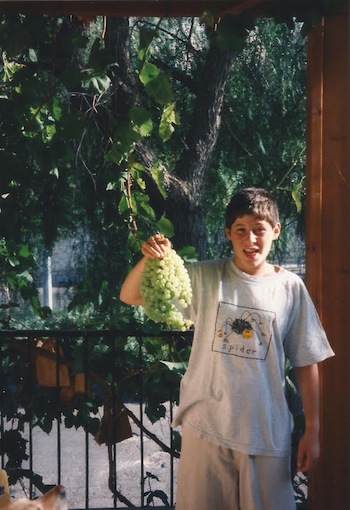
photo - Ilan Rubin Fields holds a cluster of grapes from the family’s grapevine
Ilan Rubin Fields holds a cluster of grapes from the family’s grapevine. (photo by Deborah Rubin Fields)

It should not come as a surprise that Israelis still seriously celebrate the agricultural component of their Jewish pilgrimage holidays. At Sukkot, Israelis everywhere erect sukkot, or booths, just as growers did in their fields thousands of years ago. And, of course, during Sukkot, observant Jews around the world purchase and bless the following combination of plants and fruit: the etrog (citron), lulav (palm), hadas (myrtle) and aravah (willow). These are known as the arbah minim, the four species.

The Passover seder plate contains greens that remind Jews that spring has arrived in Israel, while Shavuot commemorates the harvest that began around Pesach time and ended seven weeks later. For many years, this agricultural holiday had special meaning for those living in Israel, as the early settlers lived off farming. Today, Israel holds a variety of festivals showing off the bikurim, or first produce of the season. These holiday celebrations focus on the production of dairy products and honey.

In early winter, Jews throughout the world celebrate Chanukah by eating foods prepared in oil. Some food researchers maintain this may be related to the fact that Chanukah coincides with the end of the olive harvest. In late winter – except during the Shmitah year, when Jewish law dictates that the land be given a chance to rest – Israeli schoolchildren are out in force planting new trees on Tu b’Shevat, the birthday of the trees, which is increasingly celebrated with a special seder.

Avi Eshkoli, a veteran Jerusalem-area gardener, reported that he had seen more people trying to observe the Shmitah than he had ever witnessed before. He noted that the practice covers the gamut of Israeli religiosity and spirituality.

Part of what continues to tie Israelis to gardening is deeply implanted in Jewish tradition. There is no escaping the fact that Jewish holidays are connected to natural events. Every Jewish holiday begins with a blessing over the wine, the fruit of the vine, and special holiday texts such as Shir HaShirim (the Song of Songs), which is read on Pesach, and Megillat Ruth (the Book of Ruth), which is read on Shavuot, are ripe with references to gardens and fields.

The blessing over the wine is even part of the Jewish wedding ceremony. And, moreover, before the Sabbath eve meal, Jews recite the Kiddush that recalls G-d’s creation. Thus, at least once a week, many Jews are reminded of the process of birth, growth and production in the natural world.

Dr. Rabbi Marx points out that the “new” liturgy for Yom Ha’atzmaut, Israeli Independence Day, incorporates the concept of first fruits, reflecting “that we are home now, but acknowledg[ing] both the process leading to this moment and the fact that the dwelling in the land of Israel is not obvious or guaranteed.”

For Israelis then – and perhaps for many Jews in the Diaspora – urban gardening is not just about growing plants, but about growing spiritually as a people.

Deborah Rubin Fields is an Israel-based features writer. She is also the author of Take a Peek Inside: A Child’s Guide to Radiology Exams, published in English, Hebrew and Arabic.


Format ImagePosted on March 10, 2017March 8, 2017Author Deborah Rubin FieldsCategories LifeTags gardening, Israel, Judaism, urban gardens
High-tech, fashionable art

High-tech, fashionable art

Fashion designer Noa Raviv (photo by Ryan Duffin)

Avant-garde fashion designer Noa Raviv says her award-winning fashions were triggered by her interest in the power of mistakes.

Born in Tel Aviv in 1987, Raviv is currently developing her couture brand in New York City, after achieving global industry recognition for her Hard Copy garments combining hand-sewn, 3D-printed polymer synthetic tulle with laser-cut appliqués.

“Hard Copy was a really long process that came out of my thinking about the concept of originals and copies in our era,” she told Israel21c. “When I started working with 3D software and printing, I was intrigued by the mistakes I made. If you input a command that can’t be executed, you get unexpected results. It was kind of magical to me. I was fascinated by mistakes created by a perfect machine and started exploring how it could be my answer to designing something original – because a mistake is something you can’t replicate.”

Hard Copy features ribbed polymer shapes printed out on a Stratasys Objet Connex multi-material machine and stitched to voluminous pleated tulle, silk and organza.

Named Fashion Designer of the Year 2014 at the 3D Printshow in London, Raviv has exhibited in Carrousel du Louvre, Paris; Old Billingsgate, London; New York’s Metropolitan Museum of Art; and Boston’s Museum of Fine Arts, among other venues.

In November 2015, Raviv gave a keynote talk on The Power of Mistakes, at Futurescan 3, a conference organized by FTC (Association of Degree Courses in Fashion and Textile) at Glasgow School of Art in Scotland. She spoke on the same topic at the Museum of Design in Atlanta, Ga.

Raviv was one of four innovative Israeli women honoured at the 10th annual Israel Day at the New York Stock Exchange, Nov. 10, 2016.

Raviv, who appeared on Forbes Israel’s 2016 “30 Under 30” list, said she is “fascinated by the tension between harmony and chaos, tradition and innovation,” and wants to continue experimenting with technology.

Her current collection, Off-Line, was released in spring/summer 2016.

photo - Noa Raviv’s Off-Line collection was released in spring/summer 2016
Noa Raviv’s Off-Line collection was released in spring/summer 2016. (photo by Ryan Duffin)

Though it’s not 3D-printed, Off-Line combines elements of complex handwork and machine work, beginning with graphic design software and topped off with Swarovski crystals.

Raviv’s collaboration with Swarovski involves sending design files to Austria, where the company custom-makes molds from which millions of tiny crystals are applied onto a flexible transparent material and sent back to New York for finishing.

“Once every crystal is in the right place, they’re applied by heat to organza,” said Raviv, acknowledging that the more complicated pieces take a few weeks to complete.

“Hard Copy explored computers and digital errors. Off-Line explores the more intimate side of the creation process,” she said.

Most of the pieces in Off-Line are ready to wear and others can be made to order. Prices start at $1,800 US.

“My collections are not meant for the masses,” she admitted. “I’m still establishing my clientele – women who appreciate art, fashion and quality and care a lot about uniqueness.”

Neither is 3D fashion for the masses. In fact, Raviv doesn’t believe it will be available on the retail level anytime soon.

“Maybe in the very far future,” she said. “Fashion is far too complex to make in one machine, technique or material. There are so many nuances and the technology isn’t there yet to create what people want to wear. For now, it’s a romantic idea.”

A 3D dress made by another Israeli designer, Danit Peleg, was worn in a dance performance by U.S. snowboarder Amy Purdy at the opening ceremony of the recent Paralympics in Rio.

An intuitive choice

Always captivated by art and fashion, Raviv wavered between art school and fashion school after two years of army service and another 12-plus months pursuing other interests, including learning to speak Spanish – a very practical skill, as she is married to an Argentine-born startup entrepreneur.

“At the last minute, I intuitively went for fashion,” she said.

Raviv graduated in 2014 from Israel’s Shenkar College of Engineering and Design. Hard Copy was her senior project. Her designs also were included in 2013’s Here Comes the Bride exhibition, which opened at Beit Hatfutsot-Museum of the Jewish People in Tel Aviv and traveled to other countries.

Raviv moved to the New York City borough of Queens a little more than a year ago and is getting used to the more formal work culture in the United States.

“Israel is very small and the fashion scene is small, and it’s hard to manufacture in Israel,” she explained. “It’s important for me to be very close to the development and production of my designs.”

For more information, visit noaraviv.com.

Israel21c is a nonprofit educational foundation with a mission to focus media and public attention on the 21st-century Israel that exists beyond the conflict. For more, or to donate, visit israel21c.org.

Format ImagePosted on March 10, 2017March 8, 2017Author Abigail Klein Leichman ISRAEL21CCategories WorldTags 3D printing, fashion, Israel, New York, Noa Raviv, Swarovski, technology
This week’s cartoon … March 10/17

This week’s cartoon … March 10/17

Format ImagePosted on March 10, 2017March 8, 2017Author Jacob SamuelCategories The Daily SnoozeTags minotaur, thedailysnooze.com
Celebrity Megillah

Celebrity Megillah

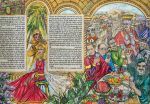
Showcased by Kedem Auction House earlier this month, the Megillah from which the above image is taken features politicians and celebrities as the story’s characters. For example, Osama bin Laden is Haman, George W. Bush is King Ahasuerus and Madonna is Queen Esther. The Megillah was commissioned by an anonymous collector, said Israeli designer Itzhak Luvaton, who was asked to create it back in 2007. Luvaton supervised the project and created the master sketch, which was sent to tens of artists and painters. After all the painting was completed, master scribe Avital Goldner wrote the text. The process took about a year.

Format ImagePosted on March 10, 2017March 8, 2017Author IMP Group Ltd.Categories Celebrating the HolidaysTags Megillah, Purim
תפסיקו ליילל ותתחילו להילחם

תפסיקו ליילל ותתחילו להילחם

ויויאן ברקוביצ’י (צילום: Foreign Affairs/Government of Canada via National Post)

שגרירת קנדה בישראל לשעבר ויויאן ברקוביצ’י: “השימוש בביקורת על ישראל כדי לבקר את היהודים הוא פשוט אובסביבי”

“קל לבקר את ישראל וקל לפעול נגדה. בכל המוסדות באו”ם רואים את הפעילות הזאת. השימוש בביקורת על ישראל כדי לבקר את היהודים הוא פשוט אובססיבי”. את הדברים אמרה שגרירת קנדה לישראל לשעבר, ויויאן ברקוביצ’י, במסגרת ראיון שערך עימה אתר אנרג’י. ברקוביצ’י מונתה לתפקיד על ידי ראש הממשלה הקודם של קנדה, סטיבן הרפר, והיא נאלצה לפרוש מתפקידה לאחר כשנתיים וחצי בלבד (ביולי אשתקד), לאור החלטת ראש הממשלה הנוכחי של קנדה, ג’סטין טרודו, להחליפה בדבורה ליינוס, שהייתה השגרירה באפגניסטן וקודם לכן עבדה בשגרירות קנדה בוושינגטון. ברקוביצ’י שהיא עורכת דין יהודיה מטורונטו היתה חסרה ניסיון דיפלומטי. היא אף גרה תקופתה מסויימת בישראל ופעלה בעבר בין היתר בתחום התקשורת הקנדית. ברקוביצ’י נחשבה מטבע הדברים לפרו-ישראלית בצורה מובהקת, יצאה נחרצות נגד החאמס, הרשות הפלסטינית והמשטר האיראני ויתכן ובממשל של טרודו לא אהבו זאת. בקהילה היהודית בקנדה לא קיבלו את החלפתה בהפתעה של ממש.

בנוגע לעליית הימין הקיצוני והתגברות הלאומיות במדיניות המערב אמרה ברקוביצ’י: “תמיד הייתה אנטישמיות בארה”ב ובקנדה, בדיוק כמו התנועות החברתיות שפעלו בשנות השישים לא העלימו את הגזענות. גם אני עת הייתי השגרירה של קנדה בישראל, הואשמתי בחוסר נאמנות לארצי בשל היותי יהודייה”.

ברקוביצ’י לא מקבלת את הטענות שהממשלה בקנדה מתעלמת מהאנטישמיות. לדבריה: “זה פשוט לא בסדר העדיפות שלהם מפני שזה לא משרת את האינטרסים הפולטיים שלהם”.

באשר לשאלה האם לא נכון לפעול משפטית נגד ההסתה נגד היהודים ברשתות החברתיות, אמרה השגרירה לשעבר: “גם הנוצרים טוענים כך. אנו לוחמים בזירה התקשורתית, והגישה התבוסתנית שזה לא צודק לא תעזור. יש להילחם בצורה מאורגנת תוך שימוש בצעירים מוכשרים למלחמה הזו. אני ממליצה שתפסיקו ליילל ותתחילו להילחם. אנו חייבים להגיב, לפעול עכשיו”.

הג’י.פי.אס אשם: כך טען נהג שרכבו נמצא במנהרה של הרכבת הקלה בטורונטו

נהג שרכבו נמצא תקוע על פסי הרכבת הקלה בטורונטו מאשים את מכשיר הג’י.פי.אס, שלדבריו כיוון אותו למקום. הרכב מסוג מיצ’ובישי כסוף שנתקע גרם לשיבושי תנועה חמורים של מערך הרכבת הקלה בעיר, בשעות הבוקר העמוסות שנמשכו כשש שעות תמימות.

אחד הנהגים של הרכבת הקלה שהסיע את הרכבת בסביבות חמש בבוקר נדהם לראות רכב תקוע על המסילה באחת המנהרות בדאון טאון. הוא הצליח לעצור את הרכבת מבלי לפגוע ברכב והזעיק את אנשי התחזוקה. מנוף מיוחד הובא למקום (כיוון שגרר של רכבים גם כן היה נתקע על המסילה) כדי להזיז את הרכב, ולאפשר לחדש את תנועת הרכבות הקלות בעיר.

מסתבר שבעל הרכב שנתקע בסביבות חצות ברח תחילה ממקום האירוע. למחרת בבוקר הוא הגיע למנהרה וכשראה את מפעיל הרכבת הקלה עומד במקום לידה, הוא התחיל לברוח שוב אך נתפס על ידו. לטענתו הוא נהג הישר לפסים שבמנהרת הרכבת הקלה, כיוון שכאמור הג’י.פי.אס ברכבו כיוון אותו לשם. דובר מערך התחבורה הציבורית של טורונטו, ברד רוס, לא מקבל את גירסת הנהג, כיוון שהרכב נסע על פסים קרוב לשמונה מאות מטר אל כיוון תחנת יוניון (שהיא התחנה המרכזית של התחבורה הציבורית בטורונטו), וזה דבר נדיר. לדברי רוס קרו בעבר מקרים בהם בעלי רכבים נתקעו על מסילות התחבורה הציבורית אך אף פעם הרכבים לא נמצאו עמוק בתוך המנהרות. הנהג קיבל דוח ובשלב זה לא ברור אם יפתחו נגדו הליכים פליליים.

Format ImagePosted on March 8, 2017March 7, 2017Author Roni RachmaniCategories עניין בחדשותTags antisemitism, driver ויויאן ברקוביצ'י, GPS, Israel, light rail, Toronto, Vivian Bercovici, אנטישמיות, ג'י.פי.אס, טורונטו, ישראל, נהג, רכבת הקלה
Envisioning the world

Envisioning the world

Brothers Tony and Ryan Smith are in the process of bringing the feature film Volition to the screen. (photo from Smith Brothers Film Company)

Local Jewish brothers Ryan and Tony Smith have worked in the film and television industry in Vancouver for most of their careers, and their latest project, a feature film, is set to begin filming in May 2017.

“Volition is a film about a man named James, who is afflicted with clairvoyance – the ability to see snippets of his future, out of order, before they happen,” Ryan told the Independent. “James gets involved in some shady dealings, using this ability. However, he soon has a disturbing clairvoyant vision: he sees his own imminent murder. At that point, he realizes that, if he has any chance of survival, he must go on the run.”

Tony has always loved metaphysics and both brothers are fans of the cerebral science fiction genre. The inspiration for Volition came during Tony’s film school days, and returned many years later, when he was going through a period in his life where he was feeling stuck.

The idea of the observer being responsible for the existence he or she sees resonated, “so, if I see the world positively, I might see the world positively; if my thoughts are negative, I’ll see the world that way,” he said. “I started to think that, what if where I’m stuck is because of my thought process, and those thought processes are almost creating a self-fulfilling prophecy. Then I thought, what would it take to get me off my ass and try something different – that turned into the character [in Volition] seeing his own death. What if that is what it takes to finally motivate somebody to change?”

Born in South Africa, and raised for the better part of their childhood in Vancouver, Tony and Ryan were exposed to the magic of illusion at an early age. Both their father and grandfather were professional magicians in South Africa. One of Tony’s earliest memories is of his dad performing a magic trick, ending with his mother locked in a trunk.

When they moved to Vancouver in 1990, their dad continued his work as a jewelry designer but remained a part of the International Brotherhood of Magicians. Their dad is still a great storyteller, and is also a budding actor – “Our dad wants to really be cast in it [Volition], but we can’t afford him,” said Ryan.

The early exposure to magic is, as Ryan puts it, related to filmmaking in terms of “what you’re presenting, where the twist is and what the audience is watching, when.”

Oxford Dictionaries defines volition as “the faculty or power of using one’s will.” About how the film’s protagonist will employ this faculty, Tony said, “That’s what it’s all about. James doesn’t believe he has free will, because he sees pieces of his future ahead of time, and his visions always come true. He almost has an arrogance to him, in that he knows something the rest of us don’t. Through the narrative, he’s faced with the daunting task of not only trying to avoid his murder, but of attempting to undo his own belief system. He needs to believe in free will, even though his life has shown him that its existence is an illusion.”

Tony is a director, writer and editor, whose short film Reflection earned five Leo Award nominations, including for best picture and best director. Ryan is a full-time writer for television (Reboot: The Guardian Code, Mr. Young, Some Assembly Required), which has earned him two Leos.

Reflection and Volition seem to share similar themes of loss, regret, isolation, hope and the need to be understood. Tony said he and his brother like writing redemptive, honest stories. Ryan added that, underlying these two films, “there is a hopefulness of returning to a truer sense of self – the character is going through something, a struggle, and they’re hopefully getting to a place of self-understanding and growth even though it can go through some dark places.”

photo - Filming for Volition is set to begin in May
Filming for Volition is set to begin in May.

Tony will be directing Volition and Ryan will be the film’s producer; both brothers are credited as writers. When asked about the challenges of working together closely, as brothers, Tony, who is the oldest, said, “Because I came to this world first and it was my kingdom first,” he has that older brother “of course, I’m right about this thing” mentality. He said he even went so far as to coerce Ryan into signing a contract (with no expiry date) at a very young age, which states, “Ryan will shoot the scene whether he wants to or not, he won’t go crying or wimping.”

Nevertheless, as Ryan grew up, he started speaking his mind. “We have so much video evidence of the short films and the things that we’ve done through the years,” said Tony. “I found this moment when Ryan is an early teenager and he’s starting to give me lip. He’s actually on-camera starting to disagree with me!”

The brothers said they come from a relatively traditional Jewish family. Ryan attended King David in South Africa and then, on moving here, enrolled in Vancouver Talmud Torah. He said his days at these two Jewish schools and his engagement with the Torah stories “were, in a way, early touchstones for story and myth.”

For Tony, Judaism’s spiritualism and mysticism also inspire his storytelling. “I still have my first Bible,” he said.

“I love the Genesis story, I love the Noah story, and my mum, at an early age, I asked her, ‘How did the world get made in seven days?’ ‘Well it’s a metaphor,’ she said. At an early age, she was letting me in on abstract ideas and symbolism,” said Tony.

Filming for Volition is expected to begin in May, and Ryan and Tony are currently in the process of gathering the crew and auditioning for the two lead roles. Veteran Vancouver actor John Cassini has signed on for the role of the villain, Ray, a corrupt businessman, and his brother Frank Cassini will also feature. Tony and John worked on Comedy Network together, and Tony said John is “such a presence … he could read the phone book and make it interesting.” Tony also noted that John brings “an authenticity to the role – it’s not a two-dimensional villain, it’s a very textured antagonist.”

The latest casting announcement came just this past Monday, on Feb. 27. Canadian actor Bill Marchant will play, according to the film’s website, the “mentor character, Elliot Williams, a troubled psychologist with a dark secret.”

The Smith brothers are taking a unique approach to their pre-production process, documenting the journey through semi-monthly webisodes.

Volition is being produced by Smith Brothers Film Company in partnership with Paly Productions Inc., and Paly has been a “driving force behind doing this indie webisode marketing,” said Tony. The brothers, who are normally private about their creative process, liked the approach of “getting to know our audience from day one and welcom[ing] them into the process so we can build a grassroot connection with them.”

Readers can check out the webisodes and follow the brothers’ journey on volitionthemovie.com.

Alice Howell is a graduate of the University of Otago in New Zealand, with a bachelor of arts in film and media studies and a bachelor of science in psychology. She is a writer and actor based in Vancouver.

Format ImagePosted on March 3, 2017February 28, 2017Author Alice HowellCategories TV & FilmTags sci-fi, Volition
Wildlife takes over the Zack

Wildlife takes over the Zack

The Intersection of Science & Art, now at Zack Gallery until March 24, features the works of Joanne Emerman and Mike Cohene. (photo by Olga Livshin)

The Intersection of Science & Art exhibit at Zack Gallery features the works of two artists – Joanne Emerman, professor emerita of physiological sciences at the University of British Columbia, for whom photography has been a hobby for decades; and Mike Cohene, whose woodcarving unfolded unexpectedly in the past few years, after a lifetime of other pursuits.

Emerman explained that, for her, science and art have always intersected. “I worked for 33 years in cancer research. I only retired four years ago. I’m a scientist. I often used my photo camera, attached to the microscope, to photograph cells.”

Her hobby, especially her photos of animals, seems an extension of her scientific imagery.

“My photographs show how animals adapt to their environment. Every feature you see in the pictures is a result of natural selection, the survival of the fittest,” she said. “The individuals with adaptations suited to their environment will live long enough to breed and pass down those traits to their offspring, whereas the individuals that don’t adapt will die off. For the natural selection to work, several factors must be present, including the overproduction of offspring. They must ‘reproduce like rabbits.’ Also beneficial are variations due to mutations. They increase the likelihood of survival.”

Because of her scientific leanings, Emerman tries to capture in every shot the most significant characteristics of each animal, the ones that contributed to the survival of the species, like the stripes of a zebra, the legs of a tortoise or the fins of a turtle. She also documents the endless variations in nature in her thousands of photo frames.

Of course, to photograph exotic creatures, she has had to travel widely.

photo - Joanne Emerman tries to get as close to the animals as she can with her camera, as is evidenced by this blue-footed booby photo
Joanne Emerman tries to get as close to the animals as she can with her camera, as is evidenced by this blue-footed booby photo. (photo by Joanne Emerman)

“I’ve always traveled a lot,” she said, “all over the world, and photographed during my travels…. I love animals but I love them in the wild. I never photograph animals in cages. The pictures in this show are all of animals and birds in their natural habitat. I took them in the Galapagos Islands and several South African game reserves. I tried to get as close to the animals as I could with my camera.”

The quality of the images reveals Emerman as a master photographer, although she is mostly self-taught. “I never took any classes on photography until I retired four years ago,” she said. “Then I decided to learn, and enrolled in a basic photography course at Emily Carr. I thought I would know everything they had to teach, or almost everything – I mean, it was called basics – but I learned so much!”

Eventually, the time was right for this show, her first gallery exhibit. “I was retired. I thought, maybe I should exhibit my pictures. I never did before. I submitted to the Zack Gallery, and the jury accepted me.”

Another first for her was meeting Cohene. Linda Lando, the gallery director, introduced them.

“Linda said, ‘We have a wonderful carver. He carves fish and birds. His works will complement yours.’ She put us together,” explained Emerman.

Cohene’s artistic journey started in 2009.

“In the summer of 2009, I visited Steveston Farmers Market,” he recalled. “They had a booth of the local woodcarvers club. I looked at their works and thought, outstanding! I could never do anything like that. I’m not artistic, though I always whittled. Professionally, I had a clothing business until I sold it awhile back. The man in the booth talked to me and said, come to the club in September. You can do it. So I went.”

His first carving was a baby bear, and he loved it. After that came a dolphin and then some fish.

“I felt good about my carving but I wanted to learn more,” said Cohene. “I started attending woodcarving classes at the Richmond Carvers Society – enjoyed it so much, took a course at Emily Carr.” He also participated in an intensive 10-day workshop with world-renowned master fish carver Dale Barrett of Redmond, Ore.

photo - Mike Cohene began woodcarving in 2009
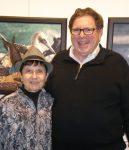
Mike Cohene began woodcarving in 2009. (photo by Olga Livshin)

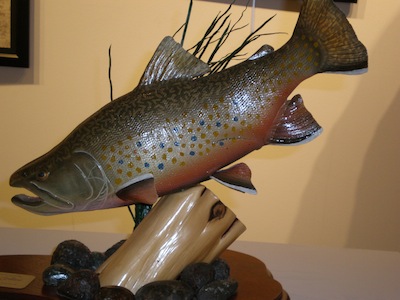
Cohene carves what interests him: wildlife, fish and birds mostly. “I’m a fisherman, have been all my life, but I never studied the fish anatomy before. I caught a fish and tossed it into a bucket. Now, I catch a fish and study it: the fins, the tail, the colour of scales. I look at fish from a different perspective now.”

To carve and paint his creations as realistically as possible, he uses reference material. “I take photos of what I catch or search for photos online,” he explained. “Sometimes, when I take commissions, people send me photos of the fish they caught and they want me to carve it.”

An active member of the Richmond Carvers Society, he regularly participates in the carvers’ juried exhibitions in British Columbia and Oregon. He has already collected a few “best in the show” awards for his work. However, as with Emerman, the exhibit at the Zack is his first gallery show.

Cohene has a second line of woodcarving, totally unrelated to his life-like creatures: Judaica. “A couple years ago, I brought 12 kilos of olive wood from Israel,” he said. “Each piece of wood was reclaimed from trees that had been in the fire of Har Carmel. I make mezuzot and dreidels from this olive wood, and people like them.”

To learn more about his carving, visit his website, mikecohene.com.

The Intersection of Science & Art opened on Feb. 23 and runs until March 24. Emerman is given an exhibit-related talk – Looking through the Lens of a Microscope and the Lens of a Camera – on March 21, 7 p.m., at the gallery. The suggested admission is a donation of $5. For more information, visit jccgv.com/content/jcc-cultural-arts.

Olga Livshin is a Vancouver freelance writer. She can be reached at [email protected].

Format ImagePosted on March 3, 2017February 28, 2017Author Olga LivshinCategories Visual ArtsTags carving, Joanne Emerman, Mike Cohene, photography, Zack Gallery
Dance that speaks out

Dance that speaks out

Kyle Abraham/Abraham.In.Motion’s The Gettin’ is among the repertoire the company will be bringing to Vancouver March 11-13 for the Chutzpah! Festival. (photo by Jerry and Lois Photography)

Kyle Abraham/Abraham.In.Motion is bringing to Western Canada for the first time a sample of its acclaimed repertoire, including The Gettin’, Quiet Dance and excerpts from the company’s newest work, Dearest Home. They will perform at the Chutzpah! Festival March 11-13.

“Dearest Home is a new evening-length work that is broken up into solos and duets dealing with love, longing and loss,” explained Kyle Abraham in an interview with the Independent. “Some of the themes, and movement itself, were derived from the workshops and conversations that took place during residencies. The excerpts that are shown in this program were made during a residency at the Hopkins Centre for the Arts, Dartmouth College.”

Politics, identity, justice and freedom are some of the other themes Abraham explores in his work.

“I try to create work that reflects society as I see it,” he said. “Sometimes people see hope in that and sometimes people see the disparity that is in closer correlation to my experience growing up in this country. But, there is also purposefully the possibility of seeing both hope and disparity in my work; I think that speaks to the conflict and tensions that have been in this country for a long period of time. There are stories that are from an earlier time, but the work winds up correlating with current events basically because of the cyclical nature of history repeating itself over and over again. With that work so often comes a direct smack in the face that there is still so much more progress to be made. I like to make work that speaks to all those things.”

Religion also plays a part in some of Abraham’s creations.

“Since my parents passed, and since my mother’s more recent passing, I have had a really conflicting connection with religion and spirituality in a larger sense,” he said. “I was very curious as a child when it came to religion. I think there’s so much history in religion, in so many different ways. My parents were of different Christian faiths: my father was raised in an Episcopalian church, my mother was raised in a Baptist church, and I purposely chose to go to Hebrew school. I think that shows that I was really interested in learning about different faiths and trying to figure out where I fit in.

“It’s a tricky thing. Just because your parents believe something doesn’t mean that’s what you will believe. Just because your friends believe something doesn’t mean that’s ultimately what you’ll wind up believing yourself. But, I’ve always been curious about religion and faith in some way, shape or form, and have spent time in different religious spaces through points in my life. The last religious space I was in was a (Jewish) temple; that was in October for a friend of mine’s mother’s passing. And then, before that, it was my mother’s passing, in a Baptist church.”

While his parents weren’t artists per se, Abraham said the arts were encouraged at home, and that his parents “were really creative people because they worked in education and they had to come up with inventive ways to really push education forward in the public school system.”

Born and raised in Pittsburgh, Abraham’s education in dance started relatively late in life.

“I started studying dance the summer I turned 17, when I took a boys jazz class,” he said. “The catalyst for this was seeing the Joffrey Ballet performing in Pittsburgh to Prince’s music, which was the first dance performance I ever saw. I also had some good friends that were in musical theatre that I went to raves with, and they suggested that I audition for our high school musical.”

Though he has made a career of dance, before Abraham started on that route, he studied music. And, when he took a break from dancing for a few years, it was to music he returned.

“For so much of my life, music has been my first passion,” he said. “When I was a senior in college, I thought about moving to England to study studio composition, to make electronic music, but, during that same year, I started taking company classes with Bill T. Jones. I was later offered an apprenticeship, which led to joining the company very briefly after college.

“That experience was very telling for me, because it helped me realize that even though I really loved that company and wanted to be around them, I preferred being a part of the creative space around the dancers rather than being a dancer myself within the company. I had a very hard time with making mistakes with an artist’s work that I respected so much. I felt like I was ruining the possibilities for people to be inspired by messing up, which is such a heavy burden to bear that I needed to find a healthier way into dance.

“When I quit dancing,” he said, “I started working in record stores; I would meet up with friends and I would maybe sing over some records for friends while playing around in the studio making songs. I also worked at the Andy Warhol Museum as an artist educator. During that time, I thought about different facets of my artistic interests growing up; for example, bringing in music at times, bringing in movement and finding ways we could connect those art forms to Warhol’s work. That’s primarily what I was doing with that time off.

“My way back into dance started when I was dating a visual artist. At the time, we both wanted to move to England so we thought that the best way for us to do that would be for both of us to get into school in England. I also applied to NYU [New York University], just as a backup plan in case I didn’t go to Europe – maybe I would go to NYU and see what New York was like again. We both ended up going to school in London, where I attended the [Trinity] Laban School. I went to Laban for maybe a couple months, but I was frustrated by the lack of opportunities I had to really dance: to make dance, take classes, etc. So, I left school and spent the rest of my time there focusing on trying new things (i.e. singing). I eventually moved to New York to go to NYU to figure out what my relationship to dance could be.”

Abraham received his bachelor in fine arts from the State University of New York at Purchase (2000) and his master’s from NYU (2006). He is a multiple award-winner, for both his choreography and performance. He has performed with many notable companies, and his works have been performed not only by his company, Abraham.In.Motion, which he founded in 2006, but others, as well, throughout the United States and abroad.

About one of the pieces set to have its West Coast première next weekend, Rachael Carnes of eugeneweekly.com wrote, “… The Quiet Dance, a quintet set to Leonard Bernstein’s ‘Some Other Time,’ this work built organically around simple gestures, from the swivel of knees and elbows side to side, to the slow descent of a head, alone, or against another. Abraham played with connection here, relating dancers to self and other, finding moments of counterpoint, without being heavy-handed or glossy. His organic style delved into lovely canonical structures without feeling artificial or contrived, as he boldly carved the stage space into two separate fields of vision.”

About The Gettin’, she wrote, “set to Robert Glasper’s interpretation of Max Roach’s Freedom Now Suite, Abraham plows even more deeply into the roots of racism, exploring the similarities between apartheid South Africa and the U.S.

“Jazzy and lyrical, yet pointed and gripping, this piece sings from a deep, guttural place.”

Abraham.In.Motion performs March 11 and 13, 8 p.m., and March 12, 7 p.m., at Rothstein Theatre. For tickets ($29.47-$36.46) and the full Chutzpah! schedule, call 604-257-5145 or visit chutzpahfestival.com.

Format ImagePosted on March 3, 2017February 28, 2017Author Cynthia RamsayCategories Performing ArtsTags Chutzpah! Festival, dance, Kyle Abraham
We must be united

We must be united

More than 100 headstones were vandalized at the Chesed Shel Emeth Society cemetery in University City, Missouri. (screenshot from cbc.ca video )

We do not need to delineate the full roster of antisemitic incidents that have made the news recently. Toppled headstones, bomb threats against Jewish institutions, spray-painted swastikas, defaced mezuzot, hate messages left on doors, physical assaults in France.

On the one hand, there is a necessity to catalogue and condemn each and every incident – and police and Jewish community organizations are doing this. On the other hand, for the sake of our own individual and collective sense of security and peace of mind, we must try to assimilate these incidents into some sort of coherent narrative that, hopefully, does not lead to panic.

For the sort of individual who would desecrate a cemetery after dark, there could be a perverse thrill in making global news for what may have been little more than a drunken act on a Saturday night. The fact is that these acts – in North America certainly – are perpetrated by a tiny number of individuals. A somewhat larger number of dedicated antisemites will take cruel pleasure in the grief and fear these acts instil in Jewish communities and individuals.

The most important thing is how the great majority of people react to such incidents. It is deeply heartening to see Muslim communities uniting with Jewish communities to make right as many of the toppled gravestones as possible in St. Louis and Philadelphia. This is a model of unity in the face of hatred.

It is also necessary for the broader public – those neither Jewish nor Muslim or having membership in other targeted groups – to express their outrage and opposition to such expressions.

The situations in which Jewish and Muslim Americans find themselves are different. Muslims are being specifically targeted not only by racist individuals and groups, but by agencies of the state. This is a particularly frightening scenario. Jews are being targeted by apparently random acts of desecration and hatred. This is frightening in a somewhat different way, in that government actions, ideally, are subject to the checks and balances set out in the U.S. Constitution and we hope that those safeguards survive and thrive in this era.

Imagine deplaning after a domestic flight in the United States and being met by security officials demanding to know “Are you a Jew?” This is an immensely chilling prospect. And this is precisely what some Muslim travelers have experienced in recent days: officials of the state demanding identification papers and inquiring as to whether travelers are Muslim. Additionally alarming is the fact that many people would probably never have heard about these incidents had one of those who experienced it not been Muhammad Ali Jr. Thank goodness, at least in this context, for America’s celebrity culture.

While there have been innumerable antisemitic incidents in recent years, those who are not immersed in such news are often only dimly aware of the frequency and increasing severity of these events. When a Jewish friend posts news of a new attack on social media, you will thankfully see condemnation from Jewish and non-Jewish friends alike. But you are as likely to see shock and disbelief.

More important than what Martin Luther King Jr. called the strident clamour of the bad people, in times like these, is the appalling silence of the good people. Part of this is caused by the refraction of media and the isolated silos of information in which we have surrounded ourselves, so that we do not encounter ideas or news from outside our respective bubbles. There are many people who simply do not yet know the extent of anti-Jewish and anti-Muslim incidents taking place.

Those who do know are elected officials in positions of power. It is heartening to see Canadian leaders and many in the United States Congress expressing solidarity with the victims and condemning the perpetrators. U.S. Vice-President Mike Pence has been at the frontline of showing solidarity with targeted Jewish communities, at least. Getting appropriate remarks out of President Donald Trump has been troublingly difficult.

We may not be able to pre-empt the actions of individuals who are driven to topple gravestones or call in bomb threats. But the finest antidote to such incidents is for ordinary people to come together in condemning these acts and speaking out in favour of the values of respect and inclusiveness. As a targeted community, Jewish Canadians and Americans have a unique role in both making others aware of what is happening and showing our Muslim friends and fellow citizens that we stand with them, as they are standing with us in communities where desecrations have taken place.

Acknowledging – and demonstrating – that we are all in this together is our best hope for thriving in these times.

Format ImagePosted on March 3, 2017February 28, 2017Author The Editorial BoardCategories From the JITags antisemitism, bigotry, Islamophobia, Jews, Muslims, racism, Trump

These times call for solidarity

When a multicultural country like Canada faces a stark rise in hatred targeting one ethnic group, its social and ethical solidarity is put to the test. The question for Canada’s Jewish establishment is, how will it respond to the shocking spike in hatred targeting the Muslim community?

On the heels of the Quebec City mosque shooting, which left six worshippers dead, and then a hate-filled protest outside of a Toronto mosque, a private member’s motion to condemn Islamophobia was introduced in Parliament. Regrettably, the Centre for Israel and Jewish Affairs (CIJA) is opposing the motion, at least in its current form.

Liberal MP Iqra Khalid introduced the non-binding motion (M-103) urging the government to “better reflect” the Canadian Charter of Rights and Freedoms by “quell[ing] the increasing public climate of hate and fear,” while “condemn[ing] Islamophobia and all forms of systemic racism and religious discrimination.” Her motion also asks Parliament to convene a study to address these issues and “to conduct needs assessments for impacted communities.”

As the motion – intended to express the will of Parliament but falling short of having any legal force – acknowledges, there are already Charter provisions for opposing racism and discrimination. And Section 319 of the Criminal Code already outlaws “communicating statements in any public place, incit[ing] hatred against any identifiable group where such incitement is likely to lead to a breach of the peace.” But, sometimes, the law is not enough to signal collective revulsion.

The demonstrators outside the downtown Toronto mosque held signs such as “Ban Islam” and “Muslims are terrorists.” Interviewed on camera, one of the protesters makes the following chilling observation: “They [she presumably means Muslims] start out friendly and, before you know it, they grow so much in population that they take over.” The interviewer challenges her: “This is sounding a lot like what people said about Jews at one time,” to which the protester replies: “There’s no comparison. Jews were not evil.”

For its part, CIJA calls M-103 “flawed.” As CIJA head Shimon Koffler Fogel writes, the motion “requires us to silence legitimate concerns or suppress a public conversation about those strains of Islam that pose a real and imminent threat to Jews around the world,” adding that the motion “denies space and opportunity within the Muslim community to confront those strains of Islam that do indeed exist and do indeed cause harm to the majority of Muslims who do not subscribe to an extremist ideology.” For these reasons, CIJA is urging lawmakers to oppose it.

It’s not the first time a private member’s motion has been introduced to focus Canada’s attention on a specific form of hatred. In 2015, Conservative MP James Bezan asked “all members [of Parliament] and all Canadians [to] join me in denouncing antisemitism.” In 2015, Liberal MP Irwin Cotler asked the “House [to] condemn the alarming development of a new antisemitism….” And then, of course, there’s the 2010 Ottawa Protocol on Combating Antisemitism, which convened parliamentary representatives from an array of countries to call out antisemitism.

CIJA director of communications Martin Sampson shared with me the amended text of the motion CIJA proposed to Khaled, including trying to add a clause that would “recognize that criticism and condemnation of any and all forms of extremism is not only acceptable but necessary in a free and democratic society; and tasking the proposed study to define ‘Islamophobia in Canada.’”

Bernie Farber, former head of Canadian Jewish Congress and now head of the Toronto-based Mosaic Institute, a diversity, peace and justice organization, said he is “baffled and stunned” by CIJA’s opposition to the motion.

Is the lack of explicit acknowledgment of the legitimacy of criticizing religion a problem, as CIJA is suggesting? No. Parliamentary motions have no legislative force. The existing Criminal Code – including laws governing freedom of expression – will remain unaffected. Fogel’s claim that the motion will silence criticism by force of law is simply wrong. It may serve to dampen enthusiasm for the kind of hateful anti-Muslim demonstrations we saw in Toronto, but that is the point.

Or perhaps the vagueness of the term Islamophobia is a problem. Sampson calls the word “politically charged and imprecise.” Cotler, for instance, is suggesting that M-103 be amended to say “anti-Muslim bigotry.”

But, like homophobia, Islamophobia is simply the term that exists to denote this form of bigotry. When I asked historian of language Liora Halperin why the term got saddled with the more clinical “phobia” suffix instead of acquiring the more straightforward “anti” prefix, she acknowledges that phobias are psychiatric diagnoses, not ideologies. But, she adds, “in practice, fear is indeed part of racism.”

The term antisemitism – which, ironically, was coined by a German antisemite – captures the unique phenomenon of Jew hatred. Similarly, Farber argues, “hatred of Muslims needs its own specific word to get people to understand the importance of what this kind of hatred of Muslims can do. And we’ve seen it, sadly, right here in Canada.”

These times call for solidarity in the face of rising tides of antisemitism, Islamophobia and all other forms of racism. In the wake of the mosque massacre and the hateful protests on Toronto’s usually peaceful streets, coupled with the shadow of U.S. President Donald Trump’s xenophobic policies, the time is now for Canadians to stand together against Islamophobia. That’s the word we have, that’s the member’s motion being proposed, and that’s the wave of hatred – one prominent wave among many, sadly – that we urgently need to address.

Mira Sucharov is an associate professor of political science at Carleton University. She is a columnist for Canadian Jewish News and contributes to Haaretz and the Jewish Daily Forward, among other publications. A version of this article was originally published on haartez.com.

Posted on March 3, 2017February 28, 2017Author Mira SucharovCategories Op-EdTags antisemitism, bigotry, Canada, CIJA, Iqra Khalid, Islamophobia, M-103, racism, Trump

Posts pagination

Previous page Page 1 … Page 8 Page 9 Page 10 Next page
Proudly powered by WordPress