What’s up in gerontology?

At the second program of the season in the Jewish Seniors Alliance Snider Foundation Empowerment Series, a few Simon Fraser University graduate students shared their research interests with the 70-plus participants who tuned in via Zoom on Jan. 15.

Jointly sponsored by the JSA and Sholem Aleichem Seniors of the Peretz Centre for Secular Jewish Studies, the Gerontology Research Panel: Eager to Share our Interests and Help our Community – What’s Up With Seniors event featured master’s students Lindsay Grasso and Kishore Seetharaman, and PhD student in gerontology Eireann O’Dea.

Grasso became interested in exploring the impacts of separating couples in long-term care settings when her own family experienced it. She said this problem of separation will become more severe as more couples age together. Current long-term care settings separate couples, depending on each partner’s individual needs.

The effects of dementia on couples is profound and, often, one partner ends up as the caregiver for the other, she said. When the point is reached that institutional care is required, being together would alleviate a lot of the pain, believes Grasso, who has received a grant to look into the long-term effects of separating couples, as well as the effects on visiting spouses, when only one partner is in care. In both scenarios, there is the loss of a shared life, shared memories and the beginning of mourning. It is important to continue the relationship through visiting, sharing activities and eating together, she said. The healthier spouse would need to monitor care and advocate for their partner. For her research, Grasso will be conducting in-person interviews with couples, and will also meet with staff to review their understanding of the issues surrounding separation.

The second presenter, Seetharaman, has a background in architecture and is interested in planning and designing dementia-friendly neighbourhoods, especially in Metro Vancouver.

Worldwide, 70% of dementia-affected adults live at home, so dementia is more than an individual health issue, it is a community issue. Communities must be more inclusive, he said. He would like them to focus on eliminating stigma, raising awareness, social engagement, accessibility to services, improving planning and design of public spaces and support given to caregivers.

In terms of design, he said, familiarity and easy recognition are important. Signs should be clearly visible and easy to read. Distinctive landmarks are helpful for finding the way, he added. There is some work being done in Vancouver in this area but it is not clear as yet how it will be implemented. Seetharaman would like to create a body of knowledge for designers. He is hoping to interview both dementia patients and public servants.

O’Dea is looking into volunteerism and cultural generativity. She became interested in these topics as an undergraduate, when she was volunteering at the Jewish Community Centre of Greater Vancouver and its L’Chaim Adult Day Centre. There, she encountered seniors who were volunteering with other seniors, and she is looking into the benefits on health and sense of purpose in life, as they move away from former roles. The strengths and capabilities of these older adults motivated other seniors to become involved, she noted, adding that each person’s aging process is unique.

O’Dea already has interviewed a number of senior volunteers regarding their motivation. She said many spoke of being motivated by the values of tzedakah (charity) and tikkun olam (repairing the world), and the passing on of Jewish culture. These responses led her to the exploration of cultural generativity, i.e., the desire or need to keep cultural identity alive and pass it down to future generations. This is especially relevant to ethno-cultural minorities, she said, and O’Dea will be researching four minorities: Jewish, Chinese, South Asian and Iranian. She will be studying the effects on both the volunteers and the members of the communities.

During the Q&A session, there were queries about dementia villages; the design and cost of facilities for couples in long-term care; and retention and recruitment of volunteers. The City of Vancouver is apparently looking into an age-friendly action plan that could include persons with dementia.

JSA co-president Gyda Chud reminded everyone about the evaluation questionnaire, then Shanie Levin, program coordinator for JSA, thanked the presenters. The entire program, including the PowerPoint images, is available via the JSA website, jsalliance.org.

Shanie Levin is program coordinator for Jewish Seniors Alliance and on the editorial board of Senior Line magazine.
Medical myths & facts

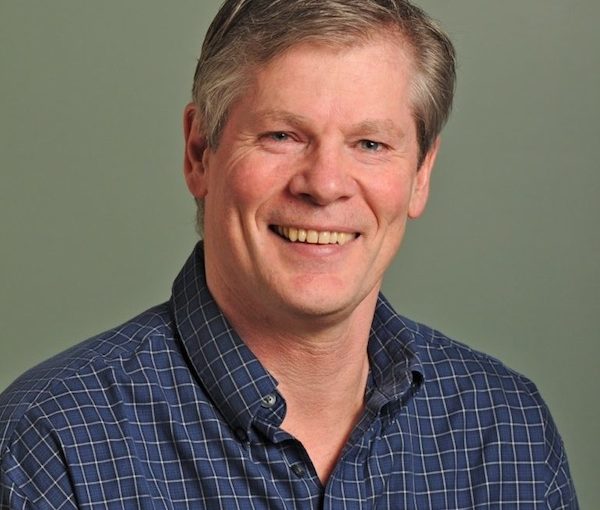
How Well Do Treatments Prevent COVID-19, Shingles, Heart Disease, Diabetes and Anything Else that Might Ail You? That was Dr. James McCormack’s topic at the Jewish Seniors Alliance fall symposium Nov. 22. And some 100 participants Zoomed in to hear his answers.

Gyda Chud, co-president of JSA, welcomed everyone and reviewed the organization’s foundational goals: outreach, advocacy and peer support. She thanked Jenn Propp, Liz Azeroual and Rita Propp for their hard work in facilitating the symposium, which emphasizes education and advocacy.

Marilyn Berger, past president of JSA, spoke a bit about McCormack’s background, noting how amazing his talk had been when he addressed the JSA a few years ago.

McCormack is a professor in the faculty of pharmaceutical sciences at the University of British Columbia, a podcast host and YouTube content creator. He began his remarks by mentioning his philosophical beliefs, which can be found in detail at therapeuticeducation.org. He emphasized that he receives no money from pharmaceutical companies and his only income is his salary from UBC. His medical podcast covers many topics, including nutrition (the Mediterranean diet is recommended) and anti-aging creams (they are all the same).

Regarding treatments and medications, McCormack recommends being skeptical and checking all information, as some are useful but many don’t work well. For example, many new drugs are not much better than those they are replacing, and many doses are too high. (See jewishindependent.ca/medical-myth-busting.)

The doctor shared a number of popular beliefs that are not supported by evidence and, indeed, which science indicates are not true. Examples included the following myths: it is not good to swim immediately after eating; sugar makes children hyperactive; you lose body heat through your head; eating carrots helps your eyesight; and spinach is strengthening.

Also, there is no evidence that you need to finish all medications, he said. For example, with antibiotics, if you are asymptomatic after 72 hours, you can stop taking them. Although we have some incredible medications, McCormack said the Golden Pill Award, given for breakthroughs in new medication, has not been awarded for the past eight years.

McCormack stated that “so-called diseases,” such as elevated blood pressure, bone density issues and high-glucose levels, should be identified as “risk factors,” rather than diseases. He also said many medications do not alter outcomes. It’s all about the numbers, what is the relative reduction of symptoms after taking certain medications. If the reduction is only two percent, is it worth taking a drug that has many side effects? he asked. He said, in the case of cardiovascular disease, following a Mediterranean diet and exercising may have more benefit than many drugs.

Regarding the serums for COVID-19, McCormack said the work has been outstanding and the oversight phenomenal. Vaccines for contagions are very important, he said.

McCormack concluded his talk by reminding us that tests and treatments can help and/or harm people. It is important to think for yourself, ask questions and have hope, he said, before responding to many audience questions.

Ken Levitt, past president of JSA, thanked McCormack for his presentation and for his emphasis on being alert about medications. The participant feedback was extremely positive.

Shanie Levin is an executive board member of Jewish Seniors Alliance and on the editorial board of Senior Line magazine.
Concert that inspires

The new Jewish Seniors Alliance Snider Foundation Empowerment Series season began on Oct. 19 with a concert. As usual, the program was co-sponsored by JSA and a community organization; in this case, the Kehila Society of Richmond. Because of the pandemic, the event took place on Zoom.

Last year’s Empowerment theme, “Be Inspired,” was carried forward for this year’s season. Fifty participants tuned in to Music in the Afternoon, which featured pianist Lester Soo and vocalist Maria Cristina Fantini. Soo is an accomplished musician who has taught, adjudicated, accompanied and performed in the world of music for many years, while Fantini – a dramatic soprano, at home in both classical and popular styles – teaches and has established her own vocal studio.

Toby Rubin, coordinator of Kehila Society, welcomed everyone and introduced Soo and Fantini.

JSA’s Gyda Chud spoke about the alliance and recalled that Soo and Fantini had performed in a joint program in the past. This time, the musicians performed from Soo’s home, where he was able to make use of his grand piano.

The audience was entertained by a number of old favourites, starting from the 1930s. Songs included “Unforgettable,” “When I Fall in Love” and “Besame Mucho.” These were followed by works by Cole Porter and Irving Berlin, k.d. lang’s version of Leonard Cohen’s “Hallelujah,” and “Tonight” from West Side Story. The duo then switched to the jazz genre, with “Misty.” Lester played a solo of “Over the Rainbow” and he and Fantini ended with an aria by Puccini, “O, My Beloved Father.”

It was a wonderful concert. The only problem was that the musicians couldn’t hear the applause because the audience was muted for the performance. However, Rubin thanked Soo and Fantini on everyone’s behalf.

For information on JSA and upcoming events, visit jsalliance.org.

Shanie Levin is an executive board member of Jewish Seniors Alliance and on the editorial board of Senior Line magazine.
Medical myth-busting

Medical myth-buster Dr. James McCormack speaks Nov. 22 via Zoom. (photo from too-much-medicine.com)

Dr. James McCormack is a bit of an anomaly as a voice in today’s medical debates. In a politically driven climate where most people tend to stand as either “all in” or “all out” with regards to their belief in science and research, McCormack’s approach is more pragmatic.

McCormack, a tenured professor in the faculty of pharmaceutical sciences at the University of British Columbia, a podcast host and a YouTube content creator, is a strong believer in evidence-based medicine. Well-known as a medical myth-buster, he dispels misinformation that often prevents doctors and their patients from making the most informed decisions possible. He will present some of his many thoughts and findings at the Jewish Seniors Alliance Virtual Fall Symposium Nov. 22, 2 p.m., which will be held on Zoom.

McCormack’s presentation will highlight some of the more common myths around what medications are actually effective and how doctors and patients can better work together to make evidence-based decisions. In a phone interview with the Jewish Independent, the doctor said his ultimate objective is to find out what the best available existing evidence is in healthcare to help doctors and patients make shared decisions on treatment plans.

This process is often “tricky,” he said, because of the many false conclusions and deceptive statistics that surround the medical field. For example, there are hundreds of clinical trials showing that statins, one of the most popular drugs in the world, help patients with high cholesterol, reducing the risk of heart attacks among 50-to-60-year-old patients from five percent to four percent.

“If you take a statin you can reduce your chance of a heart attack by about one percent,” he explained. “But what you will hear is that this is a 20% reduction in heart attacks – 20% is not a lie, but it’s misleading.

“If I come to you and say, ‘You have high blood pressure. That’s a silent killer. Do you want it to be treated?’ That’s not shared decision-making,” he argued. “If I said, ‘Your blood pressure is this number and your chance of a heart attack is 10% over the next 10 years and we can reduce it from 10% down to eight percent, what do you think of that?’ If that two percent seems like something you might want to consider, then we can try the drug, start with a low dose, make sure we don’t blow you away with any side effects, and then go from there.”

McCormack hinted at the large amount of medical misunderstanding around the world by noting his belief that at least half of all medical prescriptions are either wrong, unnecessary or the incorrect dose – a problem he says is driven by the challenges pharmaceutical companies face in getting their products to market.

“When a new drug comes onto the market, almost for sure the recommended dose is too high,” he said. “[Pharmaceutical companies] have to show that the medicine works. To show that it works, they have to recommend a dose that everybody responds to because, if you choose lower doses, you might not show enough people responding.”

He likened this process to attempting to estimate how much alcohol any specific person would need to drink in order to get drunk – a question for which there would be almost as many answers as there are people.

“This is a fundamental flaw in how we get a drug onto the market,” he said.

McCormack also brought up the alarming lack of evidence-based research on some of the most popular ideas in modern medicine and nutrition. Some of these myths include what we think about vitamins, the lack of evidence showing the health benefits of green vegetables like broccoli, and even our daily water intake.

“You see the same things with nutrition, where there are so many recommendations that are BS – like the idea of [needing to drink] eight glasses of water a day,” he noted. “Almost everyone in the world knows that’s the number of glasses of water you’re supposed to have every day, but there is not a single study that’s ever looked at that. It’s a made-up number mentioned by someone maybe 50 years ago, but it becomes incredibly powerful when everyone assumes it to be true. The evidence is pretty clear when it comes to water – you drink when you’re thirsty.”

McCormack became a myth-buster when, earlier in his career, he discovered a lack of evidence backing up the so-called facts that many of his mentors presented to him.

“I went looking for the evidence and I wondered why they were telling me this if [there was a lack of] evidence. It didn’t make any sense,” he said. “If good, smart people who are trying to do a good thing are telling me unintentional BS, why is that? So, ever since then, I’ve been very inquisitive.”

While he does his best to provide as much myth-busting content as possible to the public, McCormack warned that there’s no simple solution to helping patients understand the great nuances surrounding medical options.

“It’s very tricky,” he said. “Patients don’t feel empowered to make a decision because that’s not part of the ethos of how we do medicine. There are people who would say to their doctor, ‘Just tell me what to do.’ And that’s totally fine as long as the doctor or the pharmacist knows the best available evidence.”

While McCormack will share some of his key discoveries at the symposium, fans of his work can also listen to any of the 460-plus episodes of his podcast, The Best Science Medicine Podcast, which he has nicknamed The BS Medicine Podcast.

“We take the BS out of the BS,” he laughed, before emphasizing that he and co-host Michael Allan approach their shows with a sense of humour.

McCormack also produces various music video parodies on his YouTube channel under his own name. The videos, he said, are a labour of love. “I do [them] because I’m a tenured professor and I can do whatever I want,” he said, tongue-in-cheek. “Which is kind of nice.”

JSA members/supporters will receive an email with the Zoom link to join the virtual symposium. For more information on and to register for the JSA symposium, contact the JSA office at office@jsalliance.org or 604-732-1555.

Kyle Berger is Jewish Community Centre of Greater Vancouver sports coordinator, and a freelance writer living in Richmond.

***

Editor’s note: This article has been amended from the print version to include more detailed information on how to access the event on Zoom.

Legacy seniors knit gift

The finished scarves, each individually packaged, and including a warm message. (photo from Legacy Senior Living) 

Last month, residents of Legacy Senior Living (the Leo Wertman Residence) gave a gift of warmth to residents of New Beginnings, a temporary housing complex for Indigenous individuals. On Oct. 7, nearly 100 hand-knitted scarves, each with an uplifting message – such as “Warm Wishes,” “Smile” and “Enjoy!” – were delivered from the independent living retirement home in Vancouver’s Oakridge area to the housing complex, which is located at Heather and 33rd.

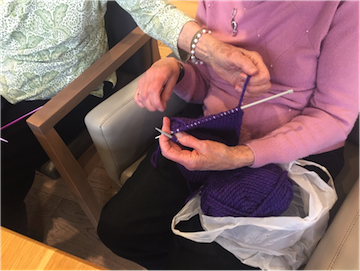
A scarf in progress at Legacy Senior Living (the Leo Wertman Residence)
A scarf in progress. (photo from Legacy Senior Living)

The idea for the project came almost a year ago. It was organized in January, and jumpstarted by a $200 grant from the Vancouver Foundation to fund the purchase of wool. Between 10 and 20 residents regularly participated; some teaching others how to knit, others brushing up on their knitting skills. They worked together while socializing, coming together weekly for a knit-and-chat session.

“When my mother lived at Legacy, I used to knit with her for therapeutic purposes,” said Annette Wertman, who organized the effort. “Then, I thought, maybe knitting would be a good activity for the residents of Legacy Senior Living. We had a meeting of those interested – and the idea took off! We applied for a grant and were so pleased to receive one from the Vancouver Foundation. While the COVID lockdown altered the way we gathered to knit together, we followed the health protocols and still managed to knit 98 scarves! And it’s perfect that we finished this in October, a more appropriate time to donate these scarves.”

photo - The delivery of scarves, just in time for winter, to New Beginnings
The delivery of scarves, just in time for winter, to New Beginnings. (photo from Legacy Senior Living)

Not only was it a more appropriate time weather-wise, but the donation took place around Thanksgiving. The Legacy knitters were grateful to be able to make “a small but warm contribution to the community.”

“Our residence, built in memory of Leo Wertman, is a vision of inclusion, diversity and philanthropy within the Jewish community, and of our broader local community,” said Wertman, a cousin of the residence’s namesake. “We all felt very good about our project and have already begun the next project – toques and blankets!”

Louis Brier and the pandemic

The garden in the courtyard of the Louis Brier. (photo by David J. Litvak)

It hasn’t been easy for any of the staff and companions working at Dr. Irving and Phyliss Snider Campus for Jewish Seniors – which comprises the Louis Brier Home and Hospital and the Weinberg Residence – during the pandemic. Nor has it been easy for the residents and their families. However, seeing a 100-year-old Holocaust survivor happily walking down the hall or a beaming bubbe (who was born in Lithuania) wheeling herself from one end of the facility to the other, or another resident greeting everyone with a hearty “Aye Yai Yai,” I can’t help but smile. Despite the challenges, we have been lucky here, so far, to have escaped the worst of COVID-19.

My pandemic journey at the Louis Brier began in January, when I was hired on a permanent, part-time basis as a mashgiach (kosher supervisor) during an influenza outbreak that foreshadowed what lay ahead. I was hired to replace one of the Brier’s longtime mashgiachs – the facility employs two on a part-time basis – and I had big shoes to fill. The previous mashgiach not only provided kosher supervision in the kitchens but entertained residents with his piano playing, puppet shows and conducting of services in the Louis Brier synagogue on Saturday mornings and weekdays.

Being employed as a mashgiach at the Louis Brier during the pandemic has had many challenging moments – slicing meat and deboning turkey were particularly painful for me because I am a vegetarian, but, luckily, I am no longer required to perform those tasks. Anyways, prior to the pandemic, Shabbat services would be held on Saturday mornings, with a Kiddush lunch afterwards that featured herring, gefilte fish, pastries, challah and grape juice. It was a real highlight for the residents, particularly the lunch. However, due to the pandemic, the weekly services and special meal were canceled. In addition, the monthly Shabbat services that were led by Cantor Yaacov Orzech and the Kol Simcha Choir were canceled, as were Friday night services. It is only recently that Louis Brier chaplin Chazzan Rob Menes has resumed the Friday night services and, in response to a personal request from one of the residents, informal Saturday morning services have also returned.

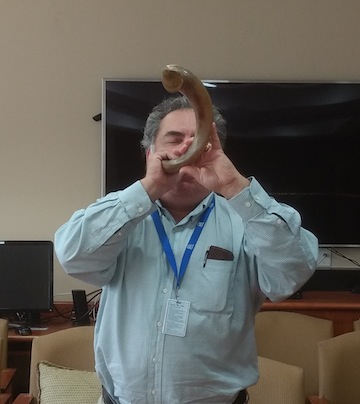
photo - Chazzan Rob Menes sounding the shofar at the Weinberg Residence
Chazzan Rob Menes sounding the shofar at the Weinberg Residence. (photo by David J. Litvak)

On Rosh Hashanah, a full service for the residents was offered, thanks to Richard Wood and Adam Ben Dov, members of the Louis Brier’s religious committee, and Rabbi David Rosenfeld of Chabad, who sounded the shofar for the residents. Menes has been blowing the shofar every morning at the Louis Brier, as well as at the Weinberg Residence, on occasion. While no family members were able to join the services, Rosh Hashanah was celebrated, albeit in a low-key manner.

Other holidays that have occurred since the pandemic have also been observed quietly. Passover at both the Brier and Weinberg was particularly stressful, as kosher-for-Passover products that would normally be available could not be ordered. The facility’s food services manager valiantly persevered to make sure people were provided kosher food during the holiday, however, and the other mashgiach and I – with the help of Rabbi Mendy Feigelstock and Schneur Feigelstock of Kosher Check – worked to keep the home kosher and chametz free. It wasn’t easy. It was a subdued Passover in another way, because the seders at the Weinberg were canceled to ensure that the residents were kept safe from the virus.

That has been the underlying principle since the pandemic began – keeping residents safe. From the outset in March, the Louis Brier’s chief executive officer, David Keselman, has shown foresight. For example, he canceled the annual Purim Megillah reading and Purim parties, which would have taken place just as the coronavirus was taking off.

In addition, from the outset of the outbreak, companions and other employees at the Louis Brier have been prohibited from working at more than one job. These decisions and the dedication of the staff and administration ensured the safety of the residents. Not one resident of the Louis Brier or the Weinberg Residence has contracted the virus.

To show his appreciation of the job that has been done at the Louis Brier, one resident, a fellow North End Winnipegger, nominated the administration for the Order of British Columbia, the Order of Canada and the Nobel Peace Prize. The resident, who started the badminton club at the home and maintains a tulip garden in its courtyard – the only outdoor space residents have been able to go for fresh air during the pandemic – marveled at how lucky he and other residents are. In the Daily Blah, a newsletter he published, he noted: “The Louis Brier does not have the virus, has a beautiful garden and we can play badminton.”

While it is true that the residents have been physically safe and have not contracted the virus, the pandemic has taken a psychological toll on everyone in the building. Until recently, due to provincial prohibitions, residents were not allowed outside visitors, other than seeing loved ones through the glass of the front lobby, and talking to them on their cellphones. Now, residents are allowed to have scheduled visits with loved ones outside the front entrance of the Louis Brier and outside the Weinberg, as well. It is a small victory that will hopefully boost the morale of the residents.

As for me, I just keep thinking of 100-year-old Louis Brier resident who tells me that, as long as he can eat, talk and walk, it’s a good day! The resilience of residents like him reminds me to always be grateful for the basic things in life.

David J. Litvak is a prairie refugee from the North End of Winnipeg who is a freelance writer, former Voice of Peace and Co-op Radio broadcaster and an “accidental publicist.” His articles have been published in the Forward, Globe and Mail and Seattle Post-Intelligencer. His website is cascadiapublicity.com.

JSA adapts to the times

The Jewish Seniors Alliance of Greater Vancouver held its annual general meeting on Sept. 10 via Zoom. Because of the pandemic, we were unable to have our usual format – the AGM followed by a gala dinner and the honouring of three volunteers, nominated by the seniors organizations with whom they work. In spite of these obstacles, we succeeded in holding a meeting that dealt with our ongoing activities and resolutions for our future. More than 50 supporters attended online.

JSA’s co-president, Gyda Chud, focused her remarks on the hard work of the peer support program volunteers, who have been putting in extra time, contacting their clients by phone several times a week. She thanked Grace Hann and Charles Leibovitch for their support of the volunteers during these demanding times. And she also thanked the rest of the JSA staff: Liz Azeroual, executive administrator; Rita Propp, administrative assistant; Jenn Propp, graphic designer and webmaster; and Wendy Lo, bookkeeper. She mentioned two new staff members – Margot Beauchamp, quality assurance liaison, and Rochelle Garfinkel, donor relations and philanthropy – and asked for a minute of silence to remember the members and supporters who had passed away over the last year.

JSA co-president Larry Shapiro explained how the formal part of the meeting would be conducted, with the use of the chat line and voting via on-screen polling. The minutes from JSA’s 2019 AGM were approved as well as the agenda for the 2020 meeting.

JSA’s financial statements were presented by treasurer Alan Marchant, then Shapiro gave a short president’s report. In it, he commented on the harmony of working with Chud, and also with the board members of JSA. He emphasized the importance of the peer support program and its work with lonely and isolated seniors. He expressed the hope that JSA’s finances would enable us to continue training and supporting the volunteers, and he urged everyone to stay in touch and to read Senior Line magazine.

Tony DuMoulin, who is in charge of governance issues, presented a special resolution for a change to the constitution. This involved removing the word “Jewish” in the section saying that JSA works with Jewish seniors, since it interacts with all seniors. He emphasized that the name of the organization, Jewish Seniors Alliance, would remain the same, and, after some discussion, the resolution was approved with 82% support.

Next, DuMoulin proposed a special resolution to change a number of the bylaws – that all donors automatically become members; meetings may be held electronically; officers would be elected by the board not by the members; and an extended term for members. These changes were approved by 88%.

Shapiro thanked DuMoulin for all his work on the bylaws, while Ken Levitt, head of the nominations committee, thanked Larry Meyer and Pam Ottem, who are retiring from the board, for their years of work on behalf of JSA. He moved that the number of directors on the board be changed from 20 to 21 and this was passed by 97%. He read out the nominations for the upcoming board and these were passed by acclamation.

Various committee chairs reported next, and these reports are available on the JSA website. The highlights include the following:

Peer support services chair Rita Roling, who is taking over from Ottem, noted that they are presently handling 100 cases and would like to increase the service.

Lyle Pullan, membership, stated that JSA has 517 members and 102 life members. He believes that many of the new members came as a result of reading Senior Line. He said new members should be listed in the magazine as an incentive.

Serge Haber reported on fundraising, including the fact that JSA has a contract with Vancouver Coastal Health for $70,000 annually to stabilize the organization. And I reported for the program committee, which is planning a fall forum for November and an Empowerment Series event in October, to be held via Zoom.

Senior Line editor Dolores Luber thanked Jenn Propp for her graphic design and collaboration, as well as the members of the editorial committee. The July issue of the magazine was different, as there had been no public events and nothing to review, but it was full and informative.

DuMoulin spoke on behalf of the advocacy committee, which has established collaboration with COSCO and anti-poverty groups. They have approached the provincial government about making the enhanced flu shot free for seniors. They want the government to make improvements in long-term care homes, increase pensions and the number of free Lifeline pendants available for low-income seniors.

After a short video showing the work of the peer support program, Haber thanked an anonymous donor, who has been giving $25,000 annually for the past five years, for helping JSA in its mission of outreach, advocacy and peer support for seniors.

Shapiro adjourned the meeting.

Shanie Levin is an executive board member of Jewish Seniors Alliance and on the editorial board of Senior Line magazine.
Best years ahead: Shanken

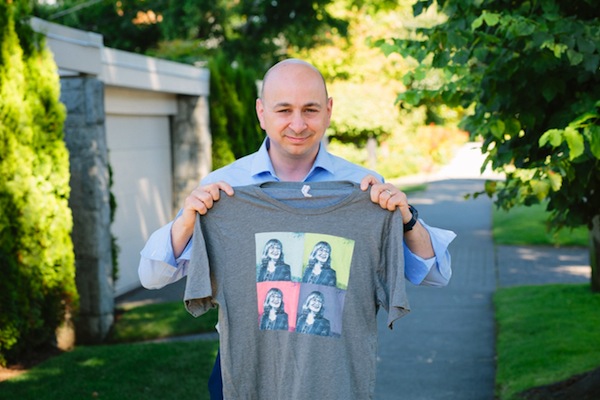
Jewish Federation of Greater Vancouver chief executive officer Ezra Shanken holding a T-shirt featuring Dr. Patricia Daly, vice-president of public health and chief medical health officer for Vancouver Coastal Health. The Facebook post thanks Daly for always being there, throughout COVID-19, “behind the scenes providing valuable support.” (photo from facebook.com/jewishvancouver)

The largest capital project in the history of British Columbia’s Jewish community – the redevelopment of the Jewish Community Centre of Greater Vancouver site – is going ahead as planned, despite the pandemic. This and many other projects are continuing as planned, says Jewish Federation of Greater Vancouver chief executive officer Ezra Shanken, in part because the agency has been preparing for a crisis for more than a decade.

As the Jewish Federation is set to launch the 2020-21 annual campaign, the Independent spoke with Shanken about the achievements and challenges of a year that started out relatively normally and veered suddenly into the utterly extraordinary.

While the COVID-19 crisis wreaked havoc on communities worldwide, and upended 2020 in unpredictable ways, Shanken said that Federation has been prepared for a crisis and that means the community remains in a position of economic and social health. After the 2008 economic recession, the organization launched a multi-year planning and allocations process intended to smooth economic ripples and equip partner agencies with reliable income expectations.

Federation raised $10.3 million this year – $8.9 million through the 2019 annual campaign and $1.4 million in special targeted funds from donors toward specific high-priority community needs such as supplemental education, to expand Jewish Family Services’ food hubs and to increase outreach to suburban and remote Jewish communities. Dr. Jonathon Leipsic was campaign chair. Alex Cristall, Federation board chair, and Shanken, provided a comprehensive overview of the year’s achievements in the 2019-20 annual report, available online at jewishvancouver.com.

When the pandemic struck, Federation launched an emergency campaign to help agencies meet the challenge of providing services to their constituencies while confronting the health crisis and its associated economic implications. The amount raised so far is not being announced, but $505,000 in funding has been released, for services like food and housing supports through JFS; to the JCCGV to help with service delivery; to supplemental and day schools to assist with tuition subsidies and transitions to online learning; for emotional support for seniors through the Jewish Seniors Alliance; and more.

A crisis like COVID, said Shanken, can have unintended consequences in helping communities overcome divisions and work together to reduce duplications of effort.

“Crisis often opens the door for opportunities for collaboration that never would have existed before for myriad political reasons,” he said. “People have far greater clarity around what the big picture looks like when they are in crisis. They are willing to forgo those smaller, often political complications that don’t allow for the advancement of big-ticket projects.”

Programs and projects that were underway before COVID include a Jewish Day School Council, chaired by Hodie Kahn, which began a year ago to undertake a benchmark study on the costs of education for each of the five schools in Metro Vancouver’s Jewish community. The findings of the report are expected to point the direction toward new funding models for Jewish education.

Community security also remains top of mind. This year saw the largest number of community organizations receive federal funding for security upgrades to facilities – Federation’s community security advisory committee, chaired by Bernard Pinsky, helped secure more than $225,000 from the federal Security Infrastructure Program. Security training sessions were provided to 160 community members.

A significant portion of campaign funds support programs abroad, including in Israel, especially in Vancouver’s partnership region, the Upper Galilee Panhandle. A connection with Jews in far-eastern Russia is also enjoying support from Vancouver’s campaign.

The challenges presented by the pandemic brought out the best in the community, Shanken said.

“It’s unprecedented in its negativity and it’s unprecedented in its positivity,” he said. “It’s unprecedented in the way that we are seeing need but it’s also unprecedented in the way that we are seeing cooperation to address that need. It’s really been a beautiful thing to see the community come together, agencies across the spectrum working together to ensure that we really have a great community as we come out of this.”

He recalls a phone call he received at the height of the lockdown.

“Somebody called me up one time when we were knee-deep in this thing and said to me, you know, Ezra, if you want to go through a crisis, go through it with the Jewish community, because we do it better than anybody,” he said. “I actually think that there is some truth to that. We really are very, very good at coming together at these critical moments. You see that materializing in the way that our agencies are working together, the way our donors are working together, the way our volunteers are coming now to serve, people are delivering food packages, over 1,300 people are being fed a week, that’s being done on the backs of volunteers and amazing professionals, multiple agencies working in conjunction with each other to make that happen. And that’s only possible because people’s best selves are emerging during this moment.… What strikes me is we really, really do, as a Jewish community, show our best selves in times of crisis.”

Shanken credits Eldad Goldfarb, executive director of the Jewish Community Centre of Greater Vancouver, for forging ahead with plans for the redevelopment of the site.

“I think people are still very passionate about seeing this project move forward,” said Shanken. “We are committed to continue to walk down the road. I can’t tell you when we will get a shovel in the ground, but I will tell you we have not put this on hold.”

Though this has been a most unusual year, so far, Shanken is bullish on the Metro Vancouver Jewish community.

“I believe it in my soul that the best years for our community have yet to happen,” he said. “We have had an amazing run over the past decade or more. Our community is incredibly strong, well positioned to emerge from COVID better than it’s ever been. But, for us to emerge in that way, it requires a commitment from our community to seize on the moment and bring us to that place that I know we can get to. The call that I would have for people is to join up, because we have an unprecedented opportunity to do truly great things for this community and to make us even stronger than we’ve ever been.”

Katz makes difference

University of British Columbia student Ava Katz has been helping people with errands since the pandemic began. (photo by Paul Joseph/UBC)

First-year kinesiology student Ava Katz commutes to the University of British Columbia from Kerrisdale, where her housemates include her 91-year-old grandmother and a mother with a heart condition. In these extraordinary times, Katz doesn’t want her loved ones risking their health with unnecessary trips to the grocery store. So, in March, she began making those trips herself. As she was transporting groceries home from Save-On Foods, something occurred to her.

“It dawned on me that there are people in the community who don’t have family, who don’t have anyone else to go out for them,” said Katz.

Her final exams were just a couple of weeks away. It’s the time of year when most students’ instincts are telling them to clear their schedules of any distractions. Katz’s instincts were telling her to do something else.

She posted a public note on Facebook: “In wake of the spreading pandemic, I would like to offer my services to anyone who is compromised during this time. If you or someone you know is in need of groceries, household items, etc., please contact me directly and we can arrange for me to complete your needed errands free of charge.”

She indicated where she lived and her phone number, assuring people, “I will not enter your homes, only drop items off at the door. Priority goes to elders and individuals with compromised health. Please do not contact me to run errands for you if you are able and in good health.”

She asked readers to share the post. The calls came quickly. Just a couple at first, but more and more as her friends returned from school in the United States and overseas. They all had to self-isolate for 14 days, so they couldn’t do anything for their own grandparents who were shut in. Katz stepped in.

“That was just kind of a no-brainer for me,” she said. “I was happy to do those things, and still am.”

Katz has been shuttling to and from supermarkets and pharmacies all over Vancouver. Each outing brings her into the orbit of people who potentially carry the virus. Katz has heard the stories about the toll COVID-19 takes on its victims. She wears a mask and takes great care not to bring the virus to the people she’s helping.

She still makes the trips for her mom and grandmother, walks her two dogs, and also delivers food between two seniors homes twice a week as a volunteer for Congregation Beth Israel. It’s a lot to do, but, as far as Katz is concerned, it’s the least she can do.

“It definitely scares me that I could be exposing myself, but people need help,” she said. “I’d rather sacrifice myself than have a senior go into a grocery store and contract the virus instead.”

Many of the volunteers who were delivering food between the two seniors homes when COVID-19 arrived were older folks themselves. It was too risky for them to continue, so the congregation put out a call for new volunteers. Katz was among the first to step up, despite her busy exam schedule.

“Crisis brings out the best and the worst in people, and I think Ava is one of those examples of it bringing out the best,” said Krystine McInnes, volunteer coordinator for the synagogue. “The idea of selfless service and loving our neighbours as ourselves – she really embodies that.”

Helping people is in Katz’s blood. Her grandfather was a doctor for more than 60 years. She came to UBC thinking she would go into medicine eventually, too. Nothing during her first year has changed that. In fact, the COVID-19 outbreak has given her even more respect for the healthcare and support workers who keep our hospitals functioning every day.

“They are real heroes,” said Katz. “I have a huge respect for what it takes to provide care to so many people at a time like this and it reinforces my commitment to be a part of it.”

Campaign wraps up

“We’re making our final push toward another record-breaking campaign,” Jonathon Leipsic, chair of Jewish Federation of Greater Vancouver’s annual campaign, said when the Independent caught up with him last month, as the 2019 fundraising drive was entering the home stretch.

The campaign’s goals for the year are “to continue to grow to meet the ongoing needs around security, education, affordability and beyond.” The distinguishing message of the 2019 campaign, when it kicked off on Sept. 1, was to amplify the impact of donors’ giving and to “create a ripple effect.”

That amplification can be seen on several fronts, such as affordable housing, the most pressing concern of Lower Mainland residents. In 2007, long before real estate prices reached the levels of the late 2010s, Jewish Federation helped establish the Tikva Housing Society. Tikva serves all those who have been impacted by the high costs of rent – families, young individuals and seniors. The society now manages 98 affordable housing units, 37 of which came about in late September through a joint project with the YWCA – awarded by the City of Vancouver – for rentals at the new Arbutus Centre at 4188 Yew St.

Jewish Federation’s work encompasses all phases of a person’s life by providing community planning expertise, developing partnerships and raising funding for critical programs and services throughout the region. These are delivered through its many partner agencies, including programs that support seniors, Jewish education, arts and culture, and services for youth and young adults.

By 2031, it is predicted that the number of Jewish seniors in Greater Vancouver will double to 6,200. With this comes the challenge of helping them keep living independently and stay engaged within the Jewish community. As part of its strategic planning process, Jewish Federation co-hosted the second annual Changing Landscapes Forum on Nov. 26, which focused on three areas to address the high-priority needs of elderly community members: aging in place, caregiver support and social connection.

As for Jewish education and educational programs, Jewish Federation currently partners with Jewish day schools, summer camps and supplementary school programs across the region. As well, its vision reaches beyond the metropolitan area, to Israel. More than a decade ago, it identified at-risk youth in its partnership region of the Upper Galilee as a group in urgent need. It then invested in tech education, which has allowed other organizations to build on its success. The Israeli government recently selected an international consortium of venture capital groups to develop a food-tech centre in Kiryat Shmona, the Upper Galilee’s largest city. The centre will benefit residents of the region and position the area as a global hub of innovation.

Jewish Federation’s work also extends to eastern Russia, home to some of the most impoverished Jews in the world. Through its partnership with the Joint Distribution Committee, an international rescue and relief organization, Federation provides needed services to 27,000 Jewish children and their families and more than 165,000 elderly Jews. As the nearest federated community to these Jews, Federation’s efforts help bring humanitarian aid in the form of food packages, medicine, heating fuel and home-care visits, among other things.

For his part, Leipsic said, “I am always humbled by the generosity of our Jewish community and the incredible volunteerism exhibited by the army of volunteers and canvassers that give their time in support of Am Yisrael.

“It is a privilege and honour to serve,” he added, in explaining why he took on the role as campaign chair, on top of having a full schedule as a physician, radiologist and professor of radiology. “I try to live my life in accordance with the talmudic saying klal Yisrael arevim zeh bazeh – all of Israel is a guarantor for each other.”

Sam Margolis has written for the Globe and Mail, the National Post, UPI and MSNBC.