Spread of extremism

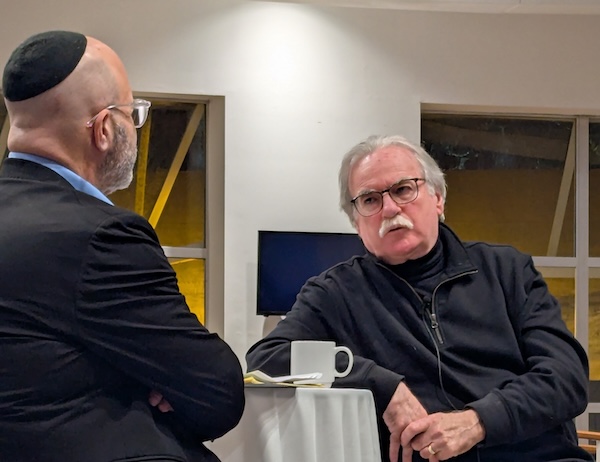
Terry Glavin, right, in conversation with Rabbi Dan Moskovitz Jan. 30, traces the evolution of anti-Israel extremism in Canada. (photo by Pat Johnson)

At times, the world seems to be going off the rails, with Canadian activists overtly cheering on terrorists and   celebrating the atrocities of Oct. 7. But Terry Glavin, a BC writer and thinker with a lifetime of experience on the ground as a journalist in the Middle East, thinks a reckoning is coming.

Speaking with Rabbi Dan Moskovitz at Temple Sholom Synagogue Jan. 30, Glavin, who says he comes from the political left, sees “a very, very disturbing and destructive phenomenon in all of the places where the left used to be.”

Part of that is a consequence of a change in global dynamics.

“Where there was once a fairly robust sort of proletariat internationalism on the left, there was something that was emerging by the ’60s and ’70s that was kind of a Third Worldist, anti-Western substitution for a genuinely progressive working-class internationalism,” he said. “That has had enormous implications in the trajectory of human history – very disturbing implications.”

The socialist or communist ideal never took hold in the West and that sent proponents seeking a spark that could catch fire.

“The working class simply didn’t take up the offer of overthrowing the state and seizing the means of production,” said Glavin, “so a lot of people on the European left went looking for a new proletariat and found it in Third World revolutionaries. Sometimes that was actually a legitimate thing to do. But, in the context of the so-called Arab world, what has often as not occurred is that bonds of solidarity would be forged with some of the most reactionary, anti-liberal, anti-progressive, theocratic, fascistic movements.”

Lacking a coherent political ideology, the movement coalesced around “anti-imperialism,” whose unifying principle was simply sharing the same enemies.

“All you have to basically do is say ‘I’m against the Americans, I’m anti-imperialist,’ and you’re in,” Glavin said.

The collapse of the Soviet Union was disorienting to the left, which then discovered the politics of anti-globalization. This created more strange bedfellows, Glavin said, because denouncing the International Monetary Fund and the World Economic Forum had once been the purview of the right.

Then, after the 9/11 terror attacks, anti-globalism took a backseat to what its adherents called an “antiwar” movement. Glavin takes exception to the term, because he said it was not an antiwar movement so much as a movement that sided with the West’s enemies in the wars in Iraq and Afghanistan.

“That’s a fairly serious charge to levy,” he said, “but organizationally and institutionally, that is actually a fact, in Canada particularly.”

A series of annual conferences in Cairo during the first decade of this century brought together global organizations including Canadian groups like Toronto Stop the War Coalition, the Canadian Peace Alliance, the Vancouver Coalition to Stop the War and others. In Cairo, they were joined by representatives of terror groups including Hezbollah, Hamas, Palestinian Islamic Jihad and the Popular Front for the Liberation of Palestine. These ostensible antiwar groups, and these decidedly violent groups, developed a program that opposed “imperialism.” And, vilified above every evil was the perceived imperialism of Zionism.

“At its very birthing, at its very centre, was anti-Zionism,” Glavin said.

While most of these Canadian activists probably self-identified as leftists, they had made common cause with the descendants of history’s most extreme right.

“We sort of imagine that there was this horrible phenomenon of Nazism that consumed millions and millions and millions of people in a world war and then we won and then it was over,” he said. “People forget that the same philosophy, the same ideology, the same antisemitic hatreds, were spreading throughout the so-called Arab world, throughout the Maghreb and the Levant, and Iran as well, in the 1920s and 1930s. It persisted.”

Glavin explained the direct line from the Nazi collaborationist Arab leaders of the 1940s and successive decades of forces in the region that translate and promulgate Mein Kampf and keep the flame of fascism alive.

Despite this seeming ideological incongruity, Canadian activists returning from Cairo found some receptive audiences for particularly Canadian reasons. Canada is a decentralized, multicultural constitutional monarchy, post-nationalistic and less driven by a cohesive patriotic impulse than some other states, according to Glavin. These fluidities caused Canadians to search for an identity.

“We needed to find a way to figure out our place in the world,” he said.

Canadians were very engaged with the creation of the United Nations, including its Declaration of Human Rights. “So, the United Nations and its protocols have always significantly informed Canadian foreign policy,” he said. “If you vest your foreign-policy principles in an institution that, without anybody noticing for some reason, became largely a function of the police-state bloc and the Organization for the Islamic Conference, you’re going to find yourself in a bit of a spot.”

This may have created fertile soil for the sorts of ideas that these activists brought back from Cairo, he said. It may also explain why “Israel Apartheid Week,” a global anti-Israel phenomenon, began at the University of Toronto and why an anti-Israel boycott movement began in Canada three years before the boycott, divestment and sanctions (BDS) movement was originated by Palestinians.

Meanwhile, as activists claimed to be advocating for peace in places like Afghanistan and Iraq, Glavin said they were instead often working at direct cross-purposes with those peoples’ self-defined interests. Such was the case, he argued, with those who opposed Canada’s engagement in Afghanistan.

“The Afghan left, the Afghan women’s movement, the Afghan student movement, Afghan intellectuals, poets, Afghan socialists, liberals, were all ‘troops in,’” he said. “All these white people in North America and Europe were all ‘troops out.’ Right away, that should tell you something. Something has been broken in the traditions of left-wing solidarity among and between working people around the world.”

Journalists Glavin knew in Afghanistan were baffled by Canadian activists.

“They would see another protest in Toronto,” he said, and they would ask: “Why would they do that to us?”

The left has to be held to account, Glavin said, naming the New Democratic Party specifically.

“Where the hell were you when this was happening? What were you saying when trade union leaders were meeting with Hezbollah, were meeting in Damascus with these blood-soaked tyrants? Where were you?” he asked. “The women of Afghanistan were begging – begging you – to stay with them, just hang on for a couple more years. [They were saying] ‘We’ve got an entire generation of young people coming up now, they’re graduating and they are going to be taking over, and you walk away from us? How could you do this?’”

All of these threads of ideological extremism came together with a particular fervour after Oct. 7, 2023, Glavin argued.

“Immediately, across this country, people were pouring into the streets celebrating the bloodiest pogrom since the time of the death camps,” he said. 

This was new, Glavin noted. A couple of decades earlier, at the height of the antiwar movement, activists were not overtly championing the terrorists.

“You didn’t have hundreds and hundreds of people in the streets saying, ‘We are Al Qaeda, we support Al Qaeda, yay Al Qaeda,’” he said. “You have that now – people who are openly, enthusiastically, deliriously, hysterically praising Hamas. That’s different. Something big has changed. Something very big has happened.”

This has affected Canadian Jews severely.

“On Oct. 8, Canadian Jews just didn’t wake up to find that the fabric of the country had been kind of torn by this, but rather that something had been woven into the very fabric of the country itself,” he said.

As things have deteriorated to the point where clusters of Canadians are literally celebrating the mass murder of Jews, Glavin sees a ray of hope. By showing their true colours, these activists have made it more difficult for aware Canadians to ignore the extremism that has consumed parts of our society, including the anti-Israel left. He foresees a reckoning.

“I am optimistic,” he said, “because I do think that most normal people, on any number of fronts, have simply had enough.” 

“We will dance again”

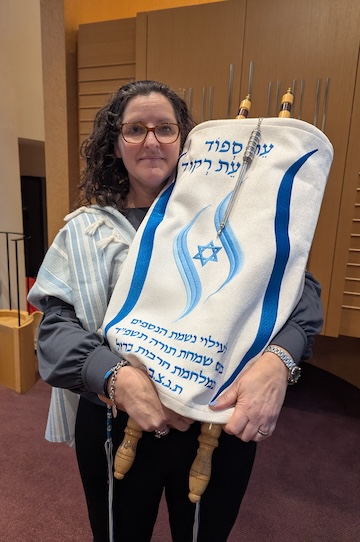
Rabbi Susan Tendler at Beth Tikvah’s aron hakodesh, where two Torahs feature covers memorializing heroes lost in the latest war. (photo by Pat Johnson)

On Simchat Torah, Jews worldwide celebrate the completion of the annual Torah reading and the beginning of another cycle. The day of rejoicing, which across centuries has been marked with often ecstatic festivities, is a time of dancing and spiritual uplift. How, though, do Jews celebrate this day after Oct. 7? The mass murders and litany of horrors perpetrated on Simchat Torah 5784 cast a pall over the occasion.

Rabbi Susan Tendler of Richmond’s Beth Tikvah Congregation expressed the emotional challenge of marking the festive holiday in the changed world.

“I can get through Oct. 7,” she said, “but how am I supposed to joyfully sing and dance on Simchat Torah?” 

Last summer, a friend was headed to Israel and told Tendler about the Simchat Torah Project. The friend was going to attend a ceremony at the Kotel, the Western Wall, with family members of individuals killed on Oct. 7 and in the ensuing war. At the ceremony, specially crafted Torah covers would be transferred to individuals from around the world, who would carry them back to their congregations.

Each cover has the name and date of death of the person it commemorates. So far, 635 Torah covers have found homes in 525 congregations in 287 cities in 31 countries. Two of those are in Beth Tikvah’s ark. Another is at Congregation Schara Tzedeck in Vancouver.

The project is inspired by ancient and modern words. King Solomon declared: “There is a time for everything under the heavens … a time to mourn, and a time to dance.” More recently, Israelis, in defiance of the enemy’s determination to break their national spirit and in emphatic solidarity with those murdered at the Nova music festival, declare, “We will dance again.”

For Tendler, the resonance was crystal clear. With most of the other congregational rabbis in Metro Vancouver, she was part of a trip to Israel in December 2023, which included an emotional visit to the Nova site, where 364 young people were murdered and crimes against humanity were perpetrated, including torture and rapes.

At the same time, in Tel Aviv, the exhibition commemorating the Nova festival pogrom was just opening and everywhere the rabbis saw the defiant declaration, “We will dance again.”

When Tendler heard about the Simchat Torah Project, it was the answer she had been seeking.

“I thought, that’s the pathway for me to be able to breathe and dance again on Simchat Torah,” she said. “On Simchat Torah, as we lifted up the sefer Torah, we would symbolically be lifting up those human beings and enabling them to dance again.” 

The rabbi’s family and another family, Mindy Zimmering and Allan Seltzer, purchased a Torah scroll in honour of the bat mitzvah of Daniella Sadoff, the daughter of Tendler and her husband Ross Sadoff. The Beth Tikvah community united to provide a home for a second cover.

photo - Rabbi Susan Tendler holds one of two Torahs featuring memorial covers from the Simchat Torah Project
Rabbi Susan Tendler holds one of two Torahs featuring memorial covers from the Simchat Torah Project. (photo by Pat Johnson)

One of the covers honours the life of Itamar Shemen, a 21-year-old medic in the Israel Defence Forces who fell in battle on Dec. 23, 2023. He was also a volunteer for Magen David Adom and was known to spend his days off volunteering to help the emergency responders. 

The other cover is dedicated to Ermias Mkurio, a 19-year-old known for his leadership and constant smile. He died a national hero on May 10, 2023.

The Torah covers note the date of death and not the date of birth because, as Tendler describes Jewish tradition, it is the totality of a life that is marked on a yahrzeit.

“We’ve done nothing when we come into this world,” she said. “But the day of our death is about the culmination of the life we’ve lived and our deeds and our legacy.”

The two Torah scrolls – blue lettering on white cloth – stand in Beth Tikvah’s aron hakodesh. 

On Simchat Torah, it was these two Torahs that the community lifted first and foremost.

“We wanted to make sure that these were the ones that were lifted the highest and that sense of connection, that sense that it’s up to us to ensure that these individuals are still rising and still connected and that their lives were not for want or that they are quickly forgotten but instead they are still impacting us and they are still dancing and they are still teaching us,” she said.

“The symbolism of having brought out the scrolls and people going and kissing them was incredibly emotional,” she said. “Watching people, knowing that these are very much in memory of people who have fallen for the state of Israel, recognizing what we are doing, and having these individuals symbolically pass around the congregation, and people finding holiness and treating them with holiness and respect, reaching out to kiss them, to interact, to engage with them, recognize them, and knowing that, no, they’re not here, but symbolically they are with us, and we are grateful and we are moved and we are humbled by your service, by the sacrifice of your life, that you’re still here with us and we are going to continue to keep your memory alive, brought many of us to tears.” 

Some miracles from tragedy

Dr. Gil Troy spoke of being inspired by Ben Mizrachi and other young Jews, who he described as Zionist lions. (screenshot)

Vancouver’s Ben Mizrachi died a hero saving others at the Nova music festival on Oct. 7, 2023. On that terrible day, and since, a new generation of Zionist lions has emerged, exemplifying the heroism that Mizrachi and so many others epitomized.

This, according to the American-Canadian-Israeli academic and author Dr. Gil Troy, is one of many miracles that have risen from the tragedy.

Troy, an American presidential historian and McGill University professor who lives in Jerusalem, knew Mizrachi well. One of Troy’s sons participated in an Israeli program with the Vancouverite. 

“They became close, close friends,” said Troy. “He was one of those kids who walked into the door and straight into your heart. He was really part of our family.”

On Oct. 7, Mizrachi, who was a trained medic, and his friend Itai Bausi, went back into the festival site and saved the lives of others before being murdered themselves.

“What I learned from his heroism was, yes, the Israeli government failed that day,” Troy said. “Yes, the IDF failed that day. But Zionism was vindicated that day. Zionism raised a generation of lions. Zionism raised a generation of Bens and Itais, who fought back, and that was the real miracle of Oct. 7. What saved Israel was Israelis. What saved Israel was Zionism, which taught them to defend themselves, which taught us the value of defending ourselves, which taught us the language of defending ourselves, which sometimes is with words and sometimes is with arms and sometimes with our bare hands.”

Troy was speaking Feb. 2 at Schara Tzedeck Synagogue. As a professor used to daily interactions with North American college students, Troy has witnessed Jewish young people undergo an awakening on and after Oct. 7. People who had never been deeply invested either in Israel or in their own Jewish identity realized they were the object of the terrorists’ wrath.

“This is happening to me. I’m being targeted. This wasn’t just anti-Zionism. This was antisemitic anti-Zionism,” Troy said of how he characterizes the realization among Jewish students. “So many young Jews had an awakening, had their Herzl moment, had their ’67 moment, had their reawakening.”

Rather than hide from their Zionism, Troy said, Jewish young people are recognizing its centrality and resisting others’ attempts to separate their Jewishness from their Zionism. 

“At Columbia University, 600 Jewish students signed a statement saying Zionism is central to our identity,” said Troy. “Zionism is who we are.”

The signatories called out those who would define for Jews the acceptable parameters of their Jewishness and Zionism – and they called out anti-Zionist Jews in language deliberately formulated to stick it to their ideological heart, accusing them of being “colonized” by antisemitic forces.

“We’ve seen, from coast to coast in Canada … Jewish students stand up and say, this shall not stand. This is not acceptable,” Troy said. “We’re watching new chapters in Zionist history being written. And we’re seeing it in Israel too.”

This is not easy, he acknowledged. The challenges are enormous. Jews on campus and elsewhere are being betrayed by the very groups who should be counted on as allies, he said. 

“Too many of my women colleagues – not all, but too many feminists either decided that it didn’t happen or that we deserved it, or that rape is resistance,” said Troy. “I can’t make this stuff up. They showed at that moment that their hatred for Israel trumped, if I can use that verb, their commitment to fighting gendered violence. That’s how deep the hatred goes.”

Troy calls this the “triple double-cross.” Activists threw Jews under the bus, threw liberalism under the bus and threw their own core ideals under the bus, he said.

The fight of which Jewish students are at the vanguard is not just a fight for Jewish security, Troy contended. 

“Who waves the American and Canadian flags at rallies and who burns them?” he asked. “Who disrupted shopping malls and the Toronto mayor’s ice-skating party? Who showed a hatred for Canada, again and again and again? The fight against this academic intifada is not just a fight for Israel and Zionism and Judaism, which should be enough, but it’s also a fight for Americanism and Canadianism and liberalism and for academic values.” 

In the face of all the hatred seen in Canadian streets and on campuses in the past year-and-a-half, he said, it could be easy to spin into despair.

“But, you know who doesn’t allow me to despair? Our students,” Troy said. “We’ve seen such heroism. We’ve seen zeal on their part, a gleam in their eye, pride.”

The inspiring courage of young Canadian Jews is mirrored in a million ways, he said. Reserve soldiers living abroad or traveling around the world came to the rescue after Oct. 7.

“Two hundred thousand Israelis flew home,” he said. Many non-Israeli volunteers mobilized as well. “So many of you, since Oct. 7, instead of running away, came toward us – either physically or spiritually and financially, which was part of the language of love.

“There has been something mystical happening here,” he continued. “For all that high price we paid, Israel is now safer than it was Oct. 6 and the United States and Canada and the world is safer than it was on Oct. 6.”

Amid all the darkness, including the tragic loss of his son’s friend, Troy sees inspiring resilience and determination. 

“Every moment since that funeral I’ve had Ben on my shoulder, inspiring me and inspiring us to fight like lions and to save the state but also to make it better,” said Troy. “Because Zionism is about defending the state when necessary but building, rebuilding and being rebuilt by it always. That’s the power of the story. That’s our good fortune amid all our grief.” 

מדינה במשבר

אירוע השבעה באוקטובר הנורא גרם לטראומה קשה מאוד אצל ישראלים רבים. ישראל מעולם לא חוותה אירוע כל כך קשה שגרם נזק נפשי גדול לתושבי המדינה שנמצאת במשבר שהולך ומתעצם

חלק מהישראלים מנסה לחזור לשגרת היום יום ויש אחרים המתסכלים החוצה אל מה שקורה בעולם. יש שרוצים לעזוב את ישראל ועל פי נתונים רשמיים כבר למעלה משמונים אלף עבור לגור בחו”ל. בפועל המספר צפוי להיות גדול יותר. אחרים רוצים לתפוס קצת מנוחה בחו”ל למספר ימים וכידוע נסיעה לחו”ל היא אחד התחביבים הידועים של הישראלים. המשבר הנוכחי יצר אף תופעה חדשה של ישראלים המלכלכים על העולם שלא עצר מלכת, או שמחפשים נקודות תורפה במדינות שנות – כדי לטעון שהחיים ישראל טובים יותר. ישראלים אלו שותפים לרגשי התעמולה הלאומנית שתפחו לאור השבעה באוקטובר. לא מפתיע כי בעת שראש ממשלת ישראל מפעיל מכונת רעל כנגד כל מי שמתנגד לו, יש אזרחים שמפעילים מכונת רעל כנגד כל דבר שהוא לא ישראלי בהן  מדינות בעולם. כידוע הנשק הטוב ביותר לפתור בעיות מבית הוא להתקיף את האחרים הזרים

לאחרונה מספר ישראלים שלחו לי לינקים על קנדה ונקודות התורפה שלה. כמו הומלסים, מהגרים, פשע ואנטישמיות. אכן האנטישמיות מרימה ראש במדינות רבות בעולם כולל קנדה וזו תופעה חמורה ביותר. אך לא פחות חמור הוא שישראלים ויהודים בעולם מתעלמים לחלוטין מהסיבה לאנטישמיות בגל הנוכחי. הם מציינים כי העלייה באנטישמיות הנוכחית החלה לאור השבעה באוקטובר. אך “שוכחים” את מעובדה לא פשוטה שעדיף להתעלם ממנה, במסגרת מסע הלאומניות השוטף את ישראל ויהודי העולם. והיא: שההרג של עשרות אלפים אזרחים חפים מפשע בעזה, הוא זה שהביא לאנטישמיות הקשה שאנו חווים כיום. אין שום הצדקה לאנטישמיות נגד עם שאיבד כמחציתו בשואה, אך עם שאיבד את מחציתו בשואה, לא יכול לאפשר הרג של אזרחים ברצועת עזה, כולל נשים וילדים רבים

על מנת להסביר עוד יותר עד כמה כיום הישראלים הם לאומניים אזכיר כיצד הם מתייחסים “ודואגים” לילדי עזה המסכנים שאף אחד לא יכול להאשימם במעשי השנאה הבלתי אנושית של החמאס ושאר ארגוני הטרור. סיפרתי לידידה ישראלית שגרה שנים בארה”ב על מופע של זמרת אמריקאית ידועה שהופיעה בחודש שעבר בוונקובר. אמרתי לשמאוד נהנינו בהופעה. ומה היא אמר בתגובה: אני שמחה שנהניתם בהופעה אך אני פחות שמחה שהוצאת כסף על כך, והזמרת תתרום חלק מההכנסות לילדי עזה. נדהמתי מהתגובה הזו והחלטתי שלא להגיב. זאת, למרות שכמעט עניתי לידידתי כי צה”ל ידאג לכך שעוד מעט לא ישארו ילדים חיים בעזה כך שאלה לא יזדקקו עוד לתרומות

מספר ישראלים שלחו לי דברי ביקורת קשים על ראש הממשלה “הנורא” של קנדה, ג’סטין טרודו, שגרם לנזק גדול למדינה. הופתעתי שפתאום הישראלים הפכו למומחים בנושאי קנדה. מכל מקום טרודו סוף סוף הודיע בימים האחרונים על התפטרותו וחבל שלא עשה זאת קודם. לגבי הישראלים: הם האחרונים שיכולים לבקר ראשי הממשלות של מדינות אחרות. ומדוע? כי במשך כשבעה עשרה שנה עומד בראש ממשלת ישראל, בנימין נתניהו הנוכל. הוא הרס כל חלקה טובה במדינה אותה הפך לבובת הסמרטוטים שלו. נתניהו הוא אחראי הראשי והראשון למחדלי השבעה באוקטובר ולרבים רבים מתחלואות מדינת ישראל בעשורים האחרונים. מי שלא הצליח להחליפו שלא יחפש ללכלך על מדינות אחרות בעולם ועל המנהיגים שלהן. הלאומניות הישראלית לא תוביל את הישראל להצלחה

Weekly vigils enter new year

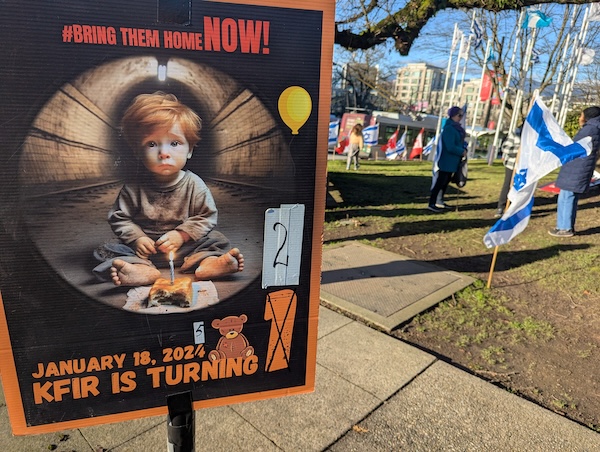
Kfir Bibas was abducted before his first birthday. His second birthday is this Saturday. (photo by Pat Johnson)

The Gregorian calendar has turned over a new year, but the vigils for the Israeli hostages continue without interruption.

Daphna Kedem, who has organized the weekly events since hours after the Oct. 7, 2023, terror attacks, acknowledged that it has been effectively an additional full-time job and that the commitment has taken a toll.

“But it’s also given me energy to continue, in a strange way,” she told the Independent in the moments before the vigil at Vancouver City Hall last Sunday. “I have to be here. I have to do it. I can’t be anywhere else.”

Inevitably, numbers have dwindled from the initial weeks, and some people have suggested to Kedem that she alter the events from weekly to monthly to get the numbers up. She’s not confident that would make a difference and, she added, that would send a negative message. To shift from the weekly routine would imply “that we are normalizing and accepting the situation of the hostages” and that is a message she will not accept, she said.

Ari Mansell is a core volunteer who is present for setup and teardown every week, as well as occasionally playing violin.

“I come here as the smallest thing I can do to help my community,” he said. “It’s a labour of love for me. It’s hard for me to stay away.”

His participation has made him feel more connected to his community.

“I’ve increased my community around me,” he said. “Moving here eight years ago [from Edmonton], I didn’t really know anyone here. This unfortunate event has brought us together and I’m so thankful for the people that I’ve got to know over this time – the musicians, Daphna, the organizers – it’s enriched my life. I don’t do it for me, but at the same time it’s helped me.”

Joanita Nakasi is one of many Christians who attend on a regular basis. She has always prayed for Israel, she said, and so, when Oct. 7 happened, she felt moved to stand with the local Jewish community. She urges others to accompany her.

“They should also come and join,” she said. “We stand together until all our brothers and sisters are back.”

Richard Lowy, who has performed music and sung at many of the vigils, lauded the community for coming together across ideological lines.

“The idea that you’re secular, you’re religious, you’re nonreligious, you’re right-wing, you’re left-wing, you’re for Trump, you’re for Biden, you’re Jewish – it doesn’t matter,” he said. “It doesn’t matter what you think. When the Nazis came, they came for the Jews regardless of your beliefs or where you stood.”

He recounted an experience he had during the process of writing a book about the Holocaust experiences of his father, Leo Lowy, a “Mengele twin.” The book will be released on Jan. 27, which is International Holocaust Remembrance Day.

“While I was working [on the book], I’m reliving the horror of Auschwitz and looking at the faces of the people that are in this concentration camp and the families and the people that were brutalized and I had to take a break because it’s just so horrific,” he said. “As I walk out to the front, where the bike lane is, there is a group of young kids riding their bicycles with their Palestinian flags yelling, ‘From the river to the sea’ right in front of my house. It’s just so devastating to see this.”

In the cold sunshine Sunday, Jonathon Leipsic asked to be described solely as “part of klal Yisrael.” 

Leipsic said he was asked to speak about antisemitism, but demurred.

“For me, antisemitism is a relatively irrelevant topic,” he told those gathered. “You may say have I lost my mind. What about this rising antisemitism?”

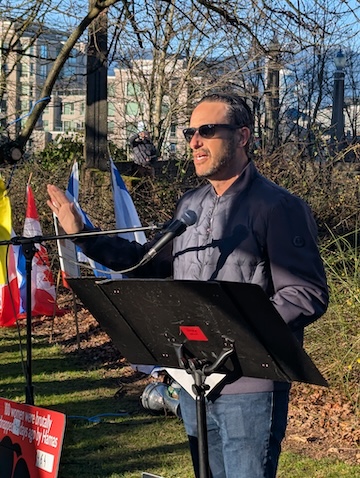
photo - Jonathon Leipsic, “part of klal Yisrael,” fears sinat chinam, baseless hatred, more than antisemitism
Jonathon Leipsic, “part of klal Yisrael,” fears sinat chinam, baseless hatred, more than antisemitism. (photo by Pat Johnson)

He said the Jewish community has done a good job teaching the next generations about antisemitism and the Shoah, to be good stewards of memory.

“We as a people undoubtedly will suffer, but we are eternal,” he said. “At the end of the day, we are eternal if we follow the words and the guidance provided to us.”

What worries him more, he said, is sinat chinam, baseless hatred.

“Baseless hatred among klal Yisrael and division and a lack of shalom bayit [peace in the home] within our people – this is, by far, and has always been, the only true threat to the eternity of am Yisrael. Our rabbis teach us that the First Temple was destroyed because of the most profound and abominable sins one could imagine that could be happening within a place of Hashem…. But yet, what brought down the Second Temple? Sinat chinam. Baseless hatred among klal Yisrael.”

He urged the audience to embrace the diversity of opinion within the community and “be less afraid of antisemitism and much more concerned about sinat chinam.”

Ohad Arazi moved to Canada from Israel in 2006 and has spent two decades bringing together Israeli and Canadian technology companies and people. As a son of a diplomat, he has spent more time living outside Israel than in it.

He reacted negatively when, prior to moving to Canada, his mother warned him that, as a Jew, “The only place you will ever feel truly safe is here in Israel.”

“I was so angry at her. I said, ‘I am a child of the world,’” Arazi recalled. “I am moving to one of the most liberal and pluralistic countries in the world. Please, Ima, don’t project your scarred Holocaust psyche on me.”

Then Oct. 7 happened.

“On that day, the world witnessed unspeakable atrocities as Hamas launched a brutal attack on Israel, resulting in the loss of innocent lives and the abduction of many,” he said. “But one more thing happened that day, which is that Canadians got their first glimpse of where our country could be headed. Shortly after the news of the scope of the atrocities began coming to light, revelers and anti-Israel protesters took to the streets in Canada.… Across governments, schools, unions and media, a toxic environment has emerged, fueling hostility against Canadian Jews.”

Israel’s war against Hamas, Hezbollah and the Houthis is proceeding successfully, he said. “But our war, as Jews in the diaspora, the war we are facing day in and day out, is a war of ideas, a war of words, ideology and truth,” said Arazi. “Our Canada should be the model for building a future where the values of humanity triumph over hatred and where every hostage is safely returned to their loved ones.”

Aliya Oran Dobres, a 15-year-old Grade 9 student at King David High School, shared her harrowing experiences of being pursued by a threatening group at a mall because of her Star of David necklace, as well as the threats her friends have experienced. In the days after Oct. 7, her fellow students covered their uniforms when in public, she said.

“We should not be scared for who we are,” she said. “As Jews, we must stick together and be strong.”

Ebube Anachebe is a fourth-year electrical engineering student at the University of Calgary, who is in Vancouver for an internship. She returned days ago from her second trip to Israel in the past year, with a Christian organization called Passages.

“The aim of the mission is to bring Christian students to the Holy Land to walk in the footsteps of Jesus,” she said. “However, since Oct. 7, they have been shifting their focus toward not just bringing students to the Holy Land, but also mobilizing Christian students to stand alongside their Jewish brothers and sisters against antisemitism.”

About 100 others joined Anachebe on the nine-day tour. 

“We experienced the Jewish roots of our faith, we experienced the love of our saviour, gifted to us by you guys, our Jewish brethren,” she said. “We encountered modern Israel and we bore witness to the realities of what happened on Oct. 7.”

She shared several memorable encounters with Israeli individuals, including Shahar, a resident of Kfar Aza.

“His beloved community was torn apart and ransacked by Hamas terrorists. When we asked him why he returned, he said, ‘Israel is my home, this kibbutz is my home, I have nowhere else that I would want to go.’

“The group’s tour guide, Danny, recounted how, on Oct. 7, when awakened by sirens at 6:30 am, his son asked him, ‘Daddy, why won’t the bad people let Israelis sleep?’

“He shared about the difficult moment when, a couple of hours later, he was called to the reserves and he had to tell his son, ‘I won’t be here for your birthday tomorrow,’” Anachebe said.

She said that, when Oct. 7 happened, “it awoke two different camps of people.”

“It awakened the antisemites, who had been slumbering,” she said. “But I tell you it also woke up leaders who didn’t even realize that they were leaders until they were called up for such a time as this, to stand up against this evil of antisemitism. This is what I witnessed when I went to Israel. I witnessed leaders who will rise up and pray for Israel, the hostages and the brokenhearted.”

Anachebe said, “We Christians see you, our Jewish brothers and sisters, as mishpachah, family. We are standing and we are standing alongside you. Am Yisrael chai.” 

Their wait to return home

Thomas Hand and the survivors of the massacre at Kibbutz Be’eri hope to return home in 2026. (photo by Gil Zohar)

Kibbutz Hatzerim, eight kilometres west of Be’er Sheva, best known for its drip-irrigation plant, also houses the newly established quarter here for the survivors of Hamas’s Oct. 7, 2023, massacre of more than 130 of Kibbutz Be’eri’s 1,071 residents. Emily Hand and her Dublin-born father Thomas, 64, are among the 200 refugees living there. In 2026, they hope to move back to rebuilt homes in their community alongside the Gaza Strip.

“We’re still in the stage of demolishing the houses beyond repair,” Hand said. A quarter of Be’eri’s housing is unsalvageable.

Some vegetation has been planted around the new temporary bungalows at Hatzerim, and the site is beginning to resemble a kibbutz neighbourhood. But little else is normal.

The Hands marked the anniversary of Emily’s release from imprisonment in the tunnels of Gaza on Nov. 26. A week earlier, the Irish-Israeli celebrated her 10th birthday. Thomas no longer allows his daughter to be interviewed by the media. The probing questions she faced raised horrific memories of captivity that she is still struggling to process, said her father. She has engaged in various therapies, including seeing a psychologist weekly, horse riding and puppy love with their pooch, Johnsey.

“She’s living day to day, enjoying every day,” her father said.

The Hands moved to their home at Hatzerim shortly before Rosh Hashanah and Emily started the new school year there. Before then, they had been sheltered at Kibbutz Ein Gedi’s hotel by the Dead Sea.

Like his daughter, Hand too is struggling. In the days after Oct. 7, he was initially informed his daughter had been murdered. After a month, that assessment was revised to missing. After more uncertainty, she was then declared a hostage – and finally released in a swap for Hamas gunmen and other terrorists.

The Hand household is still decorated with balloons from Emily’s recent birthday party. Among the guests were fellow hostages Noa Argamani, Ra’aya Rotem and Hila Rotem Shoshani, who surprised Emily with a cake and candles. Argamani, who was imprisoned with Hand, was rescued on June 8, after 245 days in captivity, in a joint operation by the Israel Defence Forces, Shabak (Israel’s security agency) and Israel Police.

Hand said Emily is adjusting “incredibly well.” But then he contextualized what that means: “She still sleeps with me. Usually in my bed.”

“She was captured from a MaMaD [safe room]. And that’s a trigger,” he said.

The constant roar of jets flying overhead to and from the nearby Hatzerim Air Base adds to their ill-ease. Hand’s conversation is punctuated by sighs and tears. “Don’t mind me,” he said. “It’s just part of the process.”

None of the kibbutz’s protected spaces had bulletproof doors, he noted. His own MaMaD wasn’t equipped with a lock, he added. “I just had to hope and pray.”

Other general tactical mistakes included storing the kibbutz’s guns and ammo in a central location rather than having them distributed among people’s homes. Half the members of Be’eri’s emergency response team were gunned down trying to reach the armoury, Hand said.

His first concern on Oct. 7 was for Emily, who was sleeping over at a friend’s house 300 metres away. With bullets flying, there was no chance to run there to attempt to rescue her, he recalled.

He left his shelter at 10 a.m. Armed with his pistol, two magazine clips and a bullet in the chamber, he positioned himself by his kitchen window, which offered a wide field of fire. The Hand family house was relatively untouched apart from shrapnel damage.

“While I couldn’t protect my daughter, I was able to protect three houses,” he said.

Hand remained at his post until 11:30 p.m., when IDF soldiers arrived.

“The amount of guilt that I felt at not going to save her [Emily] even at the risk of my own life…. But I knew I would be dead, and she would be an orphan. It was a very big thing afterwards. At the time, I was just in survival mode.”

With self-deprecating humour, Hand remembered he only had two cans of beer in the fridge that Saturday morning. It’s a mistake he has never repeated, he said, now always having a case of suds on hand.

Another cause of guilt is not being able to work. He had previously been employed at Be’eri’s printshop, and then as a painter at its toy and furniture factory. While the workshop has reopened, Hand is unable to commute the 90 minutes there, since he must stay close to his daughter. “I have to keep her normalized,” he said.

“They’ve given me a lot of leeway,” Hand said of the kibbutz secretariat.  In the meantime, he devotes a lot of time to hostage issues.

Looking wistful, he concluded: “I will not feel safe going back to Be’eri with this government in power, and without Hamas being completely crushed.” 

Gil Zohar is a writer and tour guide in Jerusalem.

אין סוף לאנטישמיות

לבעיית האנטישמיות כנגד יהודים וישראלים בעולם. אין ספק שמדינות המערב נכשלו בטיפול שורש בבעייה חמורה זו ואני חושש למראות קשים יותר בעתיד

גל האנטישמיות הנוכחי החל צובר תאוצה לאור הריגתם בעזה של עשרות ואלפי אזרחים בהם נשים וילדים רבים. יש מקום להעביר ביקורת על ישראל ולהפגין כנגדה בכל מקום בעולם. אך אסור בשום פנים ואופן לנקוט באלימות נגד תושבי ישראל והיהודים ברחבי העולם ולקרוא להשמדת המדינה. שנאה שכזו לא תביא לשום תוצאות חיוביות וכאמור על מדינות המערב להתחיל ולפעול בחריצות כנגדה

ישראלים רבים רואים את תמונת המצב בשני צבעים בלבד: שחור ולבן. מבינתם לאחר אירועי השבעה באוקטובר משנה שעברה עם ההתקפה הנוראית של הטרוריסטים מהחמאס וארגונים נוספים, מותר לישראל לעשות כרצונה – בדרך לחסל את הטרור בעזה, גם אם מדובר בהריגת עשרות אזרחים. אצל הישראלים – לאחר השבעה באוקטובר – אין שום מקום להעביר ביקורת על ישראל. וכל ביקורת היא אנטישמיות לשמה. הישראלים אומרים במפורש כי מה שלארה”ב ומדינות נוספות היה מותר לעשות באפגניסטן, עיראק, ויאטנם ומדינות נוספות, מותר גם לישראל לעשות. עמדה זו לא מקובלת עלי ואני טוען כי אין לישראל לגיטימציה לעשות את מה שמדינות אחרות עשו כיוון שמדובר בדברים חמורים מאוד. וכן אסור לשכוח לרגע שרצועת עזה נמצאת לפיתחה של ישראל והתוצאות האיומות של הרג אזרחים והריסת כשבעים אחוז מהבניינים לא יעלמו פתאום

לאור מחדלי ואירועי השבעה באוקטובר חלק מהישראלים מתקשים לעכל זאת, והפתרון נמצא בדת. אלוהים העניש את ישראל והנקמה (המוצדקת אגב) מתבצעת בשמו. בכך הם מורידים אחריות מהמדינה לגודל המחדלים שקדמו לשבעה באוקטובר, והופכים את החיים בישראל לקלים יותר

אני לא מזלזל באמונה של אלה שמאמינים באלוהים דעתי ידועה היא כי כל אחד יחיה באמונתו. אך אין מקום להכניס אמונות לנושאים אקטואליים ומעשיים כמו השבעה באוקטובר. האמונות מסוות למשל את חומרת המחדלים של ישראל בכל הרמות. האמונות כביכול נותנות מענה למצוקה הקשה והאישית עקב הדבר הנורא הזה שקרה לישראל אך אין בהם להביא לשום פתרון מעשי. אומר שוב: השבעה באוקטובר שהוא האירוע החמור ביותר לעם היהודי מאז ימי השואה, קרה בגלל שורת מחדלים קשה ביותר של ראש ממשלת ישראל, ממשלתו, הצבא וגורמי הביטחון. שום אמונה לא תשנה עובדה זו

יש לזכור שבישראל עצמה לאור שנים מתנהלת אנטישמיות נגד מתנגדי ראש הממשלה, בנימין נתניהו, וזה עובר יחסית בשתיקה. אין מספיק תגובות נגד הביביסטים שמתקיפים באלימות את משפחות החטופים. הביביסטים קוראים ליוצאי אירופה כמוני “אתם חזרו לאירופה כדי שהיטלר יחסל אתכם”. האם זו לא אנטישמיות שפלה ביותר? הגדילה לעשות שרת התחבורה, מירי רגב, שאמרה בצורה מבישה “הקפלניסטים הגיעו לבית של ביבי לסיים מה שחיזבאללה לא הצליח”. האם זו לא אנטישמיות

קודם כל צריך תסתכל טוב טוב במה שקורה בתוך ישראל לפני שמעבירים ביקורת על העולם. אני בטוח שיותר קל לדבר על זרים מאשר על חלק לא מבוטל ממדינת ישראל

לסיכום העניין יש לציין כי מצבה של ישראל והיהודים ברחבי העולם הוא מסובך ביותר. ישראל הפכה לאחת המדינות השנואות בעולם כיום והישראלים והיהודים בעולם נמצאים בסכנה מוחשית של אלימות ממשית. לאף אחד לא ברור עוד כמה זמן תימשך לחימת ישראל בעזה ורבים מתושבי המדינה היה רוצים כבר לראות את הסוף ושחררור החטופים שרובם כבר לא בחיים

הסכנה הגדולה של ישראל היא הפילוג הפנימי

ישראל נמצאת כיום במצב בטחוני מסובך ביותר כולל חזיתות רבות. הצבא ומערכת הביטחון נקראים כל העת לפעול לביטחונה של המדינה ובמקביל להכות באיומים מכל הכיוונים

למרות זאת הסכנה הגדולה ביותר שמאיימת על קיומה היא הפילוג הפנימי הגדול שלא ניתן לאחותו עוד. ישראל מחולקת כיום בברור לשני מחנותשמתנגדים אחד לשני: מחנה המרכז-ליברלים-שמאל ומולו מחנה הימין-דתיים-משיחיים

ראש הממשלה הנצחי של ישראל בנימין נתניהו, הוא הנושא באחריות העיקרי ליצירת שני מחנות ניצים אלה. אחדשמתנגד לו ואחד שתומך בו. במדיניות הפרד ומשול נתניהו שולט ביד רמה בישראל, שהפכה לבובת הסמרטוטים שלו

שוחחתי עם אשתו של חבר ותיק שגר בירושלים והיא אמרה לי מפורשות כי הפילוג הפנימי היא הסכנה הגדולה ביותר המאיימת על קיומה של מדינת ישראל. או במילותיה: מדינת יהודה מול מדינת ישראל. לדבריה היום רבים הולכים ונוטים ימינה אך במקביל ההתנגדות לנתניהו ושלטונו גם היא צוברת תאוצה

כבר זמן מה שאני שומע ישראלים שמתבטאים בצורה דומה ורואים איך המדינה שלהם מחולקת כבר לשני חלקים: מדינת יהודה ומדינת ישראל. ולרבים רבים ברור כי כבר לא ניתן לחבר בין שני המחנות והשינאה ביניהם הולכת ומתגברת. נתניהו מעצימה כדי שיוכל להמשיך ולשבת על כיסא המלך, למרות שהוא ראש הממשלה פחות ממלכתי שישראל ידעה מעולם

מספיק לראות את התנהגותם של תומכי נתניהו ממדינת יהודה שלא בוחלים בשום דרך להביע את עמדתם הניצית, ומנסים לפגוע בכל דרך במתנגדים שלהם. הם אלו שרוצים בהפיכה המשפטית כדי למלט את נתניהו הנוכל מגזרות בית המשפט נגדו, ולאפשר לו לשלוט עוד שנים רבות, תוך שהוא הופך את קופת המדינה לכיסו הפרטי

זה מביש לראות את ממשלת נתניהו המושחתת שממשיכה לנהל את ענייניה כאילו לא התרחש אסון השבעה באוקטובר, כאשר בכיריה לא לוקחים אחריות על המחדל הגדול, מתפטרים ונעלמים מעין הציבור. אחד האפסים הגדול ביותר באופוזיציה לנתניהו, גדעון סער, שטען כי אסור לראש הממשלה הזה להמשיך בתפקידו, חזר על ארבע לממשלתו. זה מביש איך זה שטען שהוא בעל ערכים העדיף את ערך הכיסא על ערך האופוזיציה לראש הממשלה הגרוע בתולדות ישראל. סער ודומיו רק ממשיכים לחזק ולתדלק את נתניהו, שממשיך לצחוק כל הדרך לבנק

מבישה ביותר התנהגות פעילי הרחוב של נתניהו שמתקיפים פיזית את משפחות החטופים, יורקים עליהם, מרביצים להם מכות, מנסים לדרוס אותם ועוד. במדינת ישראל של פעם היו ערכים בסיסיים והכל נתנו כבוד למשפחות של חטופים וחללים, ואף אחד לא ניסה לפגוע בהם ולטעון שהם אנשי שמאל אשכנזים שמתנגדים לנתניהו. לא ראינו שנתניהו יוצא להגנת המשפחות של החטופים ומבקר את פעיליו שפוגעים בהם. כל עוד זה משרת את מטרתו להמשיך ולשלוט אז הם יכולים להמשיך ולבזות את המדינה וערכיה

נתניהו ומשפחתו ממשיכה להפעיל את מכונת הרעל הכוללת תעמולה שקרית, כדי להמשיך ולחזק את עמידתה בראש המדינה. לא נראה שאכפת למשפחת המלוכה החולנית הזו כי המדינה – שהם אחראים עליה – הולכת ומתפרקת מנכסיה. הם לא מבינים כי המשבר החברתי-פוליטי הגדול הזה ועוד בזמן של מתיחות ביטחונית נוראית, עוזר להחלשת המדינה והנצחת הפילוג. לא פלא שישראלים רבים נוטשים את המדינה ורבים אחרים נערכים לעשות זאת בעתיד הנראה לעין

אני מציע לישראלים שחושבים שהם חווים רק באיום בטחוני מהשכנים, וכי השבעה באוקטובר הוא עונש מאלוהים להתעורר ולקלוט שהעונש הוא נתניהו

We have power, voice

On the International Day for the Elimination of Violence Against Women, Rolene Marks had a heartrending plea to the hundreds of people who attended a virtual event titled Stop the Violence.

“As our hostage plight fades from the minds of the world, we plead to you, be the voices of our hostages,” she said. “We know what our women and girls are enduring – they’ve been sexually violated and continue to be violated. The impact on their mental health is unfathomable. Don’t let your government or the world forget that there are 101 hostages and we need them home now. We are a devastated nation, deep in trauma. Unless we get them home, this will be a wound that will never, ever heal.”

Marks, a South African-Israeli consultant and journalist, was one of two panelists interviewed by Dana Levenson on Nov. 25 in a virtual event organized by CHW (Canadian Hadassah-WIZO), Na’amat Canada, Momentum Canada, Canadian Women Against Antisemitism and National Council of Jewish Women of Canada. She was joined by Jay Rosenzweig, a lawyer dedicated to advancing safety for women, in speaking out about violence and femicide.

Globally, in 2023, a woman was killed every 10 minutes. In 2022, 133 women or girls were killed daily by someone in their own family. And one in every three women experiences  physical or sexual violence in their lives. But statistics don’t resonate, Marks insisted. People remember stories, not numbers.

Both panelists said the silence from the United Nations and the media with respect to the sexual violence perpetrated by Hamas against women in Israel is – and continues to be – deplorable. Marks said that, in October 2024, when members of the foreign press visited the sites decimated by Hamas terrorists, she saw a complete lack of empathy. “It was like they were ticking something off their to-do list by being there. They’ve completely lost any impetus to report and tell the truth,” she said.

But it’s possible to “fell an elephant with a mosquito,” she continued, citing an African proverb. “We’re not powerless or voiceless. We need to become that mosquito, to demand that journalists employ the ethics of good journalism. We’ve got the law and ombudsmen there to adjudicate, and we need to make use of the tools available to us, remembering that every one of us has power.”

Rosenzweig said members of the Jewish community need to do more in leveraging technology to confront injustice.

“We can do better when it comes to communicating online, because technology and the digital world can be a neutralizer,” he said. “Dialoging outside of our community can also help turn the tide, so we should be reaching outside the Jewish community to find commonality with other communities, for example the Indigenous community. We can find common cause with them by speaking as one indigenous people to another.”

Marks suggested participants host screenings of the documentary Screams Before Silence. She encouraged younger members of the community to get involved by “adopting a hostage” or a victim of the Oct. 7, 2023, attacks and becoming familiar with their lives.

“By making those stories very personal, it is easier to share with others and to connect with peers from other communities,” she said. “Tell the stories of Naama Levy, Daniella Gilboa and the other girls being held hostage. They are stories of teenagers who went to dance for peace, and our teenagers can connect to these people. These stories help to humanize us as a people at a time when dehumanization is so pervasive.”

To watch the event, go to YouTube and search “Stop the Violence – A Collaborative Virtual Event.” 

Lauren Kramer, an award-winning writer and editor, lives in Richmond.

Celebrate, share light

Hanukkah is a holiday made joyous by its origins in the victory of the Jewish people over our oppressors and the liberation by the Maccabees of the Second Temple in Jerusalem. Now, thousands of years later, over eight nights, we light candles to honour our brave ancestors and to recognize the fortitude, across the millennia, of the Jewish people.  

The meaning of Hanukkah has acquired a new relevance: the bravery demonstrated by the people of Israel – especially since Oct. 7, 2023. 

It has been more than 15 months since, in the most shameful and grievous fashion imaginable, Hamas deliberately started a war, placing the people of Israel – and of Gaza and the entire region – in jeopardy. Israel continues to defend its residents and citizens from terror on multiple fronts, facing both assaults from Hamas and unprecedented attacks by hundreds of rockets from Iran-backed Hezbollah. Israelis and the global Jewish community continue to call for the release of 101 hostages who remain captive in Gaza. Families across Israel and the world continue to adjust to life without the 1,200 Israelis – and victims from 30 other nations – systematically murdered on Oct. 7. 

Yet, amid the chaos and terror of daily rocket attacks, the spirit and fortitude of the people of Israel remains as strong as ever. 

This year, as we light our candles over the eight nights of Hanukkah, we contemplate the history and symbolism of our Jewish traditions, and we have an opportunity to consider their meanings in our current reality. Just as we light our hanukkiyah with its eight, equally proportioned candles, we remember Jews have an admirable track record in fighting for social equality, and we consider where, today, there are inequalities to be addressed. 

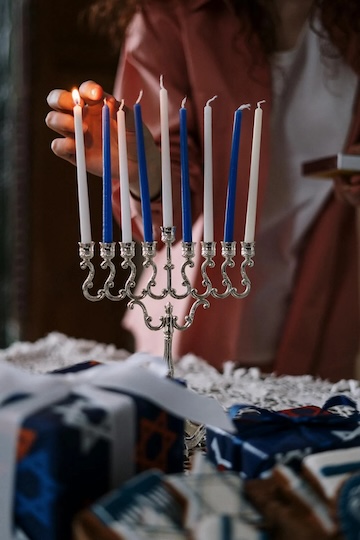
photo - This year, as we light our Hanukkah candles, we contemplate the history and symbolism of our Jewish traditions, and we have an opportunity to consider their meanings in our current reality
This year, as we light our Hanukkah candles, we contemplate the history and symbolism of our Jewish traditions, and we have an opportunity to consider their meanings in our current reality. (photo from pexels.com)

As we add candlelight to our homes, we remember our age-old obligation to bring light to our families, friends and neighbours. We encourage well-rounded education, free from hate, for all children; we advocate for a safe and welcoming learning environment for our post-secondary students and faculty; and we support the most vulnerable among us. 

There is much to do – what will your focus be over the coming year? To what cause will your efforts be directed? 

Can we hope that Gaza will be freed from the terrorist influence of Hamas? Will Lebanon emerge from under the sway of Iran-backed Hezbollah? Will Israel’s adversaries stop their war against the Jewish state?

Will our focus be on our own family, our close friends, our community, a charitable cause? Will we share the Jewish values we cherish, the triumph of light over darkness, freedom over oppression, and the importance of upholding one’s identity and beliefs?

And can we help our fellow Canadians uphold the values we hold dearest? How much light can we share this Hanukkah season? 

Let’s find out. 

Chag sameach. 

Judy Zelikovitz is vice-president, university and local partner services, the Centre for Israel and Jewish Affairs (CIJA).