My family recently traveled to northern
Virginia for a bar mitzvah. We did it in a long weekend. We left Thursday
afternoon and returned on Tuesday. It was the farthest we’ve ever gone in a
weekend with kids. Afterward, I felt bleary and fuzzy around the edges.
However, wandering through three airports in each direction and attending five
or six big family events and meals exposes you to things you might not have
noticed before.
My nephew became a bar mitzvah at my childhood
congregation. Each weekend, they print a bulletin or program with information
about services and upcoming activities. When services ended, my husband tucked
his program into his tallis bag as a memento. I also took one for safekeeping,
but I saw it as primary source material. Proof that, indeed, all these
activities could happen at a healthy congregation.
Awhile back, I wrote a column describing a
slate of weekend Jewish events, for every age group, at North American
congregations. As one template, I used Temple Rodef Shalom, in Falls Church,
Va. I’ll never forget some of the feedback I got. The loudest responses were
from older men. One told me I must be making this up. Why would any
congregation cater to special interests (children, teenagers, those with
disabilities, women, Jews of colour, the needy, Jews by choice, and others) the
way these ones did? This man stopped just shy of telling me I was writing fake
news.
I don’t consider myself a journalist. I wasn’t
trained as one. I usually write clearly marked opinion pieces, how-to articles
and features. I don’t go to war zones, report on famine or natural disasters,
but, apparently, that didn’t matter either. In a reply, I linked to two
congregations’ calendars, including ones that had served as my template. The
somewhat virulent response from this man targeted Reform Judaism, liberals and
… no need to go on, you get the picture. No amount of valid information would
likely sway him.
While going through the Winnipeg, Minneapolis
and Washington National airports, I glimpsed newsstand magazine covers. Time
magazine’s Person of the Year was not Trump. No, the 2018 people of the year
were journalists killed or imprisoned for doing their job.
Journalists and, more generally, writers, have
a job that requires them to observe, hear and listen to what’s going on around
them. In a fast-moving world, a well-written piece can help readers absorb
information or perceive a different point of view – ideally to help us
understand a bigger worldview than we can find on our own.
I thought about this “fake news” response while
I read the synagogue bulletin from the bar mitzvah. The congregation’s name,
chosen in the 1960s – Rodef Shalom, Pursuer of Peace, referencing Psalm
34:15 – was carefully selected: “Depart from evil and do good. Seek peace and
pursue it.” And, indeed, the congregation was doing many good activities in
December. They examined issues concerning gun violence, Torah, politics and the
life of the synagogue. On Dec. 25, they had a Mitzvah Day scheduled, working on
creating “care kits” for the homeless, cooking and delivering hot meals and
sandwiches to homeless shelters, and collecting, sorting and distributing
winter clothing for those who needed it.
There are many Jewish angles to being a good
journalist, writer or observer. Jews are People of the Book. We’re also primed,
in the Sh’ma, to “hear these words, to speak them, to write them and to teach
and listen to them.” In our efforts to understand who we are as Jews, we also
must learn to hear, listen and communicate with others. We should know what it
means to be a witness to events, whether we are journalists or not.
If one wants to, you can really shelter
yourself these days into consuming (watching, hearing and reading) just the
“feed” that caters to your sensibilities. That is, you can believe there is a
border wall already being built between the United States and Mexico to keep
out dangerous criminals instead of refugees. You can provide yourself a fake
news narrative that somehow allows you to think that the white person who shot
at synagogue-goers in Pittsburgh, or the one who killed so many in Las Vegas,
is not as threatening as Al Sharpton or American Muslims.
I choose a different approach. In the airport,
we smiled at others – no matter their skin colour or religious beliefs. We
chatted with a young woman who attends Howard University (an historic and
respected African-American institution) and I told her how great the campus was
when I once took a teacher licensing exam there. One of my kids pulled a book
out of a backpack for me to read them while we waited: a Scholastic book on
Viola Desmond (who’s on Canada’s new $10 bill, by the way).
Time said they chose
these journalists “for taking great risks in pursuit of greater truths, for the
imperfect but essential quest for facts, for speaking up and for speaking out.”
Part of being Jewish is taking the time to hear
and listen to what is around us, and to take risks to pursue truth and peace.
We’re known as people who speak out for those who need compassion (Joseph
helped the Jews in Egypt in time of famine) and justice (Moses spoke out
against slavery). In that tradition, we have had modern leaders like Abraham
Joshua Heschel, who spoke out on civil rights.
I take this one step further when I write it
down and it gets sent to you in the newspaper. We’re lucky – as we start 2019,
we have the power to choose to read, listen, learn and treat each other with
love and an open heart and discern what is real. I have an actual printed
bulletin to prove that synagogues can and do provide programming for many
constituencies. I do fear hatred,
lies, violence and fake news, but I don’t spread a blanket of fear where it
doesn’t belong – not on top of people of colour (Jews or non-Jews) or others
with predominantly moderate religious traditions like Islam.
Christians may talk about witnessing but, every
day, Jews recite in the Sh’ma an obligation to hear and to listen, to read and
communicate our values. When we truly pursue peace, we don’t accuse each other
of making up the news. Instead, we make news for doing good things and being
upright and honest with one another.
Let’s lift a glass to tolerance and good
communication, too. Here’s to a loving, peaceful, civil and truthful 2019.
L’chaim.
Joanne Seiffhas written regularly for CBC Manitoba and various Jewish publications. She is the author of three books, including From the Outside In: Jewish Post Columns 2015-2016, a collection of essays available for digital download or as a paperback from Amazon. See more about her at joanneseiff.blogspot.com.
According to talmudic sages, “It is
forbidden to live in a town which has no garden or greenery.” (Kiddushin 4:12;
66d) (photo by A. Christen)
Many contemporary Jews look upon Tu b’Shevat as
a Jewish Earth Day, a day for contemplating our ecological heritage – and the
multitude of threats our planet currently faces.
An ancient midrash has become all too relevant.
“In the hour when the Holy One, blessed be He, created the first person, He
showed him the trees in the Garden of Eden, and said to him: ‘See My works, how
fine they are. Now all that I have created, I created for your benefit. Think
upon this and do not corrupt and destroy My world, for if you destroy it, there
is no one to restore it after you.’” (Ecclesiastes Rabbah 7:28)
Today’s environmental threats can be compared
in many ways to the biblical 10 plagues, which appear in the Torah portions
read on the Shabbats immediately preceding Tu b’Shevat. When we consider the
threats to our land, water and air – pesticides and other chemical pollutants,
resource scarcities, threats to our climate, etc. – we can easily enumerate 10
modern “plagues.” Unfortunately, like the ancient Pharaoh, our hearts have been
hardened by the greed, materialism and wastefulness that are at the root of
these threats. And, in contrast to the biblical plagues, modern plagues are all
occurring simultaneously, and there is no modern Goshen as a refuge, where most
of these plagues do not occur.
The talmudic sages express a sense of sanctity
toward the environment: “The atmosphere [air] of the land of Israel makes one
wise.” (Baba Batra 158b) They assert that people’s role is to enhance the world
as “partners of God in the work of creation.” (Shabbat 10a)
The rabbis indicate great concern for
preserving the environment and preventing pollution: “It is forbidden to live
in a town which has no garden or greenery.” (Kiddushin 4:12; 66d) Threshing
floors are to be placed far enough from a town so that the town is not dirtied
by chaff carried by winds. (Baba Batra 2:8) Tanneries are to be kept at least
50 cubits from a town and placed only on its eastern side, so that odours are
not carried by the prevailing winds from the west. (Baba Batra 2:8,9)
“The earth is the Lord’s.” (Psalms 24:1) And we
are the stewards of God’s earth, responsible to see that its produce is
available for all God’s children. Property is a sacred trust given by God; it
must be used to fulfil God’s purposes.
The story is told of two men who were fighting
over a piece of land. Each claimed ownership and bolstered his claim with
apparent proof. To resolve their differences, they agreed to put the case
before the rabbi. The rabbi listened but could come to no decision because both
seemed to be right. Finally, he said, “Since I cannot decide to whom this land
belongs, let us ask the land.” He put his ear to the ground and, after a moment,
straightened up. “Gentlemen, the land says it belongs to neither of you but
that you belong to it.”
The prohibition not to waste or destroy
unnecessarily anything of value (bal tashchit, “thou shalt not destroy”)
is based on concern for fruit-bearing trees, as indicated in the following
Torah statement:
“When in your war against a city you have to
besiege it a long time in order to capture it, you must not destroy its trees,
wielding the ax against them. You may eat of them, but you must not cut them
down. Are trees of the field human to withdraw before you under siege? Only
trees that you know to not yield food may be destroyed; you may cut them down
for constructing siege works against the city that is waging war on you, until
it has been destroyed.” (Deuteronomy 20:19-20)
This prohibition against destroying
fruit-bearing trees in time of warfare was extended by the Jewish sages. It is
forbidden to cut down even a barren tree or to waste anything if no useful
purpose is accomplished. (Sefer HaChinuch 530)
The sages of the Talmud made a general
prohibition against waste: “Whoever breaks vessels or tears garments, or
destroys a building, or clogs up a fountain, or destroys food violates the
prohibition of bal tashchit.”
(Kiddushin 32a)
Rabbi Samson Raphael Hirsch, a 19th-century
philosopher and author, states that bal tashchit is the first and most general
call of God. We are to “regard things as God’s property and use them with a
sense of responsibility for wise human purposes. Destroy nothing! Waste
nothing!” He indicates further that destruction includes using more things (or
things of greater value) than are necessary to obtain one’s aim. (Horeb,
Chapter 56)
It has become customary to recite psalms on Tu
b’Shevat, among them Psalm 104. This psalm speaks of God’s concern and care
extended to all creatures, and illustrates that God created the entire earth as
a unity, in ecological balance:
“You make springs gush forth in torrents; they
make their way between the hills, giving drink to all the wild beasts; the wild
asses slake their thirst. The birds of the sky dwell beside them and sing among
the foliage. You water the mountains from Your lofts; the earth is sated from
the fruit of Your work. You make the grass grow for the cattle and herbage for
man’s labour, that he may get food out of the earth, wine that cheers the
hearts of men, oil that makes the face shine and bread that sustains man’s
life.” (Psalm 104:10-15)
Tu b’Shevat is indeed an appropriate time to
apply Judaism’s powerful ethic of reverence for God’s creation, conservation
and sustainability, to help move our precious, but imperiled, planet onto a
sustainable path.
Richard H. Schwartz, PhD, is
professor emeritus, College of Staten Island, president emeritus of Jewish Veg
and president of Society of Ethical and Religious Vegetarians. He is the author
of several books, including Judaism and Vegetarianism and Who Stole
My Religion? Revitalizing Judaism and Applying Jewish Values to Help Heal Our
Imperiled Planet, and more than 250 articles at jewishveg.org/schwartz. He
was associate producer of the documentary A Sacred Duty: Applying Jewish
Values to Help Heal the World.
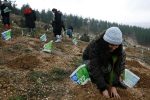
In Israel, Tu b’Shevat is a day for planting saplings. (photo from JNF via israel21c.org)
“Keep a green tree in your heart and perhaps
the singing bird will come.” This lovely quotation is not from our sages, but
is an old Chinese proverb. Nevertheless, it seems appropriate for Tu b’Shevat,
the New Year of the Trees, which falls this year on Jan. 21.
Of course, we have our own Jewish sources. For
example, “When you see handsome people or fine trees, pronounce the
benediction, ‘Praised be He who created beautiful things.’” (Tosefta: Berakot
7:4) Trees have a great significance in Judaism and, long before “ecology”
became a popular word, Jews were commanded, even in times of war, when
besieging a city, to not destroy its trees. (Deuteronomy 20:19)
Trees were sacred to many people. Pagans
believed that gods inhabited them and took their forms. They were druidic,
rising out of the earth and tossing their hair. They cooled, sheltered and
calmed. It is easy to understand reverence for the splendor and dignity of
trees, but only Judaism has a new year for them, which falls on 15th day of the
Hebrew month of Shevat (Tu b’Shevat).
In Israel, this date once marked the time from
which to count the age of the tree for reasons of tithe or taxes, and also to
indicate the maturation of the fruit of the tree. Even today, fruit cannot be
eaten until the fourth year, so Tu b’Shevat standardizes the birthday of trees.
The holiday doesn’t commemorate any great
historical event, and there are no special prayers in the synagogue. It is a
lovely time, ushered in by blossoming white almond trees with their promise of
warm summer weather.
Tu b’Shevat is traditionally a time for
planting every variety of tree. The Talmud mentions “the joyous planting” on
happy occasions. There was a delightful custom of planting a cedar when a boy
was born and a cypress sapling at the birth of a girl. When a couple married,
the wood of the trees would be used as poles to support the wedding canopy.
In Israel, it is a day for children and teens
to go with their teachers into the hills and valleys and plant tens of
thousands of saplings. There is also a custom to eat all the fruits of Israel –
olives, dates, grapes, figs, citrus, apples, bananas, nuts and pears, which
grow in great abundance.
Many scholars stay up late on the eve of Tu
b’Shevat, reciting biblical passages dealing with the earth’s fertility. They
read from Genesis how trees were created along with all the plants; from
Leviticus how the Divine promised abundance as a reward for keeping the
commandments; and from Ezekiel 17, the parable of the spreading vine, symbolizing
the people of Israel.
Many people hold a special seder to celebrate
the holiday, the New Year of the Tree of Life. They drink four cups of wine,
beginning with white wine and ending with red, with the second cup a mixture
more of white and the third more of red wine. It is rather like the landscape,
as it changes from white (pale narcissus and crocus) to red (anemones and
tulips) as Tu b’Shevat approaches.
As well as being a birthday, Tu b’Shevat is
also a day of judgment for the trees, which ones will thrive and be healthy,
which ones will wither and die. Chassidim pray for the etrogim, that they may
grow in beauty and perfection for Sukkot.
Planting trees is very significant for Jews,
the indestructible people for whom faith in the future is almost an emblem. We
plant trees whose fruit we will not eat and in whose shade we will not sit. The
one who fears that the world will end tomorrow or next year does not plant
trees.
As well, Tu b’Shevat affirms that the soil of Israel is holy. The people and the land have a mystic affinity in Judaism, and the New Year of the Trees reminds us every year of the wonder of God’s creation.
Dvora Waysmanis a Jerusalem-based author. She has written 14 books, including The Pomegranate Pendant, which was made into a movie, and her latest novella, Searching for Sarah. She can be contacted at dwaysman@gmail.com or through her blog dvorawaysman.com.
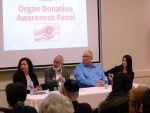
Left to right are panelists at a
recent National Council of Jewish Women panel on organ transplants: Dr. Aviva
Goldberg, Rabbi Yossi Benarroch, Marshall Miller and Na’ama Miller. (photo
from NCJW)
On Dec. 11, the Winnipeg section of National
Council of Jewish Women (NCJW) held an organ donation awareness event,
featuring community members Rabbi Yossi Benarroch, Dr. Aviva Goldberg, and
husband (organ recipient) and wife (organ donor) Marshall and Na’ama Miller.
“The short of it is, basically, that Jewish law
permits organ donations,” he said. “There’s no question about that. Of course,
when we talk about law, law is complicated and there are lots of opinions.
There’s an ideal in Judaism, which is one of those foundations, and it’s called
‘pikuach nefesh doche hakol’ … which basically means that, in Judaism,
there’s nothing more important than saving a life.
“I’m a very observant Jew and I keep kosher,”
he said, “but if I had to eat something that wasn’t kosher – pork or whatever –
in order to save my life, then Jewish law says you’re obligated to do that.”
Benarroch said it is written that, if someone
saves a life, it is as if they have saved the entire world. Furthermore, he
said, we are called to not stand idly by if another person is suffering. “We
are obligated to intervene and actually obligated to help that individual,” he
said.
Marshall Miller, who was diagnosed with
progressive kidney disease more than 25 years ago, eventually required
replacement therapy.
“Slowly, over time, my kidney failure began to
get worse and worse,” he shared. “The disease progressed to the point where, a
few years back, my GP at the time said, ‘Marshall, you’re now at the point
where you have to go see a specialist because I can’t do anything more for you
here … you need an expert to deal with your situation.’
“Everybody who suffers from kidney disease
understands that, what kidneys do, among many things, is purify your blood.
When your blood isn’t being purified properly, you can start to feel kind of
lousy. I think my family can attest to the fact that I was starting to feel
lousy. I think my whole family suffered along as I did, as I got sicker and
sicker.”
When his kidney function was down to less than
10%, the specialist started talking seriously about replacement therapy. This
involved dialysis three times a week until a matching donor could be found.
During the search for a donor, Na’ama Miller
decided to find out if she might be able to help other people in her husband’s
situation. As it turned out, she was a match for her husband.
“We were told it was a one hundred million
shot,” she said. “And so, we were next faced with a bit of a dilemma …
because it was scary for the kids. But Samantha and Maya were very much in
favour of it, because they didn’t want me to be miserable anymore.”
She said, “People ask me, how I could do this
… if it was hard. I give everyone the same answer. It was a no-brainer, a
very easy decision for me. As Marshall said … we were all suffering along
with him.”
“It’s worth it. You saved a life,” her husband
added. “We hope this event here – even if only one more person signs up …
hopefully, more and more people will choose to do it among the Jewish community
after hearing the story.”
After the Millers spoke, a second video was
screened, about a former Winnipegger who donated a kidney to save the life of a
woman in California, who he has never met.
“Right now, in Canada, there are over 4,500
people waiting for an organ transplant – 4,500 Marshalls,” said Goldberg, who
is the director of the Canadian Society of Transplantation and chair of the
Transplant Manitoba kidney allocation review committee. “We don’t have 4,500
Na’amas. That’s why we need donors – both living and also deceased donors.
“That’s what we want to talk about today,” she
said, “even if you don’t go forward to become a living donor, which is a really
big deal. It’s not something that every person in this room is going to be able
to do and that’s totally fair. But, there’s something that everyone in this
room can do and that’s to sign up for organ donation after you’ve died – say
that this is something I’d like to do, that you’d like to leave a legacy …
you can save lives after you’ve died, either with organ or tissue donation. You
can save lives by donating organs – heart, liver, lungs, pancreas, kidneys and
even small bowel – but, also tissue donation.”
In some cases, people can donate their corneas
to help improve the life of others. According to Goldberg, Manitoba, last year,
was the fourth on the world list of most donors.
While Goldberg implored people to sign up as
donors online, she further reminded them that talking to family about your
willingness to be a donor is also very important – and not just immediate
family, as they might be in the same car with you when you have a horrific
accident, for example.
“The way that organ donation works in Canada,
here, in Manitoba, is that after someone has died and they are potentially
going to be an organ donor, their family is approached,” said Goldberg. “If you
sign up for the registry, it’s a way of saying to your family, on the very
worst day of their lives, that this is something your loved one wanted – wanted
so much that they went to the registry, signed up, made that choice. It’s a
hard discussion to have … [but] it’s so important to do.”
During the question-and-answer period, one
attendee asked if there was an age limit for someone to donate an organ. The
answer? “No.”
Another question was about the possibility of
rejection and, to that, Marshall Miller shared his experience. “I suffered from
a mild early rejection,” he said. “But, the ability to detect the rejection and
be able to remedy it is incredible. They were able to treat me with medication
instantaneously and, really, it was a non-issue for me. Even though there is a
risk of rejection, it can easily be found if you attend your appointments and
take your medication.”
For information on organ donation in British Columbia and to register, visit transplant.bc.ca.
Union for Reform Judaism will be
closing down their summer camp for teen leadership development: Kutz Camp, in
Warwick, N.Y. (photo from onehappycampernj.org)
It’s that time of year again – when it’s too
cold in Winnipeg sometimes to go to synagogue. For many folks, this never
happens! For others, they never intended to go in the first place. Others would
like to attend, but aren’t well enough to leave home when it’s frigid.
Once, my twins, age 2, wanted to go to a
Shabbat family service when the temperature was ridiculously cold. With wind
chill, it was below -40. We bundled them up, got outside (we don’t have a garage),
seat belted them in and, though the cars were plugged in, car #1 wouldn’t
start.
Our hands were stiff with cold as we took off
our mitts, got the twins out of their car seats and into the other car, and
then? Car #2 wouldn’t start either. Dang.
We grabbed the kids, rushed back indoors, and
they screamed. No services. What would we do? We streamed a service from my
parents’ Virginia congregation online. The screaming stopped. The kids were
transfixed.
Sometimes, streaming services at home is the
only answer. However, it’s not the same as being there. No one knows whether
you stand up and sit down. And if you sing along? You’re all alone doing it. If
the streaming has a hiccup, well, I’ve been known to give up. (I’d only “give
up” in person if my kids disrupted things.)
So, it’s fair to say that technology offers
amazing benefits, but it’s not being there in the flesh. There are rabbinic
discussions on why streaming doesn’t fulfil certain mitzvot and, of course, it
certainly doesn’t abide by the traditional things you can “do” on Shabbat.
Why bring this up? I recently learned that the
Union for Reform Judaism will be closing down their summer camp for teen
leadership development: Kutz Camp, in Warwick, N.Y. In the press release
announcing its reluctant close, the Reform movement noted that, in its 54
years, the camp has been a living laboratory. Some of the best and most
innovative Reform Jewish experiences happen there. However, today’s teens seek
experiences closer to home, and at different times during the year.
As a camper for two years and a staff member
for one, Kutz offered me the opportunity both to learn a marketable skill and
to wrestle deeply with Jewish music, texts and tradition. The marketable skill,
song leading, allowed me to earn money teaching music at summer camps, at
religious schools and in adult education classes for years. It helped cover
expenses during my undergraduate and graduate degrees. It offered me a great
deal of joy and spiritual meaning. I helped create kid communities who sang
their way right through services together.
I also joined a program called Torah Corps,
which allowed me to study and learn Torah and commentary every camp day with
other similarly motivated teenagers. It was a meaningful endeavour, and it gave
me an opportunity to feel less alone about my passion for both Jewish text and
prayer.
The people who attended Kutz Camp over the
years went on to be real leaders, not just in their congregations, but also in
the larger Jewish community and beyond. Every so often, I hear a name pop up
and I remember someone from summer camp. These are people who make change in
the world far beyond a single summer experience. For instance, Debbie Friedman
(z”l), the famous song leader and Jewish musician, got her start at Kutz Camp.
Dr. Andy Rehfeld, the newly appointed president
for the Reform movement’s seminary and graduate school, HUC-JIR, was an admired
mentor and song leader of mine at Kutz Camp. For years, I toted around cassette
tapes that recorded the entire NFTY Chordster, an encyclopedic “real
book” for Reform Jewish song leaders. I used a Walkman, boom box and car
stereo. I learned every single melody that Andy sang into that recording.
When I Googled Andy’s name, three or four other
names from camp popped up – all are now rabbis, cantors, educators or other
leaders. Kutz Camp was an incubator. It attracted teenagers from all over the
United States, Canada, England, Israel and elsewhere. Through Kutz Camp, I had
contacts all over the continent (and beyond) for quite awhile. When I went far
away from home to attend Cornell University in upstate New York, I wasn’t
alone! I went with several dear friends from camp.
I’m sad that Kutz Camp will close. It’s sited
in a beautiful place, though the buildings were falling down even when I was
there, around 30 years ago. However, just as online streaming has changed our
options when it comes to attending services or Jewish learning online, it has
also taken away the need for some families to send their kids away to camp.
But those face-to-face leadership incubators –
Jewish summer camps – are priceless. I met people from all over the world at
Kutz, just as I knew teenagers who did the same at USY, Habonim Dror and other
camps.
We give up some things when we stay home. Maybe
it’s the casual exchanges at shul that we miss. Or that we can’t hear everyone
singing harmonies around us in the Kutz Camp congregation. Or perhaps it’s
missing a lifelong friendship or even a spouse you might have met at camp.
Sometimes, it’s just better to be there in person. (Assuming your car will
start!)
Joanne Seiffhas written for CBC Manitoba and various Jewish publications. She is the author of three books, including From the Outside In: Jewish Post Columns 2015-2016, a collection of essays available for digital download or as a paperback from Amazon. See more about her at joanneseiff.blogspot.com.
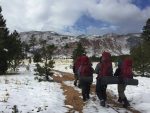
BaMidbar students hike in all weather conditions, learning to live and care for themselves in outdoor environments. (photo from BaMidbar)
When she was 15 years old, now-camp director
Jory Hanselman had some family members who were struggling with mental illness
and addiction. At the same time, a couple of close friends passed away in
pretty quick succession. Hanselman was struggling to cope, until her parents
sent her to a wilderness therapy program.
“It was an extremely transformative experience
for me,” Hanselman told the Independent. “I was there over Passover and
so, while the program I was at was not in the least bit Jewish, my identity as
a Jew was really central to what I experienced and got from it.
“I really connected it to the narrative, and
thinking about finding my freedom from narrow places and overcoming obstacles
I’ve faced in life. So, I looked into how I could become more involved in
wilderness programs.”
In college, Hanselman spent summers at Ramah in
the Rockies and saw firsthand the beautiful integration of Jewish learning via
meaningful, outdoor-based experiences. And, when Ramah in the Rockies started
exploring the idea of opening a Jewish wilderness therapy program, their
director reached out to Hanselman, knowing that she had been working in the
field. Hanselman was asked to provide input on how to build a therapy program.
“They decided they would move forward and
officially create BaMidbar and so I came on board at that time, in September
2016, to help move the program from a space of ideas to implementation and actuality,”
she said.
One great thing about its location – literally,
in the wilderness – is that it’s only an hour-and-a-half drive from Denver,
Colo. However, said Hanselman, “To give you a perspective, we are an hour drive
from cell service in any direction.”
The therapy retreat is for Jews from 18 to 28
years old who are struggling with mild to moderate social and behavioural
challenges, including depression, general anxiety, social anxiety and more. The
young adults in the program have reached the tipping point where the issues are
getting in the way of their being able to fully engage with the people and
things around them in life.
“We also see lots of folks who have
co-occurring substance abuse disorders, who are also using substances in
addition to working through challenges associated with other mental health
challenges,” said Hanselman.
Staff member Cliff Stockton teaches primitive fire building skills to students at BaMidbar. (photo from BaMidbar)
“The idea of wilderness therapy (WT) is using
wilderness- and adventure-based experiences as the vehicle for therapy, to
grow. So, we joke a lot in the WT industry that it’s not about doing therapy in
the wilderness, it’s about doing wilderness-based therapy. It’s not just going
out and meeting with a clinician in a wilderness-based setting; it’s really
using that experiential environment as a vehicle for working through different
therapeutic concepts.”
The BaMidbar program involves the whole family.
While students work with an individual therapist, their family is having weekly
phone meetings with the therapist who, in turn, also works with the field staff
to implement a treatment plan.
“So, our students are learning how to, for
example, build a fire with friction, and they use this opportunity to build
primitive skills to challenge themselves,” said Hanselman. “They learn what
tools they need to work through and understand what they’re capable of.
“Wilderness-based experiences are used as
metaphors and storytelling to support our students in connecting what is
happening in the wilderness environment to life outside the program.”
The small-group environment at the camp is used
as a way to help campers learn and rebuild communication skills and other
tools.
“We provide feedback and strong support for
them, as they determine how to have healthy emotional responses to different
stressful situations, or anger management strategies, and things like that,”
said Hanselman.
While there are many WT camps, BaMidbar is
possibly the only one that uses a Jewish lens and framework in everything they
do, including using the Jewish calendar as an opportunity to look at topics
that are thematically relevant to campers.
“To give an example, for Passover last year,
every day we had a theme we focused on that tied to the Passover narrative, as
well as our student therapeutic journey,” said Hanselman. “Day One, we focused
on our narrow place. Day Two, we talked about the story of Nachshon Ben
Aminadav … jumping into the unknown and what it might look like to take a
leap of faith and know that you need to change your situation, even if you
don’t know what the future holds. Day Three, we looked at manna in the desert
and talked about what sustains you physically, metaphorically, spiritually. Day
Four, we talked about receiving the Torah on Mount Sinai and did a summit hike,
talking about our personal value systems, what we live by, things like that.”
With BaMidbar being a kosher camp, Shabbat is a
break from the routine, which, in this case, is wilderness. On Shabbat, they
spend time in a cabin, while still studying texts through the lens of how they
are relevant to one’s life. This is the perfect time, said Hanselman, to talk
about family. For instance, “because, throughout Genesis, that revolves around
challenging family dynamics…. I always joke that Abraham was the first
wilderness therapy participant. He leaves everything he’s familiar with and
goes off into the wilderness on this journey of self-discovery. So, we do a lot
of programming around Shabbat.”
BaMidbar’s program is rooted in Jewish ritual. Here the BaMidbar community celebrates Havdalah. (photo from BaMidbar)
BaMidbar (which means “in
the desert” in Hebrew) is non-denominational and the organizers are dedicated
to meeting every student where they are in their unique journey, recognizing
and honouring that it can be very different for each individual.
“We are very dedicated to making sure that
students understand that our goal is to explore meaning, values and purpose
through a Jewish lens – not to tell them how to live Jewishly or what that
ideal Jewish life might look like,” said Hanselman. “That’s not our goal. Our
goal is to look at the wisdom Jewish tradition provides and to support students
for whole health wellness.”
Participants can expect 10 to 12 weeks in the
wilderness (Shabbat in a two-room cabin). Groups are small, with a current
maximum of eight individuals, and the program runs year-round.
In winter, said Hanselman, “We fully outfit our
students, so they receive all their gear from us. We make sure they have what
they need to be safe and warm in a wilderness environment. We have a lot of
staff practices around safety and support in that winter environment, and then
we have tents that have wood stoves in them when it gets below a certain
temperature.”
The camp fee is around $3,500 US per week. A
nonprofit, the BaMidbar program offers scholarships and works with every
family, regardless of their financial situation. Currently, about 75% of
students receive scholarships provided mainly by private donors and
foundations.
While BaMidbar has received many inquiries from
Canadian families, they have not had any Canadian participants. “But, we can
work with them – from Canada, or Israel, or other countries,” said Hanselman.
“We just haven’t yet.”
Left to right: Archbishop JohnMichael Miller, Dr. Gregg Gardner, Fr. Nick Meisl, Dr. Jay Eidelman and RabbiJonathan Infeld. (photo by Rabbi Adam Stein)
“This is a unique opportunity to learn and growtogether. What better way to open ourselves to that holiday spirit, to welcomethe mysterious and send away the fear of the unknown,” said Congregation BethIsrael president Helen Pinsky in introducing the Dec. 5 program at thesynagogue on Chanukah and Christmas, which was co-hosted by Beth Israel and theRoman Catholic Archdiocese of Vancouver.
After the lighting of a giant electronic chanukiyah by Rabbi Jonathan Infeld, the reciting of the motzi by Archbishop of Vancouver John Michael Miller and a latke-laden dinner, the crowd moved into the sanctuary to hear three scholars: Dr. Gregg Gardner, Diamond Chair in Jewish Law and Ethics at the University of British Columbia; Fr. Nick Meisl, a professor at St. Mark’s College; and Dr. Jay Eidelman, who lectures on the Holocaust and Jewish history at UBC.
Infeld started things off with a short talk.
“The neighbourhood we grew up in, in Pittsburgh, was 50% Jewish or Catholic,” he said. “The kids did not refer to themselves as Jewish or Christian but as ‘Chanukah’ or ‘Christmas.’ We don’t love this, but it shows that the holidays have a particular power.”
Noting that, for many Jews and Christians of the past, neither Chanukah or Christmas were important as religious holidays, the rabbi quoted a documentary he had watched that argued that Charles Dickens had created Christmas, quipping that maybe Dickens “created Chanukah as well, in its modern version.”
Gardner spoke on the origins of Chanukah, noting it was a festival created by the Maccabees to mark their military successes against the Greeks in an effort to preserve traditional Jewish culture. “Ironically,” he said, “creating a holiday to honour yourself is, in fact, a very Greek thing to do.”
The “subversive” rabbis of later generations altered the holiday to downplay its militaristic elements and its focus on the Maccabees, Gardner explained, replacing that with a focus on God’s miraculous intervention in the miracle of the oil that burned for eight days in the rededicated Temple.
In his remarks, Meisl said the balloon of his “naive beliefs” about Christmas popped when, in the course of his studies, he learned that Dec. 25 was not Jesus’s birthday, but rather a date chosen for other reasons. He explored the theories linking the day to the ancient Roman Saturnalia festival of late December, or the Dec. 25 holiday of Sol Invictus (Unconquerable Sun). With humour, he quoted the ancient Christian theologian Origen, who questioned whether Jesus’s birthday should be celebrated at all, noting that, in the Hebrew Bible, only “bad people celebrate their birthdays.” In seriousness, he said it seems that it was around 336 CE that Christians began celebrating Jesus’s birthday on Dec. 25.
Eidelman took to the podium to the sound of the 1970s classic “Eight Days of Chanukah” by Sharon Jones and the Dap-Kings, while changing from his suit jacket to a tacky Chanukah sweater, in the style of the dreaded Christmas sweater. His speech covered various historical and pop-culture themes related to the two holidays, with a focus on how Jews have imagined and reimagined Chanukah “as a way to define ourselves spiritually and a way to claim space in a culture largely based on Christian customs.”
After a short question-and-answer period in which people asked about the development of certain Chanukah customs and the role the story of the Maccabees has played in the Christian tradition, among other things, the archbishop wrapped up the event.
“This has been a wonderful evening of sharing the joy we each feel in the holidays with each other,” said Miller, who made a point of thanking everyone involved in the event by name, right down to the members of the catering and kitchen staff.
“The event was a splendid manifestation of the ties that bind Christians and Jews together in an age-old spiritual heritage,” Miller told the Jewish Independent by email. “Such occasions foster friendships and mutual understanding, and my hope is that they continue. I am very grateful to Rabbi Jonathan Infeld for his leadership role in interfaith relations.”
Matthew Gindinis a freelance journalist, writer and lecturer. He is Pacific correspondent for the CJN, writes regularly for the Forward, Tricycle and the Wisdom Daily, and has been published in Sojourners, Religion Dispatches and elsewhere. He can be found on Medium and Twitter.
Rabbi Joshua Samuels holds thecongregation’s Torah from Lithuania. (photo by David J. Litvak)
Congregation Beth Israel in Bellingham, Wash.,started out its life as a Lithuanian Orthodox shul in 1908. Today, thecongregation is housed in a stunning building in the woods, on 20 acres ofland.
The newly constructed synagogue opened its
doors in March of this year to serve the spiritual and cultural needs of Reform
and Conservative Jews of Bellingham and Whatcom County, Mount Vernon and the
Skagit Valley, the San Juan Islands and even Jews from Metro Vancouver.
Several weeks ago, for instance, the
congregation hosted a screening of a film about Israel, The Original Promise,
which was produced by Fraser Valley resident Bill Iny (who is a member of
Vancouver’s Congregation Beth Hamidrash) in conjunction with the Northwest
chapter of StandWithUs, an advocacy group for Israel that has chapters in the
United States, Canada and Israel. The screening, which attracted more than 100
Jewish and non-Jewish attendees, featured a panel discussion moderated by Beth
Israel’s spiritual leader, Rabbi Joshua Samuels.
This event is one of many that the Pacific
Northwest synagogue has hosted since relocating. However, while the synagogue
building may be new, it houses a nearly 300-year-old miniature Torah from
Lithuania that was commissioned in the mid-1700s by a czar of Russia.
Samuels said the czar gave the Torah to his
doctor, one of Samuels’ Lithuanian ancestors, and the Torah has remained in his
family ever since. His great-grandmother – hiding the Torah in a big coat –
fled Lithuania with her children to the United States, joining her husband in
Fargo, N.D., where he had found work.
The tiny Torah, said Samuels, has “lived in
Fargo, Long Beach, California, San Francisco (I read from it for my bar
mitzvah) and then it followed me after my ordination to Los Angeles and now is
with me here in Bellingham.”
A Torah is meant to be chanted and studied, he
noted. And, in Bellingham, he has used it on special occasions, such as on the
second day of Rosh Hashanah and for the Shabbat of Bereishit (his Torah
portion), as well as for b’nai mitvzah studies, and he has taken it to
Bellingham high schools and to Western Washington University. He wants students
“to see the beauty of a Torah scroll and to hear it chanted.”
“It’s the highlight of any visit,” he added.
Samuels also took the Torah to a cousin’s bar
mitzvah in California and will take it to Jerusalem next month for his niece’s
bat mitzvah, he said, “so that she can read from as it as her mother did 33
years ago.”
When he travels with the Torah, said Samuels,
“I feel like I am a concert musician traveling with a Stradivarius – I think
about it all the time, even if it is in a cushy case right above my seat.”
Bellingham’s Congregation Beth Israel. (photo by David J. Litvak)
Samuels, who is a fifth-generation San
Franciscan – his family arrived in San Francisco during the gold rush – worked
in the stock brokerage business in Los Angeles and San Francisco before
deciding to make a major life change. “I felt a gentle nudging to take another
path in life and, after some soul-searching for about three years, I applied to
rabbinical school at Hebrew Union College-Jewish Institute of Religion,” he
said.
After studying in Jerusalem and Los Angeles for
five years, Samuels was ordained in 2010. He began his new career at Temple
Beth Hillel in Valley Village, Calif., before coming to Bellingham to become
Beth Israel’s spiritual leader in July 2012.
Congregation Beth Israel was established in
1908 with 30 families, including Jews from Germany and Lithuania. The synagogue
was Orthodox until 1986, when it became a Reform shul and joined the Union for
Reform Judaism, which, at that time, was called the Union of American Hebrew
Congregations.
The congregation has grown to include 275
families and moved to its new building from a synagogue on Broadway that was
built in 1925 (and was recently sold). The new building was built to
accommodate the congregation’s growing community, drawing worshippers
throughout the region and from as far away as Surrey, White Rock and
Chilliwack, to attend services and the Sunday school. (For the Canadian
congregants, there is the added bonus of being able to shop at Trader Joe’s
after Sunday school.) The synagogue also hosts a Conservative minyan on the
fourth Saturday of every month.
While the new synagogue opened its doors in
March, Samuels said the construction began after he arrived in Bellingham in
2012. “The reason it took so long to build was to avoid incurring any debt,” he
said. “Just as the early Bellingham Jews bought the Broadway building outright,
we wanted to do the same with the new space.
“The state-of-the-art facility that we built
can accommodate our needs for at least the next 100 years.”
Bellingham’s Congregation Beth Israel is set on 20 acres. (photo by David J. Litvak)
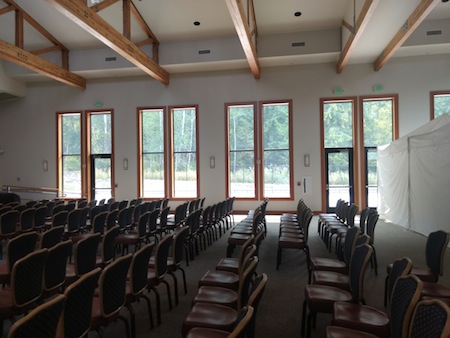
The sanctuary can seat more than 500 congregants,
and there is an outdoor patio overlooking the woods that can accommodate almost
as many. The building has 10 classrooms, two kitchens, a preschool, library,
study space and tons of storage.
Since March, the congregation has hosted a
variety of activities, including several StandWithUs events, a concert
featuring Seattle musician Chava Mirel and one with Bellingham klezmer band
What the Chelm (who performed at the synagogue’s grand opening in August), a
Purim party and a second-night Passover seder. In addition to being able to
host holiday parties, Samuels said, “We were finally able to host the High Holy
Days in our own shul after years of renting space around the city.”
And the congregation continues “to look for
opportunities to host events, speaker series, movies, classes, etc.,” he added.
As well, they would like to participate in more cross-border collaborations, he
said.
Samuels believes that his Lithuanian ancestors
would be happy to see their tiny Torah in its new Bellingham home, at the shul
in the woods. He said the Torah reminds him of his grandfather Jack (Yaacov), a
real mensch who died when Samuels was 7. His grandfather – whose mother had
brought the Torah to the United States – helped build a synagogue in Fargo.
“He is present every time I see the Torah,”
said Samuels. “I wish I could travel back and meet my family and tell them that
everything is going to turn out just fine. Their legacy is alive and well.”
David J. Litvakis a prairie
refugee from the North End of Winnipeg who is a freelance writer, former Voice
of Peace and Co-op Radio broadcaster and an “accidental publicist.” His
articles have been published in the Forward, Globe and Mail and Seattle
Post-Intelligencer. His website is cascadiapublicity.com.
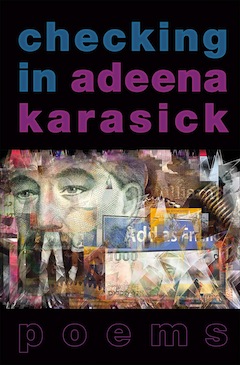
Almost half of Adeena Karasick’s latest volume of poetry, Checking In (Talonbooks, 2018), is comprised of whimsical Facebook status updates, most of which have deeper meaning on second and third thought. Together, they speak, as the book’s description notes, “to our seemingly insatiable desire for information, while acknowledging how fraught that information can be.”
“It was a totally compulsive exercise over four years, where literally everything I read or watched or where I went or what I heard was fodder for the text,” Karasick told the Independent about the faux updates’ origins. “And, I must admit, I threw away as many lines as I kept.
“Sometimes, it was just that I couldn’t get a song out of my head and then would just riff on it,” she said, giving as examples, “Ulysses is listening to Siren Song on Spotify”; “Gustave Klimt is listening to KISS”; and “Salvador Dali is doing the Time Warp. Again.”
Sometimes, she said, it was linguistically driven, such as, “E & G are saying F off” and “Bold italics are refusing to move into an upright position.” Or, “it was just pure, silly fun” to create updates like “William Wordsworth is wandering lonely on iCloud,” “Edvard Munch is watching Scream 3,” “Google is mapping the territory” and “Narcissus is using his selfie stick.”
“It was so obsessive,” said Karasick, “that even now that the book’s been published, my brain is so wired to creating those one-liners, I walk around the streets reading every sign and riff on them: ‘Thin Lizzy is watching her carbs,’ ‘Fatwa is doing a cleanse,’ ‘The Pre-Pesach Jew is clearing her cookies,’ ‘The Long, Long Sleeper is Woke.’”
Karasick’s sense of play is evident throughout Checking In. Even when describing heartbreak, confusion and other emotionally charged states, the joy she derives from words, from language and from constructing layers of meaning, is obvious.
“I think I’ve always had a really dark sense of humour,” she said, “and there’s something about taking that which is frightening or deeply disturbing and disempowering it – by not so much making fun of it, but ironically or parodically making it strange, decontextualizing it, hyberbolically defamiliarizing it.
“A lot of my work takes hard-hitting political issues, whether that be the Holocaust in Genrecide (Talonbooks, 1994) and superimposing it with the policing and massacring of language, or dealing with 9/11 in The House That Hijack Built (Talonbooks, 2004).… ‘There was a Big Building that Swallowed a Plane … How Insane to Swallow a Plane….’ A sense of jouissance (pleasure, play) really permeates all that I do. There’s nothing more exhilarating for me than playing inside language, finding unexpected liaisons, connections, sound clusters. It’s a type of erotics of the text that is for me very jewy; that jouissance, a jewy essence: all diasporic, nomadic, exilic, ex-static.
“I see this ‘play’ as operating with an ‘assimilationist’ brand of Jewish humour,” she explained, “not of bombastic neurosis, but one that threatens to unleash chaos, creates unsocialized anarchy, embodies unpredictability – impassioned, engaged, shticky, outrageous and earnest all at the same time – in a post-Woody Allen/Jon Stewart/ Sarah Silverman/Sandra Bernhardish kind of way. And, sometimes, it’s audacious, subversive, provocative and, in the true definition of ‘irony,’ explodes ontologically and cuts into the fabric of things; the smooth functioning of the quiet comfortability or the ‘homeyness’ of our world. That is the role of art.”
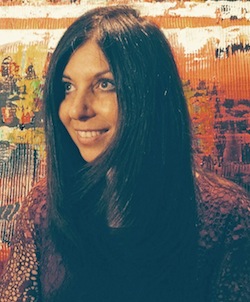
Adeena Karasick’s newest collection of poetry is Checking In. (photo by Safia Karasick Southey/talonbooks.com)
And one cannot separate Karasick’s art from her Jewish heritage – it’s “part of my DNA,” she said – and from her study of Jewish texts. With a PhD in kabbalah and deconstruction, it is not surprising that, in speaking about the concept of play, she pointed to 13th-century kabbalistic mystic Avraham Abulafia’s Science of the Combination of Letters, in which, she said, “we are instructed to play inside the language, using ancient practices of recombinatoric alchemy, gematriatic (numerological) substitution, combination, and, through lettristic ‘skips’ and ‘jumps’ slippage, meaning is infinitely re-circulated.
“According to kabbalistic thinking,” she said, “we are commanded to permute and combine the letters; focus on them and their configurations, permutations; combine consonants into a swift motion, which heats up your thinking and increases your joy and desire so much, that you don’t crave food or sleep and all other desires are annihilated. And nothing exists except the letters through which the world is being recreated, through a continual process of constructing and reconstructing borders, orders, laws, mirrors, screens, walls…. And, in accordance with the strictures of Abulafian play, to properly play is to travel inside the words within words, traces, affects, projections, sliding and slipping between the forces and intensities distributed through the texts’ syntactic economy. And this very play speaks both to how everything is infinitely interconnected – reverberant with our social, consumerist, communicative patterns – generating a contiguous infolding of meaning.”
She connected this type of play to “the actual conversation habits of Yiddish.”
“According to etymologist Michael Wex – in his Just Say Nu (Harper: New York, 2007) – Yiddish itself is inscribed in derailment, evasion, avoidance, where the norm is not to be ‘clear’ but to ‘seduce and lead astray,’ to say the reverse of whatever’s been said. For example, as we know, to say, ‘Hi, how are you,’ ‘Shalom aleichem,’ the answer is ‘Aleichem shalom.’ Answers are answered with a question, repetition, reversals, circumlocutions, interruptions, insertions (ptoo, ptoo, ptoo). Compliments are avoided in favour of their opposite. Or, like how you should never say what you mean because naming something (such as cancer, leprosy, pig) could bring it into existence.”
As for her own existence, Karasick said, “All my life, I’ve been fiercely drawn to all that seems enigmatic or paradoxical, and get great pleasure in connecting the unconnectable; drawing from different genres, lexicons or mediums and reveling in ways they inform each other in radical and innovative ways, inviting us to see the world anew.”
While she has spent years teaching philosophic and critical theory, and media and pop culture at various universities, as well as attending lectures on media ecology and ontology, she also watches “a lot of trashy TV,” she said. “I like classical jazz and MTV videos. I read [Louis] Zukofsky, [Slovoj] Zizek and Vogue magazine. And my favourite thing to do is to mash these language systems together into a kind of linguistic tzimmes; each flavour, taste, texture informing the other, expanding the palette.
“It’s especially exciting for me to break down that binary between high and low culture; draw from the music hall and the circus, erotics and spirituality; and play with ways all of this information erupts as a palimpsestic web of both sacred and secular echo-poetic referents.”
Karasick writes “on the road, on buses, trains, subways, boats; in motion,” she said. “I write best amid the bustle of life and, oddly, when I’m really busy is when I’m most inspired. I’m always hunting and gathering, drawing on the world around me. Though, I must say, when drenched in aching nostalgia, frustrated by contemporary politics or steeped in throbbing desire is when the work especially flows.”
Approaching the poetry
“Contour XLV: With Asura,” “Lorem Ipsum” and “In Cold Hollers” are all “homophonic translations, and so they all fall under the same rubric,” said Karasick of three of the poems in Checking In during a brief poetry lesson over the phone.
She explained, “Each of these [works] take the same sounds of an original poem by somebody else and I’ve translated them. I’ve done an avant-garde, post-modern translation by using the same sounds and rhythms of the original poems but changing all the words, so that if one read it simultaneously with the original poem, it would sound like the same poem, but it’s completely different. It’s a way of commenting on the previous piece; it’s translating it, moving through and across different modes.”
“In Cold Hollers” is a translation of Charles Olson’s 1953 poem “In Cold Hell, In Thicket”; “Contour XLV: With Asura” is based on “Canto 45 with Usura,” a poem by Ezra Pound, which Karasick described as a “famously antisemitic, women-hating, Jews and women are pigs kind of poem”; and “Lorem Ipsum,” which is in English, but plays on the sounds of the Latin of Cicero’s “De finibus bonorum et malorum” (“On the Ends of Goods and Evils”). “Lorem ipsum is the standard placeholder text used to demonstrate the graphic elements of a document or visual presentation,” writes Karasick elsewhere. “I am interested in exploring how the notion of ‘place holding’ gets reworked through an impossible relationship both in love and in language.”
As to how to approach a poem that you’ve never read before, Karasick said, “On one level, it depends on how deeply one wants to penetrate the text. The way I like to read is to not worry about what everything means per se, but rather … in reading, I think the most important thing is to feel the text, to go inside and feel its rhythms, its textures…. I work a lot with sound, so I’m really interested how sound itself communicates meaning and so, therefore, a lot of this type of work is about moving with the rhythms and the textures and some of that crazed emotion, how that bleeds through, just through the way that it sounds and feels in your mouth.”
Turning to the poem “Lorem Ipsum,” she said the words mean “pain itself.” She has translated Cicero’s treatise on the theory of ethics into a “passionate love poem” about the “difficulties and grueling angst that one traverses through that. Just like love itself, or pain itself, isn’t something that’s easily definable, so it is with the poem itself, which takes us through this journey of multiple ways that are easily comprehensible and other parts that are strangely defamiliarized and confusing because these very strong emotions are fiercely that…. Just like in life, you come across things that are completely foreign and impenetrable, so, similarly, the poem interweaves through the familiar and the defamiliar, the expected and that which completely takes you into new arenas of wonder and confusion.”
Karasick similarly takes Pound’s “Canto 45” and, playing with the Yiddish word asura, which means forbidden, and the English word usury, creates a new work that’s both a scathing commentary on Pound’s, as well its own poem, with its own meanings.
About “In Cold Hollers,” Karasick said she used the word “hollers” because it’s “homophonically related to hell, but it’s hollering in, calling back into Charles Olson’s original ’53 piece; and his original title, ‘In Cold Hell, In Thicket,’ refers to the opening of Dante’s ‘Inferno.’ What seems simple, it just has layers and layers and layers of history, literary history, philosophical history, as well.”
The title of Olson’s poem refers particularly to “selva oscura,” she said, “which is the dark wood that Dante wanders into in the middle of his life … so Olson’s poem, which riffs on that, is a similar excursion into a visionary experience, where he struggles to come up with a new understanding … from his own midlife … putting a voice to his own time. It is a personal drama of experience, conflict; it really speaks to the wrenching process of living and loving that, by turns, is grueling and funny and dramatic and trivial. My translation of that is dealing with all of those things and, in a way, it’s like, do you remember that old Gwen Stefani song, ‘I Ain’t No Hollaback Girl’? – I am a hollaback girl. I am hollering back, in cold hollers, to this cold hell, and basically calling into that history of both Dante and Olson, the history of post-modernism, 65 years later.”
In talking about Olson’s work and hers, Karasick said, “I sometimes like thinking of translation as trans-elation because you can never really translate anything because of culture and all the different references – in my piece, in my trans-elation, the attention is focused on a world of connected life, the personal, the political, the poetic as a system of relations. And, lastly … highlighting how the words themselves are imaginative participants; the words themselves are creating and recreating the sense of connecting the personal, the political, the poetic.”
And it’s not just the words, but how they are placed on a page that matters in poetry. So, for example, Karasick’s “In Cold Hollers” not only plays on the sound and meaning of Olson’s poem, but also mirrors its typography. “I wanted to keep it very much as he had it,” she said of where the lines break and other aspects of the formatting.
“The notion of the physicality and the materiality of where the words are placed on the page has just as much meaning as what they are communicating. We’re so often used to looking at the left margin … but I want the phrases to be moving and fluid, and that sense of how the white space between the words is equally as important as the words themselves. We can go back to kabbalah and the black fire on white fire, that the whole page becomes a series of fiery energy.”
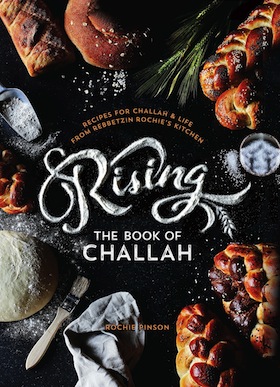
If I wrote that I had been trying to get a review copy of Rising: The Book of Challah by Rochie Pinson (Feldheim Publishers) since November 2016, readers would find that hard to believe, but the book only arrived at my door recently.
Pinson, who grew up in Vancouver, is co-founder of the IYYUN Centre for Jewish Spirituality with her husband, Rav DovBer Pinson, in Carroll Gardens, Brooklyn. They have four children. She mentors women and teaches various classes. She also conducts a challah-baking workshop, which she teaches worldwide, including in Vancouver.
For Rising, Pinson has written 352 pages about challah. This book is about her philosophy, spirituality, history and everything you wanted to know about challah. And, yes, it includes recipes – 38 of them for challah and seven for toppings.
“The intent of challah,” writes the rebbetzin, “is to reveal our innate power to nurture and nourish, and reclaim our mothering potential in all the forms it can take.”
Section I, “The Story of Challah,” explains how, as a new bride, Pinson arrived in Kobe, Japan, which had no kosher bakery, and soon got into making 40 challot a week for the Jewish community.
The book then expands to other information about challah, spirituality and other topics, including a detailed examination of each ingredient and information on the concept of “rising.”
Section II is the cookbook, with reviews and details of ingredients and equipment and troubleshooting.
There are eight recipes, including her own classic challah recipe, gluten-free challah and vegan challah; eight holiday specialties, like apple-and-honey challah and pretzel challah; six recipes from around the world, including Moroccan challah, Yemenite challah and Bukharian challah; nine challah innovations, such as a “fish” challah (shaped like a fish with salmon, tuna, mushrooms and other vegetables), a deli challah (with deli meats) and a rainbow challah (using food colouring); and eight recipes for leftover challah, like babka, cinnamon bars and French toasts. Rising also has recipes for seven different challah toppings, including cream cheese frosting, and accompaniments for other dishes, such as challah stuffing and challah croutons.
Section III is called “Laws and Customs,” which is mainly self-explanatory, though it also includes challah meditations. A glossary and index conclude the book.
There are more than 100 colour photographs in Rising and many sketches, such as 37 ways to braid and shape a challah.
Rising really is the definitive “everything you ever wanted to know about challah” book, written with love and nurturing. It contains a huge amount of information, including the story of Pinson’s life “as realized through challah baking, and challah baking as a metaphor for balanced, integrated nurturing of our self and our loved ones.”
This is the book to give to anyone who bakes challah, and to anyone else who might be contemplating it.
Sybil Kaplanis a journalist, author, compiler/editor of nine kosher cookbooks and a food writer for North American Jewish publications, who lives in Jerusalem where she leads weekly walks of the Jewish food market, Machaneh Yehudah, in English.