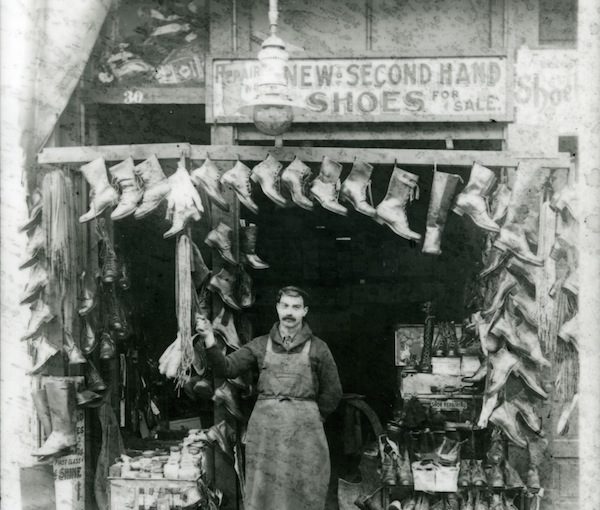
Nessim Menashe, born on the Isle of Rhodes in 1887, came to Portland in 1909. By 1914, he had established a shoe repair shop in northwest Portland, which he operated until 1921. (photo from Oregon Jewish Museum and Centre for Holocaust Education, OJM 03274)
Reading the history of the Oregon Jewish community can feel like reading B.C. Jewish history in a carnival mirror. Everything is familiar but just a little out of place.
Since the sister communities of Vancouver and Portland share both common history and common concerns about the future, there is much we can learn from each other. This is one reason why the Jewish Museum and Archives of British Columbia is excited to be hosting a trip to Portland in late May.
The three-day, two-night trip will take participants to historic sites and Jewish restaurants, and introduce them to engaging locals. Travelers will eat at Aviv, Lefty’s Café, Katchka, and Kenny & Zuke’s Deli. They will visit the Oregon Holocaust Memorial, Oregon Jewish Museum, Powell’s Bookstore, Beth Israel Historic Synagogue, Portland Art Museum, Oregon Historical Society Museum, Portland Rose Garden and Portland’s South End Jewish neighbourhood. They will also enjoy a curator-guided tour of the Oregon Jewish Museum.
As in British Columbia, it was the gold rush that attracted the first Jews to Oregon. German-born Jacob Goldsmith and Lewis May opened a general store in Portland in 1849 and helped found the Masonic Temple the following year. The community’s growth kept pace with the rapidly growing city and, in 1858, the Reform congregation Beth Israel was established. Jews had a disproportionate presence among the merchant class, with one-third of the 146 merchants on record in 1860 being Jewish. They worked in the industries of clothing, tobacco, furniture and wholesale.
Just 328 kilometres north, the Jewish population of Victoria followed a similar trajectory. The earliest arrivals stepped off boats arriving from San Francisco in 1858. They, too, established careers primarily as merchants and, in 1863, opened Congregation Emanu-El, which continues to operate today. In the 1870s, Jewish merchants began placing their bets on the future of a small encampment on the Fraser River, going by the name of Granville. These bets paid off when Granville became Vancouver in 1886, the terminus of the intercontinental railway.
The Jewish populations of Portland and Vancouver have grown dramatically over the decades since, with new arrivals from all corners of the world making their contributions. In both locations, community organizations blossomed early on, providing essential social and cultural services. Today, the Jewish population of Portland, at 50,000, is roughly double that of Metro Vancouver, thanks largely to a wave of young American Jews who were drawn to Portland in the wake of the 2008 market crash.
To learn more about the Oregon Jewish community and to experience it firsthand, join the JMABC-led trip, which departs by chartered bus on Monday, May 27, and returns Wednesday, May 29. For more information and registration, visit jewishmuseum.ca/program/portland-jewish-history-tour. The deadline to register is March 31.
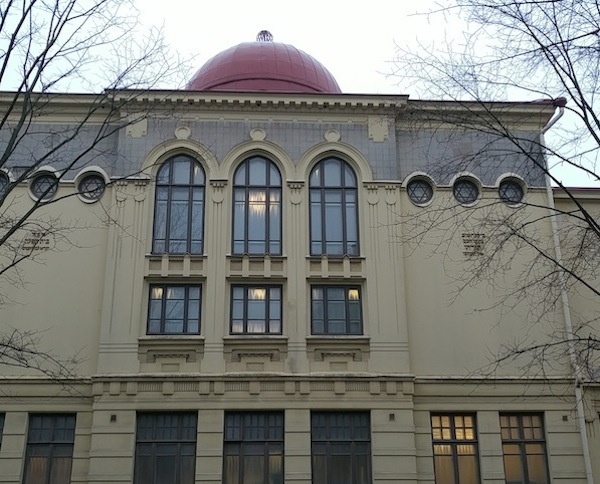
Helsinki Synagogue, in the heart of the city, was built in 1906. (photo by Dave Gordon)
Helsinki’s a city where you can experience high adventure, or simply chill, by taking in the sites on an easygoing walking tour. Elements of bustling metropolis meld with the laxity of a rural town, depending on which turn you take.
Home to some 1,400 Jews of Finland’s approximately 1,800-strong Jewish community, it is not a particularly large city, enabling a tourist to take in much of the core in a very short period of time. And it’s a treat for the eyes – modernity meets medieval, where whole city blocks are infused with colonial Swedish or Russian architecture, rich with history and stunning detail.
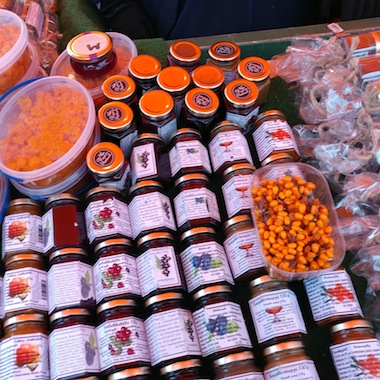
Preserves and juices in the market in Helsinki. (photo by Dave Gordon)
So, take it slowly. Walk along Norra Esplanade from the waterfront for a couple of kilometres and enjoy a wide array of boutique shops, dining options, cafés and the general feel of the city.
Stroll along Market Square, next to city hall, to get snapshot of local crafts and fare. It’s brimming with booths and kiosks – merchants peddling their wares. Drink fresh squeezed cloudberry or sea buckthorn juice (high in protein, vitamins C and E, and organic acids). Bring home an array of tchotchkes, like handmade knitted slippers, hats and sweaters. Nosh on reindeer jerky. Check out the bookmarks made with reindeer hide, and keychains made with reindeer antlers.
For investors and business, Helsinki is the latest start-up hub.
The city leapt from 43rd place in 2017 to 28th in 2018 in high-tech start-up successes among European and Scandinavian nations. The mega-conference for tech start-ups, Slush, takes place here, gathering 20,000 people. And, one of Europe’s biggest start-up campuses is about to be built, at 70,000 square metres.
Among the disruptors attracting global attention are Leadfeeder (analytics), ContractZen (one-click-cloud contracts), Smarp (shareable content hub), Utopia Analytics (artificial-intelligence monitoring of online discussion) and Hoxhunt (corporate security).
***
Finland is home to three Jewish institutions. Helsinki Synagogue, in the heart of the city, was built in 1906, and now serves about 1,200 congregants. Turku Synagogue was built in Turku in 1912, and has a few hundred members between the city and its surrounding areas. Both shuls are Ashkenazi Orthodox.
Helsinki Synagogue, with its bronze-coloured Byzantine-style dome, also houses a mikvah, a Talmud Torah and a playground. The congregation uses, not surprisingly, bilingual prayer books, in Hebrew and Finnish.
Meanwhile, Chabad Lubavitch of Finland is building a centre next to the city’s Presidential Palace, where they will offer classes, a daycare, a summer day camp and other services. Kosher meals are available through a handful of stores and organizations. Fazer, a local company that makes chocolate and cheeses, doesn’t have a hechsher (kosher certification), but is accepted by the community’s rabbinical authorities as kosher to consume.
The first Jew to officially plant roots in the country is recorded as Jacob Weikman, in 1782, despite the government ban on Jewish residence at that time. By the 1830s, there were enough Jewish soldiers to fill a makeshift chapel at the military base Suomenlinna Fortress, reports Hadassah magazine.
Many of today’s Finnish Jews are believed to be descendents of Russian infantrymen stationed there about 150 years ago.
During the Second World War, it was a complicated relationship for the Jews, many of whom fought with the Finnish army against the Soviets and, later, against the Nazis.
Finland openly defied the Nazi order to deport its 2,300 Jews, according to Yad Vashem. There was, however, a small exception: officials in 1942 allowed the Nazis to apprehend eight Jewish refugees. In 2000, a stone monument to memorialize the seven who died was erected by the government, at the park on Tähtitorninmäki (Observatory Hill).
But new evidence suggests that at least six soldiers of Finland’s army partook in the Final Solution. In January 2018, it was reported by JTA that an investigation had been launched by the Finnish government after the Finnish Society of Church History apparently found written testimony from one of the soldiers of his complicity. More than a year later, it seems that no results from the probe have been announced.
***
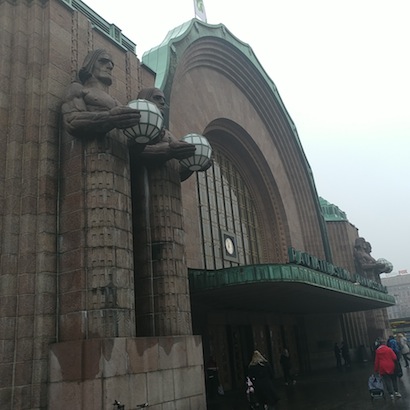
Helsinki’s train station. (photo by Dave Gordon)
More history and culture can be found at the National Museum of Finland. Until Sept. 1, the temporary exhibition Inherit the Dust – Photographs by Nick Brandt is on display, offering an idea of the damage human beings are doing to the environment. Permanent exhibitions at the museum include Prehistory, a multisensory experience that allows visitors to “[t]ouch a genuine reindeer axe, bring a cave painting to life and see a mammoth move. The digital exhibits bring history to the present day.”
The museum of contemporary art, Kiasma, at just 20 years old, has some 8,000 works in its collection, and about 100 are added annually. Here, you can get a great feel for Finnish architecture from the building itself and, with renovations starting this year, the fence blocking off the area under repair has been covered with poster art.
***
There are many other places to visit, of course.
Allas Sea Pool, next to Market Square, is where locals go after work to exercise or relax. The Olympic-size outdoor pool is heated, having a calming effect on the body, while visually, the mist hovers at eye level as it collides with the cool air. Meanwhile, the “sea water pool” – filtered and treated with UV rays – is water straight from the ocean, chilly and punchy. Think of it like the famed “polar dive.”
Want to tap the inner child in you? The grown-up playground (the name of which is too difficult to spell, let alone pronounce) is a “sports acrobatics” centre with trampolines, bouncy airtrack, foam pits, sprung floor and more.
Arkadia International bookshop is a cultural icon in the city, featuring nightly concerts of every kind of music, as well as a venue simply to enjoy a cuppa joe, play a board game or shmooze with friends.
Takeoff Simulation is where you can “fly” a commercial airliner in a flight simulator the size of a real Airbus A320. It includes high-definition visual screens, real sounds and a highly detailed cockpit.
Dave Gordonis a Toronto-based freelance writer whose work has appeared in more than 100 publications around the world.
When I was very young, I learned to embroider. My mother was a fabulous seamstress, but sewing was not my thing. Later, around middle school, an aunt taught me how to knit. I picked up crocheting but never really liked it or excelled at it. However, I took knitting to all levels, including a dress for myself, and, later, I returned to various kinds of needlepoint, coming to love them.
On my and my husband’s bedroom wall, there are framed embroidery pieces, each with its history, which I collected in the 1970s. I would have liked to have in my collection some work from Jewish women, who had done embroidery before immigrating to Israel from various countries, but they had stopped doing such work, and all the pieces I have were made by Arab women, who continued the craft.
It was with this background that I thoroughly enjoyed perusing the new-to-me pages of Jewish Threads: A Hands-on Guide to Stitching Spiritual Intention into Jewish Fabric Crafts by Diana Drew with Robert Grayson (Jewish Lights Publishing, 2011). The author explains her journey from sewing to fabric crafts, from editing for the division of Random House that published books on handicrafts to being awakened spiritually while editing for spiritual book publisher SkyLight Paths.
In Jewish Threads, there are 30 projects and 30 interesting stories (written by the author’s husband) about each artist and their project. The contributors come from the United States – Alabama, California, Kentucky, Massachusetts, Minnesota, New Jersey, New York, Pennsylvania, Vermont, Washington – and Israel.
The book has four parts: at home, in the synagogue, celebrating holidays and through the Jewish lifecycle. For the home, there are wall hangings, a needlepoint and a purse. For the synagogue, there is a runner, a Shulchan Aruch cover, placekeepers and Torah mantles. The holiday section includes challah covers, a quilt, a vest, puppets, a matzah cover, an afikomen holder and a seder plate. And, lastly, the Jewish lifecycle section includes quilts, a challah cover, a tallit and tallit bags. Another five “inspirations” include several chuppahs, a tallit bag, a wall hanging and a bimah cloth.
The techniques include quilting, appliqué, embroidery, needlepoint, cross-stitch, crochet, knitting, felting and needle felting.
Although decidedly not for beginners, each project lists details for getting started, what you’ll need and step-by-step instructions, sketches and how to finish. The “final threads” chapter offers how-to’s for quilt-making, lettering, a stitch guide, resources and projects for sewing circles, parents and children and holidays.
Sybil Kaplanis a journalist, lecturer, book reviewer and food writer in Jerusalem. She created and leads the weekly English-language Shuk Walks in Machane Yehuda, she has compiled and edited nine kosher cookbooks, and is the author of Witness to History: Ten Years as a Woman Journalist in Israel.
I’ve never seen my sister-in-law’s house look cluttered. Every piece of curated furniture and even the magazines are placed just so. I just couldn’t understand it, even though my mother told me that she was raised this way because her mother was an interior designer. My brother joked that, if he bought something new for their small townhouse, he had to give something up. Even as they moved and their family and lives grew complex, I always left their house feeling like mine had about three times as much stuff in it as theirs did.
During family emergencies where I helped out, I saw that this approach to home decorating wasn’t designed to make me feel badly about myself. So why was the house so carefully manicured? It was a chance to control something and make order where there isn’t any. When one is a methodical soul and life feels chaotic, it’s only natural to want to control something and make it do what you want. We can’t control politics or natural disasters. Even our family members are all independent. We struggle with their health and they do what they want whether or not it’s a problem for us.
This isn’t a Marie Kondo “spark joy” by cleaning article, although it may seem that way. No, it’s about Exodus, at the beginning of Chapter 38, where Bezalel comes on the scene. Bezalel helps create the Tabernacle of the Tent of Meeting, and the instructions, which were “drawn up by Moses’ bidding” (Exodus 28:21), spell out exactly how it’s to look.
I’ve heard sermons and discussions about this portion of the text where people say, “Why does the Torah spend so much time on these tiny details of design and style?” Yes, design and artistry are pleasing, and perhaps a chiddur mitzvah, beautifying the way we fulfil a commandment, but, for many, this seems to be extraneous and unnecessary.
Ever since getting to know my sister-in-law, who I love very much, by the way, I see this differently. Although I love aspects of design, I lack the gene that would enable me to keep my living space so tidy. It isn’t in me – and it’s certainly not in my spouse, who is more disorderly than I am. (He insists that every pile of paper is deeply meaningful and I shouldn’t touch his filing system.)
When we read about how the Tabernacle is created, it’s filled with precision and detail. It’s something that the Israelites contribute to, own and control, while in the midst of a wilderness, while wandering around and wondering when they will actually get to their new home. Perhaps it gives them a sense of security and purpose to create this during a time of nomadism and uncertainty. Unlike the golden calf episode, it’s a scene that’s calm and controlled.
Even while reading the specifics, there are surprises. Historically, women and children did nearly all hand-spinning of yarn. There were no factories for it. Every single yarn and thread for any garment was spun by hand, on a spindle. We might assume that all of the carefully hand-dyed linen yarn was provided by the Israelite women, yet it’s Oholiab, mentioned in Exodus 38:23, who is the man named as the carver, designer and embroiderer of “blue, purple and crimson yarns and in fine linen.”
There it is again. We think we are certain about all sorts of things in our environment and culture, like which gender does embroidery. We’re wrong. Many of the assumptions we make about gender roles, for instance, come from other times. For example, Victorian notions of a woman’s “higher spiritual nature” have seeped into Judaism. Our assumptions about what we wear or who does what kind of handiwork changes according to time period and culture.
So why be specific and detailed about the building of the Tabernacle or, for that matter, keeping your living room impeccably organized?
Some say that, since the Shechinah (G-d’s divine spirit) dwells in the Tabernacle, it must be perfect and beautiful. Others argue that our homes should also resemble the Tabernacle, because we each have bits of the holy spark, the divine, within. These are all wonderful aspirational and elevated ideas.
I’d argue something different. Our surprising world is busy and chaotic. Every time we shovel snow, the plow comes by and moves it, or it snows all over again. Maybe that flowerbed we planted last year didn’t bloom the way we’d expected it to. Our daily lives are out of our control in many ways, and this doesn’t account for disease, disaster, death or violence.
So, we manipulate what we can. My sister-in-law’s house is always going to be tidier than mine. It’s a way she can bring order to things despite the entropy around her. My house may be untidy, but I’m cooking, designing and knitting textiles in an endless attempt to keep people fed, warm and help them feel loved.
While writing this, my computer blinked. I lost a whole document. This week, a friend’s child is struggling and self-harming. Another far-away friend concludes radiation and chemo treatments, and I don’t know how she’s doing. My car might not start, my kids get sick at school – unpredictability and difficulties abound. However, there’s comfort in routine and minutiae. When we read the Torah portion or do the same Jewish prayers or rituals, we can offer ourselves that order and precision. We can’t control much, but we can control something. Goldsmithing, embroidery, carving, metal work or clothing, each of us can choose to create something precise and beautiful, in acknowledgement of a higher order.
Joanne Seiffhas written regularly for CBC Manitoba and various Jewish publications. She is the author of three books, including From the Outside In: Jewish Post Columns 2015-2016, a collection of essays available for digital download or as a paperback from Amazon. See more about her at joanneseiff.blogspot.com.
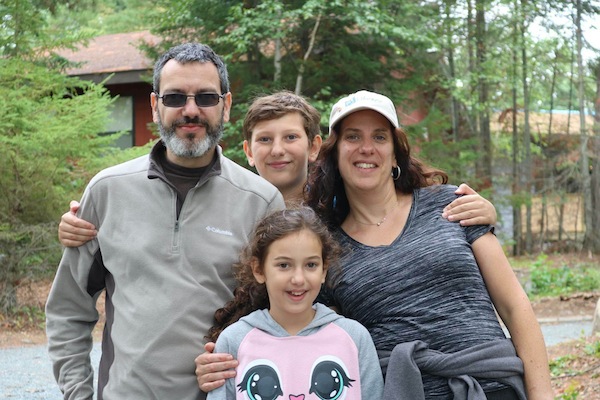
Florencia Katz and family. (photo from Florencia Katz)
PJ Library, which provides Jewish children with free Jewish-themed books and CDs, has expanded its program and now serves readers up to 11 years old.
Available in Jewish communities across North America, PJ Library is supported by local Jewish federations and many other donors. In Winnipeg, the program is in its 10th year, and Florencia Katz has been coordinating it since 2011. As a mom of two, she has experienced firsthand the impact the books have on her kids.
Eventually, Katz’s children aged out of the PJ Library program, which is for kids ages 6 months to 8 years old. But now, with the new program, PJ Our Way, Katz’s younger child, Tali, can once again enjoy the perks of PJ.
“PJ Our Way is the next chapter of PJ Library, for kids ages 9 to 11,” explained Katz. “Kids throughout the United States and Canada are eligible to enrol in the program from the day they turn eight-and-a-half until the day before their 12th birthday.
“The Harold Grinspoon Foundation, with the generous support of PJ Alliance Partners, provides PJ Our Way subscriptions at no cost to families or partner communities.”
PJ Our Way is considered the next chapter of PJ Library because it follows the same goals of the original program: engaging families and children in Jewish values, content and, ultimately, community.
PJ Our Way offers tweens the possibility of engaging online – allowing them to choose their own book, write book reviews, blog and more.
“My children and family have enjoyed the PJ Library program for years and, as avid readers, my kids were quite sad to stop receiving books at home once they aged out from PJ Library,” said Katz.
“My daughter, Tali, currently 10-and-a-half, was over the moon when I told her that she can now sign up to PJ Our Way. On the morning of the launch of PJ Our Way in Canada, before going to school, we signed up as one of the first sign-ups in Winnipeg, and maybe all Canada.
“As a parent, I am excited that, through this amazing program, my daughter will have the opportunity to keep reading quality Jewish-themed literature. The possibility that this program offers to engage online to choose the book, watch and read reviews, and submit their own reviews makes [it] attractive and exciting for this demographic.”
Tali was excited to pick her first book and spent some time on the PJ Our Way website, reading reviews and the synopses of all the available books, before choosing.
After narrowing her choice down to two books, she asked her mom for help deciding which to pick. After reading each book summary herself, Katz went to the parent section of the site to read more about the Jewish concepts and values and about the positive role models featured in each book. This helped her suggest which book her daughter might enjoy the most.
“Besides the synopsis and the concepts and values section provided for parents, there is also a section called Talk it Over, which suggests a question to discuss with your child after reading the book,” said Katz.
“I will definitely check all the information out and make a point of including it into our conversation about the book if it comes up. I will also suggest to my child to write a review of the book after she is done, so other kids can read it, the same as she read reviews when she picked the book. I want this experience to be enjoyable and fun, so I will not put any pressure or make it feel like a school task.”
Katz said the more Tali reads and learns about Jewish culture and tradition, the better equipped she will be to make her own decisions on how to live her Judaism when she grows up.
Candice Tenenbein, another parent who is part of the Winnipeg PJ Library initiative, is also very excited to have her older son, Jacob, 9, be part of PJ Our Way.
“Every month, our boys eagerly await their newest PJ Library arrivals,” said Tenenbein. “Both of our boys are avid readers. Recently, we were becoming sad that our older son, Jacob, was graduating out of this program. When we heard from Katz that PJ Our Way is now available in Winnipeg, we immediately signed up! We love that the books are exciting and fun to read, and that they all have a Jewish connection.
Candice Tenenbein and family. (photo from Candice Tenenbein)
“In our home, we celebrate Shabbat and all the Jewish holidays. These books and the online portion will add more layers to raising our children to be more knowledgeable about, and proud of, their Jewish heritage.”
Tenenbein is also looking forward to her sons spending time on their iPads in a more educational and productive manner, instead of just watching videos. PJ Our Way offers a safe and protected online environment.
At the Tenenbein house, all family members read the books provided by PJ Library, as they love to discuss their favourite parts of each one and share their thoughts of how the books impacted them.
“Jacob is especially excited that his friends will also be joining PJ Our Way,” said Tenenbein. “The kids are planning to choose the same books each month, so they can have their own book club.
“Growing up, my mother, may she rest in peace, instilled in us a love of reading and a pride in our Jewish heritage. Now, as a mother myself, I understand how truly important opportunities are which provide for our kids to understand what the religion means to them and their daily lives.
“This is especially important in today’s environment, where antisemitism and its newer anti-Israel BDS face are becoming more prevalent. My husband and I are grateful for the excellent education our children receive at Gray Academy [in Winnipeg]. PJ Library and PJ Our Way are excellent supplements for helping foster and strengthen these feelings in our children.”
Jacob is also excited about going online and becoming part of a larger community of Jewish peers. He is looking forward to being able to share his thoughts about each book and read what others have to say.
“He cannot wait to begin blogging once he reads his latest PJ Our Way book!” said Tenenbein.
These days, getting paper mail is not common, so PJ kids receiving a free gift in the mail, addressed just to them, is a unique and individual part of the experience. The online aspect then allows them to connect with other Jewish kids who are reading the same books as them. For more information, visit pjourway.org.
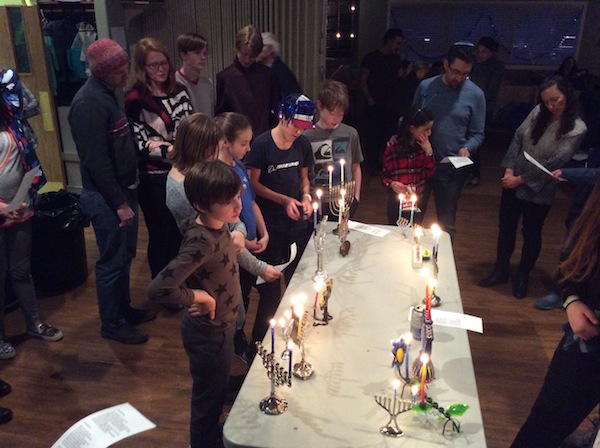
Members of the Okanagan Jewish Community came together to celebrate Chanukah. (photo from OJC)
The Okanagan Jewish Community in Kelowna has been keeping a busy schedule. Bolstered by many new members who have moved to the region – word has gotten out … who wouldn’t want to live here? – the community is growing both in numbers and in strength.
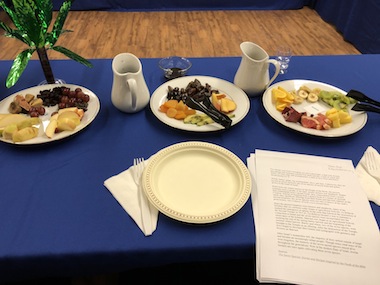
The Tu b’Shevat seder on Jan. 20 was attended by 30 members. (photo from OJC)
Traditional events such as the High Holidays – with visiting rabbis Larry and Linda Seidman from California – Sukkot and a Chanukah party attended by 80, started out our Jewish year. Of particular note was a Tu b’Shevat seder on Jan. 20, led by OJC member Barb Pullan, which was attended by 30 members. Everyone gathered to celebrate trees and discuss their importance to the preservation of life. We ate specific fruits representing those grown in Israel, drank wine or grape juice, recited blessings, told stories and sang songs. This definitely will be a repeat event in 5780.
Shabbat services were led by visiting Cantor Russ Jayne from Calgary in October and November, along with other services led by local community member Evan Orloff.
A Movie Night (The Boys: The Sherman Brothers Story) was presented on Nov. 9. The screening was organized by OJC member David Spevakow and took place at the Okanagan College Theatre, with almost 200 guests in attendance. We hope to continue the movie nights on a regular basis.
New programs this year have included:
Coffee, cake and cultural anthropology talks. I gave the first talk, on my experience meeting with the Jews in Gondar, Ethiopia. The second session was presented by Murray Oppertshauser, a retired Canadian diplomat, who spoke about his many postings throughout the world. Further talks are planned.
Several intercultural “meet and greets” have been planned with various cultural/ethnic groups in town.
The OJC participated in Taste of Home, a Kelowna community event, in which various ethnic communities in the city participated by selling a sampling of their ethnic food, and with ethnic dancing. We contributed 340 cheese knishes prepared by our members under the direction of Barb Finkleman. Our local Israeli dance group provided the entertainment.
Future events include a ball hockey tournament, Purim, Passover, regular meetings of the Ladies Group, the continuation of the Hebrew school, and our annual golf tournament in the summer.
The OJC is searching for a full-time resident rabbi. We are in the process of having several candidates come out for a Shabbat weekend, after which the community will decide which spiritual leader best fits our needs.
If you’re visiting Kelowna or, better still, moving here, contact the OJC at 250-862-2305 or admin@ojcc.ca.
Steven Finkleman is one of the original members of the Okanagan Jewish Community, having arrived in 1982. He has acquired lots of memories over the years. Currently retired, he has been serving as the president of the OJC since October 2018.
It was an uber-yummy pot roast that spawned the Accidental Balabusta. (photo by Shelley Civkin)
The definition of balabusta goes like this: 1) an impressively competent homemaker; 2) female head of household.
I recently saw balabusta used in a sentence: “She’s such a balabusta, she can make Shabbos for 20 in one afternoon.” Seriously? In which galaxy could anybody (never mind a balabusta) make any meal for 20 in one afternoon? I’m pretty sure that’s called hyperbole, or straight up bovine caca. Maybe I’m just not aware of the superpowers of real-life balabustas; the ones who sport red aprons and rule the domestic world. Personally, I couldn’t even make mac and cheese for 20 in one afternoon.
According to the Jewish Chronicle, “Balaboosters [sic] are rather out of fashion these days, victims of feminism and women’s magazines. Still, at least according to family myth, all of our grandmothers were balaboosters – heroic homemakers who raised large numbers of children in straitened circumstances and made real gefilte fish from a carp that swam about in the bathtub.” Not my Jewish grandmothers! Mine were neither spectacular cooks, nor did they have a bathtub filled with fish.
I don’t buy the idea that balabustas are out of fashion these days. I believe they’re just contemporary versions of the old-time balabustas. We hold down jobs, raise kids – well, not me, personally, but millions of other modern balabustas – and we’re active in our communities. And we just happen to bake, cook, do the laundry, clean the house and more. I, for one, am flattered to be called a balabusta. Even an accidental one. I feel like it puts me squarely in the category with other competent Jewish women, who juggle multiple tasks and are the glue that holds their families together.
So, how did I come to be crowned “the Accidental Balabusta”? It was the day I made a textbook perfect, uber-yummy pot roast. My husband Harvey took one bite and proclaimed me the Accidental Balabusta. Just like that! To substantiate his declaration, a week later I baked a batch of kalamata olive and rosemary challah buns (recipe from Rising: The Book of Challah by Rochie Pinson). They were exquisite. Or so I’m told. For the record, there was no bread machine or KitchenAid dough hook within 100 metres of my tiny galley kitchen. Just me, a 13-litre stainless steel bowl and enough flour to coat a bison.
For an encore, I made a handmade, painted challah cover. Next thing you know, I’ll be herding sheep. Anyway, that’s how the new moniker stuck.
Regarding the definition of balabusta, I might qualify as the “female head of household,” depending on whom you ask. As for being a remarkably skilled homemaker … well, the jury’s still out on that one. Way out. Truth to tell, most people I know would unequivocally classify me as the anti-balabusta. “That Shelley Civkin is a real balabusta!” Said nobody. Ever.
It’s not for lack of trying. OK, for about 50 years, it was. I simply wasn’t interested in cooking and cleaning. I was single and worked full-time. Since I only got married at age 53, the childbearing train had left the station. Empty. I was zero for three.
Then heaven happened: I retired three years ago. I took the advice of a wise rabbi, who told me that retirement doesn’t mean just sleeping in and doing nothing. It means helping others, doing mitzvot and finding your purpose in life. Did I mention I regularly volunteer to bake challah for seniors? I took the rabbi’s words to heart, and here I am today, the Accidental Balabusta. I’m sure my family and friends are laughing their tucheses off right now. “Shelley, a balabusta? You gotta be kidding?” For most of my life I was a water-burner.
If you ask Harvey, he’ll tell you I’m a great cook. To wit, he’ll eat anything. Exhibit A: the fish fiasco. A year or two into our relationship, I decided to make breaded snapper. So, I used my father’s recipe and coated the fish in flour, eggs and breadcrumbs. While it was frying, a tiny piece of breading came off, so I popped it my mouth. Something didn’t taste right. I checked the expiry date on the egg container – it was fine. Then I put my finger in the bread crumbs to taste them – they were good. Finally, I put my finger in the jar of flour. Only to realize that I’d just coated all my fish in icing sugar. Harvey, G-d bless him, ate the icing-sugar-coated fish. I went out for sushi.
Then there was the infamous lamb debacle. It was New Year’s Eve and I decided to go for broke, so I made a rack of lamb. I covered the lamb in my usual Dijon mustard, lemon and garlic mixture and put it in the oven. Our first bite in, both of us noted the unusually strong lemon flavour. But it was tasty.
An hour later, it wasn’t. Harvey ended up in the bathroom driving the big, white porcelain bus. Several hours later, I landed in the hospital emergency department having three bags of IV fluids pumped into me. Let’s just say I got very dehydrated, and leave it at that.
As for being a great homemaker, that’s not my strong suit. What I mean to say is this: I am not on a first-name basis with my vacuum cleaner. In fact, I couldn’t tell you the brand if my life depended on it. I am to housecleaning what porcupines are to Winnebagos. If tchotchkes aren’t screaming out to be dusted, leave well enough alone. Let me clarify: I’m not dirty. I’m just a little messy. I figure there are more important things to do than clean house. Like read. Or eat chips. When guests come over, though, I pull out all the stops. OK, I pull out the fancy hand towels. Actually, Harvey pulls them out. I watch.
The last time I did anything domestic was in Grade 3 Hebrew school, when our teacher had all the girls embroider kippot for the boys. The boys’ assignment – wait for it – was to wear the kippot. No sexism there. Of course, it was the early 1960s. So, you’re welcome, boys.
But back to the balabusta thing. It turns out that I actually enjoy cooking and baking. Who knew? With nothing but free time on my hands now (except for my volunteer activities), I can kick back, put my hair up and tie one on. An apron, that is.
Stay tuned for more Accidental Balabusta.
Shelley Civkin, aka the Accidental Balabusta, is a happily retired librarian and communications officer. For 17 years, she wrote a weekly book review column for the Richmond Review, and currently writes a bi-weekly column about retirement for the Richmond News.
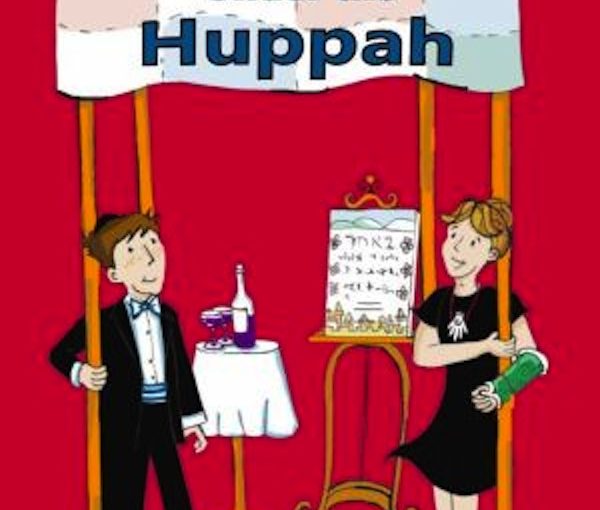
Hoopla Under the Huppah by Dori Weinstein (Five Flames Press, 2017) is the third instalment of the YaYa and YoYo series, which includes Sliding into the New Year, about Rosh Hashanah, and Shaking in the Shack, about Sukkot.
Targeted to 9-to-11-year-olds, Hoopla Under the Huppah features 11-year-old twins YaYa (Yael/Ellie) and YoYo (Yoel/Joel) Silver. Their Aunt Rachel is getting married to soon-to-be Uncle David, and they have been asked to participate. As the plans develop, YaYa and YoYo learn all of the rituals and traditions of a Jewish wedding. However, as the weeks pass, there are all kinds of good and bad adventures that the twins and their 13-year-old older brother, Jeremy, experience. As the ketubah, painted by the kids’ mother, the wedding ceremony and more evolve, YaYa worries about “the Evil Eye” and that she might be bringing bad luck to everything she touches.
Hoopla Under the Huppah offers opportunities for parents to discuss various Jewish traditions with their kids, while enjoying the humour of the Silver family. As an adult, I really enjoyed this book.
Weinstein grew up in New York, taught in public and Jewish schools and now lives in Minneapolis, Minn., with her husband and children, where she teaches preschool Hebrew.
Sybil Kaplanis a journalist, lecturer, book reviewer and food writer in Jerusalem. She created and leads the weekly English-language Shuk Walks in Machane Yehuda, she has compiled and edited nine kosher cookbooks, and is the author of Witness to History: Ten Years as a Woman Journalist in Israel.
My kids love a song called “Make me a sanctuary.” The Hebrew comes directly from Exodus 25:8. It’s based on a Shaker hymn (much of the Jewish musical liturgy comes from outside sources) and it’s in Hebrew and English. The English lyrics say: “Lord, prepare me, to be a sanctuary, pure and holy, tried and true, with thanksgiving, I’ll be a living sanctuary for you.” In Hebrew transliteration: “V’asu li mikdash, v’shochanti b’tocham,va’anachnu n’varech yah, me-ata v’ad olam.” Translation: “Make me a sanctuary, that I may dwell among them, and we will bless Hashem, now and forever.”
This comes from the Torah portion Terumah, and describes how the people will make an exquisite ark so that they can worship together. I’m a “maker” and love creating things. I spin, knit, weave and sew. I write knitting patterns. I love to build and create. Today, I just finished making some cloth napkins. However, a home (or a congregation) can’t be an inspirational sanctuary without the basics. In Canada, that includes heat.
Recently, I noticed our house seemed cool. I perched on the stairs to check the thermostat. Someone installed it decades ago in a way that makes it hard for shorter adults, like me, to see. (My partner, whose ancestors spent time in Eastern Europe, didn’t seem cold.)
The next morning, the boiler wasn’t working. After checking the thermostat battery and shrugging, my partner went to work. As the work-from-home adult, I called repair places. Although it was warm outside for winter, the forecast predicted plummeting temperatures. I worried.
The busy repair places offered an appointment for the next day. We have two gas fireplaces, which pumped out heat valiantly while I called Manitoba Hydro. Hydro scheduled someone to come out to check our boiler’s pilot light. As the temperatures dropped, the boiler kept cycling, but no heat came up, so I shut it off.
At lunchtime, a chirping alarm went off in the basement. Something else was wrong, but I couldn’t even tell what was beeping. We have an old house. Its antiquated systems can be confusing. (Smart house upgrades circa 1918, 1952, etc.) I was also tired when this started from a busy weekend. I was so befuddled by what was going on with the boiler that I wondered if I was confused due to some kind of gas leak.
Once I shut it off the boiler, I was no longer confused but so tired from the cold that I wanted to take a nap. I was wearing a toque, a heavy Icelandic wool sweater and a shawl, but part of me was like, “Don’t take a nap! People die this way! How will the Hydro guys get in if you fall asleep?!”
Here’s the stupid coincidence. The beeping was an older fire alarm with a failing battery, which had nothing to do with the boiler. Installed in 2004, it was guaranteed to last 10 years. It gave up the ghost 15 years later, on the same day as the boiler troubles. We’ve had new, hardwired fire, carbon and radon alarms installed, but missed removing this one. I was freaking out over nothing. I’d call it irrational stupidity, possibly caused by a tired “freeze” brain.
The Hydro guys came, cheerfully disconnected the old fire alarm, relit the pilot light and told me to get the boiler fully serviced. When the tradesperson serviced the boiler, it was black, dirty and not burning cleanly. It needed attention. I also got the boiler chimney cleaned. It took awhile for the house to heat up, but there was good news. We were warm again! Bad news? I lost the better part of a work week to this drama, and I was cold.
Once I was warm, I thought beyond the basics – but many people can’t. If you’re stuck with challenges like staying warm, you can’t think clearly. In the midst of a Canadian winter, we’re so lucky to have heat. Taking a moment to remember this, and recognize that there are many who are cold this winter, and how it affects us, is very important.
I was incredibly grateful to hear the boiler cycling as everything became toasty. It made me very aware of how hard it is for those among us who cannot afford to keep their houses warm or who are homeless. I was so anxious that I woke up the next morning at 5:30 a.m., panicked that the boiler might stop working again as temperatures plummeted to -30 outside.
For those of us who find something’s wrong, there are ways to fix it. This is a kind of “adulting.” Grown-ups should keep up with home maintenance, whether it’s the fire alarms or getting their boilers serviced and chimneys cleaned regularly. I couldn’t remember the last time this was done at our house.
When I had twins, life got busy. We did the best we could, but forgot a lot of important details. We all need heat during the winter. Aside from being grateful, do something that I didn’t do – be proactive. Getting your heat in order before the cold temperatures and cold freeze brain hit is wise. I wish I’d known better, but you can still get it serviced in the wintertime.
Here’s wishing you a well-maintained warm, cozy home, with up-to-date fire alarms, during all the cold snaps. It’s much better to be safe and warm than sorry.
Joanne Seiff has written regularly for CBC Manitoba and various Jewish publications. She is the author of three books, including From the Outside In: Jewish Post Columns 2015-2016, a collection of essays available for digital download or as a paperback from Amazon. See more about her at joanneseiff.blogspot.com.
I recently heard some difficult news. A good
friend of mine from university has been diagnosed with a serious form of
cancer. Over time, we’d moved, had children and fallen out of touch, but I was
able to reach her quickly. She is well enough for emailing, and we’ve fallen
right back into the dear friendship we had 20-some years ago. Some of her more
recent pathology reports are slightly more hopeful. Even so, it’s a very
serious diagnosis and she’s in her mid-forties with kids in elementary school.
During university, this friend and I were part of
a trio of busy young women. Often the only time we could spend together was
breakfast. We’d have bagels and coffee at a sunny warm spot, the Ithaca Bakery.
The snow was piled high outside and the windows were steamed with humidity as
we laughed and complained together. It was the third friend who told me about
the brain cancer. She and I each, within moments, had come up with medical
resources for our dear friend. We felt lucky to be able to say, “I know
something about this,” or “I know someone if you need medical information or
another opinion.” We wanted to support her from far away.
I was reminded of this when looking at the
Torah portion Yitro (Exodus 18:1-20:23), which starts out with a story about
Jethro, Zipporah’s father, and Moses. Jethro is Moses’ father-in-law. When
Moses tells him how the Israelites have escaped Egypt and what has happened,
Jethro responds in Exodus 18:9: “And Jethro rejoiced over all the kindness that
the Lord had shown Israel when He delivered them from the Egyptians.”
Rashi responds to this by saying that Jethro
rejoicing is the literal meaning, but that Sanhedrin 94A (a talmudic midrash)
suggests that Jethro’s skin prickled, or crept with horror. He felt upset about
Egypt’s destruction. Rashi explains further that “people say” that one should
not speak negatively about non-Jews in front of someone who has converted to
Judaism, even if the family converted 10 generations ago.
Jethro is called a Midianite priest, and is
considered a “non-Hebrew.” The Druze consider Jethro an important prophet and
ancestor. No matter – Moses was close with him, and married his daughter. This
text and the commentary is laden with meaning. Just on its surface: Jethro
celebrates and is grateful that his daughter and son-in-law and the Israelites have
come through a terrible experience. Yet further still, the midrash explains
that Jethro knew the ramifications of the experience. Egyptians suffered and
were destroyed to bring about this event. Finally, there are valued connections
between people. It doesn’t matter where you come from – we shouldn’t cause
distress to those we love, if at all possible, even if they aren’t part of our
“in-group.” Things in life are complex. We should celebrate and be grateful,
but not cause further harm, either. Jethro intertwines these concepts.
Jethro goes on to help Moses learn to delegate
and do “leadership development.” He encourages Moses to rely on the Israelites
to lead and take care of one another, as well.
What does this have to do with hearing of my
friend’s terrible illness?
It was a wake-up call and a reminder to be
thankful, as Jethro was, and celebrate what we have – we can’t take our health
for granted.
The good news is I am back in touch with
someone I care about. It’s also an opportunity to look at how a third friend
told me this news, and that my friend with cancer has a rich community to lean
on. She can delegate, too, regarding communication, help with her family, and
maybe even finding medical advice and explanations.
It’s also a reminder that we’re all connected,
regardless of religion. As Rashi shows us, treating people with care extends
beyond the team with which you daven (pray).
Finally, smart people realize that real-life
situations are complicated. It’s simplistic to have a one-size-fits-all approach
to nationalism, for example. Moses supported and shepherded the Israelites, but
he also cared deeply about people who were not, strictly speaking, part of his
crowd. Yes, we’re Jewish, but we often love people who aren’t, and that is part
of our tradition, too.
We’re lucky to have a tradition that values
complication. As Jews, we face a lot of complex concepts in the world, whether
it’s our own personal observances or how we apply those values to the world at
large. We could choose a simplistic response, such as a tirade or blanket
objection to a view different than our own. Many people do this – face it, it’s
easier. Or, we could acknowledge the complexity of our choices instead.
Jethro wasn’t Jewish, and he wasn’t a one-issue
guy. He could celebrate and express gratitude while wrestling with other
feelings: concern, loss, sadness and worry. I hope to be like Jethro and do the
same.
Joanne Seiffhas written regularly for CBC Manitoba and various Jewish publications. She is the author of three books, including From the Outside In: Jewish Post Columns 2015-2016, a collection of essays available for digital download or as a paperback from Amazon. See more about her at joanneseiff.blogspot.com.