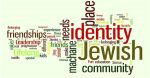
The most frequently used words by alumni answering the question “What does Camp Miriam mean to you?” The larger the word, the more frequently it was used. As with other Jewish camps, “Jewish” and “identity” are the most common responses. (from campmiriam.org/home/about/our-impact)
As a director at JCC Chicago’s Camp Chi, I often found it difficult to know with much certainty if our goals and mission were being met. Sure, I knew that campers were having a lot of fun, trying new things and forming friendships, but what about the deeper connections or personal growth?
Satisfaction surveys and return rates demonstrate one type of success, but these measurements don’t get to the heart of what we want kids to take away from their camp experiences.
I saw firsthand last summer that this challenge is even more true at day camp, where campers often don’t have the maturity or verbal expression skills to accurately share their feelings. By spending a minute at any of the nine JCC Chicago day camps, you know that campers are having the time of their lives, but how do we know if we are meeting or exceeding what we want to be the positive impact of camp or, more precisely, the positive impact of Jewish camp.
We found the answer to this question in a surprising way. Towards the end of the summer, as part of a larger project, we asked JCC Chicago day campers to complete this sentence: “It’s not just camp. It’s _______.”
Using markers and crayons, words and pictures, campers shared – often with creative spelling – what camp “is” to them. Among responses that ranged from reflective to silly, we discovered a number of answers that highlighted the distinctive elements of Jewish camp. Campers wrote: Jewish memories … Shabbat … family … Jewish tradition … Maccabi games … inspiration … Jewish … community … Israel experience … a chance to show yourself … kindness … Shabbat singing … JCC.
With an opportunity to write anything they wanted about camp, many of our campers chose to express what was meaningful to their Jewish identity and Jewish experience. These ideas were surrounded by other words and phrases, such as swimming, home sweet home, soccer, awesomeness, my happy place, fantastic, best part of the year, friends, painting and love.
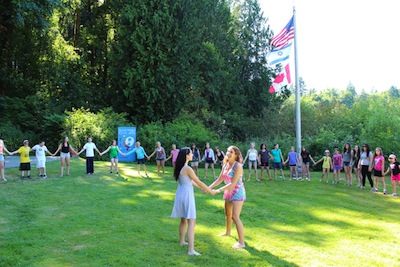
Screenshot from a 2014 Camp Solomon Schechter promotional video. While swimming and other secular activities engage campers, so do Shabbat and Israel. (from youtube.com)
Seeing this better defined for me, more than any research study, why Jewish camp matters. The melding of Jewish rituals, ideas and activities with the excitement that naturally happens at camp is the real magic of Jewish camp. Swimming was a dominant theme with our day campers, but so was Shabbat and Israel. Campers related “Jewish” alongside fun, joy, comfort and belonging.
This reminded me of something I experienced in the months leading up to my first summer working at Camp Chi. I met with small groups of campers and staff to get the real scoop on the camp. I asked all of them to tell me their favourite part of camp. Almost always the answer was “Shabbat.”
Not having attended Jewish camp as a child, I thought this was an odd response at a camp with outstanding facilities and activities. I would have expected “horseback riding” or “water skiing” or even “my friends,” but, instead, I heard about how connected they felt to the Jewish community or their “Jewishness” when at camp.
What our day and overnight campers told us is so much more than just words on paper or stories to be shared. There is incredible power in this positive relationship to Judaism that campers make while at Jewish camp. At JCC Chicago day and overnight camps, being Jewish is fun, accessible, relaxed, just like almost everything else that takes place there. In their own ways, our campers, from the youngest to the oldest, expressed that “Jewish at camp” has meaning and importance to them; it’s part of what makes camp and their camp experiences so special.
As adults, we can see that their words and stories are evidence that the seeds of Jewish connection are planted throughout the summer. The potential impact of Jewish camp is tremendous. It sets the stage for a lifetime of sense of belonging to a Jewish community, a relationship with Jewish traditions, a feeling of pride in Jewish identity and an understanding of values.
It’s not just camp. It’s the start of a lifelong Jewish journey and so much more.
Jamie Lakeis marketing manager of JCC Camping. This article is reprinted with permission from JUF News. It can be found at juf.org/news/local.aspx?id=440848.
Israeli President Reuven Rivlin at the Great Synagogue in the city of Tbilisi, Georgia, on Jan. 10. (photo by Haim Zach / IGPO via Ashernet)
At the Great Synagogue in Tbilisi, Israeli President Reuven Rivlin spoke about the history of Jews in Georgia, and the close ties that have existed over the years between Georgia and Israel. He said the connection “is good, yet we must do more.”
He noted, “The Jewish heart, the close bond with the Jewish community here, adds extra special essence to the ties between the two countries. Just this last Shabbat, we read in the Torah of Judah, who was ready to be held as a guarantee in place of his brother Benjamin. The mutual responsibility is the secret of the strength of the people of Israel, so it was in the past and so it is today. Jews in Israel and around the world have a responsibility for each other, we are one people. We will do all we can to perpetuate and to preserve the warm bond with you and with the Georgian people, and I am certain we will succeed.”
Earlier in the day, Rivlin met with Irakli Kobakhidze, chair of the Georgian parliament.
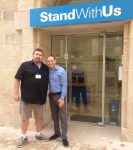
Ryan Bellerose, left, in Jerusalem with Michael Dickson of Stand With Us. (photo from Ryan Bellerose)
Ryan Bellerose is not the first Métis to stand with Israel, though he might end being one of the most influential, as he works to increase B’nai Brith Canada’s presence and advocacy voice in Alberta and British Columbia.
Based in Calgary, Bellerose became BBC’s advocacy coordinator for Western Canada just over four months ago. Like many Métis of his generation, he was raised Roman Catholic but, later in life, found his way back to indigenous spirituality and decided that Catholicism was not for him.
“I try to worship the creator the way Cree people do, rather than the way white people do,” he told the Independent.
Growing up, Bellerose read about Israel and felt a kinship with Israelis insofar as the struggles they have endured concerning their ancestral land and rights. The Métis here in Canada have had less success with similar struggles, he said.
That’s how his connection to Israel started, said Bellerose. “On top of that, on my mother’s side, my great-grandmother was really pro-Israel. She grew up in Norway during WWII. She was very pro-Israel, because she was very anti-Nazi Germany.
“She would drink Manischewitz wine everyday at 4 p.m. As a kid, I asked her one time why she drinks it, because she’d always make a face when drinking it. She told me, ‘I drink this because it shows the world that the Jews didn’t die and that the Nazis lost.’”
It would not be until Bellerose was in university that it became clear in his mind why he, himself, was pro-Israel. A Jewish friend at the University of Alberta helped him see just how similar the Métis and Jewish narratives are.
“I didn’t realize she was Jewish and I used to hang out with her a lot,” recalled Bellerose. “She’d always invite me over for dinner at her house on Friday. They weren’t super-observant Jews, but they still lit candles and had Shabbat dinner. They didn’t eat meat on Friday … all things that my family did, too. So, I just thought that they were super-Catholics, and I told my grandma that my friend is totally super-Catholic and that she’d love this girl.”
What Bellerose did not yet realize at the time was that his friend was being bullied at the U of A to a degree he had never seen before. Growing up in northern Alberta, Bellerose had experienced a lot of racism and prejudice, but nothing, he said, like these verbal attacks on his friend.
“What was a shock to me was this girl – blond-haired, blue-eyed, who played on sports teams and was super-smart academically – was being bullied to the point that she was considering suicide,” said Bellerose. “We’d be walking across the quad at the U of A and someone would yell, ‘Baby killer!’ I just always assumed they must be yelling at someone else or maybe even yelling at me, because there’s no way they would be yelling at her.”
This occurred a few times before Bellerose learned that his friend had participated in several pro-Israel events and that it was some very anti-Israel U of A students who were shouting such slurs at her.
“It’s one of those things that … it’s very difficult for a rational, moral human being to even wrap their heads around…. I think that’s why a lot of Canadians don’t understand the depth of this,” said Bellerose.
“It’s simply because she used to wear an IDF T-shirt and she was Jewish. So, I mean, the excuse would be anti-Zionism, but the truth is that it is antisemitism.
“I’m supposed to be one of her close friends and, yet, I had absolutely no idea what she was going through. I should be more sensitive than that as a Métis person who has experienced that kind of thing. It really bothered me that I didn’t see it. That was when I decided that I’m not going to stand there and be quiet when this kind of stuff happens.”
Soon after, in 2002, Bellerose was on his way to his football locker when he encountered an “apartheid wall” in his way. It was made out of papier-mâché and cardboard, and had bloody handprints on it. As the wall was blocking his way, Bellerose asked politely if they could move it. A female student responded to him, “Now, you understand the persecution the Palestinians deal with on a daily basis.”
Bellerose said, “I looked at her and said that my [Métis] people were still allowed to be killed in 1939 in Canada … that nobody will do anything about that … so don’t lecture me about oppression. I lost my cool with her and said that they should either move the wall or I would. They didn’t, so I walked over and ripped it down. I was angry, so I flipped their table over. They had a bucket of propaganda and I kicked that over.”
Fast-forward about 10 years, and Bellerose has joined Calgary United with Israel. He began his involvement helping organize events on a volunteer basis, while working full-time. During his spare time, he would argue with antisemites in comment sections of published articles, but eventually realized that he would be able to get his message out a lot more quickly if he educated influential people instead, on both sides of the conflict.
Bellerose said many people in the world, out of ignorance, believe that the Palestinians are on the side of complete right in the conflict, painting Jews as occupiers as opposed to people returning to their homeland.
“That’s literally how this whole idea that the Palestinians are the native people and the Jews are the white European colonizers came about…. That’s how it was spread so easily,” said Bellerose. “Arabs flipped that narrative…. If I allowed the argument that the Arabs are indigenous to the land of Israel, then I might as well turn around and say that white people are now indigenous to Canada. A lot of native people don’t understand that until you literally put it into those terms.”
Bellerose has a fairly significant following on social media, partly because he used to play football and partly because he is a sometimes controversial personality who makes people uncomfortable. B’nai Brith Canada began following Bellerose, too, and was especially impressed with his imploring Jews to be proactive in their advocacy and unapologetic.
“I firmly believe that the biggest part of this problem is that, a lot of times, until recently, Jewish advocates were kind of taught not to talk about the settlements,” said Bellerose. “I’m here to talk about the good things about Israel. Of course, the truth is there’s a lot to criticize – but there’s so much more to be proud of.”
When BBC hired Bellerose, he could hardly believe he would be paid to do what he loves doing and would do anyway.
“I tell people that I’m going to be more professional, swear a little less,” he quipped regarding his role with BBC. But, he added, B’nai Brith itself has become “less apologetic, more proactive … a little more in your face.”
Bellerose especially likes working with young adults, as he strongly believes there are many young people who are not connected with their identity because they don’t really understand it.
Bellerose is also working hard to build bridges between aboriginals and Jews. “I think that, by building these bridges, eventually we can help you and you can help us, and it will make the world a better place,” he said. “This is best done through what I call ‘relationship advocacy.’ Instead of going out and telling everyone how wonderful Israel is and how wonderful Jews are, I think it works much better when Jewish people invite somebody for Shabbat. The moment they see you as a human being and not an abstract concept, you build a relationship with that person. And, when that person has a relationship with you, they are way more likely to stand up for you, way more likely to actually get involved.”
Armon Hanatziv Promenade in Jerusalem on Jan. 8 following a terror attack. Four Israel Defence Forces soldiers were murdered – Yael Yekutiel, 20, Shir Hajaj, 22, Shira Tzur, 20, and Erez Orbach, 20 – and at least a dozen other people were injured when a truck driver, from the East Jerusalem neighbourhood of Jabel Mukaber, drove at speed at a group waiting at a bus stop. The terrorist was shot dead. (photo from Ashernet)
Israel is threatened by enemies who respect no rules of engagement, as we saw in the brutal vehicular attack that killed four and injured many others in Jerusalem Sunday.
Israel has faced the challenge of maintaining the moral code of a democratic, humanitarian society under the cloud of threatened annihilation and incessant terror. At the age of 18, young Israelis are often faced with the most impossible dilemmas as citizen-soldiers sworn to uphold national security while conducting themselves in a manner as ethical as the national ideals they are defending.
When Israeli soldiers go rogue, as they occasionally do, and contravene the moral code of the country and the Israel Defence Forces, the response is often polarizing. Worldwide, critics depict individual crimes as symptomatic of the culture of an illegal, apartheid state that is rotten at the core, while defenders cite the judicial processes that follow as evidence that Israel does indeed live up to its values. Sometimes, these cases open deep schisms, as we have seen recently in the case of Sgt. Elor Azaria.
Last year, Azaria, an IDF medic, shot dead a Palestinian terrorist in Hebron who had been disarmed and incapacitated. Azaria told a fellow soldier: “He stabbed my friend and he deserves to die.”
A panel of three Israeli judges unanimously convicted him of manslaughter with a possible sentence of 20 years.
“The fact that the man sprawled on the ground was a terrorist, who had just sought to take the lives of IDF soldiers at the scene, does not in itself justify disproportionate action,” the judges determined.
The trial and its aftermath have opened a debate – or reopened an endless one – about what is moral and immoral as Israel, depending on your perspective, struggles for its existential survival or perpetuates the occupation of Palestinian lands.
The case is being depicted as a fight for the moral soul of the country, although many issues have been portrayed in this dramatic fashion over the decades.
For other countries, addressing essential questions of national morality, of right and wrong, is not necessarily second nature. Yet much of the world is facing choices as stark or starker than Israel’s.
Donald Trump is about to be sworn in as president of the United States. While governments in European and other democracies have, at times, been led by unpredictable individuals, Trump’s ascension is unprecedented for a plethora of reasons that do not need itemizing.
In responding to Trump, and to myriad other current events, we have few precedents to guide us, yet how we respond will determine what our world will become.
Do we quietly accept the presidency of the bigoted, petulant, potentially dangerous Trump, recognizing that, for better or worse, he is the leader of the world’s ostensibly greatest democracy? Or do we stand as steadfast in every way possible against the regressive parts of his agenda (as scattershot and incoherent as that agenda may be)?
Do we try to empathize with, understand and transform the economic, social and racial outlooks that led 63 million Americans to vote for him, or do we dig in our heels and declare them, if not outright racists and women-haters, at least voters for whom xenophobia, race-baiting and misogyny were not deal-breakers, and seek to isolate them from mainstream discourse?
Further afield, do we oppose with every fibre the far-right movements that are growing in France, Hungary, Poland, Italy, the United Kingdom and elsewhere in Europe, or do we seek to ameliorate the conditions that are leading increasing numbers of Europeans to support these sorts of ideologies?
Do we choose to view Syrian refugees as potential terrorists or, at least, as products of a society where antisemitism is deliberately inculcated? Or do we see in them the same desperate humanity of our recent and long-past ancestors?
There are situations in the world that can reasonably cause us to seek solace in isolation, to retreat to the literal or figurative woods and cut ourselves off from the daily news that is so unsettling. However, we have a tradition that encourages discourse and action, one that tells us to repair the broken world, even if we are unable to complete the task.
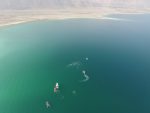
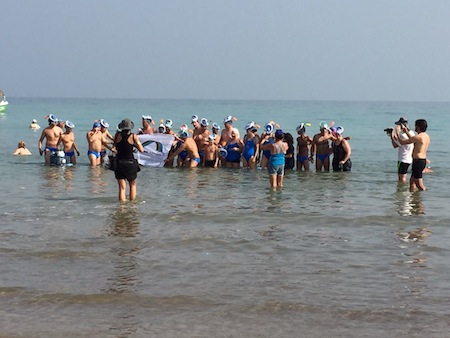
Twenty-five swimmers from around the world crossed the Dead Sea on Nov. 15. (photo from EcoPeace)
On Nov. 15, some two dozen swimmers made the seven-hour trek across the Dead Sea, starting from the Jordanian side and swimming to the Israeli.
The demise of the Dead Sea is not news. According to the group EcoPeace Middle East – a Jordanian, Palestinian, Israeli environmental peace-building organization – the sea has receded by 25 metres in the last three decades and has lost a third of its surface area. Yet, hope remains.
The recent event’s initiator and a participant swimmer, Oded Rahav, stated in an EcoPeace press release, “If it’s possible to do the impossible, like swimming across the Dead Sea, then it’s possible to save the Dead Sea. We are not just interested in raising awareness, but creating real action to benefit the Dead Sea.”
Co-sponsoring the event with EcoPeace was Tamar Regional Council in Israel.
“A group of Israeli swimmers approached EcoPeace last spring with an idea to do a first-ever event – to swim across it [the Dead Sea]!” said Mira Edelstein, project coordinator of EcoPeace’s Jordan River Rehabilitation and Save the Dead Sea projects. “Not only were they looking for an idea to follow their previous success in topping a Guinness record – swimming from Cyprus to Israel – they also sought a way to raise awareness about the need to save the Dead Sea.
“They, naturally, turned to EcoPeace, as we’re the only regional environmental organization in the Middle East working on the issue of the rehabilitation of the River Jordan, which is in direct correlation with saving the Dead Sea. We gladly took on co-organizing the event and worked hard to make it happen, especially in getting permission from the Jordanian army to ‘sail’ across the border in the middle of the sea, starting from the Jordanian side.”
The Dead Sea swim team. (photo from EcoPeace)
There were 25 swimmers from all over the world who participated, including from Israel, Palestine, South Africa, New Zealand, Greece, Spain and Denmark. They had to swim with a full-face snorkeling mask because of the water’s extreme salinity and they also had to adapt their swimming style because of the water’s high density. It was a life-risking venture and the swimmers were accompanied by a medical team, as EcoPeace notes in the press release: “A drop in the eye causes severe irritation, and chance swallowing of its water can be fatal if not treated immediately.”
The event generated an unprecedented amount of media attention and EcoPeace hopes this will help its ongoing efforts to get local decision-makers to take action on the issue.
“We’re also being approached by several other organizations to do other cross-border events – bicycle event, music event, art event, etc. – and we’ll review all of them to see which is more feasible and which will give us the best results,” said Edelstein, who was born and raised in New York and made aliyah in 1993. She now lives in Gan Yavne, which is near Ashdod. She joined EcoPeace in 2004.
“Personally, as an environmentalist but also a general nature lover, the Dead Sea is such a pearl of nature with so many unique qualities found nowhere else on this earth, that it would be a tragedy to lose it,” she told the Independent. “This is a man-made catastrophe and we must work as hard as possible to reverse it.”
Edelstein explained that the threats to the Dead Sea are coming from two directions.
“First is from the north,” she said. “Historically, the main inflow to the Dead Sea has been the Lower Jordan River. And, with the diversion of more than 95% of the Jordan River’s water by Israel, Jordan and Syria, leaving a meagre five percent to reach the Dead Sea … no wonder the Dead Sea is shrinking – by more than a metre a year.
“EcoPeace is working extremely hard to rehabilitate the Lower Jordan River back to at least a third of its historic flow, not only for the river’s own integrity – this is the holy Jordan River! – but we’re doing this for the Dead Sea as well.
“Second is from the south – from both Israeli and Jordanian mineral industries. These industries are using the most simple, antiquated, water-intensive technology to harvest minerals from the Dead Sea: evaporation. Unfortunately, both industries have no incentive to change their extraction technology, because they do not pay a penny for the amount of water they use.”
EcoPeace is working to change this; however, discussions about extracting minerals using systems based on desalination technologies (reverse osmosis) have come to a standstill, as they cost money, while evaporation is free.
“They claim they are studying them (these technologies), but have concluded that they’re very expensive,” said Edelstein. “Our point is exactly that – that until they will be forced to pay for the amount of water they use, any kind of change will be expensive.”
With the Israeli mineral industry’s contract with the state on its last leg, Edelstein is hopeful that a new contract will include putting a price on the Dead Sea’s water.
“EcoPeace is working very hard to get a bill passed through the Israeli parliament wherein the Dead Sea Works [part of the company ICL Fertilizers] will need to pay for the amount of water they use,” she added.
“Both of these actions together, that EcoPeace is working on, will help stabilize the Dead Sea. The Dead Sea will not yet be completely saved or restored, but we understand we first need to halt its destruction and [then] to work on stabilizing it.”
While there was a plan to draw water from the Red Sea to the Dead Sea, the original mega-project, which the World Bank was studying for more than a decade, has been deemed unfeasible. The present-day Red Sea-Dead Sea canal project “is different than the original one,” said Edelstein. “This project is based on a water swap between Israel and Jordan, which also includes a component for Palestinians to get more water from Israel.”
With both the Jordanian and Israeli governments working closely, mainly on furthering the canal project, EcoPeace applauds the joint efforts, but does not see the project as the solution.
“I do believe that the Dead Sea is high on the public agenda,” said Edelstein. “It’s not difficult to find information on the issue. Our website is being upgraded and we’ll soon have updated information to share, but recent news articles are a good place to begin.”
For more information about EcoPeace, which was formerly called Friends of the Earth Middle East, its Dead Sea and other projects, visit foeme.org.
ג’ון קרי בישראל בשנת 2013. (צילום: U.S. Embassy Tel Aviv via Wikimedia)
דוברת משרד החוץ של קנדה חוזרת על עמדתה הרשמית של ממשלת ג’סטין טרודו, שתומכת בהקמת מדינה פלסטינית לצד ישראל שתביא לסיומו של הסכסוך במזרח התיכון. דבריה נאמרו לאור נאומו של שר החוץ של ארה”ב, ג’ון קרי, שתקף בשבוע שעבר בנאום פרידה את ישראל, שלדבריו ממשיכה לבנות בשטחים ובכך מסכנת את אופציית הקמת המדינה הפלסטינית. לדברי מפלגת הירוקים הקנדית מדיניות נתניהו מהווה איום על השלום.
הדוברת של שר החוץ סטפן דיון, שנטל גניון, ציינה “שכתוצאה מהנחישות לבניית שלום קבוע בין ישראל והמדינה הפלסטינית, קנדה תתמוך במאמצים לקיים את פתרון שתי המדינות, וליצור את התנאים ששני הצדדים יחזרו לנהל משא ומתן ישיר למציאת שלום כולל, צודק ובר קיימא”.
חבר הפרלמנט מטעם המפלגה הקונסרבטיבית, פיטר קנט, תקף את ממשלת טרודו הליברלית לאור השתיקה שלה (אותה הגדיר “כמבישה אך לא מפתיעה”), על ההחלטה האנטי ישראלית שהתקבלה במועצת הביטחון של האו”ם. הוא הביע גם אכזבה מהממשל היוצא של אובמה בנושא. קנט ציין עוד כי עתה יותר מתמיד ישראל זקוקה לידידיה ולבני בריתה. לדבריו הדבר היחיד שמעניין את ממשלת טרודו הוא להיות שוב חברה במועצת הביטחון של האו”ם.
לעומתו חברת המפלגה הדמוקרטית החדשה, הלן לורדייר, וראש המפגלת הירוקים, אליזבט מאי, ציינו כי הן תומכות בדברי קרי לגבי ישראל והמזרח התיכון. לורדייר: “להתנחלויות הישראליות יש השפעה שלילית על הסיכויים לשלום. ומה שאנו רוצים באזור זה שלום לכולם”. ואילו מאי אמרה: “הייתי רוצה לראות שקנדה תנקוט עמדה תקיפה יותר. כמו שג’ון קרי אמר חברים הם שם גם כדי להגיד לך שמשהו אינו מתאים או אינו מקובל. המדיניות של נתניהו היא איום על תהליך השלום. אנשים צריכים להיות מסוגלים לומר את זה בכל רם מבלי שטון של לבנים ירדו עליהם”. מאי הוסיפה עוד כי חבל שארה”ב התמתינה כל כך הרבה זמן להפסיק עם החלטות הווטו שלה באו”ם.
יצויין כי מפלגת הירוקים הורידה מסדר היום את התמיכה בתנועת הבי.די.אס להחרמת ישראל, לאור איומיה של מאי לפרוש מההנהגה. המפלגה החליטה בראשית דצמבר לתמוך בהחרמת מוצרים ישראלים המיוצרים בשטחים.
כפי שפורסם בשבוע שעבר ראש ממשלת קנדה לשעבר, סטיבן הרפר, יצא נגד החלטת מועצת הביטחון של האומות המאוחדות שהכריזה לפני כשבועיים, כי ההתנחלויות של ישראל בשטחים אינן חוקיות ויש לפנותן. הרפר הגיב לתגובה של הנשיא הנבחר של ארה”ב, דונאלד טראמפ, שאמר: “בנוגע לאו”ם הדברים יראו אחרת אחרי העשרים בינואר”. הרפר בוודאי היה מסתדר עם טראמפ בכל הנוגע לסוגיית המזרח התיכון בכלל ולישראל בפרט. אך מעניין כיצד שני האישים היו מתנהלים אחד כלפי השני, בזמן שהרפר יצא נחרצות נגד פעילותה של רוסיה והעומד בראשה, הנשיא ולדימיר פוטין, והפעיל חרמות וסנקציות שונות, בעוד שטראמפ מסתדר עם רוסיה, מנהל מערכת יחסים די חברית עם פוטין והוא אף מינה לתפקיד שר החוץ אישיות מקורבת למנהיג הרוסי? הכל פוליטיקה.
ועוד בנושא ישראל: חברת הפרלמנט מטעם המפלגה הקונסרבטיבית שמנסה להתמודד על ראשות המפלגה, קלי ליץ’, והמכונה טראמפ של קנדה לאור ההתבטאיות החמורות שלה, ציינה כי אם תעמוד בראש המפלגה שגם תנצח בבחירות הכלליות ולכן תכהן כראש ממשלה, היא תעביר את שגרירות קנדה לירושלים. נוכח החלטת מועצת הביטחון ודברי קרי “על קנדה להפגין את תמיכתה בישראל” אמרה ליץ’.
מועצת הביטחון של האומות המאוחדות שהכריזה בשבוע שעבר כי ההתנחלויות של ישראל בשטחים אינן חוקיות. (צילום: UN/Manuel Elias)
ראש ממשלת קנדה לשעבר, סטיבן הרפר, יוצא נגד החלטת מועצת הביטחון של האומות המאוחדות שהכריזה ביום שישי בשבוע שעבר כי ההתנחלויות של ישראל בשטחים אינן חוקיות ויש לפנותן. כידוע ארה”ב נמנעה בהצבעה ולא הטילה וטו כך שנסללה הדרך לקבל את ההחלטה נגד ישראל וההתנחלויות. לעומת זאת ממשלת קנדה ברשות ג’סטין טרודו, בחרה עד כה שלא להגיב כלל להחלטת מועצת הביטחון. אם זאת סביר להניח שטרודו התומך בפתרון שתי המדינות בוודאי היה מישר קו עם מועצת הביטחון.
הרפר בעצם הגיב בחשבון הטוויטר שלו לתגובה של הנשיא הנבחר של ארה”ב, דונאלד טראמפ, שאמר בטוויטר כי לאור החלטת מועצת הביטחון את הדברים הבאים: “בנוגע לאו”ם – הדברים יראו אחרת אחרי ה-20 בינואר”. כידוע טראמפ יכנס לתפקידו בבית הלבן ב-20 בינואר 2017 (כ-90 אלף גולשים אהבו את דברי טראמפ). הרפר תמך בתגובת טראמפ להצבעה והודה על על התנגדותו הפומבית להחלטת מועצת הביטחון (כ-2,500 גולשים תמכו בדברי הרפר)”.
בתגובה לדברי הרפר הגולשים באינטרנט מיהרו להביע את עמדתם בעד ונגד. להלן שלוש תגובות “מעניינות ונאורות” התומכות בדברי הרפר, שמוכיחות שוב באיזה תקופה אנו נמצאים, כאשר אנשים מרשים לעצמם להגיד הכל. אחד הגולשים כתב: “קנדה צריכה מספר התקפות טרור מאסיביות. אולי זה יעורר את האידיוטים שיבינו עם מה ישראל צריכה להתמודד מדי יום מול האיסלאם”. גולש אחר: “אובמה מראה את צבעיו האמיתיים בנוגע לאו”ם המושחת והפוך. אני שמח שהוא עוזב”. ועוד גולש: “זו הנקמה של אובמה כיוון שמורשתו לא אומרת כלום אחרי ה-20 בינואר. טוב להרפר. עתה היכן טרודו עומד?”
משחקים בלגו: העירייה מצאה דרך להתקרב לתושבים
בוונקובר כמו בערים אחרות אין קשר חם בין העירייה לתושבים המקומיים, שממעטים להגיע למפגשים משותפים. בהנהלת העירייה של ונקובר הגיעו למסקנה שצריך למצוא דרך להתקרב אל תושבי העיר. לאחר בדיקות מקיפות שונות שכללו בין היתר משאל לתושבים באינטרנט, נמצא הפתרון המיוחל: קוביות לגו. מתברר שמשחק הלגו יוצר קשר בלתי אמצעי ומתמשך בין הצדדים שמשתתפים בו. מועדון הלוגו של ונקובר הובא בסוד העניין והפך לשותף מרכזי בפרוייקט החדש בין העירייה לתושבים. המועדון אחראי מעתה על אספקת חמישים סטים של קוביות למפגשים בין שני הצדדים. חברי המועדון בונים דגם ראשוני של נשוא הפגישה למשל מרכז קניות חדש, והמשתתפים שיושבים סביב שולחן גדול, ממשיכים בבניית הפרוייקט וכל מה שסביבו, תוך כדי שיחה. בהנהלת העייריה מציינים שהלוגו מאפשר לתושבים להיפתח יותר בקלות לנושאים שונים, ומספר התושבים שמגיע למפגשים הולך וגדל. בהם צעירים ובני נוער שהעייריה חפצה לשמוע גם את דעתם בנושאים שונים ובעיקר אלה הקרובים להם.
צים מרחיבה את השירותים באוקיאנוס האטלנטי כולל קנדה וארה”ב
חברת הספנות הישראלית צים החליטה להרחיב את שירותיה באזור האוקיאנוס האטלנטי, שכוללים גם את קנדה וארה”ב. כל זאת לשפר את שירותי הפריום בין החופים המזרחיים של קנדה וארה”ב עם ארצות הים התיכון – איטליה וצרפת.
השינויים שכוללים הוספת הקווים עם הפעלת חמש אוניות יבואו לידי ביטוי החל מחודש אפריל 2017. הנמלים בארה”ב אותם יפקדו האוניות הם: ניו יורק, נורפולק וסוואנה. ואילו בקנדה מדובר בנמל של הליפקס. הנמל בהפליקס נחשב לאחד החשובים ביותר בקנדה והוא משמש לנקודה המוצא המרכזית של קנדה לספינות שמפליגות לאירופה. אגב רבים מהמהגרים לקנדה נחתנו לראשונה בנמל הליפקס.
B.C. Finance Minister Michael de Jong speaks at the Canadian reception in Tel Aviv, kicking off the Nov. 13-17 trade mission to Israel. (photo from flickr.com/photos/bcgovphotos)
In November, B.C. Minister of Finance and House Leader Michael de Jong led a provincial trade mission to Israel. The invitation to delegates was sent by the minister and Dr. Moira Stilwell, MLA for Vancouver-Langara.
“A lot of the impetus for this [mission] derived from the tech sector, the health sciences sector, the cybersecurity sector itself here in B.C., who said, look, we are seeing increasing opportunities and we’d like to explore those further, is the government prepared to work with us?” de Jong told the Independent in a phone interview. “And that led to a conversation between myself and Moira – of course, she has been, for many years, a big proponent of growing the bilateral relationship – and, out of that emerged this formal trade delegation.”
It was de Jong’s second mission to Israel. His first was about five years ago, during his tenure as the province’s minister of health.
“The role the government and a minister can play is to help facilitate partnerships and contacts between people, and this particular group had done a lot of that work themselves,” he said. “So, for example, the Rick Hansen Institute had already created the beginnings of a partnership with Hadassah [Medical Centre] and we saw that go to the next level in terms of formalization. We went out to Technion University, which is this world-leading institute – in their hallway, they feature Nobel laureates the way other institutions feature alumni – it’s quite remarkable…. [On] the cybersecurity side, some of the folks who were with us are even now actively pursuing with colleagues in Israel opportunities for exchange and for trade and, ultimately, that’s what this is all about.”
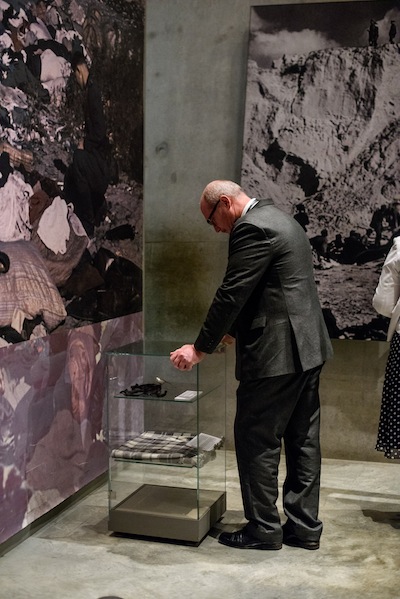
Finance Minister Michael de Jong at Yad Vashem during the November B.C. trade mission to Israel. (photo by Yuval Yosef)
Delegates on the Nov. 13-17 mission traveled to Tel Aviv, Jerusalem, Beersheva, Haifa and the West Bank to meet with various government, university and other stakeholders. Among those accompanying de Jong was Nico Slobinsky, director of the Centre for Israel and Jewish Affairs, Pacific Region. CIJA hosted an optional tour and Shabbat dinner on Nov. 18 for delegates who stayed after the mission was officially over, Slobinsky told the Independent.
“CIJA was delighted by the Government of British Columbia’s initiative to lead a trade delegation to Israel composed of B.C. entrepreneurs and professionals involved in life sciences and cybersecurity,” he said. “This mission assisted in cementing existing relationships, creating new partnerships and promoting opportunities in the province by deepening the economic, cultural and academic ties between Israel and B.C.”
One of those ties was with the Centre for Health Evaluation and Outcome Sciences (CHÉOS), a centre of the Providence Health Care Research Institute and the University of British Columbia faculty of medicine.
“Israel is viewed as a world exemplar in science, technology and commercialization – a place where we can learn, but also can share best practices from B.C.,” said Prof. Robert Sindelar, who, among other things, serves as an advisor to CHÉOS. He added, “Having participated in valuable and hugely beneficial B.C. trade missions previously to China and India, I said yes immediately when I had received the invitation to consider participating in a B.C. trade mission to Israel from the B.C. Ministry of International Trade.”
About the November trip, he said, “From our very first meeting in Israel to the very last meeting, I was continually impressed by our Israel hosts’ efforts to: 1) openly and candidly share valuable insight and details of their successes and endeavors with our delegation, and 2) the immediate connection in person or via email within 24 hours of an event to further explore potential opportunities and collaborations. Thus, we are already working together on several possible collaborations between Israel and B.C.”
Being a multidisciplinary health research centre, CHÉOS looks “to partner and collaborate with synergistic and like organizations researching at the cutting-edge of health and wellness,” said Sindelar. “Thus, true partnerships and collaborations with the best health-outcomes organizations in the world – sharing knowledge, skills and new methodologies – is a continuing goal for us. Each and every life-science event planned for the B.C. trade mission to Israel provided an opportunity and unique ideas for possible collaborations for CHÉOS health scientists and clinicians at a world-class level.”
Of course, the relationship with Israel extends beyond British Columbia to all of Canada.
“There is this very strong political and cultural tie,” said de Jong. “I think we still underachieve with respect to trade. I think there is genuine room for growth on the trade front. There are some emerging opportunities, as Israel begins to explore offshore energy potential.”
As well, “we have room to learn from the ‘start-up nation,’” said de Jong. “You go down to Beersheva, for example, and see how they have managed to create a technology hub in concert with the university there and the community there, and you see elements of that beginning to develop in British Columbia, in the Lower Mainland, in Victoria, but there are some real lessons to be learned.
“Frequently, the conversations began with the Israeli representatives reminding us of the unique challenges that they face and how innovation is borne out of necessity – smaller population base, smaller country, neighbors that aren’t always particularly friendly and, in some cases, are downright hostile, and, out of that, out of necessity, innovation has emerged. At one point, I replied to a group, acknowledged that and said I want you to think about another form of necessity. Imagine four-and-a-half million people in an area the size of Europe … well, that’s our circumstance. That breeds a different kind of innovation … 35 million people in a country that’s the second-largest country in the world. And so, we have to innovate in order to achieve a standard of living that is amongst the highest in the world, with vast distances and a very small population base, and we may have something to teach you about that. Different circumstances, both have required a degree of unique innovation, and two countries that have performed remarkably well economically.”
The cost of the trip, which included travel to Israel and England for the minister and his chief of staff, came in slightly below the ministry’s $25,000 estimate, said de Jong.
“It costs money,” he said. “You go to these hotels and, if you can find one that’s below $300 a night, you’re lucky. It’s not cheap.”
But, he explained, “It’s well spent if it facilitates business and trade. If it doesn’t, then it is not a sound investment. We try to track the trade stats and the partners that came with us and do the follow-up.”
Regarding that follow-up, he said, “Well, the trade ministry, who were also represented on the trip, will be following up with the members of the delegation; in some cases, providing additional information to folks we met in Israel. In a couple of cases, there are groups there who have indicated a desire to come here to follow-up. The ultimate test of success is the degree to which investment flows out of Israel into British Columbia and out of B.C. into Israel, and we see increased levels of commerce and trade in goods and services. We can dress it up any way we want, but that’s the measure of success. If, a year or two from now, our trade levels remain the same, then it hasn’t been a success.”
To those who support the boycott, divestment and sanction movement, de Jong said, “I disagree with the approach. I see benefits for British Columbia in developing and enhancing the trade relationship, benefits for Canada; I see benefits for Israel, I see benefits for the region. I met with the finance minister for the Palestinian Authority, went into Ramallah, had a conversation, obviously got a perspective on some of the economic challenges that they are facing. I had met earlier that day or the day previous with the Israeli health minister. There is a vexing challenge there, and I’m not going to pretend to have the recipe for resolution, but I do know that Canada and Canadians are well-regarded within Israel and, my impression was, amongst the Palestinian officials. To the extent that we can encourage or influence the prospect of negotiations and resolution, so much the better.”
After the mission to Israel, de Jong stopped in London, where British Columbia was honored by the London Stock Exchange for innovation in financial capital markets.
“As finance minister over the last five years, there’s a bit of a pattern,” said de Jong of his international travel in general. “After the budget, I’ll usually do a tour involving the North American markets, so Toronto, Montreal, New York, Boston, Chicago, that sort of triangle, if you will. We also have a lot of investors in Europe, so every second year, there will be a European show.
“As forestry minister, those were the years we were opening up the China market and were very active there, happily. It’s paying dividends now. And, more recently, we were the first government anywhere in the world to issue what are called ‘dim sum and panda bonds,’ one is offshore, one is onshore, Chinese currency bonds.
“Earlier, I mean just before I was in Israel, I was in India. We were the first government anywhere in the world to issue what are called ‘masala bonds,’ rupee-denominated bonds. We’re able to do these things because we’re triple-A … so we can go where no one has gone before … and break new ground. On the way back from Israel, I stopped in London, and the reason the stock exchange wanted to honor British Columbia was for creating an entire new trade through this masala bond. We issue it out of London and now, of course, others are following.”
According to Jewish Federation of Greater Vancouver chief executive officer Ezra Shanken, in his Nov. 18 e-newsletter, other local Jewish community members who joined the B.C.-Israel mission were Candace Kwinter, who is on Federation’s Israel and overseas affairs committee and CIJA-PR’s Local Partnership Council; Paul Goldman, who is CIJA’s immediate past chair; and Eli Mann, chief executive officer of Shield4UC, who also serves on Federation’s community security advisory committee.
In a rare venture into current events, the head of Yad Vashem has spoken out about the urgency of humanitarian disaster in Syria. After the forces backing Syrian dictator Bashir al-Assad succeeded in taking the rebel-controlled areas of Aleppo last week, murderous retribution unfolded and terrified residents fled for their lives.
Avner Shalev, chair of Yad Vashem, said “the global community must put a stop to these atrocities and avert further suffering, as well as provide humanitarian assistance to the victims seeking safe haven.”
It is not insignificant that the head of the world’s leading Holocaust museum and memorial would be moved to speak out on the subject. The atrocities the world is seeing stir memories of the past. No history is precisely like other history, obviously, and making direct comparisons can be unhelpful. Yet, after the Second World War, as the extent of the Holocaust became understood, international agencies, nations and individuals committed to a future free of those sorts of atrocities. Those promises have been betrayed too many times in the seven decades since, most recently in Syria.
When we look back in history, we ask, why didn’t this party or that country do more? Why was this or that allowed to happen? How did the world not step in sooner, when evidence began to mount about the rising danger of authoritarianism? Questions and answers are easier in hindsight. Yet there can be no doubt that Syria has presented especially difficult choices, even for actors who want to do the right thing.
U.S. President Barack Obama has insisted through the years of the Syrian civil war, which began at the time of the Arab Spring in 2011, that there was no military solution to the problem; that diplomacy had to prevail. He may have been correct that there was no military resolution. There are multiple bad guys in this fight – Assad’s regime, backed by Iran, Hezbollah and Russia, on one side, and al-Qaeda and ISIS on the other. And, on the third side – because this is, vexingly, a multiple-sided conflict – is an amalgam of defectors from the Syrian military, Kurdish militias, and other anti-Assad forces who may have democratic and pluralist intents. Or, were they to be victorious – which now seems unlikely in the extreme – they could split among themselves, their only cohesion perhaps being the glue of opposition to Assad. By one count, what we call the Syrian civil war is as many as 10 separate conflicts. The United States, Saudi Arabia, Turkey and Qatar have provided some support to the rebels, but it has been unreliable and uncoordinated. Estimates of the number of civilians and fighters killed range from 312,000 to more than 400,000.
Civilians casualties have been enormous, with all sides indiscriminately attacking civilian targets. Torture and extrajudicial killings typify the regime’s approach to war. Assad’s forces have also been accused of deliberately targeting medical installations and personnel. When the United Nations was able to secure humanitarian aid routes within Syria to provide food and medicine, the regime ensured that aid reached government-controlled areas and prevented aid from reaching rebel-controlled areas.
Negotiations have gone nowhere, because Assad is determined to hold on to power no matter how much of his population dies in the process, and he has powerful military friends in Russia and Iran who back his iron fist. The opposition is unequivocal that Assad must be deposed. There is no room for negotiation.
And so, the matter has come down to military might, with the last stronghold of the opposition crushed in recent days. Assad has now regained control of almost all the population centres of the country, with the rebels limited to peripheral enclaves.
In the process of the civil war, half of Syria’s population has been uprooted – six million people are displaced internally and another six million have been made refugees, with global implications, as European, American and other politicians have exploited fears of radicalization among refugees to advance their own xenophobic agendas. The effect may ultimately unravel the entire European Union.
Meanwhile, Hezbollah has been significantly strengthened and ISIS, which has suffered in Syria, will likely turn its attentions to more fertile ground elsewhere. The murderous Assad regime is more secure than it has been in years. Russia is ascendant in the region and globally. The United States has been chastened, and the incoming president is, characteristically, belligerent in rhetoric but anti-interventionist in expressed policy, which indicates nothing if not pandemonium in future U.S. approaches.
The world has failed the people of Syria – and, as a result, the world is a far more dangerous place.
Significant blame for this disaster must be placed on the United Nations, the primary bodies of which are hobbled by the control of despots who owe more to Assad’s governance style than to the vision of the idealists who founded the organization. While there are agencies under the UN umbrella that do superb work, its governance structures are so dysfunctional that talk of a replacement body must continue in earnest.
The least the world should be able to do now is pressure the emboldened government of Assad to allow humanitarian aid to reach those who need it and allow his citizens to move to places of safety. Then, the world should reflect on the lessons of this catastrophic experience and promise, yet again, not to let such a thing recur. What we’re doing isn’t working. To prevent recurrence, we need to stop pursuing the definition of insanity, which involves doing the same things and expecting a different result.
The World Health Organization has recognized Israel’s medical rescue teams and Israel Defence Forces’ field hospital as Type 3, the highest ranking for any foreign medical rescue team and field hospital in the world. (photo from United Hatzalah)
On Nov. 28, the World Health Organization (WHO) began a three-day meeting in Hong Kong, during which they recognized Israel’s medical rescue teams and Israel Defence Forces’ field hospital as Type 3, the highest ranking for any foreign medical rescue team and field hospital in the world. Israeli Deputy Minister of Foreign Affairs Tzipi Hotovely attended on behalf of Israel.
United Hatzalah, Israel’s national volunteer emergency medical services organization, and the Israelife Foundation, a conglomerate of Israel-based rescue organizations that respond to disasters worldwide, welcomed the award.
“We want to praise and thank all of the dedicated volunteers, staff and soldiers in all of the rescue services throughout the country. Their dedication and selfless acts of kindness in saving lives at home and abroad are officially being recognized on the world stage and, due to their efforts, Israel has become a world leader,” said Dov Maisel, United Hatzalah vice-president of international operations.
With the ceremony, Israel became the 17th foreign medical team to be classified by WHO, and it currently boasts the highest ranking. The process to achieve the ranking took nearly a year of in-depth reviews to ensure that Israel’s field hospitals met all of the criteria.
Besides the simple value of recognition, the Type 3 classification will also have some real ramifications. The classification ensures that Israeli rescue and medical teams will be the first allowed on the scene of future disasters regardless of where they happen and it will further cement Israel’s position as a world leader in emergency medicine.
Israel is not only the only Type 3 medical response team in the world, it is also the only one to be recognized by WHO that comprises a “military component” in the form of the IDF field hospital. Some aspects of the classification deal with the ethics of emergency care, and having a military branch receive the Type 3 classification highlights the ethical standing of that body.
The person behind the WHO classification system is Dr. Ian Norton, a specialist in emergency medicine and former head of his native Australia’s emergency response team. Norton developed the WHO system – which ranks foreign medical teams into Type 1, Type 2 and Type 3 – in 2013.
The different types refer to the number of patients that can be treated and the level of difficulty of the procedures that can be offered by a medical response team. Even with the high standards, Israel’s field hospital surpasses the requirements, offering more medical care than is required to be classified as Type 3. For example, the Times of Israel reported that a Type 3 field hospital needs 40 inpatient beds, whereas Israel’s has 86, and a Type 3 ranking requires the hospital to have two operating rooms, whereas Israel’s has four. Israel also qualified for the Type 3 category by employing teams that offer additional “specialized care,” such as burn units, dialysis units, obstetrics and gynecology teams, and reconstructive plastic surgery units. The IDF field hospital also received accolades for its abilities to provide exemplary levels of plastic surgery, and obstetrics and gynecology care. These latter qualifications establish the team as a “Type 3 plus.”
In addition to the field hospital, Israel was praised for the work done by its volunteer evacuation and emergency response teams, such as United Hatzalah, Zaka and Israelife. These teams of volunteer responders have conducted search and rescue operations and provided emergency medical services in disasters all over the world. Most recently, United Hatzalah sent Maisel, an emergency paramedic, to be a medical liaison and consultant as part of the Jet911 multinational response team that responded to the destruction caused by Hurricane Matthew in Haiti in October.
Other disasters to which the IDF field hospital and Israel medical response teams have responded include the earthquake in Turkey in 1999, the earthquake in Haiti in 2010, the typhoon in the Philippines in 2013 and the devastating earthquake that shook Nepal in 2015.