May defends new resolution

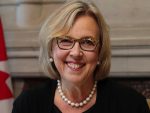
Green Party of Canada leader Elizabeth May. (photo from cjnews.com)

Federal Green Party of Canada Leader Elizabeth May said she was able to support a revised policy on the Israeli-Palestinian conflict because it rejects the boycott, divestment and sanctions (BDS) movement against Israel, but still puts the onus on the Jewish state to move towards a two-state solution.

At a special general meeting held Dec. 3-4 in Calgary, 350 members voted to pass a policy titled “Measures to pressure the government of Israel to preserve the two-state solution: addendum to current

Middle East policy.” It replaced a policy titled “Palestinian self-determination and the movement for boycott, divestment and sanctions” that passed in August at a Green party convention in Ottawa.

“It needs to be said very clearly that the BDS movement does not understand the issue properly and is in fact undermining the peace process itself,” May told the CJN the day after the addendum passed.

Immediately following the August convention, May firmly opposed the policy that supported the BDS movement.

“The reason I couldn’t accept our policy in August is because it looked very much as though we were adopting the BDS movement. And the BDS movement, although there are well-meaning people who support it, when you get down to it, their core goals do not include at all … the right of the state of Israel to exist,” May said.

At that time, May considered stepping down as leader as a result but, following a family vacation, she ultimately announced she would stay on as leader, partly because the party’s executive council agreed to call a special meeting to give members the opportunity to revisit the BDS resolution.

The amended policy states, among other things, that the “Palestinian people are among the indigenous people of the geographic region now designated as Israel and the OPT [occupied Palestinian territory],” and it supports “only non-violent responses to violence and oppression, including economic measures such as government sanctions, consumer boycotts, institutional divestment, economic sanctions and arms embargoes.”

It calls for a ban on products produced “wholly or partly within or by illegal Israeli settlements, or by Israeli businesses directly benefiting from the illegal occupation,” and it calls on the Canadian government to repeal the House of Commons resolution that condemned the BDS movement last February.

According to a statement by Thomas Woodley, president of Canadians for Justice and Peace in the Middle East, Green members voted 85% in favor of the revised policy.

Although the policy remains critical of Israel and still supports boycotts, divestment, sanctions and arms embargoes, its drafters were careful not to specifically endorse the international BDS movement. May insists the Green party is committed to a two-state solution.

“We condemn anyone who imagines that they don’t support, unequivocally, the right of the state of Israel to exist. That prefacing is critical to understanding the addendum,” she said.

“We’ve never been a party that was afraid to say out loud that we are critical of the decisions of the Israeli government from time to time. I think many Israelis are also critical of the decisions of the government from time to time.”

May said retired Israeli generals and intelligence officers who accuse Israeli Prime Minister Binyamin Netanyahu of undermining the peace process and weakening security for Israelis “make the case better than we can as Canadian Greens that there needs to be a course correction on the occupation, expansion of illegal settlements and so on…. We’d rather be aligning ourselves with criticisms that come from within the state of Israel, than with a movement that doesn’t understand the critical necessity to defend the right of the state of Israel to exist.”

May said she understands that the policy won’t sit well with many members of the Jewish community, but added, “There are a limited number of mechanisms that governments and parties can use to signal to a foreign government that we think you’re making a mistake here, while at the same time, remaining allies.”

Shimon Koffler Fogel, chief executive officer of the Centre for Israel and Jewish Affairs, said in a statement that the group condemns the resolution, “which confirms the Green party has been co-opted by extreme activists who – in their obsessive campaign of prejudice against Israelis – threaten the party’s own credibility and relevance in Canadian politics.

“The new policy is rife with historical distortions and places the Green party at odds with the Canadian consensus that BDS is discriminatory and counter-productive to peace. The Ontario legislature just voted by a tenfold margin to reject the differential treatment of Israel, underscoring how out of touch the Green party has become.”

The statement also pointed to the policy’s assertion that Palestinians are Israel’s “indigenous people,” and the implication that Jews have no ancestral or indigenous roots in Israel.

“Elizabeth May and the party’s leadership have turned their backs on the mainstream Jewish community, including the many Jewish Greens who no longer feel welcome,” he said, adding that despite calling attention to the Green party that the vote would take place on Shabbat, excluding observant Jews from the vote, the vote was held on Dec. 3.

Although May rejected the idea of boycotting Israel, she made a distinction between “legal Israel” and “illegal Israel.”

“I’d go out of my way to buy a product that is labeled a product of Israel from within the legal boundaries of Israel. But, personally, I prefer not to buy products that come from an area that is in illegally occupied territories, which, again, even retired members of the Israeli Defence Forces are saying are making life less secure for legal Israel.”

B’nai Brith Canada chief executive officer Michael Mostyn said he was encouraged by the rejection of the BDS movement.

“No matter how the party came to this position, it is a positive thing for Canadians that, once again, the antisemitic BDS movement has been rejected. It is especially significant given the amount of energy, time and resources being poured into the promotion of the antisemitic BDS movement by certain factions within the Green party.”

That being said, Mostyn added there is still misinformation in the policy.

“For example, the very characterization of settlements as ‘illegal’ under Article 49 of the Geneva Convention is either a deliberate misreading of that document, or complete ignorance of international law,” he said.

– For more national Jewish news, visit cjnews.com
There is danger in autocracy

Last week, an Israeli artist erected a life-sized golden statue of Israeli Prime Minister Binyamin Netanyahu in Tel Aviv’s Rabin Square. Reminiscent of the golden calf with its connection to forbidden idolatry, artist Itay Zalait said he was making a statement about freedom of speech in Israel and what he sees as a type of idolatry growing around the man sometimes called King Bibi.

Citizens gathered around the statue, arguing about its meaning and various interpretations. Because the installation was erected without a permit, city officials ordered it removed but, before the artist could do so, it was toppled by a bystander and left laying on its side like the figure of a deposed despot.

In addition to the prime minister’s office, Netanyahu occupies the portfolios of foreign minister, economy minister, minister of regional cooperation and communications minister.

In this latter role, Netanyahu has appointed figures to oversight positions that have allowed them to put a finger on the scale in support of media outlets that are sympathetic to the government. Similarly, American casino magnate Sheldon Adelson bankrolls the newspaper Israel HaYom, which is widely seen as a propaganda machine for Netanyahu.

The Netanyahu government is also seen as threatening the broadcast news sector, having undertaken an effort to replace the state-run broadcaster with a more complimentary version, only to reverse course when it appeared the new agency would also be insufficiently uncritical. Like other politicians in democratic countries, Netanyahu has found some popularity among his supporters by picking fights with the media, including individual reporters who report things unfavorable to the prime minister.

While discourse in Israel remains legendarily vibrant, evidence that the government may be attempting to influence or control aspects of journalistic freedom are rightly drawing deep concern. And this concern is exacerbated by evidence of other tendencies within Israeli society that seem to reflect authoritarian, anti-democratic and discriminatory inclinations.

Education Minister Naftali Bennett is having “ethical rules” drawn up for what university lecturers can and cannot say about politics. Culture Minister Miri Regev has promoted a bill to retroactively cut funding to cultural institutions that do not meet the government’s standard of “loyalty” to the state of Israel.

On a different, but similarly ham-fisted front, there is the attempt to legislate the public broadcast of the muezzin, the five-times-a-day call to Muslim prayer, which begins before dawn. Granted, not everyone is keen to have daily pre-dawn loudspeaker broadcasts, whatever the purpose, but such a move against a religious minority already experiencing myriad forms of discrimination calls into question fundamental issues of multiculturalism and respect for religious freedom and pluralism that need to be addressed.

The rabbinate has also weighed in on a few issues that have outraged progressive and feminist Israelis.

Crediting a 15th-century scholar, the Sephardi chief rabbi Yitzhak Yosef declared that women and yeshivah scholars are forbidden from serving in the Israel Defence Forces or performing national volunteer service. He claimed that women had been permitted to go to war at times in Jewish history, but only to cook and clean. The comments come at a time when Israel has seen a four-fold increase in the number of women combat soldiers and as some segments of the political spectrum and civil society are speaking up against what they see as the unsustainable tradition of military exemptions for the ultra-Orthodox.

Then there is Eyal Karim, who was recently sworn in as chief rabbi of the IDF. During his confirmation hearings, Karim was forced to explain earlier comments that seemed to justify the rape of non-Jewish women during wartime. He apologized, saying that his comments were a theoretical consideration of biblical permissions and prohibitions. Karim has also stated that women should not serve in the IDF, or sing at army events.

These and other developments have combined with the Netanyahu government’s warm reaction to Donald Trump’s election to raise alarm among some that Israel is on a path similar to the populist, authoritarian phenomenon seen in the United States and much of Europe. In so many ways, Israel’s body politic is sui generis, utterly unlike any other democracy on earth. Yet it should not surprise that what emerges among its closest allies should also find a place among Israelis.

Trump, tweeting from his gold-embossed chambers in Manhattan, is exhibiting plenty of monarchical characteristics. European political upstarts are glorifying strongmen of the past and, in some cases, of the present, in the form of the Russian leader Vladimir Putin. When these sorts of autocratic inclinations arise in Israel, they should be opposed there, just as they should be everywhere.

B’nai mitzvah connections

Teens from Temple Sholom’s sister congregation, Tzur Hadassah, in Israel. Rabbi Stacey Blank is on the far right. (photo from Rabbi Dan Moskovitz)

Derech L’Torah is a b’nai mitzvah orientation program currently offered by Temple Sholom, which pairs a group of Vancouver b’nai mitzvah with their Israeli counterparts. The Israeli families come from Tzur Hadassah, Temple Sholom’s sister community just outside of Jerusalem in the pre-1967 territory of the Judean hills. The ongoing dialogue has illuminated both similarities and differences between Israelis and Canadians preparing for the rite of passage.

“In Israel, boys are more often motivated to have bar mitzvahs by social pressure, whereas girls often desire to make a statement,” said Rabbi Dan Moskovitz of Temple Sholom. “They may be motivated by egalitarian, feminist ideals in a culture where the religious sphere is still more dominated by patriarchy.”

Canadian b’nai mitzvah may assume that Israelis will have a substantial leg up on bar or bat mitzvah preparation, but that is not necessarily the case. Canadians may actually have more synagogue experience than their Israeli compatriots, and Israelis find liturgical Hebrew something like Canadians find Shakespearean English.

“Whether Israeli or Canadian, both are going through the gateway of this liminal moment,” said the rabbi, “and both are being immersed in Jewish time and Jewish ritual.”

Among the parents, there are more similarities than differences, said Moskovitz.

In Israel, a bar mitzvah is not “required” for Jewish identity, whereas, in Canada, those who don’t have a bar mitzvah rarely cultivate a strong Jewish identity as they grow up.

“Both sets of parents want their children to be successful, without them feeling too pressured, and, for both, some of them are guiding their children through something they themselves may have walked away from.”

One of the main benefits of the program, said Moskovitz, is the way that it joins together parents of b’nai mitzvah into a cohort to connect with and support each other.

The program starts in the spring of Grade 6 and goes to the fall of Grade 7. Among the Temple Sholom contingent, the students tend to be about one-third from Vancouver Talmud Torah and Richmond Jewish Day School, and most of the rest have a supplementary school background.

The partnership between Temple Sholom and Tzur Hadassah aims to create a vibrant connection between Reform Jews in Canada and Israel and goes beyond the Derech L’Torah program. Visitors to Israel from Temple Sholom have attended Shabbat dinners and synagogue services at Tzur Hadassah, and Temple Sholom supported a community garden project there. Rabbi Stacey Blank of Tzur Hadassah has taught an adult education at Temple Sholom via Skype, and Moskovitz and Blank have published articles in each other’s temple bulletins.

Matthew Gindin is a freelance journalist, writer and lecturer. He writes regularly for the Forward and All That Is Interesting, and has been published in Religion Dispatches, Situate Magazine, Tikkun and elsewhere. He can be found on Medium and Twitter.

Spinal cord registry expands

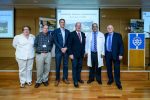
Left to right: In Jerusalem, during British Columbia’s trade mission to Israel, are B.C. MLA Dr. Moira Stillwell, Hadassah Medical Centre’s Dr. Guy Rosenthal, Rick Hansen Institute chief executive officer Bill Barrable, B.C. Finance Minister Michael de Jong; and Hadassah Medical Centre’s Prof. Eyal Itshayek and Prof. Yoram Weiss. (photo from RHI)

The medical interventions and outcomes of Israelis with spinal cord injury (SCI) can now be captured in the Rick Hansen SCI Registry (RHSCIR), a prospective observational study of individuals sustaining a traumatic SCI, thanks to the teams at the Rick Hansen Institute (RHI) and Hadassah Medical Centre.

Spinal cord injuries have a devastating impact on the health and well-being of the individuals affected. SCI health-care services are highly specialized and complex and place a significant burden on health-care systems. By connecting clinicians, researchers and health-care administrators, the goal of the registry is to advance research, improve clinical practice and reduce health-care costs.

The registry has sites at 31 major acute care and rehabilitation hospitals across Canada. In the last year, registry sites have been established in China, New Zealand and, now, Israel, marking its turn as a truly global study that connects the international SCI research and clinical care communities. There are currently more than 6,000 individuals with SCI enrolled in the registry.

At Hadassah Medical Centre, the registry pilot study is led by Dr. Eyal Itshayek and a team of researchers who will collect details about study participants’ SCI, including the extent of their injury, level of paralysis, recovery, success of various treatments and impact on quality of life and physical function.

RHI and Hadassah celebrated their established partnership with an official launch of the RHSCIR pilot study on Nov. 16. RHI’s chief executive officer, Bill Barrable, and manager of commercialization and industry relations, Jonathan Miodowski, visited the hospital as part of British Columbia’s trade mission to Israel, led by B.C. Minister of Finance Michael de Jong.

The delegation and invited guests attended a presentation from Hadasit Technology and took a tour of the trauma unit of the medical centre, which was followed by the RHSCIR pilot launch event. Elad Strohmayer from the Israel Ministry of Foreign Affairs, and Ralph Jansen, deputy head of mission from the Canadian Trade Commissioner Service, had the opportunity to say a few congratulatory words, along with de Jong, hospital representatives and Barrable. De Jong spoke highly of the partnership between Hadassah Medical Centre and RHI, and of how the launch of RHSCIR “forges another link in the chain of research that will make life better for so many people.”


Help from Muslim neighbors

Moriah Congregation’s prayer books were among items destroyed in the Haifa fires. (photo from masorti.org)

The Masorti Foundation for Conservative Judaism in Israel put out an international call for donations to help Moriah Congregation rebuild from the ashes after the recent week-long wildfires that raged across Israel. But it was two small, local initiatives that put the damaged synagogue into the headlines.

On Nov. 30, a group of worshippers from all faiths attended a special prayer service for the new Hebrew month of Kislev and to show support for the rebuilding of the community. A local member posted Facebook photos of the service. One of the photos showed 20 saplings donated by a man from Baqa al-Gharbiyye, an Arab city in the Haifa district, as a gift to replace the trees in the courtyard that had been burned in the fires.

And he wasn’t the only one bearing gifts.

Two Muslim tradesmen from Umm al-Fahm, another Arab town in the Haifa district, also came to the service and were greeted with great applause for their contribution of wood panels to the synagogue.

Moriah Congregation – the oldest Conservative synagogue in Israel – suffered extensive damage in the fires. The whole second floor and roof of the building were destroyed, including their beit midrash, all of their books, their education wing and their youth club.

At first, the Moriah community turned to a Jewish carpenter for help. He agreed to work pro-bono but asked that the synagogue pay for the wood. He went to get a price quote from wood suppliers Walid abu-Ahmed and Ziad Yunis. When they heard that the previous tables were destroyed in the fires that devastated 13 neighborhoods in Haifa, they chose to donate enough wood for 10 tables.

“I had tears in my eyes when I heard what was happening,” Rabbi Dov Hiyon, who heads the Moriah community, told Ynet news. “It was so emotional to hear that Muslims were asking to donate to a Jewish synagogue. I’ve invited them to evening prayers to personally thank them.”

“I decided to help and not receive any payment,” abu-Ahmed told the Hebrew daily news site. “Jews and Arabs live together in Haifa, and there is no discrimination. We must continue with this coexistence and promote peace.”

Israel21C is a nonprofit educational foundation with a mission to focus media and public attention on the 21st-century Israel that exists beyond the conflict. For more, or to donate, visit israel21c.org.

Bringing Israel to the table

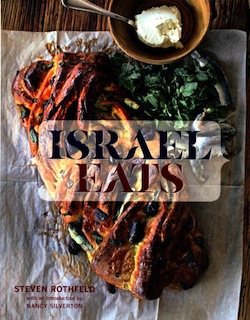
Steven Rothfeld is a travel photographer with an emphasis on culinary cuisine. He has written more than 10 books of photography and lives in Napa Valley, Calif. His cookbook Israel Eats (Gibbs Smith Publishers) came out earlier this year.

In the introduction, Rothfeld describes how he met an Israeli on a train in Italy in 1984. The fellow passenger asked Rothfeld why he hadn’t been to Israel. Twenty-five years later, reading Amos Oz’s memoir, Rothfeld’s imagination started working. In 2010, he finally made the trip.

“I encountered a world I had never imagined existed in Israel,” he writes, referring in large part to the vibrant cuisine.

He had worked on three books previously with chef Nancy Silverton so, when he conceived of Israel Eats, he asked her to join him.

Silverton is a chef, baker and author of eight cookbooks. She won the James Beard Foundation’s outstanding chef award of 2014 and lives in Los Angeles. She had been intrigued by Yotam Ottolenghi and Sami Tamimi’s cookbook Jerusalem and, in Israel, she discovered that “the cuisine of Israel is an extraordinary layering of flavors.”

And, writes Rothfeld, “Contemporary Israeli cuisine reflects a global consciousness rooted in a vast, mind-boggling array of cultural influences and traditions.”

Rothfeld and Silverton’s enthusiasm infuses this book.

book cover - Israel EatsAfter Haaretz journalist Ronit Vered explains the history of Israel’s cuisine from the 1950s to today, Rothfeld and Silverton embark on a tour of Israel – Tel Aviv-Jaffa, the north, the centre, the south, Jerusalem and the Judean hills, concluding with the “ecosystem of Israel Eats,” meaning the people who contributed to the book.

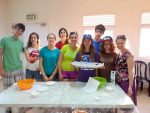
Each “chapter” has an introduction, with accounts of places Rothfeld and Silverton visited and people they met, and is followed by the recipes, each with its own introduction, source and beautiful color photographs.

Some of the recipes are from restaurants and chefs, others are from individuals and some are by Silverton. This is not a kosher cookbook but only five recipes are strictly non-kosher and most of those could be adapted by leaving out one ingredient that would not change the tone of the recipe; only one recipe is not adaptable. There are 90 recipes in total, and here are a couple.

HALLOUMI CHEESE FLOWER
(two servings: “A single flower will only make you crave a bouquet.”)

3 tbsp olive oil
1 ripe, medium-size tomato, halved and thinly sliced
3 to 4 ounces halloumi or mozzarella cheese, thinly sliced
salt and freshly ground pepper
3 large garlic cloves, thinly sliced
1 small fresh green chili, thinly sliced
10 cilantro sprigs

Heat oil in a heavy eight-inch skillet over medium heat. Arrange tomato slices in the skillet in the shape of a circle. Top the tomato slices with cheese slices. Sprinkle with salt and pepper. Arrange the garlic and chili slices atop the cheese. Bunch the cilantro sprigs in the centre of the skillet. Continue cooking until cheese is soft but not totally melted. Serve immediately.

VANILLA ICE CREAM WITH CHERRY TOMATO JAM
(four to six servings: “an excellent and surprisingly tasty marriage”)

1 pound cherry tomatoes
1 2/3 cups sugar
2 tbsp water
1 tbsp black peppercorns
2 pints vanilla ice cream
chopped fresh mint leaves

Combine the tomatoes, sugar, water and peppercorns in a medium-size heavy pot and bring to a boil. Reduce heat and simmer, stirring occasionally until the mixture is thick and syrupy and reduced by half, about one hour.

Divide the ice cream among bowls. Spoon the tomato jam over the ice cream. Garnish with mint.

Sybil Kaplan is a journalist, foreign correspondent, lecturer, food writer and book reviewer who lives in Jerusalem. She also does the restaurant features for janglo.net and leads walks in English in Jerusalem’s market.

Fêting Shemer, Cohen

Mauro Perelmann is coming from Brazil to lead a Dec. 17 musical tribute to Naomi Shemer and Leonard Cohen. (photo by Natan Guterman Fotografia)

On Dec. 17, Congregation Beth Israel will host a tribute concert to Israeli singer songwriter Naomi Shemer. The brainchild of Brazilian musical director, composer and arranger Mauro Perelmann, who appeared at Or Shalom last winter, the tribute show was originally created for a performance in Rio de Janeiro, Brazil. Following its success there, Perelmann is bringing the show to Vancouver, featuring local singers Stephen Aberle, Debby Fenson and Wendy Rubin.

The Vancouver concert – which will also include a tribute to Canadian icon Leonard Cohen, who passed away since the initial plans were made – is the result of extensive collaboration both internationally and within the Jewish community here. With the help of Perelmann’s friend Yom Shamash and sponsored by Congregation Beth Israel, Limmud Vancouver and Or Shalom, the concert features Shemer’s “best and most beautiful songs,” said Perelmann.

The archetypal Sabra, Shemer was born in 1930 at Kvutzat Kinneret, the Galilee kibbutz her parents helped found. Like other celebrated artists, she served in the Israel Defence Forces as part of the Nahal entertainment group, and went on to study at the Rubin Academy of Music in Jerusalem, now the Jerusalem Academy of Music and Dance.

After studying both classical and folk guitar in his home city of Rio de Janeiro, Perelmann followed in Shemer’s footsteps at the Rubin Academy. He studied there for a period of four years, 1976-1980, and it changed his life.

Raised in a secular Jewish home, both he and Shamash were members of Hashomer Hatzair, the Zionist youth group. Perelmann described his time in Israel as “a very touching experience, very important to my life.” On returning to Rio, he said, “I began to work as a musician, composer, arranger in Brazil. I returned to klezmer, to Hebrew and Israeli music. I began to work here in the Jewish community.”

Nowadays, Perelmann’s work follows “three branches,” he said: Jewish music; vocal music for choirs and other groups; and soundtracks for television and movies.

With only two weeks between his arrival in Vancouver and the concert, Perelmann has rehearsed with the three local singers via Skype. It was the first time he had used this technology to rehearse music.

“I sent them the scores with the voices written down and we used the technology to shorten the distance between us. It worked well! They went to the same place, I heard them singing, gave them feedback. When I arrive in Vancouver, we’ll rehearse with the whole band.”

Perelmann speaks passionately of Shemer’s compositions. He referred to her as “the voice of Israeli culture until the 1970s: the love of nature, of the people,” and added, “any Jew raised with music must know Naomi Shemer.” He described a wide-ranging repertoire, from touching love songs like “Umbrella for Two,” to lyrics describing scenes of everyday Israeli life, childhood and nature. Shamash described Shemer as the representation of “our idealized vision of a just, socialist and Zionist Israel.”

Concert-goers can, of course, look forward to hearing Shemer’s most celebrated work, “Yerushalayim Shel Zahav.” Made famous by Shuli Natan’s passionate renditions, it is a hauntingly nostalgic work, commemorating the end of the Six Day War of 1967. Combining a magical mix of open-hearted optimism and steely conviction, Shamash commented, “it was a kind of national anthem,” which united both a country and a generation of Jews around the world.

While it is widely regarded as a second national anthem of Israel, the song is not without controversy. In response to questions about the origins of the melody in Basque folk music, Perelmann said, “it happens in music; it wasn’t a conscious decision.”

And Shemer is known to have raised questions from Amos Oz, and others, over the perceived politics in “Yerushalayim Shel Zahav.” Describing the Jerusalem marketplace as “empty” without Jews, one might imagine that Shemer’s song disregards the presence of Arab Israelis. However, as Perelmann explained, Shemer clarified, “If there are no Jews there, then it is empty to me.”

Among the other Shemer songs to be featured at the Vancouver concert are “Al Kol Eleh,” “Hurshat Ha’Eucalyptus” (her song about the trees of Kvutzat Kinneret), “Lu Yehi,” “Orhim Lakayitz” and “Mahar.”

Vancouver singer Fenson treasures memories of “sitting around a campfire singing songs,” and described a lifelong relationship with Shemer’s music. “I received a book of Naomi Shemer songs for my bat mitzvah,” she shared. “Part of learning to speak Hebrew came from reading and singing those songs. Later, I used Naomi Shemer’s songs (and others) to help a friend who was also learning the language.”

As for the Cohen component of the concert, Shamash said, “The idea to add a small tribute to Leonard Cohen came from the Canadian singers…. The news of Leonard Cohen’s passing hit everyone hard, especially because it came two days after Donald Trump’s election. All of a sudden, the world looked darker and the need to grieve and mourn became more urgent. We all needed to see the light through the cracks of the broken world. I was asked to call Mauro to add a few Leonard Cohen’s songs. He understood. Hallelujah.”

The Shemer and Cohen tribute at Beth Israel on Dec. 17 starts at 8 p.m. Tickets are available at brownpapertickets.ca or at the door.

Shula Klinger is an author, illustrator and journalist living in North Vancouver. Find out more at niftyscissors.com.

Greens’ policy on Israel

On Saturday, Dec. 3, at a meeting in Calgary, the Green Party of Canada (GPC) passed a resolution updating the party’s position on the Israel-Palestine conflict. It puts the entire onus for the conflict’s continuation on Israel, specifically on Prime Minister Binyamin Netanyahu.

“The possibility of a two-state solution is diminishing directly due to the Netanyahu government’s support for illegal expansion and increasingly brutal military occupation,” reads the Dec. 4 statement on the Green party’s website. “Even over 200 former members of Israeli Defence Forces (‘Security First’ [plan for West Bank, Gaza]) have decried the worsening security situation for Israelis and Palestinians – and laid the blame directly on Prime Minister Netanyahu’s policies. The former Israeli military officers have raised the alarm of a ‘humanitarian crisis in Gaza’ and the diminishing chances for a two-state solution.

“Clearly,” continues the statement, “Canada needs to do more to register with the Israeli government that flouting international law and threatening the security of its own people while violating the human rights of Palestinians is not acceptable. In doing so, Canada must continue to condemn violence from the militant elements of Palestinian society.”

While rejecting the boycott, divestment and sanction movement – as its goals “do not include supporting the right of the state of Israel to exist” and are “incompatible with Green party policy”– the addendum to the party’s policy “is based on clear differentiation between ‘legal’ Israel, as within the 1967 borders, a democracy respecting the rights of citizens of all ethnicities within its borders, and ‘illegal’ Israel – the occupied territories beyond Israel’s legal borders. The Palestinian civilians within the occupied territories are subjected to virtual continual abuses of their human rights. The occupied territories are maintained under a brutal military occupation. Products from illegal Israel should not be granted the preferred trading status of products of legal Israel.”

With this in mind, the Green party would like to see the Canada-Israel Free Trade Agreement renegotiated, the “termination and indefinite suspension of all military and surveillance trade and cooperation” between Canada and Israel, and the repeal of “the House of Commons resolution condemning the BDS movement.”

According to the Dec. 3 article “Greens vote for new Israel policy without BDS” by James Munson on ipolitics.ca, “Approximately [350] members voted on the ‘compromise’ resolution that purged the party’s policies of any reference to the Palestinian-led boycott, divestment and sanctions (BDS) movement, which pressures companies, governments and institutions with ties to Israel.”

The article cites Green party president Ken Melamed as saying, “The party wanted to be careful not to align with a particular organization or movement. The essence of it, I think, is that the party feels that diplomatic approaches to achieving peace and justice in the Middle East have been ineffective and it’s time to move to economic actions.”

The article said that, according to Melamed, about 85% of those who voted at the meeting supported the resolution – others opposed or abstained – but that it still had to be voted on electronically by all 20,000 party members before it became official policy.

Shimon Koffler Fogel, chief executive officer of the Centre for Israel and Jewish Affairs (CIJA), condemned the resolution. In a Dec. 3 statement, he noted, “The new policy is rife with historical distortions and places the Green party at odds with the Canadian consensus that BDS is discriminatory and counter-productive to peace. The Ontario legislature just voted by a tenfold margin to reject the differential treatment of Israel, underscoring how out of touch the Green party has become.

“Elizabeth May and the party’s leadership have turned their backs on the mainstream Jewish community, including the many Jewish Greens who no longer feel welcome. Despite repeatedly flagging that the anti-Israel vote was scheduled to take place on the Jewish sabbath, senior Green party officials insisted on holding the vote today, thereby excluding many Jewish Green party members from voting. This is an alarming development and a stunning failure of leadership.”

The December resolution replaces a resolution that was passed at the Green party convention in August.

In the backgrounder to Fogel’s statement, CIJA notes, “The party’s decision to endorse economic penalties against Israel is incompatible with the wishes of the party’s grassroots. A survey of Green members conducted by the party after their convention revealed that, of 2,800 respondents, 28% agreed with the decision to support BDS, 44% wanted it repealed and 28% thought it should be amended to remove any reference to a specific movement or country.”

The backgrounder further explains, “The text’s exclusive recognition of Palestinians as ‘the indigenous people’ of the region implies that Jewish people have no ancestral or indigenous roots in Israel. This misleading suggestion contradicts millennia of archeological and documentary evidence.”

And, CIJA warns, “The one-sided nature of the resolution and its call for extreme measures against Israel puts the Green party outside the international consensus for achieving peace, which emphasizes the need for both parties to compromise and negotiate.”

Note: This article has been edited to reflect later reports that about 350 party members voted on the resolution, versus the number cited on ipolitics.ca, which was approximately 275.

Landscapes alive with color

Sandy Blass’ solo exhibit No Other Country is at Zack Gallery until Dec. 12. (photo by Olga Livshin)

Artist Sandy Blass’ first solo show in Canada – No Other Country, a series of landscapes – opened last week at Zack Gallery.

Blass has always liked painting, and received her fine arts degree from the University of Calgary in 1984. She worked an office job full-time, raised her family in Calgary and painted as a hobby. Only after her children grew up could she allow herself the joy of following her heart into the arts. Although she still works – part-time at the Jewish Family Service Agency in Vancouver – she now considers herself a full-time artist.

Two important events contributed to her recent emergence as a full-time artist: first, she visited Israel for the first time in 2012; second, she moved to British Columbia in 2014.

Her show’s title, No Other Country, comes from the Hebrew song “I Have No Other Country,” about Israel, although, for Blass, a Jewish Canadian born and raised in Calgary, the sense of belonging is broader. “I belong in both places,” she said in an interview with the Independent, “Canada and Israel.” Her painting “Under the Same Sky,” an abstract play of lines and colors shaped like clouds, feels like the artist’s manifesto, reflecting her love for both countries.

Blass’ discovery of Israel and all things connected to Judaism came late in life. “My parents were Holocaust survivors. We didn’t talk about anything Jewish or about the war,” she explained. “Sometimes, my parents whispered about it but they never talked to me. Our home was secular and full of anxiety. My father always told me not to let anyone know that I was a Jew. Of course, after his concentration camp experience as a young boy, his fear was justified. I never questioned it.”

The older she grew, the more she wanted to learn about her roots and her family history. “I felt that I was missing something,” she said. “My father didn’t want to talk about the past, but my aunt did. She told me some of my family story when I was in my 20s. Later, I started painting with regard to my family history, exploring it through my imagery. I started going to shul. And, finally, I went to Israel.

“The first time – I traveled there in 2012 – I felt like I came full circle. I have family there, those who survived the war in Europe and immigrated to Israel afterwards. Since then, I’ve visited every year. I have even been thinking about aliyah, but not yet. I don’t feel that it is the right time.”

image - "Akko Beach" by Sandy Blass
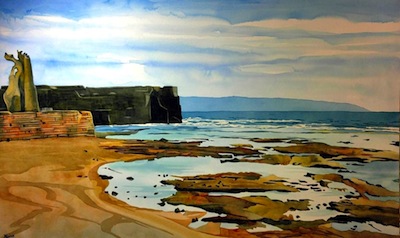
“Akko Beach” by Sandy Blass.

After that first visit, Israel found a permanent place in the artist’s heart and in her paintings. “Since I reconnected with my Jewish identity, I paint both Canadian and Israeli landscapes,” she said. “I traveled to Europe, too, but I never painted there.”

Blass’ bright, vibrant compositions are half real and half abstract, although they are always linked to a particular place. “The sky is always imaginary though,” she said with a smile. “I love painting sky and water. Blue and green are my favorite colors. I love painting reflections, whether in the ocean, a mountain lake, a sea, or just a puddle. This way, water and sky come together, and the best medium to express their coupling is watercolors.”

She paints her landscapes exclusively in watercolor, her favorite medium. “I fell in love with watercolor in high school,” she said. “I love its flow, the transparency of colors. I tried other media over the years – oils and acrylic – but nothing worked for me, while I flourish in watercolors.”

Although watercolor is not the most popular type of paint for professional artists – the majority throughout the centuries has preferred oils – she is in good company. “Watercolors have a respectable place in art history. Joseph Turner, one of the foremost British landscape painters, worked in watercolors,” she said, listing well-known artists who used the same medium she does. “Toni Onley, one of the few Canadian artists represented at the Tate Gallery in London, worked in watercolors. I also want to make inroads into contemporary art in watercolors.”

One of the reasons for her love of watercolor, surprisingly, is that the paintings are not finished when the artist puts down her brush. “I don’t have complete control. The painting is only done when the water stops flowing, dries thoroughly,” she explained. “I experiment with the water flow sometimes. I have a special art table where I paint, and I might change the angle of the surface to affect the water flow. The results could be interesting. Also, the time it takes to dry could be important. Vancouver is more humid than Calgary, so it takes more time for the paintings to dry here. I like the end results better.”

No Other Country continues until Dec 12. To learn more about Blass’ work, visit blassart.com.

Olga Livshin is a Vancouver freelance writer. She can be reached at olgagodim@gmail.com.

Fires take a huge toll

Prime Minister Binyamin Netanyahu examines arson damage in Beit Meir. (photo from Ashernet)

photo - Latrun forest fire
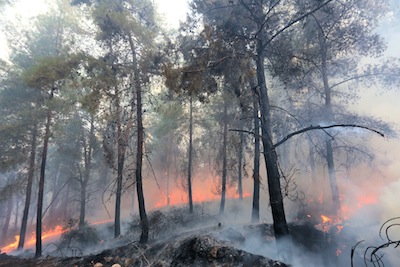
Latrun forest fire. (photo from Ashernet)

Last week’s wave of fires across northern and central Israel is estimated to have caused, so far, some half a billion shekels in damage, and total projections are higher. Several thousand homes have been either destroyed completely, or partially destroyed in the infernos.

In many cases, the fires have been set deliberately. Drones equipped with UV detection equipment filmed several instances of arsonists setting fire to brushwood around the Jerusalem region and in the north near Haifa, and several suspects have been arrested. Matters have been made worse by the fact that the winter rains have not yet started and the forests are very dry. Also, the temperatures have been higher than usual in most parts of the country.

photo - Prime Minister Binyamin Netanyahu talks with firefighters from Croatia, who came to assist in putting out the fires in northern and central Israel
Prime Minister Binyamin Netanyahu talks with firefighters from Croatia, who came to assist in putting out the fires in northern and central Israel. (photo by Kobi Gideon / GPO via Ashernet)

Several countries, including the United States, Greece, Croatia, Cyprus and Turkey, have sent fire-fighting aircraft to Israel to assist in getting the fires under control. The Palestinian Authority also sent firefighters to assist the Israeli teams to control the infernos.

On Nov. 27, Prime Minister Binyamin Netanyahu toured one of the worst-affected areas, just west of Jerusalem, in Beit Meir. The prime minister saw at least 10 homes that had been destroyed and many others showing serious fire damage, making even those uninhabitable.

JNF Canada has started an emergency campaign, every dollar of which will go to rehabilitation and clean-up efforts. For more information, visit jnf.ca or call 604-257-5155.