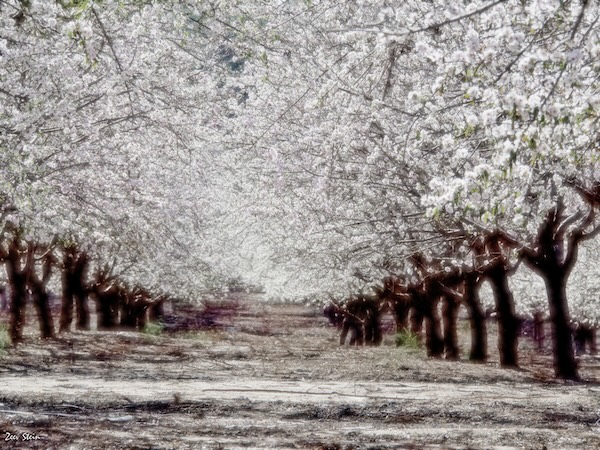
Almonds trees on the way to Jerusalem. (photo from PikiWiki)
While Israelis are not what you would call nature worshippers, once a year they do celebrate one aspect of nature: trees. Tu b’Shevat (the holiday’s name is derived from the Hebrew calendar date) is observed yearly, even when there are challenging conditions. For example, in 1991, under the threat of a gas attack from Iraq’s Saddam Hussein, residents in my neighbourhood brought along gas masks when they went out to plant trees. They were lucky on two counts: they didn’t have to use the masks and the almond trees were already blossoming.
The first celebration of Tu b’Shevat, or the “Birthday of the Trees,” occurred in the very early days of the 20th century, though the idea was older than that.
In 1891, educator Ze’ev Yavetz told Haaretz newspaper that, “for the love of the saplings … the school must make a festival of the day that was set aside from ancient times in Israel as the New Year of the Trees. To gracefully and beautifully arrange the trees, saplings, lilies and flowers just like they do in Europe on the first of May.”
That Yavetz mentions Europe is key, as decision-makers in the Jewish National Fund, or Keren Kayemet L’Yisrael, which was founded in 1901, based what they planted in pre-state Israel on the European trees with which they were familiar, mainly conifers.
After the Ottoman Empire fell and the Ottomans left what was then called Palestine, it was discovered that they had not taken care of the land itself. As such, the flora mostly consisted of maquis and garrigue, shrubs and small oaks. However, neither the British nor the Zionists were particularly interested in or familiar with the native flora of the region. Instead, they introduced trees that had not previously grown there.
By 1903, the Jewish National Fund had purchased its first parcel of land in the coastal region of Hadera and, by 1935, it had already planted 1.7 million trees over a total area of 1,750 acres (708 hectares). In the early years of its land restoration, the JNF planted large amounts of fast-growing conifers, and pine forests proliferated throughout the country.
Conifers are mostly evergreens or woody plants, with narrow leaves, often needle-like. They include firs, pines and cedars. There are separate male and female reproductive structures, the cones, and pollination is always by wind. The seeds are mostly winged, and the trees have a regular branching pattern. The needle-like, waxy leaves are helpful in a climate like Israel, as the leaves minimize water loss, but it is not clear whether early planters considered this point.
Four of the Seven Species mentioned in Deuteronomy 8:8 are native trees of the land of Israel. They include date, pomegranate, fig and olive trees. Of note, the fruits of these trees are included in the seder for Tu b’Shevat.
Karin Kloosterman, editor and writer for Green Prophet, describes one interesting, but sometimes overlooked tree in southern Israel. The sidr tree is widespread in the wadis of the Jordan Valley and in the arava, the area that roughly begins at the southern end of the Dead Sea and continues to Eilat. The distance of the arava is about 196 kilometres and it is more or less the divider between Israel on the west and Jordan on the east.
The sidr is a testament to resilience. It has weathered ancient floods and stands tall alongside the tamarisk and the mustard tree. Belonging to the ziziphus family of plants, it reaches an average height of seven or eight metres, with soft, yellowish grey branches, yellow flowers, and round fruits that turn reddish when ripe.
To Muslims, the sidr tree is considered sacred, as the Quran mentions it as being one of the plants in Paradise. It is important to Christians, as its leaves were supposedly used to make Jesus’s crown of thorns. The tree’s leaves, rich in calcium, iron and magnesium, hold therapeutic powers, serving as components in natural wound disinfectants and herbal shampoos.
Not everyone has been happy with Israel’s tree-planting policies. Ironically, the olive tree, the tree that is supposed to be the symbol of peace, has been the most contentious tree in today’s Israel. Palestinian farmers in particular have faced having their olive trees damaged or destroyed by either the Israeli army or by Israeli settlers. Apparently forgotten here is the injunction from Deuteronomy 20:19: “When in your war against a city you have to besiege a long time in order to capture it, you must not destroy its trees, wielding the ax against them. You may eat of them, but you must not cut them down.”
Six years ago, a Knesset report came out on Tu b’Shevat, revealing that Israel’s trees were not well-protected. It stated that the agriculture ministry had issued tens of thousands of licences in recent years to cut down more than 375,000 trees – more than half of them to make way for building projects. The report went on to say that not only is it hard to appeal, but it is hard to follow the consequences of an appeal. Fines to builders are often not paid.
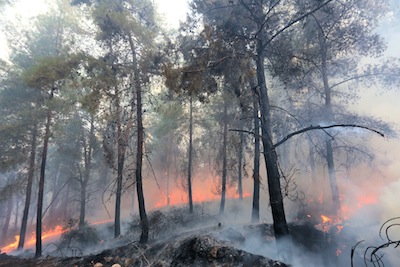
Just after Israel’s 2025 Independence Day, there was a devastating fire in the Jerusalem Hills, and thousands of acres of trees burned. The weather had been very hot and high winds stirred up the blaze. While it does not appear to have been an act of arson, the JNF estimated that around 20,000 dunams (4,900 acres) were destroyed, with 13,000 dunams (3,200 acres) of those being woodland. It turns out that conifers burn easily, with their high quantity of tree resin.
No humans were killed in the blaze, but an unknown number of slower moving animals were killed. It took a few days to totally put out the fires. Today, seeing the destruction along the Tel Aviv-Jerusalem highway is a painful reminder of what happened. It will take wisdom to re-plant, and it will also take time.
Today, tree planting in Israel is based on research. In Israel’s north, tabor oak, cypress and eucalyptus saplings are being readied for planting, while staff in Israel’s central region are preparing broad leaf trees, which provide sufficient green cover and pose less danger of forest fires. Meanwhile, in Israel’s south, acacia and palm seedlings are being prepared, as is the planting of fig, carob and tamarisk trees.
The modern state of Israel was not blessed with natural forests; its forests are all hand-planted. The Jewish National Fund has planted more than 260 million trees all over the country, providing belts of green covering more than 250,000 acres.
Tu b’Shevat starts the evening of Feb. 1 this year.
Deborah Rubin Fields is an Israel-based features writer. She is also the author of Take a Peek Inside: A Child’s Guide to Radiology Exams, published in English, Hebrew and Arabic.