Anti-racism work at risk

Selina Robinson resigned Monday as British Columbia’s minister of post-secondary education and future skills. She also announced she would not seek reelection as the member of the Legislature for Coquitlam-Maillardville – though she said the latter was a decision she had made earlier.

The resignation Monday afternoon was the culmination of a remarkably speedy controversy that erupted late last week, after video circulated of Robinson, during a B’nai Brith Canada panel discussion, referring to pre-state Israel as a “crappy piece of land with nothing on it.” That she qualified the statement immediately, saying “there were several hundred thousand people, but, other than that, it didn’t produce an economy, it couldn’t grow things, it didn’t have anything on it,” is cut off from almost all the video clips.

The language choice was problematic and careless, no question. The Zionist movement has often been criticized for consciously or unconsciously overlooking the presence of existing populations in the land that became the modern state of Israel. One of the original slogans was: “A land without a people for a people without a land.” Robinson certainly knows this history.

What she meant – as she clarified again after the controversy erupted – was that the land had few if any natural resources or economic development. There is nothing historically inaccurate about that. Not only did Palestine not have an abundance of natural resources but, for hundreds of years, it had been an ignored piece of a failing Ottoman Empire, then, for two decades, an abused outpost of British colonialism. Regardless, the way in which Robinson spoke is not a fair or productive way to talk about a land that clearly (so clearly) means so much to so many people. Resources, economic or otherwise, are not the markers of the inherent value of a land or its significance to Indigenous peoples or anyone with a close relationship to place. That said, the feverish response to her words has been out of proportion. There is a world in which her clarification and apology would have sufficed. But, of course, this is politics.

And it is more than just politics. It is Israel and Palestine politics – and that is a particularly vicious game, even here in peaceable Canada. Annamie Paul, former head of the Green Party of Canada, learned tragically what can happen to a Jewish political leader who dares to take a nuanced position (or, really, anything but a wildly anti-Israel approach) to Middle East affairs. Some of us feared Robinson’s principles on this front put a similar target on her back. We’ve been proved right.

Robinson has been an outspoken pro-Israel voice, never more than since Oct. 7. There is no doubt that some were looking for an opportunity to knock her down – and she stumbled in a bad way, leaving her open to precisely the sort of attack some people were no doubt itching for. 

Protesters, who, since Oct. 7, have been ready to mobilize about Israel with any provocation, moved into action. Social media erupted in such performative ferocity one would think British Columbians had suddenly discovered one of our leaders was a member of the Klan. 

A major New Democratic Party fundraising gala Sunday night was canceled, apparently because they feared a protest that would distract from the party’s message in an election year. A news conference on Monday on a completely unrelated issue was also canceled, presumably for the same reason.

Groups accused Robinson of “blatant bigotry.” Anjali Appadurai, who ran against the current Premier David Eby for party leader, accused Robinson of “racist views.” Protesters Monday and people on social media accused her of “white supremacy.” After the controversy arose but before she resigned, Robinson had agreed to take anti-Islamophobia training.

It is perhaps most remarkable that the people most loudly condemning Robinson probably intersect significantly with the demographic that contests the widely accepted definition of antisemitism, contending, in effect, that Jews make up false “smears” about bigotry for political gain. This, of course, is precisely what happened to Robinson: an offhand (and, yes, offensive) remark is recast as “Islamophobia” by activists who have been waiting to pounce on precisely this sort of slipup. Not incidentally, it sidelines one of Canada’s few Jewish, pro-Israel elected officials.

The rhetoric being used around whiteness, settler colonialism and vulnerable communities also reinforces narratives about Israel that are deeply troubling and rooted in antisemitism and ignorance. Robinson’s comments, heard through an already flawed lens, produced a result that was all but predetermined by entrenched narratives. This is a disturbing reality, one that hurts more than Jews and their allies. Such abuse of terms like racism and white supremacy offend the serious work we must do as a society to confront these problems. Mobilizing these terms for crude political gain, as they have been against Robinson, undermines the fight against racism. 

Robinson, and many in the Jewish community, no doubt feel heartbroken this week. In the long run, though, it is the people of British Columbia who are the losers. They have lost the services of a committed public servant.

More than this, our political culture and the fight against racism in all its forms have been debased. 

Protests, picketing alarm Jews

Screenshot of Nelson City Council’s Oct. 22, 2023, meeting. Left to right, Topaz Zafrir, Yael Finer and Judy Banfield of the Kootenay Jewish Community Association present their concerns about the rise in anti-Israel and antisemitic events to the council.

Last October, as tensions in Canada were mounting over the Israel-Hamas war, three members of the Kootenay Jewish Community Association in Nelson paid a visit to the city council meeting to convey a request: that the council refrain from taking sides when it came to the emotionally charged protest rally that had taken place the day before. Nelson residents Judy Banfield, Yael Finer and Topaz Zafrir said they were also there to ask the police to continue its protection of Jewish community events, as it had in previous years. “We are very grateful for that,” Banfield said. “Right now, our community is frightened.” 

The week before the meeting, Hamas had called to its supporters for a “day of rage.” The response was swift in Nelson, a college town that has seen an escalation of pro-Palestinian sentiment and anti-Israel demonstrations in recent years. About a hundred people turned out to hear speakers who gave accounts of what they believed was happening in Gaza. According to Kootenay Jewish community leader Yael Finer, the presentations included assertions about Israel’s role in Gaza that had already been debunked. The purpose of the rally, she felt, was to incite antisemitism and anti-Israel sentiment in the city. Finer, an Israeli-Canadian who moved to Nelson in 2016, told the council that one of the speakers also made a pitch on behalf of Hamas.

“A final speaker said, ‘Don’t hate Hamas. They’re our brothers, our sons, our fathers,’” Finer recounted.

“The event was supposed to be about peace and education,” she said. “I actually reached out to the organizer, asking to speak at the event as one of the Israeli or Jewish [residents].”

Finer told the council that she empathizes with the Palestinian people and shares concern over the current situation in Gaza. She had gone to the rally to learn. She said her request to speak at the event was denied. 

Finer added that one of the speakers was a city council member, “creating a perception of legitimacy” for the demonstration. The mayor later released a statement clarifying that only the mayor’s office represented the views of the city government, including at public events.

Not a new phenomenon

Banfield, who is a former Selkirk College instructor and has lived in Nelson since 1990, said antisemitism isn’t a new phenomenon in the city. She said the planned speech in 2013 of Greta Berlin, an accused antisemite, put the community on edge. Eventually, the Nelson library rescinded the offer for her to speak, but she was later offered a venue at the United Church. Although the gathering remained peaceful, Banfield said anti-Israel and antisemitic behaviour have only grown more evident.

“I have been in Nelson a long time and we’ve always been very open that we’re here and inviting,” she told the Jewish Independent about the local Jewish community. She said that, until recently, religious celebrations used to be open to the Nelson public. However, a couple of years ago, demonstrators picketed a Jewish holiday celebration.

“People were picketing us, basically as being Jews, being responsible for what is going on in the Middle East,” said Banfield. Since then, she said, the community has had to ask for police protection at religious and other community events and to conceal their locations from the public. “We do not feel safe gathering together in an announced venue,” she told the Nelson council.

Last November, demonstrators held another rally, this time calling on the city to formally advocate for a ceasefire. According to several attendees, there were also calls for boycotting local businesses that were assumed or known to do business in or with Israel.

Jeff Shecter, another long-time resident and one of the Jewish community’s first leaders, said even more people turned out for that rally. He said the protests and “river to the sea” chants have unnerved the Israeli members of the community.  “[They] were more shocked than the rest of us who were maybe used to it,” Shecter observed. While he said he is not afraid, “to have a demonstration supposedly in support of Palestine without anyone, not a single soul, denouncing what happened on Oct. 7 was a travesty.”

Zafrir, one Nelson’s most recent arrivals from Israel, told the council that the community isn’t trying to stifle anyone’s voice. “We’re not asking you to take sides,” she said. “The Palestinians and whoever supports them have the right to protest, as we have to do so, and still feel safe in our community. Any person in Nelson should feel safe, despite disagreement or place of origin.” 

On Dec. 5, acknowledging that it had received numerous calls for action, the city issued a formal letter “calling for peace in Gaza” and appealing for a “cessation of hostilities from all involved parties.” While the information shared among council members briefly mentioned the Oct. 7 attack by Hamas, the letter that was disseminated to the public did not. Nor did it mention the death toll from the terror attack or that more than 240 people had been abducted by Hamas and most were still missing.

Banfield said she is sympathetic of the pressure that the city council is under. “I mean, they did end up passing a resolution promoting a ceasefire. And I know there was a lot of discussion about it on council and they made it as lukewarm as possible,” she said. “And I guess at this point, the biggest thing for us is that they have given us protection.”

Asked whether she felt the city council understands the Jewish community’s concerns about safety at this time, Finer shook her head. “No,” she said, adding that she had hoped others would understand that anti-Israel protests and picketing of Jewish sites is alarming. “[Even] though there was no direct threat to the Jewish people in the town, it was implied. And that makes me feel terrified,” Finer told the council.

Still, Finer hasn’t given up hope that things could change in Nelson. As the new leader of the Kootenay Jewish Community Association, she’s already thinking about ways to bridge differences and enhance dialogue with those who don’t know, or don’t understand, Nelson’s small Jewish community. 

Jan Lee is an award-winning editorial writer whose articles and op-eds have been published in B’nai B’rith Magazine, Voices of Conservative and Masorti Judaism and Baltimore Jewish Times, as well as a number of business, environmental and travel publications. Her blog can be found at multiculturaljew.polestarpassages.com.

A hippie homesteader in B.C.

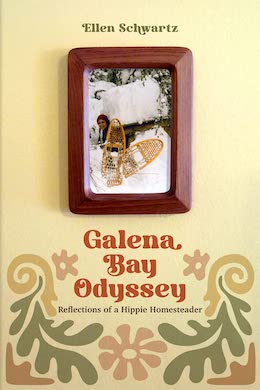
“When I came to Galena Bay, I had been afraid of many things,” writes Ellen Schwartz in Galena Bay Odyssey: Reflections on a Hippie Homesteader (Heritage House Publishing Company, 2023). “Of the physical work I would have to do. Of trying new things I have never done before, like gardening and building and raising animals. Of living in isolation. One by one, I had attempted these things, and I had survived. I had even mastered some of them. Those fears had fallen away.”

This paragraph comes as Schwartz is atop a hill, “too scared to move,” and her skis start sliding. She survives the “ungraceful and disastrous” run, even pushes through a second one. But she can’t keep her vow to never to do that again because, in the 1970s, she lived in such a far-flung place that skiing was a necessary mode of transportation, not just a leisure activity.

It is easy to see why Schwartz chose to write a memoir about this period of her life. Born into a middle-class family – her father an internist-turned-cardiologist, her mother a teacher before becoming a stay-at-home mom to Schwartz, her younger sister and brother – and raised in New Jersey, Schwartz went to university in Chicago. There, she did all you might expect a young person with the new freedom of being on their own to do. And then some, as it was the late 1960s. She writes openly about her experiences with drugs and having sex for the first time: “I figured Ned was The One. I imagined that we’d go through our four years [at school] together and eventually marry.” That didn’t happen. Nor did Schwartz go on to lead the conventional life she imagined for herself at the time.

Instead, she went to join a close friend at a farming commune in Pennsylvania, the members of which ultimately wanted to move to British Columbia. Not intending to stay longer than summer break, Schwartz fell in love with one of the commune’s founders and, well, ended up in British Columbia with Bill, who would become her husband. The group didn’t last long, but the Schwartzes are still together, though no longer in Galena Bay, which is in the West Kootenays. They now live in Burnaby.

The young urban-raised couple faced many challenges homesteading, and Schwartz has many stories of taking on the unknown, whether it be camping along the route across the continent to British Columbia, building their own cabin (including chopping down their own trees), growing their own food, raising a child in a remote area (their second would be born in Vancouver), etc., etc. Not to mention finding work that would sustain them physically (keep them housed, clothed and fed), if not spiritually. She shares the details of her hippie days matter-of-factly, with humour and with the perspective of reflection. For example, after recounting her parents’ muted reaction to her and Bill’s homemade home, she offers potential reasons for their lack of enthusiasm.

image - Galena Bay Odyssey coverSchwartz’s unique history encapsulates the overarching idealism of many in her generation. Her grandparents were “impoverished Jewish immigrants who had fled the hardships and pogroms of Lithuania and Poland” to give their kids a better life in the United States, so their grandchildren also were well set up for material success. The grandchildren – Schwartz and her peers – had an idea but no real understanding of the sacrifices that had been made to achieve the comfortable lifestyle they rejected, because of the racial and social inequality they saw around them, the environmental degradation and the war in Vietnam.

“Bill and I, part of the first wave of baby boomers, were in the privileged position of having enough education, enough wealth and enough leisure to be able to criticize our parents’ lifestyle,” she writes late in the memoir. “We were well-off enough to be able to turn our backs on materialism. We were prosperous enough to indulge in idealism and, idealistically, to define an entire new set of values. (At the time, I didn’t appreciate the irony.)”

But her desire to make the world a better place was – and is – genuine and remains a guiding force. Schwartz, who was a teacher for many years, began her subsequent career writing educational material. We find out in her memoir that the first fiction story she sold was released in 1980. She is now a celebrated children’s author, with almost 20 books to her credit directed towards younger readers, ranging from picture books to novels for teens to a couple of non-fiction publications. She is also a freelance writer and editor.

Galena Bay Odyssey is a wonderful glimpse into an integral part of Schwartz’s life. It also offers insight into North American hippie culture and the strength and ingenuity required to live in an out-of-the-way place like Galena Bay. That the “action” takes place in British Columbia will make the memoir of even more interest to local readers.

Quick look at Canadian Jews

As of last Friday, June 16, the population of Canada surpassed 40 million people. According to data from the 2021 Canadian census released last year, 335,295 Canadians consider themselves to be Jewish by religion, up from 329,500 in 2011.

The 2021 census also asked about ethnic or cultural origin. In this instance, the number of people choosing Jewish as their ethnic or cultural origin (or one of several) decreased from 2011 to 2021, from 309,650 to 282,015, though the number increased in British Columbia, from 31,865 in 2011 to 34,395 a decade later. This article focuses on Jews by religion.

More than half of Canadian Jews live in Ontario, home to 196,100 Jews, while an additional quarter (84,530) live in Quebec. British Columbia’s 26,845 Jews are 8% of the national Jewish population. Other provinces with significant Jewish populations are Alberta, with 11,565 Jews, and Manitoba, with 11,390. Smaller Jewish communities exist in Nova Scotia, with 2,195 Jews, Saskatchewan, with 1,105 Jews, and New Brunswick, where 1,000 people listed their religion as Jewish.

In Canada, approximately 12,000 Jews (3.6%) identify as a visible minority, including 2,615 Black Jews, 1,505 Latin American Jews, 1,270 South Asian Jews and 1,155 Chinese Jews. Those numbers in British Columbia are 1,425 overall, including 235 Latin American Jews, 200 Black Jews, 170 Chinese Jews and 150 South Asian Jews.

British Columbia is home to the fastest-growing Jewish population in Canada, adding 3,715 Jewish residents since 2011, representing 16% growth. By comparison, Canada added 5,795 Jews to the national population, growing 1.8%. Ontario’s Jewish population only grew 0.3%, while Quebec’s Jewish population declined by 0.7%, making it the only province whose Jewish population decreased over the 10-year period. Western provinces recorded more robust growth: 6% in Alberta, 2.5% in Manitoba and 17.5% in Saskatchewan.

Home to a combined three-quarters of Canada’s Jews, the metropolitan areas of Toronto and Montreal both saw a decline in their Jewish population over the past decade. Meanwhile, Metro Vancouver’s Jewish population grew from 18,730 in 2011 to 20,125 in 2021, an additional 1,395 Jews. Elsewhere in Canada, Greater Ottawa’s Jewish community expanded, as did the metropolitan areas of Winnipeg, Calgary and Edmonton.

Even though their metropolitan Jewish populations decreased over the last decade, the municipal Jewish populations of Toronto and Montreal both grew slightly, suggesting a Jewish movement away from the suburbs and towards the city. Vancouver’s municipal Jewish population also grew during the same period, from 10,350 to 11,675, allowing it to surpass both Winnipeg and Ottawa to become the third-largest Jewish municipal population in Canada. While the City of Vancouver’s share of the B.C. Jewish population decreased slightly over the past decade, from 44.7% in 2011 to 43.5% in 2021, its percentage of Greater Vancouver’s Jewish population grew from 55% to 58%. Greater Vancouver is home to 75% of British Columbia’s Jews, down from its share of 81% in 2011.

Other B.C. cities with sizable Jewish populations include Richmond, whose 2,515 Jews make it the second-largest Jewish municipality in the province, and Surrey, where 900 people reported their religion as Jewish – although both cities’ Jewish populations declined since 2011. The District of North Vancouver had 845 people reporting Jewish as their religion in 2021 and Burnaby 620, both increases from 2011; and West Vancouver had 555, which was a decrease from 665 in 2011. Beyond the Lower Mainland, Victoria’s Jewish population grew from 550 to 960, Saanich’s Jewish community increased from 555 to 750, and the Jewish population of Kelowna more than doubled, going from 215 in 2011 to 530 in 2021.

In addition to provincial, metropolitan and municipal data, the 2021 census also provided information about electoral ridings. Vancouver Granville was the electoral riding with the largest Jewish population in Vancouver (3,275), while Vancouver Quadra was a close second (3,125), although the Jewish population of both ridings decreased since 2011.

Vancouver Granville remains home to 27.5% of Vancouver’s Jews, while Vancouver Quadra is home to 26% of the city’s Jewish population. The Jewish population of four other electoral ridings – Vancouver Centre, Vancouver East, Vancouver Kingsway and Vancouver South – all increased significantly, suggesting a population shift from Vancouver’s West Side to Downtown and East Vancouver. Using these electoral ridings as an approximate guide, 54% of Vancouver’s Jews live in the West Side, 27% live in East Vancouver and 19% live in Downtown Vancouver. By comparison, 64% of Vancouver’s Jews lived in the West Side in 2011, 20% lived in East Vancouver and 16% lived Downtown.

Along with religion, the Canadian census also gave information about language. Canadians who can speak Hebrew increased from 70,695 in 2011 to 83,205 in 2021, while Canadians who can speak Yiddish decreased from 23,750 to 20,155 over the same period. More than half of Hebrew-speaking Canadians, 47,380, live in Ontario, while more than half of Yiddish-speaking Canadians, 12,825, live in Quebec. Hebrew speakers in British Columbia increased from 4,505 in 2011 to 6,995 in 2021, while Yiddish speakers in the province declined from 540 in 2011 to 480 in 2021.

While the 2011 census only provided information about languages spoken, the 2021 census also gave information about Canadians’ mother tongues. In 2021, 19,595 Canadians spoke Hebrew as their first language. Meanwhile, 12,060 Canadians spoke Yiddish as a first language. In British Columbia, 2,260 people spoke Hebrew as a mother tongue in 2021, while 215 listed Yiddish as their first language.

To find out more of the census results, including immigration and other statistics, visit www12.statcan.gc.ca/census-recensement/index-eng.cfm and click on census datasets (1981-2021).

Michael Rom is Social Sciences and Humanities Research Council postdoctoral research fellow at the University of British Columbia. He received a PhD in history from Yale University, and has also held research fellowships at the Centre for Jewish History in New York City, the University of Cape Town and the University of São Paulo. His research examines Brazilian Jewish politics during the Cold War.

Hate crimes down a bit

The number of antisemitic hate crimes in Canada declined a fraction last year, according to the B’nai Brith Canada League for Human Rights Annual Audit of Antisemitic Incidents 2022. The decline, though, is from 2021, which saw the highest number of incidents since the audit began 40 years ago so, despite the marginally good news, 2022 remains the second-worst year on record. In all, 2022 saw 2,769 incidents, down 1.1% from the 2,799 incidents reported in 2021.

“When viewed from a historical perspective … the numbers are less reassuring,” Marvin Rotrand, national director of the League for Human Rights, writes in the report. “In 2012, the Jewish community sounded the alarm when that audit noted 1,345 antisemitic incidents, the highest ever since we first began auditing in 1982. Ten years later, the number is an alarming 105.9% higher than that reported in 2012, and the second-highest total since we started tracking 41 years ago.”

Aron Csaplaros, British Columbia regional manager for B’nai Brith Canada, noted the most significant finding is that the majority of hate incidents are online.

“The audit says that 74% of hate is now online and that violent incidents are down,” he told the Jewish Independent. Violent incidents across Canada dropped to 25 last year from 75 the year previous. “But incidents have been moving online in the past decade or so and it’s kind of equally, if not more, dangerous when hate is online because it’s much easier to spread, more people read it,” he said. “It’s about context. It’s obviously different than a violent incident but it is equally as dangerous.”

Csaplaros does not have a clear explanation on why violent incidents saw such a drop. It may have to do with the fact that 2022 saw slightly less incendiary conflict in Israel and Palestine, overseas problems that invariably have repercussions worldwide.

“Obviously, we’re happy that violent incidents have gone down,” he said. “Hopefully, the reason for that is that certain provinces have adopted, for example, the IHRA [International Holocaust Remembrance Alliance] definition of antisemitism, and that might have filtered down into education for police forces and how they respond and deal with these situations. But we don’t really have a theory on why the violent incidents have gone down.”

In British Columbia, the number of violent crimes declined from two in 2021 to a single incident in 2022: a threat against Victoria’s Jewish Community Centre during the annual Jewish film festival in the capital city. Other B.C. instances include 51 cases of vandalism, 53 cases of harassment and 137 cases of online hate.

Csaplaros acknowledged that it is difficult to place a number on online antisemitic incidents.

“There are, unfortunately, probably thousands, millions of anti-Israel and antisemitic comments online and, obviously, just because of the sheer number of them, we don’t catch all of them,” he said.

The criteria B’nai Brith uses to measure hate online includes the question, “Is it antisemitic in that it targets Jews as a people and attribute negative things to them? For example, that they caused COVID, or do they use antisemitic stereotypes like Jews control the banks and so on and so forth,” explained Csaplaros. “With a lot of these comments, they are clearly antisemitic.”

B’nai Brith, he said, uses the “three Ds” measure created by Natan Sharansky: delegitimization, demonization, and applying double standards to the state of Israel.

While 74% of incidents were online, 15% involved vandalism, 10% in-person harassment and 1% were violent incidents.

In British Columbia overall, incidents declined more than 40%, to 242, compared with 409 the previous year. (For the purposes of the report, British Columbia and Yukon are reported together.) Examples of B.C. incidents included in the B’nai Brith report are the Simon Fraser University student society’s passing of a resolution referring to Israeli “war crimes and apartheid” and a Tweet accusing Jews of Satan worship and seeking world domination.

“At the end of the day, hate is hate,” said Csaplaros. “It’s important to have a record of how many antisemitic incidents occurred, regardless of whether it was a Laith Marouf-type thing or a violent incident or a swastika drawn on the sidewalk. Hate and antisemitism is hate … and it’s important to record all of that.”

Laith Marouf is a Montreal activist whose Community Media Advocacy Centre received more than $133,000 in federal government consulting fees before his antisemitic social media postings became widely known, including one in which he called Jewish people “loud mouthed bags of human feces.”

Csaplaros called on the province of British Columbia to join half of Canada’s other provinces in adopting the IHRA definition of antisemitism and to follow Ontario’s lead by introducing Holocaust education into the elementary school curriculum. The core curriculum in British Columbia does not mandate any Holocaust education, Csaplaros said. Students can learn about the Holocaust in elective courses and may learn about it in core courses, depending on the teacher’s choices.

The full annual audit is online at bnaibrith.ca.

Supporting arts, community

Residents of Prince George might be forgiven for thinking there is more than one person named Eli Klasner in their midst. Among his many concurrent pursuits, the Toronto native is directing the Community Arts Council of Prince George, leading a fundraising initiative for Ukrainian refugees and serving on the board of the Jewish Museum and Archives of British Columbia.

Living in Prince George is the fulfilment of a lifelong dream for Klasner. Since childhood, he had entertained the notion of living on the Canadian frontier or the Far North. When he was younger, he also made a commitment to himself that, by the time he celebrated his 40th birthday, he would do whatever it was that excited him.

photo - For philanthropist Eli Klasner, living in Prince George is a dream come true
For philanthropist Eli Klasner, living in Prince George is a dream come true. (photo from Eli Klasner)

As events unfolded, he was able to do just that after running businesses in Toronto and Vancouver. In 2017, while Klasner was working for a nonprofit, the possibility of moving to Prince George presented itself.

“I was just charmed by the roughness and climate adversity and, significantly, by the opportunities I saw both as a participant in arts and culture but also to identify that there are Jewish people here and in this area,” Klasner told the Independent.

The friendliness and accessibility of locals reaffirmed his desire to stay. “Soon after I was here, I visited City Hall and asked who is the mayor? ‘Well, that’s his office there. If you want to say hello, just go on in and introduce yourself.’ I like that. Coming from Toronto, you don’t just walk in and put your feet up on the mayor’s table. I thought that was very appealing,” Klasner recalled.

His executive director position with the arts council quickly transformed into a full-time schedule as he came to realize that the city could use support with its arts facilities. Klasner’s role in Prince George’s artistic rejuvenation includes working on a new creative hub, a new performing arts centre and, in March, the gala opening of a retired heritage church that was turned into a concert hall.

“Taking the executive director job here helped solidify that I need to settle down and find a place to live permanently. At that point in my life, I thought a lovely arts council with a lovely little gallery and gift shop would be a lot of fun,” said Klasner, who during his youth studied music in various European capitals.

For two years of his stay in Prince George, Klasner lived in a cabin in the woods, along with two hound dogs and two cats. “I moved a little off the grid,” he said. “That, for me, was the boyhood dream of living in the woods, chopping wood, growing a garden in the summer and being close to wildlife and nature. It was an amazing experience.”

Then came 2020. Klasner contracted the coronavirus at the outset of the pandemic. “COVID is an interesting part of the journey of being up here in this odd, unusual place,” he said. “It was certainly a challenge, but, also, when you live through something like that, you really come to appreciate life when you have good health, and the bounty that comes with good health.”

From a Jewish cultural perspective, one of Klasner’s recent projects has been the performance of Different Trains, a piece written for string quartet, with pre-recorded tape, by American Jewish composer Steve Reich that revolves around the Second World War and the Shoah. After being approached last year by the Prince George Symphony Orchestra, Klasner was able to arrange to have the work performed to mark Holocaust Remembrance Day this past January.

“I found it to be a remarkable process of respect and inclusion and terrifically ambitious for a small-town symphony to want to take on such a challenging and groundbreaking piece of music,” Klasner said.

Afterwards, several members of the local Jewish community were invited on stage to say a few words. The crowd, according to Klasner, was very moved by the event. “People got to sit, ask questions and talk about Holocaust and persecution. I found it a unique thing to happen in a place like Prince George. Where else is something like this done in Canada that does not have a significant Jewish population?”

Prince George, like other parts of northern British Columbia, Klasner noted, used to have a thriving Jewish community, starting with the immigrants who arrived in the 1880s. Many of the first local businesses were started by Jews, and the first Jewish female elected to public office in Canada was in Prince George, when Hanna Director became chair of the city’s school district.

From the Second World War to the 1970s, the community dwindled. The Sefer Torah that was in Prince George was sent down to Vancouver and is in storage.

However, there has been a resurgence in Jewish life, Klasner said. “What we started to do is hold community events around holidays and festivals, wanting to expose the young generation to the culture and history of Jewish celebrations and milestones, holidays and festivals. We are quite open to people who might want to come but who are not Jewish to see a Hannukah celebration and what kind of foods we eat around Rosh Hashanah, etc. There has been a lot interest in the community.”

The Jewish Museum and Archives, Klasner said, helped him understand some of the history and heritage of the Jewish community in the area. This, in turn, helped Klasner get other members of the community involved to share stories about what life in Prince George was like at one time or another. For example, there were photos of a seder in Prince George just after the war, when so many Jews wanted to be involved that a community hall had to be used.

“When there was an opening on the board of the Jewish Museum and Archives, I thought it was an opportunity to help them have province-wide representation, rather than just the Lower Mainland, the Island and the Okanagan,” he said.

Jewish values were integral in Klasner’s recent efforts to assist Ukrainian refugees in his community. When a new endowment fund was created to help the newcomers, he reached out to the organizers to help propel their fundraising.

“I was overwhelmed at the possibilities of life when people open up their hearts to strangers in their land and by the idea of opening up one’s heart and mind and wallet to people in the community – and what a Jewish attribute as well. Our families were once accepted here as refugees,” he said. “Our life on earth depends on the fact that Canada accepted refugees.”

From June 9 to 11, Prince George will host another of Klasner’s ventures, the B.C. Gourmet Arts Festival. Now in its second year, the event features scores of local artisans and presents culinary delights of the region and country.

“I love life and the opportunity to be busy and creative and help people and get involved,” Klasner said. “Life is awesome.”

Sam Margolis has written for the Globe and Mail, the National Post, UPI and MSNBC.

Local heads new office

B’nai Brith Canada has returned to Vancouver. This time with a local office headed by Aron Csaplaros, who was born and raised in Vancouver.

B’nai Brith and its now-defunct newspaper the Jewish Tribune last made their presence felt here in 2009. In an interview with the Jewish Independent, Csaplaros emphasized “that our organization is not the B’nai Brith of the 1960s or 1970s, or the 2000s. Mr. [Michael] Mostyn took over control of our organization in 2014 as CEO and has created a ‘B’nai Brith 2.0.’ We are still heavily involved in affordable housing, feeding the vulnerable and seniors and social programming (something we hope to bring to B.C. as well in the future), but our main focuses have been advocacy and combating antisemitism.”

photo - Aron Csaplaros is the regional manager of the new local office of B’nai Brith Canada
Aron Csaplaros is the regional manager of the new local office of B’nai Brith Canada. (photo from B’nai Brith Canada)

As regional manager, Csaplaros said, “My mandate is 100% focused on combating antisemitism in our province. This includes responding to incidents of antisemitic vandalism, liaising with Jewish organizations on university campuses regarding antisemitism, and also keeping tabs on antisemitic individuals and organizations active in B.C. and devising strategies, which can range from working with local police and Crown prosecutors on criminal charges, removal of their platform, which they use to spread hate, or other legal measures we can take. I am also working on having the provincial government and municipalities across B.C. adopt the crucial IHRA [International Holocaust Remembrance Alliance] definition of antisemitism.”

Csaplaros acknowledged that there are already organizations based in British Columbia that deal with antisemitism and discrimination.

“B’nai Brith’s goal, and my presence in B.C., is not to compete with, duplicate or replace the important work that other organizations do,” he said. “On the contrary, we plan to work together with other organizations when we can establish a united front against antisemitism and Jew-hate.

“The value that B’nai Brith, and my presence here, adds is our laser focus on fighting antisemitism and the legal acumen that B’nai Brith possesses to aid us in this goal. We have several staff lawyers with expertise in criminal law and constitutional law, and many of our staff members (including myself and our CEO, Michael Mostyn) have legal backgrounds in litigation. This gives the ability to devise creative strategies when dealing with antisemitic organizations and individuals, and allows us to work closely with police departments and Crown prosecutors.

“We also have a Canada-wide network of volunteer Jewish lawyers called the Matas Law Society,” he said. “These lawyers are available to assist us in anything from writing submissions for parliamentary committee hearings, to intervening in court cases that impact the Jewish community.

“We are also the only Jewish organization in Canada to have an anti-hate hotline and a mobile app with the same purpose, where people can report incidents of antisemitism or other forms of discrimination. In addition, we have produced an annual, comprehensive audit of antisemitic incidents in Canada, and this publication is used by, among other entities, Statistics Canada, the U.S. State Department and Tel Aviv University. B’nai Brith does not engage in Israel advocacy, and we only respond to issues concerning antisemitism in Canada affecting Canadian members of the Jewish community. We also have a lean but well-connected team working at our organization, which allows us to respond quickly to incidents as they arise.”

Csaplaros started his position as the B.C. regional manager for B’nai Brith in January, and has met with local leaders in the Jewish community, politicians, and leaders of non-Jewish organizations that are also involved in combating hatred and discrimination, he said.

Csaplaros was born to a family of Hungarian immigrants, with his grandfather having been the first to arrive in Canada, in the 1950s. His parents arrived in 1995.

“I was brought up in a traditional Jewish household, and my paternal grandmother is a child survivor of the Holocaust,” he said. “I grew up very close to Congregation Schara Tzedeck, the synagogue which I am a member of and still attend to this day with my wife. I sit in the same seat that my grandfather purchased over 30 years ago, and it gives me great pride to continue his legacy by sitting in his seat and regularly attending services and events at the synagogue.

“I attended Vancouver Talmud Torah all the way from preschool until graduating in seventh grade,” he continued. “I then spent a year at King David High School, before transferring to Pacific Torah Institute (PTI) [which is no longer in Vancouver] and completing high school there. I then spent three years in their post-high school program, before attending Yeshivas Chofetz Chaim in New York for a year, where I received my bachelor’s degree in rabbinical studies.”

Throughout his time at PTI and at the yeshivah in New York, Csaplaros said, “I was engaged in learning with community members and teaching how to read Jewish source texts in their original format. I was also involved in community outreach, spending time and studying with elementary and high school-aged students from disadvantaged backgrounds. I also served on the board of directors of PTI.”

After his bachelor’s degree, Csaplaros attended law school at the University of Calgary, completing his articles at Kornfeld LLP.

“I’ve always had a passion for research, advocacy and governmental affairs, and I regularly participated in debates organized by Federation,” he said. “Yeshivah studies also involve debate and plenty of research, so that is another reason I chose to pursue a yeshivah education for several years. I then decided that the best way for me to develop my advocacy skills and learn more about the structure of Canada’s government was to attend law school…. I knew from the beginning of my legal studies that I wanted to be a litigator and, in the future, focus on human rights and civil liberties matters. Throughout law school, I was involved in initiatives to increase access to justice for members of the Indigenous community.”

During his time at Kornfeld LLP, Csaplaros said, “I focused on litigation, including construction, real estate and general commercial litigation. I was fortunate to appear in court several times and run a small claims trial on my own.

“These experiences further strengthened my desire to be an advocate,” he said, “and, as my time as an articling student at the firm was coming to a close, I learned that B’nai Brith Canada was looking for a regional manager for B.C. whose main mandate would be advocacy and fighting antisemitism and hatred in all forms. I knew that B’nai Brith Canada is a leader in fighting antisemitism in Canada, and I also knew that I could use my knowledge of the legal system to help me further this goal.”

Csaplaros can be reached at aronc@bnaibrith.ca.

A complex problem

In British Columbia last year, 2,272 people died from toxic drugs, according to information released last week. More than 11,000 people have died of drug toxicity in the province since a public health emergency was declared in April 2016.

While many people associate these tragic deaths with the troubles of the Downtown Eastside, the reality is that Vancouver Coastal Health – the region that includes that neighbourhood as well as much of Metro Vancouver – accounted for 14% of the drug-related deaths in the province last year. Rural communities are disproportionately affected. Most disproportionately affected of all are Indigenous communities. The First Nations Health Authority reports that, while making up 3.2% of the province’s population, First Nations people comprised 15% of all toxic drug deaths in 2021 and 2022.

It is worth remembering that, while people have died from toxic drugs on the streets, they also have died in the living rooms of our most exclusive neighbourhoods, and they have died everywhere in between.

The City of Vancouver just announced $2.8 million for the hiring of 58 mental health workers and expanded programs to address frontline issues and public safety responses, according to Mayor Ken Sim. Also, this week, a new policy went into effect in British Columbia, under which possession of some illegal drugs will not result in arrest or charges. This is an innovative effort to reconsider the problem as a health issue, not a legal one.

While there may be disagreements and concerns about the approach the city, the province and the federal government are taking on the problems that plague individuals and communities around mental health, addictions, crime and safety, there has also been a degree of unnecessary and unwelcome cynicism. Too many seem to view the problems – and the people they affect – as an inconvenience to be swept away rather than as complex social issues requiring comprehensive responses.

In the search for explanations and solutions, there has been too frequent a tendency to blame the victim, to drive through troubled neighbourhoods in our city and province and condemn not the problems, or the context of those problems, but the people they affect.

In many instances, people suffering represent the contemporary impacts of policies and practices past and present. Land acknowledgments and efforts at reconciliation mean little to nothing if they are not accompanied by truth and by compassion for the long-term effects of these wrongs. Coming to terms with the impact on Indigenous peoples of residential schools, intergenerational trauma and generalized discrimination and lack of opportunity has opened many eyes to how these historical and contemporary realities have affected communities. Perhaps we have not done as well in recognizing how these impacts manifest in individuals.

People experiencing the harms of the drug poisoning crisis, Indigenous and non-Indigenous alike, come from a place of struggle and suffering. Really, every person is impacted in some way by circumstances of their social context, as well as their experiences. Some of the problems we experience are a result of individual health or vulnerabilities and others of systemic discrimination or falling through cracks in the education system or social safety net. Whatever the causes, they each require us to come together to address them.

Of course, these issues are not at all limited to our city. Across North America and elsewhere, urban and rural communities are troubled by substance issues and other problems, including a lack of safe and affordable housing, which is foundational to individual and communal well-being. If anyone had simple answers, they would have been adopted and implemented by now. This is an enormous challenge we must attempt to address humanely, compassionately and effectively without victim-blaming.

Organizations and many individuals in the Jewish community have been committed to these issues for some time and those collective efforts reflect the core Jewish value of tikkun olam, repairing the world, but they also reflect hakaim takim imo, “you shall surely lift him [and her] up.”

The tragic statistics confirm what we already know. They are a reminder, though, that a great deal remains to be done to address the problems and to reduce the social causes of the crisis. Trying new approaches that focus on compassion and justice is a right course. They may not work. But the cost of not trying is far too high.

My Way Bikery expands

My Way Bikery owners Moshe and Leah Appel. (photo from My Way Bikery)

Vancouver Island’s only kosher bakery started the new secular year with new owners, Moshe and Leah Appel, and a slightly new name. What was formerly known as the Bikery is now My Way Bikery. The Victoria location, at 8-1701 Douglas, inside the Public Market at the Hudson, remains the same, though the selection has expanded to include more than baked goods.

Certified pareve kosher by Kosher Check and supervised by Rabbi Meir Kaplan from Chabad of Vancouver Island, My Way Bikery encourages customers to “challah” at them anytime. The bakery also delivers to customers and businesses all around Victoria, and people throughout Greater Victoria can place orders using SkipTheDishes, DoorDash and Uber Eats. Beyond Victoria, the bakery delivers as far up Island as Parksville and Qualicum Beach every Friday, with a minimum order of $25 placed by 5 p.m. on Wednesday.

“I’m the baker,” Leah Appel told the Independent.

“I’m everything else,” followed Moshe Appel.

photo - My Way Bikery lemon poppyseed muffins
My Way Bikery lemon poppyseed muffins (photo from My Way Bikery)

Originally from Montreal, the couple have known each other since they were 7 years old, but only got together after being in and out of each other’s lives for decades.

“My background is essentially in call centre work – inbound sales, inbound customer service and inbound security, things like that. But I’m extremely active in the Jewish community here in B.C., especially since first moving to Nanaimo,” said Moshe Appel.

“The idea for the business really didn’t come to fruition until I reunited with my childhood friend (and now wife), who is a classically trained baker and someone who has been in market research and management. Coming from Montreal as we both have, we were shocked at the lack of good Jewish food in B.C., and on the Island in particular.”

The Appels, who have always enjoyed cooking traditional Jewish recipes for their friends and family, started selling their goods at local markets a couple of years ago. The realization soon struck that they would need a larger space for their production. Serendipitously, they came across an opportunity last year when their friend Markus Spodzieja, founder of the Bikery, announced his intention to sell the business. The Appels purchased it, merging their original bakery name (My Way Bakery) with the Bikery to, as they say, “keep the nostalgia of Markus’s brand alive while adding our own recipes to the mix.”

According to the Appels, Spodzieja will be moving home to Nova Scotia to care for his grandmother.

The business obtained its first name, the Bikery, in 2017, when Spodzieja sold baked goods out of a 250-pound mobile vending bicycle as part of a pilot project for the City of Victoria’s Mobile Bike Vending Permit. It moved to its present location in 2021.

photo - My Way Bikery challah
My Way Bikery challah (photo from My Way Bikery)

“I met Markus when he first opened the Bikery and I was one of his first customers, but it was purely luck that I asked his advice for starting a business in Nanaimo and he handed us the business in Victoria. Unwilling to miss this G-d-given opportunity, we jumped on the chance,” Moshe Appel recalled.

“We are keeping much of the same menu as Markus did, but expanding it to include soups, salads, more breads and Jewish dishes and, in a few months, plan to expand it to include cholov Yisroel dairy products as well.”

The menu lists dozens of items. There are savoury pastries and shakshuka, halva and combos (including pita and Leah Appel’s hummus). Some of the popular items are the My Way Sandwich, potato salad, kimmel rye, peanut butter cookies and Israeli salad. A current hit is Those Darn Cookies, a sweet made with chocolate chips and almonds.

photo - My Way Bikery tahini cookies
My Way Bikery tahini cookies (photo from My Way Bikery)

Among the new touches are jelly chal-nuts, Leah Appel’s take on a jelly donut; challah dough stuffed with sweet jelly and topped with raw cane sugar; and Oyvegg, a roll with Daiya “cheese,” an egg, garlic aioli, lettuce and tomato.

The Appels are even offering goodies for canines – Dunstan Donuts. “Named after Dunstan, who was a very good boy,” the menu reads, “these certified-kosher pareve dog treats are made with oats and bananas and taste amazing! Dunstan’s Donuts are delicious enough for you, but made just for your four-legged friend!”

Favourites from the Bikery, including numerous varieties of pretzels and bagels, lemon-poppyseed muffins and challah in all shapes, sizes and flavours, are still available.

The Appels say they are in preliminary talks to open a storefront location in Nanaimo.

My Way Bikery is located toward the back of Victoria’s Public Market, which is situated close to City Hall and Centennial Square – a few blocks away from the Empress Hotel and Parliament – in a building that operated for several decades as a Hudson Bay department store. It is open Monday to Thursday, 7 a.m.-11 p.m., Friday, 7 a.m.-3 p.m.; and Sunday, 11 a.m.-6 p.m. Friday hours will be extended in the spring, as the days grow longer.

For more information or to place an order, visit mywaybikery.ca, call 778-430-2453 or email contact@mywaybikery.ca.

Sam Margolis has written for the Globe and Mail, the National Post, UPI and MSNBC.

Make voting a priority

Voters throughout British Columbia will elect new mayors, councilors, school trustees and (depending on the jurisdiction) other officials on Oct. 15.

Over the past several decades, terms for municipal officials have gone from two years to three years to, now, four years. This makes the significance of these elections greater, as the choices we make as voters will last four years. (This longer commitment also may be one reason for what seems like an unusually large number of elected officials opting not to seek reelection this year.)

It is notable that voter turnout in municipal elections is almost always lower – often far lower – than in provincial and federal elections. In some ways, this is understandable. The “senior” levels of government are associated with greater powers, which may be true, and with portfolios that may seem “sexier.” Foreign affairs are more exciting than sewage (generally speaking) and the proper functioning of our healthcare system is, for many of us, literally a life-and-death matter, which the mowing of boulevards is not.

Local government issues, however, often affect our lives in the most intimate and powerful ways. Anyone who has traveled in places without well-functioning local governments sees the evidence around them. Uncollected garbage amasses on boulevards and in public spaces. Feral cats, dogs and rodents roam largely unhampered. Petty, even serious, crime may be rampant. In other words, when civic government is running as it should, it is often invisible. When it is not, it can make ordinary life difficult or, at worst, impossible.

As often-privileged citizens of developed Western countries, we can sometimes use hyperbole about the challenges facing our communities. Overheated rhetoric about issues as comparatively banal as bike lanes, which demand that car drivers share a bit of the road with cyclists, can become so frenzied one might think a cabal of medieval tyrants had stormed the ramparts at 12th and Cambie. We should really put things in perspective.

Successful cities are, in their way, modern miracles. It is precisely their success that blinds us to their exceptionalism. Imagine: no matter where you live in Vancouver, a truck comes past your home once a week to collect the recycling you leave on the curb, knowing it will be collected (depending on the weather) without incident. Your children are within walking distance of public schools that are of truly outstanding quality by any measure of time or place. The bus we curse for not showing up at the exact moment we arrive at the stop is, for all our complaining, a remarkable operation. Hundreds of small cogs combine to make a city run.

Of course, we have complaints. A recent Leger poll indicates that 48% of Vancouver respondents (and, for example, 60% in Surrey) said things in their city have gotten worse in the past four years. This may be true. Certainly there are serious issues affecting residents, including but not limited to a housing affordability crisis, widening inequality, a drug poisoning crisis, and the impacts of climate change. And yet, for many, things are still pretty good.

This is not to say that voters should not always be pushing our elected officials to be better and do much, much better; merely that we need to remember that we live in one of the most fortunate places in the world, with millions of people envying that which we take for granted. Things can be better, at all levels of government, but the occasional language we hear that our governments are “broken” or “failing” is shortsighted and out of proportion.

The at-large system, which operates in Vancouver and every other city in British Columbia, is a barrier to an informed electorate. Voters in the City of Vancouver, for example, are expected to make educated choices for one mayor, 10 city councilors, nine school trustees and seven park commissioners from – by our count – 138 candidates who are contesting these positions this year. There is no earthly way even the wonkiest voter could adequately inform themselves about the pros and cons of this many contestants.

But we should do our best. The adage that those who don’t vote have no right to complain is nonsense. Everyone has the right to complain.

But voting is not only a right, a franchise. It is an obligation. For whatever flaws B.C. communities might have, all of our cities and towns remain among the finest societies anyone could hope to live in. To preserve and strengthen the places where we live, voting is, almost literally, the least we can do.