גידול משמעותי באנטישמיות נגד יהודים וישראלים בקנדה

 לאור אירועי המלחמה בין ישראל לחמאס בעזה נרשם גידול משמעותי באנטישמיות בקנדה, נגד יהודים וישראלים. זאת, בדומה לגידול באנטישמיות בארצות הברית הסמוכה ומדינות אירופה השונות. בקנדה יש לזכור קיים הריכוז של היהודים מהגדולים בעולם (מחוץ לישראל)

בשכונת פורסט היל בטורונטו שבה חיה הקהילה היהודית הגדולה בקנדה, רוססו כתובות נאצה על סניף של ענקית הקפה סטארבקס. מייקל לויט, מנכ”ל ידידי מרכז השואה על שם שמעון ויזנטל, פרסם תמונות של האירוע ברשתות החברתיות. זאת למקרה שמישהו מתקשה לקרוא את גרפיטי השנאה. כתוב שם ספל קפה ובעצם אתם מתכוונים לספל דם. תפסיקו להרוג תינוקות ודם על ידיכם. זו המציאות היומיומית של יהודי קנדה

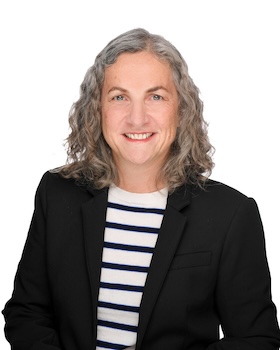
השחתת הסניף על רקע הטענה כי סטארבקס תומכת בישראל היא רק דוגמה אחת לאירועים הקשים שהפכו מנת חלקם של יהודי טורונטו וערים אחרות. באירוע אחר ריססו פעילים פרו־פלסטינים צבע אדום על חנות ספרים בטורונטו, ותלו עליה כרזות עם תמונת המנכ”לית הת’ר רייזמן בצירוף הכיתוב אתם מממנים רצח עם. באירועים במונטריאול אלמונים ירו לעבר בית כנסת ושני בתי ספר. את האירועים גינה בחריפות ראש ממשלת קנדה, ג’סטין טרודו. לדבריו אירועי האנטישמיות הנוראים במונטריאול חייבים להיפסק. אף הורה לא צריך להידרש לספר לילדו כי ירו על בית ספר. אף רב לא צריך להסביר לקהילה שבית הכנסת שלה הותקף. במונטריאול מתגוררת הקהילה היהודית השנייה בגודלה במדינה

בטורונטו דיווח גם על תלישת מזוזות, ריסוס גרפיטי של מגיני דוד טבולים בדם על בתים של יהודים ובבית ספר. בכיר במשטרת טורונטו אומר, כי הממוצע היומי של פשעי שנאה נגד יהודים קפץ בכמאה שלושים אחוז מאז פרוץ המלחמה. לפי גורמים רשמיים, אף שדווחו גם אירועים אסלאמופוביים, מספרם זעום בהשוואה לאלימות הגואה נגד יהודים. שיעור המוסלמים בקנדה הוא קרוב לחמישה אחוזים ומהגדולים במערב, לעומת כאחוז ליהודים

באוניברסיטת קונקורדיה מונטריאול מתגבשת תביעה ייצוגית נגד המוסד האקדמי ואגודת הסטודנטים בטענה כי טיפחו מרחב מוגן לאנטישמיות לאורך השנים, וגרמו בכך לפגיעה רגשית בקרב סטודנטים ומרצים. התביעה מבקשת פיצויים בסכום של חמישה עשר מיליון דולר (קנדי) עבור התובעים, שעמם נמנים סטודנטים, אנשי צוות ומרצים יהודים שהשתייכו למוסד האקדמי בשלוש השנים האחרונות. אוניברסיטת קונקורדיה כשלה בחקירה ובתגובה לאירועים אנטישמיים בתחומה, דבר שאיפשר לאנטישמיות לשגשג ברחבי הקמפוס, טענו העותרים. בבקשה תוארה תקרית אלימה בין סטודנטים פרו־ישראלים לפרו־פלסטינים שהסתיימה במעצר של סטודנט ופציעתם של סטודנט נוסף ואנשי ביטחון. התביעה נגד קונקורדיה מתגבשת ברקע מאבקן של אוניברסיטאות ברחבי קנדה להתמודד עם המציאות הנפיצה בקמפוסים, מאז פרוץ המלחמה ומצטרפת לתביעה שהגישו בשבוע שעבר סטודנטים באוניברסיטת ניו יורק שבה הושמעו טענות דומות

ההסלמה באירועים האלימים נגד יהודי קנדה מאז מתקפת חמאס איננה מאפיינת רק את הערים הגדולות ביותר. במיסיסאוגה במחוז אונטריו, העיר השביעית בגודלה בקנדה, רופא יהודי קיבל איומים על חייו. ביישוב קטן יותר באונטריו, בריונים תלו מכתב איום על בית משפחה יהודית. אין ספק שאנחנו עדים להסלמה חדה באנטישמיות בעיר שלנו, בערים ברחבי קנדה וברחבי העולם מאז מתקפת חמאס, מציין נח שאק, סגן נשיא למלחמה בפשעי שנאה ואנטישמיות, במרכז בטורונטו. בין שמדובר באירועי בריונות נגד הילדים שלנו בבתי ספר משום שהם יהודים ובין שנגד סטודנטים באוניברסיטאות, או אפילו נגד אנשים שעוצרים לקפה בדרך לעבודה ונחשפים לוונדליזם אנטישמי וכתובות שטנה. מדובר במציאות מטרידה מאוד, הוא ציין עוד

Rx for antisemitism?

A resident doctor in Vancouver was confronted by a fellow medical student demanding to know why Israel is exchanging three or more Palestinians for each Israeli hostage kidnapped by Hamas and held in the Gaza Strip. Is an individual Palestinian life of less value than a Jewish life? the student demanded.

This is one of many anecdotes making the rounds among Jewish doctors in British Columbia. These experiences, as well as an inflammatory anti-Israel letter signed by a sizeable number of University of British Columbia medical students, caused more than 100 doctors to assemble to discuss the issues Dec. 5.

“If the university doesn’t take these things seriously, I’m prepared to give up my UBC appointments,” said a Vancouver neurosurgeon who asked that their name not be used because they suspect activists would target them with vexatious complaints to professional governing bodies or harass them online or otherwise. “I don’t need to be associated with a university that does not speak out against antisemitism.”

Medical students in the province are trained in Indigenous awareness among other culturally relevant education, said the neurosurgeon.

“I consider myself to be part of the indigenous people of the land of Israel, and a minority,” the doctor said. “We’ve been labeled as settler-colonialists by a quarter of the medical students and our history has been completely ignored. I think those people should be forced to have some education about the indigenous people of Israel.”

The meeting, held at the Jewish Community Centre of Greater Vancouver, brought together about 50 doctors in person, with another 60 attending virtually. The neurosurgeon left uplifted after hearing from community leaders about strategies and actions being taken.

Addressing the meeting were Ezra Shanken, chief executive officer of the Jewish Federation of Greater Vancouver, Nico Slobinsky, Pacific region vice-president for the Centre for Israel and Jewish Affairs, and Ohad Gavrieli, assistant executive director of Hillel BC. The event was convened by Larry Barzelai, a recently retired family doctor, and Marla Gordon, a physician working in elder care and medical director for long-term care in Vancouver.

The gathering was a reunion of sorts, including some doctors who had been part of an informal cadre of Jews in the field who would get together informally a couple of times a year in recent decades. However, the turnout far exceeded expectations.

Gordon contacted Barzelai, thinking 10 or 20 doctors might want to get together over coffee. As of last week, 240 Jewish doctors, most of them in British Columbia, were part of a WhatsApp group of professionals concerned about antisemitism in their discipline, especially affecting younger doctors. About half attended last week’s event.

The letter that precipitated much of the meeting’s concern was signed by more than 300 UBC medical students – an estimated 20 to 25% of the total student body. The letter called on UBC’s new president, Benoit-

Antoine Bacon, to call for a ceasefire between Israel and Hamas, but also called Israel a “settler state” that is “dispossessing Palestinians of their homes” and stated that Palestinian people “have been continually abused, traumatized, and killed by the settler state of Israel and its Western allies for over 75 years” through “colonialism and imperialism.”

Gordon said the doctors are asking for the medical school’s diversity, equity and inclusion education modules to address antisemitism. 

“Just knowing that we are teaching these students who signed this letter, there is discomfort,” Gordon said. “We feel that everyone should be safe in their workplace. If you are a patient, you should feel safe getting care. What if one of your care providers had signed that letter and knows you’re Jewish?”

As much as the meeting had an agenda of fighting antisemitism and biased approaches to international affairs in the medical sector, Gordon said, it is also important for people to gather in mutual support when the community is feeling isolated.

Barzelai echoed Gordon, noting that several doctors told him that any future meetings should continue to be in person, or hybrid, rather than exclusively virtual, because the camaraderie was crucial.

“People are hurt,” said Barzelai. “They are having all sorts of negative experiences in their workplace, with the faculty, with other professors. They want to do something about it.”

Right now, the letter signed by hundreds of medical students is the foremost concern, he said.

“The fact that that many students would sign a letter I think shows the ignorance of the situation, or their lack of knowledge of what’s going on,” he said. “It just pointed to us that we need to educate these people, that it’s too easy to sign a letter and take sides. But the situation itself is a complex situation. To blithely sign a letter like that is kind of distressing. For us, as doctors, we think that people who get into medical school should have done some critical thinking to get there and would be a bit more nuanced about their opinions about the Middle East.”

A lawyer at the meeting stressed the importance of documenting each and every incident on campus, in the workplace or elsewhere. Pro bono legal assistance is available for students and an antisemitism hotline is likely to be operational in the new year.

An alternative letter, signed by Jewish and non-Jewish doctors and medical students, may be drafted and presented to university administrators. Successive meetings will determine next steps. 

Dialogue to empower women

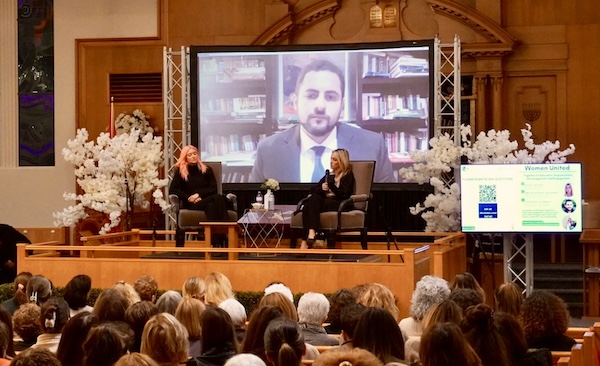
Caroline D’Amore, left, Hussein Aboubakr Mansour and Emily Austin spoke to an audience of more than 550 at Congregation Schara Tzedeck Nov. 26 for the event Women United. (photo by Kyle Berger)

Some 550 Vancouver women packed the sanctuary at Congregation Schara Tzedeck Nov. 26 for Women United, a talk arranged by Jewish National Fund, Jewish Federation of Greater Vancouver, Stand With Us Canada and Schara Tzedeck, and sponsored by the Diamond Foundation. Jewish women were encouraged to bring their non-Jewish friends, and Federation reported that 40% of attendants were non-Jewish.

“The idea was to bring together a diverse range of women from all faiths, to engage in dialogue and empower us to speak up with bravery,” said Megan Laskin, who initiated the concept for the event. She noted that there are just 15 million Jews worldwide “but we are the victims of half of the hate crimes that occur. Our pain, our fear and our loneliness are very real and very deep.” 

Emily Austin, 22, an American social media influencer who is the host of a National Basketball Association podcast called The Hoop Chat w/ Emily Austin, was the first speaker. She described how she took a deep dive into Jewish history to understand it better. “One thing Israel will always have on its side is facts,” she noted. “The Palestinians have truly sad videos with no facts, but people tend to overlook the facts because of the emotional nature of the narrative.”

Austin delivered some of those facts to the audience, refuting the Palestinians’ claims of genocide. “Go to UN.org and you’ll see that their population has quadrupled in the last 20 years,” she said.

In discussing land claims, she said, “this is not about land. It’s about Jew hatred.” She argued that, when Israel left Gaza in 2005, the Gaza Strip was a prosperous area filled with resorts, cafés and nightclubs. “They turned it into a terrorist capital,” she said of Hamas. 

Austin urged members of the audience to educate themselves so they can address false claims with confidence. “There are no excuses to not be a voice when we have the facts. If you’ve not been vocal, please be vocal now,” she said. “Silence is compliance, and those people who want Jews dead are not being silent.”

Austin warned that this conflict is not just about Israel, or even just about Jews. “When they say kill the infidels, the West is next. The common denominator is hatred, and it’s a disease,” said Austin.

Caroline D’Amore, 39, a single mom, social media influencer and the entrepreneur behind Pizza Girl pizza sauce, was the second speaker. She described herself as “a not-so-subtle, pink-haired, Malibu Italian chick” and a high school dropout. She said learning about the Holocaust and reading Anne Frank’s diary made a deep impression on her, but that she was unaware of antisemitism until Oct. 7, after which she started seeing it everywhere, and felt compelled to speak out.

D’Amore said she published a video expressing her dismay and a fact that was obvious to her. “The terrorists are the bad guys. There is no context on this earth that could justify rape and murder,” she told the audience.

The video went viral and D’Amore received hundreds of messages from mothers who were so relieved that a non-Jew could see what was going on.

“I could feel their pain, sadness and fear,” D’Amore said. “So many people are saying nothing, or shaming Jewish people for feeling this fear right now. Jews are being told to ‘stop playing the victim,’ and even I get accused of playing ‘the Zionist victim card.’ What I want to say to my accusers is ‘how dare you?’

“It’s very clear to me that this is about good versus evil,” she continued. “I dove right in and started screaming about this at the top of my lungs, and though I’ve been attacked online for over a month now, I’m still here, proudly showing my face. I plan on being on the right side of history, which means standing up against terror in the Middle East and against those who are justifying what happened on Oct. 7. My promise is that I’ll continue to use my voice to stand up against evil, to stand up for humans who are suffering, to speak up against terrorism, and to encourage and empower others to use their voices.”

D’Amore said the Jewish community was her inspiration. “You guys find the light and it shines so damn bright,” she said. “You come together in the most beautiful ways, and it’s inspired me in ways I’ve never known possible.”

Hussein Aboubakr Mansour, the third speaker, addressed the audience by Zoom from his home in Washington, DC. Now the director of the Endowment for Middle East Truth’s Program for Emerging Democratic Voices from the Middle East, he was born in Cairo, into an environment that he said inspired him and his peers to hate Jews and become jihadists. 

“From an early age, there was a story I heard everywhere, that there are people who epitomize wickedness, want to destroy Arabs and Muslims and steal our land, and want to destroy everything that is good and sacred. Those people are the Jews and Zionism is the embodiment of that ideal,” he said. 

Curious, he started teaching himself Hebrew and learning about Jewish history. That led him on a long journey that transformed his relationship with the world and turned him into an ardent Zionist and supporter of the Jewish people. 

His metamorphosis and his insistence on publishing, blogging and talking about what he learned, has cost him dearly. He was disowned by his family, was arrested on suspicion of being a Zionist spy, and was tortured in Egyptian jails before receiving political asylum in the United States in 2012. 

“I spend every day of my life thinking about how to help end this epidemic of antisemitism that’s been going on for so long,” he said. While the massacres on Oct. 7 destroyed much of his optimism, Mansour said he still believes a change for the better is possible.

He ended his remarks by saying that he is proud to be a friend of the Jewish people and of the state of Israel. “And I have no doubt that I’m not the only Arab who feels this way – I’m just ahead of the curve,” he said. “There will be more who will see this truth.” 

Lauren Kramer, an award-winning writer and editor, lives in Richmond.

The omission of antisemitism

Many Jewish students are worried to go to campus in view of threatening and hateful messages and even open hostilities at some Canadian campuses. These are taking place within a wider context of antisemitic incidents in the wake of the eruption of the Hamas-Israel war.

The silence of some Canadian universities in addressing antisemitism, in particular when considered alongside otherwise active approaches toward equity, diversity, inclusion, decolonization (EDID) and racial justice needs to be explicitly addressed.

Legal action has recently been filed against some Canadian universities for failing to address antisemitism.

Anti-Palestinian racism, antisemitism

I’m an education scholar whose work centres on equity, diversity, inclusion, decolonization and anti-racism.

My engagement in this work has been shaped by my own background migrating to Canada from Israel 12 years ago. My graduate studies in Jewish history, with focus on Holocaust memory, made me attuned to injustice.

My migration was informed by concern my children wouldn’t be able to grow up without absorbing the racism against Palestinians that is pervasive in Israeli society. I now fear that my children, and students, will be absorbing antisemitism.

Antisemitism in society at large, on campus

Antisemitism — the prejudice, hatred, and oppression of Jews and one of the oldest forms of racism — is an ongoing concern in Canada.

There has been work at some post-secondary institutions to consider how EDID frameworks need to address antisemitism and also Islamophobia and anti-Palestinian racism both in the context of Israel and Palestinian issues and in the everyday.

But many EDID frameworks — both of specific institutions, and larger guiding frameworks — do not explicitly address these problems. For example, the Federation for the Humanities and Social Sciences’ 2021 “Charter on EDID,” which states the need for “a more resolute effort to achieve [EDID] in our disciplines [and] fields of inquiry,” mentions categories of race, ethnicity and does not name antisemitism.

Addressing covert and explicit discrimination

Because racism and discrimination are often covert in higher education institutions, EDID initiatives focus on creating systemic and institutional changes in all levels and aspects of institutions, including through policies, leadership, hiring, curriculum and student experiences. But this frame is also applied to specific discrimination cases and complaints in higher education.

Universities’ equity, diversity, inclusion and decolonization initiatives are emerging and should rightfully comprehensively respond to specific forms of racism and discrimination. For example, in 2020, work on the Scarborough Charter on Anti-Black Racism and Black Inclusion in Canadian Higher Education was launched and multiple universities have since signed it, pledging “shared recognition of the realities of anti-Black racism.”

Focus on decolonization

Inspired by the Truth and Reconciliation Commission and its 94 Calls to Action, decolonization and Indigenization of Canadian higher education plans have become central for conceiving EDID work.

For example, the second part of the Social Sciences and Humanities Research Council’s Igniting Change 2021 report, from the Advisory Committee on Equity, Diversity, Inclusion and Decolonization, focuses on “Principles, Guidelines, and Promising Practices of Decolonization.”

In Canadian universities, an EDID focus on issues of decolonization and racism is important, given histories and legacies of colonial oppression, racism, exclusion and marginalization affecting Black, Indigenous and people of colour in Canada.

Yet this focus, in specific institutional approaches to EDID, fails to address and at times downplays the history of antisemitism and its ongoing reality in Canada.

Whiteness and Jews’ ambivalent racialized status

Several factors have contributed to this. The majority of North American Jews self-identify as white. “Whitening” allowed white-passing Jews to become part of a white Christian mainstream in ambivalent ways.

This process has reduced Jewish heritage to simply a religious/faith affiliation, even while Jews remain vulnerable to pernicious white supremacist and antisemitic beliefs about Jewishness being “in the blood.”

No doubt, it is complex to identify Jews as a category under “race,” since such a categorization is reminiscent of Nazi ideology. On the other hand, if we understand race as a social construct, the absence of naming antisemitism in EDID frameworks is deeply problematic.

Tools to acknowledge antisemitism

This prevents scholars and educators from acknowledging the historical, institutional, ideological and cultural underpinnings of antisemitism.

Academics working on anti-racism issues trying to bring up antisemitism are often told this is not part of the EDID agenda.

A report by a senior adviser on antisemitism at the University of Toronto’s medical school described how instances of antisemitism were dismissed as political activism against Israel, protected under academic freedom even while this activism was rife with antisemitic dog whistles (such as seeing Jews as “controlling the media” or “owning the university.”)

This conflation points to EDID settler-colonial discourses that position Jews as white colonial forces.

This framing fails to acknowledge the historical, cultural, and spiritual ties of Jews to the land of Israel and also erases the reality that Jews both in Israel and in diasporic communities globally are not a uniform ethnic group. For example, about half of the Jewish population of Israel are “Mizrachi”, descendants of Jews from the Middle East and North Africa.

Not about shielding Israel from critique

Addressing the complexity of Jewish identities doesn’t mean justifying Israeli state politics or shielding Israel from critique.

Critiquing Israel is not antisemitism. Many Jewish and Israeli scholars have strong criticisms toward Israeli politics, just as many Jews object to the killing of civilians in Gaza, and support “free Palestine.”

CBC news video announcing the death of Canadian Israeli peace activist Vivian Silver who was killed in the Hamas attacks.

Unpacking history and current events is important for EDID work.

But portraying Jewish peoples as the embodiment of colonial oppression is an antisemitic trope that legitimizes hate and violence.

Antisemitic tones, slogans in political calls

Antisemitism was seen after Oct. 7 when some academics publicly celebrated the Hamas massacre as a form of decolonizing and liberation, while victim-blaming those murdered and kidnapped.

Colleagues shared video with me of people at University of British Columbia marching and chanting “there is only one solution: Intifada revolution.” For many Jews, this chillingly evokes the “final solution.”

In other protests, demonstrators have carried signs saying: “Keep the world clean,” portraying a trash can with a Star of David in it.

Including all experiences

The failure of EDID to address antisemitism makes Jewish students targets of microaggression and hate on campuses.

Universities must aim to create educational institutions in which all lived experiences are included.

A good way to address antisemitism would be for specific universities and the higher education sector to launch a task force. In so doing universities would also need to address hard political conversations surrounding Israel and settler colonialism. Universities have tended not to address this because of complexity, but this can no longer be avoided.

Jewish students should not be made to feel less than or illegitimate as they attend university. We have a responsibility to condemn and actively address antisemitism as part of our commitment to EDID.The Conversation

Lilach Marom, Assistant Professor, Faculty of Education, Simon Fraser University

This article is republished from The Conversation under a Creative Commons license. Read the original article.

As we light the hanukkiyah 

When we look at our calendars – especially that darkest of recent days, Saturday, Oct. 7, 2023 – it’s hard to imagine that that now-infamous date is part of a millennia-long continuum. 

About 2,200 years ago, the Maccabean revolt against the Greeks controlling Judea succeeded in the rededication of the Second Temple in Jerusalem. From this ancient victory, we celebrate Hanukkah, lighting candles over eight nights to honour our brave ancestors then and those who have followed. 

Now, more than two millennia later, we call on the Israeli Defence Forces to protect Israel from Hamas who, on Oct. 7, murdered more than 1,200 (mostly) civilians, injured more than 5,400 and abducted more than 240 elderly women, men, children and other civilians. Since that day, 200,000 Israelis have had to flee their homes and all in the entire country are living under constant threat of thousands of indiscriminately fired rockets launched by Hamas from Gaza. 

Operation Iron Swords is the Israeli response fighting for the safety of its people and, in fact, for its very existence. Is it Israel’s right to defend itself? Yes. But it’s much more than that. It is Israel’s obligation to its citizens, as it would be any country’s that wants to call itself a state. 

This operation, so necessary and yet so treacherous both on the ground and in the world of public opinion, has been used as an excuse for a disgusting surge in anti-Israel and – let’s be truthful – anti-Jewish rhetoric, threats, anarchy and vandalism. We’ve seen this before, in the May 2021 Gaza War and its aftermath, and we are seeing it again, only now the campaigns are emboldened and expanded by years of online Jew-hate that has made its way from the fringes to the centre.

photo - Judy Zelikovitz
Judy Zelikovitz (photo from CIJA)

What can we do? As descendants of the Maccabees – and generations more of intrepid survivors – we can rally, finding strength and comfort in our collective calls for civility, tolerance and bedrock Canadian values. 

We can stay informed and stay connected. 

We can, as thousands young and old across Canada have done already, donate to our local federation’s emergency campaigns supporting Israelis. How proud we can be that Canada’s diaspora has already raised more than $100 million in response to the emergency. Federations have already sent millions to support victims of terror, evacuees and those in need.

We can say something if we see something. The Centre for Israel and Jewish Affairs tracks hate-based incidents at cija.ca, under the Get Involved link. If you witness an antisemitic incident, report as many details as you can remember and, if it’s safe to do so, take pictures. If there is a threat or a crime, contact your local police. Many have officers specializing in this kind of report. 

Just as we honour our forebears who protected our lives, our culture and our values, we will honour those who were injured or died on Oct. 7. We will keep the Canadians who lost their lives in our hearts and remember their bravery in saving the lives of others.

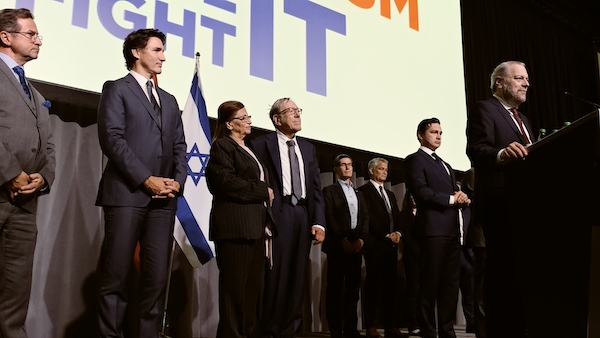
At CIJA’s Antisemitism: Face It, Fight It conference in mid-October, most among the 1,000+ attendees were Jewish. But hundreds were not. We are not alone in fighting antisemitism.

As we light our hanukkiyah candles this year, let us celebrate the courage of those who went before us, of those who served us in sacrifice over thousands of years, and let’s ensure that those protecting Israel now feel our support and our gratitude. Let us be the light!

Wishing you and yours a joyful, meaningful Hanukkah. 

Judy Zelikovitz is vice-president, university and local partner services, at the Centre for Israel and Jewish Affairs.

History both good, bad

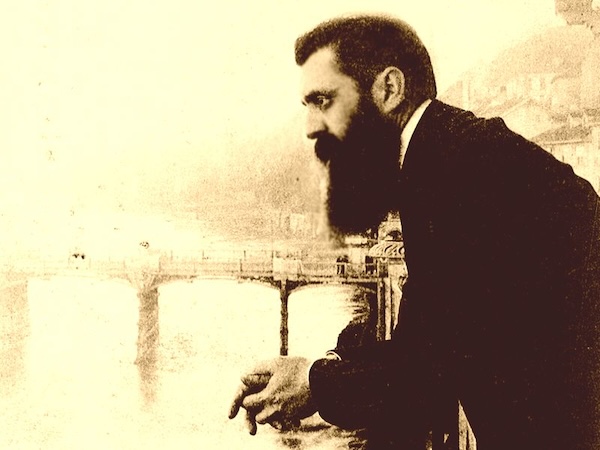
Theodor Herzl, during the First Zionist Congress, in Basel, Switzerland, 1897. (photo from mfa.gov.il)

Sometime before 1223, the first bridge spanning the Rhine River at Basel was constructed, funded through a loan to the town’s bishop by a Jewish moneylender. The bridge was a significant factor in the development of trade in the strategically located city, which is in northern Switzerland, near what are now the German and French borders.

The bridge lasted almost 800 years and was replaced between 1903 and 1905. There may be only one photograph in existence in which the original bridge can be seen – a photograph with another very significant Jewish connection. It is believed that the only place one can see the original Middle Bridge, or Mittlere Rheinbrücke, is in the famous shot of Theodor Herzl in a moment of contemplation outside the First Zionist Congress in 1897.

The bridge provides a sort of bookend to the Jewish story in Switzerland. While the bridge stood eight centuries, the history of Jews in Switzerland proved far less stable than the stone Mittlere Rheinbrücke.

photo - A pocketwatch with Hebrew characters and an engraving of the Western Wall on the reverse
A pocketwatch with Hebrew characters and an engraving of the Western Wall on the reverse. (photo by Pat Johnson)

Switzerland has a rightful reputation for natural magnificence – rolling green meadows, massive snowcapped mountains, glacial streams and rivers – as well as political stability and neutrality that have made it home to a host of international nongovernmental organizations and United Nations agencies. The prevalence of cheese and chocolate also give it a delicious reputation. History is not so agreeable. 

Some of that history is told in Basel’s small but impressive Jewish Museum of Switzerland. When the institution opened in 1966, it was the first new Jewish museum in the German-speaking world since the Holocaust.

Basel itself holds a special place in Jewish history – for better and for far worse. Herzl, credited as the founder of political Zionism, was not one for false modesty. After his debut as convenor of the 1897 conference, he declared: “At Basel, I created the Jewish state. In five years, perhaps, and certainly in 50, everyone will see it.”

Herzl himself did not see it. He died in 1904. But, indeed, 50 years on, the United Nations passed the Partition Resolution and, a year after that, the state of Israel was created.

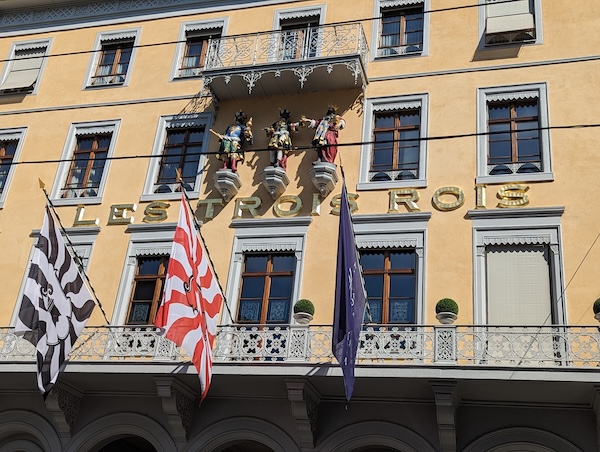
photo - The Three Kings Hotel, Basel, site of the First Zionist Congress, 1897
The Three Kings Hotel, Basel, site of the First Zionist Congress, 1897. (photo by Pat Johnson)

There are probably only about 1,000 Jews in Basel – there are around 20,000 in all of Switzerland – yet Basel stands out not only as the birthplace of the modern Zionist movement and home to the national museum of Jewish life and culture, but also has hosted the Zionist Congress 10 times, more than any other place.

Sadly, Basel is also on the Jewish historical map for far less rosy reasons. In 1349, an estimated 600 Jews were burned at the stake in Basel and 140 children were forcibly converted. This was just part of a series of pogroms in the 12th and 13th centuries across Switzerland, some based on blood libels or motivated by allegations of well poisonings at the time of the Black Plague.

Switzerland may have a reputation as being exceptional in Europe – neutral in foreign relations, and not a part of the European Union or most other multilateral bodies – but human-made borders and the majestic Alps seem to have done little to protect Swiss Jews from the horrors that have befallen coreligionists elsewhere on the continent across centuries.

As in other places, Swiss Jews were limited by law as to the professions they could pursue. A range of deliberately demeaning regulations were in place, including homes built with separate doors for Jews to enter. Jews were forced to pay what amounted to protection money to authorities.

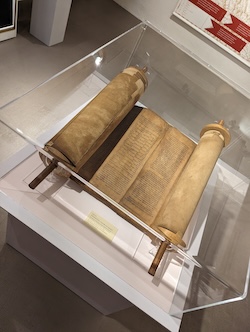
photo - A Swiss Torah scroll at Jewish Museum of Switzerland, Basel
A Swiss Torah scroll at Jewish Museum of Switzerland, Basel. (photo by Pat Johnson)

Early in the 17th century, almost all Jews were expelled from Switzerland. Physicians were a professional exception and Jews were allowed to remain in just two villages.

After Napoleon invaded Switzerland, a series of political reforms began, some better and some worse for Jews.

Jews were formally permitted to settle anywhere in Switzerland after a referendum in 1866 resulted in a slight majority of Swiss endorsing equal rights for Jews. (The Swiss have a mania for referendums, even on issues of basic human rights.)

Migrants then came from middle and eastern Europe, especially after pogroms in Russia in the 1880s. More came from Germany after Hitler came to power, in 1933, but Switzerland, like the rest of the world, eventually slammed the doors shut, in 1938.

Swiss banks, with their uniquely secretive policies that protect the illegal and immoral, have been forced to reconcile, to an extent, with their complicity with the Nazis, as well as their profiteering from the assets of Jews who, because of the Holocaust, never reclaimed assets they had deposited for safekeeping as turmoil roiled their homelands.

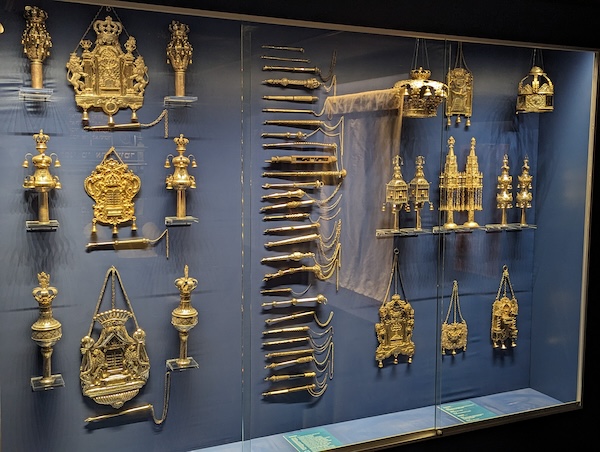
photo - The Jewish Museum of Switzerland’s display of Torah crowns and breastplates, and yads (pointers used to help read the text)
The Jewish Museum of Switzerland’s display of Torah crowns and breastplates, and yads (pointers used to help read the text). (photo by Pat Johnson)

Seemingly an oasis of stability and reason in a continent aflame in fascism, Switzerland nevertheless was steadfastly determined to prevent Jews from finding haven there. After the Anschluss, when Hitler’s army invaded and absorbed Austria, Jews from that country desperately tried to enter Switzerland, but mostly were met with rejection. Likewise, after the Nazis swamped France and the Low Countries, refugees from those places were similarly spurned.

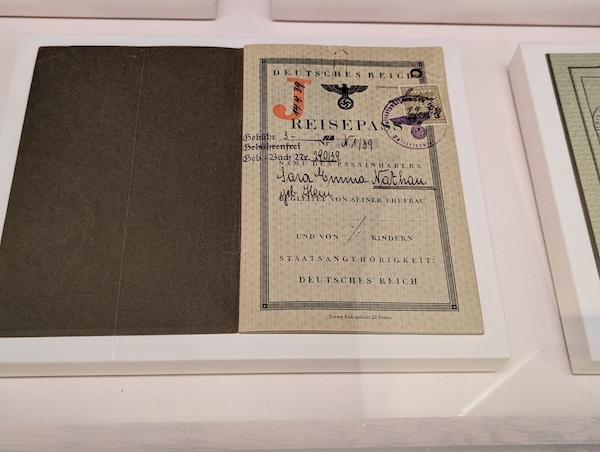
In all, about 23,000 Jews were admitted to Switzerland – but only as a country of transit. The Swiss authorities even prevailed upon the Third Reich – successfully – to stamp German passports issued to Jews with an unmistakable scarlet letter “J” to make it easier to identify and reject potential Jewish border-crossers. 

photo - Swiss authorities prevailed upon the Third Reich – successfully – to stamp German passports issued to Jews with a “J” to make it easier to identify and reject Jewish refugees
Swiss authorities prevailed upon the Third Reich – successfully – to stamp German passports issued to Jews with a “J” to make it easier to identify and reject Jewish refugees. (photo by Pat Johnson)

In the 1990s, as Swiss actions during the Second World War and the Holocaust were the subject of international attention, a backlash to this critical historical assessment led to an upsurge in antisemitic rhetoric and what a study indicated was a substantial reduction in inhibitions against racist expressions toward Jews. More recent public opinion polls suggest the Swiss are among Europe’s most antisemitic populations. 

An old and unresolved sticking point for Swiss Jews has been the banning of kosher slaughter, which was outlawed in 1874 and remains prohibited to this day. Since 2002, the Swiss government has allowed the importation of kosher meat, but ritual slaughter remains illegal.

For all its significance in Zionist history, Basel appears to have no commemorative plaque or similar tribute marking either its centrality in the birth of the modern Zionist movement or of Herzl’s association with it, although the museum celebrates the connection. 

The Jewish Museum of Switzerland is located in a nondescript side street about a 20-minute walk from the Basel train station. It is open Monday to Thursday, 1-4 p.m., and Sundays, 11 a.m.-5 p.m. The permanent exhibition explores Jewish culture, religion and history through an impressive assemblage of ritual objects, documents, household items and testimonies. The current exhibition, Literally Jewish, which runs into next year, explores how Jews have been perceived depending on the time, language and attitude, including, as the introductory material says, “from derogatory to valourizing, ideological to idealizing.” Adult admission is 10 Swiss francs – about $15.50 Canadian – making it one of the more affordable attractions in a country where everything is gobsmackingly expensive. 

Universities have obligations

My mom left Brooklyn, NY, to attend Cornell University in the early 1960s at age 16. Among other things, women students had nighttime curfews. This type of legal responsibility or intervention, called in loco parentis (in place of a parent), was common, but, by the time my mother graduated, in the mid-1960s, times had changed. Curfews became a thing of the past.

When I got to Cornell in the 1990s, some things were the same. Cornell impressed upon its new students that “actions have consequences” and that “with rights and privileges come responsibilities.” That is, you were privileged to be there. If you did something stupid, you were held responsible. All this hit me while watching North American college campuses’ turmoil since the Oct. 7 Hamas massacre of Israelis.

I have a front row seat to the drama. My husband is a professor in Manitoba. Between the two of us, we have six degrees from five different universities. We’ve got insider knowledge. I watched some of the behaviour on campuses with horror during the first days after the attack, including seeing Dr. Russell Rickford, a Cornell professor, speak of his “exhilaration” in response to Hamas’s actions. I’m not listing all of the concerning antisemitic events that continue to occur at North American universities. We’re all seeing it on social media and the news.

The first good news I read was from an article written by Rob Eshman in the Forward, which covered Dartmouth University’s response. Dartmouth is a small school. Its academic experts on the Middle East collaborated quickly. On Oct. 9, they announced two public teach-ins, with expectations of a small crowd. Hundreds attended, and there were thousands of YouTube views. What’s the primary responsibility of a university? To educate and encourage students to be critical thinkers. Dartmouth rose to the challenge.

There are other universities following this educational approach, with mixed results. Some universities don’t have the academic firepower or the will to provide an appropriately diverse panel of experts. Some attempts have been derailed by harassment or protest. Other institutions have made poor educational efforts by platforming only one side (usually the pro-Hamas/genocide/apartheid side) of the conversation.

Most professors are evaluated for their performance and tenure on several measures: teaching, research and service. To do these aspects of their job, many feel that free speech is essential and that, while the university employs them, the administration may not hamper their speech as it pertains to teaching or research. Since early October, many professors have felt stifled when expressing their political views, particularly when it comes to anti-Israel political rhetoric about the war.

I recently read a Canadian university faculty union’s stance. The document stated all members had a right to academic freedom and free expression and the union would defend that. However, that right comes with “the responsibility to respect the rights and freedoms of others” and “does not confer legal immunity from hate speech and other violations of the law.” It also doesn’t protect a professor from criticism or condemnation from others.

This document reminds academic professionals what I was taught as an undergraduate: actions have consequences, and they must take responsibility for any consequences that may occur.

Many Jewish students are being physically harassed, verbally assaulted and intimidated on college campuses. Some universities are trying to take action. Cornell had a situation where a student made death threats towards Jewish students at the kosher dining hall. The FBI was quickly involved, the student was arrested. Soon after, the president of the university and the New York State governor sat down to eat in that dining hall with students. Rickford, the professor who spoke out about the Hamas attack as an exhilarating sign of liberation, is now on leave.

Other US universities have responded with less force. Some, like George Washington University, suspended student groups who used pro-Hamas rhetoric. Others, for example, MIT, have suspended students who participate in violent or disruptive protest from all non-academic activities. There are efforts to offer antisemitism education and awareness at some universities. Hillel, the Jewish student organization on many American and Canadian campuses, offers support and advocacy for struggling Jewish students.

Universities now also face legal action when they fail to protect Jewish students. The US Department of Education is opening investigations of antisemitism (and Islamophobia) at US schools such as Cornell, Columbia, Cooper Union, University of Pennsylvania and Wellesley College. There’s a lawsuit being brought against McGill in Montreal, with support from B’nai Brith Canada, and the University of British Columbia, York University, Toronto Metropolitan University and Queen’s University have had class action lawsuits filed against them for alleged antisemitic incidents.

Where does this lead? Consider again the notion that actions have consequences. In some widely circulated video clips, university students or professors scream obscenities and tear down posters of kidnapped victims of the Hamas attack. Some cover their faces; others sneer at the camera. Sometimes, a student is seized by regret later and begs others not to post the images. These choices, caught on video and distributed online, may affect students’ careers forever – and I think that’s OK.

Yes, university students are often (but not always) still adolescents. Perhaps, according to the research, their brains are still developing and they have poor impulse control. But they are also adults in our society. These are people who legally drink, drive, vote and fight in wars. These students are old enough to work, marry and have kids. With all these rights and also the privilege of attending university, they have the responsibility to behave appropriately. Think you might be embarrassed to be caught vandalizing posters of missing persons? Don’t do it.

University leadership and professors have an important role to play “in loco parentis.” It appears many have forgotten this. Students attend universities to get an education, to become critical thinkers and to contribute to leading and shaping our future society. They deserve more than “free speech” from their teachers. They need to learn multiple perspectives, history and policy, and that includes understanding nuance.

While most universities no longer impose curfews or other restrictions, professors owe it to their students to be mentors and role models. Professors should be upstanding community members beyond academic research and teaching. They should behave with integrity. The obligation to do service means different things in various academic disciplines, but, in every case, professors shape the next generation’s professionals beyond giving exams and classroom lectures. Teaching students how they should behave, with compassion and respect for others, matters.

Don’t get me wrong, it’s OK to speak out. Academic freedom is important, but universities have an obligation, too. They should expect students to behave with dignity and respect for the law, even when speaking out. Alumni can pressure universities to do better, as can lawsuits.

There’s no “one size fits all” answer. However, we should expect that every student should have access to education without discrimination. All students – Jewish and non-Jewish – deserve nothing less.

Joanne Seiff has written regularly for CBC Manitoba and various Jewish publications. She is the author of three books, including From the Outside In: Jewish Post Columns 2015-2016, a collection of essays available for digital download or as a paperback from Amazon. Check her out on Instagram @yrnspinner or at joanneseiff.blogspot.com.

United against antisemitism

Among those on stage as Irwin Cotler received a lifetime achievement award from the Centre for Israel and Jewish Affairs last month were, left to right, Yves-François Blanchet (Bloc Quebecois leader), Prime Minister Justin Trudeau, Ariela and Irwin Cotler, David Posluns (one of the event co-chairs), Steven Kroft (one of the event co-chairs), Pierre Poilievre (Conservative Party leader) and Shimon Koffler Fogel (head of CIJA). (photo by Dave Gordon)

It was a conference months in the making, but Antisemitism: Face It, Fight It took on heightened poignancy in light of the Oct. 7 Hamas terror attacks on Israel and the subsequent spike in Jew-hatred globally.

Produced by Centre for Israel and Jewish Affairs (CIJA), the conference took place in Ottawa Oct. 16 and 17. Speakers included activists, politicians, experts and analysts on antisemitism. In attendance were 250 student leaders and some 600 others, Jews and non-Jews, according to organizers.

Shimon Koffler Fogel, chief executive officer of CIJA, noted there was an outpouring of support from the major political party leaders, as well as from minority, faith and other groups – “a uniform conclusion about Hamas and their actions, and we should embrace that.”

This message was echoed throughout the two days of the conference.

“It can’t just be Jews who talk about the rise of antisemitism. It can’t just be Muslims that talk about anti-Muslim hate,” said Farah Pandith, senior advisor to the Anti-Defamation League. “It can’t be. Whether we are talking about LGBTQ or issues of heritage or gender, we’ve had to stand up for each other. As a Muslim, it’s what my religion tells me I must do for the other.”

Former premier of Alberta Jason Kenney, who was elected as an MP in 1997, said he became a supporter of the Jewish people after the “unravelling of the Oslo process,” and learning of the antisemitism coming from Palestinian mosques and leaders.

“Do not take for granted the positions being expressed here in Ottawa today,” said Kenney. “You must redouble your efforts intelligently to build coalitions across the pluralism of this country, and to be a voice of clarity and courage with our political leadership.” Citing examples of possible coalitions, he told the JI that “the Jewish community has to continue to reach out to Muslim and other communities, find allies.”

“I know we can best tackle what we are seeing when we work together, when we are not siloed,” said Minister of Justice and Attorney General of Canada Arif Virani, an Ismaili Muslim, in his speech. “Hatred and intolerance against any minority community is a risk to every minority community. That’s why groups promoting equity have to have each other’s backs.”

Emily Schrader, digital strategist and senior correspondent of Ynet News, observed, “We see now that all over the world there are Iranians organizing and participating in rallies to support Israel … despite knowing that the Iranian regime is the biggest supporter of Hamas. The Iranian people have a complete rejection of the regime.”

Canadian human rights advocate Irwin Cotler received a lifetime achievement award from CIJA “in recognition of his enduring commitment to the pursuit of justice” and “the advancement of human rights for the world’s most vulnerable and oppressed.”

In his acceptance speech, Cotler applauded the multi-partisan groups standing up against antisemitism, “who heed this call to action, where we act in concert on behalf of our common humanity.”

Cotler was a parliamentarian from 1999 to 2015 and is a former minister of justice. Over the course of his legal career, he represented clients such as Natan Sharansky and Nelson Mandela. Until recently, he was the government’s special envoy on antisemitism. He said “2023 is not 1943” and “there is a Jewish state as an antidote to Jewish powerlessness.”

“In 1943,” he said, “the Jews could not get a meeting with the president of the United States, and, in 2023, the president has been a leader in calling out this [Hamas’s] moral evil.”

Cotler told the JI that young Jews should bravely step forward to “call out antisemitism when they see it, unmask it, expose it.”

Prime Minister Justin Trudeau called out Hamas as a “terrorist organization that launched an attack of unspeakable brutality” and said “Canada supports Israel’s right to defend itself in accordance with international law.” He said the only thing Hamas stands for is “more suffering for Israeli and Palestinian civilians.”

In addressing “scary rising antisemitism,” Trudeau said “families are worried about what they face if they go to synagogue, and I’m sure you are all seeing hateful rhetoric online.” He ended by saying, in Hebrew, “gam zu l’avor” – “this too shall pass.”

Opposition leader Pierre Poilievre, head of the Conservative Party, vowed that his party would stand with Israel, and acknowledged the fears of many Jewish Canadians. About Oct. 7, he said, “the terrorists that carried out this attack did so as part of a deliberate agenda: to maximize bloodshed not only of the Jewish people, but actually to maximize the bloodshed of Palestinians and Muslims as well. These are the actions of sadistic, criminal terrorists who can only be defeated and not negotiated with.”

Poilievre added that, especially in light of Iran’s fingerprints being on the attacks, governments must “respond with crippling sanctions – the strongest legal action – and by criminalizing the Islamic Revolutionary Guard Corps.”

Jagmeet Singh, leader of the New Democratic Party, said, “These are horrific attacks and we strongly condemn them. There is no place in our world for terrorism. The international community must work together to ensure that there is an end to terrorist organizations like Hamas and Hezbollah.”

Singh acknowledged that Jews in Canada are “deeply afraid” and “worried about their safety.”

“It’s wrong and I’m deeply sorry it’s happening,” he said.

In noting pro-Hamas rallies around the world, Singh said, “We’ve seen horrible celebrations for the attacks on Israelis civilians. This is abhorrent. This is antisemitism. Violence against civilians is never justified.”

He concluded: “I know that not everyone will agree with our position on a ceasefire, but I believe the only way to peace is to talk to each other.”

Historian and author Gil Troy encouraged the audience to not forget the courage of “our citizen’s army, our plainclothes commandos, our kibbutzim Rambos and our army,” who saved innocents from much worse.

“When I heard these stories, I shift[ed] from the victim mentality to the Zionist mentality. The Zionist is one that says ‘yes, we sometimes suffer,’ but we are not passive and we are not victims. The Zionist story says we are not alone. We can’t let them win.”

Calgary-based communications consultant Emile Scheffel, who is not-Jewish, told the JI: “History shows that those who threaten the Jewish people are enemies of freedom and dignity for the rest of us as well. I stand with Israel because the Jewish state embodies the values of freedom, democracy and pluralism that are important to me.”

He added, “the conference was an important call to action for non-Jews to stand with our Jewish friends and neighbours in opposing hatred and discrimination. A united front is essential to making sure that antisemitism doesn’t gain any more ground in Canada, and that Jewish Canadians can live in peace and security.”

Attendee Nika Jabiyeva, member of the Network of Azerbaijani Canadians, said she was proud to “stand against hate, shoulder to shoulder with our friends in the Jewish community and many multifaith allies.”

“Our voices carry more weight when we speak up for one another,” she said, “especially during trying times.”

Dave Gordon is a Toronto-based freelance writer whose work has appeared in more than 100 publications around the world. His website is davegordonwrites.com.

Tensions at university

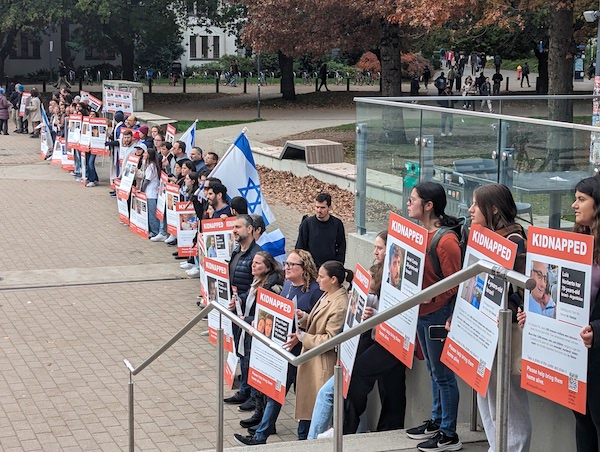
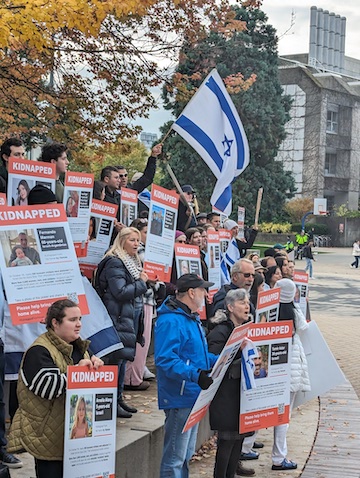
On Nov. 1, about 200 Jewish students and their supporters engaged in a low-key demonstration, with many holding posters of kidnapped Israelis. (photo by Pat Johnson)

When the new president of the University of British Columbia arrived for his first day on the job Nov. 1, he already had a full plate, including a 9 a.m. meeting with Jewish representatives and an urgent letter from community organizations expressing concerns about the safety of Jewish students on campus.

Dr. Benoit-Antoine Bacon starts his tenure at a contentious time, as Jewish, pro-Israel, anti-Israel and other students engage, sometimes constructively but often much less so, with events taking place in the Middle East.

Rob Philipp, executive director of Hillel BC, was joined by his assistant executive director, Ohad Gavrieli, and Nico Slobinsky, Pacific region vice-president for the Centre for Israel and Jewish Affairs, at the meeting with Bacon. Afterward, Philipp told the Independent the university has been on the right track but needs guidance.

“Generally speaking, I would say UBC has been very supportive of us, to the best of their ability,” he said, noting that Bacon’s welcoming of Jewish representatives is a good sign. “I had one of the very first meetings with him, so that speaks to how important this is on their radar.”

The university administration has been “somewhat consistent,” said Philipp.

“We are seeing support,” he said. “We don’t always see the right action, so that’s where we have to help and guide them.”

The larger issues, he said, are the serious affronts to civility on campus during the weeks since the start of the war between Israel and Hamas.

“There are so many red lines being crossed right now, it’s incredible,” said Philipp. “It seems OK now to kill civilians, to murder people for the ‘just’ cause and it keeps spilling over. People aren’t always understanding the details behind it all, so it’s as difficult a time as I have ever seen in this community – and it’s not just UBC, it’s all the university campuses all over North America.”

Hours after the meeting with the university president, about 200 Jewish students and their supporters engaged in a low-key demonstration, walking from Hillel House to the student union building, with many marchers holding posters of kidnapped Israelis. A student entered the building to deliver a letter to the president of the student government, the Alma Mater Society, expressing the group’s collective concerns. An emailed response to the letter from the AMS president was characterized by Hillel officials as positive.

photo - Jewish students and their supporters at the University of British Columbia on Nov. 1
Jewish students and their supporters at the University of British Columbia on Nov. 1. (photo by Pat Johnson)

A Jewish student leader from Simon Fraser University who asked that her name not be published said she came to the rally to protest the antisemitism in the world and, specifically, the lack of regard among student bodies to recognize what happened in Israel.

“It’s an extremely complex conflict that isn’t just black-and-white and I wish people would pay more attention or just seek a more nuanced view on the subject,” she said, adding that the climate at Simon Fraser does not seem as negative as at UBC, but that could change. In the last couple of years, the student government at SFU has demonstrated unbalanced, anti-Israel approaches, including adopting a motion on Israel and Palestine for which they consulted what the student called “tokenized [Jewish] fringe groups” while excluding Hillel and other mainstream Jewish voices.

Other participants at the rally said they felt the need to attend to be seen, and to register empathy with Israelis overseas and with Jewish students in Canada.

“We are here today so UBC acknowledges what’s going on in Israel – the kidnapped kids, elderly, children, women, Israelis – and what happened on Oct. 7,” said a 21-year-old Israeli-born woman who is not a student but came to support her brother, who is.

“I’m feeling very alone and feeling a lack of empathy and sympathy with what’s going on in Israel, feeling like people are too quick to comment sometimes,” she added.

Several non-Jewish students participated in the rally.

“I’m here because even though I’m not Jewish, I have a lot of Jewish friends and I believe the Hamas attacks against Israel are terrorism,” said fourth-year political science student Joe Latam. “The university’s attitude towards these literal terrorist organizations has been completely inadequate and they need to take better action.… The Jewish people have been systematically discriminated against for thousands of years and Israel is the one place where they can feel safe.”

Zara Nybo, who is also not Jewish, was motivated in part because her partner is Jewish and she sees the impact of events on him and his family.

“It’s important for me to stand up against terrorism and help spread the word that there are still innocent hostages who have been taken out of their home country,” she said. “We see a lot on the news that is politicized and very emotionally heartbreaking. I’m not here to say that Palestinian citizens have not died in this war, but I am here to say that death is death and we need to be able to recognize that heartbreak is heartbreak, so we are all here together.”

A first-year student who is Sikh called statements he has seen from peers and student leaders “frankly shameful.”

“I think there are many international students here that have been espousing hate, that have been espousing terrorist beliefs,” he said. “They have been saying they are pro-Hamas, they are saying [the Oct. 7 attacks were] a ‘beautiful act of resistance.’ I think we should double-check whether they deserve to be students at our wonderful university institutions.”

Bar Wolpert, an Israeli doing a one-semester landscape architecture exchange at UBC, said he was accosted by someone who tried to “shame” him as an Israeli.

“He just approached me out of the blue,” said Wolpert. “He was [aiming] his camera in front of my face.”

The person asked Wolpert if he supports “genocide.”

“I’m holding a [poster of a] kidnapped woman,” he said. “I am Israeli. I have a loss. So, please, first, respect my loss, respect my grief. And we are all standing here with many signs of kidnapped people and dead people, that is what is mattering for us right now, so before you are attacking me, respect my loss.”

Also at the rally were two brothers, Israeli high school students, whose parents sent them to stay with Canadian friends and family during the conflict.

A mother, walking with her young adult daughter, teared up when she realized that the poster she was carrying of a 21-year-old French-Israeli hostage could have been her own daughter.

“I can understand the pain,” said Evelyn Fichmann. “I think anybody can understand the pain.”

As he walked alongside scores of Jewish students and allies, a UBC student said the event gave him much-needed optimism.

“It really gave me some hope about unity,” he said.

A call for toughness

Rabbi Dr. Michael Berenbaum spoke at Congregation Schara Tzedeck on Nov. 5. He said: “We can’t raise a generation that is scared of being Jewish.” (photo from kolotmanagement.com)

The mood at Congregation Schara Tzedeck was solemn Sunday night, Nov. 5, when parents, grandparents and students from the Jewish community gathered to listen to Rabbi Dr. Michael Berenbaum, an American professor who is considered one of the world’s preeminent Holocaust scholars. Berenbaum came to discuss the importance of campus conversations, and specifically how to handle the critics of Israel who are voicing their support of Palestinians vociferously on college campuses throughout Canada and the United States.

Until the Oct. 7 terror attacks, Berenbaum said, our children had never known serious difficulty as Jews. “They’ve had the privilege of living in the greatest time to be Jewish, maybe in the history of the Jewish people,” he said. “Now, we’re asking our kids to toughen up, because they’re now going to face difficulty, pain, anguish and danger – physical or intellectual – for being Jews. This is our test of the hour, and it comes with the shattering of easily held assumptions about Jewish life.”

The Oct. 7 pogrom, he said, was worse than the 1906 Kishinev pogrom and worse than Kristallnacht in 1938 in terms of the number of Jews killed and the vehemence with which they were killed. “We believed Israel was founded to protect its people from these pogroms, and yet we were not safe.”

Berenbaum said it is crucial for Jewish students to be armed with accurate knowledge so they can counter the anti-Israel rhetoric they hear on campus. That means refuting claims that Israel is committing genocide. “Understand that this is war, and it has both direct and collateral consequences,” he said. “You cannot deal with war at this point without significant civilian casualties. While Israel is taking significant steps to avoid that, it’s unavoidable.” He noted that, since March 2011, the conflict in Syria has claimed the lives of 500,000 people – “and the rest of the world has heard nothing about this.”

On the claim that Israel is “occupying Gaza,” he clarified that Israel left Gaza in 2005, displacing 8,000 settlers so that Gazans would take control of their lives. “Israel is the only country in the world who has sacrificed land for normalization. We gave up Sinai for normalization with Egypt, and the reason the invasion happened now was because it appeared Saudi Arabia would establish a certain kind of peace with Israel,” he said. “Normalization represented a danger to the lateral forces in the region and that’s why this broke out now.”

On the claim that “Jews are colonizers,” he noted that Jews have never forsaken their connection to the land of Israel, and that there have been five cities with a permanent Jewish settlement in Israel. “When they came to Israel, they settled and worked the land, which is the opposite of colonization,” he said. “They didn’t take its resources and export it elsewhere.”

He noted that Palestinians were offered a state in 2000 and again in 2006, and they turned both opportunities down. “The Palestinians have never lost an opportunity to lose an opportunity, because their leadership is weak and corrupt,” he said.

There are a few things we can do now to ensure we are strong, he continued. One is to educate ourselves on the history of the state of Israel and Zionism. Another is to ensure we have solidarity by reaching out to one another.

 “These are not easy times and we need Jewish toughness and resilience,” said Berenbaum. “We can’t raise a generation that is scared of being Jewish. I want our Jewish students to be proud, tough and confident enough to accept the animus that will come their way, but to have the human capacity to respond to it.”

He ended his talk by calling Jews the “canary in the coalmine. You want to know if a society is healthy? See how it treats its Jews. We’re living in a world that’s fundamentally unhealthy, but it’s important to remember that we have many friends, we are not alone. We have to cultivate and respect those friendships, and not take them for granted.”

The events of Oct. 7 precipitated an earthquake, he added, “and the ground won’t settle for awhile. But earthquakes give the opportunity to build in a different way. We are in for a tough and difficult time, which will demand the best of us. But I fundamentally believe we have it in us to rise to the occasion.”

Lauren Kramer, an award-winning writer and editor, lives in Richmond.