The new Jewish Seniors Alliance Snider Foundation Empowerment Series season began on Oct. 19 with a concert. As usual, the program was co-sponsored by JSA and a community organization; in this case, the Kehila Society of Richmond. Because of the pandemic, the event took place on Zoom.
Last year’s Empowerment theme, “Be Inspired,” was carried forward for this year’s season. Fifty participants tuned in to Music in the Afternoon, which featured pianist Lester Soo and vocalist Maria Cristina Fantini. Soo is an accomplished musician who has taught, adjudicated, accompanied and performed in the world of music for many years, while Fantini – a dramatic soprano, at home in both classical and popular styles – teaches and has established her own vocal studio.
Toby Rubin, coordinator of Kehila Society, welcomed everyone and introduced Soo and Fantini.
JSA’s Gyda Chud spoke about the alliance and recalled that Soo and Fantini had performed in a joint program in the past. This time, the musicians performed from Soo’s home, where he was able to make use of his grand piano.
The audience was entertained by a number of old favourites, starting from the 1930s. Songs included “Unforgettable,” “When I Fall in Love” and “Besame Mucho.” These were followed by works by Cole Porter and Irving Berlin, k.d. lang’s version of Leonard Cohen’s “Hallelujah,” and “Tonight” from West Side Story. The duo then switched to the jazz genre, with “Misty.” Lester played a solo of “Over the Rainbow” and he and Fantini ended with an aria by Puccini, “O, My Beloved Father.”
It was a wonderful concert. The only problem was that the musicians couldn’t hear the applause because the audience was muted for the performance. However, Rubin thanked Soo and Fantini on everyone’s behalf.
For information on JSA and upcoming events, visit jsalliance.org.
Shanie Levinis an executive board member of Jewish Seniors Alliance and on the editorial board of Senior Line magazine.
Diabetes Canada named Gerri Klein as Diabetes Nurse Educator of the Year, 2020, citing Klein’s dedication and passion for her work. For three years, rain or shine, she led a noontime Walk the Walk program for patients living with diabetes; she often makes home visits to vulnerable seniors afflicted by the condition and has accompanied patients to smoking cessation clinics, psychologist and psychiatrist visits, as well as support meetings such as Alcoholics Anonymous and Al-Anon visits.
* * *
The board of directors of the Kehila Society of Richmond has announced the appointment of its new political liaison, Zach Segal, effective this month.
Segal grew up in Richmond, attending Richmond Jewish Day School and Steveston High School. He then studied political science at the University of British Columbia and the University of London.
Following university, Segal worked in Ottawa for four years as a political advisor under the last Conservative government. Today, he can be found working at Vancouver-based Canada Mortgage and Housing Corp.
As a strong advocate for community involvement among Jewish youth, Segal has spoken to schools and Jewish youth organizations about political activism and community involvement. He and his family have a long history in the Lower Mainland and within British Columbia’s Jewish community, dating back to his great-grandparents. He is an active member of the Jewish community and a longtime member and volunteer with CIJA, CJPAC and a variety of other outreach Jewish community organizations.
The board looks forward to Segal assisting in the continued growth of Kehila’s Richmond Jewish community and the community at large. He is a passionate and strong advocate who is ready to roll up his sleeves to make a real difference.
For more information, contact the Kehila office at 604-241-9270.
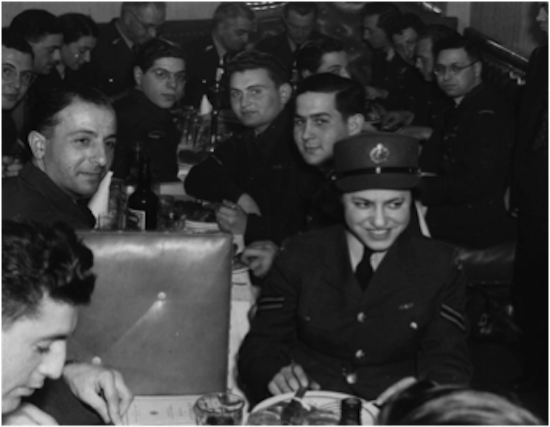
During the Second World War, 17,000 Jews were enlisted in the Canadian Armed Forces, serving their country despite Canada’s “none is too many” Jewish immigration policy. Of these 17,000, at least 279 were women. To highlight the contributions of these Jewish servicewomen and to combat the lack of public awareness of their participation in the war, original artworks are being sought.
Canadian artists who self-identify as Jewish and as women are invited to submit proposals for 2D digital artwork, inspired by the stories of the 36 Jewish service women featured on the website She Also Serves, live-ucalgary.ucalgary.ca/she-also-serves.
Submissions should include a maximum 500-word idea for an original 2D digital artwork (created, for example, using Photoshop, digital photography, digital collages, etc.) for a vertical banner measuring 75 by 165 centimetres. A link to your website, or a pdf including 10 examples of previous work and a curriculum vitae, must accompany the submission. Digital copies of drawings, paintings or other non-digitally generated works will not be considered.
In the end, 10 artists will be invited to create works based on the proposals submitted. Criteria for evaluation include clarity of theme, quality of research supporting the proposal, creativity, visual presentation, and quality of supporting documents. The jurors are Dr. Jennifer Eiserman, associate professor, department of art, University of Calgary; Saundra Lipton, adjunct librarian, U of C; Dick Averns, Canadian Forces artist; and David Bercuson, U of C department of history.
Selected artists will receive a contract indicating that each artist retains copyright and will be paid a CARFAC group exhibition fee of $395. These works will be printed on banners that will be hung throughout the existing exhibitions and galleries at the Military Museums in Calgary during Jewish Heritage Month, May 2021. In addition to the physical exhibition, artworks will be virtually circulated on the project website.
Submissions are due by Dec. 31, 2020 and artists will be notified by Jan. 22, 2021, regarding the jury’s decision. Artists invited to participate will be asked to send TIFF files of completed pieces by April 1, 2021. Send submissions and any questions to Eiserman at [email protected].
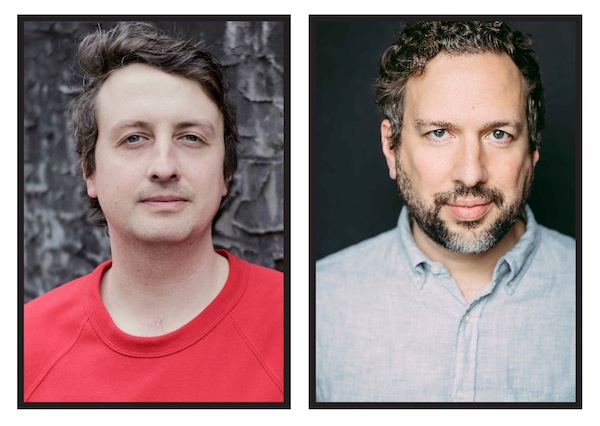
Ryan Beil, left, and Mark Chavez. (photos from Studio 58)
Studio 58’s 55th season continues with the world première of Theatre: The Play, a comedic love letter to the art form, written and directed by Ryan Beil and Mark Chavez.
The Nearlake Theatre Festival & Bar & Grill faces certain closure, unless it can produce a hit show. Dudley, the festival’s intrepid artistic director, throws out all the stops in an attempt to stage a masterpiece the likes of which the theatre world has never seen: Macbeth, War on Christmas. But, can the cast and crew deal with their personal demons before the punters show up? Theatre: The Play is both an homage and a sly middle finger to the world of theatre, asking, “Why would anyone work in this unforgiving and unstable field of make-believe?”
Studio 58 students in their fourth term will perform the play, which will be filmed and then offered online to viewers, who can watch from the comfort of their homes Nov. 29 to Dec. 6.
“We are so excited to push the boundaries of what it means to produce a play online,” said Beil, a member of the Jewish community, and Chavez. “To go beyond just setting up a camera and pressing record, instead making the experience for people watching at home just as electric as it [would be] for those watching in the theatre.”
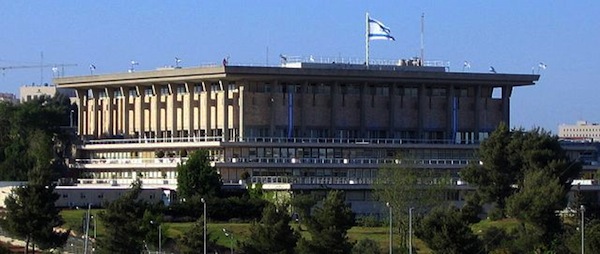
הצעת חוק החדשה של חברת הכנסת תהילה פרידמן ממפלגת כחול לבן, מעוררת עניין רב בעולם היהודי. לדברי אחד מהבכירים בקהילת היהודים בארצות הברית, דיוויד באטלר, הצעת חוק זו מעלה על הפרק את אחד האירועים המשמעותיים ביחסי ישראל והתפוצות מזה שנים רבות.
השאלה שהחוזרת על עצמה אין סוף פעמים, נדונה לעיתים קרובות במאמרי דעות בעיתונות, בנאומים ובכנסים יהודיים שונים, אך היא מעולם לא זכתה לתשובה חד משמעית. כעת מוצעת בכנסת חקיקה חדשה שתיתן למנהיגי יהדות התפוצות סוף סוף תפקיד רשמי בענייניה של ישראל, ואולי אף תבשר על עידן חדש ביחסי ישראל והתפוצות.
מתוך כלל היהודים בעולם שמספרם מוערך בכחמישה עשר מיליון, קרוב לשבעה מיליון גרים בישראל, לפי נתוני ממשלת ישראל. על פי הערכות שונות כשמונת המיליונים הנותרים חיים ברובם בשש המדינות הבאות: ארה”ב כשישה מיליון, צרפת כחצי מיליון, קנדה כארבע מאות אלף, בריטניה כשלוש מאות אלף, ארגנטינה כמאתיים אלף ורוסיה כמאתיים אלף.
את הצעת החוק, שזכתה לתמיכת משרד התפוצות, מקדמת כאמור ח”כ תהילה פרידמן. החוק המוצע יחייב את ממשלת ישראל להיוועץ במנהיגי יהדות העולם בעניינים שייחשבו בעיניה כמכריעים, ונוגעים גם לכשמונה מיליון היהודים שחיים מחוץ לישראל.
באטלר אומר הצעת החוק החדשה “עשויה להיות אחד האירועים המשמעותיים ביותר ביחסי ישראל והתפוצות מזה עשרות שנים”. באטלר אגב משמש יו”ר ועדת ישראל וחו”ל של ארגון הגג של הפדרציות היהודיות בצפון אמריקה (שמאגד מאה ארבעים ושש פדרציות יהודיות ועוד שלוש מאות קהילות עצמאיות).
פדרציות אלו שולחות במשותף לישראל מדי שנה מאות מיליוני דולרים בדמות מענקים למלכ”רים שונים, שפועלים למען ישראלים מכל מגזרי בחברה. ביניהם שני השותפים העיקריים של הפדרציות מחוץ לארה”ב: הסוכנות היהדות לישראל וארגון הג’וינט.
בסוף חודש אוקטובר קיימו הארגונים את הכנס השנתי שלהם (בפורמט מקוון) ובו עלתה לדיון השאלה המרכזית: באיזו מידה צריכה להיות ליהודי העולם אמירה בענייני הפנים של ישראל. שאלה זו שימשה כזרז להצעת החוק הממשלתית של השרה לענייני התפוצות עומר ינקליבץ’ (השרה החרדית הראשונה בישראל).
אריק פינגהרט, לשעבר חבר קונגרס יהודי מאוהיו (עומד כיום בראש רשת הפדרציות היהודיות) מאמין שהישראלים וממשלת ישראל צריכים לרצות לשמוע גם מהיהודים בעולם, וללמוד ולהבין את נקודות המבט של היהודים בעולם. “איננו רוצים לנסות לומר לממשלת ישראל מה לעשות, אבל אנחנו כן רוצים שהם ישמעו את מה שיש לנו לומר בעניינים המשפיעים על הקהילה שלנו”, הוא מוסיף.
לדברי השרה ינלקביץ’: “עלינו להבין לעומק את האינטרסים והצרכים של כשמונה מיליון האחים והאחיות של ישראל הגרים מחוץ לגבולותינו. זה נכון במיוחד כאשר מדינת ישראל מקבלת החלטות המשפיעות ישירות על קהילות יהודיות מחוץ לישראל. אם למדתי משהו בתפקידי כשרה בשמונת החודשים האחרונים, זה שליהדות העולם יש קול. הוא עשיר, הוא מגוון, הוא חזק, אי אפשר ואין רשות להתעלם ממנו”.
ישנן כמה סוגיות שבאופן קבוע נוגעות בנקודות רגישות במערכת היחסים המורכבת בין שתי הקהילות היהודיות הגדולות בעולם, ישראל וארה”ב. רוב היהודים האמריקנים מזדהים כרפורמים או כקונסרבטיבים, אך היחס לשני הזרמים הלא אורתודוקסיים הללו הוא יחס של בוז או עוינות של ממש, מצד רבים בישראל, בכלל זה הרבנות הראשית. גיורים שעורכים רבנים רפורמים או קונסרבטיבים אינם מוכרים בישראל, ויהודים אמריקנים שרוצים להתפלל בכותל המערבי במניינים שיוויוניים, בעירוב נשים וגברים או בהובלת נשים, נחסמים באופן קבוע ואינם מורשים לעשות זאת.
“במשך זמן רב מדי הייתה ישראל המקום היחיד עלי אדמות שבו לא כל היהודים מקבלים יחס שווה. זה משהו שישראל צריכה לתקן ויפה שעה אחת קודם, ולא רק בגלל יהודי התפוצות”, אומרת חברת הכנסת מרב מיכאלי ממפלגת העבודה. “יש לנו גם כאן בישראל יהודים רפורמים וקונסרבטיבים שעדיין אינם נהנים משיוויון לא במימון, לא בזכויות ולא בהכרה על-ידי המדינה”, היא מוסיפה.
רבים מחברי הכנסת התומכים בחקיקה החדשה התנסו במגורים בתפוצות או בעבודה עם יהודי התפוצות. מיכאלי עבדה בעבר כמדריכה במרכז קהילתי יהודי במערב פאלם ביץ’, פלורידה. פרידמן, עורכת דין דתייה מירושלים, ייצגה בעבר את הפדרציה היהודית הגדולה ביותר בניו ג’רזי (הידועה בשם גרֵייטר מֶטרוֹ-ווֶסט). הוריה של ינקלביץ’ עלו לישראל מברית המועצות לשעבר.
חברת כנסת נוספת שתומכת בחקיקה היא מיכל קוֹטלר-ווּנש ממפלגת כחול לבן, שגדלה במונטריאול ולאחר מכן שבה לישראל. אביה, ארווין קוטלר, שימש בעבר שר המשפטים בקנדה. לדבריה: “השאלה אינה אם אלא איך לערב את יהודי התפוצות. אנחנו חיים ברגע היסטורי, שבו יש לנו הזדמנות כבירה לעצב מחדש ולשנות את תבנית המחשבה ביחסי ישראל והתפוצות, למה שהיא שהייתה אמורה להיות”.
שמואל רוזנר, שמשמש עיתונאי ופרשן של הניו יורק טיימס, אומר כי הוא אינו חושב שהצעד הזה יעבור בכנסת במיוחד עכשיו, כשישראל ממוקדת בקורונה, ודעת ראש הממשלה בנימין נתניהו מוסחת בשל ההפגנות נגד עמידתו בראשות הממשלה. הוא מוסיף: “הקמת מנגנון אפקטיבי שמייצג נאמנה את האינטרסים של יהודי התפוצות יהיה בלתי אפשרי, והישראלים אינם רוצים בחוק שכזה. אני חושב שהתייעצות בין ישראל לבין יהדות העולם צריכה להיעשות באופן קבוע ורציני, אבל לא צריכה להיות רשמית בשום צורה. אני תומך לחלוטין בדיאלוג, אבל מתנגד לכל דיאלוג שתלוי במנגנונים רשמיים ובחוקים שתכליתם היא לכפות על ממשלת ישראל התייעצות עם גורמים מבחוץ”.
פרידמן מסכימה כי נמוכים הסיכויים שהצעת החוק שלה שפרטיה מעורפלים בשלב זה, לדרוש חובת התייעצות עם יהדות התפוצות בהחלטות שיש להן השפעות ישירות על יהדות העולם – תהפוך לחוק. זאת, במיוחד בנסיבות הנוכחיות. אך היא שואבת עידוד מכך שמשרד התפוצות הטיל את כובד משקלו על ההצעה. “זה פשוט הופך את כל העניין להרבה יותר רציני”, היא הוסיפה.
שירה רודרמן, מנכ”לית קרן משפחת רדומן, גוף פילנתרופי עם משרדים בישראל ובבוסטון, שמבקש לעזור לגשר על הפער שבין ישראל לתפוצות, אומרת שבדרך כלל המחוקקים הישראלים שמים לב לקהילות היהודיות מעבר לים, רק כאשר יש משבר בבית או בחו”ל. רודמן: “זה צריך להשתנות. במשך השנים, שמענו הרבה הערות נגד יהודים רפורמים וקונסרבטיבים, שהדעות שלהם אינן חשובות, למעט כאשר הדברים אמורים בתרומות ובשתדלנות למען ישראל. לפני למעלה משבעים שנה, הייתה לעם היהודי בכל מקום שבו היה – מטרה משותפת: להקים מולדת יהודית. היום, אין לנו מטרה משותפת או ייעוד משותף. איך אפשר לבנות עתיד ביחד אם אין לך מטרה משותפת”.
פרידמן שממשיכה בקידום החקיקה, אישרה שקיימת התנגדות להצעת החוק, אבל היא מאמינה שבכל זאת מדובר ברעיון חשוב. פרידמן: “אני מקבלת לחץ נגדי הן מהשמאל והן מהימין. ברור לכולנו שישנן סוגיות שרק אזרחי ישראל יכולים להחליט בהן, כמו ביטחון וכלכלה. אבל כשמדובר בסוגיות שיש להן השפעה ישירה על העם היהודי כולו, כמו שינוי חוק השבות או איך אמור להיראות הכותל, או שאלות לגבי גיור – גם יהדות העולם צריכה לקבל קול”.
Medical myth-buster Dr. James McCormack speaks Nov. 22 via Zoom. (photo from too-much-medicine.com)
Dr. James McCormack is a bit of an anomaly as a voice in today’s medical debates. In a politically driven climate where most people tend to stand as either “all in” or “all out” with regards to their belief in science and research, McCormack’s approach is more pragmatic.
McCormack, a tenured professor in the faculty of pharmaceutical sciences at the University of British Columbia, a podcast host and a YouTube content creator, is a strong believer in evidence-based medicine. Well-known as a medical myth-buster, he dispels misinformation that often prevents doctors and their patients from making the most informed decisions possible. He will present some of his many thoughts and findings at the Jewish Seniors Alliance Virtual Fall Symposium Nov. 22, 2 p.m., which will be held on Zoom.
McCormack’s presentation will highlight some of the more common myths around what medications are actually effective and how doctors and patients can better work together to make evidence-based decisions. In a phone interview with the Jewish Independent, the doctor said his ultimate objective is to find out what the best available existing evidence is in healthcare to help doctors and patients make shared decisions on treatment plans.
This process is often “tricky,” he said, because of the many false conclusions and deceptive statistics that surround the medical field. For example, there are hundreds of clinical trials showing that statins, one of the most popular drugs in the world, help patients with high cholesterol, reducing the risk of heart attacks among 50-to-60-year-old patients from five percent to four percent.
“If you take a statin you can reduce your chance of a heart attack by about one percent,” he explained. “But what you will hear is that this is a 20% reduction in heart attacks – 20% is not a lie, but it’s misleading.
“If I come to you and say, ‘You have high blood pressure. That’s a silent killer. Do you want it to be treated?’ That’s not shared decision-making,” he argued. “If I said, ‘Your blood pressure is this number and your chance of a heart attack is 10% over the next 10 years and we can reduce it from 10% down to eight percent, what do you think of that?’ If that two percent seems like something you might want to consider, then we can try the drug, start with a low dose, make sure we don’t blow you away with any side effects, and then go from there.”
McCormack hinted at the large amount of medical misunderstanding around the world by noting his belief that at least half of all medical prescriptions are either wrong, unnecessary or the incorrect dose – a problem he says is driven by the challenges pharmaceutical companies face in getting their products to market.
“When a new drug comes onto the market, almost for sure the recommended dose is too high,” he said. “[Pharmaceutical companies] have to show that the medicine works. To show that it works, they have to recommend a dose that everybody responds to because, if you choose lower doses, you might not show enough people responding.”
He likened this process to attempting to estimate how much alcohol any specific person would need to drink in order to get drunk – a question for which there would be almost as many answers as there are people.
“This is a fundamental flaw in how we get a drug onto the market,” he said.
McCormack also brought up the alarming lack of evidence-based research on some of the most popular ideas in modern medicine and nutrition. Some of these myths include what we think about vitamins, the lack of evidence showing the health benefits of green vegetables like broccoli, and even our daily water intake.
“You see the same things with nutrition, where there are so many recommendations that are BS – like the idea of [needing to drink] eight glasses of water a day,” he noted. “Almost everyone in the world knows that’s the number of glasses of water you’re supposed to have every day, but there is not a single study that’s ever looked at that. It’s a made-up number mentioned by someone maybe 50 years ago, but it becomes incredibly powerful when everyone assumes it to be true. The evidence is pretty clear when it comes to water – you drink when you’re thirsty.”
McCormack became a myth-buster when, earlier in his career, he discovered a lack of evidence backing up the so-called facts that many of his mentors presented to him.
“I went looking for the evidence and I wondered why they were telling me this if [there was a lack of] evidence. It didn’t make any sense,” he said. “If good, smart people who are trying to do a good thing are telling me unintentional BS, why is that? So, ever since then, I’ve been very inquisitive.”
While he does his best to provide as much myth-busting content as possible to the public, McCormack warned that there’s no simple solution to helping patients understand the great nuances surrounding medical options.
“It’s very tricky,” he said. “Patients don’t feel empowered to make a decision because that’s not part of the ethos of how we do medicine. There are people who would say to their doctor, ‘Just tell me what to do.’ And that’s totally fine as long as the doctor or the pharmacist knows the best available evidence.”
While McCormack will share some of his key discoveries at the symposium, fans of his work can also listen to any of the 460-plus episodes of his podcast, The Best Science Medicine Podcast, which he has nicknamed The BS Medicine Podcast.
“We take the BS out of the BS,” he laughed, before emphasizing that he and co-host Michael Allan approach their shows with a sense of humour.
McCormack also produces various music video parodies on his YouTube channel under his own name. The videos, he said, are a labour of love. “I do [them] because I’m a tenured professor and I can do whatever I want,” he said, tongue-in-cheek. “Which is kind of nice.”
JSA members/supporters will receive an email with the Zoom link to join the virtual symposium. For more information on and to register for the JSA symposium, contact the JSA office at [email protected] or 604-732-1555.
Kyle Berger is Jewish Community Centre of Greater Vancouver sports coordinator, and a freelance writer living in Richmond.
***
Editor’s note: This article has been amended from the print version to include more detailed information on how to access the event on Zoom.
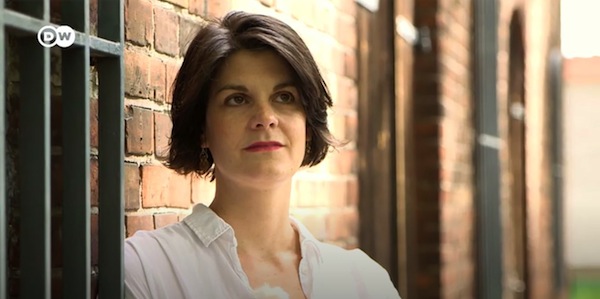
Writer and illustrator Nora Krug spoke with the Globe and Mail’s Marsha Lederman at a virtual event Oct. 27. (photo by DW Deutsche Welle)
The first time Nora Krug heard the word “Jew” was in elementary school during religion class, which was taught by the local priest. He told students that Jews killed Jesus.
Born in the German city of Karlsruhe, Krug is now associate professor of illustration at the Parsons School of Design in New York City, and author of the book Belonging: A German Reckons with History and Home. She spoke with Marsha Lederman at a virtual event Oct. 27 presented by the German Consulate General in Vancouver, the Vancouver Holocaust Education Centre, the University of British Columbia and the University of Victoria. Lederman is the Western arts correspondent for the Globe and Mail and her own book, Kiss the Red Stairs: Intergenerational Trauma, the Holocaust, and Me, is to be published in 2022.
“I came home from school that day and confronted my mother about it,” Krug recalled. “I said, ‘Are Jews evil?’ She got really angry because [it was] so obvious to her that this was something that nobody in Germany should ever think or say.”
A few years later, in her early teens, when she began learning about the Holocaust, she made a yellow star and intended to wear it as an act of solidarity with the Jewish people. Her mother, again, set her on a more appropriate path.
Krug explores her own struggles with her family’s past, as well as that of her country, in the book, a visual memoir that incorporates prose, graphics and photography. (See jewishindependent.ca/creative-engaging-memoir.)
The book was challenging on many fronts, Krug said, including her intention to tell one family’s story about the war era without downplaying German atrocities or doing anything that would appear to paint Germans as victims. While Germans did suffer during the war, it was ultimately a result of their own government’s actions.
“I’m not saying that Germans did not suffer during the war. I think they did,” she said. “But it was a self-imposed suffering.”
Like many aspects of researching a family’s or a country’s past, some things are unknowable and, at times, evidence can raise more questions than it answers. For instance, Krug had been told that her grandfather was a lifelong social democrat. But, when she dug through archives and found the military questionnaire that Germans in the American sector of occupied Germany were required to fill out to explain their war-era activities, he had acknowledged being a Nazi party member. Holding the document in her hands – not a facsimile, but the very document on which her grandfather had responded to more than 300 questions – was chilling, she said. The knowledge of her grandfather’s relationship with the Nazi party could only lead to speculation when she pieced two other facts together.
Krug had always known the location where her grandfather’s office had been in Karlsruhe. But only when she was researching the book did she discover that the Jewish centre and a synagogue were right across the street. Where was her grandfather when the synagogue was attacked on Kristallnacht and Jews were beaten in the streets? In the book, she posits four possibilities, from watching out his office window to laying home in bed sick to the most alarming possibility: that maybe he was among the mobs perpetrating the attacks.
Having lived for the past two decades in the United States – and being married to a Jewish man and having a 5-year-old daughter who is beginning to ask questions about history – all impacted her decision to write the book.
“I don’t think I would have done that had I not left Germany because I think, when I lived in Germany, I felt like I learned everything there is to learn about the war, what else is there to investigate?” she said. “That was my thinking. But, since I’ve been living in New York, I’m an individual and I am a German representing my country.”
Being away from her homeland also made her consider history more from an individual perspective.
“I think when you live as a German among Germans you accept the collective understanding of how we grew up learning about the war,” she said, crediting Germany with doing a good job addressing the topic as a nation. “But I think where we have to really still catch up is to do it on an individual basis, to really go back into our families, into the archives, into the cities where we grew up, what happened in our streets, in our houses, and investigate more deeply on an individual level.”
These are complex challenges and Krug sees a problem with the way Germans struggle with their national identity because of the terrible history of the 20th century.
“I think Germans really need to learn to love their culture,” she said. “I have a problem with it, too. I’m not saying I know how to do that. But I do think it’s a dangerous thing to only highlight our guilt. I think we need to learn, as Germans, to replace the word guilt or shame with the term responsibility.”
By struggling to express national pride, she said, Germans tend to abandon that to a fringe element.
“The problem is a lot of Germans who are willing and open to looking back at the past from a critical angle cannot express this love for their culture,” she said. “I think Germans should try to learn to do that because, otherwise, we leave it to the extreme right to do it for us and that’s a big problem.”
After Krug’s conversation with Lederman, a high school teacher submitted a question noting that some Canadian students are expressing fatigue at learning about Canada’s history of residential schools and asked whether German kids are getting tired of learning about the Holocaust. Krug acknowledged this might be the case and suggested ways of teaching that make the lessons more directly relevant for the present.
“If we had learned in Germany, for instance, more about the German resistance movement, we could have applied that knowledge to the present as well and asked ourselves, how can I help minorities that are harassed today or how can I make sure that we defend our democracy?” she said. “I think the more important question to ask is not what would I have done back then but what am I doing today on a daily basis to reflect on the issues that we have in our countries, no matter what country that is.”
It has been a particularly reflective and momentous week. The U.S. elected Joe Biden as its 46th president and Kamala Harris as vice-president, the first Black woman and first woman of Asian and Indian descent elected to that high office. Around the world, there were nearly audible sighs of relief and cries of jubilation as the count trickled in and it became clear that president-elect Biden had cleared the 270 Electoral College threshold, even as the counting of ballots continues and results are not certified until early in December. More solemnly, this week was the commemoration of the 82nd anniversary of Kristallnacht and of Remembrance Day. And, right at the dawn of this emotional week, we learned of the passing of Rabbi Lord Jonathan Sacks. Britain’s former chief rabbi, Sacks died of cancer on Shabbat at age 72.
Formally called chief rabbi of the United Hebrew Congregations of the Commonwealth, Sacks held the role from 1991 to 2013, during which time his scholarship in philosophy helped him elucidate Jewish theology to general audiences as a regular guest on BBC Radio. He was admired and his death lamented by leading figures in British society, not least the heir apparent to the throne, Prince Charles. He was good friends with now-retired Anglican bishop George Carey, who was the head of the Church of England, strengthening interfaith relations.
Sacks’s time in leadership was not without controversy. He has been viewed by some as too accommodating of orthodoxy and not adequately inclusive of progressive or liberal strains of Judaism. Sacks skipped the 1996 funeral of Rabbi Hugo Gryn, the leading figure in Reform Judaism, drawing rebukes from liberals. In contrast, a book Sacks authored, The Dignity of Difference, implied that all religions and streams therein are equally valid, a thesis that was deemed too ecumenical by some British Orthodox Jews. One rabbi accused him of “heresy.”
In other words, Sacks leaves behind a mixed legacy, though few among us in this generation have left such a lasting mark on contemporary Judaism. The sort of centralized religious leadership that British Jewry and others in Europe have is unfamiliar to North American Jews. But anyone in a position of responsibility in the Jewish community knows the perils of presuming to speak on behalf of all – or most – Jews. Anyone in a job like Sacks’s would draw admirers and detractors. Chief rabbi is, of course, not a political role, but it must be a profoundly political one nonetheless, to elicit an accusation of heresy.
The concept of heresy seems to have seeped from the theological into the political realm in recent years. Fanaticism and extreme loyalty have always played a part in politics. But, in the highly polarized situation we see in the United States and many other places, differences of opinion are magnified into civilizational, even existential, divisions. This certainly seemed to be the case in the U.S. elections. Not everyone likes the incumbent President Donald Trump but, to paraphrase a beer commercial, those who like him like him a lot. While Biden won the support of a vast majority of Jews, surveys suggest that somewhere between 20% and 30% of American Jews voted for Trump’s reelection, a higher vote for a Republican than in many of the last presidential elections. The vehemence of opinion on both sides – some decry Trump as antisemitic while others claim he is the most pro-Israel president ever – would be confusing to the proverbial Martian.
We are assimilating this news in a week where we reflect on the destruction of European Jewry in the Holocaust, the world wars, the bloody history of the 20th century and all the conflict and misery and bloodshed it wrought. The 21st century seems similarly full of divisions and conflicts. Political polarization in democratic countries, as well as growing authoritarian tendencies in several democracies, call for a response.
Biden ran as a unifying figure bent on restoring a sense of moderation and respect to public discourse. Whether one individual can alter the trajectory of a divided society will be seen as the president-elect navigates a narrowly divided House and Senate to shepherd his legislative vision into reality. The unexpected tightness of Republican-Democratic splits in both chambers may exacerbate his challenge. A small tail of far-left Democrats and of far-right Republicans could wag the dog that is their respective party. On the other hand, this challenge could present an opportunity, if there are those willing to fight for what is right and to compromise across the aisle when appropriate and necessary. Such a shift from the failure of bipartisanship in recent years would be monumental indeed. But it could effectively reduce the influence of extremes.
Perhaps what these disparate events illustrate is that conflict – from the cataclysmic to the mild awkwardness of politics at the Shabbat table – is innate to humans. But so is confronting conflict and difference intellectually and with open hearts. Seeking moderation and compromise has lost currency in the age of social media and 24/7 cable news. Nuance is blurred and enlightenment darkened by ideological certainty.
We should seek understanding wherever we might find it and avoid elevating mere mortals to unattainable standards or demonizing them beyond all reasonable recognition. In our spiritual and political realms, in our daily work and home life, we can all commit to some additional humility, to deeper listening and to finding wisdom wherever it might be, even in unexpected places.
Jonathon Leipsic is chair of the Jewish Federation of Greater Vancouver’s annual campaign, and his father, Peter Leipsic, is co-chair of the annual campaign of the Jewish Federation of Winnipeg. (photo from Leipsics)
Father and son, Peter Leipsic and Jonathon Leipsic, are chairing the Jewish Federation annual campaigns in their respective hometowns. Peter is co-chair, with Neil Duboff, of the Winnipeg fundraising effort, while Jonathon is in his third consecutive year of leading the fundraising here in Vancouver.
For Peter, “growing up, helping others was something that just got ingrained in you. You see somebody in trouble, you reach down and help them. My father served in Europe and following in his steps I went to Israel as a volunteer, in the ’67 war. It was just an automatic.
“I remember being at our synagogue and … on the cover of Time Magazine, I guess May of ’67 … there was a picture of 800 Syrian tanks, 600 Egyptian and Iraqi…. It made Israel look like they were going to be toast. At the synagogue, they were asking for money from all the members and I remember the cheques being torn up and being returned to people … saying, that, ‘No, we’re not interested in this. We’re interested in a cheque that hurts. Don’t give us your $1,000…. We want $10,000.’
“When I saw that,” said Peter, “I was probably 21. I think that just sort of instilled in me how to look out for the underdog. People would make fun of me for handing out money to people on the street and I’d say to them, ‘Where are you sleeping tonight? Are you having a shower or not?’”
Peter has been raising money for the Combined Jewish Appeal (CJA) for more than 50 years now, and he has learned that, with some people, giving is automatic, one doesn’t even need to ask. “In the end, we all end up in the same place. Eventually, I don’t know where the cemeteries are in Vancouver, but, in Winnipeg, they’re in the North End – we’re all going to end up there, and you ain’t taking it with you!”
The Leipsics do their best to help out beyond the Jewish community, as well. Peter established a scholarship program at Winnipeg’s Gordon Bell High School, where applicants are judged, not according to scholastic achievements, but on how much of a mensch they are. This past year, there were nine recipients – the highest number yet. “They sent the bios on these people, and, they were just gut-wrenching,” said Peter. “After reading the bios, I said, ‘OK. Can I add another $1,000?’ And, of course, I sent [the list] to Jonathon, too. Well, I raised it to $6,000 and Jonathon doubled it, up to, I think, $11,000. So, instead of them getting $400 per person, they each were given $1,018. And Jonathon, of course, explained to them the significance of 18 in Jewish life. To me, I’m tickled … to actually be able to see somebody’s face, and how I changed that face – taking a massive weight off of them.”
While both Peter and Jonathon are calling on people to help, they each have their own unique styles, with Peter being more direct and Jonathon having a more diplomatic approach.
“I probably burned a couple of bridges,” said Peter of his method. “When you know that somebody has the ability and you tried to explain to them the need, yet they back off and they back off … and, at some point, they say, ‘Do you want me to hang up on you now?’ Some people just don’t get it.”
Even in times such as these, some people, like the Leipsics, are downplaying the negative aspects and focusing on the needed work at hand.
“I mentioned in my campaign opening address that we, the Jewish people, certainly have known challenges greater than COVID,” said Jonathon. “While the challenges are profound, I always like to remind people that, even though, in the last 1,000 years, the challenges were seemingly insurmountable, we overcame and moved from strength to strength by never forgetting our call from Sinai and the centrality of community and Klal Yisroel. I think that COVID has been an eye-opener for people of my generation and younger. It has to start at home, I think.”
Jonathon said that he has really learned from his father’s commitment and that it has set the tone. “We’re taught in our homes and taught through Torah … we have to make community a priority, and my father has always done that,” said Jonathon. “Whether he does it by giving more, giving his time and whatever we were in the position to be able to do, he made those decisions up front – not after all our spending was done, rather at the beginning. ‘First things first,’ as they say. He showed me the way to a life of tzedakah, commitment and meaning…. To be in the same position with him, I think, is actually really, really special.”
Having had the benefit of helping fundraise in Winnipeg, Jonathon understands the different challenges that exist in Vancouver. “We have a bigger community, but it’s spread out,” he noted. “And, as a result, the binding of the community is less tight than it was when our community was more closely tied to Oak Street [in the past, and in] the North End of Winnipeg.”
Learning from both campaigns, Jonathon said, “We work together and do what we can. At the end of the day, food security and access to safe housing is becoming more and more challenging. And then, the isolation with COVID, obviously, is really profound with the elderly and those who can’t get out…. I can imagine, when it’s raining all winter or cold, the social isolation will become even more profound … the potential [effects] it can have on them, but also, their sense of community. I think, more than ever, these sorts of community initiatives are essential.”
“If you want Jewish life to continue,” Peter added, “you must reach down and support the people that are in need. You never know who the next leaders of your community are going to be. A lot of people that have received help had nowhere else to turn, and they may turn out to be your future leaders.”
As far as both Leipsics are concerned, Judaism is defined by the talmudic words, Klal Yisroel areivim zeh bah zeh (all of Israel is a guarantor for one another).
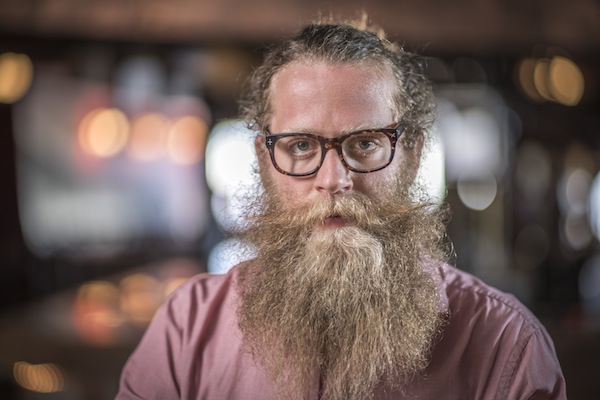
Ben Caplan opens this year’s Chutzpah! Festival Nov. 21. (photo from Chutzpah!)
In the last issue of the Jewish Independent, Chutzpah! Festival artistic managing director Jessica Mann Gutteridge, festival host and stand-up performer Iris Bahr and event comedy closers Jess Salomon and Eman El-Husseini, aka the El-Salomons, were featured. This week, the JI offers a glimpse into the rest of the lineup, by order of appearance.
Musician Ben Caplan opens the festival on Nov. 21 with a recorded performance. Before the recent COVID restrictions, the show was to be presented live from the Rothstein Theatre.
Caplan was on stage here back in January, bringing Old Stock: A Refugee Love Story – which is based on the true story of two Jewish Romanian refugees coming to Canada in 1908 – to the PuSh International Performing Arts Festival (jewishindependent.ca/searching-for-a-safe-harbour). This show, Caplan will be performing songs from his album Old Stock, which is adapted from this music-theatre work.
“The story of Chaim and Chaya, and, by extension, that of a great number of immigrants and refugees who have come to Canada, is full of a great many hardships and tribulations,” said Caplan when asked what lessons from their experience might be relevant in COVID times. “Their story is not free from conflict, both with the outer world, with each other and with themselves. What we see in their story is that, through perseverance, they are able to cross the narrow bridge of their precarity into a sweeter time. It is a nice reminder that no matter how dark things get, there are always brighter moments ahead.”
* * *
Last Chutzpah! Festival, former Vancouverite Tamara Micner performed her one-woman show Holocaust Brunch here. On Nov. 22, she’s offering a first peek at a new work-in-progress from her current hometown, London, England.
Tamara Micner in Old Friends. (photo by Sam Micner)
“Old Friends is very much in the early days – I would say it’s in kindergarten,” admitted Micner. “I’ve been working on it this year and the Chutzpah! Festival streaming will be the first time I perform some of the piece with a public audience. I don’t know exactly what the performance will look like or exactly what will be in it. It’s ‘nervciting’! I look forward to sharing some of the work with Chutzpah! audiences and doing a Q&A afterwards to speak more about the show. I’m hoping and aiming to present the full show in 2021.”
A key inspiration for Old Friends is the music of Paul Simon and Art Garfunkel, and their relationship.
“I find Simon and Garfunkel’s music comforting and uplifting…. The combination of Paul’s songwriting, Art’s voice and their harmonies are beautiful,” said Micner. “I also find the themes in their music resonant at this time – including loneliness, isolation, hope and a yearning for connection…. I’m also intrigued by the on-again, off-again nature of their relationship and the Jewishness in that – how we have a tendency to cling to each other, leave each other, not talk for years, but not be able to fully stay apart or let go. There’s a lot to mine in that, I think – where that comes from, what it’s about and how we can free ourselves from that cycle.”
* * *
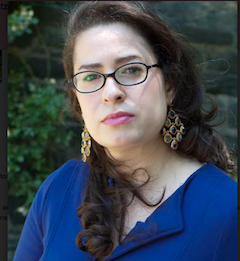
Also on Nov. 22, New York-based playwright Rokhl Kafrissen shares her new work-in-progress.
Rokhl Kafrissen’s Shtumer Shabes stars a drag performer as the Yiddish Theatre diva. (photo from Chutzpah!)
“Shtumer Shabes [Silent Shabbat] opens in the year 2000,” said Kafrissen. “A performance studies grad student named Jess is writing about the heyday of Yiddish theatre in Poland in the 1930s. Jess is studying what she calls the ‘hybrid potentialities of interwar Yiddish performance practices.’ How did Jews use their art to embody binaries like Yiddish and Polish, Jew and Catholic, urban and rural, capitalist and socialist? She argues that The Dybbuk is the ultimate expression of that hybridity.
“As the play opens, Jess stumbles into the chance to interview an honest-to-goodness Warsaw Yiddish diva. It turns out that Sonja, a 90-something veteran of the Polish-Yiddish stage, is living in her neighbourhood. Jess comes to believe that Sonja possesses a ‘lost’ play script: Shtumer Shabes. Her encounter with Sonja is also her opportunity to write history. But Jess is confronted by the elusiveness of ‘plain facts’ and the cost of writing history. For me, the encounter between Jess and Sonja represents two competing ways of understanding the past, through scholarship and through art.”
Imagining Sonja’s world wasn’t hard for Kafrissen, as she knows well Yiddish theatre, past and present, and the standard Yiddish reference sources. However, she did struggle with her protectiveness of the Yiddish past and her obligation as a journalist “to the people and productions I’ve been reading about, an obligation to tell their stories accurately and respectfully.”
“But, at some point, my inner journalist has to be thanked politely and shown the door,” she said. “If you’re going to write historically informed fiction (which is what I consider this piece), you have to be comfortable going beyond the facts. It gets even trickier because part of Sonja’s backstory … is flashback to the war, when she was imprisoned in the Warsaw Ghetto. I know enough about the Warsaw Ghetto to invent a plausible scenario. But depicting it feels daunting. The potential for kitsch or melodrama is high. My characters grapple with extremely sensitive issues, including allegations of collaboration with the Germans. It was important to me that if I was going to include such provocative topics, I had to stick closely to historical fact and stay within the realm of the possible. My characters would not be saints or holy martyrs, but real people, caught in the worst possible circumstances.”
Cast as Sonja is Shane Baker, who Kafrissen has known since she worked with him in 2009 on his one-man show The Big Bupkis: A Complete Gentile’s Guide to Yiddish Vaudeville.
“I quickly became a big admirer of Shane’s work,” she said. “He can go from the highest brow, as with his translation of Waiting for Godot into Yiddish, all the way to the lowest brow, as with his vaudeville show…. In the last few years, Shane had been working on a drag character called Miss Mitzi Manna. She was inspired in part by his close friendships with the last generation of Yiddish theatre grandes dames. So, when I got a 14th Street Y LABA Fellowship in 2019, I decided to write a play with a role for Shane in drag as my yearlong fellowship project. I knew from the beginning that the role wasn’t written for Mitzi Manna per se, but Shane’s development of the character was a huge inspiration. Writing the role of Sonja with a drag character in mind opened up a kind of playfulness and experimentation for me. Drag is such a dramatically rich device. It heightens our awareness of the artifice of theatre and interrogates the mimetic nature of theatre itself.”
A staged reading of Shtumer Shabes was supposed to have taken place last in April. “Unfortunately,” said Kafrissen, “that coincided with the world as we knew it collapsing. As I get ready to present excerpts from the play for the Chutzpah! Festival, I can see a tiny sliver of silver lining. Even with the pandemic, I’ve managed to sneak in some actor time in the last couple months, as well as getting thoughtful feedback on the script from folks both within my artistic circle and outside. The script is now so much better than the version I had in the spring, so I tell myself maybe it’s better that I didn’t present that earlier draft to the world.”
The Dybbuk by S. Ansky infuses Shtumer Shabes: Jess is obsessed with The Dybbuk and it’s why she went to grad school; and “Sonja’s career on the Warsaw Yiddish stage was tied up with the phenomenal, real world success of The Dybbuk,” said Kafrissen. “It was with a Dybbuk monologue that she auditioned for Yiddish drama school and the role of Leah (the young woman possessed by the dybbuk) was always her dream.”
This year marks the 100th anniversary both of Ansky’s death in November 1920 and the première of the Yiddish version of the play a month later. “I love the idea of having our Chutzpah! program serve as Sonja’s final tribute to Ansky and his creation,” said Kafrissen.
* * *
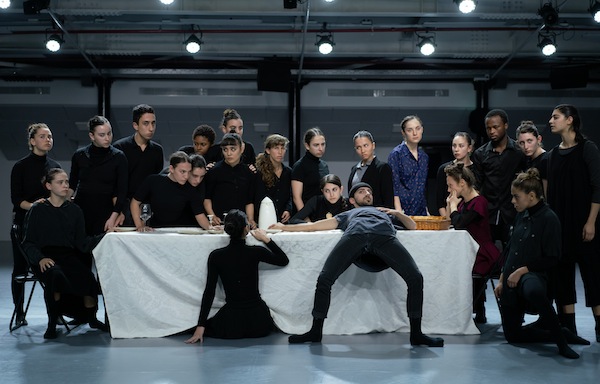
Ella Rothschild’s Pigulim unfolds against the backdrop of a meal at a long dining table. (photo by Efrat Mazor)
Death … and life are at the centre of Israeli choreographer Ella Rothschild’s Pigulim, which is described as “a cultural narrative [that] unfolds against the backdrop of a meal at a long dining table where three characters suffer from unbearable loneliness and battle their way between life and death. Each character travels between their individual materialistic being and their consciousness, revealing their essential humanity in relation to existence and the quest for happiness.” A pre-recorded performance of the work will be shown at the Chutzpah! Festival on Nov. 23.
In the summer of 2019, Rothschild was selected as one of the first artists-in-residence at Suzanne Dellal Centre. She started Pigulim there and continued researching it in “other places in the world with different scenarios and different cast members.” This year, back at the centre, the piece premièred in its video version.
Pigul (pigulim, pl.) “describes a law from the Jewish tradition,” explained Rothschild. “It refers to a sacrifice that was prohibited to be eaten because of a forbidden thought that the priest (kohain) had in the moment he was making the sacrifice. It can mean abomination or loathsome, and it’s not a word used in everyday Hebrew. The idea that a thought can change reality has a direct connection to what I tried to present in Pigulim. If the thought one can have determines the reality of another entity, how much from our consciousness is being present in our reality and our society?
“Another aspect of choosing this particular name is another gap that unravels between the sound of the word and its meaning. Pigulim has a nice way of rolling in the mouth. The letters are round and when you pronounce it, it almost sounds like a name of a rare flower – but the meaning of it is the opposite. It contains strong emotions and gravity. Once more, it holds this gap between what we experience and the reality.”
This gap – “a certain detachment between our body and mind” – is something with which we must live, said Rothschild, and its loneliness is not changed by “how many people are surrounding you in the space.”
“As I see it and experience it, it is a state of being, not only of certain individuals but as a mass society,” she said. “I have learnt, through working with others, more about how this gap appears and how we perceive it. We behave inside these structures that are determined for us and, yes, it leaves a gap or an absence that we don’t really understand, or we will forever try to make sense of.”
However, there is more than just absence. “I did find out that we share more than we think,” she said. “We share beauty, laughter, sadness and grief. We cry from the same things and we worry and we fear. But we also love. And that is an overwhelming thing to share.”
* * *
Israeli pianist and composer Guy Mintus – whose solo concert will be live-streamed on Nov. 24 – is about to release his third album with the Guy Mintus Trio: A Gershwin Playground.
Mintus’s study of piano didn’t follow a traditional path. “I didn’t start with classical piano,” he said. “I started on a little keyboard my parents got me, not an acoustic piano even, and I was studying a very mixed repertoire of adapted arrangements for beginning keyboard players. Among that repertoire were the Beatles, Israeli pop songs, Fiddler on the Roof and … two [George] Gershwin tunes: ‘It Ain’t Necessarily So’ and ‘Summertime.’ When I started playing those, my father handed me the Porgy and Bess album of Ella [Fitzgerald] and Louis [Armstrong]. That totally blew my mind and I started trying to emulate the arrangements on my keyboard (which had the ability to switch between different sound samples).
Guy Mintus will play songs from his upcoming album, which celebrates George Gershwin’s music. (photo by Ella Barak)
“To me, these songs are timeless – musically and lyrically. They’re very rich and have a strong musical character but yet they remain very open and flexible to let you in and bring yourself into them. The lyrics also mostly speak of things that will always be relevant. It’s not by accident that generations and generations of jazz musicians have been interpreting Gershwin.”
One aspect of the music’s continued importance is that, “unfortunately, we’re constantly reminded by these horrific events that keep happening that racism is still very much around; that the colour of your skin can easily become a disadvantage right off the bat,” said Mintus. “When I’m thinking of Gershwin, I’m also considering his background as a Jewish-American composer coming from a family of immigrants. Of all things he could be fascinated by, he was fascinated by Black American music and ended up writing the first jazz opera bringing this marginalized music to the heart of the consensus. More than that, he wouldn’t allow Porgy and Bess to be premièred at the Met Opera because, at the time, they wouldn’t allow Black performers. He made it mandatory that, if Porgy and Bess is ever performed, main roles have to be performed by Black people. Now, Porgy and Bess has its controversies in regards to race and representation but I believe in the essence of its coming from a place of great respect to the incredible culture its getting inspiration from.
“I think that the Jewish and African-American communities actually share quite a lot in common,” he continued. “There’s certainly a collective trauma we’re each dealing with. To me, Gershwin was standing right in the middle of that – in ‘Rhapsody in Blue’ (which is on the album, as well, in a solo version) you literally have a meeting point between klezmer and the blues. I want to echo that connection, which is still very relevant to me, through my own lens as an Israeli who lived, studied and worked in New York. It’s important to give back, acknowledge and show respect where it’s due. Last July, the trio and I did an online fundraiser concert called Gershwin Global. It was in order to raise funds for the Jazz Foundation, who takes care of elderly musicians and emergency cases. This music comes from people who gave their lives to it – if we benefit from it, we’ve got to find a way to also give back to its source.”
The new album will be launched on Nov. 27 and, given COVID, touring it is not an option. Nonetheless, Mintus said it is worthwhile to put it out anyway. “Life goes on, music goes on and, in my opinion, it’s as relevant, if not more, to release new music in this period,” he said.
With the internet, there are many ways to connect with people all over the world, he added. “This poses a creative challenge how to find interesting, experiential ways to share this music with the world; how to share the story behind the album. Each single has a unique artwork, there are videos, a bunch of online live events that are planned – all of this is going to be available through my Facebook page (facebook.com/guymintusmusic). The fact that I’m not switching countries so often as normal allows me a different kind of focus and attention on how to turn this release process into the most fun, meaningful and creative process it can be.”
* * *
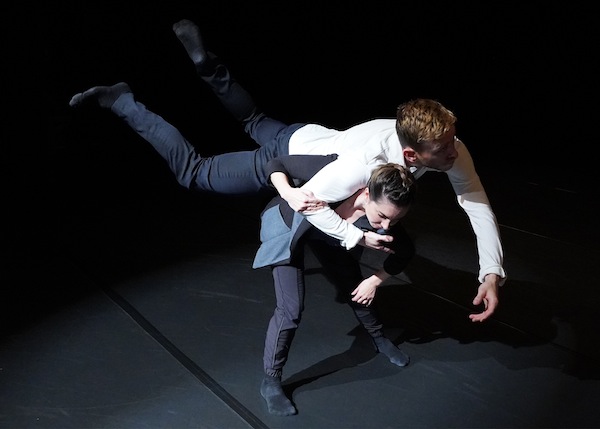
Racheal Prince and Brandon Lee Alley in Hourglass by Idan Cohen. (photo by Theo Bell)
Chutzpah! artist-in-residence this year is choreographer Idan Cohen (Ne. Sans opera and dance). The world première of his Hourglass, which is presented by RBC, will be performed and live-streamed from the Rothstein Theatre on Nov. 25.
“Both the residency and this opportunity to present at Chutzpah! are the best things that could have happened to me during a time when artists are facing difficult challenges,” Cohen told the Independent. “I believe with all my heart in the strength and importance of the arts for a healthy society. It is not a luxury but a necessity, especially within a specific culture. Judaism is not just a common history or a set of beliefs, but a diverse culture that needs to be ever-evolving, reinterpreted and recreated, respecting and learning from our common past while creating a shared future. Having Jessica [Mann Gutteridge] share some of the same core values, and acknowledge the importance of going forward with the festival this year, has been such an empowering force for me and my collaborators during these past few months.”
Hourglass is an exploration of aging set to music by Philip Glass. It is a duet with former Ballet BC company dancer Racheal Prince and returning Ballet BC company dancer Brandon Lee Alley.
“As dance artists,” said Cohen, “our focus is on our most intimate tool and instrument: the human body. When that body is extremely intelligent and qualified, as Racheal’s and Brandon’s bodies are, true magic happens on stage. It’s like an ancient fairytale told to you as a child: it represents both the past and the future, it’s exciting and haunting, and it teaches you something valuable through the most basic elements of storytelling. No need for fireworks or special effects.
“For this edition of the festival, we are presenting 30 minutes of dance to four out of 20 études composed by Glass played by the conductor and celebrated pianist Leslie Dala (Vancouver Opera, Bach Choir). Leslie was actually the one who first presented the idea of this project to me, and dancing and working with him has been a most gratifying experience. There are linear elements in the piece, but Glass’s music marries the abstract and the linear, the romantic and the intellectual, in a way that not many composers are able to do, and that’s what makes it so unique.
“Racheal and Brandon, who are young yet mature and highly experienced dancers, can embody different physical states in such a fascinating way,” said Cohen. “They had a significant role in our exploration of the theme of aging and time.”
Being a real-life couple means that Prince and Alley have been able to rehearse together safely during COVID, and the Rothstein Theatre is large enough for them to work with Cohen at a safe distance. “Since Leslie is also dancing (!) in the piece,” added Cohen, “we had to adapt in order to keep everyone safe, which is, of course, the priority. This has definitely been a great learning experience, and an immensely gratifying one.”
The Chutzpah! Festival runs Nov. 21-28. For tickets, which start at $18, visit chutzpahfestival.com or call 604-257-5145.