Skip to content
  • Home
  • Subscribe / donate
  • Events calendar
  • Business Directory
  • FAQ
  • News
    • Local
    • National
    • Israel
    • World
    • עניין בחדשות
      A roundup of news in Canada and further afield, in Hebrew.
  • Opinion
    • From the JI
    • Op-Ed
  • Arts & Culture
    • Performing Arts
    • Music
    • Books
    • Visual Arts
    • TV & Film
  • Life
    • Celebrating the Holidays
    • Travel
    • The Daily Snooze
      Cartoons by Jacob Samuel
    • Mystery Photo
      Help the JI and JMABC fill in the gaps in our archives.
  • Community Links
    • Organizations, Etc.
    • Other News Sources & Blogs
  • JI Chai Celebration
  • JI@88! video

Recent Posts

  • Federation now across BC
  • Israel fighting for its existence
  • Deal strengthens Iran
  • Patriotic belonging diminishes
  • A campaign to engage
  • Upstanders’ first live event
  • Responding to Carney
  • Having your own home
  • Music a family tradition
  • Musical to warm heart
  • Community milestones … June 2026
  • Sharing her passion for Israel
  • Or Shalom reopens its doors
  • JFS from past to future
  • Need holistic approach
  • Sharing stories, advice
  • Journalist shares fears
  • Skills to live together
  • Road to independence
  • Cutting grass with scissors
  • Zionism as a solution
  • Deceit, desire & the divine
  • Reclaiming sacredness
  • Creative project ideas
  • Summer squares and cobbler
  • Thou shalt … summer commandments
  • Legal help for students
  • Revisiting myth of Lilith
  • Wrong person rebuked
  • Canada’s mixed messages
  • Questions for museum
  • Symposium on antizionism
  • Making soccer political
  • CJPAC lauds Pulver’s impact
  • City recognizes Vrba’s legacy  
  • Organ donation saves lives

Archives

Follow @JewishIndie
image - CJN box ad Rockowers 2026

Category: Op-Ed

Srulik, meet Handala

Srulik, meet Handala

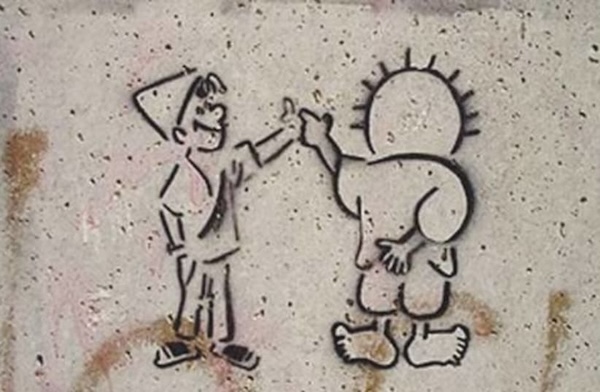
The ways in which the characters of Srulik, left, and Handala epitomize the historical and cultural narrative of the Israelis and Palestinians, respectively, imbue these cartoons with an impact stronger than words. (photo by Gil Zohar)

Driving east from Jerusalem on the winding Jordanian-built road that once led down from the Mount of Olives to the Dead Sea, one passes through a series of picturesque Arab suburbs and soon comes to a dead end in front of the grotesque West Bank barrier.

Called Geder ha-Hafrada (separation fence) in Hebrew and jidar al-fasl al-’unsuri (apartheid wall) in Arabic, the insurmountable (if still incomplete) eight-metre-high concrete barrier has no doubt contributed to a reduction in terrorism and car theft. However, my objection to it is more existential: like some of those in West Berlin who spray-painted their protest for freedom on the Bundesrepublik side of die Mauer even as armed GDR guards used deadly force to prevent anyone from approaching the wall’s eastern side, I believe all walls must fall.

It is a metaphor that has repeated itself from Joshua’s encircling of Jericho, to the Berlin Wall and its remaining East Side Gallery, to Garth Hewitt’s ballad “They’ve Canceled Christmas in Bethlehem,” about the stranglehold the wall has placed on both day-to-day life and religious pilgrimage in the place where Jesus, “the Prince of Peace,” was born 2,000-plus years ago.

The world today is caught between two conflicting ideologies: some democratic countries joining in unions with open borders, joint legal systems and a common currency, of which the European Union – notwithstanding its problems – is a great success. Then, there are other countries – many repressive and undemocratic – defending their borders with minefields and walls. Like John Lennon, I prefer the first vision – of a growing global union without barriers. Imagine that.

Thus, armed with the tools of the graffiti artist – an X-ACTO knife, cardboard stencil and spray paint – I recently made my way to Abu Dis with my friend Hajj Ibrahim Abu el-Hawa, my daughter Bareket and fellow artist Eva Feld to make our mark. Reasoning that a picture is worth a thousand words, we chose a symbolic image whose meaning is unequivocal.

The image we created depicts Handala raising hands with Srulik (see picture). The two iconic cartoon characters are respectively well known by Palestinians and Israelis – yet, each is equally unknown by the other. It is a symmetry of ignorance of the other’s narrative that will have to be overcome before true peace can be achieved.

Allow me to explain the mirror meanings of the twin caricatures.

Handala – an omnipresent image on T-shirts and key chains in the aswaq (plural of suq, market) of Jerusalem, the West Bank and Gaza Strip – was created by Naji al-’Ali in 1969. A 10-year-old child driven in 1948 from his Galilee village of ash-Shajara (14 kilometres from Tiberias) to the ‘Ain al-Hilweh refugee camp in Lebanon, al-’Ali went on to become the leading political cartoonist in the Arab world.

Before being assassinated in London in 1987, he produced more than 40,000 bitingly sarcastic cartoons lampooning Arab leaders and lamenting the stateless status of his people. His autobiographical image of Handala – a barefoot, faceless, refugee youth – remains a potent symbol of the struggle of the Palestinian people for justice and self-determination.

Al-’Ali wrote: “Handala is my signature. I gave birth to this child in the [Persian] Gulf. He was born 10 years old, and he will always be 10. At that age, I left my homeland and, when he returns, Handala will still be 10, and then he will start growing up. The laws of nature do not apply to him. He is unique. Things will become normal again when the homeland returns.”

Impish Srulik – a diminutive of Yisrael (Israel) – carries an equally rich symbolism in depicting nascent Israel and, in particular, its native-born Sabras. The illustrated character was first drawn in 1956 by the cartoonist Kariel Gardosh, better known by his nom de plume, Dosh. The Hungarian-born Holocaust survivor drew Srulik for decades in the pages of the daily Maariv, until his death in 2000.

Dosh generally depicted Srulik as a young man wearing a kova tembel hat, “biblical sandals” and khaki shorts. He drew him as a pioneering Zionist and lover of the land of Israel, a dedicated farmer who in time of need dons an Israel Defence Forces uniform and goes out to defend the state of Israel, equipped with an Uzi machine gun. In contrast to the antisemitic stereotype of the weak or cunning Jew, which appeared in the Nazi weekly Der Stürmer and other European and Arab newspapers and journals, Dosh’s Srulik was a proud, strong and sympathetic Jewish character.

Shalom Rosenfeld, editor of Maariv from 1974 to 1980, wrote: “Srulik became not only a mark of recognition of [Dosh’s] amazing daily cartoons, but an entity standing on its own, as a symbol of the land of Israel – beautiful, lively, innocent … and having a little chutzpah and, naturally, also of the new Jew.”

Introducing Srulik to Palestinians and Handala to Israelis is not a bad way to begin to redress each side’s ignorance of the other’s narrative. The ways in which they epitomize the historical and cultural narrative of their own people imbue these cartoons with an impact stronger than words.

When a peace treaty is ultimately implemented between Israel and Palestine (as I’m sure it must), perhaps the image of Handala and Srulik holding hands could be adopted as a neutral symbol of coexistence and nonviolence. Their creators, Naji al-’Ali and Kariel Gardosh, both knew firsthand of persecution and exile, and the iconic figures they bequeathed us share the hope of living in freedom and peace. When peace finally arrives, new and emotionally satisfying images and symbols will need to be created to bridge the chasm between Jews and Arabs in our broken Promised Land. 

Gil Zohar is a writer and tour guide in Jerusalem.

Format ImagePosted on June 28, 2024June 27, 2024Author Gil ZoharCategories Op-EdTags cartoons, Handala, history, Israeli-Palestinian conflict, Kariel Gardosh, Naji al-’Ali, peace, Srulik

Community and relationships

Recently, I came across a LinkedIn post. It suggested that people could evaluate their work by asking if it “made  money, saved money or saved time.” One of the responses suggested that nurses, for instance, would not fit into this model. Neither would teachers, therapists or social workers, for that matter. While education or therapy do eventually probably save money and time for society, their worth isn’t measured by these markers. As a writer, my work is also worthless in this evaluation, as it doesn’t earn lots of money or save time. But caring/thinking professions are still meaningful. I did a silent revision to the post. I added: Does your work create meaning? Is your work creating value? Meaning and value aren’t always measured in monetary terms.

I didn’t respond to this piece I read online. I don’t know who posted it originally, but priorities are different than mine. It isn’t a bad thing to save money, make money or save time, but I was left wondering – if these are a person’s top priorities, what will they do with the money or time saved? I wonder where “making meaning” comes into this person’s life.

My household is just recovering from our twins’ b’nai mitzvah. Out-of-town relatives and friends were here for several days before and after. I managed many details and events, multiple meals, a tent, chair and table rental, games and more. The synagogue service my children led was very meaningful, and looking out at the congregation was amazing. I felt so supported by family, friends and community.

For days afterwards, Jewish community members wished us mazal tov and non-Jewish neighbours and friends continued to congratulate us. My twins got gifts from places we didn’t expect. Both kids were truly flummoxed by the love and generosity showered on them.

I won’t lie: I’m exhausted after this lifecycle experience. I was the main organizer for everything other than services. Everything went smoothly, far better than I’d expected, especially given that our synagogue is under renovation.

When guests suggested a future as an event planner, I said no! I couldn’t wait to get back to my freelance writer/editor day job. Perhaps what I have learned is that, while I’m good at organizing and details, I don’t find meaning in doing those things. For me, it’s only the relationships and community that makes meaning.

A snippet of learning I did this week made that clear. I was studying the Babylonian Talmud tractate of Bava Metzia 109 when I read this story:

“Rav Yosef had a certain planter, a contractor whose job was to plant trees. He died and left behind five sons-in-law. Rav Yosef said: Until now I had to deal with only one person; now there are five. Until now, they did not rely on each other to plant the trees and did not cause me a loss, as the responsibility was their father-in-law’s, but, now that they are five, they will rely on each other to plant the trees and cause me a loss. Rav Yosef decided to discontinue the agreement with them. Rav Yosef said to them: If you take the value of your enhancement that you brought to the field and remove yourselves, all is well, but, if not, I will remove you without giving you the value of the enhancement.”

The rabbis then debate if Rav Yosef’s behaviour as a businessman was acceptable. Their conclusion is that canceling the agreement was acceptable, but sending the sons-in-law off his land without compensation wouldn’t be right. When I read Rav Yosef’s choices here, as a person in business, I saw why he made his choices. Rav Yosef had a business relationship with a contractor. When that ended due to death, he didn’t have the same agreement or support from the five sons-in-law, all of whom might have left the job to someone else. He wanted to pay them for what had been done and cut his losses.

I worried about the contractual commitments I’d made for our family event. Would the tent, tables, chairs, catering, servers, games, six-person bike, fancy vegan popsicle cart all arrive as scheduled? In the end, it all worked out. However, if I’d been faced with an issue like Rav Yosef’s – the death of someone I trusted and a time-sensitive need to get something done – I too might have wanted to pay for the work done so far and cut my losses.

Sometimes, we recognize that, without the original helper, chaos might erupt. Our synagogue caterer provided food for 75 people as take-out for us, but had no servers, due to the building closure and renovations. I worried about what to do. Luckily, through Jewish community connections, I found someone who used to work at the synagogue, and three others who worked at a different Jewish congregation. My brother (former manager of a fine-dining restaurant) stepped in to help. My neighbour volunteered her oven as a backup to warm up food, though we did not need it in the end.

This experience helped me realize that, although we moved to Canada in 2009, we had built community over time. People volunteered to support us and connections with businesspeople made the event happen. A “team” of loving people, both from far away and close by, pulled together to make meaning for us as a family.

Long before I had kids, I loved attending Shabbat services that celebrated a new baby, an upcoming wedding, a birthday or bar or bat mitzvah. Now I see that, as part of the extended community, I too created meaningful connections. The congratulations, singing “Simon Tov U’Mazel Tov,” and warm smiles matter. Being a witness and a celebrating participant are valuable.

For some, our twins’ b’nai mitzvah helped people make money. Months of work as the “organizer/Mom/event planner” saved money. If recent world events, or Rav Yosef’s contractor agreement, have taught anything, it’s that our lives could be short – time matters. It matters that we do straightforward, moral business with others. So many things can go wrong. There is absolutely nothing like a few days of love, support and meaningful interactions with people who care about us. We can also always use more love and community support. 

Joanne Seiff has written regularly for the Winnipeg Free Press and various Jewish publications. She is the author of three books, including From the Outside In: Jewish Post Columns 2015-2016, a collection of essays available for digital download or as a paperback from Amazon. Check her out on Instagram @yrnspinner or at joanneseiff.blogspot.com.

Posted on June 28, 2024June 27, 2024Author Joanne SeiffCategories Op-EdTags Judaism, lifestyle, meaning, value, work

So many choices to be made

The late afternoon, right after school or summer camp, is go time for many parents. These are the moments where my twins have every kind of need, from taking off their outside gear and emptying lunch bags to signing permission forms, getting help on projects, and more. It is a period of chaos, usually with a desperate need for snacks as well as dinner preparation, all rolled up. There are days when things are calm, sure, but there are other times when I savour my last moments of quiet at 3:25 because from 3:35 until 6:30 or so, after dinner, I am a whirlwind doing Marathon Mom work.

Our public junior high this year presented us with Mega Options activities for the last few days of school. While the various options were hyped to students in advance, only whispers of this made it home. So, on an average Monday afternoon in June, my kids told me to be sure to open the special Mega email fast, as all the best activities would fill up. At 4:30 on the button, my inbox told me about the many Mega Options I would need to hurry to fill out to meet my twins’ expectations.

There were so many choices: Métis sash-weaving and historic cemetery trips, Inuit printmaking and Indigenous storytelling, Euro-style soccer tournaments, Pickleball, phone photography, kinesiology and nutrition lab field trips to a university, and more. There were bike treks, orienteering, the list went on. The selection was huge. Not every outing had a description or information. Some choices came with big fees. Others were free.

It was a huge rush to decide. We watched some activities fill up even as we tried to sign up – and, with twins, we had to sign up twice. In the end, my more social kid called one of his close friends. On the other end of the phone line, I heard his mom, a teacher I am friendly with, coaching him through. It was a great solace to know I was not alone in sorting through this!

Within moments, both my twins were signed up, with their friend, for one day of board games, outside games, and baking bannock and eating together. The other day was reserved for going to Assiniboine Park, Winnipeg’s version of New York City’s Central Park, and always a fan favourite. I emailed the other mom afterwards. “Sheesh!” she replied. “That was stressful – lol.” It was. She was completely right. The Mega Options format left me strung out and worried. Did we make the right choices? What does “A day at Assiniboine Park” mean? There was no description. What do we parents need to provide? Lunch? Money? Rides?

After the decisions were made and the activities secured, I was relieved. The fun warm weather choices our boys made were free, easy and uncomplicated. Sure, it wasn’t going to be a big learning experience, but the decisions were made. We no longer had to dwell on the choices themselves. 

After stepping back, I realized that these late afternoon blitzes are so hard because they can be unpredictable and disorderly. There are multiple tasks thrown at parents at once, when we’re not necessarily at our best energy-wise. Both flexibility and preparedness are necessary. There’s no telling if today I’ll have to be a math whiz, an event planner, or a custodian, cleaning up after a kid is sick in the hallway. (Hey, it happens.)

The skills required to manage the late afternoon rush aren’t just relevant to kids. As adults, and as Jewish people, we are often offered “Mega Options” when it comes to making choices. We don’t have one specific menu item at restaurants, nor do we have a single kind of Jewish ritual, religious life or home observance. We face tons of choices every day. Further, while the pandemic narrowed some options, the post-pandemic world has vastly increased them. When our usual routines are disrupted, we’re forced to evaluate what we’ve done all along. Is streaming a religious service easiest?  Are we healthy enough to attend in person? What is the COVID protocol (or non-protocol) these days, even as the virus still circulates? Sometimes, we crave situations where the decisions are just made for us, even as we know it would be better to make up our own minds instead.

This was our world before Oct. 7. Afterwards, the choices became even larger. Now, questions of safety and freedom from harassment also come into play. We choose whether to wear anything identifiably Jewish when out on the street. We question if we’ll feel safe attending this Jewish venue. Is attending this graduation/parade/campus/event going to force us to deal with protesters or hate speech? Then there’s: Are we still safe, wherever we live? Should we be considering a move to someplace safer? Is there somewhere safer? 

We could pretend that all these choices are a part of the modern age, but we know from Torah study, the many debates of the Talmud and Jewish history that the act of making choices is an essential part of what it means to be Jewish. From the first, we were shown hard choices and real consequences: from Leviticus 10’s Nadav and Abihu, who chose to sacrifice “strange fire” and were struck down for it (a bad choice, apparently), to Deuteronomy 30:19, which summarizes a long list of choices we can make, concluding, “I have put before you life and death, blessing and curse. Choose life….” 

The Mega Options presented to celebrate the end of school is nothing when compared to big decisions in life. One could just shrug it off as no big deal – but life is a series of little choices, one after another, that can affect everything. Survivors of major disasters often explain how they “just missed” the accident because they felt sick, woke up late or forgot to make their lunch. Historically, Jewish refugees described how they left at a moment’s notice, with only a suitcase, or just the clothes on their backs.

We don’t always know which choices are the big ones, or the good ones. Some of the best choices result in happy, long-lasting results, like meeting one’s life partner, discovering a passion or skill, or experiencing an amazing natural event like a meteor shower or the Northern Lights. Here’s to hoping our choices are easy and small ones, and that these options lead to all positive things. Here’s to celebrations, miracles and good deeds this summer – may we all have more “mega” pleasant choices ahead. 

Joanne Seiff has written regularly for the Winnipeg Free Press and various Jewish publications. She is the author of three books, including From the Outside In: Jewish Post Columns 2015-2016, a collection of essays available for digital download or as a paperback from Amazon. Check her out on Instagram @yrnspinner or at joanneseiff.blogspot.com.

Posted on June 14, 2024June 13, 2024Author Joanne SeiffCategories Op-EdTags education, Judaism, lifestyle, Oct. 7, summer

The making of a milestone

By the time you read this, I’ll be working on the last days of preparation before my twins’ b’nai mitzvah. This, as many have said, is a big simcha (happy party), a once-in-a-lifetime event, a milestone and an achievement in our lives. It won’t surprise those who know me that this also puts a lot of pressure on us! Don’t get me wrong, my household is excited. We’re also nervous, apprehensive and stressed by all the details.

It helps to put this into context. We’re a family who has been going to services on Saturdays regularly since long before these children appeared on the scene. My kids are familiar with what’s expected of them and want to do a good job. We’re from a family with diverse approaches to Jewish life, so we’ve gone to all sorts of services, as well as different kinds of Shabbat dinners, family outings on Saturdays, and more. Our kids have experienced many more different ways of observing holidays and Jewish life than I did growing up. This was one of my goals for raising well-informed Jewish kids. For a small ethno-religion, we have so many varied traditions.

This came to mind when I chatted with some of my husband’s young cousins long ago. They told something to the effect that there was only one way to sing a particular part of the Shabbat service. When I explained that there were many melodies and ways to recite the same Shabbat prayers, they looked at me with disbelief. Their experiences with only one congregation in a specific ethnic group and religious movement meant they hadn’t been exposed to multiple melodies or the rich musical traditions of other Jewish communities.

Exploring these choices has made my kids’ lessons and preparations more difficult. If they only knew one tune, well, that’s the one they would sing. However, offering learners many choices means it can be harder to narrow down and practise one melody to make it shine.

Staying true to our family’s particular needs and choices when it comes to the celebration itself has been its own adventure. If one is used to a specific type of bar/bat mitzvah party, with loud music, dancing, catered “rubber chicken,” a photo slide show or a candlelighting ceremony, anything different can seem peculiar. At age 12, I attended one classmate’s bat mitzvah party that was (gasp) held at the family’s home rather than at the synagogue or at a party venue. Rather than graciously modeling that people are different, I thought this was weird. No one reprimanded me for saying this. In retrospect, it was a lovely, heimisch (homey) party held by a family who celebrated the way that they felt most comfortable. I wish I’d had the maturity to see that then.

Holding a Jewish event on a June Shabbat in Winnipeg means that it will be light until late at night, so we’re having a seudah shlishit (a third Shabbat meal or supper). Our congregation’s building is under renovation so the meal will be at home, without the loud music or DJ, to align with those who observe more traditionally. We’ve made numerous choices that my tween self would call “weird.” As an adult, I see it as providing the celebration that fits our family the best.

We’re mostly introverts. Three of the four of us don’t usually like noisy, crowded events. An entire weekend of socialization will be a lot of people time for us. Since many of our relatives are coming from far away, it may be more like a week of company. One of us jokingly said he would announce, “Hey! The party’s over! Please leave!” so he could go back to reading quietly in a corner. We’ve encouraged him not to voice this aloud to any of our relatives or guests.

Although some people hire event planners to manage this, for many households, the burden falls on the mom to arrange everything. This seems to be yet another gendered responsibility. I’ve been told that 50-some years ago, women in the community cooked all the food as well, and there was no catering on offer. I’ve had kind supportive offers from older women friends who remember those days. However, even if one wants to hire serving staff, it can be hard to do in these post-COVID days. There’s just nobody out there who seems to want to do it.

Making so many decisions, from catering to dishes to compost bins and yard games for kids, feels overwhelming. In some moments, I find myself excited about when it will be over and I can stop worrying. Yet, I know that, for many people, this event is a lifelong memory. I just want to make it a meaningful one for all of us. With twins, we only get one chance at it, too, so … no pressure?

Often, I have Jewish texts to lean on to help me understand and guide me. Although it’s not my family’s tradition to recite Eishet Chayil (Proverbs 31:10-31), the tribute to a “woman of valour,” it strikes me that the woman in this important narrative knew how to throw a perfect Jewish family event. I hope I can do something that is half as acceptable, where everyone feels welcome, comfortable and full of good food at the end.

In my head, I’m hearing phrases offered by the older people in my husband’s family at the end of every family party: “May we only meet at happy occasions,” for example. After such a difficult and sad time, I cannot forget those messages. While I worry over the details, please take the opportunity, when it is offered to you, to celebrate at these once-in-a-lifetime happenings. Bring your joy and light to make them special for everyone. “May we only meet at weddings (and not funerals). May we only meet at happy occasions,” these aunts would say as they hugged us. It’s about time to find space for some happy moments, too. 

Joanne Seiff has written regularly for the Winnipeg Free Press and various Jewish publications. She is the author of three books, including From the Outside In: Jewish Post Columns 2015-2016, a collection of essays available for digital download or as a paperback from Amazon. Check her out on Instagram @yrnspinner or at joanneseiff.blogspot.com.

Posted on May 24, 2024May 23, 2024Author Joanne SeiffCategories Op-EdTags b'nai mitzvah, family, Jewish tradition, milestones

Expectations for behaviour

Our neighbourhood has narrow sidewalks lined by hedges. When my dog and I take our daily walks, we step to the side at a driveway or front walk so that another pedestrian can pass. My dog sits patiently, sometimes even when I don’t prompt her. Over the years, through the lives of several dogs, we (the dogs and I) have received compliments because of how well behaved the dogs are. I say thank you. The next question is, “How did you do it? I can’t get my dog to do that!” My response is always the same. We’ve been taking these walks every day for years. We practise! Usually, the passerby shakes their head, as if I am just not letting on my secret – but I have. Consistency is everything in reinforcing behaviour.

In the Babylonian Talmud, Tractate Bava Metzia 60a, the rabbis discuss sales practices. While Rabbi Yehudah disagrees, the rabbis conclude that a shopkeeper is allowed to offer children toasted grains and nuts for free. By doing so, he accustoms the children to see him for their shopping, rather than going to other shopkeepers. Also, the rabbis suggest, it is OK to offer things for sale at a “below market” price, that is, on sale, in order to attract customers. These are, in effect, ancient – and approved – business marketing guidelines that reinforce desired behaviours. In this text, there are also suggestions for what is not acceptable and why.

Festive holiday meals sometimes give us time to think about what’s acceptable in our homes, too. One invites friends and family over, or goes to other homes, and that’s when you can see all sorts of different families, with different guidelines about what’s acceptable. I find myself observing all this with interest. This is one way we learn about other ways of doing things. It’s also a chance to reevaluate how we run our homes. What could we do better? What isn’t acceptable in one home may be fair game in another.

As an adult, I observe all this but my children, just like those attracted by toasted nuts in Bava Metzia, react fast when they see things that are tempting or considered “out of bounds.” For instance, my kids love additional opportunities to eat treats. However, kids also notice when things go awry.

More than once, we’ve had a young holiday guest have a colossal meltdown. We all know that kids can lose it, especially during atypical situations, in others’ houses, later in the evening, etc. However, my kids feel strongly about times when the kid (or family) shows disrespect to us. After all, it’s our house. Having a child fall apart due to exhaustion or overstimulation happens. Having a kid yell at us is different, and my kids are rightfully upset when another child snaps or is rude when I express concern or want to keep them from getting hurt. My family pointed out that I, as a grown-up, am responsible for everybody’s safety in my house – of course, I have to say something when a situation looks dangerous. 

Earlier this year, our household was unsettled not only due to an extended outburst, but because no one apologized for it. Some parents apparently think that we, as holiday meal hosts, should tolerate and absorb a tantrum. For days afterwards, I fielded my kids’ comments as I stung with frustration. We spend many hours cleaning, setting the table and making multi-course celebratory meals. We take great care. Why go to all this effort for guests who don’t model basic respect for their kids in another person’s home?

By comparison, another set of family friends stayed over during a holiday. They were having breakfast in our kitchen with my kids when I came into the room. Their teenager had raspberries topping each finger (something I don’t allow my kids to do) but also, hadn’t washed their fruit. I rushed to wash the fruit, while the teenager said she was “immune” to whatever was on it. Her mom immediately jumped in. This mom insisted the teenager thank me for washing the fruit and correcting the possibly unsafe situation.

In this interaction, my kids saw the parent modeling an expected behaviour. They looked relieved. Those daily dog walks, often with kids, offer plenty of time to reflect on what we see. My twins, at the cusp of teenagerhood, now have firm ideas of how boundaries work, what respect and kindness mean, even in difficult situations. They know when parents correct things or when things go off the rails.

Watching the student encampments unfold at universities has been a chance to review those boundaries. When is it OK to protest? Why? It’s important to learn how one’s behaviours affect others and how they have lifelong ramifications. We’re seeing these issues play out in real time. 

In our house, we’ve discovered new growth. Reinforcing consistent upright, respectful and kind interactions is annoying sometimes. Saying “careful!” every day because I worry about someone’s safety can be a drag. Yet, just like the dog sitting at the street corner, my household has reinforced certain behaviours. We say thank you when someone works hard to take care of us. We worry about others’ safety. We apologize when things go wrong.

Recognizing how we should behave with others is a crucial part of living in a functional community. Watching the university encampments from afar and their conflicting messages of hate towards the Jewish community and Israel makes me worry about how we will proceed in the future. The media coverage of these protests makes me question what the protesters’ parents modeled. What are these parents thinking now? The chants by some of the students make me wonder if their version of community considers Jews or Israelis eligible for membership.

I’m heartened to see when my hard work pays off as a parent, holiday meal host or dog owner. Yet, I’m worried about what it means when our boundaries or expectations aren’t respected, too. Being yelled at in my own home at a holiday meal wasn’t a good harbinger of the future. Our tradition sets some expectations for behaviour in the marketplace and at home. Even as we interpret these traditions differently, how we consistently model behaviour will determine our children’s and our society’s future. Consistently reminding one another of how to behave as responsible community members may result in a better, safer future for all of us. 

Joanne Seiff has written regularly for the Winnipeg Free Press and various Jewish publications. She is the author of three books, including From the Outside In: Jewish Post Columns 2015-2016, a collection of essays available for digital download or as a paperback from Amazon. Check her out on Instagram @yrnspinner or at joanneseiff.blogspot.com.

Posted on May 10, 2024May 8, 2024Author Joanne SeiffCategories Op-EdTags Judaism, lifestyle, respect, Talmud

What matters on a birthday?

As I stepped out my front door for an afternoon walk, I met an older dad taking a walk with a 15-month-old baby girl in a carrier on his chest. She was wiggly. The dad leaned over so the baby could pet my (sizeable) Gordon Setter mix dog. She babbled and waved and touched. She was in on all the action.

While my kids are now 12, I was transported immediately back to the days of naps and screaming tantrum wake-ups. I remembered the power of nature walks and time in a baby wrap, which often calmed both. To this dad, I just looked like an older woman with a big dog, but, by the end of the walk, he had the picture and we’d even figured out that our spouses worked at the same university.

Before this, I’d been concentrating on work, writing an opinion piece about a Winnipeg swimming pool that faces closure and potential demolition. Its name, Happyland, felt poignant and sad. To some, demolishing an aging outdoor facility that serves our winter city for only a couple months a year seems obvious, in terms of its financial worth. Yet, for us, or anyone who has had a chance to play in the shallow end with splashing kids, eager to try out their swimming skills on a sunny day, it’s a hard loss.

These random moments make up the stories of our families, our daily lives, and maybe our bigger communities. They are small and insignificant as they happen, but, at the same time, contain so much. As the dad in his 40s talked to me about being with his partner for 21 years before having a kid, and about “this magnificently overwhelming” experience, I imagined how spectacularly their lives had changed with the birth of this child.

My daily Jewish text study is not always something relatable, but things will pop back into mind at later times. Sometimes, I study my Daf Yomi, my page of Babylonian Talmud a day, and I struggle. Each day, I get an email, an essay, from My Jewish Learning that helps me stay on track and focused on one issue on a page. For Bava Metzia 46, there’s a discussion around how we define acquiring something. Does it happen when we exchange money for the physical object? Does it happen when we “pull,” or physically take, the object? The text goes further into what amounts to an ancient currency exchange counter. 

Imagine traveling from Country A to another country, Country B, and you needed some cash. Your money from Country A is no longer good in B. Does it have value? If you exchange it, are you technically buying B’s currency with invalid currency from A? Is the money invalid because it’s no longer in use as your empire disintegrates, or because Country B doesn’t recognize it? Can these currencies, if invalid, still be used privately? (Like cryptocurrency, perhaps?) These are complicated ideas, but the rabbis saw that governments – kingdoms, provinces, countries, etc. – come and go. What is meaningful in one place might be worthless in another.

I layered this on top of Bava Metzia 39, a page that just ripped me up as I studied it. It was about who can be in charge and how to manage the assets and property of a captive when they might still be alive, and how to reassess these practical matters if word arrives that the captives have died. The page explored the details: if minor children were involved, and how to supervise a woman’s property when her mother or sister died in captivity. It was heartbreaking to read this text, codified more than 1,500 years ago, with hostages still in Gaza.

As the date of Israel’s 76th Independence Day approaches, I’m left juggling two concepts. There’s the physical reality of the state – its currency, its government and its infrastructure. Then there’s the enormous emotional, up-and-down response many Jews around the world are experiencing as we struggle as a big extended family through the current war and the antisemitism worldwide. The only thing I can liken the emotions to is that of parenthood. That gut-wrenching, desperate crying from your baby, or the shrieks of joy from your tween as he splashes towards you in a pool. The emotion is overpowering, even while you juggle the practical notions of how governments behave. My parallel universe in Winnipeg: how much municipal money it costs to repair city infrastructure and whether your money (in whatever currency) is enough to pay for ice cream after the swim. The emotional joy of an ice cream after a good splash … that’s something to dream of doing again.

About 35 years ago, I was a teenager living on a kibbutz, splashing in an outdoor swimming pool on a sunny day. When I got out, I might share a slightly melted chocolate bar with my roommate as we changed for dinner. The truth is I have no idea if that kibbutz pool still exists. I haven’t been there since I was 17, but just like Happyland in Winnipeg, it isn’t the concrete that matters, it is those powerful memories of play with my friends.

I’m not sure if it’s possible to sort out all the actual infrastructure costs and damage that Israel, Gaza, the West Bank and Southern Lebanon face. The regional rebuild after this catastrophe will be enormous. The lives of people in the region are irrevocably changed. Meanwhile, if we can avoid numbness and hold onto powerful emotions like the clasping finger of a baby, and the laughter and that cool pool water on a hot day, maybe there’s the potential to regain our equilibrium.

I wish Israel good health on this birthday … good emotional and mental health even if, physically, things are still a hot mess. If Israel were a person? I’d be leaning in for a tearful hug over the cake, saying “You know I love you, right?” 

Joanne Seiff has written regularly for the Winnipeg Free Press and various Jewish publications. She is the author of three books, including From the Outside In: Jewish Post Columns 2015-2016, a collection of essays available for digital download or as a paperback from Amazon. Check her out on Instagram @yrnspinner or at joanneseiff.blogspot.com.

Posted on April 26, 2024April 26, 2024Author Joanne SeiffCategories Op-EdTags Israel, Talmud, Yom Ha'atzmaut

The story of my mother’s narrow escape

In February, I attended the Canadian première of the movie 999: The Forgotten Girls, directed by Heather Dune Macadam, who also wrote the book on which it is based, 999: The Extraordinary Young Women of the First Official Transport to Auschwitz. Screened at the Rothstein Theatre, the documentary was presented by the Vancouver Jewish Film Centre.

image - poster for the film 999: The Forgotten Girls
Watching the film 999: The Forgotten Girls prompted Dr. Helen Karsai to write about her mother’s last-minute escape from the “work assignment” that had some of her friends taken to Auschwitz, where most were killed.

This is a brilliantly made movie, which combined clips from home movies, historic film footage and photos, interviews with survivors and others, Slovak folk songs, and more. The movie explained how the Hlinka Guards (Slovak militia) rounded up young, unmarried Jewish girls from small towns in eastern Slovakia. The Jewish girls from the city of Humenné were put on buses and transported to the city of Poprad, where they were put into military barracks. On March 25, 1942, when the number of girls reached 999, they were put into a cattle-car train and left Poprad and their native Slovakia for an “unknown destination.” The train went into the Third Reich for “volunteer work.” This was the first transport to Auschwitz. Most of these girls died there.

I heard a similar story from my mother, Klara (Tamara) Kulkova, who was born in northern Slovakia, in the town of Zilina. She remembered that, in the summer of 1940, she attended a Jewish camp of the Maccabi movement, and that she enjoyed that summer very much with her classmates and some older girls. She fondly remembered these days as being full of fun and laughter.

Then came the years of repression for Jews. They were not allowed to go to school or summer camp. In March 1942, my mother heard from her friends that they had received a letter, which summoned them to volunteer for a work assignment. She asked her parents for permission to volunteer, too.

At the time, nobody had any idea where these Jewish girls were going. For some reason, my mom’s father was not suspicious, despite that he had, by this time, given away his Ripper liquor-producing business to a Slovak employee for the company to continue functioning and given up the family’s spacious middle-class apartment, as Jews were forced to live in smaller accommodations. He gave my mom permission to go with her friends. So, my mom and her parents went to the gathering place in Zilina. The Hlinka Guards read the names of the invited girls and my mom’s name was not on the list. At this point, my mom asked a guard if she could join. He said, “Well, you are already here, I will add your name and you can come with your friends.”

The boys who had also been in the Maccabi summer camp decided to come help the girls with their luggage. My mom mentioned Duri Singer and I met Martin Schpitzer, who told me that the boys felt fear for the fate of these girls. They asked the guards in charge of these Jewish girls, where is this transport going? They got no answer. They also asked how long the working assignment would be, and again they did not get any answer, only smiles from the guards.

The train arrived in Poprad and the girls went into a military barrack. My mom remembers that her cousin, Erika Tellemanova, was with her, as well as some friends: Dita Linksova, Rosa Scheinbergerova, Iluska Weilova, Zuzka Policerova and Anika Grossmanova. She recalled that the military barrack did not have toilets. There was a hole in the ground, called a Turkish toilet, which they had to use. They slept on hay, on one side was Erika Tellemanova and on her other side was Rita Brownova. They stayed there for a few days, waiting for more girls to arrive from other towns, as the train out of Slovakia was, in my mom’s memory, to have around 1,000 unmarried Jewish girls on it.

In the meantime, after the boys returned, Duri Singer went straight to my grandparents and insisted that my grandfather try to get my mother out of the transport. My grandfather, Leon Kulka, listened. He then went to his lawyer and they traveled to the capital city of Bratislava, to the department of the Hlinka Guards. They met the head of the transport department and explained that they had not received a response about their application for “economically needed Jews” to be exempted from the deportations. They asked for my mom to be released and their request was granted. A telegram was sent from Bratislava to Poprad to release my mom.

My grandfather went back to Zilina and filled up his car with liquor, then traveled to Poprad to get my mother. The head of the camp said this was the first request he had received to release somebody and suggested that my grandfather take my mom and leave quickly. There was the possibility that some other Hlinka Guard would object to the release. Of course, all the liquor was left for the guards in the camp. Much later, my mom understood that the day after she left was the third transport of Jewish girls from Poprad to Auschwitz concentration camp.

After all this happened, my grandparents decided to send my mom away from Zilina, and she became a babysitter to her niece, Maya Berger, in the town of Sučany.

It took many years for my mom to be able to tell me about March 1942. It was only after the Second World War that the fate of the women transported became known. My mom lost her good friends, so she was only able to add very slowly some details about this tragic time in her life. 

Helen Karsai is a retired medical doctor, who used to work at BC Cancer Agency. In the 1980s, she was a co-chair of the Western Association of Holocaust Survivors, Families and Friends. Her previous printed article was “Secrets of My Native Town,” published in the Spring 2022 Zachor, the magazine of the Vancouver Holocaust Education Centre.

Posted on April 12, 2024April 10, 2024Author Helen KarsaiCategories Op-EdTags film, history, Holocaust, Slovakia, Vancouver Jewish Film Centre, VJFF

Mitzvah to return lost items

During the winter and spring in Winnipeg, sometimes one sees a child’s toy or a colourful mitten attached to a tree or hedge along a sidewalk. These are lost items. The neighbourly thing to do when you see something in a snowbank or on the packed snowy sidewalk is to pick it up and prop it up at adult eye level. It helps others. Maybe it will stop toddlers’ tears. 

Our household found somebody’s bike lock key last fall. This was harder to post. We took a piece of paper and wrote “Is this your key?” on it in large capital letters. Using clear tape, we attached the key and the sign to a powerline pole. A long time passed. One day, someone finally found their key. Relieved, we took down the sign.

I’ve been studying the Babylonian talmudic tractate of Baba Metzia, which covers civil law, including the rules around how to deal with lost items. It examines details that I often ponder. For instance, if a person finds an inanimate object, it has different obligations attached than if one finds an animal. We must return lost animals. If we don’t know how to return them, the finder must care for the animal, including feeding and watering the animal. If the animal’s upkeep is a burden, provisions exist for selling the animal and keeping the money to compensate the person who lost their animal. The particulars can be complex.

I became interested in a category that isn’t easy to describe – an object that isn’t alive or animate but still needs care. Things like books, which, in the days of the Talmud, were scrolls made of parchment made from animals. The finder had to rotate the scrolls occasionally to maintain them until they could return them. The finder couldn’t use the scrolls for study in a way that might cause undue wear on these hand-scribed texts. 

Another thing in this category, in Bava Metzia 29b, says: “If one found a garment, he shakes it once in thirty days and he spreads it out for its sake, to ventilate it, but he may not use it as a decoration for his own prestige.” As someone who makes and cares for natural fibre textiles (handspun and knit sweaters, for instance), I understood this immediately. Clothing wasn’t mass produced then. There were no factories. Everyone used spindles and spun and wove clothing. It wasn’t fast fashion. Clothes took skill and a lot of time to make. So, if someone found a garment, he knew its value. It wasn’t disposable. He must keep it well-aired, to be sure it was clean and cared for, and not attracting destructive pests like moths. Since he didn’t own or make it, he also couldn’t use the garment himself. 

Bava Metzia also explores when someone loses a garment and “despairs” of its return. That is, when one gives up entirely on getting it back.

For anyone who has seen images of the destroyed cars, homes and belongings left after Oct. 7 on the kibbutzim in southern Israel or from the Nova festival, these details hit hard. Some Israelis from these areas escaped with their lives but have “despaired” of ever getting back what they lost, they don’t want to return and try to reclaim things. Others asked for help or sifted through the remains of their homes to find precious items. Still others have managed to return home to their belongings and restart their lives.

This despair and reclamation reminded me of my in-laws and their stories of displacement after the Second World War. Their possessions, buried or left behind years earlier in Poland, were impossible to claim. Non-Jews had moved into their homes and taken their things. After four years in five different displaced persons’ camps, my father-in-law, his sisters and parents moved to the United States. Decades later, my husband’s grandmother would describe her family’s bakery in Mezritch and what they lost. Even in her despair, there was an acknowledgement that she worked daily to let go of that loss, and be grateful for a new, rich life for her family. 

This family refugee story, of loss and rebuilding, contrasts sharply with the UNRWA concept of intergenerational Palestinian refugee status. As Jewish communities have been forced to move over thousands of years, we have, perhaps, been lucky to have these talmudic guidelines, now 1,500 to 2,000 years old, on how we can claim lost items and how we can accept loss and move on. As we tell the Passover story, we remind ourselves of the many times our people have had to leave everything behind and start again. 

Teaching how to navigate lost items starts young. A PJ Library book sent to our children, called Sara Finds a Mitzva, helped us with this. Sara, the protagonist, follows through with the mitzvah (commandment) to return lost items when she finds a toy duck. She tours her Orthodox New York City neighbourhood to find the duck’s owner. My kids loved this book and its beautiful illustrations, which offered glimpses of my mother’s childhood, as well as taught a valuable lesson.

We also work with our children to help them understand that sometimes things go missing, and how to move on. After all, we say, it’s just a thing. People matter more than things. With war on our minds, we must focus on what counts most. I am praying for the safe return of the Israeli hostages. We cannot fall prey to despair – our tradition teaches that, when we despair, we have given up hope of an eventual return. Further, we must make sense of a situation where thousands of Israelis have lost their physical belongings but must now make a new life for themselves. Across the border, there are civilians in Gaza who must also rebuild their homes and lives after the war.

It’s one thing to study the rabbis’ ancient debates as an intellectual exercise. It’s another thing altogether to return pets and livestock, find belongings, and make new households amid this destruction. We have a history of past loss that offers guidance, as those affected by war are physically finding their way through this difficult experience. 

We must work together to find new paths after loss. Even if it’s familiar territory, as Jews, it doesn’t mean it’s easy. Perhaps each of us, like Sara in the children’s book, can be lucky and find something – whether it’s physical or intangible. Then we, too, can do the mitzvah of returning lost things, and observe Passover, too. Creating a joyful holiday after trauma also offers a third mitzvah, that of tikkun olam, or “repairing the world” – bringing a bit of joy back to someone who needs it. 

Joanne Seiff has written regularly for the Winnipeg Free Press and various Jewish publications. She is the author of three books, including From the Outside In: Jewish Post Columns 2015-2016, a collection of essays available for digital download or as a paperback from Amazon. Check her out on Instagram @yrnspinner or at joanneseiff.blogspot.com.

Posted on April 12, 2024April 10, 2024Author Joanne SeiffCategories Op-EdTags Bava Metzia, education, Hamas terror attacks, Israel, loss, mourning, Oct. 7, Talmud

Passover reflections: Fighting modern-day plague

Passover is a story of survival and courage. At the heart of it, over these 2,000 years, our tenacity as a people and our willingness to stand up to those who would do us harm have remained steadfast. 

One of the most widely observed Jewish holidays, Passover is a cherished opportunity for families and friends to gather and conduct the seder, a retelling of our ancestors’ story, beginning with a call from Moses to “let my people go” and concluding with the Jewish people’s freedom from slavery in Egypt.

But, this year, hundreds will mourn losses of family and friends murdered on Oct. 7. More than 100 families in Israel will have empty seats around their seder table, as their loved ones remain captive, held by Hamas terrorists in Gaza. And hundreds of thousands, from both the north and south of Israel, will celebrate our ancestors’ return from exodus away from their homes, having been displaced by the violence so heartbreakingly started on Oct. 7.

During the seder, we count the 10 plagues that G-d wrought upon the Egyptians. Today, one is confronted with the modern-day plague of antisemitism and Jew-hatred at levels never seen. The recent surge in online antisemitism continues to gain force, as misinformation, disinformation, lies and age-old conspiracies about Jews and Israel’s past and present capture the attention and play on the credulity of many around the world. 

Since Oct. 7, even more online Jew-hatred and anti-Israel vitriol has been spilling onto streets across the world, endangering Jewish lives and, among our most elderly, evoking comparisons to a pre-Second World War Europe they witnessed firsthand and prayed never to see again. 

Online hate engenders real-world threats and violence, and Canada is not immune. In some predominantly Jewish communities in Canada, there have been bomb scares in synagogues, bullets fired at Jewish schools, attacks on Jewish businesses and hateful graffiti on Jewish homes.

We have seen a wave of protests rife with violent hate speech – calls for “Free Palestine” or “From the river to the sea” – often strategically located to target Jewish neighbourhoods, schools, community centres and businesses.

On campuses nationwide, Jewish faculty, staff and students have been made to feel unsafe, insecure and even threatened.

These problems are not small. But neither are they new or insurmountable. CIJA’s mission to protect the quality of Jewish life in Canada has never been more meaningful, even crucial. Our team – across Canada and Israel – has been meeting with government officials, providing interviews and information to media, intervening with school boards and university administrations, working with local federations and grassroots Jewish community groups, and planning events and rallies, all to ensure the voice of the Jewish community is heard – to combat antisemitism, safeguard the security of the Jewish community and our institutions, educate Canadians about the important role Israel plays in Jewish life and identity, and advocate on behalf of Israel and for the return of the hostages.

We are working with government to advocate for long-overdue legislation to address online hate, demanding accountability from social media platforms, institutions and organizations. We are asking for – and receiving – grassroots help to participate in action alerts demanding change. We are using – and training community members and allies to use – social media to change the narrative, to educate, counter disinformation and inform.

Over these past months, CIJA has been involved in many battles – some lost, but many won. There have been moments of fatigue, sometimes even tears, and days when the weight of our work felt overwhelming. But we have drawn strength from the resilience of our brothers and sisters in Israel and from the courageous heart of the Jewish communities we serve in Canada.

As we recall the story of Passover at the seder table, let’s take a moment to remember both our ancestors’ journeys and our personal responsibility to ensure that, as it has for countless generations, our historic resolve to fight oppression will sustain us today. 

Judy Zelikovitz is vice-president, university and local partner services, at the Centre for Israel and Jewish Affairs.

Posted on April 12, 2024April 10, 2024Author Judy ZelikovitzCategories Op-EdTags antisemitism, Centre for Israel and Jewish Affairs, CIJA, countering disinformation, Passover

Pat Johnson’s full speech – rally for Israeli hostages March 17/24

I want to thank Daphna not just for inviting me today. But for inviting each of us here every Sunday. It’s so important.

Daphna – todah rabah.

**

I was not born into this community. Nor did I convert. I just showed up here, about 30 years ago, like a stray dog. And you took me in.

As someone coming into this community from the outside — but especially, coming from a background of progressive, left-wing activism, from the gay community, from antiracist activism, I have had the opportunity to see, to hear and to understand events from different angles.

When I showed up in Vancouver’s Jewish community, I had no idea about the depths of the familial, spiritual, emotional and personal connections between almost every Jewish person and the state and the land of Israel.

And I think this is one of the things that you probably discovered in the last five months. Most people just do not comprehend what Israel means to Jewish people.

We need to share that story. But we can only share that story if other people will listen. And that is the problem.

Because the people who need to hear it are too busy chanting to listen … or to understand.

**

Many British Columbians fail to understand why a former cabinet minister is claiming anti-Jewish bias while so many of her colleagues, who have apparently invested no effort into exploring the many forms antisemitism can take, steadfastly insist there must be some other explanation.

Israel is the national embodiment of the Jewish people. To attack Israel is to attack Jews.

Here is the bigger issue …

The people who are marching against Israel … they are not helping the people of Gaza … and they sure as hell are not making the world a better place.

The only thing they are doing is making Canada a more dangerous, toxic, intolerant country.

Hateful words against Israel are inciting violence against Jews in Canada.

And when we express concern about this undeniable correlation, we are accused of conflating anti-Zionism with antisemitism … as if that distinction makes a damn bit of difference to the victim of a hate crime.

Words of hate … lead to acts of hate. We understand this when it comes to any other group.

But when it comes to Jews … people are willing to employ the most dangerous, inflammatory and incendiary rhetoric. And let the chips fall where they may.

**

But it is not only Jews and Israelis who are under attack by these radical extremists.

It is the very essence of what it means to be Canadian. It is our core national values that these activists betray.

Day after day, we see shrieking, crazed mobs shutting down events, screaming obscenities and threatening people who are trying to live their lives, commute to work, go to the theatre, attend synagogue or get an education.

The person you should be hearing from is not me.

Selina Robinson was invited here today. But it was not safe for her to come.

What does that tell you about the state of civil discourse in Canada?

You’ve seen their rallies. You have heard their chants. Do those look to you like people of peace?

They call for Israel to stop defending itself … but they refuse to demand the one thing that would immediately end the war and all this dying – the surrender of Hamas.

On the steps of this art gallery, days after the pogrom of October 7, people stood here and celebrated murder, rape, beheadings and kidnappings.

**

We mourn … we grieve every single innocent life lost.

We do not celebrate dead innocents.

Neither do we tally up bodies in a grotesque competition where the side with the most dead wins moral victory.

And even if some of the people who march for Palestine do not celebrate beheadings, do not applaud rape or rejoice at mass murder – they are absolutely content to march alongside people who do.

Those who on these steps called those horrific, inhuman atrocities “brilliant and amazing” are not only part of a movement that is holding human beings hostage.

They are holding hostage humanity itself.

They have abducted words like peace and ceasefire, freedom and human rights — but they desecrate these values.

Canadians have allowed people who align with the most misogynistic, homophobic, xenophobic, violent and totalitarian forces on earth to masquerade as voices for justice and equality … while accusing us of humanity’s greatest crimes.

If these people were genuinely advancing human rights and social justice, they wouldn’t need to cover their faces in keffiyahs and balaclavas.

We need to figuratively tear off their masks and show Canadians who these people are …

**

Maybe many Canadians don’t care about a conflict half a world away.

But the violence, coercion, intimidation and racism these people embody is a threat to Canada… to our civility … our peace, our multiculturalism and political discourse.

But the threat does not come only from the goons marching in the streets.

It also comes from some of our elected officials – including some who, until very recently, we thought were our friends — from the trusted teacher, the activist clergyperson, the crusading union leader, the self-righteous politically engaged artist.

Meanwhile, far too many Canadians have stood on the sidelines while extremists have taken over our streets, our campuses, our community theatres, our high schools, our public service.

Maybe they don’t care about Israelis.

Maybe they don’t care if the Jewish people lose their country.

But when they wake up and see that Canadians have lost ours … Jewish Canadians and their allies will be asking. Where were you?

Where were you when we were standing up for the values that Israelis and Canadians share?

Where were you when we demanded bring them home?

Because if you are not standing with Israelis against extremism … you are emboldening extremism in Canada.

This is not about choosing between Israelis and Palestinians. Unlike the extremists, we want peace for everyone.

This is about choosing between civilization and barbarism.

And we need to ask every Canadian: Which side are you on?

Posted on March 22, 2024March 21, 2024Author Pat JohnsonCategories Op-EdTags Canada, civil society, democracy, hostages, Israel, rally

Posts pagination

Previous page Page 1 … Page 8 Page 9 Page 10 … Page 56 Next page
Proudly powered by WordPress