Skip to content
  • Home
  • Subscribe / donate
  • Events calendar
  • News
    • Local
    • National
    • Israel
    • World
    • עניין בחדשות
      A roundup of news in Canada and further afield, in Hebrew.
  • Opinion
    • From the JI
    • Op-Ed
  • Arts & Culture
    • Performing Arts
    • Music
    • Books
    • Visual Arts
    • TV & Film
  • Life
    • Celebrating the Holidays
    • Travel
    • The Daily Snooze
      Cartoons by Jacob Samuel
    • Mystery Photo
      Help the JI and JMABC fill in the gaps in our archives.
  • Community Links
    • Organizations, Etc.
    • Other News Sources & Blogs
    • Business Directory
  • FAQ
  • JI Chai Celebration
  • JI@88! video

Recent Posts

  • Last hostage home
  • New bill targets hate crimes
  • Concerning actions
  • Recipes not always required
  • Survivor urges vigilance
  • Seniors profoundly affected
  • Farm transforms lives
  • Musical legacy re-found
  • A range of Jewish literature
  • A concert of premieres
  • Variety telethon on Feb. 22
  • Victoria club’s many benefits
  • Avodah dedicated to helping
  • Artists explore, soar, create
  • Life’s full range of emotions
  • Community needs survey closes March 29
  • Jerusalem marathon soon
  • Historic contribution
  • Chronicle of a community
  • Late-in-life cartoonist
  • Cashflow vs growth portfolio
  • My new best friend is Red
  • ישראלים רבים ממשיכים לתמוך בטראמפ ועדיין אינם מבינים במי מדובר
  • עשרים ואחת שנים בוונקובר
  • Supporting the Iranian people
  • The power of photography
  • A good place to start
  • When boundaries have shifted
  • Guitar virtuosos play
  • Different concepts of home
  • Broadway’s Jewish storylines
  • Sesame’s breadth and depth
  • Dylan Akira Adler part of JFL festival
  • Mortality learning series
  • A new strategy to brighten up BC
  • Sharing latkes and light

Archives

Follow @JewishIndie
image - The CJN - Visit Us Banner - 300x600 - 101625

Category: Arts & Culture

The complexities of humanity

The complexities of humanity

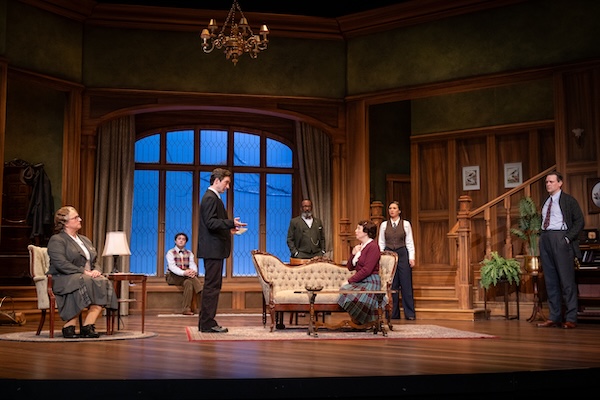
Mitch and Murray Productions’ presentation of Heroes of the Fourth Turning co-stars, left to right, Jennifer Clement, David Kaye, Elizabeth Barrett, Aaron Craven and Nyiri Karakas. (Shimon Photo)

This is a story about the interesting and intersecting balance of faith, peace, politics, sex, sexuality, deceit, forgiveness and mysticism with the modern world. How do we grapple with the changing self, while clasping hands with those we no longer align with, but feel we must commune?” said Mitch and Murray Productions’ Kate Craven about Will Arbery’s play Heroes of the Fourth Turning, which has its Western Canadian premiere Jan. 31-Feb.9 at Studio 16.

“It’s about letting go of preconceived notions,” she said. “It’s about being wrong, even when convinced otherwise. It’s complex and startling and astonishing and I truly think it is one of the great plays of this generation.”

Heroes of the Fourth Turning has won multiple awards and was a Pulitzer Prize finalist. In it, reads the synopsis, “four young conservatives have gathered to toast the newly inducted president of their tiny Catholic college – one week after the Charlottesville riots in 2017. Their reunion spirals into spiritual chaos and clashing generational politics, becoming less a celebration than a vicious fight to be understood.”

“The play’s title is a take on the book The Fourth Turning by William Strauss and Neil Howe, which hypothesizes the cycles of history and attempts to teach us how to live through these cycles via examples from past generations,” explained Craven, who is the theatre company’s board chair and operations manager. “They base their hypothesis on the past 500 years of American history and uncover what they deem as a distinct pattern: that modern history moves in cycles, each one lasting about the length of a long human life and each composed of four times 20-year eras, aka ‘turnings’ that comprise history’s seasonal rhythm of growth – maturation, entropy and rebirth. Otherwise broken down as the High, a period of confident expansion, followed by the Awakening, a time of spiritual exploration and rebellion. Then, the Unraveling, in which individualism triumphs over crumbling institutions. Finally, the Crisis (the Fourth Turning), when society passes through a great and perilous gate in history, a specific time that requires a generation of heroes to rise up, resolve crisis and reset imbalances created in prior turnings. 

“The Fourth Turning was written in 1997, at the tipping point between Gen X and the Millennial generation,” said Craven. “It references the Fourth Turning being in line with the coming of age of Millennials, a generation which three of the play’s characters fit into.”

One of those characters is played by Jewish community member David Kaye.

“I play a Catholic man in his late 20s named Kevin who is currently experiencing tremendous crises of identity and faith while struggling with alcohol abuse,” Kaye told the Independent. “A graduate of the Transfiguration College of Wyoming, Kevin received wilderness training, learned to scale mountains, ride horses, build igloos, memorize poetry and speak conversational Latin. Initially believing that he was being groomed to become ‘a leader of the world,’ Kevin has realized that he was woefully underprepared to actually live in the real world.”

While the character is drunk for most of the show, he is the only one asking questions, said Kaye. “He is often the butt of the joke but, ultimately, I think Kevin is the wise fool. Kevin wants so badly to connect with other people, regardless of their political leanings or religious affiliations. He wants to have hard conversations and expand his mind and is open to new ideas; unfortunately, he is not the greatest conversationalist.”

The role has certainly expanded Kaye’s mind. Having attended Vancouver Talmud Torah and King David High School growing up, the actor said “all of the knowledge of Catholicism I have is from pop culture, so building my character’s world has involved quite a lot of reading in theology and philosophy that I was completely unfamiliar with. As far as being a Jewish actor in the context of this play, I think that Kevin is actually the easiest character for me to identify with because he is constantly questioning things, and that was a core part of my Jewish education and exploration.”

Craven, who is also Jewish, “had the unique experience of growing up in a bi-faith family, one half Jewish, the other Pentecostal Christian.”

“It’s a difficult thing to belong to a family unit which falls on both sides of the faith divide and subsequently (often) political divide,” she said. “Perhaps this prepared me for a play like Heroes of the Fourth Turning. I find myself reaching for empathy for these often confused, sometimes wildly misguided characters and that makes this play very uncomplicated and uniquely human.”

She added that it feels like Arbery, the playwright, “is managing a perilous dance between faith, violence, truth and real-world events as his characters evolve and devolve in front of us. It feels much less about faith, religion and belief than it does about the crisis of being human. That’s relatable no matter who you are or which people you belong to.”

“This show can be viewed through many different lenses and each one will have a different takeaway,” said Kaye. The play will “ruffle some feathers,” he said. “But, if you are open to it, this is a show that will provoke thought, challenge perceptions, and might make you question the world around you.”

For Kaye, that is one of the main things he has learned from the character he is portraying – “that it is OK to question everything you have ever known to be true. It may be ugly and uncomfortable, but challenging your beliefs can lead to more authentic connections and a more fulfilling life.”

Craven said Mitch and Murray Productions’ goal has always been to present “bold, smart pieces that require the audience to be willing participants in the discourse and discussion. Our hope is that our productions showcase what it is to be a complex, imperfect human, as opposed to being a human who fits into a specific political, religious or cultural box, the aftermath of which potentially opens us up to empathy and understanding instead of division and despair.”

Set in rural Wyoming, Heroes of the Fourth Turning references hunting, there is a prop rifle on stage and gunshots are heard throughout the play. Other warnings include the use of coarse language and “heavy political debates which cover a range of difficult topics,” said Craven. “With this in mind,” she encourages people to come to the play with “a spirit of open-mindedness and an attitude of willingness – to see, hear and learn. All of which hearkens back to what I mentioned earlier about the plays Mitch and Murray attempts to produce – stories about a conflicted and imperfect humanity. We may not be able to see ourselves uniquely and specifically reflected in these characters, but there is certainly a reflection of humanity that is profound and deeply moving.”

Stories, she said, have “the capacity, when told well, to move and shape our molecules in a unique way. If we can be even a small part of creating compassionate debate, then we’re doing our job.”

For tickets ($15-$37) to Heroes of the Fourth Turning, visit mitchandmurrayproductions.com. 

Format ImagePosted on January 17, 2025January 15, 2025Author Cynthia RamsayCategories Performing ArtsTags David Kaye, play, politics, religion, The Fourth Turning, theatre
An inspiring Shabbat Shira

An inspiring Shabbat Shira

Cantor Shani Cohen and Wendy Bross Stuart (photo below) team up for another Shabbat Shira concert at Temple Sholom, on Feb. 8. (photo from Temple Sholom)

“I’m looking forward to the Shabbat Shira concert as an opportunity for our community to come together and enjoy some beautiful music as a temporary respite from the challenges of the past two years, within the safety of our own walls,” said Temple Sholom’s Cantor Shani Cohen of her Feb. 8 performance at the synagogue with Wendy Bross Stuart.

“Shabbat Shira is the annual day when we read the Song of the Sea, which is the climax of the Exodus story,” explained Cohen. “To celebrate this Torah reading, there is a tradition of adding some extra musical elements to the weekend. That was the inspiration for the Shabbat Shira concert that Wendy and I are doing. We started this tradition last year, and it was a wonderful evening of music that brought the community together.”

Cohen and Bross Stuart have chosen a range of musical styles for the concert, from musical theatre to jazz to classical art song. 

photo - Wendy Bross Stuart
Wendy Bross Stuart (photo from Temple Sholom)

“One of our focuses in the concert is highlighting Jewish composers,” said Cohen. “In this vein, we will be performing ‘How Much Do I Love You’ by Irving Berlin, ‘Still Hurting’ from Jason Robert Brown’s Last Five Years and ‘Vanilla Ice Cream’ from Jerry Bock’s She Loves Me. There will also be some songs by the very talented Jewish songwriting duo Zina Goldrich and Marcy Heisler, including ‘The Last Song’ and ‘Let Me Grow Old.’

“Finally, I am excited to be sharing a few classical art songs, including some by contemporary American composer Lori Laitman from her song cycle ‘The Mystery,’ and one from Hector Berlioz’s song cycle, ‘Les nuits d’été.’”

Before Cohen went to cantorial school, she studied to be an opera singer. She still feels a strong connection with classical music, she said.

“While I love being a cantor and find the role incredibly fulfilling and meaningful, I realized that I still have a passion for opera,” she said. “Singing opera, for me, is like a workout for my vocal muscles, keeping them in shape and, in turn, helping me sing my cantorial music more confidently. 

“I also think it’s important and healthy to have a work-life balance. For me, that means finding activities outside of synagogue life. Over the past two years, I have found some creative outlets that have allowed me to delve into classical music again in a different way than I do as a cantor. It has been an exciting and fun journey that has challenged me in new ways.”

Cohen’s passion for classical singing led her to Opera Lirica, headed by artistic director Trudy Chalmers, which is dedicated to bringing classical music to the community and providing performance opportunities to local opera singers. Among other things, Cohen was invited to perform as part of their Heritage Salon Series.

“My concert was on Nov. 10, and it was entitled The Sacred Tongue and the Mother Tongue: A Concert of Hebrew and Yiddish Songs. I had a wonderful time preparing for the concert with pianist Roger Parton [Opera Lirica’s music director]. I explored my own Israeli and Ashkenazi family background, and performed both new and familiar Hebrew and Yiddish repertoire…. It was a deeply personal concert, and I was proud to share it with not just the Jewish community, but the wider Vancouver music community. It meant a lot to me that after Oct. 7 and the rise in antisemitism that we have experienced, Trudy and Roger were both so supportive of this project and of me. This is the kind of crucial cross-cultural relationship building that I believe music can help us do.”

In another cross-cultural endeavour, Cohen will join the Jan. 26 performance of Songs of the Wasteland about survivor Renia Perel, which was written by Perel, who died in 2017, and arranged by Larry Nickel. The Vancouver Academy of Music is once again presenting the work, in honour of International Holocaust Remembrance Day (vancouveracademyofmusic.com/events).

For the past two years, Cohen has performed with the Reform Cantors and Cantorial Soloists of Canada (RCCC) organization in Toronto. “This year, we will be hosting the RCCC concert at Temple Sholom in May! More information to come,” she said.

Cohen and Bross Stuart first worked together on the community Yom Hashoah commemoration a few years ago, and in which both have participated multiple times. They also worked together in the Chutzpah! Festival concert debut of the Joan Beckow Project and album release; Bross Stuart and her daughter Jessica Stuart, who is also a musician, are co-directors of the project.

“We each bring a different musical perspective,” said Cohen of working with Bross Stuart. “Wendy has a wealth of knowledge and experience in musical theatre, Yiddish music and jazz, while I have a background in Jewish and classical music. We each learn from the other, and are able to meld our experiences into programs that I believe are intriguing and exciting for our audience.”

When Cohen started working at Temple Sholom back in 2021, she was straight out of cantorial school, and had just moved to Vancouver from New York. Grateful for the opportunities she has had at Temple Sholom, she said, “I am especially thankful to work with the supportive and inspiring clergy team that we have: Rabbi Dan Moskovitz and Rabbi Carey Brown. It was Rabbi Moskovitz’s vision to bring in an ordained cantor to our synagogue for the first time, and both he and Rabbi Brown have been supporting me through every step of my transition into this vibrant community.”

Over the years, Cohen has found ways to bring more of herself into her job: “more of my passions, interests and identity into what I offer.”

“On a basic level,” she said, “my role includes leading prayer services, running our b’nai mitzvah program and officiating lifecycle events like weddings and funerals. Beyond that, I am passionate about growing our musical offerings at Temple Sholom, and I believe in the power of music to help us tap into our spirituality. That’s why I started a small vocal ensemble that sings at our High Holy Day services, as well as a few special Shabbatot throughout the year. I also started a Temple Sholom band, called the Temple Tones, who enrich our Friday night services a few times a year for holidays and Shabbatot.”

Cohen oversees the Sholom Shishim (60-plus) program. 

“My goal with this group is to find new and creative opportunities to engage our seniors,” she said. There have been lunch-and-learns, speakers, concerts and various outings. “We now have on average 70 attendees per month, and our annual Hanukkah party gets up to 100 seniors!” she said.

“I run a monthly Temple Sholom Tea gathering at the Louis Brier for our members who live there, though anyone is welcome to join,” she added. “A few years ago, I began a program I call Teatime with Cantor Cohen, where I meet with small groups of Temple Sholom seniors in local cafés and tea shops, so they can get to know me, each other and, hopefully, create meaningful relationships in their own neighbourhoods.” 

One thing Cohen loves about her cantorial role is that she works with people of all ages, from teaching classes at the shul’s religious school, to various adult offerings. “Recently,” she said, “I began a High School Prayer Leader program to train the next generation of prayer leaders.”

Cohen also started a Queer Torah Study group, which has evolved into Kehilateinu, the Temple Sholom Pride Club.

“When my wife and I moved to Vancouver, we were welcomed into the community with open arms, and I want to ensure that our growing number of queer members feel welcomed at Temple Sholom as well,” she said. “I know that Kehilateinu’s events have been especially meaningful since Oct. 7, when so many queer Jews were rejected by their social circles.”

Tickets for the Shabbat Shira concert are $18 for synagogue members and $36 for non-members. The Feb. 8 event starts at 7 p.m. with a happy hour and the concert is at 7:30 p.m. Register at templesholom.ca.

Format ImagePosted on January 17, 2025January 15, 2025Author Cynthia RamsayCategories MusicTags Jewish composers, opera, Shabbat Shira, Shani Cohen, Wendy Bross-Stuart
Robinson kicks off book fest

Robinson kicks off book fest

The JCC Jewish Book Festival opens Feb. 22 with Selina Robinson talking about her memoir, Truth Be Told. (photo from JCC Jewish Book Festival)

This year’s JCC Jewish Book Festival opens Feb. 22 with Selina Robinson talking about her recently published memoir, Truth Be Told.

Most Jewish Independent readers will be familiar with the events that propelled Robinson to write this book. The first chapter, called “Four Fateful Words,” starts at what some people may think is the beginning – when, during a Jan. 30, 2024, webinar, Robinson said the state of Israel was reestablished on a “crappy piece of land.” But she believes she had been targeted for months.

“It was sloppy language, nothing more, but it provided the Gotcha! for anti-Israel extremists to build a case that I was racist, Islamophobic, intolerant and an evil monster that needed to be canceled,” she writes.

“In an ideal world, it would have been the extremists who were dismissed, not me. In an ideal world, we would be blessed with leaders who can differentiate between right and wrong.”

Truth Be Told covers the fallout from her comments. Premier David Eby initially seemed prepared to stand by Robinson, but the political pressure – including from a group of Muslim clergy who threatened the NDP’s access to Muslim voters unless Robinson was dismissed – soon led to him firing her from cabinet, though he never used the word.

“I told the premier that if he wanted my resignation, I would give it to him, but he needed to ask for it,” writes Robinson.

“In the end, he didn’t fire me and I didn’t resign, although the undeniable conclusion of the call was that I was no longer in cabinet.”

After taking some time to absorb the situation, Robinson rallied. 

“As part of my t’shuvah [repentance], the premier asked that I make a series of calls to Muslim community leaders,” she shares. “I began to think: What if I could engage with these groups and bring the Jewish community and the Arab and Muslim communities together in some way? These two heartbroken communities, both fearful for their families overseas and feeling powerless to effect change, could find commonality in that shared experience, at the very least. Action is always an antidote to hopelessness and helplessness. I could do this as part of my role as an MLA and the government could take credit for doing something meaningful that makes a positive difference for both these aching communities. For me, this would be a profound form of redemption, of t’shuvah, and also of tikkun olam [repair of the world].”

But this ray of light was soon extinguished, the idea being deemed “too political.”

“I knew in that moment that this was no longer my place, no longer my government, no longer my political party,” writes Robinson. “A place and a party where I belonged would recognize the opportunity for someone who was seen to have transgressed to do some good. My place, my party, would recognize the value of bringing people together. A place where I belonged would not be afraid to try something unique and potentially powerful.”

Robinson quit the NDP and finished her term as an MLA as an independent. She was going to retire anyway, but this was not how she wanted her political career to end.

And it was quite a career. With a master’s degree in counseling psychology, Robinson spent most of her working life as a family counselor and in senior roles in various social service agencies.

“I never planned to enter politics,” she writes. “The first real engagement I had was speaking to Coquitlam City Council, my hands shaking, in support of an emergency cold weather refuge for homeless people proposed by a church in my neighbourhood.”

image - Truth Be Told book coverOne of the councilors suggested she run for council, and she did. She was elected to Coquitlam City Council in 2008 and reelected in 2011. Truth Be Told gives readers a glimpse of what that experience was like, what Robinson accomplished as a councilor, and more. We find out how and why she made the leap to provincial politics in 2013 – a decision in which the late John Horgan played a pivotal role. The memoir is dedicated to Horgan, for whom Robinson had great respect and a close relationship. As premier, Horgan was the one who appointed Robinson minister of finance after the 2020 election that gave the NDP a majority government. She held that position through COVID, the government managing to file budget surpluses despite the challenges the pandemic brought.

“What saddens me right now is that people are losing faith in government,” writes Robinson. “That is especially distressing because if anything should have renewed people’s faith in government, it was the collective response to the pandemic.”

When Horgan stepped down as premier in 2022 because of the toll his cancer treatments were taking on him, Robinson began to more seriously reflect on her own future. She had been in public service for so long, she wanted to spend more time with her family. In Truth Be Told, we learn more of her own fight against cancer – a fight that started in 2006, a fight she seems to have won, finding out on Oct. 6, 2023, that her cancer had disappeared. The celebration was short-lived. That evening, news started coming in of Hamas’s terror attacks on Israel.

Robinson’s ambivalence about running for reelection was one of the reasons she didn’t pursue the party leadership vacancy Horgan’s departure opened. Other candidates bowed out, and Eby was anointed the new leader of the BC NDP and became premier in November 2022.

Robinson calls herself an “eternal optimist,” and that attitude has served her well. Despite being effectively demoted by Eby after he became premier, Robinson threw herself into the position of post-secondary education and future skills minister. It is interesting to read about some of the issues in that sector, and of the other portfolios Robinson held, as well as get some insider knowledge of how politics works and about the personalities of the people who represent us.

The crux of Truth Be Told is Robinson’s “four fateful words,” the reactions to them, and what was said and done – or, more importantly, what was not said and what was not done. Many of her colleagues were “quiet allies,” not willing to speak out.

“There are lessons from my experience that transcend my personal story,” she writes. “There are lessons for our democracy about the necessity to stand up to coercion from interest groups and harassment from mobs. There are lessons for leaders about how to act (and how not to act) when presented with choices between what is easy but wrong and difficult but right. There are lessons about speaking up rather than remaining silent.”

Truth Be Told is about a person doing what they passionately believe in, a person living their values – some of which were instilled at Camp Miriam, where Robinson was a counselor in her youth – and trying to make what they feel are positive contributions to the world. 

Given what happened to her, Robinson could be forgiven for giving up and going quietly into obscure retirement. But that’s not who she is. She asks Canadians to have the courage to speak up, while recognizing that we should not “kid ourselves that a millennia-old problem will be resolved in a day.” She ends her book with calls to action, suggestions of what we each can do to counter antisemitism, as Jews (for example, don’t hide, “engage respectfully or not at all” and don’t give up) and non-Jews (speak up and engage with Jews, among other things), and as a society (for instance, protect students and nurture real inclusion). She includes some resources for readers wanting to explore various topics more.

In the “Final Reflections” chapter, Robinson writes, “We will never be perfect. The world will never be faultless. But repairing the world must always be our guiding star. Our reach must always exceed our grasp.”

Profits from the sale of Truth Be Told will be donated to the Parents Circle-Families Forum (theparentscircle.org/en) and Upstanders Canada (upstanderscanada.com). 

The JCC Jewish Book Festival runs Feb. 22-27. For the full list of events and participating authors, visit jccgv.com/jewish-book-festival.

Format ImagePosted on January 17, 2025January 15, 2025Author Cynthia RamsayCategories BooksTags antisemitism, JCC Jewish Book Festival, memoir, politics, Selina Robinson, Truth Be Told

Kiki more than a muse

History is fickle. Who becomes known as great in their field, whose work is displayed in museums or taught in schoolbooks? When there is a tangible product – a building, a painting, a book, whatever – the chances seem higher that you’ll be remembered. But what if you were mainly a muse to others, what if you could enthrall audiences with your voice but never recorded an album, if you created works of art that people liked and even bought, but you didn’t create in the popular style of the day, or you were a woman in a man’s world?

image - Kiki Man Ray book coverMost readers will not have heard of Kiki de Montparnasse, born Alice Prin in 1901, in Châtillon-sur-Seine, about 240 kilometres southeast of Paris, to an unwed mother who wasn’t much into mothering. But most would likely recognize her – she modeled for many an artist (Alexander Calder, Tsuguharu Foujita, Amedeo Modigliani, to name a few, as well as Maurice Mendjizky, with whom she fell in love for awhile). And, during her seven-year relationship with surrealist photographer Man Ray (who thought himself more of a painter), she posed for him many a time. In 2022, one of Ray’s most famous images of her, called “Le Violon d’Ingres,” sold for $12.4 million, the most expensive photograph ever sold at auction.

Yet, what of her own work, her talents, her accomplishments?

Cultural historian Mark Braude gives Kiki her overdue due with his latest book, Kiki Man Ray: Art, Love and Rivalry in 1920s Paris, which Braude will discuss with University of British Columbia professor emeritus of history Chris Friedrichs at the JCC Jewish Book Festival on Feb. 24, in an event called Art & History: Paris, Jews and Surrealism.

While Kiki wasn’t Jewish, so many of the artists she hung out with were, including, of course, Ray, who was born Emmanuel “Manny” Radnitzky. If she hadn’t lived among the who’s who of Dada and Surrealist art, perhaps she wouldn’t have been overshadowed, mostly forgotten. She was a commanding performer, she sold at least a few dozen paintings, wrote a memoir, appeared in films. By all accounts, a success. But, as “Queen of Montparnasse,” the early-1900s bohemian paradise in Paris, Kiki lived on the more wild side. Addiction would speed along her end – she died in 1953, only 51 years old. Another reason, perhaps, that her legacy was not as lasting.

As much as Braude’s account is about Kiki, it is about the time in which she lived and the people among whom she lived. Because, “as she experienced her era and channeled that experience into her art, Kiki shared drinks and cigarettes and ideas with many of the people who would shape how their century saw and thought and spoke: Modigliani, Stein, Picasso, Barnes, Matisse, Guggenheim, Calder, Duchamp, Breton, Cocteau, Flanner, Hemingway,” writes Braude. “And Man Ray, whose emergence as a modern artist must be understood as intimately linked to her own.”

While Kiki may not have left much physical evidence behind of her influence, it doesn’t mean she wasn’t influential. Living as she did, with whom she did, Braude writes: “Evolving in concert with them, watching them become who they were, challenging them and joking with them, working with them and through them, Kiki, too, played her role in shaping the cultural history of the past hundred years.”

Braude’s book is not only a fascinating read, but a reminder that none of us is insignificant. Even if our names are lost to history, we matter, we impact others and the world around us.

For the full book festival schedule, visit jccgv.com/jewish-book-festival. 

Posted on January 17, 2025January 15, 2025Author Cynthia RamsayCategories BooksTags art, history, JCC Jewish Book Festival, Kiki de Montparnasse, Man Ray, Mark Braude, painting, Paris 1920s, photography

A summer camp moment

image - cartoon featuring summer campers lining up at the camp clinic, by Beverley Kort

Posted on January 17, 2025January 15, 2025Author Beverley KortCategories Visual ArtsTags health care, Jewish summer camp, youth
A Dickens of a musical

A Dickens of a musical

Anthony Santiago, at front, plays Fagin in Gateway Theatre’s production of Oliver!, which runs until Jan. 4. (photo by David Cooper)

Charles Dickens wrote Oliver Twist in 1837. His eponymous main character, an 11-year-old orphan, has the audacity to ask for more when the workhouse daily gruel is handed out, leading to a series of events that change his life forever. And local audiences will be asking for more, more, more of Gateway Theatre’s offering of Oliver!, the musical “freely adapted” from Dickens’ novel by Lionel Bart, which plays until Jan. 4.

A beloved classic, the 1968 screen adaptation of Oliver! won the Academy Award for best picture of the year. A revival of Bart’s work is currently playing in London’s West End to widespread acclaim. I predict the same for this production. 

The story revolves around Oliver’s journey through the gritty underworld streets of Victorian London, from being an impoverished orphan sold to apprentice a cruel undertaker, to his secondment to a gang of street urchins under the tutelage of Fagin “the Jew” and, finally, a reunion with his well-to-do family. 

Community member Josh Epstein ably directs his 24-person cast, a superb mix of professional and amateur actors (including 11 children), as they enthusiastically sing, dance and cavort their way across Ryan Cormack’s handsome set. 

On the dark side of the original story is Dickens’ portrayal of Fagin as a venal, sinister, petty criminal who runs a den of adolescent thieves, teaching them to pick the pockets of London’s elite. Dickens refers to Fagin as a Jew more than 250 times, mostly in a negative way. He defended his choice by stating that he was just reflecting the reality of the time – that London underworld criminals were almost invariably Jewish. Some say he based the character on Ikey Solomon, a notorious Jewish fence. Over the years, consistently called out by Jewish community members for antisemitism, Dickens eventually apologized and edited out the negative references. Bart, who is Jewish, downplayed any stereotypes of Fagin in his rewrite.

In Gateway’s production, you would not even know that Fagin, played by Anthony Santiago, is Jewish, although, in his one solo, “Reviewing the Situation,” the klezmer-inspired clarinet accompaniment hints at a connection. Even as Fagin salivates over his cache of jewels, overall, he comes across as a lovable rogue, not the sleaze Dickens originally described. On opening night, I asked Epstein about this characterization. “I did not want to make a Jewish caricature of him,” said Epstein. “I wanted the show to be something entertaining and deep without that aspect.”

While this is truly an ensemble production, a number of actors stand out. Many of the veterans take on multiple roles, gliding effortlessly from one to the other.

Miranda MacDougall, who can really belt out a song, does double duty as Nancy, one of Fagin’s accomplices, a kind-hearted strumpet, and Mrs. Sowerberry, the undertaker’s wife. She also carries off a pretty good Cockney accent.

Tanner Zerr plays Nancy’s churlish beau Bill Sykes, whose cruelty leads to murder and his ultimate demise. One wonders what Nancy sees in this violent partner and why she stays with him. The answer comes in her poignant rendition of “As Long As He Needs Me,” which brought tears to my eyes. Zerr also doubles as Mr. Sowerberry in a very funny funeral scene and chorus line dance, including a spry corpse – Kate Malcic.

Santiago is simply fantastic as Fagin. Lucas Gregory as the Artful Dodger, the leader of Fagin’s gang, has a very physical role, as he slides down poles and climbs up and down ladders. I hope he can make it through the three-week run without an injury.

Then, of course, there is Rickie Wang as Oliver. Wang gives a sublime performance and showed his singing talent with “Where is Love?”

More minor characters, Victor Hunter, as Mr. Bumble, the beadle, and Cecilly Day, as Widow Corney, delight in a raunchy two-hander that had the audience in stitches. Daniel Curalli plays Mr. Brownlow, who turns out to be Oliver’s uncle, with the appropriate gravitas, and Suani Rincon does a nice job as Bet, 

Nancy’s friend. All the gang kids, from the tallest to the smallest, are great and perform with gusto. 

A musical of this scope is nothing without the behind-the-scenes work of the creative team. In this production, they really deliver.

Cormack’s industrial two-storey wrought-iron set constantly revolves, morphing from a workhouse to Fagin’s hideout to a posh London salon to London Bridge. Frenetic activity accompanies each revolution with various cast members running to and fro.

Lighting designer Sophie Tang’s rich colours infuse the various sets, providing the mood for each scene.

The costumes of Donnie Tejani authentically reflect the Victorian era – the rustling petticoats of the ladies, the tattered frocks and knickers of the children’s gang, Fagin’s patchwork overcoat, and fancy waistcoats and trousers for the gentlemen. 

Against the backdrop of all of these designs, choreographer Nicol Spinola gets her young charges hoofing away to musical director Sean Bayntun’s impressive six-piece orchestra. With iconic songs like “Food, Glorious Food,” “Consider Yourself One of the Family” and “Oom Pa Pa,” what’s not to like?

My only complaint is that the hidden orchestra often overpowers the actors (although they are all wearing microphones) so that many of the lyrics are lost. Hopefully, over the course of the run, this will be corrected.

In program notes Epstein remarks: “Directing Oliver! has been an incredible opportunity to reimagine a story that has resonated for generations. While it’s a tale of resilience and hope, it also confronts the harsh realities of poverty, abandonment, and the search for belonging. For this production, we’ve worked to see the story through Oliver’s eyes, capturing the vivid and fantastical way children remember moments.

“This isn’t a softened version of Oliver!, it’s raw, unflinching, and a true dark fairy tale. It’s a story about finding light in the darkest places and holding onto hope when it feels out of reach.”

I highly recommend this delightful musical, suitable for ages 10 and up. Tickets can be purchased at [email protected] or by calling 604-270-1812. Special performances include VocalEye audio description for guests with visual impairments (Dec. 28) and a relaxed performance (Dec. 21). 

Tova Kornfeld is a Vancouver freelance writer and lawyer.

Format ImagePosted on December 20, 2024December 19, 2024Author Tova KornfeldCategories Performing ArtsTags antisemitism, Charles Dickens, Gateway Theatre, history, Josh Epstein, Lionel Bart, musical theatre, Oliver!
Writing the human condition

Writing the human condition

Maya Arad and Eshkol Nevo are featured in the JCC Jewish Book Festival prologue event Jan. 19.

The JCC Jewish Book Festival begins its 40th year with a discussion that’s sure to be as intriguing as it is relevant. The two Israeli writers featured in the festival prologue event Jan. 19 – Maya Arad and Eshkol Nevo – are keen observers and talented communicators, even as their characters are not.

Boundaries, generational differences, family, love, work, politics, social mores, and other themes run through both Arad’s  (New Vessel Press, 2024) and Nevo’s Inside Information (Other Press, 2023). Each book comprises three novellas, though Nevo’s very loosely connects all the narratives, so dubs itself a novel, despite the stories being almost completely unrelated. Melancholic would best describe the mood of both works.

While the English version of Arad’s The Hebrew Teacher was published just this year – translated by Jessica Cohen – the Hebrew version came out in 2018. Its stories retain their immediacy, and readers will be able to relate to some aspect(s) of every one.

image - The Hebrew Teacher book coverThe title story, “The Hebrew Teacher,” is brilliant. When Ilana arrived in the United States from Israel in 1971 and started teaching, her Hebrew classes, both children and adult, at her synagogue and at the university, were packed: “Parents wanted their children to be able to chat in Hebrew, not just recite the prayers…. Everyone wanted to know a little Hebrew before they visited Israel. They wanted to learn the new songs.” Of course, those songs are far from new at this point in Ilana’s career, yet she still holds them and their visions of Israel dear.

But enrolment in the Hebrew-language university courses has been dropping for almost two decades, both because “Israel was a tough sell these days. It wasn’t the fledgling little country of 45 years ago. Nor was Ilana the same beaming young woman who’d arrived, thick copper braid over one shoulder, to regale the riveted students with stories about hiking from the Mediterranean to the Sea of Galilee, working on a kibbutz, and firing an Uzi when she served in the Israel Defence Forces.”

Into Ilana’s tenuous professional world – her husband has just retired from the university and other key allies have moved on – comes a new hire, Yoad Bergman-Harari, who’d been born Yoad Harari but had “added on his father’s original name, Bergman.” When Ilana asks why, he responds, “‘To negate the negation of the diaspora’ … as though it were the most obvious thing in the world.”

The differences in their worldviews – particularly on the Israeli-Palestinian conflict – and approach to collegiality are stark. While Ilana has taught at the university for decades, she holds none of the cards here, as Yoad is the latest newfangled intellectual thing, and a professor, so can pretty much write his own ticket, and does.

In “A Visit (Scenes),” Miriam comes to the States for a three-week visit with her only child, Yoram, his wife Maya and their son Yonatan. Miriam makes the journey because her son rarely returns to Israel and she has yet to meet her grandson in person. In a string of short snippets, mostly from Miriam’s perspective but also from Yoram’s and Maya’s, we are privy to what everyone is feeling – which boils down to a lot of unhappiness. The lack of honest, open communication contributes to the tensions and dissatisfactions, which build as the visit goes on.

The final story, “Make New Friends,” is kind of mystifying at first, as we watch Efrat, an educated, successful woman with a good husband, start to spiral as she tries to protect their unpopular teenaged daughter from being hurt by so-called friends. She gets way too involved, even entering the teen social media universe, and it’s only when Efrat realizes that she herself doesn’t belong to any group or have any real friends that she begins to understand her reactions (and actions) to her daughter’s situation. 

One review of The Hebrew Teacher comments that Arad, in these novellas, “probes the demise of idealism and the generation gap that her heroines must confront.” This is an apt description. And it could be said that Nevo also explores the demise of idealism in Inside Information, which was translated from Hebrew into English by Sondra Silverston.

image - Inside Information book coverThe first two stories of the novel have similar plotlines – men who are led by their sexual desires to act in illegal or inappropriate ways. The main difference between the protagonists is that the “hero” in “Death Road,” Omri, goes mostly willingly towards his potential downfall while Dr. Caro, the main character of “Family History,” tries to convince himself that he did nothing wrong.

In “Death Road,” while on a trip to Bolivia following the recent breakup of his marriage, Omri runs into newlyweds Ronen and Mor. Once back in Israel, he reads in the newspaper about the death of Ronen in a cycling accident in Bolivia. He decides to go to the shiva – as he drives there, his “mind filled with more and more images of Mor’s surprise nocturnal visit to my room two weeks earlier.”

As Omri lays out the story, he proves an unreliable narrator. Nothing ultimately ends up being what it seems at first. More details become known. Questions arise. It’s a thriller of sorts, but one that doesn’t seem all that original or urgent. There are twists but nothing that’ll stop readers in their tracks.

The femme fatale reappears in the next story, “Family History,” this time in the form of a young medical resident who supposedly mistakes the ostensibly paternal gesture of the respected Dr. Caro for sexual harassment and files a complaint that threatens the good doctor’s reputation. Even as Caro tells his story, he’s trying to convince himself as much as us about the purity of his motivations. But he’s a widower who obviously loved his wife, he seems well-liked at work and good at his job. He is a more empathetic character than Omri, and the twist in this story does elicit some surprise, and puts Caro’s actions into an even darker light.

The last part of the novel, “A Man Walks Into An Orchard,” is a direct rift on the talmudic tractate about four Jewish sages who went into pardes, which means both paradise and orchard, and only one came out unharmed. In Nevo’s story, husband and wife Ofer and Chelli go for one of their regular Saturday walks in the orchard. This Saturday, though, Ofer needs to pee, so he gives his phone to Chelli and goes into the trees, while she waits on the road. And waits. He never comes back. He is never found. 

The way in which Chelli and her two children work through their loss is emotionally engaging. She and her son become estranged, while she and her daughter become closer as they search Ofer’s blogs for clues to his potential whereabouts. He had intended to complete 100 stories of 100 words each, and then publish a book. He had posted his 99th story the week before he disappeared.

There is something satisfying in this third tale, though it takes a detour into Chelli’s drug-induced visions to somewhat resolve the mystery of Ofer’s disappearance. It highlights our desire for things to make sense, to know what happened. When that’s impossible, storytelling can fill in the blanks. 

The Maya Arad and Eshkol Nevo event on Jan. 19 takes place at 1 p.m., at the Jewish Community Centre of Greater Vancouver. Olga Campbell gives a talk on her memoir (jewishindependent.ca/a-multidimensional-memoir) and its exhibit on Jan. 23, 7 p.m., at the Zack Gallery. The book festival and the Vancouver Holocaust Education Centre present a talk by Roger Frie on his book Edge of Catastrophe: Erich Fromm, Fascism and the Holocaust on International Holocaust Remembrance Day, Jan. 27, 7 p.m. The festival itself opens Feb. 22 – with Selina Robinson in conversation about her new memoir, Truth Be Told – and runs through Feb. 27. Events will be posted at jccgv.com/jewish-book-festival as they are confirmed.

Format ImagePosted on December 20, 2024December 19, 2024Author Cynthia RamsayCategories BooksTags Eshkol Nevo, fiction, Israel, JCC Jewish Book Festival, Maya Arad, novellas, novels, translation
Revisiting magic in Victoria

Revisiting magic in Victoria

Linda Dayan Frimer signs books at the Indigo in Victoria’s Mayfair Mall. (photo by David J. Litvak)

Victoria has always been a magical place for BC artist and author Linda Dayan Frimer. She has exhibited her art at the Empress Hotel and participated in a concert with the Victoria Symphony Orchestra. It was an agent from Victoria who helped kickstart her career and, more recently, she connected with the Victoria  editor who worked on her latest book, Luminous. On a trip this fall to Victoria to promote that book, Frimer rekindled her special relationship with British Columbia’s capital.

“Victoria is a place of very special memories and wondrous new happenings for me and my art,” said Frimer.

Recalling her early days, she said, “My large watercolour paintings depicting the landscape of British Columbia, placed in the window of Northern Passage Gallery by the owner and my Victoria-based art agent Valerie Pusey, seemed to fly out the door in swift succession.”

Pusey “was astonishing in helping my art champion many causes,” said Frimer. Those causes included Margaret Laurence House for women leaving an abusive partnership, breast cancer research, and arts and science benefits. With Pusey’s help, Frimer was chosen as the first artist to represent the Trans Canada Trail, with her painting “The Golden Journey, 5000 Miles of Freedom.” That long-ago concert with the Victoria symphony was a fundraiser, with Frimer being invited to paint on stage just behind the orchestra.

“Hearing the symphony inside my heart while painting in harmony with them was an exquisite experience,” Frimer shared.

Frimer’s memoir, Luminous: An Artist’s Story as a Guide to Radical Creativity, follows the history of her ancestors from Romania, Lithuania and Russia, as they experienced cultural turmoil and fled to North America, and delves into the stories of renowned artists and the artworks they produced in response to social injustice and war. The book includes exercises designed to help readers connect with these artists, and to inspire readers to get in touch with their own inner artist and the art of their own story. (See jewishindependent.ca/how-to-be-radically-creative.)

photo - A painting by Linda Dayan Frimer from her “Wonder” series, which is in Luminous. At a recent signing, a young girl was entranced by this series and Frimer’s art
A painting by Linda Dayan Frimer from her “Wonder” series, which is in Luminous. At a recent signing, a young girl was entranced by this series and Frimer’s art. (image from Linda Dayan Frimer)

While Frimer has traveled across North America promoting Luminous, this recent trip was her first event in Victoria promoting it. As people passed by the table where Luminous was displayed at Indigo in the Mayfair Mall, they couldn’t help but notice it. One young fan could not take her eyes off it.

“My book was blessed by the appearance of a little 7-year-old girl who appeared at my signing table,” said Frimer. “She began to turn each page of the book intently. After a few minutes, her mother asked her if she would like to go to the toy department. No, she responded, I want to stay right here. She seemed mesmerized by each colour-filled page and, as she pointed out her favourite painting, entitled ‘Wonder,’ I felt a rush of awe. When her mother returned after some time shopping, I gifted the little girl my book and when she received the book, she hugged it tightly. Her mother was in tears and said to us that this was a seminal moment in her daughter’s life that would guide her future.”

Frimer was moved by the encounter.

“This was the best gift my life and art could receive – for I know that each of us is the artist of our own story and, when we are inspired to reach the foundational core of ourselves, we discover true meaning and purpose,” she said. “That afternoon, I realized that, if I had only written my book to bring wonder to this little girl, it had served its purpose.”

In addition to the event at Indigo, Frimer got together with Ellen Godfrey, the editor of Luminous, and Pusey while she was in Victoria.

“I vividly recall my first glimpse of Linda Dayan Frimer’s artwork and my feeling of awe at the interplay of emotion and passion, intelligently expressed through paint on paper,” said Pusey. “That glimpse confirmed all that critics had previously observed: her distinct ability to cultivate colour, light and motion within the watercolour medium. Linda Frimer’s artwork is so fundamentally powerful that it transcends esthetic beauty to express a depth of spiritual awareness and sensitivity. Her message is one of reverence for all of creation.”

During the rest of Frimer’s time in Victoria, seeds were planted for a future event at Congregation Emanu-El and possibly an artist residency at one of the local hotels. For more information about Frimer and her work, visit lindafrimer.ca. 

David J. Litvak is a prairie refugee from the North End of Winnipeg who is a freelance writer, former Voice of Peace and Co-op Radio broadcaster, “accidental publicist,” and “accidental mashgiach” at Louis Brier Home and Hospital. His articles have been published in the Forward, Globe and Mail and Seattle Post-Intelligencer. His website is cascadiapublicity.com.

Format ImagePosted on December 20, 2024December 19, 2024Author David J. LitvakCategories BooksTags art, books, Linda Dayan Frimer, Luminous, painting, Victoria
Touring with Cirque’s ECHO

Touring with Cirque’s ECHO

Cirque du Soleil’s ECHO, at Concord Pacific Place until  Jan. 5, is just beautiful. (photo by Jean-François Savaria)

Beautiful. Cirque du Soleil’s ECHO, at Concord Pacific Place until Jan. 5, is just beautiful – the costumes, the movements, the music, the projected images. As with most Cirque productions, there is a minimal storyline. This one follows heroine Future and her dog Ewai as they try to restore balance to the world, between humans, animals and the environment. It is an optimistic, fantastical show, an uplifting break from a reality that sometimes seems hopeless.

photo - "Double Trouble," Cirque du Soleil's ECHO
“Double Trouble,” Cirque du Soleil’s ECHO. (photo by Jean-François Savaria)

The performance the audience sees under the Big Top is, of course, as much the result of many behind-the-scenes and front-of-house workers as it is the performers’ hours of practise and great skill. Every Cirque show is a highly orchestrated experience, international in scope. According to its website, since Cirque du Soleil’s creation in 1984, “more than 400 million people have been inspired on six continents and 86 countries. The Canadian company now employs more than 4,000 employees, including 1,200 artists from more than 80 different nationalities.”

One of those employees is Jewish community member Sarah Sananes, who was born in Florida but grew up in Montreal. She and her siblings attended Hebrew Foundation School for elementary.

“We learned to read, write and speak Hebrew, attended synagogue every Friday morning at Congregation Beth Tikvah, and learned both French and English at the same time,” Sananes told the Independent. “I was young, but I remember loving everything I did and learned during my time there, especially getting to eat TCBY [kosher yogurt]. 

“To this day, my father still uses the menorah I made, which consists of bolts to hold the Hanukkah candles. We celebrated Shabbat every Friday and attended synagogue for the High Holidays. It truly is a beautiful religion to celebrate. As I grew up, I still celebrate the High Holidays and attend Shabbat dinners whenever I can. I continue to educate myself on my religion even as I get older and don’t always have the chance to celebrate like I used to when we were younger.”

photo - Sarah Sananes is a guest experience supervisor with Cirque du Soleil’s ECHO, which is in Vancouver until Jan. 5
Sarah Sananes is a guest experience supervisor with Cirque du Soleil’s ECHO, which is in Vancouver until Jan. 5. (photo from Cirque du Soleil)

Sananes entered the workforce right out of high school.

“I was always more of an active kid than a quiet one who liked to sit in class. This led me straight into the hospitality industry, where I quickly fell in love with the fast pace,” she said. “I worked hard to climb the ladder into assistant manager roles, which led me to managerial positions. I take great pride in my work ethic and leadership skills, even to this day. This is one of the main things that led me to Cirque, and has kept me here. Whether you are presented with a happy guest or an angry guest, the outcome can always be positive, depending on the way you see and handle the situation. One of my favourite quotes is: ‘We can’t control the winds, but we can adjust the sails.’”

Sananes is now a guest experience supervisor with ECHO.

“I first began my journey with Cirque du Soleil in the summer of 2022. I was hired when I started working as the on-site manager on another show, named KOOZA, with the local staffing agency. Once the summer ended, I returned to my job as an entrepreneur,” said Sananes, who owns an employment agency.

“The following summer, I heard Cirque du Soleil was launching a brand new show and, sure enough, I returned once again to manage the local staff. As the Montreal run neared its end, the guest experience position on ECHO became available and, after my interview, I was asked to join the team!”

Sananes had so loved working on KOOZA that, she said, “When ECHO came out, I knew, if it was anything like KOOZA, I would love what I did, everywhere I did it.”

As to what her job entails, it’s a lot.

“The guest experience team is the team that manages everything that has to do with guests in the front of house. Our team is made up of nine supervisors across six departments, which are box office, concierge, merchandise, food and beverage, VIP, and usher,” she explained. “We also have an inventory supervisor and then myself. Each supervisor manages their respective department every day, whereas my role is more like the chameleon of supervisors. Each day, I morph into a different role. Within my time here, I have learned the ins and outs of every single department, being able to cover or assist any of my co-workers whenever and wherever needed. 

“Another part of my role is being the direct link between our partnerships and our visibility departments at Cirque du Soleil’s international headquarters located in Montreal and the tour,” said Sananes. “I make sure all our signage and branding are properly managed and set up. This includes physical signs and all digital assets. Lastly, due to my previous experience as an on-site manager, now being on the other side, I work closely with the local staffing agency and their on-site team to ensure they are able to deliver what we need to successfully operate our show call operations, day in and day out. Some markets are tougher than others when hiring and managing local staff, but it wouldn’t be fun and rewarding if it was always easy!”

Sananes has worked in many markets since ECHO launched in Montreal in April 2023. She has been with the show since the beginning, traveling with it from Montreal to Washington, DC, Atlanta, Ga., and Miami, Fla., before returning to Canada, with performances in Toronto and in Gatineau, Que., among other places.

photo - "Human Cradle," Cirque du Soleil's ECHO
“Human Cradle,” Cirque du Soleil’s ECHO. (photo by Jean-François Savaria)

“After five different cities, we landed here in beautiful British Columbia’s Vancouver,” said Sananes. “My plan is to remain on tour and continue to travel with the show for the foreseeable future. I’ve already got my cowboy boots ready for Houston, so I don’t plan to go anywhere just yet! One of the beautiful perks about being on tour is being able to travel to all these places I’ve never been before, some of which I probably wouldn’t have gotten to see at all.”

When asked if there was anything else she’d like to tell JI readers, Sananes expressed gratitude for her parents.

“My father was born in Jerusalem and my mother was born in Canada. They have both taught me very valuable lessons in life, from when I was little until this very day, and, I pray, for all the days to come,” she said. “Because of my mother, I am tough, courageous and kind. Because of my father, I am resilient, fearless and wise. To my mother and my father, thank you for teaching me the importance of being independent, while still being able to spread love to all those around me.”

For tickets to ECHO, visit cirquedusoleil.com. 

Format ImagePosted on December 13, 2024December 11, 2024Author Cynthia RamsayCategories Performing ArtsTags acrobatic, circus, Cirque du Soleil, Sarah Sananes
PuSh Festival turns 20

PuSh Festival turns 20

Clayton Lee explores his childhood obsession with Jewish professional wrestler Bill Goldberg in his The Goldberg Variations, which is at Waterfront Theatre Jan. 30 (photo by Kenneth Koo)

PuSh International Performing Arts Festival runs Jan. 23-Feb. 9. This year’s run marks the festival’s 20th year.

PuSh 2025 features more than 25 presentations, including 20 original performance-based productions; five animated parties and cabaret-style events; two film events; and two artist residencies, one of which will culminate in an open studio showing by international guest artists. In addition to a strong Canadian presence, with 13 presentations, the PuSh Festival includes works by artists of Belgium, South Korea, Brazil, United Kingdom, Uruguay, France, Denmark, Italy, Taiwan, the United States, Sweden and Democratic Republic of Congo. 

Among the many presentations this year are at least two with a Jewish angle.

On Jan. 30, 9 pm., at Waterfront Theatre, The Goldberg Variations by Clayton Lee (Canada/United Kingdom) will have its Western Canadian premiere, with a talkback following the show.

Through an unapologetic investigation of desire, power dynamics and identity, Lee explores his childhood obsession with Jewish professional wrestler Bill Goldberg and the impact it has had on his sexual and romantic history. The perplexing crossroads between dominance, submission, heartbreak and vulnerability are laid bare in this candid and unconventional performance where fantasies are both indulged and deconstructed.

photo - Rebecca Margolick is part of Dances for a Small Stage, Feb. 4 and 5, which showcases 10 experimental, short dance pieces by femme and non-binary artists from different generations and dance practices
Rebecca Margolick is part of Dances for a Small Stage, Feb. 4 and 5, which showcases 10 experimental, short dance pieces by femme and non-binary artists from different generations and dance practices. (photo from PuSh)

On Feb. 4 and 5, 6:30 p.m., at Please Beverage Co., Jewish community member Rebecca Margolick is part of Dances for a Small Stage. Presented by PuSh Festival and Small Stage, the event showcases 10 experimental, short dance pieces by femme and non-binary artists from different generations and dance practices. The other artists participating are Claudia Moore, Cori Caulfield, Jessica Dawn Keeling, Nasiv Kaur Sall, AJ Simmons, Nicole Rose Bond, Burgundy, Ray Young, Adreane Leclerc and Bettina Szabo. There is a post-show talkback Feb. 5.

Other highlights for the 2025 PuSh include BOGOTÁ (Jan. 31 and Feb. 1) by Montreal’s Andrea Peña & Artists, which constructs a brutalist landscape from choreography inspired by Colombia’s political and spiritual heritage, and Dimanche (Feb. 6-8) by Belgium’s Focus and Chaliwaté companies, which paints a sharp yet tender portrait of humanity caught off guard by devastating natural disasters.

PuSh 2025’s animated parties and cabaret-style events include Van Vogue Jam’s Dune Wars Kiki Ball (Feb. 2), opening and closing parties with surprise performances, and the return of the frank theatre’s QT Cabaret at Club PuSh (Jan. 29).

Rounding out the lineup will be two film events: a free marathon screening featuring Brazilian actress Renata Carvalho, the artist behind PuSh’s Transpofagic Manifesto (Feb. 9), and a Born in Flames (Lizzie Borden) film screening (Feb. 6).

The festival’s Industry Series for arts leaders (producers, presenters, curators, directors, and more) returns for 2025, from Jan. 28 to Feb. 2. PuSh, in partnership with Playwrights Theatre Centre and Festival TransAmériques, will also offer free artistic consultations for local artists with invited national and international dramaturgs. 

Ticket prices for most PuSh shows range from $15 to $39. Visit pushfestival.ca or call the PuSh Festival info line at 604-449-6000. 

– Courtesy PuSh Festival

Format ImagePosted on December 13, 2024December 11, 2024Author PuSh FestivalCategories Performing ArtsTags Bill Goldberg, dance, PuSh International Performing Arts Festival, Rebecca Margolick, theatre

Posts pagination

Previous page Page 1 … Page 11 Page 12 Page 13 … Page 161 Next page
Proudly powered by WordPress