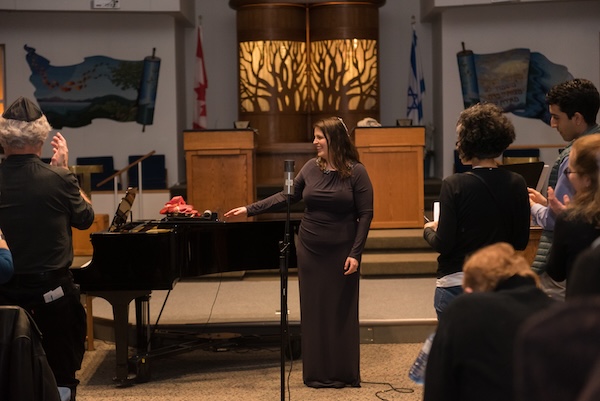
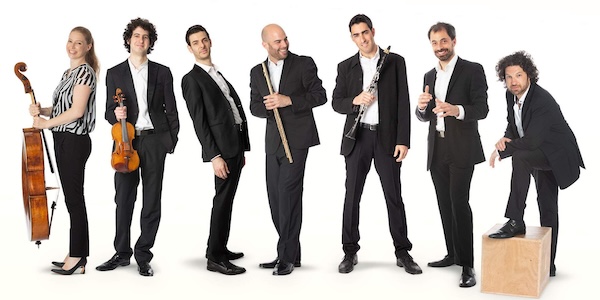
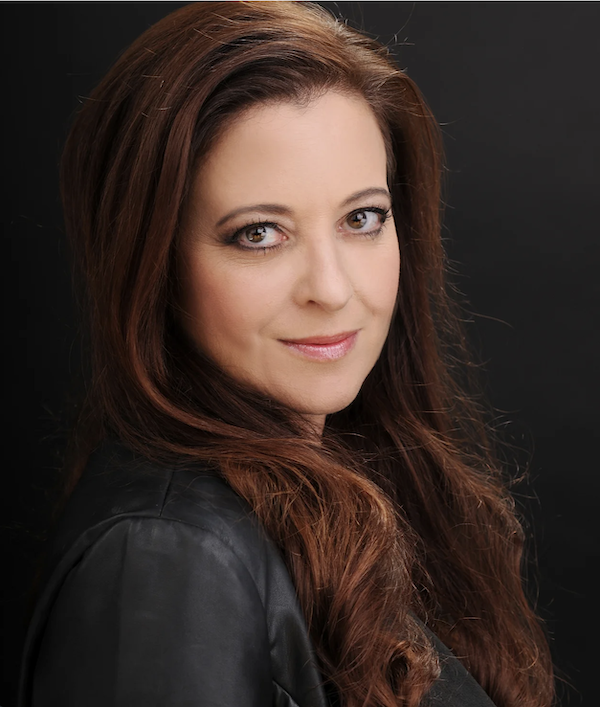
The Israeli Chamber Project’s semi-staged production of Arnold Schoenberg’s Pierrot Lunaire features soprano Hila Baggio. The Vancouver Recital Society presents the production on Dec. 1. (photo from Israeli Chamber Project)
Celebrating the 150th birth year of Arnold Schoenberg, the Israeli Chamber Project will present a semi-staged production of his expressionist cabaret Pierrot Lunaire on Dec. 1 at Vancouver Playhouse, hosted by the Vancouver Recital Society.
A collaboration with Israeli Opera star Hila Baggio and stage director Shirit Lee Weiss, this production premièred in 2016. The program also includes Igor Stravinsky’s Scenes from Petrushka and Maurice Ravel’s La Valse, both arranged by Yuval Shapiro into chamber versions created especially for the Israeli Chamber Project. Joining Baggio (soprano) in the performance will be Guy Eshed (flute), Tibi Cziger (clarinet), Daniel Bard (violin/viola), Sivan Magen (harp), Michal Korman (cello) and Assaff Weisman (piano).
The Vancouver Recital Society’s 2024-2025 season, which started in September, features performances from a diverse group of artists from Canada and around the world. The next event – Oct. 20 at the Playhouse – features pianist Tamara Stefanovich, whose broad repertoire reaches from before Johann Sebastian Bach to beyond Pierre Boulez.
A two-concert Brahms Fest Nov. 3 at Vancouver Playhouse brings together eight musicians from three countries to celebrate the work of Johannes Brahms. The Castalian String Quartet, violist Timothy Ridout, cellist Zlatomir Fung and pianists Angela Cheng and Benjamin Hochman join forces in various groupings to play iconic works such as the String Sextet No. 2 in G major, and the Piano Quintet in F minor.
Guitarist Raphaël Feuillâtre – born in Djibouti, on the northeastern coast of Africa, and raised in the small city of Cholet in Western France – makes his Vancouver debut Nov. 24 at the Playhouse. Meanwhile, Montenegrin guitar virtuoso Miloš returns to the VRS Jan. 26, also at the Playhouse.
Grammy Award-winning Canadian soprano and conductor Barbara Hannigan will make her VRS debut with French pianist Bertrand Chamayou. At the Chan Centre for the Performing Arts Nov. 30, her performance will feature works by Olivier Messiaen, Alexander Scriabin and John Zorn.
Evgeny Kissin in 2021. The Russian-born Jewish pianist performs here April 16. (internet photo)
Pianist Tom Borrow made his Canadian debut on the VRS stage in 2023 and wowed the VRS audience with his talent. He returns Feb. 16 for a concert at the Playhouse. And, on Feb. 23, tenThing, an all-female brass ensemble from Norway, led by trumpeter Tine Thing Helseth, will blow the roof off the Playhouse when they play a varied program that includes works by Edvard Greig, George Gershwin and Astor Piazzolla.
South Korean pianist Yuncham Lim will make his Vancouver debut playing Bach’s Goldberg Variations at the Orpheum March 2, while Swedish/Norwegian violinist Johan Dalene, with pianist Sahun Sam Hong, makes his Canadian debut March 23 at the Playhouse.
British pianist Steven Osborne comes to the Playhouse March 30, and cellist Jean-Guihen Queyras and pianist Alexander Melnikov perform there April 6.
Pianist Evgeny Kissin’s April 16 performance at the Chan Centre will feature works by Ludwig von Beethoven, Frédéric Chopin and Dmitri Shostakovich. And, when cellist Yo-Yo Ma returns to the VRS May 6 at the Orpheum, he will play a selection of his favourite pieces and share stories about an extraordinary life dedicated to music.
Full details of the VRS 2024-2025 performances are available online at vanrecital.com. Tickets start at $28 and can be purchased on the website or by phone at 604-602-0363.
[Editor’s Note: Due to unforeseen circumstances related to flight restrictions, the Chutzpah! Festival must postpone Yamma Ensemble’s performances to March. However, the festival has found a vibrant alternative for Nov. 5: Itamar Erez Trio and special guests. Click here for more.]
Original music that honours the culture and traditions of its creators. Unique songs that you’d have to travel thousands of kilometres to see and hear live. Or, you could buy tickets to Chutzpah! The Lisa Nemetz Festival of International Jewish Performing Arts, which runs Nov. 1-10.
Kommuna Lux from Ukraine brings its unique “Odesa Gangsta Folk” – which they describe as “thrilling klezmer music and common gangster folk songs from their hometown, all with a dose of rocket fuel” – to Vancouver to open the festival Nov. 2, 7 p.m., at the Pearl. The event is presented in partnership with Caravan World Rhythms. The group will also travel to Victoria, for a Nov. 1 show at the Edelweiss Club.
Kommuna Lux’s music is specific to their part of the world, Volodymyr Gitin (clarinet) told the Independent.
“What I like most about this style is the special energy that charges both us and our listeners,” he said. “But I also really like how diverse our music is, because it includes almost everything related to the cultural heritage of Odesa.”
Similarly, Yamma Ensemble from Israel brings its unique heritage-rich music to Chutzpah! – on Nov. 5, 7 p.m., at Rothstein Theatre. They also give an intergenerational matinee performance Nov. 4, geared to school and seniors groups, in which they will “include as many explanations as possible about the ancient musical instruments, about the Jewish communities around the world, about the songs,” lead vocalist Talya G.A Solan told the Independent.
“We wish to celebrate and enjoy the richness and the immense beauty of the Jewish culture and our origins,” she said. “We mainly bring out the mix of Jewish cultures, the mix of our different backgrounds and the fact that we came together into an organic and whole music ensemble…. So, in our music, you can hear the music of Spanish Jews from Thessaloniki and Spanish Jews from Turkey, the singing of psalms by the Jews in Iraq and the singing of religious poems from Yemen.”
Yamma Ensemble (photo by Zohar Ron)
On the group’s website, they note that Yamma means “toward the sea” in Hebrew and “mother” in Arabic.
“The connection between Hebrew and Arabic is not only a connection between two very similar Semitic languages, but also a connection between the countries of origin of the Jews who lived in Arab countries and their descendants, who were born here and grew up in Israel,” explained Solan. “Our musical heritage, like our origins, is connected to the Jewish communities in the Middle East who immigrated to Israel with the language they spoke, the Arabic language in its many dialects (Yemeni, Iraqi, Moroccan, etc.). They came to Israel and had to speak the local language – Hebrew.”
Hebrew is a central element of the ensemble’s repertoire, directly tied to the members’ identity as Israeli musicians.
“Hebrew is our mother tongue, the language we were born into and the language in which we dream and communicate,” said Solan. “It is an ancient, gorgeous and special language that became extinct and was revived in the 20th century. We try to perform mostly in Hebrew. We mix between our own original creations (always Hebrew) and traditional music (Sephardic, Yemenite).
“There is no Israeli music group that performs out of Israel and has been active for a long time [mainly] performing Hebrew music,” she continued. “This fact is odd and crazy, since Hebrew is the spoken language in Israel, but none of the Israeli musicians active abroad focus on this magnetizing and beautiful ancient language.
“One of the reasons that Yamma Ensemble’s YouTube channel is the most viewed channel of Hebrew music for foreign audiences,” she said, is “the accessibility of Hebrew for foreign audiences who do not speak it. We translate all the songs, so people can watch them with English translation. We receive daily messages from all over the world from people who write us that they learn Hebrew with the songs, that they get closer to their Judaism through the songs. It feels like a serious task that we didn’t ask to take on, and it happened naturally.”
Yamma Ensemble has four albums – Yamma (2011), Basket Full of Stars (2017), Rose of the Winds (2020) and To Awaken Love (2023) – the last of which comprises entirely original music, inspired by traditional sounds, said Solan.
The group is working on an album of psalms. Their performance of Psalm 104 is “the most viewed Jewish chant on YouTube, [in the] category of live and traditional music,” she said. “It has already passed 10 million views! So, we need to record this psalms album.”
However, to produce a recording is an expensive undertaking, and that’s one thing when the music will have a relatively large market. For music “that is not commercial and does not carry profits or compensation, there must be a budgetary basis or significant support,” said Solan. People who are interested may support the psalms project via the ensemble’s website, yammaensemble.com.
Coincidentally, Kommuna Lux’s original name also has to do with the financial side of the music business.
“Dengi Vpered means ‘Money Forward’ or ‘Cash in Advance,’” explained Gitin. “This name appeared before I was in the group. One day, the guys didn’t get paid for a performance and, since then, they started taking money in advance. At the same time, they named the group that way, with a bit of Odesa humour, and also so that it would be immediately clear how they do business.
“After six incredible years of being together, it so happened that our vocalist decided to go his own way and we needed to figure out how and with whom to continue our journey. Also, for various reasons, we felt that it was necessary to change the name…. So, first we found [singer] Bagrat [Tsurkan], who quickly became a valuable member of our team, and then the name itself came along, which resonated with us very much.
“Kommuna Lux has several meanings,” he said. “One of them is ‘the Commune,’ which is united by the common idea of bringing light and joy to people. But ‘Kommuna’ can also mean a communal apartment in which several families live. In such apartments, there is a shared kitchen and sometimes a bathroom, and people need to agree with each other to live in peace and harmony. And ‘Lux’ in this case has another meaning, as a sign of the quality of how we look and sound on stage, the quality of the luxury level.”
Gitin joined the band, which has one album to date (OdesaFM), in 2014.
“I was attracted by the idea of reviving Odesa songs and Jewish folklore in a new, modern way,” he said. “Everything was created and performed with great enthusiasm and a desire to share positive emotions with people. We felt that we were doing something special.”
And they do something extra special in some of their performances – they raise money for Ukrainians affected by the ongoing war with Russia.
“Mostly, we collect money for 110 Brigade, they always need different vehicles for different goals,” said Gitin. “Also, during our last tour, we [participated in a] joint initiative of Rotary E-Club of Ukraine to buy beds for burn victims, for a hospital in the city of Kramatorsk in Donetsk region.
“Our whole life is connected with our home and we feel that every Ukrainian joined to help our people,” he said. “So, our reasons are the same, we can’t just watch, we feel that we should do what we can.”
He added, “Music is very important, especially in such periods, because, through it, it is possible to express the whole spectrum of feelings. Music can raise the spirit, unite everyone around a common idea, and also help people experience deep feelings, especially when they lose loved ones.”
Rounding out the musical offerings at Chutzpah! this year is New Orleans multi-instrumentalist Mark Rubin, “offering Southern Americana from a Jewish, socially conscious point-of-view.” Jacob Samuel headlines a comedy night hosted by Kyle Berger, and Jeremy Goldstein’s Truth to Power Café includes stories from Vancouverites in response to the question, “Who has power over you and what do you want to say to them?” A dance double bill features Fortress (Rebecca Margolick and Livona Ellis) and About Time (Ne.Sans Opera & Dance, Idan Cohen). Canadian Yiddishist Michael Wex brings The Last Night at the Cabaret Yitesh (di letste nakht baym yitesh) to the festival, and the Vancouver Jewish Film Festival and Chutzpah! co-present the screening of Gimpel the Fool Returns to Poland by Nephesh Theatre artistic director Howard Rypp, which “follows the show’s journey throughout different towns of Poland, while tracing [Gimpel writer Isaac Bashevis] Singer’s escape from the Holocaust, finally finding refuge in the USA.”
For tickets to any of the festival events, visit chutzpahfestival.com or call 604-257-5145.
New this year for the Chutzpah! Festival: Jewish Community Centre of Greater Vancouver members receive discounted ticket prices and concession purchases at the theatre. Select Student/Senior/JCC Member tickets and ChutzPacks and bring your membership card to the theatre.
Of course, not everyone in Israel is religious. Yet, there is a rich heritage of Hebrew songs with lyrics taken either directly from the Hebrew Bible or inspired by it. Over the years, these songs have been tremendously popular with the Israeli public.
The first example – a song taken from Deuteronomy Chapter 30, verse 19 – unfortunately has special meaning in Israel today, as thousands of residents from both the northern and southern parts of the country have been forced to live away from their homes for almost a year now.
“Because man is a tree of the field” – this verse has been variously understood to mean human beings are like a tree planted on their land. While it has been recorded by more than one Israeli singer, a version I really like is the one with extended lyrics taken from a poem by the late Nathan Zach. It can be found at nli.org.il, if you know Hebrew.
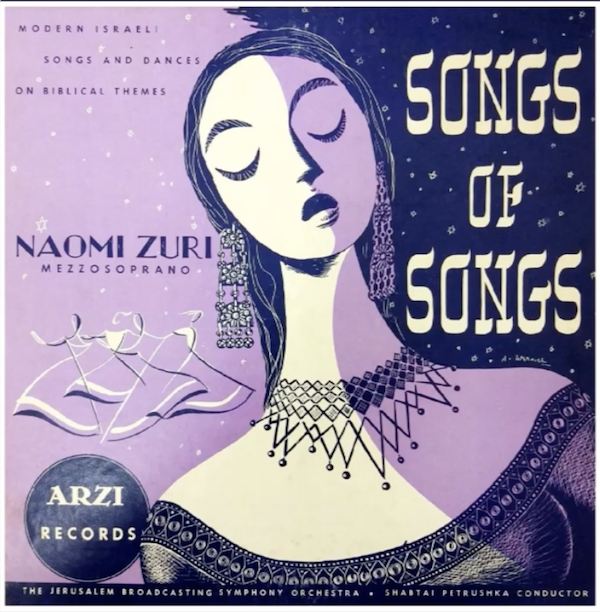
Early in the daily morning prayer service and on holidays, including Rosh Hashanah, there is a section meant to put us in the mood for prayer, but is not prayer itself. In p’sukei d’zimra, we recite “Adonai [G-d] is my strength and my might; G-d is my deliverance.” These words are taken from the Song of the Sea, which is in the Book of Exodus, Chapter 15, verse 2. It was not only a popular Israeli song, but it was sung as part of the morning prayers by the Women of the Wall, which is fighting for women’s right to pray aloud, with Torah scrolls and tefillin, at the Western Wall (the Kotel). A version of it, sung by Naomi Zuri, is on YouTube.
From the same Song of the Sea comes a song of thanksgiving by Amir Benayoun. Found in the Book of Exodus 15:1-15 and 15:20-21, the text describes how the Israelites successfully crossed the Red Sea, leaving Pharaoh and his chariots to their fate when the sea closes back up. It’s on YouTube as well.
Another popular song is based on an event in the Book of Numbers 20:11, though it doesn’t use the exact wording of the biblical text. In the story, Moses hits a rock twice in frustration, water gushes out, and the Israelites and their animals drink. G-d apparently refused Moses entry into the Land of Canaan because of this angry action. According to the late Rabbi Lord Jonathan Sacks, Moses failed to understand that times had changed and he was facing a new generation. The people he confronted the first time were those who had spent much of their lives as slaves in Egypt. Those he now faced were born in freedom in the wilderness.
Rabbi Sacks clarified what that meant: slaves respond to orders, free people do not. Free people must be taught; otherwise, they will not learn to take responsibility. Slaves understand that a stick is used for striking, but free human beings must not be struck. Hence, Sacks suggested that, for this lack of understanding, Moses was punished.
There is a video on YouTube of Aviva Semadar singing “Mosheh hikah al sela” (“And Moses Struck a Rock”) and there is also a video of “Ya’aleh v’Yavo” (“He Will Go Up and He Will Come”), performed by Gidi Gov, who first sang Yoram Taharlev’s song in a 1973 song contest. In the first stanza, Moses has climbed Mount Nebo to look at the Promised Land. While no one knows for sure where Moses is buried, many claim he died on Mount Nebo and G-d Himself is said to have buried him.
Curiously, these words – “Ya’aleh v’Yavo” – also appear in the Amidah. And, those who are familiar with the Grace after Meals will note that this phrase is added on Rosh Chodesh and holidays. It is chanted right before the section dealing with the [re]building of Jerusalem.
Significantly, on Rosh Hashanah, we sing a verse from the Book of Jeremiah (31:19) during the Zikhronot section (which, according to Mahzor Lev Shalem, recalls the covenantal relationship between G-d and humanity) of the musaf Amidah for Rosh Hashanah:
“‘Is not Ephraim, my dear son, my precious child, whom I remember fondly even when I speak against him? So, my heart reaches out to him, and I always feel compassion for him,’ declares Adonai.”
You can listen to Israeli singer Miri Aloni sing “Haben Yakir Li” (“My Dear Son”) at matchlyric.com.
There are several songs taken from the Song of Songs. One of the older well-known pieces is “Dodi Li,” “My Beloved is Mine,” sung by Sharona Aron, which is on YouTube, as are two other pieces from the Song of Songs, which have been composed more recently.
The first is performed by the Yamma Ensemble – a group that records in both Hebrew (ancient or modern) as well as in Ladino and Arabic dialects – which is coming to Vancouver for Chutzpah! (For story, click here.)
The lyrics are: “As a lily among thorns, so is my love among the daughters.My beloved spoke and said unto me: ‘Rise up, my love, my fair one, and come away. For, lo, the winter is past, the rain is over and gone.”
The other piece from the Song of Songs is performed by singer Hadar Nehemya: “Many waters cannot quench love, neither can the floods drown it; if a man would give all the substance of his house for love, he would utterly be condemned / As a lily among thorns, so is my love among the daughters / My beloved spoke, and said unto me: ‘Rise up, my love, my fair one, and come away.’”
Since Rosh Hashanah is approaching, I will end with an optimistic song, Yehoshua Engelman’s “Eliyahu (Elijah),” which can be heard on Spotify. Eliyahu is mentioned in numerous places in the Hebrew Bible and takes on numerous roles, though we don’t ever learn much about him. He is a bit of a mystery man, supposedly the harbinger of the Messiah. At the end of Havdalah, the ceremony marking the end of either Shabbat or holidays, we sing to Eliyahu, asking him to bring us redemption.
We could certainly use it.
Deborah Rubin Fieldsis an Israel-based features writer. She is also the author of Take a Peek Inside: A Child’s Guide to Radiology Exams, published in English, Hebrew and Arabic.
Alon Sariel is Early Music Vancouver’s artist in residence for this summer’s festival. (photo by Suzette Vorster-Van Acker)
‘We are thrilled to offer audiences an adventurous program of some of Bach’s seminal works, but with a twist,” said Early Music Vancouver artistic and executive director Suzie LeBlanc in a press release announcing this summer’s early music festival. “From traditional compositions reworked for unique instruments, such as mandolin and oud, to the introduction of vocal improvisation, inspired by Bach’s own customary practice of instrumental extemporization, Bach Untamed welcomes listeners to seek out new perspectives of Bach’s well-known and beloved classics.”
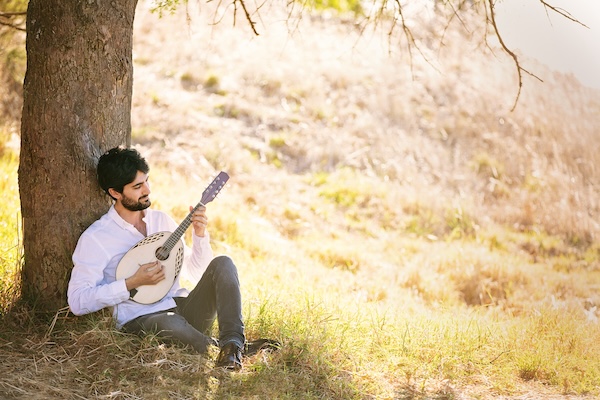
This year’s festival – which runs July 30-Aug. 8 at various venues – features almost 50 emerging and established early music artists from around the world, including mandolinist and multi-instrumentalist Alon Sariel, who is EMV’s 2024 Summer Festival Artist in Residence.
In addition to headlining two concerts – Alon Sariel: Plucked Bach at Congregation Beth Israel on July 31, in which he will premiere his own Bach-inspired Mandolin Partita, and EMV’s festival finale at the Vancouver Playhouse, which features the Canadian premiere of Amit Weiner’s 2019 reconstruction of Bach’s Italian Concerto – Sariel will perform in several other festival concerts, as well as teach a workshop on Bach for plucked instruments.
Sariel, who was born and raised in Beersheba, Israel, met LeBlanc at the Utrecht Early Music Festival, in the Netherlands, last fall.
“I was playing there with friends from Profeti della Quinta, an Israeli vocal ensemble based in Switzerland, who was already a guest of EMV in the past,” Sariel told the Independent. “Suzie and I had a chat and it turned out I had some very different programs to offer and that a residency could be a lovely idea to feature a few of those.”
Sariel’s first visit to Vancouver was more than 30 years ago, as a kid, with his family. He’s excited to return. He arrived July 24 and will be staying until Aug. 9 – “the final concert, Bach & the Mandolin, with the Pacific Baroque Orchestra, is on Aug. 8,” he said.
“The program looks really splendid (a huge shout out to Suzie!) and I’m very glad and proud to wear the artist-in-residence hat this summer – can’t wait really!” said Sariel.
LeBlanc started the artist-in-residence program in 2021 “to create more exchanges between EMV’s guests and the local community.”
“EMV has under its wing a local baroque orchestra – the Pacific Baroque Orchestra, led by Alexander Weimann – and a Baroque Mentorship Orchestra Program (BOMP) at UBC for students and community players,” she explained. “In addition to his own concerts in the summer festival, Alon will collaborate with these ensembles, working with professionals, students and community players, going beyond concert performances and delivering a collaborative and educational experience.
“He will also lead a three-day course called ‘Unconventional Bach,’ which focuses on playing and arranging Bach’s works for different instruments,” she said, noting, “Alon is also a composer and his guiding principle is ‘giving new life to existing material, as well as creating completely new works.’ We’re excited to have an artist in residence who shares this philosophy with EMV and will be so present beyond the concert stage.”
LeBlanc described Sariel’s Bach solos on mandolin as “captivating and very personal.”
“He fully deserves his notoriety as one of the most versatile and gifted mandolin players, lutenists and ensemble directors of today,” she said.
A soloist, chamber player and artistic director, Sariel has performed more than 1,000 concerts in more than 35 countries, according to his bio. In his Plucked Bach recordings (Pentatone), he interprets Bach’s solo music and creates new arrangements for mandolin and lute, the baroque guitar and the oud. His album Telemandolin (Berlin Classics) was awarded an OPUS KLASSIK, making Sariel the first mandolinist to earn the honour. But the path to professional success hasn’t been easy and, said Sariel, “there are still many obstacles in the way of a mandolin player.”
“For any violinist, pianist, conductor, etc., there are many competitions which could serve as a jump step to a musical career – the mandolin has none,” he explained. “I attended several competitions which were open to all instruments and won them all and, even then, I kept getting lines like, ‘Thank you very much for getting in touch, we’ll contact you shall we be interested in the future.’ Booking agencies, record labels and concert halls can still be very suspicious when it comes to the mandolin, that’s why I feel a great responsibility in every concert that I play. It’s not only about me getting re-invited, but it’s about convincing this or that director and, of course, the audience, to give a chance to something new. The theatres could always go for another Rachmaninoff piano concerto or another Beethoven symphony, they don’t have to ‘take a risk’ with a mandolin player, that’s why I really have to stand out in my artistic profile in order to get the chance.”
LeBlanc first heard about Sariel from Renaud Loranger, the artistic director of the Festival de Lanaudière in Québec. When she met Sariel at the Utrecht Early Music Festival, she said, “Our meeting was very pleasant – his playing was fabulous – and I immediately saw that he would be a great and versatile artist in residence. Also, I knew that Vancouverites love the mandolin player Avi Avital, who has played many times in Vancouver. What perhaps they don’t know is that Alon has collaborated with Avi on a recording of Vivaldi’s concerto for two mandolins (Deutsche Grammophon, 2020). I hope all mandolin lovers will come out to hear Alon – he has brought to light many works for the mandolin from centuries past and commissioned composers to write new pieces for him.”
And to think that Sariel wanted to play the electric guitar when he was a kid.
“I wished to learn e-guitar, but I was much too young for that,” he recalled. “The director of the conservatory gave me a little basic test – I had to clap some rhythms and sing some tones, etc. She suggested I should take the violin, but I wasn’t excited. Then she said there’s also the mandolin – which I didn’t know at all – and that it’s in fact ‘very similar’ to the guitar, you hold it pretty much the same way, but the size would be perfect for an 8-year-old. She mentioned the mandolin orchestra and the fact it gets to represent the city occasionally, even abroad, so I agreed to give it a try and thought I’d shift to e-guitar later on. Very soon I forgot about the guitar and was all invested in the mandolin, I absolutely loved it!”
LeBlanc chooses EMV’s artists in residence “first and foremost for their great artistry, for their extensive knowledge of historical performance practice, and their ability to share their ideas and knowledge generously,” she said. Previous artists in residence have been Cree-Métis baritone Jonathon Adams (2021); Scottish Baroque specialists David Greenberg and David McGuiness, violin and keyboard (2022); and Catalina Vicens, keyboard and curator of the Tagliavini Collection of ancient musical instruments in Bologna, Italy (2023).
“It has been extremely rewarding to watch the program grow over the past few years, and hear the enthusiastic audience feedback to our different artists in residence,” she said.
For more information about and tickets to this summer’s festival, visit earlymusic.bc.ca.
Novelist Milan Kundera said of Jews in the 20th century that they “were the principal cosmopolitan, integrating element in Central Europe: they were its intellectual cement, a condensed version of its spirit, creators of its spiritual unity. That’s why I love Jews and cling to their heritage with as much passion and nostalgia as though it were my own.”
I love reading these words, it helps me keep my head up. And motivated. I think of them often as I work on two major concerts which celebrate multiple aspects of Jewish heritage and history, the devastating impacts of hate, and the need for more love and compassion in the world today.
You may remember my last endeavour, Project Tehillim, which was about the salvation of the Bulgarian Jews during the Second World War. (See jewishindependent.ca/music-to-say-thank-you.) I grew up in Bulgaria and, while I never experienced the antisemitism, I knew about it from history books. This is why I am shocked and horrified at what is going on around the world, including here in Vancouver. One of my friends said: “The evil is shocking. The willingness of this evil to parade itself is even more shocking.”
I can only respond with what I know best: the power of music and art. The arts have the incredible ability to affect people more profoundly than plain facts. It is personal stories, artistically presented, that have an emotional impact.
I am the artistic director, with fellow pianist Jane Hayes, of Yarilo Contemporary Music Society, which is dedicated to high-quality professional music performances. The Yarilo ensemble has performed in Zurich, Moscow, Sofia and Tel Aviv, and the society has commissioned a number of Canadian composers: Jocelyn Morlock, Kelly-Marie Murphy, Jordan Nobles, John Burke, Colin MacDonald, Michael Conway Baker and Farangis Nurulla-Khoja. We work with members of the Vancouver Symphony Orchestra and we collaborate with Leslie Dala, the conductor of the Vancouver Opera and the Bach Choir.
Because government and other funding for the arts is in huge decline, I am turning to you, my fellow Jewish community members, for help in realizing Yarilo’s next project: Compassion Above All.
The first concert of the project, To Hope and Back, is a chamber music event that will take place this year on Nov. 10, 2 p.m. and 7:30 p.m., at Orpheum Annex. The budget is $10,000.
To Hope and Back is based on the book of the same name by Kathy Kacer, the daughter of a Holocaust survivor. The book tells the story of the SS St. Louis through the eyes of two children on board the ship that sailed from Germany in 1939 carrying nearly 1,000 Jewish refugees and was refused the right to land by every country, including Canada, forcing it to return to Europe, where many of the passengers were murdered in the Holocaust. The November concert will include two child actors reading excerpts from the book and Kacer has confirmed that she would like to come for the event from Toronto. It will include the music of Philip Glass, Steve Reich, Iman Habibi and Gheorghi Arnaoudov. Steve Reich’s work, “Different Trains,”includes archival recordings from the trains going to Auschwitz.
The second concert, The Tale of Esther in Our Time, is a symphony music concert conducted by Dala, and it will take place in 2025, on March 29, 7:30 p.m., at Christ Church Cathedral. Its budget is between $60,000 and $80,000.
The featured work of The Tale of Esther in Our Time is Iman Habibi’s “Shāhīn-nāmeh,” which was nominated for a Juno and won the Azrieli Foundation award for Jewish music in 2022. Based on the poetry of 14th-century Judeo-Persian poet Shahin Shirazi, the composition depicts the tale of Esther and delves into the themes of love, spiritual struggle and devotion. “Shāhīn-nāmeh” calls out for love and compassion; it brings the heart of humanity into focus.
Also on the program will be Arvo Part (“Tabula Raza”), Peteris Vasks (“The Message”) and Kelly-Marie Murphy (“En El Escuro Es Todo Uno,” “In the Darkness We Are One”).
Please feel free to ask any questions. I will also happily take any advice for funding opportunities. Any donation, even the smallest one, is a great support, financial and moral.
“The Tempest Project is a roving musical adventure that will see audiences taken on a journey, both literally and figuratively,” Shayna Goldberg told the Independent.
“Audiences will be led through the entire Vancouver Playhouse by guides, moving between spaces, through the theatre, hallways and stairwells, through the usual lobbies to the very unexpected,” she said. “While The Tempest Project is not a re-telling of the famous work, it is filled with storms and magic and wonder, and we believe it will leave audiences breathless.”
Goldberg is artistic planning and operations manager of Music on Main, which presents The Tempest Project July 17-22 at the Playhouse. She co-leads the production with artistic director David Pay.
“Audiences can expect a unique opportunity to listen together,” said Goldberg. “While traveling through the Playhouse, our hope is that audiences will experience what David Pay says music does best: convey emotions and feelings that cannot easily be put into words.”
On the route through the theatre, there will be live performances, recordings, projections, audio-and-optical illusions, and more.
Pay began thinking about The Tempest Project in 2017, but development began in 2020, when the pandemic started and in-person gatherings weren’t permitted, said Goldberg. The first production was As dreams are made, “a beautifully intimate experience for one audience member with one musician (very pandemic friendly) and a sensational soundscape with a recording of a speech from Shakespeare’s play,” said Goldberg.
“Following the success of that first experiment into this project, we began working with local artists to explore the themes from The Tempest and how they could fit into a full-scale production,” she explained. “We did a lot of ensemble work with The Tempest Project Company, exploring how their insights, musical backgrounds and lived experiences could all contribute to devising creative ideas. Working with these amazing musicians over the past five years has certainly been a highlight to this entire process.
“As we enter the final phase, we are taking all of the things we learned as a team to create the world première! We knew that we wanted The Tempest Project to be something memorable and I think that, with the expert team we have assembled and by being in the Vancouver Playhouse, we’ll definitely achieve that.”
The musicians are Julia Ulehla, vocals; Paolo Bortolussi, flute; Aram Bajakian, guitar; Saina Khaledi, santour; Dailin Hsieh, zheng; Julia Chien, percussion; Jonathan Lo, cello; and Rachel Kiyo Iwaasa, piano. Dramaturg Melanie Yeats and production manager Alexis Douglas are part of the creative team.
Pieces have been commissioned from Khaledi; musician and storyteller Gabriel Kahane; Nancy Tam, who specializes in sound creations; and Alfredo Santa Ana, whose compositions range from the classical to electronic. There also will be improvised arrangements based on Solange’s “Things I Imagined,” and other works.
“David chose musicians who connect with audiences, have widely different but complementary music-making practices, and who reflect different aspects of the city we live in,” explained Goldberg. “The instrumentation of the ensemble is super varied…. It’s definitely not a typical ensemble! But the friendships and working relationships we’ve all forged as artists was one of the outcomes we were hoping for back in 2020 when we first invited everyone together.”
Goldberg has been working with Music on Main and Pay since 2018, when she joined the organization.
“I’ve been lucky over the past 10 years to work with multiple companies, including almost five years at Pi Theatre. When I saw the posting for Music on Main, it felt like just the right challenge to me and, fortunately, they thought so, too,” said Goldberg, who has known from a young age that she wanted a career in the arts.
“I’ve always been a bit of a performer, maybe a tad dramatic, and I found that arts management was the right place for me and where I could help bring productions to life!” she said.
“While working with the Classical Theatre Project in Toronto, I felt a need to do more than be a group sales and company manager, and that led me back to school,” she said. “I never imagined that I’d complete an MBA, but the MBA with an arts and media management diploma from the Schulich School of Business was exactly what I was looking for. It provided me with the education to take my career to the next level, and the guts to move out to Vancouver, something I had always wanted to do.”
Since becoming a Vancouverite, Goldberg said she has “invested time in finding a strong and supportive community, and that has been primarily in the Jewish community. Shortly after moving here,” she said, “I was welcomed as a resident into the Moishe House and built some incredibly strong connections and friendships from that time. Also, through work with Na’amat Canada and the Axis Young Professionals program through Jewish Federation, I’ve really found my place here.”
And that includes, of course, her place at Music on Main.
“When I interviewed with David,” shared Goldberg, “I asked him what his next big project was and he said a large musical adventure exploring The Tempest. Now, coming from the theatre world and with a sincere love of Shakespeare, I was immediately excited. It took us awhile, but, when we were finally able to start the process, it was very much a labour of love on both our parts.”
For tickets to The Tempest Project, visit musiconmain.ca.
Eastside Arts Society presents CREATE! Eastside Arts Festival July 22-28. (photo by Wendy D)
Eastside Arts Society (EAS) presents the fourth edition of its newly expanded, immersive summer arts event, CREATE! Eastside Arts Festival, at various Eastside Arts District (EAD) venues from July 22-28, in addition to its traditional all-day outdoor festivities at Strathcona Park July 27.
“We are thrilled to see the evolution of the CREATE! Eastside Arts Festival into a true, district-wide event that illuminates all that the EAD has to offer,” said Esther Rausenberg, artistic and executive director of EAS, who is a member of the Jewish community.
The festival will offer affordable ticketed art workshops and performances at pop-up locations. Community highlights include CREATE! pop-up art workshops at Off the Rail Brewing, Luppolo Brewing and Strange Fellows Brewing from July 22-26 and studio art workshops at 1000 Parker Street Studios, the Mergatroid Building and the Arts Factory on July 28; Canadian musical artist Paul Pigat at the Firehall Arts Centre on July 25; singer-songwriter Art Bergmann at the Rickshaw Theatre on July 26; a roving piano and dance performance from Mascall Dance on July 26; live mural painting by Eastside Culture Crawl co-founder Richard Tetrault at East 4th Avenue and Ontario Street from July 22-26; and more.
On July 27, the festival returns for a full day of festivities at Strathcona Park, with a series of outdoor art-making workshops taught by EAD artists, including weaving, summer florals, introduction to flamenco (all abilities), crochet, charcoal drawing, and a BIPOC expressive art workshop.
For the first time this year, CREATE! will partner with 604 Records and Light Organ Records to present a live music concert stage at Strathcona Park (July 27, 2-6 p.m.), featuring homegrown artists Haleluya Hailu, Fur Trade (Steven Bays and Parker Bosley from Hot Hot Heat) and Sarah Jane Scouten.
A free all-ages CREATE! Festival Concert pass will also include access to the festival’s Art Zone, featuring public art activities, beer garden, food trucks and Art Shop, sponsored by the Strathcona BIA. CREATE! Art Zone public art activities will include zine making; planting flowers and painting your own pot to keep; and cyanotype, a photographic printing process activated by the sun.
A curated selection of local handmade artworks and goods will be available at the Festival Art Shop, and visitors can enjoy a fully licensed beer garden, serving beer, cider and wine from Strange Fellows Brewing, as well as an assortment of food from food trucks including Camion Café, Midnight Joe’s and Varinicey Pakoras.
Also on July 27, participants in Eastside Arts Society’s 9th annual Art! Bike! Beer! Crawl Brewery Tour Fundraiser will end their day of cycling/walking and imbibing at the CREATE! Art Zone. All fundraiser proceeds will benefit the Eastside Arts Society’s yearly activities and community events.
Art workshops are $35 for youth/adults and $20 for flamenco and children’s workshops. Children under the age of 12 must be supervised by an adult. The general public can access festival activities with a free CREATE! Festival Concert pass, sponsored by the Strathcona BIA. For full festival details and ticket info, visit createartsfestival.ca.
The accordion “has gradually and sneakily taken over my life,” says musician David Symons, member of the group Obliquestra. (photo by Stephanie Reed)
“Klezmer, choro, Tin Pan Alley, French musette, German songs, Russian waltzes, and so on” … Obliquestra plays the music they “most wanted to play after being isolated at home for so long” during the pandemic, David Symons told the Independent. The accordionist, singer and composer is one of the three members of the band who will be playing at the Vancouver Folk Music Festival, which takes place July 19-21 at Jericho Beach Park.
Symons will be joined at the festival by Dr. Sick on violin, guitar and musical saw, and Susanne Ortner on clarinet. It will be their first time performing together in Vancouver.
Obliquestra started when live music started returning in 2021, explained Symons. “Dr. Sick, who I had worked with for years in my band The Salt Wives (and one of the most unfairly talented musicians in town) called me up and said there was a new bar opening next door to his house and it would be amazingly convenient to play there every Saturday. I called SusanneOrtner, who I hadn’t played with, but who I knew was a master klezmer clarinetist, though she mainly does Brazilian choro and jazz now.”
They started playing together in Symons’ backyard with banjoist Aaron Gunn and bassist Stoo Odom, “without any concept, really,” said Symons, just playing what they wanted to play.
“I’ve sort of always had this eclectic approach,” he said. “Discreet genres of music are mostly a marketing convenience. Musicians have always played and been influenced by whatever they heard, whatever was available, and whatever the public would pay them to play. Klezmer is a good example of this, being an amalgam of various musical styles from central and eastern Europe and, later, America. I doubt those old school musikers (you wouldn’t call someone a klezmer in those days unless you were trying to get punched) were concerned with notions of ‘authenticity’ or genre. They were playing what they heard and liked, and what their public wanted to hear. We are at least doing the first part of that.”
Obliquestra – Dr. Sick, left, David Symons and Susanne Ortner – play at the Vancouver Folk Music Festival on July 21. (photo by Stephanie Reed)
While Symon has “gotten away from klezmer a bit these last few years, really since the pandemic started, mostly for lack of people to play it with,” he said “it’s still the music closest to my heart.”
Why that’s the case, and why he’s also been interested in Yiddish music, despite not being Jewish, is hard to put into words, he said. “In fact, if I could put it into words, maybe we wouldn’t need music. It makes me feel good?”
He said many people assume that a person is Jewish if they play klezmer, and even that it’s a strange thing for a non-Jew to do.
“I’ve always felt this attitude contains an implicit condescension toward the music,” said Symons. “It would never occur to anyone that if someone plays Rachmaninoff they must be Russian, or if they play bluegrass they must be a hillbilly, etc. The music stands on its own merits, whatever one’s ethnic background. Most of the Jewish klezmorim I have known didn’t grow up with the music any more than I did. Still, you have to be careful and respectful. I used to do a lot of Yiddish song and, though I love it, I do less of that now because I realized that, unless I am prepared to devote a few years of my life to learning the language, there’s a lot of nuance that I’m going to miss, no matter how much I work on my pronunciation.”
Symons grew up in rural New Hampshire. “My father plays Latin percussion and guitar, but my folks were divorced and I didn’t see him much, and I had very little interest in music until about 15,” he said. “I was into theatre and acting. Then, I more or less simultaneously discovered Tom Waits and classical music, particularly Beethoven, and suddenly fell in love with music.
“I played guitar for a few years, but the Waits album Frank’s Wild Years convinced me to get an accordion. This was pre-internet in rural New Hampshire, so I put an ad in the local paper asking if anyone had an accordion I could buy. It turned out a lot of people did, and I was very lucky to get something playable. Then, the accordion more or less sat around decoratively for the next couple of years until I happened to see Itzhak Perlman on David Letterman’s show with a bunch of klezmer musicians. He had just released a klezmer album with the top American klezmer bands at the time, and I became obsessed with this music and went down a deep rabbit hole for the next 25 years or so. I taught myself accordion to play klezmer, largely while working in a parking garage in Burlington, Vt., which had nice, cathedral-like acoustics.”
Symons acknowledged, “Of course, no one is truly self-taught – that just means I’ve learned a lot of little things from a lot of different people, without ever having any one teacher or mentor. As for my relationship with the accordion, the damn thing has gradually and sneakily taken over my life. They’ll tell you that you can just pick it up for fun once and awhile and put it down whenever you want, no harm done, but don’t believe them, kids! For many years, I tried to resist accordion clichés and now, in my middle age, I own not one, but two pairs of lederhosen. I started fixing accordions when I moved to New Orleans and there was no one doing it here. Twelve years later, I am sitting in a room in my home with somewhere between 40 and 50 accordions around me, in various states of functionality. The accordions have won.”
About the move to New Orleans, Symons said, “I lived in Vermont for 15 years and was ready for something new. Or, in the case of New Orleans, something old and dirty. I had spent a month in here in 2003 when I was traveling around the country busking in this tiny, ancient Toyota camper. I always thought about going back and trying to live there. Loving New Orleans is like loving a complicated, brilliant, yet self-destructive person. Someone who might be utterly charming one day and destroy a hotel bathroom the next. I still feel like an outsider here most of the time, but I’ve come to terms with that. I’m happy that I’m able to make myself useful to my fellow accordionists by keeping their instruments in working order.”
Symons and his fellow Obliquestra musicians – “Mini-Obliquestra or Obliquestrio,” as Symons quipped – play the folk festival’s South Stage July 21, 11:50 a.m.-12:40 p.m. For the weekend’s full lineup and tickets, visit thefestival.bc.ca.
Boris Sichon, above, and Jesse Waldman return to this year’s Mission Folk Music Festival, which takes place July 26-28 at Fraser River Heritage Park. (photo from missionfolkmusicfestival.ca)
“I know that people are going to find that new-to-them artist that changes their world. I know that new friendships will be forged among volunteers. And I know that people will just enjoy being together in the park in community,” said Michelle Demers Shaevitz, artistic and executive director of the Mission Folk Music Festival, about the upcoming weekend-long event. “That’s what I look forward to the most.”
Joining Demers Shaevitz at this year’s festival, which takes place July 26-28 at Fraser River Heritage Park, will be fellow Jewish community members Boris Sichon and Jesse Waldman. Both musicians are returning artists to the festival, but will be performing new material.
Sichon will be leading the interactive Recychestra, an orchestra that uses musical instruments made from recycled objects. The performance is the last part of an instrument-building program offered through the City of Mission next month.
The idea for Recychestra came from a meeting with Mark Haney, a composer and musician working for the City of Mission, said Sichon. The program comprises seven sessions between July 6 and 26 at the Mission Leisure Centre, culminating in the July 28 performance at the Mission Folk Music Festival – though Sichon would like the program to carry on.
“I hope we’re going to continue this project after the festival,” he told the Independent.
“We don’t know yet who’s going to sign up,” Sichon said. “Kids love to create musical instruments more than playing instruments, while adults enjoy both activities. It would be great to have some musician friends from the Mission community.”
Even if someone hasn’t attended the program, they will be welcome to join the orchestra at the festival performance, said Sichon. “We will have enough recycled instruments. It will be a very friendly atmosphere, joyful. Play and dance!”
Waldman is also looking forward to performing at the Mission Folk Music Festival.
“We’ve got some great new songs to share and a couple tricks up our sleeves, too!” said Waldman, who will perform in several music sessions, including in concert with Beau Wheeler on the Sunday afternoon of the festival. The collaboration with Wheeler has been a long time in the making.
“I’d seen Beau perform at an art space in East Van nearly 20 years ago and was blown away,” said Waldman. “Many moons passed, until 2018, where I was performing in the Monica Lee Band and we shared a bill with Beau at Pat’s Pub. Beau caught our set with Monica and invited the band to stay on stage and join him and it was a magical moment. We decided we should get together again and that’s how it all started. We have a lot of the same taste in music and are both very emotional players. I try and add memorable and atmospheric parts to fit the feeling of Beau’s amazing songs.”
Waldman has been busy since the Independent spoke with him in advance of last year’s Mission folk festival. Among the highlights, he said, are “[t]he completion of a new full-length album entitled The Shimmering Divide, set for release September 2024 [and an] outstanding full band performance at Or Shalom Synagogue featuring a rendition of ‘Papirosen,’ where the band played along with my grandmother’s voice from a tape from 1957.”
Following Waldman’s first album, Mansion Full Of Ghosts, The Shimmering Divide “sees an even more introspective songwriting exploration by Waldman with lyrics that are both confessional and poetic, vulnerable and hopeful, spanning the personal and the universal,” notes the PR material.
“For me, the title The Shimmering Divide represents the age-old battle between good and evil, which path to take to do the right thing in your life – those points in your life are charged with possibilities that can change it forever,” said Waldman.
In all, some 30 artists from around the world will be participating in this year’s Mission Folk Music Festival. In selecting performers, Demers Shaevitz tends to focus on a theme.
“This year,” she said, “I was digging into this idea of tradition and looking for artists that are grounded in their tradition. What that means for me is finding artists who can emphasize a through line in their music. Who can take the best parts of their culture, genre, community or language, for example, and bring it to audiences in new and or exciting ways. This is key to me when I consider folk traditions: I want contemporary takes on this heritage artform. We’ll hear that in Moira & Claire and their Maritime song tradition. We’ll hear that in how PIQSIQ presents Inuit throat singing in a contemporary context. And we’ll hear (and dance) to how Kobo Town takes traditional Trinidadian sounds and modernizes them for today’s audiences.”
For more information about the festival, including the schedule and tickets, visit missionfolkmusicfestival.ca.
The Options Israeli music cover band closes the Festival of Israeli Culture on May 26. (photo from the JCC)
This year’s Festival of Israeli Culture takes place May 21-26, with the main event at the Jewish Community Centre of Greater Vancouver the afternoon of Lag b’Omer, May 26.
Falling on the 33rd day of the counting of the Omer, between the second night of Passover and Shavuot 49 days later, Lag b’Omer is a celebration amid tragedy. It commemorates the end of a plague that is said to have killed 24,000 of Rabbi Akiva ben Yosef’s students during the Bar Kochba rebellion against the Roman Empire in the second century. Only five students survived, one of whom was Rabbi Shimon bar Yochai, the sage who wrote the Zohar, among other things. Jewish tradition states that, after Rabbi Shimon offered his last kabbalist teaching, he died, on Lag b’Omer, having requested that his death not be mourned. For Rabbi Shimon, death means a soul has taken its place with God.
Among the traditions of Lag b’Omer are bonfires (perhaps in remembrance of fires the Bar Kochba rebels lit to relay messages), weddings, a boy’s first haircut, singing and dancing.
“I felt that it is so sensitive to be celebrating when there is such a complex and sad situation going on in Israel,” Nomi Zysblat, organizer of the annual JCC festival this year, told the Independent. “But, after researching the meaning of Lag b’Omer, I really see it as our community coming together with our individual sparks of light, a way of staying together, of communicating, a collective medura [bonfire or campfire] of strength and warmth.”
This year’s festival will be on the quieter side.
“We thought about this a lot,” said Zysblat. “Is it OK to ‘celebrate’? Is it safe? After many conversations, we decided that we need a gathering, we need to feel safe, we need to remember and we also need to be proud. We aren’t having a huge event, it’s going to be slightly more intimate … more gatherings and community enjoyment rather than huge events, both for the general feeling and also for security reasons. We aren’t flaunting but are also still wanting to enjoy being together.”
On May 21, there will be a dance party, kibbutz-style, at the Anza Club (tickets, $15). The night will be hosted by DJ Guy Hajaj, who will showcase modern and alternative Israeli music.
“He’s had a show for 10 years on Israeli radio and also a popular music blog, among other things,” explained Zysblat. “He DJs at events in Israel throughout the year but has been based in Vancouver for six years.”
On May 23, Moshe Bonen performs a sing-along-style show with festival organizer Nomi Zysblat. (photo from the JCC)
On the afternoon of May 22, the JCC parking lot will become an arts space where kids/teens can participate in a collaborative mural project led by Zohar Hagbi, a local Israeli artist. And, on the evening of May 23, the JCC atrium will come alive with music in a sing-along-style show led by musician and former Israeli radio broadcaster Moshe Bonen with Zysblat (tickets, $10, include a glass of wine).
“I have a music degree from Berklee College of Music in Boston and used to write and perform my own folk/rock music back in the day,” said Zysblat. “But, my favourite thing in the world to do when I was living in New York was to go up to the Bronx to Moshe’s loft and sing while he played his grand piano. He is an amazing player and accompanist.”
Zysblat’s professional background is both in music management and in the food industry. She started her own company 12 years ago – Paletas, which makes and sells natural popsicles. She got the idea while living in New York, discovering the icy Mexican treat at a grocery store.
“After she brought the idea to the restaurant where she worked as a cook in Brooklyn and created unique desserts for the restaurant’s menu, she realized that it could be a lot of fun to make them in Israel,” it says on the company’s website. “Naomi went on a trip to Mexico to learn from local paleteros, their method and tradition, and get inspiration for special and different flavours, then came back and opened her small business here in Tel Aviv.”
“I was born in Jerusalem to Canadian-born parents – my dad was from Calgary and my mom is from Vancouver,” Zysblat told the Independent. “We grew up visiting our grandparents and aunts and uncles and cousins every summer in Canada so it’s like a second home to me. I even spent a few sabbatical years my parents took here in Vancouver, and attended school here. I knew this was an experience I wanted for my kids as well and, after Oct. 7, realized there’s no better time to come here. My husband Adi always loved BC because he was a mountain biker and beer brewer, so it was a win-win.”
It’s not surprising then that a nature walk is also part of this year’s festival. On the morning of May 25 at Central Park in Burnaby, there will be a walk led by young community madrichim (leaders). The terrain is suitable for all ages and abilities. There will be songs, stories, snacks.
At the festival’s main event at the JCC on May 26, there will be food trucks (Planted and Meet2Eat), a marketplace (jewelry, glass work, flower arrangements, photography, home decor, Israeli popsicles and jachnun, a Yemenite Jewish pastry), DJ’ed Israeli music, Israeli dance shows (troops from across Metro Vancouver, including Or Atid youth dancers), a drum circle, wine-tasting, arts and crafts, a gaga pit, face-painting, and dance, art and hummus workshops. In the Zack Gallery, the Tikun Olam Community Art Installation is already on display. The day closes with a performance by the Options, a group of local Israelis who cover Israeli rock and other songs.