Skip to content
  • Home
  • Subscribe / donate
  • Events calendar
  • News
    • Local
    • National
    • Israel
    • World
    • עניין בחדשות
      A roundup of news in Canada and further afield, in Hebrew.
  • Opinion
    • From the JI
    • Op-Ed
  • Arts & Culture
    • Performing Arts
    • Music
    • Books
    • Visual Arts
    • TV & Film
  • Life
    • Celebrating the Holidays
    • Travel
    • The Daily Snooze
      Cartoons by Jacob Samuel
    • Mystery Photo
      Help the JI and JMABC fill in the gaps in our archives.
  • Community Links
    • Organizations, Etc.
    • Other News Sources & Blogs
    • Business Directory
  • FAQ
  • JI Chai Celebration
  • JI@88! video

Recent Posts

  • Sharing her testimony
  • Fall fight takes leap forward
  • The balancing of rights
  • Multiple Tony n’ Tina roles
  • Stories of trauma, resilience
  • Celebrate our culture
  • A responsibility to help
  • What wellness means at JCC
  • Together in mourning
  • Downhill after Trump?
  • Birth control even easier now
  • Eco-Sisters mentorship
  • Unexpected discoveries
  • Study’s results hopeful
  • Bad behaviour affects us all
  • Thankful for the police
  • UBC needs a wake-up call
  • Recalling a shining star
  • Sleep well …
  • BGU fosters startup culture
  • Photography and glass
  • Is it the end of an era?
  • Taking life a step at a time
  • Nakba exhibit biased
  • Film festival starts next week
  • Musical with heart and soul
  • Rabbi marks 13 years
  • Keeper of VTT’s history
  • Gala fêtes Infeld’s 20th
  • Building JWest together
  • Challah Mom comes to Vancouver
  • What to do about media bias
  • Education offers hope
  • Remembrance – a moral act
  • What makes us human
  • המלחמות של נתניהו וטראמפ

Archives

Follow @JewishIndie
image - The CJN - Visit Us Banner - 300x600 - 101625

Byline: The Editorial Board

Trump’s empty gesture

When U.S. President Donald Trump tweeted last week that Israeli control over the Golan Heights should be recognized as legitimate sovereignty, it was like sending a box of cherry cordials to his friend Binyamin Netanyahu. In other words, the gesture was sweet, cheap and filled with empty calories.

Israel handing the Golan back to Syria is not on anyone’s agenda. A strategic position at the confluence of Syria, Lebanon, Jordan and Israel, the area was taken by Israel from Syria in the 1967 war and remains, ostensibly, a disputed territory, like the West Bank. But it’s different. For one thing, Israel effectively absorbed the Golan into Israel proper in 1981, though for critics that makes no difference. More importantly, the Golan has strategic significance in ways that differ from the strategic significance of the West Bank. Notably, most of the Syrian population that had lived there fled during the war and both the Jewish and non-Jewish populations of the Golan have remained comparatively small since. So, while still a matter of international dispute, the Golan does not evoke the same issues as the population-dense West Bank in terms of a large non-citizen population living under military rule.

More to the point, who, in their right mind, would think that handing any land, anywhere, over to Syria at this point in history would be a reasonable idea? That country has been catastrophically ripped apart by civil war. If anyone sincerely thinks that Syria deserves the Golan back, they couldn’t possibly think this would be an appropriate time to make such a move.

But up pops the U.S. president to kick a sleeping dog, declaring American recognition of the Golan as part of Israel. It was a typical Trump triumph: it cost him nothing, it rewarded his pal Netanyahu as the Israeli leader arrived in Washington and it set Trump’s enemies into a raging fury, which seems to be one of the few coherent identifiable objectives of most of the president’s actions.

As the BBC reported: “Syria said Mr. Trump’s decision was ‘a blatant attack on its sovereignty.’” If the tragedy of Syria were not so sorrowful, this response would be laughable. “We interrupt this civil war, which has cost hundreds of thousands of lives and displaced 12 million people to haughtily contest the recognition of what has been, for all intents, the status quo for half a century.” Suffice to say, the Golan is the least of Syria’s worries right now.

Yet the gambit was just another trinket Trump has offered to Netanyahu as the latter enters the final days of a tight reelection campaign. The U.S. president makes no pretense about his support for Netanyahu’s continued leadership of Israel. As we discussed in this space two weeks ago, the politicizing of the American-Israeli relationship has potential benefits only for cynical American politicos. Israel (and Jewish Americans) will not win when Jewish people’s identity and connections to the Jewish state are exploited for partisan ends.

But neither is this a case where Jewish people are standing by, uninvolved and without agency. The Israeli government – the prime minister in particular – has encouraged this sort of partisanship overtly at least since he snubbed then-president Barack Obama by accepting a Republican invitation to address Congress. More egregiously, Jewish Americans, including some leading individuals and agencies, have exacerbated the political divisions. Some have created the “Jexodus” movement, inviting the roughly 75% of Jewish Americans who usually vote Democratic to move over to the Republicans. Such a campaign probably has more legs on social media than it does in the real world, but more worrying examples abound.

It is true that AIPAC, the American Israel Public Affairs Committee, was among those groups to speak out against Netanyahu’s courtship of a far-right Israeli extremist party recently. But, that aside, its conference earlier this week in many ways cast aside the group’s traditional bipartisanship. Vice-president Mike Pence and other elected officials delivered overtly partisan speeches. Many leading Democrats, including several who are vying for their party’s 2020 presidential nomination, stayed away from the gathering. A better response would have been to attend and speak frankly about the genuine divisions that exist among Israelis, Diaspora Jews, Americans and the various constituencies, including disaffected young Jews and upstart alternatives to the perceived rightward drift of AIPAC, such as J Street. By ceding the platform, Democrats fed a narrative that reinforces the unhelpful partisan divide.

Regardless of who wins next month’s Israeli election or next year’s American election, Jews and Zionists in the United States, Canada, Israel and everywhere will need to either heal this divide or play into the charade that one side of the political spectrum is friend and the other foe. We need to reject partisanship and return to a time when standing with Israel is a logical extension of Western democratic, pluralist values. The alternative is to accept a new world where standing with Israel, and potentially with Jews, is weaponized by one set of partisans to hammer another.
Posted on March 29, 2019March 27, 2019Author The Editorial BoardCategories From the JITags Golan Heights, international relations, Israel, Netanyahu, politics, Syria, Trump, United States

Condolences, friendship

The mass murder of Muslims in two New Zealand mosques last week is a tragedy that transcends words. But, of course, humans being what we are, we need to struggle to try to understand this sort of evil. As a natural consequence, billions of words have been shared, some thoughtful and empathetic, others attempting to score political points off the misery.

No amount of words can turn back time and prevent the horror. Our only way forward is to share our deepest condolences with Muslims in our communities and worldwide, while striving for a better world.

Empathy should be a natural response to Jewish communities in North America, as we can so easily put ourselves in the positions of our Muslim neighbours. In some ways, Muslim British Columbians must be feeling something similar to those feelings experienced by Jewish people after the murder of six people in a Pittsburgh synagogue less than five months ago.

Again, there is no way to turn back time and change history. Lives taken cannot be brought back. But, when faced with an act of such grievous hatred and violence, from which it seems nothing good could ever emerge, there are things we can do to ease the grief and remind survivors and others affected that the world is not defined by the acts of one, or a few, terrible people.

After that act of terror in Pittsburgh in October, many of us experienced feelings of isolation, the sorrowful kinship of being part of a targeted community, the comprehension of how interchangeable we may be with the victims in the eyes of murderous haters. These feelings were eased in small but meaningful ways by acts of understanding and sympathy. Synagogues, day schools, Jewish community centres and Jewish individuals all over the world received notes and other gestures of solidarity and sympathy. A “solidarity Shabbat” that took place the following week saw congregations throughout North America swell with non-Jewish friends who were moved to demonstrate support and friendship.

Likewise, members of the Jewish community and many diverse members of the broader British Columbia community came together at a number of vigils and events in recent days, trying to alleviate the isolation and feelings of being targeted that our Muslim neighbours must be experiencing.

Part of the shock of the attack, which killed 50 people, is that it happened in a place so unaccustomed to hatred and violence of this magnitude. For many Canadians, the murders brought back memories not only of the Pittsburgh attack, which is so fresh in our minds, but also of the Quebec City terror attack of two years ago, when six Muslims were murdered and 19 others injured during a similarly motivated hate crime. Whatever self-image Canadians have as a peaceable people was challenged by that act. Likewise, New Zealanders, who, despite being a world away from us, share much of our colonial and post-colonial history and a common parliamentary foundation, must be coming to terms with the reality that they are not at a remove from the world’s worst ideas and people.

In an era when everyone’s reactions to every event, however monumental or insignificant, can be broadcast to the world through social media, we have seen responses that are beautiful and others that are inappropriate. An Australian senator famously blamed the victims.

Each of us can make a small difference by sending a message to our Muslim neighbours – whether we know them or not. Google “Vancouver (or Richmond or Surrey or wherever you live) mosque” and send kind thoughts to the congregation. Reach out to Muslim friends and let them know that the feelings they are having are understandable.

But there is one other thing. As noted, this is not a time for politicizing. So try to accept this suggestion as it is intended, as a humanitarian, rather than a political, statement: when a community of people is attacked, people of goodwill need to stand with that particular community and, for a moment or whatever length of time seems respectful, avoid universalizing the tragedy.

When elected officials or other well-intentioned people declare that “an attack on Group X is an attack on all of us,” it diminishes the experiences of the targeted group. When Jews were murdered in Pittsburgh, people needed to express (and Jewish people needed to hear) condemnations of antisemitism and words of support. Today, we need to face Islamophobia and white supremacy. We need to express (and Muslim people need to hear) words of support and condemnations of anti-Muslim violence.

There is a time for universal messages of solidarity and unity. In the aftermath of a catastrophe specifically targeting an identifiable group, we need to deal in specifics.

Posted on March 22, 2019March 20, 2019Author The Editorial BoardCategories From the JITags murder, Muslims, New Zealand, racism, shooting, solidarity, white supremacists

Trump not true friend

Last week, U.S. President Donald Trump said the Democratic party in that country has become an “anti-Jewish” and an “anti-Israel” party.

The president was criticizing Democrats based on stands taken by Rep. Ilhan Omar, who has made impolitic comments, including accusing pro-Israel politicians of forgetting what country they represent. Omar, along with fellow freshmen congresswomen Alexandria Ocasio-Cortez and Rashida Tlaib, have made their presence known on the national scene faster and more effectively than almost any political newcomers in years. They bring a fresh, radical approach to politics, whether one agrees with their positions or not. They have the potential to be a left-wing version of the Tea Party, which upended the Republican party beginning a decade ago. The parallels are several: fresh faces with radical views and little respect for business-as-usual or party leadership hierarchies.

The Tea Party and the new Democrats, who dub themselves “The Squad,” are both causes and symptoms of a widening polarity in American politics. The centre is not holding – a reality that many Democrats are fearing as they enter the most unpredictable presidential nominating process in their history, with a score of credible candidates having entered the race. Progressives think another centrist like Hillary Clinton can’t win, while party leaders fear that nominating an avowed socialist or other seemingly far-lefty will give Trump another term.

That divisiveness is exactly what Trump wants. His only criterion for supporting an issue is whether it has short-term rating benefits for his reality-TV presidency. He may not have a sound, thought-out strategy, but if a tweet or a comment from him can monopolize the talking heads for a news cycle, this is what he views as a presidential triumph.

So, to stick a knife in the entire Democratic party based on a few (admittedly crude and arguably antisemitic) statements by a couple of new politicians is just the sort of infotainment that Trump relishes. The problem is, it isn’t the Democrats who will suffer most if Trump’s latest gambit succeeds. It’s Jews.

Trump has a compulsive need to poke sticks at people, but weapons can sometimes miss their mark. He has painted himself as a Judeophile, touting his Jewish grandchildren, but he also traffics in overt stereotypes of Jews, such as when he noted before a group of Jewish Republican that he is “a deal-maker, like you folks.” This is to say nothing of his unconcealed cavorting with white supremacists and neo-Nazis.

But the line about Democrats being an anti-Jewish and anti-Israel party is a step too far. It’s not a problem in the sense that it is entirely false – we have seen the Labour party in the United Kingdom degenerate into a movement irreparably saturated with prejudice toward Jews and an attitude toward Israel that in many cases borders on psychosis. The Democratic party could follow a similar path if the trajectory from a sliver of the party’s progressive wing is not put in check.

The reason Trump’s comments are despicable is that he takes joy in the possibility that his opposition could become a genuinely anti-Zionist and anti-Jewish party. Jews be damned, it could help Trump get reelected, so he exploits it as much as he can.

Whatever the likelihood might be of the Dems actually becoming an anti-Jewish, anti-Israel party, like U.K. Labour, Trump has politicized Israel and Jews in a way that can only harm Jewish Americans and the American-Israeli relationship.

Support for Israel based on moral, military, economic and historical foundations has been an unshakeable plank in the platform of Democrats and Republicans for decades. By refusing to turn that bilateral relationship into a partisan slapfest, both parties have managed to ensure that, barring bratty interpersonal spats like the Obama-Netanyahu tantrums, the relationship between the two allies remains strong and seemingly unbreakable.

The Democrats are finding ways to accommodate new ideas. Some of them will be good ideas, some less so. The vast majority of elected Democrats stand as firmly with Israel as ever, and they could take some lessons from the newcomers about how to get their messages across in a dynamic, engaging way.

We have had this discussion in Canada when political figures have tried to make support for Israel a partisan wedge. True friends don’t do that, because they know that their political advantages will flow and ebb, while Jewish and Zionist Canadians will have to live with whatever consequences result from short-term political schemes.

A sitting U.S. president who foments tectonic political discord around an issue like this is no friend to Jewish Americans or Israel. No matter how much he professes love for his grandchildren and Jewish deal-making skills.

Posted on March 15, 2019March 14, 2019Author The Editorial BoardCategories From the JITags antisemitism, Democrat, Donald Trump, Israel, Jews, politics, Republican

Happy Purim 2019!!

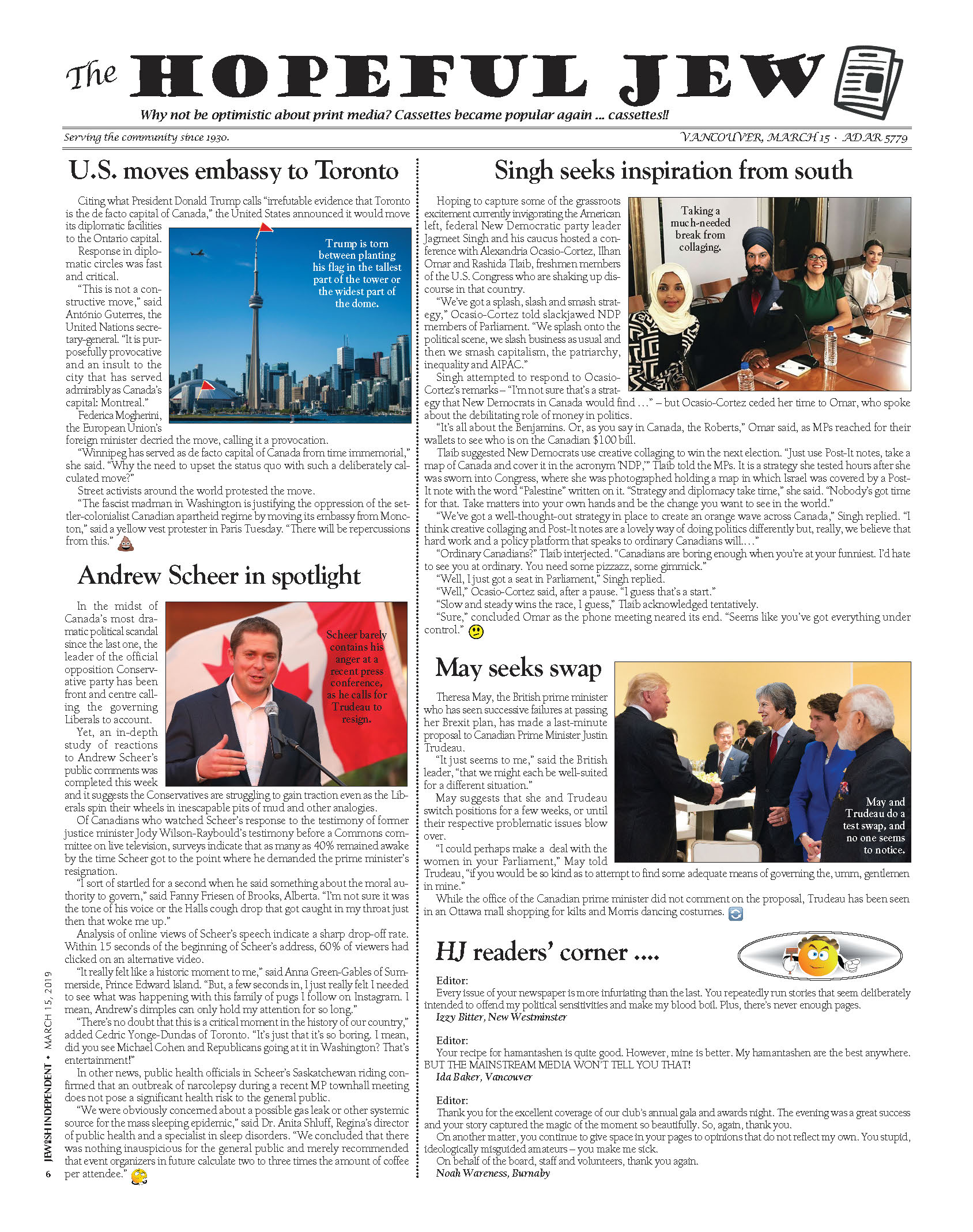
image - JI Purim Spoof 2019 - The Hopeful Jew

Format ImagePosted on March 15, 2019March 14, 2019Author The Editorial BoardCategories Celebrating the HolidaysTags politics, Purim, satire
Self-inflicted troubles

Self-inflicted troubles

There are few political leaders who can rest easy these days. Movements are sweeping the world, upending existing assumptions and bringing or threatening major change.

In Venezuela, the leadership is still contested between the far-left incumbent President Nicolás Maduro and the Western-backed opposition leader Juan Guaidó, who claims the presidency. In Brazil, a new rightist regime is making nice with U.S. President Donald Trump and Israeli Prime Minister Binyamin Netanyahu. Far-right parties continue to make gains in European elections, including last weekend’s vote in Estonia, while a movement in Spain is exhuming the fascist past of the Franco era.

In Canada, we appear to be in the midst of the most dramatic political scandal in recent memory. Former justice minister and attorney general Jody Wilson-Raybould’s testimony last week to the Commons’ Justice Committee blew the lid off what she called inappropriate, excessive political interference and veiled threats from the prime minister and other top government officials, who allegedly attempted to influence her decision around a criminal case involving the Quebec corporation SNC-Lavalin. Wilson-Raybould’s testimony painted a picture of a leadership that couldn’t differentiate between the partisan interests of the Liberal party and the judicious operations of the affairs of the government of Canada. The prime minister’s recently resigned former chief of staff, Gerald Butts, was to address the same committee this week, presumably to voice the narrative of the Prime Minister’s Office. But, before he had time to utter his first word, another cabinet minister, Treasury Board president Jane Philpott, abruptly quit cabinet Monday.

“I must abide by my core values, my ethical responsibilities and constitutional obligations,” Philpott declared in a written statement. “There can be a cost to acting on one’s principles, but there is a bigger cost to abandoning them.” Yikes! What does she know that we don’t know? And when do we find out?

The parallels and differences were stark on the same day last week between American and Canadian politics. While Wilson-Raybould was having her say, Trump’s former personal lawyer, Michael Cohen, was unloading a decade’s worth of pent-up hostility at his former boss in front of members of the U.S. Congress. While Wilson-Raybould was handled with figurative kid gloves by fellow Liberals on the committee (whose job, in some ways, was to defend the prime minister and his government on the issue), the reaction from Republicans toward their former ally was anything but cordial. Trump-allied congresspeople went at Cohen hammer and tong, accusing him of being a serial liar, the irony of the scene seemingly lost in their moral indignation.

While both Trudeau and Trump had a very bad week, impeaching Trump seems like a nearly impossible dream given the loyalty of most Republicans to defend his every action. But Trudeau, whose party is now facing almost certainly more challenging conditions in October’s election, may have an internal revolt on his hands if he does not somehow square the circle of the SNC-Lavalin catastrophe and its associated circus side-shows and, not secondarily, reassure his caucus that they’re not all going to get the boot because their leader interfered with a fundamental tenet governing the proper proceedings of justice and rule of law. This is probably far from over.

In Britain, Prime Minister Theresa May flounders about trying to find some resolution to the impending exit from the European Union, which is scheduled to happen in three weeks. The terms of that breakup – and whether it will take place as planned, be delayed or somehow permanently put on hold – remain entirely uncertain. The governing Conservatives and the opposition Labour party have all acted like amateurs through this process, stumbling from one failure to another. Last week, Labour announced they would support a second referendum on the issue, which could provide an escape hatch. If only the deadline for Brexit were not now being counted in hours.

In Israel, King Bibi faces the most serious threat to his leadership in years. Netanyahu was notified last week that he will almost certainly face indictment for bribery, fraud and breach of trust based on allegations that he has provided benefits to allies and friends in return for gifts like pink champagne and cigars, as well as allegedly bartering favours for positive media coverage. With an election now a month away, and facing a new opposition coalition headed by Benny Gantz, the former chief of general staff of the Israel Defence Forces, Netanyahu is not only fighting against the imminent criminal charges. He now faces, in Gantz, someone who neutralizes Bibi’s perpetual advantage over his political rivals – his reputation as a leader who is tough on security. While Netanyahu has tried to paint the apparently centrist Gantz as a “leftist,” most Israeli voters seem mainly concerned with the cost of living, inflation and other pocketbook issues. While the jockeying for coalitions after the vote is often as significant as the election results themselves, sober commentators are speculating that the Netanyahu era may not last much longer.

While political turmoil can have many sources, much of it in democracies comes straight from the highest levels of leadership – from the malfeasance or misfeasance of top elected officials themselves. Whatever the future has in store for Trudeau, Trump, May and Netanyahu, in each case, much of the damage they individually face is self-inflicted.

Format ImagePosted on March 8, 2019March 6, 2019Author The Editorial BoardCategories From the JITags Binyamin Netanyahu, Britain, Canada, Donald Trump, Israel, Justin Trudeau, politics, Theresa May, United States
Don’t dismiss findings

Don’t dismiss findings

A survey of Jewish Canadians indicates that we are not a Zionist monolith. This will be news to no one who has enjoyed a family seder or logged onto social media in recent years. However, it is useful to have a fairly comprehensive public opinion survey on the range of issues that tend to most divide us.

For some, the organizations that co-sponsored the survey will lead to outright dismissal. Undertaken by the polling firm EKOS on behalf of Independent Jewish Voices Canada (IJV) and  (UJPO), the goal of the exercise was no doubt to show considerable support for the positions espoused by these two groups that are routinely critical of Israeli policies.

By and large, though, the methodologies of the survey appear to have been relatively unbiased, and to ignore the findings is to bury our heads in sand.

Almost half (48%) of Jewish Canadians surveyed believe that “accusations of antisemitism are often used to silence legitimate criticism of Israeli government policies.” More than one-third (37%) have a negative opinion of the Israeli government. On the matter of the United States moving its embassy to Jerusalem, 45% oppose and 42% support the move. Nearly one-third (30%) think that a boycott of Israel is reasonable and 34% also oppose Parliament condemning those who endorse such a boycott. Almost one in three (31%) oppose the military blockade of the Gaza Strip.

The sponsors of the survey see the results as evidence that Jews whose positions are often dismissed as marginal actually represent a large swath of Canadian Jewish opinion.

We quibble with aspects. One question asks: “In 2004, the International Court of Justice ruled unanimously that the wall built by the Israeli government on Palestinian territory violates international law. In response, one year later, over 170 Palestinian citizens’ organizations called for a boycott to pressure Israel to abide by international law. Do you consider the Palestinians’ call for such a boycott to be reasonable?” It may be a bit much to ask someone answering a phone at dinnertime to disagree with something called the International Court of Justice and 170 Palestinian organizations. Overall, though, most of the questions were not misleading nor did they have preambles intended to lead the respondents, as did this one. The survey does, nonetheless, reflect a prevailing narrative that Israel has no legitimate security concerns and erects barriers along the West Bank and blockades Gaza just for fun. But that is the playing field we are on.

Whatever criticisms or doubts we might have about the survey should not distract us from the reality it means to deliver. There are serious divisions between Diaspora Jews and the approach of the government of Israel. Ignoring, papering over or stigmatizing these differences of opinion will harm both Jewish cohesion in the Diaspora and crucial support for Israel. As we have said in this space many times over the years, Israel’s leaders must make decisions based on its security needs, not on what makes it easier for Diaspora Jews to be proud Zionists. However, we do Israel and our own community a disservice by isolating and denouncing those who disagree with the positions of our main communal agencies.

An election is approaching in Israel and that could lead to more of the same or to a significant shift in policy – or to some sort of hybrid between the two. Things change quickly, particularly in that part of the world, and what is true in a survey today may not be true in a year or five.

Even if Israeli policies remain largely the same after April’s election, it is probably not a sustainable position for Canadian or other Diaspora Jewish communities to pretend that a (seemingly) growing chorus of dissent is nonexistent, insignificant, misguided or ill-willed. That is a recipe for irrelevance, particularly among younger Jews.

In fairness, the idea that the Jewish “establishment” is a monolith is an unjust characterization. A diversity of opinions exists in our communal organizations and, certainly, in the plethora of traditional media (like this one) and new media (blogs, online publications and social platforms), a million flowers bloom. So, we challenge the premise that our community enforces a strict ideological membership code. But, we definitely could be better at acknowledging the full range of diversity – even if that means arguing and contesting positions, or even shifting our communal narrative. Indeed, that is entirely in keeping with our community’s tradition.

The survey raises questions we rightfully should be addressing.

Format ImagePosted on March 1, 2019February 27, 2019Author The Editorial BoardCategories NationalTags Canada, Diaspora Jews, IJV, Independent Jewish Voices Canada, Israel, politics, poll, survey, UJPO, United Jewish People’s Order

Awareness and denial

Historical ignorance has been in the news recently, with polls indicating widespread lack of awareness of the Holocaust, especially among young people in North America and Europe. (See jewishindependent.ca/much-work-left-to-do.) Some media reports got the story wrong, however, claiming that many people “don’t believe” six million Jews died in the Holocaust. The reality is that many people “don’t know” this fact, and there is a big difference between not knowing and not believing. Then there is a different phenomenon altogether: denial.

Plenty of well-informed but ill-intentioned people know the truth of the Holocaust but, for various reasons, take a position that the facts are falsified. The notorious Holocaust denier David Irving is reportedly again making the rounds in Britain, promoting his ahistorical ideology. In a nice contrast, Irving’s nemesis, Prof. Deborah Lipstadt, is back in the news promoting her new book, Antisemitism: Here and Now.

Lipstadt went from respected Emory University professor to a sort of global superstar when Irving sued her for libel in a British court in 1996 for correctly characterizing him as a Holocaust denier. Although Lipstadt is an American, she and the book’s U.K. publisher were targeted because Irving apparently thought that country’s libel laws might serve his cause. In the United Kingdom, libel law places the burden of proof on the defendant instead of the plaintiff. As a result, the trial played out as a public history lesson, with Lipstadt’s legal team forced to prove the historical truths of the Holocaust. They did, of course, and won the case. Nonetheless, Irving’s career as a provocateur and historical revisionist continues.

More serious than a nasty British gadfly is the Holocaust denial taking place in Poland right now, a phenomenon that has led to a collapse in Israeli-Polish relations.

Until recently, Poland was one of Israel’s closest allies on the world stage. While Polish society has never undergone the self-reflection that Germany did after the Holocaust, Polish governments developed excellent relations with the Jewish state. After the fall of the communist regime, relations between the two countries grew quite warm. Trade and diplomatic relations at the highest levels flourished.

With the election of the right-wing nationalist Law and Justice party, in 2015, things began to change. Last year, the Polish government passed a law criminalizing speech that references Polish collaboration with the Nazis during the Holocaust.

Canadian Prof. Jan Grabowski, who spoke in Vancouver last fall, heads a team of researchers, most of them in Poland, who are scouring archives throughout that country amassing what is probably the most comprehensive assessment ever compiled on the subject of Poles’ complicity in the Holocaust. Without Polish collaboration – frequently offered willingly and without compulsion, the research indicates – the Nazis could not have succeeded nearly so completely at their murderous destruction of Polish Jewry, Grabowski insists.

Politicizing this history – that is, criminalizing the truth – has put the Polish government on a trajectory of institutionalized denial. Unlike masses of young North Americans and Europeans, the Polish leaders know very well what transpired in their country during the war. As Grabowski notes, it is not the collaborators and their descendants who are today ostracized in small communities across Poland but rather those families whose members helped their Jewish neighbours.

It was inevitable that Poland’s approach would have repercussions in the Polish-Israeli relationship. It happened dramatically in recent days. The Visegrád Group, which is a cultural and political alliance of the Czech Republic, Hungary, Poland and Slovakia, was slated to meet with Israeli leaders at an extraordinary summit in Israel this week.

A week ago Friday, Prime Minister Binyamin Netanyahu was visiting the Museum of Polish Jews, in Warsaw, when he stated, in a meeting with Israeli reporters where recording devices were not permitted, that Poles had aided the Nazis. A flurry of confusion followed as the prime minister’s office clarified that he had said “Poles,” and not, as some media had reported, “the Poles” or “the Polish nation.”

Polish Prime Minister Mateusz Morawiecki decided to snub Netanyahu by withdrawing from the summit and sending his foreign minister instead.

Yisrael Katz, on his second day on the job as Israel’s foreign minister, dumped fuel on the simmering conflict in a TV interview. Ostensibly sent to smooth over the matter, Katz used the opportunity to quote the late Israeli prime minister Yitzhak Shamir to the effect that “the Poles imbibe antisemitism from their mothers’ milk.”

Suffice to say the summit is off. The leaders of the three other countries are still slated to travel to Israel for bilateral meetings but Polish-Israeli relations are on the rocks.

The conflict illuminates a strange dichotomy. The government of one of the countries most affected by the Holocaust tries to blot out what they certainly know to be the truth. Meanwhile, a generation of young people look on, unaware of even the barest details of what is at the root of the uproar.

Posted on February 22, 2019February 21, 2019Author The Editorial BoardCategories From the JITags antisemitism, diplomacy, history, Holocaust, international relations, Israel, Poland, politics
Antisemites amid JVP

Antisemites amid JVP

Jewish Voice for Peace, an American organization that has been highly critical of Israel, announced recently that it is “anti-Zionist.” It is certainly a matter of semantics, as the group’s own executive director acknowledged.

“This doesn’t change anything about our focus or our political analysis,” said Rebecca Vilkomerson. “It just names something that hasn’t been named before.”

On the one hand, at least the group is being honest and not hiding behind the ambiguity they had adhered to until now. On the other hand, it represents a progression in the evolution of the anti-Israel movement.

Until just a few years ago, it was rare for people like those in JVP to say they opposed Israel’s existence. They would claim they were merely opposed to a specific policy or direction of the Israeli government. Now, they admit, they don’t think there should be an Israeli government.

In the same interview in which Vilkomerson made the announcement, she also repeated that “anti-Zionism is not antisemitism.” Again, a few years ago, people said “criticism of Israel is not antisemitism.” This appears to be an evolution.

In what intellectual framework is it acceptable to make a statement like “anti-Zionism is not antisemitism”? The undercurrent of the sentence is that, under no circumstances, by any measure, in no way, is anti-Zionism connected with or affected by antisemitism. Progressive people – which is how JVP and many of Israel’s other critics define themselves – would never dream of dismissing the potential of bigotry toward any other ethnic or cultural group.

More egregiously, Vilkomerson overtly contradicts her very words, acknowledging that there are, indeed, antisemites in the movement.

“Obviously, there are people who are antisemitic or anti-Zionist and there are people who mask their antisemitism with anti-Zionist language. That’s a given,” she says, “but that doesn’t paint anti-Zionism as concept.”

Here is what does paint anti-Zionism as concept: it is a movement utterly unconcerned that there is antisemitism and that there are antisemites within it. The leader of JVP admits that her movement attracts antisemites but expresses not a whiff of displeasure or concern. It is what it is.

“Ever since [the advent of] Zionism there has been anti-Zionism within Jewish communities,” she goes on. This is true. Zionism did not reach a consensus point among European and North American Jews until sometime around the Holocaust. When the implications of Jewish statelessness became the gravest in 2,000 years, a massive majority of Jews worldwide abandoned whatever ambivalent positions they had held and (almost entirely) united to create and support Israel.

There is no false corollary here: the state of Israel was not a “consolation prize” for the Holocaust, as has been suggested on more than one occasion. No one gave the state of Israel to the Jewish people; our ancient homeland was won back through a bloody defensive war and has survived and thrived despite massive external opposition.

We will see if other organizations, including similar Jewish groups in Canada, follow JVP’s suit. We will also continue to see primarily non-Jewish groups argue against Israel’s existence based on an anti-nationalist idealism or more nefarious interests. As we watch these developments, it is worth wondering why, as the first target of a battle against the concept of nationalism, “progressive” activists target Israel. Why not France? Why do Hungarians deserve their own country? What makes Norwegians so special that their nationhood is not called into question?

Closer to the point, Why do the Palestinian people deserve a homeland, which is the stated motivating purpose of JVP and so many other groups, while Israelis do not? Can people who declare “anti-Zionism is not antisemitism” see how these inconsistencies, including the indifference to Jewish statelessness, might make their protests seem hollow?

Format ImagePosted on February 15, 2019February 13, 2019Author The Editorial BoardCategories From the JITags anti-Zionism, Israel, Jewish Voice for Peace, JVP, politics, Rebecca Vilkomerson

Two bads don’t make good

The United States Senate was expected to vote this week on a bill that would make it easier for state and local governments, as well as government agencies and perhaps other bodies, to refuse to do business with groups that endorse a boycott against Israel.

The bill comes after several state governments have taken steps against BDS, the movement to boycott, divest from and sanction Israel. Florida’s legislators, for example, directed officials in 2016 to create a list of companies that engage in boycotts of Israel and instructed all government entities to divest from those companies. Two years later, the state passed a bill preventing companies that engage in boycotts of Israel from bidding on local or state government contracts. In all, about half of the 50 states have some form of statute on the subject, some simply making their opposition to BDS known, without adding punitive economic conditions.

Boycotting Israel is a dumb and self-defeating position, but so is the idea of governments boycotting the boycotters.

Opponents of the federal anti-BDS effort – and even some people with no horse in the race – are asking whether boycotts are covered by free speech legislation. Nobody is saying BDS should be illegal. But, when a company or individual applies to government for, say, a contract to build a road, there are numerous conditions. Non-unionized companies may be excluded, for example, or businesses may have to prove they adhere to government guidelines around equal employment. People are free to boycott Israel, and governments are free to prevent those people from obtaining contracts with them. On free speech grounds, we don’t really have a problem with the idea – and we’re pretty defensive about free speech.

To us, the discussion is less a legal one, or even a moral one, than it is a strategic one.

Despite their thuggish, bullying tactics, members of the anti-Israel movement love to position themselves as victims. While harassing Jewish students on campuses, shouting down speakers, making Jewish women unwelcome at women’s marches and disrupting venues where Israel and Palestine would seem to have little relevance, such as at a major LGBTQ conference in Detroit recently, they nevertheless depict themselves as tiny Davids fighting Goliath. With that in mind, legislation that punishes those who support BDS will give its advocates their first rightful justification for claiming victimhood. But there is a more important and obvious reason why we should not be legislating against BDS.

We shouldn’t need to tie the hands of BDS supporters behind their backs to win this fight. Our strength must be our ability to refute the lies, exaggerations, hypocrisies and prejudices of the BDS movement. There are a million arguments against BDS.

Ireland recently passed a wide-ranging Israel-boycott law and promptly realized that its high-tech sector, which is mostly propped up by American investment, could be imperiled if Ireland forces giants like Apple, Google and Facebook to choose between Dublin and Tel Aviv. While BDS is intended to be economically injurious to Israel, it can harm the very people who are advancing it. And it is more than economic damage BDS can self-inflict. Given the plethora of life-saving and life-enhancing innovations emerging constantly from Israel, boycotting that country could be detrimental to one’s health.

There are countless ways to counter BDS … like pointing out that BDS hurts Arabs. Not just Israeli Arabs or Palestinians, like those who famously lost their jobs when BDS forced the closure of a SodaStream plant in the West Bank, but impoverished residents of countries adjoining Israel, too. Seventy years of its Arab neighbours boycotting and isolating Israel has done nothing to harm the massive economic and social successes enjoyed by citizens of Israel. It has only ensured that the people of Jordan, Lebanon and other countries that snub Israel suffer from being deprived of these economic, technological and scientific achievements. Since the Arab boycott of Israel went global, the discrepancies have only grown. Israel’s GDP has doubled since 2005, when BDS started to take off.

The preoccupation of the BDS movement with academic boycotts is especially easy to confront: it’s the ideological descendent of book-burning.

We should also be conscious that even people who take positions we support may be using us to advance their own agendas. While the Republican party has been steadfastly pro-Israel – as have most Democratic party lawmakers – this anti-BDS measure is a bald attempt to sow division among Democrats by shining a light on some of the new elected officials who diverge from the traditional bipartisan consensus on the American-Israeli special relationship. Confronting those dissenters on the issues is justified – and is being taken up by a new group of Zionist Dems, called the Democratic Majority for Israel. But allowing one party to monopolize Israel for political advantage spells disaster for American Zionists and for Israel (despite the overt collaboration of Israel’s prime minister in the Republicans’ partisanship on this issue).

BDS is a bad idea. But, banning – or, more accurately, boycotting – BDS gives the appearance that Israel is indefensible on merit. That makes legislation to punish BDS supporters another bad idea.

At a time when there are plenty of bad ideas to go around, this is absolutely a case where two wrongs do not make a right. Defeating BDS should be done intellectually, not legislatively.

Posted on February 8, 2019February 7, 2019Author The Editorial BoardCategories From the JITags anti-Israel, antisemitism, BDS, boycott, Israel, politics, United States
Much work left to do

Much work left to do

One of the displays in the exhibit Canada Responds to the Holocaust, 1944-1945, which was at the Vancouver Holocaust Education Centre in 2016. (photo by Cynthia Ramsay)

Nearly half of Canadians are not able to name a single Holocaust concentration camp. A large number of Canadians do not know that six million Jews died in the Shoah, offering up numbers like two million, with nearly one in four admitting outright that they just don’t know. Among millennials, those aged 18 to 34, the numbers are particularly disturbing: 22% have not heard of the Holocaust or are not sure whether they have (which seems like much the same thing). One in three Canadians thinks that this country had an open immigration policy for Jewish refugees in the 1930s, unaware that very few Jews were permitted into Canada in the lead up to genocide.

These are some of the details found in a survey conducted on behalf of the Azrieli Foundation and the Claims Conference. The study was based on 1,100 interviews of Canadians to coincide with International Holocaust Remembrance Day Sunday. (See story, “Emerging from terrible abyss. ”)

On the positive side, 85% of respondents said it’s important to keep teaching about the Holocaust in order to prevent such a thing from happening again, while 82% said that all students should learn about this part of history.

In reality, it is unlikely that all Canadian students will learn about the Holocaust. In British Columbia, for example, the Holocaust only became part of the core curriculum with the overhaul of the entire provincial curriculum three years ago – and only if the teacher chooses to include it. The history of genocide is one module that teachers are able to select from a range of subject components at particular grade levels. Therefore, it is still a crapshoot whether a student graduating from the British Columbia education system will have much or any knowledge on the subject.

It is extraordinarily unlikely that the curriculum will be revised again any time soon to make Holocaust education mandatory across the system. Educators complain, with good reason, that they are expected to teach more content than there are hours in a day. Competing needs, including career preparation and life skills, contend with subjects like history for class time.

In Canada, where the educational curriculum is determined by every province, similar discussions take place across the country and a patchwork of curricula exist.

At the same time, a massive shift in the larger culture has taken place, eliminating what had been, until the last few decades, a largely shared body of knowledge. In the days when there were only a couple of television networks, and hard copy newspapers were most people’s sources of information, everyone would generally be aware of similar issues and events. Half of all televisions in the United States in 1978, for example, were tuned in to the nine-and-a-half-hour miniseries Holocaust (a program that was admittedly not without its critics among Jews, historians and others).

The internet and the proliferation of cable TV channels has refracted our attention in unlimited directions. People now largely self-select the information they receive and that can blind us to matters outside of our spheres.

In a better world, knowledge of the Holocaust would be universal. In the world we live in, it remains vital to continue to focus attention on the subject whenever possible – and to use this history to educate about other genocides and violations of humanity while not diminishing the uniqueness of the Shoah itself.

Organizations devoted to the critical work of Holocaust education, including the Vancouver Holocaust Education Centre, are carrying a heavy burden for the larger society and depend on public support to meet their mandate. The Azrieli Foundation, which undertook this study, publishes survivor memoirs and funds a variety of Holocaust-related projects across Canada. Other groups, to varying degrees, share the burden of teaching this history, including universities, synagogues, Hillels, book publishers and authors, and so forth.

Unquestionably, the most powerful form of Holocaust education is firsthand testimony from survivors and witnesses. British Columbians who are survivors of the Holocaust have spoken to tens of thousands of students but, in a handful of years, this method of transmitting history will no longer be possible. Innovative strategies are being developed, such as the New Dimensions in Testimony oral history project, a collaboration involving Steven Spielberg’s USC Shoah Foundation, which includes holographic representations of survivors with whom students and others can interact virtually. This project recognizes that the issue is not only to continue educating, but to find ever-advancing means of doing so effectively.

The breadth of the challenge was underscored by Prof. Jan Grabowski, who delivered the Rudolf Vrba Memorial Lecture at the University of British Columbia last November. He and a team of scholars and researchers are visiting town and city archives across Poland, doing primary research on the events that led to the murder of three million Jews in that country. In other words, we’re still compiling the most basic facts of that history and, it may be safe to say, we are just as far away as ever as to understanding the larger moral questions – How? Why? – the Holocaust raises. Much work remains to be done.

Format ImagePosted on February 1, 2019January 29, 2019Author The Editorial BoardCategories From the JITags Canada, education, genocide, Holocaust, VHEC

Posts pagination

Previous page Page 1 … Page 22 Page 23 Page 24 … Page 49 Next page
Proudly powered by WordPress