Skip to content
  • Home
  • Subscribe / donate
  • Events calendar
  • News
    • Local
    • National
    • Israel
    • World
    • עניין בחדשות
      A roundup of news in Canada and further afield, in Hebrew.
  • Opinion
    • From the JI
    • Op-Ed
  • Arts & Culture
    • Performing Arts
    • Music
    • Books
    • Visual Arts
    • TV & Film
  • Life
    • Celebrating the Holidays
    • Travel
    • The Daily Snooze
      Cartoons by Jacob Samuel
    • Mystery Photo
      Help the JI and JMABC fill in the gaps in our archives.
  • Community Links
    • Organizations, Etc.
    • Other News Sources & Blogs
    • Business Directory
  • FAQ
  • JI Chai Celebration
  • JI@88! video

Recent Posts

  • Sharing her testimony
  • Fall fight takes leap forward
  • The balancing of rights
  • Multiple Tony n’ Tina roles
  • Stories of trauma, resilience
  • Celebrate our culture
  • A responsibility to help
  • What wellness means at JCC
  • Together in mourning
  • Downhill after Trump?
  • Birth control even easier now
  • Eco-Sisters mentorship
  • Unexpected discoveries
  • Study’s results hopeful
  • Bad behaviour affects us all
  • Thankful for the police
  • UBC needs a wake-up call
  • Recalling a shining star
  • Sleep well …
  • BGU fosters startup culture
  • Photography and glass
  • Is it the end of an era?
  • Taking life a step at a time
  • Nakba exhibit biased
  • Film festival starts next week
  • Musical with heart and soul
  • Rabbi marks 13 years
  • Keeper of VTT’s history
  • Gala fêtes Infeld’s 20th
  • Building JWest together
  • Challah Mom comes to Vancouver
  • What to do about media bias
  • Education offers hope
  • Remembrance – a moral act
  • What makes us human
  • המלחמות של נתניהו וטראמפ

Archives

Follow @JewishIndie
image - The CJN - Visit Us Banner - 300x600 - 101625

Byline: The Editorial Board

Airing, rejecting bad ideas

Hundreds of thousands of women and allies marched in cities all over North America Saturday, bringing people from across the spectrum together to stand for equality and justice. It was the third annual network of women’s marches that sprang out of the shock and alarm after the election of U.S. President Donald Trump.

To ensure that the nearly spontaneous eruption of resistance to the direction of American (and world) politics was more than lightning in a bottle, a movement was solidified in the form of Women’s March Inc. This body, led by a small group of activists who quickly gained international fame and recognition, not only came to helm one of the most remarkable new grassroots movements in American history, they also became central figures in the cadre of leftist, socialist and progressive political activists that is loosely defined as “the resistance.”

Unfortunately – or, perhaps, fortunately, for reasons we’ll explain – the small group of Women’s March leaders has recently been beset by controversy. In a book-length analysis last month, Tablet magazine reconstructed accounts of the earliest hours of the march movement – including the marginalization of Jewish women who were there at the start and the assertion, apparently made in one of the earliest meetings, that “white Jews” were partly responsible for “white supremacy.”

Additionally, some of the leaders of Women’s March Inc. are associated with Louis Farrakhan, head of the Nation of Islam and an unrepentant Jew-hater and Hitler admirer who last month capped a career of antisemitic rhetoric by declaring Jews “satanic.” Tamika Mallory, one of the most visible faces of the march movement, has referred to Farrakhan as “the GOAT” – the greatest of all time.

These developments led march organizers in various cities to disassociate their marches from Women’s March Inc. While some figures tried to patch over or reconcile divergences within the movement, such efforts were undermined by top leaders, including Mallory, who appeared on national TV the Monday before Saturday’s marches. She defended her position on Israel and Palestine. She declared “the Palestinians are native to the land,” and that “there are people who have a number of sort of ideologies around why the Jewish people feel this should be their land. I’m not Jewish. So for me to speak to that is not fair.” She’s not Palestinian, either, her interviewer noted, yet she had no qualms defending Palestinians’ right to national self-determination.

At a time when another organization might aim for conciliation, Women’s March Inc. leaders seemed to double down on their troubles. In her keynote speech to the march in Washington Saturday, Linda Sarsour, another leading figure, expressed support for the BDS movement. While she had, earlier, finally rejected Farrakhan’s antisemitism and homophobia, her decision to use her limited time on stage to focus on BDS – an issue peripheral at best to the women’s movement – suggests she is not finished enflaming tensions with Jewish people.

Notably, attendance was down at rallies across the continent, including here in Vancouver. There could be a range of explanations – Trump-fatigue, weather – but certainly some Jewish and non-Jewish women were motivated to stay away because of the association of march leaders with bad ideas.

Within the loose affiliation of “resistance” figures, several of the individuals elected to the U.S. Congress in November’s midterm elections have made themselves known for statements about Israel and Palestine. One of the freshmen, Rep. Ilhan Omar, a Democrat from Minnesota, came under criticism for a 2012 social media post in which she wrote: “Israel has hypnotized the world, may Allah awaken the people and help them see the evil doings of Israel.” She has since said that she didn’t understand the implications in her choice of words.

Another new legislator, Rashida Tlaib, Democrat of Michigan, made her entry into Washington known by displaying a map of the world with a Post-it note with the word “Palestine” covering Israel.

These examples – and there are more – are disheartening. That these ideas have moved from the recesses of crackpot online discussion forums and into Congress, into one of the most significant grassroots organizations and, apparently, into a significant swath of the Democratic party, is certainly concerning. But there is a silver lining: it also allows us to openly confront the trend and, perhaps, to gain allies in opposing it.

When we talk about the need to shine light on dark crevices of bigotry, this is exactly what we mean. Social media has, for better or worse, allowed anyone with any views to broadcast them. In the chaotic network of the internet, there is no practical, central force for contesting bigotry and other bad ideas. When those ideas and expressions seep into institutions like Women’s March Inc., Congress or, even more noticeably, the U.K. Labour party, this presents an opportunity unavailable elsewhere. It is a chance to bring these issues out in the open and contest them in the light of day. Among other things, it forces people with power and influence to make a choice.

Among those who made choices in recent weeks – the choice to withdraw as sponsors of Women’s March Inc. – are prominent individuals and organizations, including the Democratic National Committee, the Southern Poverty Law Centre, the women’s political action group EMILY’s List, the LGBTQ advocacy group Human Rights Campaign, the pro-choice organization NARAL, the Centre for American Progress, and Amnesty International.

This is the kind of unified voice we need: a concerted rejection of antisemitism or Jew-baiting or Israel-bashing that has emerged as a force in important places.

Posted on January 25, 2019January 24, 2019Author The Editorial BoardCategories From the JITags anti-Zionism, antisemitism, Farrakhan, racism, women, Women's March

Taking principled stand

Rahaf Mohammed al-Qunun, an 18-year-old Saudi woman, was publicly welcomed to Canada Saturday. She had spent a week in a hotel in Thailand, asking for asylum in a Western country, saying that she did not want to return to her allegedly abusive family, whom she says have threatened to kill her.

Whether her family is indeed abusive has not been proven. But two factors make that issue somewhat moot. First, guardianship laws in Saudi Arabia require women to get permission from a father, husband, brother, son or other male relative in order to work, travel, marry, receive certain medical treatments and even to leave the house. This is codified inequality and abuse against about half the population of the country. In principle, that law alone should make all Saudi women eligible for refugee claims in democratic countries. Additionally, al-Qunun renounced Islam, which is an offence punishable by death in Saudi Arabia.

The teen’s arrival was a bit of a media festival, with Foreign Affairs Minister Chrystia Freeland embracing al-Qunun at Toronto’s airport.

The ostentatious greeting was extra-weighted because Canada is in an ongoing diplomatic spat with the Saudis. After Freeland tweeted a criticism of Saudi arrests of civil and women’s rights activists last year, the Saudis threw Canada’s ambassador out of the country and threatened to withdraw thousands of Saudi medical students from Canada, among other responses. The public greeting of a now-prominent Saudi dissident by a senior Canadian government official will be seen as a provocation, and perhaps it was intended as such.

Some commentators note that al-Qunun jumped the queue, not only flown to Canada to make a refugee claim, but accepted immediately as a refugee. The global visibility of her case resulted in a country – ours – leaping to accept her, even while one percent of refugees are resettled in a given year.

Also, some diplomats with Saudi experience are warning that the young woman should not be used as a political football – both because that could put her safety at risk and because it could unnecessarily enflame existing tensions.

David Chatterson, a former Canadian ambassador to Saudi Arabia, told the CBC that he worried about precedents.

“What happens the next time a teenage girl or adult woman from Saudi Arabia flees her family and declares herself to no longer be a Muslim, does that mean automatic sanctuary?” he asked.

Of course, diplomatic idealism is always tempered by economic and other realities. The CBC obtained, through an Access to Information request, evidence that the federal government heard concerns from Canadian businesses about their interests being jeopardized when Freeland’s tweets to the Saudis raised the ire of the kingdom’s rulers. On the flip side, Canada does not have as many economic ties to the Saudis as many European and other democratic countries, and this might give us a little more freedom to criticize. The U.S. president has already stated explicitly that he will not endanger American economic interests by contesting Saudi treatment of dissidents – including the murder and dismemberment of Washington Post writer Jamal Khashoggi.

Of 149 countries rated by the World Economic Forum in its annual report on gender equality, Saudi Arabia came 141st. Canada cannot free every one of the 16 million or so Saudi women, but we can ensure freedom for this one.

Yes, al-Qunun did effectively “jump the queue.” But, at the moment when the whole world was watching, that queue-jumping allowed Canada to take a principled stand for gender equality and for the freedom of – and from – religion.

Posted on January 18, 2019January 16, 2019Author The Editorial BoardCategories From the JITags al-Qunun, immigration, politics, refugees, Saudi Arabia, women

Tax troubles start year

In a perfect world, no country would need a military. Countries and people would live in peace; the kingdom of heaven, as promised by almost every religion, at last realized.

As ideal as that wish might be for the first editorial of a new secular year, it remains true that countries need militaries. Places like Canada, which have not been forced to wage war on home turf in 205 years, nevertheless maintain a military, with our soldiers serving various roles around the globe.

In Israel, on the other hand, the military is the one thing standing between the country’s citizens and oblivion. Like the militaries of every country, the Israel Defence Forces protects the country’s borders and citizens from external and internal threats. More controversially, as a result of Israel’s complicated history, the IDF also controls parts of the West Bank under a military rule that is the cause of much international criticism.

Some of this criticism comes from Canada, including from a Palestinian-Canadian, Ismail Zayid, who has been complaining for years to the Canada Revenue Agency (CRA) over his assertions that the Jewish National Fund of Canada has been in contravention of Canadian tax law for providing material support to the IDF.

Well, it’s more than assertions, actually. In stories splashed across Canadian media last weekend, there is plenty of evidence that JNF Canada was, until 2016, openly fundraising for projects that support infrastructure projects on Israeli army, air and naval bases. These include a “new planned IDF Training Base City in the Negev,” “helping the development of the Bat Galim training base complex area” and new mess hall-type facilities at two air bases. Funds raised at Edmonton’s Negev Dinner in 2014 were explicitly and openly allocated to developing parts of the largest military training facility in Israel.

In October 2017, according to the CBC, Zayid filed another complaint to CRA “in concert with an Ottawa professor, a Vancouver rabbi and a retired nurse.” The complaint is that JNF was ignoring rules that forbid Canadian charities from issuing tax receipts for contributions that go toward foreign militaries. CRA would not confirm details of the investigation to the CBC and JNF said only that they are engaged in confidential negotiations with CRA.

There is nothing stopping any Canadian from sending a cheque to Israel’s Ministry of Defence, news reports noted, but rules forbid doing so via a charity that provides tax receipts for it. This is admirable policy. Even if some Canadians would be perfectly happy seeing our tax policy support the IDF, would we be as pleased to see tax receipts issued for funds directed to the militaries of other countries with whom we don’t have as good a relationship?

Whatever one thinks about the morality of the IDF or its presence in the West Bank, the JNF appears to have made a naive or foolish mistake – not once but apparently about a dozen times. The head of JNF Canada said they stopped funding IDF projects after CRA alerted them to the issue in 2016. But how could an organization of this calibre have done so for so long, especially when it knew there were a series of complaints being lodged regularly around this very topic?

Since 1948, countless Jewish Canadians have supported Israel, including its military, in myriad ways. For four generations, young Jewish Canadians have enlisted, even in times of war, to serve in the IDF. Canadians of all ages have volunteered in the various roles the IDF offers to overseas friends of Israel. Most Jewish Canadians recognize the life-and-death necessity of a strong Israel, supported by a strong IDF.

The Jewish National Fund is the reason Israel is the only country on the planet that ended the 20th century with more trees than when the century started. Beyond reforestation, the number of extraordinary initiatives JNF carries out all over Israel makes it an integral part of the Zionist project. Israel is Israel, in large part, thanks to JNF.

Because of JNF’s critical importance, Canadian supporters must be confident that our support is going to an organization that is transparent and scrupulously adhering to relevant regulations. To ensure that the irreplaceable work the JNF does in Israel does not waver, JNF Canada must ensure that Canadians trust the decisions and leadership of the national organization.

Posted on January 11, 2019January 9, 2019Author The Editorial BoardCategories From the JITags Canada Revenue Agency, CRA, Jewish National Fund, JNF, taxes1 Comment on Tax troubles start year

There remains darkness to light

A recent poll determined that a large number of Europeans hold views that are antisemitic and, at the same time, awareness about the Holocaust is decreasing.

More than 7,000 people were polled on behalf of the news network CNN. In each of seven countries – Austria, France, Germany, Hungary, Poland, Sweden and the United Kingdom – 1,000 people were surveyed.

One-third of those surveyed – and one in two respondents in Poland – stated that Jews exploit the Holocaust to advance their goals and that Israel uses the Holocaust as a tool to justify its policies.

One in 20 Europeans have never heard of the Holocaust. In Austria, 12% of respondents said they had never heard of it, while 40% admitted they know little about it.

About 40% of respondents in Poland and Hungary claim that Jews have too much influence on business and finances. One-third of Poles and Hungarians think Jews exert too much influence on global politics.

Other findings in the poll deliver a mixed bag. Half of respondents in all countries claimed to know “quite a lot” about the Holocaust, with 20% claiming to have “extensive knowledge.” Two-thirds of Europeans agree that commemorating the Holocaust helps ensure similar atrocities do not happen in future and half believes that Holocaust commemoration helps combat antisemitism today.

While Jewish people constitute about 0.2% of the total world population, 25% of Hungarians and 20% of Polish and British respondents believe that more than 20% of the world is Jewish.

The poll says that 54% of Europeans believe that Israel has a right to exist as a Jewish state. (One almost wishes they had been asked if France has a right to exist as a French country, or Poland as a Polish country.)

One-third of Europeans, according to the poll, believe that criticism of Israel is symptomatic of antisemitism, while 20% believe that it is not.

Deflecting blame for antisemitism away from its perpetrators and onto its victims, 28% of respondents contend that antisemitism in their respective countries is a direct response to Israel’s actions. Fully 18% of Europeans blame antisemitism on the behaviour of Jews themselves.

Polls like these are an important barometer of opinion. There is little in the results that will surprise anybody who has been paying attention to European developments in recent years. Previous surveys have indicated that Europeans (as well as North Americans and others) have what we would consider an inadequate grasp of the realities of the Holocaust. Likewise, nobody needed a survey to know that antisemitism in Europe is at a level unprecedented in recent decades. However, it is important to have empirical evidence like this, especially a survey that is both cross-national and includes enough respondents to make it statistically significant.

It would be no help at all to throw up one’s hands and declare Europe lost, as some people have done in recent days. But neither do we, in Canada, have all that much influence over what happens there.

We do, however, have the ability to influence things closer to home and we should redouble our efforts to ensure that trends in Europe are not transmitted to our shores. We are, by no means, immune to this kind of thinking. A similar study done in Canada or the United States would indicate some parallels with the European results, albeit, we hope, not to the deeply concerning degree that this study has indicated.

We must continue to support every area ofHolocaust education possible. The work being done at the Vancouver HolocaustEducation Centre and by organizations across Canada must be supported andstrengthened. As Prof. Jan Grabowski said in delivering the annual Vrba lecture(jewishindependent.ca/revealing-truth-elicits-threats), there is still verymuch primary research left to do about the Holocaust, unearthing basic detailsthat are still not recorded about that time in history.

On the front of combating antisemitism here, the Jewish community must continue being vigilant and raising alarms whenever antisemitic ideas or actions emerge because this work has fallen primarily to Jewish Canadians. We must continue to build strength through our allies in all the multicultural communities in the country. This is the surest method to combat the growth of antisemitism – and this has to be a two-way street. As a community, we must stand with other groups and individuals when they are unjustly targeted if we are to expect others to stand with us.

While the last lights of Chanukah our now extinguished, we still have the season of winter before us and it is our responsibility to continue bringing light where there is darkness.

Posted on December 14, 2018December 12, 2018Author The Editorial BoardCategories From the JITags antisemitism, Europe, Holocaust

Each one, and all one

The news is not good. Hate crimes are up almost everywhere in the world one cares to look. A Statistics Canada report on police-reported hate crimes in Canada erases whatever smug superiority Canadians may have been feeling when watching rampant racism south of the border, at least some of which seems a result of the licence granted by a president who flirts with the most incendiary elements in U.S. society. The number of hate crimes reported to Canadian police in 2017 far outstripped the number in 2016 (see story, page 1) – and the actual number of hate-motivated incidents may be up to three times larger than the number reported to police.

Similarly terrible phenomena are taking place across Europe, where xenophobic and racist rhetoric is manifesting into violence against Jews, Muslims, Roma, asylum-seekers from Africa and Asia and, really, anyone who does not fit an escalating nationalist and populist consensus.

The lines are not all clear, either. The perpetrators and the victims can, at times, overlap. In online posts, email threads and private conversations, we witness members of our own community attributing motives to entire groups of people, and spreading hatred based on religious or racial identities. Likewise, messages of anti-Jewish hatred are common in online locations addressing the Israeli-Arab conflict, often including antisemitic comments from members of victimized minority groups.

The range of hate-motivated incidents addressed in the Statistics Canada report varies – most are non-violent and involve graffiti or crimes against property. But, when they are violent, they strike with a precision that aims at the emotional, as well as physical, vulnerabilities of the victims. In three of the most horrific hate crimes of recent years, assailants struck in the very places where people should expect safety – in the spiritual sanctuary of Emanuel African Methodist Episcopal Church, in Charleston, S.C., where nine African-Americans were murdered by a white supremacist on June 17, 2015; at the Islamic Cultural Centre of Quebec City, a mosque, where six people were murdered by an Islamophobic killer on Jan. 29, 2017; and at the Tree of Life synagogue in Pittsburgh, where 11 were murdered during Shabbat services this past Oct. 27.

The idea that people should be safe in a place of religious observance seems to be precisely the reasoning behind such attacks. But there is another form of violent crime that seems oddly excluded from this discussion.

Thursday (Dec. 6) marked the 29th anniversary of the mass murder at the École Polytechnique, in Montreal, where 14 women were killed by a man with deep-rooted hatred against women. A commemoration took place at the Vancouver Art Gallery, in recognition of the annual National Day of Remembrance and Action on Violence Against Women, with empty shoes representing the 545 women who have been murdered in British Columbia between 1997 and 2015 (the last year for which reliable statistics are available).

These victims include some of Canada’s murdered indigenous women, women working in vulnerable situations and women who were murdered because they were women and members of another marginalized group. Others were murdered by their domestic partners. In probably all of these cases, issues of differential power (of various forms) and attitudes about the value of women’s lives, factored into their fates. They are victims of gender-based violence.

It seems strange that, in a discussion about hate-motivated crimes, we exclude an entire gender, whose experience with violence is as prevalent, or more so, than that of other identifiable groups.

This is not an attempt to detract from one or another group’s experience with violence to emphasize something else; it is more an attempt to emphasize that every life should be respected and that membership in an identifiable group often diminishes that respect in the eyes of perpetrators.

But neither should the universal idea – every life is sacred and every individual deserves respect – detract from the more particular issue at hand. Every life is sacred and every individual is deserving of respect, but membership in particular groups can disproportionately impact on one’s experience with violence and discrimination. So, while we should be always conscious of the universal, we should likewise militate against the particular bigotries and prejudices that lead to disproportionate victimization of identifiable groups. In Canada and around the world right now, humankind could benefit from more emphasis on both the universal and the particular.

Posted on December 7, 2018December 4, 2018Author The Editorial BoardCategories From the JITags antisemitism, Canada, hate crimes, Islamophobia, racism, Statistics Canada, violence against women

Canada’s faith mosaic

Jewish tradition says that the chanukiyah should be illuminated in a window where it can be seen from the outside. This intersection of private celebration and public visibility is part of the holiday and, in places like Canada, where multicultural diversity is celebrated, this tradition fits nicely with the idea that we should all be proud of our various heritages.

The intersection of religiosity and public life, while not exactly parallel to this example, was addressed in a newly released study that threw a lot of accepted wisdom into doubt. The Vancouver-based Angus Reid Institute, in partnership with Cardus, a non-partisan, faith-based think tank, undertook a study on faith in the public square – and it appears almost everyone was surprised by some of the conclusions.

The study included a survey of 2,200 people across Canada, who responded to questions about their attitudes toward religion and its role in aspects of public life. The respondents divided quite neatly into thirds: the researchers identified public faith proponents (37% of the population), public faith opponents (32%) and the uncertain (32%).

Respondents were asked what they thought of the role of faith in areas such as education, social services, healthcare (such as hospitals, clinics and homes for the aged) and social justice causes (such as poverty, peace and overseas development). Overall, Canadians would like to see less faith-based involvement in these issues (56% of respondents say this), while 44% would like to see more influence. What surprised researchers, though, was who fell into the various categories.

“Notably, the results may challenge a traditional view of who Canadians within the proponent group are,” says the introduction to the study’s findings. “While one may assume this group is more likely to be made up of older and more Conservative-voting Canadians, this study finds proponents more likely to be younger, more highly educated, and largely Liberal-supporting.”

The authors continue: “This suggests that a range of Canadians – not just the highly religious – appear willing to accept certain elements of faith in public life. In fact, one-quarter of those who are most accepting of public faith have never read a religious text. Similarly, those with more strongly held religious beliefs may not necessarily be accommodating of the beliefs of others, or want to see them participating in the public discourse.”

The study’s authors seem to infer that some religious Canadians might seek to limit faith-based involvement in public life if it is extended to religious groups other than their own.

More interesting, perhaps, is the flip side: younger, more highly educated and apparently liberal (or, as the study categorized them, Liberal) Canadians who do not choose to participate in a religious tradition themselves can nevertheless see value in faith-based organizations doing good things for society. Why?

While we do not have the opportunity to probe the reasons for respondents’ answers, the surprise result might make more sense if we assume that, as multiculturalism has encouraged Canadians to recognize and celebrate difference in our heritages and traditions, a similar openness to difference has imbued itself in our attitudes to religious difference. Canadians, in general, may be less religiously affiliated, but we may, at the same time, be more open to accepting the presence of the religiosity of others – and their engagement in the delivery of public services.

Most people can probably understand that a person who has lived their lives observing Jewish traditions would, later in life, seek an assisted living or care facility that reflects their identity rather than one where the food choices, holiday celebrations and other cultural activities accentuate their difference and make them feel like outsiders. Similarly, it is natural, when in need, to seek help from an agency that is part of the community to which one belongs. Probably because we know that government cannot do all things for all people – perhaps in the roaring economy of the 1950s and ’60s we may have thought so, but those days are over – we recognize that, whatever theological differences we have, religious organizations are irreplaceable partners in caring for the sick, in-need and at-risk in our society.

Jews in North America, particularly in the United States, have been at the forefront of the movement to ensure the separation of church and state. There should certainly be vigilance against any creeping proselytization or overt theological mission within the delivery of public services. But we should recognize the difference between that and the positive impacts that people of various faith traditions have in dedicating themselves to good works. We call it tikkun olam and probably every religion has its parallel. Even as Canadians in general become less religious, it turns out we may be increasingly willing to see faith-based organizations deliver services that make our communities better.

Posted on November 30, 2018November 30, 2018Author The Editorial BoardCategories From the JITags Canada, interfaith, multiculturalism, social services, tolerance
JI awarded for its editorials

JI awarded for its editorials

The annual American Jewish Press Association’s Simon Rockower Awards recognize excellence in Jewish journalism. Once again, the Jewish Independent has been honoured with a Rockower for its work, winning first prize in its circulation category for editorial writing.

The JI’s editorial board – Basya Laye, Pat Johnson and Cynthia Ramsay – were recognized for the op-eds “How we memorialize the past,” “Sukkah more than symbolic” and “The year it all changed.” All of these editorials – and other opinion pieces and articles published by the JI can be found at jewishindependent.ca.

“The year it all changed” (June 2, 2017) discusses the turning point that Canada’s 100th birthday represented, when we “came into our own as a country,” and the significance of that year for Israel and Diaspora Jews: “The Six Day War, which began June 5, 1967, literally and figuratively reshaped Israel, the Middle East, Diaspora Jewry and global diplomacy.”

“How we memorialize the past” (Sept. 1, 2017) uses the racist rally in Charlottesville, Va., which “was ignited, ostensibly, by the removal (or threatened removal) of Confederate commemorative statues and plaques,” as a jumping off point to talk about how communities and societies commemorate the people and events of the past, including here in Canada.

Finally, “Sukkah more than symbolic” (Oct. 6, 2017) notes, “For most of us, the sukkah is but a symbol of our wandering in the desert all those years ago, a symbol to remind us to be humble, empathetic, grateful. However, for many living in Metro Vancouver, including members of our own community, homelessness is a reality.” It highlights some of the initiatives undertaken by Tikva Housing Society and the barriers to finding housing. It notes that indigenous people continue to represent the highest proportion of homeless, and that there are tens of thousands of people at risk of becoming homeless. It concludes, “there is a lot of work to be done.”

This year’s awards – honouring articles published in 2017 – were presented at the 37th Annual Simon Rockower Awards banquet, held in conjunction with the AJPA’s 2018 annual conference June 17-19 in Cleveland, Ohio. Second place in the under-15,000 circulation category went to the St. Louis Jewish Light, based in St. Louis, Mo. Winners in the 15,000-plus circulation category were the Forward (New York, N.Y.), taking first place, and the Jewish Standard (Teaneck, N.J.) placing second.

Format ImagePosted on November 30, 2018November 28, 2018Author The Editorial BoardCategories From the JITags AJPA, awards, Jewish Independent, journalism, newspapers, Rockower

Boring politics is good

When Prime Minister Justin Trudeau stood in the House of Commons this month and apologized for his predecessors’ decision to turn away more than 900 Jewish refugees on the ship MS St. Louis in 1939, he also made a plea for a better, more tolerant world.

Almost all Jewish Canadians – and probably most Canadians in general – thought this was the right thing to do.

The most recent public opinion polls indicate that most Canadians think that, on balance, what Trudeau has been doing since he became prime minister three years ago is generally OK. With the collapse in public support of the New Democratic Party and the Bloc Québecois, Trudeau seems to have an edge in a two-way race against the Conservative party of Andrew Scheer.

It is hard not to imagine that the leaders of most of our allied countries aren’t a bit jealous of Trudeau’s position right now.

In the United States, the mixed messages of this month’s midterm elections – which strengthened Republican control in the Senate and saw the Democrats retake control of the House of Representatives – leaves President Donald Trump with less power than he had a few weeks ago, although it does give him a scapegoat, in the shape of a Democratic House of Representatives, which will doubtlessly invigorate his 3 a.m. tweetstorms.

German Chancellor Angela Merkel is stepping down as leader after a remarkable 13 years at the country’s helm. At times, she has seemed the adult at an international kids’ table, holding Europe together while bailing out failing economies and managing influxes of refugees, among other things. But apparently she’s had enough of the excitement.

One-time wunderkind French President Emmanuel Macron is learning that coming out of nowhere to take the top job can leave one ill-equipped for the demands it entails. His popularity, according to polls, is spiraling downward.

In far worse shape are the governments to the west and east of these European powers. In both Israel and the United Kingdom, the leaders are unsure when they go to bed what their status will be when they wake. Between the time of writing and the time of reading this page, either or both of these governments may have fallen and new elections called – or some Band-Aid solution found for propping up or rejigging the existing coalitions.

In Britain, division at the top over the conditions of British withdrawal from the European Union has led to resignations of top cabinet officials (as well as lesser cabinet officials). Dissidents are penning letters that could lead to a leadership review for Theresa May, the Conservative prime minister, by her own caucus. Even if she survives that, the inevitable vote on the Brexit plan could see her government defeated just a few weeks hence.

For Jewish Britons, this situation is particularly serious. May’s Conservative government has been struggling in popularity almost since she took the helm. The Tories faced a surprisingly strong challenge from Jeremy Corbyn’s Labour party in last year’s general election, in which the Conservatives expected to glide to an easy majority and ended up having to cobble together a coalition with sectarian parties from Northern Ireland. A new Conservative leader might revive the party’s chances, though it seems impossible to see how anyone could paper over the seemingly irreparable divisions in that party between pro- and anti-Brexiteers.

The potential for a Corbyn-led Labour government is anathema to the vast majority of Jewish voters in that country. Corbyn himself has been a leading voice against Israel and in support of those who seek its destruction, including Hamas and Hezbollah, whom he has referred to as “friends.”

While extremists on the continent, like French far-right leader Marine Le Pen, do everything in their power to convince Jewish and other voters that they are not antisemitic, Corbyn seems to relish poking Jewish voters figuratively in the eye. And he is the proverbial tip of an iceberg. Websites are devoted to chronicling the extraordinary outpouring of overt antisemitism in the party he leads. One local chapter recently demurred on condemning the mass murder at the Pittsburgh synagogue, with one member complaining that there is too much focus on “antisemitism this, antisemitism that.”

In Israel, division among top cabinet officials over the response to the most recent violence from Gaza has led to the resignation of Avigdor Lieberman as defence minister, and extremely unfriendly musings from Education Minister Naftali Bennett. Prime Minister Binyamin Netanyahu’s coalition government is hanging by a thread, though public opinion polls indicate that support for his Likud bloc may actually give him reason to look favourably on early elections.

An ancient Chinese curse speaks of living in “interesting times.” For the leaders of many of our closest allies, these are interesting times indeed. But they probably look enviously to Canada and realize what Jews have known for many generations: when it comes to politics, boring is good.

Posted on November 23, 2018November 20, 2018Author The Editorial BoardCategories From the JITags antisemitism, Canada, politics
Win two tickets to Bronfman!

Win two tickets to Bronfman!

Anyone who buys a first-time subscription to the Jewish Independent as a gift for themselves or for a friend, family member or colleague by Nov. 28 will be entered into a draw to win two free tickets to hear Yefim Bronfman, one of the greatest pianists of our time, at the Orpheum Theatre on Dec. 6, 8 p.m.

With the Vancouver Symphony Orchestra, Bronfman will play Johannes Brahms’s Piano Concerto No. 2 in a concert that also features one of Richard Strauss’s great tone poems, Don Juan, and Franz Liszt’s Les preludes.

Not only will new subscribers be entered in the draw, but they will be able to purchase their subscription at a discount: only $20 for a one-year e-sub (40% off) and only $70 for a mailed sub (10% off).

The deadline to enter the draw is Wednesday, Nov. 28, 5 p.m. Email [email protected] or call 604-689-1520 for your chance to win.

Happy Chanukah!

Format ImagePosted on November 23, 2018November 20, 2018Author The Editorial BoardCategories MusicTags contest, symphony, VSO, Yefim Bronfman
Connect gifts to holiday

Connect gifts to holiday

Gifts can range from superhero socks to a journal to time with family and friends.

“When you consider the meaning of Chanukah, it’s about the Jewish struggle to maintain observance within a non-Jewish world,” writes Deena Yellin in the article “To gift or not to gift” on chabad.org. “The Maccabees’ victory was not just a military triumph but a win over assimilation as they succeeded in preserving the Jewish tradition. Chanukah presents a wonderful opportunity to convey the message of maintaining a strong identity despite outside pressures.”

In Yellin’s household, they “get out the Chanukah box filled with homemade decorations featuring menorahs and Maccabees that the children made in previous years…. We hang them up in our windows and around the candlelighting area. After all, publicizing the miracle is a big part of celebrating Chanukah.”

As well, every child lights their own chanukiyah, often one they’ve made themselves, and they invite people over. “One of the best ways to show children the beauty of the holiday is by sharing it with friends and relatives.”

Of course, food – latkes, sufganiyot and other deep-fried treats – is part of the celebration, as are games and crafts. Even gift-giving games. “One of my friends,” writes Yellin, “holds a ‘Mystery Maccabee’ project in which everyone picks the name of a family member from a hat so that they only need to buy a gift for that person. At their annual Chanukah party, everyone has fun guessing who got whose gift.”

Finally, many people use “Chanukah as an opportunity to teach their children to think of others who are less fortunate. One way to do this is by encouraging them to donate one of their gifts or some of their gelt to sick or needy children. Other philanthropic options are donating non-perishable items to a local food pantry or volunteering in a soup kitchen.”

***

Sarah Zadok, also in an article published on chabad.org (“Is giving Chanukah presents a non-Jewish custom?”), notes, “The word Chanukah shares a root with the word l’chanech or chinuch, which means ‘to mold’ or ‘to educate.’ Education, especially the education of children, is the foundation of what we celebrate on Chanukah.”

She allows that it is possible to educate and “to highlight the meaning of Chanukah through gift-giving. For example, giving your kids books or tapes or videos about the story of Chanukah…. Or, by drawing attention to the concept of the triumph of light over darkness – another powerful theme of the Chanukah story – you could invite your kids to bring ‘light’ where it is dark. You could, for example, make a project and bring it to a retirement home and brighten up someone’s day, or hand out cookies or latkes or winter coats to homeless people, or teach another Jew about our Chanukah traditions and invite them in to make a blessing over the candles with you.”

***

In the forward.com article “8 days of meaningful Hanukkah giving,” Shanee Markovitz writes, “it’s not about what we give as much as why we are giving it.” She offers night-by-night suggestions based on different themes.

Night 1 (Jewish values and roots): gifts like Chanukah Mad Libs for kids or a gift card to a Judaica store for adults.

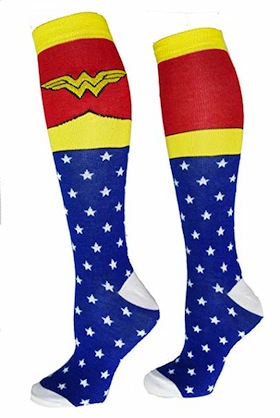
image - Wonder Woman socksNight 2 (self-care): for kids, tablets that change the colour of bath water; for adults, essential oils for the bath or a massage.

Night 3 (dream big): for all ages, a journal or a pillow and/or pillowcase.

Night 4 (family and friends): again, for all ages, a picture frame for photos of/with family and friends.

Night 5 (hope): for kids, a night-night projector; for adults, scented candles.

Night 6 (gratitude): write someone “a letter of why you are grateful for them and leave them an empty card for them to write a letter and pass on the favour to someone else.”

Night 7 (surround yourself with warmth): for kids and adults, a sweater.

Night 8 (resilience): superhero socks for the kids and, for the adults, a goal planner or household tool kit (Maccabees means “Hammer,” after all).

***

Rabbi Rona Shapiro writes on ritualwell.org, in the article called “Chanukah gifts,” about using theme nights in an effort to practise moderation. Her family has had Big Gift Night (when each child gets one big gift from their parents); Grandparent Night (gifts from the grandparents); Book Night; Music Night (a night of songs); Cooking Night (make latkes and enjoy them with friends); Tzedakah Night (wrap presents to deliver to a children’s hospital or other charity); and Homemade Gift Night (such as a family photo album or scrapbook).

Shapiro suggests incorporating some new rituals into your celebration. For example, “Chag Habanot, the seventh night of Chanukah, is traditionally a women’s holiday (it falls out on Rosh Chodesh) when it was customary for women to give gifts and tell the stories of valiant Jewish women.”

For adults, she suggests presents ranging from personal blessings to wine, food and candles.

Format ImagePosted on November 23, 2018November 20, 2018Author The Editorial BoardCategories Celebrating the HolidaysTags Chanukah, children, gifts

Posts pagination

Previous page Page 1 … Page 23 Page 24 Page 25 … Page 49 Next page
Proudly powered by WordPress