Skip to content
  • Home
  • Subscribe / donate
  • Events calendar
  • Business Directory
  • FAQ
  • News
    • Local
    • National
    • Israel
    • World
    • עניין בחדשות
      A roundup of news in Canada and further afield, in Hebrew.
  • Opinion
    • From the JI
    • Op-Ed
  • Arts & Culture
    • Performing Arts
    • Music
    • Books
    • Visual Arts
    • TV & Film
  • Life
    • Celebrating the Holidays
    • Travel
    • The Daily Snooze
      Cartoons by Jacob Samuel
    • Mystery Photo
      Help the JI and JMABC fill in the gaps in our archives.
  • Community Links
    • Organizations, Etc.
    • Other News Sources & Blogs
  • JI Chai Celebration
  • JI@88! video

Recent Posts

  • SFU honours Gloria Gutman
  • Lifting people’s spirits
  • Wedding a ray of light
  • Indigeneity and Zionism
  • Rule of law broken: councilor
  • Football and its roles
  • The burden of defence
  • Fish Café returns after fire
  • All right in what goes wrong
  • Nuns & mermaids at TUTS
  • Camp offers holiday retreat
  • Students and mentors inspire
  • Once-in-a-lifetime trip
  • 100 dancers, one heart
  • Money for the sciences
  • What “Jewish food” means
  • Have a cookie, schnitzel too
  • Federation now across BC
  • Israel fighting for its existence
  • Deal strengthens Iran
  • Patriotic belonging diminishes
  • A campaign to engage
  • Upstanders’ first live event
  • Responding to Carney
  • Having your own home
  • Music a family tradition
  • Musical to warm heart
  • Community milestones … June 2026
  • Sharing her passion for Israel
  • Or Shalom reopens its doors
  • JFS from past to future
  • Need holistic approach
  • Sharing stories, advice
  • Journalist shares fears
  • Skills to live together
  • Road to independence

Archives

Follow @JewishIndie
image - CJN box ad Rockowers 2026

Byline: Rebeca Kuropatwa

Jewish dating app fills gap

Jewish dating app fills gap

Shapira began piloting JFiix in Israel a couple of years ago and it was launched recently in the United States and Canada with an English version. (screenshot)

In 1996, at a time when not everyone had a home computer, Joe Shapira started a dating website – JDate. Today, very few people in the Jewish community have not heard of it. Since its inception, it has been embraced by Jews around the world.

“When I started in the online dating business, I was one of the pioneers of this business on the internet,” Shapira told the Independent. “And I never anticipated it would become such a big business.

“There were a few other dating sites when I started. I hired the programmer and we launched the very first dating site where you could define your preferences. We started marketing and it took off like a fire.”

Shapira was living in Los Angeles at the time. From a conversation with a friend about the difficulty of meeting other Jews in a place where the majority of people are not Jewish came the idea of JDate. Shapira wanted to help Jews meet other Jews, reduce the rate of intermarriage and help ensure Jewish continuity.

Born in Tel Aviv, Shapira went to a technical high school before serving in the army. After he finished his army service, he became an entrepreneur. Four years later, he moved to Los Angeles, where he stayed for some 30 years before moving back to Israel several years ago to spend more time with his kids.

“I think that people, in general, adapted well to the internet dating world,” said Shapira. “It’s a very highly used internet service. I think, in the Jewish community, the need was there. You live in a certain community and, pretty much by the time you’re 25, your connection – whether it’s your mother, grandmother or through mutual friends – we’re expected to meet a Jewish mate there. It’s ingrained in us. But, sometimes, you just exhaust your ability.

“The internet became more and more [popular and] … the style of work that most people do [changed]. You used to meet more people at work and talk to people on the phone. Now, you don’t even go out to the stores to a certain extent. Instead of telephones, we use email or texting. The lifestyle of people created less interaction with others and the Jewish community had a distinct need.”

Although, technically, Shapira launched JDate in Los Angeles, he was quick to point out that it has always been accessible around the world. In fact, the first marriage through a JDate interaction was in Caracas, Venezuela.

“If you are single and looking and you found JDate somehow, you’re going to tell your friends,” said Shapira. “We Jews are a close-knit community. I loved JDate, because of my concern for Jewish continuity, but I left the company in 2006, before smartphones and Facebook.”

Over the last few years, Shapira has been noticing a gap in communication that computer-based sites are still struggling with – that younger people do all their communication via smartphones, not on laptops or in front of computer screens.

“Millennials use the smartphone more than desktop computers,” said Shapira. “You go to work and you have a desktop computer. You work on your laptop at home. Unless you are in your 20s … then, you use your iPhone for everything.”

Internet dating is “a lifestyle thing,” he said. For someone in their 20s, “online dating is like emailing or texting – very natural. When I started JDate 20 years ago, it was not completely natural. In Israel, it took awhile before it caught on.”

Because Jewish online dating sites were not adapting well to mobile phones, Shapira found that millennial Jews were going to non-Jewish sites and this raised again his concern for Jewish continuity. Hence, he started JFiix.

“If you look at the landscape, you have Tinder on one end of the spectrum and the hookup app,” said Shapira. “And then you have apps like JDate or Match.com that are just a smaller [version] of a website.

“One of the big advantages of having an app is you’re always available. You remember JDate – if you wanted to contact someone, you sent them a message and then it took them two to five days to reply. With a mobile, if a woman contacts you, you decide in seconds.”

Shapira began piloting JFiix in Israel a couple of years ago and it now has about 250,000 users. It was launched only recently in the United States and Canada with an English version.

“We are at the stage of acquiring the user base and marketing,” said Shapira. “I think it will be another four months before [we reach] a critical mass of users.”

Shapira promises to wow users with the app’s complex technology, which includes a matchmaker feature. “The matches we select for you are based on the people that you’ve had good communication or chats with,” he said. “We also do a deep learning of photos you submit, so we know your type. People are usually attracted to the same type.”

With JFiix, no nudity or provocative clothing is allowed. The software monitors what people write in their profiles and analyzes the chats, removing any inappropriate content in a manner that is several notches above the competition.

“The purpose of this is to maintain a very positive community, a positive customer experience,” said Shapira. “We can’t prevent non-Jews from being a part of it, as it would be illegal to discriminate based on religion, just as a synagogue can’t prevent non-Jews from joining. However, we provide certain features, especially for women. For instance, women can define who can see them – age, distance, religion – as, when you register, one of the data collected is if you’re Jewish or not. A woman can say she wants only Jews.”

JFiix communities in Canada, so far, include Toronto and Montreal, with only a few individuals in Vancouver, a community he’d like to see grow to allow JFiix to work best.

“I think we provide a very good solution for millennial Jews,” said Shapira. “With the continuity of the Jewish community so important to the Jewish people, I hope I will be able to make a dent in intermarriage’s growing numbers. I think most Jews want to marry a Jew to continue the tradition. In saying that, I hope to, at the very least, help some Jews find Jewish soulmates.”

Rebeca Kuropatwa is a Winnipeg freelance writer.
Format ImagePosted on May 6, 2016May 5, 2016Author Rebeca KuropatwaCategories WorldTags dating, Israel, JDate, JFiix, Shapira, technology
Lifting up women’s voices

Lifting up women’s voices

Left to right: Dana Chappellaz, Susan Weidman Schneider and Yelena Maleyev. (photo by Shayla Fink)

The first-ever Winnipeg Jewish Women’s Symposium was held at Rady Jewish Community Centre on April 9 and 10, bringing together women of all ages to explore the different ways in which women can make a difference in the Jewish and general communities.

The event was the inspiration of Rady JCC executive director Gayle Waxman and assistant executive director Tamar Barr.

“Gayle and Tamar approached me to co-chair the symposium on behalf of Rady in the fall of 2015, and it’s been a flurry of activity ever since,” said Lindsay Sawyer, a financial planner and a Rady JCC volunteer, who co-chaired the event with Yelena Maleyev, a product manager at Manitoba Telecom Service and a leader in National Council of Jewish Women (NCJW) in Winnipeg.

“We’ve taken great care to ensure that our speakers cover a wide range of topics to appeal to women of all ages in our community – from new volunteers to seasoned community leaders,” she said.

According to Sawyer, although women are talented, dynamic and committed people, they are still too often underrepresented at the board level of the Jewish community – something she and others involved in the symposium are setting out to change.

“If we don’t invite ourselves to shape the direction of the community we live in, we’ll wind up missing too many valuable voices at the table,” said Sawyer. “Our hope is to engage and inspire talented woman of all ages who, due to lack of opportunity, direction or support, may not yet be having their voices heard, while also celebrating the achievements of those who are playing key roles in their organizations.

“We are elated to have had Susan Weidman Schneider join us this year as our keynote speaker. Susan, an expat Winnipegger, is the founder and editor-in-chief of Lilith magazine, an award-winning Jewish women’s quarterly. It was our privilege to celebrate such an accomplished and dynamic talent and to be able to claim Susan as one of our own.”

Maleyev, who is Winnipeg NCJW’s treasurer as well as the creator of its young women professionals branch, also wants more women to get involved.

“We have seen successful events, such as SHE Day, grow over the years, and agreed that we should provide a similar opportunity for women in our community, but approach it from a Jewish perspective,” said Maleyev. “We aim to empower and educate the younger generation, while ensuring all women are involved and encouraged to remain involved. We want to match the energy of the younger generation with the experiences of those who have been in leadership roles for awhile now. Like Sheryl Sandberg mentions in her book Lean In – the more women help one another, the more we help ourselves. Acting like a coalition truly does produce results.

“We want to encourage the power of mentorship and how sharing our experiences at any age can help uplift one another,” she continued. “Women make up over half of the population and yet not even close to half the leadership roles in management or on boards. We need equal representation to ensure our voices are heard. We need mentors, sponsors, role models and supporters to help us achieve our professional goals, as well as balance in our personal lives.”

The symposium kicked off with Havdalah and a performing arts showcase on April 9 and, on April 10, the learning sessions took place. About 150 women attended.

“The performing arts showcase was absolutely exceptional,” said Sawyer. “It was honestly just an absolutely incredible experience to hear the stories of so many very talented and passionate women … about the importance of community and making sure our voices are heard. I left on Sunday with such incredible enthusiasm for both where our community is and where we’ll be going with the next generation of leadership coming into contributing volunteer positions.

“Certainly, at the top of my list, was one of the opening panels, with Dianne Glass, Debbie Hoffman, Laurel Malkin and Baillie Chisick. Their views of being a voice at the table and women in community leadership was so inspiring and uplifting.”

Sawyer also lauded Weidman Schneider’s keynote address about where women have come from and where they still need to make inroads.

“It’s my hope that this event will continue and that we can continue to reach out to our community and inspire others to join us in continuing to make our Winnipeg Jewish community a special and welcoming place,” said Sawyer.

Maleyev, who found the symposium “phenomenal,” said, “The panelists were all incredibly inspiring. They shared many personal and professional stories, and provided varied opinions and experiences…. Susan brought such good perspectives on the topic of feminism and urged us to be allies in our feminist journey. As well, attendees received many opportunities to mingle and network, and meet new people in the community.”

Maleyev is hopeful that, with support from women mentors, more young women will see that there is room for them to grow their skills and get involved with whatever organizations align with their values.

“Our very sincere thanks to the leadership of Gayle Waxman, Tamar Barr, Cindy Lazar [NCJW] and all our tremendously talented and dedicated volunteers in bringing this event to fruition,” said Sawyer.

Rebeca Kuropatwa is a Winnipeg freelance writer.
Format ImagePosted on April 22, 2016April 20, 2016Author Rebeca KuropatwaCategories NationalTags feminism, Lilith, NCJW

Diagnosing, treating ADHD

Why are boys three to four times more likely to be diagnosed with attention deficit hyperactivity disorder (ADHD) than girls, when studies have repeatedly shown that girls are just as likely to have it? According to psychiatrist Dr. Doron Almagor, this may be due to how it manifests differently in girls than it does in boys.

Almagor treats ADHD throughout the lifespan. He is also the president of the Canadian ADHD Resource Alliance (CADDRA), which is a Canadian body of physicians that sets the standards for treatment of ADHD in the country.

Dr. Doron Almagor
Dr. Doron Almagor (photo from Doron Almagor)

Originally from Israel, Almagor moved to Canada with his parents when he was 10 years old. During his training in child and adolescent psychiatry, Almagor became exposed to kids with ADHD.

“I found out, as I did my practice, that there was a really wide need for it,” he said. “It’s a very underserviced, under-recognized, underappreciated area within the Canadian health-care system and worldwide as well. I could see changes happening very quickly for people who may have been suffering for years and were then able to turn their lives around. So, that is something I became more involved in.

“I then became more involved with education over the years and really tried to promote the message that it’s something that’s under-recognized and easily addressed. Compared to other treatments in psychiatry, it tends to be much more effective, but underappreciated for being so.”

According to Almagor, one of the myths is that ADHD kids are hyperactive. The reality is that there are different types of ADHD, some of which have no hyperactivity associated with them at all. These used to be referred to as ADD (attention deficit disorder).

“When people hear ADHD, they may not identify themselves as having it or their children or family as having it, because they think hyperactivity has to be there,” said Almagor. “But, there are types of ADHD with no hyperactivity – that’s a more silent type and even more underappreciated.

“The problem with ADHD and all types of ADHD is that they’re defined by symptoms with attention, focus, and with the hyperactive-type problems, with hyperactivity and impulsivity. But these aren’t the real issues ADHD causes. The real issues are things like school failure, low self-esteem, social problems – things that evolve into other issues like depression and anxiety. It’s really the secondary effects of ADHD that are the real problems, rather than the pure attention or hyperactivity issues.

“If a child has ADHD and that causes self-esteem issues, they can’t focus, keep up with their peers, [they] have teachers who are negative about them, and people may say that they’re just being lazy and making careless mistakes. That’s going to be internalized into the child’s character. That will be part of their image of themselves. That’s going to affect how they relate to the rest of the world…. That’s going to be harder to fix as they get older. The earlier it can be addressed, the better.”

Learning disabilities often go together with ADHD. According to Almagor, when someone has been diagnosed with a learning disability, they should also be screened for ADHD, as 50% of those with a learning disability also have ADHD and vice versa.

If a parent is concerned about their child, his or her teachers are in a very good position to be able to gauge where the child is at, as they see them in a context of 30 other kids their age, he said.

“Often, parents may have a 7-year-old who can’t focus, but they may not know if that is the same as or similar to other 7-year-olds. Teachers are always consulted before making a diagnosis.

“Another good first step,” he continued, “is the child’s pediatrician, as many pediatricians are trained in the diagnosis and recognition of ADHD. Pediatricians may be able to diagnose it themselves or may have consultants they rely on, whether that is a child psychiatrist or specialist pediatricians (developmental pediatricians).”

Further testing may be needed to confirm an initial diagnosis, but this testing is covered by the public health-care system when prescribed by the child’s doctor. Psychiatric treatments may not be covered.

Another common misconception concerning ADHD is that medication is the only option, yet, that is only one of the potential treatments.

“Parents need to make sure the pediatrician is open and knowledgeable about ADHD,” said Almagor. “There are still some who don’t believe there is such a thing as ADHD or they’ll do a very quick assessment ruling ADHD out too soon without a full assessment.”

One of CADDRA’s missions is to educate physicians in making proper diagnoses, and providing proper treatment or referring people to the appropriate resources and experts.

CADDRA’s website provides a list of symptoms that people can access that might be helpful in trying to determine if you have a child with ADHD, but Almagor cautioned that these are all just initial screening tools that can only give an indication that further trained assessment may be needed.

“We can’t expect a 10-year-old to focus as well as a 19-year-old,” said Almagor. “Besides initial symptoms, like trouble focusing, secondary symptoms can include being very hesitant about being in school, being withdrawn about school and having low self-esteem about their abilities. These types of things are softer. They’d be good alerts that the child needs further assessment. Being behind in school is another one. But, it might not be ADHD. It might be a learning disability or something else, like depression.

“Girls tend to have the more silent type of ADHD – the inattentive type – so, not as visible. Inattention is internal – hesitancy, being withdrawn and being unsure of their abilities. These are often missed and that’s why girls are only diagnosed later in life.

“Often, when mothers bring in their daughters for assessment, they read about the diagnoses and they self-identify. I see a parent who will say, ‘Now that I’ve learned more about ADHD, my child has it and I realize I have it, too.’ It’s common as well because ADHD is about 80% genetic. So, often when there’s a child that has ADHD, one of the parents has it, too.

“I always ask and try to determine who else in the family might have ADHD and maybe encourage that they also seek out treatment, too. It’s important, as, if a parent is having ADHD symptoms themselves, it may make it harder for them to parent effectively and may make the child’s ADHD worse.

“Even when girls are hyperactive,” he continued, “they’re still often under-treated. They tend to be chatty girls in class and can’t sit still. Recent research from Denmark is showing that girls with ADHD have higher rates of effects of it than boys. So, they have higher rates of drug use and higher death rates, which may be because they’re not being treated.”

In early childhood, boys diagnosed with ADHD outnumber girls four to one, but the number of adult men and women are about equal. Overall, the number of people with ADHD has been steady for the past 30 years, according to Almagor, at around five percent. And, although Almagor said he sees many Jewish patients, he does not attribute this to there being higher percentages of Jews with ADHD as compared to the general population. Rather, he feels Jewish parents’ attentiveness to what is going on may be the cause of them bringing their kids in more often for treatment.

The way in which the condition and its treatment are perceived by the public, said Almagor, is one of the main problems, and it is a problem that may be causing harm to kids.

“I think people avoid treatment or avoid addressing it because of stigma, or they think the only option is medication,” he said. “They need to be aware that treatment for ADHD is what we call ‘integrated.’ We look at psychotherapy as well as medication choices. It can also be addressed without medication, which is often very helpful for the long-term well being of the child.”

Psychotherapy treatments may include a focus around self-regulation in cases with hyperactivity and impulsivity, or being able to learn to think before acting via exercises that include mindfulness and other ways to help children control their impulses. Other treatments for ADHD can include helping with executive functioning to improve organization, focus and the sequencing of tasks. For more information, visit caddra.ca.

Rebeca Kuropatwa is a Winnipeg freelance writer.
Posted on April 22, 2016April 20, 2016Author Rebeca KuropatwaCategories NationalTags ADHD., Almagor, attention deficit, health
Bleak future for Israel

Bleak future for Israel

Raphael Hoult, winner of the inaugural Barry Rubin Prize Essay Competition. (photo from Raphael Hoult)

“A Game of Clocks: An Analysis of the Situation in the Middle East and Its Effects on Israel” by Winnipeg’s Raphael Hoult is the winner of the Centre for Israel and Jewish Affairs’ inaugural Barry Rubin Prize Essay Competition.

Hoult, a physics major at the University of Winnipeg in his second year of studies, conjured up a mind-bending theory about the stability of Middle East security and consulted expert sources for his essay.

In physics, Hoult’s interests lie in the field of quantum gravitation, which attempts to combine two major theories – those of general relativity and quantum mechanics.

“These two theories don’t play well together,” said Hoult. “They conflict in places. The biggest place they conflict is in that every force in the universe has been quantized, meaning that we’ve found a very small, discrete package of it in the universe. For example, electromagnetism is delivered by something called a photon. The other forces have something that delivers them, as well. But, with gravity, we’ve found no such thing yet. What we say is we haven’t been able to quantify it, though there are a lot of theories out there for how to solve that problem. There’s string theory. Another is loop quantum gravity, that attempts to bring some parts together.

“I want to help look for a theory of quantum gravity, so we can finally resolve this dilemma … combine the two theories into one bigger theory, a more complete theory. And, hopefully, that will give us a lot more insight into the way gravity works and allow us to do more with our understanding of gravity – to utilize it more, similar to the way our deeper understanding of electricity and magnetism has allowed us to do more intricate electronics in the past couple years.”

According to Hoult, this reconciliation of quantum mechanics and general relativity has been the Holy Grail of physics for the past 50-some years, and solving it will be huge for physicists and the world as we know it.

“The proposed theoretical messenger particle for gravity is the graviton, which is something we’ve not yet observed at all,” he said. “Quantum mechanics requires there to be a graviton…. General relativity in no way makes reference to a graviton.

“The main thing is quantum mechanics works really well with very small things, general relativity works really well for really big things. Things with a lot of mass are usually very large. The problem comes when you have things that are very massive and also very small, such as neutron stars or black holes. These are very dense, have a lot of mass and exert a lot of gravitational force, but they are also very small. In the case of a black hole, they are actually on the atomic level. So, quantum mechanics is very important to the way they work, but general relativity also is in play. When our two theories don’t work and they are supposed to be working at the same time, that’s a problem and something we want to fix.”

In addition to his knowledge of physics, Hoult is also well-versed in Israeli politics. “I’ve actually never taken a political science course at university,” he acknowledged, “but I went to Gray Academy [of Jewish Education in Winnipeg], so I had a very strong basis in knowledge about Israel. I had a good grounding there. I also read the Times of Israel and Haaretz every day.”

When Hoult saw an advertisement for the Barry Rubin Essay Competition on Facebook, it piqued his interest. The contest topic was, “What does the current regional turmoil in the Middle East mean for Israel?”

In his essay, Hoult said, “The three main critical points I talked about were the constancy of Hezbollah, Hamas and Daesh (the Islamic State in Iraq and Syria [ISIS]). I wrote about the fact that Hezbollah is involved in the war in Syria, specifically as affiliates of Bashar Al-Assad. They support him and are fighting on behalf of him. On the flipside, a branch of ISIS, called Al-Wilayat Sinai, is operating in the Sinai Peninsula desert against the Egyptians, making their lives very difficult. They’ve also struck up an alliance with Hamas.”

According to Hoult, the main three players in regards to Israel involve Hezbollah in the north, Hamas in Gaza and Al-Wilayat Sinai (Daesh) in the south. Hoult does not delve into the Iranian threat in his essay, apart from Iran’s role in supporting these groups.

“My hypothesis was that these three forces are connected to one another,” he said. “And, because of the ongoing campaign against ISIS, my hypothesis is that, as soon as that campaign succeeds and breaks down ISIS, all hell will break loose for Israel.”

Hoult explained that this theory takes into account Hezbollah’s huge military arsenal, which is estimated at around 100,000 rockets, and their ability to hit every point in Israel from Metula to Eilat, combined with the southern threat from Hamas and from the Al-Wilayat Sinai, which, so far, has been mainly fighting the Egyptians.

“Once ISIS collapses in the north, the Al-Wilayat Sinai … will suddenly be like a tentacle that has been cut off from the squid,” he said. “It will have no control and will be in desperate throes to stay alive, making it likely that it will involve at least a couple cross-border raids. If those involve any Israeli deaths, it will force Israel to respond, which is an issue, due to the fact that Israel can’t cross the border without Egyptian permission.

“There is also the fact that Hamas is having another military build-up,” he added.

Hoult predicts this will likely lead to another war in 2017 and, once that war is over, he said Hezbollah would have had ample time to gather its troops and possibly attack Israel from the north. “This is not a good thing for Israel, as Hezbollah is dead set on destroying Israel if they can,” he said.

As to why Hoult thinks his essay was selected as the winner, he said he is not sure, although he imagines it may have “had something to do with all the sources cited, creating a compelling likelihood of my hypotheses coming true.”

One of his many concerns is that “the primary backer of Hezbollah and Hamas is Iran. Iran has just had billions of dollars unlocked, due to the nuclear deal … which I’m not going to condemn or support, though I’m a little bit skeptical of whether or not unlocking those funds was a good thing.”

 Rebeca Kuropatwa is a Winnipeg freelance writer.

Format ImagePosted on April 15, 2016April 13, 2016Author Rebeca KuropatwaCategories NationalTags Barry Rubin, CIJA, Daesh, Hamas, Hezbollah, Hoult, ISIS, Israel, terrorism
Learning about other faiths

Learning about other faiths

During mock weddings, participants learn about Jewish and Sikh rituals. (photo from Shaul Osadchey)

While Judaism is the main focus of any synagogue, and many stop there, that is not the case with Calgary’s Beth Tzedec Congregation. They have decided to take their Jewish engagement into the wider world and have hired scholars from other faiths to teach them about those faiths.

“There are a great number of religious traditions that are present in the community,” said the synagogue’s Rabbi Shaul Osadchey. “How do we learn about other people? How do we engage in conversation and interfaith relationships with people unless we know something about them? That’s the challenge.

“In thinking about that, which is fundamentally an issue of how we make Jews more religiously literate about other religions, the challenge is to do that in a way that people will come out and actually participate in the learning.”

Osadchey knew that if he left it to others to start the process, he’d be able to count participants on one hand – out of the 600 families that are a part of the synagogue.

“People aren’t going to initiate that,” said Osadchey. “People are intimidated going into other people’s houses of worship. They don’t find the time to do this on their own. The thought was, then, sanction it and bring it into the synagogue … making it ‘kosher’ in the sense that it’s acceptable for us to do. Secondly, it will be much more effective, because people will be much more comfortable coming into a familiar environment to learn about others.”

Osadchey was able to find someone in his congregation willing to support the cause, leading to the creation of the Lil Faider Interfaith Scholar in Residence Program.

“The idea was to allocate $10,000 a year for five years and pick five religions we wanted to examine, and invite a scholar or religious leader from the chosen tradition to be on our staff and teach within the synagogue for about 10 months (not over the summer).

“The first year, 2013-2014, we selected Sikhs. I thought that would be a good starting point because we know very little about Sikhs. They have a fairly significant amount of people in the Calgary community. Approximately 20,000 Sikhs live here, which is at least twice the size of the Jewish community, and they are very visible and yet kind of mysterious to us, we don’t know much about them.”

In his High Holiday sermon that launched the program, Osadchey invited attendees to learn about Sikhism. “All we know about them is they work at the airport, they

drive taxis and they wear a turban,” said Osadchey to congregants. “People kind of chuckled, and said, ‘Yeah, yeah. I know that.’ The point was, what do you know beyond that? The answer was relatively nothing. That’s not enough to engage people in conversation let alone collaborate in community activities.”

The synagogue hired Dr. Harjot Singh, a medical doctor and leader in the Sikh community. She presented lectures, followed by some experiential activities. One program was called Turban and Tefillin.

“That was pretty amazing, because it was a way in which we explored what the meaning of religious apparel is in our respective traditions,” said Osadchey. “The fact that we both cover our heads and wear identifiable religious objects was a starting point. During this program, all the Jewish participants were shown how to put on a turban and each of us was wrapped in one.

“We see turbans, but we don’t see them unwrapped … and now [we] understand how complicated it is for the novice to actually do that. Even though it only takes them three to five minutes to do, it’s quite an art. It was really quite wonderful to be wearing this turban and get a feel for what it’s like. Then, we wrapped them in a tefillin and they got an idea of what that was as a religious object.”

The congregation was invited into a gurdwara, the Sikh house of worship, and experienced a service. Then, they joined everyone in the langar, or common kitchen, where people can eat for free. Lastly, they finished the year off with a mock Sikh wedding and a mock Jewish wedding, for which they put up a chuppah, and presented the wedding rituals, acting them out and taking note of the similar and different rituals.

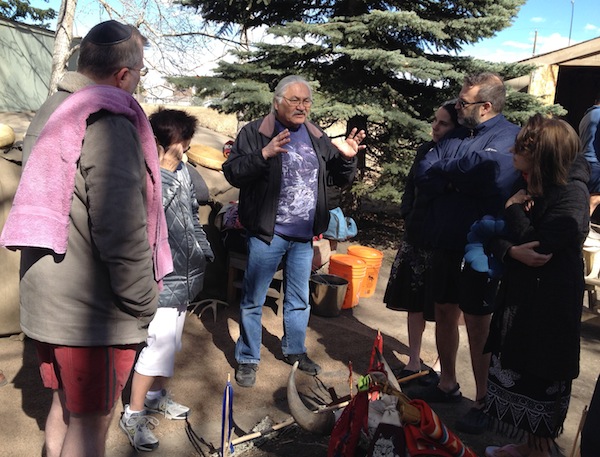
photo - Casey Eagle Speaker welcomes Beth Tzedec’s interfaith learning group to a sweat lodge
Casey Eagle Speaker welcomes Beth Tzedec’s interfaith learning group to a sweat lodge. (photo from Shaul Osadchey)

In 2014-2015, the synagogue focused on aspects of First Nations spirituality, inviting Casey Eagle Speaker and another teacher to give lessons on their culture.

“The year ended with a sweat lodge we went to, for us exclusively,” said Osadchey. “Afterwards, we sat around and passed the peace pipe together. People really learned a lot from that, as native spirituality is an oral tradition mainly. These are customs passed on and taught – sundance, sweat lodges and so forth – but they also have a very interesting perspective about the creator, nature and the role of people in terms of building community and families. That was quite eye-opening.”

This year, with all the new connections the synagogue has made with the Muslim community, they decided to focus on Islam.

“We didn’t start with Islam and we didn’t start with Christianity, because people probably would have said, ‘Oh, I know everything I need to know about Christianity, so I’m not going to show up,’” said Osadchey. But it was time to get to Islam, he said. “The next two years are going to be Hinduism and Buddhism.”

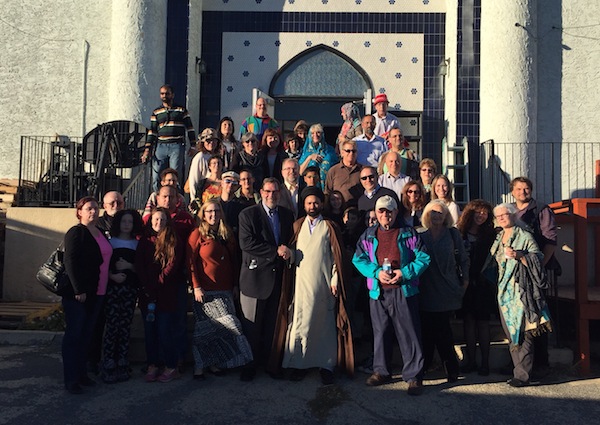
For Islam, the congregation selected Imam Syed Hadi Hasan of the Shia branch of Islam, who has a long history of interfaith work.

“What we did, however, was to respond to some of the naysayers and the skeptics by inviting a Jewish rabbi/scholar from L.A. after the imam had given about three lectures, and then we had Dr. Reuven Firestone come and speak,” said Osadchey. “He’s written books on Islam for Jews, about what Jews should know about Islam and what Muslims should know about Judaism. He’s very active in Muslim-Jewish dialogue. He came up and gave us a weekend of four lectures on different aspects of Islam and how we approach it. We invited our Islamic friends to come and many did. And, they were very impressed by his scholarship and knowledge of the Koran and so forth.”

At Chanukah time, the synagogue invited three imams to share their thoughts on religious freedom and join in the lighting of the chanukiyah, along with the rabbis. At the end, they all held up letters that spelled the phrase, “We refuse to be enemies.”

Osadchey said, “It was a powerful moment and brought Chanukah and the whole meaning of respect into a much different perspective.”

photo - Imam Syed Hadi Hasan, right centre, takes Rabbi Shaul Osadchey, left centre, and some congregants on a tour of his mosque
Imam Syed Hadi Hasan, right centre, takes Rabbi Shaul Osadchey, left centre, and some congregants on a tour of his mosque. (photo from Shaul Osadchey)

This March, the synagogue initiated the program Our House is Your House, which will be profiled in a future issue of the Independent.

Although Christianity is not one of the religions studied in the first five years of the program, the synagogue hopes to continue with a sixth year focused on Christianity. The program so far has been beneficial.

“It has given people permission to go out into the community and do things in a way they may have been hesitant to do before,” said Osadchey. “They have more confidence that they have the knowledge and the literacy to engage people.”

The scholars, too, gained much from the experience. “I was thrilled and amazed at that request and immediately accepted it,” said Hasan. “And I did my best to teach about Islam and answer all the questions from the participants of the five sessions I was part of.

“In the first session, participants were not very comfortable…. They were friendly, but they were a little bit formal in the beginning … but, gradually, we developed a friendship.”

Hasan is planning to bring Judaism into his mosque in a similar fashion, calling Beth Tzedec’s method “perfect and brilliant.”

He said, “We will be inviting Rabbi Osadchey for probably three to four sessions and he will be introducing Judaism…. When we are ignorant, when we don’t know each other, definitely, we have a lot of misconceptions. We are going to bring knowledge and awareness, and show that we are almost the same. We all work for the welfare of humanity and the universe. In this sense, we all are the same. In doing these programs, we are promoting peaceful coexistence and we are bringing harmony and unity within our communities.”

Speaker, who is a member of the Blood Tribe, which is part of the Blackfoot Confederacy in Alberta, echoed Hasan’s feelings, mentioning he found the experience very valuable.

“I enjoyed the hospitality and the openness that the people had,” said Speaker. “The congregation was very open in mind, body and spirit, very open to listening, to understanding who we are as a people, as indigenous people, and about the concerns or issues prevalent in society. They showed me a hunger to learn and to create an understanding, rather than just knowing.

“In our culture, we share openly to create an understanding and come together as human beings, rather than being separated by race, creed, color and religion. Those don’t work. We’ve seen the conflict that those create.

“They shared with me. They felt safe. They didn’t feel threatened. It felt more like family and how we do … the openness of sharing and expressing kindness, generosity and acceptance of each other was something they really came to be accustomed to. And, our style of ceremony, going into prayer and stuff like that, it’s so heart-warming.”

Rebeca Kuropatwa is a Winnipeg freelance writer.
Format ImagePosted on April 15, 2016April 13, 2016Author Rebeca KuropatwaCategories NationalTags Aeriosa Dance Society, Beth Tzedec, Calgary, interfaith
Kids4Peace keeps growing

Kids4Peace keeps growing

Kids4Peace youth present religious items to friends at an interfaith session. (photo from Kids4Peace)

Kids4Peace (K4P) started in 2002 as a two-week summer retreat/camp in the United States for 12 kids: four Muslim, four Christian and four Jewish. It is now a global movement that works year-round to “break down stereotypes and foster supportive, mature friendships rooted in spiritual values of equality and respect.”

K4P was the brainchild of a Vermont Christian, Dr. Henry R. Carse, who, at 18, left the United States, not wanting to be drafted into the Vietnam War. He moved to Israel and became a citizen. Having done his mandatory service in the Israel Defence Forces (IDF), he served in the IDF during the First Intifada (1987-1993). By the time of the Second Intifada (2000), he had been in Israel for about 30 years, was married and had four children. He wanted things to change so, with the help of some American friends, he created K4P, and the first camp took place in the States though Carse lived in Israel.

In 2004, Yakir Englander joined the organization as a volunteer. He did so for a few reasons.

A student at the time, Englander had grown up in Israel’s Bnei Brak area in a modern, Chassidic family. However, he left the Orthodox community at the age of 22.

“I decided to leave my community with a lot of love … some criticism, but mostly with love, and a huge desire to find more ways to be connected to spirituality and the divine,” he said.

When he left orthodoxy, he was drafted into the IDF, serving in an educational capacity, later spending most of his reserve time in a unit that had to identify dead bodies.

In his first month of studies at Hebrew University, in Jerusalem, in 2002, a bomb exploded and he found himself carrying the bodies of students, some of whom were American. He said that he felt lost, as did “many other Israelis,” feeling that the way toward change was through meeting with Palestinians.

“I went to a few meetings with different organizations,” he told the Independent, “but what I felt was that there’s this huge criticism of Israel in words and language that blames me. Yet, I didn’t have an opinion…. I didn’t know. It wasn’t just because I was Orthodox in the past. At the end of the day, there are many things we don’t know and also life is much more complicated.

“Another thing is that religion is always blamed as the reason for the conflict. For me, my religion was a source of love, a source that gave me energy, a source that gave me courage to go meet with Palestinians.”

When Englander heard about K4P, he joined as a Jewish advisor, and then later as a director until 2012.

Englander found it intriguing that two-thirds of K4P participants are Palestinians, both Muslim and Christian. “The fact that they are the majority in K4P, in a way, gives them the first opportunity to be in the majority,” said Englander. “This created new sets of power of dynamics, which are very interesting.”

About K4P’s goal, he said, “I think, today, when we hear the word ‘Islam,’ some people hear ‘ISIS.’ When some hear the word ‘Judaism,’ some people think ‘settlements.’ We want to change that.”

The transition is difficult, however, said Englander. He said some of the kids lose their bearings after the experience. “They no longer knew what to do or how to act, as they no longer hated Israelis or Palestinians,” he said.

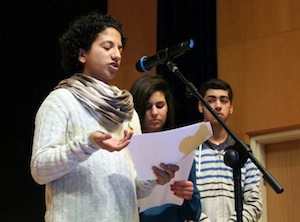
photo - Kids4Peace youth speak at annual Kids4Peace winter event
Kids4Peace youth speak at annual Kids4Peace winter event. (photo from Kids4Peace)

In 2006, K4P changed to a year-round model. Throughout his time there, Englander continued his studies, culminating with a PhD in gender studies, sexuality and Jewish theology. His schooling led him to Northwestern University. He became a Fulbright scholar, and spent a year as a visiting professor at Harvard Divinity School.

“During these years, I served as a vice-president for K4P International, working a lot on creating connections with many moms, rabbis, priests, government people, and doing a lot of lectures all over North America, including Canada,” said Englander.

Last year, Englander, together with the board, decided to end his term as vice-president to instead lead K4P graduates. Englander created a new program for 18-to-25-year-olds, working with them to shift from a dialogue-only model to a dialogue-to-action one.

“The idea with the kids and teenagers is we do a lot of dialogue and volunteering and other things in between, but we can’t put them at risk,” said Englander. “But, if you really want to create change, you must take some risk. So, dialogue-to-action is an answer for these needs.”

Children join K4P in Grade 6 for a six-year program with summer camps along the way. “It’s amazing to have two weeks together, but they work all through the year for six years, so it’s a very long process,” said Englander. “Because of this, it lets us dig deeper with them, step by step, in the conflict.”

For now, the program in Israel only operates in Jerusalem, due to financial constraints.

“Last year, the U.S. Institute for Peace gave us a very nice amount of money, so we have enough now for all the families who join K4P,” said Englander. “When the kids have a meeting, the parents, too, must come.

“We now have chapters in eight or nine cities around the world, with some [others] in the process of establishing chapters. Each one has two therapists, Israeli and Palestinian, who do the full journey with the parents and kids. So far, Toronto is the only Canadian chapter, but we also have [groups] in Houston, Seattle, New Hampshire, Vermont, Atlanta and a new one in Lyon, France.”

The Israeli chapter currently has about 150 kids, with the capacity to add another 65 new kids and their families this year.

“Hopefully, by next year, we’ll grow by 80 new families,” said Englander. “But, we also need to take into account that we are building a new program for 18-to-25-year-olds, with 15 amazing, serious young people. Some of them are graduates from K4P and some have parents who would never [have] consider[ed] sending them for K4P – settlers who grow up in settlements – [but] something very deep broke in them last year.

“It’s important for us that people will see Palestinians and Israelis together, hand in hand, helping in hospitals. But now, with the young adults, we want to take it further.”

Englander said that, in today’s situation, Israelis and Palestinians do not generally mix in public places. But, on Feb. 29, he said, K4P challenged that reality, having these young adults meet in a public space in Jerusalem.

“So, this group of people with a lot of courage decided they [were] going to do it,” said Englander. “Half of the meetings are going to happen in public spaces … that we choose very carefully … spaces where normal people from east Jerusalem and west Jerusalem are going to see them in their public space – Palestinians and Israelis together, body next to body, and dealing with the crucial, most important questions.

“We are planning to record and share these meetings,” he continued. “It’s very important to bring the voices and pictures to the world, to see how Muslims are opening themselves, how Jews are opening themselves – so they can see that it’s not just shalom/salaam, they care about their Jewish identities, their Muslim identities, their Christian identities … though they struggle with that, they still decide to work for peace.

“It’s a huge responsibility,” he said, “And, I will be honest and say that we feel a failure sometimes, thinking why didn’t we reach out to all the kids of Jerusalem and offer them this opportunity.”

Rebeca Kuropatwa is a Winnipeg freelance writer.
Format ImagePosted on April 15, 2016April 13, 2016Author Rebeca KuropatwaCategories IsraelTags Englander, interfaith, Israel, K4P, Palestinians, peace
Finding joy in food and art

Finding joy in food and art

Talia Syrie (photo from Talia Syrie)

In 1999, Israeli-born longtime Winnipegger Talia Syrie spent her summer working as a tree planter in British Columbia. Trained as a heavy diesel mechanic, she was tree planting to pay off her student loans. A month into the summer, Syrie stepped on some broken glass and injured herself. Not yet ready to leave, however, she found work in the kitchen, helping feed 90 planting staff.

“I kind of endeared myself to the kitchen staff and they let me stay on,” said Syrie. “I realized, doing that, that I really enjoyed it, really liked cooking. I came back to Winnipeg and did that for the next year or two.

“I really liked the bush-camp cooking experience, when you’re out in the middle of nowhere and you don’t have the resources available to you that a regular kitchen provides. I liked that challenge.”

With this newfound passion, Syrie started working in the catering world. Then, a friend suggested that she open her own catering business.

With that, Syrie began searching for a commercial kitchen from which to work, eventually finding a small one at a downtown hotel. The owner offered her the kitchen, as long as she also agreed to open a restaurant at the hotel.

“There wasn’t anything like that in the neighborhood, on Main and Logan,” said Syrie. “It’s now the Red Road Lodge, but it used to be the Occidental Hotel. I had grown up in the North End, where my grandfather on my father’s side had a business. Today, too, I live quite close to there (in North Point Douglas).

“It felt nice to be working in that neighborhood, I was happy to do it. I didn’t really think that anyone would come into the restaurant. I thought it was going to be mostly for show and then we’d run the catering company and have this ‘fake’ restaurant.”

When Syrie first opened the Tallest Poppy, they only had three or four tables. As it turned out, these tables were always occupied, so they had to add more. In no time, the restaurant was so busy that Syrie did not have much time for catering.

“It was very challenging at the beginning, the restaurant industry,” she said. “Having little to no restaurant experience, there was a pretty steep learning curve. It was exciting and there was a lot of fun and a lot of things were great, but, in a lot of ways, it was pretty messy.

“I always say that I’m really grateful that we started out where we did. The North End is pretty forgiving, pretty gentle with us, so we were able to make mistakes and learn things.”

After a few years, Syrie found enough time to start developing the catering part of her business, doing office lunches, barbeques and small parties. “We also cater a lot of funerals,” she said.

“I love making party sandwiches,” added Syrie. “If I could do anything, I’d probably just make party sandwiches. That would be my dream job. I like the practical nature of a lot of catering. You have a whole bunch of people and they have to eat, people working that have to be fed.”

Syrie said her primal drive to feed people has its roots in her Jewish upbringing, being taught at an early age that the only way to really show someone you care is by feeding them.

“That’s the only way that really counts,” she said. “You buy somebody a car, it doesn’t matter. If you make them soup when they’re sick, that’s how they know you actually love them.”

About three years ago, a new community marketplace, Neechi Commons, opened in the neighborhood. The owners asked Syrie for help setting up their restaurant. She agreed, as she was happy to help a worthwhile project in her neighborhood. She ran both places for awhile and, later, decided to close the Tallest Poppy.

Once the Neechi Commons restaurant Come ’n Eat was up and running, Syrie opted to move on. She returned to British Columbia to do some consulting work for a friend and then returned to Winnipeg to find a new location to reopen the Tallest Poppy.

“I was walking down Sherbrook Street with a friend one day,” said Syrie, “and, as we were passing by the Sherbrook Hotel, he said, ‘I think that’s a restaurant … I think you should check that place out.’ All the blinds were shut. My friend said it used to be a Chinese food restaurant, but that there is nothing in there now…. I called and made an appointment to come down and take a look. The rest is history, as they say.”

Syrie reopened the Tallest Poppy in its new location last September. Not knowing the neighborhood well, she did not know if her concept would be a good fit, but she has found the people to be very welcoming, generous and kind.

Wanting to give space to the arts community, Syrie has offered her restaurant walls to local artists.

“I don’t know if I support the artists or they support me,” she said. “It’s important to me to have art around me all the time. It makes me feel better. It’s kind of selfish. The Winnipeg arts scene is so exciting. I work a lot and I’m stuck in my restaurant a lot of the time. I can’t always get out to gallery openings or go to shows. It’s really convenient for me to have them come do it right at my place.”

Syrie has formed a connection with a local company that displays art in public places, called Synonym Art Consultation, and the company organizes and programs all the restaurant’s art-related happenings. This includes a residency project that brings in an artist once a month to the restaurant to create art in the restaurant, while also interacting with clientele. “They are these super people doing this wonderful work,” said Syrie. “We sort of ride on their coattails. I’m very privileged and honored that they’re willing to work with us.”

The artists are varied, and some are performers.

“They come for two to three days, generally on the weekends, and people are able to engage them, which is a lot of fun,” said Syrie. “So, regular people having breakfast can come and talk to the artist about the work they’re doing.

“The artist has an opportunity to engage a lot of people they may not normally have access to. Their work is shown in the restaurant for a month, whatever it was that they built or did.”

The Tallest Poppy also hosts an after party on the first Friday of every month for people who go from gallery opening to gallery opening, including food and an arts presentation with DJs.

“A lot of things about Winnipeg make it really hospitable for independent business,” she said. “Our economy is pretty stable and there’s a bunch of hardworking people who are generally pretty down with jumping on board if you have a good idea. If I was going to do something else, this is the only place that makes sense for me to do it.”

Rebeca Kuropatwa is a Winnipeg freelance writer.
Format ImagePosted on April 15, 2016April 13, 2016Author Rebeca KuropatwaCategories NationalTags restaurant, Syrie, Tallest Poppy, Winnipeg
On becoming a great leader

On becoming a great leader

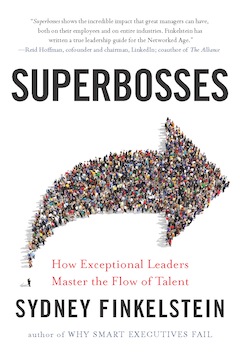
Sydney Finkelstein’s most recent book is Superbosses. (photo from Penguin/Random House Canada)

While the target audience for Sydney Finkelstein’s newest book, Superbosses: How Exceptional Bosses Master the Flow of Talent, is businesspeople, it is clear that his ideas carry well into many aspects of life, not just work, and not just business.

Finkelstein, who is a professor at the Tuck School of Business at Dartmouth College in Hanover, N.H., is originally from Montreal. He has authored 21 books and more than 80 academic articles.

“Pretty early on, I was interested in why people did what they did and in people who seem to have a lot of power and influence in society,” said Finkelstein. “I was actually very interested, and still am, in not just business leaders, but political leaders.”

Ten years ago, Finkelstein struck a note with his book Why Smart Executives Fail, and he was invited to give keynote speeches and to consult for several companies.

“Everybody pretty much had the same question, which was how to avoid getting into my sequel,” he said. “In the book, I talked about a lot of things you could do to avoid falling into the trap that led to failure but, over time, I came to realize that there was something else more important – the ability to generate and regenerate talent on a continuous basis. That’s the only way to survive and thrive in the long-term.”

After coming to this realization, Finkelstein set out to learn who possessed this ability. This is what led him to learn of those he came to call “superbosses.”

cover - SuperbossesThe Jewish Independent spoke with Finkelstein around the time of his March 8 talk and book signing at Concordia University in Montreal.

“The big difference was the ‘why smart executives fail’ leaders look at people around them – other managers and team members – as people to be used and exploited for their own purposes…. They didn’t really appreciate the fact that the people around them – team members – are actually probably the most important part of what you are doing, because they help you get better.”

Superbosses, on the other hand, wholly prioritized the idea of having great teams and great organizations of great people, understanding that this is the best way to succeed, he said. “The WSEF leaders didn’t understand that. So, that’s a gigantic difference in mindset – thinking about other people and what role they can play.

“Then, when you look at the details of how they run their businesses, there are many, many differences – from how they identify talent, to how they motivate people, how they develop teams, the role of vision and [of] inspiration.”

While most leaders, good or bad, carry with them a certain amount of ego due to their previous endeavors’ successes, Finkelstein said superbosses find ways to put that ego aside.

“This may be the best first thing for people to work on – having a degree of humility about yourself, your own accomplishments and your own personality even,” he said. “Humility doesn’t mean you’re afraid to take on challenges. It means you understand that there are other people who play a role and that you can’t let your ego run away with things.

“By the same token, listening is one of the most important managerial skills I’ve ever seen – the ability to really listen, to understand, not to critique. A lot of people are listening to find a flaw in their argument or to justify a point of view they already have. I’m talking about listening that’s designed to learn something. That’s a tremendous skill and mindset.”

Another important skill Finkelstein advised honing is open-mindedness, ranked highly with its close cousin, curiosity. These are attributes he regularly discusses with boards of directors and management teams.

“You need to have that curiosity about life, about what you’re doing,” he said. “When you have curiosity, you’re asking why a lot. Kids do that, but when we’re older, we don’t do that so much. You learn so much more by doing that.”

Courage is on the list, too – the kind of courage that challenges convention, and the ability to raise your voice when something is not going the way you think it should. “This doesn’t mean you’re going to win the argument or get your way,” said Finkelstein. “It’s about trying to improve the eventual outcome or situation you’re in.

“Many people often remain silent. They just nod their heads. As a result, they’re not engaged in what’s going on. Later, they spend their time complaining and back-biting, rather than being part of the solution. Sometimes, of course, managers or leaders create an environment where, if you challenge, you get punished, so it can be difficult, but I think courage is a critical factor.”

The next item on the list is accountability – recognizing you need to be responsible for your own actions and behavior, as well as instilling a sense of accountability in others.

“I think, by the way, that most people prefer not to be held personally accountable,” said Finkelstein. “I don’t think people should assume people would automatically be accountable. I think people enjoy it when it happens, but they don’t automatically do it. This is particularly relevant in volunteer organizations.

“Being a teacher, a nurturer of talent, is something anyone can do, no matter what their job is,” he continued. “You don’t have to be a famous CEO. You can be an average person doing whatever you’re doing. But, if you spend some time and energy acting to help others get better, often through teaching, sharing and listening … I think that’s a giant differentiator and extremely meaningful in people’s lives. If you have an impact in helping other people, it makes you feel good, too.

“Younger people, earlier in their career, who are ambitious, have high expectations, want to accomplish great things. How do you find people to work with, to work for? I talk a little about that in the book, but I also think that trying to work for someone who is more like a superboss, rather than less like one, is a great way to learn, develop and accelerate your career.”

As the book’s subtitle suggests, Finkelstein sees managing the flow of talent as one of the most important things for superbosses to do, and he segments this aspect into three categories.

“One is finding good people,” he said. “Everyone needs to hire when you’re growing, you need to hire and find people…. That’s the first stage in this flow of talent.

“The second stage, which not everyone engages in, is developing that talent, helping them get better. That’s managing the flow of that talent in a team/organization for a number of years.

“The third stage is managing the flow of talent sometimes even outside your own region, division or role in the company. Very few managers, leaders or bosses think a lot about … how they should manage people out of the organization. I’m talking about good and very good performers.

“The typical assumption among most leaders is to keep those people forever,” he said. “But, those who work for superbosses, people that really enhance their skills or have this vision, they won’t be satisfied with that small piece of pie. They want a bigger role themselves so, in fact, many of them will end up wanting to leave anyways. Managing the flow of talent should also consider this kind of radical or counterintuitive idea – managing people out of the company itself.”

Finkelstein said, “The best people know they will move around, look for those opportunities. If you know that will happen, the questions become how can you take advantage of that, how can you be strategic in that, how can you create a win-win out of that situation?’ That’s what superbosses do. They make a spinout business. One example from the book is the Hospital Corporation of America (HCA). The CEO used to create big opportunities for senior executives who were going to leave anyways. He would create a spinout company in a mental health clinic, surgical centre or what have you. That former team member would be given the opportunity to be CEO of that spinout business but, because you’re doing the spinout, you get to participate in a financial sense.”

To see where you sit on the superbosses scale, Finkelstein invites readers to visit superbosses.com and take a 10-12 question quiz.

“The quiz is because people find it interesting to see how they rank,” he said. “The book can help them get better.”

Rebeca Kuropatwa is a Winnipeg freelance writer.
Format ImagePosted on March 25, 2016March 24, 2016Author Rebeca KuropatwaCategories BooksTags business, Finkelstein, leadership, superbosses
Kashua talks at U of W event

Kashua talks at U of W event

Sayed Kashua spoke in Winnipeg as part of the University of Winnipeg’s annual Middle East Week. (photo by Rebeca Kuropatwa)

On Feb. 25, as part of the University of Winnipeg’s annual Middle East Week, about 75 people came out to hear what guest speaker Sayed Kashua had to say on the topic The Arabs in Israel: The Inaudible Cry for Full Citizenship.

Born and raised in Tira, Israel, Kashua is an author and journalist. His three novels – Dancing Arabs, Let it Be Morning and Second Person Singular – have been translated into English, with the stories of his first and third novels being combined to become the film Dancing Arabs. Among other things, he is the creator of the Israeli TV show Arab Labor and the subject of the documentary Forever Scared. His 2013 talk in Vancouver sold out.

At the recent Winnipeg event, Global College executive director Dean Peachey and U of W president Dr. Annette Trimbee welcomed Kashua and the audience to the U of W’s Eckhardt-Gramatté Hall.

Kashua moved with his family to Champaign, Ill., a year and a half ago, finding the “noise” in Israel too distracting.

“When we arrived,” he said, “I taught my kids two things: that people here stand in line and that, if you’re asked where you’re from, just say you’re from Jerusalem … and, according to their response, you’ll decide if it’s east or west.”

When Kashua enrolled his kids at school, he found himself stumped by the forms when he came to the question about race, as Arab was not listed.

“I almost checked off ‘other,’ but I was so worried about losing my visa within three days of landing in the States…. I almost signed my kids as Asians, because I can easily prove that Jerusalem is part of Asia…. I didn’t know what to do. I raised my hand and the nice lady asked how she could help. I said I don’t know what my race is. She asked where I was from. I said Jerusalem. So, she said that I’m from the Middle East … so, I’m ‘white.’ That was the point that I knew I loved Champaign.”

For the first time, Kashua was part of the majority.

It was not until he went to the United States that he was asked about Islamophobia. As a secular Muslim, he had to think about the question, and he decided that the more important aspect to him was his nationality.

However, he recently found out at a parent-teacher meeting that his son was going to prayer. Kashua asked the teacher which religion or faith his son was following.

“The teacher said, ‘What do you mean? [He prays] with the Muslims. You are Muslims?’

“I said, ‘Yes, but I had no idea that my son prays.’ It was shocking for us, how the majority defines you, and how my son who is only 10 already realized he belongs to the group of Muslim kids in their school.”

Kashua then spoke of his greatest influence in becoming a writer – his illiterate grandmother who had lost her husband in the Israeli War of Independence.

“She was illiterate, but she was intelligent and sharp,” said Kashua. “She always told me bedtime stories. Maybe writing for me is just [a way] to keep telling myself bedtime stories. She told me wonderful stories, sometimes fairy tales. A huge part of her stories were about the war.”

According to Kashua, most Palestinians who became citizens of Israel after the war – farmers and those who remained in their villages – were or are illiterate.

“In 1948, most Palestinian villages, especially on the shore, were demolished,” he said. His grandmother had stories about her husband, “who was shot in the war, killed in 1948.” Kashua’s father was born in 1947, “so he was less than 1-year-old when his father was killed.

“She told stories about how she was trying to protect her son, sometimes running in the wheat fields, trying to cover him, when the bullets were whistling around her … escaping to the mountains,” said Kashua. These were, he added, “my childhood stories, and, to me, it’s history. It was never part of our education system, we belong to the Israeli education system. We are Palestinians, but also Israelis … became Israelis after the war of 1948. The war is never mentioned in our history books.”

It was not until after the war that Kashua’s grandmother learned that she no longer had land. To his family, he said, that was a bigger loss than losing their house.

“My grandmother, who used to have a lot of land, became a worker, picking fruit for Jewish bosses, sometimes in her own private land, picking fruit in fields she planted herself,” said Kashua. “That’s a very strong feeling I received as a boy, about being a refugee.”

When Tira became part of Israel people received Israeli citizenship. They lived under a military regime he said, until 1966, just a few months before what he described as “the occupation of the West Bank,” noting that “the military regime meant you couldn’t leave your village without permission from the military officer in charge.

“My father was telling us [that] only on Israeli Independence Day, you didn’t need a permit. Kids would jump onto trucks to go to another town, just to see, for a chance to go out. Of course, they were forced in their schools to celebrate Independence Day with Israeli flags.”

Even today, according to Kashua, conditions are different in east Jerusalem than in west Jerusalem. He said that Palestinian Israelis do not have equal rights, and are discriminated against in all aspects of life.

With Tira’s population at 25,000 now – growing from 1,500 in 1948 – Kashua said that poverty and crime there is hard to control.

“Maybe, at the beginning, people wanted to defend our identity, language, culture and tradition, but that’s no longer the case. We are trying to escape the ghetto, but there are so many laws that forbid us to do so. That’s the situation, you are completely segregated.”

Kashua described Israel as an “ethnocracy.”

“It’s democratic only if you’re Jewish,” he said. “If democracy is judged by how it treats minorities, Israeli democracy is facing a very big problem with the Arab minority…. We are still considered a national threat, a demographic problem.

“If you look at the history, you will see that, since 1948 until now, it was very rare that Arab citizens of Israel were activist against or being a real threat to the security of Israel. All Israelis know that reality and they know we are completely discriminated against when it comes to all aspects you can think of – land, the ability to move from your village. The sad thing is, sometimes the slave feels like he needs the master more than the master needs the slave. You have no idea how strong of a feeling it is when you don’t have even the ability to dream.”

Kashua was fortunate to find a Jew willing to sell him an apartment in west Jerusalem. They were the only Arab family living there and this was one of the reasons they moved to the United States.

Kashua believes that Palestinians want to be citizens of Israel and that they do not want to destroy the state, but they do want equal rights, as well as acknowledgement for the suffering they feel they have endured since 1948. This is something Kashua does not see as possible with the current leadership in Israel.

Rebeca Kuropatwa is a Winnipeg freelance writer.

Format ImagePosted on March 18, 2016March 16, 2016Author Rebeca KuropatwaCategories IsraelTags Israel, Israeli-Palestinian conflict, Middle East Week, peace, Sayed Kashua, University of Winnipeg
Examining the cosmos

Examining the cosmos

Prof. Victoria Kaspi, winner of the 2016 Gerhard Herzberg Canada Gold Medal for Science and Engineering. (photo from McGill University)

McGill University Prof. Victoria Kaspi – the first woman to win the Gerhard Herzberg Canada Gold Medal for Science and Engineering – says that her Jewish background and her parents’ support have had a lot to do with how much she has accomplished.

“Questioning is so inherently Jewish,” she told the Independent. “I think this builds personality, skill, and derived pleasure from talking and thinking. Jews are very studious, loving the books. For some people, it’s the Torah; for others, it’s different types of books … just really enjoying the process of studying, thinking and analyzing. I think that’s what my Jewish background has brought to my work.”

Neither of her parents were scientists. “I just really like it,” she said. “I grew up loving math. My parents were pretty hands off and they certainly never discouraged me. I was sort of an oblivious kind of kid, so if there were cultural signals that I shouldn’t go into science, I must have missed them.

“I think my parents built up my confidence. They never questioned my decisions. When I said I want to go into science, they never asked why I’d want to do that. They used to buy me lots of math toys and puzzles as a kid. Probably my mom encouraged me. She used to play lots of games with me.

“I’m sure I had encouragement from teachers along the way and family as well,” she added. Describing science as “always a great love,” she said it was neither forced on her or strongly encouraged as a study or career path. But Kaspi is aware of the societal pressures on women to not go into science, especially now, with her own daughters.

“They are sometimes subtle and pointing them out can be petty, but when you notice them as an overall trend – where there’s lots of little, tiny subtle signals that, in the end, register very large – I think that needs some work,” said Kaspi of the pressures. “Why I didn’t suffer from that? I’m not sure. I’m hoping that this will improve with time.”

Kaspi uses radio and X-ray telescopes to examine the behavior of neutron stars, using the cosmos as a lab to study the nature of matter in extreme environments.

“The sort of work I’ve done has involved different types of neutron stars,” said Kaspi. “One, in particular, that I’ve done is magnetars, which are neutron stars with very high magnetic fields. They sometimes explode randomly and are just really interesting to study. But there are other things, too.”

photo - A satellite picture of the island of Montreal with an illustration of a neutron star for comparison. While relatively small, neutron stars are so dense that just one teaspoon would weigh about a billion tons
A satellite picture of the island of Montreal with an illustration of a neutron star for comparison. While relatively small, neutron stars are so dense that just one teaspoon would weigh about a billion tons. (photo from NASA)

Neutron stars are stars that have collapsed and are very dense. A black hole is a star that has collapsed onto itself, due to gravity being so strong that nothing can escape from the surface, not even light; hence, the name, black hole. Neutrons are close cousins of black holes, but some light does escape from them.

“The typical neutron star has as much matter in it as half a million planet earths, but is crushed down to the size of a city,” said Kaspi. “We think a typical diameter of a neutron star is something like 20 kilometres.

“If you’ve crushed all that matter into the size of a small city, you have matter that is extremely dense. If you went up to a neutron star with a teaspoon and you took a teaspoon of the matter, it would weigh something like a billion tons.”

Kaspi said, “We don’t understand the physics of it very well, and that’s one of the things we are hoping to learn by studying them. When studying these objects, we use very powerful computers and algorithms, digital signal processing, there’s a lot of hard work and managing of big data.

“People who study pulsars are snapped up by software companies, because they are really good at developing algorithms, thinking out of the box and finding creative solutions to big data problems.”

Pulsars are rapidly spinning neutron stars and emit a bright beam of light. They are observed through their flashes. If you wanted to go flying around the galaxy and needed a useful, simple way to know where you are, you could use a pulsar. “They all pulse very regularly,” said Kaspi. “You can use that to know where you are in the galaxy and which direction you want to go.”

Kaspi’s research group has used neutron stars to confirm Albert Einstein’s theory of general relativity.

“As scientists, we don’t believe just because a theory is beautiful, it has to be right,” she said. “You have to test it with experiments. These neutron stars allow you to do phenomenal tests of general relativity. Was Einstein right or not? There are other theories of gravity and we can test those, too.”

One of the biggest projects Kaspi is currently working on in Canada is the building of the Chime Telescope in Penticton. She is also looking into “fast radio bursts.”

Of this phenomenon, Kaspi said, “It’s something that’s a big mystery right now that we don’t understand. Astronomers are pretty puzzled over these things. They are very short, a few milliseconds, bursts of radio waves, little blips in the sky that go off randomly but frequently. We think a few thousand go off across the whole sky every day. The first one was discovered a decade ago. Until now, only about 20 have been recorded.”

Kaspi has earned international recognition and numerous awards for her work over the years. As for receiving the Herzberg medal, she said she feels honored, and added, “I may be the first [woman] for this prize, but I won’t be the last. There will be many more women in the future.”

Rebeca Kuropatwa is a Winnipeg freelance writer.
Format ImagePosted on March 11, 2016March 10, 2016Author Rebeca KuropatwaCategories NationalTags astronomy, Einstein, Herzberg medal, Kaspi, McGill, neutron star

Posts pagination

Previous page Page 1 … Page 20 Page 21 Page 22 … Page 31 Next page
Proudly powered by WordPress