Throughout her long career, award-winning artist Lilian Broca has tried many styles and various media, but, over the years, her main theme crystallized: the power of women. Her current show at the Zack Gallery exemplifies this theme.
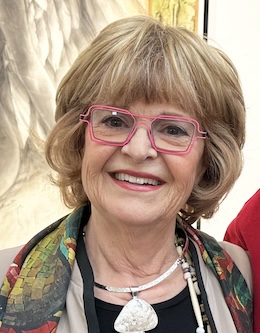
“I studied abstract art at university and worked in it in the beginning,” Broca told the Independent. “In the 1960s and 1970s, abstract art was on the rise; figurative art was considered commercial, and it wasn’t a compliment. I worked in the abstract style, but it didn’t speak to me. There is no humanity, no emotions in the abstract. I wanted human figures, and I started introducing them into my paintings, but disguised with overlayed belts of colours. The figures were invisible, but they were there.”
Broca’s tendency to work against the established mode started that early. Then she got married and had her first son. After being immersed in diapers for months, she had a revelation. “I realized that I would never be on the cover of Time magazine,” she said. “I might as well paint what I wanted. I started working in a realistic style and never looked back. And, of course, after having a baby, I wanted to paint women. I wanted to explore their place in our society.”
Biblical women – Esther, Judith, Mary Magdalene – became the focal point of her art. She wanted to analyze their stories, to see them through new eyes. “Everyone knows their names, but I’m a storyteller,” Broca said. “My paintings always tell a story, and they always have an unexpected twist, an aspect nobody else ever painted. I do lots of research for my works, as I want to show those women as powerful in their own right.”
Broca’s love of mythology contributed to her selection of topics, but she has always been attracted by feminist ideas, too. It is no surprise that she was drawn to the myth of Lilith, which firmly resides at the intersection of mythology and feminism.
Before the Lilith works, Broca painted a series of angels. To do so, she studied the anatomy of a wing. “Wings are difficult to draw,” she said. “Once, I was in Seattle, participating in a show, and I saw a real wing from a bird – a raptor maybe – in a hunting shop, alongside guns. I bought that wing and studied it. All the Lilith wings are based on that one wing. I still have it at home. It looks so old and sad now.”
After learning about the Jewish-American feminist magazine Lilith, Broca recalled, “I was intrigued. I decided to study the story of Lilith. Both Lilith and her counterpart, Eve, are two central female figures in Christian and Judaic origin stories, which are very important in any society – the origin story always sets the place for both men and women in any culture,” she said.
Broca found that not much was known about Lilith. “She is not in the Bible. I needed to dig deeper, to find other sources. I read Midrash and the medieval text The Alphabet of Ben Sira.”
She started working on her Lilith series in 1993. “From that time until 2000, when I painted the last one, I made 58 large drawings. About half of them were sold during various exhibitions. The rest, I put in crates, until Sarah Dobbs from the Zack Gallery contacted me. She thought that the theme of Lilith was experiencing a revival nowadays and wanted to show my series at the Zack. The current exhibition includes 16 mixed media paintings of that series.”
The series traces Lilith’s journey in two senses: historical and symbolic.
“In early traditions, Lilith is Adam’s first partner. They were created equal at the same time by God,” Broca explained. “But Adam wanted dominance, and Lilith refused to submit. She ran away, choosing self-imposed exile over subordination and obedience.”

Broca’s drawings, richly detailed and infused with light and shadows, follow Lilith on her difficult quest toward autonomy and freedom. “In ancient times, leaving your community was often a death sentence,” Broca explained. “Exile was a punishment, as the outside world was usually hostile. But Lilith had to go. She had to brave the unknown dangers, because her independence was paramount to her.”
Patriarchal society couldn’t let it stand. “The authorities didn’t wish Lilith to become a role model for young women, so they turned her into a demon,” said Broca. “They portrayed her as an evil temptress, to be feared and reviled, while she only wanted her emancipation.”
That’s why the legend of Lilith was so important to Broca. She wanted to re-evaluate the story from a modern perspective, to show Lilith as a composite heroine in the middle of mythology, theology and contemporary feminist discourse.
The contrast between Lilith and Eve is glaring in Broca’s version of the tale. While Eve is obedient and nurturing, Lilith stands as rebellious and free, bowing to no one. “We, modern women, are a mix of Lilith and Eve. Not one or the other but both at once,” Broca said.
Broca’s high school friend, cellist Kristine Bogyo, produced a multimedia performance involving classical music, poetry and Broca’s images of Lilith. Bogyo’s A Song of Lilith, which premiered in 2001, fused music by Larysa Kuzmenko, poetry by Joy Kogawa and Broca’s images. “We toured for a few years in several Canadian cities,” said Broca.
After Lilith, after 2000, Broca started working on large panels, telling new and equally as inspiring stories of biblical women in the ancient medium of glass mosaic. She continues to reach for other creative horizons to explore. Her newest project is going to be a collaboration with a 99-year-old nun from Jerusalem, Sister Maureena Fritz.
“We met in 2024 in Saskatoon,” said Broca, “during Sister Maureena’s Canadian tour to promote her latest book, Redeeming the Name of Jesus. It was fascinating to me, especially because I did a huge amount of biblical research for my Mary Magdalene mosaic series.”
They started corresponding, and Sister Maureena expressed her appreciation of Broca’s mosaics.
“Two months ago, Maureena emailed me,” Broca said. “She plans to write a new book and asked me to illustrate it with my drawings. My initial reaction was, oh, I can’t. I have done enormous research on ancient goddesses and I wanted to pair them with female robots in a new mosaic series – there is a kind of AI worship in our 21st century. But then I thought better about it and agreed to Maureena’s proposal.”
The Lilith exhibit, which opened at the Zack Gallery on May 20, is part of the Jewish Community Centre of Greater Vancouver’s Festival of Jewish Culture. Sponsored by the Averbach Family Foundation and Ben Shneiderman, it runs until June 29. For more information about Broca, check out her website, lilianbroca.com, and jewishindependent.ca.
Olga Livshin is a Vancouver freelance writer. She can be reached at olgagodim@gmail.com.