Skip to content
  • Home
  • Subscribe / donate
  • Events calendar
  • Business Directory
  • FAQ
  • News
    • Local
    • National
    • Israel
    • World
    • עניין בחדשות
      A roundup of news in Canada and further afield, in Hebrew.
  • Opinion
    • From the JI
    • Op-Ed
  • Arts & Culture
    • Performing Arts
    • Music
    • Books
    • Visual Arts
    • TV & Film
  • Life
    • Celebrating the Holidays
    • Travel
    • The Daily Snooze
      Cartoons by Jacob Samuel
    • Mystery Photo
      Help the JI and JMABC fill in the gaps in our archives.
  • Community Links
    • Organizations, Etc.
    • Other News Sources & Blogs
  • JI Chai Celebration
  • JI@88! video

Recent Posts

  • SFU honours Gloria Gutman
  • Lifting people’s spirits
  • Wedding a ray of light
  • Indigeneity and Zionism
  • Rule of law broken: councilor
  • Football and its roles
  • The burden of defence
  • Fish Café returns after fire
  • All right in what goes wrong
  • Nuns & mermaids at TUTS
  • Camp offers holiday retreat
  • Students and mentors inspire
  • Once-in-a-lifetime trip
  • 100 dancers, one heart
  • Money for the sciences
  • What “Jewish food” means
  • Have a cookie, schnitzel too
  • Federation now across BC
  • Israel fighting for its existence
  • Deal strengthens Iran
  • Patriotic belonging diminishes
  • A campaign to engage
  • Upstanders’ first live event
  • Responding to Carney
  • Having your own home
  • Music a family tradition
  • Musical to warm heart
  • Community milestones … June 2026
  • Sharing her passion for Israel
  • Or Shalom reopens its doors
  • JFS from past to future
  • Need holistic approach
  • Sharing stories, advice
  • Journalist shares fears
  • Skills to live together
  • Road to independence

Archives

Follow @JewishIndie
image - CJN box ad Rockowers 2026

Byline: Rebeca Kuropatwa

Galilee as a food-tech hub

Galilee as a food-tech hub

Former chief scientist of Israel Avi Hasson, left, and MK Dr. Erel Margalit. (photo from Noa Yaar)

Having the Upper Galilee be the world’s food-tech hub is the dream of Israeli Member of Knesset Erel Margalit, who recently announced he will run for leadership of the Labour party. And the work has started in the form of Israel Initiative 2020 (ii2020).

Leading the establishment and development of the food-tech hub in Kiryat Shmona is Michal Drayman, a partner and chief financial officer of Jerusalem Venture Partners (JVP). She has 11 years of high-tech experience and 14 years’ experience in the agro-bio medical activity area of investment.

For Drayman, ii2020 is her volunteer job, and she describes her role as “vice-chairman.” The initiative started up nearly four years ago, focusing much of its work in Israel’s upper north and south.

“We decided to focus on agri-food development in the Eastern Galilee, which is made up of a group of 22 municipalities, from Tiberius in the south, up to Metula in the north and the Golan Heights in the east,” she told the Independent.

They began working with the region in January 2014, holding brainstorm sessions and doing about six months of research with 10 leaders from the region to pinpoint a focus, which became agriculture.

“Anything that can be grown on earth can be grown in the Eastern Galilee,” said Drayman. “Because of the difference in height, climate, water and land, it allows them to grow anything from tropical things to cherries, apples and everything in between.

“We also discovered that the area already has a lot of activity when it comes to agro-bio research – in particular, with Migal, a foundation founded in the early ’70s that has about 115 employees, 65 PhDs and about 50 laboratories developing food and agro-bio activity.”

With Tel-Hai College to develop the academic focus – most of its 5,000 students are studying agriculture, bio-technology, food and nutrition – the region is well-positioned in the field.

As Drayman and team sought an even more specific focus, they decided on medical food, which means any food promoting health and preventing illness. “With this, we’re taking into consideration modified food, functional food, macro-bio activities, and how it will affect us concerning nutrition going forward,” said Drayman.

While work in this field is being done on a large scale by the Volcani Centre, as well as by other institutions throughout Israel, it has rarely reached the market. It took Drayman only six months to get consensus from area municipalities that medical food would be their focus, after which she began on the year-long process of writing up a plan.

“Bio-technology and health, there’s so much to do that, with the right investment, we see the potential of growing something significant in that area,” she said. “In food tech, there’s a lot of innovation and research, but not a lot of invested money. Much of the work that is done is void of being able to monetize it. That’s true of the world, not just in Israel.”

Looking at how food companies impact health by what they put into the food they make – ingredients such as sugar and salt, for example – Drayman and team are working with the industry to change regulations, especially food labeling. The goal is to give customers clear information about the nutrition content in the product they are buying.

“The idea is that companies cannot just [add] sugar whenever they don’t have another ingredient and want to fill [the product] with something very cheap,” said Drayman. “We’re going to show … a red stop light on food. If it has too much salt or sugar, it will be identified on the wrapping.

“The food industry is going through significant change,” she added. “Regulations, GDP talks, and the fact that people are more educated and understanding about what we’re eating, will affect how we’ll be when we get older. If we’re going to make sure we’re eating proper nutrition, then probably we’re going to affect a lot of the illnesses and reduce the amount of obesity.”

Exactly three years from the initiation of the project, with the 22 municipalities participating, the government approved about 80% of Drayman and team’s submitted budget. Next, they will speak with various multinational companies to see if they will invest in research and development in the area.

“One of the things that’s already in process is the movement of the Volcani Centre that is currently in the Tel Aviv area to the Galilee,” said Drayman. “It was declared, but I’m less optimistic about how fast it will happen. But it was declared it will happen, which is huge, because we’re talking about 5,000 scientific people doing research. So, moving that kind of activity would be significant.”

The municipality of Kiryat Shmona has allocated a building to house the new food innovation centre and funds are being collected to allow for the renovations, with Jewish National Fund picking up half of the $6 million tab.

“Basically, we want it to be an iconic building in the centre of Kiryat Shmona, something that will be visible from the road,” said Drayman. “It will have an accelerator for food-tech activities and activities with kids and education – trying to have two percent of top-tier students working together with the accelerator, incubator and entrepreneurship … being part of a success story.

“We’re going to also have music, because we don’t want to have it only as a high-tech building. We want to make sure we have regular people being part of it, living the scene, and not isolating this kind of activity.”

To raise the remainder of the needed funds, Drayman is working to create a consortium of five multinational companies that would run the accelerator and, subsequently, create and run an incubator.

“The accelerator, as opposed to regular accelerators that only do mentoring and primarily help when you’ve started to build a theme … we want to do proof of concept with our accelerator,” said Drayman. “We’d like to invest money, not only time and support, from high-tech people. We want to actually invest money and run the project for four to 12 months to identify an actual R&D project or research and bring it to commercialization.

“Assuming it’s able to be commercialized, then we’d like to take it into the space of an incubator and invest larger amounts of money to be able to run the project until an actual company is created.”

As of press time, IBM was considering providing data analytics.

For more information or to get involved with ii2020, contact Noa Yaar at [email protected] or 1-781-530-8025.

Rebeca Kuropatwa is a Winnipeg freelance writer.

Format ImagePosted on July 14, 2017July 11, 2017Author Rebeca KuropatwaCategories IsraelTags food, high-tech, ii2020, Israel, Kiryat Shmona, technology
The two sides of surrogacy

The two sides of surrogacy

Jennifer Clarke with three of her children. (photo from Jennifer Clarke)

By the time Cyrus and Pam Mizrahi met in the summer of 2015, Pam had already gone through menopause, yet they wanted to have kids. After getting married in December of that year, the couple decided to explore their options.

“We both wanted to have children and Pam was not in a condition to have babies, so it was adoption or a surrogating program,” said Cyrus.

They chose surrogacy, Cyrus explained, because with “surrogacy you have all sorts of options when it comes to having your own kids or children. Adoption is different. You take babies from another parent.”

The Mizrahis did some research and opted for an agency in their home city of Boston, called Circle Surrogacy, an established firm that connected them with a surrogate from the City of Surprise, Ariz. Though they would have loved to have found a Jewish surrogate, none was available at the time. They consulted their rabbi.

“We contacted the rabbi who officiated our wedding,” said Cyrus. “He approved it and said it was a great idea. He said that what is more important is how we bring up our babies – providing Jewish education and raising them Jewish, if we want them to maintain a Jewish identity. It’s certainly important, of high importance, to us.”

The next step was working with the laboratory to produce the embryos. The Mizrahis wanted a boy and a girl. Luckily, both embryos took, and the twins were born on May 17, 2016.

“The first thing we did when the babies were born was we had the bris for the boy, of course,” said Cyrus. “I’ve taken them to shul a number of times and I’ll continue doing that. We have a kosher kitchen at home. We’re not Orthodox, but we observe to some degree. We’re hoping to send them to Jewish school and provide them with a Hebrew education.”

He said, “We named them after my parents’ Hebrew names. Our son is named Sol for Solomon (but only Sol) and our daughter is named Alexa. Sol is after my father – we have the tradition that we can name him after someone who is alive – and his middle name is Michael, named after my wife’s uncle. Alexa is a Hebrew name, named after my mom.” (It is an Ashkenazi custom to not name a child after a living person.)

The connection with the surrogate was very positive and strong. She has come to visit the twins and new parents three times within the past year.

“She lives far away, but she comes from time to time to visit us,” said Cyrus. “We’re always welcoming and it’s fine with us. We want to keep her as a friend in the family.”

With Cyrus having many relatives in Israel, he is anxious to take his kids for a visit there – and he and Pam are planning to do so when the twins turn 4 or 5 years old. “I have many cousins, first and second cousins,” said Cyrus. “A whole tribe. They are all over Israel – Petah Tikva, Jerusalem, Kfar Saba, all over.”

As for the surrogate, her name is Jennifer Clarke. She teaches high school Spanish just outside Surprise, which is a suburb of Phoenix.

For Clarke, the idea of surrogacy arose a few years back when she saw an ad at her church posted by a couple who could not have their own children. They were seeking a surrogate, and Clarke thought to herself, “I can have babies so easily…. I have four. I’ve never had any problems or complications, and others can’t and really want kids. So, I thought I’d offer to do that if she’d cover the medical expenses…. I talked my then-husband into it – he did think I was crazy … but he was used to my crazy ideas and eventually was accepting of it. I approached the girl about it and they had just received confirmation of getting two children from Mexico, a 3-year-old and a 5-year-old, so they didn’t need a service like that any longer.”

But, as Clarke already had made up her mind to help, she began doing some research, looking for someone else she might be able to assist. Clarke found a few companies that provide surrogacy service and went through the extensive application process.

“They want to make sure you’re mentally stable and that you’re financially sound,” she said. “You can’t be doing this if you want money … they don’t offer very much. It’s mostly just expenses plus a bonus. You can’t be in it for the money.”

The application took about two hours to complete over the phone. The company also screens the surrogacy applicant’s friends and spouse (if there is one). Everyone gets at least one hour-long phone call, to try and ensure that the surrogate has a strong support system and that there will not be an issue with the spouse or anyone else close to the surrogate. If the applicant qualifies – including being given the green light by their doctor and obstetrician/gynecologist – a profile is created of her, which is shown to “intended parents” (IPs).

The company selects some potential surrogates who match what the IPs are seeking – including factors such as how much communication they want with the surrogate, what the surrogate’s habits are (for example, diet, activity level, etc.) – and shows their files to the potential parents. “They sort of match you like a dating service,” said Clarke. “It might take a couple of interviews to find someone who fully suits you, but then you get matched and start the process of hormone treatments, implantation and such.”

Having Our Baby: The Surrogacy Boom, a documentary by Vancouver filmmaker Nick Orchard, aired recently on the Documentary Channel in Canada. While there are some differences between Canada and the United States when it comes to surrogacy, it seems that both countries’ systems work to ensure that the surrogate is entering the arrangement with mainly altruistic rather than monetary aims.

According to Orchard, infertility is often a “disability, for lack of a better word,” that couples hide. Therefore, he said, “most people are unaware of how, for some couples, it’s a real problem – conceiving and having a child of their own. So, it’s a situation where couples and gay couples and, every now and again, some single people really want to have a child, but they can’t do it without help from someone else. That’s when they reach out.”

He said, “The surrogates are doing this because they very much want to help someone. What they are doing is incredibly selfless – to put their … in many cases … own lives on the line. There are dangers involved in having a baby and to do all of that, I find it quite incredible. That was one of the things that first drew me to the topic.”

Some of the costs involved in hiring a surrogate in Canada, according to Orchard, include $10,000 to an agency; $20,000 for a surrogate’s expenses; $30,000 in fees for the clinics doing the transfers, developing the embryos, and so on; and $30,000 in legal fees for agreements drawn up between the surrogate and the IPs, to reduce the risks of having a surrogate change her mind and keep the baby once the process is done.

“You have to really want to have a child and, of course, it’s never a sure thing either,” said Orchard. “You can pay that money and you create the embryo … you might have to get the eggs from an egg donor … who you cannot pay [it is illegal]. You can get the embryos created and implant them, but, in many cases, they don’t take on the first go-around. So, you’ve just lost $10,000 and you have to start all over again.”

For more information on Orchard’s documentary and some of the facts about surrogacy in Canada, visit cbc.ca/documentarychannel/docs/having-our-baby.

Rebeca Kuropatwa is a Winnipeg freelance writer.

Format ImagePosted on July 7, 2017July 5, 2017Author Rebeca KuropatwaCategories WorldTags family life, infertility, Judaism, surrogacy
Expanding food savvy

Expanding food savvy

Kat Romanow is director of food programming at the Museum of Jewish Montreal. (photo from Kat Romanow)

Kat Romanow has taken upon herself the challenge of teaching people more about Jewish food in one of Canada’s most Jewish cities.

“I started studying Judaism in my undergrad and, at the end of it, food was something that sparked my interest,” said Romanow. “I ended up going to Boston for a summer to do an internship and it was there that all of this coalesced.

“Jewish food is what I want to study academically. I also felt a connection to Judaism – Shabbat dinners, shul … I get the non-academic Jewish things, and it was there I realized I felt a deep connection to it. That’s when I knew I wanted to convert. It’s a connection I didn’t necessarily feel in Catholicism, but I found in Judaism – the community, rituals … things that really speak to me and bring meaning to my life.”

Romanow was born and raised in Montreal and is currently the director of food programming at the Museum of Jewish Montreal, where she runs and manages Fletchers, the museum’s restaurant.

Founded in 2010, the museum offers walking tours of historic Jewish neighbourhoods, numerous online exhibits and a large oral history collection. And, now that they have a physical space – which they acquired about a year ago – they also offer lectures, workshops and pop-up exhibitions.

Romanow majored in Jewish food history at Concordia University and, in conjunction with the museum and a friend, developed a walking tour called The Wandering Chew.

“We aimed to teach people about lesser-known Jewish food traditions through pop-up dinners, cooking workshops and other food events,” said Romanow. “That’s where I got the cooking experience, holding pop-up dinners for 30 to 40 people. We’d find the community we wanted to explore, interview people from the community, including getting their recipes, put together a menu and do a dinner.”

The goal was to expand people’s knowledge about Jewish food. “Here, in Montreal, you automatically think of bagels and smoked meat,” said Romanow. “But, our aim was to go beyond that and show people that Jewish food is very diverse and is made up of a lot of different cuisine and dishes.”

At Fletchers, they serve foods during the day that draw from the flavours of the diverse communities highlighted on the walking tours. And, in the evening, one can find a variety of workshops, meals and cookbook launches.

Romanow has been selected to represent Montreal at the ROI (Return on Investment) Summit in Jerusalem July 2-6. The summit brings together 150 of the brightest Jewish minds from around the world to brainstorm ideas for the future.

“I’m really excited,” said Romanow. “It’s also my first time going to Israel. For the summit, I’m most excited about getting to meet all these other young Jews doing really cool projects … making connections and sharing ideas. We’ll learn from each other and build off of what we’re all doing. So, I think, coming out of this, I’ll be full of new ideas and inspiration. I’ve already received emails and I can see potential future collaboration.”

Romanow is planning to stay in Israel after the summit, to visit the country, experience the Israeli food scene and get some new ideas for Fletchers.

Something she has found lately is that people in their 20s and 30s are becoming more open to exploring different ways of making the food they grew up with different, putting their own mark on it.

“There’s now a community of younger Jews who are reintroducing people to what Jewish food is,” said Romanow. “I want to keep adding to the menu and keep holding more and more events, so that people can really engage with their Jewish identity through food on a regular basis.

“But, I also aim to write a cookbook about exploring Jewish food in the Diaspora. That’s what I’ve been doing with the Wandering Chew. I think the cookbook is the next step. I’m in the process of writing the proposal, so hopefully in the next few years it will come out.”

For now, Romanow plans to delve deeper into local Jewish food history, as she balances running Fletchers, the Wandering Chew dinners and walking tours of the local Jewish food scene, which are called Beyond the Bagel.

Through Beyond the Bagel, Romanow said, “We go to places like Schwartz’s and we eat bagels. But, I did all kinds of archival research and oral history interviews … and so you get to go deeper into the history of these places.

“At our space (at the museum), we also have a boutique where we sell things related to Jewish history and Montreal – books, locally made products. And we use it as an event space … concerts, lectures and many more.

“Right now, we have Yiddish classes there, too, and photo exhibits that change throughout the year related to Jewish culture. We’re not a traditional museum, one that you go into and look at objects. You can come to the space, grab a bite, browse the boutique and also go on one of the walking tours or onto the website.”

For more information, visit imjm.ca.

Rebeca Kuropatwa is a Winnipeg freelance writer.
Format ImagePosted on June 30, 2017June 29, 2017Author Rebeca KuropatwaCategories NationalTags Diaspora, Fletchers, food, Israel, Kat Romanow, Montreal, museums
Roots cultivates peace

Roots cultivates peace

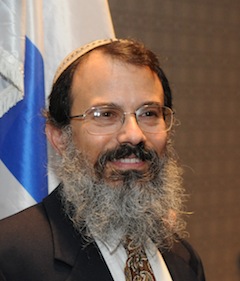
Left to right: Ali Abu Awwad, Shaul Judelman and Rabbi Hanan Schlesinger. (photo by hiddensparksphotography.com)

By bringing together Jewish settlers and Palestinian refugees, Roots is trying to help achieve peace.

Rabbi Hanan Schlesinger is one of the leaders of this group, which was established in 2014 by Ali Abu Awwad and Shaul Judelman. In being involved, Schlesinger said he is following in the steps of Rabbi Menachem Froman, who, “for most of his career, for three or four decades, advocated getting Palestinians who we live among to come to a point of dialogue, reconciliation and understanding.

“Froman’s students started a movement called Eretz Shalom, Land of Peace,” explained Schlesinger. “This organization did some activities to bring together Palestinians and Israelis, but really never made it off the ground. When he died, in 2013 … the students who were following in his footsteps, in terms of dialogue connections between Palestinians and Israelis, felt that they had better do something to continue his legacy…. Otherwise, it’s going to be gone.

“Those students, with his widow, in the last week of January 2014, had a little event together with some Palestinians they’d met, which brought together about 15 people from each of the sides. And, 95% of the people there were Israelis and Palestinians who’d met the other side during their lifetime, [were] involved a little bit in reconciliation. The one person there who had never been before was me.”

Schlesinger was deeply affected by the event. He had lived in Gush Etzion for 30 years, and had never met a Palestinian. And, upon meeting some of them, he realized how distorted his idea was of Palestinians.

“I went into a spiritual introspection of revisiting who I was and what I was doing on this land,” Schlesinger told the Independent. “And I forced myself to begin a journey that was leading me to examine many of my core beliefs – realizing it wasn’t just me and my people, that there was another people here who also belong here.

“Without really meaning to, I found myself creating a movement that was embodying this need to open up eyes and hearts, and continue my spiritual process, as well as help others in the spiritual process … that we, the Jews, are not the only ones in this land … that there are other people here and we need to take into account their existence, their humanity, their needs, their suffering.”

Schlesinger met with Palestinians who had been working toward a solution for more than a decade, but only with secular Israelis in Tel Aviv. Until Schlesinger made the connection, they had not sat down with Jewish settlers.

“They’d never met their own neighbours, who are religious Jews, who are deeply connected to the land in a religious, historical sense,” said Schlesinger.

As was the case with Schlesinger, these Palestinians began to undergo a transformation in their understanding. The Israelis with whom they had spoken before then had explained Zionism as of 1948, sometimes as far back as the 1880s. But the secular Israelis had never explained, because, Schlesinger said, they didn’t really know themselves, the ancient Jewish connection to the land – the land from the Jordan to the Mediterranean.

“These Palestinians were getting to know the foundations of Zionism and the Jewish history, culture and religion … just as I was getting to know the fact that there are Palestinians and that they have been living here for many, many years,” said Schlesinger. “Both sides were undergoing revelations.”

Seeing these positive results on a micro-level, with one another, they decided to create a foundation for macro-transformation.

photo - Rabbi Hanan Schlesinger
Rabbi Hanan Schlesinger (photo from Roots)

According to Schlesinger, the Oslo Accord did not go far enough. He explained, “It didn’t involve religious Jews or settlers who are deeply connected to the roots of the conflict, the land and history. It marginalized them and swept under the rug, ignoring the roots of the conflict. On the Palestinian side, it didn’t involve observant Muslims. It didn’t involve people deeply connected to the land and history – the people today that they call ‘Hamas.’”

With about a thousand people from each side stepping up and coming to events, Schlesinger understands this is only a drop in the bucket. But, he takes solace in the fact that this is only the beginning.

“Those who do hear of us on both sides, most are critical or skeptical … [seeing us as] ridiculous or traitorous … [because we believe] the other side is worthy to talk to … is human,” said Schlesinger. “It’s really hard going, an uphill struggle. I’ll even say that, especially for our Palestinian partners, it’s particularly challenging. They’re being confronted in their societies and are asking themselves how they can allow themselves to go against the accepted narrative.”

Roots has created different activities with a focus on the youth, keeping in mind the larger goal of transforming Israeli and Palestinian societies.

“For the Palestinians, in their society, ‘dialogue’ is a dirty word,” said Schlesinger. “Dialogue is just a way for the Israelis to buy time before they completely take over their land and destroy them…. Again, their narrative is that Israelis just want to talk and that nothing comes of it.

“When we organize our summer camp and photography workshop, we have to really make it clear to Israelis that the goal is not [only] to get to know the Palestinians. The goal is to get to know them, so that we will have a foundation to bring peace and justice.”

Roots is now working with high school students, where the youth meet three times a month and have joint activities, meals, field trips and conversations about identity, narrative and truth. “This is creating ongoing connections that are powerful,” said Schlesinger.

The group is working to develop political awareness on both sides. They are finding that this aspect is moving much faster on the Palestinian side, as their situation is more dire.

“For the Israelis living here, life is more or less normal,” said Schlesinger. “Every once in awhile, someone is attacked with a knife or a gun and someone may be killed or injured, and that’s a terrible tragedy. But, most people are not killed in terrorist attacks and most don’t have children with relatives killed. Most people have normal lives.

“On the Palestinian side, it’s different. They live under military occupation every single day and they are suffering: suffering from poverty, disenfranchisement and from having their dignity stripped of them.

“I say all that to explain that although on the Israeli side the status quo, is not so bad and most people are willing to live with it … on the Palestinian side, the status quo is insufferable. Our hope is nothing less than peace, justice and reconciliation.”

A documentary has been made about Roots. Called The Fields, it focuses on the founding leaders on both sides – Schlesinger and Judelman on the settlers’ side and Awwad and Khaled Abu Awwad on the Palestinian side. A trailer of it can be watched at friendsofroots.net.

Rebeca Kuropatwa is a Winnipeg freelance writer.
Format ImagePosted on June 23, 2017June 21, 2017Author Rebeca KuropatwaCategories IsraelTags Arab-Israeli conflict, Hanan Schlesinger, Israel, Oslo Accord, Palestinians, peace
Helping one village at a time

Helping one village at a time

With solar panels, Innovation: Africa – founded by Sivan Ya’ari, centre – is helping bring light and water to African villages. (photo from Sivan Ya’ari)

“Growing up in Israel, we were a poor family,” recalled Sivan Ya’ari, founder of Innovation: Africa. “But the poverty I saw in Africa was true poverty. We can’t compare.”

Ya’ari spent part of her childhood in France, which later helped her land a job with Jordache, a jeans manufacturing company based in the United States that had some factories in French-speaking African countries.

“After spending time in villages and traveling to other countries, I realized that the main challenge in Africa, the main reason why Africa is still in poverty, is the lack of energy,” she told the Independent. “Because there is no energy, they can’t get access to medicine, vaccines – because there is no refrigeration. Because there is no energy, people don’t get access to good education. But, most importantly, people don’t have access to water.”

Ya’ari had imagined Africa to be a continent with little water, but she discovered there is actually plenty of water in Africa. However, the water is located in aquifers and, to get to it, you need to pump it – and to do that, you need energy.

“Growing up in Israel, I remember seeing solar panels on every building,” she said. “So, when I came and learned a bit more about energy, I thought, maybe we just need to transfer some of the knowledge and some of the technology to remote villages to give them a chance to access water and education.”

Ya’ari enrolled in Columbia University’s master’s in energy program and began fundraising to bring energy solutions to Africa.

As a student, Ya’ari started in one village, and then another, continuing to the point that, today, she has brought the technology – a large pump run by solar panels – to about 140 villages, and counting. The water is pumped into a large holding tank and then, with the help of gravity, flows to different taps that are installed throughout a village.

“Usually, we’re putting one tap two kilometres from the water pump system, another tap four kilometres from it and another … in all directions,” said Ya’ari. “So, with one water pump system, we’re able to reach many villages and people.”

Once the concept proved successful, Ya’ari founded Innovation: Africa, which operates in seven African countries. “In every country, we have an office with a local manager,” she said. “In Uganda, for example, we have seven full-time local people working who have all been trained. They are managing and doing the work on the ground.

“We first hire a company that does geological surveys. This provides information about how deep the aquifers are, how much water we can find and where would be best to drill. Then we hire a drilling machine company and have local contractors do the rest – installing the pump, the water tank, involving the community (meaning, the villagers) who decide where to instal the different taps.

“Once this is all installed, sometimes, in some villages, we instal an extra tank – only for irrigation technology (Netafim) that we bring from Israel – and then we provide irrigation pipes to the village.”

Each pump provides 30,000 litres on average per day per system.

Innovation: Africa recently received an award from the United Nations for their remote monitoring system – another technology that came from Israel.

“It’s off-grid, remote monitoring, so, at any point, we are able to remotely know how much water we’re pumping into every village,” explained Ya’ari. “If something breaks, meaning a pump hasn’t pumped water in 24 hours, we are notified about it by the system; not only us, but the local contractors and the local managers.”

Most of the funding has come from individuals and foundations, often with one individual or family sponsoring a village. On Innovation: Africa’s website (innoafrica.org), there is information about how to become a sponsor.

“We have a bar or bat mitzvah … choosing an orphanage to adopt and then they are traveling with their parents to be there when the kids get light for the first time,” said

Ya’ari. “We have families adopting villages. It’s very transparent, personal and concrete. The donors appreciate that they also have access to the remote monitoring. At any point on their phone, they are able to see how much energy was produced or consumed and how much water was pumped. They also know if something breaks. They are connected to the villagers. They go back and visit.”

According to Ya’ari, many children, especially girls, are kept out of schools in Africa so that they can walk the great distances necessary to get water.

“I believe that the best return on the investment is when we bring water to a village,” said Ya’ari. “What we found is that people are spending hours a day looking for water. Most of the time, the water they find is dirty and is not good for drinking. Once we bring clean water, the people are healthier. The changes we see … the children are going to school. We see a lot more girls going and getting an education. We see that they are growing food.

“What inspires me is the number of businesses villagers are able to grow with access to water. They are able to grow food and sell it in the market. They are making bricks and making their homes, no longer made with mud. We see livestock…. They are making more money.

“And, for the medical centres, it’s tremendous,” she said. “Once we provide a little energy and we buy a small fridge, then people come in from the capital to the village to help. The doctor, with energy, she can actually work.”

When it comes to the cost to make this happen, it is about $5,000 to light a classroom and $18,000 to light a whole school, including the homes of the teachers. To bring water to a entire village, it costs around $50,000.

No governments are involved in these projects. It is all about people on one end of the world helping out people on another end.

“Unfortunately, there is no shortage of villages waiting,” said Ya’ari. “In the seven countries that we operate, we have a long list of schools needing light and water centres. It has a lot to do with funding and people to adopt the villages. We have the people on the ground and the technology.”

Rebeca Kuropatwa is a Winnipeg freelance writer.

Format ImagePosted on June 16, 2017June 29, 2017Author Rebeca KuropatwaCategories WorldTags Africa, innovation, Israel, Sivan Ya’ari, solar energy, tikkun olam
Interfaith efforts recognized

Interfaith efforts recognized

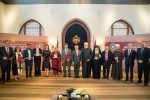
The winners of the 2017 King Abdullah II World Interfaith Harmony Week Prize with King Abdullah, centre, at Al Husseiniya Palace in Amman, Jordan. (photo from worldinterfaithharmonyweek.com)

On April 30, the leaders of the Calgary Interfaith Council were in Amman, Jordan, to receive the 2017 King Abdullah Award for World Interfaith Harmony’s first prize from the king himself.

The council’s co-chairs – Rabbi Shaul Osadchey of Beth Tzedec Congregation, Debra Faulk of the Unitarian Church of Calgary and Imam Fayaz Tilley, a chaplain at the University of Calgary and board member of the Muslim Council of Calgary – were invited to attend the ceremony at the Royal Hashemite Palace. They were presented with the award by King Abdullah II. It included a cheque for $25,000 US to put toward their continuing work in Calgary.

Osadchey described the experience as “memorable, momentous, impactful.”

“The Calgary Interfaith Council (CIC) was reconstituted in February as part of the launch of the United Nations World Interfaith Harmony Week program,” Osadchey told the Independent. “The CIC is now the amalgamated body of five or six other smaller interfaith organizations in Calgary. It was launched as the central voice of the interfaith community here, so we decided to première that with the United Nations World Interfaith Harmony Week.

“We organized a week of programs that highlighted interfaith cooperation and strength of the community. We did a program that began with an opening ceremony at city hall. The mayor had issued a proclamation for the city that designated the week of Feb. 1st to the 7th as UN World Interfaith Harmony Week in Calgary, and he personally came and spoke.”

They had 15 different religious communities involved in the festivities, which included interfaith breakfasts, a weekend open house, and people were welcomed into various congregations for workshops and tours. There were also two “build days,” where participants volunteered to build a house with Habitat for Humanity.

“We raised $15,000 for the Habitat project,” said Osadchey. “It was a program with depth.”

The Calgary Interfaith Council submitted what they did to the website that oversees the worldwide program of activities, said Osadchey. “There were over 1,000 events worldwide and we were selected as the outstanding program for 2017 and won first prize, the gold medal. What that meant was that they asked us to send three representatives to receive the award in Jordan, along with the second- and third-place winners – the second-place winners were from Bosnia and the third-place winners were from London, England. We were flown to Jordan and spent three days there.”

According to the prize’s press release, the International Forum Bosnia’s Centre for Interfaith Dialogue was honoured “for their efforts toward dialogue and cooperation among ethnic and religious groups in Bosnia and Herzegovina” and the London-based nonprofit PL84U Al Suffa for “providing meals and services to the homeless, elderly and others in need in an atmosphere of interfaith respect and cooperation.”

At the Sunday morning awards ceremony, both King Abdullah II and Prince Ghazi ibn Muhammad were in attendance, with the latter giving a talk. Osadchey was asked to give a three-minute speech on behalf of the winning delegation.

Osadchey was the first Jew and rabbi to be part of one of the award ceremonies. “They were very respectful, very interested and engaged in the conversation about Judaism and about the Jewish experience in the interfaith arena,” he said. “Both the king and the prince were pleased to have me as a delegate and acknowledged that the interfaith dimension of the program had taken a significant expansion by having Jews included.

“I was looking forward to being able to convey some comments to the king. I began by reciting the brachah [blessing] that is said when you’re in the presence of the king or head of state. I recited it to the king in Hebrew and then translated it into English. And my comments were about how religious literacy is a necessary component for creating interfaith harmony.

“I suggested to the king that the World Interfaith Harmony Initiative develop a youth component that would focus on religious literacy among the youth of the world. And, when I received the medal from him and we had a few moments to exchange some words, he asked me to follow up on that proposal, as did the prince.”

Osadchey said he is in the process of writing a proposal to create this youth component, and added that he is looking forward to running a youth interfaith harmony week in Calgary. He hopes that others will use his model and do likewise in their communities.

“I think it’s important that not only adult leaders engage in creating relationships, but that we begin developing those among the next generation,” he said. “If we can do that, then the road to true harmony will be a lot easier to create.”

Since the world interfaith award was created in 2010, said Osadchey, there have been two other Canadian cities that have won awards – Toronto and Halifax, both achieving third place in their respective years.

The Calgary Interfaith Council is hoping to inspire a national designation of Feb. 1-7 as World Interfaith Harmony Week across the country and to bring other Canadian cities and communities into the picture. They are starting with their home province, encouraging their leaders to issue a proclamation designating it throughout Alberta. “We’re pretty close to getting that done,” said Osadchey. “Then, we’ve got an MP that’s working in Ottawa to do the same.”

Osadchey returned from Jordan full of hope and was impressed by the respect, interest and welcoming response of the Jordanian people he encountered. Nonetheless, he thought that, while interfaith activity might take place among the upper echelons of Jordanian society, he suspected that the general population is likely not as open or accepting. “That would have to do with probably lower levels of literacy, education, just in general,” he said.

He added, “The fact that their neighbour is Israel – and even though they have a fairly good relationship with Israel – it is still tinged with the Palestinian issue as well. I don’t think the ‘man on the street’ really cares about interfaith relationships in Jordan, but the leadership and the king certainly are trying to push the country more toward an acceptance of that.”

In Jordan, dialogue is mainly with the Christian world and does not seem to have any links with the Jewish world, but Osadchey is hopeful it may happen as a consequence of his visit.

“We’ll see how that takes place, but they’re reaching out,” he said. “The fact that the king of Jordan is the one responsible for this initiative…. They are trying to project a different image internationally.

“It’s really been very positive…. It’s had a positive effect on the Calgary community, both Jewish and non-Jewish, seeing this as a great recognition of our efforts in the interfaith community. It’s garnered a lot of recognition locally and spurred people to get more involved in our program, so that’s been a really positive benefit.”

For more information and to see more photos from the ceremony in Jordan, visit worldinterfaithharmonyweek.com/2017-prize-awarding-ceremony.

Rebeca Kuropatwa is a Winnipeg freelance writer.
Format ImagePosted on June 9, 2017June 7, 2017Author Rebeca KuropatwaCategories WorldTags Calgary, interfaith, Jordan, King Abdullah, religion, Shaul Osadchey, tikkun olam
HIPPY ventures into Asia

HIPPY ventures into Asia

HIPPY, developed in 1969, is being used by some 20,000 families in various countries. (photo from HIPPY International)

For the first time ever, HIPPY (Home Instruction for Parents and Preschool Youngsters) will be setting up offices in Southeast Asia.

HIPPY is an early learning program developed by researchers in 1969. It is already being used by 20,000 families in Argentina, Australia, Austria, Canada, Germany, Israel, Liberia, New Zealand and the United States.

As explained on the HIPPY Canada website, the program “delivers a curriculum based on the needs of children to become school-ready; recognizes role-play as the method of teaching the skills needed to implement the child-centred curriculum; and features a peer home visitor system that enables mothers, who may be hard to reach due to social isolation, poverty, language or other cultural issues, to feel comfortable participating in the program.”

“HIPPY has the same core program across the world. In each country, it is adapted to the cultural and linguistic context,” Miriam Westheimer, director of HIPPY International, told the Independent.

In addition to its Southeast Asia offices, other HIPPY news includes a major expansion in Argentina, progress with the program’s digitization and the development of a HIPPY app.

As well, HIPPY’s program in Liberia continues to grow and is now a part of the government’s early childhood strategic plan. The program was originally funded by Friends of Liberia, a group comprised of former Peace Corps volunteers. For the past three years, it has been funded through the Open Society Foundation and is now a ministry of education program.

In Korea and China, HIPPY will introduce a fee for the program, creating a revenue stream Westheimer hopes will allow for more programs in developing countries.

“Typically, once we start a pilot program in a new country, we can then attract policy-makers and funders to help sustain and grow the program,” she said. “What’s interesting is that the models in Korea and China are the first programs working with a higher-education parent population and the pilot project starting there sells the program to upper-middle-income families who can purchase it.”

It’s HIPPY’s first for-profit venture. Typically, the program is free-of-charge and relies on volunteers and community participation, but the agencies and organizations in Korea and China that approached HIPPY wanted to do this as an entrepreneurial project.

“We see it as an opportunity to raise some money so we can do this in countries where we haven’t been able to work yet, developing countries,” said Westheimer. “There are several African countries very interested and we don’t have the start-up [funds] to be able to start working there. We’re looking at this as a model for how we can benefit from the sale of the program, if it does indeed take off, to raise funds to support other new countries in the network.”

“We just started a pilot in Asia,” said Westheimer. “We started with 60 families. Now, we are working with 120 families. We hope to double or triple this next year, but it’s growing slowly. The idea is that it could become part of the ministry of education’s plan and we’re laying the groundwork for it to become a national program.

“We started the same way in Argentina. We started in a few shantytowns in Buenos Aires. It started in a Jewish community, through AMIA, the Jewish community centre in Buenos Aires, and then, several other groups, childcare centres, built in these shantytowns around Buenos Aires.

Because of its success, the federal government has given a grant to expand to six provinces. They started 100 families in each of the six provinces.”

The model is also working well in a few European countries, such as Austria and Germany, where they have something they call “HIPPY-inspired programs.” For these programs, they take the basic concept of working with parents in the home, with home visits or group meetings, but not using the HIPPY-developed curriculum.

“They have their own curriculum,” said Westheimer. “So, we have HIPPY-inspired programs in Finland, Sweden, Turkey and Holland. The Turkey program is … the most remotely connected to the HIPPY network. The other ones are really part of our international network.”

The program in Turkey has been running for about 30 years, she said. While it began as a small HIPPY program, it has evolved into an independent one with really no connection to HIPPY.

For more information about HIPPY Canada, visit hippycanada.ca or call its office in Vancouver at 604-676-8250.

Rebeca Kuropatwa is a Winnipeg freelance writer.

Format ImagePosted on May 19, 2017May 17, 2017Author Rebeca KuropatwaCategories WorldTags education, HIPPY
Books for people with dementia

Books for people with dementia

Eliezer Sobel created L’Chaim: Pictures to Evoke Memories of Jewish Life with his parents in mind. (photo from Shutterstock)

Eliezer Sobel’s new book, L’Chaim: Pictures to Evoke Memories of Jewish Life, was born from personal experience.

Sobel is an artist at heart and has spent his life finding ways to interact with people – through writing, facilitating workshops and running retreats over the past three decades. Three years ago, on his parents’ 67th anniversary, things took a turn for the worse.

“My mother is in her 17th year of Alzheimer’s and is 93,” Sobel told the Independent. “My dad was fine and taking care of her at home until he was 90. On their 67th wedding anniversary, he fell down the stairs. He fell on his head and almost died. Overnight, there were two dementia patients in the house.

“Prior to that, he was driving, cooking and shopping, as well as hiring and handling the payroll for a team of seven aides. He was amazing with it. Suddenly, overnight, I had a brain-damaged dad at 90 years old.”

Sobel and his wife lived in Virginia at the time, which is seven to eight hours away from New Jersey, where his parents lived. After the accident, however, they moved into his parents’ home.

photo - Writer Eliezer Sobel’s parents, Manya and Max, in 2016. They were the inspiration for Sobel’s series of picture books for readers with dementia
Writer Eliezer Sobel’s parents, Manya and Max, in 2016. They were the inspiration for Sobel’s series of picture books for readers with dementia. (photo by Eliezer Sobel)

“We stayed in the house for 10 months, taking care of my parents and trying to get the right kind of help in the house that would enable us to eventually move out,” explained Sobel. “But we stayed nearby so we could monitor and manage the scene.”

His dad recovered a substantial amount of his cognitive and physical ability, but passed away this past November.

The work on the book goes back to 2011. “She didn’t speak English words anymore,” said Sobel of his mother at the time. “She would sometimes make up her own language and sounds. She stopped reading, as far as we knew.

“One day, I came upon her accidentally…. She was flipping through a magazine and I overheard her reading the big print headlines out loud, in English, correctly. I was totally floored. Mom can still read, even if it’s just a three-word phrase.”

Sobel wanted to run out and buy his mom a picture book, one designed for Alzheimer’s and dementia sufferers, but he couldn’t find one anywhere. His next thought was to use a children’s picture book, but he was unsure whether his mother could negotiate a book with a storyline. He wanted each page to stand on its own, so it would not require the reader to recall what had happened on a previous page.

“I called up the national Alzheimer’s association and spoke with their chief librarian for the whole U.S. and her response to me was to say that there were 20,000 books for caregivers of those with memory loss,” said Sobel. “I said, ‘I am not looking for [a book for] the caregiver, I’m looking for my mother, the patient. There was dead silence on the other end of the line. She couldn’t think of any such book. Eventually, she did mention one other author who has since become an acquaintance of mine who had a few books, but they weren’t really what I wanted, so I realized I had to do this myself.

“I first did a book that wasn’t just for Jews. It was for anyone with memory loss. It was called Blue Sky, White Clouds, and came out in 2012.”

Sobel – who has also written a novel and a memoir – received such a positive response to this first picture book that he decided to make it into a series.

“My mother got to enjoy the first book a lot,” said Sobel. “Her aides would use it with her almost daily. We would observe that she would zero in on particular photos, ignore certain pages, find a photo – particularly one of a married elderly couple – and contemplate it for 20 minutes and caress the faces.

“These books are for a particular stage of dementia,” he said. “They’re appropriate for someone who’s got enough memory loss and dementia that they won’t be offended or have awareness that this is kind of a simplistic picture book, they’ll just be interested. But they can’t be too far gone, like my mother now, who can’t even look at my face, let alone my book.”

Caregivers often struggle with how to engage people with Alzheimer’s.

photo - A page from L’Chaim: Pictures to Evoke Memories of Jewish Life
A page from L’Chaim: Pictures to Evoke Memories of Jewish Life. (photo by Olaf Herfurth)

“It’s very hard to find activities to do with someone in that condition,” said Sobel. “So, what I was trying to accomplish was to give caregivers something they could share with the patient … or give patients something they could use on their own…. It was an opportunity for sharing to occur, an activity of quality time. For certain pages, in the earlier stages [of dementia], it stimulates memories, conversations, reminiscences or free association.

“I’m from the creative right brain of things, so I could find things to do with my mother, like empty a box of coins on the table and we’d spend an hour playing with them – pennies over here, stacking the quarters, making a picture of a house with the dimes. Then, I’d say to my dad, ‘See, Dad! There are lots of things you can do with Mom. You could put these coins away and do the same thing tomorrow. She won’t remember.’

“He would call me the next day, and say, ‘Ah, it didn’t work. She didn’t know the difference between a penny and a nickel.’ That was the point. He’s a mathematician and very linear … [he] could not break into the play mode. If you’re someone who’s good with little kids, you can do that with someone like my mom.”

In some ways, Sobel often finds himself feeling grateful to Alzheimer’s, because it made it possible for him and his mother to grow closer – at least for the first 10 years of her disease.

At the beginning, Sobel saw her become more available. As a Holocaust refugee, she had always been very insulated, private and afraid of others. Sobel said he went to a psychic early on in her disease, worried that his mother was losing her memories, and the psychic thought she’d be happier without them.

“It was true,” Sobel reflected. “She transformed from that scared refugee into an open, childlike, loving, laughing angel. People would feel blessed to be around her. She was delightful – greeting strangers and striking up conversations that made no sense. She and I laughed about who knows what. She and my father would dance to music. A lot of things were happy about her Alzheimer’s experience.

“I’m not saying there weren’t nightmarish times. We had our share of those as well,” he added. “She went through a violent period where she was chasing people with steak knives. We had to put her into a psych ward for 10 days.”

That was the exception, though, and Sobel said, “I had an opportunity to finally heal my relationship with her.”

Rebeca Kuropatwa is a Winnipeg freelance writer.

Format ImagePosted on May 19, 2017May 17, 2017Author Rebeca KuropatwaCategories BooksTags Alzheimer's, dementia, Eliezer Sobel, health care, Holocaust, Judaism
Prairie study results in

Prairie study results in

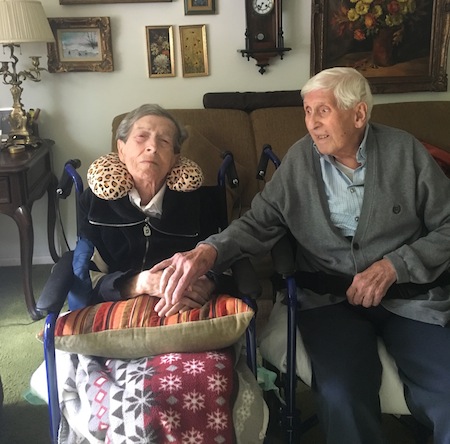
Andrea Silverstone, coordinator of Shalom Bayit at Jewish Family Service Calgary. (photo from Andrea Silverstone)

A study of domestic violence in Jewish communities in the Prairie provinces was recently completed.

“The study has been a desire of mine probably since the day we started,” said Andrea Silverstone, Shalom Bayit coordinator at Jewish Family Service Calgary, “because a lot of what we know about domestic violence in the Jewish community is based on anecdotal information, suppositions, copying what is in the non-Jewish community or research from other jurisdictions outside our own.

“We were doing a good job of addressing the needs of the clients who walked in the door, some of the prevention programs we had in the schools and the community … [but] it wasn’t research-based in the sense of understanding the scope of the issue across the Jewish communities in the Prairie provinces.”

Silverstone would have loved to do a Canada-wide study, but her supporter, Resolve, which is a tri-party research body conducting community-based action, has a set research mandate of focusing exclusively on the Prairie provinces: Saskatchewan, Manitoba and Alberta.

Over the years, Silverstone has done a lot of work with Resolve and has an extensive background in dealing with domestic violence in her capacity at Shalom Bayit, which addresses everything from bullying and harassment to child abuse, elder abuse and spousal abuse.

“There was a research study done in 2004 by Jewish Women International that was fairly comprehensive,” said Silverstone. “So, we reached out to them, asking to borrow the methodology of their study, which they allowed. We also thought it would be a good comparison.”

Silverstone and the Resolve team, led by Dr. Nicole Letourneau of the University of Calgary, then approached Jewish Child and Family Service in Winnipeg, Jewish Family Services in Edmonton and various Jewish community organizations in Saskatchewan, asking them to be involved.

Silverstone found that getting people to work on this topic was easy – both the academics and community groups – as domestic violence has touched most people in one form or other.

“Everyone wanted to better understand the scope and needs around domestic violence in the Jewish community,” said Silverstone. “I don’t think anyone needed to be convinced [that there was an issue worth studying]…. It was just a matter of figuring how to best do this, so we that we weren’t taxing already taxed resources.”

The study involved two parts in terms of gathering data. The first part had participants take 20 to 25 minutes to fill out a survey based on the JWI survey. About 280 people filled this out.

Once the surveys were collected, the researchers asked two questions: Was there anything surprising? And, what did they understand from it?

“Those were the two data question points that helped us build the results of the study,” explained Silverstone. “We knew we’d have data to compare to mainstream populations. In terms of rates of people reporting that they are survivors of domestic violence, it is about the same as the general population. Twenty percent of the people who answered our study said they were victims of domestic violence. And, in the general population, those numbers are anywhere from 25 to 40%.”

The other aspect, she added, is “of those who experience domestic violence, their experience of it, in terms of physical and financial toll, is about the same, except for in our reported rates in the study of domestic violence in the form of emotional abuse – that is higher than the general population. They report about half to 60% of the domestic violence they experience is verbal [in the general population] and, in our survey, it was 82%.”

Silverstone said this divergence may be because Jews are very verbal people. Another possibility is that people tend to perceive verbal abuse as a more acceptable kind of domestic violence – they refrain from physically hitting their partner, but they won’t stop themselves from yelling or name-calling. “This is probably an area we should be researching further,” said Silverstone.

For Silverstone, there were some surprises when it came to the survey results, such as the low number of people who would consult with their rabbi about their situation – only three percent of those surveyed.

“Something that struck me,” she added, “which was also a finding of the JWI study, is that the top three sources victims utilize in domestic violence situations are friends, family and private therapists. Friends and family are, by far, the highest. It made me realize that we need to be focused on teaching friends and family in the Jewish community how to recognize domestic violence, to respond appropriately and then to refer people.”

Currently, Silverstone is in the process of determining which kinds of programs should be implemented and what kind of awareness-raising campaigns the community should be taking on, based on the survey results.

The first step is to educate friends and family about how to be good supports, she said. “There is all sorts of other research out there about what are called ‘informal supports.’… If the informal supporter has a healthy response, the person is going to go get help. If they don’t, that person is going to shut down and not seek help again for a long time. I think it’s important that we get that straight.”

Silverstone feels strongly that there is a need to dig deeper and find out why people are not using rabbis. “Is this because we’re not doing a good enough job of helping rabbis be effective supporters? Are they not talking about the issue enough? Do people not feel safe? Because they are a great resource if we can tap into them.”

Another big issue that came to light through the survey is that of safe housing for victims and that victims are not finding shelters to be helpful. Silverstone wants to examine this further.

If you or someone you know is experiencing domestic violence, contact the Jewish Family Service Agency at 604-257-5151, the bc211 help line at 211 if you live in Metro Vancouver, the Fraser Valley, Squamish-Lillooet or Sunshine Coast, or VictimLinkBC at 1-800-563-0808.

Rebeca Kuropatwa is a Winnipeg freelance writer.
Format ImagePosted on May 5, 2017May 3, 2017Author Rebeca KuropatwaCategories NationalTags Andrea Silverstone, domestic violence, JWI, Prairies, women
Using film school as therapy

Using film school as therapy

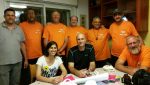
From Ma’aleh School of Television, Film and Art, standing, from left to right, are Asher Lemann, David Cohen, Chanan Ariel, Ofir Shaer, Yosef Baruch Kalangel and Nachum Lemkus. Sitting, from the left, are Keren Hakak, Menachem Assaraf and Shalom Sarel. (photo from Ma’aleh)

When a major donor came to Neta Ariel, director of Ma’aleh School of Television, Film and Art, with an offer to provide scholarships as long as the students give back to the community, Ariel accepted the challenge.

“Ma’aleh is located in the centre of Jerusalem and, unfortunately, there are a lot of social issues,” Ariel told the Jewish Independent. “For example, lots of high school-age teens walk the streets or, during the night, use drugs and live on the streets. So, my students tried to help them – we knew a few of them, and we invited them to come to the school once a week for two hours in the afternoon to learn about film.”

The students at Ma’aleh became mentors, encouraging the teens to bring their own stories to life through the materials. Another group – comprised of immigrants from Ethiopia – also works with the students.

“Tell your story,” said Ariel of the most important aspect of the program.

“At the end of the year,” she said, “when we screened the movie for the group, teacher, friends … it was an amazing thing. They [had] left high school, or the family didn’t want them; they felt like they’re losers and didn’t have self-confidence. When we had the screening and their family or friends came, they really appreciated them. And the film gave them hope. We thought, the making of the film was not only fun, it was a teaching tool to uplift them and our students.”

Through learning how to film, from making personal connections and from telling their stories – which often included trauma or conflict, from rape, violence and negative treatment to gender or sexual orientation issues – they began to heal.

For most participants, it was their first encounter with therapy.

“Most of the time, at the end of the day, after the project was done, they shared with us that this is the first time they’d dealt with this,” said Ariel. “This was their way to tell the society, family or friends that this is their story and what I suffer from.”

From these beginnings, the school developed a curriculum for the program and, with each passing year, it has grown. Now, the school offers two such programs, focusing on how to use film as therapy and how to work together.

“You have a group of social workers and filmmakers,” explained Ariel. “Every week, they meet and work on the exercises we give them, and they work together to find a balance. It works well, the partnership. It’s amazing how the psychologist becomes a filmmaker and the filmmaker comes to understand psychology.”

Months after Operation Protective Edge, the school decided to host a group of bereaved mothers from the conflict, to determine if there was a way they could help.

They found ways of incorporating filmmaking into the process of mourning. At each meeting, they studied and focused on one aspect of filmmaking – lighting, filming, music, and so on. Once taught, participants were given an exercise to practise the skill. Then, they were given a camera and asked to practise filming.

“They didn’t tell them to make a movie about something specific,” said Ariel. “They gave them a task about something emotional. Most chose an aspect connected to the son they lost a few months ago.

“Then, we teach them how to write the script, how to do voiceovers, how to incorporate music. Automatically, most would think about their son or themselves and their fears. So, part of the meeting was talking about what we go through, and a lot of it was about creating things.

“At the end of the year, everyone together made a film called Saba. The main character in the movie is the grandfather, as all of them had mentioned their grandfathers, from time to time.”

Last year, the school opened a bereaved fathers group and found that, while they seemed to barely communicate in the classroom, they collaborated well outside of class. They put together what Ariel described as an “amazing movie” about their surviving kids.

“This is something the fathers said – that the kids at home blamed the parents, saying that, at home, they give a lot of time, attention and energy to something dedicated to the dead son … and [are] not taking care of them,” said Ariel. “Regardless of the age of the kids, in every house, they found it was the same situation. And, it was just amazing.

“Now, we are trying to open a group for grandparents … but, most of them, they can’t come, too hard for them, very far. So, I hope that … we’ll open another group for bereaved mothers … those who couldn’t come last time.”

While the main objective of Ma’aleh stems from a Jewish perspective, Ariel travels the world to introduce filmmaking and therapy to schools.

“Most of our students come from a Jewish Orthodox background … not all, but a lot of them,” said Ariel. “And, a lot of the subjects we touch on are connected to Jewish identity and our roots.”

At the time of her interview with the Independent, Ariel had just returned from the United States, where one of her stops was at a Christian school, where she spoke about how to best relay religious differences through film.

Apart from teaching, Ariel uses these trips to fundraise for the school and to keep in touch with filmmakers, mostly in Los Angeles.

“When they come to Israel, they help us, come to give a workshop at our school,” said Ariel. “We do projects together. Most importantly, we’re sharing our graduate movies with the world. A lot of institutions in Israel and America use them as education tools, cultural tools, and even, from time to time, to promote Israel.

“My goal is that this tool will be used for all kinds of populations. Many different kinds of groups can take care of themselves using this process.”

For more information, visit maale.co.il. The bereaved fathers’ short film can be seen at youtube.com/watch?v=uoNiQVSqhOw&feature=youtu.be.

Rebeca Kuropatwa is a Winnipeg freelance writer.
Format ImagePosted on April 7, 2017April 4, 2017Author Rebeca KuropatwaCategories IsraelTags film, Israel, Judaism, therapy, tikkun olam

Posts pagination

Previous page Page 1 … Page 14 Page 15 Page 16 … Page 31 Next page
Proudly powered by WordPress