Skip to content
  • Home
  • Subscribe / donate
  • Events calendar
  • News
    • Local
    • National
    • Israel
    • World
    • עניין בחדשות
      A roundup of news in Canada and further afield, in Hebrew.
  • Opinion
    • From the JI
    • Op-Ed
  • Arts & Culture
    • Performing Arts
    • Music
    • Books
    • Visual Arts
    • TV & Film
  • Life
    • Celebrating the Holidays
    • Travel
    • The Daily Snooze
      Cartoons by Jacob Samuel
    • Mystery Photo
      Help the JI and JMABC fill in the gaps in our archives.
  • Community Links
    • Organizations, Etc.
    • Other News Sources & Blogs
    • Business Directory
  • FAQ
  • JI Chai Celebration
  • JI@88! video

Recent Posts

  • Story of Israel’s north
  • Sheltering in train stations
  • Teach critical thinking
  • Learning to bridge divides
  • Supporting Iranian community
  • Art dismantles systems
  • Beth Tikvah celebrates 50th
  • What is Jewish music?
  • Celebrate joy of music
  • Women share experiences 
  • Raising funds for Survivors
  • Call for digital literacy
  • The hidden hand of hate
  • Tarot as spiritual ritual
  • Students create fancy meal
  • Encouraging young voices
  • Rose’s Angels delivers
  • Living life to its fullest
  • Drawing on his roots
  • Panama City welcoming
  • Pesach cleaning
  • On the wings of griffon vultures
  • Vast recipe & story collection
  • A word, please …
  • מארק קרני לא ממתין לטראמפ
  • On war and antisemitism
  • Jews shine in Canucks colours
  • Moment of opportunity
  • Shooting response
  • BC budget fails seniors
  • Ritual is what makes life holy
  • Dogs help war veterans live again
  • Remain vital and outspoken
  • An urgent play to see
  • Pop-up exhibit popular
  • An invite to join JWest

Archives

Follow @JewishIndie
image - The CJN - Visit Us Banner - 300x600 - 101625

Byline: Cynthia Ramsay

First book of trilogy now out

First book of trilogy now out

Michael Seidelman is donating 10% of novel profits this month to the Cystic Fibrosis Foundation. (photo from Michael Seidelman)

May is Cystic Fibrosis Awareness Month, so author Michael Seidelman will be donating 10% of the profits from this month’s book sales to the Cystic Fibrosis Foundation to help find a cure.

The connection? The heroine of his Garden of Syn young adult series suffers from CF.

“When I was 10 years old, I watched a TV movie called Alex: The Life of a Child, the true story of an 8-year-old girl who died from CF. Seeing that a child could lose her life so young had a profound impact on me then and continues to do so all these years later,” he explained.

Having his protagonist suffer from CF “could potentially raise awareness about the devastating illness,” he said. “I learned a lot about CF while researching for the book and I’m sure anyone who reads it will as well.”

But, while an integral part of her character and of the plot, CF does not define Syn, though it does offer her challenges most people do not have to face, and has made her more responsible and mature than her years. But so have several other factors.


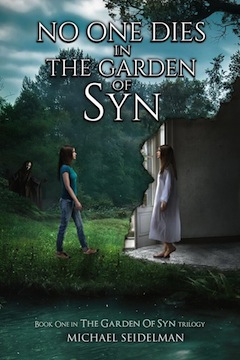
book cover - No One Dies in the Garden of SynThe first book of the trilogy – No One Dies in the Garden of Syn, which was released last month – introduces us to Syn. Right away, we find out that her parents went missing when she was 5 years old and her aunt has looked after her ever since. In addition to dealing with her illness, Syn has regular teenage problems with friendships, boyfriends and school, and exhibits that brand of cynicism so often found in kids of that age.

“Syn,” she notes. “Short for Synthia. I don’t know why my parents spelled my name with an ‘S’ but if I could ask them anything, that would be my last question. Aunt Ruth tells me it’s likely because I was special and deserving of a unique spelling. I highly doubt that’s it.”

Syn is a formidable and likable hero for whom readers will root. And the constant action will keep readers turning the pages. Along her accidental journey, she must face situations and enemies that are potentially more threatening than her illness.

“Young adult novels are usually geared towards an audience of 12 years and up,” said Seidelman when asked whether he was concerned with how young readers might react. “While it does contain some dark themes, I think kids in that age group are familiar with the topics that are explored. I also think that this book is more appropriate for younger readers than many other books in the young adult category. I probably wouldn’t recommend the Hunger Games or Twilight for a 12-year-old reader. While No One Dies in the Garden of Syn may be a bit scary towards the book’s climax, any kid who is comfortable reading the Harry Potter series should be more than fine reading this.”

His own creative journey was sparked by books he read as a kid.

“My favorite stories growing up were about secrets worlds, like Alice in Wonderland and The Lion, the Witch and the Wardrobe. Since I was in high school, I had wanted to write my own book about a secret world. It took me many years before I came up with the right story – one that is inspired by the tales of Lewis Carroll, L. Frank Baum and C.S. Lewis, but at the same time is very different and geared towards an older audience.

“The ideas that triggered the story I ended up telling came to me when I immersed myself in nature and let the ideas flow. I jotted down notes for a few months and made many changes to the story and characters before I sat down in April of 2014 and plotted out each chapter in detail. That took about a month and then it took another four months to write the novel. But that was only the beginning, as there were many rewrites and edits that followed.”

No One Dies in the Garden of Syn is Seidelman’s first published novel. But, as much as he enjoyed writing it, he said, it was not an easy task.

“The rewriting and editing process probably took six times the effort that writing the initial manuscript did, if not more,” he said. “Every single word is immensely important, as are continuity and proper tenses. But, for the second book in the Garden of Syn series, which I am currently working on, I think that part of the process will be smoother. Having now done this once, I now know what works and what doesn’t.

“For anyone wishing to self-publish a book,” he advised, “I cannot emphasize enough the importance of paying for a professional editor. You also need a professional-looking cover that will stand out as people really do judge a book by its cover. Having it professionally formatted for the physical copy and ebook readers is also important. With over 3,000 books published every single day, you need to do everything in your power to make yours the best it can possibly be.

“And then, when it is published, your journey has just begun. You need to use every avenue available to let people know about your book and encourage them to read it. The internet offers many wonderful tools to help do this but you really need to put in the time to market it. As I write my second book, at least 25% of my time goes to marketing the first one.”

The next book in the trilogy will be out next year, and the conclusion in 2018. The first novel is available in paperback and as an ebook from online sellers, including via michaelseidelman.com.

Format ImagePosted on May 20, 2016May 18, 2016Author Cynthia RamsayCategories BooksTags cystic fibrosis, Seidelman, Syn
Learning about other faiths

Learning about other faiths

Grade 6 students from Vancouver Talmud Torah – Sophie Chelin, Ava Abramowich, Sayde Shuster, Ruth Nahmad and Rachel Seguin – do the blessing over the candles at an interfaith Shabbat dinner on May 6. (photo by Jennifer Shecter-Balin)

The joy of learning, the excitement of meeting new people, the comfort of community, the satisfaction of a job well done. All of these energies filled the room at Congregation Beth Israel on May 6. And, while that Shabbat dinner marked the culmination of Vancouver Talmud Torah’s Grade 6 Term 2 Tikkun Olam course, it seemed like a beginning as well.

With the knowledge and relationships gained and curiosity and compassion further engrained, these students now have an even more solid foundation from which to carry on their interfaith connections and broaden their experiences beyond the Belief project.

The initiative of Jennifer Shecter-Balin, director of admissions and communications at VTT, who guided the students with Grade 6 humanities and tikkun olam teacher Meghan Davey, the project was inspired by Oprah Winfrey’s seven-part Belief series.

Every week, students watched an episode of the series, explained Shecter-Balin in an email to the Independent. They then “completed related assignments and activities to both deepen their own connection to Judaism and broaden their understanding of other world religions and belief systems.”

“Each week, we journeyed across the globe to learn about different streams of Judaism, Christianity, Islam, Hinduism, Sikhism and other non-traditional beliefs systems,” she explained to those gathered on May 6. “In addition to gaining further grounding in their Judaism, our students expanded their perspectives and worldviews through learning about myriad different spiritual practices, rituals and beliefs.”

“Throughout the term,” added Davey, “we broadened our vocabulary and learned terms such as monotheism, agnosticism and atheism…. We debated the merits of arranged marriages; we compared the divinely inspired versus the scientific; and we discussed the concept of miracles and what constitutes one. But most satisfying was the fact that the students all agreed that being alive and having one’s health is indeed miraculous.”

Davey also noted that, “They have learned to identify similarities across the religions – the importance of water for purification in so many traditions, for example – as well as significant differences between the major world faiths.”

For the course’s final assignment, students had to interview someone of a faith other than Judaism and then write about that person’s beliefs and influences.

“For many students, this was their first time ever interviewing an adult and someone of a considerably different background to them,” said Shecter-Balin.

The result is a nicely designed spiral-bound book of essays on the 40 interviews conducted. A copy of the book was placed at every Shabbat table and Shecter-Balin invited guests – the students’ families and many of the interviewees – to read through it.

“Like us,” she said, “you’ll learn about a host of beliefs, practices and unique life experiences, and you’ll read our students’ enthusiastic reflections about this assignment. Most importantly, their hearts and minds have further opened without compromising the integrity of who they are or where they’re from. In fact, we believe it will only serve to strengthen their identity.”

For many of the guests, the dinner was their first time in a synagogue and their first time attending a Shabbat dinner. Sharing this experience and more about Judaism, said Shecter-Balin, is a way to continue to build bridges of understanding. “This, we believe, is tikkun olam, or the Jewish commandment to repair the world,” she said.

Davey thanked all the parent volunteers who helped prepare the meal with Shlomo and Hagar Yekutieli; VTT head of school Cathy Lowenstein and assistant head of school Jessica Neville “for their support with this initiative and trusting us to think a bit outside the box”; Ellen Wiesenthal, VTT’s director of curriculum and programming, who led everyone in a few Shabbat songs after the blessings; and Beth Israel’s Gaynor Levin, for her help in planning and organizing the dinner.

Lowenstein said a few thanks of her own, including to Beth Israel Rabbi Jonathan Infeld for being so welcoming. She also introduced Rabbi Marc Kasten and his family, who came to Vancouver for the weekend. Kasten – who is currently at Temple Beth Am Day School in Miami – will start in August as VTT’s new school rabbi and director of Jewish life and learning. He spoke about some of the Shabbat rituals before they were fulfilled, mainly by the students: the singing of L’Cha Dodi, the candlelighting, the blessing of the children by their parents, the Kiddush and Hamotzi.

The next step in the project, Shecter-Balin said, is “to send a copy of the book to Oprah along with notes from the students sharing their personal reflections of watching the video series.”

Format ImagePosted on May 20, 2016May 24, 2016Author Cynthia RamsayCategories LocalTags Davey, Oprah, Shecter-Balin, tikkun olam, Vancouver Talmud Torah, VTT
JFSA lunch raises $266K

JFSA lunch raises $266K

Hootsuite’s Ryan Holmes speaks to an attendee at the Innovators Lunch on May 4. (photo by Sandra Steier)

More than 550 people at the Jewish Family Service Agency’s Innovators Lunch on May 4 raised more than $266,000 for the important services JFSA provides.

Starting the event at the Hyatt Regency, featuring Hoosuite founder and chief executive officer Ryan Holmes, was Beth Israel Rabbi Jonathan Infeld who, before the motzi, said a few words about volunteer Elayne Shapray, whose funeral had been that morning. Incoming JFSA board chair Karen James also spoke about Shapray’s contributions, noting that she had been “honored with the highest volunteer award from JFSA, the Paula Lenga Award, for her quiet strength and years of support.”

photo - Innovators Lunch committee members, left to right, Shannon Ezekiel, Hillary Cooper and committee chair Sherri Wise with keynote speaker Ryan Holmes, CEO and founder of Hootsuite
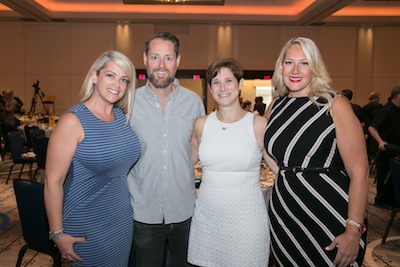
Innovators Lunch committee members, left to right, Shannon Ezekiel, Hillary Cooper and committee chair Sherri Wise with keynote speaker Ryan Holmes, CEO and founder of Hootsuite. (photo by Sandra Steier)

When event chair Dr. Sherri Wise took to the podium, she thanked everyone involved in making the lunch possible, including her co-chairs, Shannon Ezekiel and Hillary Cooper. Richard Fruchter, senior management consultant at JFSA, added his thanks and, after a video about JFSA’s impact, introduced Dr. Neil Pollock who, with his wife Michelle, matched all new and increased donations to the lunch up to $20,000.

Pollock spoke about his family’s involvement with JFSA. In particular, he spoke about Dorita Flasker, who came to Vancouver from South America as a senior, having had all her wealth expropriated by her home country’s government. In the years since JFSA connected them, she and the Pollocks have become family, and they all recently celebrated her 80th birthday together.

Shay Keil of Keil Investment Group of ScotiaMcLeod, one of the lunch’s co-presenting sponsors, introduced the keynote speaker. Holmes founded Hootsuite in 2008, said Keil, taking the company from a small startup “to a global leader in social media with over 13 million users, including 800 of the Fortune 1000 companies.”

“My parents were both teachers – they left teaching in the ’70s to get back to the land, to become farmers,” said Holmes. “They bought a hobby farm. I grew up with goats, chickens … kerosene lamps, a water well in the Okanagan Valley.”

He discovered computers – “magical things” – at the library. The librarian noticed his enthusiasm and suggested he enter a schoolwide programming contest. Two months later, he won the contest – the prize, an Apple IIc computer, which had to be connected to the family car’s battery, as their home had no electricity.

His first business was a paintball company he started in high school. He went to university to study business, but dropped out and opened a pizza place, which he ran for a couple of years. After selling the restaurant, he moved to Vancouver, bought a computer and started learning how to build HTML websites. He got a job at a dot-com that crashed about six months later, so founded his own agency, Invoke. He continued to learn his craft and eventually hired employees. They had customers to whom they would provide computing services and they built a number of products, such as product-management and e-commerce systems.

“Around 2008, we started to do marketing on social media for our customers,” he said. “What we realized very quickly was that there weren’t very many tools out there to manage social media…. We needed a tool to help manage multiple team members and multiple social networks all from one place, and that was the aha moment for Hootsuite.”

Soon thereafter, Hootsuite was launched. Investors were found about a year later – “Remember, this was at a point when people were asking, ‘Is Twitter just a fad?’ ‘Is Facebook just the next MySpace or the next Friendster, is it going to be obsolete in a year?’ People didn’t know if social media was relevant and was here to stay.”

Hootsuite – which has about 800 employees – is headquartered in Vancouver, but has offices around the world. “We send 28 million messages a week and these messages reach three billion users across the planet every week.” Among those users have been the Arab Spring and Occupy Wall Street movements, and the White House.

“We’re in an era of unimagined disruption,” he said, pointing to three trends driving it: social (sharing videos, for example, which can go viral), a more collaborative economy (businesses like Uber) and mobile.

“Sixty percent of people who complain on Twitter expect a response within one hour,” said Holmes. “So, if you’re a brand, if you’re a business, and you’re not there … it’s like you don’t have a website, like you don’t have a telephone…. The thing about social is there is an implied contract: you’re naked and transparent….” If customers do not get a response, “they’re going to talk about it over and over again and, so, you’re going to be brought into the open as a business.”

Holmes compared various communications technologies. “The telephone took 75 years to reach 50 million users, radio 38, television 13, LinkedIn six-and-a-half, Twitter four, Facebook three, Instagram 1.7. Adoption is happening quicker and quicker.”

He then talked a bit about Snapchat, and showed the audience how to use it.

About the next big thing, he hopes that, like “the PayPal mafia” – “a group of alum … [who are] driving a lot of the innovation that’s happening in Silicon Valley” – there will be a “maple syrup mafia.”

“I would love to see the alum of Hootsuite go on to create the next 10 Hootsuites within Vancouver and more within Canada,” he said.

Already, the B.C. technology sector employs more people than the mining, oil and gas, and forestry sectors combined. To create an even better ecosystem for innovation, he said, there are three key requirements: capital (money to build companies), environment (places for people to live and work) and talent (education and immigration, as there currently is a lack of supply).

“There is huge opportunity for people who want to head into this industry,” he said, predicting an increasing demand for these types of jobs.

During the question-and-answer period, Holmes responded to concerns about privacy – he believes the good aspects of technology outweigh the bad; housing – a problem for every business, he said, putting the onus on the government to increase supply, create more diverse product (not just 500-square-foot living spaces) and implement policies to control demand; and corporate responsibility, which he thinks will become more of an issue. To him, the lack of what once were basic skills – such as writing – is simply the evolution of language, the next steps being the keyboard and more voice-activated technology.

Format ImagePosted on May 13, 2016May 11, 2016Author Cynthia RamsayCategories LocalTags Hootsuite, Innovators Lunch, Jewish Family Service Agency, JFSA, Ryan Holmes, Snapchat, tikkun olam
Courage’s two records

Courage’s two records

Lorne Segal, chair, Courage to Come Back Awards. (photo by Cynthia Ramsay)

In its chai year, the Courage to Come Back Awards had a record night on May 5 at the Vancouver Convention Centre, with more than 1,500 guests and more than $1.43 million raised for Coast Mental Health.

In his address, Courage to Come Back chair Lorne Segal pondered the question of why the event is so popular. “Because,” he said, “at these awards, like nowhere else, we feel the extraordinary power of the ordinary spirit and the deep humanity so often lacking in our daily lives.”

He said, “We all shed a tear tonight and, whether it was a tear of joy, of hope, of love, it was not because we wanted to, but because we needed to. You see, we need to know that, even against the worst hand we could be dealt in life, we too can triumph. Because our six heroes tonight could do it, so can we.

photo - Cynthia Ramsay, publisher of the Jewish Independent, and Shay Keil of Keil Investment Group of ScotiaMcLeod
Cynthia Ramsay, publisher of the Jewish Independent, and Shay Keil of Keil Investment Group of ScotiaMcLeod. (photo from Cynthia Ramsay)

“Each of us came into this room for a different reason, but we will all leave with our nourished souls tied together by one common thread: the unshakeable belief that, by seeing the very best in others – courage, faith, hope, endurance – we will somehow find the strength to face our own fears and achieve our greatest dreams. And for that, we need to thank our six superstars who are symbols of the possibilities which lie within us all.”

This year’s six honorees were Christy Campbell (in the physical rehabilitation category), Jemal Damtawe (addiction), Meredith Graham (social adversity), Dr. Barbara Harris, (mental health), Coltyn Liu (youth) and Tom Teranishi (medical). Since 1999, Courage to Come Back has now honored 103 individuals who have had the “courage to overcome serious adversity, change their lives for the better and move forward to help others do the same.”

Co-hosting the gala evening were Randene Neill and Kevin Evans, while Howard Blank emceed the fundraising portion of the proceedings. In his comments, Blank noted that Coast Mental Health helps an average of 12 clients a day and that its programs address three main pillars: housing, employment and support services.

The largest donation of the evening came from B.C. taxpayers, as Minister of Health Terry Lake donated $100,000 from the province on behalf of Premier Christy Clark and Minister of Finance Mike de Jong. The largest private donation came from Joseph and Rosalie Segal, who contributed $50,000. Many other individuals and companies made donations, several citing the Segal family as their example of what it means to give back to community.

There was no shortage of role models for giving that night, with the six honorees leading the way. There were many meaningful takeaways, including Liu’s statement: “Mom’s lesson: don’t feed the negative monster inside; rather, fight with a belief in yourself and for a reality you want.” And Graham’s reminder that, “sometimes, you can give what you didn’t get.”

“What part will you play,” she asked the crowd, “to change lives today?”

Format ImagePosted on May 13, 2016May 11, 2016Author Cynthia RamsayCategories LocalTags Courage to Come Back, mental health, Segal, tikkun olam
Prize winners tour Canada

Prize winners tour Canada

Filmmakers Aleeza Chanowitz, above, and Prague Benbenisty will be in Vancouver for the Sir Jack Lyons Charitable Trust Film Prize and to help the Jerusalem Foundation celebrate its 50th anniversary. (photo from Vancouver Jewish Film Centre)

Two up-and-coming Israeli filmmakers are bringing their films – and themselves – to Vancouver this month.

The Sir Jack Lyons Charitable Trust Film Prize event, being presented on May 16 at the Rothstein Theatre by the Jerusalem Foundation of Canada with the Vancouver Jewish Film Centre and Chutzpah!PLUS, will feature a screening retrospective and the 2016 winning films, followed by a question-and-answer period with the Jerusalem filmmakers, Aleeza Chanowitz (Mushkie) and Prague Benbenisty (Blessed).

The Lyons Prize is awarded annually to two students from Jerusalem film schools. There is a monetary component to the prize and the jury-selected students are also invited to present their films at the Israeli Film Festival in Montreal and other festivals in Canada. “By traveling to Canada and being introduced to established film industry professionals,” reads the prize material, “the award winners are given an important stepping stone in their creative and professional development.”

photo - Prague Benbenisty
Prague Benbenisty (photo from Vancouver Jewish Film Centre)

Chanowitz and Benbenisty have presented their films in Jerusalem, and Chanowitz’s Mushkie premièred at this year’s Berlin Film Festival. They started their time in Canada in Montreal, and also presented their work in Toronto. During their stay in Vancouver, the filmmakers will tour Emily Carr University’s 3-D film-capture and virtual reality projects, as well as visit studios.

“I’ve had a couple of face-to-face meetings, a ton of phone calls and emails with Nomi Yeshua since mid-November 2015,” said VJFC executive director Robert Albanese about planning the event. Yeshua, who grew up in Vancouver and made aliyah about 25 years ago, heads the Canada Desk of the Jerusalem Foundation. The May 16 event will also celebrate the foundation’s 50th anniversary.

“Nomi had the plan to bring the winning filmmakers to Canada and I was totally on board to make this happen,” said Albanese.

As for Chutzpah!PLUS, Mary-Louise Albert, who runs the annual Jewish performing arts festival, and Albanese have been running a cooperative series of films for the past two years, so she, too, was on board to co-present, he said.

“We’re looking forward to engaging the whole community, especially young adults,” said Albanese. There is no charge to attend the event. At the reception, Yeshua will make a brief introduction, and then attendees will move into the Rothstein.

“I’ll be making a selection of past year’s winning short films and screening those,” said Albanese, “then bringing up this year’s winners to the stage and, after some brief words, screening both of their films and bringing them back up to the stage for a talkback.”

Both Chanowitz and Benbenisty began their studies at the Sam Spiegel Film and Television School in 2012, and wrote and directed their respective films in their third year of study. Chanowitz, who was born in Brooklyn, made aliyah a couple of months after receiving her bachelor’s degree; Benbenisty was born in Tel Aviv. Their films are very different, in part because of their differing geographies.

Chanowitz’s Mushkie, which runs just over 12-and-a-half minutes, is a day (or two) in the life of two recent olim (immigrants) from the United States, best friends Mushkie and Sari. Chanowitz plays the title character, who is secretly exploring life outside of the boundaries of her religious upbringing, and gets into a little trouble while doing so. Chanowitz’s sense of humor shows not only in the film, but in the credits, where she thanks, among many others, her parents, who, she writes, “… I hope will continue to support me, but never see my work.” Given Mushkie’s sexual explicitness, the sentiment is understandable.

Benbenisty’s 15-minute Blessed offers viewers a glimpse into Sephardi – specifically Moroccan – culture in Israel. While in the biblical story, it is the younger Jacob who steals older brother Esau’s blessing from their father, in Blessed, it is the older, overlooked and unmarried sister, Zohara, who steals – at least initially – from her soon-to-be married younger sister the blessing that is given to all brides before their wedding day. The blessing gives Zohara the ability to see the love that has always been around her, and changes not only her relationship with her sister, but herself.

And there is more to this short film. In attempting to catch Zohara’s attentions, a shy but determined suitor recites to her a poem, “Zohra Al Fassiya,” by Erez Biton. Al Fassiya (1905-1994) was a well-known and popular Jewish Moroccan singer who, when she had to leave her home country, emigrated to Israel in 1962. She fell into anonymity and represents the negation of Sephardi culture by the Ashkenazi majority in Israel until recent years. That Blessed’s Zohara hears and is affected by this poem adds significant meaning to this short film.

The Sir Jack Lyons Charitable Trust Film Prize event starts at 7 p.m. on May 16 in the Zack Gallery.

Format ImagePosted on May 6, 2016May 5, 2016Author Cynthia RamsayCategories TV & FilmTags Benbenisty, Chanowitz, Chutzpah!Plus, Israel, Jerusalem Foundation, Vancouver Jewish Film Centre
Comic book radio show

Comic book radio show

The Intergalactic Nemesis: Target Earth comes to York Theatre April 30 and May 1. (photo from Jason Neulander)

The story takes place in 1933. And, were it not the full-color cartoon panels being projected onto a large screen, you might feel as if you were also back in 1933 while watching the live performance of The Intergalactic Nemesis: Target Earth at York Theatre April 30 and May 1.

Target Earth is the first instalment of a trilogy that follows “Pulitzer Prize-winning reporter Molly Sloan and her intrepid research assistant Timmy Mendez,” as they “team up with a mysterious librarian … named Ben Wilcott. Together, they travel from Romania to Scotland to the Alps to Tunis to the Robot Planet and finally to Imperial Zygon to defeat a terrible threat to the very future of humanity: an invading force of sludge-monsters from the planet Zygon!”

The dozens of characters are voiced on stage by three actors. They are joined by a Foley artist, who creates all of the sound effects, and a pianist/organist who provides the music soundtrack. The full-color comic book is projected onto a movie screen. In Vancouver, the actors will be Rachel Landon, Brock England and Jeff Mills, with Kelly Matthews in charge of the sound effects and Harlan Hodges on piano and organ.

The series – comprised of Target Earth, Robot Planet and Twin Infinity – is produced and directed by Jason Neulander.

photo - Jason Neulander
Jason Neulander (photo from Jason Neulander)

Neulander grew up in New Jersey and went to college at Brown University in Providence, R.I., where he majored in theatre.

“Right out of school, I founded a company called Salvage Vanguard Theatre in Austin, Tex., where we developed and produced new plays. The Intergalactic Nemesis came out of that company, originally as a radio play,” he told the Independent.

“I ran Salvage from 1994 to 2008 and built the company up to a point where it’s now something of a local institution. They’re still going strong without me. In 2008, I decided to focus entirely on The Intergalactic Nemesis and got invited to bring the show to the Long Centre for the Performing Arts [in Austin]. The venue there was 2,400 seats and I felt like that was too big to house my little radio play. So, I came up with the idea of projecting comic book artwork to create a visual spectacle to fill the room. That version of the show premièred in 2010 and we’ve been on the road with it ever since.”

Based on an original idea by Ray Patrick Colgan, the touring show was adapted from the radio drama by Colgan, Neulander, Jessica Reisman, Julia Edwards and Lisa D’Amour. The comic-book artwork for Target Earth is by Tim Doyle with Paul Hanley and Lee Duhig; the sound effects were created by Buzz Moran; and Graham Reynolds was the composer. Others, of course, helped bring the whole production to fruition.

For his part, Neulander said his biggest inspiration for The Intergalactic Nemesis was his kids. “I wanted to make something that I could enjoy with them,” he said. “That’s actually worked out pretty well! Artistically, this show is all about pushing my own inner-kid buttons. I was 7 when Star Wars came out (the first one) and 12 when Raiders of the Lost Ark came out and I love that kind of storytelling.

“One of my favorite memories as a kid was watching the old Flash Gordon serials and the old Ray Harryhausen movies on TV with my dad on Saturday mornings. When I was a little older, I got really into golden-age sci-fi short fiction, like Bradbury and Asimov and those guys. When I was a young adult, I discovered golden-age Hollywood movies for myself – His Girl Friday hugely influenced our script. I kind of backed into both radio drama and comic books, so maybe those are actually a little less influential on the show than those other things.”

While there is no overt Jewish aspect to the story, Neulander said his sense of Jewish heritage played a role in its creation.

“This show is all about the heroes defeating the bad guys more through smarts than through violence,” he explained. “The main male character is a librarian, so I feel like there’s got to be some Talmud in there somewhere. But, more than that, I think my upbringing taught me that if you work hard, you can succeed against all odds. I’m not sure if that’s solely a Jewish thing, but it’s definitely what the story of this show is all about.”

And Target Earth won’t just take you to another time, but place.

“It’s so much fun!” said Neulander. “It’s like getting to watch an animated movie and seeing how they do it all at the same time. The visual images are just beautiful to look at and then you have three voice actors playing so many characters, often in the same scene, you have one person using all these unusual objects to make sounds you never thought they could make (my favorite is a trail from a box of mac and cheese), and the music just soars. You really do get taken to another world.”

While Neulander is taking a creative break from the Intergalactic world – “I’m just wrapping up a script for a thriller, which will be my film directing debut” – the series’ shows keep touring. This summer, said Neulander, “we are taking Twin Infinity to the fringe festival in Edinburgh in what we think will be a very splashy U.K. première.”

But first, Target Earth and target Vancouver.

“We’ve been itching to get to Vancouver for a few years now,” said Neulander. “I think that your city really is one of the ideal places for this show. I just think audiences are going to eat it up! Can’t wait to get there!”

Shows are April 30, 4 and 7 p.m., and May 1, 2 p.m. Tickets start at $25 from tickets.thecultch.com or 604-251-1363.

Format ImagePosted on April 22, 2016April 20, 2016Author Cynthia RamsayCategories Performing ArtsTags comics, Cultch, Intergalactic, Neulander, sci-fi
Ballet BC dances Bill

Ballet BC dances Bill

Ballet BC dancer Gilbert Small is among those who will perform Program 3. (photo by Michael Slobodian)

Ballet BC finishes this season with Program 3, which features the remount of artistic director Emily Molnar’s 16+ a room and of Finnish-born choreographer Jorma Elo’s I and I am You – as well as the Canadian première of Israeli choreographer Sharon Eyal’s Bill.

Already in Vancouver setting Eyal’s work for Ballet BC is Osnat Kelner, who has been choreographing since 2001. In addition to her own creations, Kelner is an assistant choreographer for Eyal and American-Israel choreographer Barak Marshall.

“I met both Sharon and Barak for the first time when I was dancing in the ensemble Batsheva in 2000 and they created pieces for the company,” Kelner told the Independent.

“I started setting Sharon’s pieces in 2005 after working with her again, this time as the rehearsal director of ensemble Batsheva, where she created another piece.

“I started working with Barak as his assistant in 2008. A year earlier, I met him in Israel, after his long absence. He discussed the option of coming to create a new piece, said he still remembered how great it was to work with me, and that he’d like me on his team.”

Eyal, who is based in Tel Aviv, is former resident choreographer of the Batsheva Dance Company. She currently is artistic director of L-E-V, a company she and Gai Behar formed. For Bill, she again collaborated with Behar and musician, drummer and DJ Ori Lichtik. In the work, notes Ballet BC, “Eyal combines dance, music and design into an instantly recognizable whole of raw, unexpected beauty created with equal parts ebb and flow. Premièred by Batsheva Dance Company, Bill showcases Eyal’s trademark shifts from large group to smaller ensemble, which, in turn, morph into breathtaking solos.”

“In order to set another choreographer’s pieces,” explained Kelner about her role in the production, “you firstly need their trust, you need a really good memory, the ability to see the big picture and the smallest details, and a way with people. It means you are responsible for passing information to dancers who have never worked with this choreographer before, and you try to stay as honest to that person’s vision as you understand it.”

Kelner also has her creative vision, which she focuses on more than one artistic endeavor.

“As a freelancer,” she said, “I do many different things. I choreograph, I stage other choreographers’ pieces, I work as rehearsal director for independent projects, I make costumes for dance and theatre, I sometimes perform myself and I’m the mother of a 19-month-old boy. I can’t imagine it any other way. I love being involved in many different projects, in different roles, and sometimes at the same time. I only grow and learn from it, as an artist and a person.”

Audiences at Program 3 will also see Molnar’s 16+ a room, set to music by Dirk Haubrich and inspired by the work of writers Jeanette Winterson and Emily Dickinson. According to the press material, it “displays Molnar’s unique choreographic language through a complex study of time, transition and stillness, where the space between is as important as the space occupied, where one is left with the feeling of both liberty and disappearance.”

Finally, Elo’s I and I am You, first performed by Ballet BC in 2013, features “Elo’s signature virtuosic vocabulary and lightning-fast musicality interspersed with moments of enormous intimacy and tenderness.”

Program 3 is at Queen Elizabeth Theatre May 12-14, 8 p.m. Tickets, which range from $30 to $90, can be purchased at 1-855-985-2787 or ticketmaster.ca.

Format ImagePosted on April 22, 2016April 20, 2016Author Cynthia RamsayCategories Performing ArtsTags Ballet BC, Israel, Kelner, Sharon Eyal
Vilna, the place, its people

Vilna, the place, its people

It is a master storyteller who can make you feel like you’ve met someone you never knew, visited a city to which you’ve never been, make you long for a people, place and culture you’ve never experienced but from a generation, location and language once, twice or thrice removed. Abraham Karpinowitz (1913-2004) is such a writer. And, thanks to local master storyteller and translator Helen Mintz, more of us can now visit Karpinowitz’s Vilna – a city full of colorful characters, both real and not, and share in a small part of their lives.

Vilna My Vilna (Syracuse University Press, 2016) is a collection of 13 short stories and two brief memoirs by Karpinowitz, translated from Yiddish into English by Mintz. For context and a better understanding of Karpinowitz and his work – notably one of the main “characters” in his writing, Vilna – there is a foreword by Justin Cammy, an associate professor of Jewish studies and comparative literature at Smith College in Massachusetts, and an introduction by Mintz. These two scholarly essays are invaluable, but if you’re completely unfamiliar with Karpinowitz, perhaps jump ahead and read a few of the stories before heading back to these parts of the book. It’s kind of a Catch-22, in that their insight enhances the enjoyment of the stories, but the stories enhance the understanding of the analysis and history.

book cover - Vilna My VilnaRomantics will appreciate most the linked stories of “The Folklorist” and “Chana-Merka the Fishwife.” In the first tale, Rubinshteyn heads to the Vilna fish market to collect material for YIVO (the Yiddish Scientific Institute) because he knows that, if the “genuine language of the people” is not documented, “it would be a great loss for the culture.” Dedicated to his work, and a dedicated bachelor, he fails to notice that Chana-Merka has fallen in love with him and, once his research is complete, he stops visiting the fish market, much to her – and his – sadness. In the second tale, Chana-Merka heads to YIVO herself to make sure that Max Weinreich, its director, knows from whom all of Rubinshteyn’s material came: she makes lists of curses for Weinreich, such as “May you speak so beautifully that only cats understand you,” and “May you be lucky and go crazy in a more important city than Vilna.”

Weinreich is one of the real people who appear in this collection where fiction and non-fiction meld. Yoysef Giligitsh, a teacher at the Re’al Gymnasium, is another. Most readers will not be able to identify all of these people and, while there will be added realism for those who can, the characters stand on their own. Besides, these people are secondary to the protagonists, who are the fishwives, the prostitutes, the criminals, the poor.

Despite that everyone is trying to eke out an existence, even the criminals follow a moral code. For example, Karpinowitz notes, in “Vilna, Vilna, Our Native City” that the Golden Flag criminal organization’s constitution includes the admonition, “Our members should behave properly and not forget that even though we are who we are, we are still Jews,” and that “[t]here was a directive for the general treasury to provide dowries for poor brides.”

Karpinowitz pokes fun at communism, capitalism, politics in general. His descriptions put readers right into the scene, almost as if they’re standing on the opposite street corner watching events unfold. And he has some wonderful turns of phrase. In “Shibele’s Lottery Ticket,” for example, Sheyndel’s husband goes off to fill the water bucket and never returns: “Sheyndel missed her husband, the shiksa chaser, less than the bucket.”

Or, in one of the two memoirs, “The Tree Beside the Theatre,” Karpinowitz writes about his father’s choice to sell his print shop to run a theatre, “If he’d stayed in the print shop, he’d be a rich man. My mother reminded him of this every time she couldn’t cover expenses. But everything in the print shop, including the machines and the letters, was black, and everything in the theatre was colorful, even the poverty.”

Karpinowitz’s characters have self-dignity and hope. They are not passive, for the most part, but are actively trying to change their situation for the better or to help someone else. Not surprisingly, many of the stories have bleak endings, with the narratives going from charming and/or humorous to horrific, illustrating just how abruptly and brutally this world came to an end.

These stories that turn on a dime are so moving. They emphasize just how little people at the time understood that most of them would soon be murdered. As Karpinowitz writes in “Vilna, Vilna, Our Native City”: “For years, a Jew with blue spectacles stood on Daytshe Street begging, ‘Take me across to the other side.’ His plea was so heartrending that, rather than asking to be taken across the few cobblestones separating Gitke Toybe’s Lane from Yiddishe Street, he sounded like he needed to cross a deep and dangerous abyss. Maybe he was the first Jew in Vilna with a premonition about the Holocaust. Just the name of the street, Daytshe Gas, German Street, drove him from one side to the other. We could all see the little water pump and Yoshe’s kvass stall on the other side of the street, but through his dark spectacles, that Jew saw farther. Fate didn’t take him to the safer side. He ended up in the abyss at Ponar with everyone else.”

Karpinowitz survived the Holocaust in the Soviet Union, having left Vilna in 1937. He briefly returned in 1944 and then, after two years in a displaced persons camp in Cyprus, moved to Israel. Mintz notes that he wrote seven works of fiction, two biographies, a play and five short story collections. He was awarded the Manger Prize (1981), among several other honors.

In the stories of Vilna My Vilna, the geography of the city is integral, and the maps included are useful in situating the action. The glossary is also an essential part of the book: kvass, for example, is a “fermented beverage made from black or regular rye bread.”

Adding even more value to this collection are three illustrations by Yosl Bergner that were in the original 1967 Yiddish publication of Karpinowitz’s Baym Vilner durkhhoyf and the painting “Soutine Street” by Samuel Bak is the cover of Vilna My Vilna. Both artists (and the Pucker Gallery, in the case of Bak’s painting) gave permission for their work to be used at no charge, which is an indication of the translation’s import beyond entertainment.

Mintz’s acknowledgements are many, and that she accepted so much input into the book speaks volumes about her integrity and the quality of her work. “Translating these stories brought me great joy,” she writes. “While never swerving from the truth, Abraham Karpinowitz answered genocide with love: love for his characters and love for his craft as a writer.” With Vilna My Vilna, Mintz adds her love, and that of many others, to ensure that Vilna, its people and its stories will not be forgotten.

Format ImagePosted on April 15, 2016April 13, 2016Author Cynthia RamsayCategories BooksTags Holocaust, Karpinowitz, translation, Vilna, Yiddish, YIVO
Restoring ritual of tea

Restoring ritual of tea

“The mini cube is our modern interpretation of the traditional ceremonies of ancient cultures,” say Cérémonie Tea’s Elli and Efrat Schorr. (photo from Cérémonie Tea)

From the professions of law and psychology, Elli and Efrat Schorr turned to tea. And, from the Israeli market, they are expanding worldwide. Cérémonie Tea can be bought in several locations in the Lower Mainland, for instance, but the Schorrs’ connections to Vancouver are deeper.

“Efrat’s enduring memory of Vancouver is of the hospitality and openness that she and her family experienced in their time in B.C.,” Elli told the Independent. “For me, Cérémonie Tea is an opportunity to return the warmth to the

Vancouver community, sending the best flavors that Israel has to offer back home, along with our friendship.”

Elli was born in Washington, D.C., and Efrat was born in New York. She lived out east for her earliest years, but then the family moved to the West Coast, living in Vancouver for two years and then in Richmond for another two years. Her father, Rabbi William Altshul, was the principal of Vancouver Talmud Torah from 1979-83 and Efrat worked at VTT, with kindergarteners through Grade 3s. Her father helped found Richmond’s Eitz Chaim Congregation.

From Vancouver, Efrat’s family moved to D.C., which is where she met Elli. They were high school sweethearts, marrying in 1995. Raised in strong Zionist homes and inspired by their experiences in post-high school yeshivah programs in Israel, they made aliyah in 2005 after they completed their graduate studies.

Elli was a lawyer, graduating from Georgetown University, and Efrat has a PhD in developmental psychology from the University of Maryland, College Park. After working in their respective fields for several years, they decided to go into business in 2012.

“After sharing 20 years of marriage and five children,” reads Cérémonie’s website, “these childhood sweethearts decided to look for their next adventure together.” They bought Cérémonie Tea from the founders in February 2013.

“We were looking for a business opportunity and explored coffee, even visiting Ethiopia, the birthplace of coffee,” Elli told the Independent. “Along the way, we encountered Cérémonie Tea, with its striking design and delicious products and fell in love. We worked in partnership with the founders for about a year and then purchased the company from them, undertaking management of the company since then.”

The company is based in Migdal Haemek in the northern part of Israel. The Schorrs live in Gush Etzion, in the town of Alon Shevut, which is about a two-hour commute. “We are enjoying the learning experience of working in a different environment, far away from our English-speaking bubble!” said Elli.

Established in 2003, the Schorrs have expanded the company’s reach internationally since taking over, beginning in Italy in 2014 and the Netherlands in 2015. The ingredients – whole tea leaves, along with spices, herbs and flowers – come from around the world, and the tea bag material is imported from Japan. “Presently,” said Elli, “we are not using compostable materials, but are exploring such options for the future.”

Cérémonie Tea offers a range of products, including mini cubes, pyramid tea bags and loose tea blends.

Bringing “their American style of customer service and entrepreneurial spirit to the traditional world of tea,” the Schorrs are trying to return people to the “ritual of serving tea.”

“The mini cube is our modern interpretation of the traditional ceremonies of ancient cultures,” explains their website, “innovative in our style of serving but classic and timeless in our taste.”

Currently, Cérémonie Tea can be found in Richmond at Save-On-Foods at Ironwood Plaza, Loblaws City Market and Superstore, as well as at Superstore in Vancouver on Marine Drive and Save-On-Foods South Point in Surrey. There is always the option of buying online, of course, at ceremonietea.com.

Format ImagePosted on April 15, 2016April 13, 2016Author Cynthia RamsayCategories IsraelTags Cérémonie, Israel, Schorr, tea
From nonsense, knowledge

From nonsense, knowledge

To help readers remember what they learn, Hilarious Hebrew uses silly sentences and illustrations. (all images from Hilarious Hebrew)

“The poor monkey has a cough.” “If you’re feeling sleepy, let the lights dim, yawn and let your imagination run free.”

Through such silly sentences, readers of Hilarious Hebrew: The Fun and Fast Way to Learn the Language (Pitango Publishing) learn that, in Hebrew, the word for monkey is kof (pronounced similarly to cough) and that imagination is dim’yon (pronounced dim, yawn). If the context of the sentences isn’t enough, the illustrations should ensure you remember.

book cover - Hilarious Hebrew“The method in Hilarious Hebrew is aimed at teaching vocabulary rather than whole sentences because the whole point of it is to teach a Hebrew word in the context of a sentence in English that would convey the pronunciation and the meaning of the new word (in Hebrew) through a familiar, easy context (in English),” explained Hebrew teacher Yael Breuer, who co-authored the book with musician Eyal Shavit.

The writing duo is continually coming up with new teaching phrases, which they often post on the book’s Facebook page, Instagram and Twitter accounts, said Breuer.

“I’ve used the method over the years with my Hebrew students and classes and knew that the method worked well – the words stuck in the students’ minds! – and that it added an element of fun to the lessons.”

And her testing ground has been extensive. The longtime teacher has worked with a wide variety of students: “people with family members in Israel, people who planned to visit Israel, partners of Israelis who want to learn some Hebrew, people converting to Judaism, a vicar, nuns – a real interesting mix,” she said.

About the book’s origins, Breuer said she shared a list of 20 to 30 sentences that she used regularly in teaching with Shavit, who is also an Israeli expat living in Brighton, England.

“Eyal loved the idea so much and started making up new sentences and texting them to me to make me laugh. I started reciprocating with new sentences that I would make up and, for awhile, we were just making up sentences for our own amusement. A few months down the line, however, when I realized that there were about 300 sentences that taught a variety of Hebrew words from various fields and at all levels, I suggested to Eyal that we share the resource – and that’s how the idea of the book came about.

“It took us about a year from conception to publication,” she continued. “We did not approach a publisher, as we knew how we wanted the book to look and feel. It was a long and rather hard process at times, and we would regularly spend hours rewriting one sentence so that it taught the Hebrew word in the best possible way. We also had to liaise with designers, find the right illustrator, choose the right printers and make many decisions, but we completed the process, are getting fantastic feedback and are very pleased with the result!”

An important part of the book’s appeal is the drawings by cartoonist, writer and illustrator Aubrey Smith, who has contributed his art to several books and also has written How to Build a Robot with Your Dad and Screw It, both published by Michael O’Mara Books.

image - from Hilarious HebrewIn addition to teaching Modern Hebrew, Breuer writes for the Jewish Chronicle; she also has had her articles on British culture published in Israeli newspapers Haaretz and Maariv. From Rehovot, Breuer moved to Brighton 27 years ago, she said. “My husband, David, is English and, although he is originally from London, he already lived in Brighton when I met him.”

Shavit, who is from Kibbutz Kfar Szold in northern Israel, has been in Brighton for nine years. “He was working elsewhere in the U.K. but someone recommended Brighton as a vibrant and arty place where he could pursue his music career, so he came here and stayed,” said Breuer. “He studied music in Brighton and has been making a living as a musician (plays the guitar and sings) ever since.”

The two friends met fellow Brightoner Smith, who is English, “by pure chance through my neighbor, Dave,” explained Breuer. “As soon as we saw his wonderful, humorous style, we knew that he was the one. Aubrey has never had a connection to Judaism or Hebrew but, through illustrating the book, he himself learned some Hebrew words and would sometimes use them in his emails to us, which was another proof that the method works!”

The Jewish community in Brighton is a few thousand strong, said Breuer, with “four active synagogues – two Orthodox, a Reform and a Progressive, and a Chabad branch, too. There is a small community of a few dozen Israelis but it is a vibrant one – we meet regularly in a pub in Brighton, celebrate festivals together and keep in touch. Many of the Israelis here and their English-speaking partners or children have been our ‘guinea pigs’ when writing the book and their feedback helped us tremendously.”

Hilarious Hebrew is available at hilarioushebrew.com, some bookshops and gift stores and also on Amazon.

Format ImagePosted on April 15, 2016April 13, 2016Author Cynthia RamsayCategories BooksTags Breuer, Brighton, Hebrew, Shavit

Posts pagination

Previous page Page 1 … Page 68 Page 69 Page 70 … Page 84 Next page
Proudly powered by WordPress