Skip to content
  • Home
  • Subscribe / donate
  • Events calendar
  • News
    • Local
    • National
    • Israel
    • World
    • עניין בחדשות
      A roundup of news in Canada and further afield, in Hebrew.
  • Opinion
    • From the JI
    • Op-Ed
  • Arts & Culture
    • Performing Arts
    • Music
    • Books
    • Visual Arts
    • TV & Film
  • Life
    • Celebrating the Holidays
    • Travel
    • The Daily Snooze
      Cartoons by Jacob Samuel
    • Mystery Photo
      Help the JI and JMABC fill in the gaps in our archives.
  • Community Links
    • Organizations, Etc.
    • Other News Sources & Blogs
    • Business Directory
  • FAQ
  • JI Chai Celebration
  • JI@88! video

Recent Posts

  • Story of Israel’s north
  • Sheltering in train stations
  • Teach critical thinking
  • Learning to bridge divides
  • Supporting Iranian community
  • Art dismantles systems
  • Beth Tikvah celebrates 50th
  • What is Jewish music?
  • Celebrate joy of music
  • Women share experiences 
  • Raising funds for Survivors
  • Call for digital literacy
  • The hidden hand of hate
  • Tarot as spiritual ritual
  • Students create fancy meal
  • Encouraging young voices
  • Rose’s Angels delivers
  • Living life to its fullest
  • Drawing on his roots
  • Panama City welcoming
  • Pesach cleaning
  • On the wings of griffon vultures
  • Vast recipe & story collection
  • A word, please …
  • מארק קרני לא ממתין לטראמפ
  • On war and antisemitism
  • Jews shine in Canucks colours
  • Moment of opportunity
  • Shooting response
  • BC budget fails seniors
  • Ritual is what makes life holy
  • Dogs help war veterans live again
  • Remain vital and outspoken
  • An urgent play to see
  • Pop-up exhibit popular
  • An invite to join JWest

Archives

Follow @JewishIndie
image - The CJN - Visit Us Banner - 300x600 - 101625

Byline: Cynthia Ramsay

Exploring the science of life

Exploring the science of life

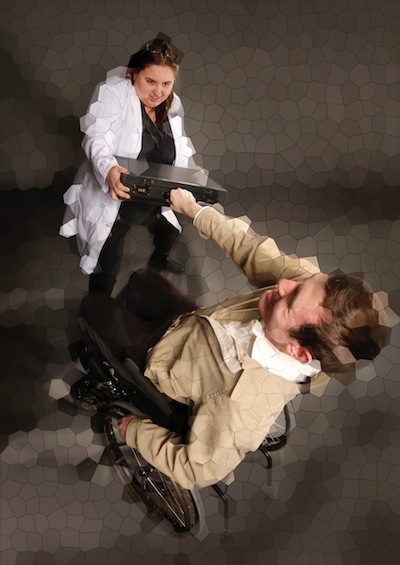
Amy Amantea and Jake Anthony in Sequence, which runs March 14-24 at Presentation House Theatre. (photo by Tim Matheson)

“To direct this play requires a willingness to grapple with the concepts, to accept that sometimes questions are more important than answers, not everything is answerable, and to be committed to entertaining possibilities. It’s heady stuff,” director Rena Cohen told the Independent about Sequence, which opens next week at Presentation House in North Vancouver.

Describing the play as “a science thriller that will challenge as much as it entertains,” Cohen, who is also managing artistic director of Realwheels Theatre, explained, “In Sequence, we follow two absorbing stories. In one, a professor confronts a student who’s defied probability by taking a multiple-choice exam only to get every answer – 150 of them – wrong (the chance of achieving this is one in a pentillion). In the second story, the ‘Luckiest Man Alive’ – his status cemented by his uncanny ability to predict the winner of the Super Bowl coin toss for 20 years running – is confronted by a young woman who claims to know his secret.

“Each of these narratives is presented coherently, cleverly and simultaneously, and it’s how they intertwine through ‘wormholes’ in the dialogue that makes the play fascinating, and mystifying. Playwright Arun Lakra compares the structure of the play to two strands of intertwining DNA. You could argue it’s comparable to a Möbius strip-like dramatic encounter. You’re following two narratives, only to have the carpet swept out from under you.”

For readers who don’t have Wikipedia or a dictionary handy, a Möbius strip, or band, is “a surface with only one side and only one edge. It can be made using a strip of paper by gluing the two ends together with a half-twist.” It’s a non-orientable surface, which means it “cannot be moved around the surface and back to where it started so that it looks like its own mirror image.” The example given for further explanation, is that “no matter what, a human right hand, cannot be rotated in such a way that it becomes a human left hand. The right hand is, therefore, orientable.”

How does one direct a play like Sequence so that it’s enjoyable and comprehensible?

“There are ways we harness the ‘language of theatre’ to capture audiences’ attention, to heighten a moment,” said Cohen. “Sometimes, it’s in the way an actor delivers a line, the way they land on a phrase containing important information. We also signal key moments using lighting and/or sound, so even if, when information doesn’t necessarily register on a conscious level, you absorb it.’”

The material of the play – “Wading into new intellectual territory, learning the mathematical concepts used to understand randomness and probability” – was initially a challenge for Cohen.

“My last physics course was in high school, the last time I studied math was in CEGEP [a post-secondary school program in Quebec] and I’ve never taken a biology course,” she said, “so some of the references in the play – regarding genetics, for example – may not be complicated to a Grade 10 biology student, but they’ve been a challenge to me.

“Sequence is also very fast-paced, and there’s a ton of stage business, most of which is – incidentally – performed by Amy Amantea, our actor who lives with blindness. She’s fearless.”

And, added Cohen, “Working with an integrated cast of performing artists with disabilities and able-bodied artists means there’s a wider range of experience, and we’re challenged to become an ensemble in a few short weeks.”

photo - Krista Skwarok and Byron Noble
Krista Skwarok and Byron Noble. (photo by Tim Matheson)

Amantea (as the professor) will be joined in the performance by actors Jake Anthony (the student), Byron Noble (the “luckiest man”) and Krista Skwarok (the woman who purports to know his secret).

“Two members of the cast live with disability: Amy is legally blind and Jake lives with autism,” said Cohen. “The casting speaks to our (Realwheels’) commitment to fostering interchange between mainstream and disability arts sectors. That means interchange between artists, and we’re all learning from each other.

“Amy Amantea has such a generous spirit, so much heart and decency and, in Sequence, she’s playing a dark, angry character. Her character is also very funny and over-the-top, and this is new territory for Amy, who left the performing arts after she lost her sight 11 years ago. Furthermore, Amy’s character lives with severe sight loss, but of a type that’s different from her own, so there’s a whole other layer of challenge. She also has the most ‘stage business.’

“Jake Anthony is a sensitive actor, and an incredible advocate for persons with autism; getting to know him means gaining appreciation for the gifts that accompany autism,” continued Cohen. “Jake is a decisive and determined individual, very focused, so lovely and respectful to everyone, and he’s bringing tremendous insight into his character, a young man of faith, and an inveterate optimist.”

Skwarok is a recent graduate of Langara College’s Studio 58 theatre program, said Cohen, “and this is her first professional gig. Such bright energy, she’s super-smart and quick and creative and game. Expect to see a lot more of her – Krista’s talent is explosive.”

As for Noble, Cohen said he “is loaded with charm.” In Sequence, she said, his character “is slick, playful and, yes, he’s a charmer – and we get to see his character grow and other unexpected qualities emerge. It’s beautiful to watch. Byron is the most seasoned actor in the Sequence company, and we’re all benefiting from his experience and generosity.”

She said this play feels made for Realwheels “because it isn’t about disability, yet disability forms the landscape against which universal issues are debated onstage.”

She explained, “The four characters in Sequence are attached to their individual frameworks of the world: faith versus science, fate versus DNA. Did God use evolution as a means of creation? If something isn’t testable, how do you justify believing it? Is there an innate rightness to biological outcomes rooted in our fundamental DNA?”

Sequence has won several awards. The playwright, Lakra, is an ophthalmologist in Calgary, where he splits his time between practising medicine and writing, said Cohen. “This is the first time,” she said, “the play is being produced with an integrated cast – professional actors with disabilities playing alongside able-bodied actors.”

Sequence runs 80 minutes with no intermission, and is not suitable for children. It is at Presentation House Theatre March 14-24 (except March 19), with proceeds from the March 14 preview going to Realwheels Society to cover production costs. For tickets ($28-$10), call 604-990-3474 or visit phtheatre.org.

Format ImagePosted on March 9, 2018March 7, 2018Author Cynthia RamsayCategories Performing ArtsTags Arun Lakra, inclusion, physics, Presentation House, Realwheels, science, Sequence
Finding the future in the past

Finding the future in the past

Left to right: Michael Rubenfeld, Mary Berchard and Katka Reszke in We Keep Coming Back, which plays March 13 and 14 as part of the Chutzpah! Festival. (photo by Jeremy Mimnaugh)

At first, we expected the piece to focus mainly on the past and how sad the absence of Jewish life in Poland is. After going and also spending more time in Poland, we now propose that it is through focusing on the present and future, with an aim at building positive perspectives, that will ultimately lead to transformation and genuine healing,” said Michael Rubenfeld about We Keep Coming Back, which plays at the Chutzpah! Festival March 13 and 14.

Rubenfeld created the multimedia work with Sarah Garton Stanley, as well as his mother, Mary Berchard, and filmmaker and translator Katka Reszke. Rubenfeld and Garton Stanley are co-directors of Selfconscious Theatre. We Keep Coming Back is based on a trip that Rubenfeld and his mother took to Poland in 2013.

“It was always our intention to make a piece of theatre and the trip was connected to a desire to explore intergeneration trauma and, also, more specifically, the problems in my relationship with my mother that stem from unresolved trauma and disconnect from our family’s roots in Poland,” said Rubenfeld. “So, the trip was an experiment of sorts; to see if going to Poland with my mother, visiting her mother and father’s hometowns and going to Auschwitz, would give us the opportunity to mourn together, which might also bring us closer together.”

According to a blog on Selfconscious Theatre’s website, after surviving the Holocaust, “Berchard’s family moved from Poland to Sweden, where she was born. They then immigrated to Canada in 1951, where she grew up and eventually had a son, Michael.”

Rubenfeld and Berchard were in Poland for about two weeks. “My mother has since been back three or four more times, and I now have a home in Poland with my wife,” said Rubenfeld – the couple lives in both Krakow and Toronto. “We’ve toured We Keep Coming Back to Poland three times,” he added.

The project has worked to bring mother and son closer.

“It’s been really nice for us to have a piece that we do together,” said Rubenfeld. “It gives us an excuse to spend time together to do something we know we’re going to enjoy. It’s also given us commonality, which has been really essential for our relationship.

“My mother has always been very supportive, though we don’t always have a lot in common. This project has changed that. We also now have Poland in common, and our mutual interest. My mother really loves it in Poland. She’s also become quite interested in uncovering more about our history and has started researching and archiving our family tree. It’s brought her a lot of happiness and has been a really healing thing – which, in general, has been good for our relationship as well.”

We Keep Coming Back “speaks so openly and honestly about what it means to love a parent, or to be loved by a child, and how so many of the resources for a good and enduring love were torn apart by the Holocaust and all of the horrors, throughout the generations that linger,” said Garton Stanley, who is also associate artistic director of English theatre and interim facilitator for indigenous theatre at the National Arts Centre in Ottawa.

“Honestly, as someone on the ground since the get-go, I was most curious about Michael’s developing love for Poland and how, over the course of the play’s creation, he not only fell in love with a Jewish woman from Poland but that he now lives there,” she said. “Michael and I are very interested in the line between fiction and reality and the space for realizing possible worlds through dramatic form. Michael now speaks some Polish. He’s making deep-rooted reconnections and helping contribute to a vibrant Jewish life in Poland.”

Garton Stanley and Rubenfeld met just over 10 years ago, after she saw him in a show. “He was performing in it with my partner at the time,” she said. “He was amazing. We became fast friends shortly thereafter.”

At Selfconscious Theatre – which they started together – the two have also co-created The Book of Judith; Mother, Mother, Mother; and The Failure Show.

For We Keep Coming Back, Garton Stanley is not only co-creator but the director. “My co-creation,” she explained, “was part facilitator, part conceiver, part devisor, part writer, part mediator, part friend and always enthusiast.”

How Reszke became involved in the production is a little more circuitous and fortuitous.

“Once we decided to take the trip to Poland, we connected with a producer named Evelyn Tauben, who was doing research around contemporary Jewish Poland,” explained Rubenfeld. “Through Evelyn initially, we started learning about the renaissance of Jewish culture in Poland, which, at the time, I knew nothing about. Once learning about it, we determined that it was important to us that we engage with it on our trip, and that’s when Katka came into the picture.

“We knew we needed a translator to join us, and we also knew we wanted to document the process. We joked that it would be incredible if we could find someone who could both translate, film and be a Polish Jew who might want to collaborate with us artistically. On a lark, we Googled ‘Polish, Jewish, filmmaker,’ and that’s how we discovered Katka. We sent her an email, and one thing led to another.”

“Mary Berchard and Katka Reszke,” added Garton Stanley, “are fascinating performers and neither of them has any training in this area. Their stories and their curiosity combine with Michael’s to create a new family. And this feels like one of the piece’s hidden successes.”

As for what has most surprised her about the project, she said, “That we are still doing it and learning from it. And learning from the audiences whose histories intersect with Michael’s, Mary’s and Katka’s own generational challenges and traumas. And that the piece resonates as deeply as it does. It has a beautiful heart and this is always surprising, in the best way.”

“I believe that, in our desire to never forget what happened during the Holocaust, we have also forgotten that Poland was one of the most important contemporary homelands for the Ashkenazi Jewish people for over 500 years,” said Rubenfeld. “So much of our contemporary culture was bred in this land, and we forget that the Jewish people were happy living in Poland before the war. We are raised to think of Poland as only the place of tragedy. While I understand why, I think that it’s essential to remember and celebrate a time when there was such vibrant Jewish culture. Most was destroyed because of the war, and it’s impossible to not feel sad. But, as we move into the future and the pain continues to recede, it is just as important to remember the incredible prewar Polish Jewish world of Poland. It was very profound.”

For tickets to We Keep Coming Back at the Rothstein Theatre, and for the full Chutzpah! schedule, visit chutzpahfestival.com.

Format ImagePosted on March 2, 2018March 1, 2018Author Cynthia RamsayCategories Performing ArtsTags Chutzpah! Festival, family, Holocaust, intergenerational trauma, Michael Rubenfeld, Poland, Sarah Garton Stanley, Selfconscious Theatre
JCC site to be redeveloped?

JCC site to be redeveloped?

An aerial view of the proposed redevelopment of the Jewish Community Centre of Greater Vancouver site, looking south. (image by Acton Ostry Architects Inc.)

On Feb. 7, the Jewish Community Centre of Greater Vancouver was packed with community members, as well as some area residents. For the three-hour open house hosted by the City of Vancouver, visitors worked their way through the crowded atrium, reading the numerous poster boards about the proposed redevelopment of the centre site, and how that redevelopment fits in with the massive changes proposed for the Oakridge neighbourhood.

While it is still early in the process, the City is looking for public feedback by March 30 on the rezoning application it has received for 950 West 41st Ave., i.e. the JCC.

The proposed redevelopment comprises a nine-storey building to replace the current JCC, a 13-storey replacement for the Louis Brier Home and Hospital and a 24-storey residential building.

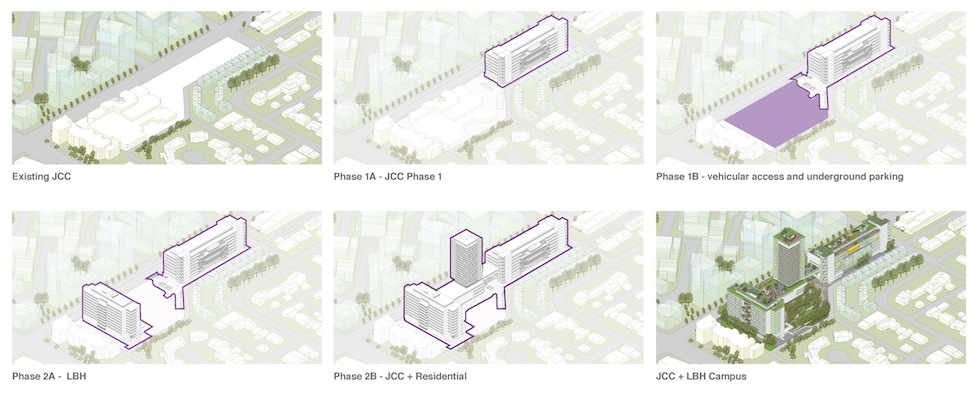
image - The rezoning application proposes that the redevelopment starts with the building of most of the new JCC on what is now the existing centre’s parking lot, then moves to the construction of the underground parking, followed by that of the new Louis Brier Home and ending with the residential tower and the rest of the JCC
The rezoning application proposes that the redevelopment starts with the building of most of the new JCC on what is now the existing centre’s parking lot, then moves to the construction of the underground parking, followed by that of the new Louis Brier Home and ending with the residential tower and the rest of the JCC. (image by Acton Ostry Architects Inc.)

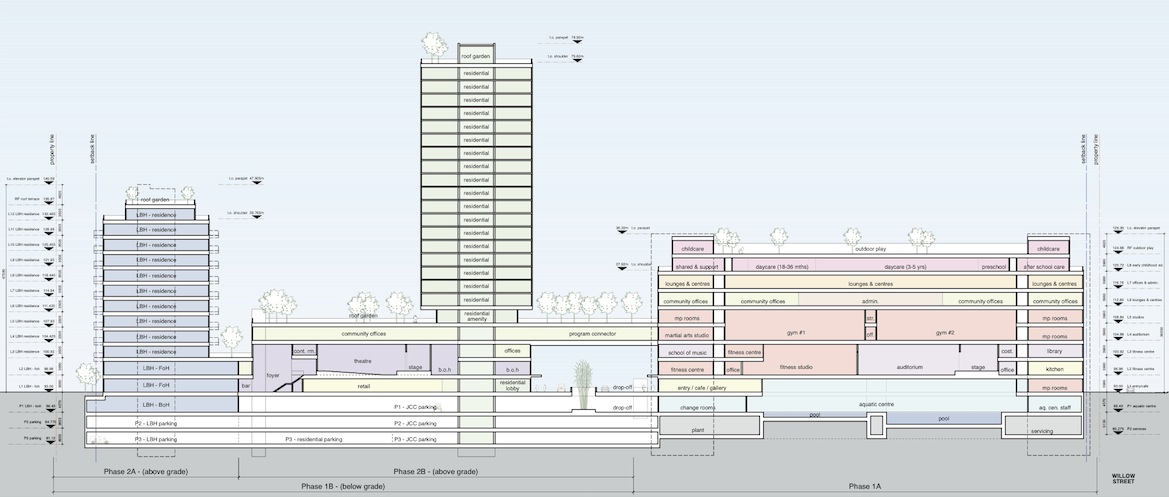
According to the rezoning proposal, the new JCC would include “recreation space, including pools and gyms; ground-level commercial space; an Early Childhood Education Centre, including 104 private daycare spaces; cultural arts, auditorium and theatre space; [and] nonprofit office space.”

The new Louis Brier would have “266 senior assisted living, complex care and memory care beds,” and the residential building would have “160 secured market rental units,” including 64 studios, 40 one-bedroom units, 40 two-bedroom units and 16 three-bedroom units. “Underground parking, with 693 vehicle parking spaces and 250 bicycle parking spaces, is proposed.”

The rezoning application is being considered by the City under the Oakridge Transit Centre Policy Statement.

The City of Vancouver explains on its website that the Oakridge Transit Centre, across from the JCC, “was formerly home to 244 trolley and 182 diesel buses, and employed over 1,200 transit staff including drivers, mechanics and administrators…. With the completion of the Vancouver Transit Centre on the Eburne Lands in 2006, almost all services moved out of the OTC” within several years and TransLink determined that the OTC was no longer required as a transit centre. TransLink approached the City about the redevelopment of the site: “Council approved a cost-recovered planning program to create a policy statement for the site in February 2014 and the program was publically launched in June 2014.”

The statement was approved in December 2015, after “an 18-month process involving community engagement at key points, and technical planning and design work.” It guides “the rezoning and redevelopment of the Oakridge Transit Centre,” as well as that of the JCC, the Petro Canada Station at the corner of 41st and Oak, and Oakmont Medical Centre (809 West 41st).

The JCC rezoning application was coordinated by Acton Ostry Architects Inc., the JCC and the Louis Brier Home. In the application, which is on the City’s website, Acton Ostry explains that the “surrounding context is in a state of transition and transformation from a low-density semi-urban neighbourhood to a high-density urban centre. Transit is a driving force at the heart of the new town centre with the Canada Line on Cambie Street and a new B-line proposed for West 41st Avenue.” The document notes that King David High School, which is east of the JCC, on Willow Street, uses and “shares many spaces in the existing JCC and is intended to have a dedicated gym in the proposed new JCC, in addition to access and use of many other activity spaces.”

image - How the space in the three proposed new buildings might be used
How the space in the three proposed new buildings might be used. (image by Acton Ostry Architects Inc.)

According to the timeline on one of the posters at the February open house, there was a pre-application open house in November 2016 and the rezoning application was submitted in December 2017. With the City-led open house now having been held, there will be a public hearing, “pending staff review and feedback,” followed by a council vote, again “pending staff review and feedback.” If the rezoning is approved, “the proposal becomes a development application.”

Development and building permits would take months to years to procure, and the construction itself would also take a few years. Since the JCC cannot be non-operational for that long, the project is envisioned in phases. The existing JCC would remain in place as the main building of the new JCC is built on what is now the centre’s parking lot, followed by the construction of the new underground parking lot. Once the new JCC was operational, Phase 2 would start with the new Louis Brier Home, to be located at the opposite end of the development site, then move to the construction of the residential tower and the rest of the JCC, located in between the main JCC and Louis Brier.

The entire rezoning application can be found at rezoning.vancouver.ca. Feedback can be submitted online.

Format ImagePosted on February 23, 2018February 21, 2018Author Cynthia RamsayCategories LocalTags development, JCC, Oakridge, rezoning, Vancouver
Filler doing it her way

Filler doing it her way

Deb Filler performs at the Chutzpah! Festival on March 4. (photo from Chutzpah!)

“I’ve performed all over the world, baked challah bread onstage, done shows everywhere, and this is the first time in all these years I am performing in Vancouver live. Delighted to be coming back to do a show! I hope there’ll be more,” Deb Filler told the Independent.

Filler, who will perform at the Chutzpah! Festival on March 4, lived in Vancouver for six months, starting in late 1979.

“I was tempted to stay but never did,” said the comedian, actor, musician, teacher and writer originally from New Zealand. “My career in North America started there. I had an agent and things were going well but New York called, Stella Adler and Uta Hagen, the great acting teachers I studied with. So, I drove across country and the rest as they say….”

While Filler left Vancouver for New York, she has lived in Toronto since 1995.

“I came for a film that was being made of my work, Punch Me in the Stomach, and I stayed and I fell in love,” she said. “Toronto is a terrific city for fun, culture. And it’s close to Europe and New York. I was in New York before that for 15 years, so I guess I’m a bit of a rightie not a leftie – coastie. Not politically, that’s for sure!”

Filler will be bringing her show I Did It My Way in Yiddish (in English) to the Rothstein Theatre for one performance only – March 4, 1 p.m. Described as a journey around the world, “jam-packed” with music (Filler on her guitar) “and a raft of loveable characters she creates,” the initial work was commissioned by the Jewish Community Centre London, called the JW3, as it is located on Finchley Road, NW3. The centre’s tagline is “The postal code for Jewish life.”

“It’s a fantastic modern facility in North London with cafés, art studios, a theatre, meeting places, gallery, classrooms, a school, a film space, a real cultural hub,” said Filler, who had worked with them before the commission. “I’d gotten a great response several times in the past and they were keen for me to come back for their U.K. Jewish Comedy Festival so asked me to perform a new show. I knew – because the stories I tell about meeting and befriending Leonard Bernstein, Leonard Cohen and another Jewish musician called Lenny – that London audiences would respond like audiences have all over the world. So, when they asked, I was delighted to agree, and now the show has been in New York, L.A., Sydney, Toronto, and is coming to Vancouver and D.C.”

Since the commission, the show has changed a bit.

“We made a short dramatic film of one of the stories, which is sometimes screened during the show as a multimedia segment, which Chutzpah! requested. Also, the name has changed to describe the show better than The Three Lennys.”

A March 2017 article on broadwayworld.com describes a bit of the show: “As Deb drives for a car service in New York City, she takes us on a truly incredible ride with Leonard Cohen, reducing the venerable Canadian folksinger to tears of laughter. Her story of meeting Leonard Bernstein as a teen, bringing him fresh challah bread from her father, a survivor of the Holocaust who heard Bernstein play Gershwin’s Rhapsody in Blue in a displaced persons camp after the war, is extraordinary. What happens next is truly unbelievable.”

One of the things that will happen next for Filler is a trip to Europe. “I’m being invited to Landsberg in Germany as guest of the reunion there of my father’s displaced persons camp, where Leonard Bernstein played and my dad saw him in 1948…. I’m also working on My German Roots Are Showing, which I read in London with actor Miriam Margolyes as my mother. She is fantastic!”

In a conversation a few years ago on Auckland’s Newsbeat (newsbeat.kiwi) with journalist Keren Cook, Filler spoke about Jewish humour and how her family provided a rich environment and offered many resources for her creative expression.

When the Independent asked her about how she takes into account her relatives’ feelings, Filler said, “There are red lines, nothing too personal, but my family are wonderful and amongst my biggest fans, so it’s been a pleasure to perform for them. One relative loved my show Punch Me in the Stomach, but somebody put a worm in her ear and she got defensive so I’ve taken her out of future shows to safeguard any feelings she may have about being exposed. It’s all done with love and admiration, and a bit of comedy of course. So, sometimes one must exaggerate for the laugh. But it’s all good.”

Filler taught at Brown University for 14 years in Providence, R.I., and she teaches at Humber College in Toronto and at Toi Whakaari (New Zealand Drama School), in addition to having private students. “I’ve recently started directing,” she said, “and just had a wonderful show open in Auckland for Pride Festival, called Random Shagger. It’s doing really well.”

She advises aspiring comics about to pick up the mic for the first time, “Be strong! Be brave! Have confidence in your persona. And do it for yourself, not for drunken college students who tend to populate comedy club audiences.”

For tickets to I Did It My Way in Yiddish (in English) and the full Chutzpah! Festival lineup, visit chutzpahfestival.com.

Format ImagePosted on February 23, 2018February 21, 2018Author Cynthia RamsayCategories Performing ArtsTags Chutzpah! Festival, comedy, Deb Filler
Salomé’s rightful place

Salomé’s rightful place

Salomé: Woman of Valor will have its world première at the Chutzpah! Festival March 8-10. (image by Anya Ross, graphics by John Greenaway)

There have been many interpretations of Salomé – thought to be the woman whose alluring dance persuaded King Herod to honour her request that he have John the Baptist beheaded – but none quite like that of Salomé: Woman of Valor, which has its world première at Chutzpah! March 8-10.

The creation of this complex, multilayered work that combines poetry, music, dance and film was led by composer and trumpeter Frank London and poet and performer Adeena Karasick. It features live music by London, percussionist Deep Singh and keyboard player Shai Bachar. The poetry is written and performed by Karasick, the dance choreographed and performed by Rebecca Margolick and Jessie Zaritt, and the video analyzing Charles Bryant’s 1923 silent film Salomé was made by Elizabeth Mak. The whole production is directed by Alex Aron.

“Frank was intrigued by the Salomé story due to the visual cornucopia of the Bryant film, and because it is a story where dance was at the centre, motivating the complex chain of events, and thus ripe for reinvention as a contemporary dance-theatre piece incorporating Bryant’s imagery,” Karasick told the Independent about why the work focuses on Salomé and not another Jewish historical or literary woman. “However, he was only aware of the [Oscar] Wilde retelling of the Salomé story and thus not really interested in her narrative. He came to me to see if I could reenvision her story in a more compelling way.”

It has always bothered her, said Karasick, how, within Christian mythology and entrenched in history by writers like Wilde, Gustave Flaubert and Stéphane Mallarmé and artists such as Gustav Klimt, Gustave Moreau and Aubrey Beardsley, “Salomé was seen as yet another Jewish temptress/Christian killer – but, in fact, there isn’t any evidence to substantiate this claim. According to apocrypha and Josephus’s Antiquities, she came from Jewish royalty and there is no evidence she murdered John the Baptist or even danced for Herod,” said Karasick.

“The only historical reference that [Herod’s wife] Herodias’s daughter’s name was Salomé is from Flavius Josephus, who makes no other claims about her – not that she danced for Herod, not that she demanded John’s head, but only that she went on to marry twice and live peacefully. The other apocryphal reference is that a daughter danced for Herod, which caused him to lose his mind and kill John the Baptist. Thus, the conflagrated Salomé that appears in the Wilde play, [Richard] Strauss opera and all subsequent productions, is an amalgamated construct, so we felt it was our duty to set the record straight.”

In fact, added Karasick, there are three women named Salomé in Jewish history: Salomé, daughter of Herodias and Herod II (circa 14-71 CE); Queen Salomé, her great-aunt (65 BCE-10 CE); and Salomé Alexandra (139-67 BCE).

“Her great-aunt, Salomé I, was the powerful sister and force behind Herod the Great, king of Judea and Second Temple rebuilder,” said Karasick, while Salomé Alexandra (also known as Shelomtzion) was one of only two women who reigned over Judea.

“I wanted my Salomé, Salomé of Valor, to carry the weight of both her genetic lineage and the cultural heredity of her name, embodying the legacy and power of the women that came before her,” said Karasick.

Karasick, who was born in Winnipeg, grew up in Vancouver, earning her bachelor’s from the University of British Columbia. She did her master’s at York University and her PhD at Concordia University. Among other things, she teaches literature and critical theory at Pratt Institute in New York, is co-founding artistic director of KlezKanada and performs her work around the world. The author of nine books – with a 10th, Checking In, published by Talonbooks, on the way – she has been awarded for her contributions to feminist thinking and, last year, the Adeena Karasick Archive was established at Special Collections, Simon Fraser University.

London – a member of the Klezmatics and the group Hasidic New Wave, who has performed with countless musicians and made numerous recordings of his own – saw Karasick perform in New York in 2011. He then hired her, she said, “along with Jake Marmer to design and lead the poetry retreat at KlezKanada…. We hadn’t yet collaborated before this, but I was always compelled by his music and the breadth of all he created as a masterful revolutionary himself, not only as a spectacularly fierce trumpet player but virtuosic composer, reinvigorating klezmer music, transcendentally intermixing it with aspects of world music, jazz, Chassidic new wave, punk – and always felt it would be a thrilling and highly symbiotic artistic match.”

When Frank approached her about the Salomé project, said Karasick, they both “fell in love with the Bryant film but were so perplexed” about Salomé’s “reputation in cultural history.”

So, Karasick started researching, “poring through the multiple and conflict[ing] narratives – through Josephus and the apocrypha, locating the many discrepancies between Christian and Jewish mythologies, speaking with specialists in the field, and became fascinated with how there are so many ‘truths,’ stories, misreadings, and how imperative it is to question these grand narratives, problematize traditional cultural, moral and religious perspectives.

“For millennia,” she said, “Jews have been portrayed as the murderers of gods and prophets in other people’s mythologies, so Salomé: Woman of Valor deconstructs this mythology, exposing how she was not a demonic murderess, and opens up the possibilities for infinite retelling and how truth itself is always a construct of veiling and unveiling.”

About the magnitude of the project, Karasick said, “As the author of nine books invested in issues of ethnicity, gender and ways to construct meaning, as professor of poetry and critical theory, gender images in the media, and poetics and performance, Salomé: Woman of Valor is a logical progression in my 30-year career, and has allowed me to integrate my experiences in one work – something that I have never done before.

“Due to the scope of this show,” she said, “I’m able to weave together the multiple styles of writing that I’ve experimented with over the years – sound poetry, homophonic translations, post-language conceptualism, kabbalistic and feminist revisionist practices, all syntactically playful, polyphonic, ironic and rhythmically complex – a fusion of my esthetic passions and expertise; opening a space of female empowerment.”

While London has been involved in many projects, Karasick said Salomé might be the first for him with performance poetry at the centre.

“We created Salomé: Woman of Valor as an integration of performance poetry, dance, music and video exploring the dialectic between narrative and abstraction – it is a quantum leap forward in collaborative artistic development, challenging my conceptual processes of making an artwork,” she said. “I couldn’t be more excited.”

Salomé: Woman of Valor is already being presented in an array of venues and contexts, said Karasick. “Its form and content make it appropriate to be presented at jazz, dance, poetry, new theatre, literary and electronic literature festivals; in performing arts centres, universities, avant garde text-based multimedia events, as well as events focusing on new media and cross arts,” she said.

“With its feminist and mystical kabbalistic take on Jewish historical subject matter and a live score which draws from East European Jewish music (klezmer) with jazz, Arabic and Indian musics, our Salomé is especially attractive to Jewish culture festivals and to presenters of Jewish music, language, dance and art.”

The libretto has been published in Italian and in English, and selections of it have been published in Bengali, Arabic, Yiddish and German. It is “being taught in universities worldwide in departments of global literature, Jewish studies and humanities and media studies,” she said.

The artists bringing Salomé: Woman of Valor to Vancouver are all “at the forefront of their respective fields,” said Karasick, “and so I feel so fortunate to be working with such powerful creators, all revolutionaries in their own ways. Frank works with Shai Bachar and Deep Singh on a number of musical projects – Deep and Frank started the internationally acclaimed bhangra-klezmer fusion band Sharabi; and [Frank] co-developed Night in the Old Marketplace with Alex Aron, so bringing her on board as a director seemed a natural fit.

“Over the five years of envisioning the piece, we tried on a number of dance styles, ranging from tribal belly dance to sword dance/swallowers, and, with the advice of (Merce Cunningham protégé) Gus Solomons, Jr., settled on the avant garde modern dance of Israeli superstar Jesse Zarrit and the stunningly poetic Rebecca Margolick, with a shout-out to the Dadaist Loïe Fuller stylings by Jodi Sperling.”

Mak’s video on Bryant’s silent film, notes the project’s promotional material, is “punctuated with Jim Andrews’ stunning vispo [visual poetry], with special video appearances by … Tony Torn as Herod, lit by Nicole Lang.”

“Together,” said Karasick, “we’re expanding our work in ways only dreamed possible; have created an intellectually provocative, audio-visual sensorium, informed by our (Frank’s and my) ongoing obsession with excess, desire and pushing boundaries.”

And it’s an interest, if not obsession, with many others, as well. The Kickstarter campaign for Salomé surpassed its goal of $20,000, about half of the project’s budget.

“The show has been garnering a lot of love and support from colleagues and patrons,” said Karasick, “perhaps due to ways that it addresses the social and political necessity to speak the unspoken, resist stereotypes, misrepresentation and outdated myths, and fosters a thinking that leads to a hybridized syncretic culture, one that honours the intermixing of blood, belief, rhythm, texture and being. Content-wise, it addresses outdated notions of identity and ethnicity, and carves out a space where difference and otherness can be celebrated. We feel incredibly grateful, and hope that we can keep growing it. Broadway, here we come!”

But, first, the Chutzpah! Festival. They have also been invited to Toronto’s Ashkenaz Festival and the Boston Jewish Music Festival, said Karasick, who will continue to tour with the Salomé books. “Frank,” she said, “will record and release the music as a CD. We hope to see it at major festivals and venues worldwide.”

The presentations of Salomé at Chutzpah! are presented in association with the Dance Centre, where the performances will take place. For tickets and the full festival lineup, visit chutzpahfestival.com.

Format ImagePosted on February 16, 2018February 14, 2018Author Cynthia RamsayCategories Performing ArtsTags Adeena Karasick, Charles Bryant, Chutzpah! Festival, dance, film, Frank London, music, Oscar Wilde, poetry, Salomé, spoken word, vispo, women
Ventanas come to B.C.

Ventanas come to B.C.

Tamar Ilana leads a Sephardi singing workshop Feb. 20 and she and her ensemble, Ventanas, have five shows in British Columbia. (photo by Zahra Saleki)

Tamar Ilana and Ventanas wind up their Arrelumbre tour with six engagements in British Columbia, starting off Feb. 20 with Tamar leading a Sephardi singing workshop at Net Loft on Granville Island.

The group will perform at Russian Hall in Vancouver (Feb. 24), as well as in Duncan (Feb. 21), in Victoria (Feb. 22), on Quadra Island (Feb. 23) and on Bowen Island (Feb. 25). When they return to Toronto, they will record their third album.

Ventanas’ first album, which was self-titled, was released in 2013. Arrelumbre was recorded in November 2014 and released in June 2015 at the Aga Khan Museum in Toronto. Both recordings were nominated for two Canadian Folk Music Awards each: Ventanas for best traditional singer and best ensemble in 2014 and Arrelumbre for best traditional singer and best world group in 2015.

“On Arrelumbre, we recorded four original compositions – our first compositions!” Tamar told the Independent. “Up until then, we had focused on rearranging traditional works, but Arrelumbre launched us on the path of creativity. These four originals, each in a different rhythm, are ‘Elianto’ (slow 9/8), ‘Primavera’ (7/8 with a bulerías flamenco insert), ‘Libertad’ (6/8) and ‘Si Te Quiero’ (10/8). These pieces were composed by our oud player, Demetri Petsalakis, who is not joining us on this tour because he is touring with the New Canadian Global Music Orchestra. I then wrote lyrics in Spanish and we arranged them as a band.

“We also incorporated bass for the first time (on ‘Libertad’), invited guest Ukrainian folk singers Mark and Marichka Marczyk, and guest Iranian daf virtuoso Naghmeh Farahmand,” she added. “We loved having bass so much that we invited the guest bass player, Justin Gray, to become a member of the band. He has been with us ever since and he will be on tour with us this month. He is also the brother of our percussionist, Derek Gray, which makes them a great team for our rhythm section.”

When the Independent interviewed Tamar, she was in California – since the beginning of 2015, she has been touring with Lemon Bucket Orkestra’s Counting Sheep, a multimedia play inspired by the 2014 Maidan revolution in Ukraine. Tamar said the show has had three soldout runs in Toronto, won various awards at the Edinburgh Fringe Festival and has also traveled to Germany, Ireland, England and New York.

Since the Independent last interviewed Tamar four years ago – when she and Ventanas were in Vancouver for the folk festival – Tamar has also been doing other creative endeavours. In fall 2015, she performed in Yaël Farber’s Salomé at the Shakespeare Theatre Company in Washington, D.C., for three months. And, in 2016, with some funding from the Ontario Arts Council, she studied at Les Glotte-Trotters, a private vocal academy in Paris, France. Last year, she sang as an invited guest on various albums by other artists.

Among Ventanas’ highlights since the Vancouver folk fest, the group performed in 2016 at APAP|NYC (Association of Performing Arts Professionals | New York City), which, according to the organization’s website, is “the world’s leading gathering of performing arts professionals.” Ventanas also came out to Burnaby that year, to perform at Pacific Contact, B.C. Touring Council’s annual showcase. In 2017, they toured the United States for the first time, hitting New York City, Washington, D.C., Boston, Chicago and Minneapolis.

“We are absolutely thrilled to be returning to B.C., where we find the people to be warm and hospitable, and to greatly appreciate our art,” said Tamar.

Once they return home, however, Ventanas won’t be wasting any time – they are set to record their new album in March.

“This recording,” said Tamar, “will be at least 50% original material, this time from various members of the band, including Jessica Hana Deutsch, our violinist; Benjamin Barrile, our flamenco guitarist; Demetri Petsalakis. I have written some lyrics; however, I have also taken poetry in French by the poet Omar Khayyam for one piece, inspiration from Martin Luther King’s ‘I Have a Dream’ for another, and Hebrew teachings for another. This album brings us closer to our long-term goal of composing the majority of our music, based on the fusing of our cultures and traditions, resulting in our own sound and feel.”

The group that is in British Columbia this month is a little different than the one that came to Vancouver in 2014.

“Dennis Duffin, who was here with us in 2014, has since moved to Seville, Spain, to pursue his studies in flamenco guitar … and Alejandra Talbot, a flamenco dancer with us in 2014, has since moved to Mexico to delve into her roots,” said Tamar. “Benjamin Barrile, who I have collaborated with over the years … and who was a member with myself, Dennis and Lia [Grainger] in Flamenguitos del Norte, has been playing with Ventanas now since 2015, and we are excited to have him record with us on our upcoming album for the first time. Justin Gray, also with us since 2015, co-produces our albums, along with myself.”

Tamar said, while members have come and gone over the years – every musician bringing “their expertise and individual sound to the group” – “the core feeling of the band remains, and gets passed down through the generations, so to speak.”

“Overall,” she said, “the sound has matured, the sound grows richer and our musicianship increases, as we continue to become more and more ourselves. We are all working on various projects and what we learn, we pour into Ventanas, resulting in a depth and richness that we only hinted at in the beginning.”

For the full schedule and tickets to Ventanas’ B.C. performances, including Tamar’s singing workshop, visit ventanasmusic.com.

Format ImagePosted on February 16, 2018February 14, 2018Author Cynthia RamsayCategories MusicTags Arrelumbre, Sephardi, Tamar Ilana, Ventanas
Jumping gene research

Jumping gene research

Dr. Gideon Rechavi, who founded Sheba Cancer Research Centre, was in Vancouver in January for an international conference at which he presented new findings on “jumping genes.” (photo from Sheba Cancer Research Centre)

Dr. Gideon Rechavi, who founded Sheba Cancer Research Centre, in Ramat Gan, Israel, was in Vancouver in January for an international conference on DNA and RNA methylation.*

“I described a new work we just published, regarding ‘jumping genes,’” he told the Independent about his presentation at the conference. “Forty-five percent of our genome, part of what people used to call ‘junk DNA,’ is composed of genes that can jump from one place to another.”

As far as what this means for the functioning of a body, he explained, “When they jump, they can activate genes and they can also inactivate genes, and it’s a random process. Actually, when I was PhD student in ’82 at the Weizmann Institute, I found the first example of such an event in mammals.” And, he added, “We were also the first to show the role of such events in cancer.”

Rechavi explained, “In cancer, there is a set of genes called oncogenes, genes that usually are normal genes in our genome but, when they are over-activated or activated in the wrong cell or at the wrong time, they can push the cell to proliferate and can cause cancer.”

Now, he said, many years later, using advanced technologies based on whole genome sequencing, they have found that, “in a variety of neurodevelopmental disorders, such as autism and Rett syndrome and similar diseases, there is a basic gene defect in the family or in the affected child. However, the clinical presentation can differ even between identical twins. Nobody understands why the same genome and the same genetic background will result in such a difference, one patient will be affected by epilepsy, the other one by autism or mental retardation.

“The mechanism that we show is that, in the brain, there is, normally, a constant level of jumping of such genes and, probably, it’s essential for diversity of neurons and brain plasticity and activity.”

This is happening all the time in neuronal stem cells, he said. “During the differentiation of neuronal stem cells … there is a very precise time window of 48 hours when such transposition events can take place. And, probably, it’s essential, because you find it in mice, in monkeys and in humans. However, in all the diseases that we are studying, there is over-activation of the mechanism, so you have many more jumping events.”

We have neuronal stem cells dividing in the brain our whole life, said Rechavi. “In the past, we used to think that all of the neurons are created during pregnancy or soon after, but now, in the last 20 years or so, we know there are also adult neuronal stem cells. When you do gymnastics or when you take Prozac, there are more neuronal stem cells. And, in these neuronal stem cells, these transposable elements – jumping genes – are jumping and probably contribute to brain function.”

The process seems to be quite regulated, he said. “The mechanism we suggest, we call it the ‘lightning rod’ mechanism or hypothesis.”

He explained, “The majority of jumping events occur in sequences in the genome where integration will not cause harm. So, in a normal level of jumping, we expect it will be beneficial, and the chance for damage is low. Although, if, in a variety of diseases, there is uncontrolled activation of this mechanism, so there are many more jumps, then it can saturate the lightning rod safeguard mechanism and then affect genes that are relevant to neuronal diseases, and we have a lot of examples where such things happened.”

To study this, said Rechavi, they sequenced the genomes of 100 samples, which included normal, diseased and control brain samples. “We were able to show that there is a particular normal level of transposition … and, then, over-activation, with many more transposition events, in the brains of disease-affected children.”

From these results, he said, we know that “the genes affected by such insertions from these transpositions, you see that many of them are relevant to neuronal functioning, neural development and a variety of neuronal disorders, such as autism and schizophrenia.”

By understanding the biochemical mechanism in these patients, what activates the jumping, “then you can intervene,” said Rechavi. For example, perhaps a drug could be developed that would decrease the level of transposition.

“This is the next step,” he said. “Now, we have several patients where we know the gene defect involved in the syndrome and, therefore, is involved in the enhanced transposition, so now we have to find a way to shut it off, to lower the activity.”

Rechavi said his lab is researching these jumping genes and their effects in both cancer and neuronal disorders, and that they are currently looking for funding to study the involvement of such genes in Alzheimer’s and in aging.

The purpose of the jumping genes is not certain. “What people suggest,” said Rechavi, “is that it has to do with diversity.” Recalling that it is a random process, he explained, “So, instead of having all the neurons in a particular part of the brain being identical, now you have diversity and probably the diversity increases the efficiency of the brain circuits, etc. It can also be relevant to plasticity. We know that specific brain regions can take over following damage or following a kind of environmental influence and change the activity and perform new activities. So, maybe the ability to create diversity in the brain is an advantage.

“A similar model has to do with the immune system,” he added. “With the immune system, we know that there are genetic mechanisms that increase diversity and, then, the cells of the immune system of an individual can respond to any virus and any bacteria.”

The main focus of his lab at Sheba Medical Centre, he said, is to find new genetic and epigenetic mechanisms, “and then to ask, what is their relevance to normal physiology and what’s their relevance to diseases. That’s how this story that started with cancer research turned out to be very relevant to neuronal disorders and psychiatric disorders.”

Rechavi said the phenomenon of jumping genes, or transposable elements, was first identified by American scientist Barbara McClintock (1902-1992) in experiments with maize. (She won the Nobel Prize in 1983 for this and other contributions to the study of genetics.) “She found it in maize,” he said. “We found it in mammals.”

Conferences like the one Rechavi was attending in Vancouver when he spoke to the Independent by phone Jan. 23 from his room at the Fairmont Hotel Vancouver, where the conference was being held, are useful for several reasons.

“Some people, after my talk, came and they wanted to collaborate, they want to learn the methodologies. Some people suggested samples we could analyze…. This is the basis for scientific collaboration, the main reason to do scientific meetings. You can read everything on the internet,” he said, “but when you discuss with people the findings and you drink coffee together and discuss the details, you can get new information, new non-published information, and also collaborations and friendships.”

Sheba Medical Centre doesn’t have many partnerships with Canadian institutions, said Rechavi. The centre’s main collaboration in Canada, he said, is with Toronto’s Hospital for Sick Children, especially in the field of brain tumours, because one of Rechavi’s former trainees, Dr. Uri Tabori, went to SickKids to study such tumours and stayed there.

Before obtaining his PhD at the Weizmann Institute of Science, in Rehovot, Rechavi earned his doctor of medicine at Tel Aviv University’s Sackler School of Medicine. He is a professor of hematology at Sackler School and heads the Cancer Research Centre at Sheba Medical Centre, the largest hospital in Israel, which serves as a university teaching hospital (affiliated with Sackler) and as a tertiary referral centre. He has published more than 450 scientific papers.

In addition to treating some 1.5 million patients annually, Sheba Medical Centre has 75 laboratories and more than 2,000 ongoing clinical trials; 30% of Israeli medical research is performed at Sheba, which files, on average, 15 biomedical patent applications per year.

In October 2017, Sheba Medical Centre inaugurated the Wohl Institute for Translational Medicine. The idea, said Rechavi, is to take the “findings emerging from basic research and try to translate it into taking care of patients; to better diagnose, to [develop] better treatments.”

* Methylation, explained Dr. Gideon Rechavi, “is the addition of a chemical group known as methyl on the four basic letters of the genetic material (DNA and RNA) to generate a new expanded ‘alphabet.’”

Format ImagePosted on February 16, 2018February 14, 2018Author Cynthia RamsayCategories IsraelTags aging, Alzheimer's, cancer, DNA, Gideon Rechavi, health, jumping genes, medicine, methylation, neurodevelopmental disorders, science, Sheba Medical Centre
Musical tribute to dear friend

Musical tribute to dear friend

Perla Batalla brings the music of Leonard Cohen to the Rothstein Theatre March 11. (photo from Chutzpah!)

I didn’t choose singing. It chose me,” Perla Batalla told the Independent in an email interview. Batalla brings her personal and moving tribute to her good friend, Leonard Cohen, to the Chutzpah! Festival March 11.

“He was not only a mentor and a friend, but also a very great inspiration. Being as I was young when I worked with Leonard – I was in my 20s – I watched him like I was watching a master and learning as much as I possibly could,” she said. “His need to always seek the comfort of his audience was truly generous – and all too rare. We began working together in the 1980s and we never lost touch, even after I was touring on my own.

“In Leonard’s earlier tours,” she said, “he would tell stories before every song – very funny, honest stories about his life. Each night he’d tell similar stories, but they always seemed fresh – like I’d never heard them before – I think that was because of his honesty, and his ability to show up and always be authentic, be authentically Leonard Cohen.

“He had a huge impact on what I do and how I perform. If I approach a song with unconditional honesty, the meaning is not static – it can ebb and flow as I relate the words to my own life and experiences.”

In Vancouver, Batalla – who lives in Ojai, Calif. – will be joined by pianist Michael Sobie.

“He recently returned after touring as assistant conductor and pianist with the Game of Thrones Concert Stadium Tour,” Batalla said. “Michael also performs as the principal pops pianist with the Grand Rapids Symphony and has toured internationally as pianist/conductor with Broadway musicals like Les Misérables, Wicked, Aïda and tons more. He is a dream to work with.”

Perla Batalla in the House of Cohen features songs and personal stories that “reveal Cohen’s lighter side,” notes Batalla’s website. It also shows “her sincere respect and deep love for the music, the poetry and, most of all, for her dear friend, Leonard Cohen.” Cohen passed away Nov. 7, 2016.

Batalla released her first recording in 1994, an eponymous CD on the Warner/Discovery label, and has since produced six CDs on her own label, Mechuda Music, one of which, Bird on the Wire, was a tribute to Cohen. Internationally known, Batalla composes and performs in both English and Spanish. The names of two of her CDs, Discoteca Batalla and Mestiza, more than hint at how important her heritage is to her.

“I grew up in Venice, Calif.,” she said. “Our family owned a Mexican record shop called Discoteca Batalla, which served as an important hub for Latino culture in West L.A. I constantly feel the push and pull of the Afro-Mexican influence from my father and the Euro-Argentine-Jewish elements from my mom. This is my own mestiza, mix – I wouldn’t trade it for the world. From all sides, theatricality is in my bones, my roots. I don’t only use my voice to sing a song. To completely engage, I have to use my entire body. And it has to be sincere. It has to come from within.”

She said she comes from a long line of musicians on her father’s side in Mexico and theatre people on her mother’s side in Argentina. “My father was a singer and my uncle, Cipriano Silva, was a trumpet player with the world-famous Mariachi Vargas de Tecalitlán,” she added. “My desire to sing came early – when my family took a camping trip, I can remember sitting by myself among the redwoods singing to them. I made up a song and it felt strange, but good. Trees are a very attentive audience.

“When I was a little older,” she continued, “I remember watching my uncles and my father (who were usually pretty scary) singing traditional songs after dinner and openly weeping as they sang – and it occurred to me at the time that music seemed to have a unique power. By the time I was in my teens, I was studying opera privately and singing in clubs at night; I have never wanted to do anything else.”

When asked about her creative process, how a song comes to her, she said, “Research and serendipity. My current Frida Kahlo project, Blue House, is an example. I wanted this song cycle to be a love letter to the creative spirit. My songwriting partner, David Batteau, and I began by reading everything we could get our hands on; we spent a lot of time in museums; I even started to paint and do art pieces. Through research and discussion, ideas begin to appear like ghosts. It starts as a thread, and then we follow the thread to wherever it leads; destinations we had no idea were even there when we embarked.

“I am also inspired by stories. When I keep my ears open, I can hear stories everywhere. Sometimes there can be a great story hidden within a painting, a black-and-white photograph, or a symphony.”

Not only has Batalla been recognized for her work in music, but she also has been awarded for trying to heal the world in other ways, as well.

“I am most grateful for having the opportunity to do educational outreach with at-risk youth in underserved communities around the U.S.,” she said. “I take a lot of time to talk with the students about how being creative can give you power. Sometimes young people just need to be given permission to explore the artistic horizon.

“Passing on love and appreciation for music, poetry and the beauty of the Spanish language to the next generation of artists is paramount. I want young people to discover the magic of song. When words and music collide with honesty and humanity, the result is the foundation on which everything of life is built. At a time when art and music are marginalized in the education of youth, I am now more than ever committed to educational outreach as I travel throughout the world. Exposing young audiences to the beauty of art, music and poetry through music and live theatre may be our best defence against the current onslaught of cynicism.”

As for her love of Cohen’s music?

“For me, it is his imagery, use of metaphor and painful honesty, which gives Leonard’s lyrics such depth of meaning,” she said. “His poems and songs are also intrinsically personal. When I sing his songs, Leonard’s lyrics help sustain me – I reinterpret them with each performance. Plus, his lifetime dedication to his craft at the expense of all else is the epitome of devotion to beauty.”

She added, “For an artist, reading reviews or caring what everyone thinks is the kiss of death. Since I’m human, I do care what some people think, but, in the end, I do what will satisfy my creative goals and desires. I am grateful every day that I have the freedom to take chances and continue my own journey.”

Perla Batalla in the House of Cohen is at the Rothstein Theatre for one performance only, on March 11, 7:30 p.m.

For all of the Chutzpah! music offerings and the full festival schedule, visit chutzpahfestival.com.

Format ImagePosted on February 9, 2018February 7, 2018Author Cynthia RamsayCategories Performing ArtsTags Chutzpah! Festival, Leonard Cohen, music, Perla Batalla, storytelling
Chutzpah! opens with Open

Chutzpah! opens with Open

Ezralow Dance’s Open comprises many themes. (photo by Angelo Redaelli)

Los Angeles-based Ezralow Dance kicks off this year’s Chutzpah! Festival at the Rothstein Theatre Feb. 15 with, appropriately enough, a work called Open, for its embodiment of myriad ideas and ways in which to express them.

Chutzpah! also features a range of creative expression every year, with performers from around the world in dance, comedy and theatre. As has become tradition, the Jewish Independent will highlight several of the performances prior to the month-long festival. This week, we focus on dance, speaking with Daniel Ezralow, as well as Israel’s Roy Assaf.

* * *

“Open is a testament to what I believe,” Daniel Ezralow told the Independent in an email interview. “When my wife (who collaborated with me) and I were thinking of a title for the show, we played around with a lot of options, but when we came up with the one word Open, it expressed everything that I wanted to say. Be open, open yourself, open to others, open your eyes, open your mind, open your heart and stay open to the world in many senses.

“It was a way of saying, leave your judgments at the door and try, just try, to be open-minded. I find that we are so full of judgment, many times we fail to see the beauty of what is so simple and directly in front of us. I am constantly attempting to open my mind and receive what comes to me. There is a wonderful concept, ‘to want what you get, not get what you want.’ I think Open has something to do with this.”

In his work, Ezralow is certainly open to new ideas and a wide variety of media. In his 40-some years in dance, he has performed with several companies, co-founded others and choreographed for numerous groups around the world, including Batsheva Dance Company, Paris Opera Ballet, Maggio Musicale Fiorentino and the Atlanta Ballet. He choreographed the opening ceremony of the 2014 Winter Olympics and Cirque du Soleil’s Love. He has created for dance festivals, Broadway shows, gymnastics competitions, television, film, commercials and other corporate projects, awards programs, pop star performances and music videos. The award-winning choreographer, director and multimedia artist has a vast and eclectic resumé, to say the least.

“I remember as a child always asking my father ‘why?’ I asked him why about just about everything. There is no question I am naturally curious,” said Ezralow. “I was once working with Chaim Topol on a project in New York City and we were in a taxi together. I asked him why – why does he work, why does he do the things he does? I’ll never forget the response he gave me. He said, ‘Curiosity.’ At that point, I understood that was the same thing that made me do the things I do. My mother always encouraged me to ask questions and to do what I believed in. I do lose myself in creations, but usually it is not an escape. In my best moments, I also try to live life like a creation and lose myself in it.”

In looking at his body of work, it’s hard to believe that Ezralow didn’t take a formal dance lesson until he was in his late teens, when he was a biology student at University of California, Berkeley.

“Dancing chose me so strong, I had little choice to shy away from it,” he said of his change in career direction.

“At the time, I was deeply disappointed with the American medical system. I felt it had nothing to do with helping people and was mostly about a hierarchy to achieve a status of life. The system was very closed to acupuncture, Eastern ideas and anything alternative. At the time, this made me feel that it was really askew and not for healing and helping people but rather for diagnosing, medicating with pills and cutting in surgery.

“Hopefully, this has changed and we are now entering a period of truer possibilities,” he said. “I just saw a wonderful documentary titled Heal, which delves into the human possibilities to heal ourselves. This is the kind of medicine I would like to get involved with. I also feel that the work I do is healing – dance is healing!”

About his goal as an artist, he said, “As I have grown, I have shed some of my desire to be a performer/exhibitionist and have been humbled with age, which has allowed me to dig deeper to understand that all I ever really wanted was to make people happy. Happy can mean crying, happy can mean laughing, happy can mean many things to me. I really just want to help people to be inspired to live another day of their lives on this planet.”

Ezralow’s father’s family came to Los Angeles via Winnipeg, of all places.

“My grandfather ran from the Russian revolution to Canada and settled in Winnipeg, where my father was born, who was one of a family of five. My grandfather was a carpenter,” he explained. The family moved to Los Angeles, he said, “probably because my grandfather saw there was opportunity. They settled in Boyle Heights, the poor Jewish area of L.A., and he began building houses. One by one, he would build a house, sell the one they lived in and move to the new house. I took a tour of Boyle Heights with my father before he passed away and he pointed out all of the homes my grandfather built and the family had lived in.”

According to the Jewish Journal, Ezralow’s parents met in Los Angeles; his mother was born in Poland, but the family emigrated when she was quite young.

“My mother grew up a Sabra in Palestine, before the declaration of the state of Israel,” he said. “All of my family on her side are still in Israel and I would travel every other summer with my family to Israel, so I am connected by heritage to a people I know intimately from my entire childhood. This has given me a sense of Jewishness as natural and surrounding me.

“In Los Angeles, as well,” he continued, “there is a very strong and permeated Jewish community, which I grew up in and was a bar mitzvah. But, after that, I felt that there was too much dogma in religion. I have worked many times with Batsheva in Israel and still have a deep connection to everyone. I am sometimes sad to see what is happening with the conflict there. But I feel a strong sense of Jewish humanity in my soul. It is something that is universal and not selective to one religion.”

* * *

photo - Roy Assaf Dance’s Six Years Later
Roy Assaf Dance’s Six Years Later. (photo by Costin Radu)

Roy Assaf is both creator of and a performer in the two award-winning pieces he is bringing to the Chutzpah! Festival, starting Feb. 22.

“I dance in both works, the duet Six Years Later and the trio The Hill,” he said in an email. “Back in 2011 and 2012, when these works were created, it felt perfectly natural for me to choreograph and to dance the work at the same time. Nowadays when I create, it is not at all the obvious choice.”

Assaf was born in Israel, and dance has been a part of his life for as long as he can remember. About 15 years ago, he started working with Emanuel Gat, initially as a dancer, then as an assistant choreographer. Assaf’s first choreographed work, in 2005, won two awards at the Shades in Dance competition in Tel Aviv. In 2010, he worked with the Noord Nederlandse Dans company in Groningen, Holland, creating for them a work called Rock.

“I was invited by their artistic director, Stephen Shropshire,” said Assaf about that commission. “The amount of trust that Stephen gave me while working with his company strengthened my belief in myself that I could and should keep making pieces.”

Since then, Assaf has created or co-created works for many other companies, including two full-length pieces supported by the Intima Dance Festival, a work for L.A. Dance Project for the Biennale de Lyon, a collaborative piece for the Royal Swedish Ballet, and a piece for the Gothenburg Ballet. This past fall, he began creating 25 People, working with third-year Juilliard students in New York City, where he was on faculty for a semester, which he is resetting with dancers in Israel.

For Assaf, dance is not simply art for art’s sake.

“I would like to give people room to imagine,” he said. “It’s certainly not about distracting people – I really hope we are in the business of encouraging or facilitating engagement in one’s own life. What a pity it would be if dance principally served to distract or disconnect someone from his or her experience. Please do come to a performance and be fully yourself there – see what you see, recognize what you recognize, run with your fantasies, meet your uncomfortable places.”

The duet Six Years Later explores the relationship between two people who have come together after having been separated for a long time, while The Hill is a commentary on war, based on the Hebrew song “Givat Hatachmoshet,” about a particularly devastating battle that took place during the Six Day War in 1967, a battle that Israel won but with great losses.

Despite the different subject matter, Assaf has described both pieces as having a lot in common.

“They share a spine, in terms of physical material,” he explained. “If you look closely, you may discover that they are both dealing with much of the same movement – but that the same movement has undergone a very different treatment in each work. You might say they share a point of origin, but parted ways in their process. Each work followed a path to its logical conclusion. Both, however, deal with the story of human touch: its effect, its consequence.”

For all of the Chutzpah! dance offerings and the full festival schedule, visit chutzpahfestival.com.

Format ImagePosted on February 2, 2018February 1, 2018Author Cynthia RamsayCategories Performing ArtsTags Chutzpah! Festival, dance, Daniel Ezralow, Israel, Rothstein Theatre, Roy Assaf
Klondike’s Jewish links

Klondike’s Jewish links

Entrance of the Jewish Cemetery in Dawson City, Yukon. The sign reads Bet Chaim (House of the Living). The photo was taken in 1961. (photo by Irving Snider; Dr. Irving and Phyliss Snider fonds; Jewish Museum and Archives of BC L.18992)

As visitors to the traveling exhibit The Jewish Presence During the Klondike Gold Rush 1897-1918 will learn, while the hope of striking it rich drew thousands upon thousands to the Klondike during the gold rush, most had left the region within five years, many as poor as when they arrived.

The exhibit, created by the Jewish Cultural Society of Yukon, is currently at Temple Sholom and will open at Congregation Beth Israel on Jan. 31, 7:30 p.m. The opening will feature a talk by Michael Schwartz of the Jewish Museum and Archives of British Columbia, and the exhibit will be on display at BI until Feb. 7.

The first panel, called “Gold Fever Strikes,” begins, “It was at Schwabacher’s dock on Seattle’s Elliott Bay that the steamer Portland arrived on July 17, 1897, with her ‘ton of gold’ that electrified the world and sparked the Klondike gold rush. Soon thousands would leave that dock and others on their way to Alaska.” It notes that the Schwabachers – Abraham, Sigmund and Louis – who founded their Seattle merchandising business in 1869, had been born “in Germany of Jewish heritage” and “they left to escape the oppression of Bismarck.” The rest of the panel highlights several Jews who were involved in supplying goods and transportation to Yukon.

The second panel – “Life in the Klondike” – relates some of the stories of successful, and not so successful, Jewish prospectors and merchants. For example, “Louis Brier, a native of Romania, followed the rush and provided grubstakes to prospectors on a percentage basis. He eventually left for British Columbia with what he called ‘a rather bulging bankroll,’” it notes.

One of the less happy outcomes is that of the Shudenfreis. Among the first Jews to arrive, in fall 1897 to Dawson City, Solomon and Rebecca Shudenfrei came to the Klondike without their children. By September 1898, Rebecca had left and, soon after a fire in March 1899 that destroyed many of the city’s homes and businesses, including Solomon’s hotel, Solomon also left. The loss of the hotel was a mixed blessing, according to a letter he wrote: “I only lost all I had, which is not much, and I was glad that the fire occurred so that I could get rid of all my bed-bugs, which I could not do otherwise … the loss is not so great when you come to consider that we would have to remove the building anyhow by May 1, and [that] would have been a great expense to me…. The whole town is on the buy, and all my acquaintances are not any better off than I. This is the only consolation we have.”

The second panel also touches upon other aspects of life at the time – religious observance, politics, the Jewish cemetery and crime (of which Jews, as much as anyone else, were among the victims and perpetrators). The third panel, “After the Gold Rush, Where Did They Go?” provides brief descriptions of where some 15 Jews went after the rush was over.

The exhibit includes a booklet, as well as four videos, each about eight minutes long. They centre on the finding and rededication of the Jewish cemetery in Dawson City in 1998. One video shows the finding of the cemetery, which was established in 1902 but fell into disrepair as the Jewish presence in the area disappeared; one video covers the cemetery’s restoration; and one the July 31, 1998, rededication ceremony, which included many guests, including then-deputy prime minister Herb Gray, who spoke at the ceremony. (Gray passed away in 2014.) The fourth video, explains the document about the exhibit’s setup, “is the CBC TV coverage of the arrival of a Torah, the first time in history that Shabbat services were held in Whitehorse, a little tour of Dawson City … and the rededication services.”

That Torah, in 1998, was only the second to have been brought to Whitehorse – the first having been brought during the gold rush. With the rededication, the Dawson City Jewish cemetery, Bet Chaim (House of the Living), once again became a place where Jews can be buried.

photo - Rick Karp, president of the Jewish Cultural Society of Yukon
Rick Karp, president of the Jewish Cultural Society of Yukon. (photo from JCSY)

“Cyril Leonoff’s book Pioneers, Pedlars and Prayershawls: The Jewish Communities in British Columbia and the Yukon was what started all of our research,” said Rick Karp, president of the Jewish Cultural Society of Yukon, in an email. Additional research was contributed by Dr. Brent Slobodin, who has a doctorate in Canadian history from Queen’s University and was the assistant deputy minister of advanced education in Yukon. Slobodin has been a member of a number of heritage advisory and volunteer boards.

Karp’s day job is president of the Whitehorse Chamber of Commerce, and Slobodin joined the chamber when he retired to manage its Partnering for Success Program, Karp told the Independent. “As an historian, he was fascinated with the work we were doing on the Jewish presence during and after the Klondike gold rush and we hired him to work on the research, design and preparation of the mobile display,” said Karp.

Now that the exhibit has been completed and displayed both within and outside of Yukon, Karp said the cultural society has two main priorities, the first of which is keeping “the display going across the country, so, after Vancouver, it will go to Edmonton, Calgary and Winnipeg. Then we will get it back here and it will go to Alaska and a few other cities in the U.S.”

The second priority is closer to home. “We are also educating the Yukon on what it is to be Jewish so, for example, we celebrate Passover and have the seder in the United Church meeting hall (about 40 people attended last year), and we are part of the interfaith community in Whitehorse,” said Karp.

“We also have more than 12 Israelis living in Whitehorse and have visits from Israel often,” he added. “For example, we have Dr. Wayne Horowitz coming … from Hebrew University and we will have him do presentations when he is here, and Dr. Paul Sidoun, as well, who is coming in February.”

Format ImagePosted on January 26, 2018January 24, 2018Author Cynthia RamsayCategories NationalTags Beth Israel, history, Klondike, museum, Rick Karp, Yukon

Posts pagination

Previous page Page 1 … Page 56 Page 57 Page 58 … Page 84 Next page
Proudly powered by WordPress